
1910 General Industry Hazard Communication Program
PC
Published · 55 slides · 0 views
1 / 1

Description
1910 General Industry Hazard Communication Program Elevator Industry Safety Partners Introduction Lesson objectives: Identify the employers responsibilities under the HCS, including training requirements Identify components of a Hazard
Related Topics
Share
Embed code
Download this presentation From Below
"1910 General Industry Hazard Communication Program" is the property of its rightful owner. Permission is granted to download and print the materials on this website for personal, non-commercial use only, and to display it on your personal computer provided you do not modify the materials and that you retain all copyright notices contained in the materials. By downloading content from our website, you accept the terms of this agreement.
Presentation Transcript
01
1910 General Industry
Hazard Communication Program Elevator Industry Safety Partners<br>
Hazard Communication Program Elevator Industry Safety Partners<br>
02
Introduction Lesson objectives:
Identify the employer’s responsibilities under the HCS, including training requirements
Identify components of a Hazard Communication program
Describe requirements of the different types of Hazard Communication labels
Locate pertinent information about chemicals on labels, including other forms of hazard communication, to ensure “right to understanding” provisions of GHS requirements<br>
Identify the employer’s responsibilities under the HCS, including training requirements
Identify components of a Hazard Communication program
Describe requirements of the different types of Hazard Communication labels
Locate pertinent information about chemicals on labels, including other forms of hazard communication, to ensure “right to understanding” provisions of GHS requirements<br>
03
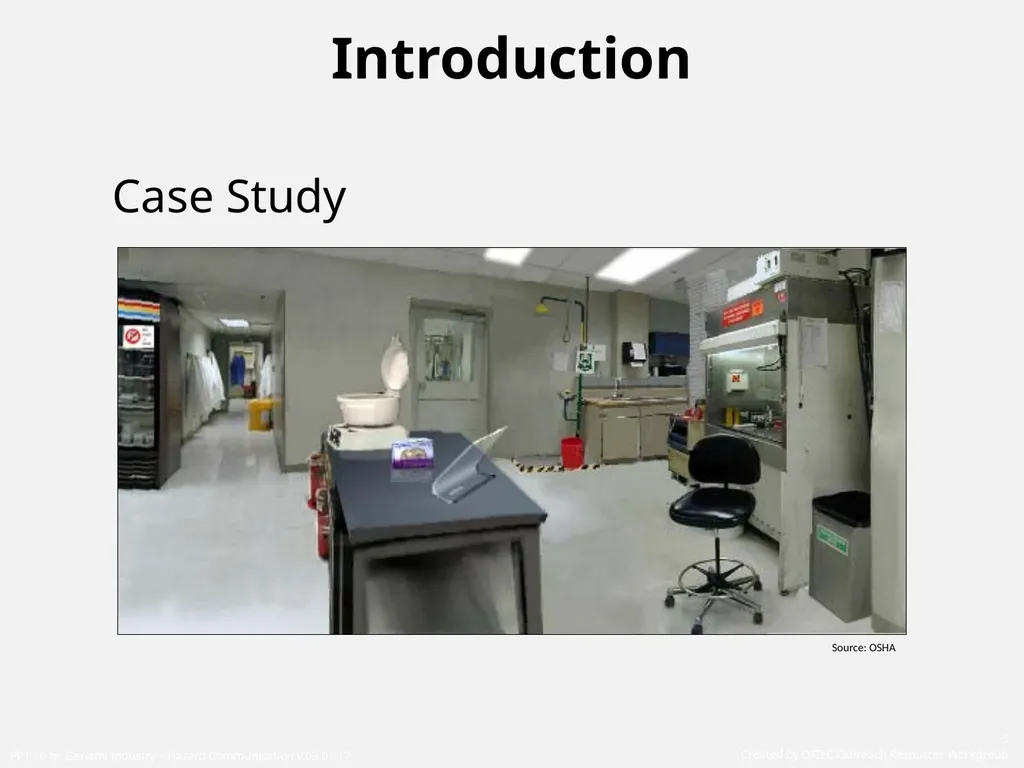
Introduction Case Study Source: OSHA<br>
04
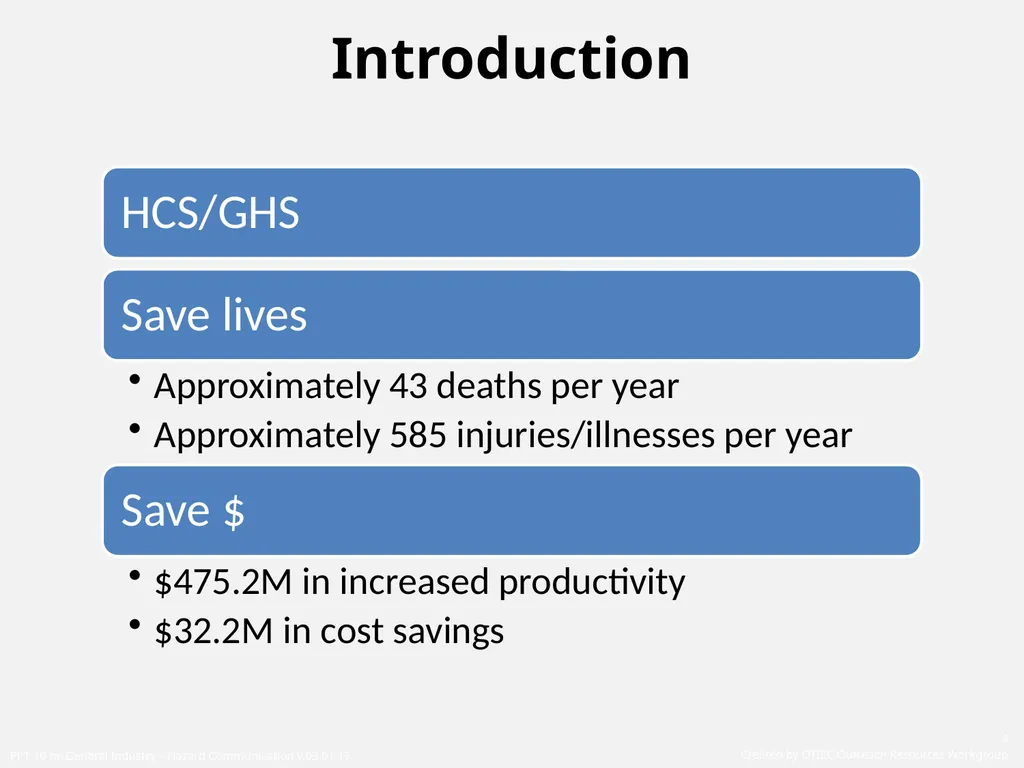
Introduction<br>
05
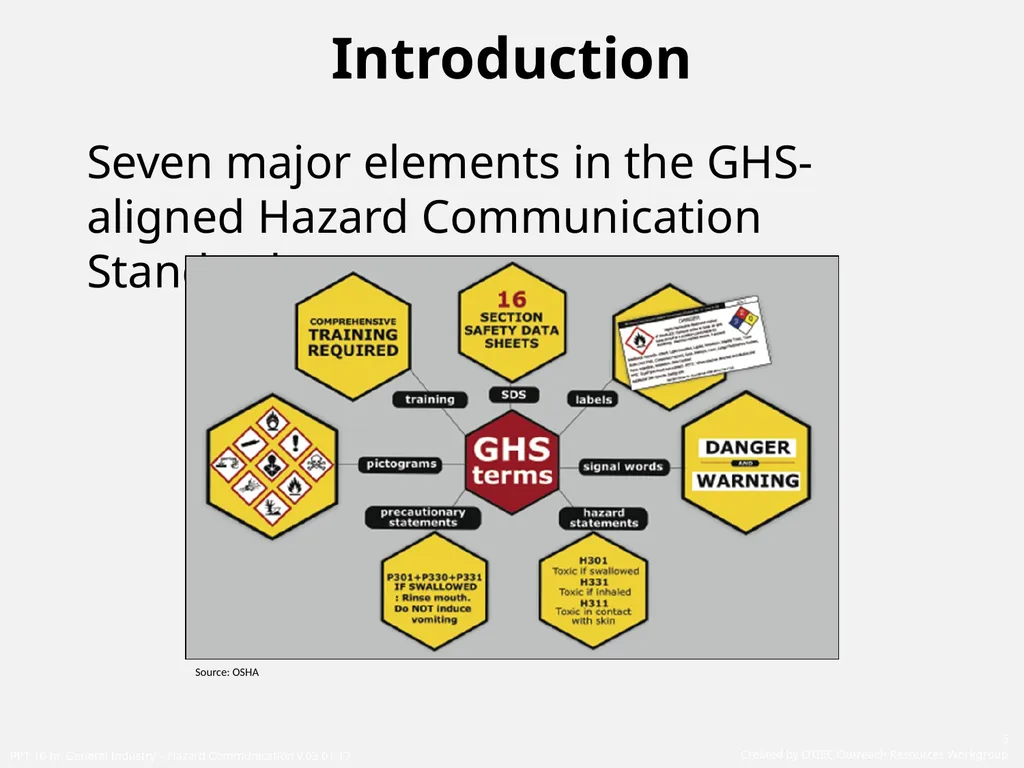
Introduction Seven major elements in the GHS-aligned Hazard Communication Standard Source: OSHA<br>
06
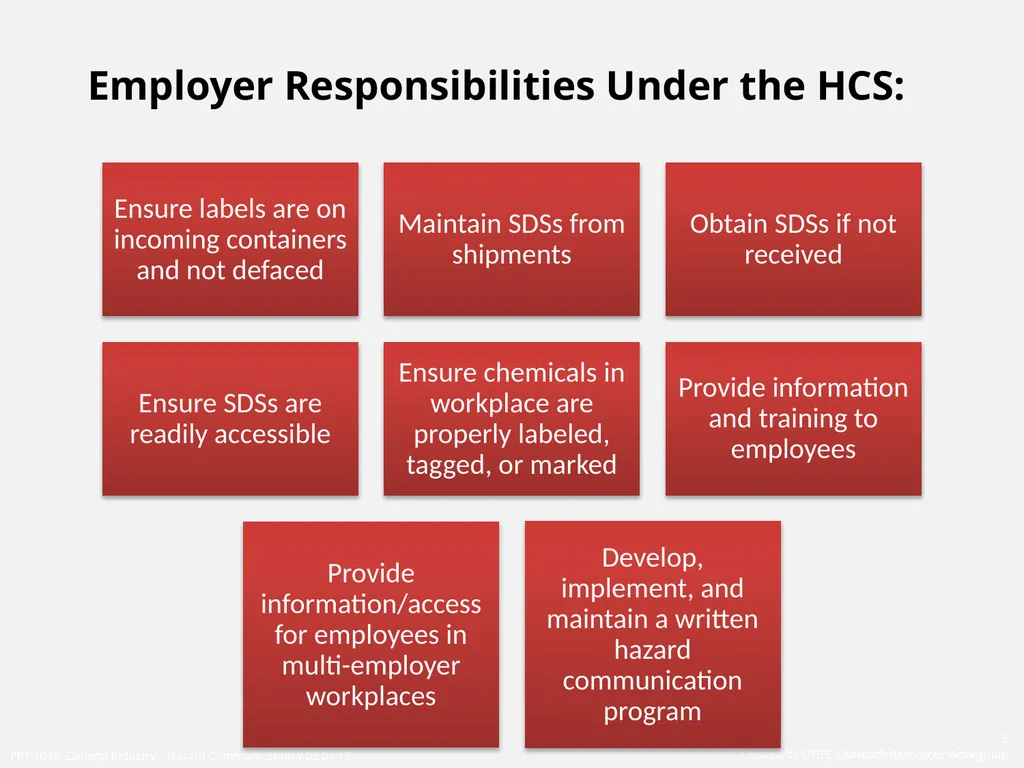
Employer Responsibilities Under the HCS:<br>
07
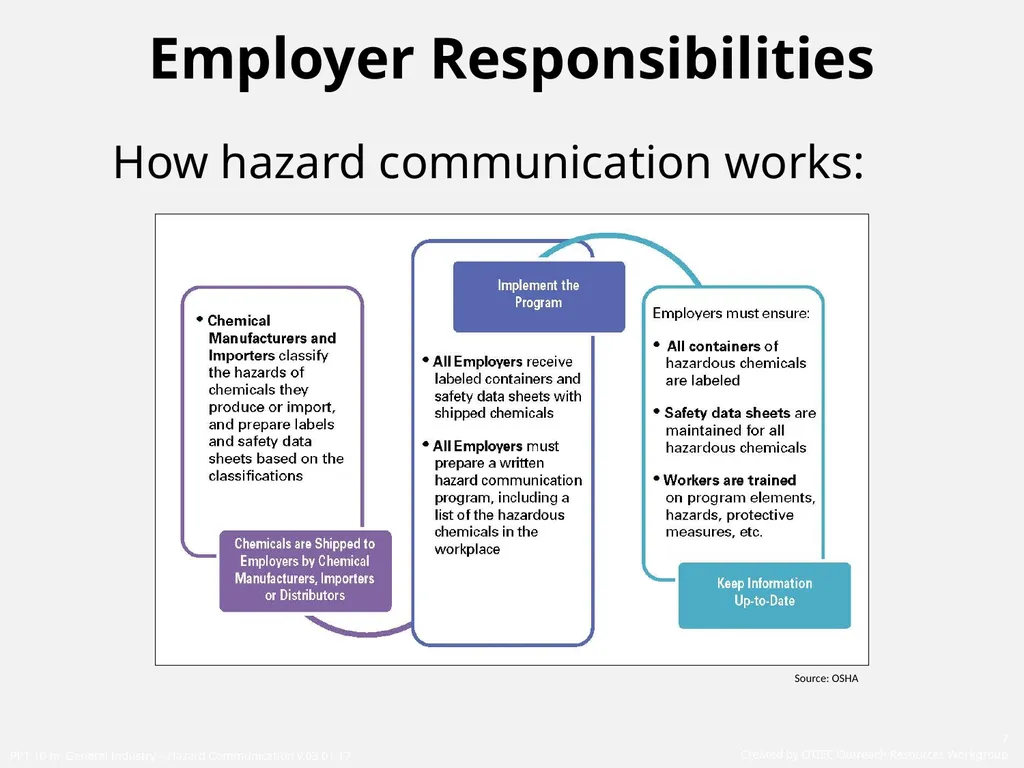
Employer Responsibilities How hazard communication works: Source: OSHA<br>
08
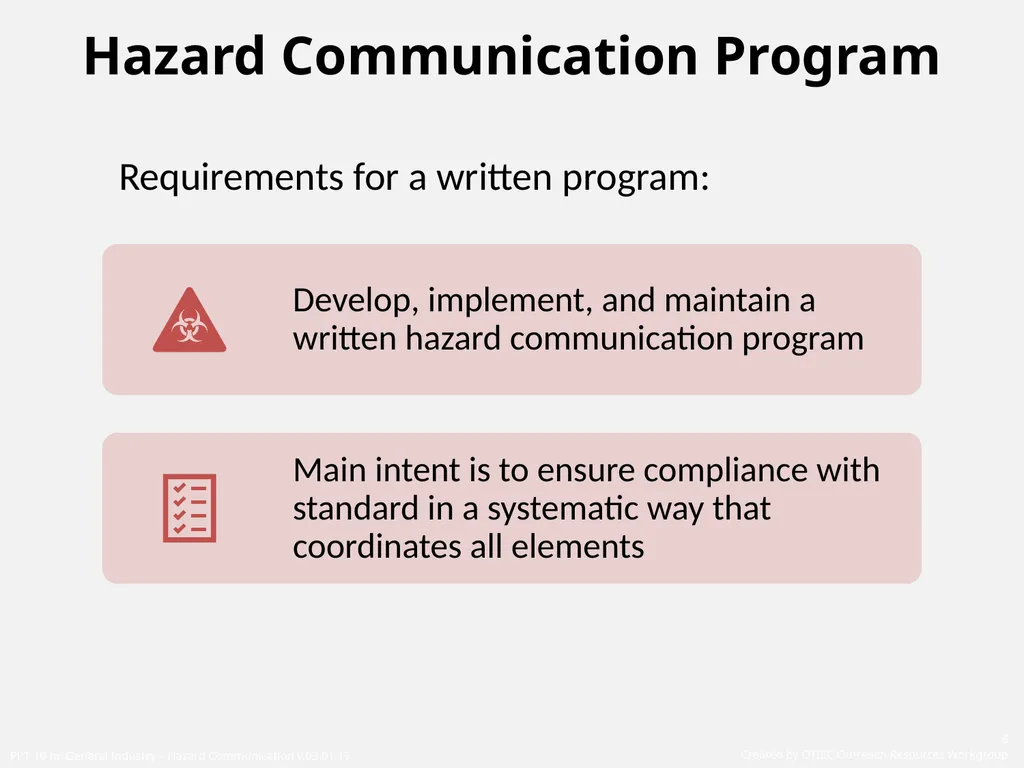
Hazard Communication Program Requirements for a written program:<br>
09
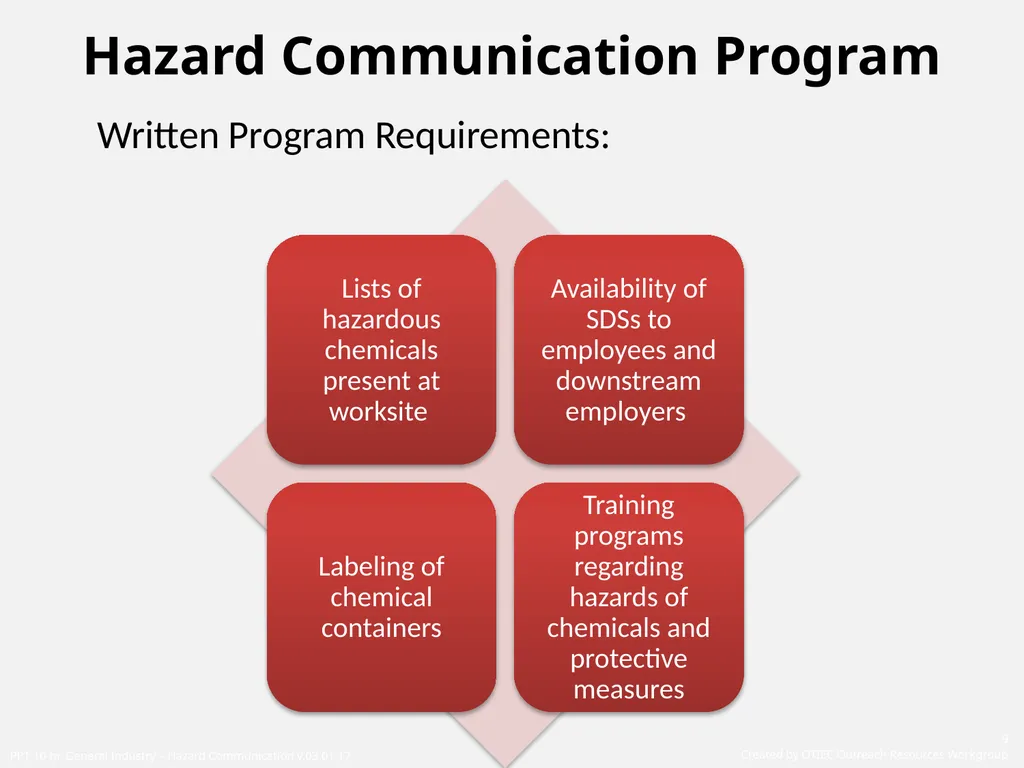
Hazard Communication Program Written Program Requirements:<br>
10
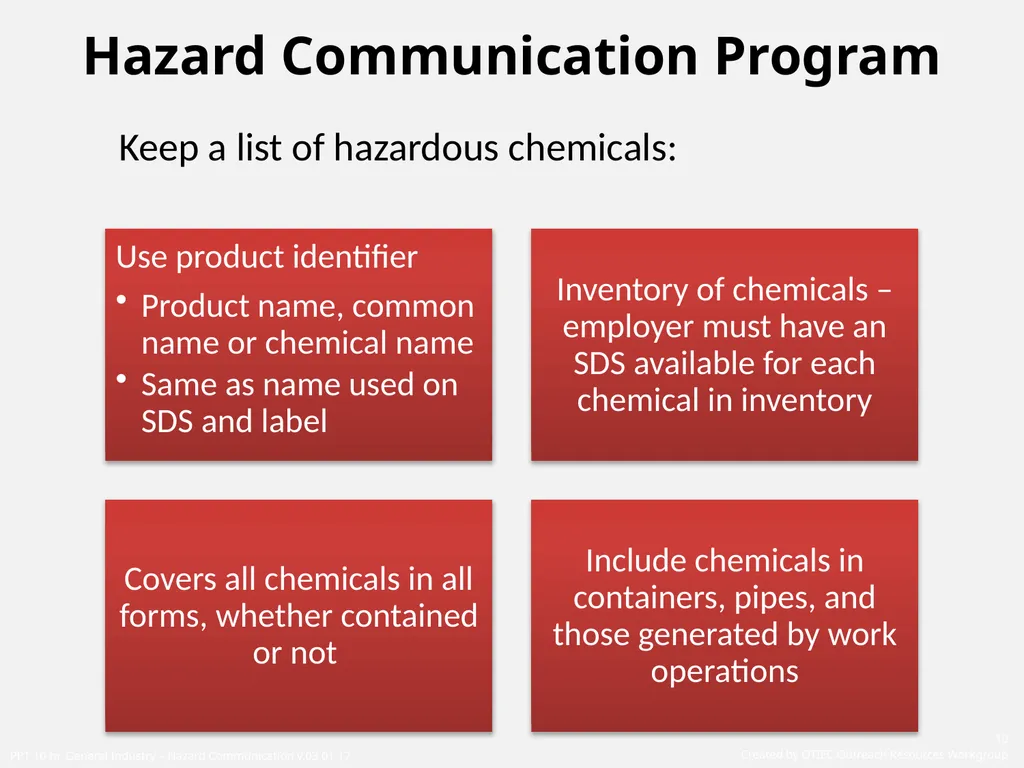
Hazard Communication Program Keep a list of hazardous chemicals:<br>
11
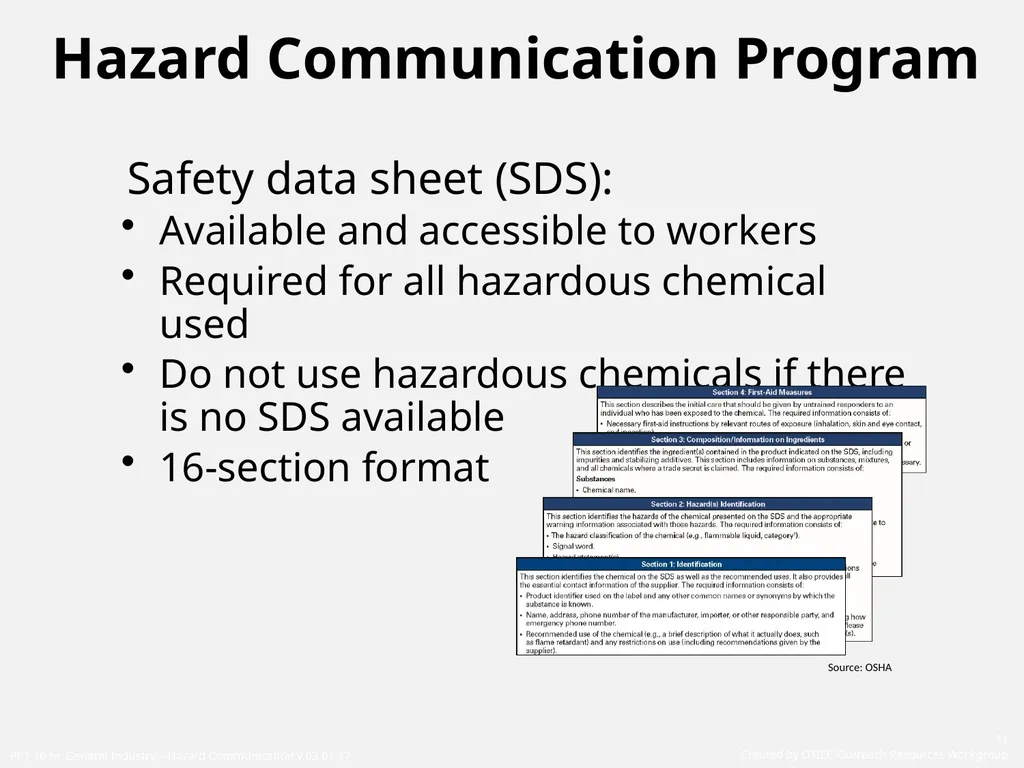
Hazard Communication Program Safety data sheet (SDS):
Available and accessible to workers
Required for all hazardous chemical used
Do not use hazardous chemicals if there is no SDS available
16-section format Source: OSHA<br>
Available and accessible to workers
Required for all hazardous chemical used
Do not use hazardous chemicals if there is no SDS available
16-section format Source: OSHA<br>
12
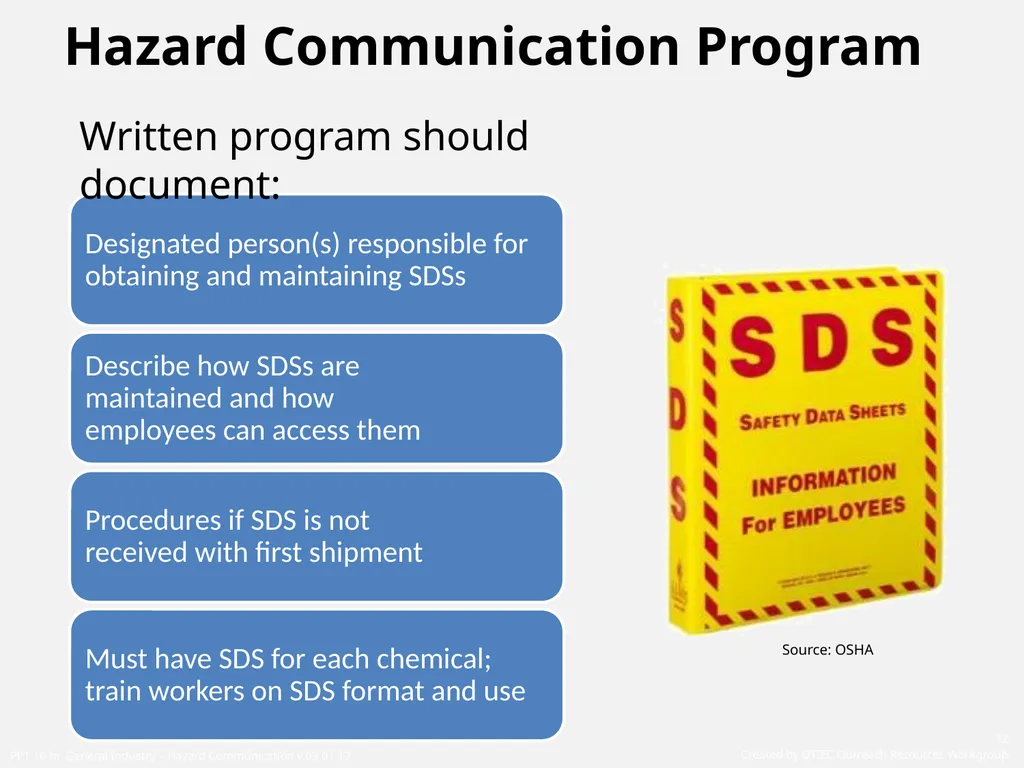
Hazard Communication Program Source: OSHA Written program should document:<br>
13
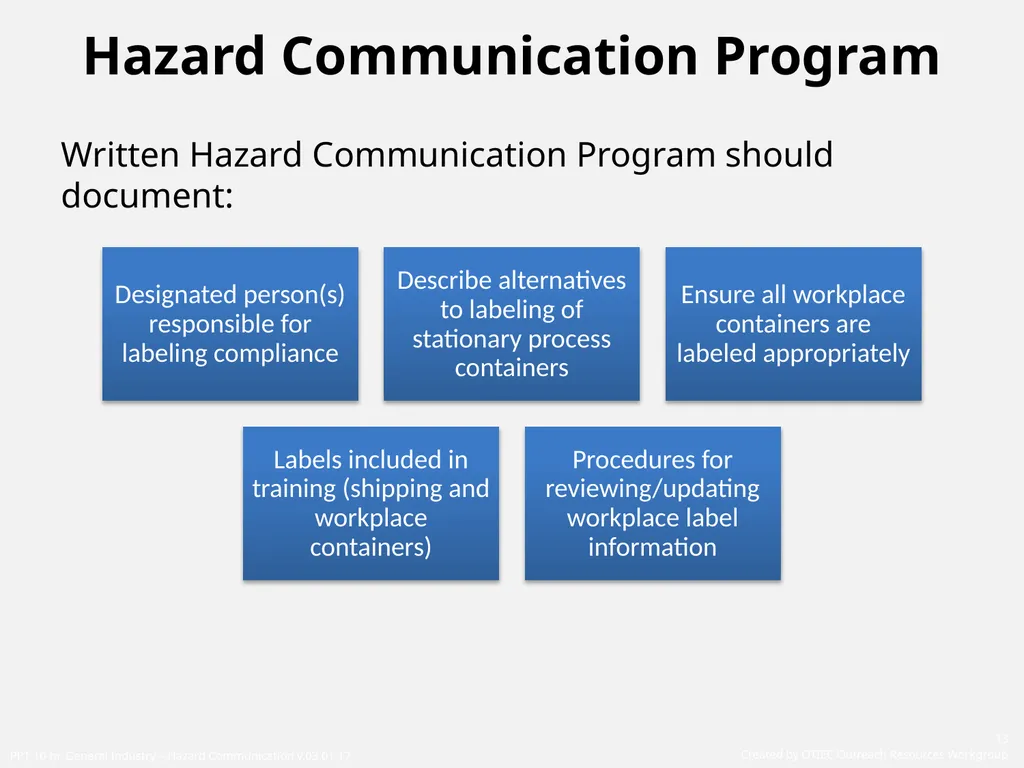
Hazard Communication Program Written Hazard Communication Program should document:<br>
14
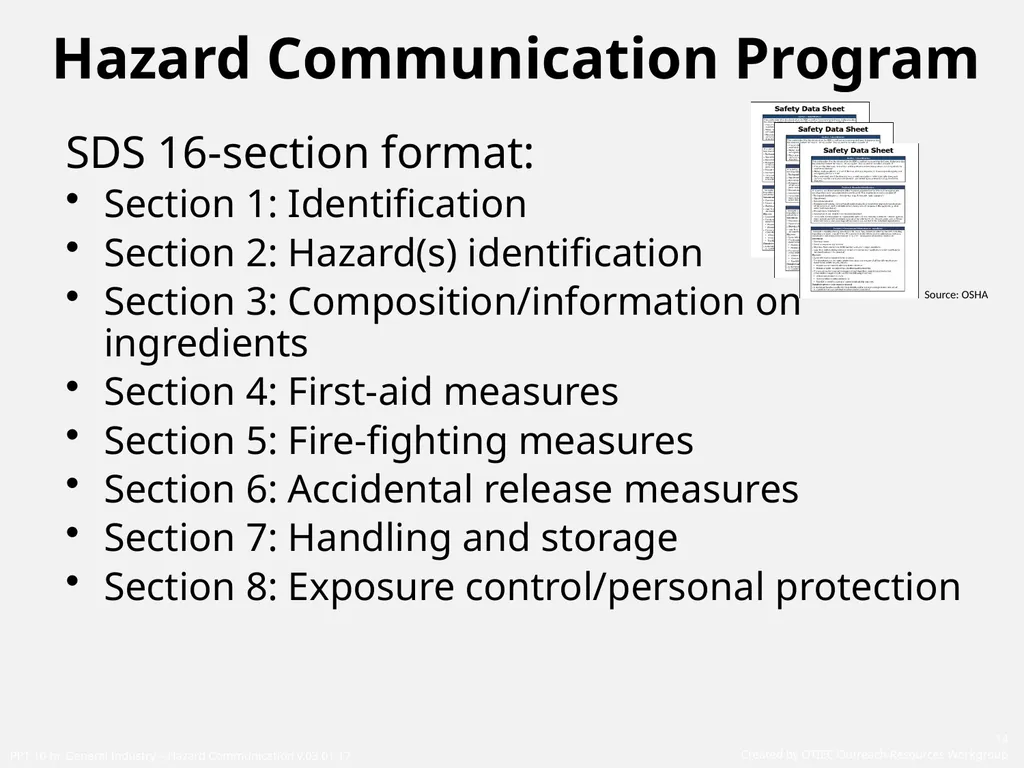
SDS 16-section format:
Section 1: Identification
Section 2: Hazard(s) identification
Section 3: Composition/information on ingredients
Section 4: First-aid measures
Section 5: Fire-fighting measures
Section 6: Accidental release measures
Section 7: Handling and storage
Section 8: Exposure control/personal protection Hazard Communication Program Source: OSHA<br>
Section 1: Identification
Section 2: Hazard(s) identification
Section 3: Composition/information on ingredients
Section 4: First-aid measures
Section 5: Fire-fighting measures
Section 6: Accidental release measures
Section 7: Handling and storage
Section 8: Exposure control/personal protection Hazard Communication Program Source: OSHA<br>
15
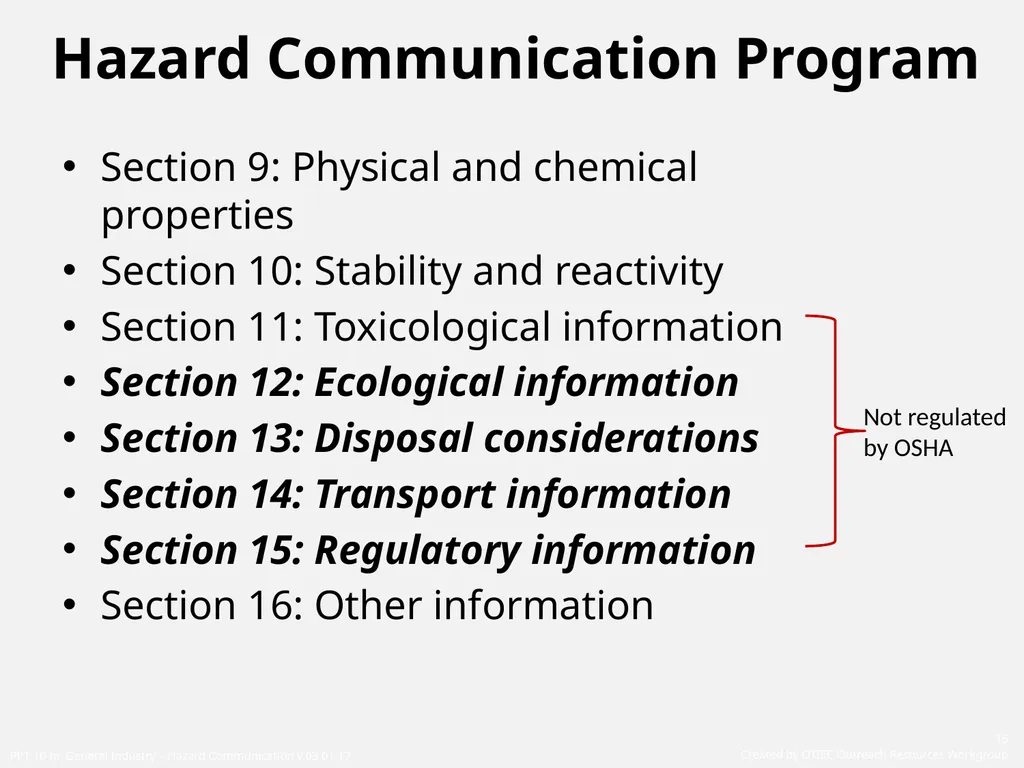
Section 9: Physical and chemical properties
Section 10: Stability and reactivity
Section 11: Toxicological information
Section 12: Ecological information
Section 13: Disposal considerations
Section 14: Transport information
Section 15: Regulatory information
Section 16: Other information Not regulated by OSHA Hazard Communication Program<br>
Section 10: Stability and reactivity
Section 11: Toxicological information
Section 12: Ecological information
Section 13: Disposal considerations
Section 14: Transport information
Section 15: Regulatory information
Section 16: Other information Not regulated by OSHA Hazard Communication Program<br>
16
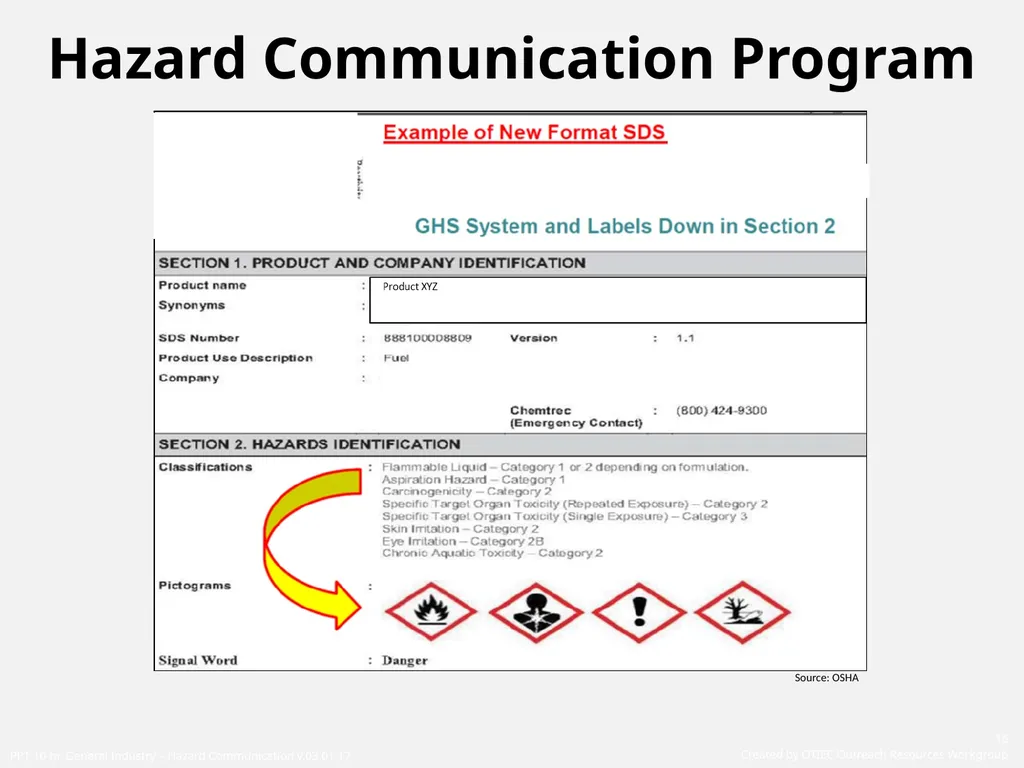
Source: OSHA Hazard Communication Program<br>
17
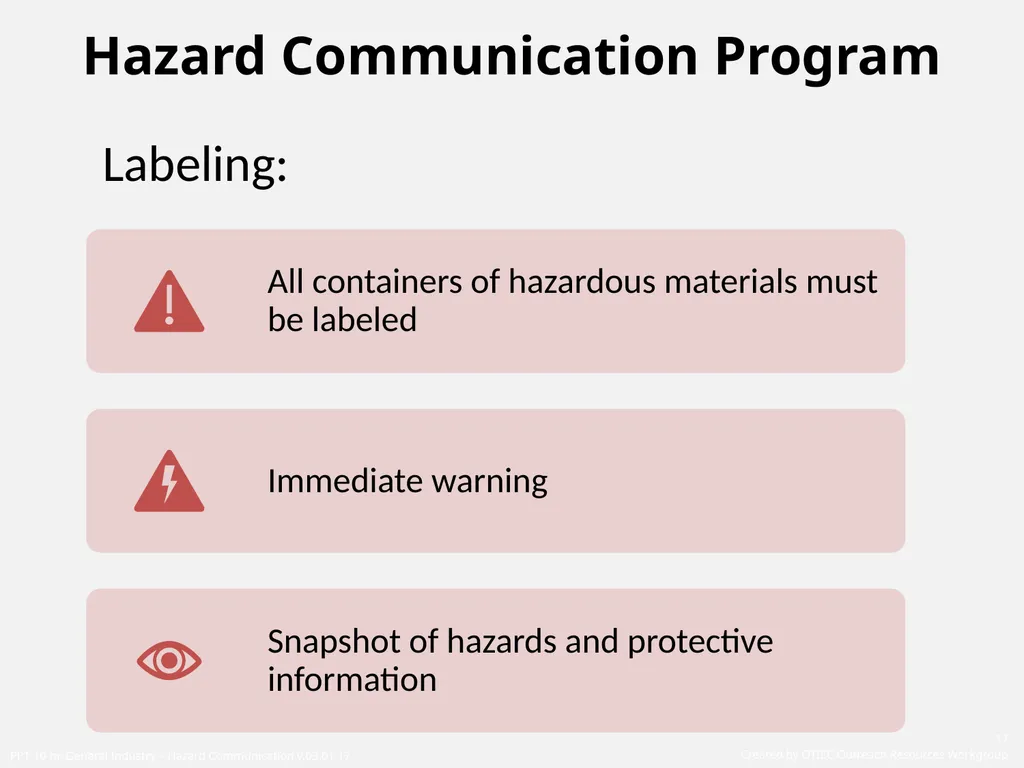
Hazard Communication Program Labeling:<br>
18
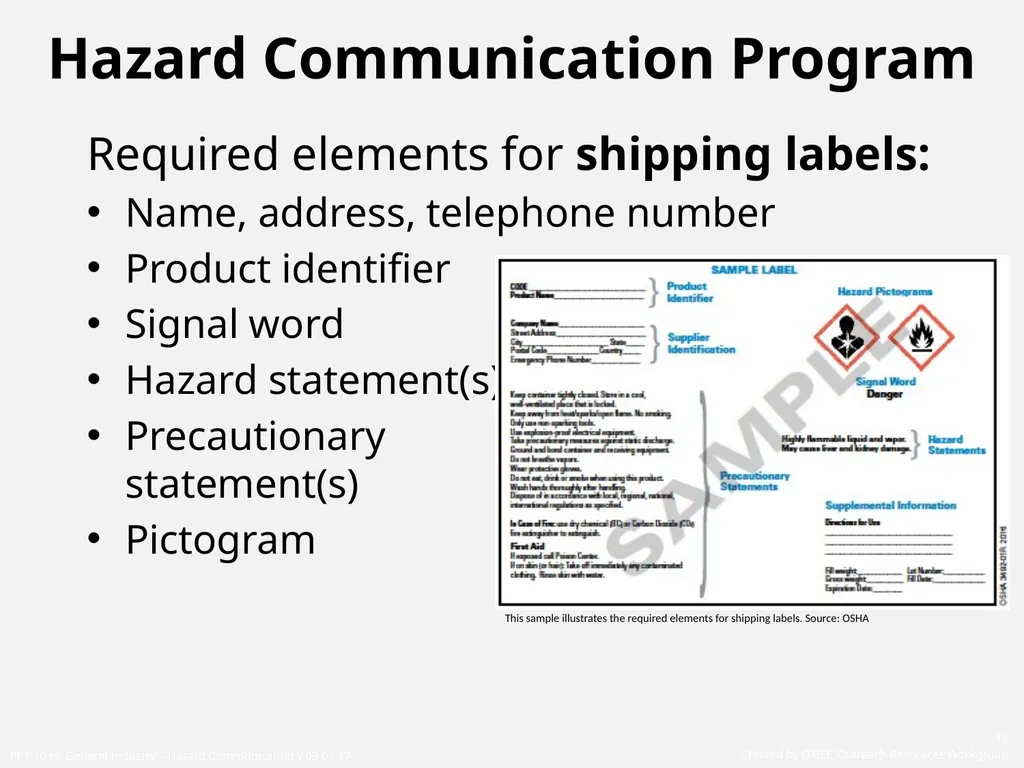
Hazard Communication Program Required elements for shipping labels:
Name, address, telephone number
Product identifier
Signal word
Hazard statement(s)
Precautionary statement(s)
Pictogram This sample illustrates the required elements for shipping labels. Source: OSHA<br>
Name, address, telephone number
Product identifier
Signal word
Hazard statement(s)
Precautionary statement(s)
Pictogram This sample illustrates the required elements for shipping labels. Source: OSHA<br>
19
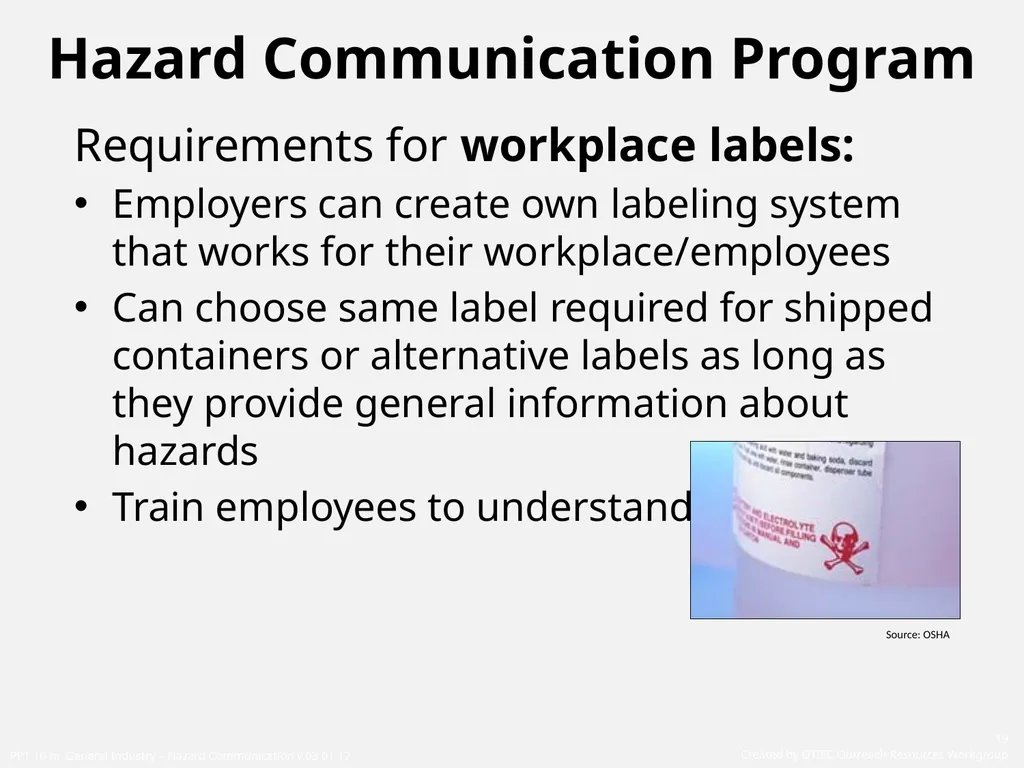
Hazard Communication Program Requirements for workplace labels:
Employers can create own labeling system that works for their workplace/employees
Can choose same label required for shipped containers or alternative labels as long as they provide general information about hazards
Train employees to understand Source: OSHA<br>
Employers can create own labeling system that works for their workplace/employees
Can choose same label required for shipped containers or alternative labels as long as they provide general information about hazards
Train employees to understand Source: OSHA<br>
20
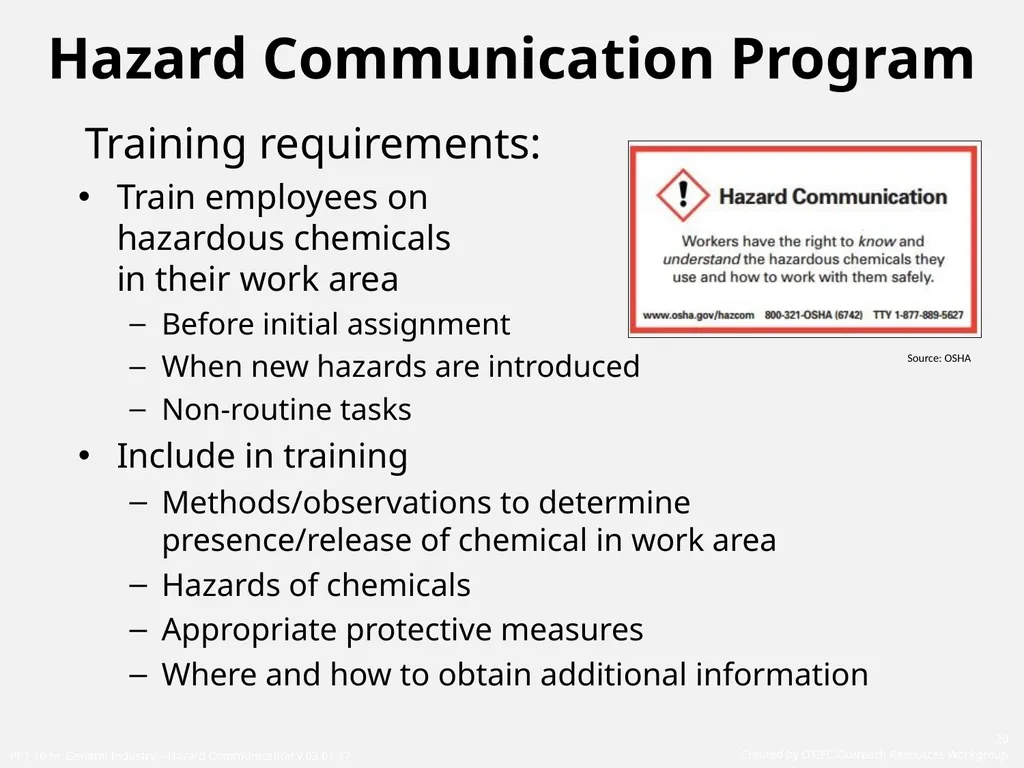
Training requirements:
Train employees on hazardous chemicals in their work area
Before initial assignment
When new hazards are introduced
Non-routine tasks
Include in training
Methods/observations to determine presence/release of chemical in work area
Hazards of chemicals
Appropriate protective measures
Where and how to obtain additional information Source: OSHA Hazard Communication Program<br>
Train employees on hazardous chemicals in their work area
Before initial assignment
When new hazards are introduced
Non-routine tasks
Include in training
Methods/observations to determine presence/release of chemical in work area
Hazards of chemicals
Appropriate protective measures
Where and how to obtain additional information Source: OSHA Hazard Communication Program<br>
21
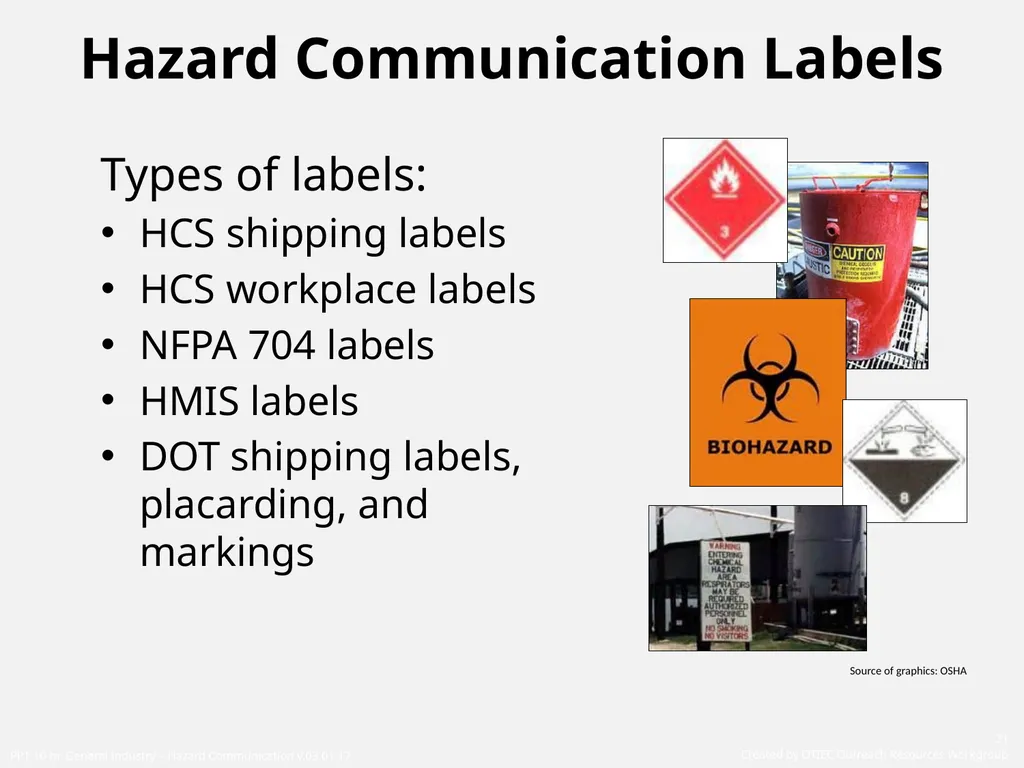
Types of labels:
HCS shipping labels
HCS workplace labels
NFPA 704 labels
HMIS labels
DOT shipping labels, placarding, and markings Hazard Communication Labels Source of graphics: OSHA<br>
HCS shipping labels
HCS workplace labels
NFPA 704 labels
HMIS labels
DOT shipping labels, placarding, and markings Hazard Communication Labels Source of graphics: OSHA<br>
22
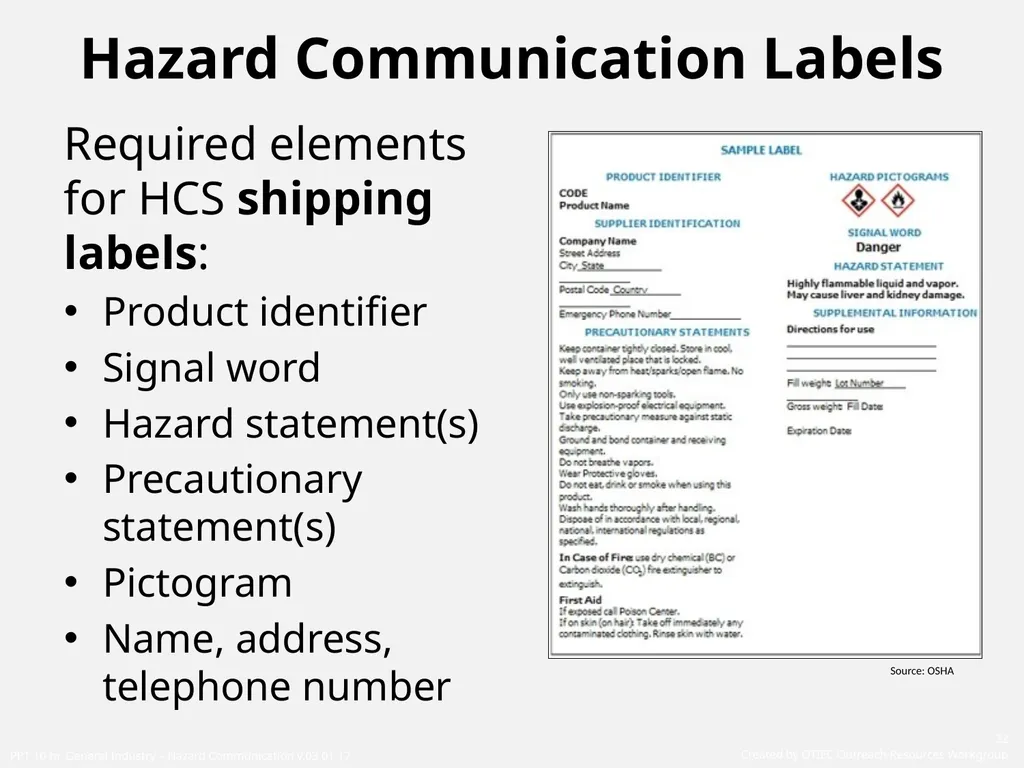
Hazard Communication Labels Required elements for HCS shipping labels:
Product identifier
Signal word
Hazard statement(s)
Precautionary statement(s)
Pictogram
Name, address, telephone number Source: OSHA<br>
Product identifier
Signal word
Hazard statement(s)
Precautionary statement(s)
Pictogram
Name, address, telephone number Source: OSHA<br>
23
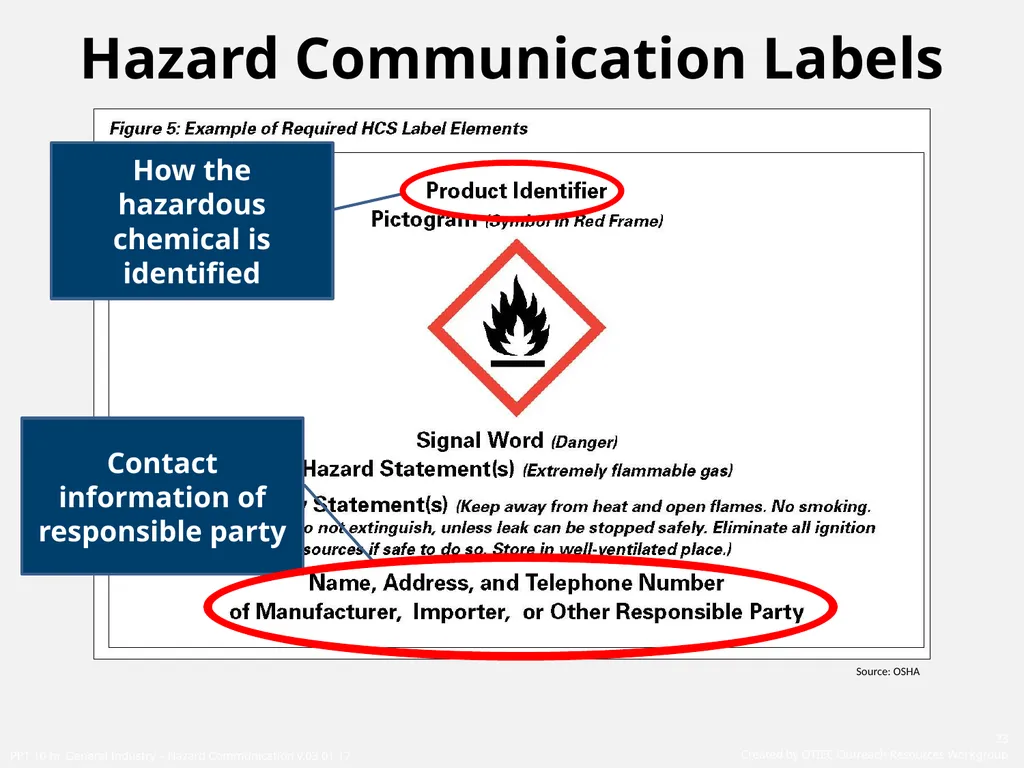
Hazard Communication Labels How the hazardous chemical is identified Contact information of responsible party Source: OSHA<br>
24
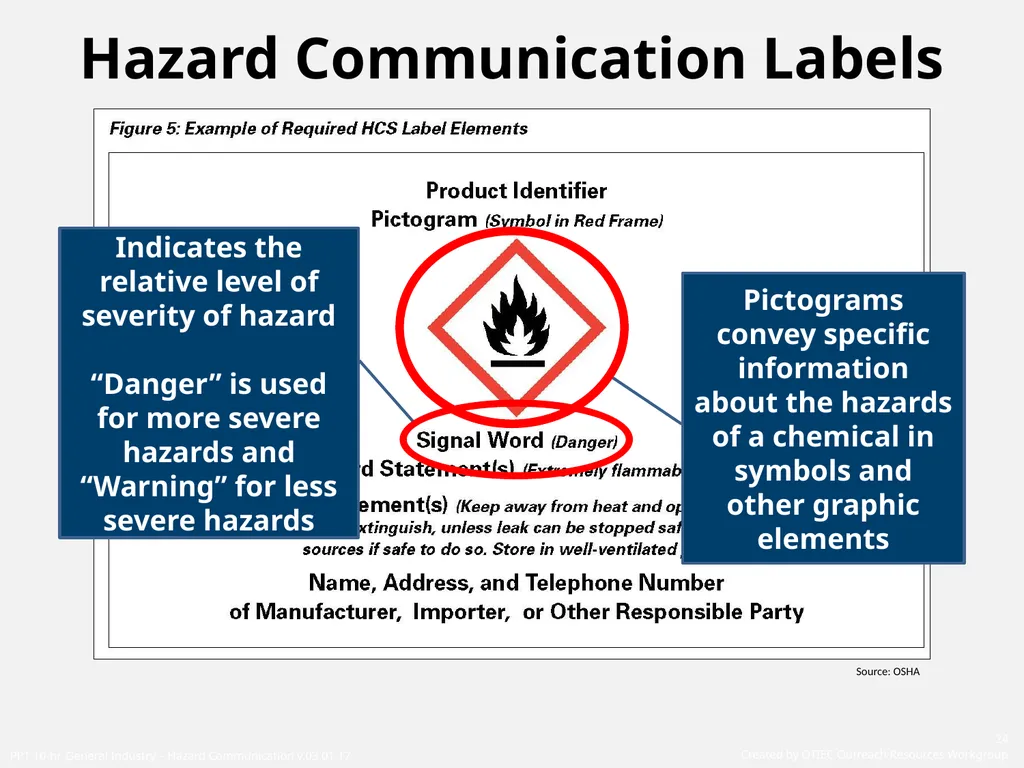
Hazard Communication Labels Indicates the relative level of severity of hazard
“Danger” is used for more severe hazards and “Warning” for less severe hazards Pictograms convey specific information about the hazards of a chemical in symbols and other graphic elements Source: OSHA<br>
“Danger” is used for more severe hazards and “Warning” for less severe hazards Pictograms convey specific information about the hazards of a chemical in symbols and other graphic elements Source: OSHA<br>
25
Hazard Communication Labels Source: OSHA<br>
26
Hazard Communication Labels Source: OSHA<br>
27
Hazard Communication Labels Source: OSHA<br>
28
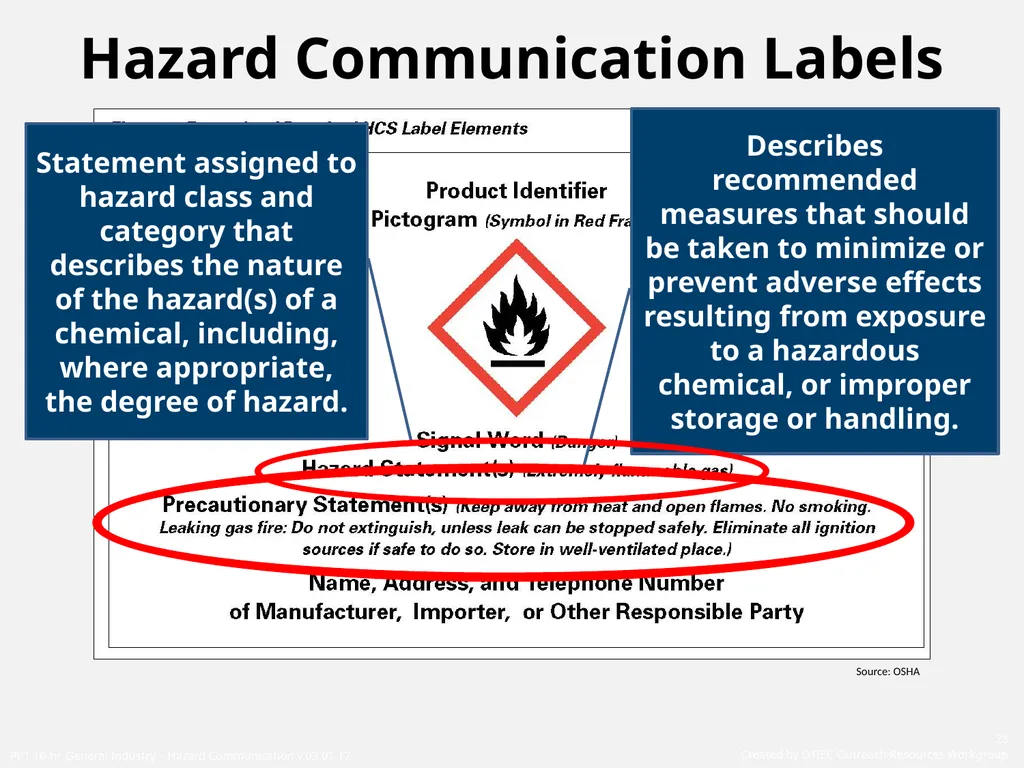
Hazard Communication Labels Statement assigned to hazard class and category that describes the nature of the hazard(s) of a chemical, including, where appropriate, the degree of hazard. Source: OSHA Describes recommended measures that should be taken to minimize or prevent adverse effects resulting from exposure to a hazardous chemical, or improper storage or handling.<br>
29
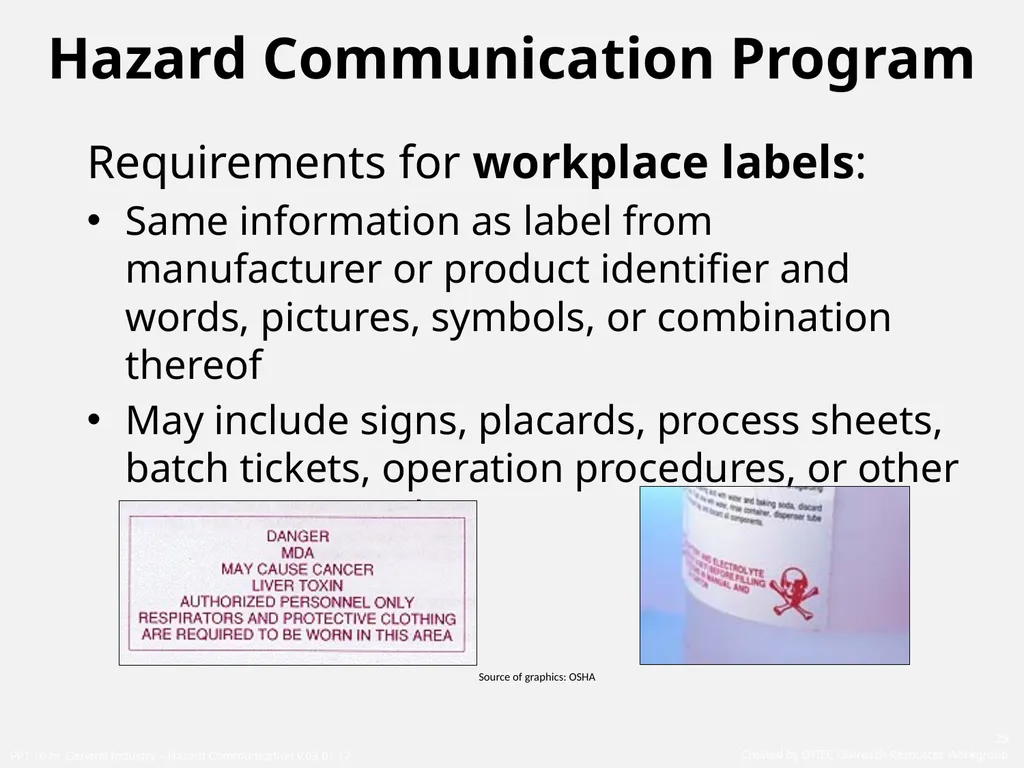
Hazard Communication Program Requirements for workplace labels:
Same information as label from manufacturer or product identifier and words, pictures, symbols, or combination thereof
May include signs, placards, process sheets, batch tickets, operation procedures, or other written materials Source of graphics: OSHA<br>
Same information as label from manufacturer or product identifier and words, pictures, symbols, or combination thereof
May include signs, placards, process sheets, batch tickets, operation procedures, or other written materials Source of graphics: OSHA<br>
30
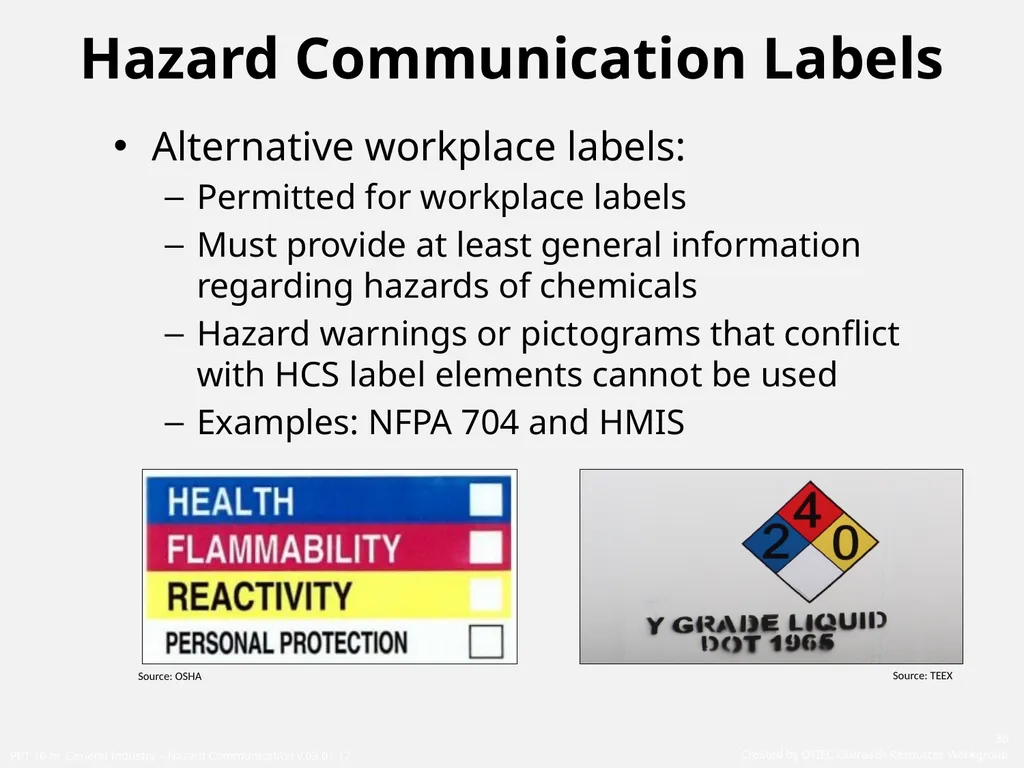
Alternative workplace labels:
Permitted for workplace labels
Must provide at least general information regarding hazards of chemicals
Hazard warnings or pictograms that conflict with HCS label elements cannot be used
Examples: NFPA 704 and HMIS Hazard Communication Labels Source: OSHA Source: TEEX<br>
Permitted for workplace labels
Must provide at least general information regarding hazards of chemicals
Hazard warnings or pictograms that conflict with HCS label elements cannot be used
Examples: NFPA 704 and HMIS Hazard Communication Labels Source: OSHA Source: TEEX<br>
31
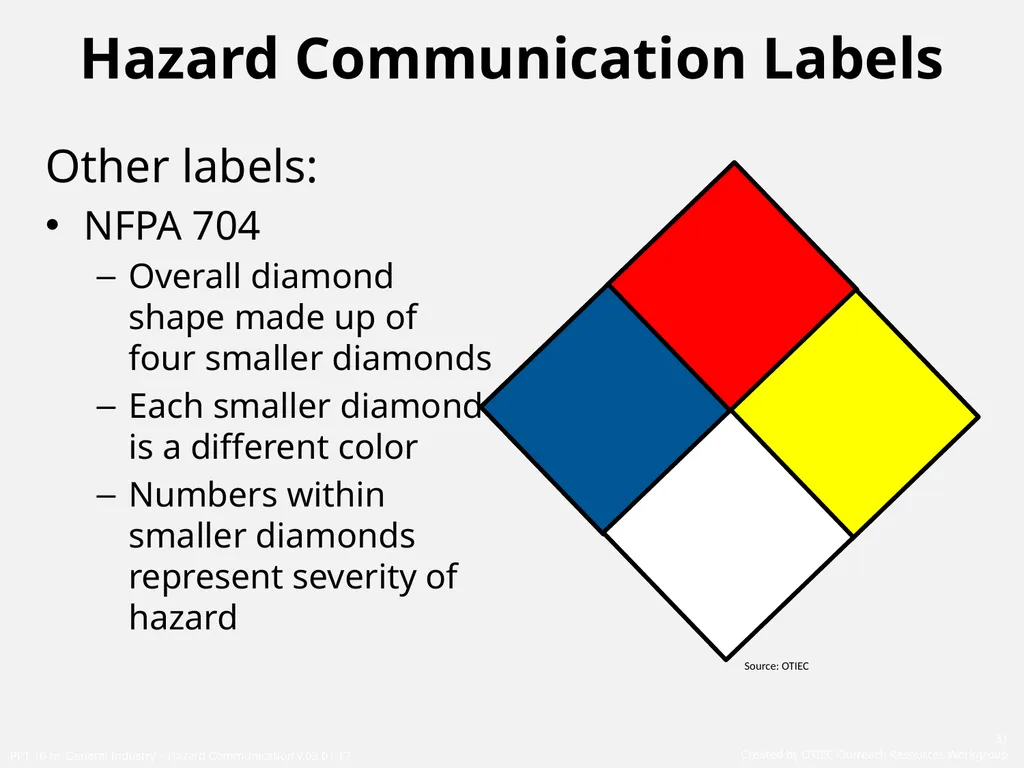
Other labels:
NFPA 704
Overall diamond shape made up of four smaller diamonds
Each smaller diamond is a different color
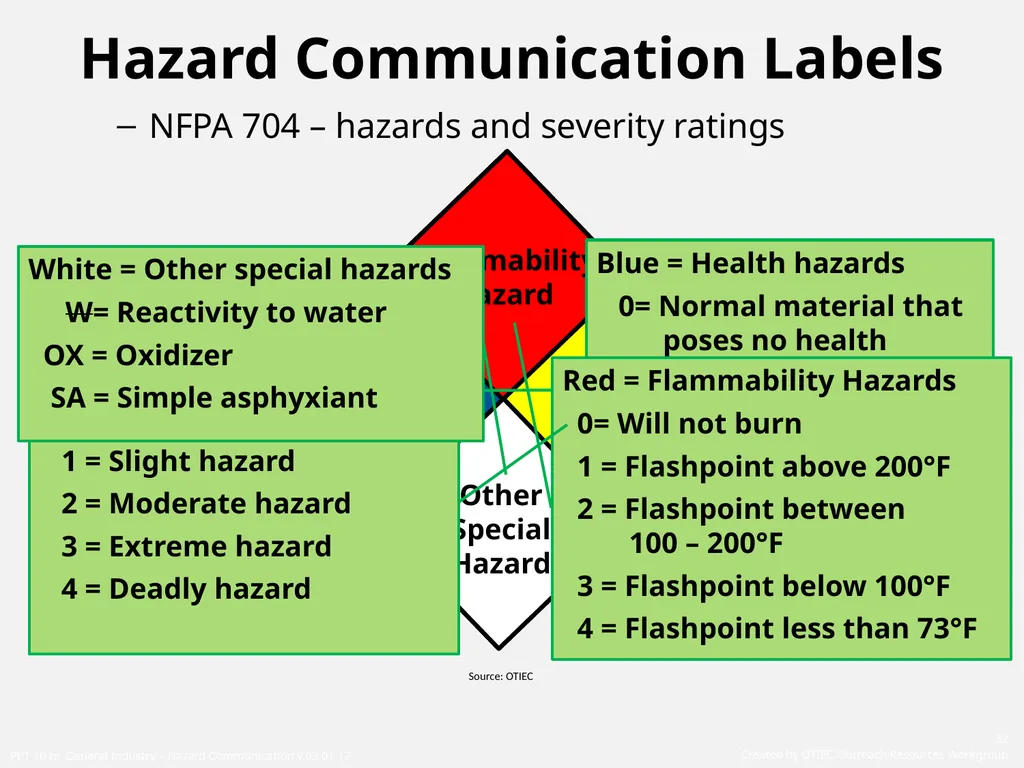
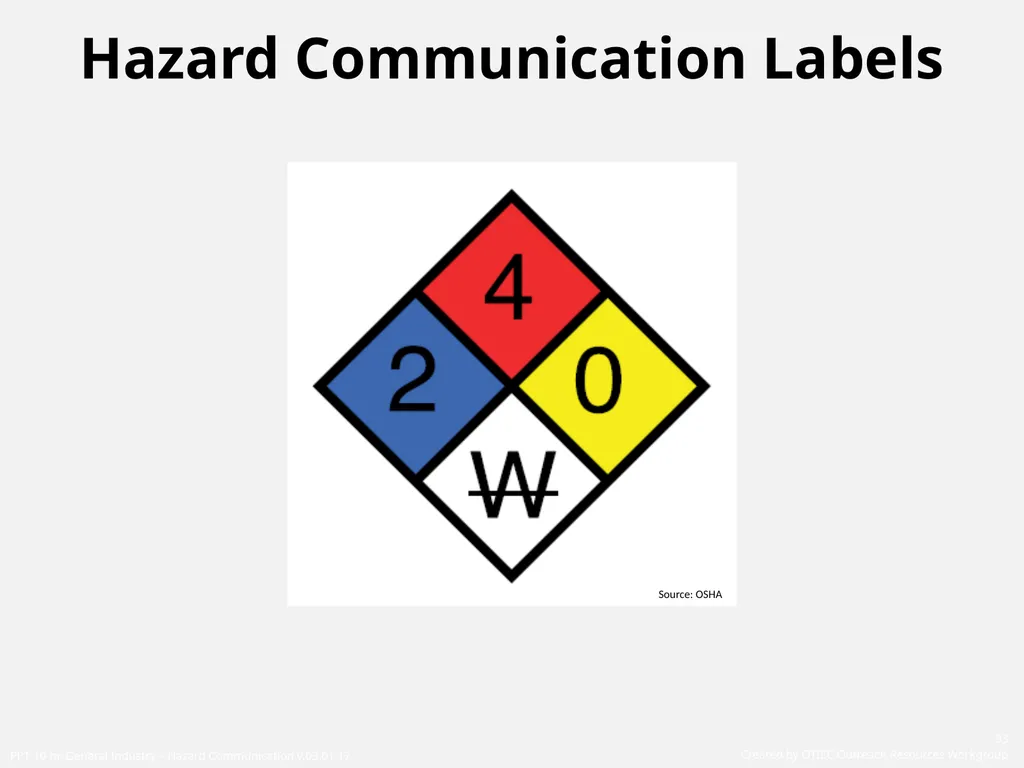
Numbers within smaller diamonds represent severity of hazard Hazard Communication Labels Source: OTIEC<br>
NFPA 704
Overall diamond shape made up of four smaller diamonds
Each smaller diamond is a different color
Numbers within smaller diamonds represent severity of hazard Hazard Communication Labels Source: OTIEC<br>
32
Hazard Communication Labels Blue = Health hazards
0= Normal material that poses no health
1 = slight hazard
2 = moderate hazard
3 = extreme hazard
4 = deadly hazard Red = Flammability Hazards
0= Will not burn
1 = Flashpoint above 200°F
2 = Flashpoint between 100 – 200°F
3 = Flashpoint below 100°F
4 = Flashpoint less than 73°F Yellow = Instability Hazards
0= normally stable
1 = Slight hazard
2 = Moderate hazard
3 = Extreme hazard
4 = Deadly hazard White = Other special hazards
W= Reactivity to water
OX = Oxidizer
SA = Simple asphyxiant NFPA 704 – hazards and severity ratings Source: OTIEC<br>
0= Normal material that poses no health
1 = slight hazard
2 = moderate hazard
3 = extreme hazard
4 = deadly hazard Red = Flammability Hazards
0= Will not burn
1 = Flashpoint above 200°F
2 = Flashpoint between 100 – 200°F
3 = Flashpoint below 100°F
4 = Flashpoint less than 73°F Yellow = Instability Hazards
0= normally stable
1 = Slight hazard
2 = Moderate hazard
3 = Extreme hazard
4 = Deadly hazard White = Other special hazards
W= Reactivity to water
OX = Oxidizer
SA = Simple asphyxiant NFPA 704 – hazards and severity ratings Source: OTIEC<br>
33
Hazard Communication Labels Source: OSHA<br>
34
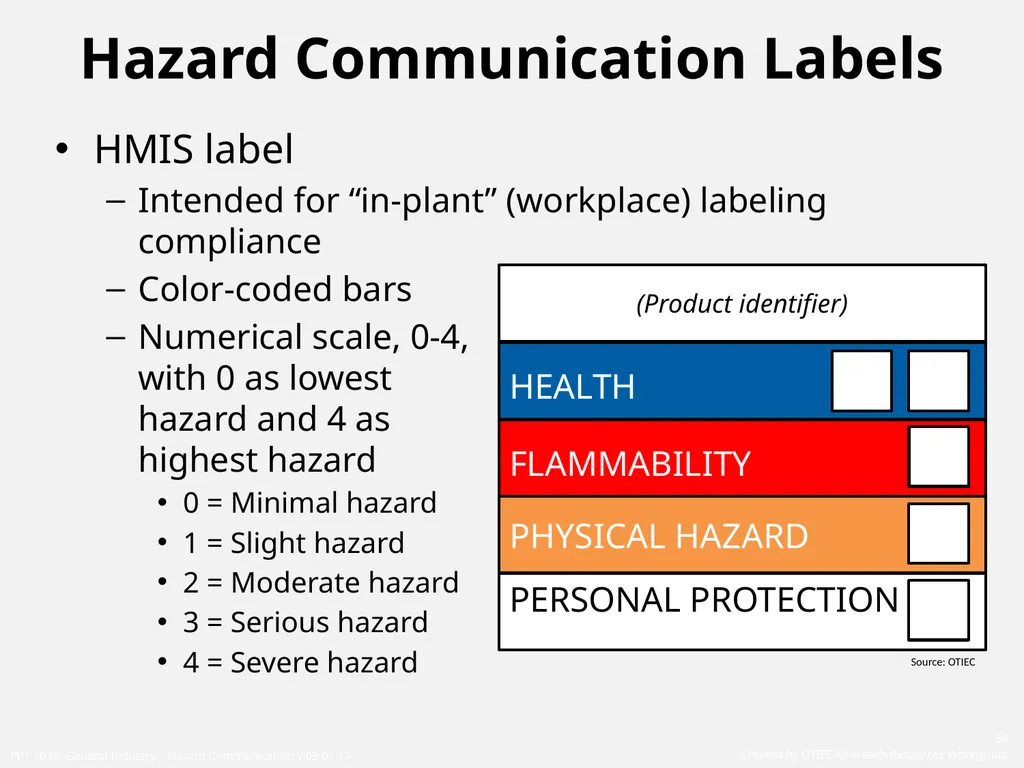
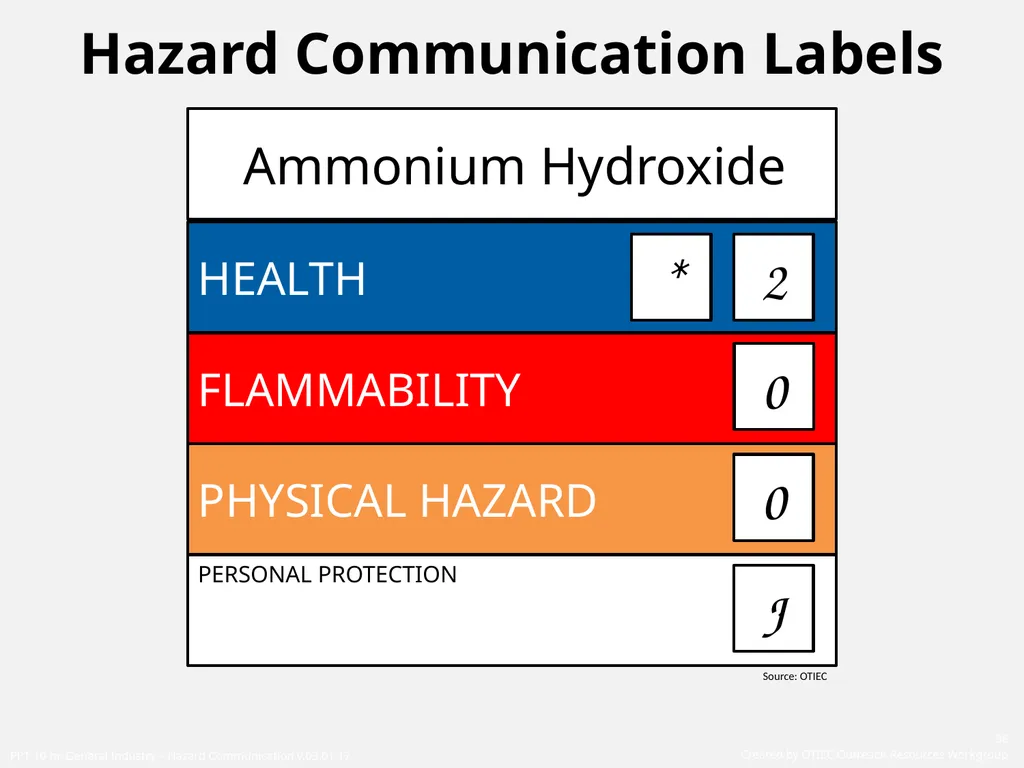
HMIS label
Intended for “in-plant” (workplace) labeling compliance
Color-coded bars
Numerical scale, 0-4, with 0 as lowest hazard and 4 as highest hazard
0 = Minimal hazard
1 = Slight hazard
2 = Moderate hazard
3 = Serious hazard
4 = Severe hazard Source: OTIEC Hazard Communication Labels<br>
Intended for “in-plant” (workplace) labeling compliance
Color-coded bars
Numerical scale, 0-4, with 0 as lowest hazard and 4 as highest hazard
0 = Minimal hazard
1 = Slight hazard
2 = Moderate hazard
3 = Serious hazard
4 = Severe hazard Source: OTIEC Hazard Communication Labels<br>
35
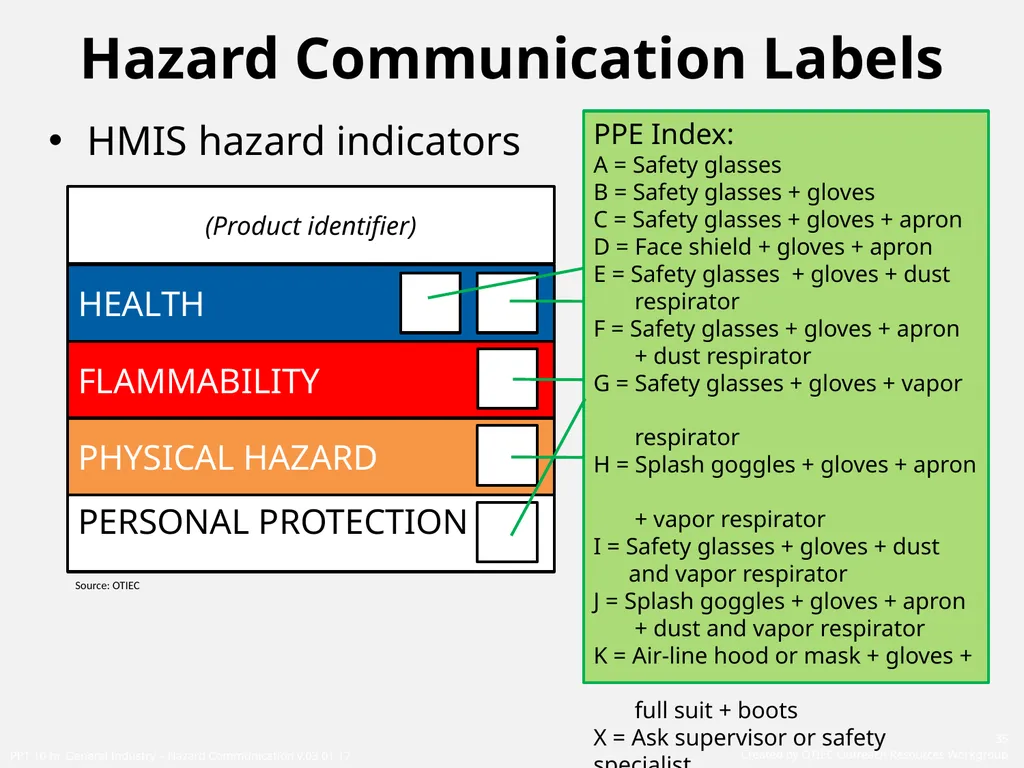
Health ratings:
0 = no significant risk
1 = irritation/minor injury
2 = temporary/minor injury
3 = major injury
4 = life-threatening HMIS hazard indicators Source: OTIEC Hazard Communication Labels Health ratings:
The second space signifies chronic health hazard with an asterisk (*) Flammability ratings:
0 = will not burn
1 = flashpoint >200°F
2 = flashpoint ≥100°F, but <200°F
3 = flashpoint <73°F and boiling point >100°F, or flashpoint between 73°F and 100°F 4 = flashpoint <73°F and boiling point <100°F Physical Hazard ratings:
0 = normally stable
1 = normally stable, but can become unstable
2 = unstable
3 = explosive
4 = readily explosive PPE Index:
A = Safety glasses
B = Safety glasses + gloves
C = Safety glasses + gloves + apron
D = Face shield + gloves + apron
E = Safety glasses + gloves + dust respirator
F = Safety glasses + gloves + apron + dust respirator
G = Safety glasses + gloves + vapor respirator
H = Splash goggles + gloves + apron + vapor respirator
I = Safety glasses + gloves + dust and vapor respirator
J = Splash goggles + gloves + apron + dust and vapor respirator
K = Air-line hood or mask + gloves + full suit + boots
X = Ask supervisor or safety specialist<br>
0 = no significant risk
1 = irritation/minor injury
2 = temporary/minor injury
3 = major injury
4 = life-threatening HMIS hazard indicators Source: OTIEC Hazard Communication Labels Health ratings:
The second space signifies chronic health hazard with an asterisk (*) Flammability ratings:
0 = will not burn
1 = flashpoint >200°F
2 = flashpoint ≥100°F, but <200°F
3 = flashpoint <73°F and boiling point >100°F, or flashpoint between 73°F and 100°F 4 = flashpoint <73°F and boiling point <100°F Physical Hazard ratings:
0 = normally stable
1 = normally stable, but can become unstable
2 = unstable
3 = explosive
4 = readily explosive PPE Index:
A = Safety glasses
B = Safety glasses + gloves
C = Safety glasses + gloves + apron
D = Face shield + gloves + apron
E = Safety glasses + gloves + dust respirator
F = Safety glasses + gloves + apron + dust respirator
G = Safety glasses + gloves + vapor respirator
H = Splash goggles + gloves + apron + vapor respirator
I = Safety glasses + gloves + dust and vapor respirator
J = Splash goggles + gloves + apron + dust and vapor respirator
K = Air-line hood or mask + gloves + full suit + boots
X = Ask supervisor or safety specialist<br>
36
Hazard Communication Labels Source: OTIEC<br>
37
DOT shipping containers – marking, labeling, and placarding
Uses graphic elements on square-on-point placards or labels to identify shipments of hazardous materials
Square-on-points have backgrounds of various colors
Where shipping container is also container used in workplace, workers must be made aware of DOT pictograms
DOT Classification – groups hazardous materials based on dangers posed in transportation; 9 classes Hazard Communication Labels<br>
Uses graphic elements on square-on-point placards or labels to identify shipments of hazardous materials
Square-on-points have backgrounds of various colors
Where shipping container is also container used in workplace, workers must be made aware of DOT pictograms
DOT Classification – groups hazardous materials based on dangers posed in transportation; 9 classes Hazard Communication Labels<br>
38
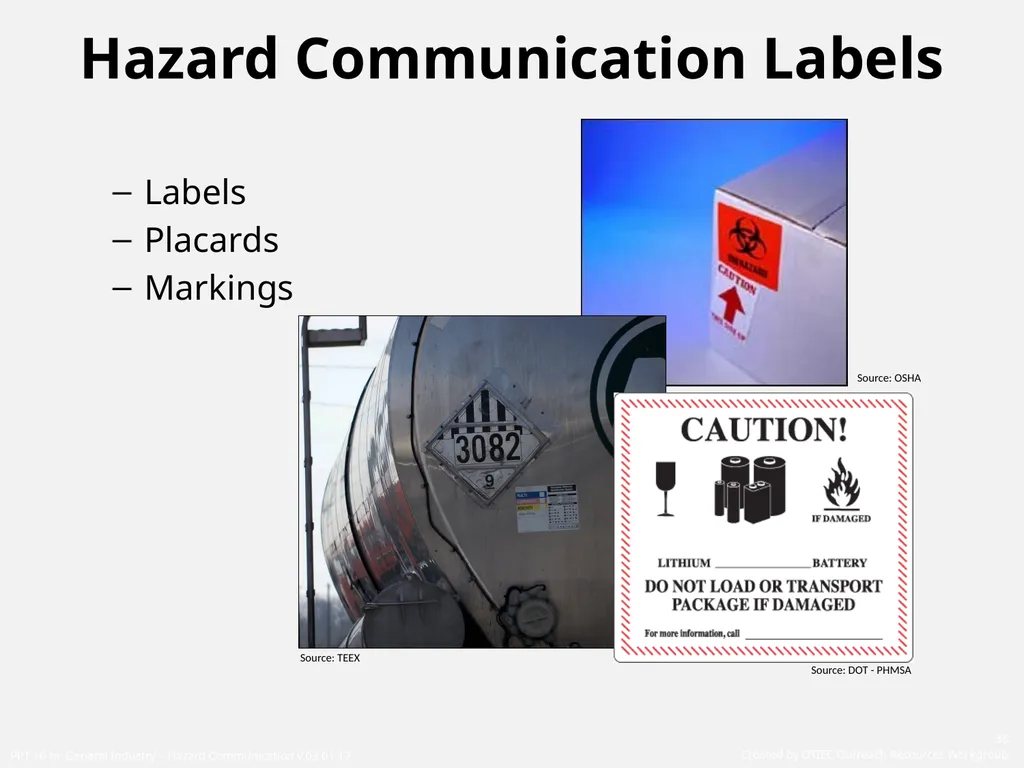
Labels
Placards
Markings Source: OSHA Source: TEEX Source: DOT - PHMSA Hazard Communication Labels<br>
Placards
Markings Source: OSHA Source: TEEX Source: DOT - PHMSA Hazard Communication Labels<br>
39
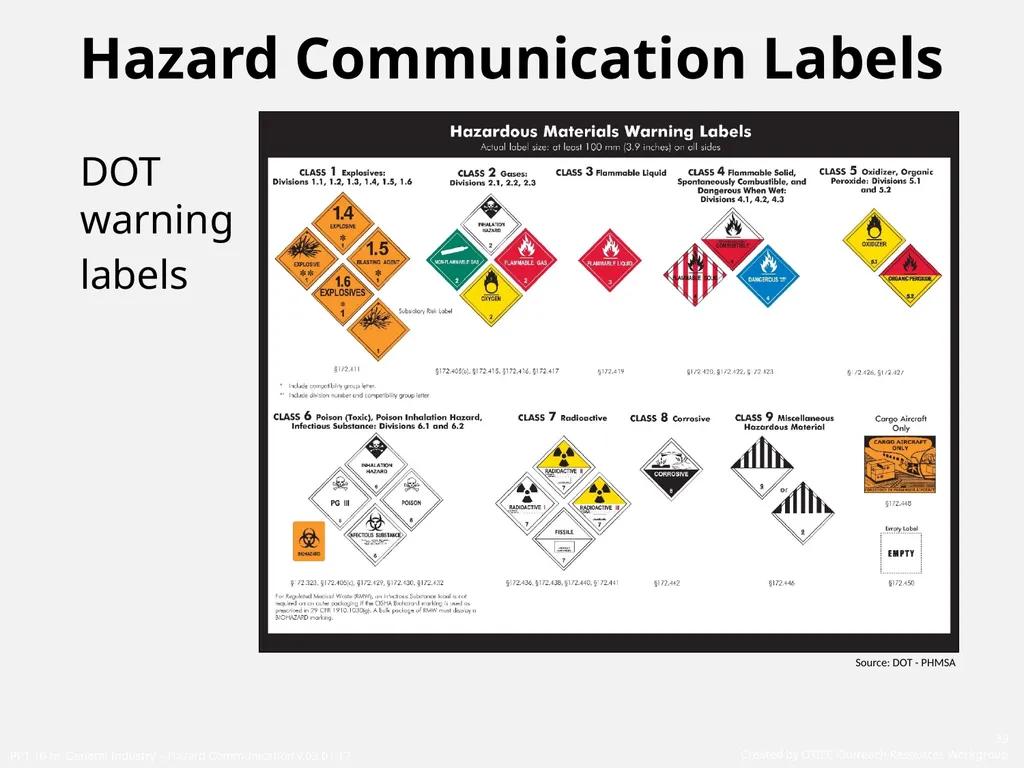
Hazard Communication Labels DOT
warning
labels Source: DOT - PHMSA<br>
labels Source: DOT - PHMSA<br>
40
Hazard Communication Labels DOT
warning
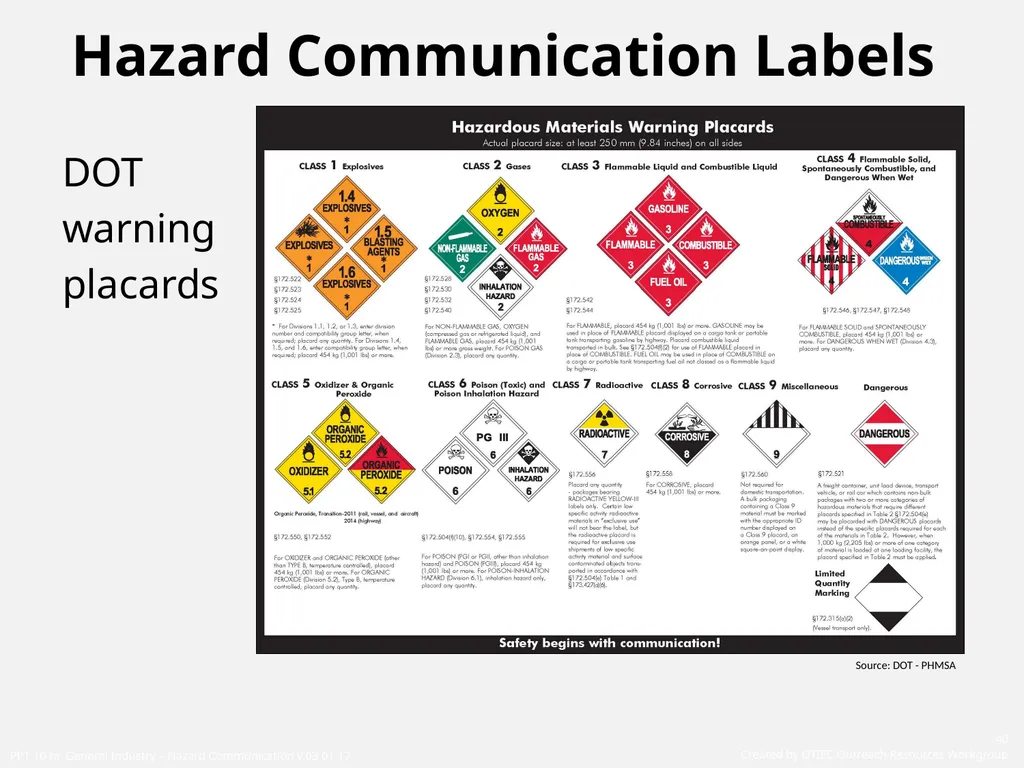
placards Source: DOT - PHMSA<br>
warning
placards Source: DOT - PHMSA<br>
41
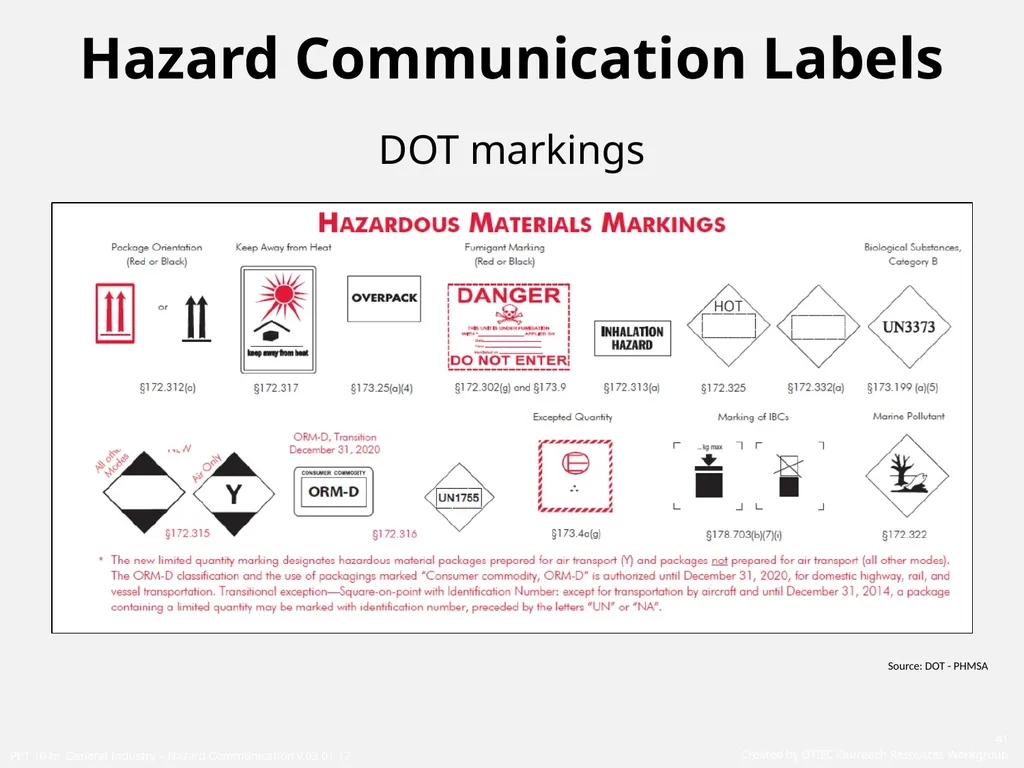
Hazard Communication Labels DOT markings Source: DOT - PHMSA<br>
42
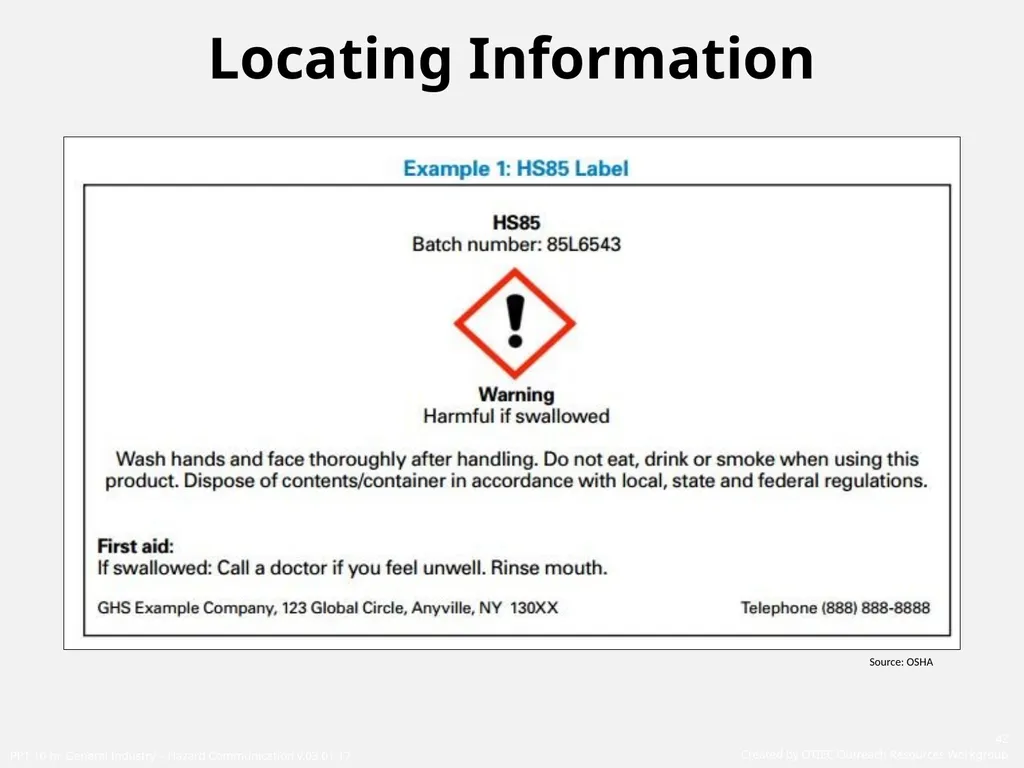
Locating Information Source: OSHA<br>
43
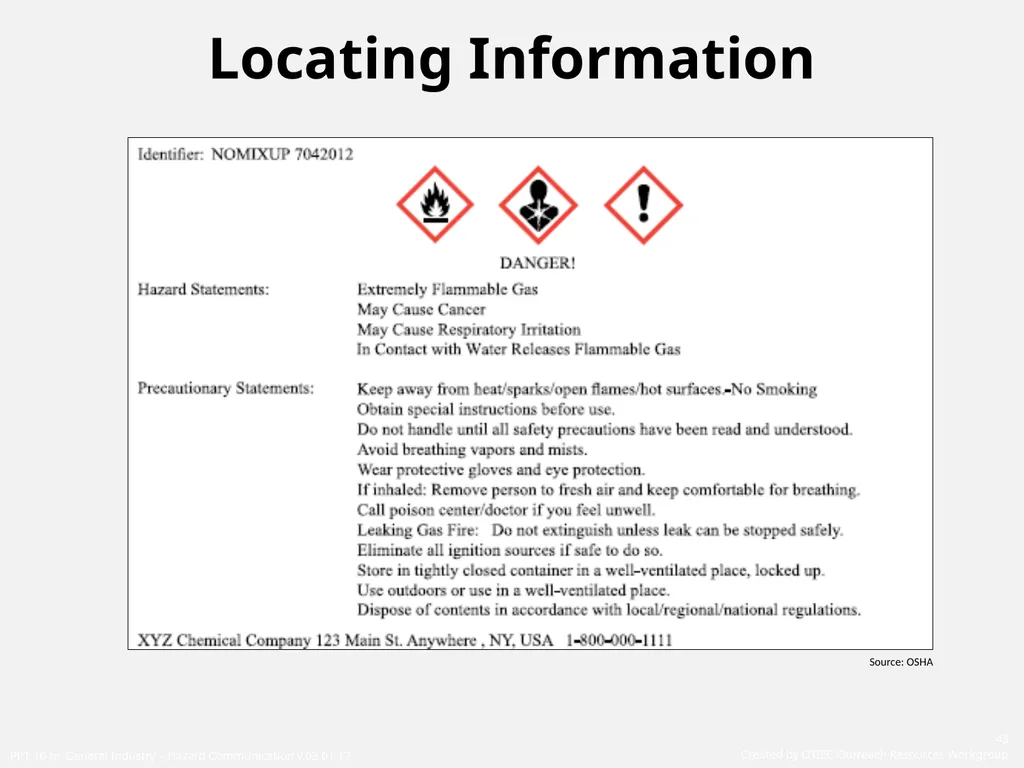
Locating Information Source: OSHA<br>
44
Locating Information Source: OSHA<br>
45
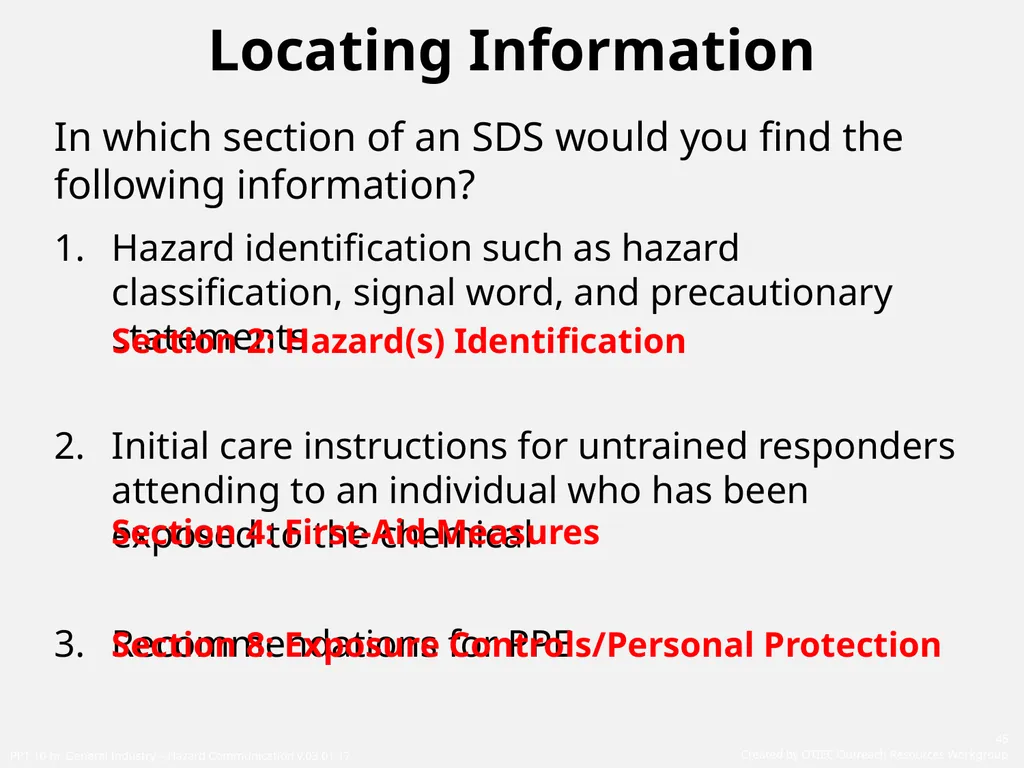
Locating Information In which section of an SDS would you find the following information?
Hazard identification such as hazard classification, signal word, and precautionary statements
Initial care instructions for untrained responders attending to an individual who has been exposed to the chemical
Recommendations for PPE Section 2: Hazard(s) Identification Section 4: First-Aid Measures Section 8: Exposure Controls/Personal Protection<br>
Hazard identification such as hazard classification, signal word, and precautionary statements
Initial care instructions for untrained responders attending to an individual who has been exposed to the chemical
Recommendations for PPE Section 2: Hazard(s) Identification Section 4: First-Aid Measures Section 8: Exposure Controls/Personal Protection<br>
46
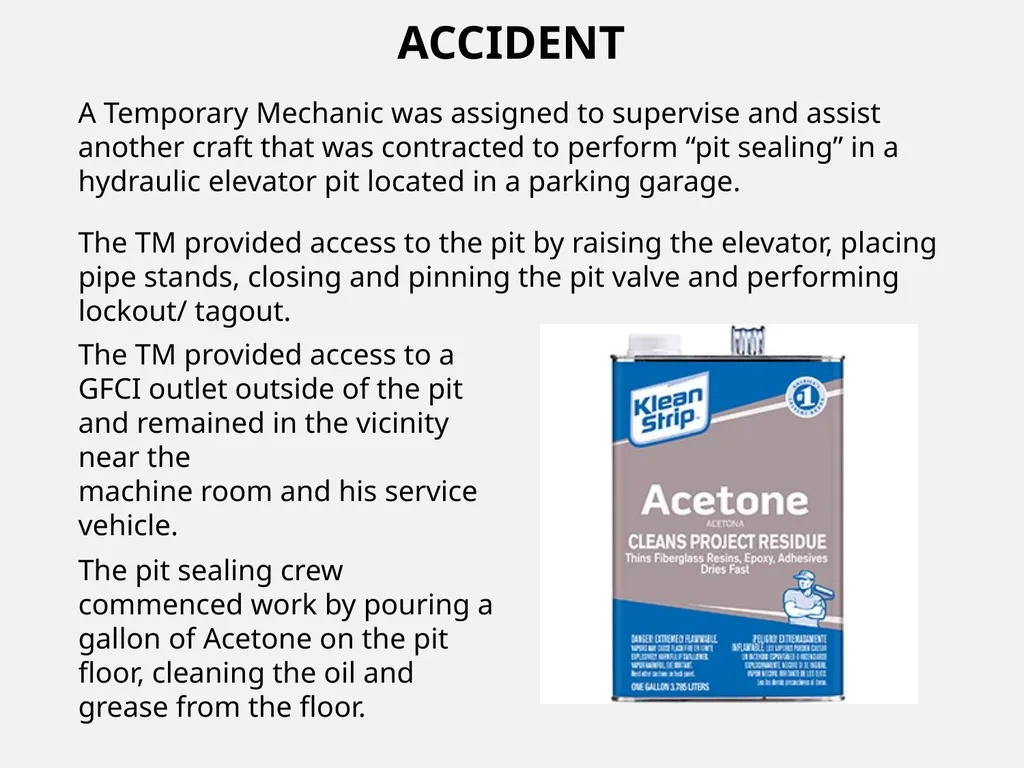
ACCIDENT A Temporary Mechanic was assigned to supervise and assist another craft that was contracted to perform “pit sealing” in a hydraulic elevator pit located in a parking garage. The TM provided access to the pit by raising the elevator, placing pipe stands, closing and pinning the pit valve and performing lockout/ tagout. The pit sealing crew commenced work by pouring a gallon of Acetone on the pit floor, cleaning the oil and grease from the floor. The TM provided access to a GFCI outlet outside of the pit and remained in the vicinity near the
machine room and his service vehicle.<br>
machine room and his service vehicle.<br>
47
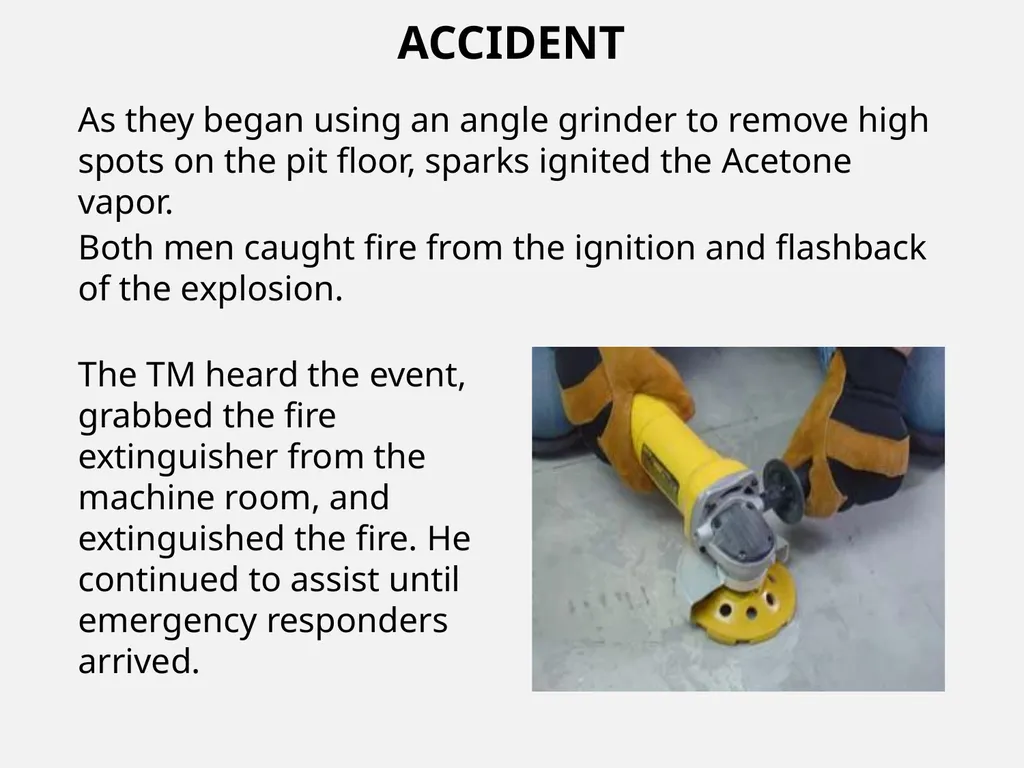
ACCIDENT As they began using an angle grinder to remove high spots on the pit floor, sparks ignited the Acetone vapor. Both men caught fire from the ignition and flashback of the explosion. The TM heard the event, grabbed the fire extinguisher from the machine room, and extinguished the fire. He continued to assist until emergency responders arrived.<br>
48
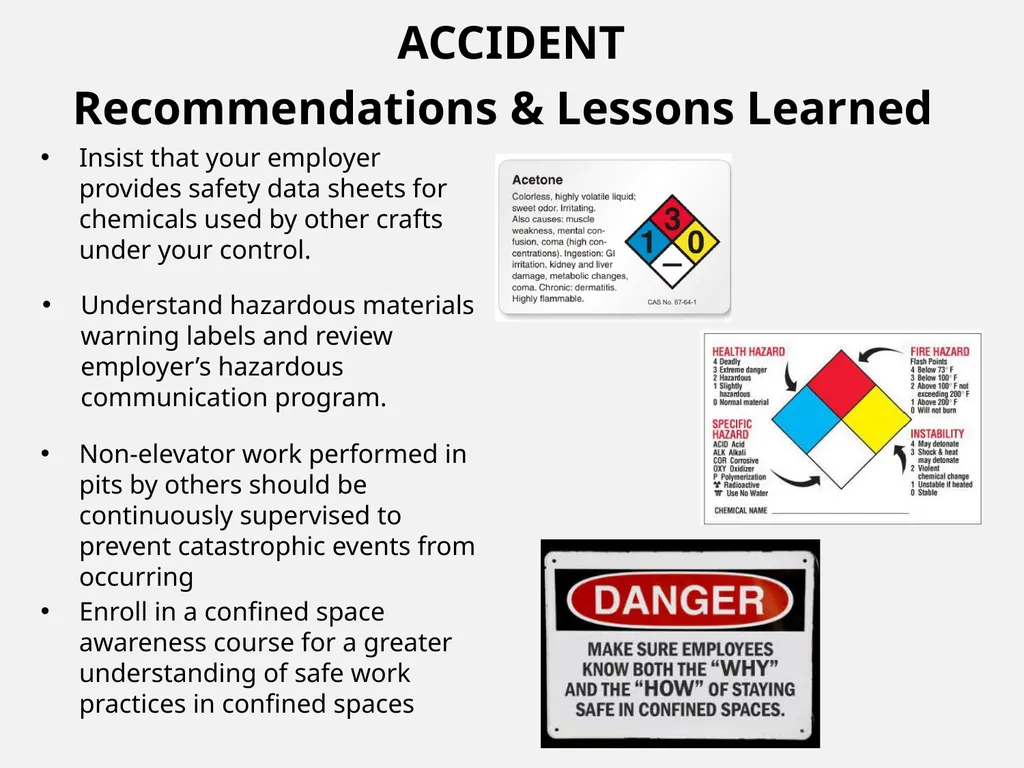
ACCIDENT Recommendations & Lessons Learned Insist that your employer provides safety data sheets for chemicals used by other crafts under your control. Understand hazardous materials warning labels and review employer’s hazardous communication program. Non-elevator work performed in pits by others should be continuously supervised to prevent catastrophic events from occurring Enroll in a confined space awareness course for a greater understanding of safe work practices in confined spaces<br>
49
Knowledge Check A hazard communication program requires which of the following components?
Written program
SDS/labeling
Training
All of the above Answer: d. All of the above<br>
Written program
SDS/labeling
Training
All of the above Answer: d. All of the above<br>
50
Knowledge Check 2. How many sections are required on an SDS?
11 sections
16 sections
4 sections
As many as necessary to convey understanding Answer: b. 16 sections<br>
11 sections
16 sections
4 sections
As many as necessary to convey understanding Answer: b. 16 sections<br>
51
Knowledge Check 3. Which of the following statements is true of the pictograms on HCS labels?
They are identical to those used on DOT transport labels and may have various background colors
They consist of four bars that are color-coded as blue, red, yellow, and white to match hazards
HCS pictograms are required and standardized red square-on-points with black hazard symbols and white backgrounds
All of the above Answer: c. HCS pictograms are required and standardized red square-on-points with black hazard symbols and white backgrounds.<br>
They are identical to those used on DOT transport labels and may have various background colors
They consist of four bars that are color-coded as blue, red, yellow, and white to match hazards
HCS pictograms are required and standardized red square-on-points with black hazard symbols and white backgrounds
All of the above Answer: c. HCS pictograms are required and standardized red square-on-points with black hazard symbols and white backgrounds.<br>
52
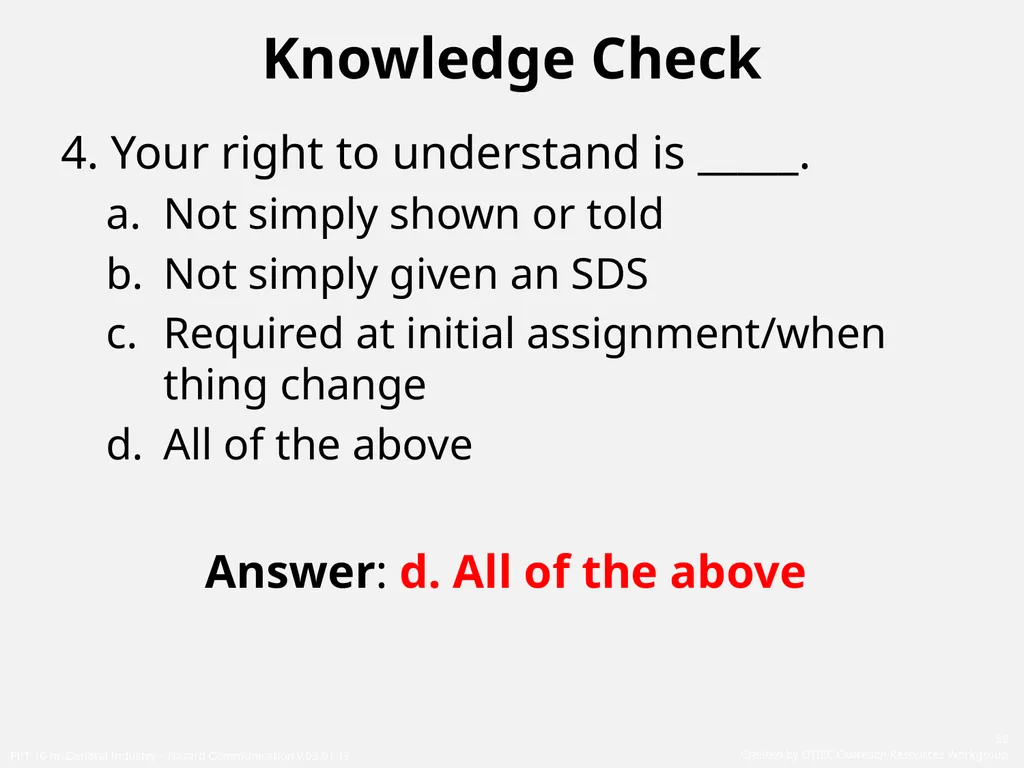
Knowledge Check 4. Your right to understand is _____.
Not simply shown or told
Not simply given an SDS
Required at initial assignment/when thing change
All of the above Answer: d. All of the above<br>
Not simply shown or told
Not simply given an SDS
Required at initial assignment/when thing change
All of the above Answer: d. All of the above<br>
53
Summary In this module we discussed:
Employer’s responsibilities under HCS
Components of a hazard communication program
Requirements of different types of hazard communication labels
How to locate pertinent information<br>
Employer’s responsibilities under HCS
Components of a hazard communication program
Requirements of different types of hazard communication labels
How to locate pertinent information<br>
54
Through the Alliance between OSHA’s 10 Regional Offices and the Elevator Contractors of America (ECA), Elevator Industry Work Preservation Fund (EIWPF), International Union of Elevator Constructors (IUEC), National Association of Elevator Contractors (NAEC), National Elevator Industry Educational Program (NEIEP), and National Elevator Industry Inc. (NEII), collectively known as The Elevator Industry Safety Partners, developed this Industry Specific Training for informational purposes only. It does not necessarily reflect the official views of OSHA or the U.S. Department of Labor. May 2021
Under the Occupational Safety and Health Act, employers are responsible (http://www.osha.gov/as/opa/worker/employer-responsibility.html) for providing a safe and healthy workplace and workers have rights (https://www.osha.gov/workers). OSHA can help answer questions or concerns from employers and workers. OSHA's On-Site Consultation Program (https://www.osha.gov/consultation) offers free and confidential advice to small and medium-sized businesses, with priority given to high-hazard worksites. For more information, contact your regional or area OSHA office (https://www.osha.gov/contactus/bystate), call 1-800-321-OSHA (6742), or visit https://www.osha.gov/.<br>
Under the Occupational Safety and Health Act, employers are responsible (http://www.osha.gov/as/opa/worker/employer-responsibility.html) for providing a safe and healthy workplace and workers have rights (https://www.osha.gov/workers). OSHA can help answer questions or concerns from employers and workers. OSHA's On-Site Consultation Program (https://www.osha.gov/consultation) offers free and confidential advice to small and medium-sized businesses, with priority given to high-hazard worksites. For more information, contact your regional or area OSHA office (https://www.osha.gov/contactus/bystate), call 1-800-321-OSHA (6742), or visit https://www.osha.gov/.<br>