
© 2008 Pearson Prentice Hall, Electronic Commerce
LO
Published · 46 slides · 0 views
1 / 1
Description
2008 Pearson Prentice Hall, Electronic Commerce 2008, Efraim Turban, et al. Chapter 1 Overview of Electronic Commerce 1-2 Learning Objectives Define electronic commerce (EC) and describe its various categories. Describe and discuss the
Related Topics
Share
Embed code
Download this presentation From Below
"© 2008 Pearson Prentice Hall, Electronic Commerce" is the property of its rightful owner. Permission is granted to download and print the materials on this website for personal, non-commercial use only, and to display it on your personal computer provided you do not modify the materials and that you retain all copyright notices contained in the materials. By downloading content from our website, you accept the terms of this agreement.
Presentation Transcript
01
© 2008 Pearson Prentice Hall, Electronic Commerce 2008, Efraim Turban, et al. Chapter 1 Overview of Electronic Commerce<br>
02
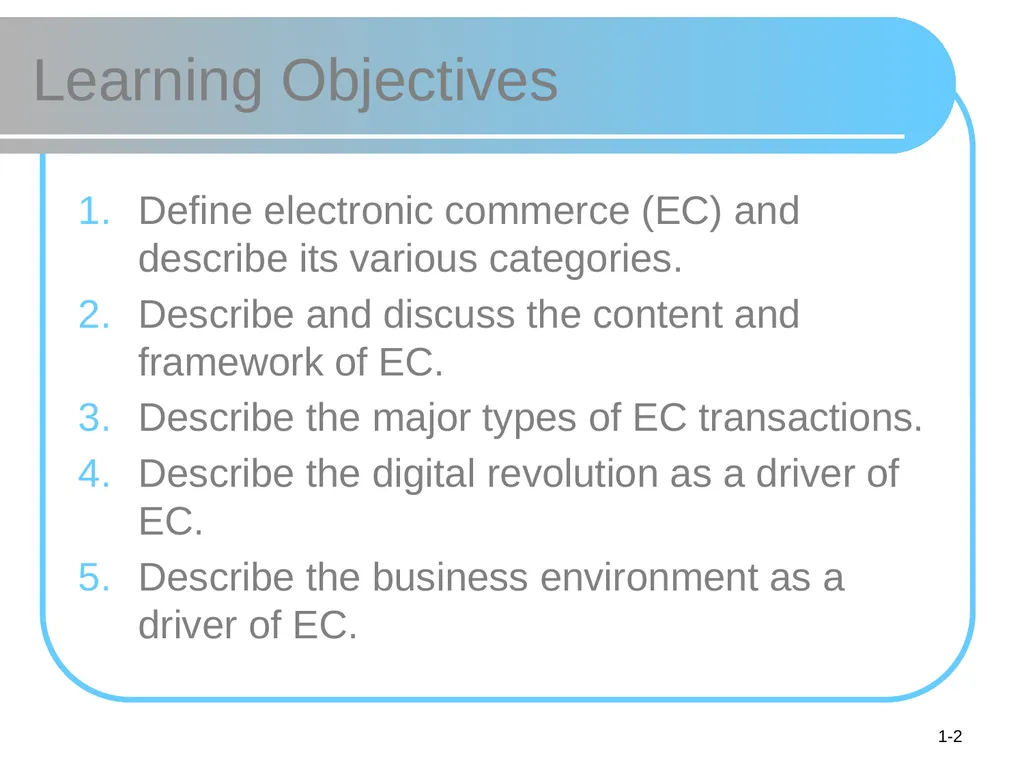
1-2 Learning Objectives Define electronic commerce (EC) and describe its various categories.
Describe and discuss the content and framework of EC.
Describe the major types of EC transactions.
Describe the digital revolution as a driver of EC.
Describe the business environment as a driver of EC.<br>
Describe and discuss the content and framework of EC.
Describe the major types of EC transactions.
Describe the digital revolution as a driver of EC.
Describe the business environment as a driver of EC.<br>
03
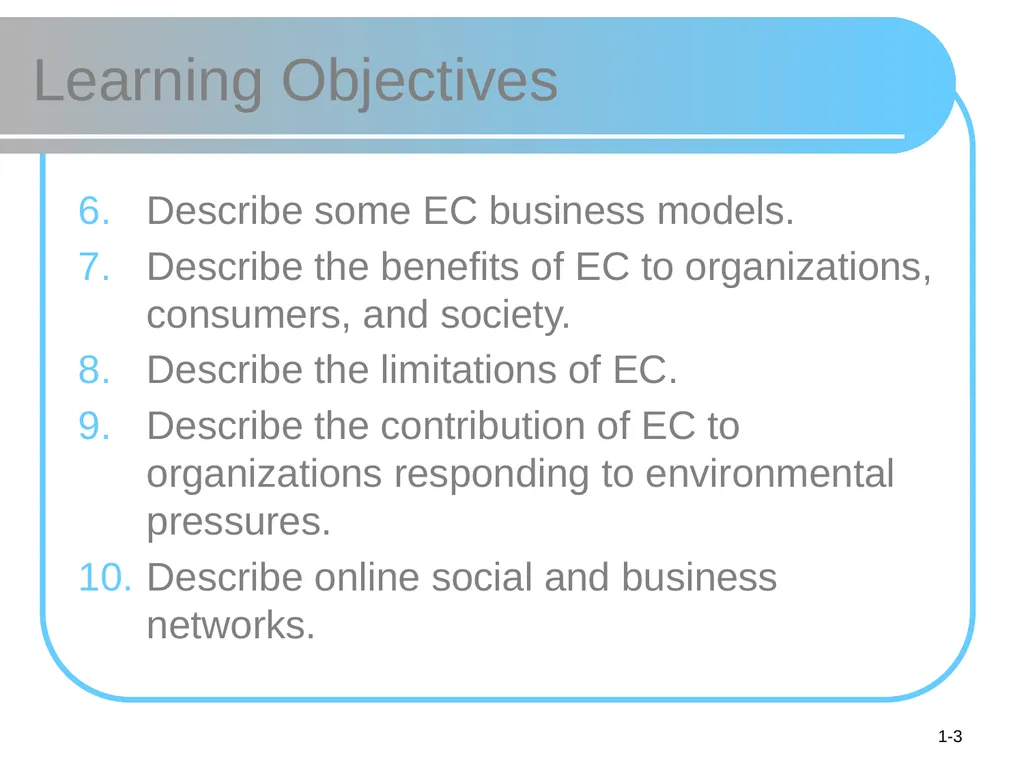
1-3 Learning Objectives Describe some EC business models.
Describe the benefits of EC to organizations, consumers, and society.
Describe the limitations of EC.
Describe the contribution of EC to organizations responding to environmental pressures.
Describe online social and business networks.<br>
Describe the benefits of EC to organizations, consumers, and society.
Describe the limitations of EC.
Describe the contribution of EC to organizations responding to environmental pressures.
Describe online social and business networks.<br>
04
1-4 Electronic Commerce:
Definitions and Concepts electronic commerce (EC)
The process of buying, selling, or exchanging products, services, or information via computer networks<br>
The process of buying, selling, or exchanging products, services, or information via computer networks<br>
05
1-5 Electronic Commerce:
Definitions and Concepts EC can be defined from these perspectives:
Business process
Service
Learning
Collaboration
Community<br>
Business process
Service
Learning
Collaboration
Community<br>
06
1-6 Electronic Commerce:
Definitions and Concepts e-business
A broader definition of EC that includes not just the buying and selling of goods and services, but also servicing customers, collaborating with business partners, and conducting electronic transactions within an organization<br>
A broader definition of EC that includes not just the buying and selling of goods and services, but also servicing customers, collaborating with business partners, and conducting electronic transactions within an organization<br>
07
1-7 Electronic Commerce:
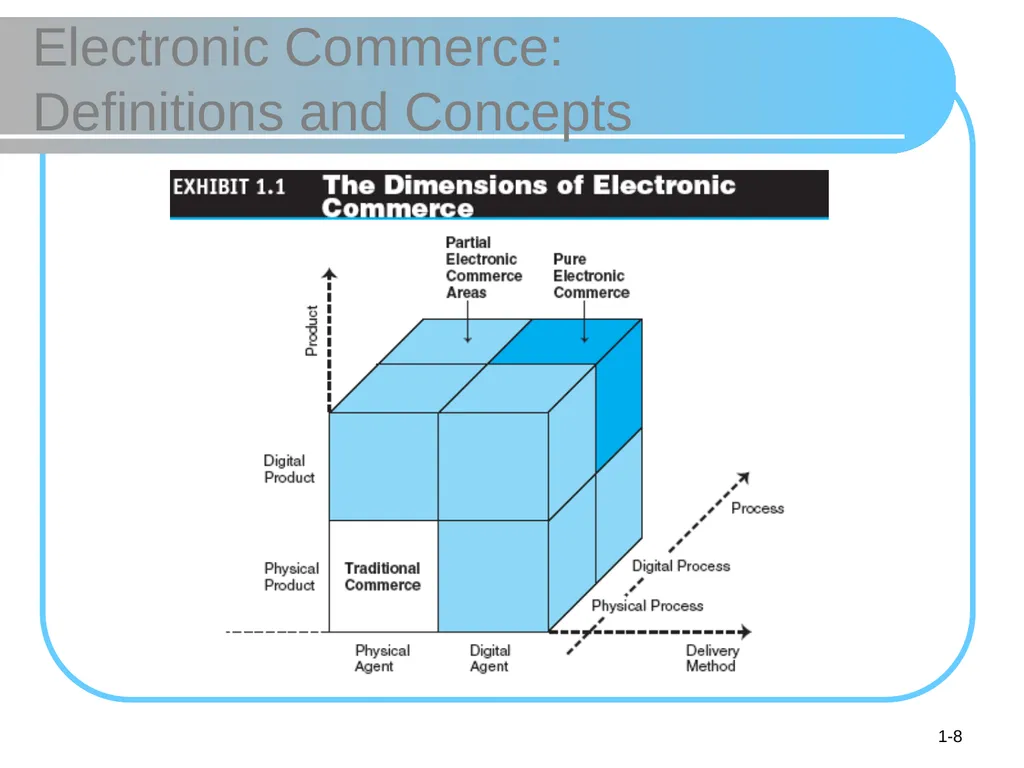
Definitions and Concepts Pure versus Partial EC
EC can take several forms depending on the degree of digitization
the product (service) sold
the process (e.g., ordering, payment, fulfillment)
the delivery method<br>
EC can take several forms depending on the degree of digitization
the product (service) sold
the process (e.g., ordering, payment, fulfillment)
the delivery method<br>
08
1-8 Electronic Commerce:
Definitions and Concepts<br>
09
1-9 Electronic Commerce:
Definitions and Concepts old economy organizations
Old-economy organizations (corporations) that perform their primary business off-line, selling physical products by means of physical agents
virtual (pure-play) organizations
Organizations that conduct their business activities solely online<br>
Old-economy organizations (corporations) that perform their primary business off-line, selling physical products by means of physical agents
virtual (pure-play) organizations
Organizations that conduct their business activities solely online<br>
10
1-10 Electronic Commerce:
Definitions and Concepts click-and-brick organizations
Organizations that conduct some e-commerce activities, usually as an additional marketing channel<br>
Organizations that conduct some e-commerce activities, usually as an additional marketing channel<br>
11
1-11 Electronic Commerce:
Definitions and Concepts Internet versus Non-Internet EC
Most EC is done over the Internet, but EC also can be conducted on private networks, such as value-added networks, local area networks, or on a single computerized machine
Non-Internet EC includes the use of mobile handwriting-recognition computers used by field reps to write their notes in the field<br>
Most EC is done over the Internet, but EC also can be conducted on private networks, such as value-added networks, local area networks, or on a single computerized machine
Non-Internet EC includes the use of mobile handwriting-recognition computers used by field reps to write their notes in the field<br>
12
1-12 Electronic Commerce:
Definitions and Concepts electronic market (e-marketplace)
An online marketplace where buyers and sellers meet to exchange goods, services, money, or information<br>
An online marketplace where buyers and sellers meet to exchange goods, services, money, or information<br>
13
1-13 Electronic Commerce:
Definitions and Concepts interorganizational information systems (IOSs)
Communications systems that allow routine transaction processing and information flow between two or more organizations
intraorganizational information systems
Communication systems that enable e-commerce activities to go on within individual organizations<br>
Communications systems that allow routine transaction processing and information flow between two or more organizations
intraorganizational information systems
Communication systems that enable e-commerce activities to go on within individual organizations<br>
14
1-14 The EC Framework, Classification, and Content intranet
An internal corporate or government network that uses Internet tools, such as Web browsers, and Internet protocols
extranet
A network that uses the Internet to link multiple intranets<br>
An internal corporate or government network that uses Internet tools, such as Web browsers, and Internet protocols
extranet
A network that uses the Internet to link multiple intranets<br>
15
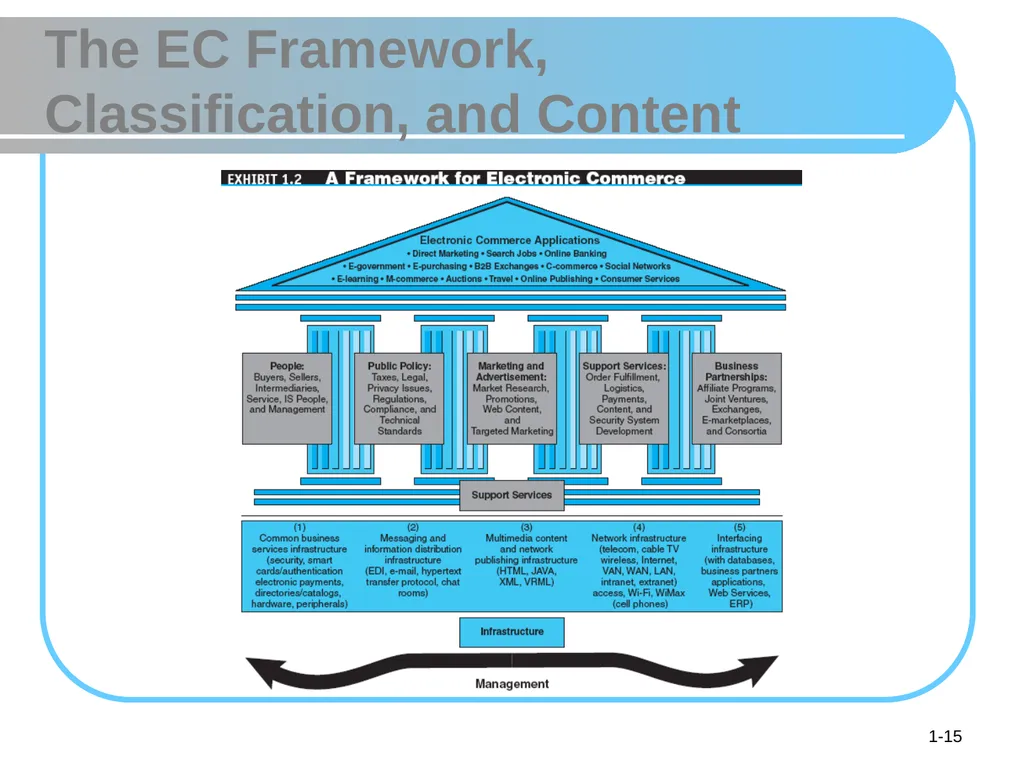
1-15 The EC Framework, Classification, and Content<br>
16
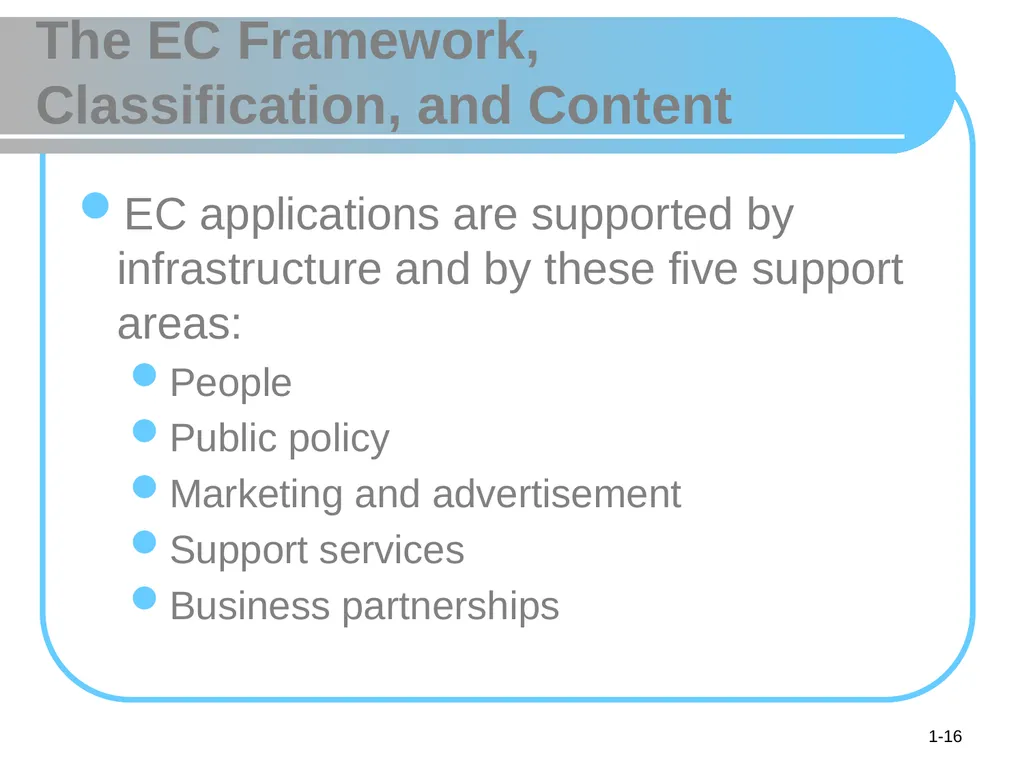
1-16 The EC Framework, Classification, and Content EC applications are supported by infrastructure and by these five support areas:
People
Public policy
Marketing and advertisement
Support services
Business partnerships<br>
People
Public policy
Marketing and advertisement
Support services
Business partnerships<br>
17
1-17 The EC Framework, Classification, and Content Classification of EC by the Nature of the Transactions or Interactions
business-to-business (B2B)
E-commerce model in which all of the participants are businesses or other organizations<br>
business-to-business (B2B)
E-commerce model in which all of the participants are businesses or other organizations<br>
18
1-18 The EC Framework, Classification, and Content business-to-consumer (B2C)
E-commerce model in which businesses sell to individual shoppers
e-tailing
Online retailing, usually B2C
business-to-business-to-consumer (B2B2C)
E-commerce model in which a business provides some product or service to a client business that maintains its own customers<br>
E-commerce model in which businesses sell to individual shoppers
e-tailing
Online retailing, usually B2C
business-to-business-to-consumer (B2B2C)
E-commerce model in which a business provides some product or service to a client business that maintains its own customers<br>
19
1-19 The EC Framework, Classification, and Content consumer-to-business (C2B)
E-commerce model in which individuals use the Internet to sell products or services to organizations or individuals who seek sellers to bid on products or services they need
mobile commerce (m-commerce)
E-commerce transactions and activities conducted in a wireless environment<br>
E-commerce model in which individuals use the Internet to sell products or services to organizations or individuals who seek sellers to bid on products or services they need
mobile commerce (m-commerce)
E-commerce transactions and activities conducted in a wireless environment<br>
20
1-20 The EC Framework, Classification, and Content location-based commerce (l-commerce)
M-commerce transactions targeted to individuals in specific locations, at specific times
intrabusiness EC
E-commerce category that includes all internal organizational activities that involve the exchange of goods, services, or information among various units and individuals in an organization<br>
M-commerce transactions targeted to individuals in specific locations, at specific times
intrabusiness EC
E-commerce category that includes all internal organizational activities that involve the exchange of goods, services, or information among various units and individuals in an organization<br>
21
1-21 The EC Framework, Classification, and Content business-to-employees (B2E)
E-commerce model in which an organization delivers services, information, or products to its individual employees
collaborative commerce (c-commerce)
E-commerce model in which individuals or groups communicate or collaborate online
consumer-to-consumer (C2C)
E-commerce model in which consumers sell directly to other consumers<br>
E-commerce model in which an organization delivers services, information, or products to its individual employees
collaborative commerce (c-commerce)
E-commerce model in which individuals or groups communicate or collaborate online
consumer-to-consumer (C2C)
E-commerce model in which consumers sell directly to other consumers<br>
22
1-22 The EC Framework, Classification, and Content peer-to-peer (P2P)
Technology that enables networked peer computers to share data and processing with each other directly; can be used in C2C, B2B, and B2C e-commerce
e-learning
The online delivery of information for purposes of training or education
e-government
E-commerce model in which a government entity buys or provides goods, services, or information from or to businesses or individual citizens<br>
Technology that enables networked peer computers to share data and processing with each other directly; can be used in C2C, B2B, and B2C e-commerce
e-learning
The online delivery of information for purposes of training or education
e-government
E-commerce model in which a government entity buys or provides goods, services, or information from or to businesses or individual citizens<br>
23
1-23 The EC Framework, Classification, and Content exchange
A public electronic market with many buyers and sellers
exchange-to-exchange (E2E)
E-commerce model in which electronic exchanges formally connect to one another for the purpose of exchanging information<br>
A public electronic market with many buyers and sellers
exchange-to-exchange (E2E)
E-commerce model in which electronic exchanges formally connect to one another for the purpose of exchanging information<br>
24
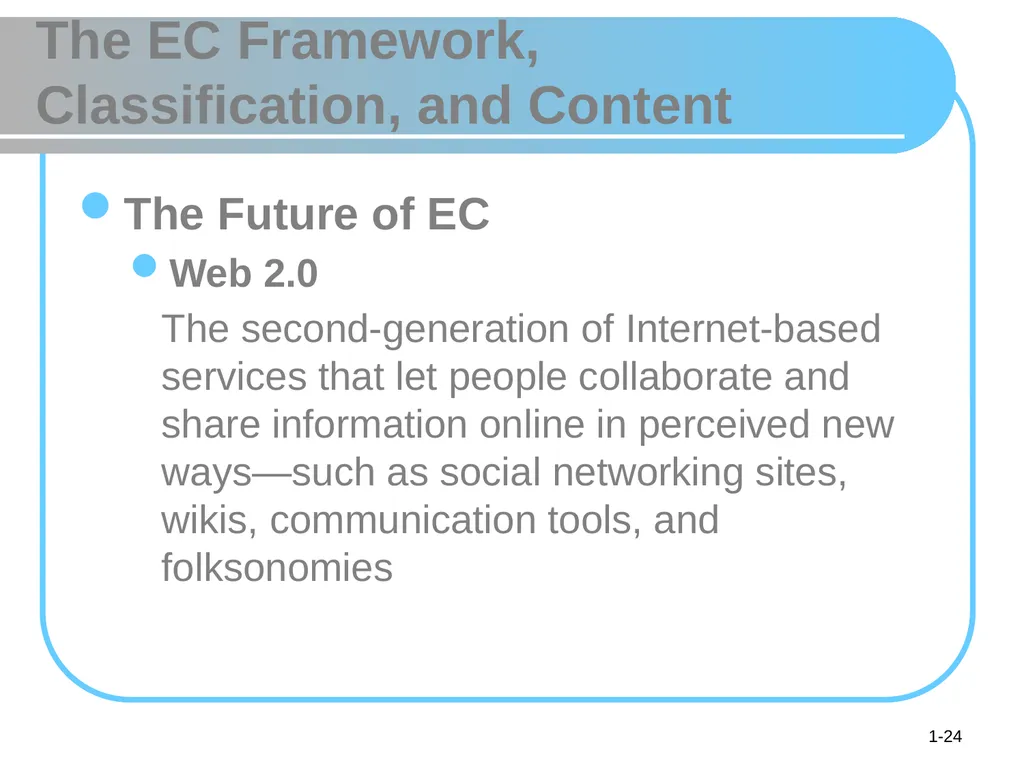
1-24 The EC Framework, Classification, and Content The Future of EC
Web 2.0
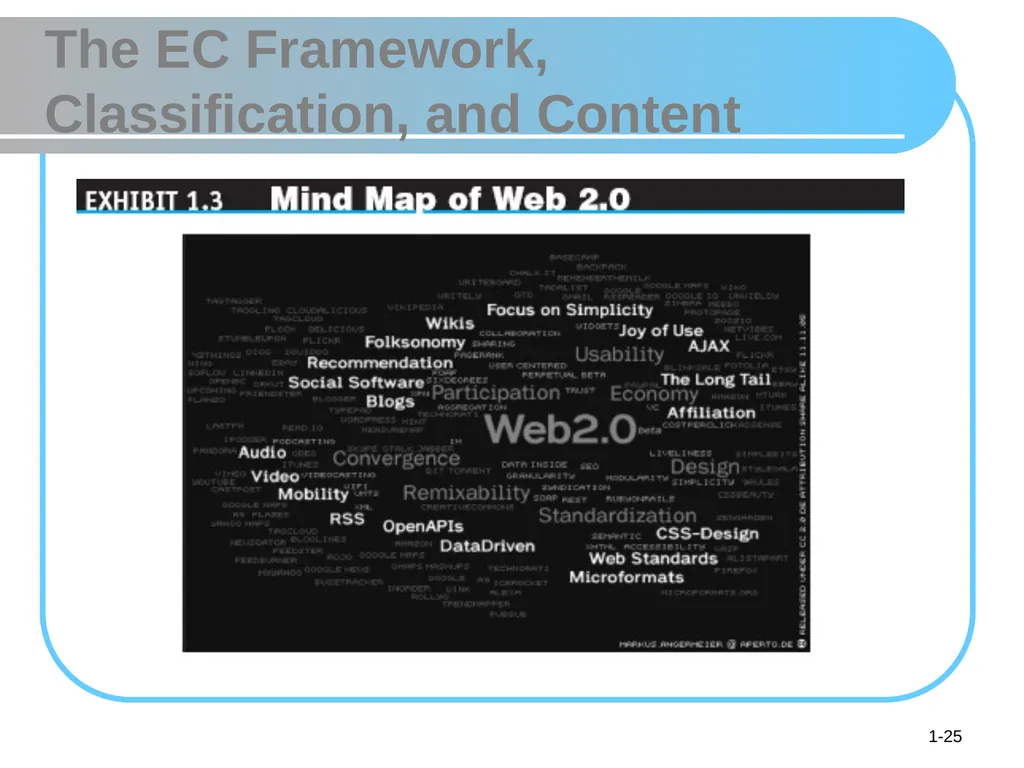
The second-generation of Internet-based services that let people collaborate and share information online in perceived new ways—such as social networking sites, wikis, communication tools, and folksonomies<br>
Web 2.0
The second-generation of Internet-based services that let people collaborate and share information online in perceived new ways—such as social networking sites, wikis, communication tools, and folksonomies<br>
25
1-25 The EC Framework, Classification, and Content<br>
26
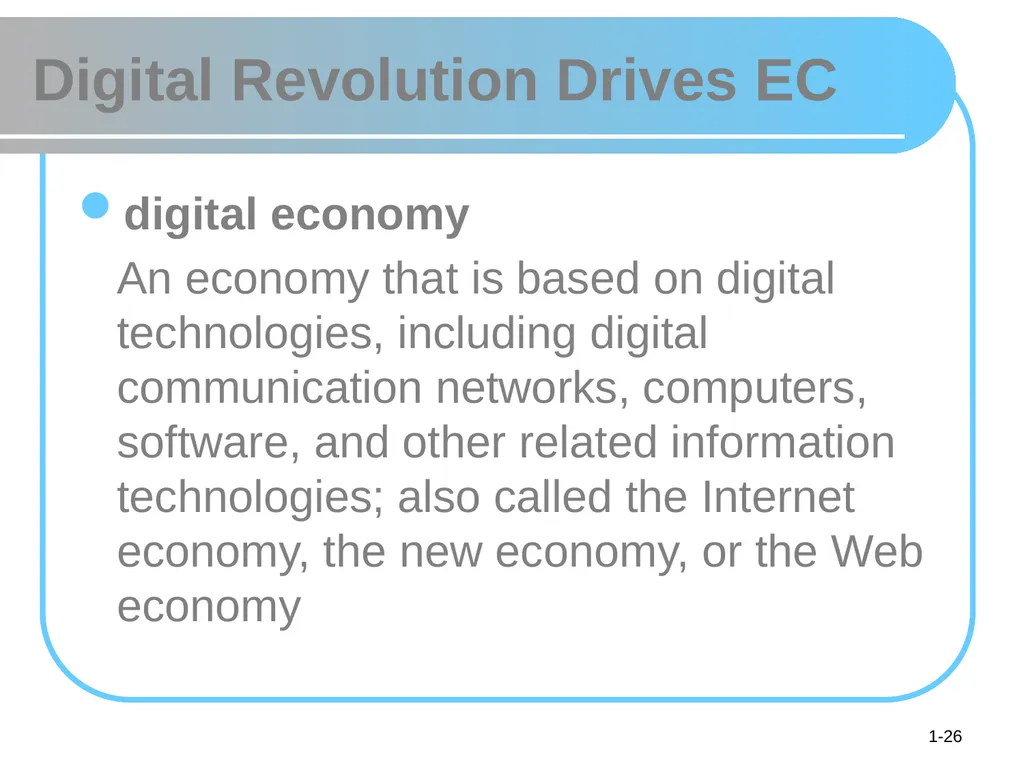
1-26 digital economy
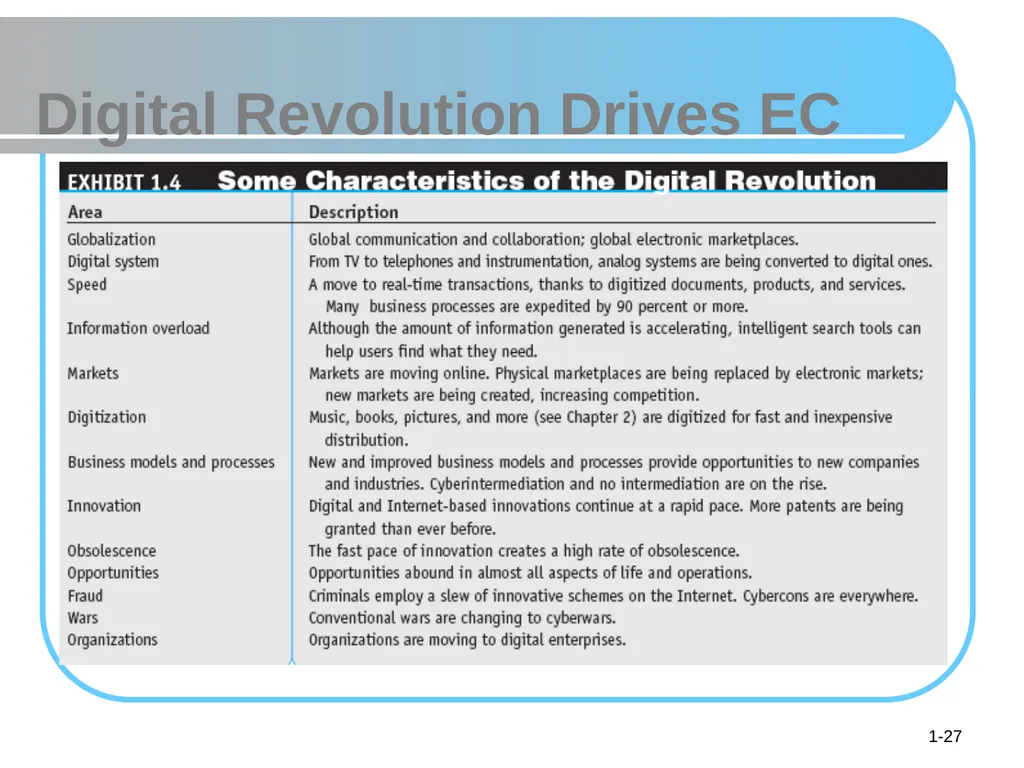
An economy that is based on digital technologies, including digital communication networks, computers, software, and other related information technologies; also called the Internet economy, the new economy, or the Web economy Digital Revolution Drives EC<br>
An economy that is based on digital technologies, including digital communication networks, computers, software, and other related information technologies; also called the Internet economy, the new economy, or the Web economy Digital Revolution Drives EC<br>
27
1-27 Digital Revolution Drives EC<br>
28
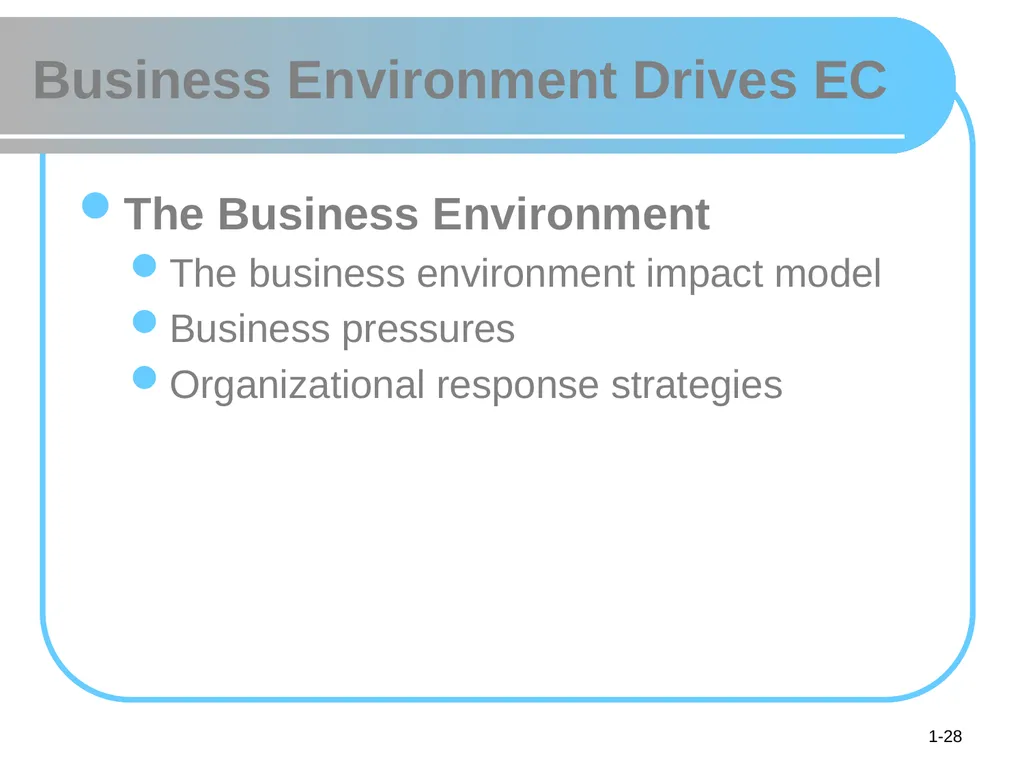
1-28 Business Environment Drives EC The Business Environment
The business environment impact model
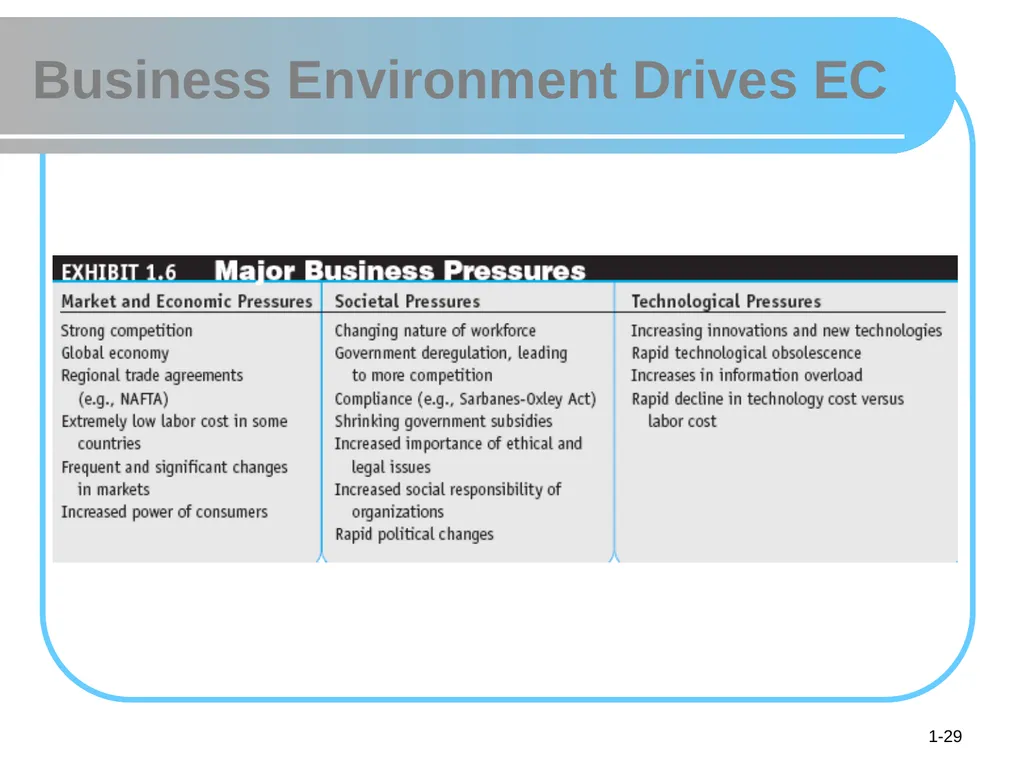
Business pressures
Organizational response strategies<br>
The business environment impact model
Business pressures
Organizational response strategies<br>
29
1-29 Business Environment Drives EC<br>
30
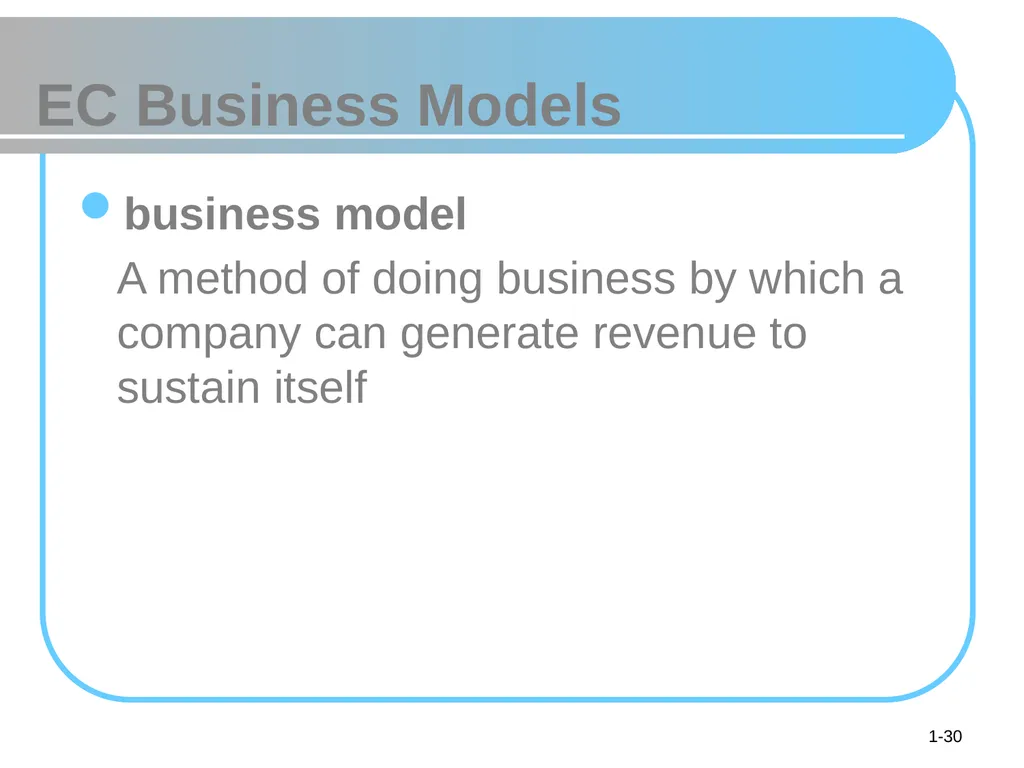
1-30 EC Business Models business model
A method of doing business by which a company can generate revenue to sustain itself<br>
A method of doing business by which a company can generate revenue to sustain itself<br>
31
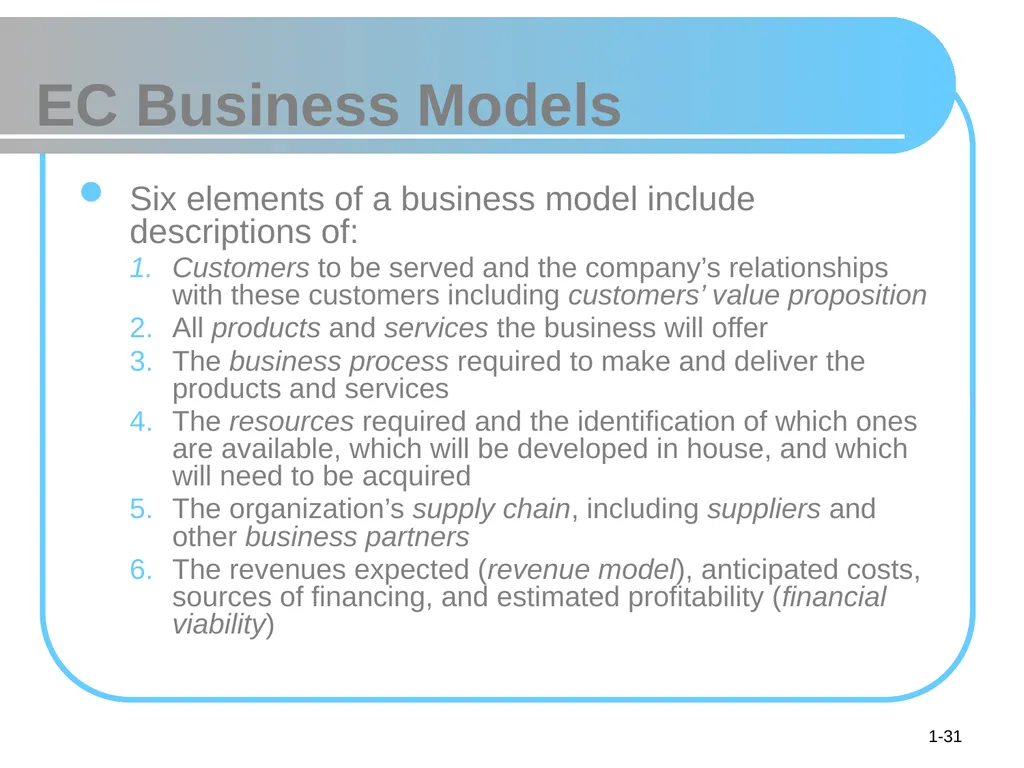
1-31 EC Business Models Six elements of a business model include descriptions of:
Customers to be served and the company’s relationships with these customers including customers’ value proposition
All products and services the business will offer
The business process required to make and deliver the products and services
The resources required and the identification of which ones are available, which will be developed in house, and which will need to be acquired
The organization’s supply chain, including suppliers and other business partners
The revenues expected (revenue model), anticipated costs, sources of financing, and estimated profitability (financial viability)<br>
Customers to be served and the company’s relationships with these customers including customers’ value proposition
All products and services the business will offer
The business process required to make and deliver the products and services
The resources required and the identification of which ones are available, which will be developed in house, and which will need to be acquired
The organization’s supply chain, including suppliers and other business partners
The revenues expected (revenue model), anticipated costs, sources of financing, and estimated profitability (financial viability)<br>
32
1-32 EC Business Models revenue model
Description of how the company or an EC project will earn revenue
value proposition
The benefits a company can derive from using EC<br>
Description of how the company or an EC project will earn revenue
value proposition
The benefits a company can derive from using EC<br>
33
1-33 EC Business Models The major revenue models are:
Sales
Transaction fees
Subscription fees
Advertising fees
Affiliate fees
Other revenue sources<br>
Sales
Transaction fees
Subscription fees
Advertising fees
Affiliate fees
Other revenue sources<br>
34
1-34 EC Business Models Functions of a Business Model
Articulate a customer value proposition
Identify a market segment
Define the venture’s specific value chain structure
Estimate the cost structure and profit potential
Describe the venture’s positioning within the value network linking suppliers and customers
Formulate the venture’s competitive strategy<br>
Articulate a customer value proposition
Identify a market segment
Define the venture’s specific value chain structure
Estimate the cost structure and profit potential
Describe the venture’s positioning within the value network linking suppliers and customers
Formulate the venture’s competitive strategy<br>
35
1-35 EC Business Models Online direct marketing
Electronic tendering systems.
Name your own price
Find the best price
Affiliate marketing
Viral marketing
Group purchasing
Online auctions
Product and service customization
Electronic marketplaces and exchanges Information brokers (informediaries)
Bartering
Deep discounting
Membership
Value-chain integrators
Value-chain service providers
Supply chain improvers
Social networks, communities, and blogging
Direct sale by manufacturers
Negotiation Typical EC Business Models<br>
Electronic tendering systems.
Name your own price
Find the best price
Affiliate marketing
Viral marketing
Group purchasing
Online auctions
Product and service customization
Electronic marketplaces and exchanges Information brokers (informediaries)
Bartering
Deep discounting
Membership
Value-chain integrators
Value-chain service providers
Supply chain improvers
Social networks, communities, and blogging
Direct sale by manufacturers
Negotiation Typical EC Business Models<br>
36
1-36 EC Business Models tendering (bidding) system
Model in which a buyer requests would-be sellers to submit bids; the lowest bidder wins
name-your-own-price model
Model in which a buyer sets the price he or she is willing to pay and invites sellers to supply the good or service at that price<br>
Model in which a buyer requests would-be sellers to submit bids; the lowest bidder wins
name-your-own-price model
Model in which a buyer sets the price he or she is willing to pay and invites sellers to supply the good or service at that price<br>
37
1-37 EC Business Models affiliate marketing
An arrangement whereby a marketing partner (a business, an organization, or even an individual) refers consumers to the selling company’s Web site
viral marketing
Word-of-mouth marketing in which customers promote a product or service to friends or other people<br>
An arrangement whereby a marketing partner (a business, an organization, or even an individual) refers consumers to the selling company’s Web site
viral marketing
Word-of-mouth marketing in which customers promote a product or service to friends or other people<br>
38
1-38 EC Business Models SMEs
Small-to-medium enterprises
group purchasing
Quantity (aggregated) purchasing that enables groups of purchasers to obtain a discount price on the products purchased<br>
Small-to-medium enterprises
group purchasing
Quantity (aggregated) purchasing that enables groups of purchasers to obtain a discount price on the products purchased<br>
39
1-39 EC Business Models e-co-ops
Another name for online group purchasing organizations
customization
Creation of a product or service according to the buyer’s specifications<br>
Another name for online group purchasing organizations
customization
Creation of a product or service according to the buyer’s specifications<br>
40
1-40 Benefits and Limitations of EC Benefits to
Organizations
Consumers
Society
Limitations
Technological
Nontechnological<br>
Organizations
Consumers
Society
Limitations
Technological
Nontechnological<br>
41
1-41 Social and Business Networks social networks
Web sites that connect people with specified interests by providing free services such as photo presentation, e-mail, blogging, etc.
Business-oriented networks are social networks whose primary objective is to facilitate business<br>
Web sites that connect people with specified interests by providing free services such as photo presentation, e-mail, blogging, etc.
Business-oriented networks are social networks whose primary objective is to facilitate business<br>
42
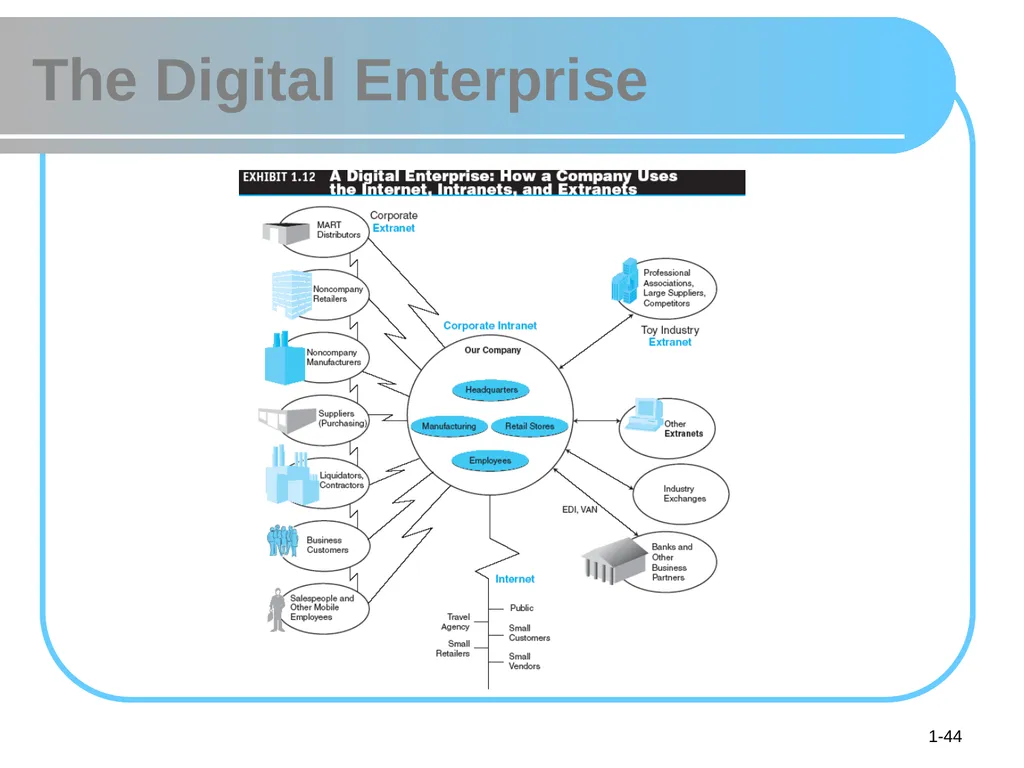
1-42 The Digital Enterprise digital enterprise
A new business model that uses IT in a fundamental way to accomplish one or more of three basic objectives: reach and engage customers more effectively, boost employee productivity, and improve operating efficiency. It uses converged communication and computing technology in a way that improves business processes<br>
A new business model that uses IT in a fundamental way to accomplish one or more of three basic objectives: reach and engage customers more effectively, boost employee productivity, and improve operating efficiency. It uses converged communication and computing technology in a way that improves business processes<br>
43
1-43 The Digital Enterprise corporate portal
A major gateway through which employees, business partners, and the public can enter a corporate Web site<br>
A major gateway through which employees, business partners, and the public can enter a corporate Web site<br>
44
1-44 The Digital Enterprise<br>
45
1-45 Managerial Issues Is it real?
Why is B2B e-commerce so attractive?
There are so many EC failures—how can one avoid them?
How do we transform our organization into a digital one?<br>
Why is B2B e-commerce so attractive?
There are so many EC failures—how can one avoid them?
How do we transform our organization into a digital one?<br>
46
1-46 Managerial Issues How should we evaluate the magnitude of business pressures and technological advancement?
How can we exploit social/business networking?
What should be my company’s strategy toward EC?
What are the top challenges of EC?<br>
How can we exploit social/business networking?
What should be my company’s strategy toward EC?
What are the top challenges of EC?<br>