
2020/21 annual REPORT PRESENTED BY:
DP
Published · 78 slides · 0 views

1 / 1




Description
202021 annual REPORT PRESENTED BY: DIRECTOR-GENERAL: SPORT, ARTS AND CULTURE DATE: 16 NOVEMBER 2021 Purpose Introduction Performance Overview Departmental performance overview results Overview of programme-specific performance Expenditure
Related Topics
Share
Embed code
Download this presentation From Below
"2020/21 annual REPORT PRESENTED BY:" is the property of its rightful owner. Permission is granted to download and print the materials on this website for personal, non-commercial use only, and to display it on your personal computer provided you do not modify the materials and that you retain all copyright notices contained in the materials. By downloading content from our website, you accept the terms of this agreement.
Presentation Transcript
01
2020/21 annual REPORT PRESENTED BY:
DIRECTOR-GENERAL: SPORT, ARTS AND CULTURE
DATE: 16 NOVEMBER 2021<br>
DIRECTOR-GENERAL: SPORT, ARTS AND CULTURE
DATE: 16 NOVEMBER 2021<br>
02
Purpose
Introduction
Performance Overview
Departmental performance overview results
Overview of programme-specific performance
Expenditure Report 2 PRESENTATION OUTLINE<br>
Introduction
Performance Overview
Departmental performance overview results
Overview of programme-specific performance
Expenditure Report 2 PRESENTATION OUTLINE<br>
03
3 PURPOSE The purpose of this presentation is to report on 2020/21 performance of DSAC with the Portfolio Committee on Sport, Arts and Culture.
For accountability as required by law.
To enable the Committee to provide oversight on the work of the Department and its entities.<br>
For accountability as required by law.
To enable the Committee to provide oversight on the work of the Department and its entities.<br>
04
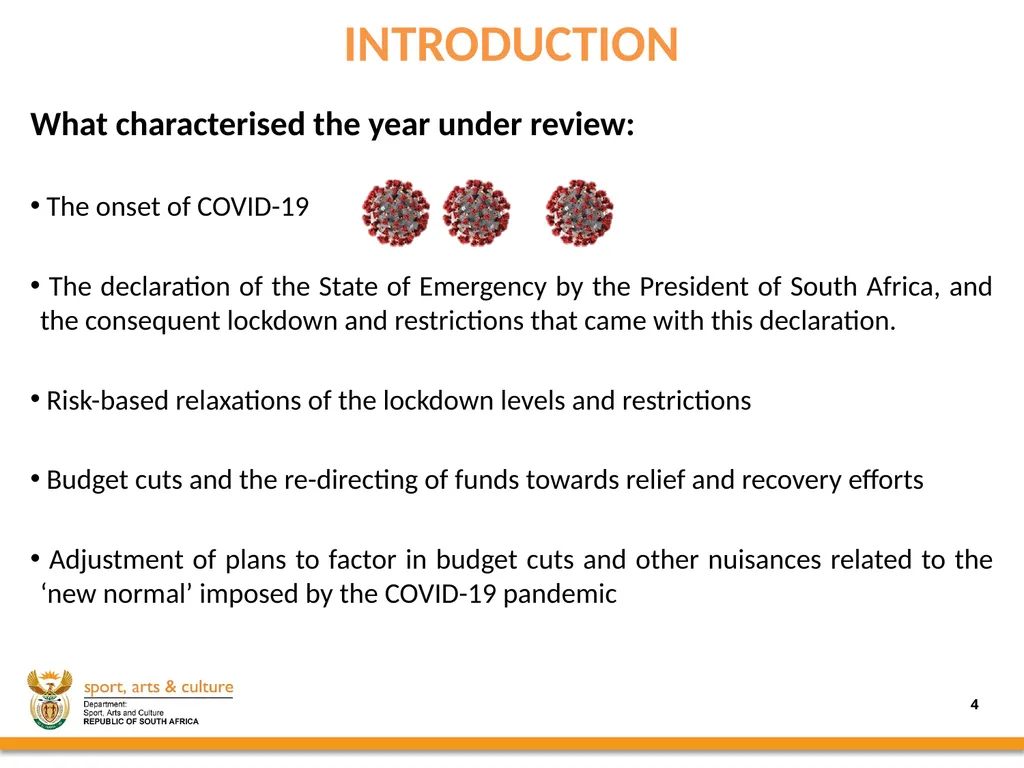
What characterised the year under review:
The onset of COVID-19
The declaration of the State of Emergency by the President of South Africa, and the consequent lockdown and restrictions that came with this declaration.
Risk-based relaxations of the lockdown levels and restrictions
Budget cuts and the re-directing of funds towards relief and recovery efforts
Adjustment of plans to factor in budget cuts and other nuisances related to the ‘new normal’ imposed by the COVID-19 pandemic 4 INTRODUCTION<br>
The onset of COVID-19
The declaration of the State of Emergency by the President of South Africa, and the consequent lockdown and restrictions that came with this declaration.
Risk-based relaxations of the lockdown levels and restrictions
Budget cuts and the re-directing of funds towards relief and recovery efforts
Adjustment of plans to factor in budget cuts and other nuisances related to the ‘new normal’ imposed by the COVID-19 pandemic 4 INTRODUCTION<br>
05
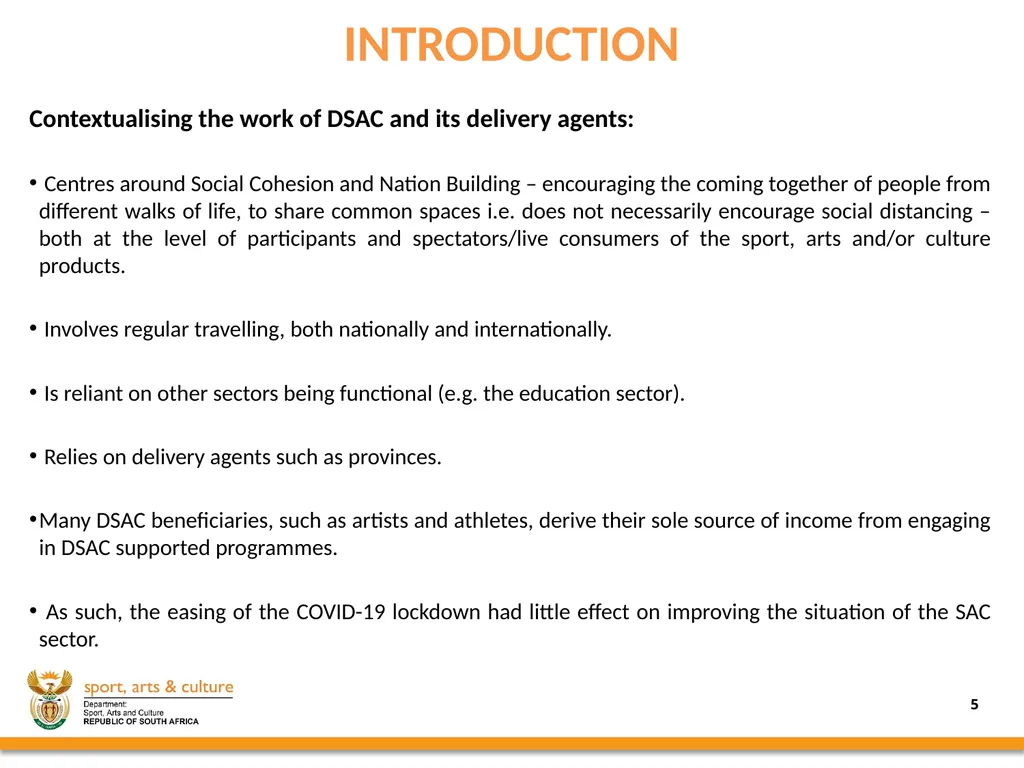
Contextualising the work of DSAC and its delivery agents:
Centres around Social Cohesion and Nation Building – encouraging the coming together of people from different walks of life, to share common spaces i.e. does not necessarily encourage social distancing – both at the level of participants and spectators/live consumers of the sport, arts and/or culture products.
Involves regular travelling, both nationally and internationally.
Is reliant on other sectors being functional (e.g. the education sector).
Relies on delivery agents such as provinces.
Many DSAC beneficiaries, such as artists and athletes, derive their sole source of income from engaging in DSAC supported programmes.
As such, the easing of the COVID-19 lockdown had little effect on improving the situation of the SAC sector. 5 INTRODUCTION<br>
Centres around Social Cohesion and Nation Building – encouraging the coming together of people from different walks of life, to share common spaces i.e. does not necessarily encourage social distancing – both at the level of participants and spectators/live consumers of the sport, arts and/or culture products.
Involves regular travelling, both nationally and internationally.
Is reliant on other sectors being functional (e.g. the education sector).
Relies on delivery agents such as provinces.
Many DSAC beneficiaries, such as artists and athletes, derive their sole source of income from engaging in DSAC supported programmes.
As such, the easing of the COVID-19 lockdown had little effect on improving the situation of the SAC sector. 5 INTRODUCTION<br>
06
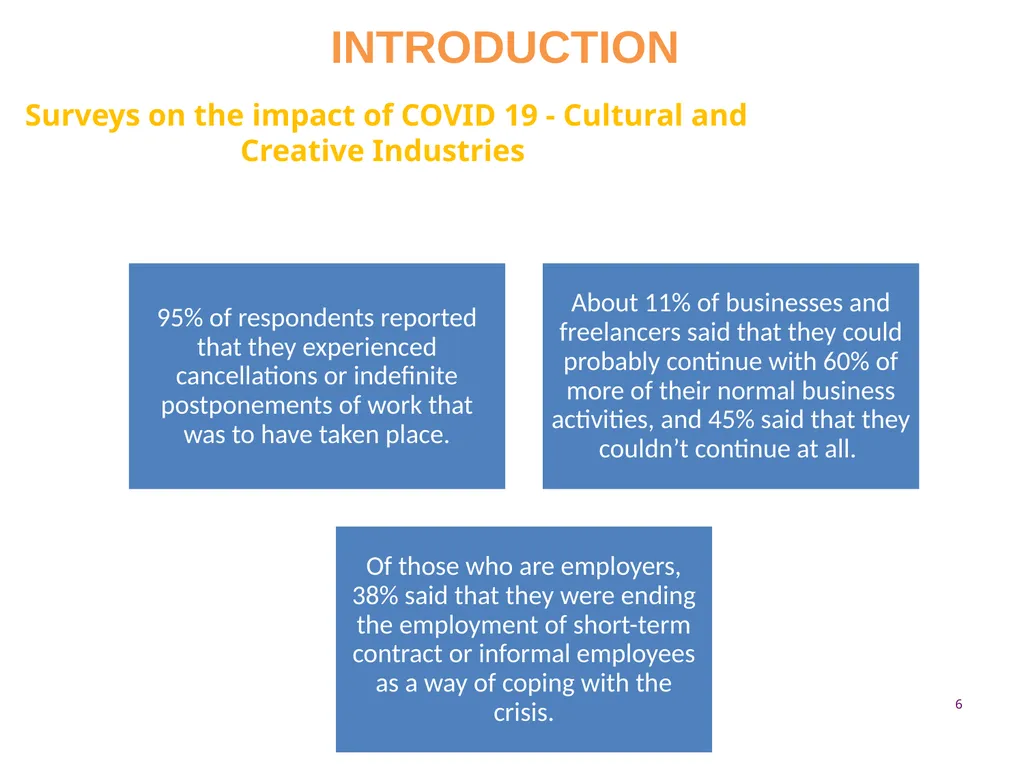
6 Surveys on the impact of COVID 19 - Cultural and Creative Industries INTRODUCTION<br>
07
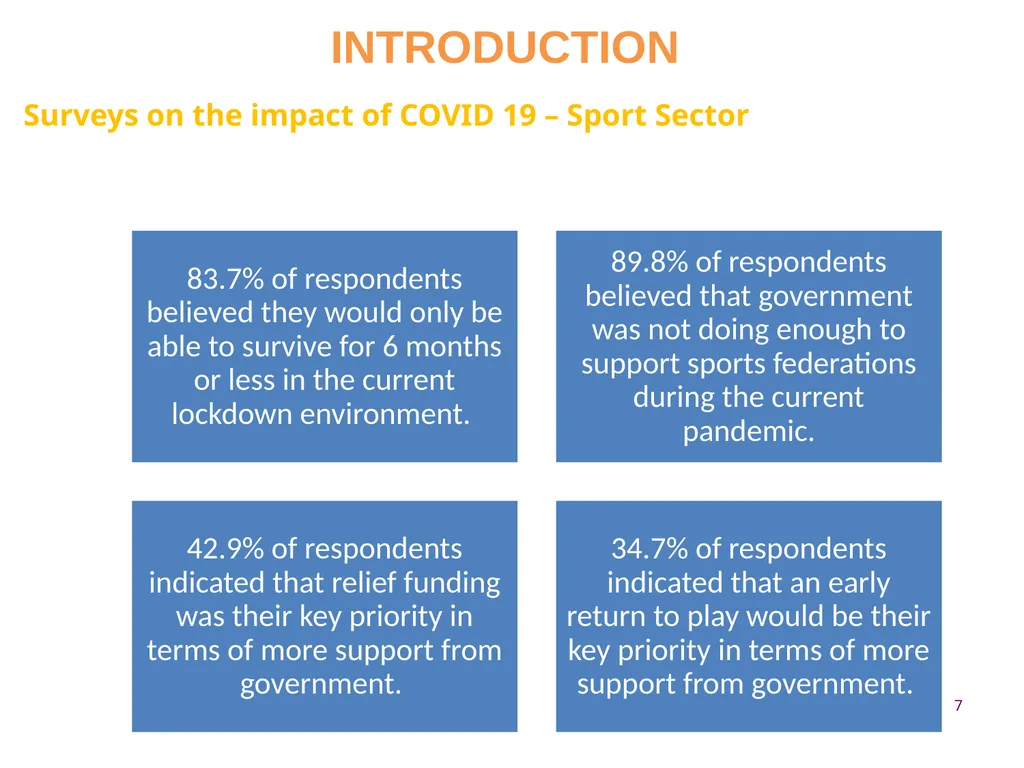
7 INTRODUCTION Surveys on the impact of COVID 19 – Sport Sector<br>
08
Surveys on the impact of COVID 19 - Sport Federations’ Main Source of Income to meet operational costs 8 The information provided below was based on responses (in actual numbers) received from 49 sport federations (respondents) INTRODUCTION<br>
09
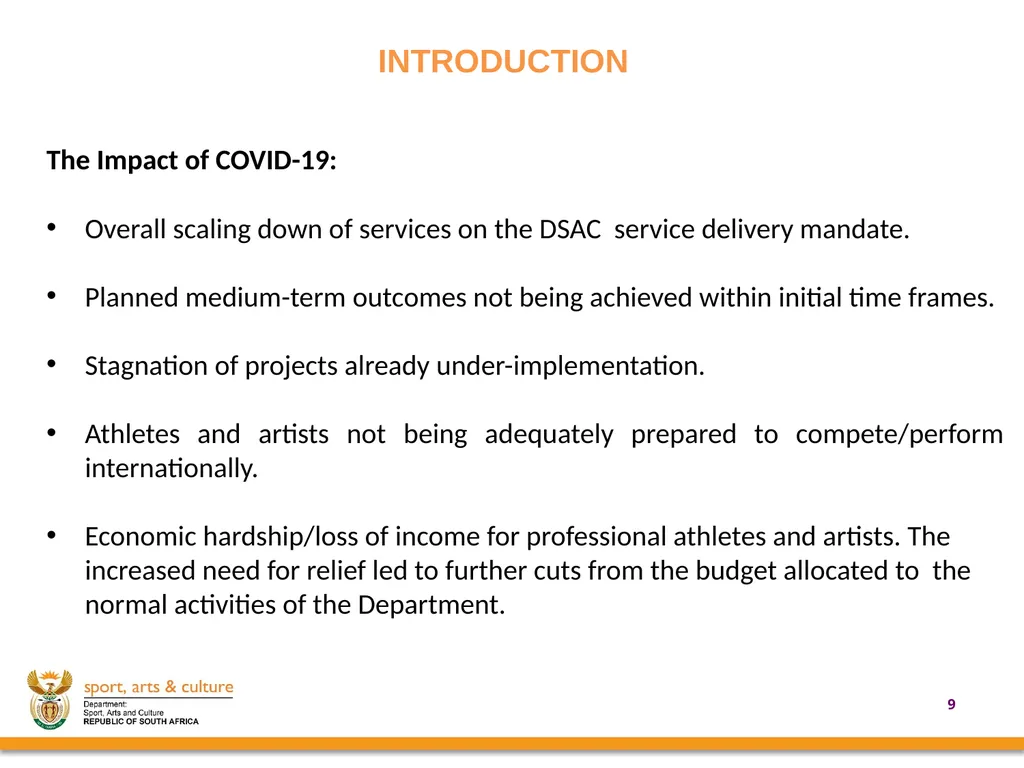
INTRODUCTION The Impact of COVID-19:
Overall scaling down of services on the DSAC service delivery mandate.
Planned medium-term outcomes not being achieved within initial time frames.
Stagnation of projects already under-implementation.
Athletes and artists not being adequately prepared to compete/perform internationally.
Economic hardship/loss of income for professional athletes and artists. The increased need for relief led to further cuts from the budget allocated to the normal activities of the Department. 9<br>
Overall scaling down of services on the DSAC service delivery mandate.
Planned medium-term outcomes not being achieved within initial time frames.
Stagnation of projects already under-implementation.
Athletes and artists not being adequately prepared to compete/perform internationally.
Economic hardship/loss of income for professional athletes and artists. The increased need for relief led to further cuts from the budget allocated to the normal activities of the Department. 9<br>
10
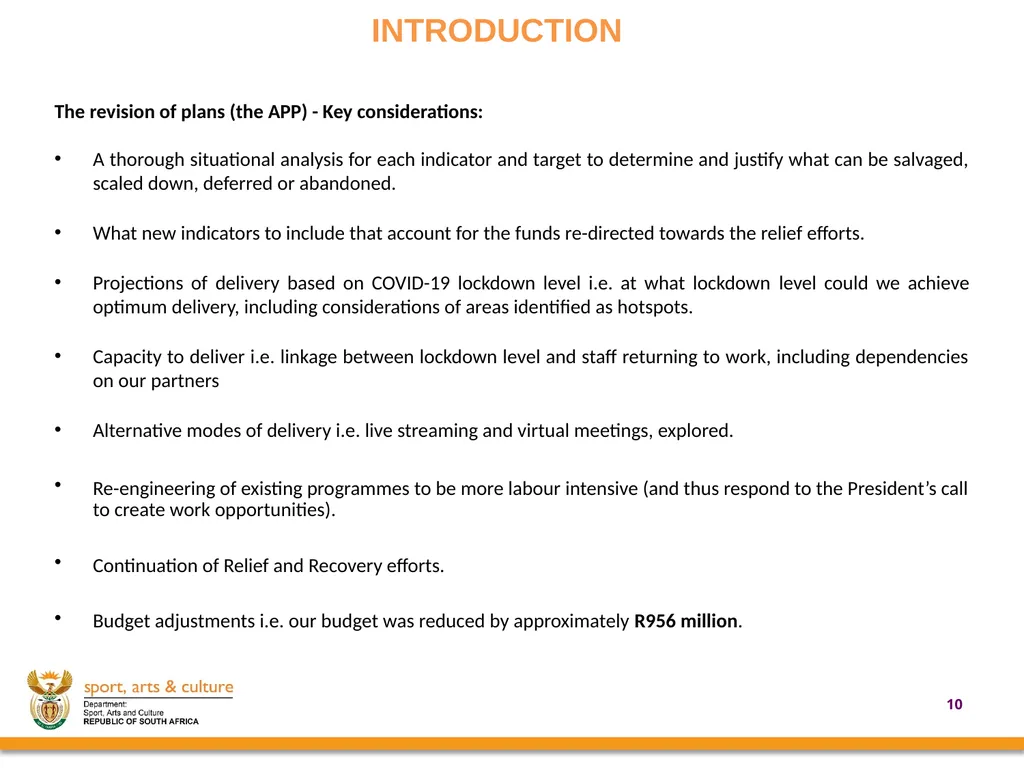
INTRODUCTION The revision of plans (the APP) - Key considerations:
A thorough situational analysis for each indicator and target to determine and justify what can be salvaged, scaled down, deferred or abandoned.
What new indicators to include that account for the funds re-directed towards the relief efforts.
Projections of delivery based on COVID-19 lockdown level i.e. at what lockdown level could we achieve optimum delivery, including considerations of areas identified as hotspots.
Capacity to deliver i.e. linkage between lockdown level and staff returning to work, including dependencies on our partners
Alternative modes of delivery i.e. live streaming and virtual meetings, explored.
Re-engineering of existing programmes to be more labour intensive (and thus respond to the President’s call to create work opportunities).
Continuation of Relief and Recovery efforts.
Budget adjustments i.e. our budget was reduced by approximately R956 million. 10<br>
A thorough situational analysis for each indicator and target to determine and justify what can be salvaged, scaled down, deferred or abandoned.
What new indicators to include that account for the funds re-directed towards the relief efforts.
Projections of delivery based on COVID-19 lockdown level i.e. at what lockdown level could we achieve optimum delivery, including considerations of areas identified as hotspots.
Capacity to deliver i.e. linkage between lockdown level and staff returning to work, including dependencies on our partners
Alternative modes of delivery i.e. live streaming and virtual meetings, explored.
Re-engineering of existing programmes to be more labour intensive (and thus respond to the President’s call to create work opportunities).
Continuation of Relief and Recovery efforts.
Budget adjustments i.e. our budget was reduced by approximately R956 million. 10<br>
11
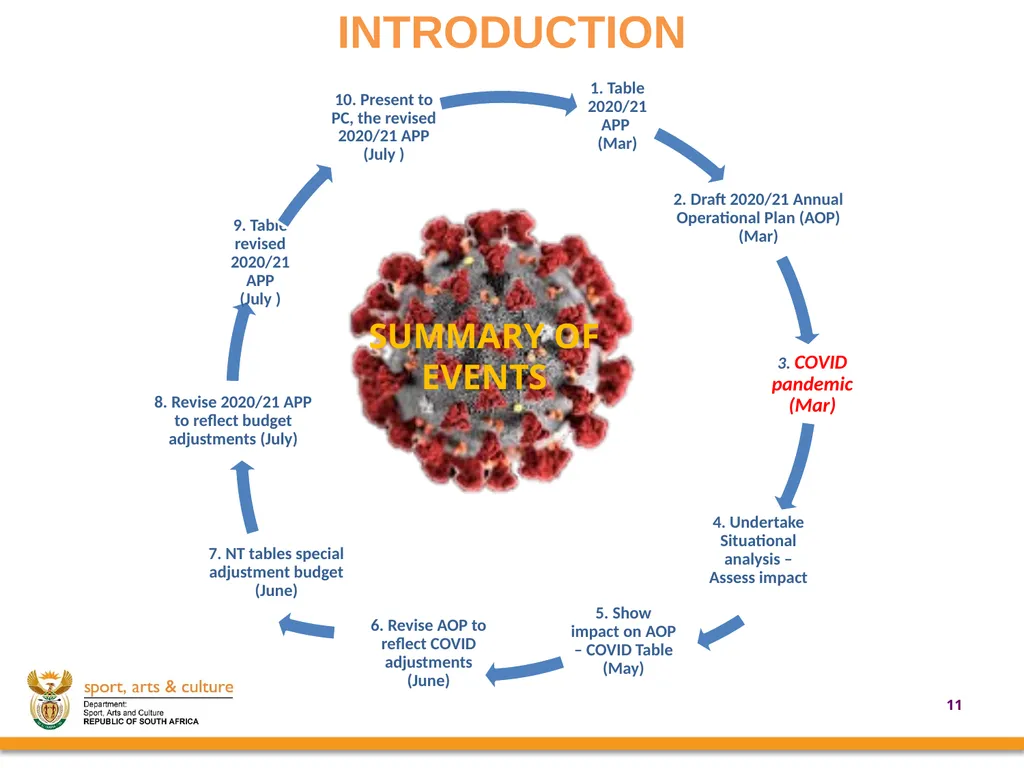
11 INTRODUCTION SUMMARY OF EVENTS<br>
12
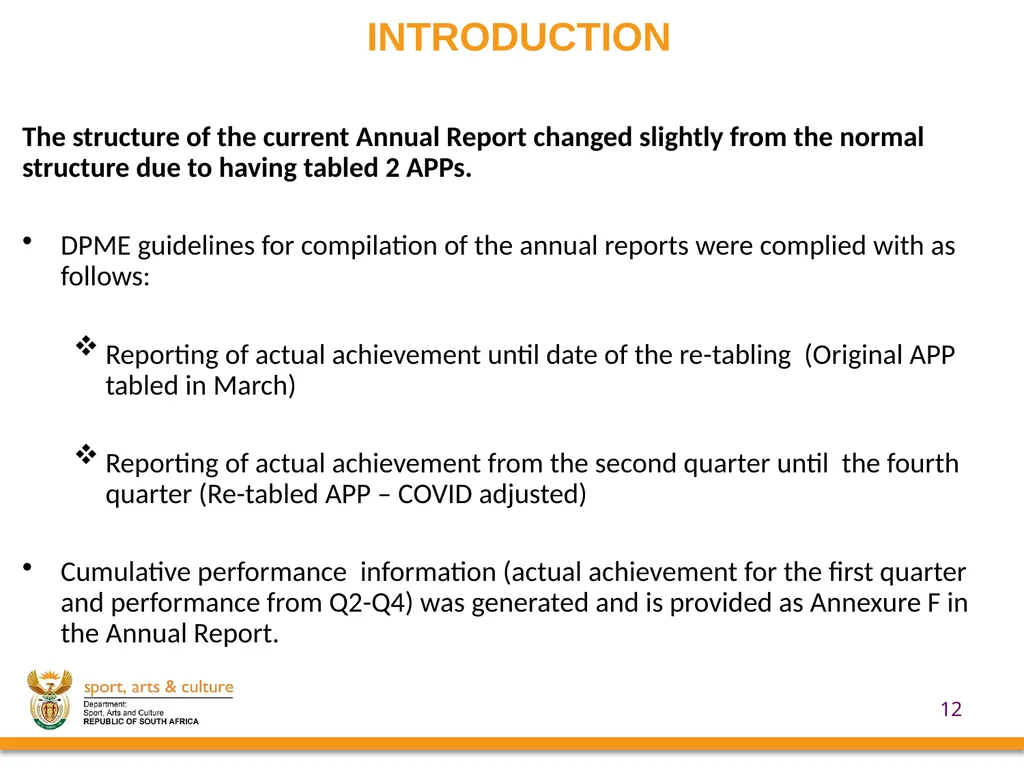
INTRODUCTION The structure of the current Annual Report changed slightly from the normal structure due to having tabled 2 APPs.
DPME guidelines for compilation of the annual reports were complied with as follows:
Reporting of actual achievement until date of the re-tabling (Original APP tabled in March)
Reporting of actual achievement from the second quarter until the fourth quarter (Re-tabled APP – COVID adjusted)
Cumulative performance information (actual achievement for the first quarter and performance from Q2-Q4) was generated and is provided as Annexure F in the Annual Report. 12<br>
DPME guidelines for compilation of the annual reports were complied with as follows:
Reporting of actual achievement until date of the re-tabling (Original APP tabled in March)
Reporting of actual achievement from the second quarter until the fourth quarter (Re-tabled APP – COVID adjusted)
Cumulative performance information (actual achievement for the first quarter and performance from Q2-Q4) was generated and is provided as Annexure F in the Annual Report. 12<br>
13
Performance overview<br>
14
PERFORMANCE OVERVIEW 14<br>
15
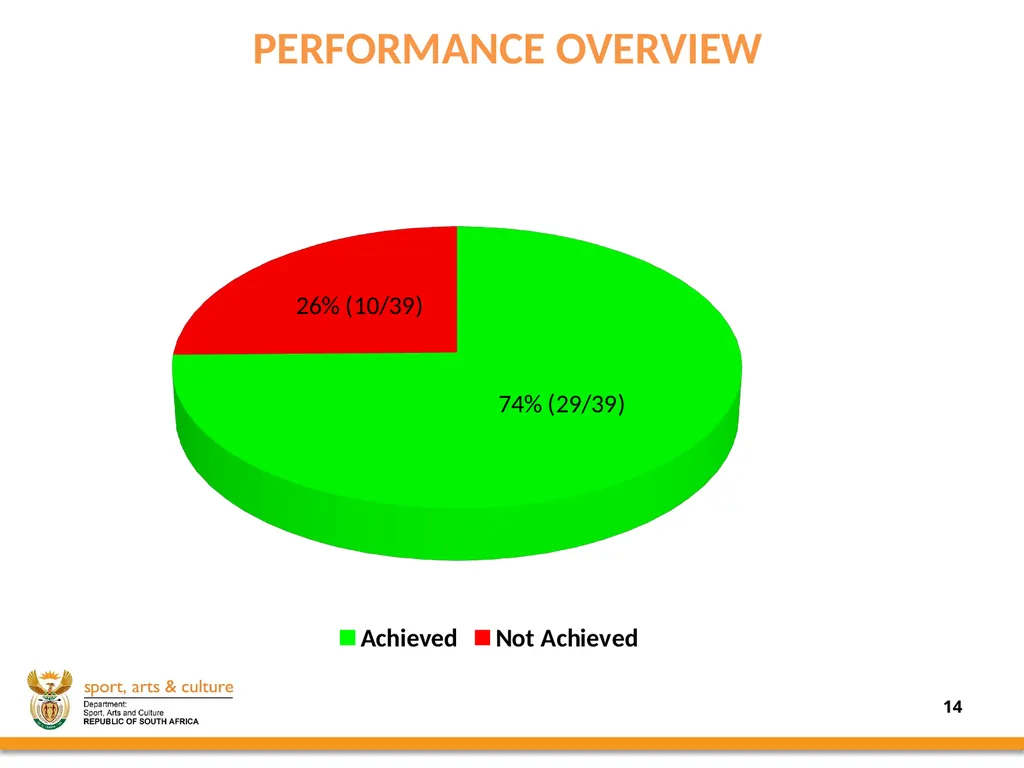
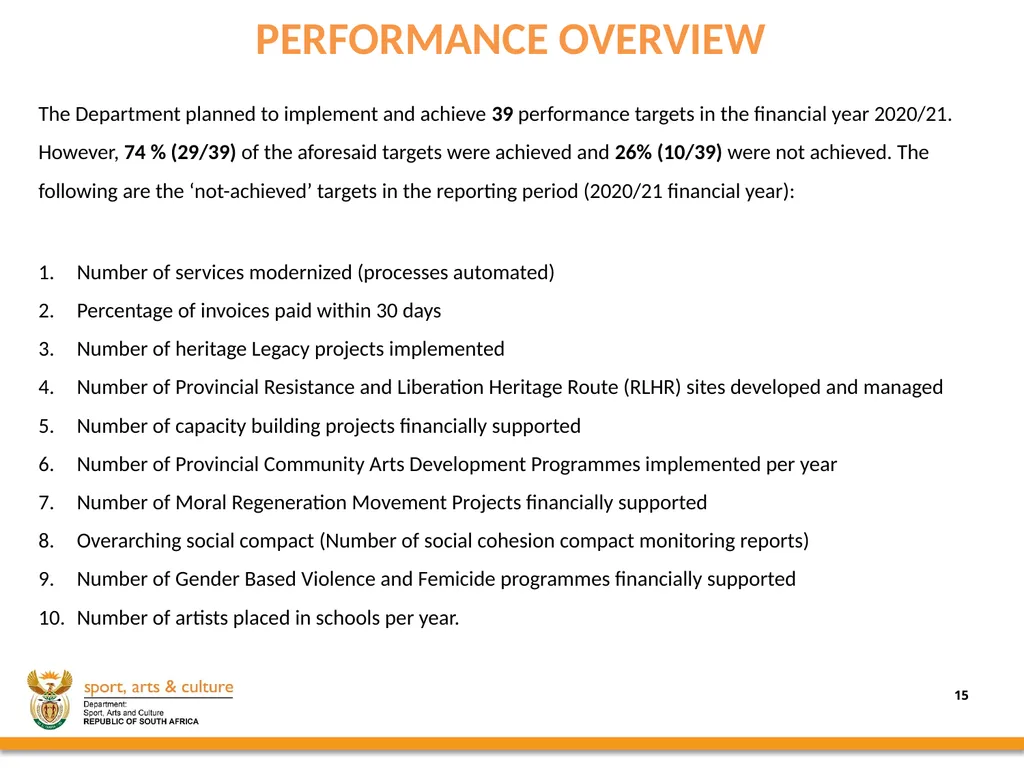
The Department planned to implement and achieve 39 performance targets in the financial year 2020/21. However, 74 % (29/39) of the aforesaid targets were achieved and 26% (10/39) were not achieved. The following are the ‘not-achieved’ targets in the reporting period (2020/21 financial year):
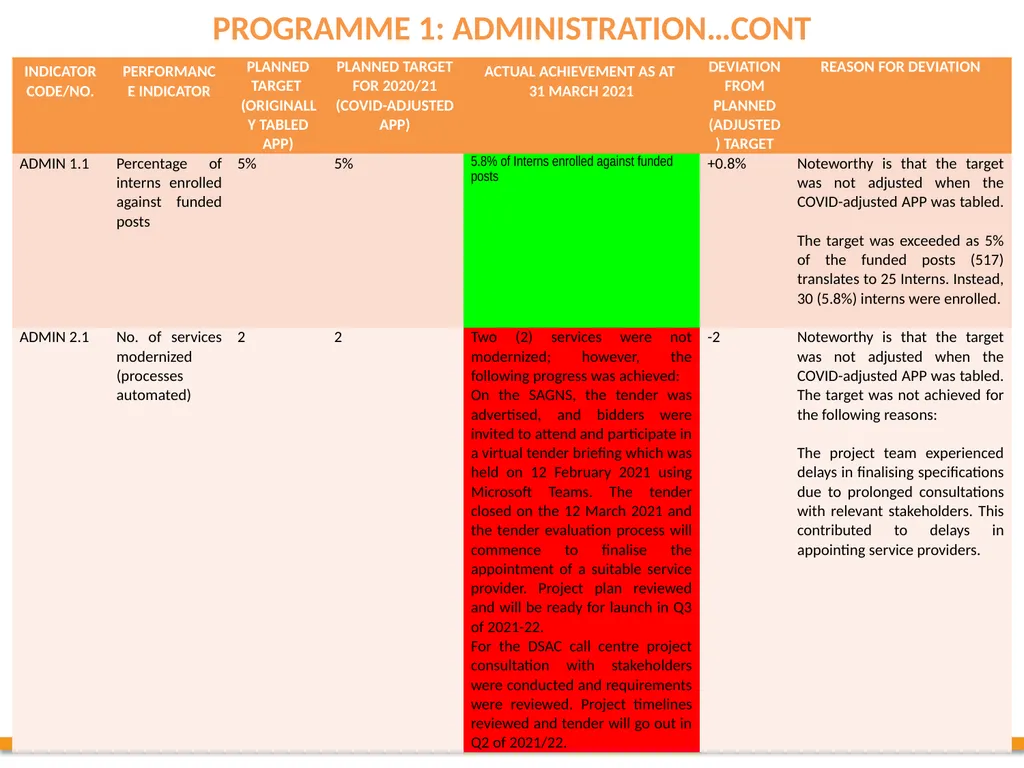
Number of services modernized (processes automated)
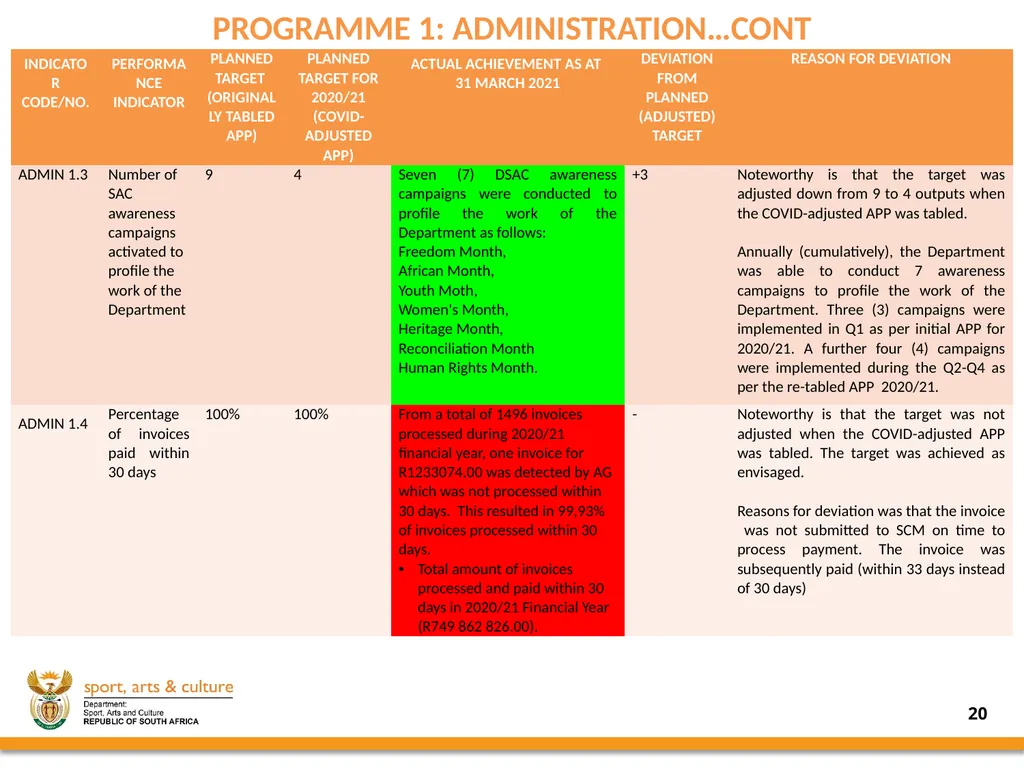
Percentage of invoices paid within 30 days
Number of heritage Legacy projects implemented
Number of Provincial Resistance and Liberation Heritage Route (RLHR) sites developed and managed
Number of capacity building projects financially supported
Number of Provincial Community Arts Development Programmes implemented per year
Number of Moral Regeneration Movement Projects financially supported
Overarching social compact (Number of social cohesion compact monitoring reports)
Number of Gender Based Violence and Femicide programmes financially supported
Number of artists placed in schools per year. 15 PERFORMANCE OVERVIEW<br>
Number of services modernized (processes automated)
Percentage of invoices paid within 30 days
Number of heritage Legacy projects implemented
Number of Provincial Resistance and Liberation Heritage Route (RLHR) sites developed and managed
Number of capacity building projects financially supported
Number of Provincial Community Arts Development Programmes implemented per year
Number of Moral Regeneration Movement Projects financially supported
Overarching social compact (Number of social cohesion compact monitoring reports)
Number of Gender Based Violence and Femicide programmes financially supported
Number of artists placed in schools per year. 15 PERFORMANCE OVERVIEW<br>
16
Overview of Programme-Specific Performance<br>
17
PROGRAMME-SPECIFIC PERFORMANCE 17<br>
18
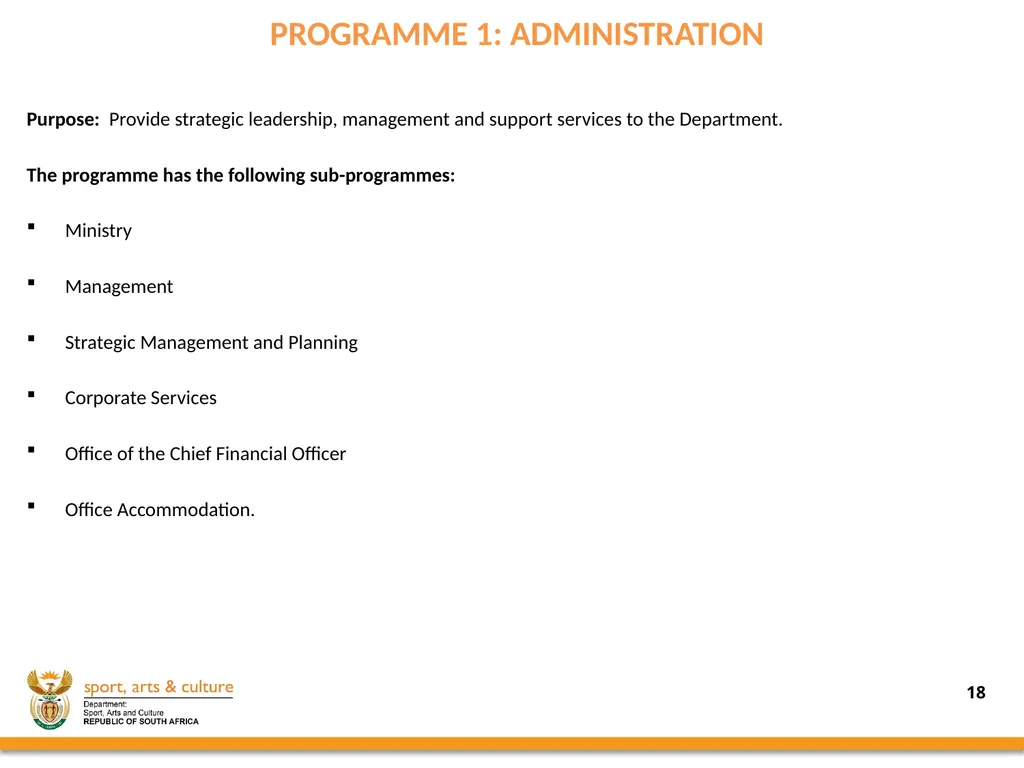
PROGRAMME 1: ADMINISTRATION 18 Purpose: Provide strategic leadership, management and support services to the Department.
The programme has the following sub-programmes:
Ministry
Management
Strategic Management and Planning
Corporate Services
Office of the Chief Financial Officer
Office Accommodation.<br>
The programme has the following sub-programmes:
Ministry
Management
Strategic Management and Planning
Corporate Services
Office of the Chief Financial Officer
Office Accommodation.<br>
19
PROGRAMME 1: ADMINISTRATION…CONT 19<br>
20
PROGRAMME 1: ADMINISTRATION…CONT 20<br>
21
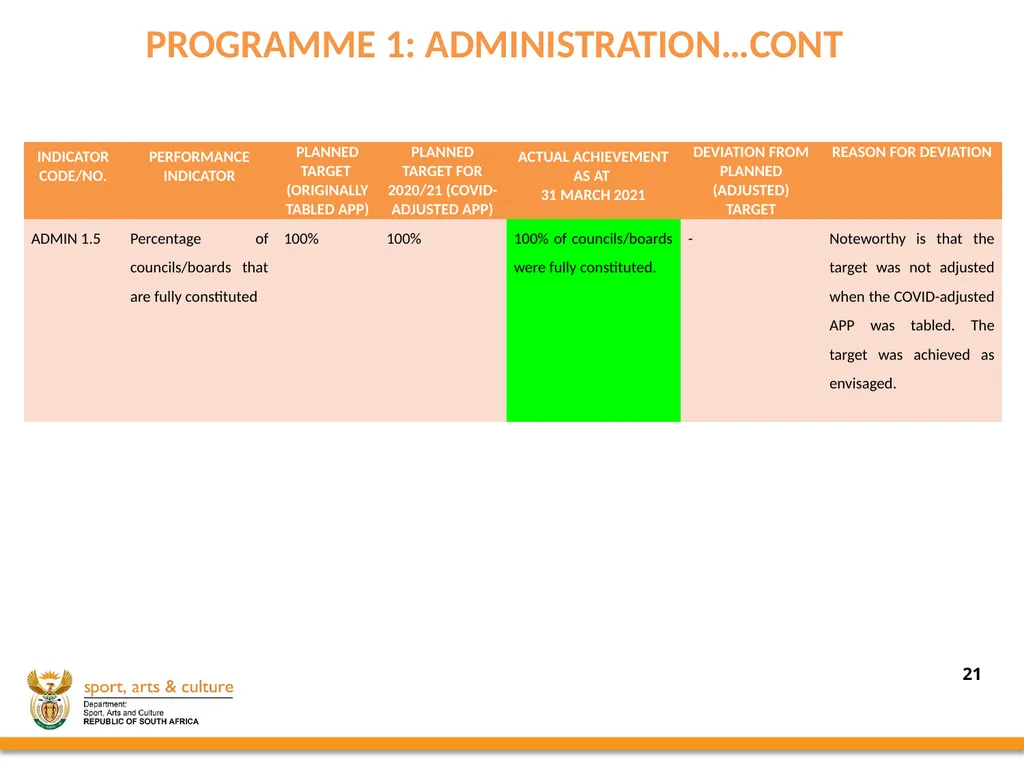
PROGRAMME 1: ADMINISTRATION…CONT 21<br>
22
PROGRAMME 2:
RECREATION DEVELOPMENT AND SPORT PROMOTION<br>
RECREATION DEVELOPMENT AND SPORT PROMOTION<br>
23
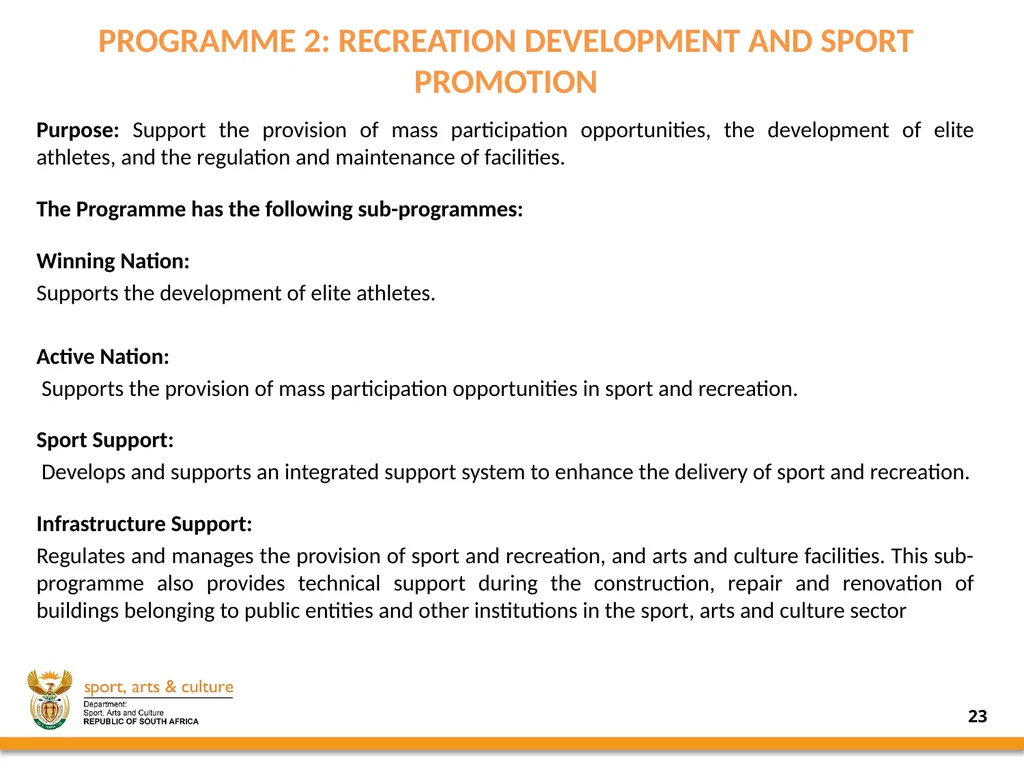
PROGRAMME 2: RECREATION DEVELOPMENT AND SPORT PROMOTION 23 Purpose: Support the provision of mass participation opportunities, the development of elite athletes, and the regulation and maintenance of facilities.
The Programme has the following sub-programmes:
Winning Nation:
Supports the development of elite athletes.
Active Nation:
Supports the provision of mass participation opportunities in sport and recreation.
Sport Support:
Develops and supports an integrated support system to enhance the delivery of sport and recreation.
Infrastructure Support:
Regulates and manages the provision of sport and recreation, and arts and culture facilities. This sub-programme also provides technical support during the construction, repair and renovation of buildings belonging to public entities and other institutions in the sport, arts and culture sector<br>
The Programme has the following sub-programmes:
Winning Nation:
Supports the development of elite athletes.
Active Nation:
Supports the provision of mass participation opportunities in sport and recreation.
Sport Support:
Develops and supports an integrated support system to enhance the delivery of sport and recreation.
Infrastructure Support:
Regulates and manages the provision of sport and recreation, and arts and culture facilities. This sub-programme also provides technical support during the construction, repair and renovation of buildings belonging to public entities and other institutions in the sport, arts and culture sector<br>
24
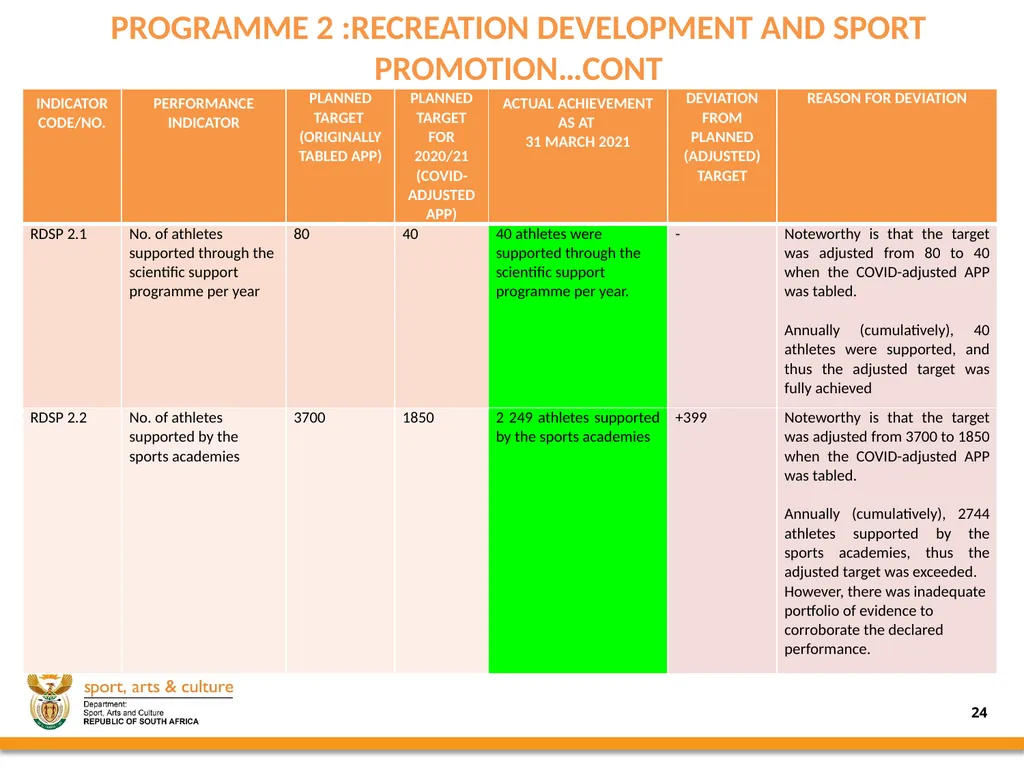
PROGRAMME 2 :RECREATION DEVELOPMENT AND SPORT PROMOTION…CONT 24<br>
25
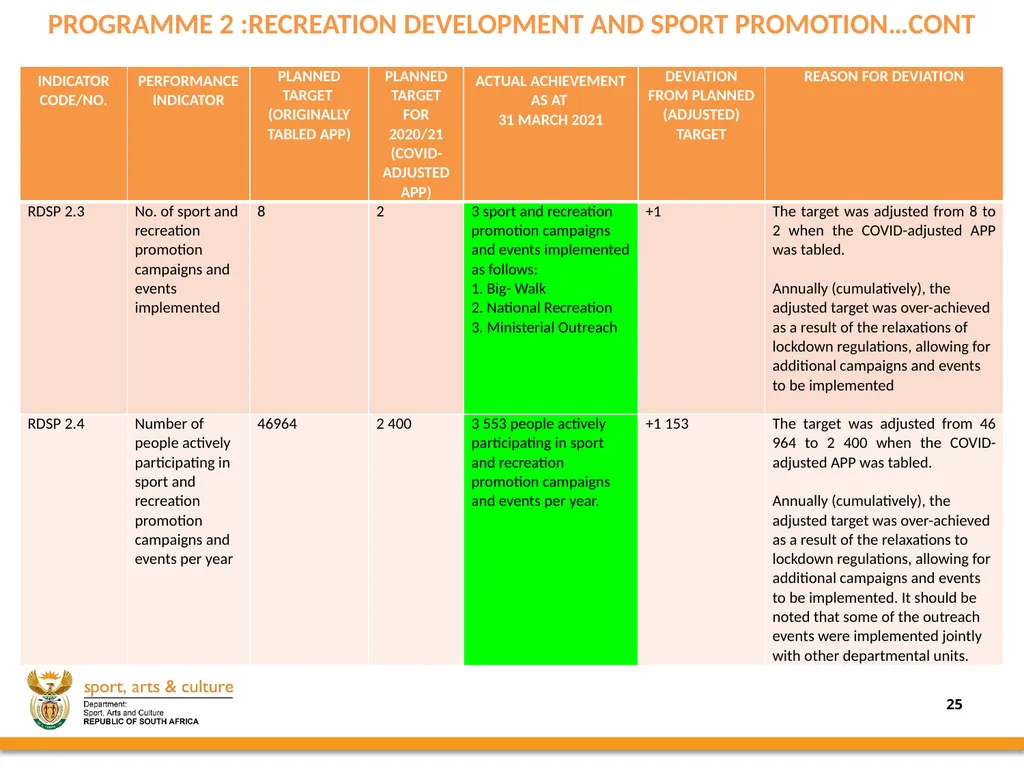
25 PROGRAMME 2 :RECREATION DEVELOPMENT AND SPORT PROMOTION…CONT<br>
26
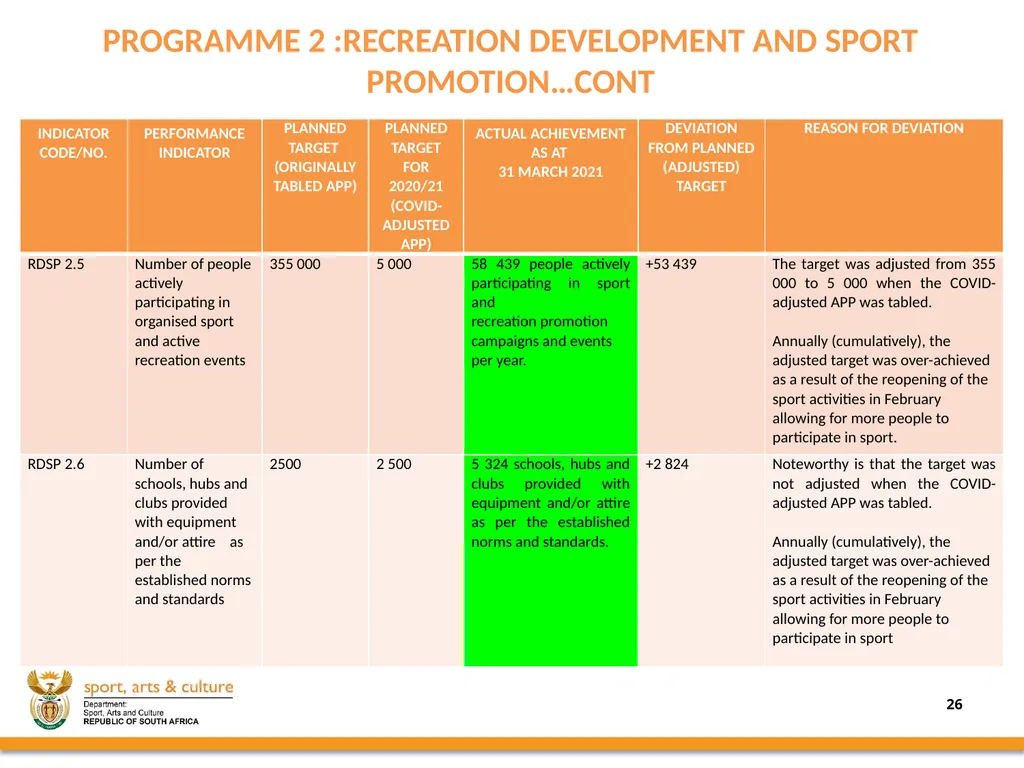
26 PROGRAMME 2 :RECREATION DEVELOPMENT AND SPORT PROMOTION…CONT<br>
27
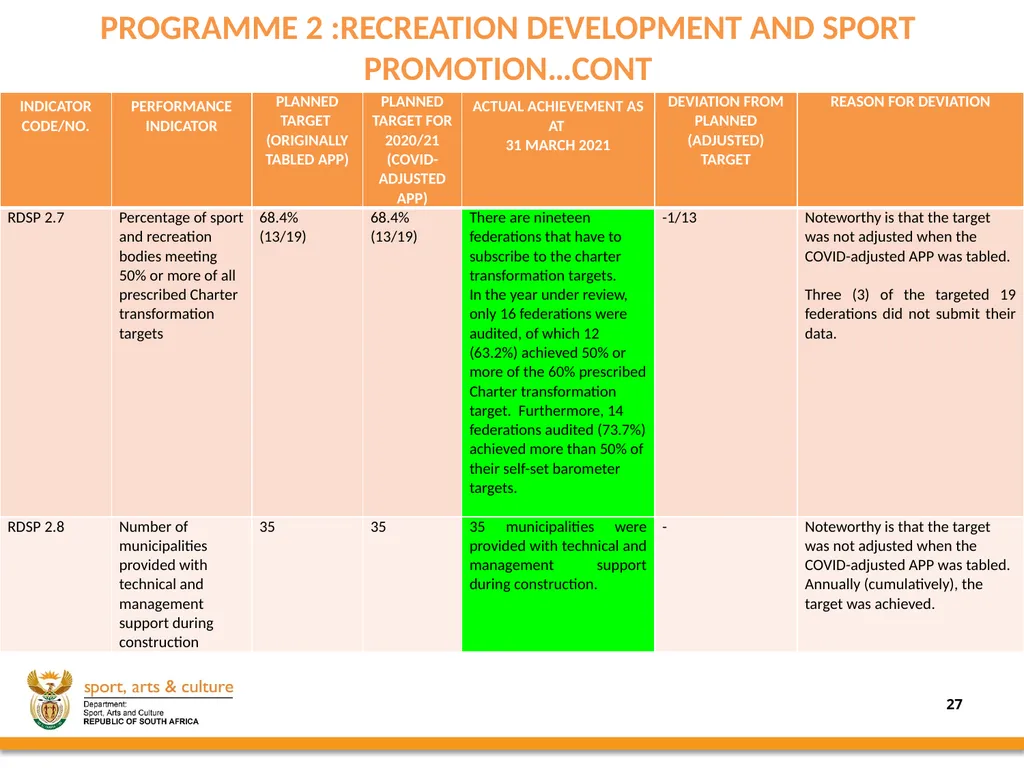
27 PROGRAMME 2 :RECREATION DEVELOPMENT AND SPORT PROMOTION…CONT<br>
28
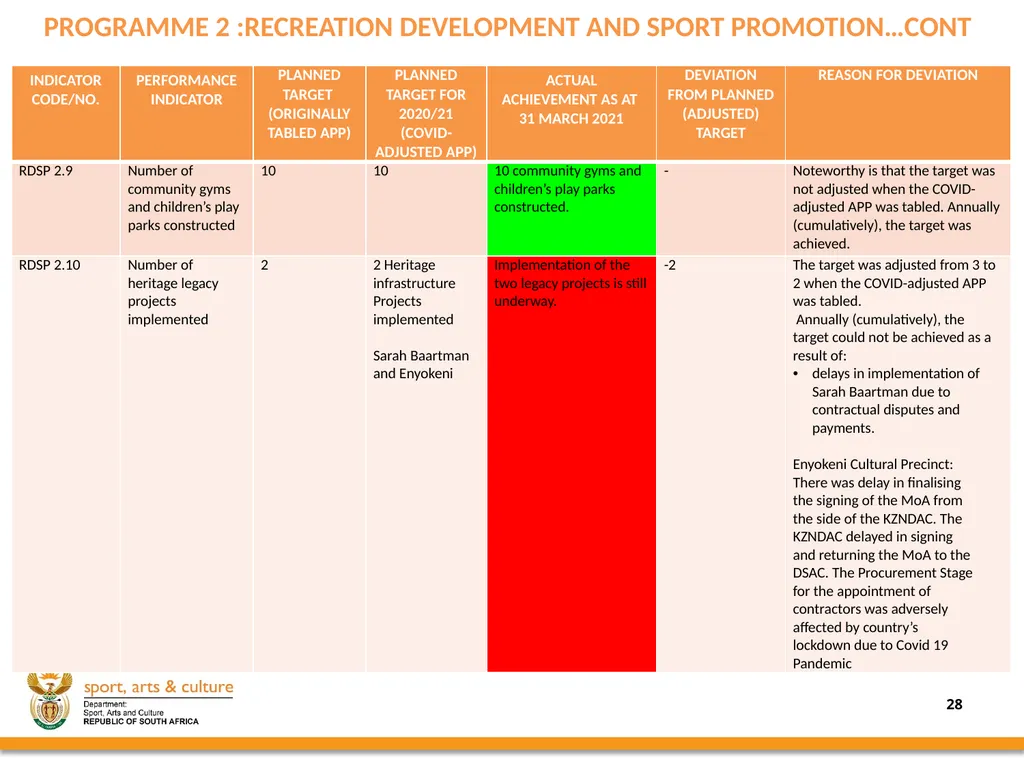
28 PROGRAMME 2 :RECREATION DEVELOPMENT AND SPORT PROMOTION…CONT<br>
29
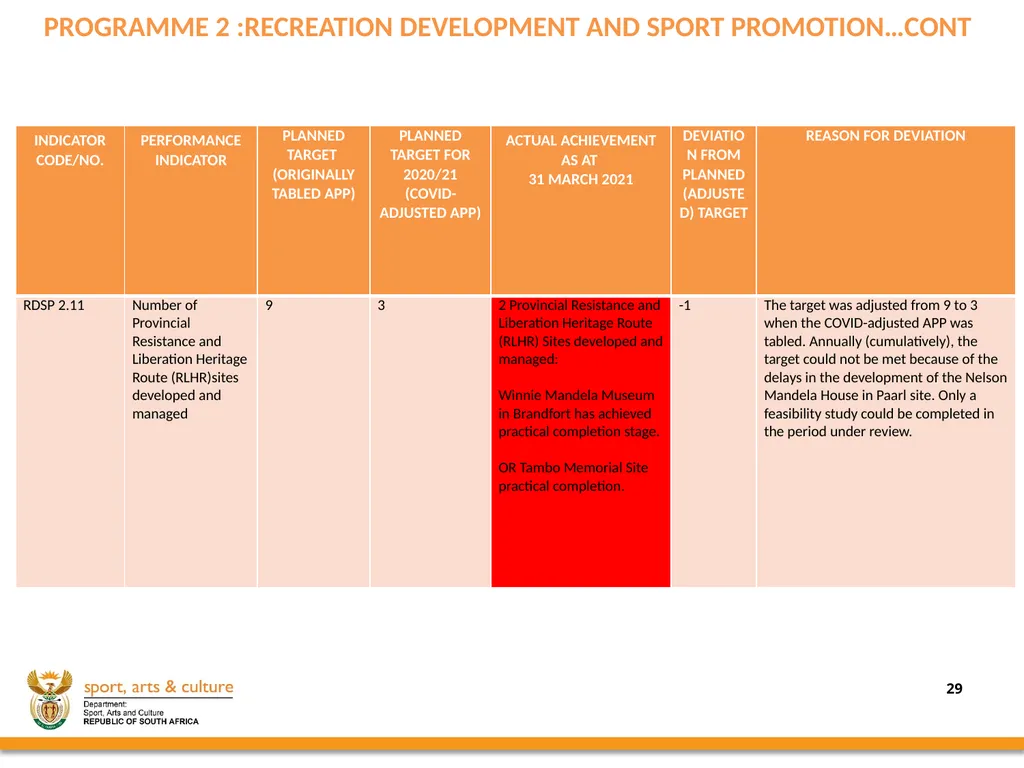
29 PROGRAMME 2 :RECREATION DEVELOPMENT AND SPORT PROMOTION…CONT<br>
30
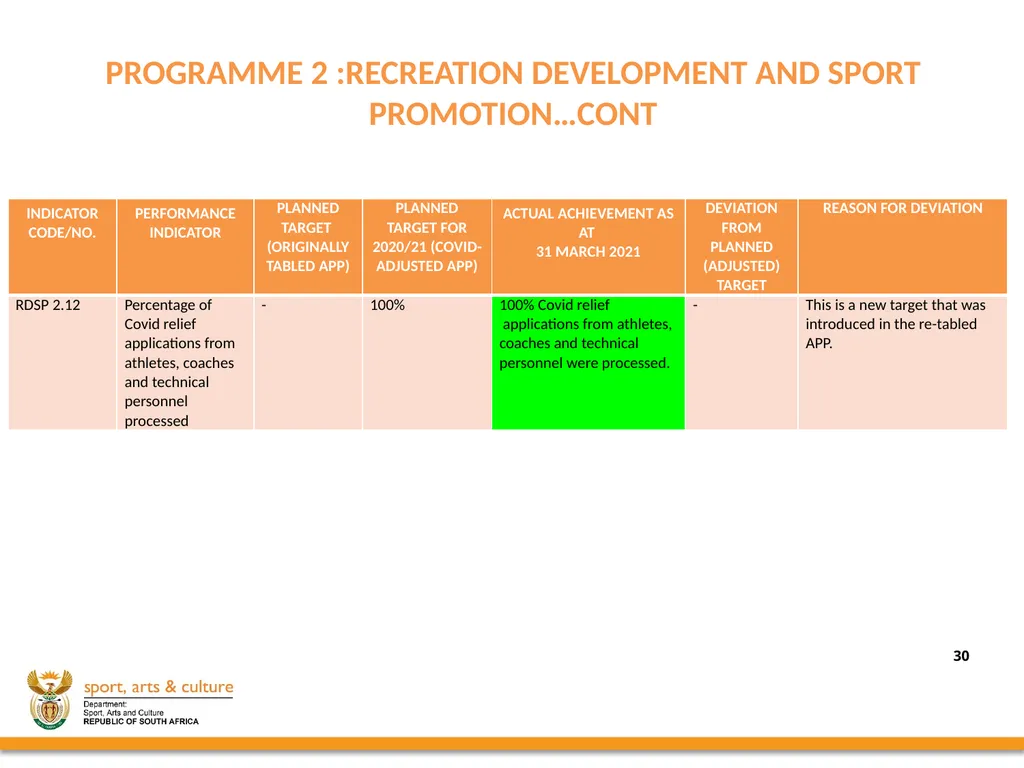
30 PROGRAMME 2 :RECREATION DEVELOPMENT AND SPORT PROMOTION…CONT<br>
31
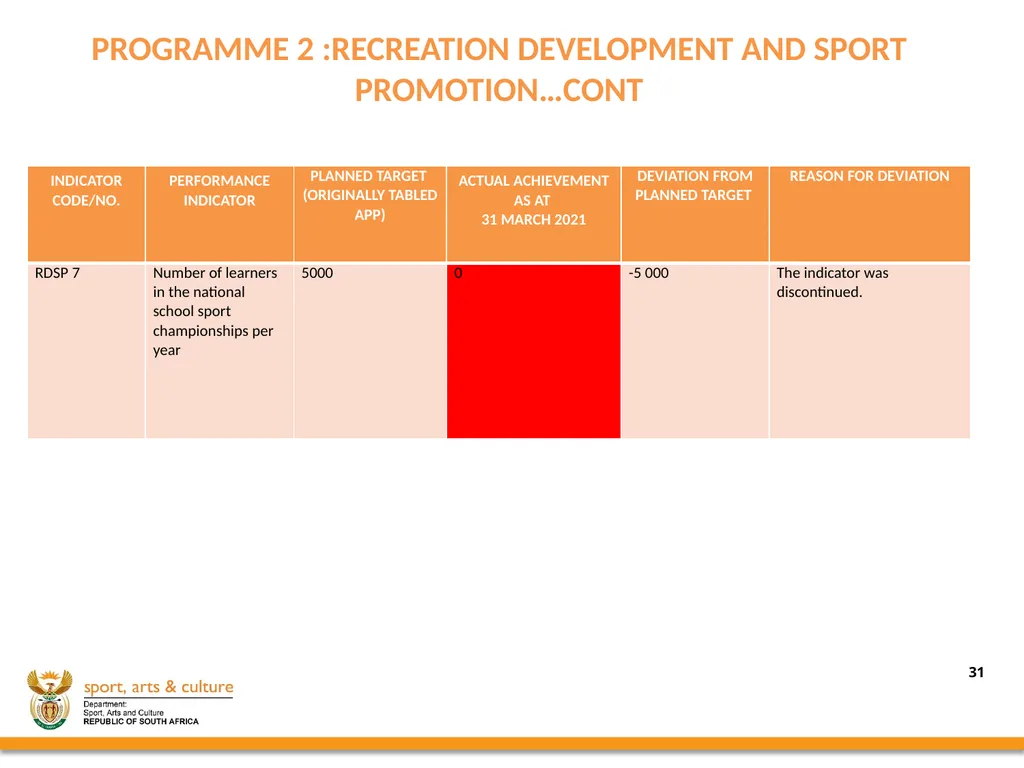
31 PROGRAMME 2 :RECREATION DEVELOPMENT AND SPORT PROMOTION…CONT<br>
32
PROGRAMME 3:
ARTS AND CULTURE PROMOTION AND DEVELOPMENT<br>
ARTS AND CULTURE PROMOTION AND DEVELOPMENT<br>
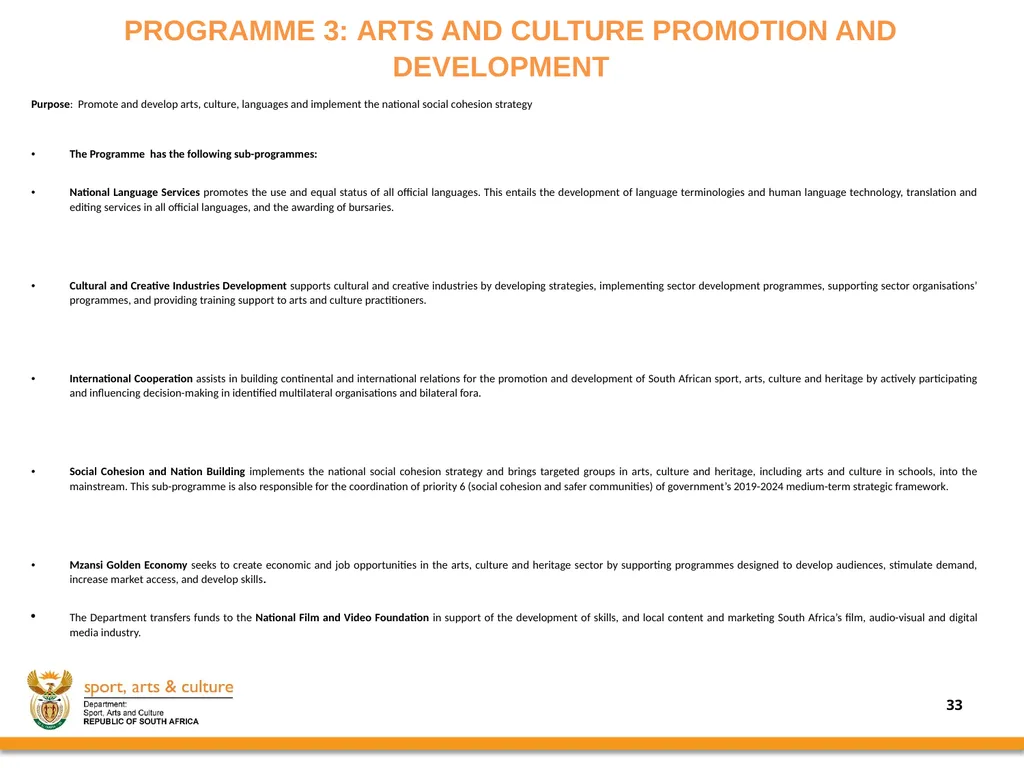
33
Purpose: Promote and develop arts, culture, languages and implement the national social cohesion strategy
The Programme has the following sub-programmes:
National Language Services promotes the use and equal status of all official languages. This entails the development of language terminologies and human language technology, translation and editing services in all official languages, and the awarding of bursaries.
Cultural and Creative Industries Development supports cultural and creative industries by developing strategies, implementing sector development programmes, supporting sector organisations’ programmes, and providing training support to arts and culture practitioners.
International Cooperation assists in building continental and international relations for the promotion and development of South African sport, arts, culture and heritage by actively participating and influencing decision-making in identified multilateral organisations and bilateral fora.
Social Cohesion and Nation Building implements the national social cohesion strategy and brings targeted groups in arts, culture and heritage, including arts and culture in schools, into the mainstream. This sub-programme is also responsible for the coordination of priority 6 (social cohesion and safer communities) of government’s 2019-2024 medium-term strategic framework.
Mzansi Golden Economy seeks to create economic and job opportunities in the arts, culture and heritage sector by supporting programmes designed to develop audiences, stimulate demand, increase market access, and develop skills.
The Department transfers funds to the National Film and Video Foundation in support of the development of skills, and local content and marketing South Africa’s film, audio-visual and digital media industry. 33 PROGRAMME 3: ARTS AND CULTURE PROMOTION AND DEVELOPMENT<br>
The Programme has the following sub-programmes:
National Language Services promotes the use and equal status of all official languages. This entails the development of language terminologies and human language technology, translation and editing services in all official languages, and the awarding of bursaries.
Cultural and Creative Industries Development supports cultural and creative industries by developing strategies, implementing sector development programmes, supporting sector organisations’ programmes, and providing training support to arts and culture practitioners.
International Cooperation assists in building continental and international relations for the promotion and development of South African sport, arts, culture and heritage by actively participating and influencing decision-making in identified multilateral organisations and bilateral fora.
Social Cohesion and Nation Building implements the national social cohesion strategy and brings targeted groups in arts, culture and heritage, including arts and culture in schools, into the mainstream. This sub-programme is also responsible for the coordination of priority 6 (social cohesion and safer communities) of government’s 2019-2024 medium-term strategic framework.
Mzansi Golden Economy seeks to create economic and job opportunities in the arts, culture and heritage sector by supporting programmes designed to develop audiences, stimulate demand, increase market access, and develop skills.
The Department transfers funds to the National Film and Video Foundation in support of the development of skills, and local content and marketing South Africa’s film, audio-visual and digital media industry. 33 PROGRAMME 3: ARTS AND CULTURE PROMOTION AND DEVELOPMENT<br>
34
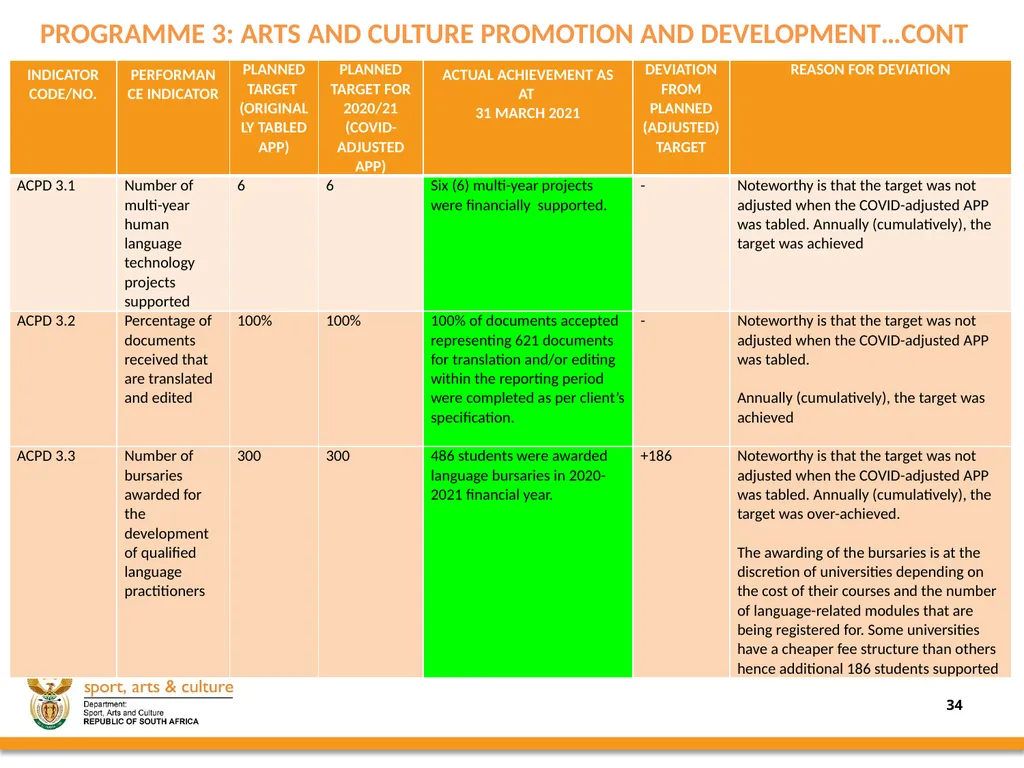
34 PROGRAMME 3: ARTS AND CULTURE PROMOTION AND DEVELOPMENT…CONT<br>
35
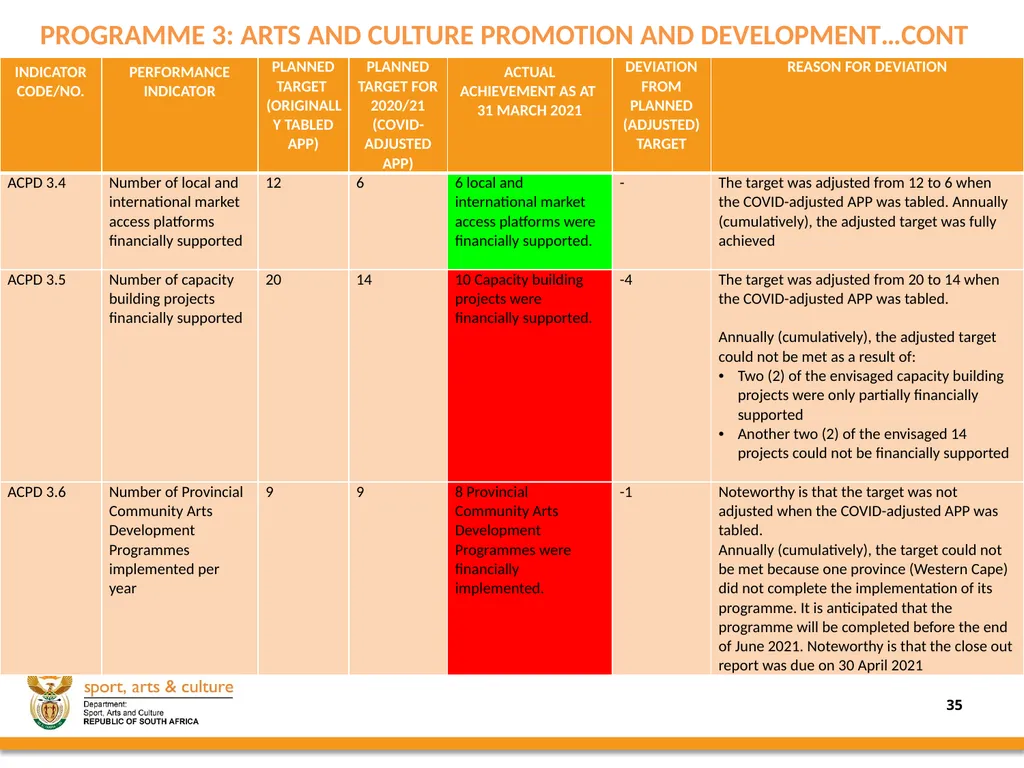
35 PROGRAMME 3: ARTS AND CULTURE PROMOTION AND DEVELOPMENT…CONT<br>
36
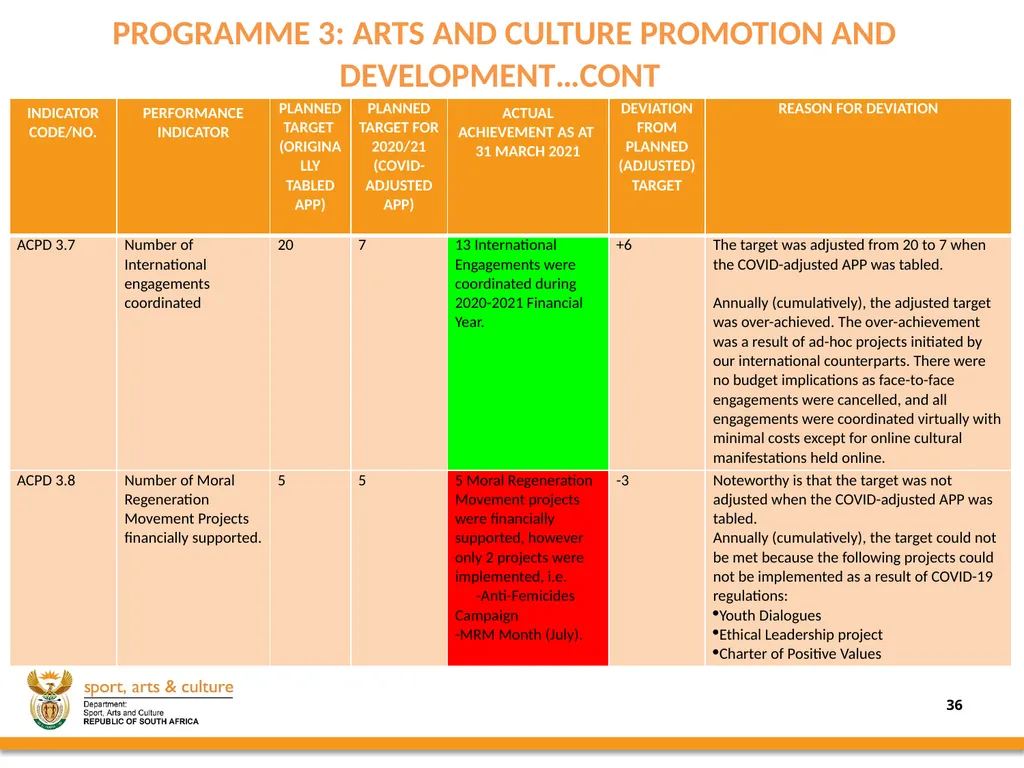
36 PROGRAMME 3: ARTS AND CULTURE PROMOTION AND DEVELOPMENT…CONT<br>
37
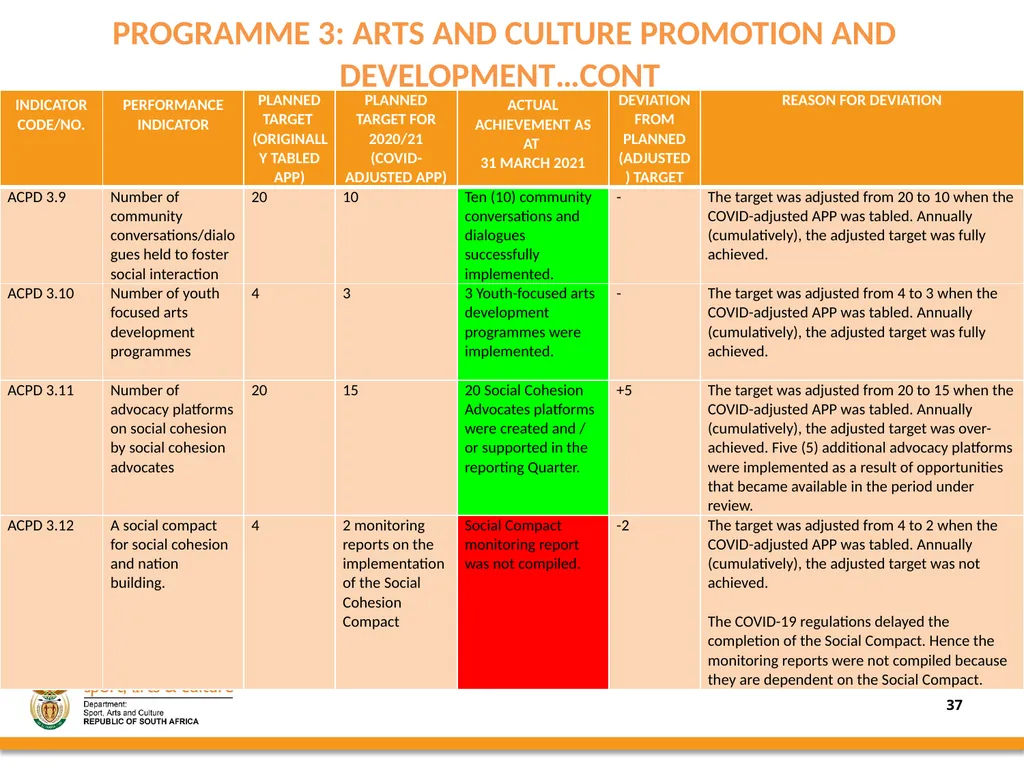
37 PROGRAMME 3: ARTS AND CULTURE PROMOTION AND DEVELOPMENT…CONT<br>
38
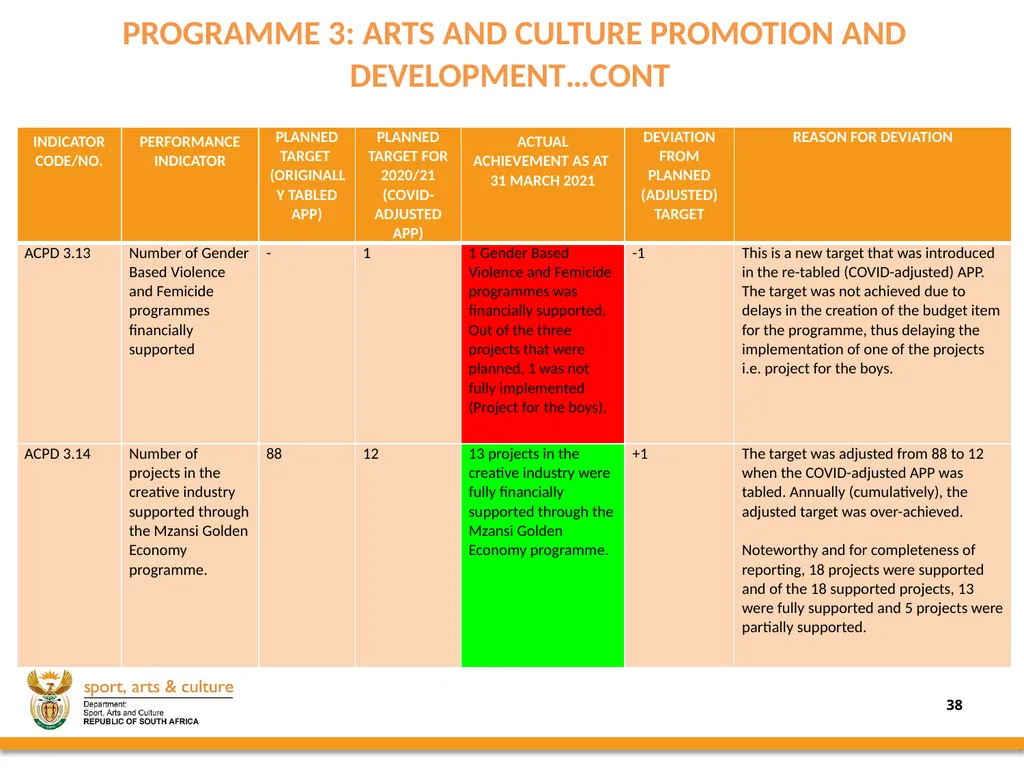
38 PROGRAMME 3: ARTS AND CULTURE PROMOTION AND DEVELOPMENT…CONT<br>
39
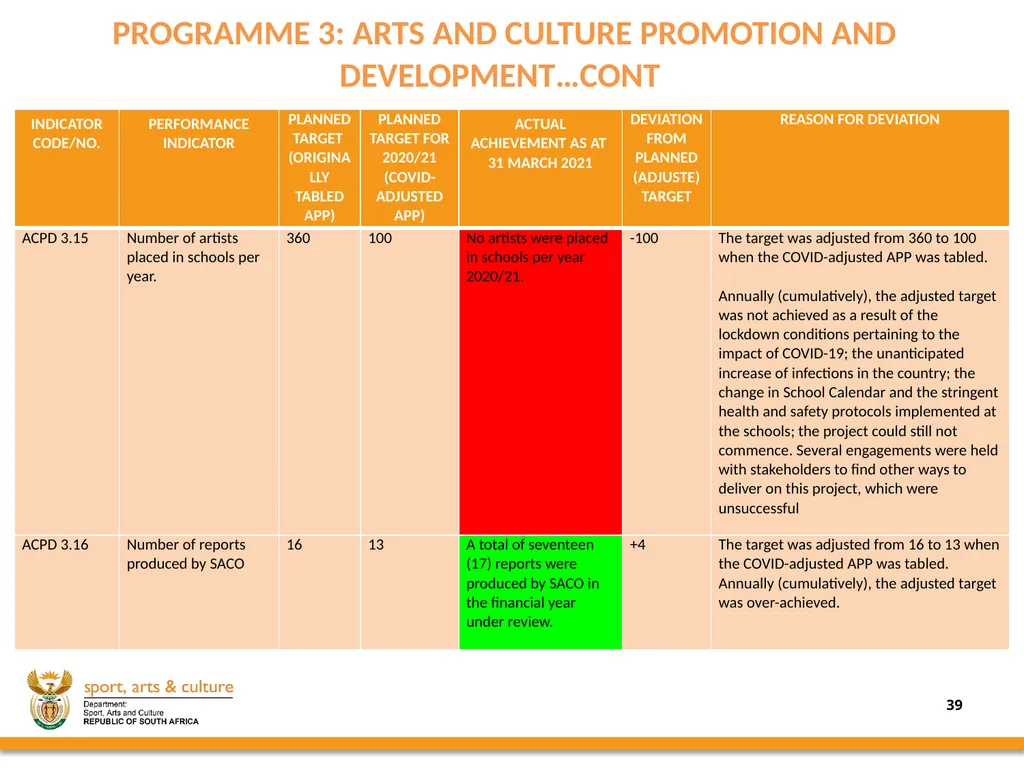
39 PROGRAMME 3: ARTS AND CULTURE PROMOTION AND DEVELOPMENT…CONT<br>
40
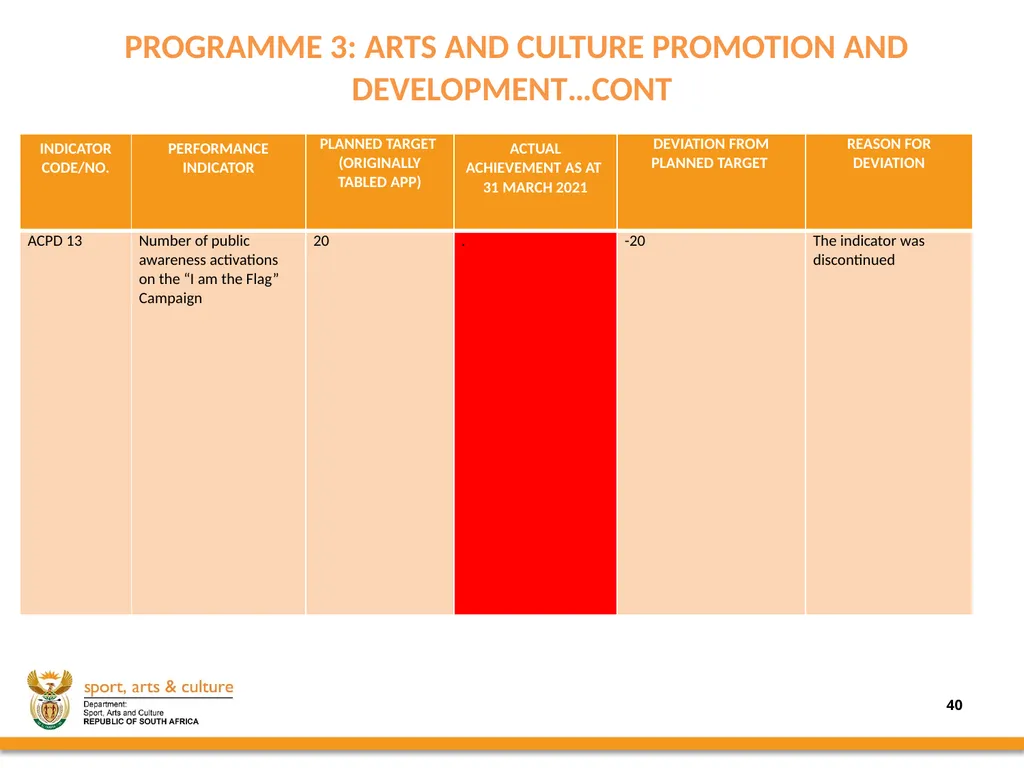
40 PROGRAMME 3: ARTS AND CULTURE PROMOTION AND DEVELOPMENT…CONT<br>
41
PROGRAMME 4:
HERITAGE PROMOTION AND PRESERVATION<br>
HERITAGE PROMOTION AND PRESERVATION<br>
42
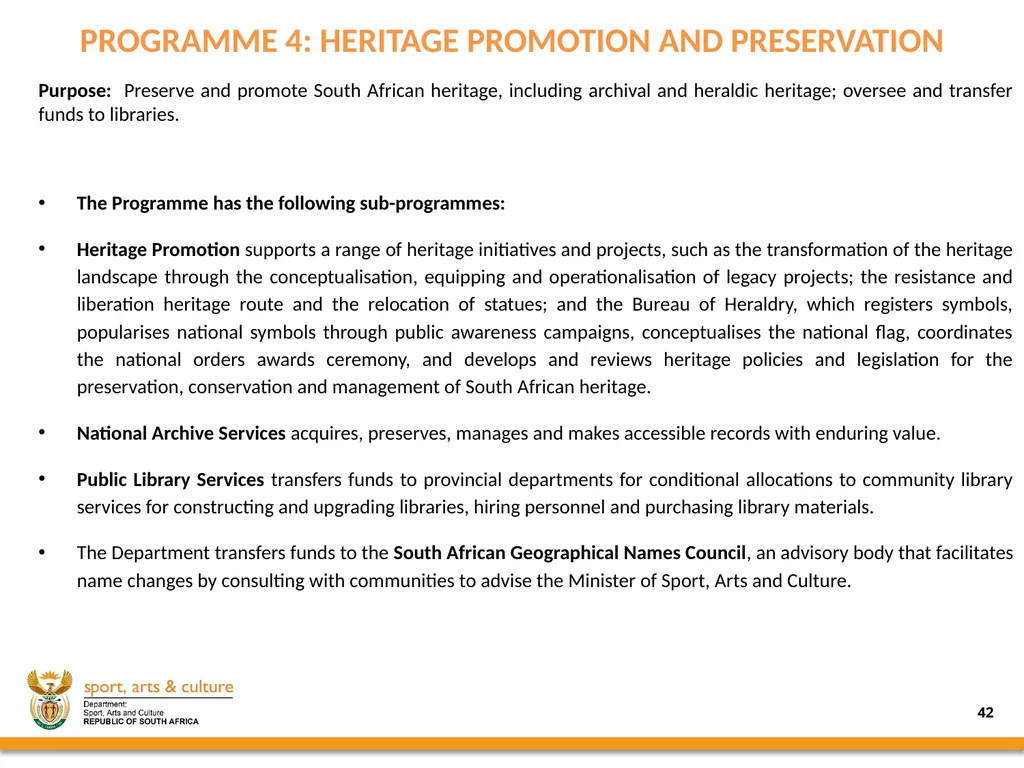
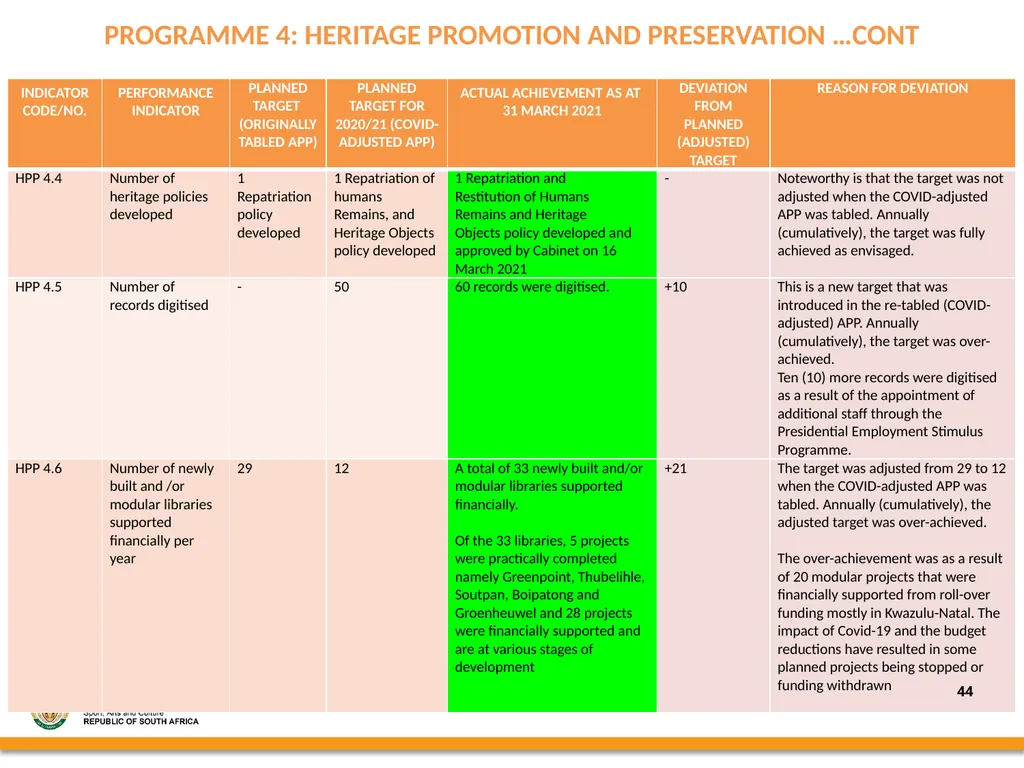
PROGRAMME 4: HERITAGE PROMOTION AND PRESERVATION 42 Purpose: Preserve and promote South African heritage, including archival and heraldic heritage; oversee and transfer funds to libraries.
The Programme has the following sub-programmes:
Heritage Promotion supports a range of heritage initiatives and projects, such as the transformation of the heritage landscape through the conceptualisation, equipping and operationalisation of legacy projects; the resistance and liberation heritage route and the relocation of statues; and the Bureau of Heraldry, which registers symbols, popularises national symbols through public awareness campaigns, conceptualises the national flag, coordinates the national orders awards ceremony, and develops and reviews heritage policies and legislation for the preservation, conservation and management of South African heritage.
National Archive Services acquires, preserves, manages and makes accessible records with enduring value.
Public Library Services transfers funds to provincial departments for conditional allocations to community library services for constructing and upgrading libraries, hiring personnel and purchasing library materials.
The Department transfers funds to the South African Geographical Names Council, an advisory body that facilitates name changes by consulting with communities to advise the Minister of Sport, Arts and Culture.<br>
The Programme has the following sub-programmes:
Heritage Promotion supports a range of heritage initiatives and projects, such as the transformation of the heritage landscape through the conceptualisation, equipping and operationalisation of legacy projects; the resistance and liberation heritage route and the relocation of statues; and the Bureau of Heraldry, which registers symbols, popularises national symbols through public awareness campaigns, conceptualises the national flag, coordinates the national orders awards ceremony, and develops and reviews heritage policies and legislation for the preservation, conservation and management of South African heritage.
National Archive Services acquires, preserves, manages and makes accessible records with enduring value.
Public Library Services transfers funds to provincial departments for conditional allocations to community library services for constructing and upgrading libraries, hiring personnel and purchasing library materials.
The Department transfers funds to the South African Geographical Names Council, an advisory body that facilitates name changes by consulting with communities to advise the Minister of Sport, Arts and Culture.<br>
43
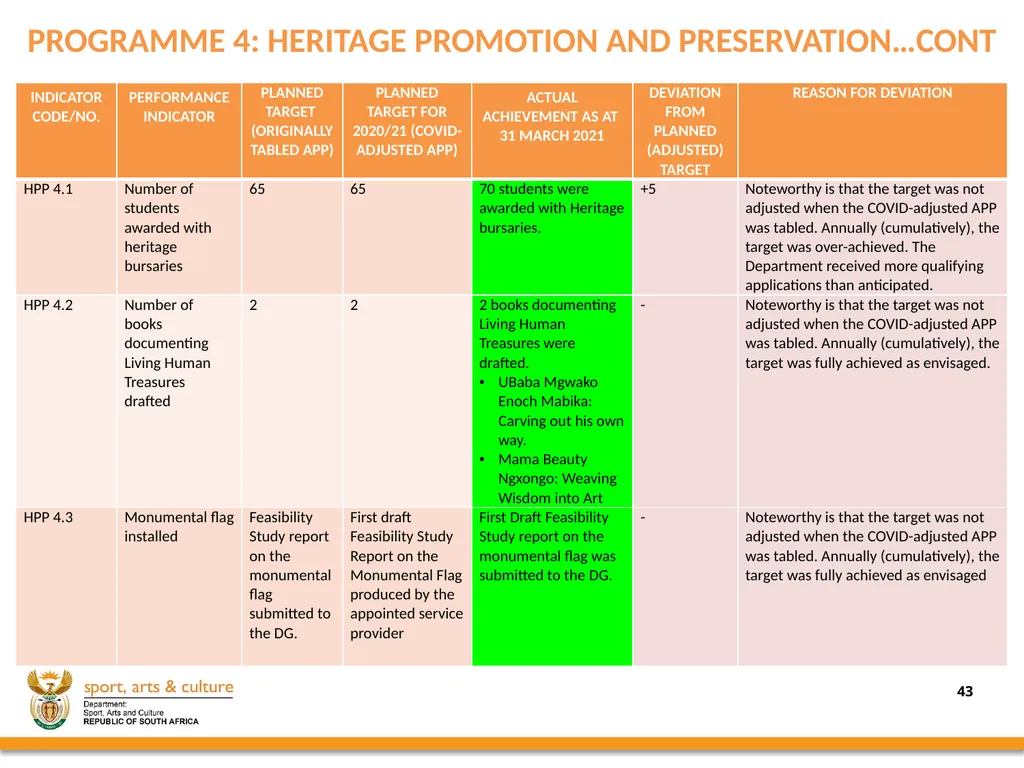
PROGRAMME 4: HERITAGE PROMOTION AND PRESERVATION…CONT 43<br>
44
PROGRAMME 4: HERITAGE PROMOTION AND PRESERVATION …CONT 44<br>
45
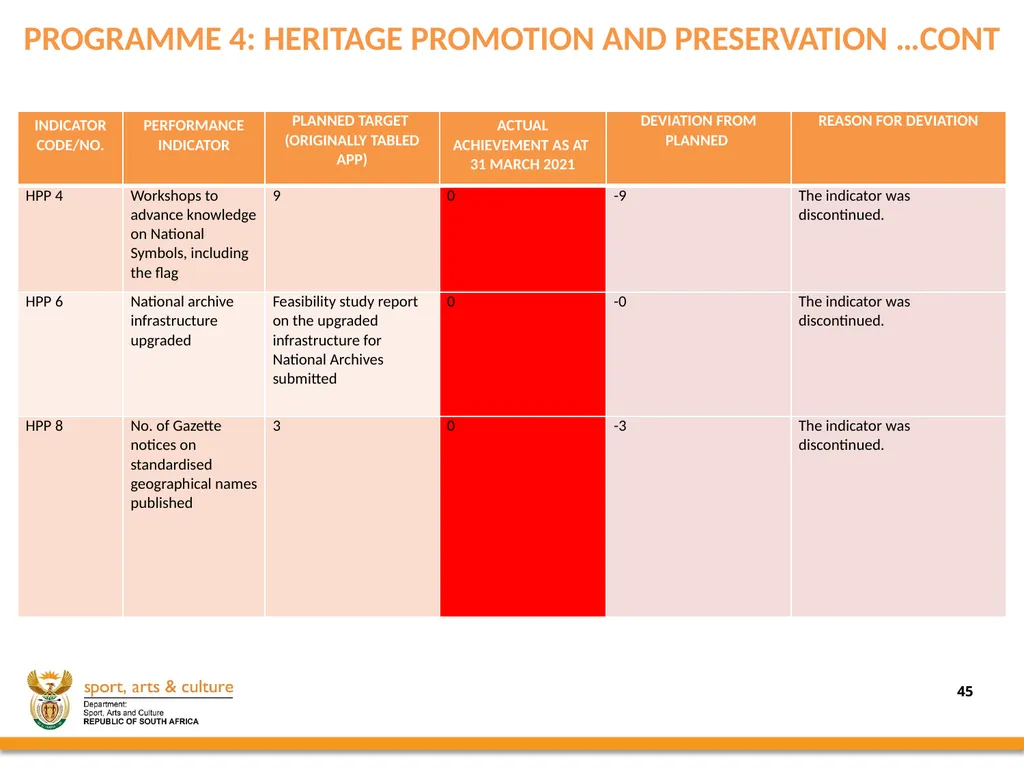
PROGRAMME 4: HERITAGE PROMOTION AND PRESERVATION …CONT 45<br>
46
FINANCIAL PERFORMANCE REPORT AS AT
31 march 2021 (FINANCE)<br>
31 march 2021 (FINANCE)<br>
47
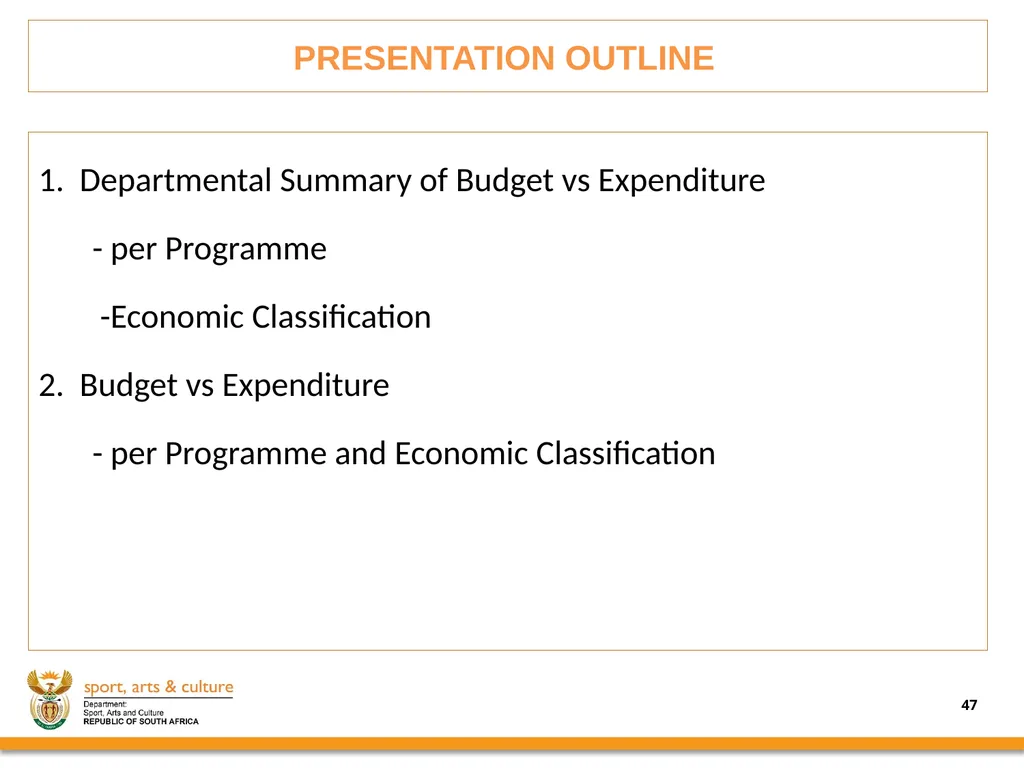
47 PRESENTATION OUTLINE 1. Departmental Summary of Budget vs Expenditure
- per Programme
-Economic Classification
2. Budget vs Expenditure
- per Programme and Economic Classification<br>
- per Programme
-Economic Classification
2. Budget vs Expenditure
- per Programme and Economic Classification<br>
48
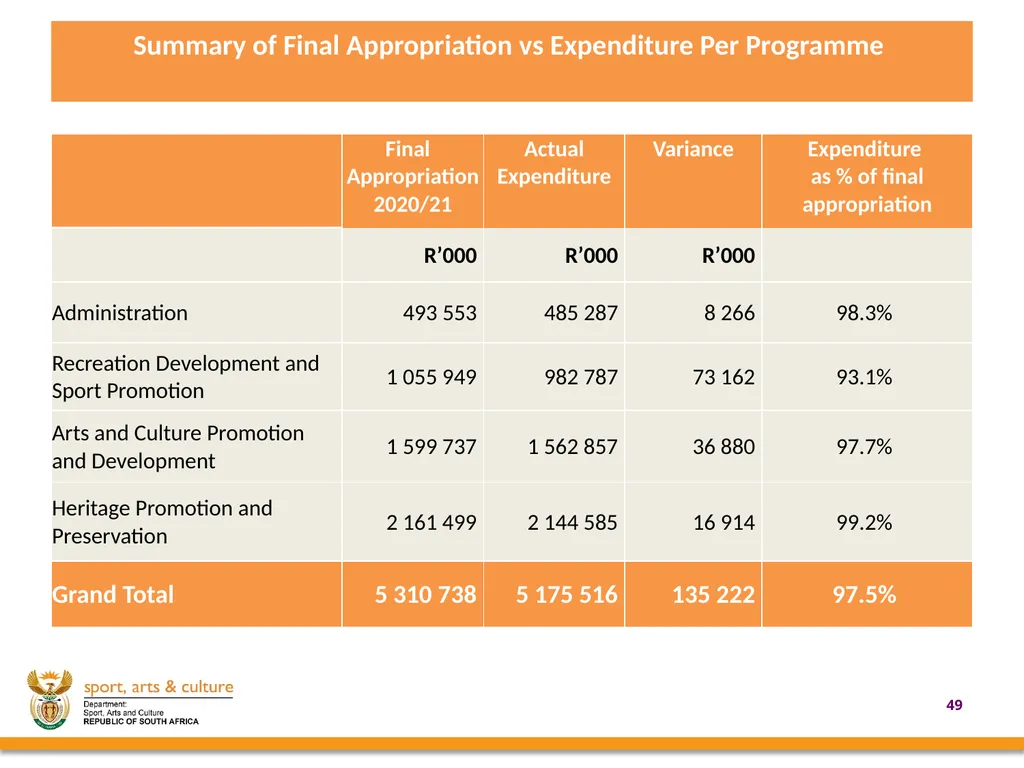
49 Summary of Final Appropriation vs Expenditure Per Programme<br>
49
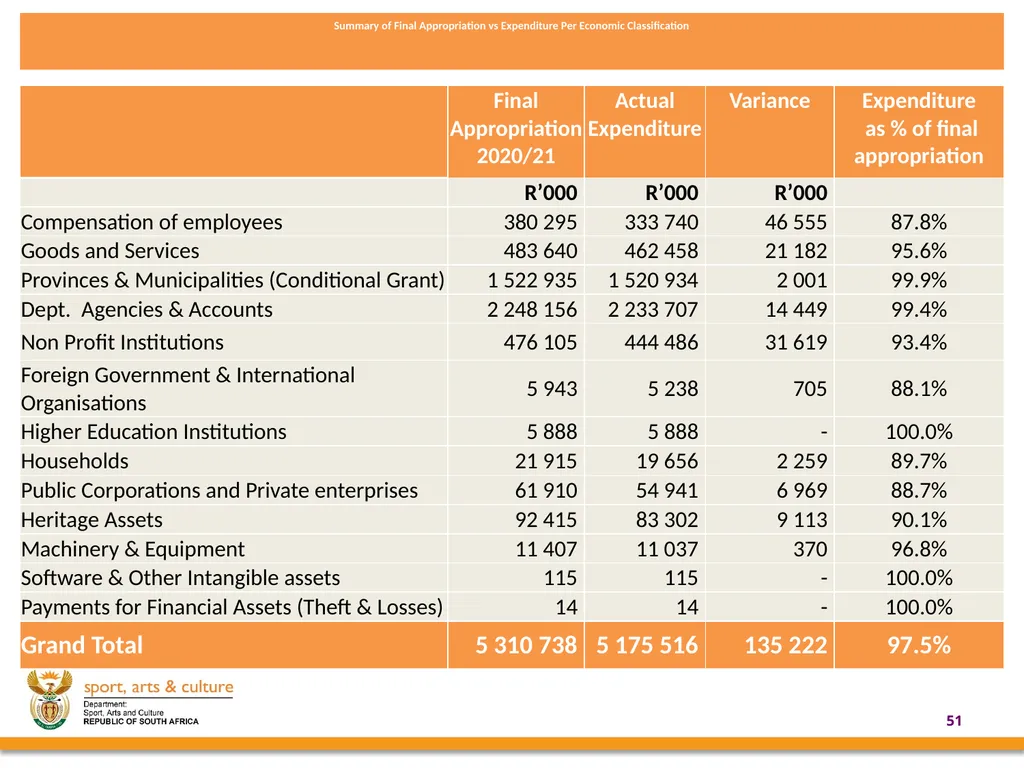
51 Summary of Final Appropriation vs Expenditure Per Economic Classification<br>
50
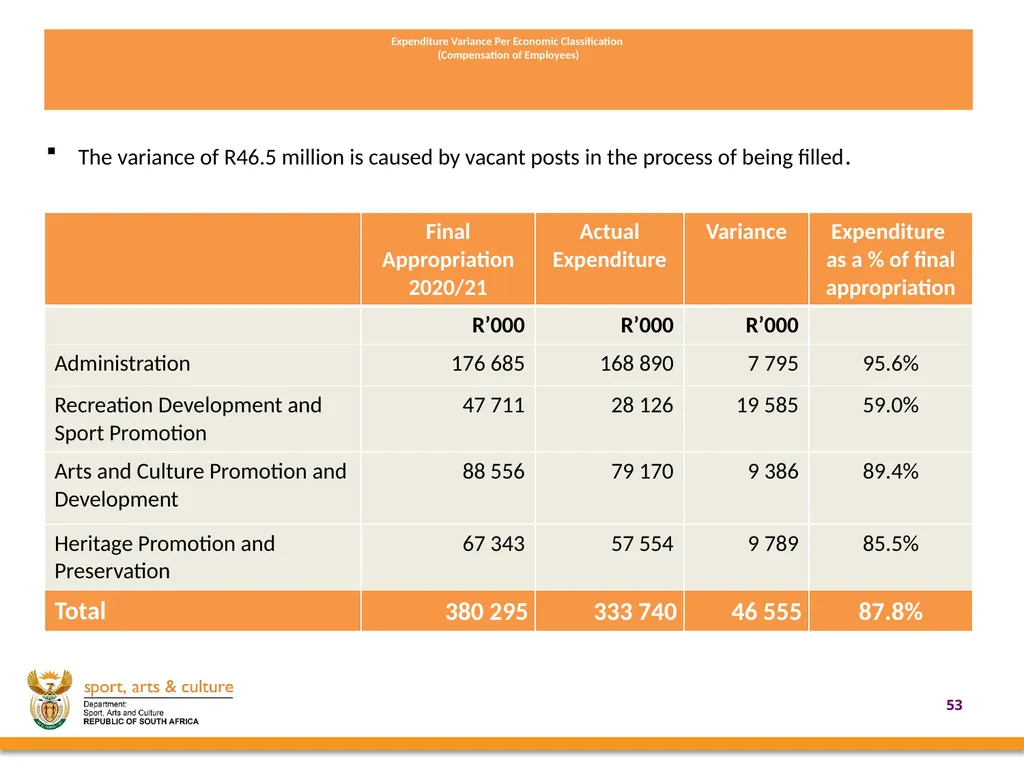
53 Expenditure Variance Per Economic Classification
(Compensation of Employees) The variance of R46.5 million is caused by vacant posts in the process of being filled.<br>
51
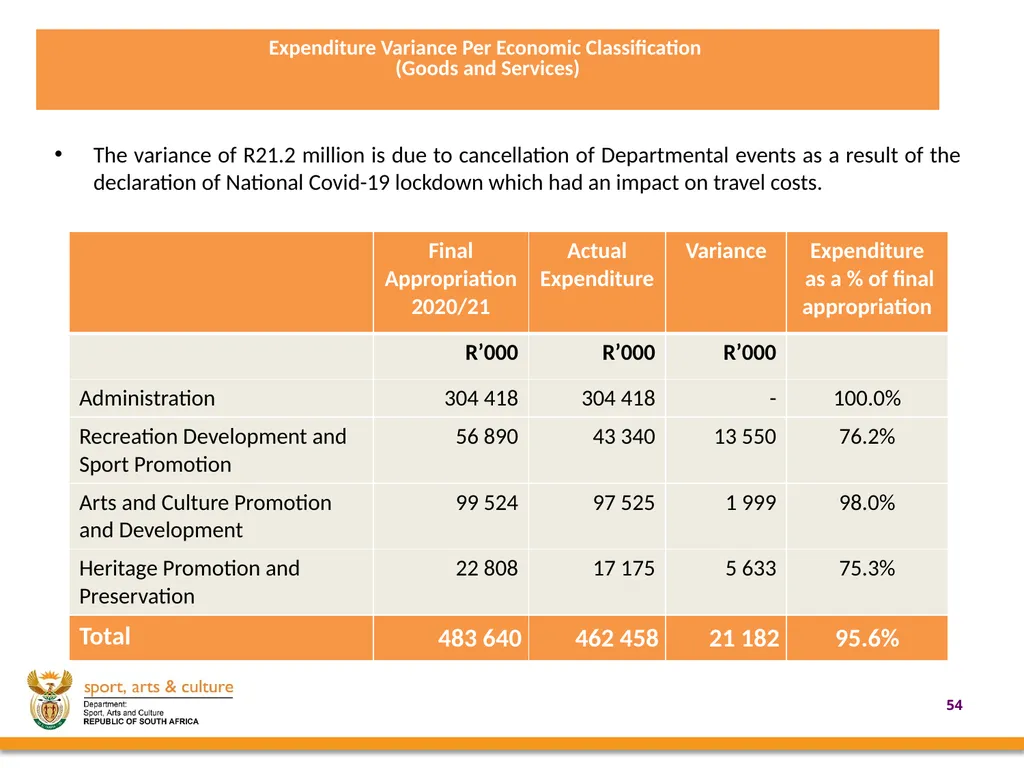
Expenditure Variance Per Economic Classification
(Goods and Services) The variance of R21.2 million is due to cancellation of Departmental events as a result of the declaration of National Covid-19 lockdown which had an impact on travel costs. 54<br>
52
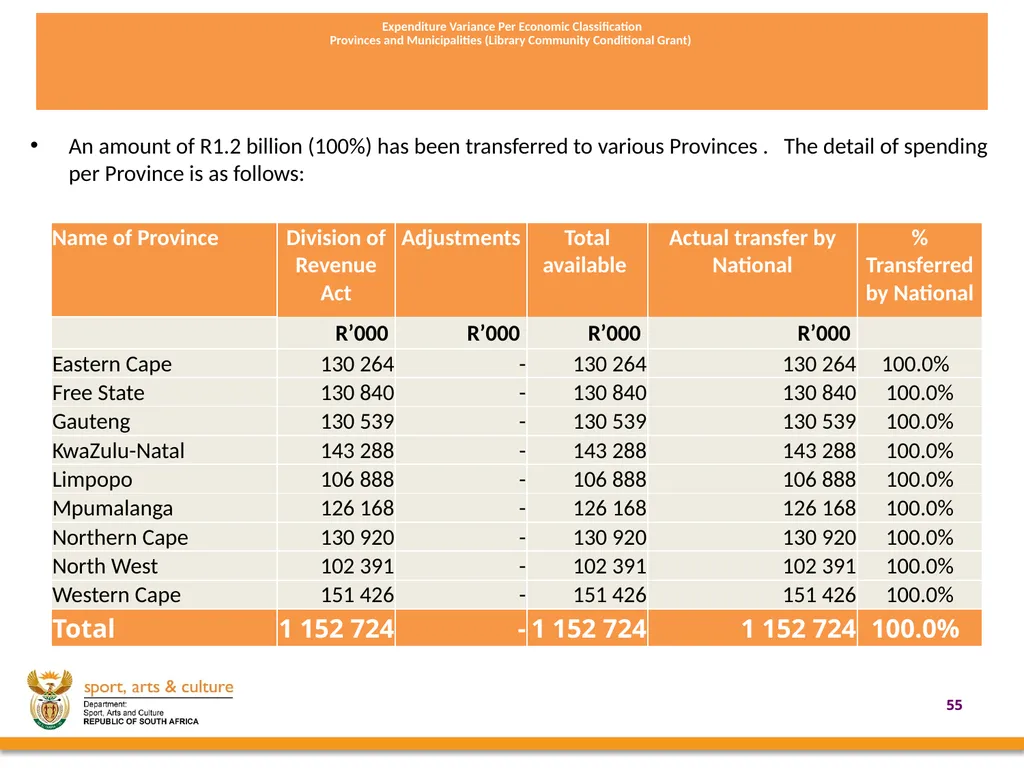
55 Expenditure Variance Per Economic Classification
Provinces and Municipalities (Library Community Conditional Grant) An amount of R1.2 billion (100%) has been transferred to various Provinces . The detail of spending per Province is as follows:<br>
53
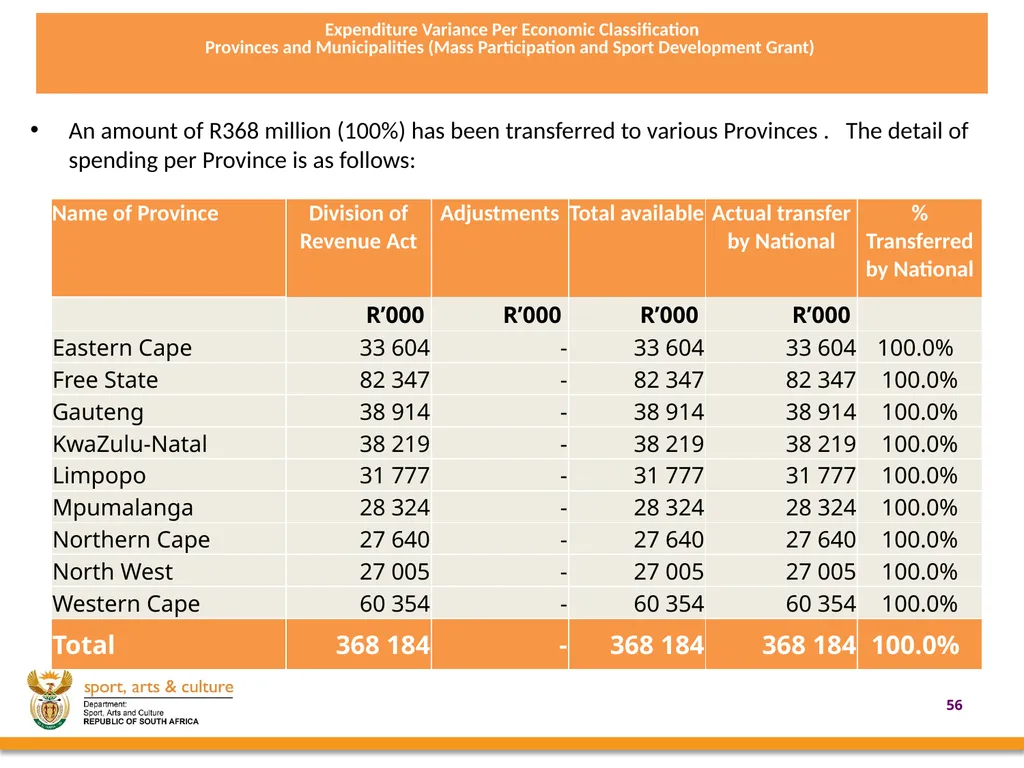
56 An amount of R368 million (100%) has been transferred to various Provinces . The detail of spending per Province is as follows: Expenditure Variance Per Economic Classification
Provinces and Municipalities (Mass Participation and Sport Development Grant)<br>
54
Expenditure Variance Per Economic Classification
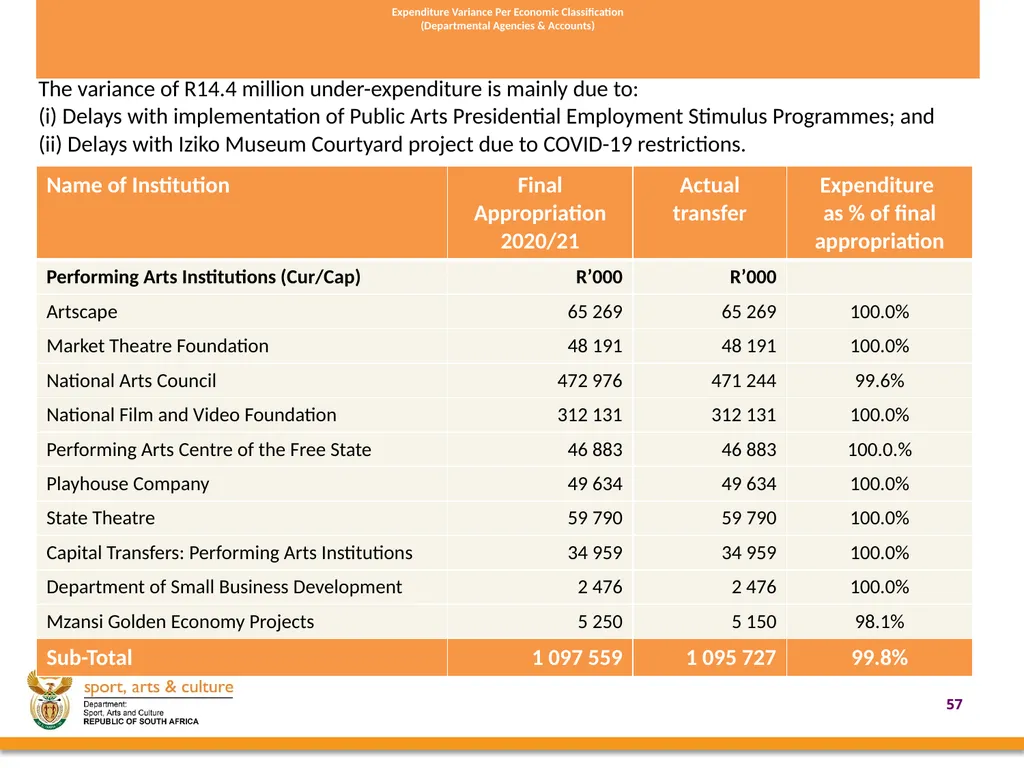
(Departmental Agencies & Accounts) The variance of R14.4 million under-expenditure is mainly due to:
(i) Delays with implementation of Public Arts Presidential Employment Stimulus Programmes; and
(ii) Delays with Iziko Museum Courtyard project due to COVID-19 restrictions. 57<br>
(i) Delays with implementation of Public Arts Presidential Employment Stimulus Programmes; and
(ii) Delays with Iziko Museum Courtyard project due to COVID-19 restrictions. 57<br>
55
Expenditure Variance Per Economic Classification
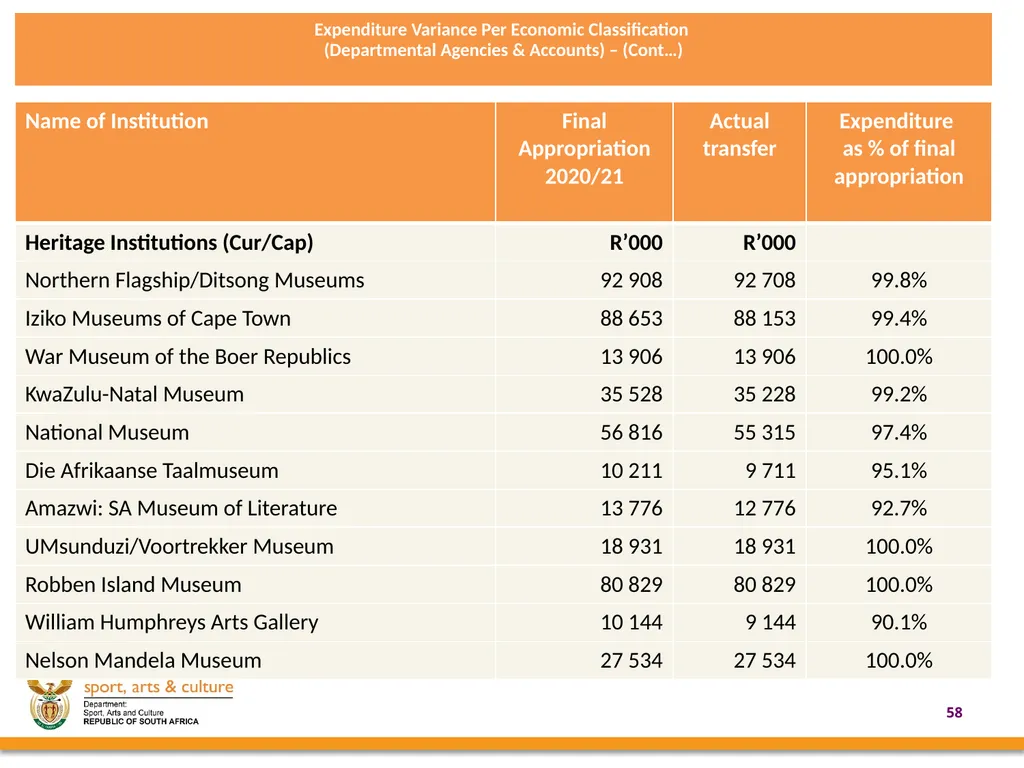
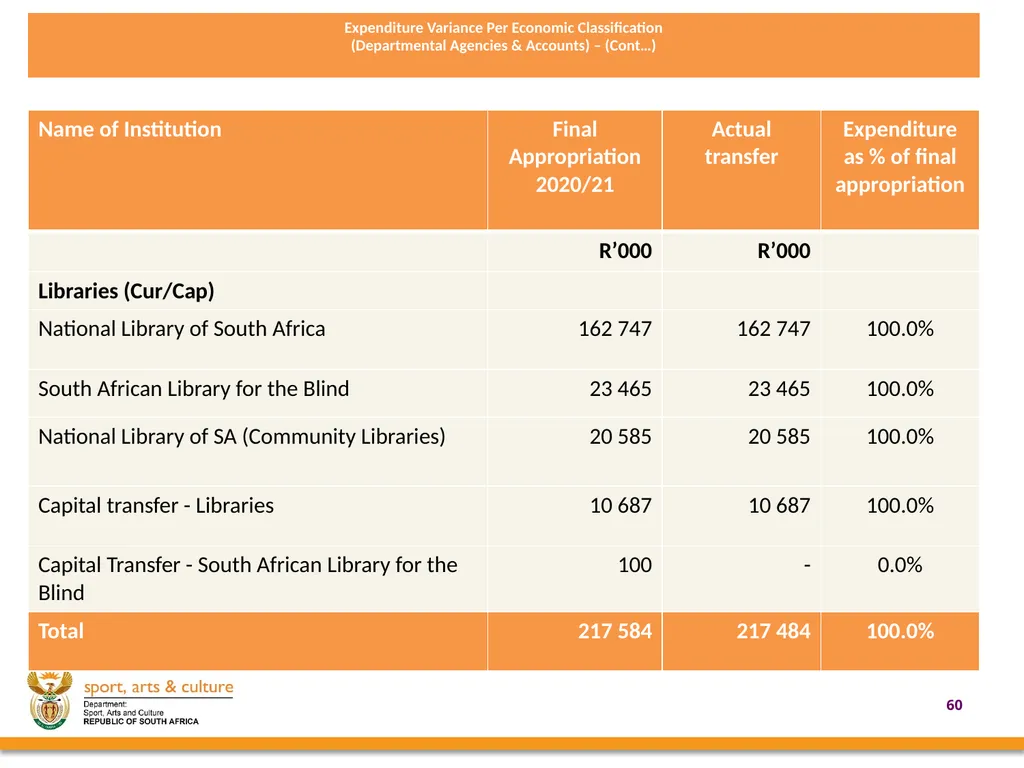
(Departmental Agencies & Accounts) – (Cont…) 58<br>
56
Expenditure Variance Per Economic Classification
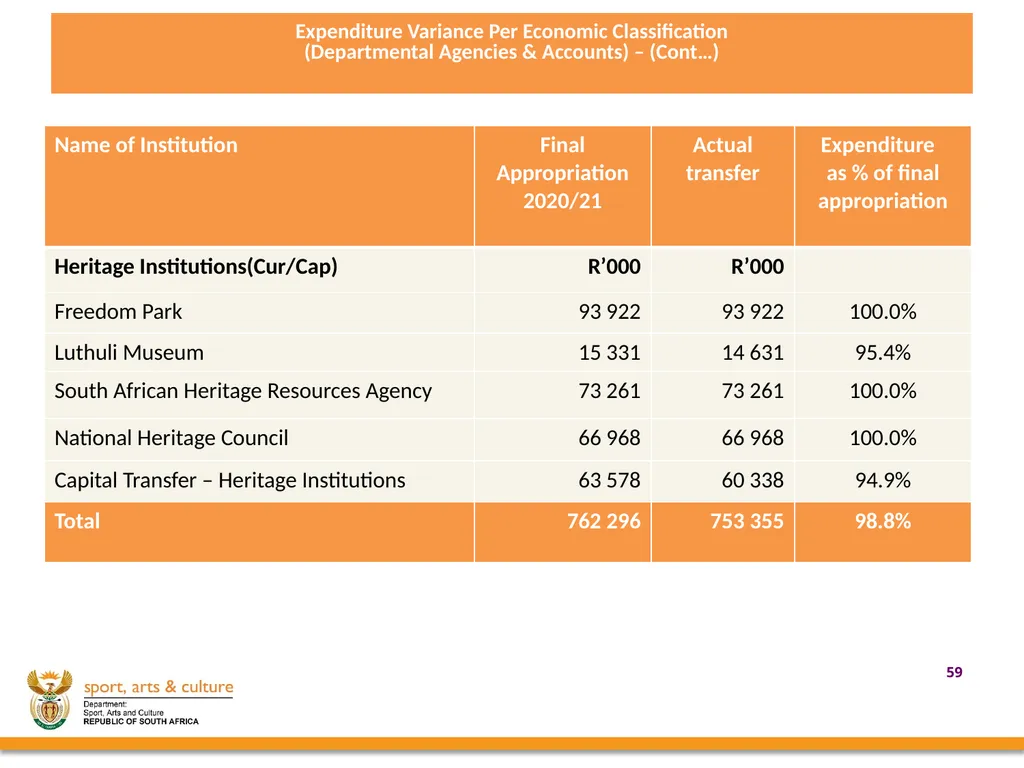
(Departmental Agencies & Accounts) – (Cont…) 59<br>
57
Expenditure Variance Per Economic Classification
(Departmental Agencies & Accounts) – (Cont…) 60<br>
58
Expenditure Variance Per Economic Classification
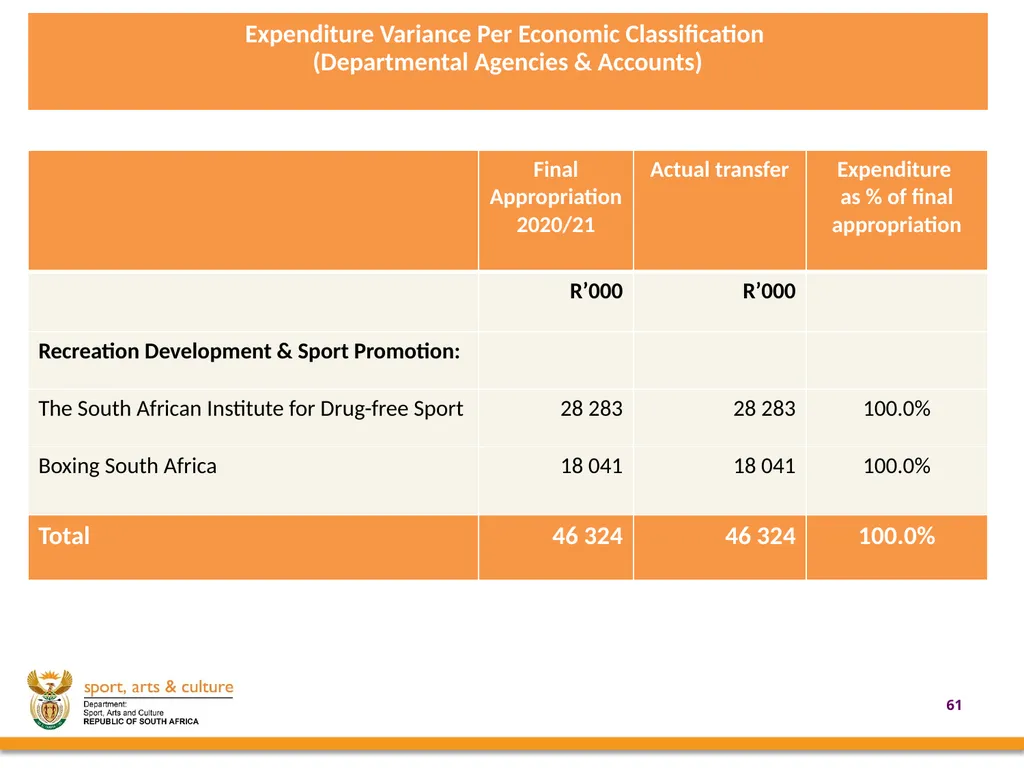
(Departmental Agencies & Accounts) 61<br>
59
Expenditure Variance Per Economic Classification
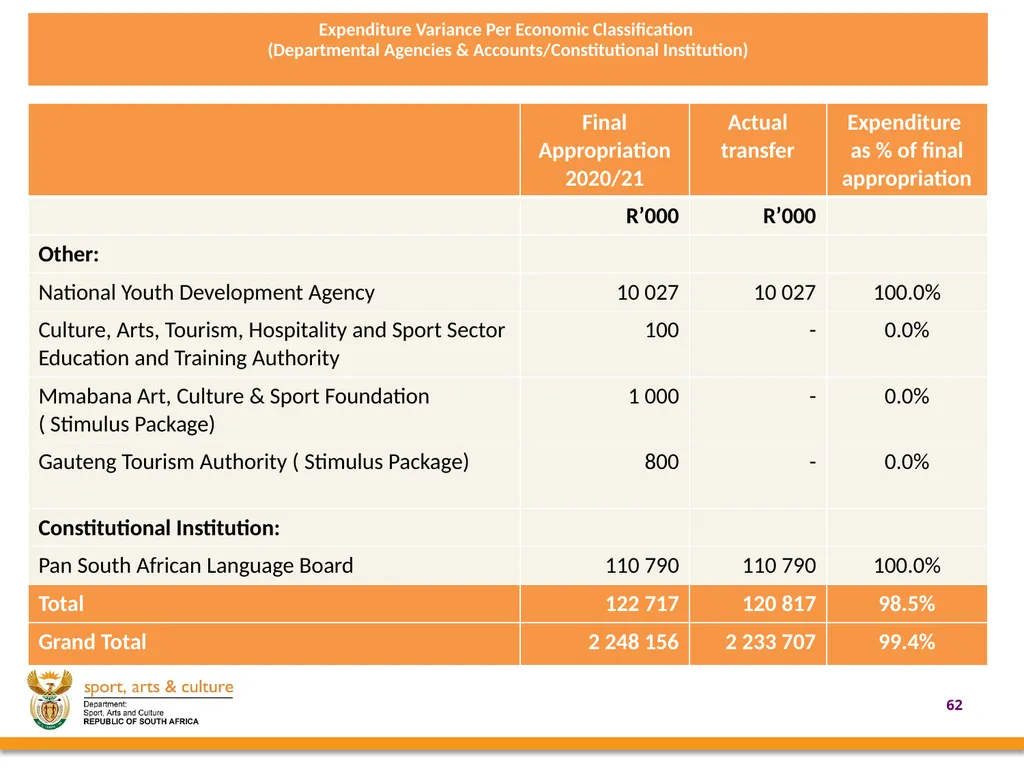
(Departmental Agencies & Accounts/Constitutional Institution) 62<br>
60
Expenditure Variance Per Economic Classification
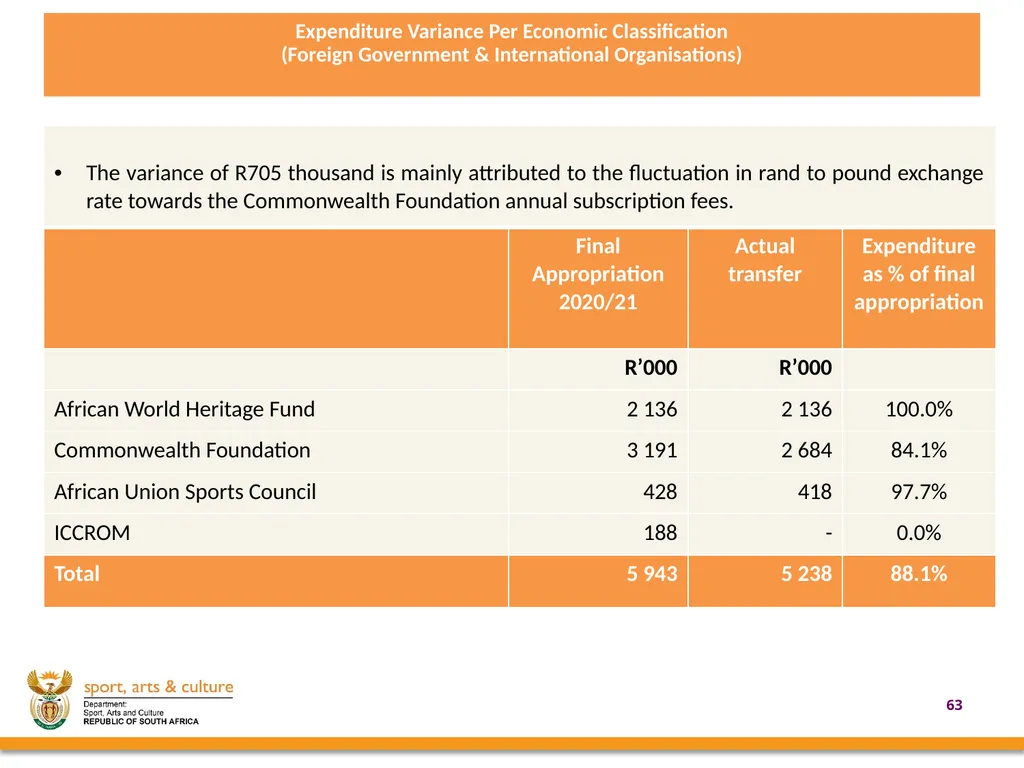
(Foreign Government & International Organisations) 63<br>
61
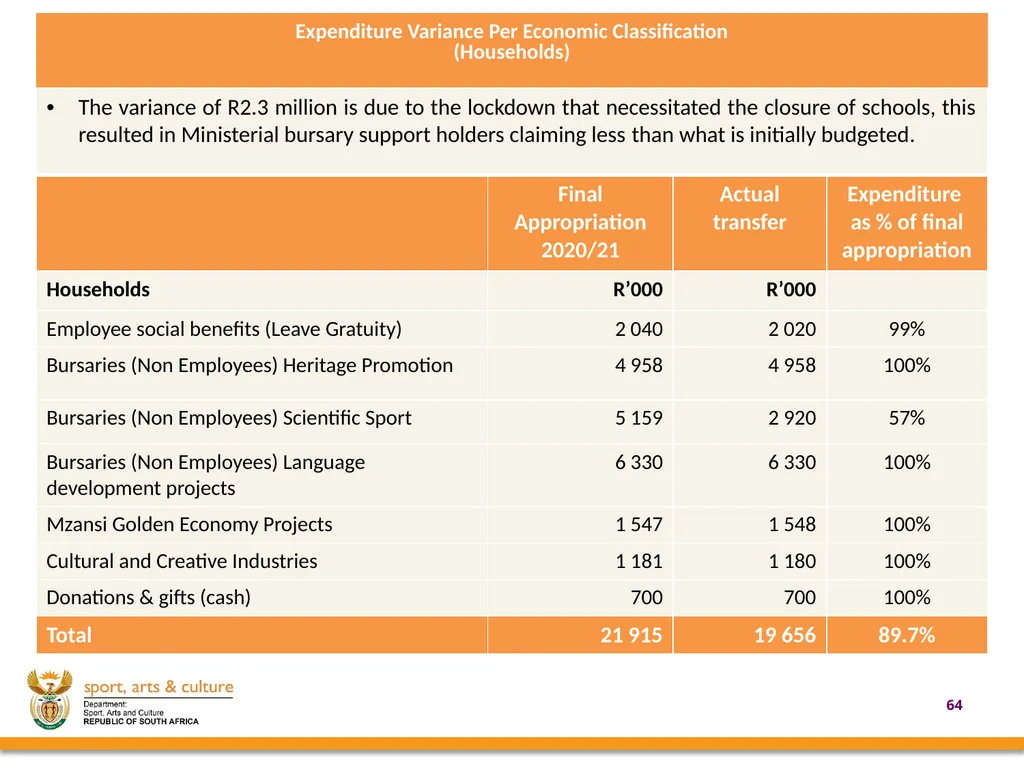
Expenditure Variance Per Economic Classification
(Households) 64<br>
62
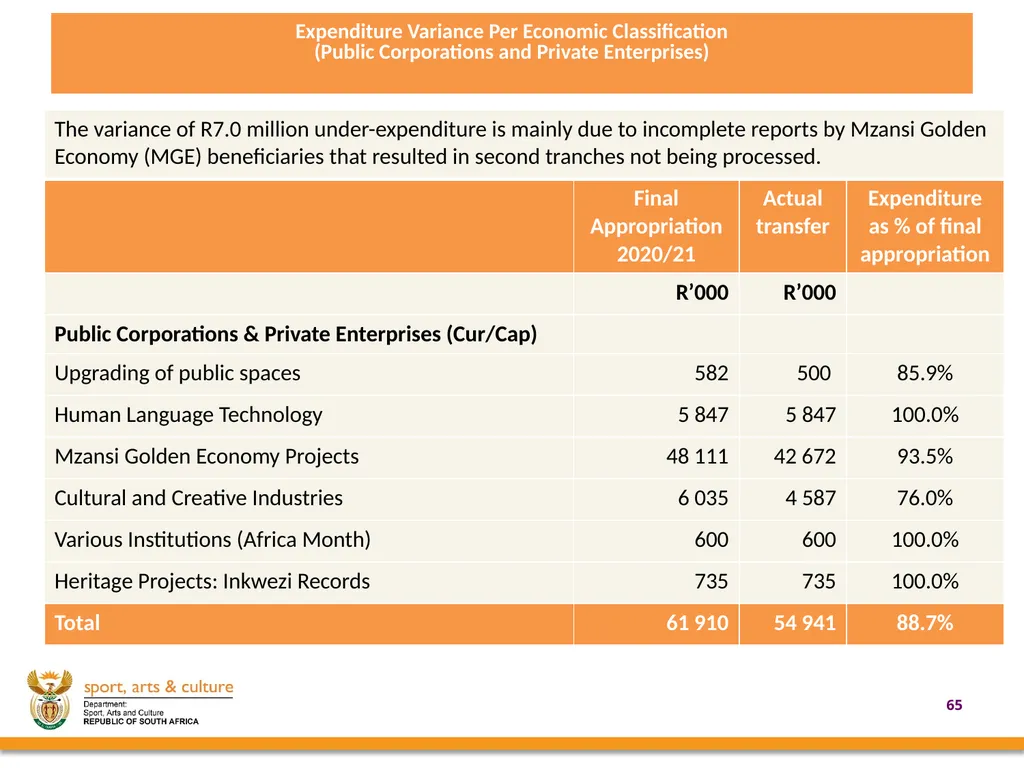
Expenditure Variance Per Economic Classification
(Public Corporations and Private Enterprises) 65<br>
63
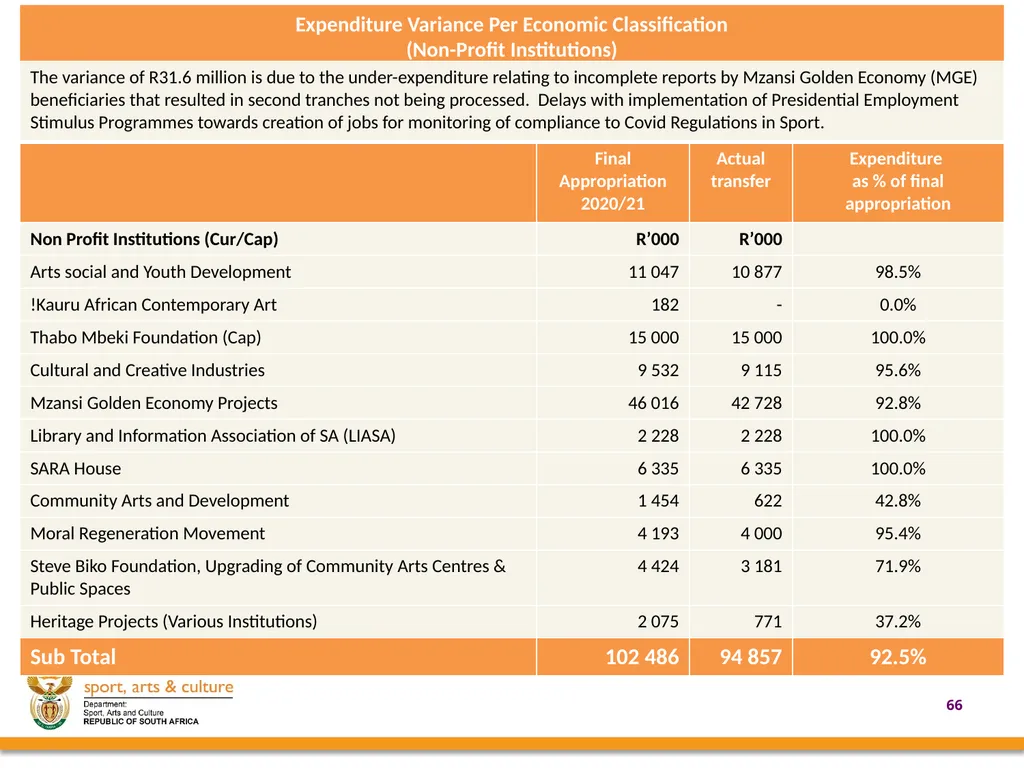
Expenditure Variance Per Economic Classification
(Non-Profit Institutions) 66<br>
64
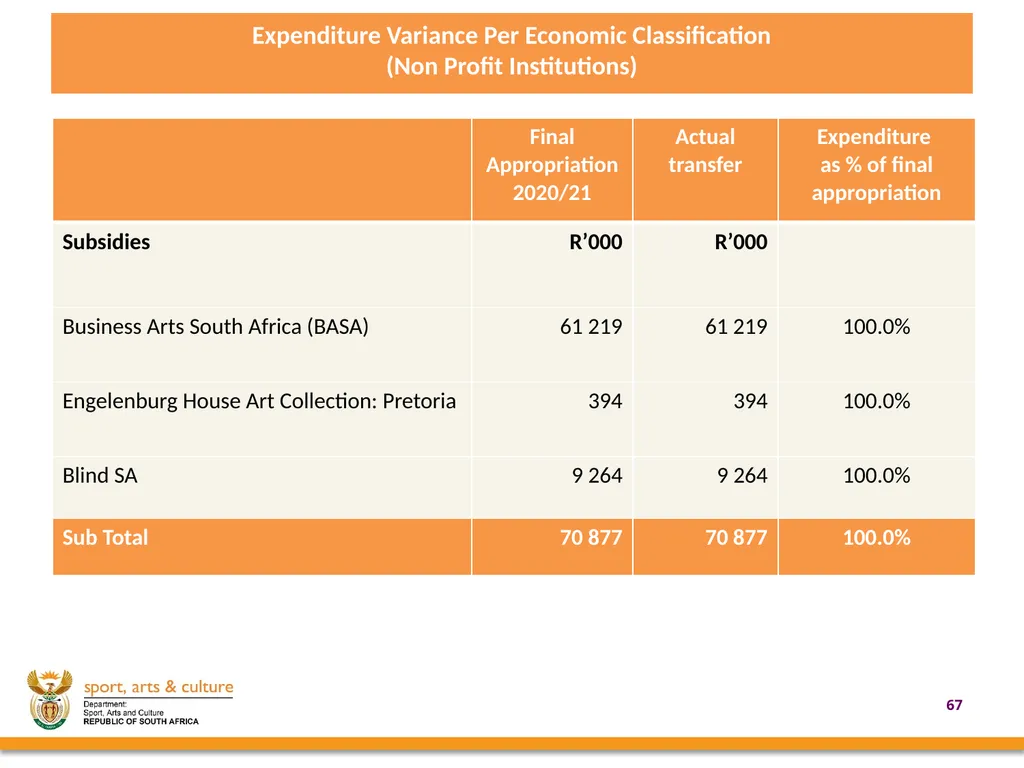
Expenditure Variance Per Economic Classification
(Non Profit Institutions) 67<br>
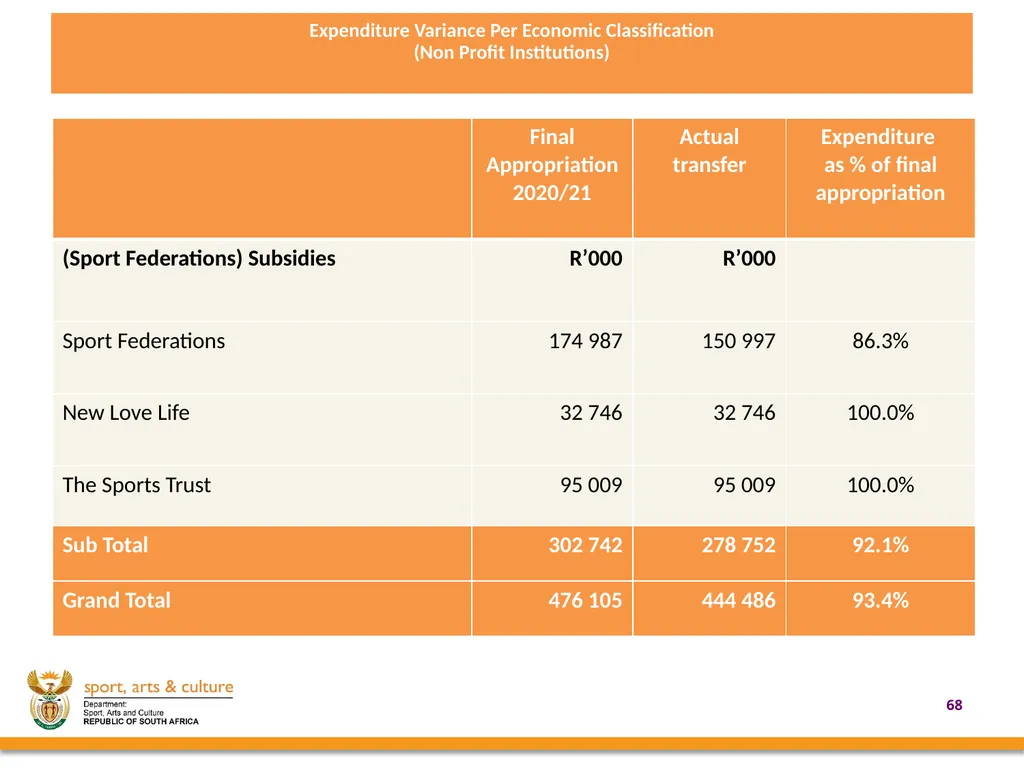
65
Expenditure Variance Per Economic Classification
(Non Profit Institutions) 68<br>
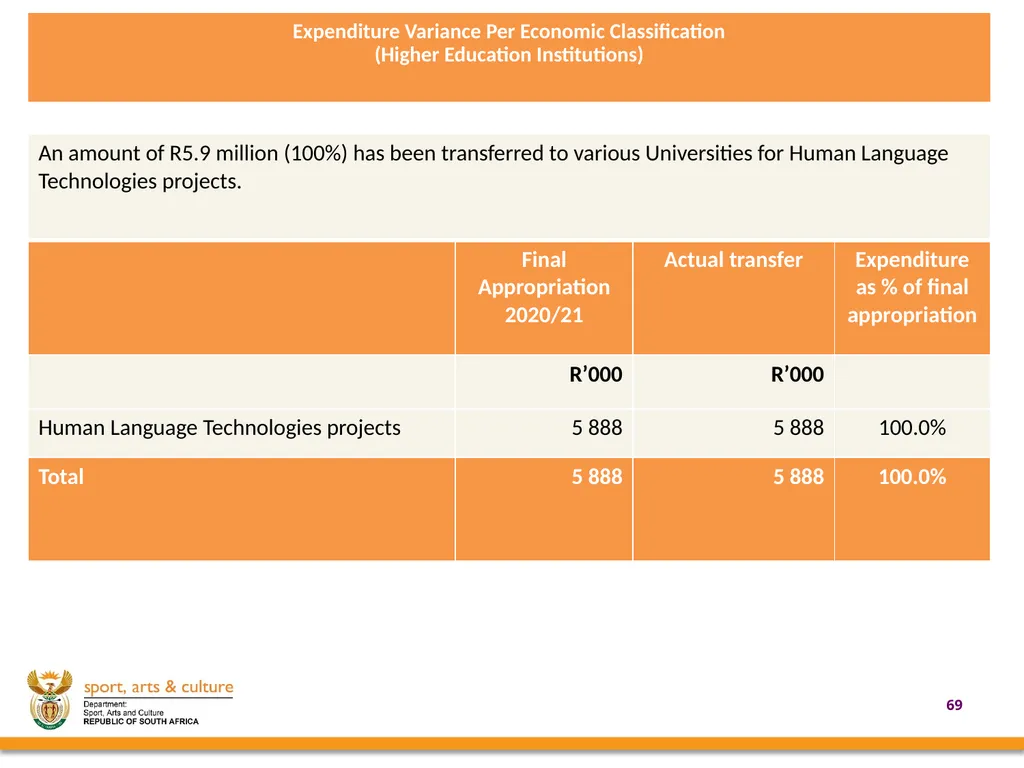
66
Expenditure Variance Per Economic Classification
(Higher Education Institutions) 69<br>
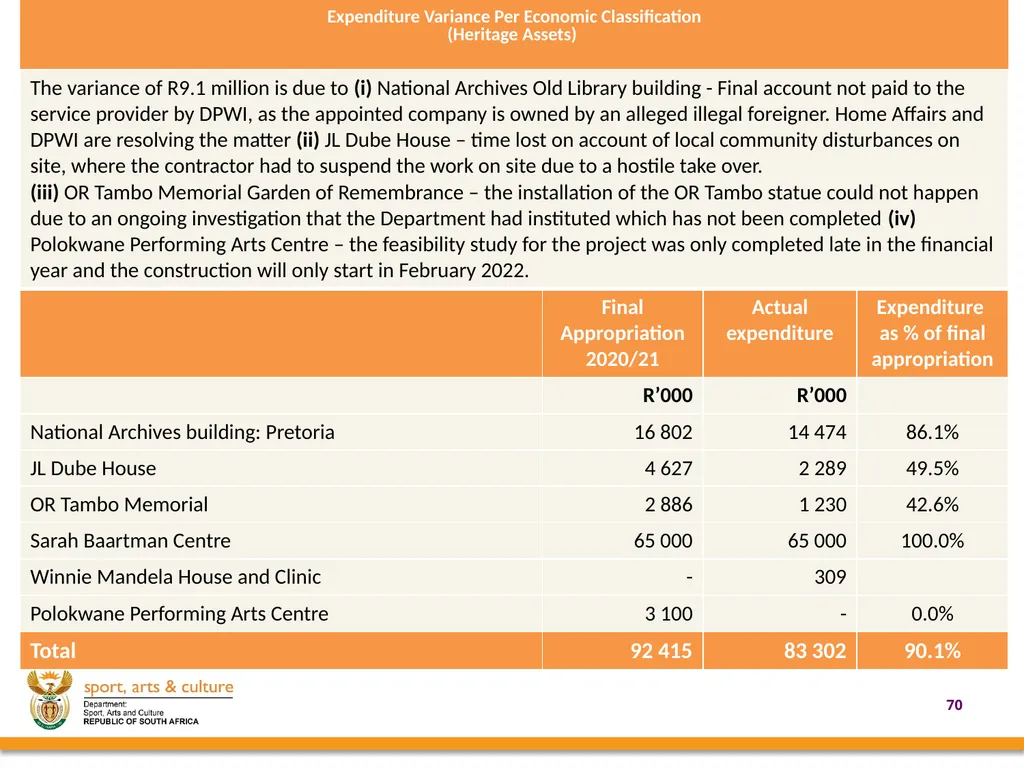
67
Expenditure Variance Per Economic Classification
(Heritage Assets) 70<br>
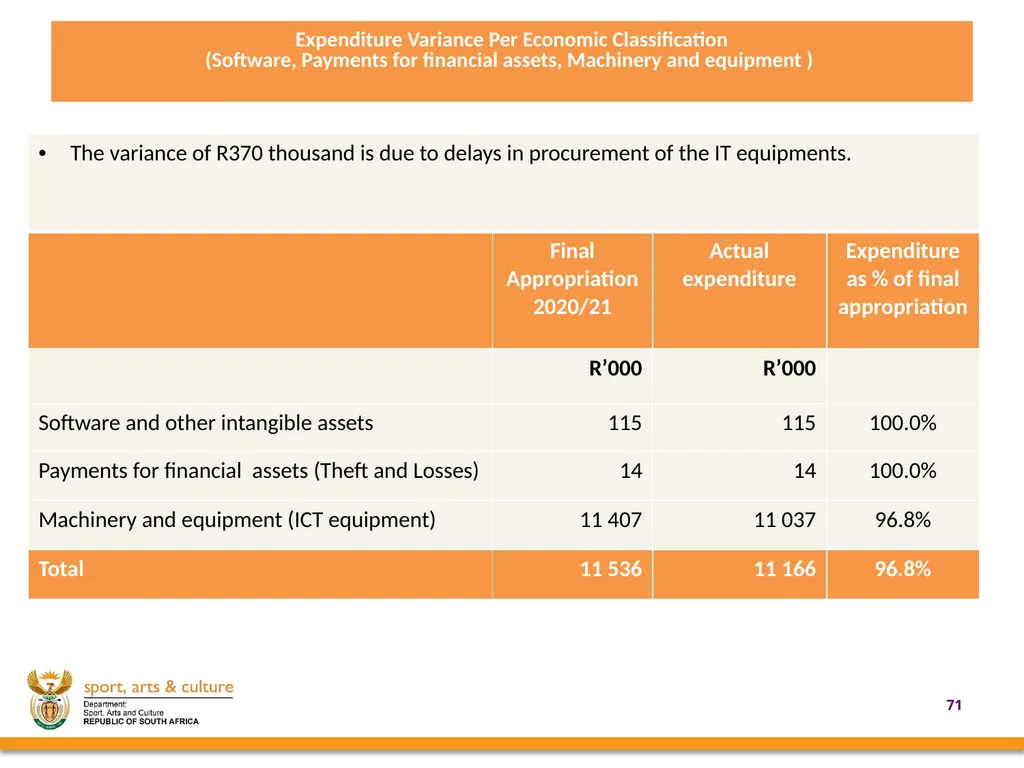
68
Expenditure Variance Per Economic Classification
(Software, Payments for financial assets, Machinery and equipment ) 71<br>
69
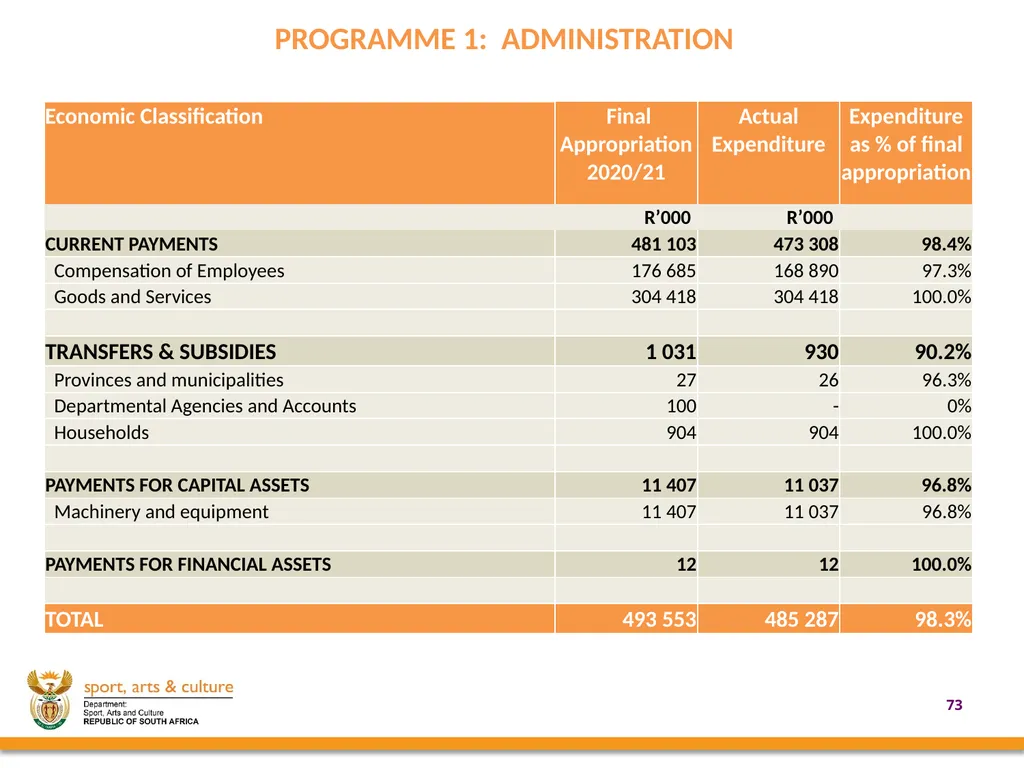
73 PROGRAMME 1: ADMINISTRATION<br>
70
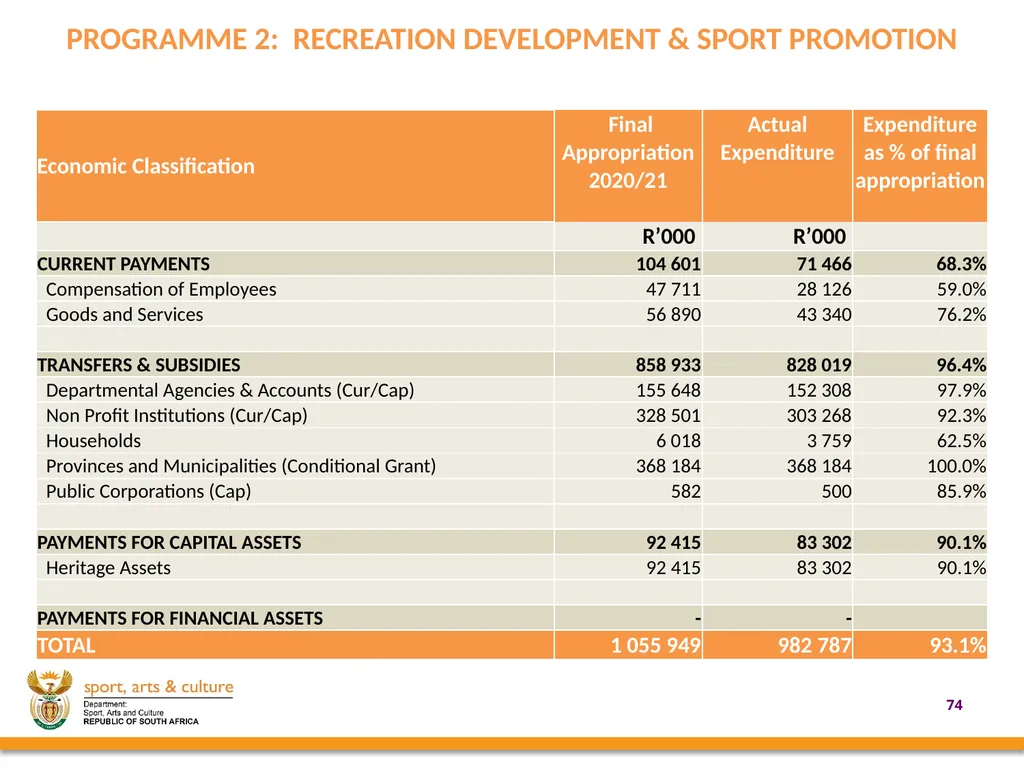
74 PROGRAMME 2: RECREATION DEVELOPMENT & SPORT PROMOTION<br>
71
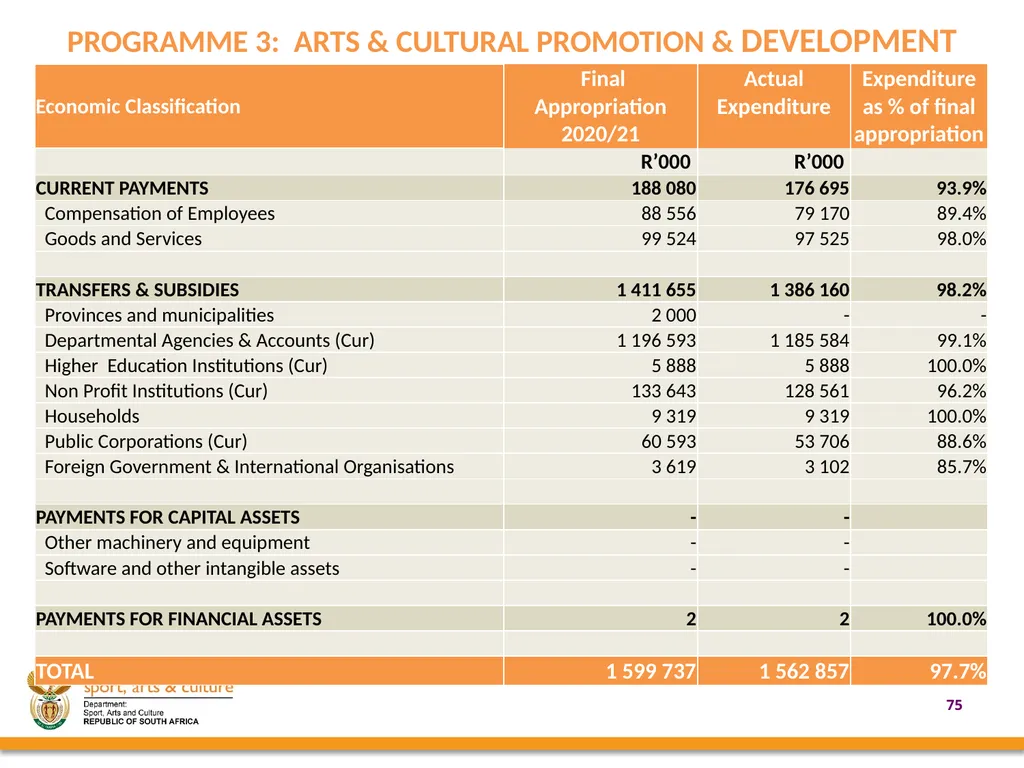
75 PROGRAMME 3: ARTS & CULTURAL PROMOTION & DEVELOPMENT<br>
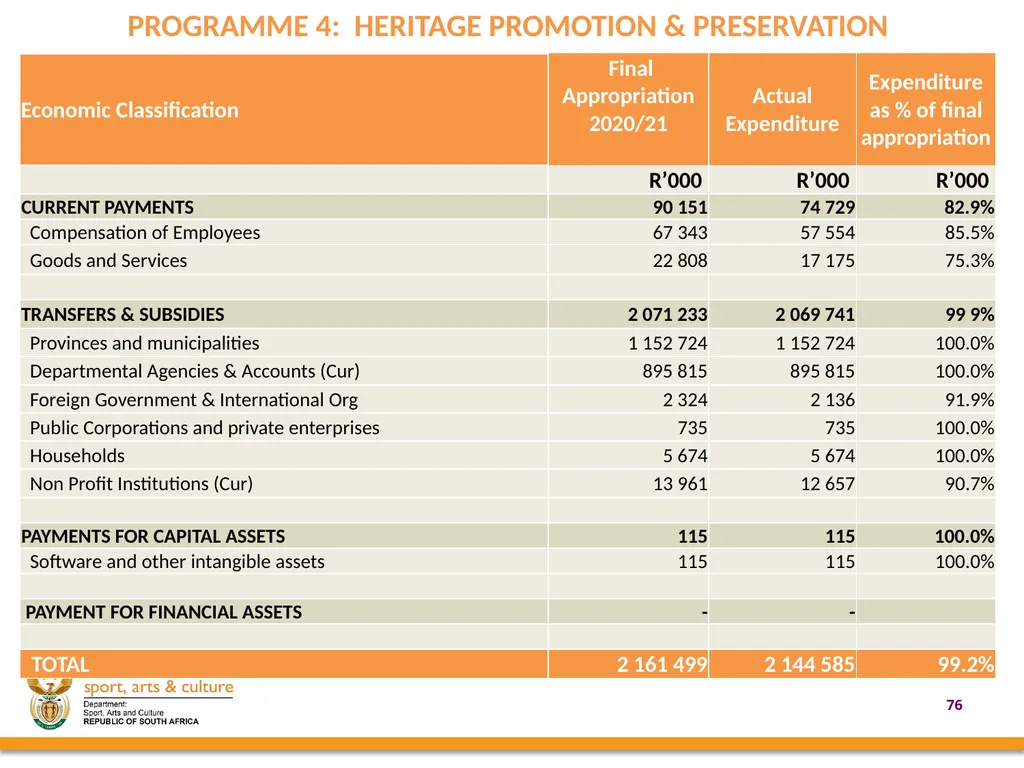
72
76 PROGRAMME 4: HERITAGE PROMOTION & PRESERVATION<br>
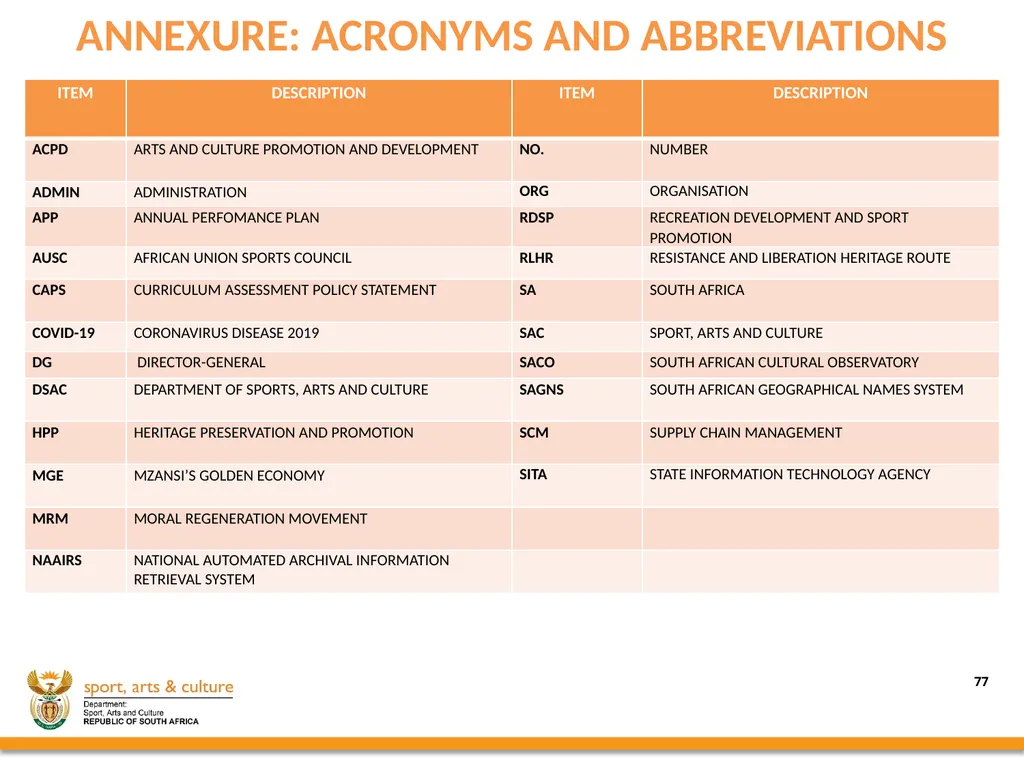
73
77 ANNEXURE: Acronyms and Abbreviations<br>
74
THANK YOU<br>