2023 Winter Wheat Breeding Research Updates Dr. Sue Mondal Winter Wheat Breeder Background Worked in .. Breeding for abiotic stress tolerance heat drought Genomic and phenomic technologies in improving selection efficiencies Rapid
"2023 Winter Wheat Breeding & Research Updates Dr." is the property of its rightful owner. Permission is granted to
download and print the materials on this website for personal, non-commercial use only, and to display it
on your personal computer provided you do not modify the materials and that you retain all copyright
notices contained in the materials. By downloading content from our website, you accept the terms of this
agreement.
Presentation Transcript
01
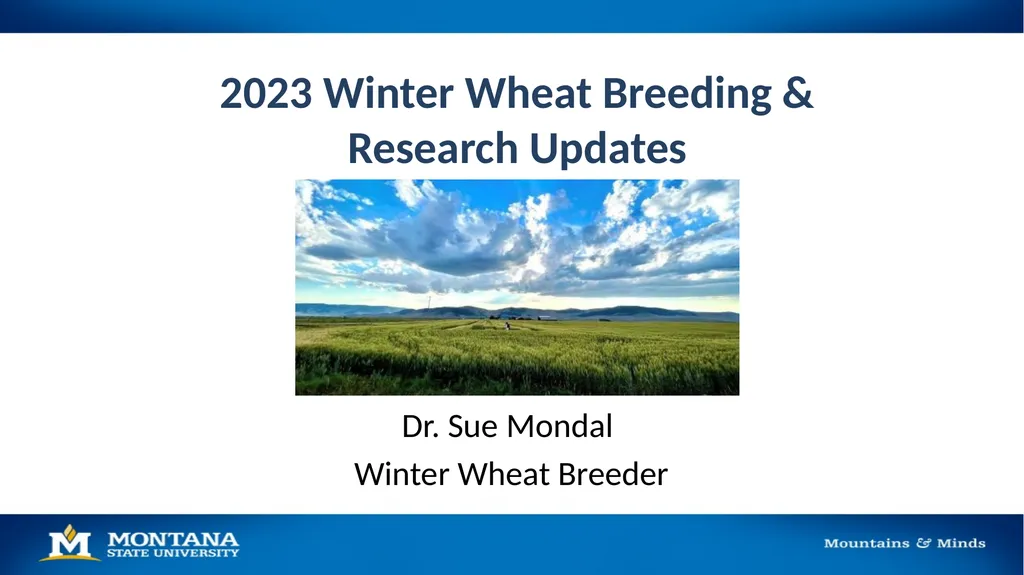
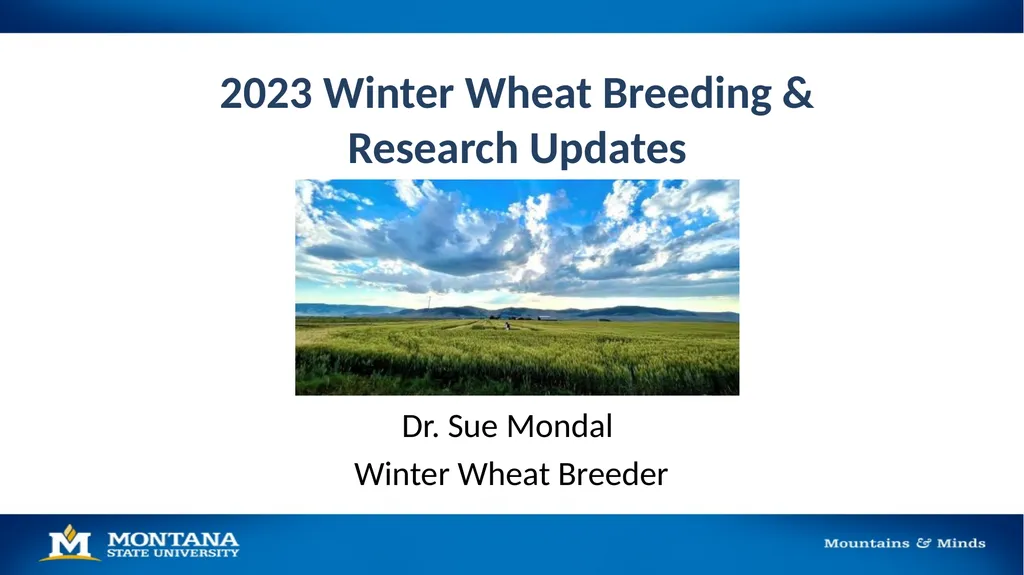
2023 Winter Wheat Breeding & Research Updates Dr. Sue Mondal
Winter Wheat Breeder<br>
02
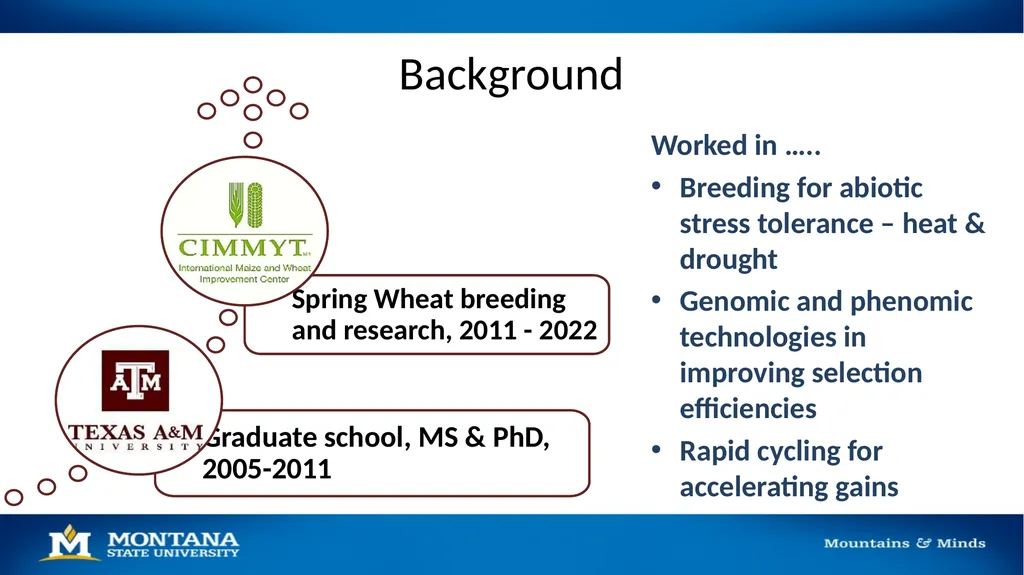
Background Worked in …..
Breeding for abiotic stress tolerance – heat & drought
Genomic and phenomic technologies in improving selection efficiencies
Rapid cycling for accelerating gains<br>
03
Winter Wheat Breeding Program at MSU Core Objectives:
Breed for high and stable yielding winter wheat varieties
Ability to tolerate drought stress art early and late season
Resistance to Wheat Stem Sawfly (WSS)
Resistance to diseases: stripe rust & stem rust
Winter hardiness
End use quality<br>
04
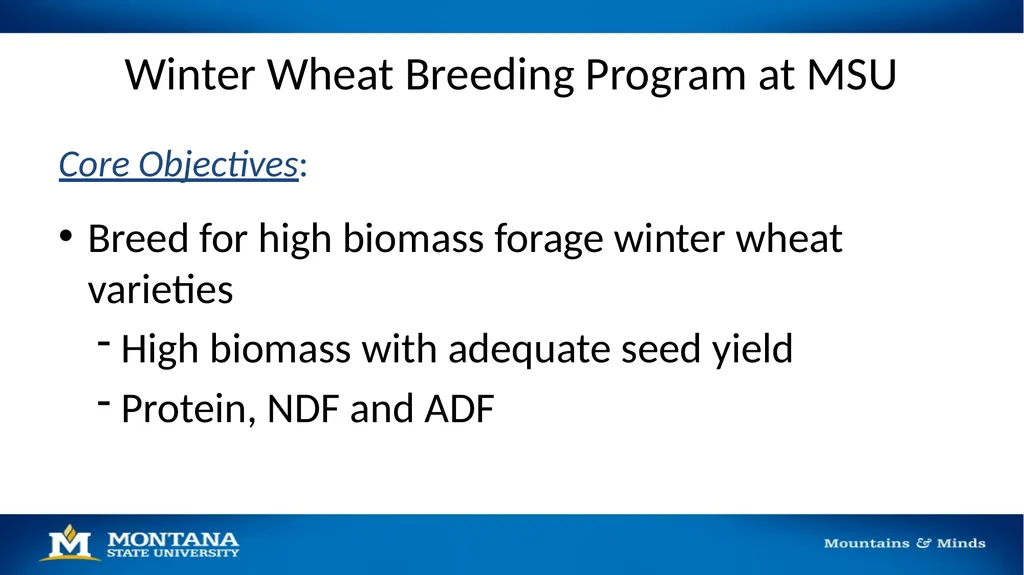
Winter Wheat Breeding Program at MSU Core Objectives:
Breed for high biomass forage winter wheat varieties
High biomass with adequate seed yield
Protein, NDF and ADF<br>
05
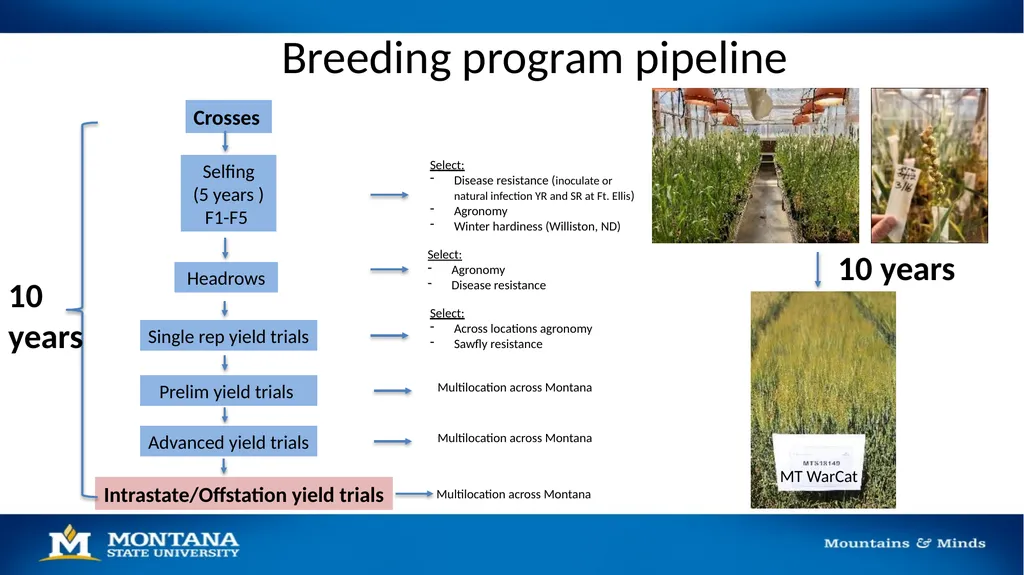
Breeding program pipeline Crosses Selfing
(5 years ) F1-F5 Select:
Disease resistance (inoculate or natural infection YR and SR at Ft. Ellis)
Agronomy
Winter hardiness (Williston, ND) Headrows Single rep yield trials Select:
Agronomy
Disease resistance Select:
Across locations agronomy
Sawfly resistance Prelim yield trials Advanced yield trials Multilocation across Montana Multilocation across Montana Intrastate/Offstation yield trials Multilocation across Montana 10 years 10 years MT WarCat<br>
06
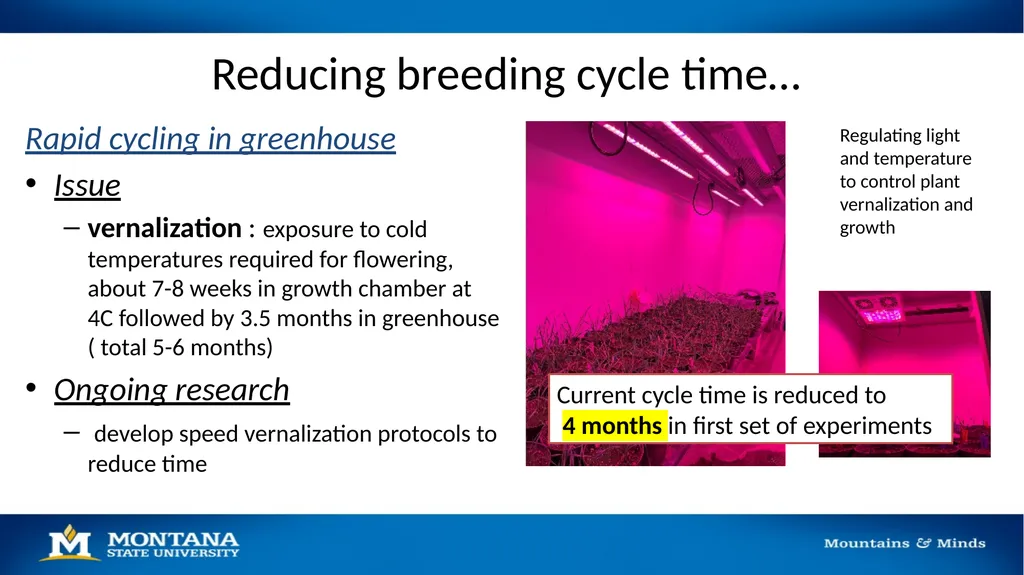
Reducing breeding cycle time… Rapid cycling in greenhouse
Issue
vernalization : exposure to cold temperatures required for flowering, about 7-8 weeks in growth chamber at 4C followed by 3.5 months in greenhouse ( total 5-6 months)
Ongoing research
develop speed vernalization protocols to reduce time Regulating light and temperature to control plant vernalization and growth Current cycle time is reduced to
4 months in first set of experiments<br>
07
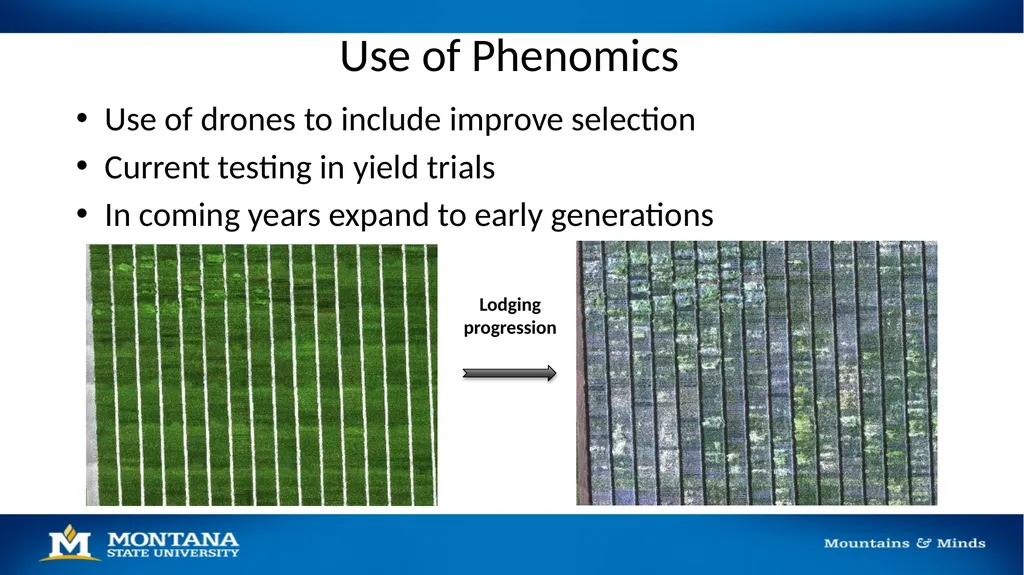
Use of Phenomics Use of drones to include improve selection
Current testing in yield trials
In coming years expand to early generations Lodging
progression<br>
08
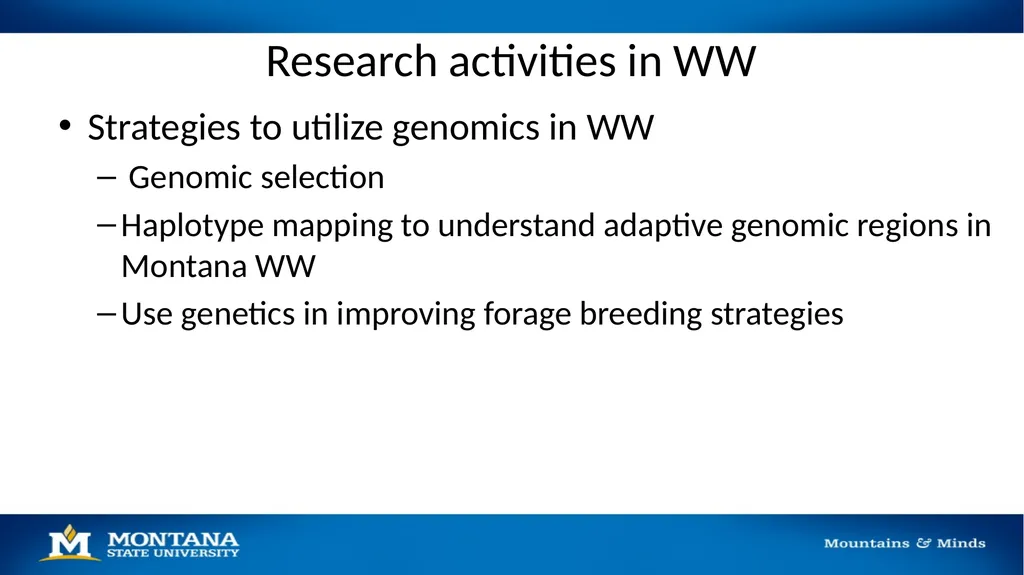
Research activities in WW Strategies to utilize genomics in WW
Genomic selection
Haplotype mapping to understand adaptive genomic regions in Montana WW
Use genetics in improving forage breeding strategies<br>
09
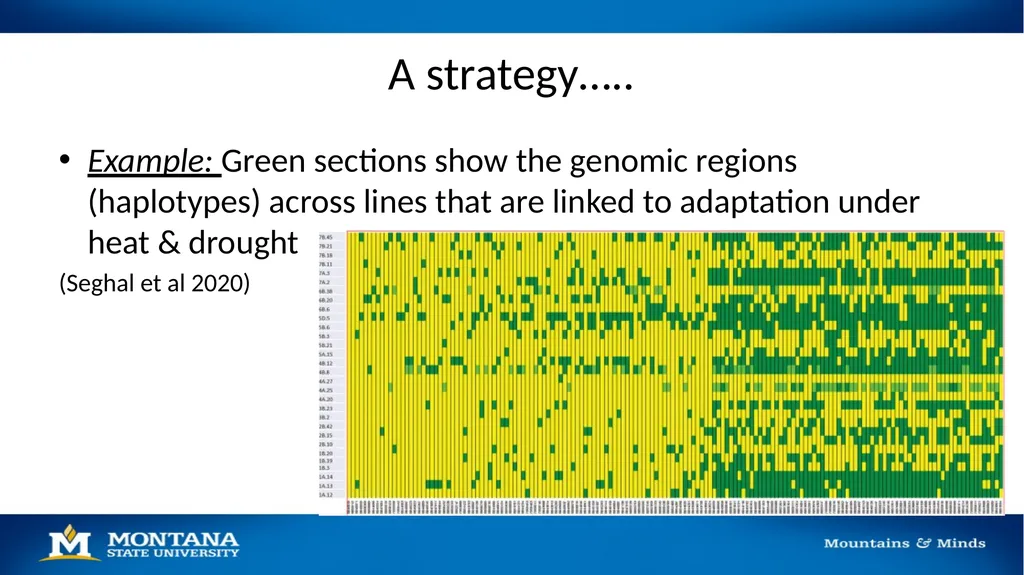
A strategy….. Example: Green sections show the genomic regions (haplotypes) across lines that are linked to adaptation under heat & drought
(Seghal et al 2020)<br>
10
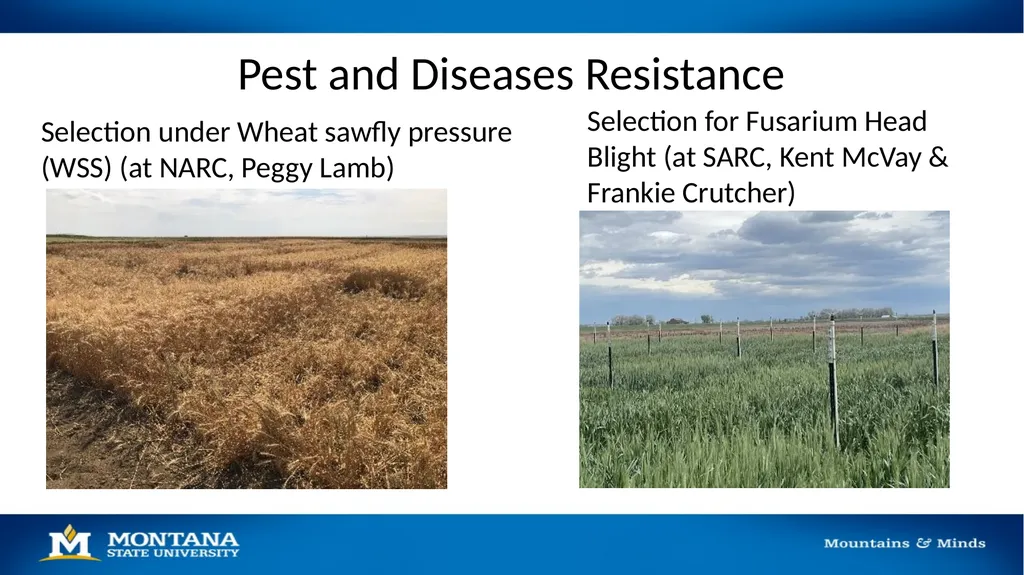
Pest and Diseases Resistance Selection under Wheat sawfly pressure (WSS) (at NARC, Peggy Lamb) Selection for Fusarium Head Blight (at SARC, Kent McVay & Frankie Crutcher)<br>
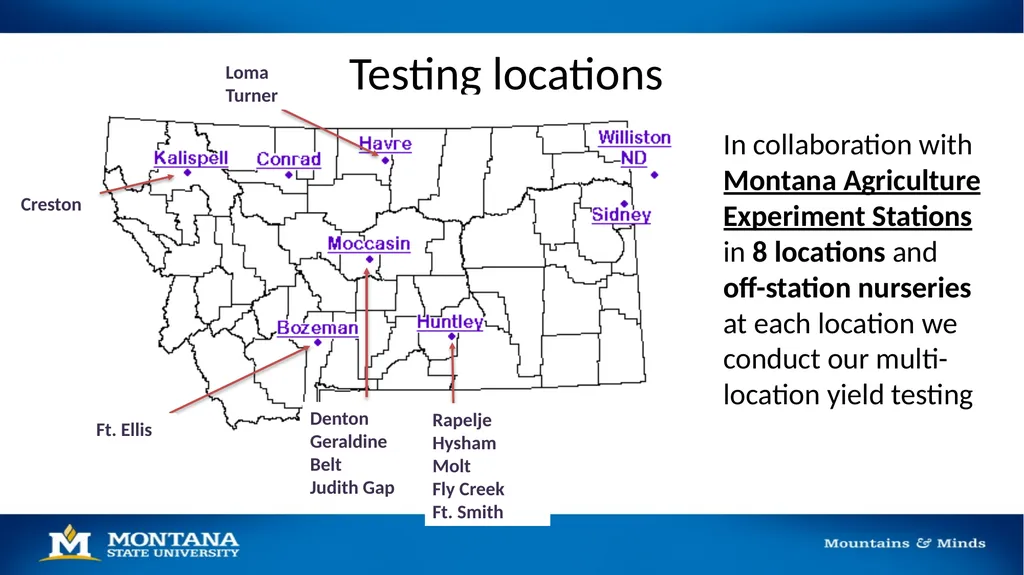
Testing locations In collaboration with Montana Agriculture Experiment Stations in 8 locations and off-station nurseries at each location we conduct our multi-location yield testing Creston Loma
Turner Denton
Geraldine
Belt
Judith Gap Rapelje
Hysham
Molt
Fly Creek
Ft. Smith Ft. Ellis<br>
14
Performance in Intrastate Yield Trial 2022 49 entries, 3 reps, across 9 locations
Includes released varieties from MSU, private companies, public breeding programs and new lines<br>
15
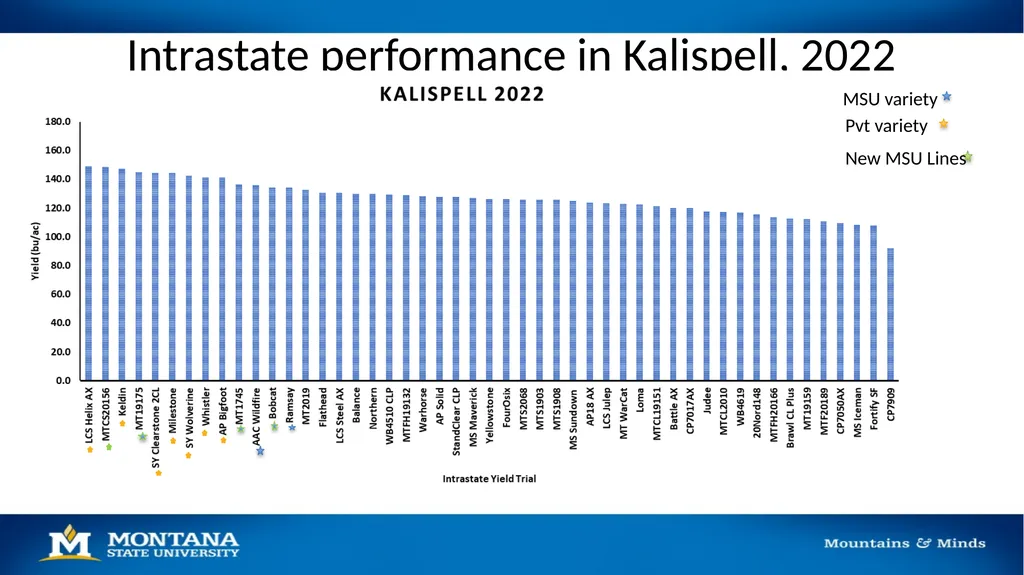
Intrastate performance in Kalispell, 2022 MSU variety Pvt variety New MSU Lines<br>
16
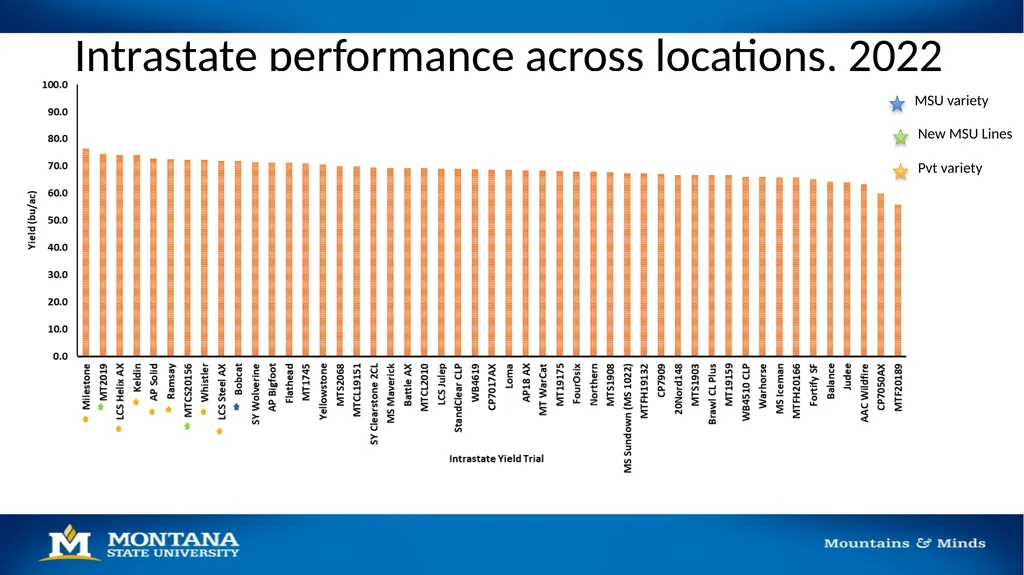
Intrastate performance across locations, 2022<br>
17
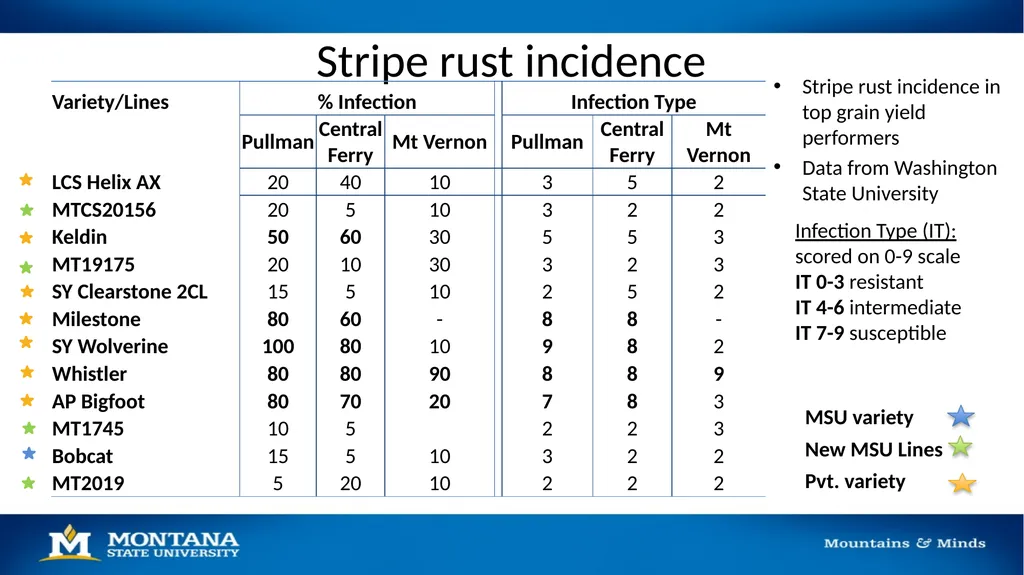
Stripe rust incidence Stripe rust incidence in top grain yield performers
Data from Washington State University Infection Type (IT): scored on 0-9 scale
IT 0-3 resistant
IT 4-6 intermediate
IT 7-9 susceptible MSU variety Pvt. variety New MSU Lines<br>
18
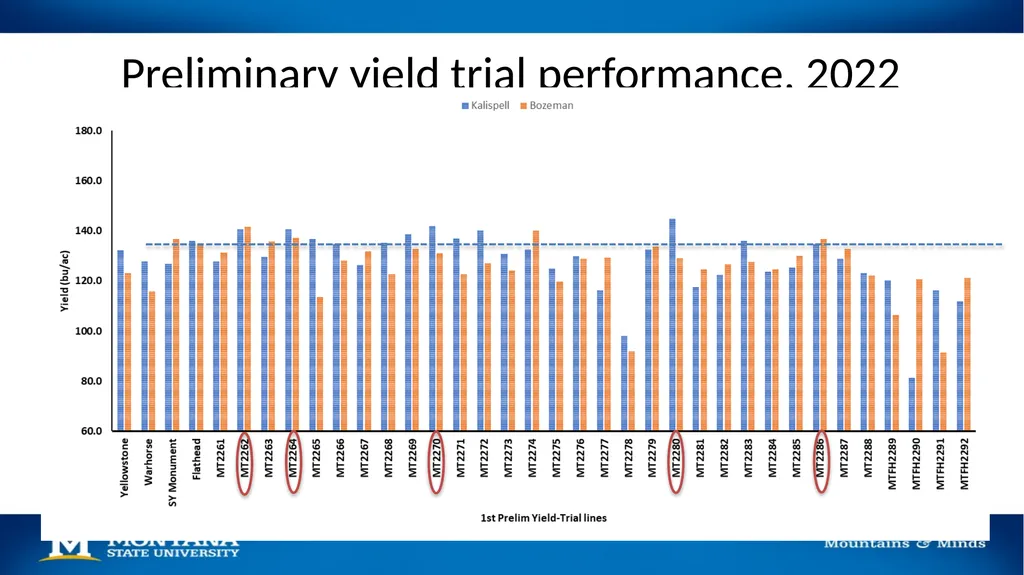
Preliminary yield trial performance, 2022<br>
19
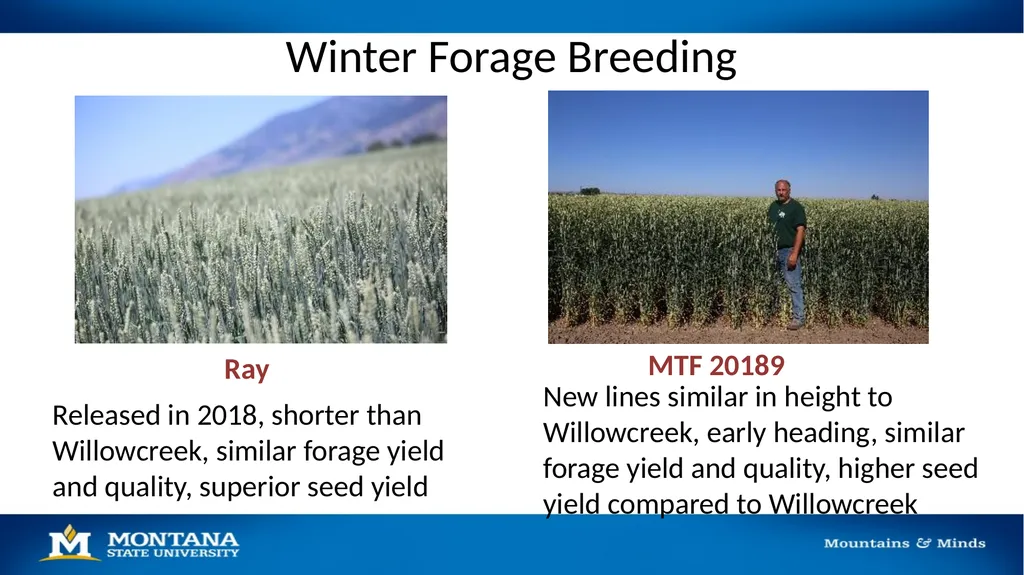
Winter Forage Breeding Ray MTF 20189 Released in 2018, shorter than Willowcreek, similar forage yield and quality, superior seed yield New lines similar in height to Willowcreek, early heading, similar forage yield and quality, higher seed yield compared to Willowcreek<br>
20
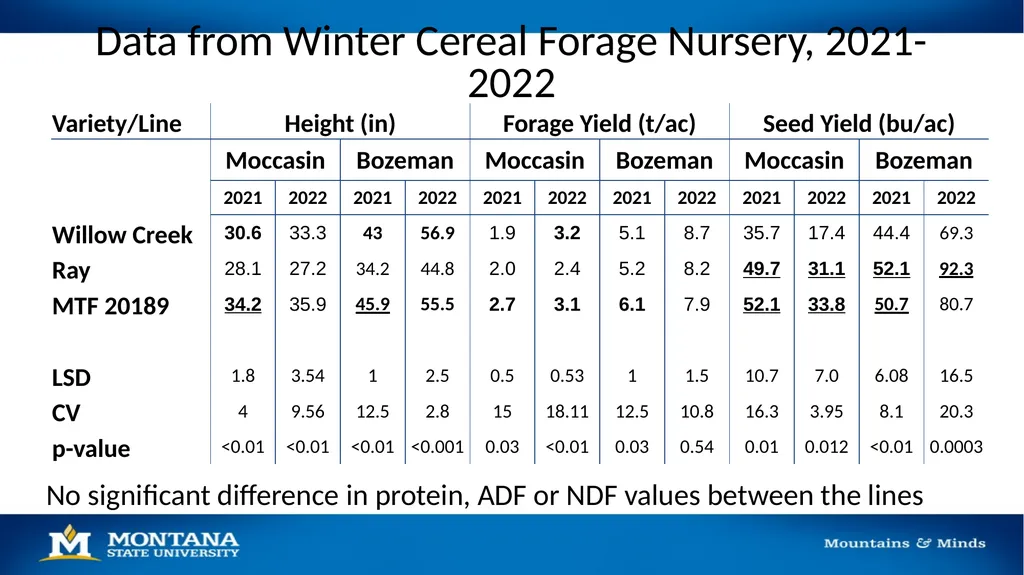
Data from Winter Cereal Forage Nursery, 2021-2022 No significant difference in protein, ADF or NDF values between the lines<br>
21
Acknowledgements Winter Wheat Breeding Program Phil Bruckner (retired)
Ron Ramsfield
Jim Berg (retired)
Duncan Pantos
Foundation Seed Program
Doug Holen
BranDee Johnston Montana Agriculture Experiment Stations
Darrin Boss
Jessica Torrion (NWARC)
Clint Beiermann (NWARC)
Jessica Pavelka (NWARC)
Daniel Porter (NWARC)
Peggy Lamb (NARC)
Patrick Carr (CARC)
Jed Eberly (CARC)
Jennifer Hammontree (CARC)
McKenna Volkman (CARC)
Dave Gettel (Bozeman)
Ken Kephart ( SARC - retired)
Kent McVay (SARC)
Qasim Khan (SARC)
Chengci Chen (EARC)
Frankie Crutcher (EARC)
NDSU Williston Extension Research Center, North Dakota
Gautam Pradhan<br>