
2024 David J. Apol, General Counsel Seth H. Jaffe,
SB
Published · 24 slides · 0 views

1 / 1

Description
2024 David J. Apol, General Counsel Seth H. Jaffe, Chief - Ethics, Law Policy Branch U.S. Office of Government Ethics MARCH 21, Standards of Conduct Amendments SUMMIT OGE Standards of Conduct Modernization 1992 2024 How did we get here?
Related Topics
Share
Embed code
Download this presentation From Below
"2024 David J. Apol, General Counsel Seth H. Jaffe," is the property of its rightful owner. Permission is granted to download and print the materials on this website for personal, non-commercial use only, and to display it on your personal computer provided you do not modify the materials and that you retain all copyright notices contained in the materials. By downloading content from our website, you accept the terms of this agreement.
Presentation Transcript
01
2024 David J. Apol, General Counsel
Seth H. Jaffe, Chief - Ethics, Law & Policy Branch
U.S. Office of Government Ethics MARCH 21, Standards of Conduct Amendments SUMMIT OGE<br>
Seth H. Jaffe, Chief - Ethics, Law & Policy Branch
U.S. Office of Government Ethics MARCH 21, Standards of Conduct Amendments SUMMIT OGE<br>
02
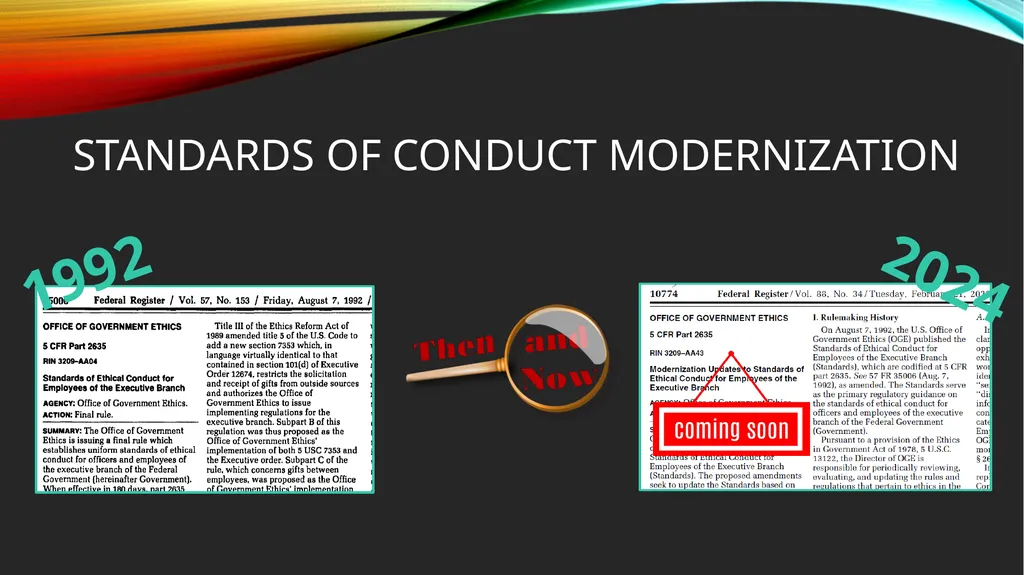
Standards of Conduct Modernization 1992 2024<br>
03
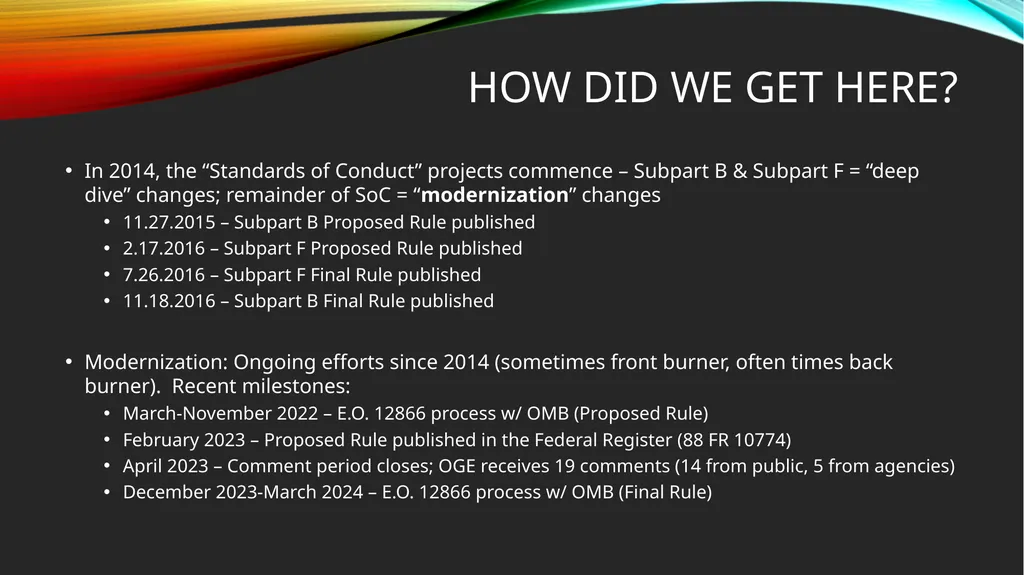
How did we get here? In 2014, the “Standards of Conduct” projects commence – Subpart B & Subpart F = “deep dive” changes; remainder of SoC = “modernization” changes
11.27.2015 – Subpart B Proposed Rule published
2.17.2016 – Subpart F Proposed Rule published
7.26.2016 – Subpart F Final Rule published
11.18.2016 – Subpart B Final Rule published
Modernization: Ongoing efforts since 2014 (sometimes front burner, often times back burner). Recent milestones:
March-November 2022 – E.O. 12866 process w/ OMB (Proposed Rule)
February 2023 – Proposed Rule published in the Federal Register (88 FR 10774)
April 2023 – Comment period closes; OGE receives 19 comments (14 from public, 5 from agencies)
December 2023-March 2024 – E.O. 12866 process w/ OMB (Final Rule)<br>
11.27.2015 – Subpart B Proposed Rule published
2.17.2016 – Subpart F Proposed Rule published
7.26.2016 – Subpart F Final Rule published
11.18.2016 – Subpart B Final Rule published
Modernization: Ongoing efforts since 2014 (sometimes front burner, often times back burner). Recent milestones:
March-November 2022 – E.O. 12866 process w/ OMB (Proposed Rule)
February 2023 – Proposed Rule published in the Federal Register (88 FR 10774)
April 2023 – Comment period closes; OGE receives 19 comments (14 from public, 5 from agencies)
December 2023-March 2024 – E.O. 12866 process w/ OMB (Final Rule)<br>
04
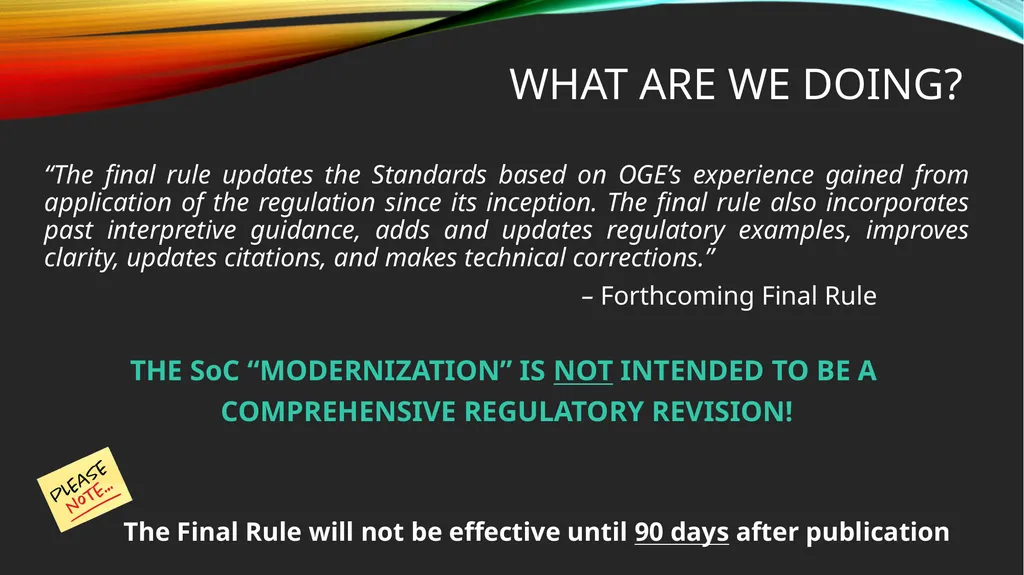
What are we doing? “The final rule updates the Standards based on OGE’s experience gained from application of the regulation since its inception. The final rule also incorporates past interpretive guidance, adds and updates regulatory examples, improves clarity, updates citations, and makes technical corrections.”
– Forthcoming Final Rule
THE SoC “MODERNIZATION” IS NOT INTENDED TO BE A
COMPREHENSIVE REGULATORY REVISION!
The Final Rule will not be effective until 90 days after publication<br>
– Forthcoming Final Rule
THE SoC “MODERNIZATION” IS NOT INTENDED TO BE A
COMPREHENSIVE REGULATORY REVISION!
The Final Rule will not be effective until 90 days after publication<br>
05
Global technical changes As part of the SoC modernization, OGE is:
Removing gendered language and language that unnecessarily focuses on marital status
Making punctuation/capitalization changes for consistency
Replacing “disqualification” and “disqualify” with “recusal” and “recuse” (consistent with Subpart F updates)
Updating agency names and outdated citations (e.g., to 5 CFR part 2637, to inaccurate 2638 citations)
Modernizing various examples to remove outdated language, e.g.,
Example regarding use of Govt property previously referred to a long distance call charged to a personal calling card…it now involves an email sent from a Govt email address
Another example involved an employee using their “office word processor” for personal purposes…it now refers to use of an office computer
Example regarding use of subordinate time previously referred to a supervisor asking his secretary to type his personal correspondence…it now refers to the supervisor asking an assistant to run personal errands<br>
Removing gendered language and language that unnecessarily focuses on marital status
Making punctuation/capitalization changes for consistency
Replacing “disqualification” and “disqualify” with “recusal” and “recuse” (consistent with Subpart F updates)
Updating agency names and outdated citations (e.g., to 5 CFR part 2637, to inaccurate 2638 citations)
Modernizing various examples to remove outdated language, e.g.,
Example regarding use of Govt property previously referred to a long distance call charged to a personal calling card…it now involves an email sent from a Govt email address
Another example involved an employee using their “office word processor” for personal purposes…it now refers to use of an office computer
Example regarding use of subordinate time previously referred to a supervisor asking his secretary to type his personal correspondence…it now refers to the supervisor asking an assistant to run personal errands<br>
06
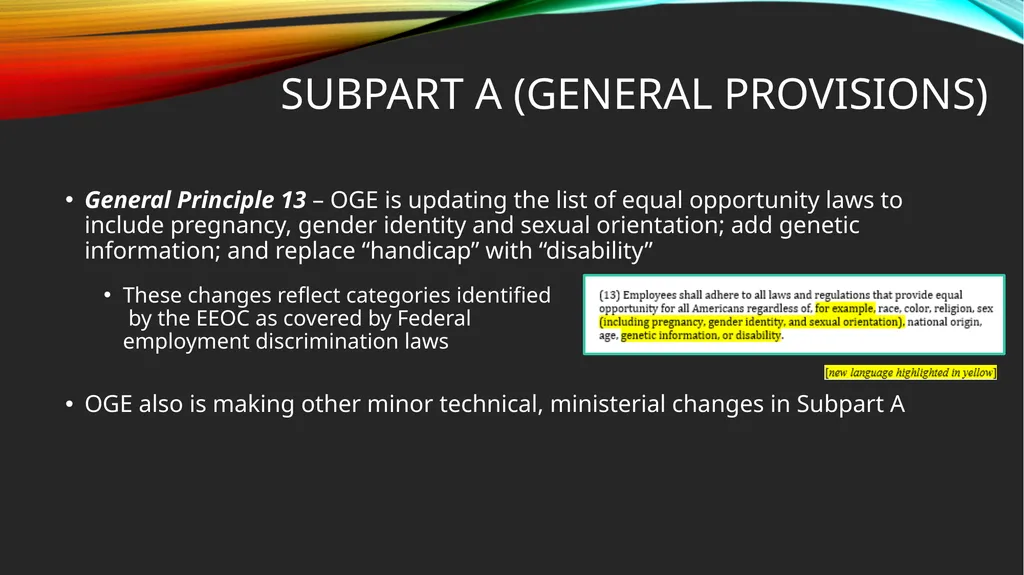
Subpart A (General Provisions) General Principle 13 – OGE is updating the list of equal opportunity laws to include pregnancy, gender identity and sexual orientation; add genetic information; and replace “handicap” with “disability”
.
These changes reflect categories identified by the EEOC as covered by Federal employment discrimination laws
OGE also is making other minor technical, ministerial changes in Subpart A<br>
.
These changes reflect categories identified by the EEOC as covered by Federal employment discrimination laws
OGE also is making other minor technical, ministerial changes in Subpart A<br>
07
Subpart B (gifts from outside sources) OGE is making minor technical/ministerial changes in Subpart B, and minor changes to examples
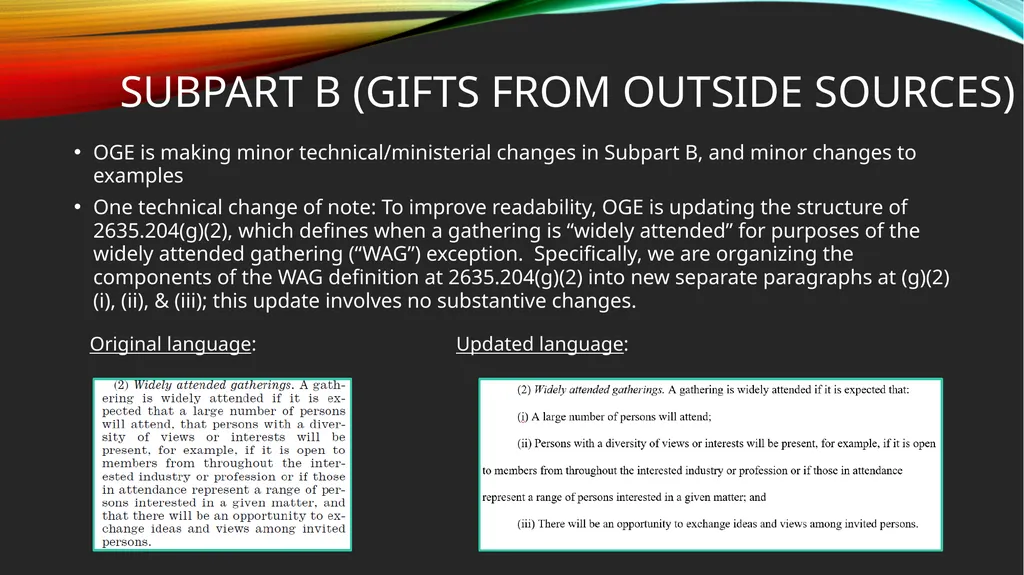
One technical change of note: To improve readability, OGE is updating the structure of 2635.204(g)(2), which defines when a gathering is “widely attended” for purposes of the widely attended gathering (“WAG”) exception. Specifically, we are organizing the components of the WAG definition at 2635.204(g)(2) into new separate paragraphs at (g)(2)(i), (ii), & (iii); this update involves no substantive changes.
Original language: Updated language:<br>
One technical change of note: To improve readability, OGE is updating the structure of 2635.204(g)(2), which defines when a gathering is “widely attended” for purposes of the widely attended gathering (“WAG”) exception. Specifically, we are organizing the components of the WAG definition at 2635.204(g)(2) into new separate paragraphs at (g)(2)(i), (ii), & (iii); this update involves no substantive changes.
Original language: Updated language:<br>
08
Subpart C (Gifts between Employees) Subpart C is based on an underlying statute, 5 U.S.C. 7351, which establishes certain restrictions on gifts between employees. The underlying statute provides functional limits to how OGE can update this Subpart.
OGE is making various technical updates to Subpart C, including: .
Replacing “donating” and “donation” with “contributing” and “contribution”
.
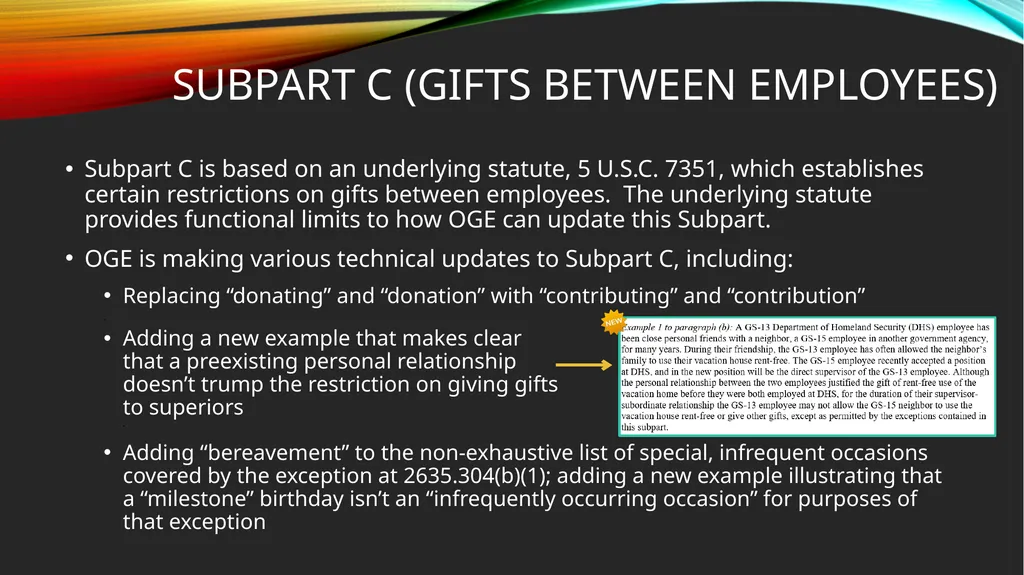
Adding a new example that makes clear that a preexisting personal relationship doesn’t trump the restriction on giving gifts to superiors .
Adding “bereavement” to the non-exhaustive list of special, infrequent occasions covered by the exception at 2635.304(b)(1); adding a new example illustrating that a “milestone” birthday isn’t an “infrequently occurring occasion” for purposes of that exception<br>
OGE is making various technical updates to Subpart C, including: .
Replacing “donating” and “donation” with “contributing” and “contribution”
.
Adding a new example that makes clear that a preexisting personal relationship doesn’t trump the restriction on giving gifts to superiors .
Adding “bereavement” to the non-exhaustive list of special, infrequent occasions covered by the exception at 2635.304(b)(1); adding a new example illustrating that a “milestone” birthday isn’t an “infrequently occurring occasion” for purposes of that exception<br>
09
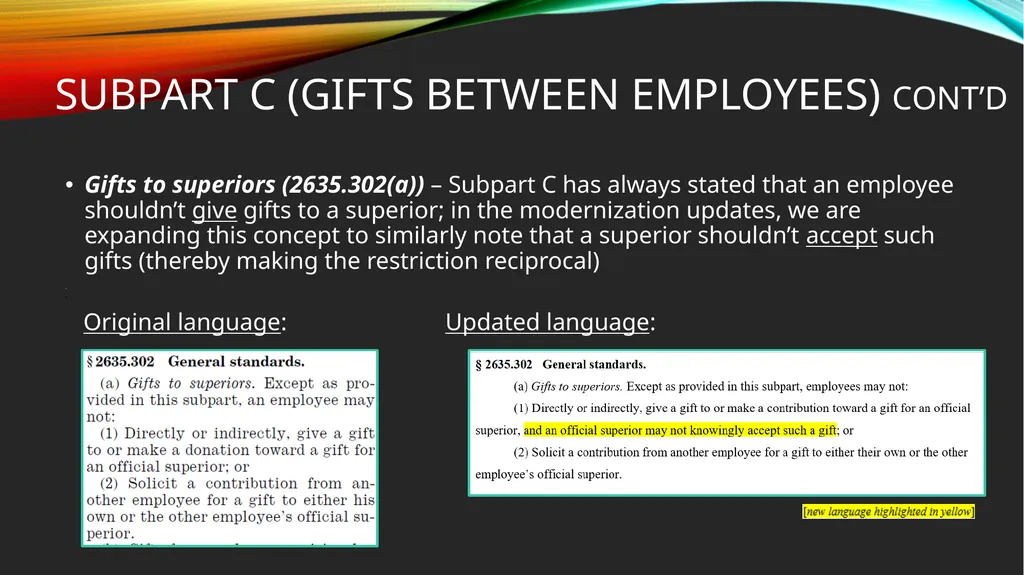
Subpart C (Gifts between Employees) cont’d Gifts to superiors (2635.302(a)) – Subpart C has always stated that an employee shouldn’t give gifts to a superior; in the modernization updates, we are expanding this concept to similarly note that a superior shouldn’t accept such gifts (thereby making the restriction reciprocal)
. .
Original language: Updated language:<br>
. .
Original language: Updated language:<br>
10
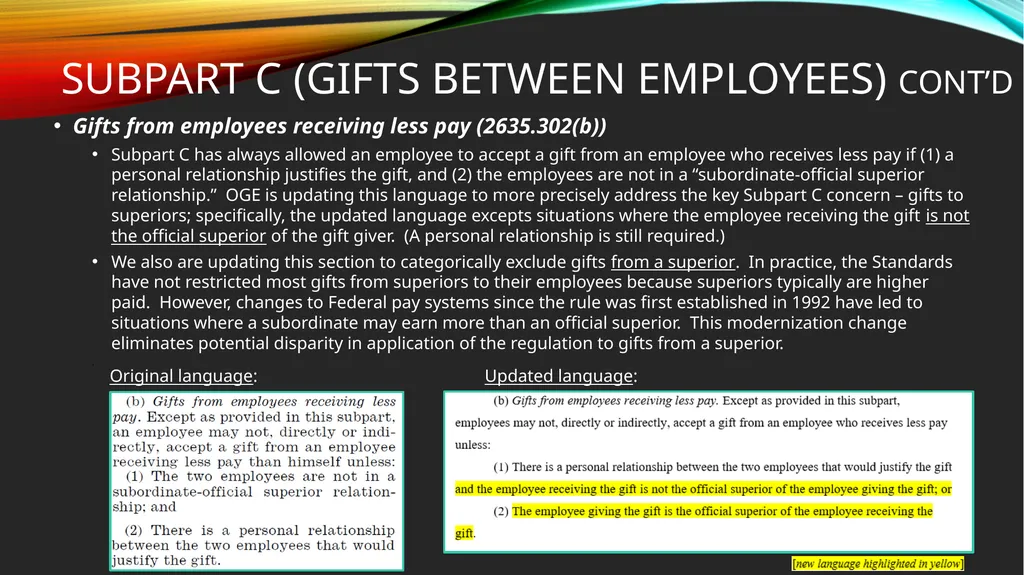
Subpart C (Gifts between Employees) cont’d Gifts from employees receiving less pay (2635.302(b))
Subpart C has always allowed an employee to accept a gift from an employee who receives less pay if (1) a personal relationship justifies the gift, and (2) the employees are not in a “subordinate-official superior relationship.” OGE is updating this language to more precisely address the key Subpart C concern – gifts to superiors; specifically, the updated language excepts situations where the employee receiving the gift is not the official superior of the gift giver. (A personal relationship is still required.)
We also are updating this section to categorically exclude gifts from a superior. In practice, the Standards have not restricted most gifts from superiors to their employees because superiors typically are higher paid. However, changes to Federal pay systems since the rule was first established in 1992 have led to situations where a subordinate may earn more than an official superior. This modernization change eliminates potential disparity in application of the regulation to gifts from a superior.
.
Original language: Updated language:<br>
Subpart C has always allowed an employee to accept a gift from an employee who receives less pay if (1) a personal relationship justifies the gift, and (2) the employees are not in a “subordinate-official superior relationship.” OGE is updating this language to more precisely address the key Subpart C concern – gifts to superiors; specifically, the updated language excepts situations where the employee receiving the gift is not the official superior of the gift giver. (A personal relationship is still required.)
We also are updating this section to categorically exclude gifts from a superior. In practice, the Standards have not restricted most gifts from superiors to their employees because superiors typically are higher paid. However, changes to Federal pay systems since the rule was first established in 1992 have led to situations where a subordinate may earn more than an official superior. This modernization change eliminates potential disparity in application of the regulation to gifts from a superior.
.
Original language: Updated language:<br>
11
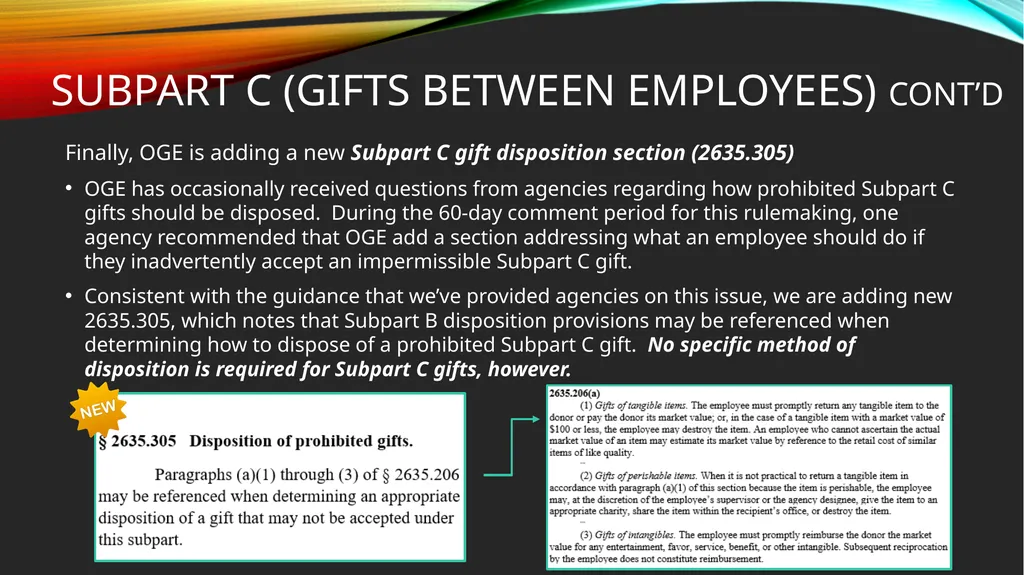
Subpart C (Gifts between Employees) cont’d Finally, OGE is adding a new Subpart C gift disposition section (2635.305)
OGE has occasionally received questions from agencies regarding how prohibited Subpart C gifts should be disposed. During the 60-day comment period for this rulemaking, one agency recommended that OGE add a section addressing what an employee should do if they inadvertently accept an impermissible Subpart C gift.
Consistent with the guidance that we’ve provided agencies on this issue, we are adding new 2635.305, which notes that Subpart B disposition provisions may be referenced when determining how to dispose of a prohibited Subpart C gift. No specific method of disposition is required for Subpart C gifts, however.<br>
OGE has occasionally received questions from agencies regarding how prohibited Subpart C gifts should be disposed. During the 60-day comment period for this rulemaking, one agency recommended that OGE add a section addressing what an employee should do if they inadvertently accept an impermissible Subpart C gift.
Consistent with the guidance that we’ve provided agencies on this issue, we are adding new 2635.305, which notes that Subpart B disposition provisions may be referenced when determining how to dispose of a prohibited Subpart C gift. No specific method of disposition is required for Subpart C gifts, however.<br>
12
Subpart D
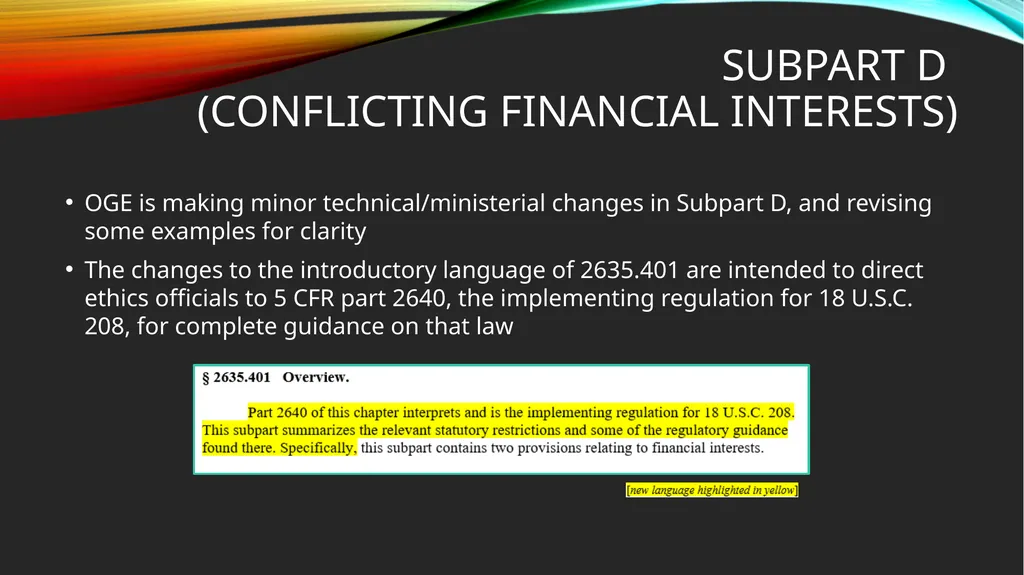
(Conflicting financial interests) OGE is making minor technical/ministerial changes in Subpart D, and revising some examples for clarity
The changes to the introductory language of 2635.401 are intended to direct ethics officials to 5 CFR part 2640, the implementing regulation for 18 U.S.C. 208, for complete guidance on that law<br>
The changes to the introductory language of 2635.401 are intended to direct ethics officials to 5 CFR part 2640, the implementing regulation for 18 U.S.C. 208, for complete guidance on that law<br>
13
Subpart E
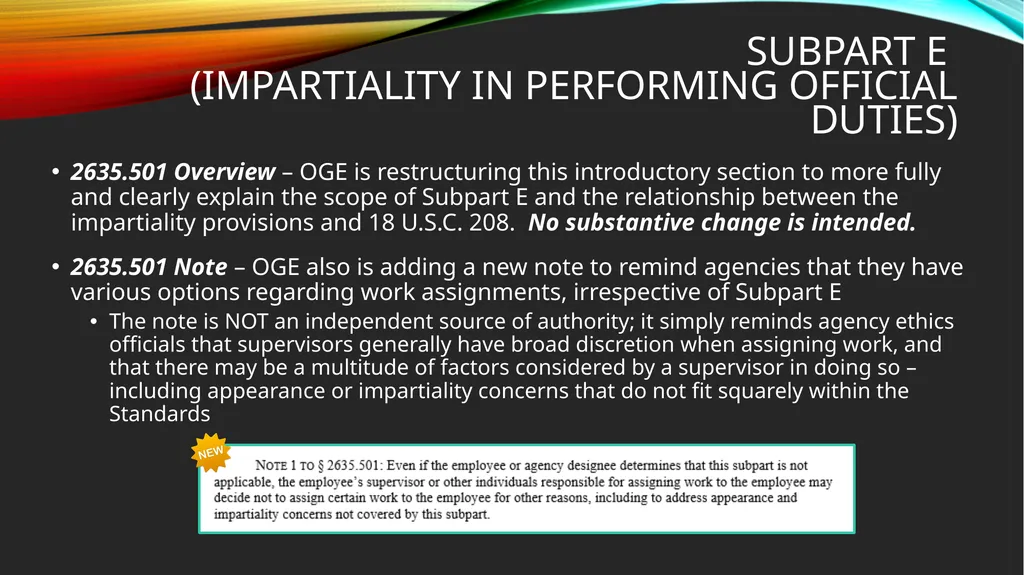
(Impartiality in performing official duties) 2635.501 Overview – OGE is restructuring this introductory section to more fully and clearly explain the scope of Subpart E and the relationship between the impartiality provisions and 18 U.S.C. 208. No substantive change is intended.
2635.501 Note – OGE also is adding a new note to remind agencies that they have various options regarding work assignments, irrespective of Subpart E
The note is NOT an independent source of authority; it simply reminds agency ethics officials that supervisors generally have broad discretion when assigning work, and that there may be a multitude of factors considered by a supervisor in doing so – including appearance or impartiality concerns that do not fit squarely within the Standards<br>
2635.501 Note – OGE also is adding a new note to remind agencies that they have various options regarding work assignments, irrespective of Subpart E
The note is NOT an independent source of authority; it simply reminds agency ethics officials that supervisors generally have broad discretion when assigning work, and that there may be a multitude of factors considered by a supervisor in doing so – including appearance or impartiality concerns that do not fit squarely within the Standards<br>
14
Subpart E
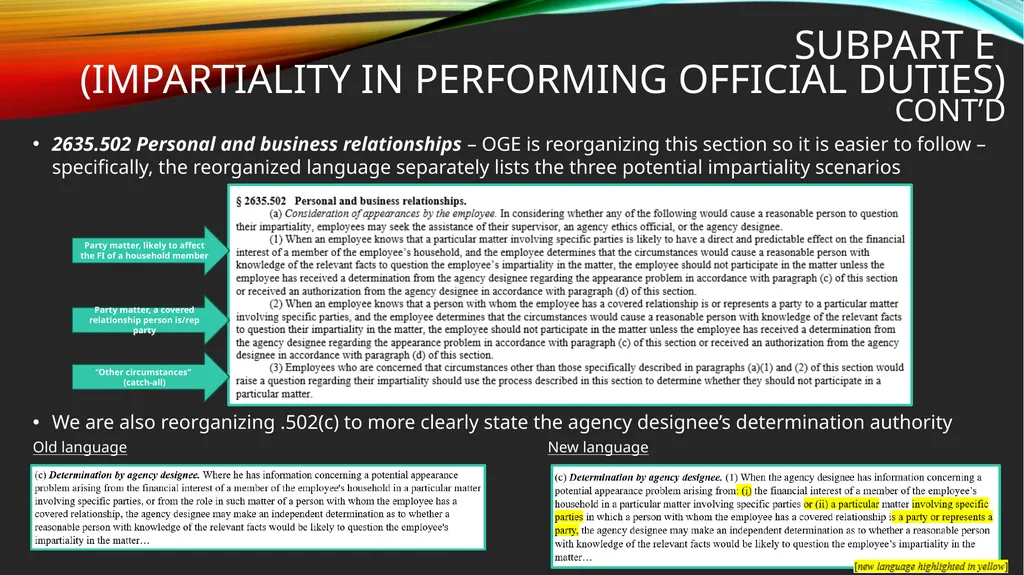
(Impartiality in performing official duties) cont’d 2635.502 Personal and business relationships – OGE is reorganizing this section so it is easier to follow – specifically, the reorganized language separately lists the three potential impartiality scenarios
.
We are also reorganizing .502(c) to more clearly state the agency designee’s determination authority
Old language New language Party matter, likely to affect the FI of a household member Party matter, a covered relationship person is/rep party “Other circumstances” (catch-all)<br>
.
We are also reorganizing .502(c) to more clearly state the agency designee’s determination authority
Old language New language Party matter, likely to affect the FI of a household member Party matter, a covered relationship person is/rep party “Other circumstances” (catch-all)<br>
15
Subpart E
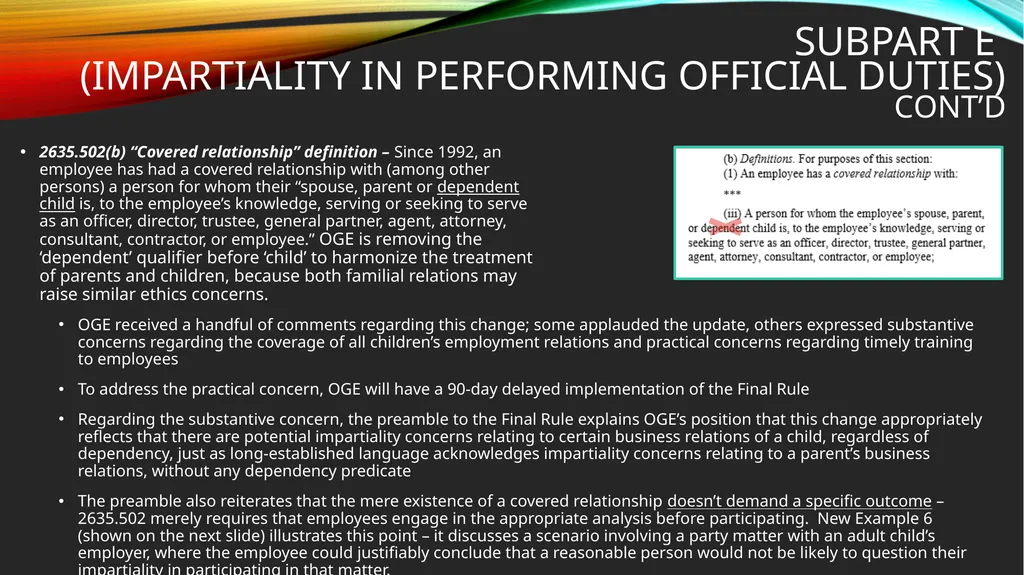
(Impartiality in performing official duties) cont’d 2635.502(b) “Covered relationship” definition – Since 1992, an
employee has had a covered relationship with (among other
persons) a person for whom their “spouse, parent or dependent
child is, to the employee’s knowledge, serving or seeking to serve
as an officer, director, trustee, general partner, agent, attorney,
consultant, contractor, or employee.” OGE is removing the
‘dependent’ qualifier before ‘child’ to harmonize the treatment
of parents and children, because both familial relations may
raise similar ethics concerns.
OGE received a handful of comments regarding this change; some applauded the update, others expressed substantive concerns regarding the coverage of all children’s employment relations and practical concerns regarding timely training to employees
To address the practical concern, OGE will have a 90-day delayed implementation of the Final Rule
Regarding the substantive concern, the preamble to the Final Rule explains OGE’s position that this change appropriately reflects that there are potential impartiality concerns relating to certain business relations of a child, regardless of dependency, just as long-established language acknowledges impartiality concerns relating to a parent’s business relations, without any dependency predicate
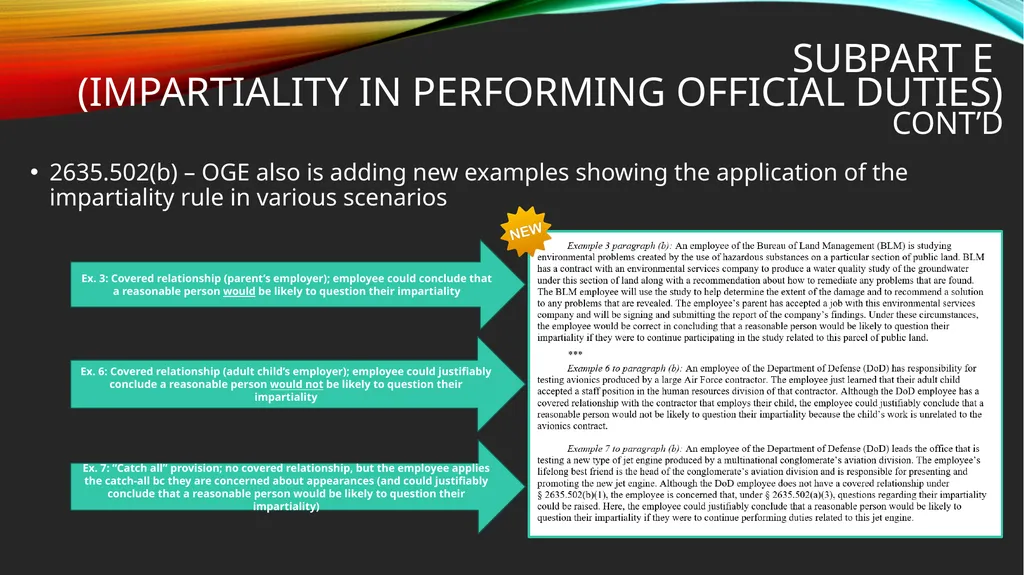
The preamble also reiterates that the mere existence of a covered relationship doesn’t demand a specific outcome – 2635.502 merely requires that employees engage in the appropriate analysis before participating. New Example 6 (shown on the next slide) illustrates this point – it discusses a scenario involving a party matter with an adult child’s employer, where the employee could justifiably conclude that a reasonable person would not be likely to question their impartiality in participating in that matter.<br>
OGE received a handful of comments regarding this change; some applauded the update, others expressed substantive concerns regarding the coverage of all children’s employment relations and practical concerns regarding timely training to employees
To address the practical concern, OGE will have a 90-day delayed implementation of the Final Rule
Regarding the substantive concern, the preamble to the Final Rule explains OGE’s position that this change appropriately reflects that there are potential impartiality concerns relating to certain business relations of a child, regardless of dependency, just as long-established language acknowledges impartiality concerns relating to a parent’s business relations, without any dependency predicate
The preamble also reiterates that the mere existence of a covered relationship doesn’t demand a specific outcome – 2635.502 merely requires that employees engage in the appropriate analysis before participating. New Example 6 (shown on the next slide) illustrates this point – it discusses a scenario involving a party matter with an adult child’s employer, where the employee could justifiably conclude that a reasonable person would not be likely to question their impartiality in participating in that matter.<br>
16
Subpart E
(Impartiality in performing official duties) cont’d 2635.502(b) – OGE also is adding new examples showing the application of the impartiality rule in various scenarios Ex. 3: Covered relationship (parent’s employer); employee could conclude that a reasonable person would be likely to question their impartiality Ex. 6: Covered relationship (adult child’s employer); employee could justifiably conclude a reasonable person would not be likely to question their impartiality Ex. 7: “Catch all” provision; no covered relationship, but the employee applies the catch-all bc they are concerned about appearances (and could justifiably conclude that a reasonable person would be likely to question their impartiality)<br>
17
Subpart E
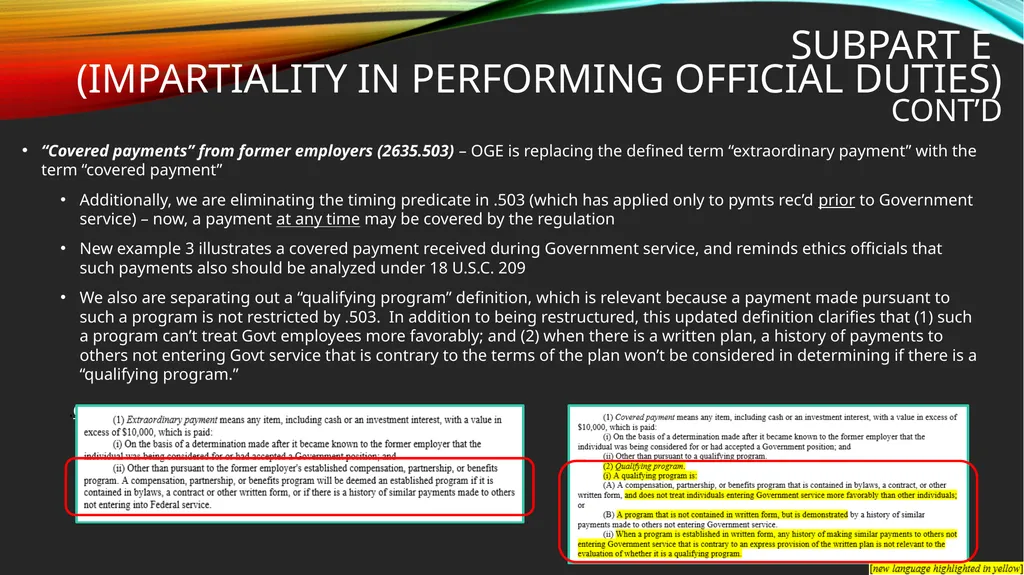
(Impartiality in performing official duties) cont’d “Covered payments” from former employers (2635.503) – OGE is replacing the defined term “extraordinary payment” with the term “covered payment”
Additionally, we are eliminating the timing predicate in .503 (which has applied only to pymts rec’d prior to Government service) – now, a payment at any time may be covered by the regulation
New example 3 illustrates a covered payment received during Government service, and reminds ethics officials that such payments also should be analyzed under 18 U.S.C. 209
We also are separating out a “qualifying program” definition, which is relevant because a payment made pursuant to such a program is not restricted by .503. In addition to being restructured, this updated definition clarifies that (1) such a program can’t treat Govt employees more favorably; and (2) when there is a written plan, a history of payments to others not entering Govt service that is contrary to the terms of the plan won’t be considered in determining if there is a “qualifying program.”
.Old language New language<br>
Additionally, we are eliminating the timing predicate in .503 (which has applied only to pymts rec’d prior to Government service) – now, a payment at any time may be covered by the regulation
New example 3 illustrates a covered payment received during Government service, and reminds ethics officials that such payments also should be analyzed under 18 U.S.C. 209
We also are separating out a “qualifying program” definition, which is relevant because a payment made pursuant to such a program is not restricted by .503. In addition to being restructured, this updated definition clarifies that (1) such a program can’t treat Govt employees more favorably; and (2) when there is a written plan, a history of payments to others not entering Govt service that is contrary to the terms of the plan won’t be considered in determining if there is a “qualifying program.”
.Old language New language<br>
18
Subpart F (Seeking other employment) OGE is making minor technical/ministerial changes, and minor changes to examples in Subpart F<br>
19
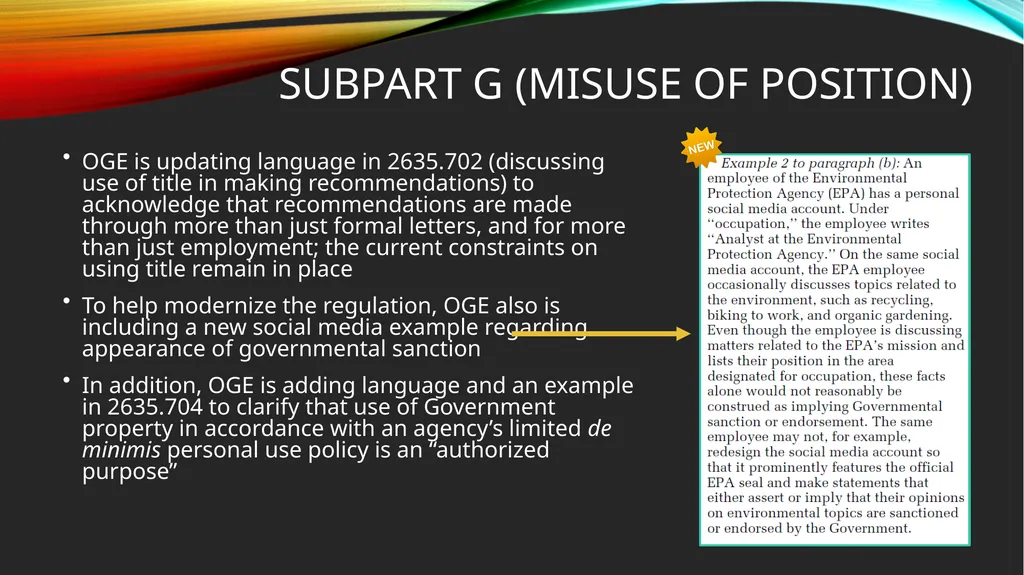
Subpart G (MISUSE OF POSITION) OGE is updating language in 2635.702 (discussing use of title in making recommendations) to acknowledge that recommendations are made through more than just formal letters, and for more than just employment; the current constraints on using title remain in place
To help modernize the regulation, OGE also is including a new social media example regarding appearance of governmental sanction
In addition, OGE is adding language and an example in 2635.704 to clarify that use of Government property in accordance with an agency’s limited de minimis personal use policy is an “authorized purpose”<br>
To help modernize the regulation, OGE also is including a new social media example regarding appearance of governmental sanction
In addition, OGE is adding language and an example in 2635.704 to clarify that use of Government property in accordance with an agency’s limited de minimis personal use policy is an “authorized purpose”<br>
20
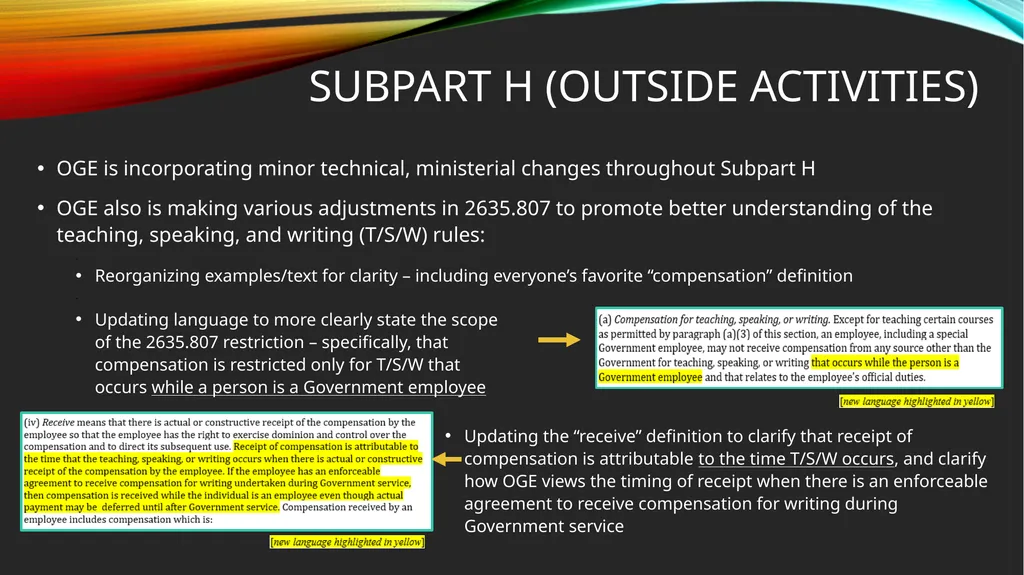
Subpart H (outside activities) OGE is incorporating minor technical, ministerial changes throughout Subpart H
OGE also is making various adjustments in 2635.807 to promote better understanding of the teaching, speaking, and writing (T/S/W) rules:
.
Reorganizing examples/text for clarity – including everyone’s favorite “compensation” definition
.
Updating language to more clearly state the scope of the 2635.807 restriction – specifically, that compensation is restricted only for T/S/W that occurs while a person is a Government employee
Updating the “receive” definition to clarify that receipt of compensation is attributable to the time T/S/W occurs, and clarify how OGE views the timing of receipt when there is an enforceable agreement to receive compensation for writing during Government service<br>
OGE also is making various adjustments in 2635.807 to promote better understanding of the teaching, speaking, and writing (T/S/W) rules:
.
Reorganizing examples/text for clarity – including everyone’s favorite “compensation” definition
.
Updating language to more clearly state the scope of the 2635.807 restriction – specifically, that compensation is restricted only for T/S/W that occurs while a person is a Government employee
Updating the “receive” definition to clarify that receipt of compensation is attributable to the time T/S/W occurs, and clarify how OGE views the timing of receipt when there is an enforceable agreement to receive compensation for writing during Government service<br>
21
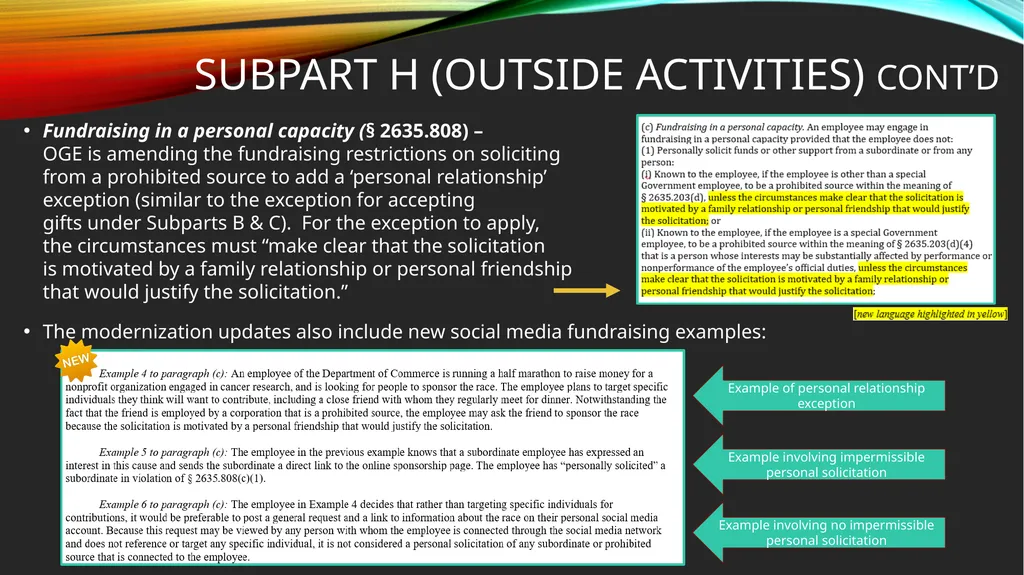
Subpart H (outside activities) cont’d Fundraising in a personal capacity (§ 2635.808) –
OGE is amending the fundraising restrictions on soliciting
from a prohibited source to add a ‘personal relationship’
exception (similar to the exception for accepting
gifts under Subparts B & C). For the exception to apply,
the circumstances must “make clear that the solicitation
is motivated by a family relationship or personal friendship
that would justify the solicitation.”
The modernization updates also include new social media fundraising examples:
. Example of personal relationship exception Example involving impermissible personal solicitation Example involving no impermissible personal solicitation<br>
The modernization updates also include new social media fundraising examples:
. Example of personal relationship exception Example involving impermissible personal solicitation Example involving no impermissible personal solicitation<br>
22
Subpart I (RELATED STATUTORY AUTHORITIES) OGE is making minor technical/ministerial changes, and updating outdated citations in Subpart I<br>
23
Subpart J (LEGAL EXPENSE FUNDS) The modernization rulemaking makes no changes to Subpart J—Legal Expense Funds. OGE published the final rule for Subpart J in May 2023 (88 FR 33799), and Subpart J became effective on November 21, 2023.<br>
24
Subpart H (outside activities) cont’d Fundraising in a personal capacity (§ 2635.808) –
OGE is amending the fundraising restrictions on soliciting
from a prohibited source to add a ‘personal relationship’
exception (similar to the exception for accepting
gifts under Subparts B & C). For the exception to apply,
the circumstances must “make clear that the solicitation
is motivated by a family relationship or personal friendship
that would justify the solicitation.”
The modernization updates also include new social media fundraising examples:
. Example of personal relationship exception Example involving impermissible personal solicitation Example involving no impermissible personal solicitation QUESTIONS?<br>
The modernization updates also include new social media fundraising examples:
. Example of personal relationship exception Example involving impermissible personal solicitation Example involving no impermissible personal solicitation QUESTIONS?<br>