
4B Supporting LGBTQ Youth & Educators Within the
AM
Published · 27 slides · 0 views

1 / 1

Description
4B Supporting LGBTQ Youth Educators Within the PBIS Framework Jennifer Freeman, University of Connecticut Renee Bradley, U.S. Department of Education Topic: Equity Keywords: Implementation, PBIS Foundations Learning Objectives Understand
Related Topics
Share
Embed code
Download this presentation From Below
"4B Supporting LGBTQ Youth & Educators Within the" is the property of its rightful owner. Permission is granted to download and print the materials on this website for personal, non-commercial use only, and to display it on your personal computer provided you do not modify the materials and that you retain all copyright notices contained in the materials. By downloading content from our website, you accept the terms of this agreement.
Presentation Transcript
01
4B Supporting LGBTQ Youth & Educators Within the PBIS Framework Jennifer Freeman, University of Connecticut
Renee Bradley, U.S. Department of Education Topic: Equity
Keywords: Implementation, PBIS Foundations<br>
Renee Bradley, U.S. Department of Education Topic: Equity
Keywords: Implementation, PBIS Foundations<br>
02
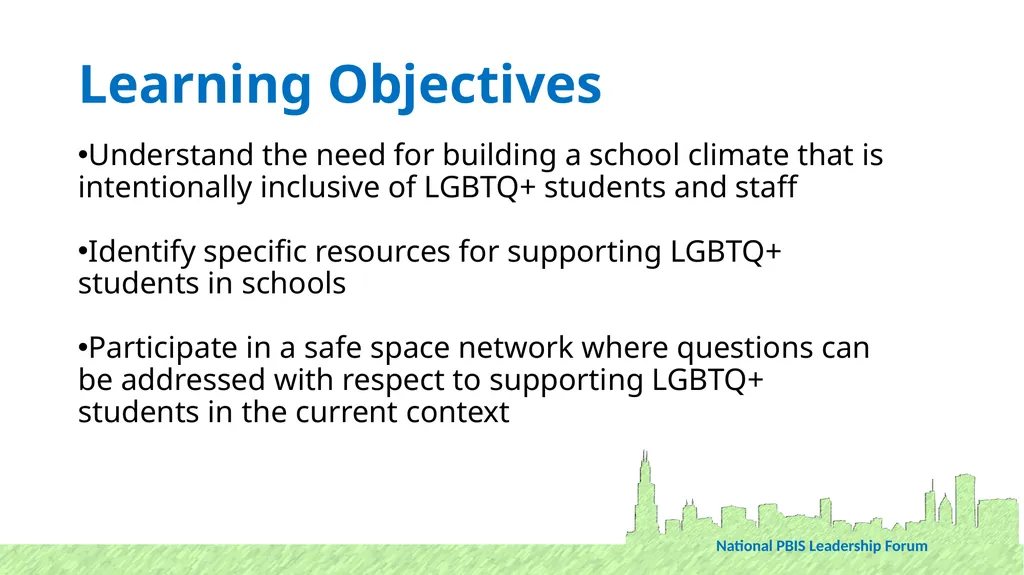
Learning Objectives Understand the need for building a school climate that is intentionally inclusive of LGBTQ+ students and staff
Identify specific resources for supporting LGBTQ+ students in schools
Participate in a safe space network where questions can be addressed with respect to supporting LGBTQ+ students in the current context<br>
Identify specific resources for supporting LGBTQ+ students in schools
Participate in a safe space network where questions can be addressed with respect to supporting LGBTQ+ students in the current context<br>
03
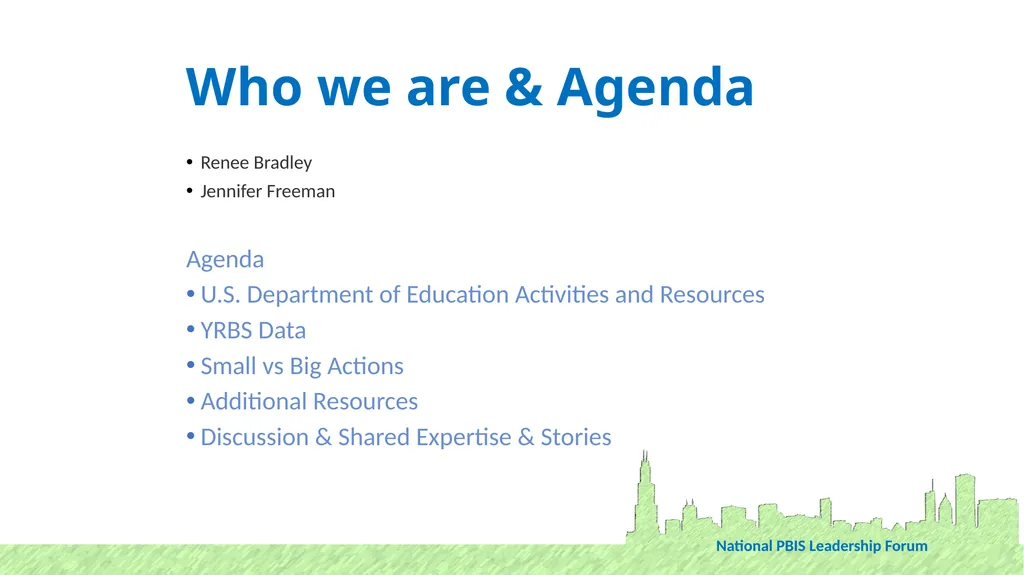
Who we are & Agenda Renee Bradley
Jennifer Freeman
Agenda
U.S. Department of Education Activities and Resources
YRBS Data
Small vs Big Actions
Additional Resources
Discussion & Shared Expertise & Stories<br>
Jennifer Freeman
Agenda
U.S. Department of Education Activities and Resources
YRBS Data
Small vs Big Actions
Additional Resources
Discussion & Shared Expertise & Stories<br>
04
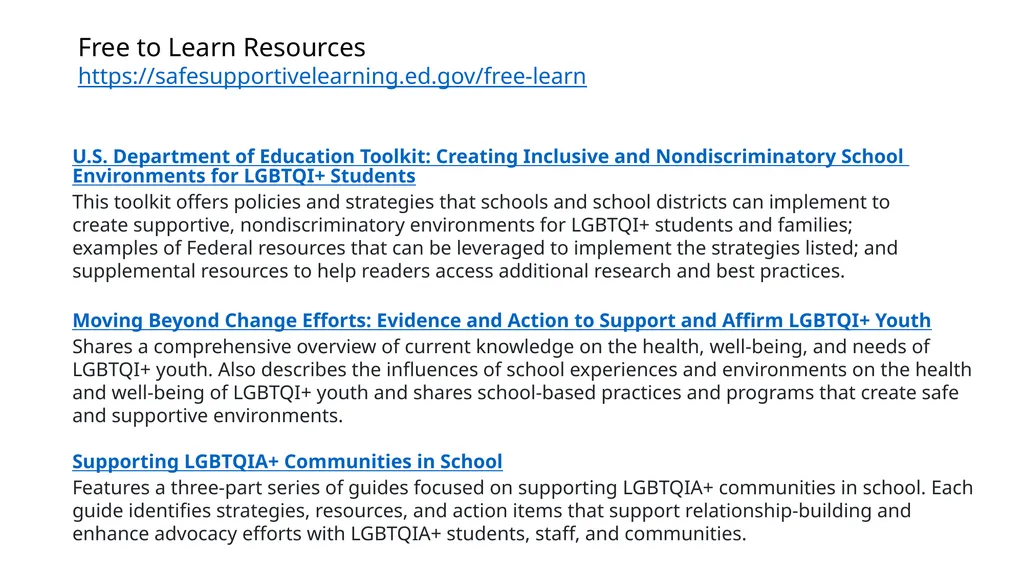
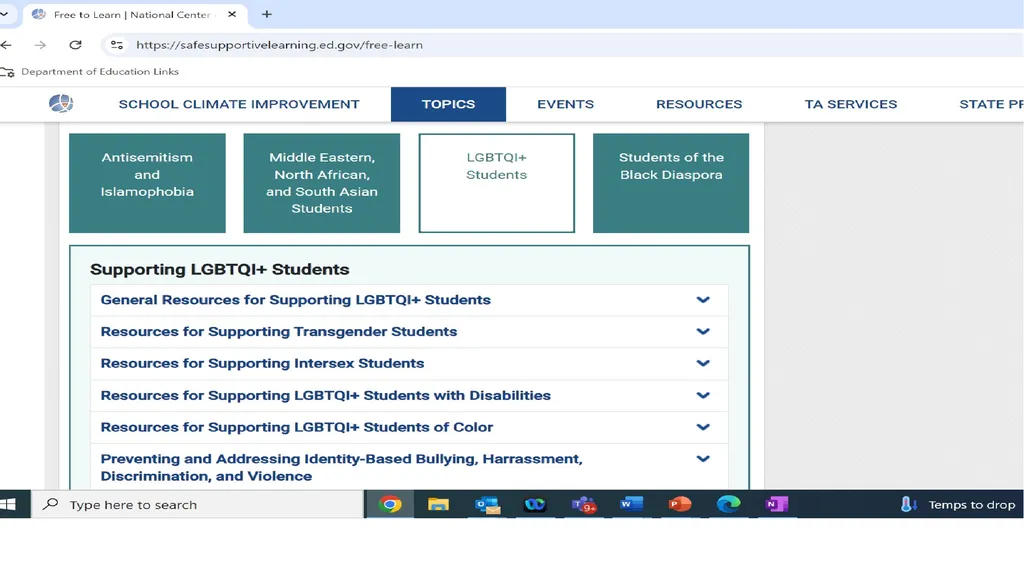
Free to Learn Resources
https://safesupportivelearning.ed.gov/free-learn U.S. Department of Education Toolkit: Creating Inclusive and Nondiscriminatory School Environments for LGBTQI+ Students
This toolkit offers policies and strategies that schools and school districts can implement to create supportive, nondiscriminatory environments for LGBTQI+ students and families; examples of Federal resources that can be leveraged to implement the strategies listed; and supplemental resources to help readers access additional research and best practices. Moving Beyond Change Efforts: Evidence and Action to Support and Affirm LGBTQI+ Youth
Shares a comprehensive overview of current knowledge on the health, well-being, and needs of LGBTQI+ youth. Also describes the influences of school experiences and environments on the health and well-being of LGBTQI+ youth and shares school-based practices and programs that create safe and supportive environments.
Supporting LGBTQIA+ Communities in School Features a three-part series of guides focused on supporting LGBTQIA+ communities in school. Each guide identifies strategies, resources, and action items that support relationship-building and enhance advocacy efforts with LGBTQIA+ students, staff, and communities.<br>
Supporting LGBTQIA+ Communities in School Features a three-part series of guides focused on supporting LGBTQIA+ communities in school. Each guide identifies strategies, resources, and action items that support relationship-building and enhance advocacy efforts with LGBTQIA+ students, staff, and communities.<br>
05
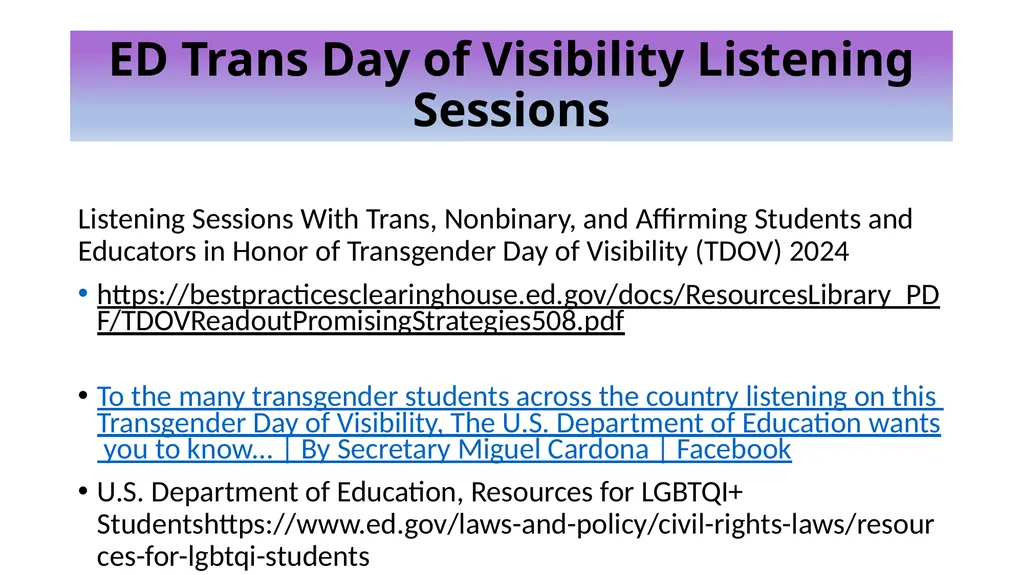
ED Trans Day of Visibility Listening Sessions Listening Sessions With Trans, Nonbinary, and Affirming Students and Educators in Honor of Transgender Day of Visibility (TDOV) 2024
https://bestpracticesclearinghouse.ed.gov/docs/ResourcesLibrary_PDF/TDOVReadoutPromisingStrategies508.pdf
To the many transgender students across the country listening on this Transgender Day of Visibility, The U.S. Department of Education wants you to know... | By Secretary Miguel Cardona | Facebook
U.S. Department of Education, Resources for LGBTQI+ Studentshttps://www.ed.gov/laws-and-policy/civil-rights-laws/resources-for-lgbtqi-students<br>
https://bestpracticesclearinghouse.ed.gov/docs/ResourcesLibrary_PDF/TDOVReadoutPromisingStrategies508.pdf
To the many transgender students across the country listening on this Transgender Day of Visibility, The U.S. Department of Education wants you to know... | By Secretary Miguel Cardona | Facebook
U.S. Department of Education, Resources for LGBTQI+ Studentshttps://www.ed.gov/laws-and-policy/civil-rights-laws/resources-for-lgbtqi-students<br>
06
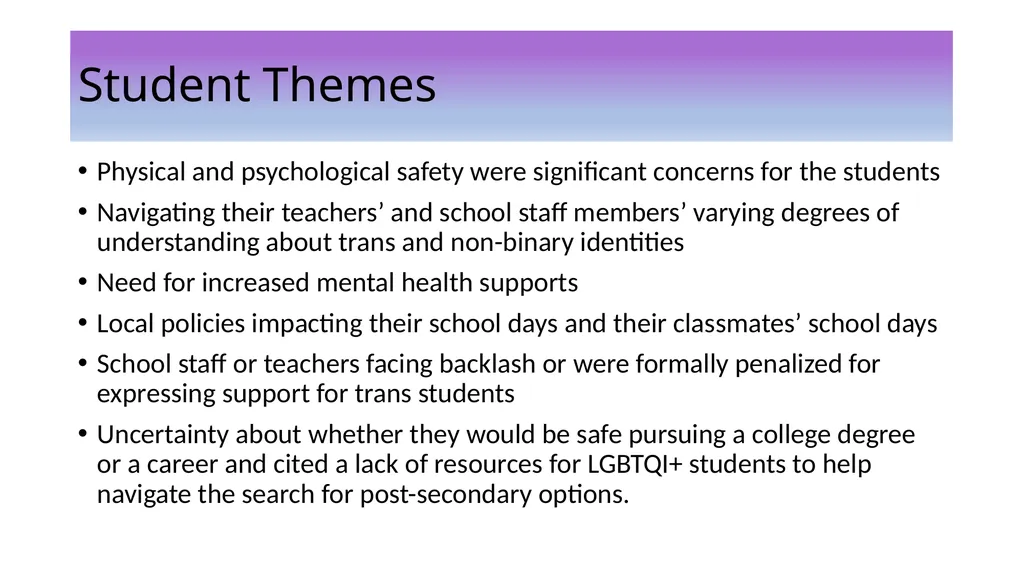
Student Themes Physical and psychological safety were significant concerns for the students
Navigating their teachers’ and school staff members’ varying degrees of understanding about trans and non-binary identities
Need for increased mental health supports
Local policies impacting their school days and their classmates’ school days
School staff or teachers facing backlash or were formally penalized for expressing support for trans students
Uncertainty about whether they would be safe pursuing a college degree or a career and cited a lack of resources for LGBTQI+ students to help navigate the search for post-secondary options.<br>
Navigating their teachers’ and school staff members’ varying degrees of understanding about trans and non-binary identities
Need for increased mental health supports
Local policies impacting their school days and their classmates’ school days
School staff or teachers facing backlash or were formally penalized for expressing support for trans students
Uncertainty about whether they would be safe pursuing a college degree or a career and cited a lack of resources for LGBTQI+ students to help navigate the search for post-secondary options.<br>
07
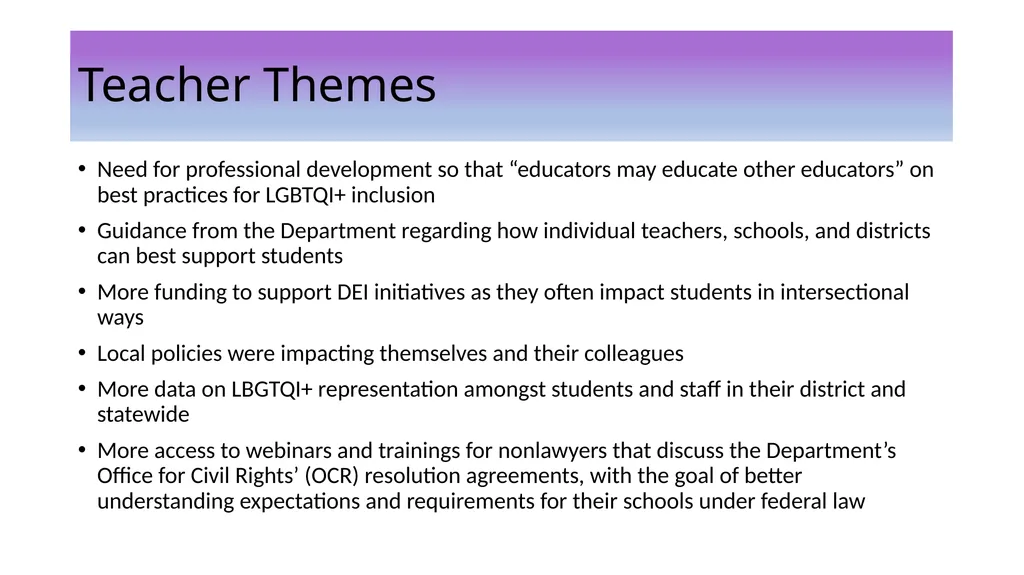
Teacher Themes Need for professional development so that “educators may educate other educators” on best practices for LGBTQI+ inclusion
Guidance from the Department regarding how individual teachers, schools, and districts can best support students
More funding to support DEI initiatives as they often impact students in intersectional ways
Local policies were impacting themselves and their colleagues
More data on LBGTQI+ representation amongst students and staff in their district and statewide
More access to webinars and trainings for nonlawyers that discuss the Department’s Office for Civil Rights’ (OCR) resolution agreements, with the goal of better understanding expectations and requirements for their schools under federal law<br>
Guidance from the Department regarding how individual teachers, schools, and districts can best support students
More funding to support DEI initiatives as they often impact students in intersectional ways
Local policies were impacting themselves and their colleagues
More data on LBGTQI+ representation amongst students and staff in their district and statewide
More access to webinars and trainings for nonlawyers that discuss the Department’s Office for Civil Rights’ (OCR) resolution agreements, with the goal of better understanding expectations and requirements for their schools under federal law<br>
08
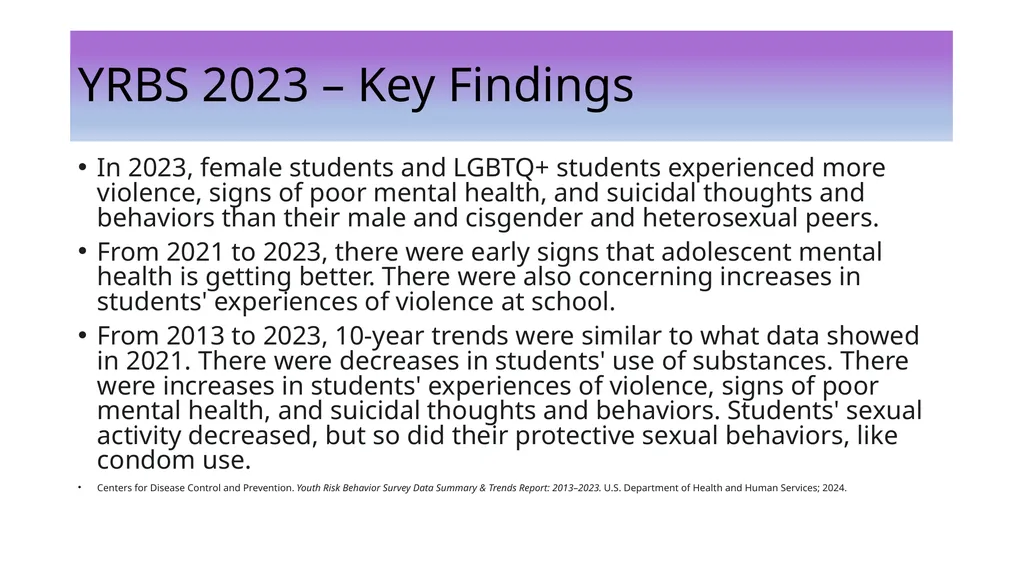
YRBS 2023 – Key Findings In 2023, female students and LGBTQ+ students experienced more violence, signs of poor mental health, and suicidal thoughts and behaviors than their male and cisgender and heterosexual peers.
From 2021 to 2023, there were early signs that adolescent mental health is getting better. There were also concerning increases in students' experiences of violence at school.
From 2013 to 2023, 10-year trends were similar to what data showed in 2021. There were decreases in students' use of substances. There were increases in students' experiences of violence, signs of poor mental health, and suicidal thoughts and behaviors. Students' sexual activity decreased, but so did their protective sexual behaviors, like condom use.
Centers for Disease Control and Prevention. Youth Risk Behavior Survey Data Summary & Trends Report: 2013–2023. U.S. Department of Health and Human Services; 2024.<br>
From 2021 to 2023, there were early signs that adolescent mental health is getting better. There were also concerning increases in students' experiences of violence at school.
From 2013 to 2023, 10-year trends were similar to what data showed in 2021. There were decreases in students' use of substances. There were increases in students' experiences of violence, signs of poor mental health, and suicidal thoughts and behaviors. Students' sexual activity decreased, but so did their protective sexual behaviors, like condom use.
Centers for Disease Control and Prevention. Youth Risk Behavior Survey Data Summary & Trends Report: 2013–2023. U.S. Department of Health and Human Services; 2024.<br>
09
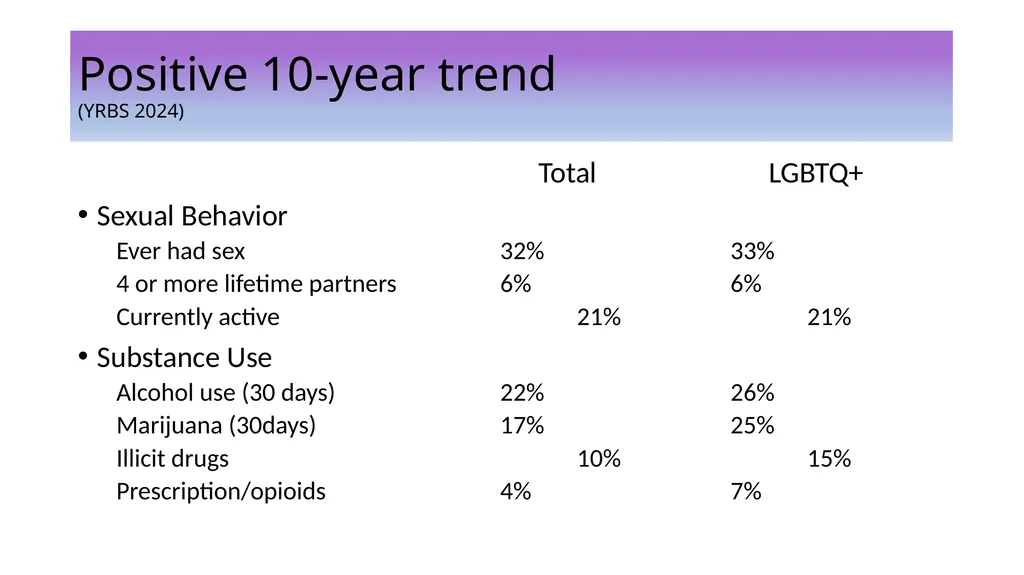
Positive 10-year trend
(YRBS 2024) Total LGBTQ+
Sexual Behavior
Ever had sex 32% 33%
4 or more lifetime partners 6% 6%
Currently active 21% 21%
Substance Use
Alcohol use (30 days) 22% 26%
Marijuana (30days) 17% 25%
Illicit drugs 10% 15%
Prescription/opioids 4% 7%<br>
Sexual Behavior
Ever had sex 32% 33%
4 or more lifetime partners 6% 6%
Currently active 21% 21%
Substance Use
Alcohol use (30 days) 22% 26%
Marijuana (30days) 17% 25%
Illicit drugs 10% 15%
Prescription/opioids 4% 7%<br>
10
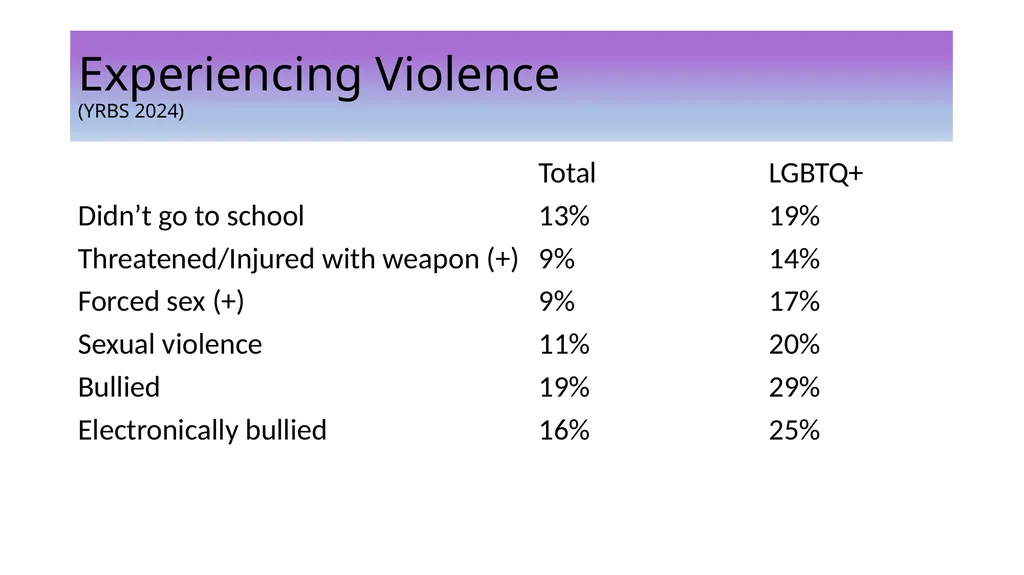
Experiencing Violence
(YRBS 2024) Total LGBTQ+
Didn’t go to school 13% 19%
Threatened/Injured with weapon (+) 9% 14%
Forced sex (+) 9% 17%
Sexual violence 11% 20%
Bullied 19% 29%
Electronically bullied 16% 25%<br>
Didn’t go to school 13% 19%
Threatened/Injured with weapon (+) 9% 14%
Forced sex (+) 9% 17%
Sexual violence 11% 20%
Bullied 19% 29%
Electronically bullied 16% 25%<br>
11
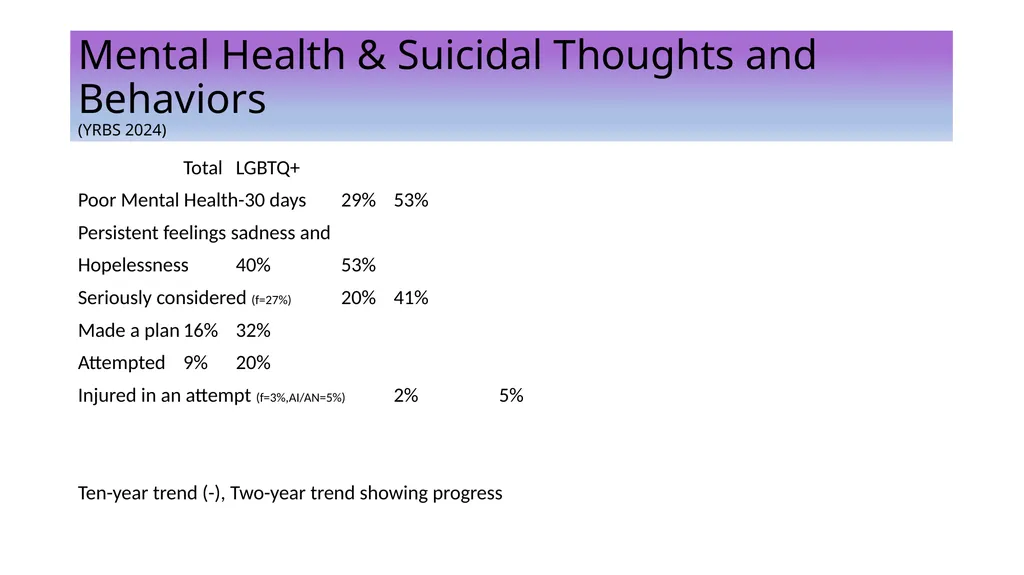
Mental Health & Suicidal Thoughts and Behaviors
(YRBS 2024) Total LGBTQ+
Poor Mental Health-30 days 29% 53%
Persistent feelings sadness and
Hopelessness 40% 53%
Seriously considered (f=27%) 20% 41%
Made a plan 16% 32%
Attempted 9% 20%
Injured in an attempt (f=3%,AI/AN=5%) 2% 5%
Ten-year trend (-), Two-year trend showing progress<br>
Poor Mental Health-30 days 29% 53%
Persistent feelings sadness and
Hopelessness 40% 53%
Seriously considered (f=27%) 20% 41%
Made a plan 16% 32%
Attempted 9% 20%
Injured in an attempt (f=3%,AI/AN=5%) 2% 5%
Ten-year trend (-), Two-year trend showing progress<br>
12
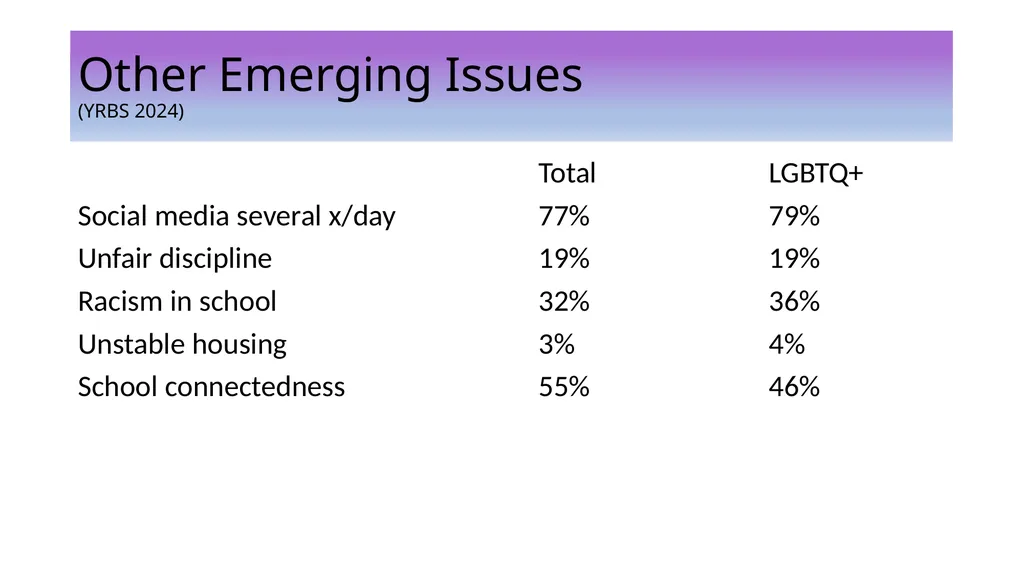
Other Emerging Issues
(YRBS 2024) Total LGBTQ+
Social media several x/day 77% 79%
Unfair discipline 19% 19%
Racism in school 32% 36%
Unstable housing 3% 4%
School connectedness 55% 46%<br>
Social media several x/day 77% 79%
Unfair discipline 19% 19%
Racism in school 32% 36%
Unstable housing 3% 4%
School connectedness 55% 46%<br>
13
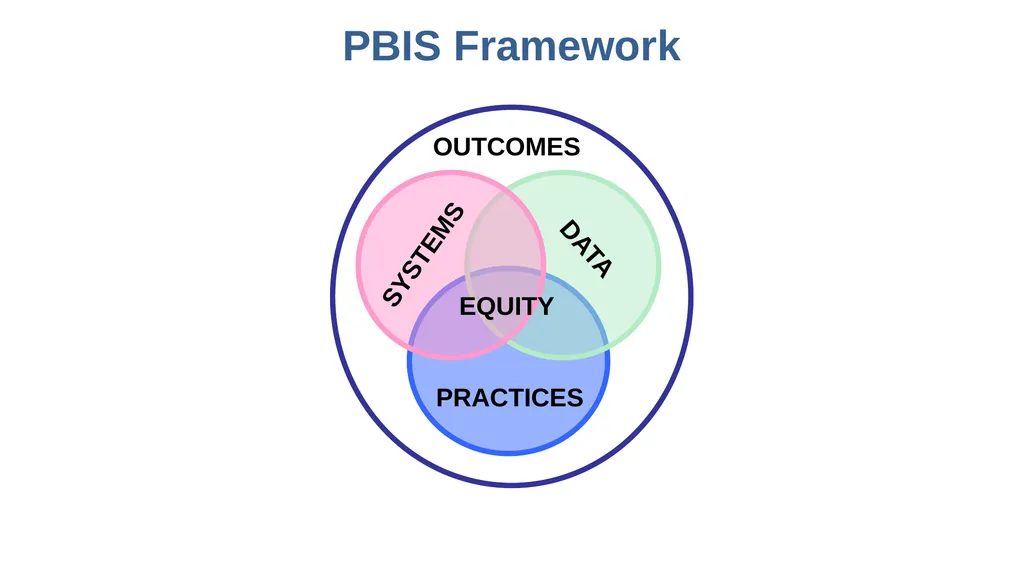
PBIS Framework OUTCOMES PRACTICES DATA SYSTEMS EQUITY<br>
14
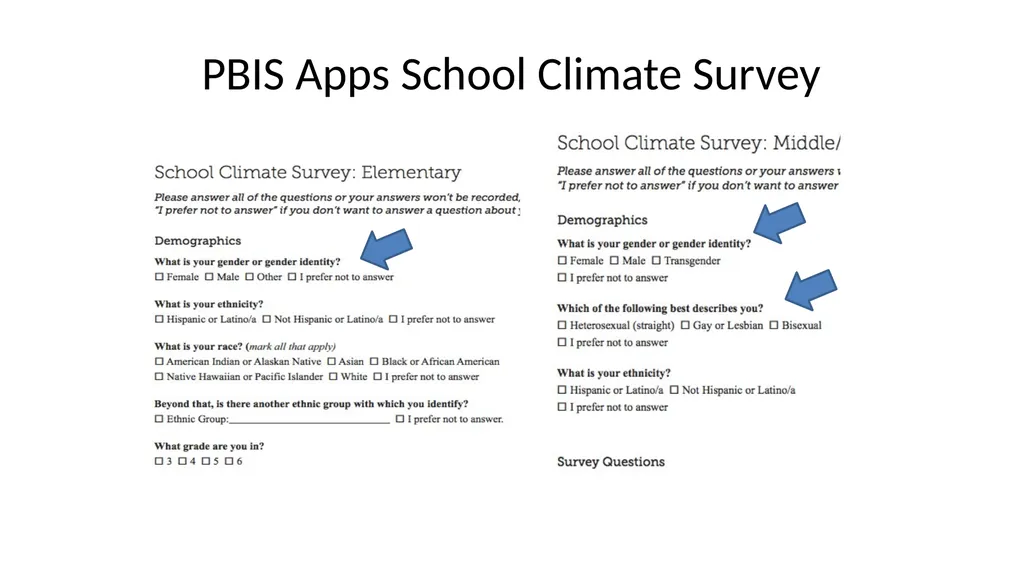
PBIS Apps School Climate Survey<br>
15
Range of Actions to Support LGBTQ Students<br>
16
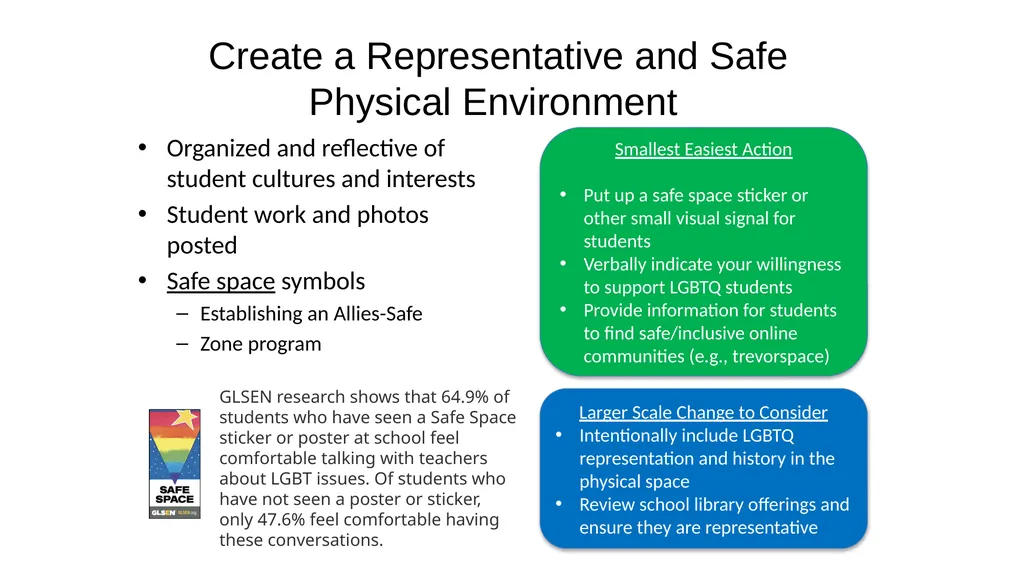
Create a Representative and Safe Physical Environment Organized and reflective of student cultures and interests
Student work and photos posted
Safe space symbols
Establishing an Allies-Safe
Zone program GLSEN research shows that 64.9% of students who have seen a Safe Space sticker or poster at school feel comfortable talking with teachers about LGBT issues. Of students who have not seen a poster or sticker, only 47.6% feel comfortable having these conversations. Smallest Easiest Action
Put up a safe space sticker or other small visual signal for students
Verbally indicate your willingness to support LGBTQ students
Provide information for students to find safe/inclusive online communities (e.g., trevorspace) Larger Scale Change to Consider
Intentionally include LGBTQ representation and history in the physical space
Review school library offerings and ensure they are representative<br>
Student work and photos posted
Safe space symbols
Establishing an Allies-Safe
Zone program GLSEN research shows that 64.9% of students who have seen a Safe Space sticker or poster at school feel comfortable talking with teachers about LGBT issues. Of students who have not seen a poster or sticker, only 47.6% feel comfortable having these conversations. Smallest Easiest Action
Put up a safe space sticker or other small visual signal for students
Verbally indicate your willingness to support LGBTQ students
Provide information for students to find safe/inclusive online communities (e.g., trevorspace) Larger Scale Change to Consider
Intentionally include LGBTQ representation and history in the physical space
Review school library offerings and ensure they are representative<br>
17
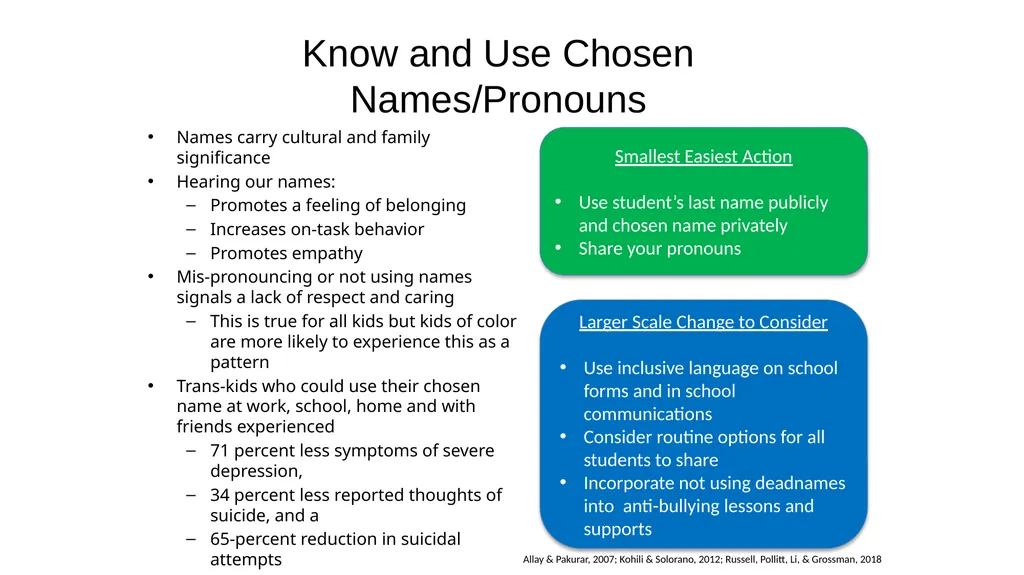
Know and Use Chosen Names/Pronouns Names carry cultural and family significance
Hearing our names:
Promotes a feeling of belonging
Increases on-task behavior
Promotes empathy
Mis-pronouncing or not using names signals a lack of respect and caring
This is true for all kids but kids of color are more likely to experience this as a pattern
Trans-kids who could use their chosen name at work, school, home and with friends experienced
71 percent less symptoms of severe depression,
34 percent less reported thoughts of suicide, and a
65-percent reduction in suicidal attempts
There was a 29-percent decrease in suicidal thoughts for kids who could use their chosen name even in one those places Smallest Easiest Action
Use student’s last name publicly and chosen name privately
Share your pronouns Larger Scale Change to Consider
Use inclusive language on school forms and in school communications
Consider routine options for all students to share
Incorporate not using deadnames into anti-bullying lessons and supports Allay & Pakurar, 2007; Kohili & Solorano, 2012; Russell, Pollitt, Li, & Grossman, 2018<br>
Hearing our names:
Promotes a feeling of belonging
Increases on-task behavior
Promotes empathy
Mis-pronouncing or not using names signals a lack of respect and caring
This is true for all kids but kids of color are more likely to experience this as a pattern
Trans-kids who could use their chosen name at work, school, home and with friends experienced
71 percent less symptoms of severe depression,
34 percent less reported thoughts of suicide, and a
65-percent reduction in suicidal attempts
There was a 29-percent decrease in suicidal thoughts for kids who could use their chosen name even in one those places Smallest Easiest Action
Use student’s last name publicly and chosen name privately
Share your pronouns Larger Scale Change to Consider
Use inclusive language on school forms and in school communications
Consider routine options for all students to share
Incorporate not using deadnames into anti-bullying lessons and supports Allay & Pakurar, 2007; Kohili & Solorano, 2012; Russell, Pollitt, Li, & Grossman, 2018<br>
18
Teach an inclusive curriculum
Diversity promotes learning, creativity, and counters stereotypes
Be purposeful about counteracting and talking about stereotypes
Teaching tolerance
Inclusive curricular (GLSEN)
Lesson plans (HRC)
Provide safe spaces
Gender and sexualities alliance (GSA) Teach an Inclusive Curriculum and Provide Access to Resources and Support Smallest Easiest Action
Point out positive examples of LGBTQ people in history or literature
Celebrate diversity in general and counter stereotypes when you see/hear them
Provide access to reputable online resources where students can learn more (e.g., trevor project, HRC, GLESN, PFLAG)
Provide an informal safe space for LGBTQ students in your room Larger Scale Change to Consider
Join curriculum committees and push for inclusive and comprehensive mental and physical health and academic curriculum
Be visible as a member of the LGBTQ community or ally
Sponsor or support LGBTQ affinity groups for students and staff<br>
Diversity promotes learning, creativity, and counters stereotypes
Be purposeful about counteracting and talking about stereotypes
Teaching tolerance
Inclusive curricular (GLSEN)
Lesson plans (HRC)
Provide safe spaces
Gender and sexualities alliance (GSA) Teach an Inclusive Curriculum and Provide Access to Resources and Support Smallest Easiest Action
Point out positive examples of LGBTQ people in history or literature
Celebrate diversity in general and counter stereotypes when you see/hear them
Provide access to reputable online resources where students can learn more (e.g., trevor project, HRC, GLESN, PFLAG)
Provide an informal safe space for LGBTQ students in your room Larger Scale Change to Consider
Join curriculum committees and push for inclusive and comprehensive mental and physical health and academic curriculum
Be visible as a member of the LGBTQ community or ally
Sponsor or support LGBTQ affinity groups for students and staff<br>
19
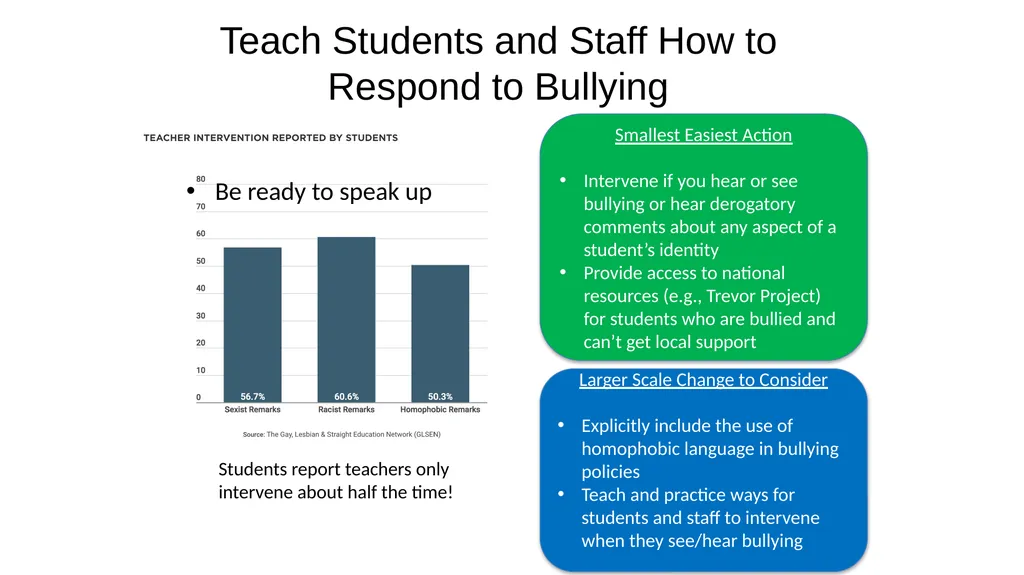
Teach Students and Staff How to Respond to Bullying Be ready to speak up Students report teachers only intervene about half the time! Smallest Easiest Action
Intervene if you hear or see bullying or hear derogatory comments about any aspect of a student’s identity
Provide access to national resources (e.g., Trevor Project) for students who are bullied and can’t get local support Larger Scale Change to Consider
Explicitly include the use of homophobic language in bullying policies
Teach and practice ways for students and staff to intervene when they see/hear bullying<br>
Intervene if you hear or see bullying or hear derogatory comments about any aspect of a student’s identity
Provide access to national resources (e.g., Trevor Project) for students who are bullied and can’t get local support Larger Scale Change to Consider
Explicitly include the use of homophobic language in bullying policies
Teach and practice ways for students and staff to intervene when they see/hear bullying<br>
20
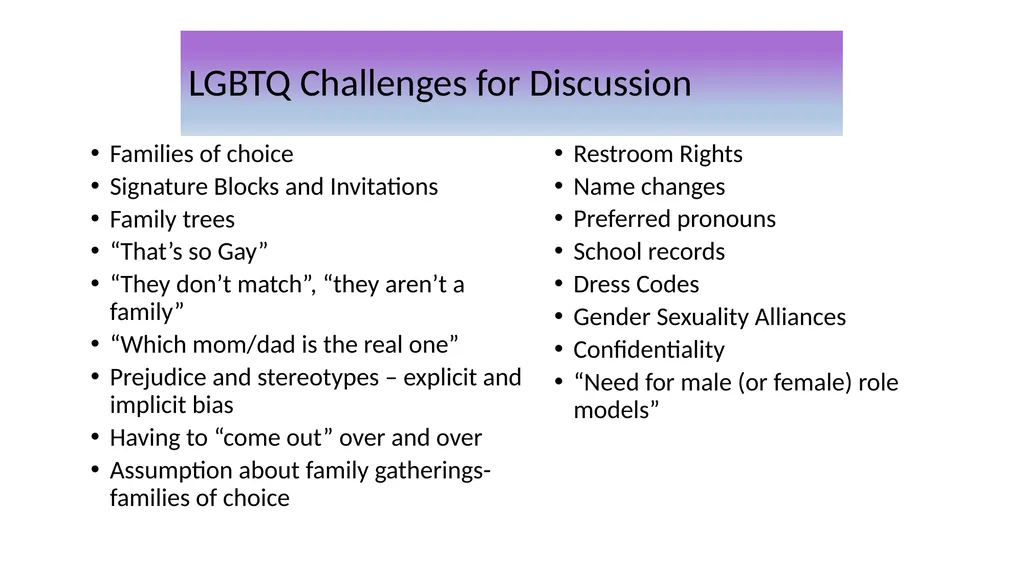
LGBTQ Challenges for Discussion Families of choice
Signature Blocks and Invitations
Family trees
“That’s so Gay”
“They don’t match”, “they aren’t a family”
“Which mom/dad is the real one”
Prejudice and stereotypes – explicit and implicit bias
Having to “come out” over and over
Assumption about family gatherings- families of choice Restroom Rights
Name changes
Preferred pronouns
School records
Dress Codes
Gender Sexuality Alliances
Confidentiality
“Need for male (or female) role models”<br>
Signature Blocks and Invitations
Family trees
“That’s so Gay”
“They don’t match”, “they aren’t a family”
“Which mom/dad is the real one”
Prejudice and stereotypes – explicit and implicit bias
Having to “come out” over and over
Assumption about family gatherings- families of choice Restroom Rights
Name changes
Preferred pronouns
School records
Dress Codes
Gender Sexuality Alliances
Confidentiality
“Need for male (or female) role models”<br>
21
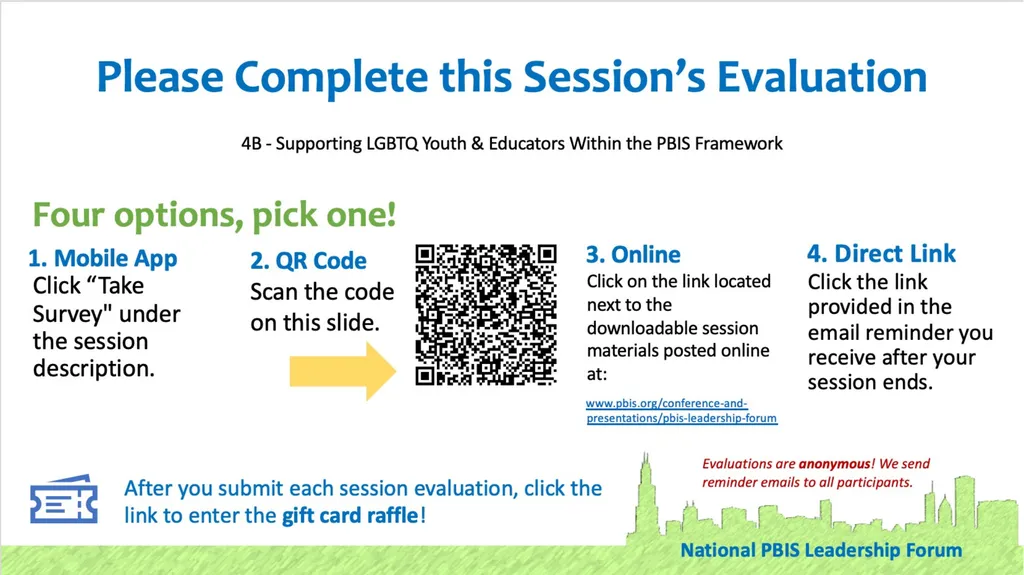
Evaluations are anonymous! We send reminder emails to all participants. After you submit each session evaluation, click the link to enter the gift card raffle! 4. Direct Link
Click the link provided in the email reminder you receive after your session ends. 3. Online
Click on the link located next to the downloadable session materials posted online at:
www.pbis.org/conference-and-presentations/pbis-leadership-forum SAMPLE 2. QR Code Scan the code on this slide. 1. Mobile App Click “Take Survey" under the session description. Four options, pick one! 4B - Supporting LGBTQ Youth & Educators Within the PBIS Framework Please Complete this Session’s Evaluation<br>
www.pbis.org/conference-and-presentations/pbis-leadership-forum SAMPLE 2. QR Code Scan the code on this slide. 1. Mobile App Click “Take Survey" under the session description. Four options, pick one! 4B - Supporting LGBTQ Youth & Educators Within the PBIS Framework Please Complete this Session’s Evaluation<br>
22
Additional Resources<br>
23
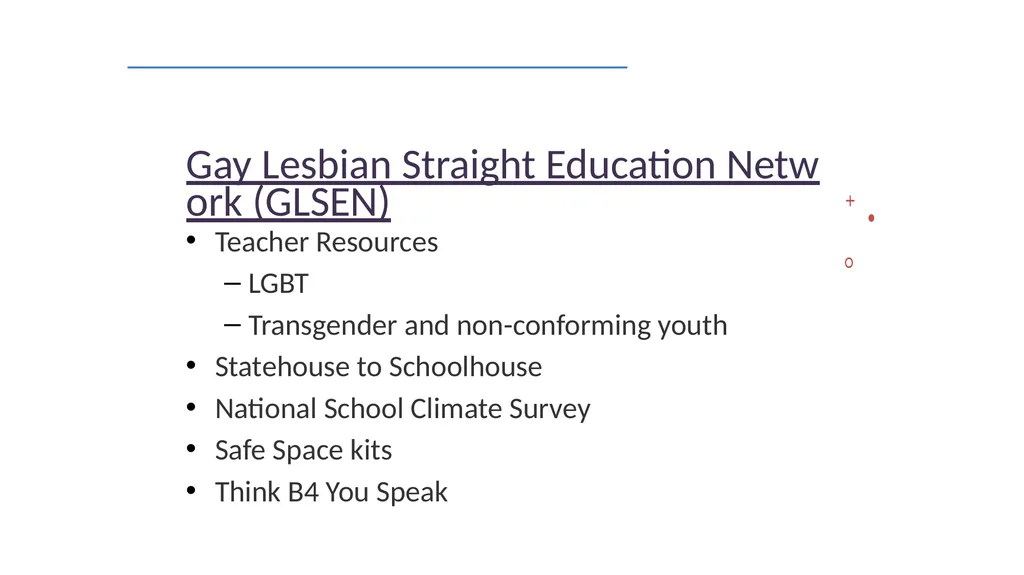
Gay Lesbian Straight Education Network (GLSEN) Teacher Resources
LGBT
Transgender and non-conforming youth
Statehouse to Schoolhouse
National School Climate Survey
Safe Space kits
Think B4 You Speak<br>
LGBT
Transgender and non-conforming youth
Statehouse to Schoolhouse
National School Climate Survey
Safe Space kits
Think B4 You Speak<br>
24
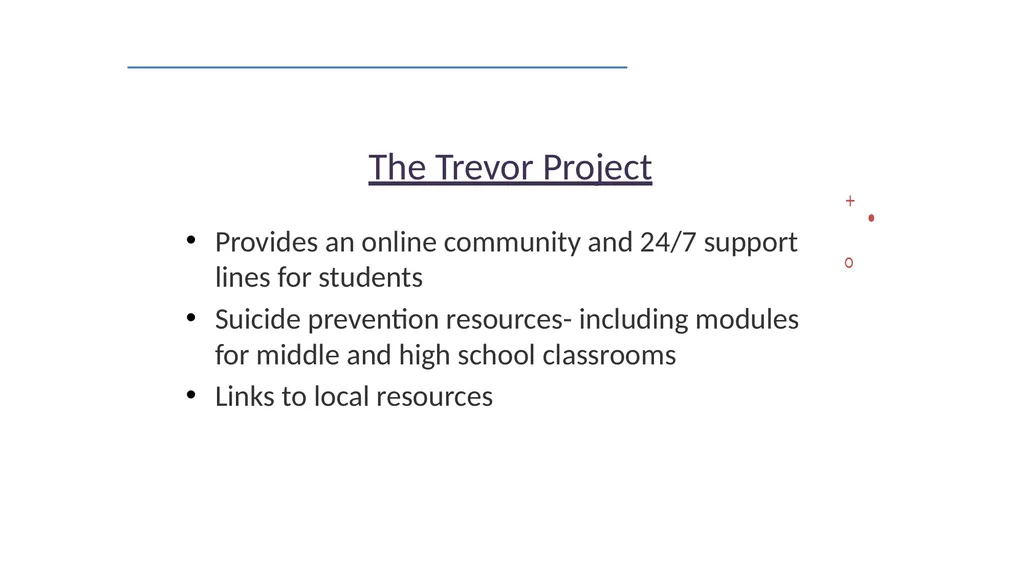
The Trevor Project Provides an online community and 24/7 support lines for students
Suicide prevention resources- including modules for middle and high school classrooms
Links to local resources<br>
Suicide prevention resources- including modules for middle and high school classrooms
Links to local resources<br>
25
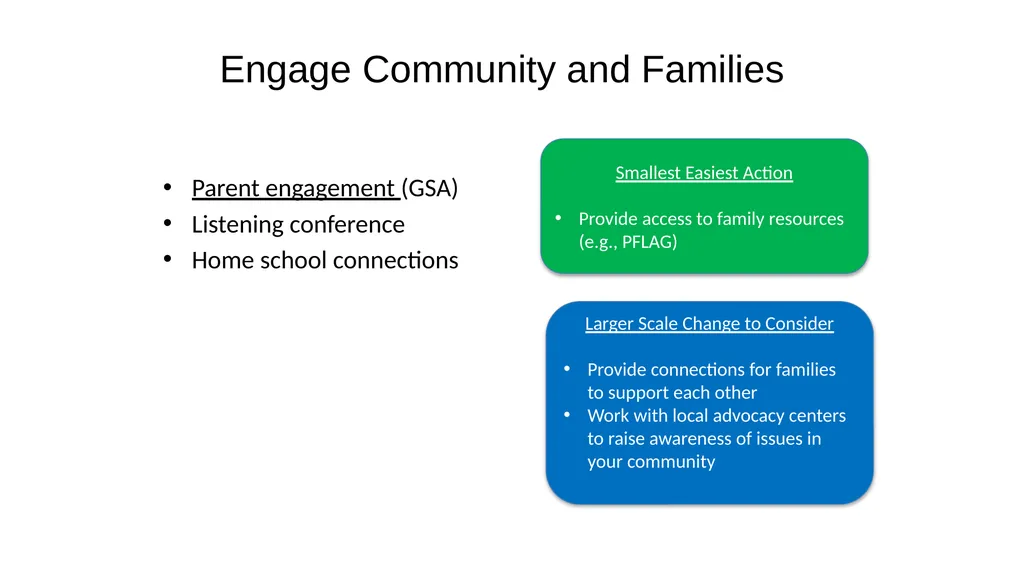
Parent engagement (GSA)
Listening conference
Home school connections Engage Community and Families Smallest Easiest Action
Provide access to family resources (e.g., PFLAG) Larger Scale Change to Consider
Provide connections for families to support each other
Work with local advocacy centers to raise awareness of issues in your community<br>
Listening conference
Home school connections Engage Community and Families Smallest Easiest Action
Provide access to family resources (e.g., PFLAG) Larger Scale Change to Consider
Provide connections for families to support each other
Work with local advocacy centers to raise awareness of issues in your community<br>
26
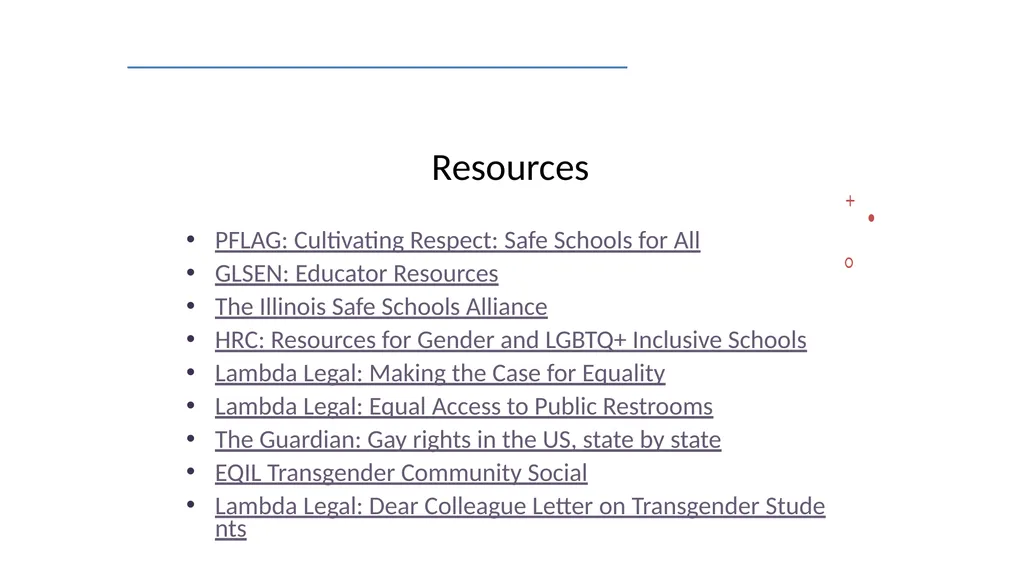
Resources PFLAG: Cultivating Respect: Safe Schools for All
GLSEN: Educator Resources
The Illinois Safe Schools Alliance
HRC: Resources for Gender and LGBTQ+ Inclusive Schools
Lambda Legal: Making the Case for Equality
Lambda Legal: Equal Access to Public Restrooms
The Guardian: Gay rights in the US, state by state
EQIL Transgender Community Social
Lambda Legal: Dear Colleague Letter on Transgender Students<br>
GLSEN: Educator Resources
The Illinois Safe Schools Alliance
HRC: Resources for Gender and LGBTQ+ Inclusive Schools
Lambda Legal: Making the Case for Equality
Lambda Legal: Equal Access to Public Restrooms
The Guardian: Gay rights in the US, state by state
EQIL Transgender Community Social
Lambda Legal: Dear Colleague Letter on Transgender Students<br>