
5 Critical Job Description Elements For Your New
PM
Published · 23 slides · 0 views
1 / 1

Description
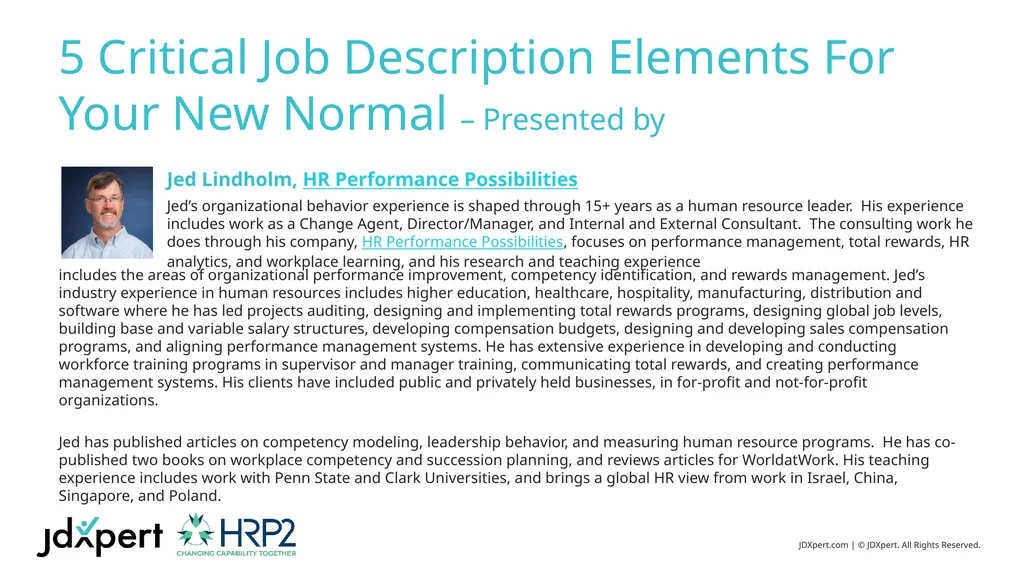
5 Critical Job Description Elements For Your New Normal Presented by includes the areas of organizational performance improvement, competency identification, and rewards management. Jeds industry experience in human resources includes
Related Topics
Share
Embed code
Download this presentation From Below
"5 Critical Job Description Elements For Your New" is the property of its rightful owner. Permission is granted to download and print the materials on this website for personal, non-commercial use only, and to display it on your personal computer provided you do not modify the materials and that you retain all copyright notices contained in the materials. By downloading content from our website, you accept the terms of this agreement.
Presentation Transcript
01
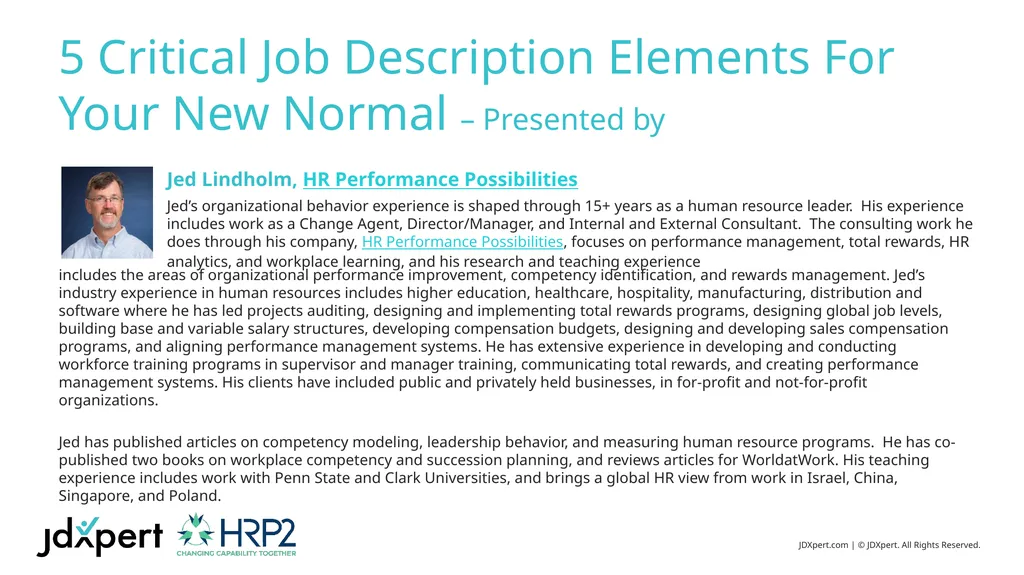
5 Critical Job Description Elements For Your New Normal – Presented by includes the areas of organizational performance improvement, competency identification, and rewards management. Jed’s industry experience in human resources includes higher education, healthcare, hospitality, manufacturing, distribution and software where he has led projects auditing, designing and implementing total rewards programs, designing global job levels, building base and variable salary structures, developing compensation budgets, designing and developing sales compensation programs, and aligning performance management systems. He has extensive experience in developing and conducting workforce training programs in supervisor and manager training, communicating total rewards, and creating performance management systems. His clients have included public and privately held businesses, in for-profit and not-for-profit organizations.
Jed has published articles on competency modeling, leadership behavior, and measuring human resource programs. He has co-published two books on workplace competency and succession planning, and reviews articles for WorldatWork. His teaching experience includes work with Penn State and Clark Universities, and brings a global HR view from work in Israel, China, Singapore, and Poland. Jed Lindholm, HR Performance Possibilities
Jed’s organizational behavior experience is shaped through 15+ years as a human resource leader. His experience includes work as a Change Agent, Director/Manager, and Internal and External Consultant. The consulting work he does through his company, HR Performance Possibilities, focuses on performance management, total rewards, HR analytics, and workplace learning, and his research and teaching experience<br>
Jed has published articles on competency modeling, leadership behavior, and measuring human resource programs. He has co-published two books on workplace competency and succession planning, and reviews articles for WorldatWork. His teaching experience includes work with Penn State and Clark Universities, and brings a global HR view from work in Israel, China, Singapore, and Poland. Jed Lindholm, HR Performance Possibilities
Jed’s organizational behavior experience is shaped through 15+ years as a human resource leader. His experience includes work as a Change Agent, Director/Manager, and Internal and External Consultant. The consulting work he does through his company, HR Performance Possibilities, focuses on performance management, total rewards, HR analytics, and workplace learning, and his research and teaching experience<br>
02
5 Critical Job Description Elements For Your New Normal
Now is the Time to Redesign
Jed Lindholm, HR Performance Possibilities<br>
03
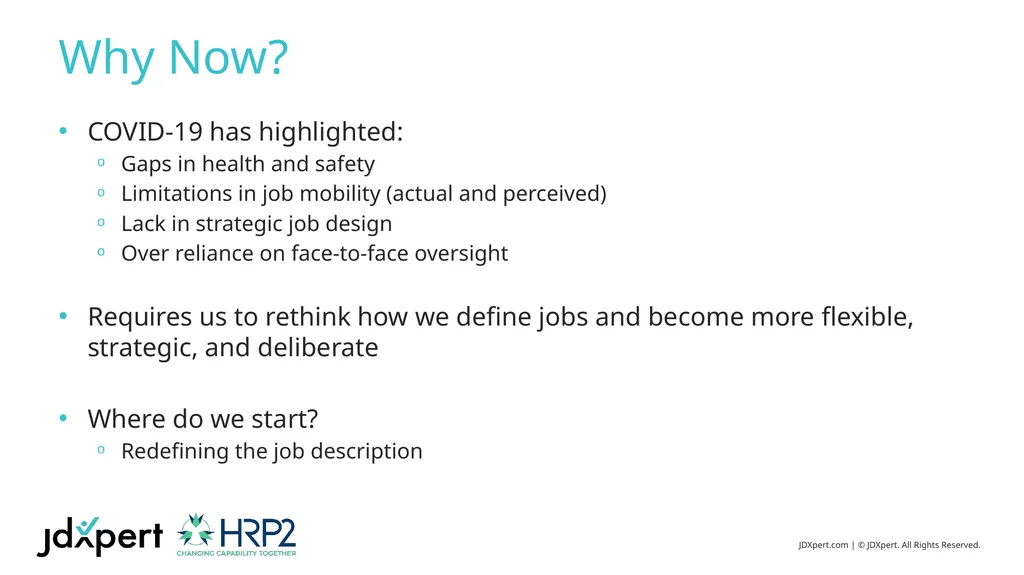
Why Now? COVID-19 has highlighted:
Gaps in health and safety
Limitations in job mobility (actual and perceived)
Lack in strategic job design
Over reliance on face-to-face oversight
Requires us to rethink how we define jobs and become more flexible, strategic, and deliberate
Where do we start?
Redefining the job description<br>
Gaps in health and safety
Limitations in job mobility (actual and perceived)
Lack in strategic job design
Over reliance on face-to-face oversight
Requires us to rethink how we define jobs and become more flexible, strategic, and deliberate
Where do we start?
Redefining the job description<br>
04
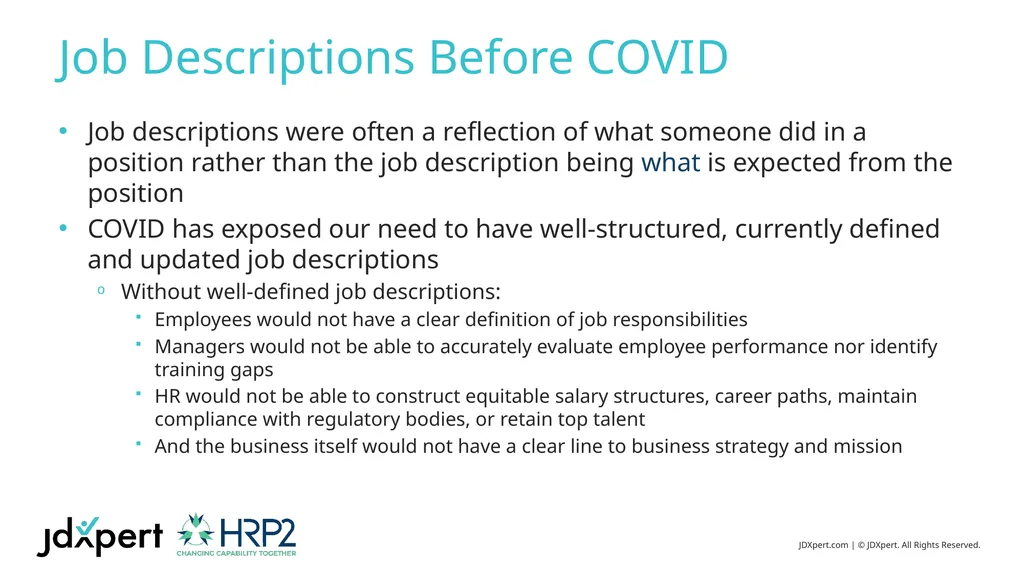
Job Descriptions Before COVID Job descriptions were often a reflection of what someone did in a position rather than the job description being what is expected from the position
COVID has exposed our need to have well-structured, currently defined and updated job descriptions
Without well-defined job descriptions:
Employees would not have a clear definition of job responsibilities
Managers would not be able to accurately evaluate employee performance nor identify training gaps
HR would not be able to construct equitable salary structures, career paths, maintain compliance with regulatory bodies, or retain top talent
And the business itself would not have a clear line to business strategy and mission<br>
COVID has exposed our need to have well-structured, currently defined and updated job descriptions
Without well-defined job descriptions:
Employees would not have a clear definition of job responsibilities
Managers would not be able to accurately evaluate employee performance nor identify training gaps
HR would not be able to construct equitable salary structures, career paths, maintain compliance with regulatory bodies, or retain top talent
And the business itself would not have a clear line to business strategy and mission<br>
05
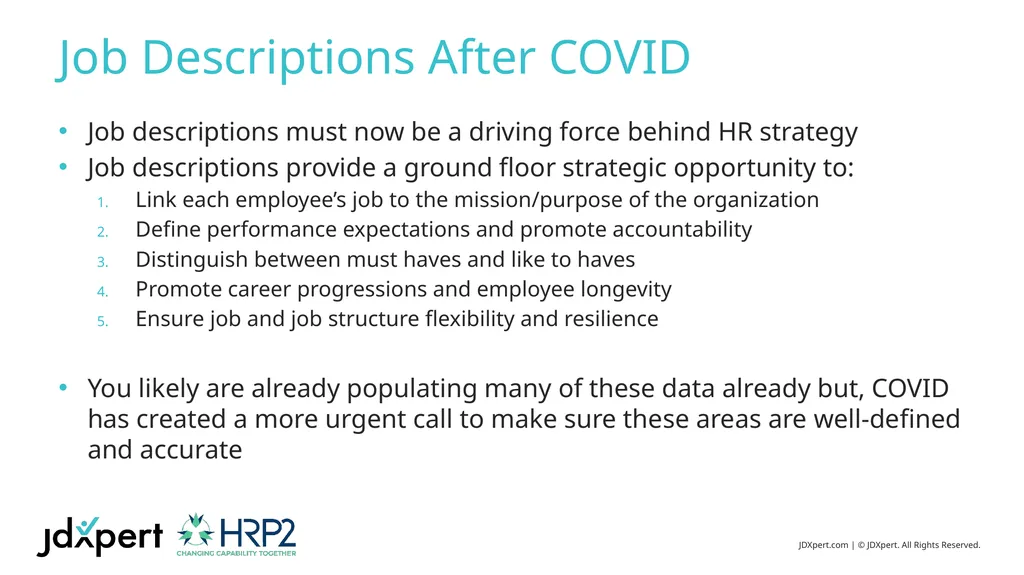
Job Descriptions After COVID Job descriptions must now be a driving force behind HR strategy
Job descriptions provide a ground floor strategic opportunity to:
Link each employee’s job to the mission/purpose of the organization
Define performance expectations and promote accountability
Distinguish between must haves and like to haves
Promote career progressions and employee longevity
Ensure job and job structure flexibility and resilience
You likely are already populating many of these data already but, COVID has created a more urgent call to make sure these areas are well-defined and accurate<br>
Job descriptions provide a ground floor strategic opportunity to:
Link each employee’s job to the mission/purpose of the organization
Define performance expectations and promote accountability
Distinguish between must haves and like to haves
Promote career progressions and employee longevity
Ensure job and job structure flexibility and resilience
You likely are already populating many of these data already but, COVID has created a more urgent call to make sure these areas are well-defined and accurate<br>
06
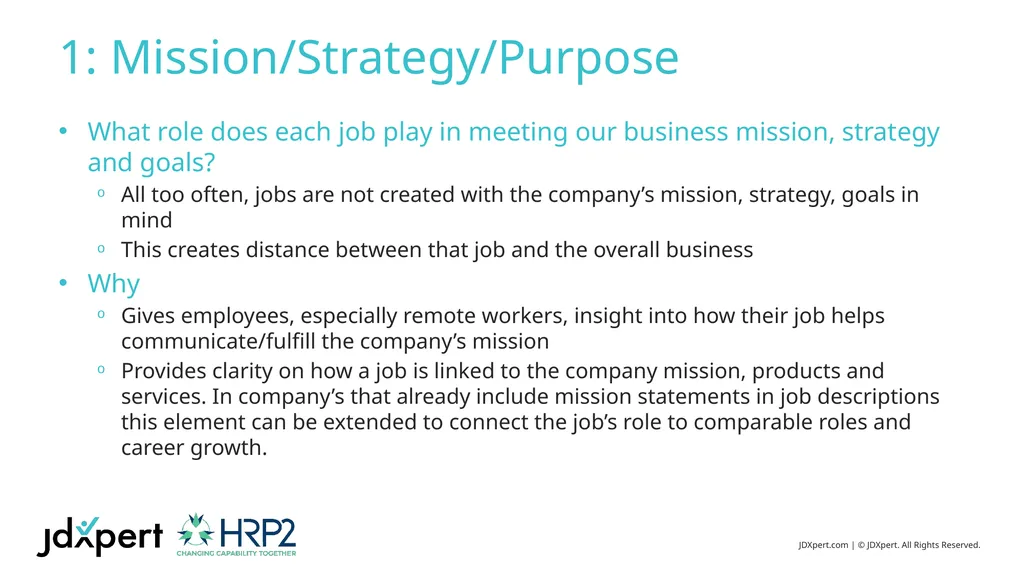
1: Mission/Strategy/Purpose What role does each job play in meeting our business mission, strategy and goals?
All too often, jobs are not created with the company’s mission, strategy, goals in mind
This creates distance between that job and the overall business
Why
Gives employees, especially remote workers, insight into how their job helps communicate/fulfill the company’s mission
Provides clarity on how a job is linked to the company mission, products and services. In company’s that already include mission statements in job descriptions this element can be extended to connect the job’s role to comparable roles and career growth.<br>
All too often, jobs are not created with the company’s mission, strategy, goals in mind
This creates distance between that job and the overall business
Why
Gives employees, especially remote workers, insight into how their job helps communicate/fulfill the company’s mission
Provides clarity on how a job is linked to the company mission, products and services. In company’s that already include mission statements in job descriptions this element can be extended to connect the job’s role to comparable roles and career growth.<br>
07
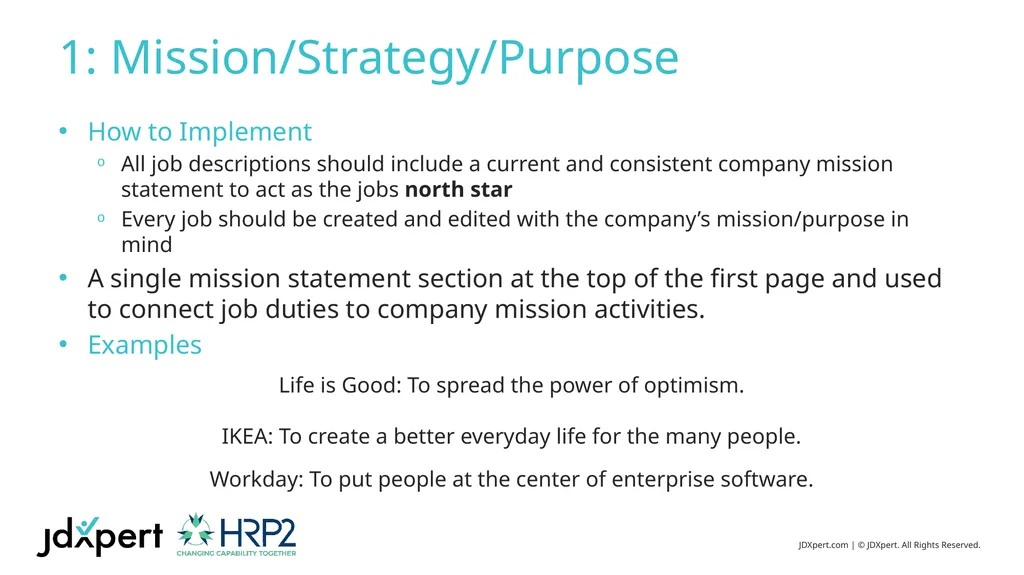
1: Mission/Strategy/Purpose How to Implement
All job descriptions should include a current and consistent company mission statement to act as the jobs north star
Every job should be created and edited with the company’s mission/purpose in mind
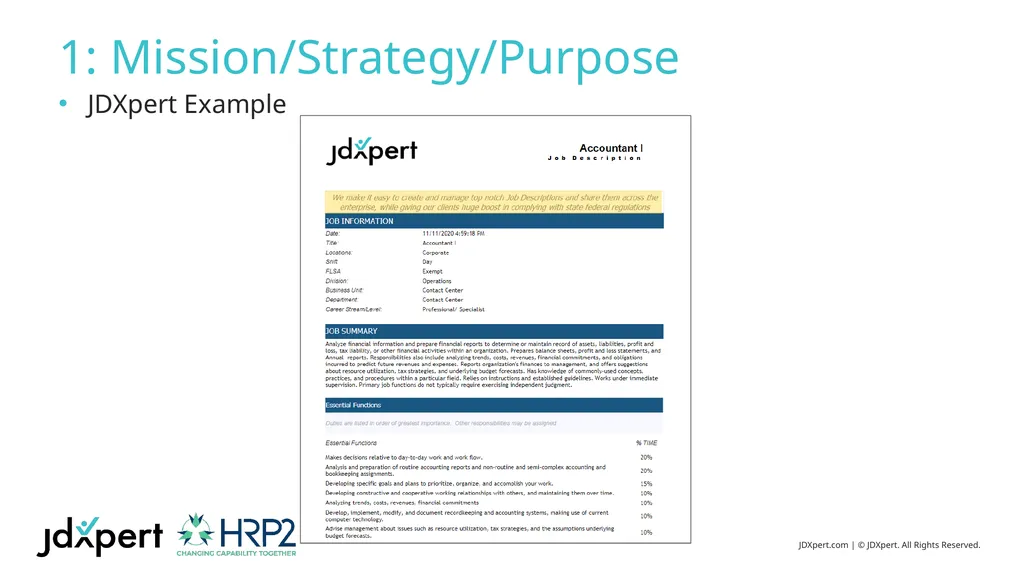
A single mission statement section at the top of the first page and used to connect job duties to company mission activities.
Examples
Life is Good: To spread the power of optimism.
IKEA: To create a better everyday life for the many people.
Workday: To put people at the center of enterprise software.<br>
All job descriptions should include a current and consistent company mission statement to act as the jobs north star
Every job should be created and edited with the company’s mission/purpose in mind
A single mission statement section at the top of the first page and used to connect job duties to company mission activities.
Examples
Life is Good: To spread the power of optimism.
IKEA: To create a better everyday life for the many people.
Workday: To put people at the center of enterprise software.<br>
08
1: Mission/Strategy/Purpose JDXpert Example<br>
09
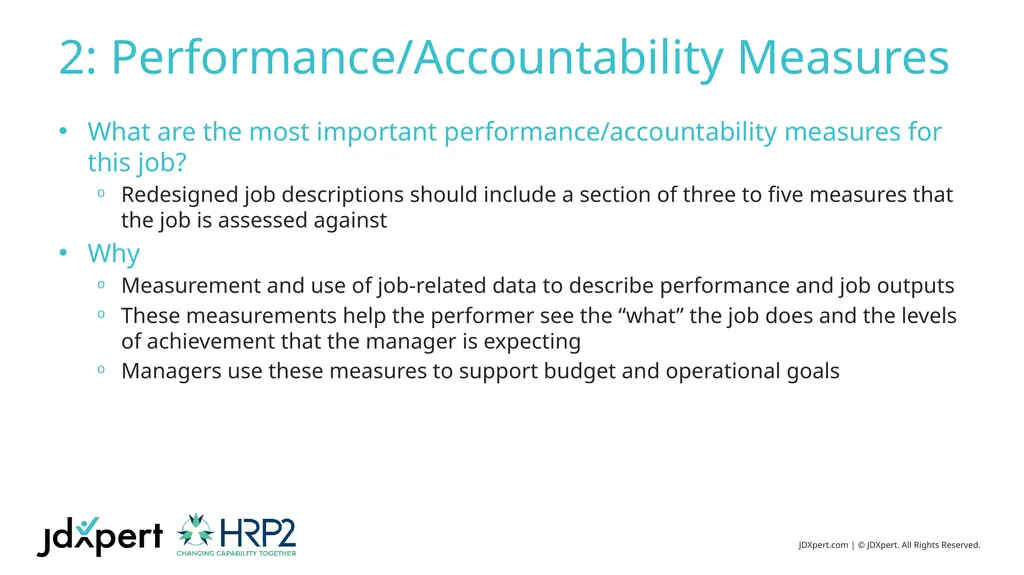
2: Performance/Accountability Measures What are the most important performance/accountability measures for this job?
Redesigned job descriptions should include a section of three to five measures that the job is assessed against
Why
Measurement and use of job-related data to describe performance and job outputs
These measurements help the performer see the “what” the job does and the levels of achievement that the manager is expecting
Managers use these measures to support budget and operational goals<br>
Redesigned job descriptions should include a section of three to five measures that the job is assessed against
Why
Measurement and use of job-related data to describe performance and job outputs
These measurements help the performer see the “what” the job does and the levels of achievement that the manager is expecting
Managers use these measures to support budget and operational goals<br>
10
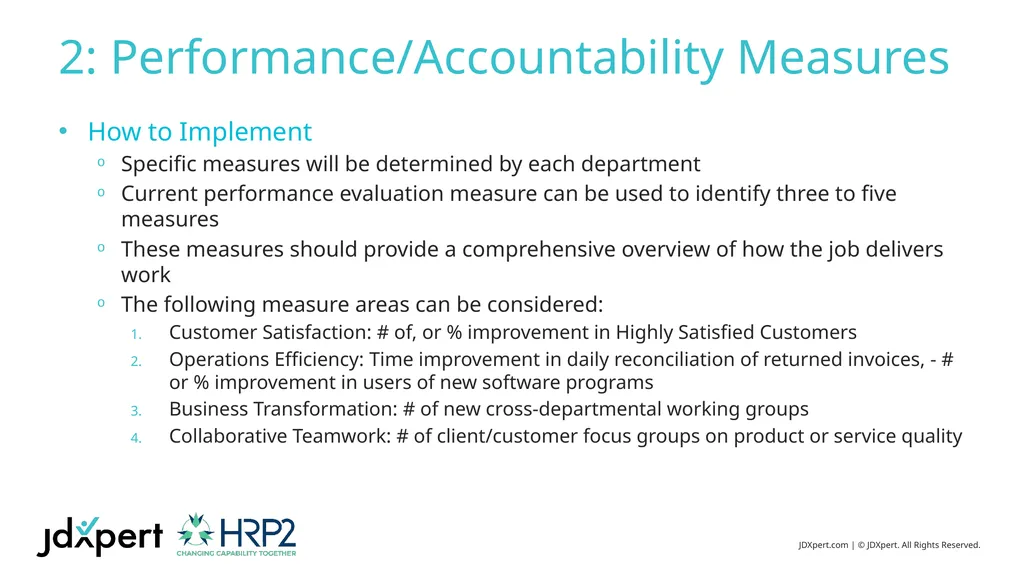
2: Performance/Accountability Measures How to Implement
Specific measures will be determined by each department
Current performance evaluation measure can be used to identify three to five measures
These measures should provide a comprehensive overview of how the job delivers work
The following measure areas can be considered:
Customer Satisfaction: # of, or % improvement in Highly Satisfied Customers
Operations Efficiency: Time improvement in daily reconciliation of returned invoices, - # or % improvement in users of new software programs
Business Transformation: # of new cross-departmental working groups
Collaborative Teamwork: # of client/customer focus groups on product or service quality<br>
Specific measures will be determined by each department
Current performance evaluation measure can be used to identify three to five measures
These measures should provide a comprehensive overview of how the job delivers work
The following measure areas can be considered:
Customer Satisfaction: # of, or % improvement in Highly Satisfied Customers
Operations Efficiency: Time improvement in daily reconciliation of returned invoices, - # or % improvement in users of new software programs
Business Transformation: # of new cross-departmental working groups
Collaborative Teamwork: # of client/customer focus groups on product or service quality<br>
11
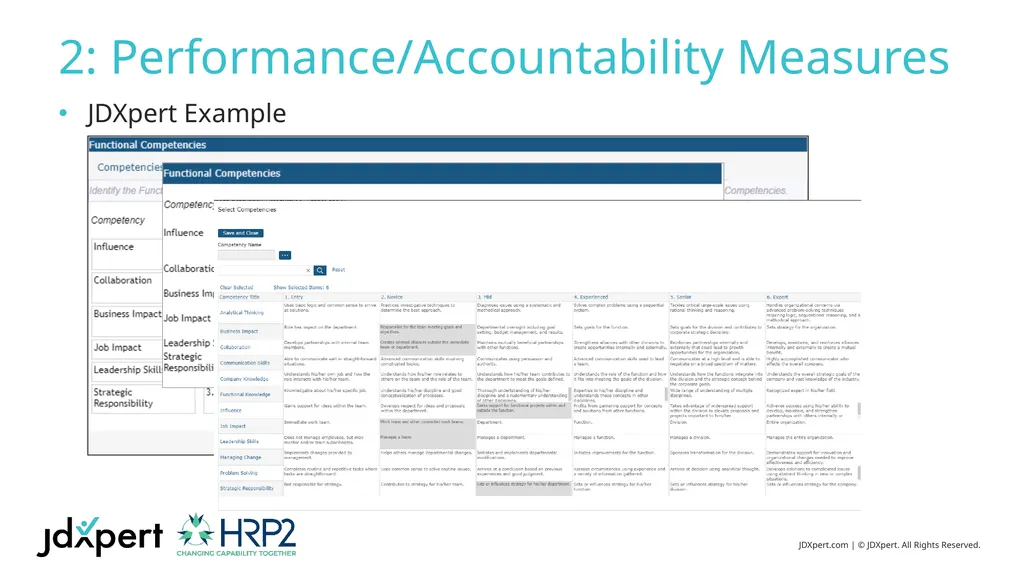
2: Performance/Accountability Measures JDXpert Example<br>
12
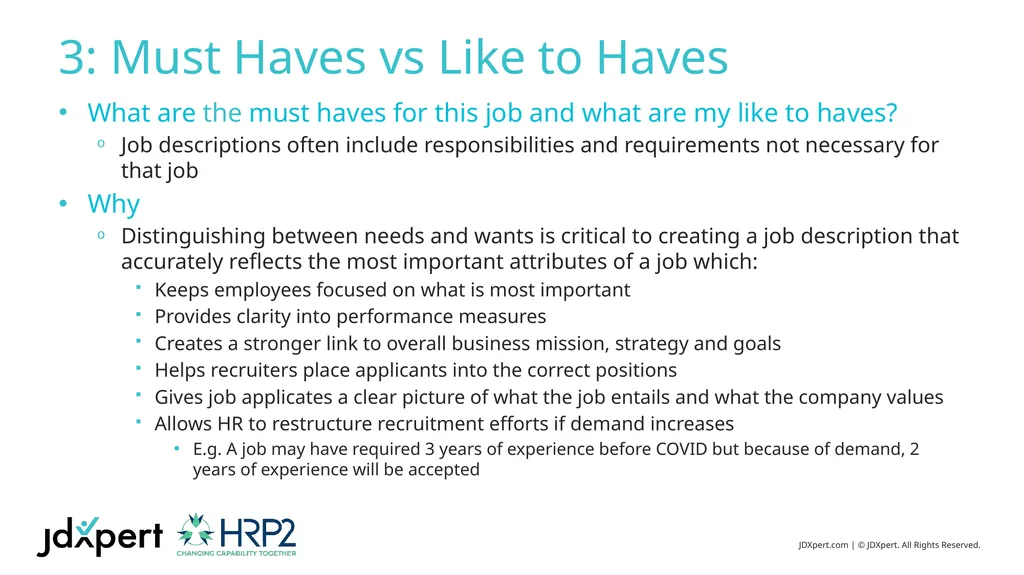
3: Must Haves vs Like to Haves What are the must haves for this job and what are my like to haves?
Job descriptions often include responsibilities and requirements not necessary for that job
Why
Distinguishing between needs and wants is critical to creating a job description that accurately reflects the most important attributes of a job which:
Keeps employees focused on what is most important
Provides clarity into performance measures
Creates a stronger link to overall business mission, strategy and goals
Helps recruiters place applicants into the correct positions
Gives job applicates a clear picture of what the job entails and what the company values
Allows HR to restructure recruitment efforts if demand increases
E.g. A job may have required 3 years of experience before COVID but because of demand, 2 years of experience will be accepted<br>
Job descriptions often include responsibilities and requirements not necessary for that job
Why
Distinguishing between needs and wants is critical to creating a job description that accurately reflects the most important attributes of a job which:
Keeps employees focused on what is most important
Provides clarity into performance measures
Creates a stronger link to overall business mission, strategy and goals
Helps recruiters place applicants into the correct positions
Gives job applicates a clear picture of what the job entails and what the company values
Allows HR to restructure recruitment efforts if demand increases
E.g. A job may have required 3 years of experience before COVID but because of demand, 2 years of experience will be accepted<br>
13
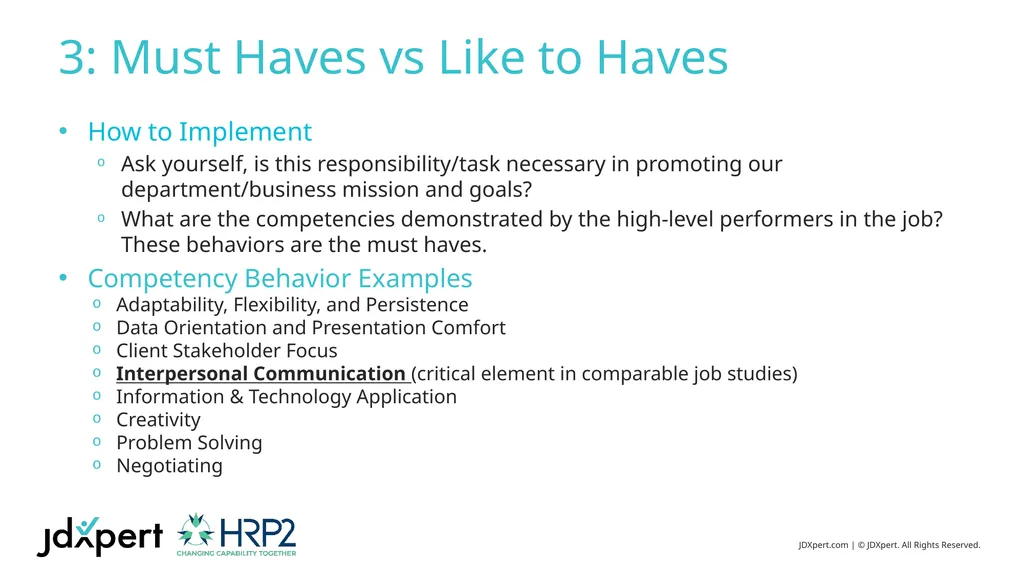
3: Must Haves vs Like to Haves How to Implement
Ask yourself, is this responsibility/task necessary in promoting our department/business mission and goals?
What are the competencies demonstrated by the high-level performers in the job? These behaviors are the must haves.
Competency Behavior Examples
Adaptability, Flexibility, and Persistence
Data Orientation and Presentation Comfort
Client Stakeholder Focus
Interpersonal Communication (critical element in comparable job studies)
Information & Technology Application
Creativity
Problem Solving
Negotiating<br>
Ask yourself, is this responsibility/task necessary in promoting our department/business mission and goals?
What are the competencies demonstrated by the high-level performers in the job? These behaviors are the must haves.
Competency Behavior Examples
Adaptability, Flexibility, and Persistence
Data Orientation and Presentation Comfort
Client Stakeholder Focus
Interpersonal Communication (critical element in comparable job studies)
Information & Technology Application
Creativity
Problem Solving
Negotiating<br>
14
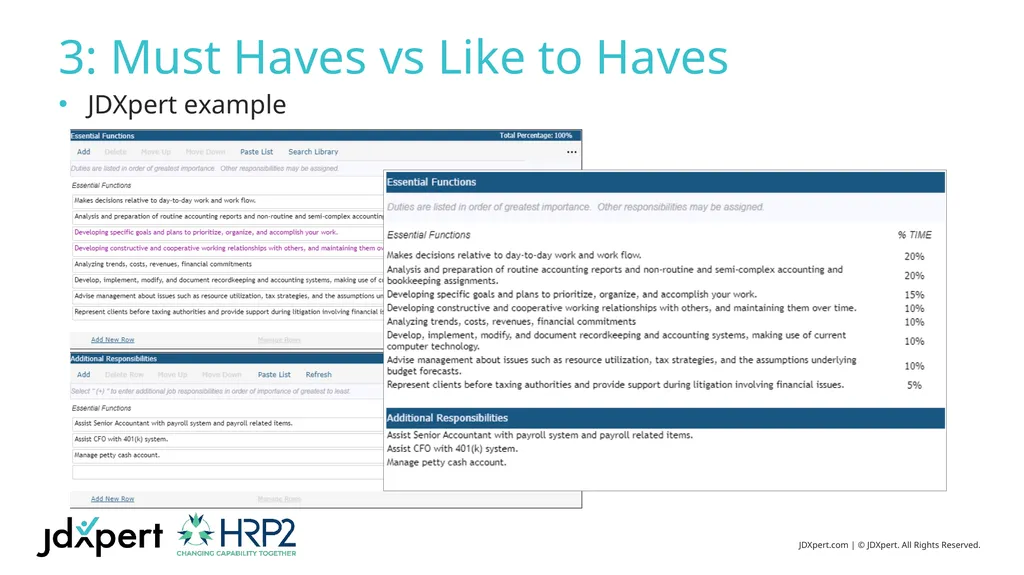
3: Must Haves vs Like to Haves JDXpert example<br>
15
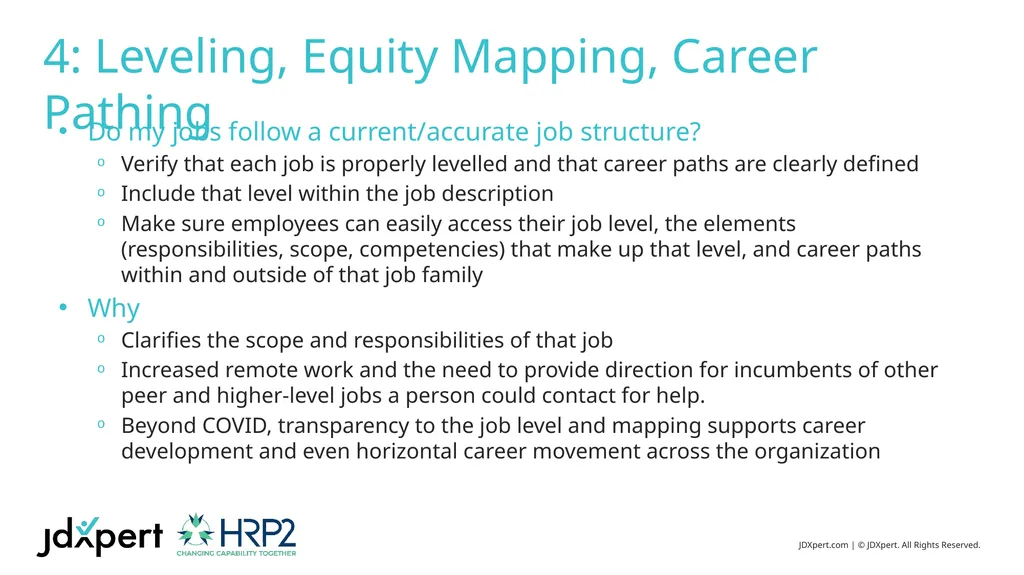
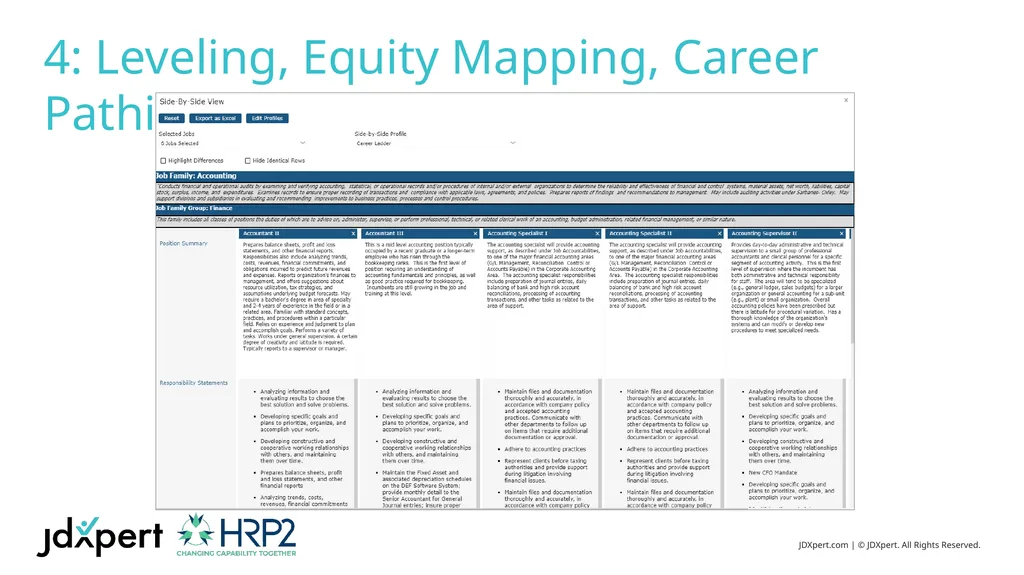
4: Leveling, Equity Mapping, Career Pathing Do my jobs follow a current/accurate job structure?
Verify that each job is properly levelled and that career paths are clearly defined
Include that level within the job description
Make sure employees can easily access their job level, the elements (responsibilities, scope, competencies) that make up that level, and career paths within and outside of that job family
Why
Clarifies the scope and responsibilities of that job
Increased remote work and the need to provide direction for incumbents of other peer and higher-level jobs a person could contact for help.
Beyond COVID, transparency to the job level and mapping supports career development and even horizontal career movement across the organization<br>
Verify that each job is properly levelled and that career paths are clearly defined
Include that level within the job description
Make sure employees can easily access their job level, the elements (responsibilities, scope, competencies) that make up that level, and career paths within and outside of that job family
Why
Clarifies the scope and responsibilities of that job
Increased remote work and the need to provide direction for incumbents of other peer and higher-level jobs a person could contact for help.
Beyond COVID, transparency to the job level and mapping supports career development and even horizontal career movement across the organization<br>
16
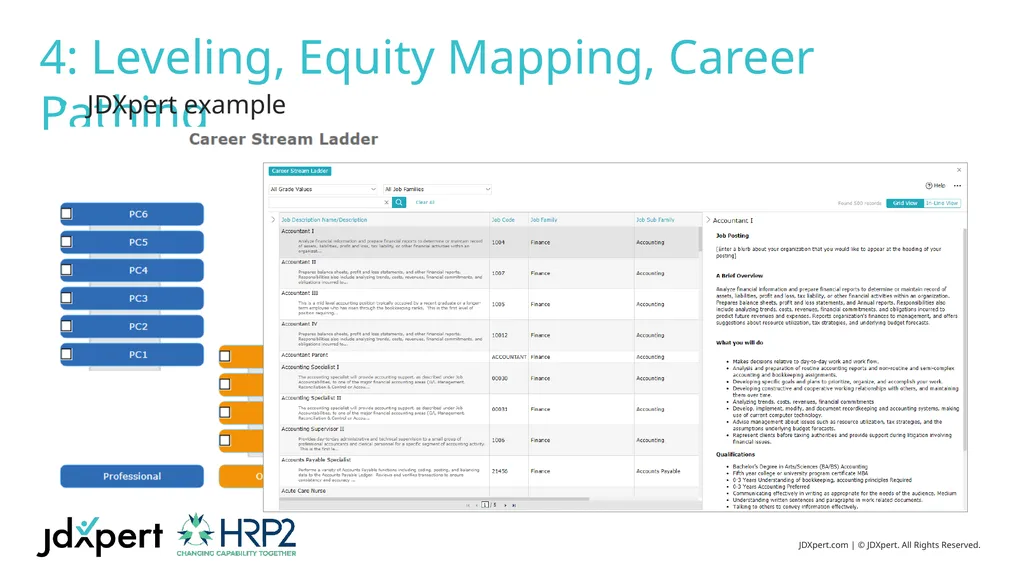
4: Leveling, Equity Mapping, Career Pathing JDXpert example<br>
17
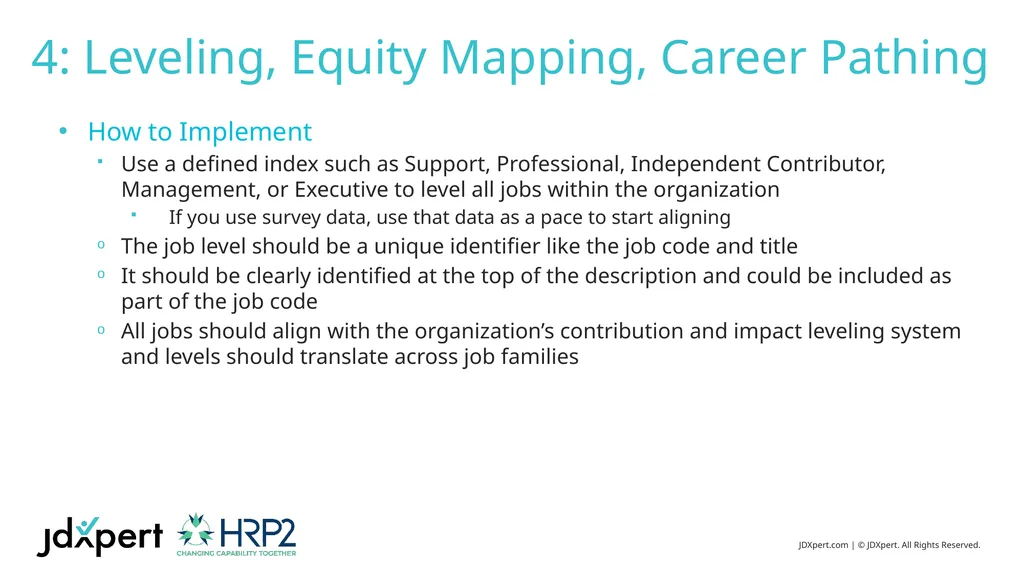
4: Leveling, Equity Mapping, Career Pathing How to Implement
Use a defined index such as Support, Professional, Independent Contributor, Management, or Executive to level all jobs within the organization
If you use survey data, use that data as a pace to start aligning
The job level should be a unique identifier like the job code and title
It should be clearly identified at the top of the description and could be included as part of the job code
All jobs should align with the organization’s contribution and impact leveling system and levels should translate across job families<br>
Use a defined index such as Support, Professional, Independent Contributor, Management, or Executive to level all jobs within the organization
If you use survey data, use that data as a pace to start aligning
The job level should be a unique identifier like the job code and title
It should be clearly identified at the top of the description and could be included as part of the job code
All jobs should align with the organization’s contribution and impact leveling system and levels should translate across job families<br>
18
4: Leveling, Equity Mapping, Career Pathing<br>
19
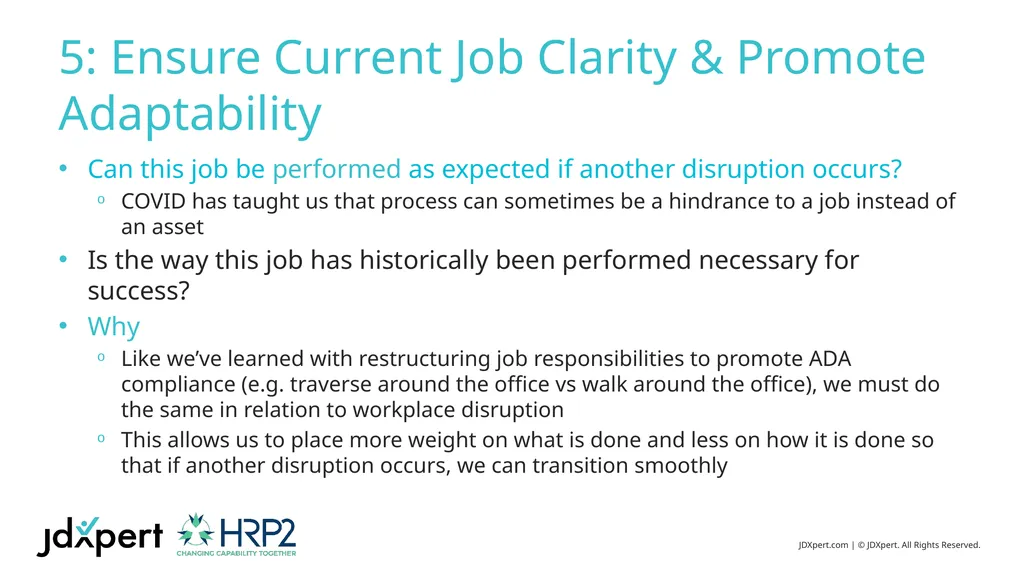
5: Ensure Current Job Clarity & Promote Adaptability Can this job be performed as expected if another disruption occurs?
COVID has taught us that process can sometimes be a hindrance to a job instead of an asset
Is the way this job has historically been performed necessary for success?
Why
Like we’ve learned with restructuring job responsibilities to promote ADA compliance (e.g. traverse around the office vs walk around the office), we must do the same in relation to workplace disruption
This allows us to place more weight on what is done and less on how it is done so that if another disruption occurs, we can transition smoothly<br>
COVID has taught us that process can sometimes be a hindrance to a job instead of an asset
Is the way this job has historically been performed necessary for success?
Why
Like we’ve learned with restructuring job responsibilities to promote ADA compliance (e.g. traverse around the office vs walk around the office), we must do the same in relation to workplace disruption
This allows us to place more weight on what is done and less on how it is done so that if another disruption occurs, we can transition smoothly<br>
20
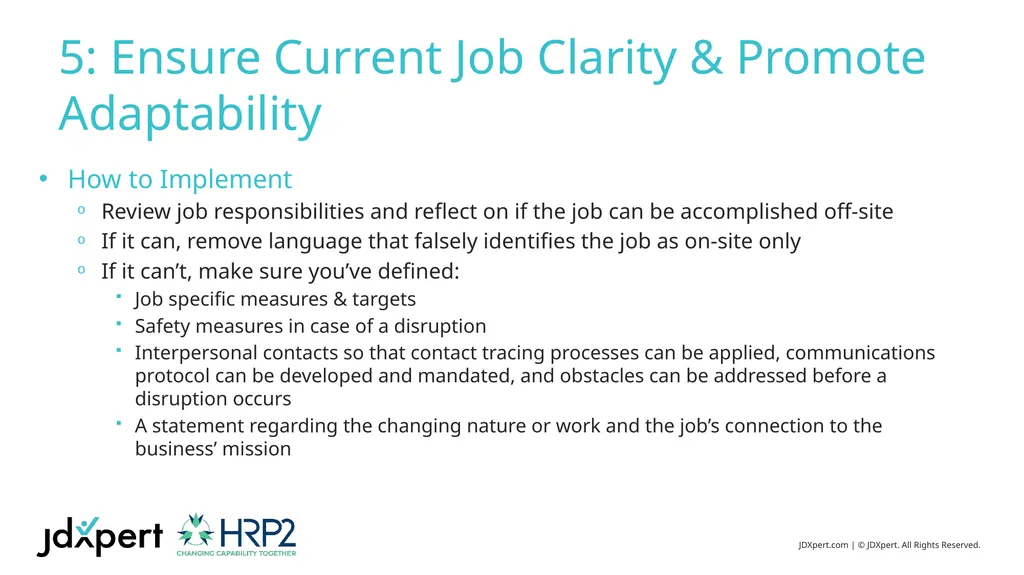
5: Ensure Current Job Clarity & Promote Adaptability How to Implement
Review job responsibilities and reflect on if the job can be accomplished off-site
If it can, remove language that falsely identifies the job as on-site only
If it can’t, make sure you’ve defined:
Job specific measures & targets
Safety measures in case of a disruption
Interpersonal contacts so that contact tracing processes can be applied, communications protocol can be developed and mandated, and obstacles can be addressed before a disruption occurs
A statement regarding the changing nature or work and the job’s connection to the business’ mission<br>
Review job responsibilities and reflect on if the job can be accomplished off-site
If it can, remove language that falsely identifies the job as on-site only
If it can’t, make sure you’ve defined:
Job specific measures & targets
Safety measures in case of a disruption
Interpersonal contacts so that contact tracing processes can be applied, communications protocol can be developed and mandated, and obstacles can be addressed before a disruption occurs
A statement regarding the changing nature or work and the job’s connection to the business’ mission<br>
21
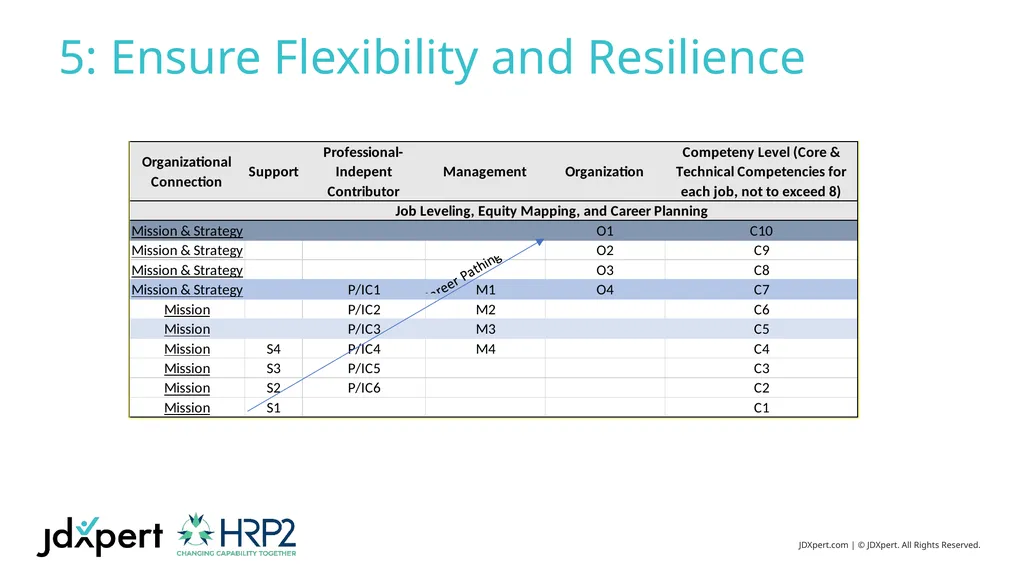
5: Ensure Flexibility and Resilience<br>
22
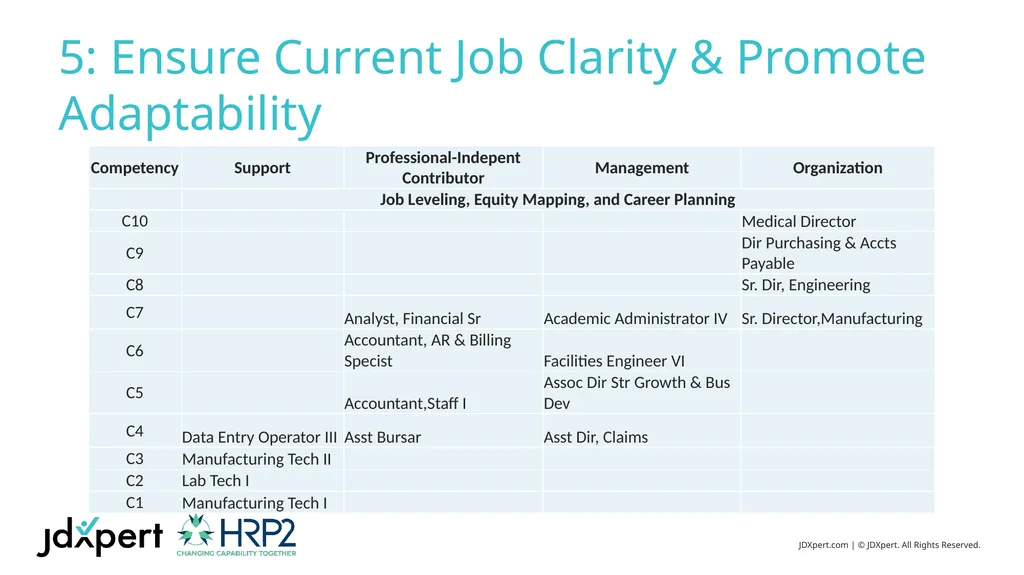
5: Ensure Current Job Clarity & Promote Adaptability<br>
23
Thank You! For more information about JDXpert, visit jdxpert.com
or email Ashley at ashley@hrtms.com
For more information about Jed Lindholm and HR Performance Possibilities, email Jed at jlindholm@hrp2.com or visit hrp2.com
As a thank you for joining us today, click here to download a free copy of our eBook, 10 Ways To Improve Your Job Descriptions<br>
or email Ashley at ashley@hrtms.com
For more information about Jed Lindholm and HR Performance Possibilities, email Jed at jlindholm@hrp2.com or visit hrp2.com
As a thank you for joining us today, click here to download a free copy of our eBook, 10 Ways To Improve Your Job Descriptions<br>