
5 Years PYQ’s (2019-2023) Ethics and Human
PM
Published · 32 slides · 0 views

1 / 1

Description
5 Years PYQs (2019-2023) Ethics and Human Interface Copyright 2024 by Vision IAS. www.visionias.in Team VisionIAS By Shri. Krishan Mohan, IAS (Retd.) OPEN SESSION UPSC GS Mains Ethics: Theory Differentiate moral intuition from moral
Related Topics
Share
Embed code
Download this presentation From Below
"5 Years PYQ’s (2019-2023) Ethics and Human" is the property of its rightful owner. Permission is granted to download and print the materials on this website for personal, non-commercial use only, and to display it on your personal computer provided you do not modify the materials and that you retain all copyright notices contained in the materials. By downloading content from our website, you accept the terms of this agreement.
Presentation Transcript
01
5 Years PYQ’s (2019-2023)
Ethics and Human Interface Copyright © 2024 by Vision IAS. [www.visionias.in] Team VisionIAS By
Shri. Krishan Mohan, IAS (Retd.) OPEN SESSION UPSC GS Mains Ethics: Theory<br>
02
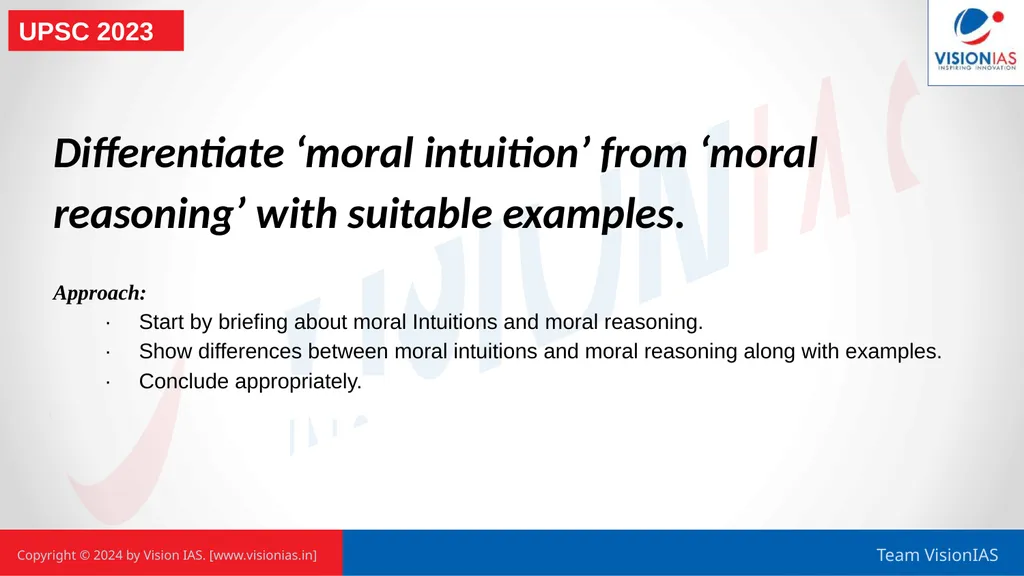
Differentiate ‘moral intuition’ from ‘moral reasoning’ with suitable examples.
Approach:
· Start by briefing about moral Intuitions and moral reasoning.
· Show differences between moral intuitions and moral reasoning along with examples.
· Conclude appropriately. Copyright © 2024 by Vision IAS. [www.visionias.in] Team VisionIAS UPSC 2023<br>
03
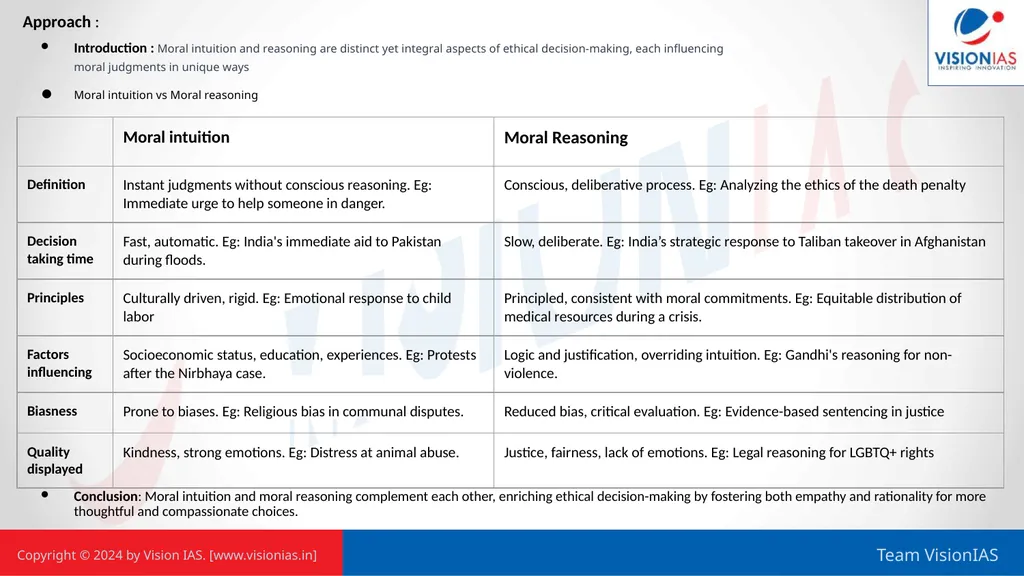
Approach :
Introduction : Moral intuition and reasoning are distinct yet integral aspects of ethical decision-making, each influencing
moral judgments in unique ways
Moral intuition vs Moral reasoning
Conclusion: Moral intuition and moral reasoning complement each other, enriching ethical decision-making by fostering both empathy and rationality for more thoughtful and compassionate choices. Copyright © 2024 by Vision IAS. [www.visionias.in] Team VisionIAS<br>
04
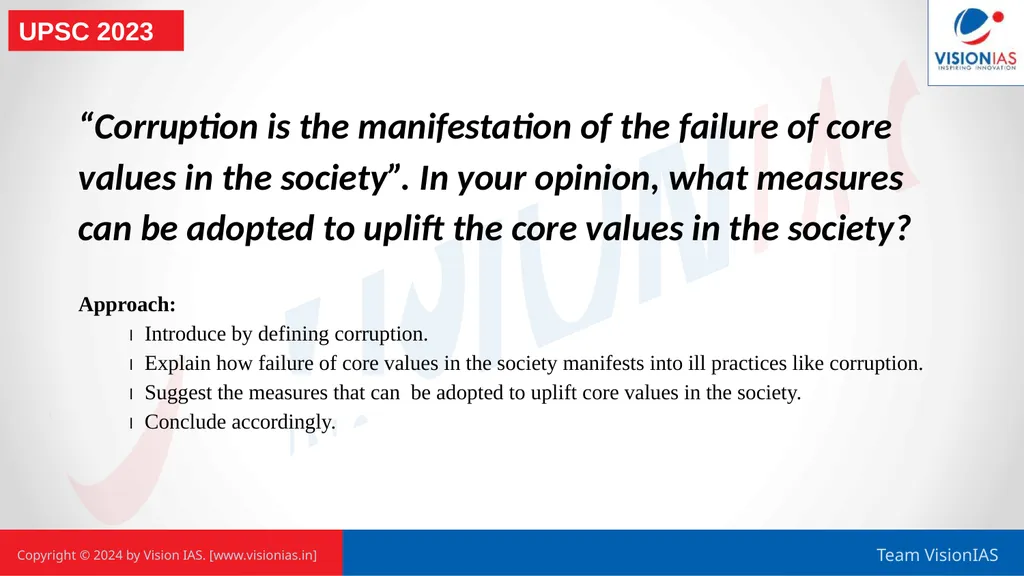
“Corruption is the manifestation of the failure of core values in the society”. In your opinion, what measures can be adopted to uplift the core values in the society?
Approach:
l Introduce by defining corruption.
l Explain how failure of core values in the society manifests into ill practices like corruption.
l Suggest the measures that can be adopted to uplift core values in the society.
l Conclude accordingly. Copyright © 2024 by Vision IAS. [www.visionias.in] Team VisionIAS UPSC 2023<br>
05
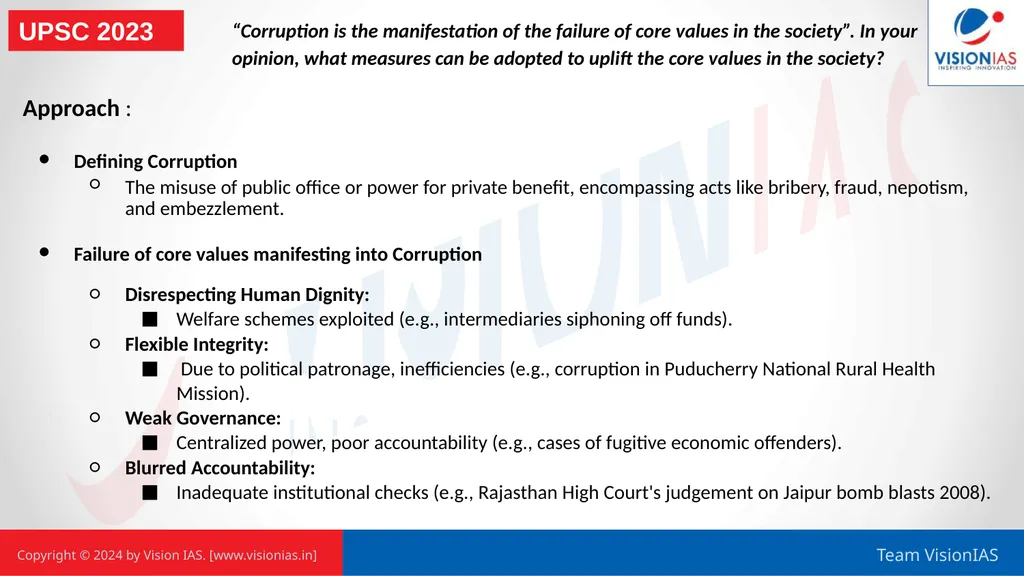
Approach :
Defining Corruption
The misuse of public office or power for private benefit, encompassing acts like bribery, fraud, nepotism, and embezzlement.
Failure of core values manifesting into Corruption
Disrespecting Human Dignity:
Welfare schemes exploited (e.g., intermediaries siphoning off funds).
Flexible Integrity:
Due to political patronage, inefficiencies (e.g., corruption in Puducherry National Rural Health Mission).
Weak Governance:
Centralized power, poor accountability (e.g., cases of fugitive economic offenders).
Blurred Accountability:
Inadequate institutional checks (e.g., Rajasthan High Court's judgement on Jaipur bomb blasts 2008). Copyright © 2024 by Vision IAS. [www.visionias.in] Team VisionIAS “Corruption is the manifestation of the failure of core values in the society”. In your opinion, what measures can be adopted to uplift the core values in the society? UPSC 2023<br>
06
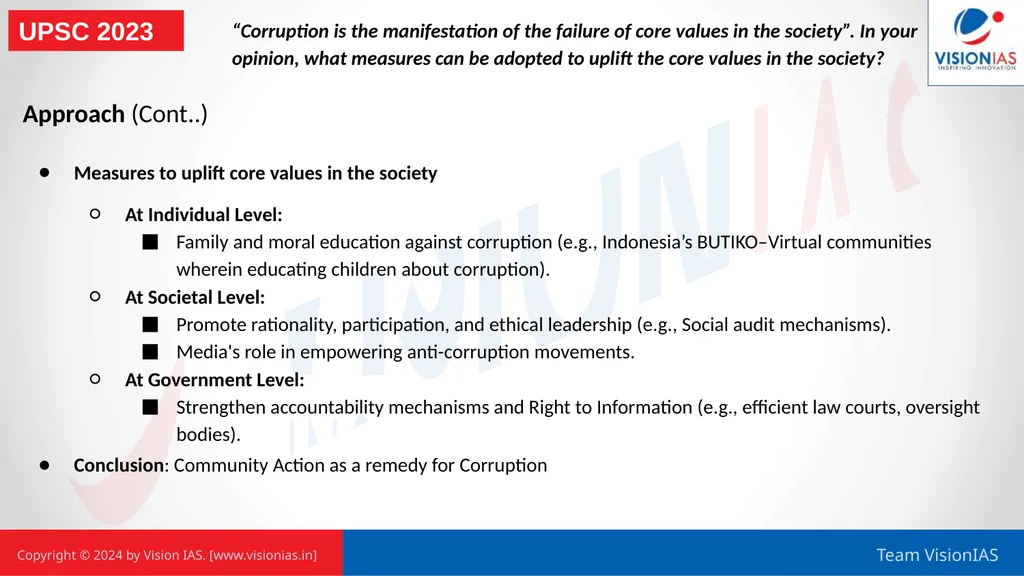
Approach (Cont..)
Measures to uplift core values in the society
At Individual Level:
Family and moral education against corruption (e.g., Indonesia’s BUTIKO–Virtual communities wherein educating children about corruption).
At Societal Level:
Promote rationality, participation, and ethical leadership (e.g., Social audit mechanisms).
Media's role in empowering anti-corruption movements.
At Government Level:
Strengthen accountability mechanisms and Right to Information (e.g., efficient law courts, oversight bodies).
Conclusion: Community Action as a remedy for Corruption Copyright © 2024 by Vision IAS. [www.visionias.in] Team VisionIAS “Corruption is the manifestation of the failure of core values in the society”. In your opinion, what measures can be adopted to uplift the core values in the society? UPSC 2023<br>
07
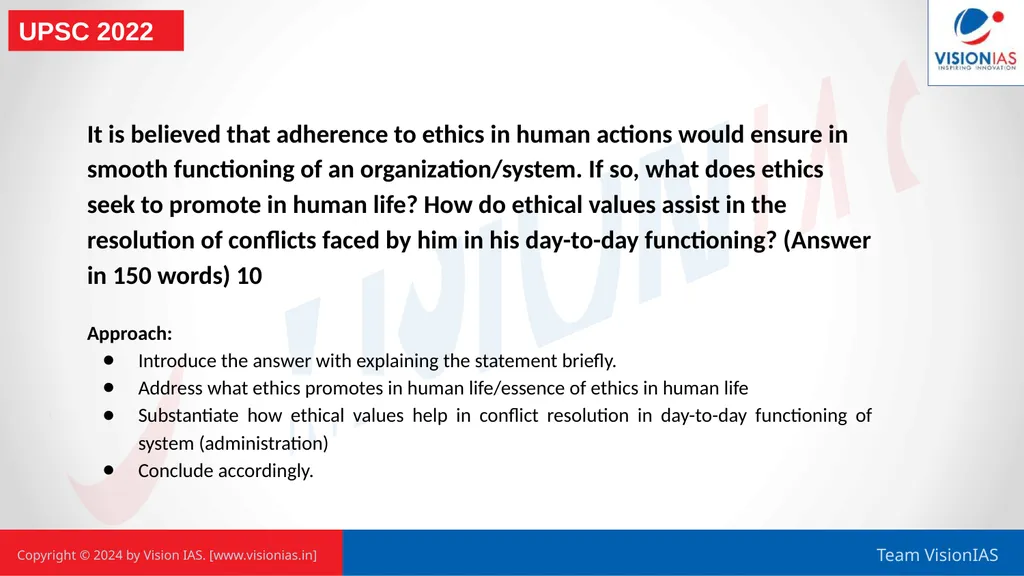
Copyright © 2024 by Vision IAS. [www.visionias.in] Team VisionIAS UPSC 2022 It is believed that adherence to ethics in human actions would ensure in smooth functioning of an organization/system. If so, what does ethics seek to promote in human life? How do ethical values assist in the resolution of conflicts faced by him in his day-to-day functioning? (Answer in 150 words) 10
Approach:
Introduce the answer with explaining the statement briefly.
Address what ethics promotes in human life/essence of ethics in human life
Substantiate how ethical values help in conflict resolution in day-to-day functioning of system (administration)
Conclude accordingly.<br>
08
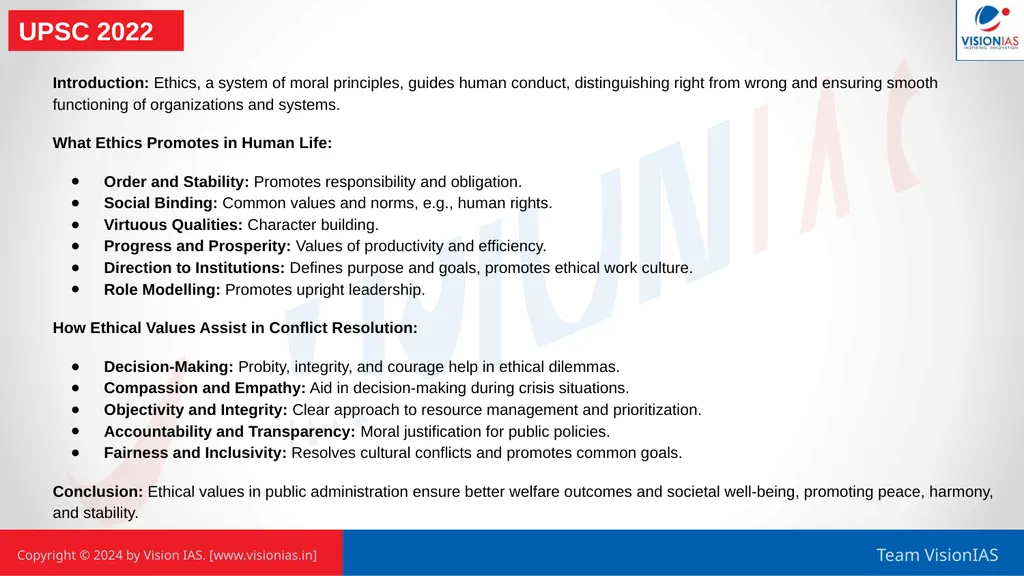
Copyright © 2024 by Vision IAS. [www.visionias.in] Team VisionIAS UPSC 2022 Introduction: Ethics, a system of moral principles, guides human conduct, distinguishing right from wrong and ensuring smooth functioning of organizations and systems.
What Ethics Promotes in Human Life:
Order and Stability: Promotes responsibility and obligation.
Social Binding: Common values and norms, e.g., human rights.
Virtuous Qualities: Character building.
Progress and Prosperity: Values of productivity and efficiency.
Direction to Institutions: Defines purpose and goals, promotes ethical work culture.
Role Modelling: Promotes upright leadership.
How Ethical Values Assist in Conflict Resolution:
Decision-Making: Probity, integrity, and courage help in ethical dilemmas.
Compassion and Empathy: Aid in decision-making during crisis situations.
Objectivity and Integrity: Clear approach to resource management and prioritization.
Accountability and Transparency: Moral justification for public policies.
Fairness and Inclusivity: Resolves cultural conflicts and promotes common goals.
Conclusion: Ethical values in public administration ensure better welfare outcomes and societal well-being, promoting peace, harmony, and stability.<br>
09
Copyright © 2024 by Vision IAS. [www.visionias.in] Team VisionIAS UPSC 2022 Online methodology is being used for day-to-day meetings, institutional approvals in the administration and for teaching and learning in education sector to the extent telemedicine in the health sector is getting popular with the approvals of the competent authority. No doubt it has advantages and disadvantages for both the beneficiaries and system at large. Describe and discuss the ethical issues involved in the use of online method particularly to vulnerable section of society. (Answer in 150 words) 10
Approach:
· Introduce with context of use of online methodology.
· Write advantages for the beneficiaries and the system at large.
· Write disadvantages for both the beneficiaries and the system at large.
· Discuss the ethical issues involved in the use of online method particularly to the vulnerable section of the society
· Conclude accordingly.<br>
10
Copyright © 2024 by Vision IAS. [www.visionias.in] Team VisionIAS UPSC 2022 Introduction:
Online methodology involves using Information and Communication Technology (ICT). Its adoption has increased post-pandemic.
Advantages:
Better Service Delivery: E-governance improves quality (e.g., UMANG App).
Enhanced Social Capital: Work-from-home boosts family interaction.
Better Accessibility: E-learning and telemedicine ensure fairness and equity.
Efficiency: Greater transparency and efficiency (e.g., Direct Benefit Transfer).
Disadvantages:
Digital Learning Gap: Students without reliable internet struggle.
Health Impact: Mental health issues from excessive social media use.
Privacy Concerns: Biometrics increase risk of data misuse.
Women's Rights: Increased domestic abuse during the pandemic.
Cybersecurity: Increased digital connectivity raises security concerns.<br>
11
Copyright © 2024 by Vision IAS. [www.visionias.in] Team VisionIAS UPSC 2022 Ethical Issues:
Data Misuse: Authorities might use data to manipulate behavior.
Erosion of Trust: Cyber frauds and harassment reduce trust in digital media.
Accessibility: Low literacy, internet penetration, and access to smartphones.
Digital Gender Inequality: Fewer women access the internet, reducing their learning and earning opportunities.
Children: Internet addiction affects concentration and well-being.
Technological Abuse: Cyberbullying, commodification of women, and youth radicalization.
Digital Illiteracy: Prevalent among older generations and in rural areas.
Conclusion: Addressing the digital divide and increasing awareness programs are crucial for ensuring inclusion and equity among vulnerable sections of society. (Cont..)<br>
12
Copyright © 2024 by Vision IAS. [www.visionias.in] Team VisionIAS UPSC 2021 Impact of digital technology as reliable source of input for rational decision making is debatable issue. Critically evaluate with suitable example. (Answer in 150 words)
Approach:
· Introduce about increasing use of digital technology in decision making.
· Discuss how digital technology is a reliable source of input for rational decision making
· Discuss how digital technology cannot be treated as a reliable source of input for rational decisions.
· Conclude appropriately.<br>
13
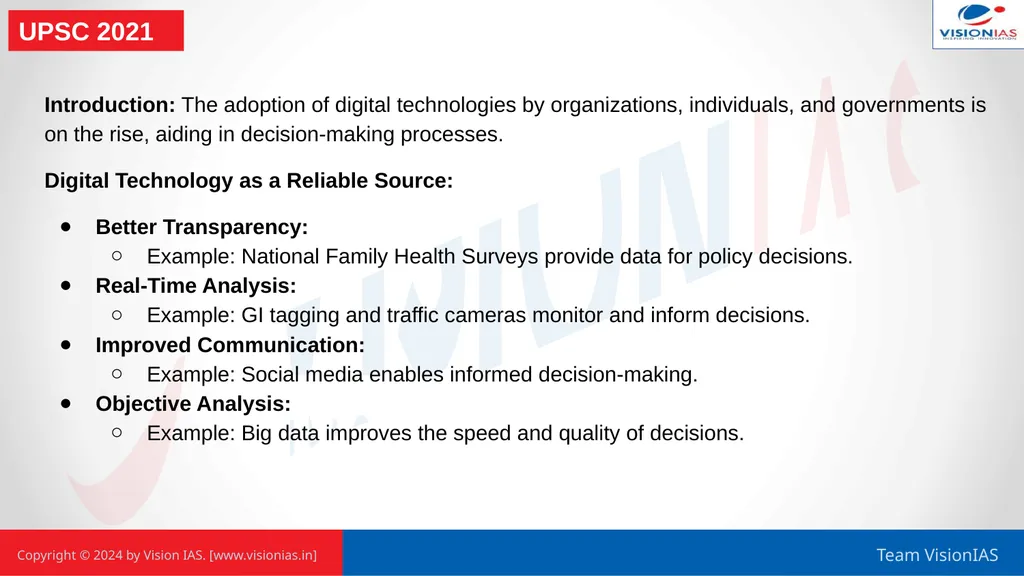
Copyright © 2024 by Vision IAS. [www.visionias.in] Team VisionIAS UPSC 2021 Introduction: The adoption of digital technologies by organizations, individuals, and governments is on the rise, aiding in decision-making processes.
Digital Technology as a Reliable Source:
Better Transparency:
Example: National Family Health Surveys provide data for policy decisions.
Real-Time Analysis:
Example: GI tagging and traffic cameras monitor and inform decisions.
Improved Communication:
Example: Social media enables informed decision-making.
Objective Analysis:
Example: Big data improves the speed and quality of decisions.<br>
14
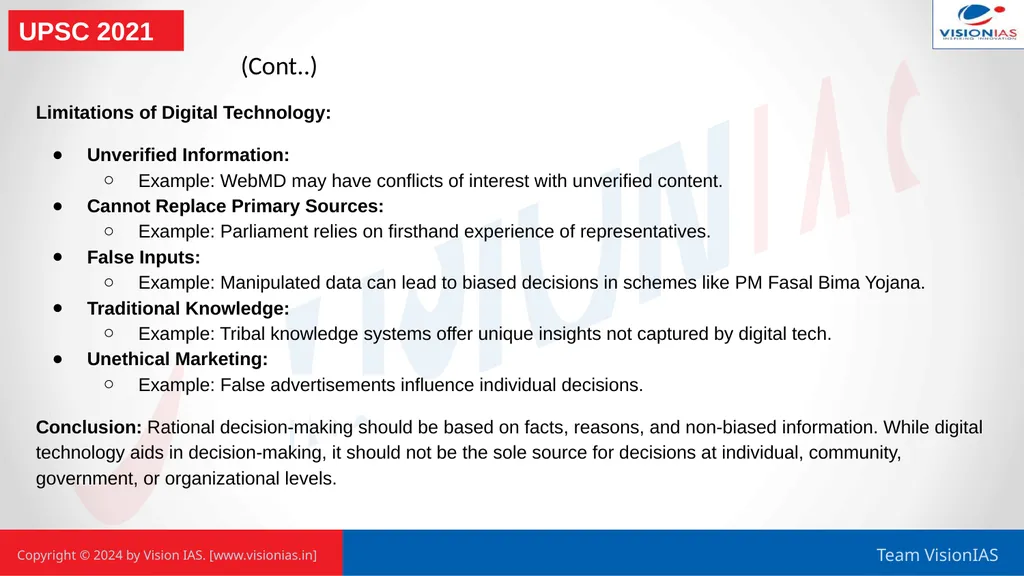
Copyright © 2024 by Vision IAS. [www.visionias.in] Team VisionIAS UPSC 2021 Limitations of Digital Technology:
Unverified Information:
Example: WebMD may have conflicts of interest with unverified content.
Cannot Replace Primary Sources:
Example: Parliament relies on firsthand experience of representatives.
False Inputs:
Example: Manipulated data can lead to biased decisions in schemes like PM Fasal Bima Yojana.
Traditional Knowledge:
Example: Tribal knowledge systems offer unique insights not captured by digital tech.
Unethical Marketing:
Example: False advertisements influence individual decisions.
Conclusion: Rational decision-making should be based on facts, reasons, and non-biased information. While digital technology aids in decision-making, it should not be the sole source for decisions at individual, community, government, or organizational levels. (Cont..)<br>
15
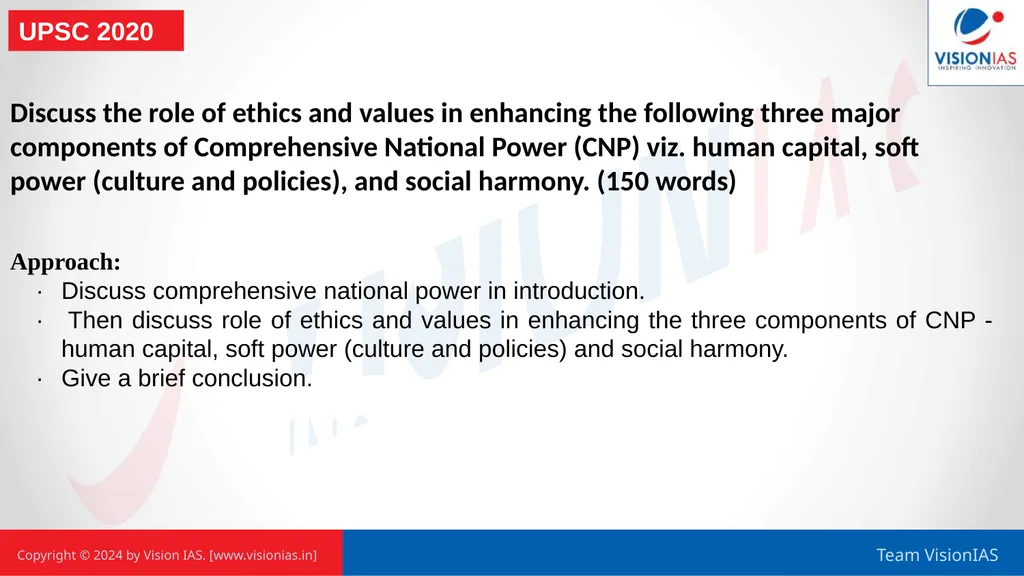
Copyright © 2024 by Vision IAS. [www.visionias.in] Team VisionIAS Discuss the role of ethics and values in enhancing the following three major components of Comprehensive National Power (CNP) viz. human capital, soft power (culture and policies), and social harmony. (150 words)
Approach:
· Discuss comprehensive national power in introduction.
· Then discuss role of ethics and values in enhancing the three components of CNP - human capital, soft power (culture and policies) and social harmony.
· Give a brief conclusion. UPSC 2020<br>
16
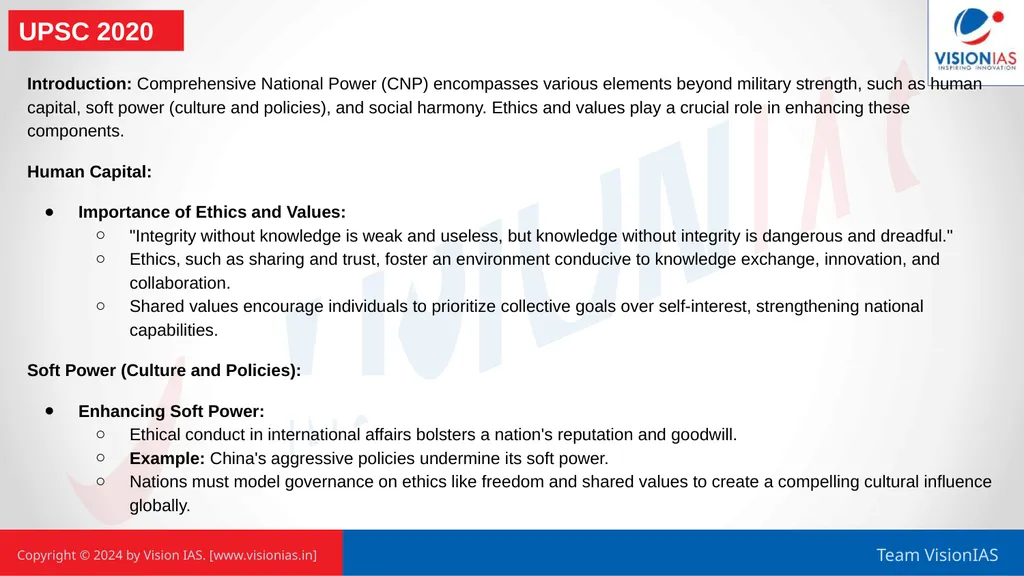
Copyright © 2024 by Vision IAS. [www.visionias.in] Team VisionIAS UPSC 2020 Introduction: Comprehensive National Power (CNP) encompasses various elements beyond military strength, such as human capital, soft power (culture and policies), and social harmony. Ethics and values play a crucial role in enhancing these components.
Human Capital:
Importance of Ethics and Values:
"Integrity without knowledge is weak and useless, but knowledge without integrity is dangerous and dreadful."
Ethics, such as sharing and trust, foster an environment conducive to knowledge exchange, innovation, and collaboration.
Shared values encourage individuals to prioritize collective goals over self-interest, strengthening national capabilities.
Soft Power (Culture and Policies):
Enhancing Soft Power:
Ethical conduct in international affairs bolsters a nation's reputation and goodwill.
Example: China's aggressive policies undermine its soft power.
Nations must model governance on ethics like freedom and shared values to create a compelling cultural influence globally.<br>
17
Copyright © 2024 by Vision IAS. [www.visionias.in] Team VisionIAS UPSC 2020 Social Harmony:
Achieving Social Cohesion:
Ethics and values are essential for equity and inclusiveness.
Empathy and concern for others build trust and cooperation within society.
Values of justice and fairness foster harmonious relationships across diverse communities.
Conclusion: Ethics and values are foundational to enhancing human capital, soft power, and social harmony. They ensure a nation’s prosperity, stability, and international stature, aligning with the state’s aim of promoting the welfare and prosperity of its citizens, as envisioned in Kautilya’s Arthashastra. (Cont..)<br>
18
“Education is not an injunction, it is an effective and pervasive tool for all-round development of an individual and social transformation”. Examine the New Education Policy, 2020 (NEP, 2020) in light of the above statement. (150 words)
Approach:
· In the introduction, briefly explain the holistic role and function of education.
· Briefly discuss the relevant provisions of NEP, 2020 that aims to achieve them.
· Conclude accordingly. Copyright © 2024 by Vision IAS. [www.visionias.in] Team VisionIAS UPSC 2020<br>
19
Copyright © 2024 by Vision IAS. [www.visionias.in] Team VisionIAS Introduction: Education is a tool for all-round development and social transformation. It should develop thoughtful, well-rounded, and creative individuals who can positively impact society.
NEP 2020 Provisions:
Universal Access:
Aim: 100% Gross Enrolment Ratio (GER) in school education by 2030.
Ensures no child misses opportunities due to birth circumstances or background.
Bridging Social Gaps:
Focus on access, participation, and learning outcomes.
Goal: Reduce social disparities in education.
Multidisciplinary Approach:
No rigid separation between streams.
Students can choose subjects across streams.
Introduction of vocational education from Class 6 with internships.
Reduced Curriculum Load:
Core essentials focus to allow critical thinking.
Inquiry-based, holistic, and analysis-based learning. UPSC 2020<br>
20
Copyright © 2024 by Vision IAS. [www.visionias.in] Team VisionIAS Experiential Learning:
Hands-on, arts-integrated, and sports-integrated education.
Shift to competency-based learning and education.
Technology Integration:
National Educational Alliance for Technology (NEAT) to enhance learning outcomes using AI.
Personalized and customized learning experiences through EdTech collaborations.
Competency-Based Assessment:
Evaluation of higher-order skills like analysis and critical thinking.
Shift from marks-based to competency-based assessments.
Conclusion: The NEP 2020 aims to transform education into a holistic, inclusive, and flexible system. Its success depends on uniform and transparent implementation, ensuring equitable resource distribution. UPSC 2020 (Cont..)<br>
21
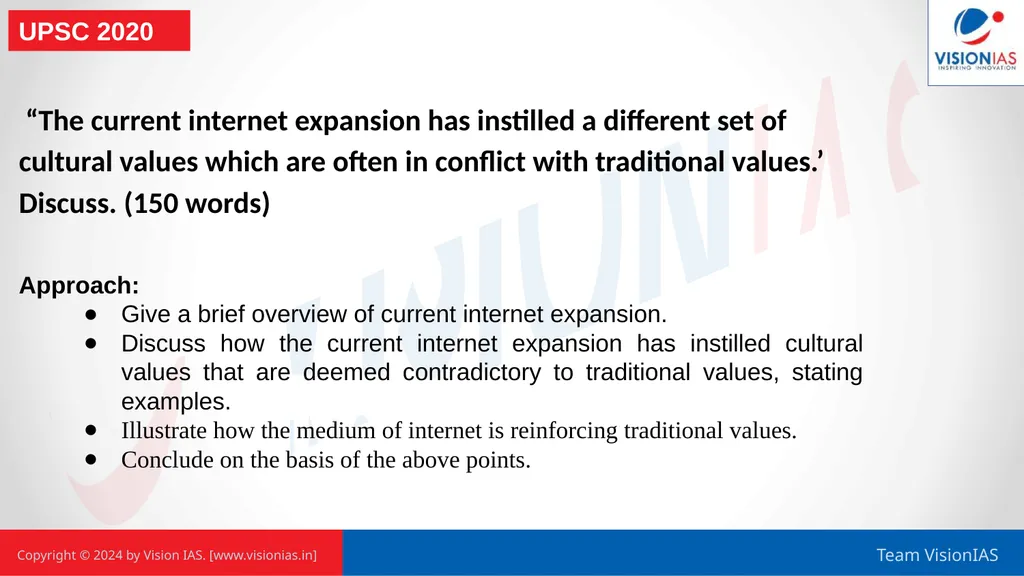
Copyright © 2024 by Vision IAS. [www.visionias.in] Team VisionIAS UPSC 2020 “The current internet expansion has instilled a different set of cultural values which are often in conflict with traditional values.’ Discuss. (150 words)
Approach:
Give a brief overview of current internet expansion.
Discuss how the current internet expansion has instilled cultural values that are deemed contradictory to traditional values, stating examples.
Illustrate how the medium of internet is reinforcing traditional values.
Conclude on the basis of the above points.<br>
22
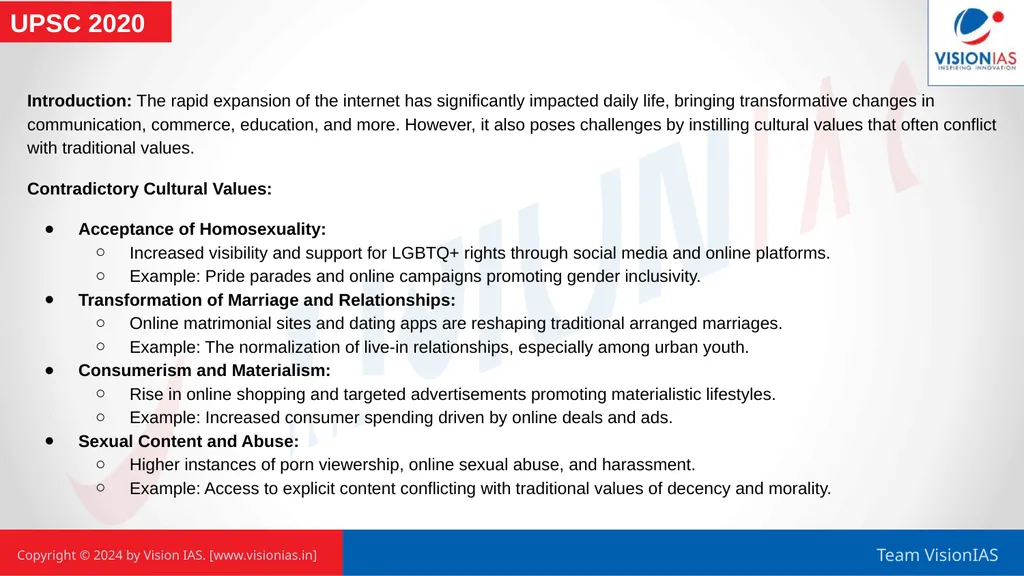
Copyright © 2024 by Vision IAS. [www.visionias.in] Team VisionIAS UPSC 2020 Introduction: The rapid expansion of the internet has significantly impacted daily life, bringing transformative changes in communication, commerce, education, and more. However, it also poses challenges by instilling cultural values that often conflict with traditional values.
Contradictory Cultural Values:
Acceptance of Homosexuality:
Increased visibility and support for LGBTQ+ rights through social media and online platforms.
Example: Pride parades and online campaigns promoting gender inclusivity.
Transformation of Marriage and Relationships:
Online matrimonial sites and dating apps are reshaping traditional arranged marriages.
Example: The normalization of live-in relationships, especially among urban youth.
Consumerism and Materialism:
Rise in online shopping and targeted advertisements promoting materialistic lifestyles.
Example: Increased consumer spending driven by online deals and ads.
Sexual Content and Abuse:
Higher instances of porn viewership, online sexual abuse, and harassment.
Example: Access to explicit content conflicting with traditional values of decency and morality.<br>
23
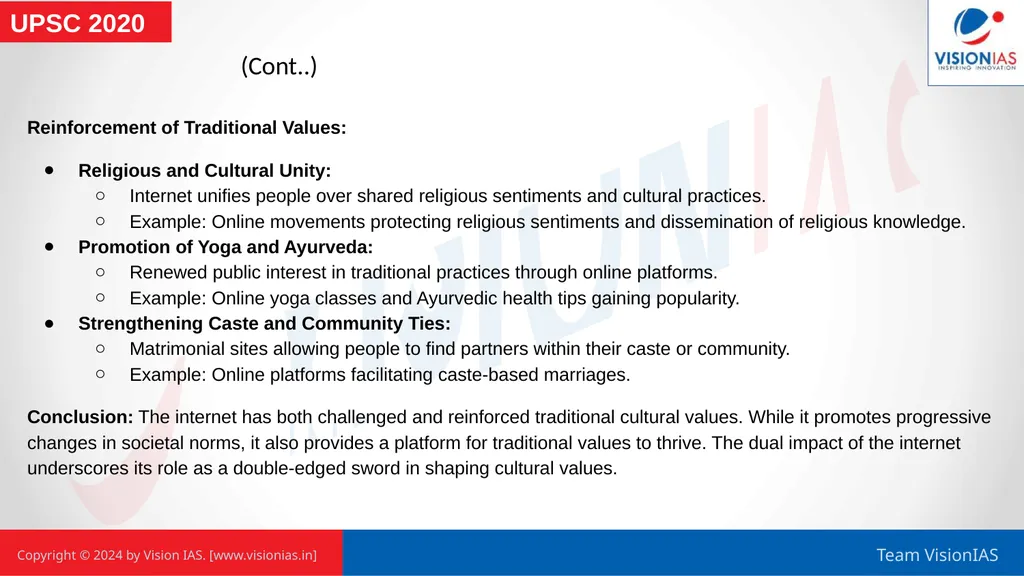
Copyright © 2024 by Vision IAS. [www.visionias.in] Team VisionIAS UPSC 2020 Reinforcement of Traditional Values:
Religious and Cultural Unity:
Internet unifies people over shared religious sentiments and cultural practices.
Example: Online movements protecting religious sentiments and dissemination of religious knowledge.
Promotion of Yoga and Ayurveda:
Renewed public interest in traditional practices through online platforms.
Example: Online yoga classes and Ayurvedic health tips gaining popularity.
Strengthening Caste and Community Ties:
Matrimonial sites allowing people to find partners within their caste or community.
Example: Online platforms facilitating caste-based marriages.
Conclusion: The internet has both challenged and reinforced traditional cultural values. While it promotes progressive changes in societal norms, it also provides a platform for traditional values to thrive. The dual impact of the internet underscores its role as a double-edged sword in shaping cultural values. (Cont..)<br>
24
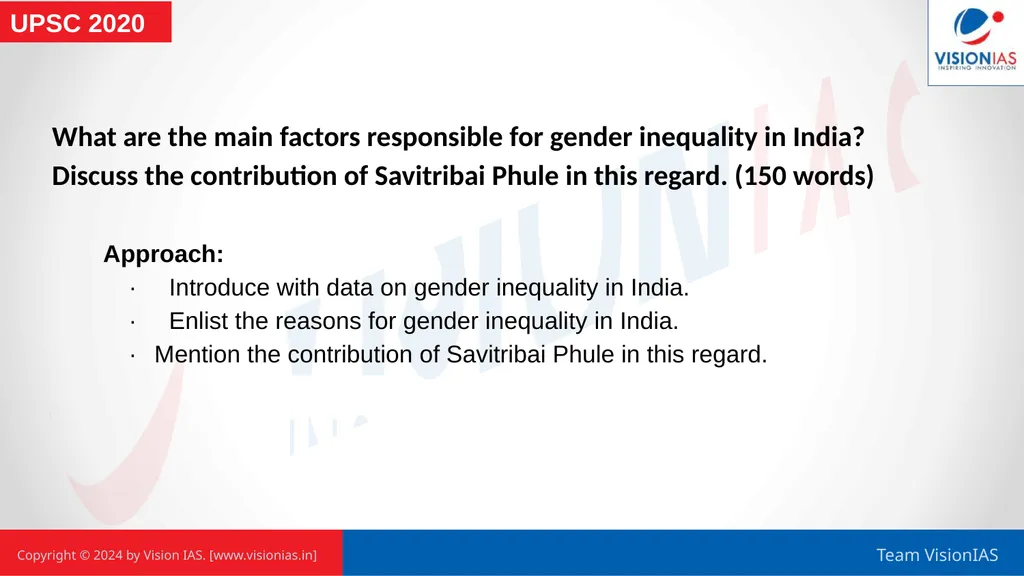
Copyright © 2024 by Vision IAS. [www.visionias.in] Team VisionIAS UPSC 2020 What are the main factors responsible for gender inequality in India? Discuss the contribution of Savitribai Phule in this regard. (150 words)
Approach:
· Introduce with data on gender inequality in India.
· Enlist the reasons for gender inequality in India.
· Mention the contribution of Savitribai Phule in this regard.<br>
25
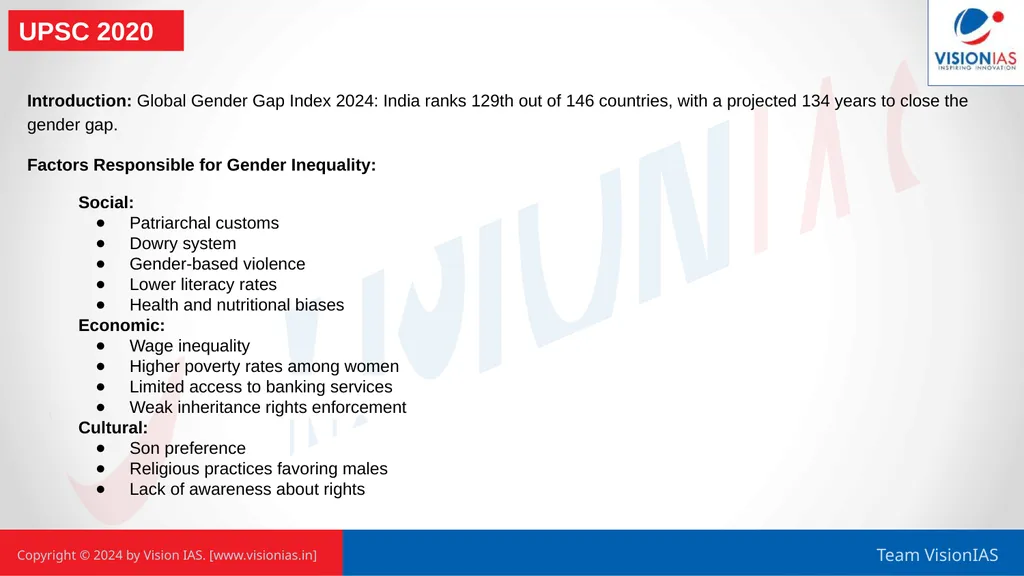
Copyright © 2024 by Vision IAS. [www.visionias.in] Team VisionIAS UPSC 2020 Introduction: Global Gender Gap Index 2024: India ranks 129th out of 146 countries, with a projected 134 years to close the gender gap.
Factors Responsible for Gender Inequality:
Social:
Patriarchal customs
Dowry system
Gender-based violence
Lower literacy rates
Health and nutritional biases
Economic:
Wage inequality
Higher poverty rates among women
Limited access to banking services
Weak inheritance rights enforcement
Cultural:
Son preference
Religious practices favoring males
Lack of awareness about rights<br>
26
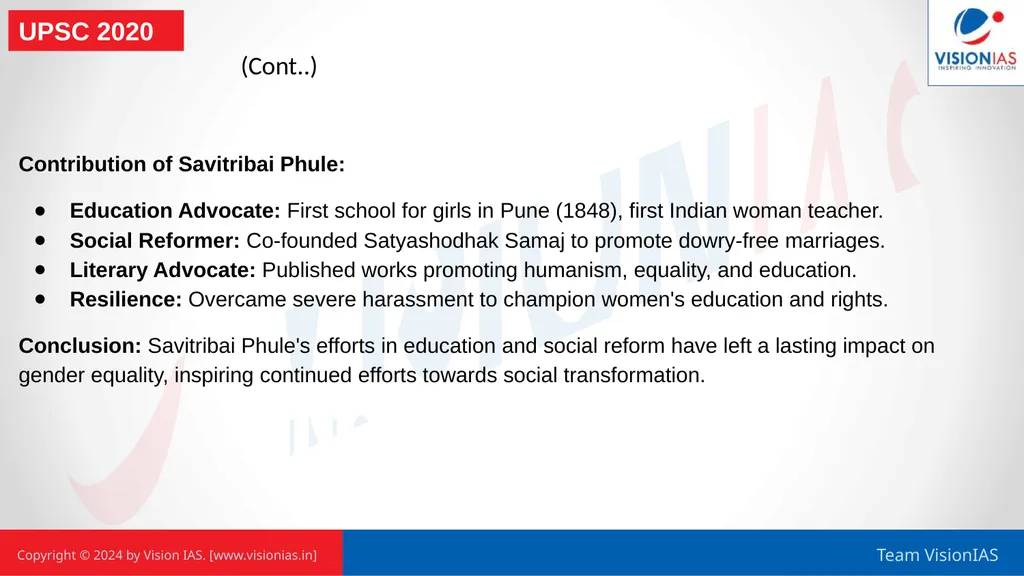
Copyright © 2024 by Vision IAS. [www.visionias.in] Team VisionIAS UPSC 2020 Contribution of Savitribai Phule:
Education Advocate: First school for girls in Pune (1848), first Indian woman teacher.
Social Reformer: Co-founded Satyashodhak Samaj to promote dowry-free marriages.
Literary Advocate: Published works promoting humanism, equality, and education.
Resilience: Overcame severe harassment to champion women's education and rights.
Conclusion: Savitribai Phule's efforts in education and social reform have left a lasting impact on gender equality, inspiring continued efforts towards social transformation. (Cont..)<br>
27
What were the major teachings of Guru Nanak? Explain their relevance in the contemporary world.
Approach:
· Start by telling who Guru Nanak was and what his major philosophy was.
· List down his major teaching and present day relevance.
· Conclude accordingly Copyright © 2024 by Vision IAS. [www.visionias.in] Team VisionIAS UPSC 2023<br>
28
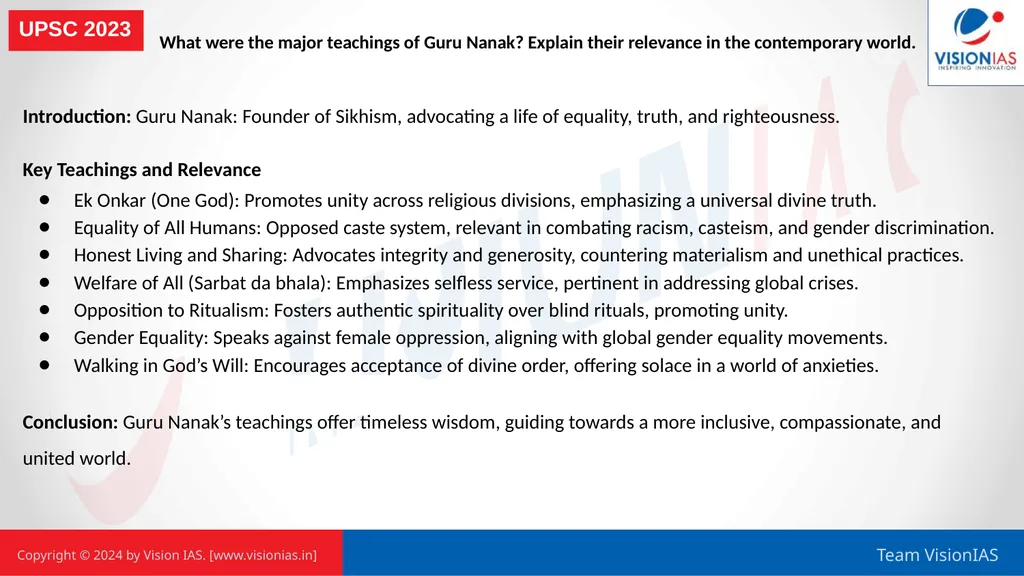
Introduction: Guru Nanak: Founder of Sikhism, advocating a life of equality, truth, and righteousness.
Key Teachings and Relevance
Ek Onkar (One God): Promotes unity across religious divisions, emphasizing a universal divine truth.
Equality of All Humans: Opposed caste system, relevant in combating racism, casteism, and gender discrimination.
Honest Living and Sharing: Advocates integrity and generosity, countering materialism and unethical practices.
Welfare of All (Sarbat da bhala): Emphasizes selfless service, pertinent in addressing global crises.
Opposition to Ritualism: Fosters authentic spirituality over blind rituals, promoting unity.
Gender Equality: Speaks against female oppression, aligning with global gender equality movements.
Walking in God’s Will: Encourages acceptance of divine order, offering solace in a world of anxieties.
Conclusion: Guru Nanak’s teachings offer timeless wisdom, guiding towards a more inclusive, compassionate, and united world. Copyright © 2024 by Vision IAS. [www.visionias.in] Team VisionIAS What were the major teachings of Guru Nanak? Explain their relevance in the contemporary world. UPSC 2023<br>
29
What teachings of Buddha are most relevant today and why? Discuss. (150 words)
Approach:
· Briefly highlight Buddha’s teaching and his role as a moral philosopher.
· Discuss his ideas like non-violence, middle path and their contemporary relevance.
· Mention how his teachings inspired great leaders like Gandhiji. Copyright © 2024 by Vision IAS. [www.visionias.in] Team VisionIAS UPSC 2020<br>
30
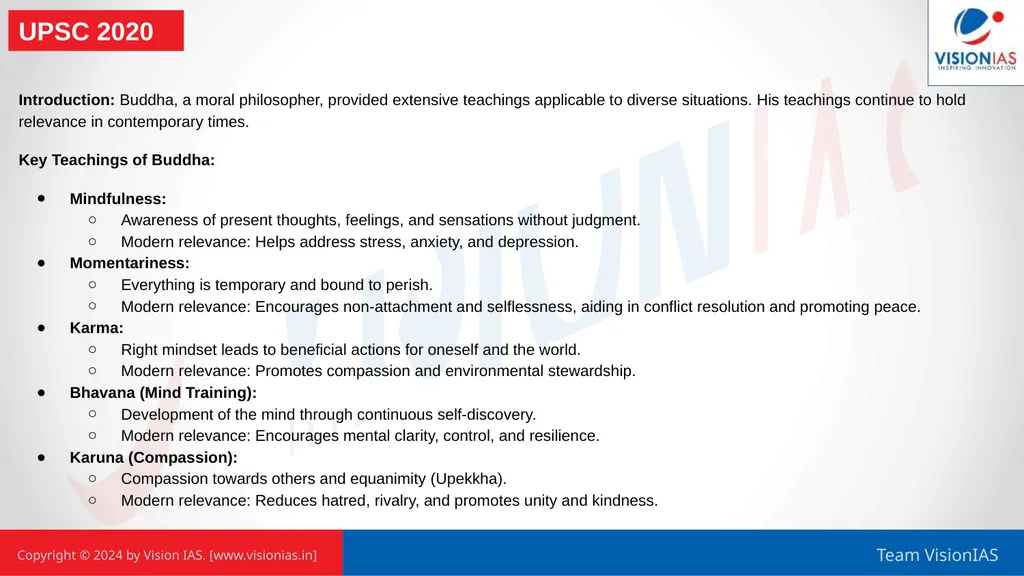
Copyright © 2024 by Vision IAS. [www.visionias.in] Team VisionIAS Introduction: Buddha, a moral philosopher, provided extensive teachings applicable to diverse situations. His teachings continue to hold relevance in contemporary times.
Key Teachings of Buddha:
Mindfulness:
Awareness of present thoughts, feelings, and sensations without judgment.
Modern relevance: Helps address stress, anxiety, and depression.
Momentariness:
Everything is temporary and bound to perish.
Modern relevance: Encourages non-attachment and selflessness, aiding in conflict resolution and promoting peace.
Karma:
Right mindset leads to beneficial actions for oneself and the world.
Modern relevance: Promotes compassion and environmental stewardship.
Bhavana (Mind Training):
Development of the mind through continuous self-discovery.
Modern relevance: Encourages mental clarity, control, and resilience.
Karuna (Compassion):
Compassion towards others and equanimity (Upekkha).
Modern relevance: Reduces hatred, rivalry, and promotes unity and kindness. UPSC 2020<br>
31
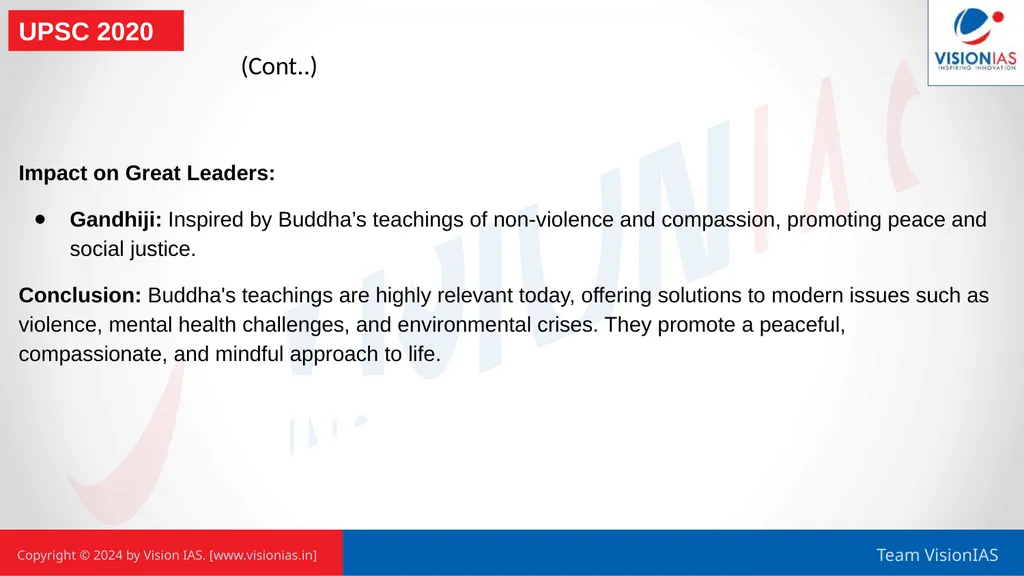
Copyright © 2024 by Vision IAS. [www.visionias.in] Team VisionIAS Impact on Great Leaders:
Gandhiji: Inspired by Buddha’s teachings of non-violence and compassion, promoting peace and social justice.
Conclusion: Buddha's teachings are highly relevant today, offering solutions to modern issues such as violence, mental health challenges, and environmental crises. They promote a peaceful, compassionate, and mindful approach to life. UPSC 2020 (Cont..)<br>
32
Thank You Copyright © 2024 by Vision IAS. [www.visionias.in] Team VisionIAS<br>