6B PROTECTIVE PARENTS GRAMMAR: ZERO CONDITIONAL; CONDITIONALS WITH IMPERATIVES AND MODAL VERBS; IN CASE PROTECTIVE PARENTS Please, open your books, p46. Read the article The Parent Trap. Please, try to do exercise 1. When you were a
"6B PROTECTIVE PARENTS GRAMMAR: ZERO CONDITIONAL;" is the property of its rightful owner. Permission is granted to
download and print the materials on this website for personal, non-commercial use only, and to display it
on your personal computer provided you do not modify the materials and that you retain all copyright
notices contained in the materials. By downloading content from our website, you accept the terms of this
agreement.
Presentation Transcript
01
6B PROTECTIVE PARENTS GRAMMAR: ZERO CONDITIONAL; CONDITIONALS WITH IMPERATIVES AND MODAL VERBS; IN CASE<br>
02
PROTECTIVE PARENTS Please, open your books, p46.
Read the article ’The Parent Trap’.
Please, try to do exercise 1.
When you were a child, what did your parents make you do?
What did they let you do?
How do the children spend their free tim these days?
How is this different to when you were a child?<br>
03
Please, try to do exercise 3. Tick the true sentences and correct the false ones.
Below, you can find help with new vocabulary:
Protect – keep safe from harm or injury
The media – the main means of mass communication (especially television, radio, newspapers, and the Internet) regarded collectively
Grow up – become adult
Freedom - the power or right to act, speak, or think as one wants without hindrance or restraint<br>
04
The Zero Conditional We can make a zero conditional sentence with two present simple verbs (one in the 'if clause' and one in the 'main clause'):
If + present simple, .... present simple.
This conditional is used when the result will always happen.
If water reaches 100 degrees, it always boils.
It's a fact. I'm talking in general, not about one particular situation. The result of the 'if clause' is always the main clause.
The 'if' in this conditional can usually be replaced by 'when' without changing the meaning.<br>
05
Here are some more examples:
If people eat too much, they get fat.
If you touch a fire, you get burned.
People die if they don't eat.
You get water if you mix hydrogen and oxygen.
Snakes bite if they are scared.
If babies are hungry, they cry.<br>
06
You can use the imperative in the result-clause to give instructions, advice, or explain rules.
If you want to lose weight, eat less and exercise more.
If you drink, don’t drive.
Please don’t disturb me if I am asleep!
Eat something if you’re hungry.
Call me if you feel sad.
If you don’t like your job, quit!
If you want to speak to someone, press 1.<br>
07
You can use modal verbs.
You use a modal before another verb in the zero conditional to express an idea such as ability, necessity, or permission.
In the zero conditional sentence structure, you can use could, can, must, or should, and their negative forms.
If you can’t see the TV, you need glasses.
If you can read this, thank a teacher!
If you must know, I’m not married.
If you want to go to university, you must study hard.
I can’t drive if I don’t have my glasses.
If you drink, you shouldn’t drive.
If you have celiac disease, you can’t eat wheat.
It could happen to you if you’re not careful!
You should go to the doctor if you don’t feel well.<br>
08
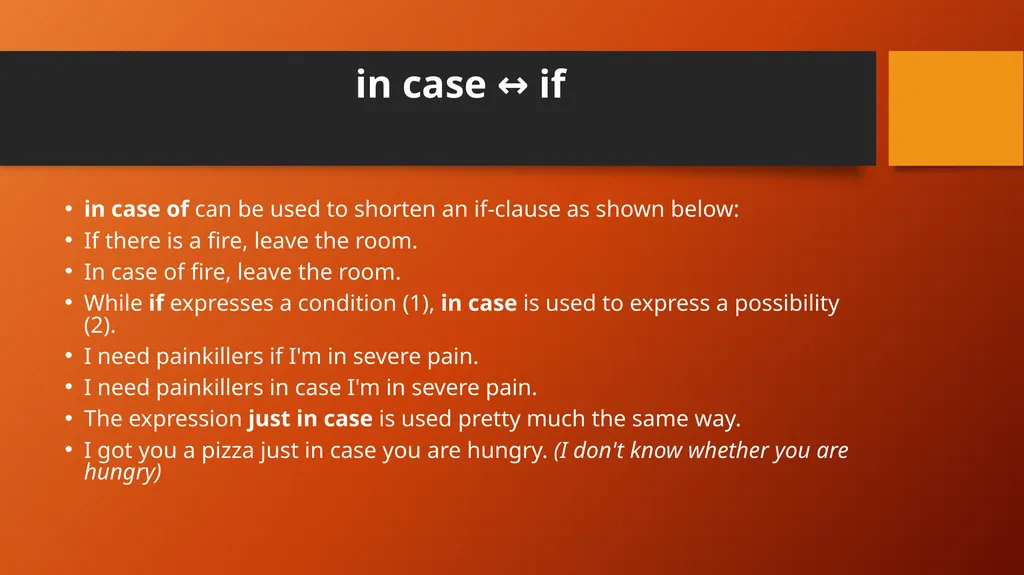
in case ↔ if in case of can be used to shorten an if-clause as shown below:
If there is a fire, leave the room.
In case of fire, leave the room.
While if expresses a condition (1), in case is used to express a possibility (2).
I need painkillers if I'm in severe pain.
I need painkillers in case I'm in severe pain.
The expression just in case is used pretty much the same way.
I got you a pizza just in case you are hungry. (I don't know whether you are hungry)<br>
09
Thank you for your attention!
# hope to see you soon
Lecturer Ivana Milačić
ivana.milacic@udg.edu.me<br>