A conversation for peer educators, health professionals, educators, and community groups EVERY BODY WORLD SEXUAL HEALTH DAY 2026 THE CLAIM 2 Sexual health belongs to everyone, at every age, in every body. Not as a reward for the right kind
"A conversation for peer educators, health" is the property of its rightful owner. Permission is granted to
download and print the materials on this website for personal, non-commercial use only, and to display it
on your personal computer provided you do not modify the materials and that you retain all copyright
notices contained in the materials. By downloading content from our website, you accept the terms of this
agreement.
Presentation Transcript
01
A conversation for peer educators, health professionals, educators, and community groups EVERY BODY WORLD SEXUAL HEALTH DAY 2026<br>
02
THE CLAIM 2 Sexual health belongs to everyone, at every age, in every body. Not as a reward for the right kind of body.
Not for some people and not others. What would it take for that to be true everywhere?<br>
03
THE THEME EVERY BODY is the World
Sexual Health Day 2026 theme. Our bodies are personal, relational and political — all at once, all the time. Personal, because our body is our own.
Relational, because it is how we meet everybody else. Political, because other people write rules about it: what we are taught, what care we can get, what is allowed and what is not. 3<br>
04
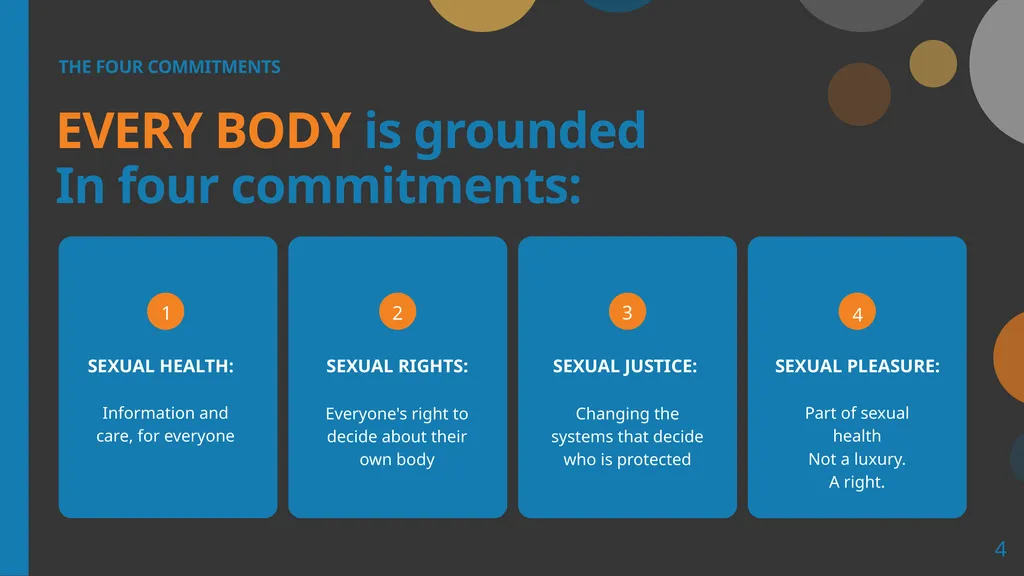
THE FOUR COMMITMENTS 4 EVERY BODY is grounded
In four commitments: SEXUAL HEALTH: SEXUAL RIGHTS: SEXUAL JUSTICE: SEXUAL PLEASURE: Information and care, for everyone Everyone's right to decide about their own body Changing the systems that decide who is protected Part of sexual health
Not a luxury.
A right. 1 2 3 4<br>
05
THE FIVE LAYERS 5 Our bodies: where sexuality,
health, rights and justice are lived. It starts with us and our own bodies, then the people closest to us,
then the people we turn to for care, then the world around us, and
finally the rules written about us by people we will never meet. Most of us are living in all five at once, and
what happens in one shapes the rest.<br>
06
LAYER 1 6 Our bodies and ourselves Ours to know, to understand and to enjoy fully. Let us be at home in them. DISCUSSION PROMPT
What were you told about your own body growing up? What do you wish you had been told? Knowing our own body — how it works, what we like, what to call it — is where sexual health starts.
And so is deciding who comes near it. Most people are never given any of that.<br>
07
LAYER 2 7 Our bodies and the people
closest to us Sexuality is lived with others, and consent is how
we say what we want and what we don't. Let us be heard. DISCUSSION PROMPT
Who taught you what you know about your own body? What would have made that easier? Most of what we first learn about our bodies, we learn at home. But for some
people the hardest decisions about their body are made by those closest to them,
sometimes before they can speak at all.<br>
08
LAYER 3 8 Our bodies and the
systems around us Education, services and care should be built for the bodies and lives they serve. Let us be met as we are. DISCUSSION PROMPT
In your setting, who is least likely to be asked about their sexual health? What would need to change? Too often the conversation never starts. Older people, people with disabilities and people
who are seriously ill are assumed to have no sex life worth mentioning, so nobody asks.
Others ask and are not believed.<br>
09
LAYER 4 9 Our bodies and the
world around us Art, culture, faith and technology shape how
we see our bodies and live our desires. Let us choose what we carry. DISCUSSION PROMPT
Where do people in your community go for information about sex and bodies? Is what they find any good? We learn what our bodies mean long before anyone hands us a pamphlet.
Communities can make room for us, or they can make shame — and good information
now competes with a great deal that is wrong.<br>
10
LAYER 5 Our bodies and politics Politics decides whose sexuality is respected and protected,
and whose is controlled. Let us be free and respected. DISCUSSION PROMPT
Name one rule in your country that decides who gets sexual health care and who waits.
Who wrote it, and could it be changed? Someone decided what your school could teach you, and at what age. Someone decided what
your health system covers. Someone decided how long an appointment lasts. None of it was
decided about you personally — and all of it can be decided differently. 10<br>
11
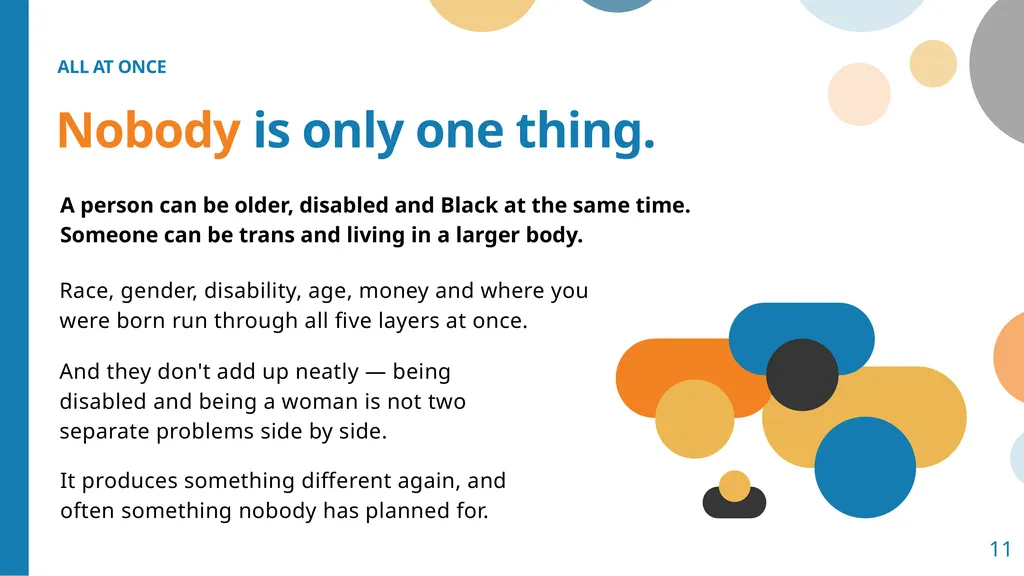
11 ALL AT ONCE Nobody is only one thing. Race, gender, disability, age, money and where you were born run through all five layers at once. A person can be older, disabled and Black at the same time.
Someone can be trans and living in a larger body. It produces something different again, and
often something nobody has planned for. And they don't add up neatly — being disabled and being a woman is not two separate problems side by side.<br>
12
WHY THIS HAPPENS When care doesn't reach someone,
it is usually the system, not the person in front of them. Most doctors, nurses and teachers want to do this well. What stops them is what a training course left out, what a form doesn't ask, how short an appointment is, and whether anyone ever told them it was their job to raise the subject. That is good news. People are hard to change. Curricula, forms and appointment times are not. 12<br>
13
13 REFLECTION Does your work reach And if not, where does it fall short, and what would it take to change that? DISCUSSION PROMPT
What is one thing, however small, you could change in your practice, your organization or
your community to make sexual health reach someone it currently doesn't? EVERY BODY?<br>
14
WORLD SEXUAL HEALTH DAY 4 September 2026 #WSHD2026 #EveryBody worldsexualhealthday.org matters. belongs. deserves Sexual Health, Rights, Justice, and Pleasure. EVERY BODY<br>