
A focus on Railway Safety Critical Grades for
MY
Published · 29 slides · 0 views

1 / 1
Description
A focus on Railway Safety Critical Grades for improved Railway Safety Performance Reginald Ntshingila Railway Safety Regulator Sub-theme CONTENTS 1. INTRODUCTION 2. DEFINING SAFETY-CRITICAL GRADES IN RAILWAY OPERATIONS 3. THE ROLE OF
Related Topics
Share
Embed code
Download this presentation From Below
"A focus on Railway Safety Critical Grades for" is the property of its rightful owner. Permission is granted to download and print the materials on this website for personal, non-commercial use only, and to display it on your personal computer provided you do not modify the materials and that you retain all copyright notices contained in the materials. By downloading content from our website, you accept the terms of this agreement.
Presentation Transcript
01
A focus on Railway Safety Critical Grades for improved Railway Safety Performance Reginald Ntshingila
Railway Safety Regulator
Sub-theme<br>
Railway Safety Regulator
Sub-theme<br>
02
CONTENTS
1. INTRODUCTION
2. DEFINING SAFETY-CRITICAL GRADES IN RAILWAY OPERATIONS
3. THE ROLE OF SAFETY-CRITICAL GRADES IN RAILWAY SAFETY
4. EXISTING POLICIES AND REGULATORY FRAMEWORK
5. TYPICAL CHALLENGES FACING SAFETY-CRITICAL GRADES
6. NOTABLE OCCURENCES RELATING TO SCG
7. POSSIBLE INTERVENTIONS
8. INTERVENTIONS BY DOT AND THE RSR
9. IMPLEMENTATION PREPARATIONS FOR SCG
10. NEXT PHASE – IMPLEMENTATION
11. CONCLUSION<br>
03
INTRODUCTION
The global railway system is one of the most efficient and cost-effective means of transporting passengers and goods, playing a significant role in economic development. However, railway safety is a complex issue influenced by a number of factors (Pillay, 2019). The industry continues to face persistent challenges in ensuring safe operations. Safety concerns have been driven by a combination of aging infrastructure, lack of investment, human error, and inadequate safety management systems.
For railway operations to be safe and efficient, specific roles, known as safety-critical grades, must be adequately managed. In a general sense, these personnel include train drivers, signal operators, and dispatchers, whose actions are directly responsible for the safe operation of trains.
This paper aims to examine the significance of safety-critical grades in improving railway safety and reducing accidents/railway occurrences in South Africa. This paper aims to address the critical need for focusing on safety-critical grades—specific job roles and functions essential for the safe operation of railways—to improve safety outcomes.<br>
04
DEFINING SAFETY-CRITICAL GRADES IN RAILWAY OPERATIONS
Safety-critical grades are generally specific job roles directly responsible for maintaining the safe operation of railways. To be more specific, Safety Critical Grades (SCG) and functions in the context of South Africa, are defined within our Safety Management Systems (incl. standards) as:
“Functions and/or activities directly related to the authorization and control of rolling stock movements, and to the execution of the movement of rolling stock, as well as the direct supervision of personnel involved in these safety critical functions”
These SCG Functions include the following:
Train drivers (all categories)
TCO’ s/ dispatchers
SCG Supervisors (eg. Section managers)
track inspectors,
Shedman<br>
05
Distinction between Safety Related and Safety Critical Functions/work in terms of our Standards;
Safety-related functions
Roles that are responsible for ensuring that railway operations adhere to safety standards, and any lapse in their duties can result (and in some instances has resulted) in significant safety incidents. The human element remains a critical component in railway safety, making it imperative to focus on improving the skills, training, and performance of these safety-critical grades.<br>
06
3. THE ROLE OF SAFETY-CRITICAL GRADES IN RAILWAY SAFETY
Railway safety is a multidimensional challenge that requires careful coordination between various elements, including infrastructure, human elements, and technology. According to the Railway Safety Regulator (RSR, 2022), human factors are among the leading causes of railway incidents in South Africa, contributing to derailments, collisions, and signal failures. This underscores the importance of safety-critical grades, whose roles are vital to preventing accidents.
3.1 Train Drivers
Train drivers are responsible for the safe operation of trains, adherence to speed limits, and timely response to signals. The decisions made by drivers, especially under high-pressure situations, are critical in ensuring the safety of passengers and preventing derailments (Jones & Martin, 2020). As technological advancements such as Automatic Train Protection (ATP) systems are introduced, drivers must be continuously trained to operate alongside these technologies, maintaining both manual and automated controls.<br>
07
3. THE ROLE OF SAFETY-CRITICAL GRADES IN RAILWAY SAFETY - Cont
3.2 Signal Operators
Signal operators are essential in ensuring that trains move safely through rail networks by managing track signals and communication between trains. According to Black and Stevenson (2018), errors in signalling, such as delayed or incorrect signal inputs, can lead to catastrophic accidents. Hence, these operators must be equipped with up-to-date training and technology to handle the increasing complexity of railway networks.
3.3 Track Inspectors and Maintenance Personnel
Track inspectors and maintenance teams are responsible for the physical condition of the railway tracks and infrastructure. Regular inspections help identify issues such as track misalignments, broken rails, and worn-out components, which are significant contributors to derailments (RSR, 2022). As railway systems expand and age, maintenance personnel must be equipped with advanced diagnostic tools and predictive maintenance systems to keep the infrastructure in optimal condition.<br>
08
3. THE ROLE OF SAFETY-CRITICAL GRADES IN RAILWAY SAFETY - Cont
3.4 Train Control Officers (Dispatchers)
Railway dispatchers coordinate train schedules, communicate with train crews, and manage real-time train traffic. Their role is particularly critical in avoiding congestion and ensuring that emergency procedures are promptly executed when incidents occur. Poor communication between dispatchers and train operators can result in operational delays or accidents (Smith, 2021).<br>
09
EXISTING POLICIES AND REGULATORY FRAMEWORK
The Railway Safety Regulator (RSR), who is the entity under the Department of Transport, in terms of Act 16 of 2002 (as amended), is tasked with ensuring compliance with safety protocols across the country’s rail network (RSR, 2022). The RSR establishes the safety standards and regulatory framework for railway operations in South Africa.
The RSR mandate provides for the RSR to monitor and enforce compliance with safety management systems (SMS), training requirements, regular audits and inspection of railway operators. However, challenges persist amidst enforcing regulations, especially in smaller operators and amid resource constraints. A strengthened regulatory framework and compliance is to also encourage railway operators to prioritize safety-critical training and infrastructure investments, ultimately improving the overall safety of the railway system.<br>
10
TYPICAL CHALLENGES FACING SAFETY-CRITICAL GRADES
Training and Competency: Inadequate and outdated training programs do not equip safety-critical personnel with the necessary skills and knowledge. Continuous training and competency assessments are required to maintain high safety standards.
Human Factors: Fatigue, stress, and workload are significant contributors to human errors in railway operations. Addressing these issues is crucial for improving the performance of safety-critical grades.
Resource Allocation: Limited financial and human resources impact the ability of railway operators to invest in safety improvements, including training, equipment upgrades, and infrastructure maintenance.
Technological Integration: The integration of advanced safety technologies, such as automatic train protection (ATP) systems, remains limited due to high costs and compatibility issues with existing infrastructure.<br>
11
6. NOTABLE OCCURENCES RELATING TO SCG
i) Train Collision in Hammarsdale 2024
Collision of Train 1076 Collision with Train T6202 At Hammarsdale On 09/05/2024. Hammarsdale points-809 on main-line-2 were incorrectly cranked from the trailing point (instead of facing point) and wedged set for the turn-out onto incorrectly set points on main-line-1, resulting in the PRASA train colliding with the goods train (Human Factor Elements were sighted)<br>
12
ii) Ermelo Yard Level Crossing Preliminary Investigation (November 2020)
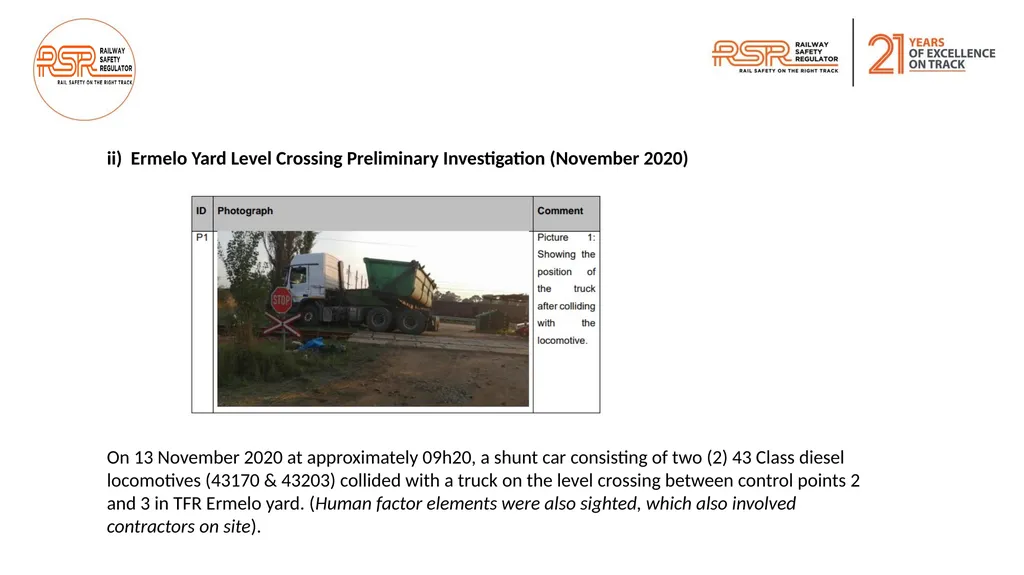
On 13 November 2020 at approximately 09h20, a shunt car consisting of two (2) 43 Class diesel locomotives (43170 & 43203) collided with a truck on the level crossing between control points 2 and 3 in TFR Ermelo yard. (Human factor elements were also sighted, which also involved contractors on site).<br>
On 13 November 2020 at approximately 09h20, a shunt car consisting of two (2) 43 Class diesel locomotives (43170 & 43203) collided with a truck on the level crossing between control points 2 and 3 in TFR Ermelo yard. (Human factor elements were also sighted, which also involved contractors on site).<br>
13
iii) Train Collision at Booysens Station: 2018
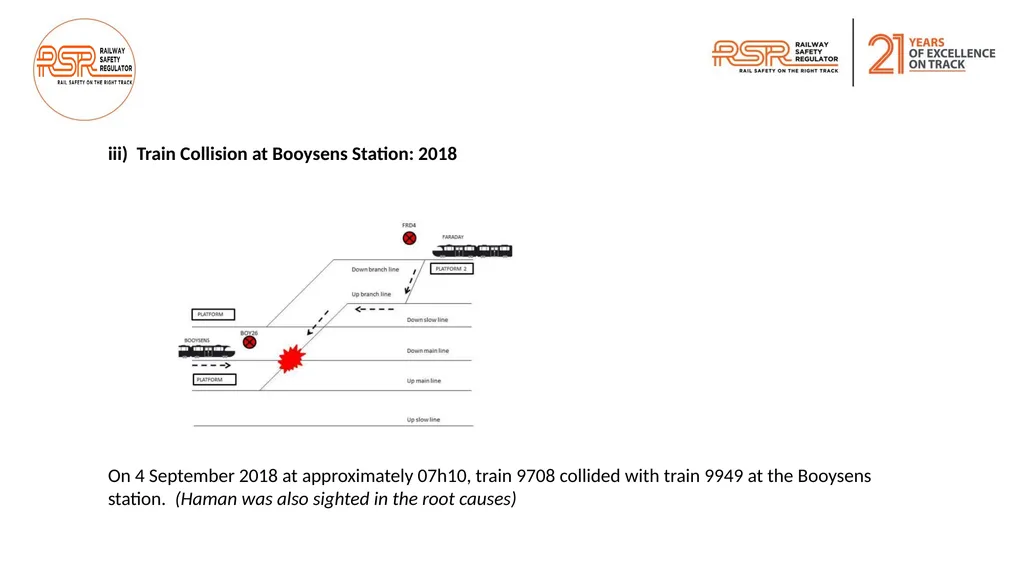
On 4 September 2018 at approximately 07h10, train 9708 collided with train 9949 at the Booysens station. (Haman was also sighted in the root causes)<br>
On 4 September 2018 at approximately 07h10, train 9708 collided with train 9949 at the Booysens station. (Haman was also sighted in the root causes)<br>
14
iv) Train Derailment at Crown Station: 2017
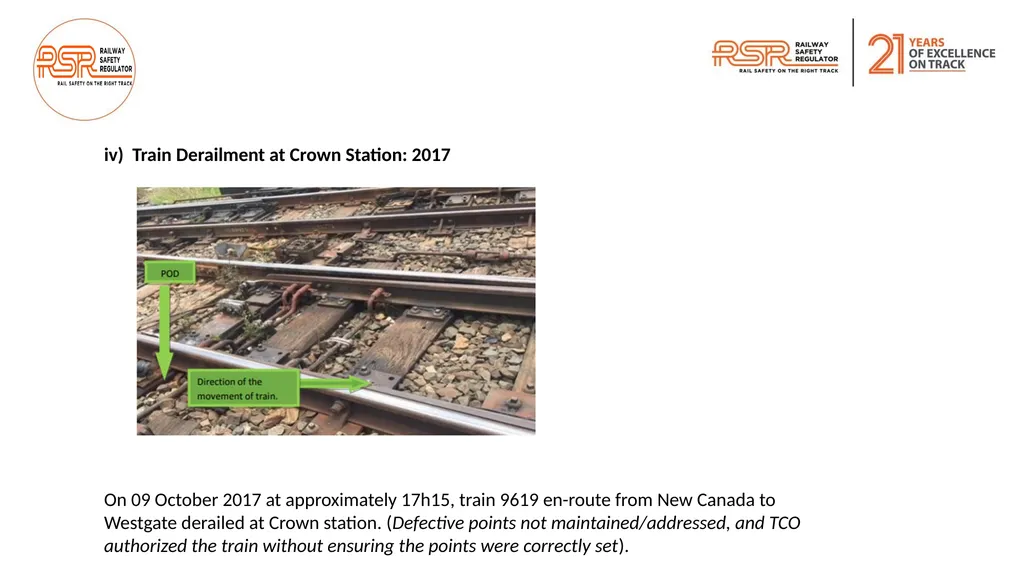
On 09 October 2017 at approximately 17h15, train 9619 en-route from New Canada to
Westgate derailed at Crown station. (Defective points not maintained/addressed, and TCO authorized the train without ensuring the points were correctly set).<br>
On 09 October 2017 at approximately 17h15, train 9619 en-route from New Canada to
Westgate derailed at Crown station. (Defective points not maintained/addressed, and TCO authorized the train without ensuring the points were correctly set).<br>
15
POSSIBLE INTERVENTIONS
Enhanced Training and Certification: Developments comprehensive training programs that focus on scenario-based learning, regular assessments, and certification for safety-critical grades. Leveraging technology, such as simulation training, can improve decision-making and emergency response capabilities.
Implementation of Fatigue Management Programs: Implementation of fatigue management programs to monitor and manage work hours, rest periods, and shifts for safety-critical staff. This can help reduce the risk of human error due to fatigue.
Investment in Modern Safety Technologies: Prioritize the integration of modern safety technologies, such as ATP systems, real-time monitoring, and predictive maintenance tools, to enhance safety and efficiency in railway operations.
Strengthen Regulatory Oversight and Compliance: The RSR to enhance its regulatory oversight by conducting frequent audits, enforcing penalties for non-compliance, and supporting railway operators in implementing safety management systems.
Collaborative Approach to Safety Culture: Foster a safety culture that emphasizes continuous improvement, open communication, and collaboration among all stakeholders—railway operators, employees, regulators, and the community.<br>
16
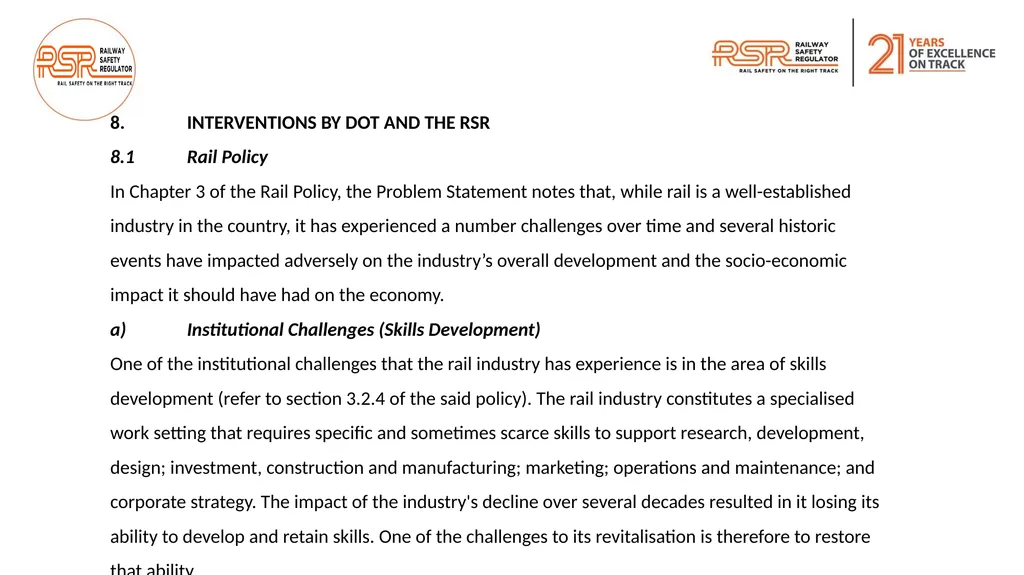
8. INTERVENTIONS BY DOT AND THE RSR
8.1 Rail Policy
In Chapter 3 of the Rail Policy, the Problem Statement notes that, while rail is a well-established industry in the country, it has experienced a number challenges over time and several historic events have impacted adversely on the industry’s overall development and the socio-economic impact it should have had on the economy.
a) Institutional Challenges (Skills Development)
One of the institutional challenges that the rail industry has experience is in the area of skills development (refer to section 3.2.4 of the said policy). The rail industry constitutes a specialised work setting that requires specific and sometimes scarce skills to support research, development, design; investment, construction and manufacturing; marketing; operations and maintenance; and corporate strategy. The impact of the industry's decline over several decades resulted in it losing its ability to develop and retain skills. One of the challenges to its revitalisation is therefore to restore that ability.<br>
17
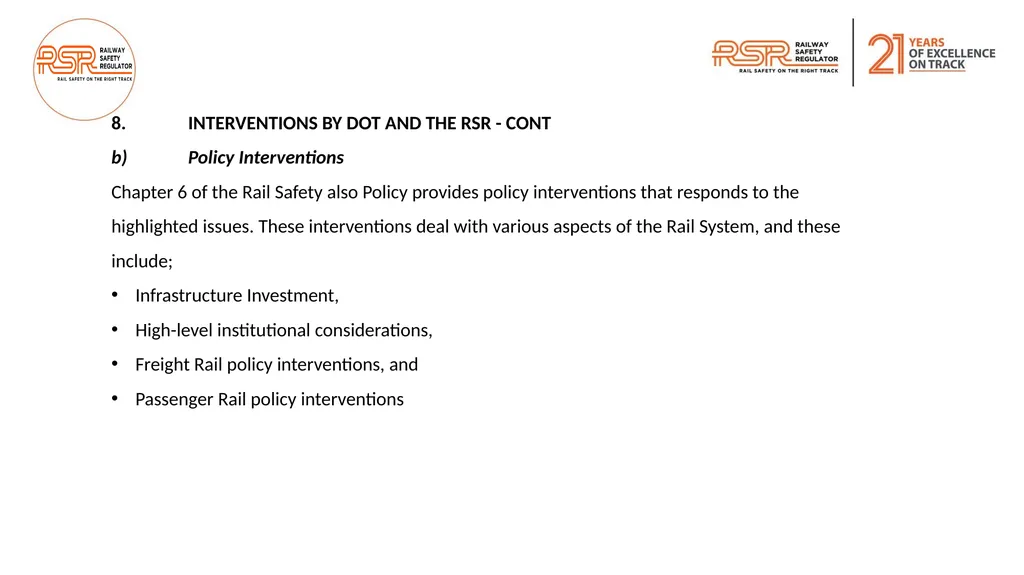
8. INTERVENTIONS BY DOT AND THE RSR - CONT
b) Policy Interventions
Chapter 6 of the Rail Safety also Policy provides policy interventions that responds to the highlighted issues. These interventions deal with various aspects of the Rail System, and these include;
Infrastructure Investment,
High-level institutional considerations,
Freight Rail policy interventions, and
Passenger Rail policy interventions<br>
18
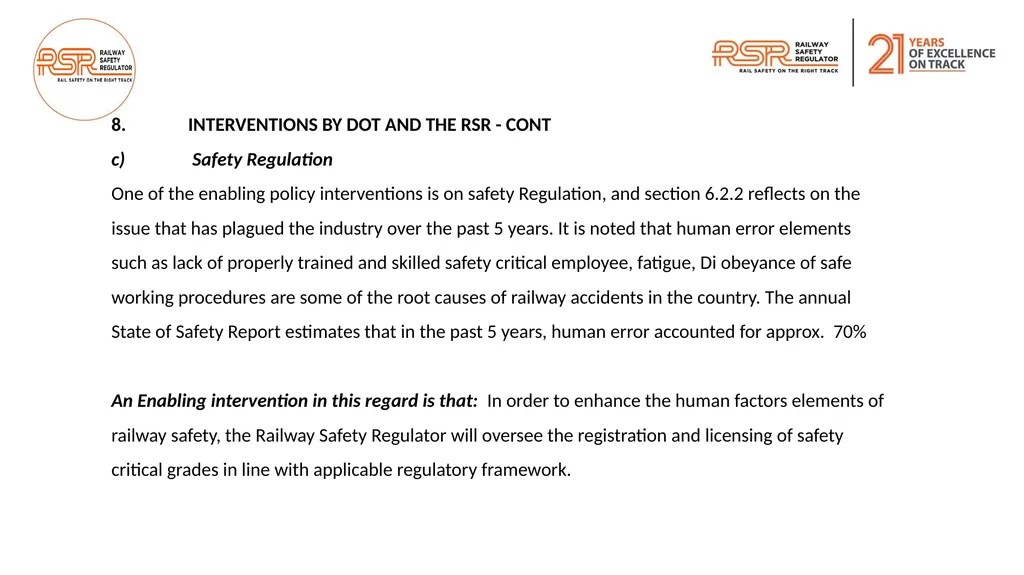
8. INTERVENTIONS BY DOT AND THE RSR - CONT
c) Safety Regulation
One of the enabling policy interventions is on safety Regulation, and section 6.2.2 reflects on the issue that has plagued the industry over the past 5 years. It is noted that human error elements such as lack of properly trained and skilled safety critical employee, fatigue, Di obeyance of safe working procedures are some of the root causes of railway accidents in the country. The annual State of Safety Report estimates that in the past 5 years, human error accounted for approx. 70%
An Enabling intervention in this regard is that: In order to enhance the human factors elements of railway safety, the Railway Safety Regulator will oversee the registration and licensing of safety critical grades in line with applicable regulatory framework.<br>
19
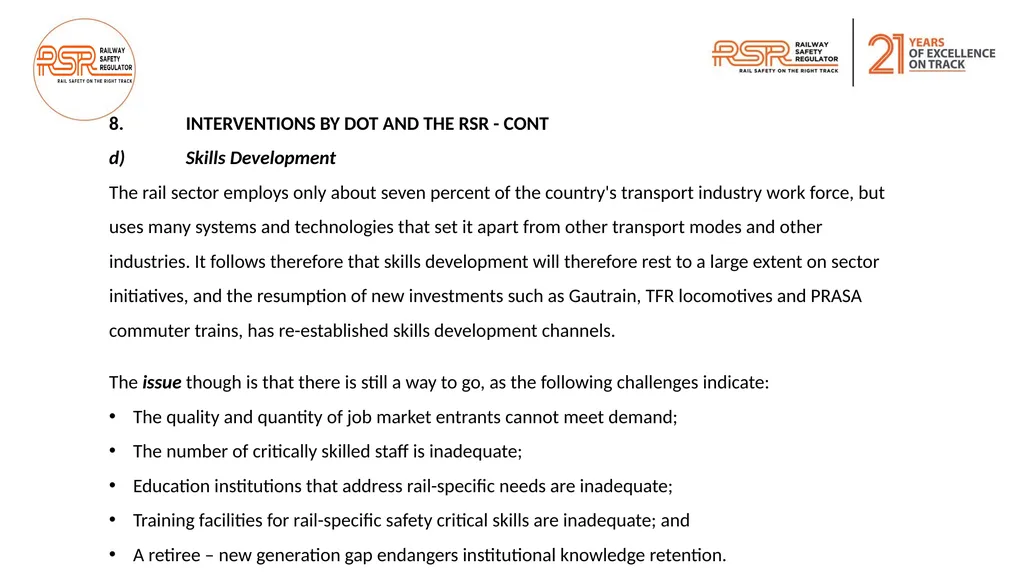
8. INTERVENTIONS BY DOT AND THE RSR - CONT
d) Skills Development
The rail sector employs only about seven percent of the country's transport industry work force, but uses many systems and technologies that set it apart from other transport modes and other industries. It follows therefore that skills development will therefore rest to a large extent on sector initiatives, and the resumption of new investments such as Gautrain, TFR locomotives and PRASA commuter trains, has re-established skills development channels.
The issue though is that there is still a way to go, as the following challenges indicate:
The quality and quantity of job market entrants cannot meet demand;
The number of critically skilled staff is inadequate;
Education institutions that address rail-specific needs are inadequate;
Training facilities for rail-specific safety critical skills are inadequate; and
A retiree – new generation gap endangers institutional knowledge retention.<br>
20
8. INTERVENTIONS BY DOT AND THE RSR - CONT
An Enabling intervention in this regard is that
a competitive, revitalised rail industry is expected to set the stage to attract the right calibre of job seekers. Government will promote rail skills development to prepare people for employment opportunities at all levels as an integral part of its investment plan to reposition the rail sector as backbone of the country's land transport by 2050. Operating entities are expected to manage and deliver workplace exposure and rail skills development programmes in support of rail revitalisation.<br>
21
8. INTERVENTIONS BY DOT AND THE RSR - CONT
8.2 The Rail Safety Bill
The Railway Safety Bill, 2021 (‘‘Bill’’), seeks to improve the regulatory framework regulating railway safety in the Republic of South Africa in order to improve the safety of passengers and freight.
The Bill seeks to repeal the National Railway Safety Regulator Act, 2002 (Act No. 16 of 2002) (‘‘NRSR Act’’). The NRSR Act established the Railway Safety Regulator (‘‘RSR’’) to oversee and promote safe railway operations through appropriate support, monitoring and enforcement guided by an enabling regulatory framework.
The Bill empowers the Railway Safety Regulator (the RSR) to monitor, promote, and enforce compliance to ensure safety in all aspects of railway operations, including the safe transportation of dangerous goods by rail.<br>
22
8.2 The Rail Safety Bill - CONT
Section 7 provides the Functions and powers of Regulator and in particular, (1) (d) of the Bill further requires the RSR to promote and enforce compliance with this Act in order to ensure safety in railway and railway operations, including the safe transportation of dangerous goods by rail, by—
(d) (iii) granting safety critical grade licences as contemplated in section 34(2);
(iv) evaluating and registering appropriate training institutions, as contemplated in section 35, in order to monitor the licensing of persons employed in safety critical grades;
The Bil further provides in section 34(2); that: No person may:
(a) perform work in a safety critical grade position, unless such person is in possession of a relevant safety critical grade licence granted by the Regulator; or
(b) be appointed or required to perform work in a safety critical grade position, unless such person is in possession of a relevant safety critical grade licence granted by the Regulator<br>
23
9. IMPLEMENTATION PREPARATIONS FOR SCG
9.1 Framework for Registering Training Institutions and Licensing of Safety-Critical Grades
While railway SCG competence requirements may exist, various improvement areas have been identified. The Framework for Registering Training Institutions and Licensing of Safety-Critical Grades as provided for in the Rail Safety Bill is one of the aspects of responding to the challenges raised.<br>
24
Framework for Registering Training Institutions and Licensing of Safety-Critical Grades
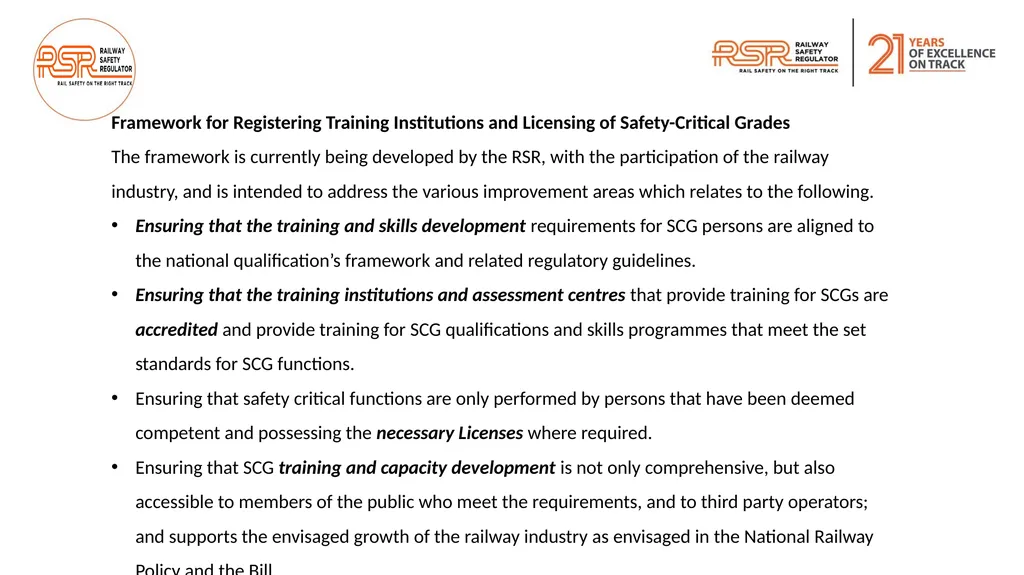
The framework is currently being developed by the RSR, with the participation of the railway industry, and is intended to address the various improvement areas which relates to the following.
Ensuring that the training and skills development requirements for SCG persons are aligned to the national qualification’s framework and related regulatory guidelines.
Ensuring that the training institutions and assessment centres that provide training for SCGs are accredited and provide training for SCG qualifications and skills programmes that meet the set standards for SCG functions.
Ensuring that safety critical functions are only performed by persons that have been deemed competent and possessing the necessary Licenses where required.
Ensuring that SCG training and capacity development is not only comprehensive, but also accessible to members of the public who meet the requirements, and to third party operators; and supports the envisaged growth of the railway industry as envisaged in the National Railway Policy and the Bill.<br>
25
9.2 Progress on the Framework Development
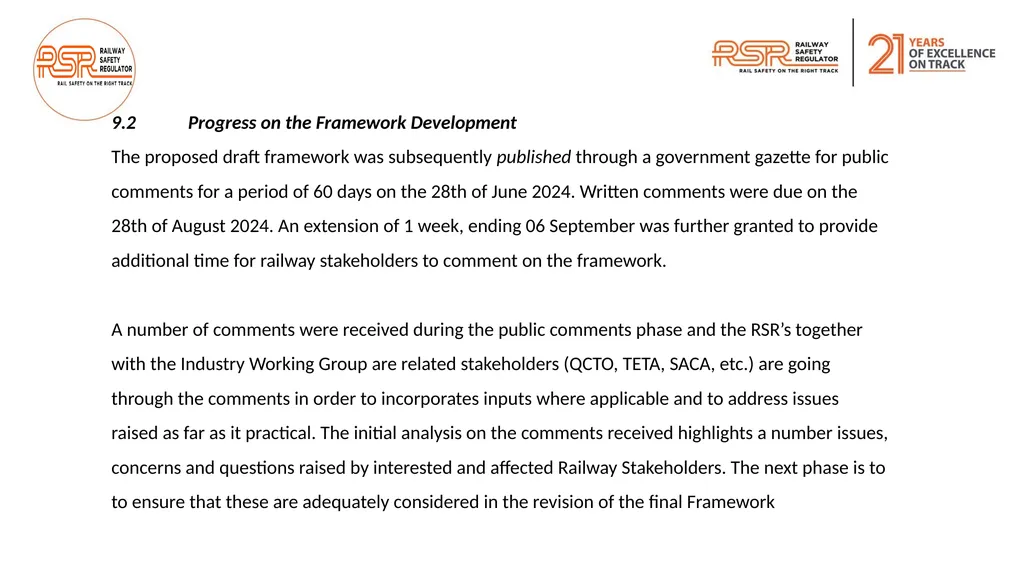
The proposed draft framework was subsequently published through a government gazette for public comments for a period of 60 days on the 28th of June 2024. Written comments were due on the 28th of August 2024. An extension of 1 week, ending 06 September was further granted to provide additional time for railway stakeholders to comment on the framework.
A number of comments were received during the public comments phase and the RSR’s together with the Industry Working Group are related stakeholders (QCTO, TETA, SACA, etc.) are going through the comments in order to incorporates inputs where applicable and to address issues raised as far as it practical. The initial analysis on the comments received highlights a number issues, concerns and questions raised by interested and affected Railway Stakeholders. The next phase is to to ensure that these are adequately considered in the revision of the final Framework<br>
26
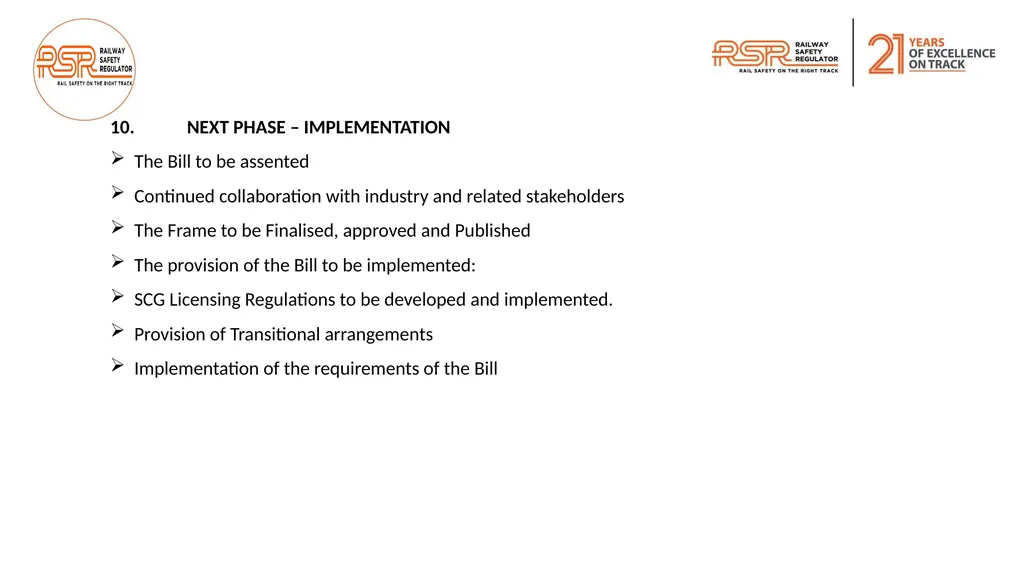
10. NEXT PHASE – IMPLEMENTATION
The Bill to be assented
Continued collaboration with industry and related stakeholders
The Frame to be Finalised, approved and Published
The provision of the Bill to be implemented:
SCG Licensing Regulations to be developed and implemented.
Provision of Transitional arrangements
Implementation of the requirements of the Bill<br>
27
11. CONCLUSION
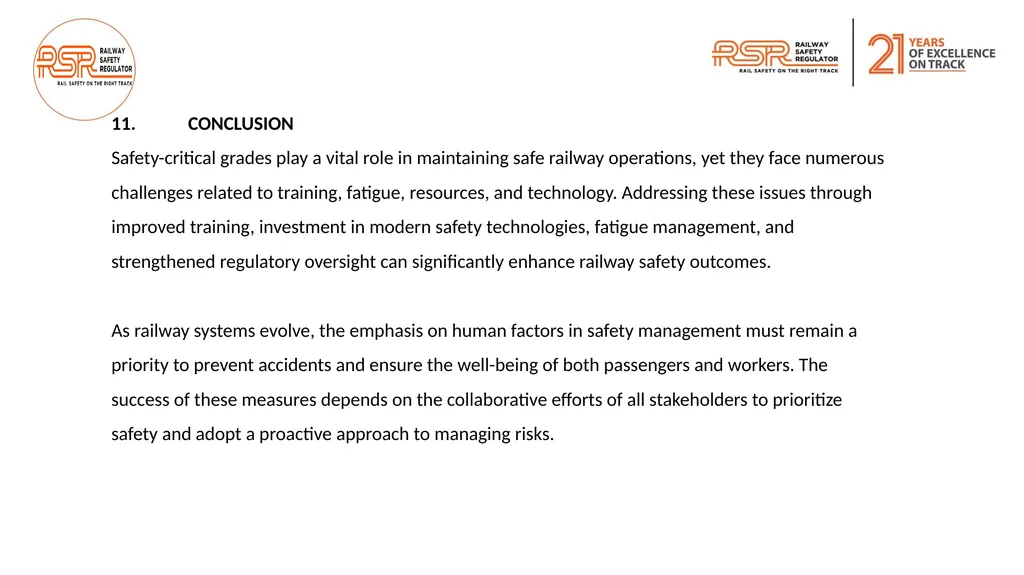
Safety-critical grades play a vital role in maintaining safe railway operations, yet they face numerous challenges related to training, fatigue, resources, and technology. Addressing these issues through improved training, investment in modern safety technologies, fatigue management, and strengthened regulatory oversight can significantly enhance railway safety outcomes.
As railway systems evolve, the emphasis on human factors in safety management must remain a priority to prevent accidents and ensure the well-being of both passengers and workers. The success of these measures depends on the collaborative efforts of all stakeholders to prioritize safety and adopt a proactive approach to managing risks.<br>
28
THANK YOU<br>