
A Primer for Quantitative Study Design Chosang




Description: A Primer for Quantitative Study Design Chosang Tendhar, Ph.D. Office of Institutional Effectiveness and Assessment Research Compass Introduction Purpose is to introduce processes involved in designing a quantitative study Number of books on
Related Topics
Download Presentation
"A Primer for Quantitative Study Design Chosang" is the property of its rightful owner. Permission is granted to download and print the materials on this website for personal, non-commercial use only, and to display it on your personal computer provided you do not modify the materials and that you retain all copyright notices contained in the materials. By downloading content from our website, you accept the terms of this agreement.
Presentation Transcript
slide1. A Primer for Quantitative Study Design Chosang Tendhar, Ph.D.
Office of Institutional Effectiveness and Assessment<br>
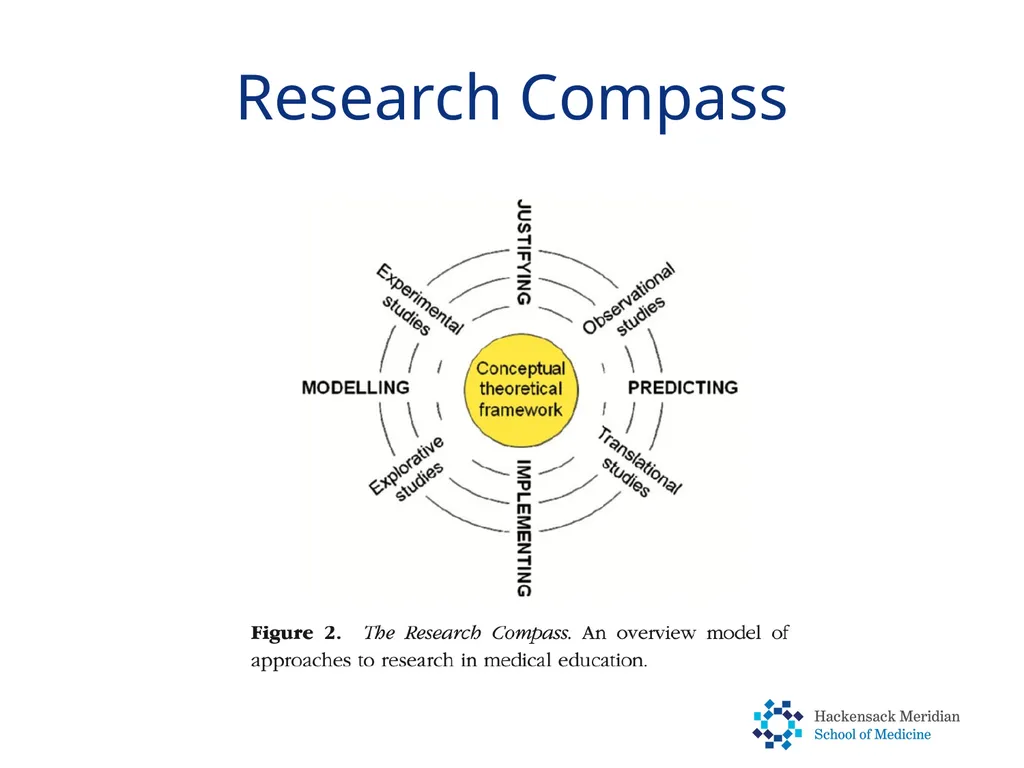
slide2. Research Compass<br>
slide3. Introduction Purpose is to introduce processes involved in designing a quantitative study
Number of books on research methods
Several primers on research design and analysis
Focus is on some of the basics-conceptualization and designing it
Takes a rigorous training, extensive coursework, and many years of experience to conduct high quality scholarly research<br>
slide4. Introduction (Contd) This primer should serve as a good guide
This should enable the readers to pursue additional readings on relevant topics
Some variations exist in the research process<br>
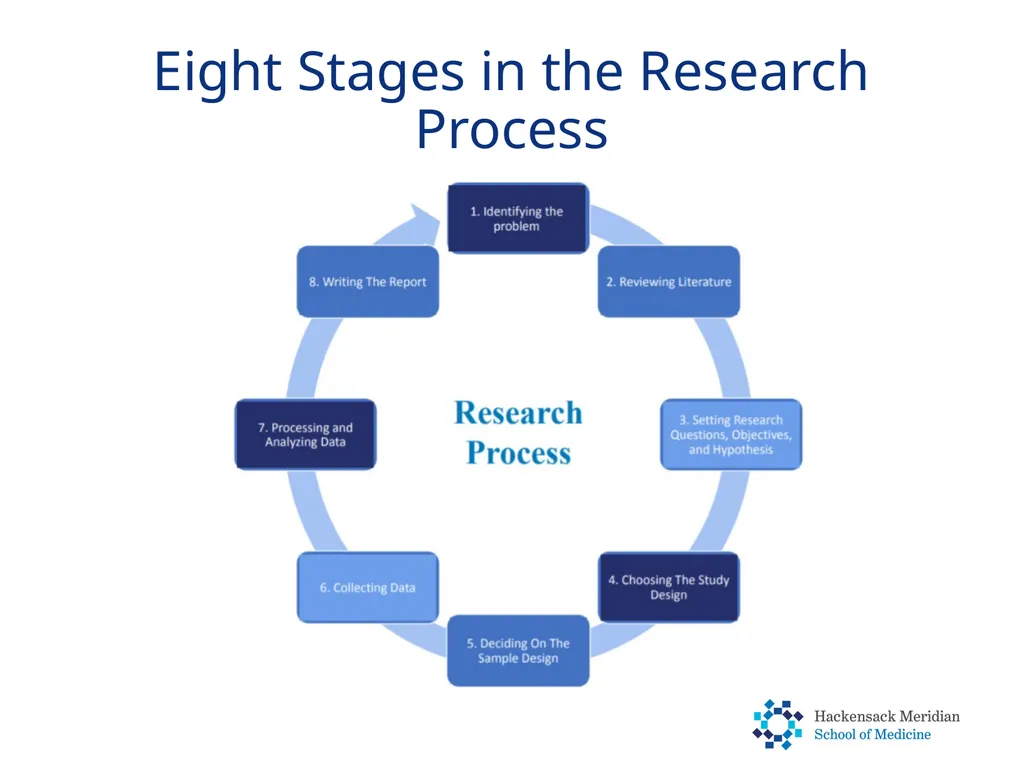
slide5. Eight Stages in the Research Process<br>
slide6. Eight Stages in the Research Process i. Identifying the problem
ii. Reviewing the literature
iii. Setting research questions, objectives, and
hypotheses
iv. Choosing the study design
v. Deciding on the sample design
vi. Collecting data
vii. Processing and analyzing data
viii. Writing the report<br>
slide7. i. Identifying the Research Problem Most important step in the scholarly research endeavors
“A problem well put is half solved”
Research problem statement indicates overall direction of the study
Usually rather general
Scope of the study to be appropriate<br>
slide8. Identifying the Research Problem (Contd) Broad questions tend to lead to vague answers
Research problems should be workable and solvable with relationships between specific variables clearly established
Examples
The purpose of this study is to examine the relation between teaching style and student academic achievement
This study investigates the effect of sex on aggression<br>
slide9. Sources for Problems Investigator’s interest and experience
Theory
Replication
Clarification of contradictory findings<br>
slide10. ii. Review of Literature Conduct a thorough review of the relevant literature
Past research on the phenomenon under study play a key role in the process of problem formulation and the design of a study
Sources of research problems extend beyond the existing literature
Benefit - an extensive review of the literature will enable researchers to demonstrate the significance of their studies
Sharing the piece(s) of the puzzle their studies contribute to the existing knowledge base<br>
slide11. Review of Literature (Contd) Literature review should not be restricted to one’s own discipline and subdiscipline
It is important to break out of the almost inevitable parochialism that training and specialization engender
Failure to do so will foster tunnel vision
Detrimental to cumulative knowledge<br>
slide12. Review of Literature (Contd) Interdisciplinary studies are more impactful
Medical education overlaps with educational research in general, and particularly with other professional education, such as engineering education
Study of professional identity formation is an emerging theme within the medical education community
There is a rich literature on the professional identity formation as a construct in engineering education
Medical education stands to gain if we integrate literature from other fields in addressing medical education research questions<br>
slide13. Review of Literature (Contd) Some of the core purposes of reviewing literature include:
Refining the research problem
Establishing the conceptual or theoretical orientation
Identifying contradictory findings
Developing research hypotheses
Learning about new information<br>
slide14. iii. Research Questions, Objectives, and Hypothesis Researcher presents specific and narrow questions to obtain measurable and observable data
Researchable question is one that can be investigated empirically
Example of a researchable question
What is the effect of sex on aggression?
Questions with appropriate level of specificity and knowledge of the current literature
Enable a researcher to develop hypothesis and identify IV and DV<br>
slide15. Definitions Hypothesis: A hypothesis is a conjectural statement about a relation between two or more variables, or about how the variables in the study are related
In research, a hypothesis is typically the investigator’s prediction or expectation of what the results will show
Such a prediction is made prior to data collection
Example: There is a significant difference between males and females in aggression and that males tend to be more aggressive<br>
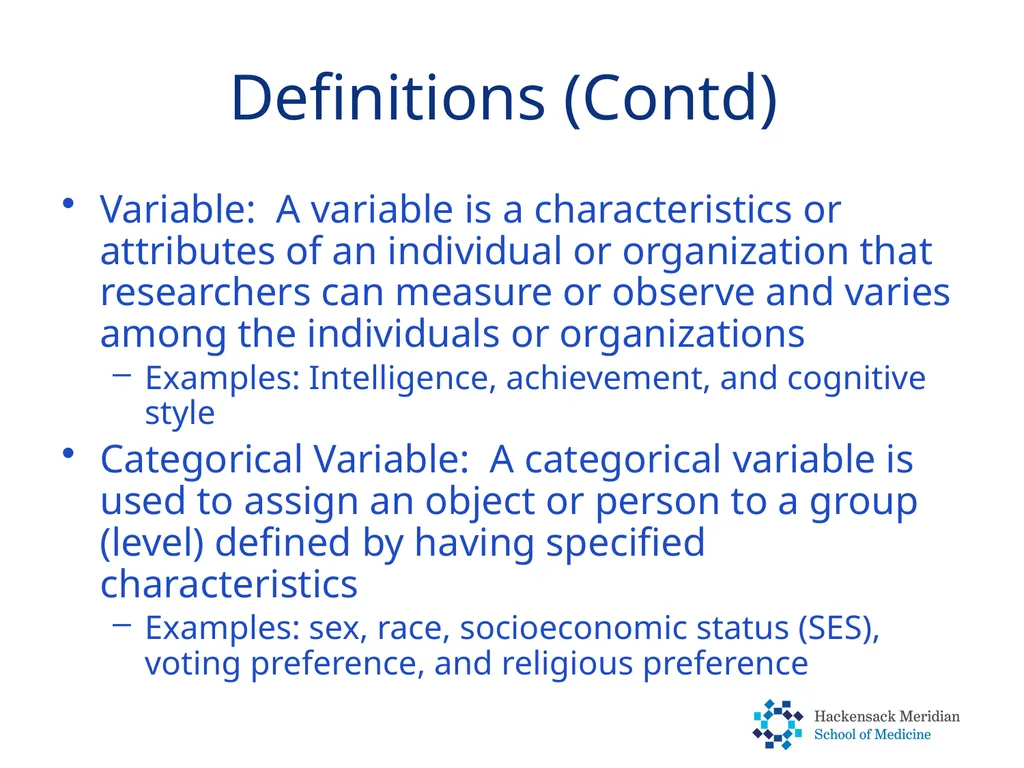
slide16. Definitions (Contd) Variable: A variable is a characteristics or attributes of an individual or organization that researchers can measure or observe and varies among the individuals or organizations
Examples: Intelligence, achievement, and cognitive style
Categorical Variable: A categorical variable is used to assign an object or person to a group (level) defined by having specified characteristics
Examples: sex, race, socioeconomic status (SES), voting preference, and religious preference<br>
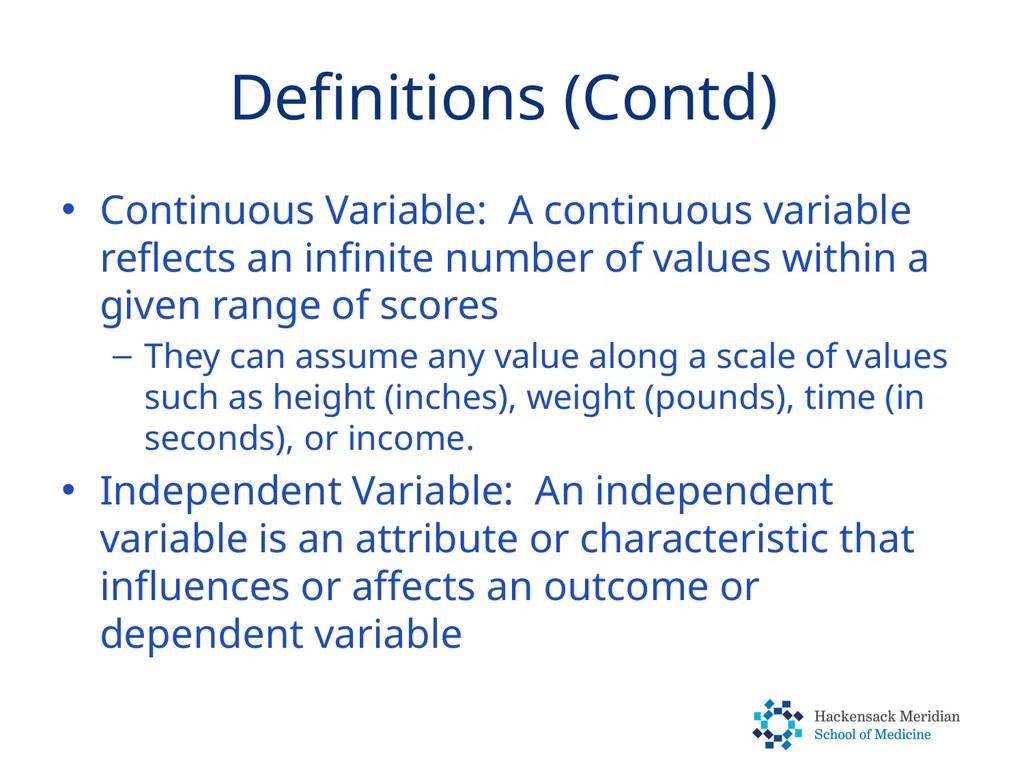
slide17. Definitions (Contd) Continuous Variable: A continuous variable reflects an infinite number of values within a given range of scores
They can assume any value along a scale of values such as height (inches), weight (pounds), time (in seconds), or income.
Independent Variable: An independent variable is an attribute or characteristic that influences or affects an outcome or dependent variable<br>
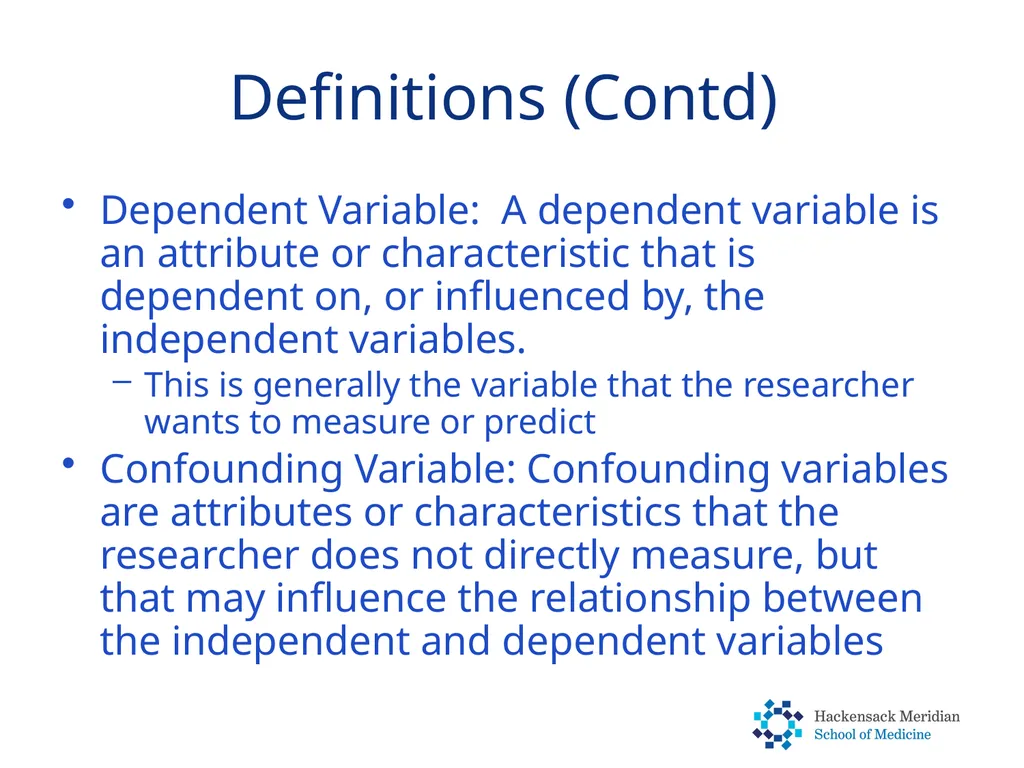
slide18. Definitions (Contd) Dependent Variable: A dependent variable is an attribute or characteristic that is dependent on, or influenced by, the independent variables.
This is generally the variable that the researcher wants to measure or predict
Confounding Variable: Confounding variables are attributes or characteristics that the researcher does not directly measure, but that may influence the relationship between the independent and dependent variables<br>
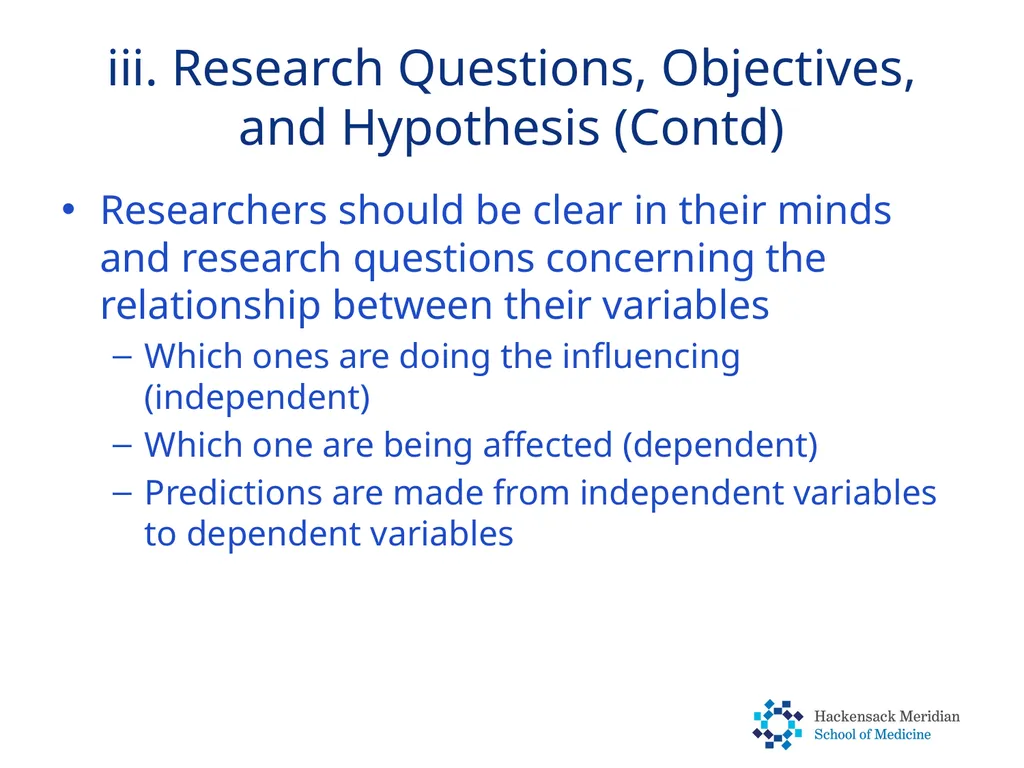
slide19. iii. Research Questions, Objectives, and Hypothesis (Contd) Researchers should be clear in their minds and research questions concerning the relationship between their variables
Which ones are doing the influencing (independent)
Which one are being affected (dependent)
Predictions are made from independent variables to dependent variables<br>
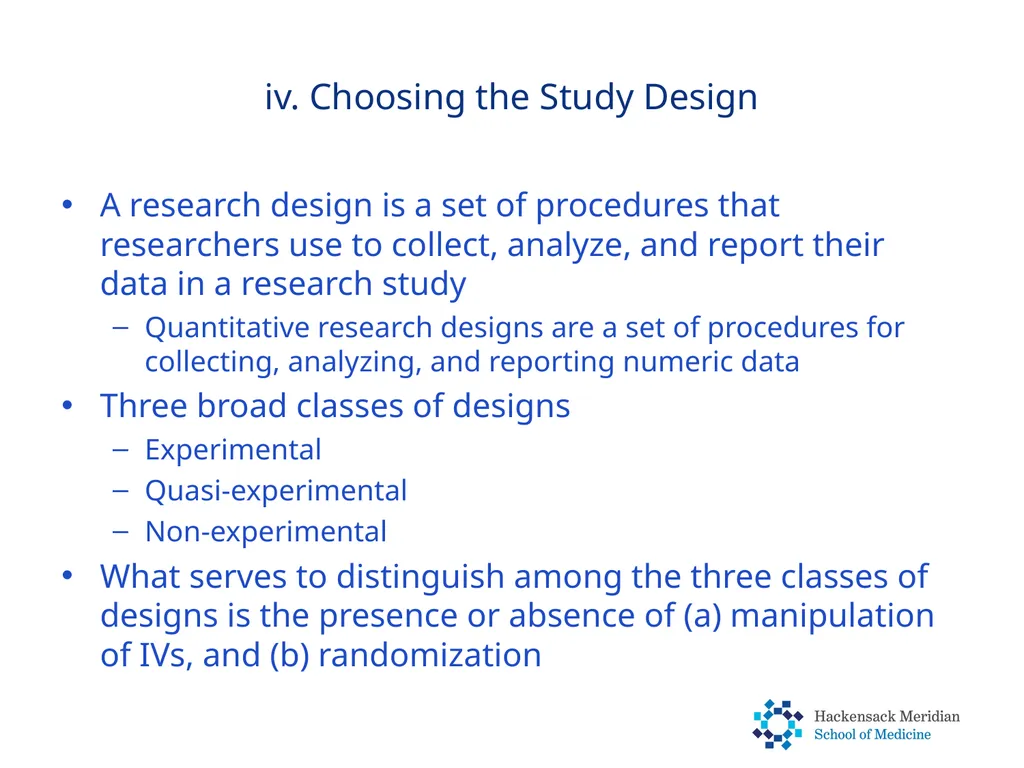
slide20. iv. Choosing the Study Design A research design is a set of procedures that researchers use to collect, analyze, and report their data in a research study
Quantitative research designs are a set of procedures for collecting, analyzing, and reporting numeric data
Three broad classes of designs
Experimental
Quasi-experimental
Non-experimental
What serves to distinguish among the three classes of designs is the presence or absence of (a) manipulation of IVs, and (b) randomization<br>
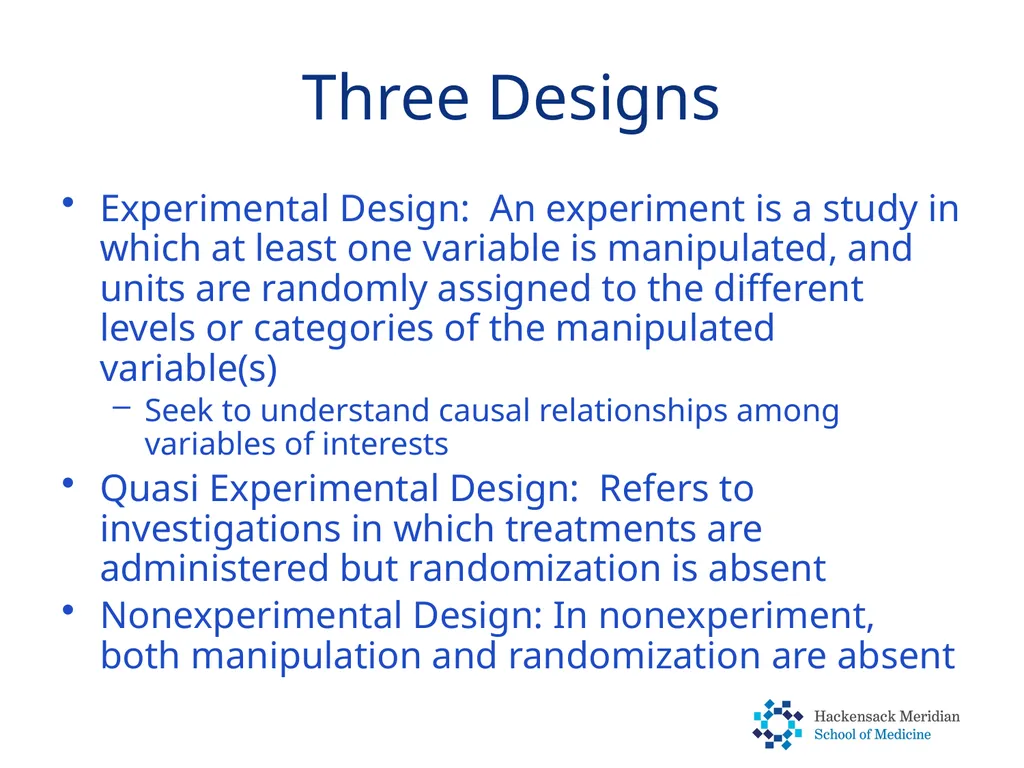
slide21. Three Designs Experimental Design: An experiment is a study in which at least one variable is manipulated, and units are randomly assigned to the different levels or categories of the manipulated variable(s)
Seek to understand causal relationships among variables of interests
Quasi Experimental Design: Refers to investigations in which treatments are administered but randomization is absent
Nonexperimental Design: In nonexperiment, both manipulation and randomization are absent<br>
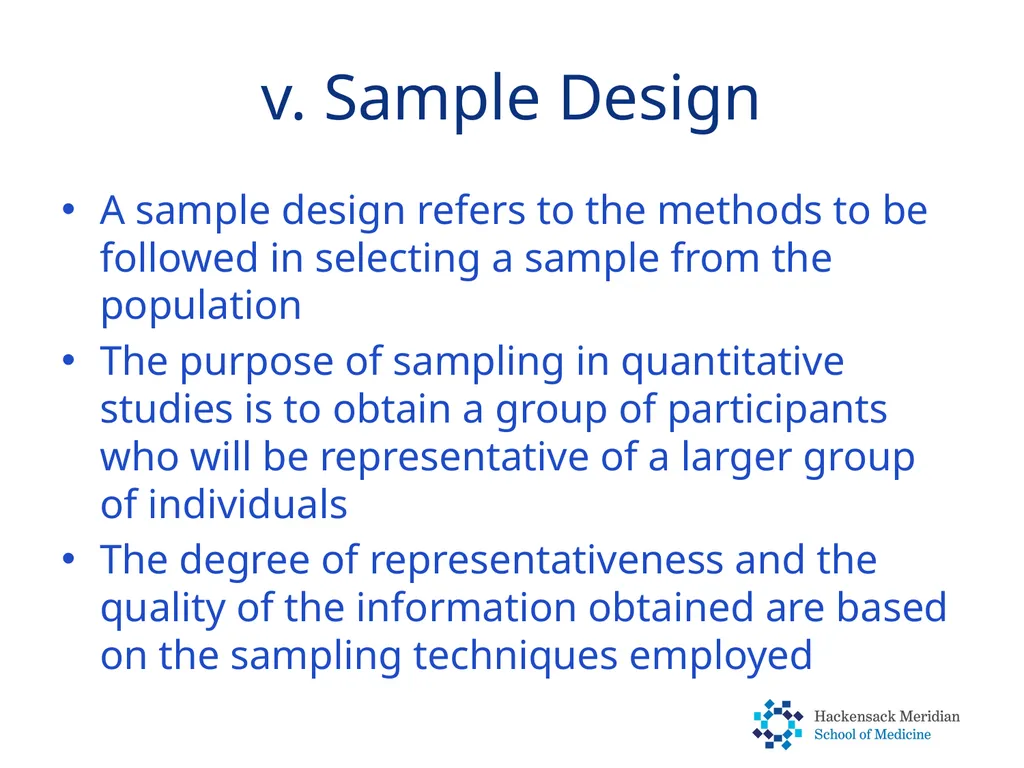
slide22. v. Sample Design A sample design refers to the methods to be followed in selecting a sample from the population
The purpose of sampling in quantitative studies is to obtain a group of participants who will be representative of a larger group of individuals
The degree of representativeness and the quality of the information obtained are based on the sampling techniques employed<br>
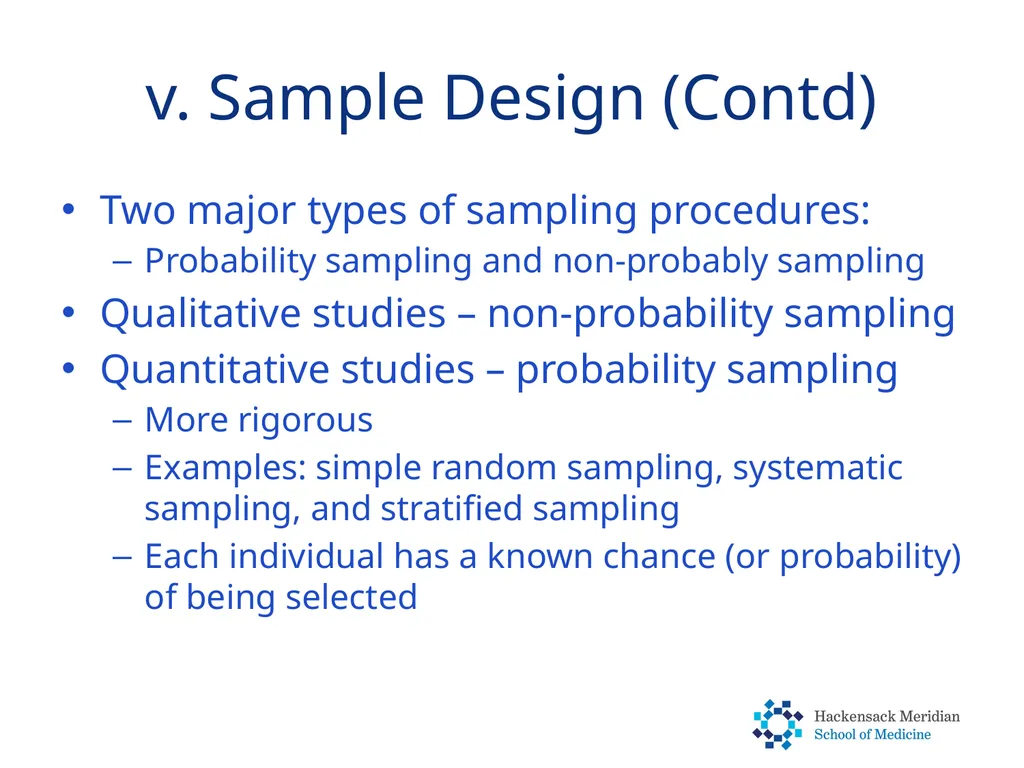
slide23. v. Sample Design (Contd) Two major types of sampling procedures:
Probability sampling and non-probably sampling
Qualitative studies – non-probability sampling
Quantitative studies – probability sampling
More rigorous
Examples: simple random sampling, systematic sampling, and stratified sampling
Each individual has a known chance (or probability) of being selected<br>
slide24. vi. Collecting Data Researchers use instruments to measure the variables in the study
An instrument is a tool for recording quantitative data
It contains specific questions and response possibilities
Examples of instruments:
Survey questionnaire, checklists that can be used to observe an individual’s behaviors, standardized tests, secondary data analysis, and structured interviews<br>
slide25. vii. Processing and Analyzing Data In quantitative research, researchers analyze the data using mathematics procedures, called statistics
Separate primer on statistics
Many might know how to calculate correlation coefficient or perform a t-test, but not all of them might be able to pick an approach that is appropriate to address a particular research question
A statistical technique to be used will be determined by the research question<br>
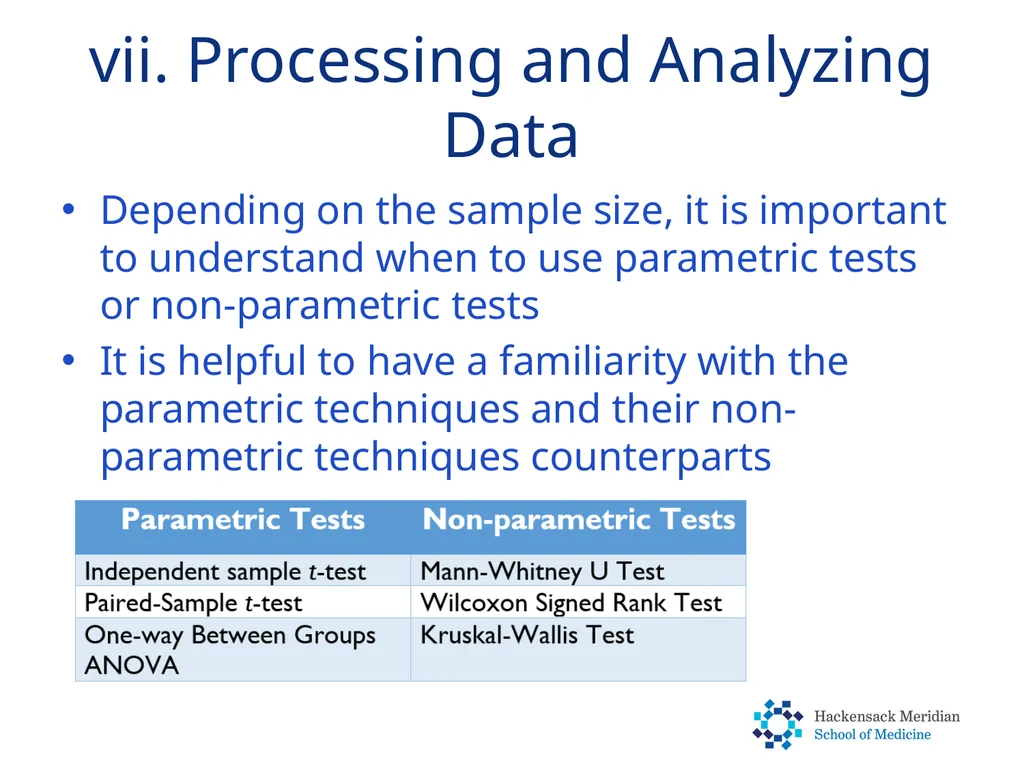
slide26. vii. Processing and Analyzing Data Depending on the sample size, it is important to understand when to use parametric tests or non-parametric tests
It is helpful to have a familiarity with the parametric techniques and their non-parametric techniques counterparts<br>
slide27. vii. Writing Reports The entire research process culminates in a report that is disseminated to audiences
The overall format for a report of quantitative study follows a predictable pattern:
Introduction, literature review, methods, results, and conclusions
Essentially all of the steps involved in conducting research, discussed above<br>
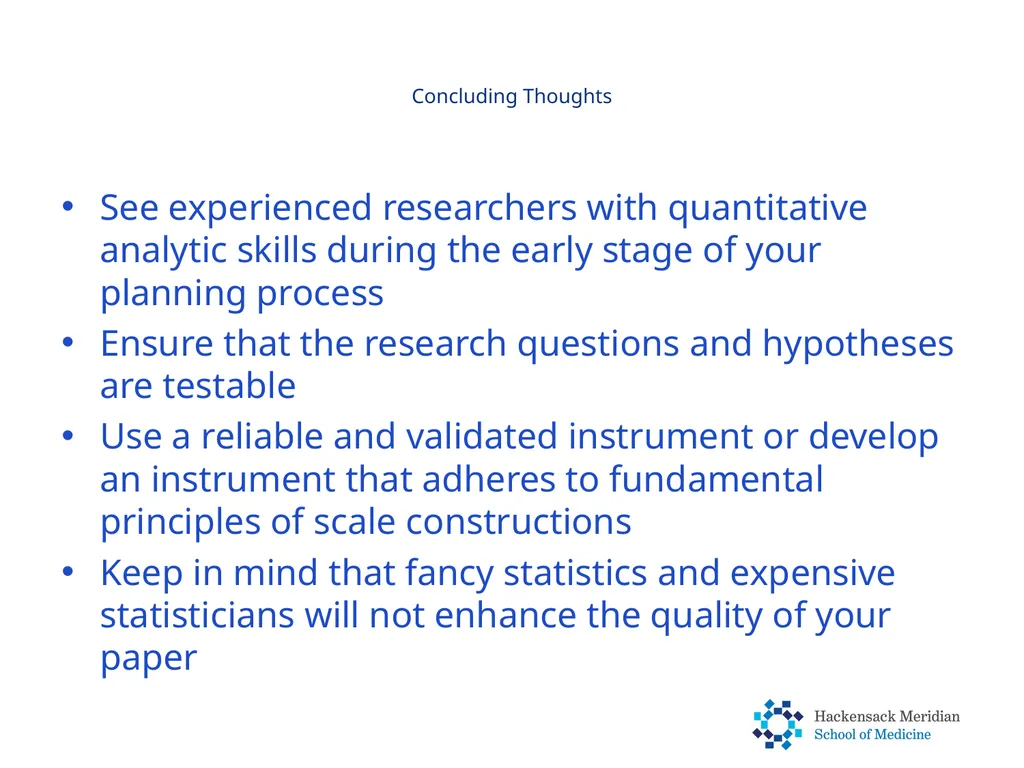
slide28. Concluding Thoughts See experienced researchers with quantitative analytic skills during the early stage of your planning process
Ensure that the research questions and hypotheses are testable
Use a reliable and validated instrument or develop an instrument that adheres to fundamental principles of scale constructions
Keep in mind that fancy statistics and expensive statisticians will not enhance the quality of your paper<br>
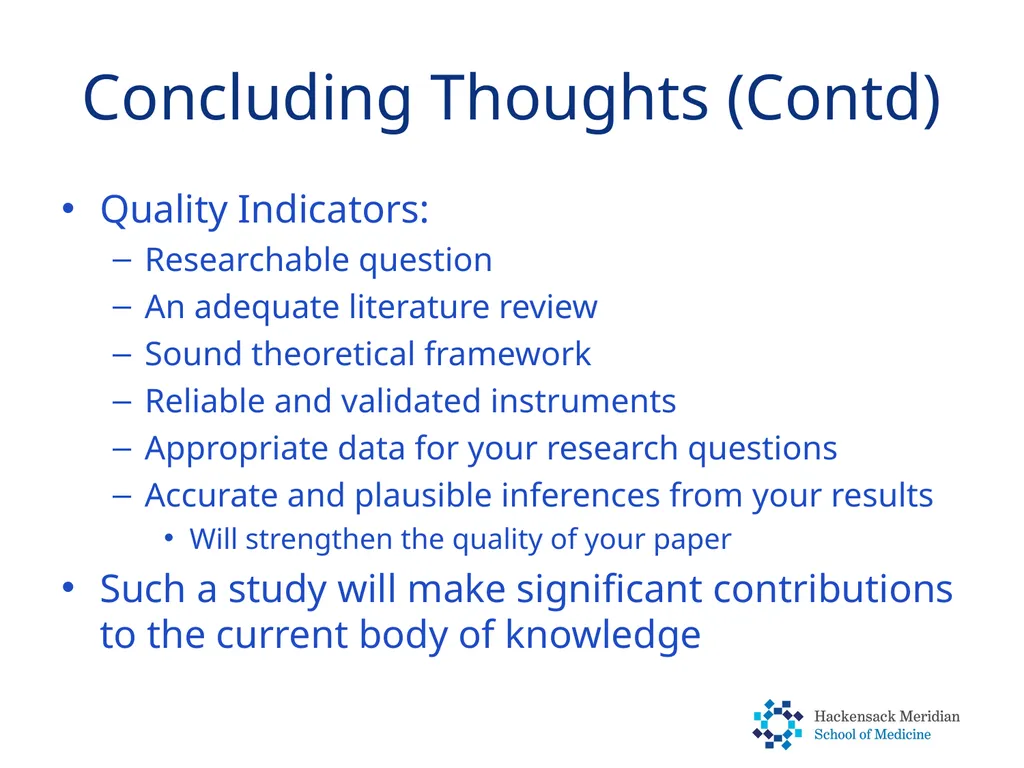
slide29. Concluding Thoughts (Contd) Quality Indicators:
Researchable question
An adequate literature review
Sound theoretical framework
Reliable and validated instruments
Appropriate data for your research questions
Accurate and plausible inferences from your results
Will strengthen the quality of your paper
Such a study will make significant contributions to the current body of knowledge<br>
Office of Institutional Effectiveness and Assessment<br>
slide2. Research Compass<br>
slide3. Introduction Purpose is to introduce processes involved in designing a quantitative study
Number of books on research methods
Several primers on research design and analysis
Focus is on some of the basics-conceptualization and designing it
Takes a rigorous training, extensive coursework, and many years of experience to conduct high quality scholarly research<br>
slide4. Introduction (Contd) This primer should serve as a good guide
This should enable the readers to pursue additional readings on relevant topics
Some variations exist in the research process<br>
slide5. Eight Stages in the Research Process<br>
slide6. Eight Stages in the Research Process i. Identifying the problem
ii. Reviewing the literature
iii. Setting research questions, objectives, and
hypotheses
iv. Choosing the study design
v. Deciding on the sample design
vi. Collecting data
vii. Processing and analyzing data
viii. Writing the report<br>
slide7. i. Identifying the Research Problem Most important step in the scholarly research endeavors
“A problem well put is half solved”
Research problem statement indicates overall direction of the study
Usually rather general
Scope of the study to be appropriate<br>
slide8. Identifying the Research Problem (Contd) Broad questions tend to lead to vague answers
Research problems should be workable and solvable with relationships between specific variables clearly established
Examples
The purpose of this study is to examine the relation between teaching style and student academic achievement
This study investigates the effect of sex on aggression<br>
slide9. Sources for Problems Investigator’s interest and experience
Theory
Replication
Clarification of contradictory findings<br>
slide10. ii. Review of Literature Conduct a thorough review of the relevant literature
Past research on the phenomenon under study play a key role in the process of problem formulation and the design of a study
Sources of research problems extend beyond the existing literature
Benefit - an extensive review of the literature will enable researchers to demonstrate the significance of their studies
Sharing the piece(s) of the puzzle their studies contribute to the existing knowledge base<br>
slide11. Review of Literature (Contd) Literature review should not be restricted to one’s own discipline and subdiscipline
It is important to break out of the almost inevitable parochialism that training and specialization engender
Failure to do so will foster tunnel vision
Detrimental to cumulative knowledge<br>
slide12. Review of Literature (Contd) Interdisciplinary studies are more impactful
Medical education overlaps with educational research in general, and particularly with other professional education, such as engineering education
Study of professional identity formation is an emerging theme within the medical education community
There is a rich literature on the professional identity formation as a construct in engineering education
Medical education stands to gain if we integrate literature from other fields in addressing medical education research questions<br>
slide13. Review of Literature (Contd) Some of the core purposes of reviewing literature include:
Refining the research problem
Establishing the conceptual or theoretical orientation
Identifying contradictory findings
Developing research hypotheses
Learning about new information<br>
slide14. iii. Research Questions, Objectives, and Hypothesis Researcher presents specific and narrow questions to obtain measurable and observable data
Researchable question is one that can be investigated empirically
Example of a researchable question
What is the effect of sex on aggression?
Questions with appropriate level of specificity and knowledge of the current literature
Enable a researcher to develop hypothesis and identify IV and DV<br>
slide15. Definitions Hypothesis: A hypothesis is a conjectural statement about a relation between two or more variables, or about how the variables in the study are related
In research, a hypothesis is typically the investigator’s prediction or expectation of what the results will show
Such a prediction is made prior to data collection
Example: There is a significant difference between males and females in aggression and that males tend to be more aggressive<br>
slide16. Definitions (Contd) Variable: A variable is a characteristics or attributes of an individual or organization that researchers can measure or observe and varies among the individuals or organizations
Examples: Intelligence, achievement, and cognitive style
Categorical Variable: A categorical variable is used to assign an object or person to a group (level) defined by having specified characteristics
Examples: sex, race, socioeconomic status (SES), voting preference, and religious preference<br>
slide17. Definitions (Contd) Continuous Variable: A continuous variable reflects an infinite number of values within a given range of scores
They can assume any value along a scale of values such as height (inches), weight (pounds), time (in seconds), or income.
Independent Variable: An independent variable is an attribute or characteristic that influences or affects an outcome or dependent variable<br>
slide18. Definitions (Contd) Dependent Variable: A dependent variable is an attribute or characteristic that is dependent on, or influenced by, the independent variables.
This is generally the variable that the researcher wants to measure or predict
Confounding Variable: Confounding variables are attributes or characteristics that the researcher does not directly measure, but that may influence the relationship between the independent and dependent variables<br>
slide19. iii. Research Questions, Objectives, and Hypothesis (Contd) Researchers should be clear in their minds and research questions concerning the relationship between their variables
Which ones are doing the influencing (independent)
Which one are being affected (dependent)
Predictions are made from independent variables to dependent variables<br>
slide20. iv. Choosing the Study Design A research design is a set of procedures that researchers use to collect, analyze, and report their data in a research study
Quantitative research designs are a set of procedures for collecting, analyzing, and reporting numeric data
Three broad classes of designs
Experimental
Quasi-experimental
Non-experimental
What serves to distinguish among the three classes of designs is the presence or absence of (a) manipulation of IVs, and (b) randomization<br>
slide21. Three Designs Experimental Design: An experiment is a study in which at least one variable is manipulated, and units are randomly assigned to the different levels or categories of the manipulated variable(s)
Seek to understand causal relationships among variables of interests
Quasi Experimental Design: Refers to investigations in which treatments are administered but randomization is absent
Nonexperimental Design: In nonexperiment, both manipulation and randomization are absent<br>
slide22. v. Sample Design A sample design refers to the methods to be followed in selecting a sample from the population
The purpose of sampling in quantitative studies is to obtain a group of participants who will be representative of a larger group of individuals
The degree of representativeness and the quality of the information obtained are based on the sampling techniques employed<br>
slide23. v. Sample Design (Contd) Two major types of sampling procedures:
Probability sampling and non-probably sampling
Qualitative studies – non-probability sampling
Quantitative studies – probability sampling
More rigorous
Examples: simple random sampling, systematic sampling, and stratified sampling
Each individual has a known chance (or probability) of being selected<br>
slide24. vi. Collecting Data Researchers use instruments to measure the variables in the study
An instrument is a tool for recording quantitative data
It contains specific questions and response possibilities
Examples of instruments:
Survey questionnaire, checklists that can be used to observe an individual’s behaviors, standardized tests, secondary data analysis, and structured interviews<br>
slide25. vii. Processing and Analyzing Data In quantitative research, researchers analyze the data using mathematics procedures, called statistics
Separate primer on statistics
Many might know how to calculate correlation coefficient or perform a t-test, but not all of them might be able to pick an approach that is appropriate to address a particular research question
A statistical technique to be used will be determined by the research question<br>
slide26. vii. Processing and Analyzing Data Depending on the sample size, it is important to understand when to use parametric tests or non-parametric tests
It is helpful to have a familiarity with the parametric techniques and their non-parametric techniques counterparts<br>
slide27. vii. Writing Reports The entire research process culminates in a report that is disseminated to audiences
The overall format for a report of quantitative study follows a predictable pattern:
Introduction, literature review, methods, results, and conclusions
Essentially all of the steps involved in conducting research, discussed above<br>
slide28. Concluding Thoughts See experienced researchers with quantitative analytic skills during the early stage of your planning process
Ensure that the research questions and hypotheses are testable
Use a reliable and validated instrument or develop an instrument that adheres to fundamental principles of scale constructions
Keep in mind that fancy statistics and expensive statisticians will not enhance the quality of your paper<br>
slide29. Concluding Thoughts (Contd) Quality Indicators:
Researchable question
An adequate literature review
Sound theoretical framework
Reliable and validated instruments
Appropriate data for your research questions
Accurate and plausible inferences from your results
Will strengthen the quality of your paper
Such a study will make significant contributions to the current body of knowledge<br>