A Project Financiers Standpoint Risk Assessment in IPF 19th May, 2014 Project Structured FinanceInvestment Banking Group P r e s e n t a t i o n UNITED BANK LIMITED Note Please note that the following slides contain information
Related Topics
Share
Embed code
Download this presentation From Below
"A Project Financier's Standpoint |Risk Assessment" is the property of its rightful owner. Permission is granted to
download and print the materials on this website for personal, non-commercial use only, and to display it
on your personal computer provided you do not modify the materials and that you retain all copyright
notices contained in the materials. By downloading content from our website, you accept the terms of this
agreement.
Presentation Transcript
01
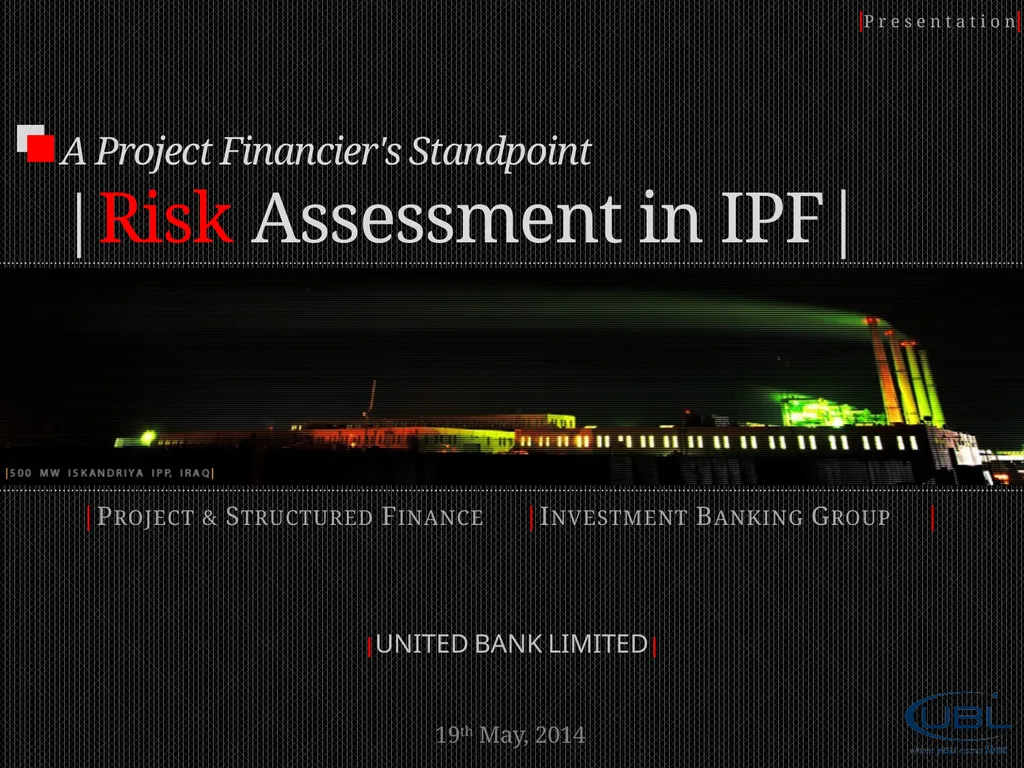
A Project Financier's Standpoint |Risk Assessment in IPF| 19th May, 2014 |Project & Structured Finance|Investment Banking Group| |P r e s e n t a t i o n| |UNITED BANK LIMITED|<br>
02
Note Please note that the following slides contain information on certain project finance transactions that have taken place in the Pakistan financial markets over the last 8 years.
The information presented herein is aimed at sharing key risks that manifested themselves during construction period or over the initial operating life of the project(s) and how the Project Financiers dealt with them (or should have dealt with them) given the Project Finance framework as enshrined in the IPF Guidelines issued by the SBP and/or internal policies governing PF transactions, issued by banks and FIs for internal stakeholders’ consumption.
The details and specifics of transactions mentioned are from an academic and learning standpoint only and should not be construed as being reflective of the respective projects or any of their stakeholders in any manner. -Slide 2- |Project & Structured Finance|UNITED BANK LIMITED|<br>
03
Contents Definition
Risk Matrix
The Adequacy of LDs
Short Case Studies -Slide 3-<br>
04
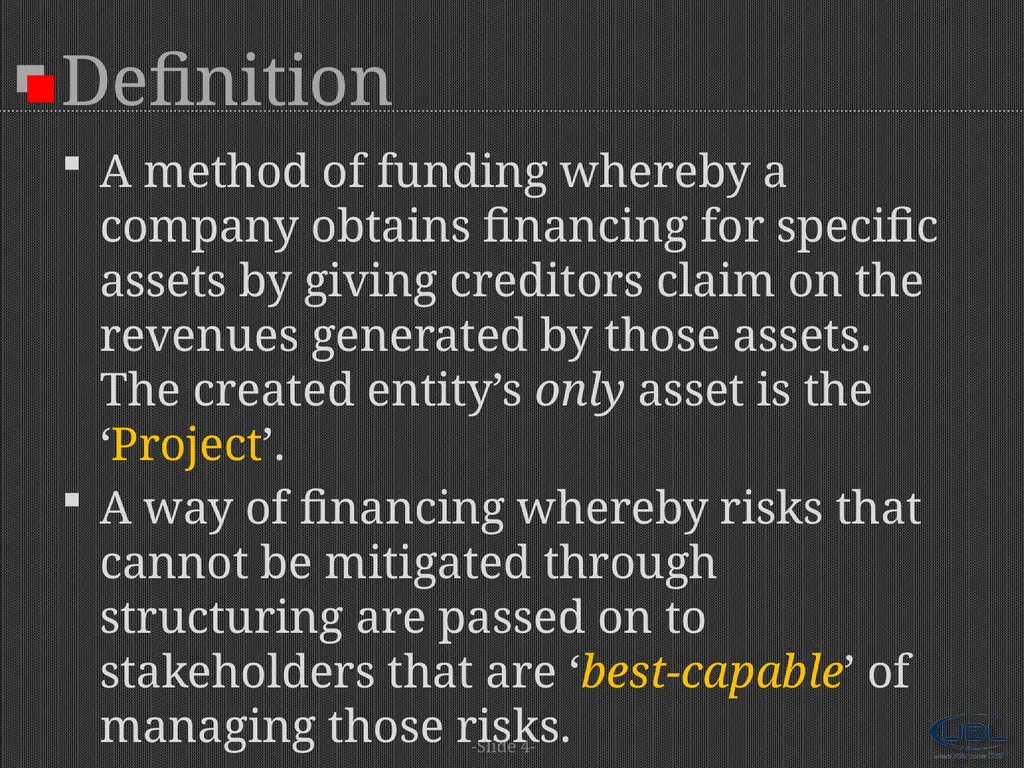
-Slide 4- Definition A method of funding whereby a company obtains financing for specific assets by giving creditors claim on the revenues generated by those assets. The created entity’s only asset is the ‘Project’.
A way of financing whereby risks that cannot be mitigated through structuring are passed on to stakeholders that are ‘best-capable’ of managing those risks.
Principle of ‘Equitable Allocation.’<br>
05
Usually raised for a new project rather than an established business.
Generally high debt:equity ratio.
No guarantees from the investors (‘non-recourse’), or limited guarantees (‘limited-recourse’) for the project finance debt.
Reliance on future cash flows of the Project for debt servicing rather than value of its assets and/or operational history.
Main security for lenders is the Project’s contracts, licenses or ownership of rights to natural resources; physical assets likely to be worth much less than the debt if they are sold off after a default on financing.
Finite life, based on such factors as the length of the contracts, concessions, licenses or the reserves of natural resources. -Slide 5- Characteristics<br>
06
Roman and Greek merchants used this technique to share risks inherent in maritime trading.
Loan would be advanced to a shipping merchant on the agreement that such loan would be repaid only through the sale of cargo brought back by the voyage (i.e. internally generated cash flows).
In modern history, used for developing Panama Canal (1914).
Adopted widely during the ‘70s for development of North Sea oilfields.
Most prolific use is UK’s Private Finance Initiative (PPP regime) in ’92 for infrastructure spanning schools, hospitals, prisons and roads. -Slide 6- A bit of history…<br>
07
Global Perspective Global PF market size circa USD 200bn (2012)
Top sectors include: Power, Oil & Gas and Transport (approx. 70-80%).
Europe and Asia Pacific two biggest markets for IPF.
Bank loans still provide over 70% of debt capital for IPF (bonds: 10-15%).
Debt markets struggling with sovereign ratings and Basel III.
Increasing reliance on MLAs and ECAs. -Slide 7-<br>
Contents Definition
Risk Matrix
The Adequacy of LDs
Short Case Studies -Slide 3-<br>
11
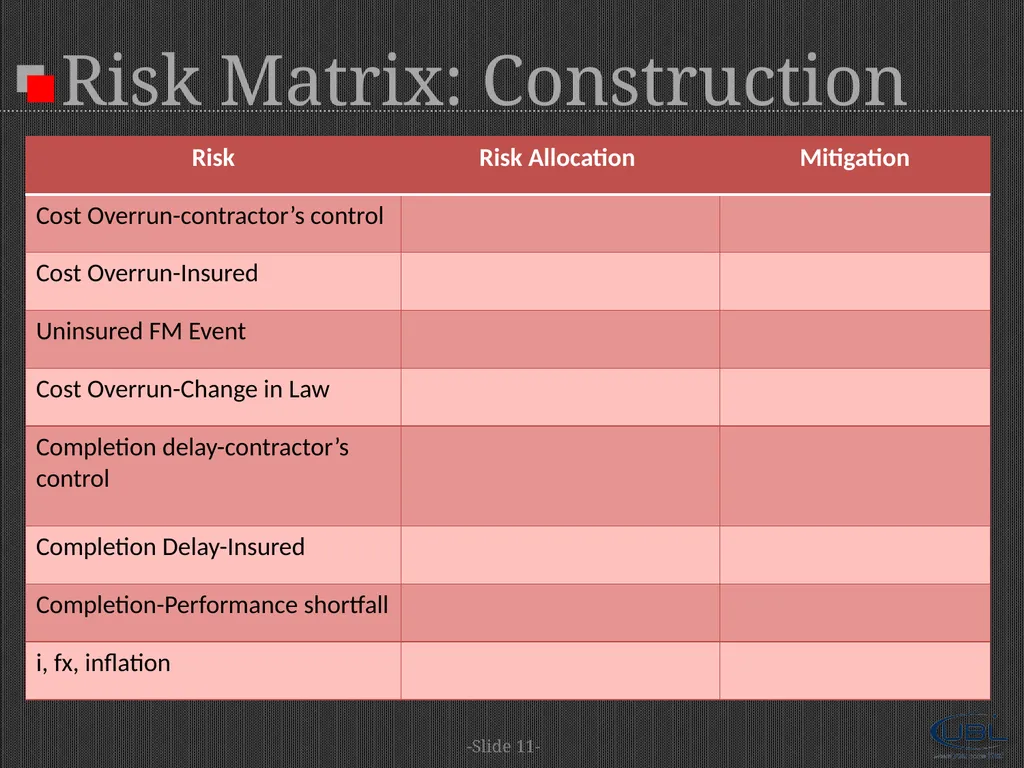
Risk Matrix: Construction -Slide 11-<br>
12
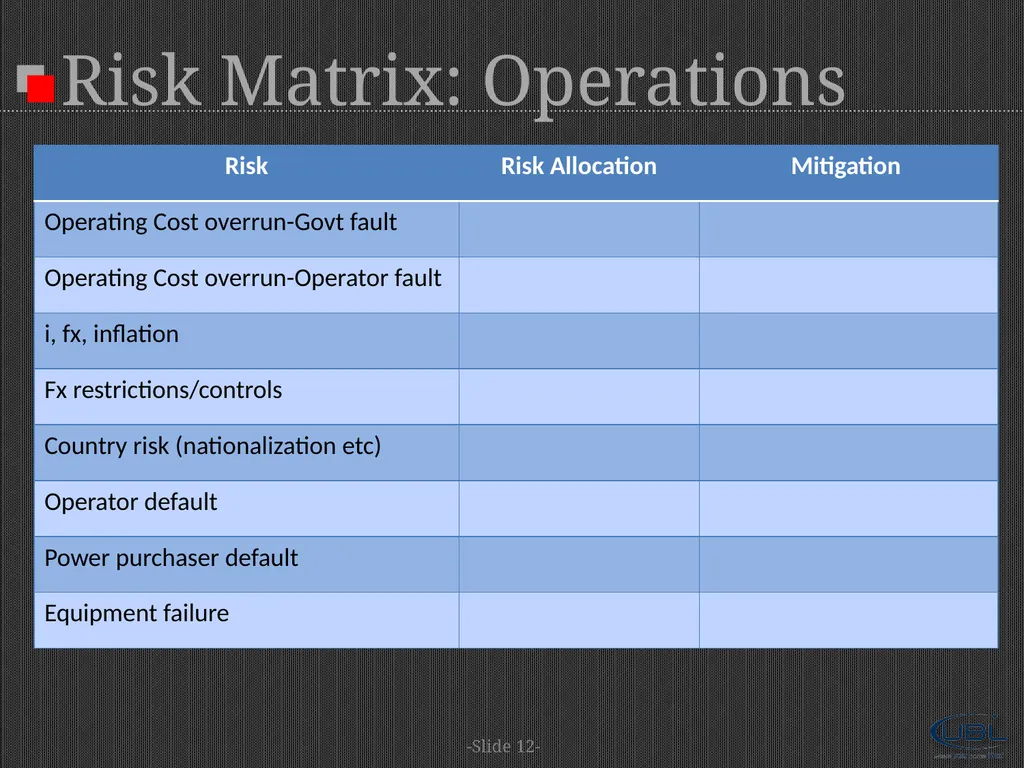
Risk Matrix: Operations -Slide 12-<br>
13
Contents Definition
Risk Matrix
The Adequacy of LDs
Short Case Studies -Slide 3-<br>
14
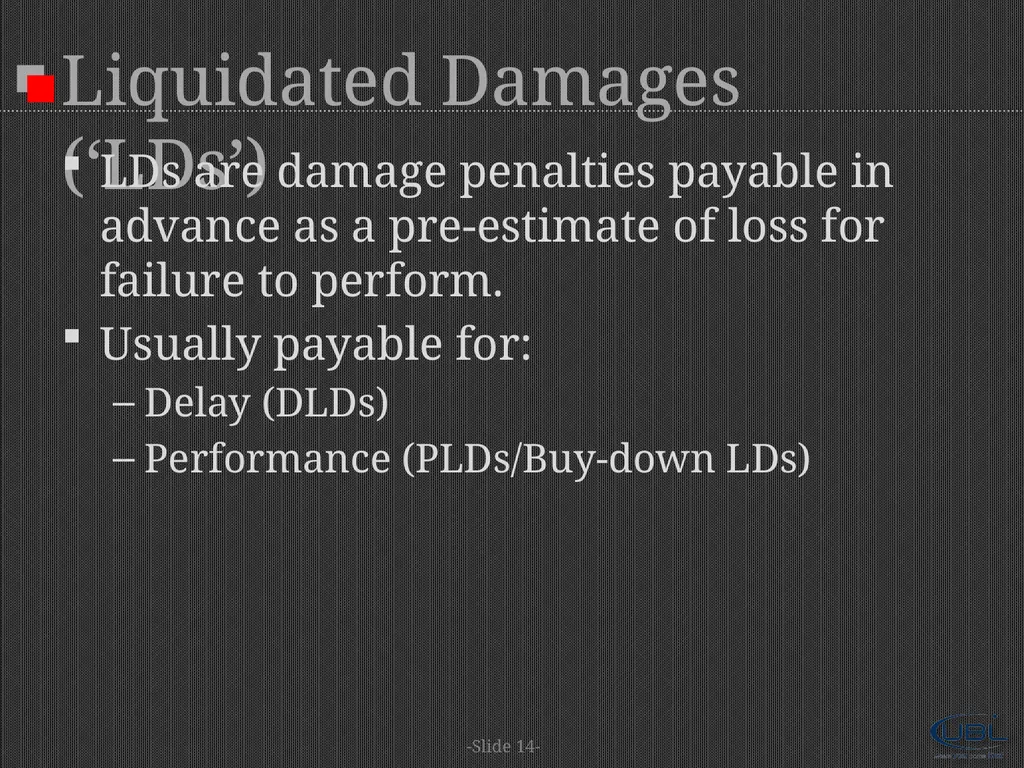
Liquidated Damages (‘LDs’) LDs are damage penalties payable in advance as a pre-estimate of loss for failure to perform.
Usually payable for:
Delay (DLDs)
Performance (PLDs/Buy-down LDs) -Slide 14-<br>
15
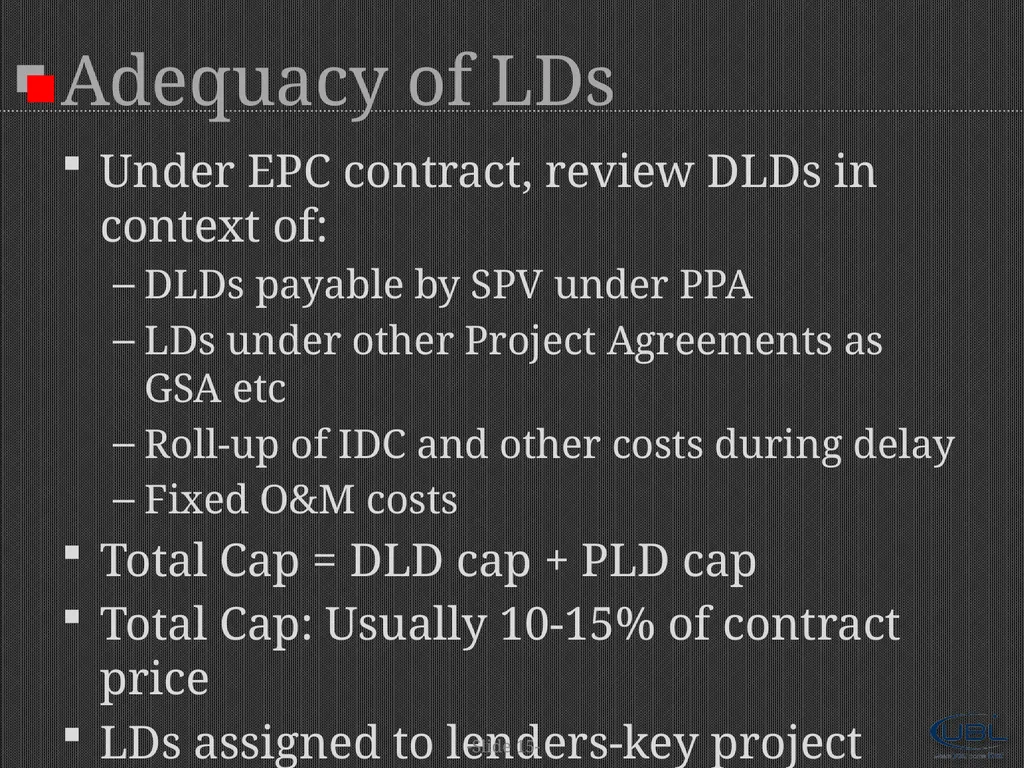
Adequacy of LDs Under EPC contract, review DLDs in context of:
DLDs payable by SPV under PPA
LDs under other Project Agreements as GSA etc
Roll-up of IDC and other costs during delay
Fixed O&M costs
Total Cap = DLD cap + PLD cap
Total Cap: Usually 10-15% of contract price
LDs assigned to lenders-key project security -Slide 15-<br>
16
The LD Adequacy Matrix Typically, for an IPP, Lenders demand a 6-month coverage of LDs payable and Fixed Costs incurred by the Project. -Slide 16-<br>
17
Contents Definition
Risk Matrix
The Adequacy of LDs
Short Case Studies -Slide 3-<br>
18
Thank you |M. Umer Khan|SVP & Head, Project & Structured Finance|
|Investment Banking Group|UNITED BANK LIMITED|
|Umer.Khan@ubl.com.pk|021 3241.1846|<br>