
A SUPPLEMENTARY RESOURCE TO THE SBTi SUPPLIER
SB
Published · 48 slides · 0 views

1 / 1


Description
A SUPPLEMENTARY RESOURCE TO THE SBTi SUPPLIER ENGAGEMENT GUIDANCE VERSION CONTROL: This presentation is version 1.1 (V1.1) of these slides. They replaced V1 in July 2025. ENGAGING SUPPLY CHAINS ON THE DECARBONIZATION JOURNEY DISCLAIMER:
Related Topics
Share
Embed code
Download this presentation From Below
"A SUPPLEMENTARY RESOURCE TO THE SBTi SUPPLIER" is the property of its rightful owner. Permission is granted to download and print the materials on this website for personal, non-commercial use only, and to display it on your personal computer provided you do not modify the materials and that you retain all copyright notices contained in the materials. By downloading content from our website, you accept the terms of this agreement.
Presentation Transcript
01
A SUPPLEMENTARY RESOURCE TO THE SBTi SUPPLIER ENGAGEMENT GUIDANCE VERSION CONTROL: This presentation is version 1.1 (V1.1) of these slides. They replaced V1 in July 2025. ENGAGING SUPPLY CHAINS ON THE DECARBONIZATION JOURNEY DISCLAIMER: This presentation was developed by the Science Based Targets initiative, for companies engaging their suppliers on the topic of science-based target setting. This resource is publicly available on the SBTi website and should not be altered.<br>
02
This slide deck is intended for companies with science-based targets - including supplier engagement targets - to use when educating and engaging their suppliers on science-based target setting.
This is a complementary resource for companies to use as part of their engagement programs.
The SBTi encourages companies to explore additional resources, such as key documents and the Introduction to the Science Based Targets initiative video, for a clearer understanding of what science-based targets are, the criteria for setting them, and the process involved. ABOUT THIS PRESENTATION NOTES FOR COMPANIES WITH SUPPLIER ENGAGEMENT TARGETS<br>
03
I. INTRODUCTION
TO THE SCIENCE BASED TARGETS INITIATIVE<br>
TO THE SCIENCE BASED TARGETS INITIATIVE<br>
04
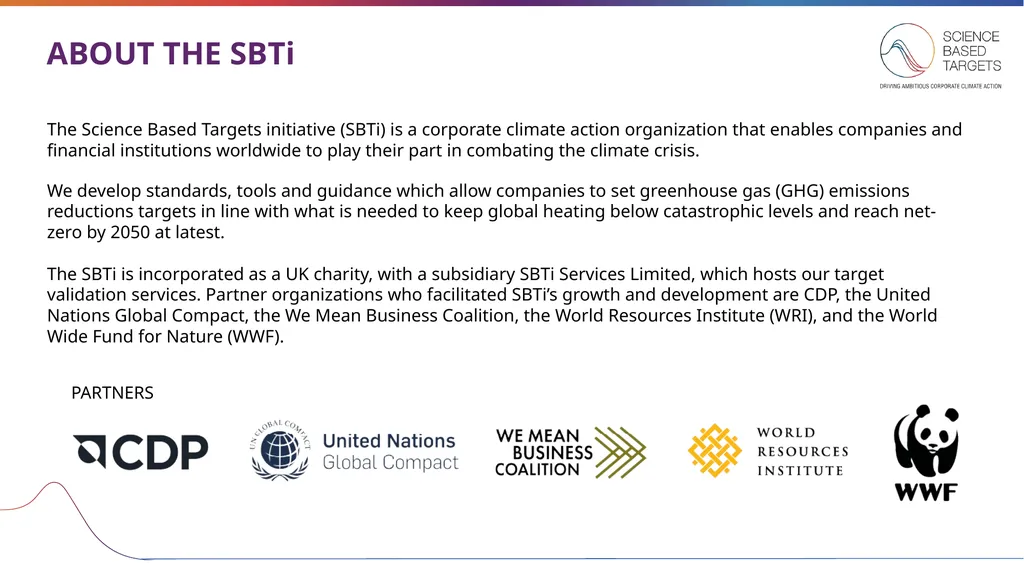
ABOUT THE SBTi The Science Based Targets initiative (SBTi) is a corporate climate action organization that enables companies and financial institutions worldwide to play their part in combating the climate crisis.
We develop standards, tools and guidance which allow companies to set greenhouse gas (GHG) emissions reductions targets in line with what is needed to keep global heating below catastrophic levels and reach net-zero by 2050 at latest.
The SBTi is incorporated as a UK charity, with a subsidiary SBTi Services Limited, which hosts our target validation services. Partner organizations who facilitated SBTi’s growth and development are CDP, the United Nations Global Compact, the We Mean Business Coalition, the World Resources Institute (WRI), and the World Wide Fund for Nature (WWF). PARTNERS<br>
05
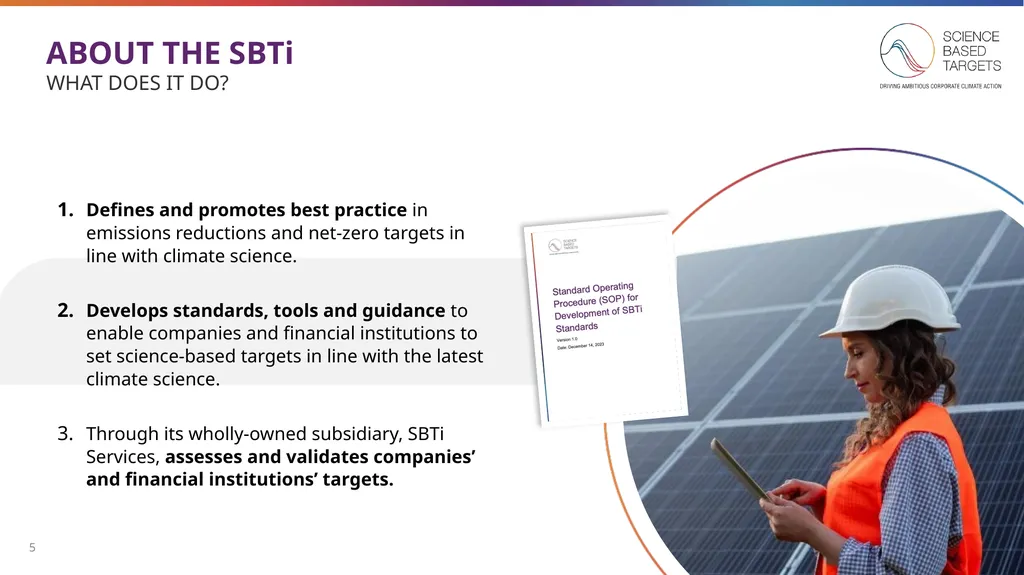
Defines and promotes best practice in emissions reductions and net-zero targets in line with climate science.
Develops standards, tools and guidance to enable companies and financial institutions to set science-based targets in line with the latest climate science.
Through its wholly-owned subsidiary, SBTi Services, assesses and validates companies’ and financial institutions’ targets. ABOUT THE SBTi WHAT DOES IT DO? ‹#›<br>
06
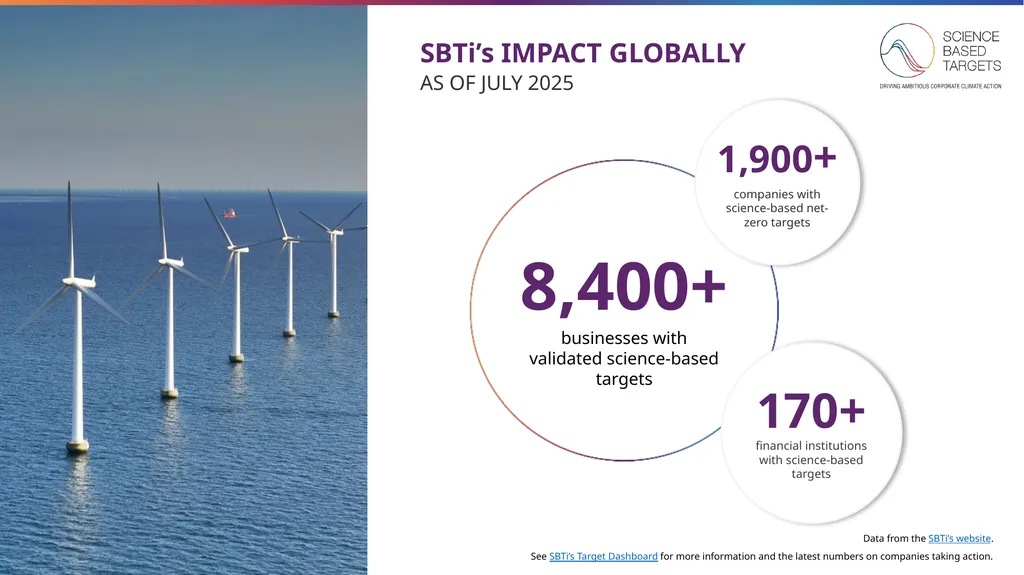
Data from the SBTi’s website. See SBTi’s Target Dashboard for more information and the latest numbers on companies taking action. SBTi’s IMPACT GLOBALLY AS OF JULY 2025<br>
07
II. THE IMPORTANCE OF SETTING SCIENCE-BASED TARGETS<br>
08
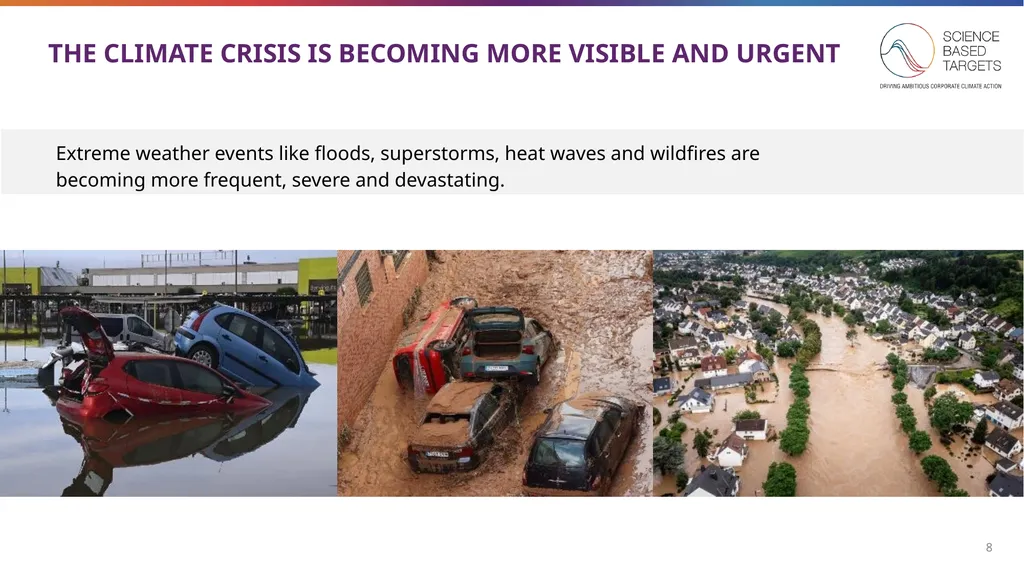
THE CLIMATE CRISIS IS BECOMING MORE VISIBLE AND URGENT Extreme weather events like floods, superstorms, heat waves and wildfires are becoming more frequent, severe and devastating. ‹#›<br>
09
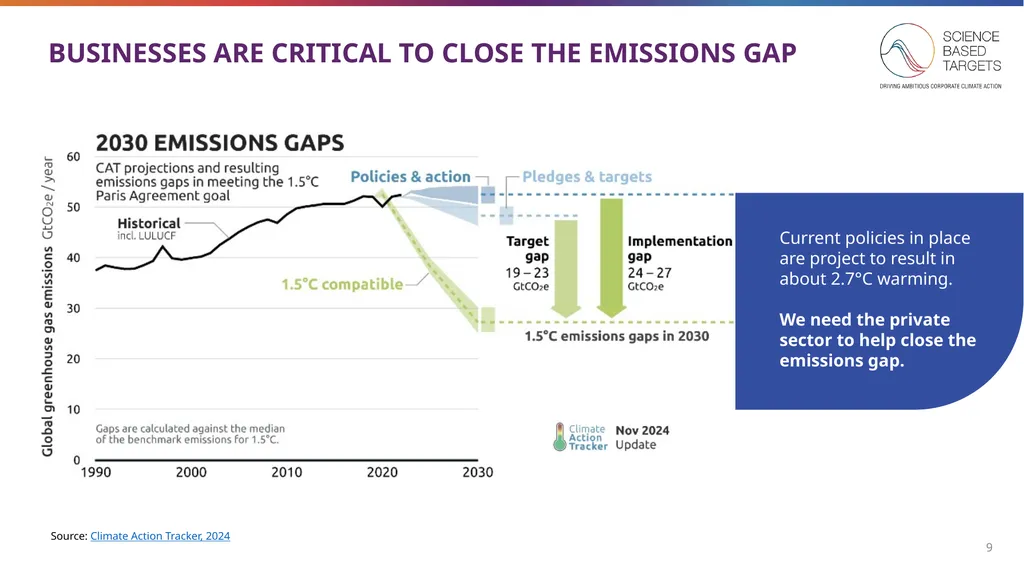
BUSINESSES ARE CRITICAL TO CLOSE THE EMISSIONS GAP Source: Climate Action Tracker, 2024 ‹#›<br>
10
III. WHAT ARE SCIENCE-BASED TARGETS?<br>
11
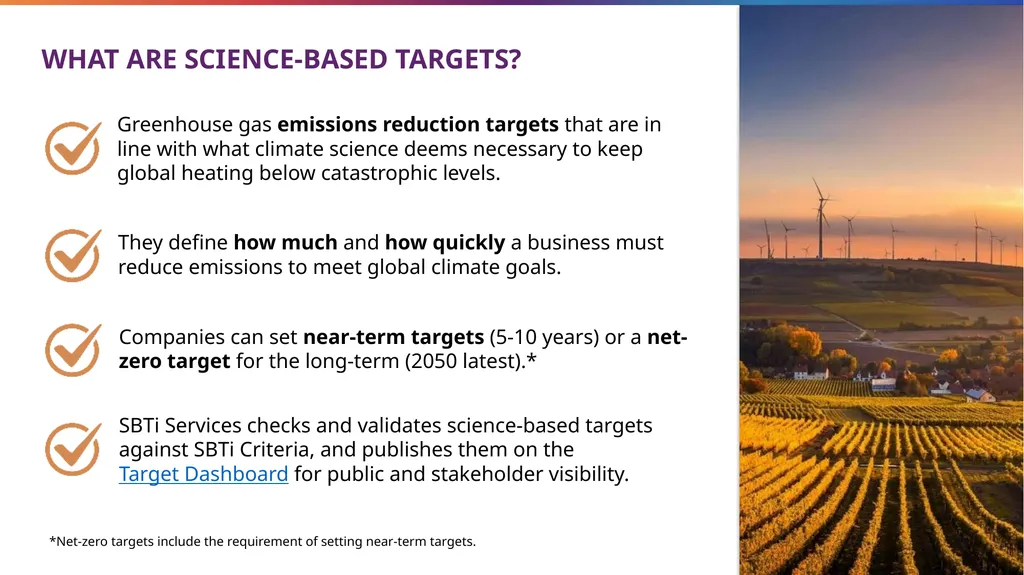
‹#› Greenhouse gas emissions reduction targets that are in line with what climate science deems necessary to keep global heating below catastrophic levels. They define how much and how quickly a business must reduce emissions to meet global climate goals. SBTi Services checks and validates science-based targets against SBTi Criteria, and publishes them on the Target Dashboard for public and stakeholder visibility. Companies can set near-term targets (5-10 years) or a net-zero target for the long-term (2050 latest).* *Net-zero targets include the requirement of setting near-term targets. WHAT ARE SCIENCE-BASED TARGETS?<br>
12
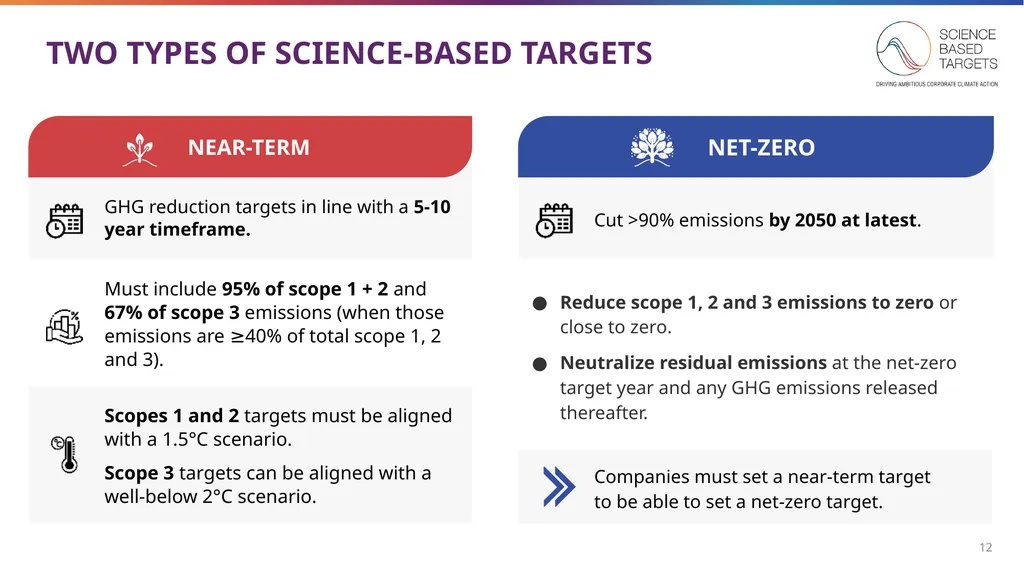
Reduce scope 1, 2 and 3 emissions to zero or close to zero.
Neutralize residual emissions at the net-zero target year and any GHG emissions released thereafter. TWO TYPES OF SCIENCE-BASED TARGETS ‹#›<br>
Neutralize residual emissions at the net-zero target year and any GHG emissions released thereafter. TWO TYPES OF SCIENCE-BASED TARGETS ‹#›<br>
13
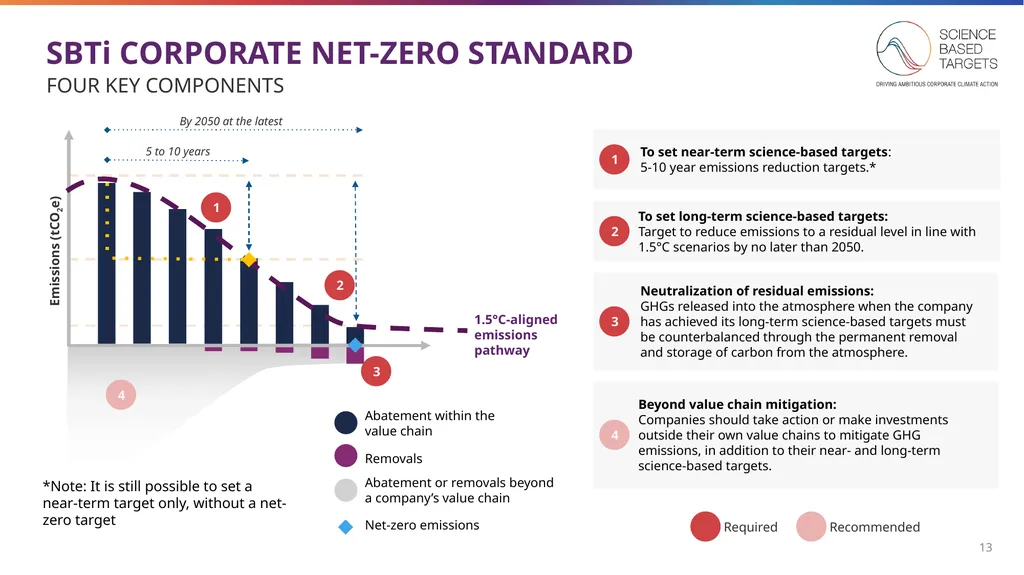
SBTi CORPORATE NET-ZERO STANDARD Required Recommended Net-zero emissions 1.5°C-aligned emissions pathway Emissions (tCO2e) 2 Removals Abatement within the value chain Abatement or removals beyond a company’s value chain 1 3 By 2050 at the latest 5 to 10 years *Note: It is still possible to set a near-term target only, without a net-zero target FOUR KEY COMPONENTS 4 ‹#›<br>
14
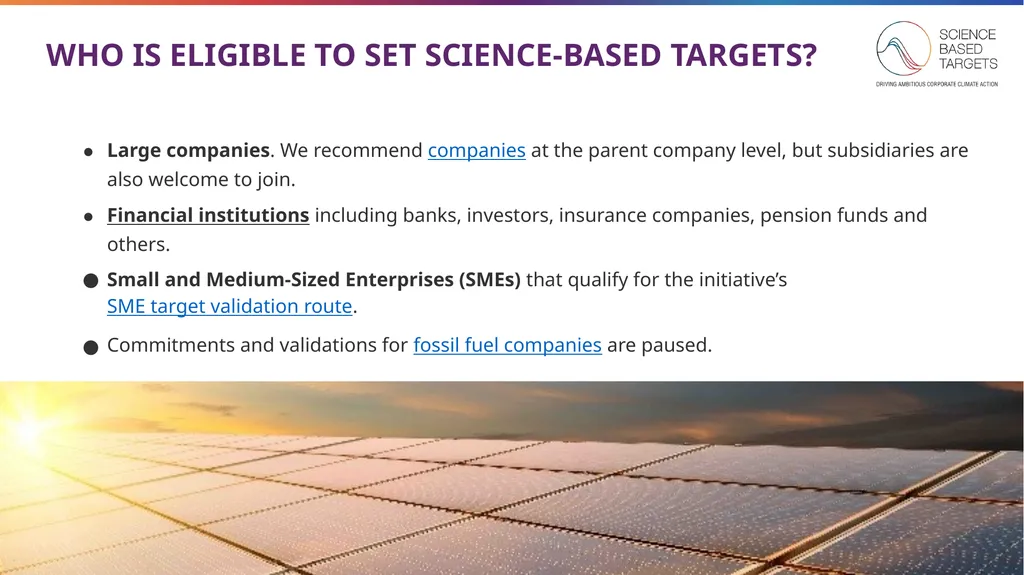
Large companies. We recommend companies at the parent company level, but subsidiaries are also welcome to join.
Financial institutions including banks, investors, insurance companies, pension funds and others.
Small and Medium-Sized Enterprises (SMEs) that qualify for the initiative’s SME target validation route.
Commitments and validations for fossil fuel companies are paused. WHO IS ELIGIBLE TO SET SCIENCE-BASED TARGETS?<br>
15
IV. WHAT ARE THE BENEFITS OF SETTING SCIENCE-BASED TARGETS?<br>
16
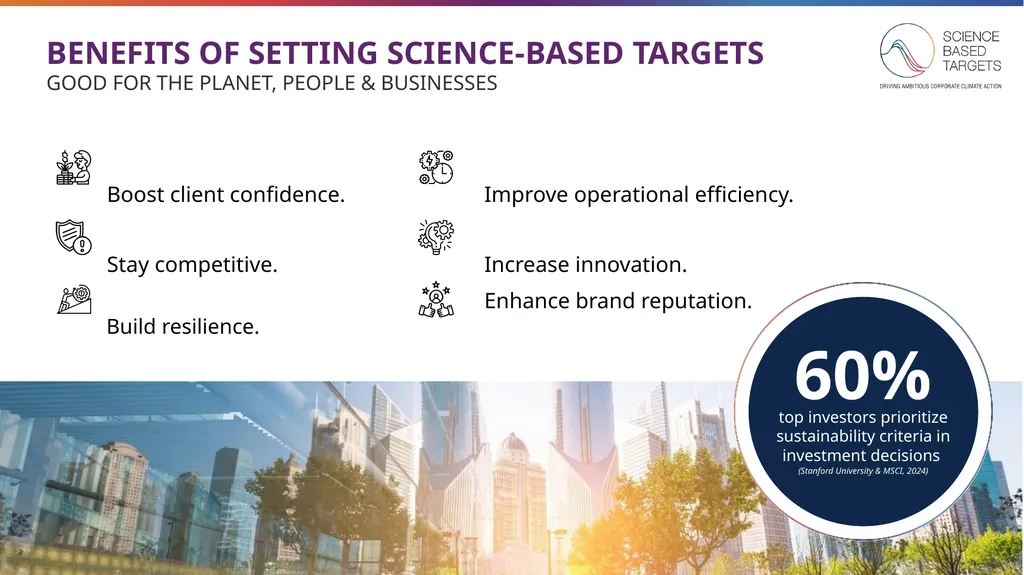
Enhance brand reputation. Increase innovation. Stay competitive. Build resilience. BENEFITS OF SETTING SCIENCE-BASED TARGETS 60% top investors prioritize sustainability criteria in investment decisions (Stanford University & MSCI, 2024) GOOD FOR THE PLANET, PEOPLE & BUSINESSES Boost client confidence. Improve operational efficiency.<br>
17
V. HOW CAN COMPANIES SET SCIENCE-BASED TARGETS?<br>
18
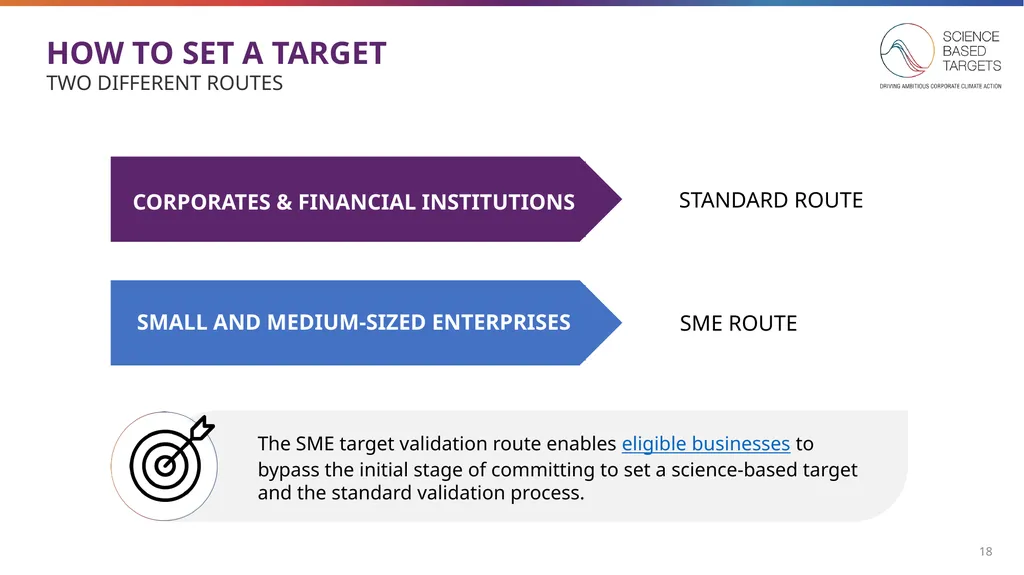
HOW TO SET A TARGET TWO DIFFERENT ROUTES ‹#›<br>
19
STANDARD ROUTE:
CORPORATES & FINANCIAL INSTITUTIONS<br>
20
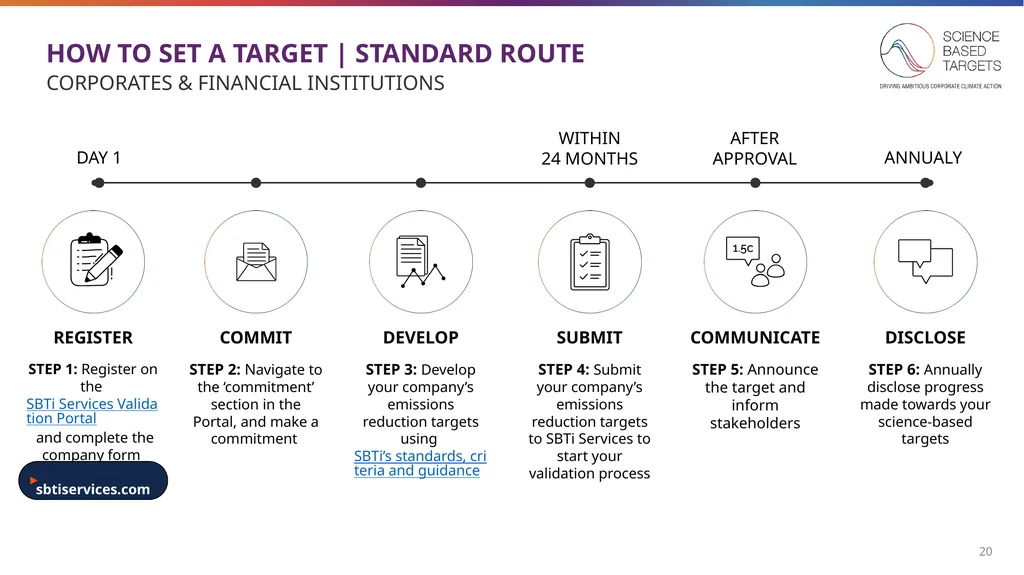
HOW TO SET A TARGET | STANDARD ROUTE CORPORATES & FINANCIAL INSTITUTIONS STEP 2: Navigate to the ‘commitment’ section in the Portal, and make a commitment COMMIT STEP 3: Develop your company’s emissions reduction targets using SBTi’s standards, criteria and guidance DEVELOP STEP 4: Submit your company’s emissions reduction targets to SBTi Services to start your validation process SUBMIT STEP 5: Announce the target and inform stakeholders COMMUNICATE STEP 6: Annually disclose progress made towards your science-based targets DISCLOSE STEP 1: Register on the SBTi Services Validation Portal and complete the company form REGISTER AFTER
APPROVAL ‹#›<br>
APPROVAL ‹#›<br>
21
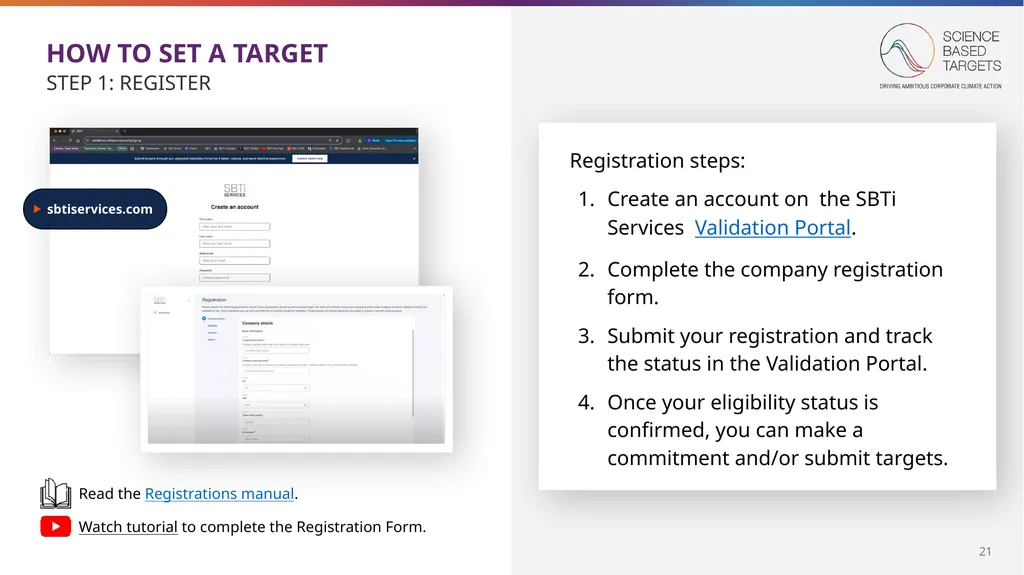
HOW TO SET A TARGET STEP 1: REGISTER Watch tutorial to complete the Registration Form. Registration steps:
Create an account on the SBTi Services Validation Portal.
Complete the company registration form.
Submit your registration and track the status in the Validation Portal.
Once your eligibility status is confirmed, you can make a commitment and/or submit targets. ‹#› Read the Registrations manual.<br>
22
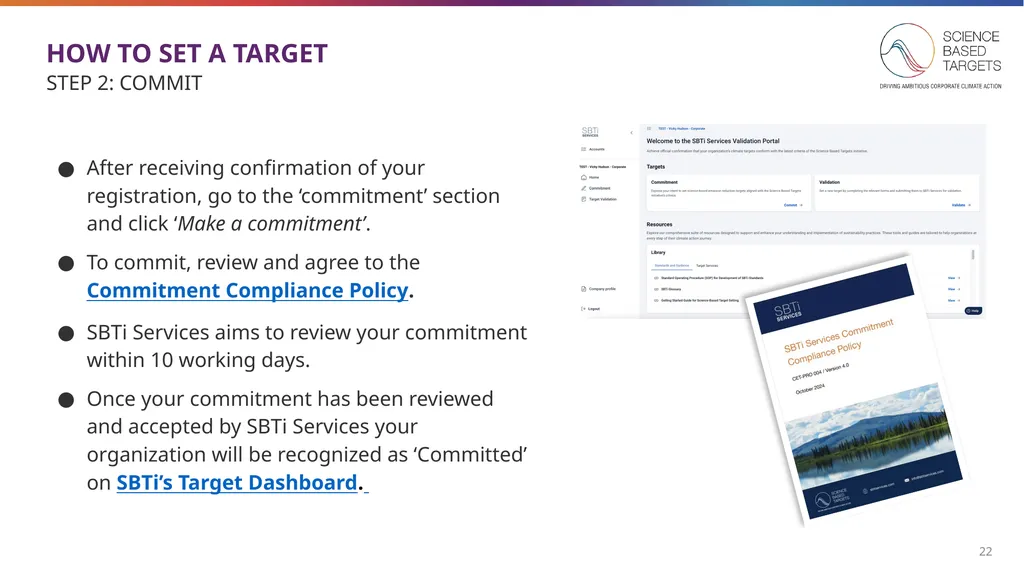
HOW TO SET A TARGET STEP 2: COMMIT ‹#› After receiving confirmation of your registration, go to the ‘commitment’ section and click ‘Make a commitment’.
To commit, review and agree to the Commitment Compliance Policy.
SBTi Services aims to review your commitment within 10 working days.
Once your commitment has been reviewed and accepted by SBTi Services your organization will be recognized as ‘Committed’ on SBTi’s Target Dashboard.<br>
To commit, review and agree to the Commitment Compliance Policy.
SBTi Services aims to review your commitment within 10 working days.
Once your commitment has been reviewed and accepted by SBTi Services your organization will be recognized as ‘Committed’ on SBTi’s Target Dashboard.<br>
23
“We urge businesses and investors to join the Race to Zero, align their portfolios with the goals of the Paris Agreement and set science-based net-zero targets of 2050 at the latest.”
G7 Climate and Environment Ministers, May 2021. HOW TO SET A TARGET STEP 2: COMMIT When a company commits, it is committing to set a near-term target.
Net-zero science-based targets are an additional commitment. In addition to setting a near-term target, companies can choose to also set a net-zero target.
Companies that commit to setting net-zero science-based targets automatically join the Race to Zero* campaign. * Companies that are eligible to join the Race to Zero must follow the SBTi’s current fossil fuel policy. If companies have questions, please reach out to Race to Zero at racetozero@unfccc.int. Non-state actors committed to net-zero through partner initiatives such as SBTi<br>
24
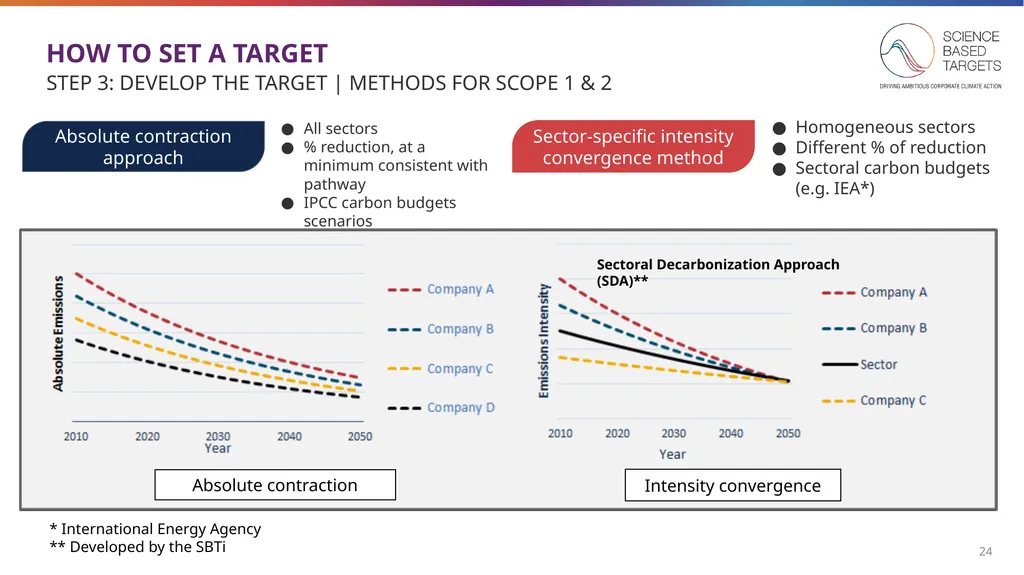
Intensity convergence Absolute contraction * International Energy Agency
** Developed by the SBTi HOW TO SET A TARGET STEP 3: DEVELOP THE TARGET | METHODS FOR SCOPE 1 & 2 ‹#› Sectoral Decarbonization Approach (SDA)**<br>
** Developed by the SBTi HOW TO SET A TARGET STEP 3: DEVELOP THE TARGET | METHODS FOR SCOPE 1 & 2 ‹#› Sectoral Decarbonization Approach (SDA)**<br>
25
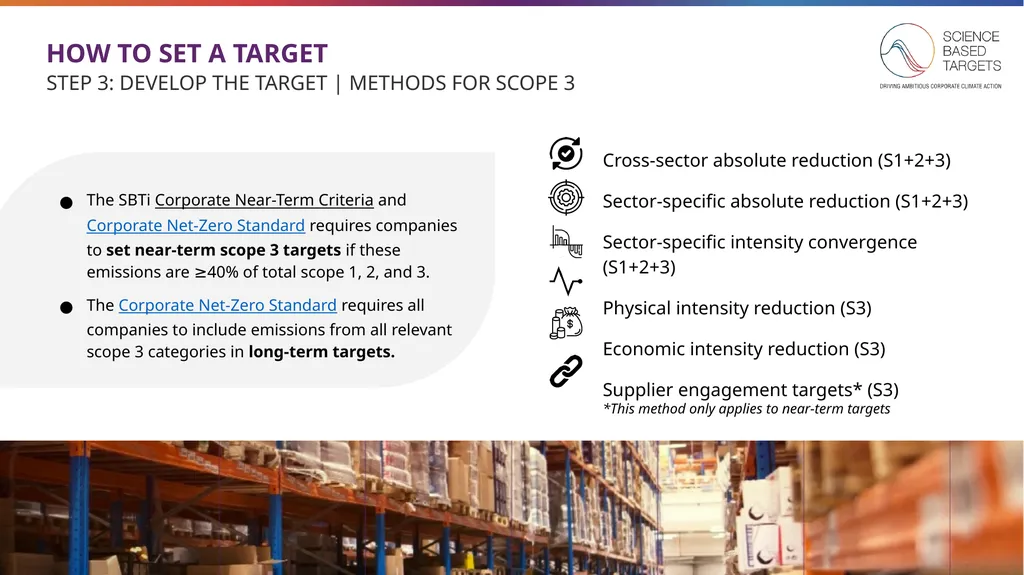
HOW TO SET A TARGET STEP 3: DEVELOP THE TARGET | METHODS FOR SCOPE 3 Cross-sector absolute reduction (S1+2+3)
Sector-specific absolute reduction (S1+2+3)
Sector-specific intensity convergence (S1+2+3)
Physical intensity reduction (S3)
Economic intensity reduction (S3)
Supplier engagement targets* (S3)
*This method only applies to near-term targets<br>
Sector-specific absolute reduction (S1+2+3)
Sector-specific intensity convergence (S1+2+3)
Physical intensity reduction (S3)
Economic intensity reduction (S3)
Supplier engagement targets* (S3)
*This method only applies to near-term targets<br>
26
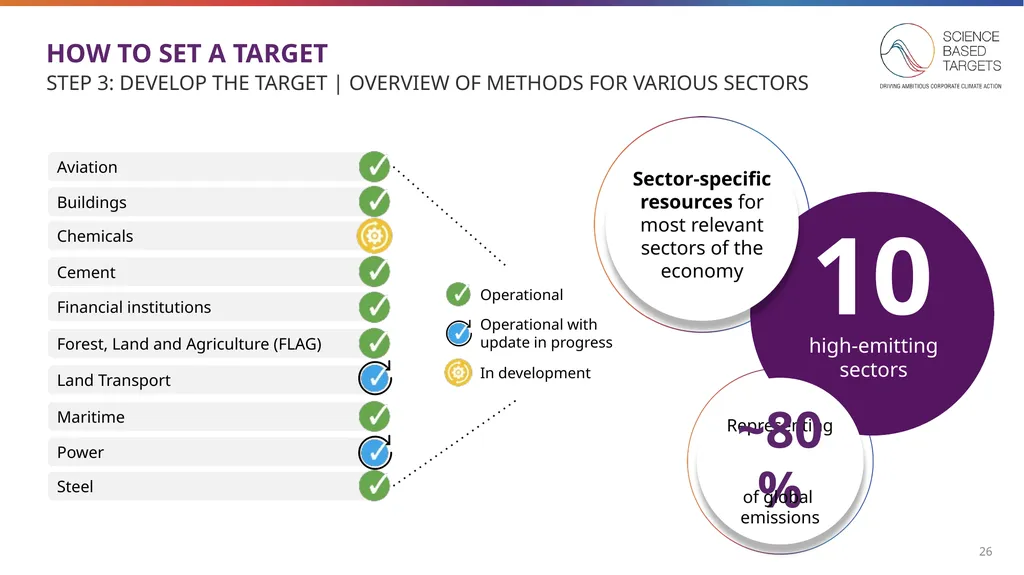
Aviation Buildings Chemicals Cement Financial institutions Forest, Land and Agriculture (FLAG) Maritime Land Transport Power Steel STEP 3: DEVELOP THE TARGET | OVERVIEW OF METHODS FOR VARIOUS SECTORS HOW TO SET A TARGET ‹#›<br>
27
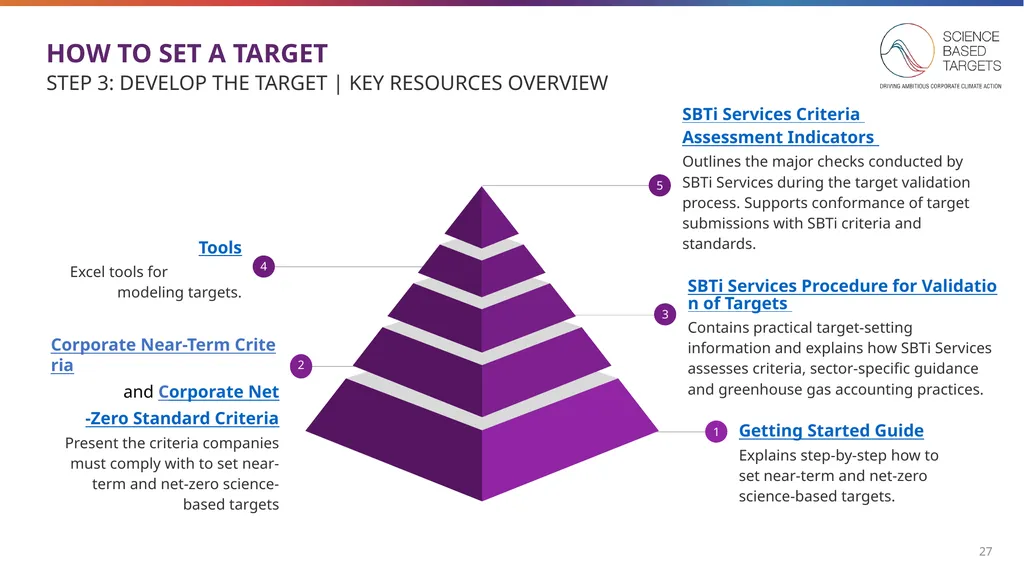
HOW TO SET A TARGET STEP 3: DEVELOP THE TARGET | KEY RESOURCES OVERVIEW<br>
28
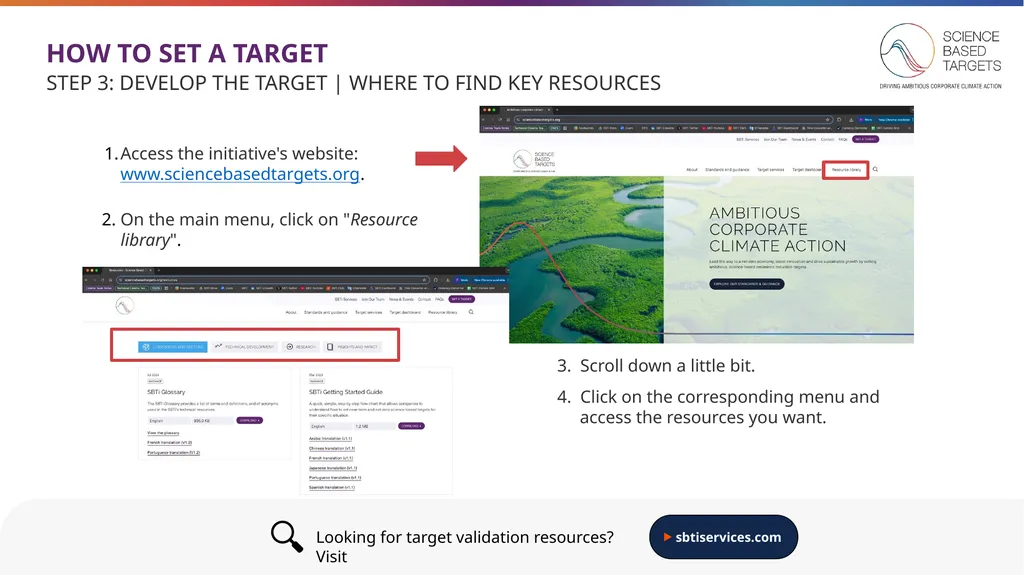
3. Scroll down a little bit.
4. Click on the corresponding menu and access the resources you want. HOW TO SET A TARGET STEP 3: DEVELOP THE TARGET | WHERE TO FIND KEY RESOURCES 2. On the main menu, click on "Resource library". Looking for target validation resources? Visit 🔍<br>
4. Click on the corresponding menu and access the resources you want. HOW TO SET A TARGET STEP 3: DEVELOP THE TARGET | WHERE TO FIND KEY RESOURCES 2. On the main menu, click on "Resource library". Looking for target validation resources? Visit 🔍<br>
29
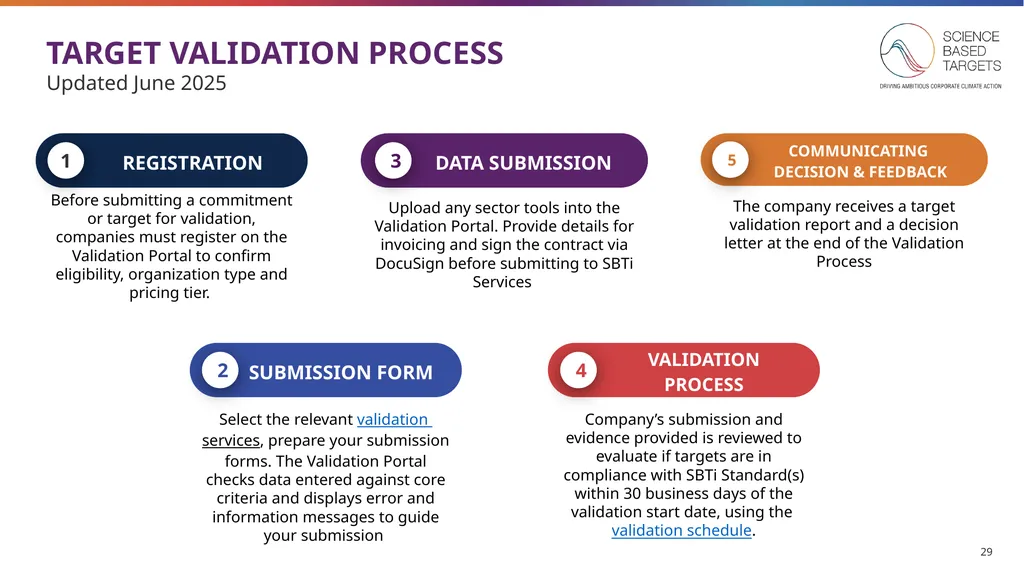
TARGET VALIDATION PROCESS Updated June 2025<br>
30
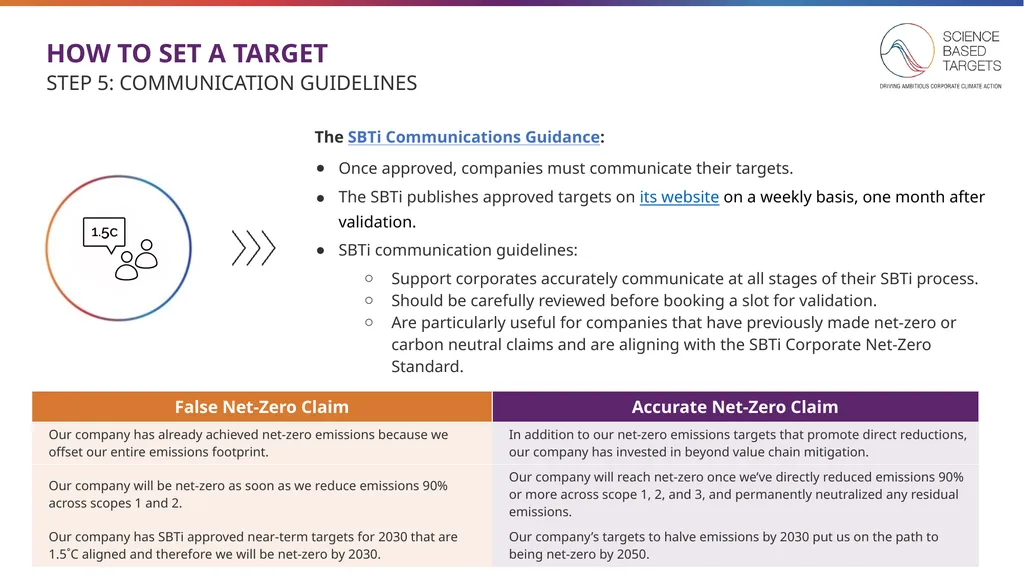
The SBTi Communications Guidance:
Once approved, companies must communicate their targets.
The SBTi publishes approved targets on its website on a weekly basis, one month after validation.
SBTi communication guidelines:
Support corporates accurately communicate at all stages of their SBTi process.
Should be carefully reviewed before booking a slot for validation.
Are particularly useful for companies that have previously made net-zero or carbon neutral claims and are aligning with the SBTi Corporate Net-Zero Standard. HOW TO SET A TARGET STEP 5: COMMUNICATION GUIDELINES<br>
31
HOW TO SET A TARGET STEP 6: DISCLOSE Companies must publicly disclose their emissions inventory and progress against their targets on an annual basis.
Recommendations include annual reports, sustainability reports, the company’s website, and/or disclosure through CDP’s annual questionnaire.
Reporting guidance can be found in Annex D of the SBTi Corporate Net-Zero Standard. ‹#›<br>
Recommendations include annual reports, sustainability reports, the company’s website, and/or disclosure through CDP’s annual questionnaire.
Reporting guidance can be found in Annex D of the SBTi Corporate Net-Zero Standard. ‹#›<br>
32
SME ROUTE:
SMALL AND MEDIUM- SIZED ENTERPRISES<br>
33
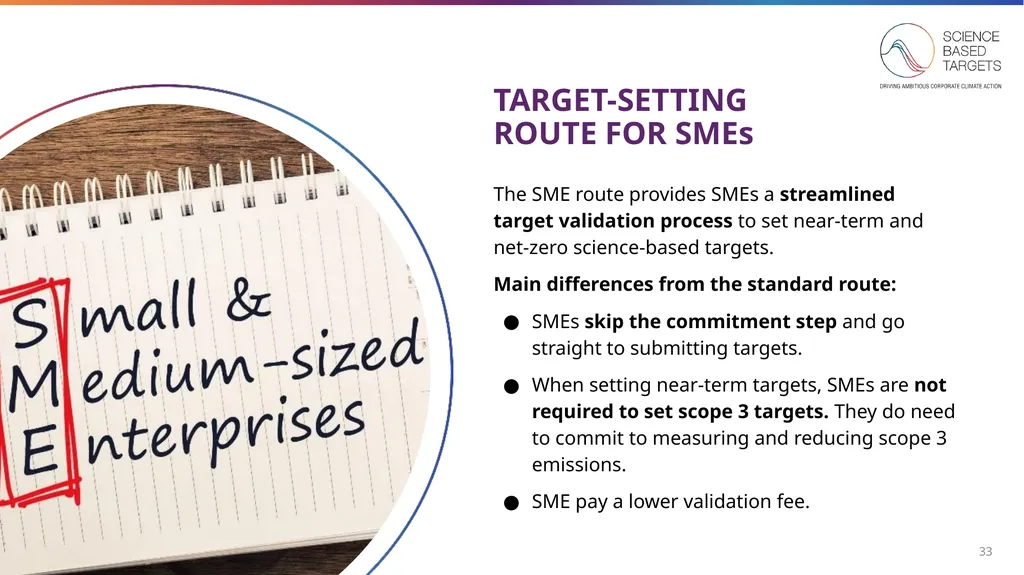
TARGET-SETTING
ROUTE FOR SMEs The SME route provides SMEs a streamlined target validation process to set near-term and net-zero science-based targets.
Main differences from the standard route:
SMEs skip the commitment step and go straight to submitting targets.
When setting near-term targets, SMEs are not required to set scope 3 targets. They do need to commit to measuring and reducing scope 3 emissions.
SME pay a lower validation fee. ‹#›<br>
34
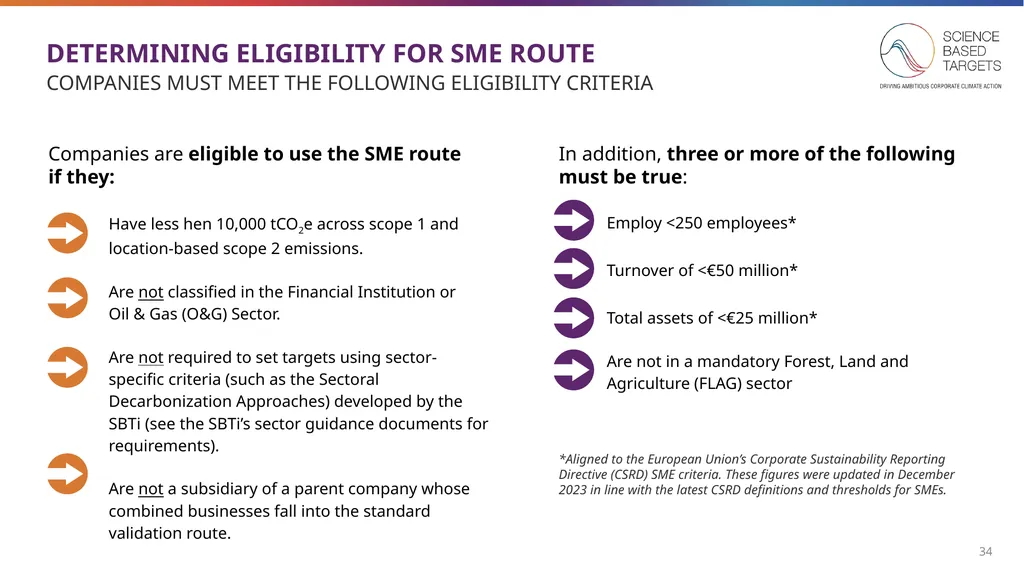
DETERMINING ELIGIBILITY FOR SME ROUTE COMPANIES MUST MEET THE FOLLOWING ELIGIBILITY CRITERIA Companies are eligible to use the SME route
if they:
Have less hen 10,000 tCO2e across scope 1 and location-based scope 2 emissions.
Are not classified in the Financial Institution or Oil & Gas (O&G) Sector.
Are not required to set targets using sector-specific criteria (such as the Sectoral Decarbonization Approaches) developed by the SBTi (see the SBTi’s sector guidance documents for requirements).
Are not a subsidiary of a parent company whose combined businesses fall into the standard validation route. In addition, three or more of the following
must be true:
Employ <250 employees*
Turnover of <€50 million*
Total assets of <€25 million*
Are not in a mandatory Forest, Land and Agriculture (FLAG) sector *Aligned to the European Union’s Corporate Sustainability Reporting Directive (CSRD) SME criteria. These figures were updated in December 2023 in line with the latest CSRD definitions and thresholds for SMEs. ‹#›<br>
35
‹#› OUR FUTURE DEPENDS ON CLIMATE ACTION Don’t let your business
fall behind. Time is running out. Set science-based targets today.<br>
fall behind. Time is running out. Set science-based targets today.<br>
36
THANK YOU<br>
37
APPENDIX<br>
38
VI. INTRODUCTION TO THE GHG PROTOCOL<br>
39
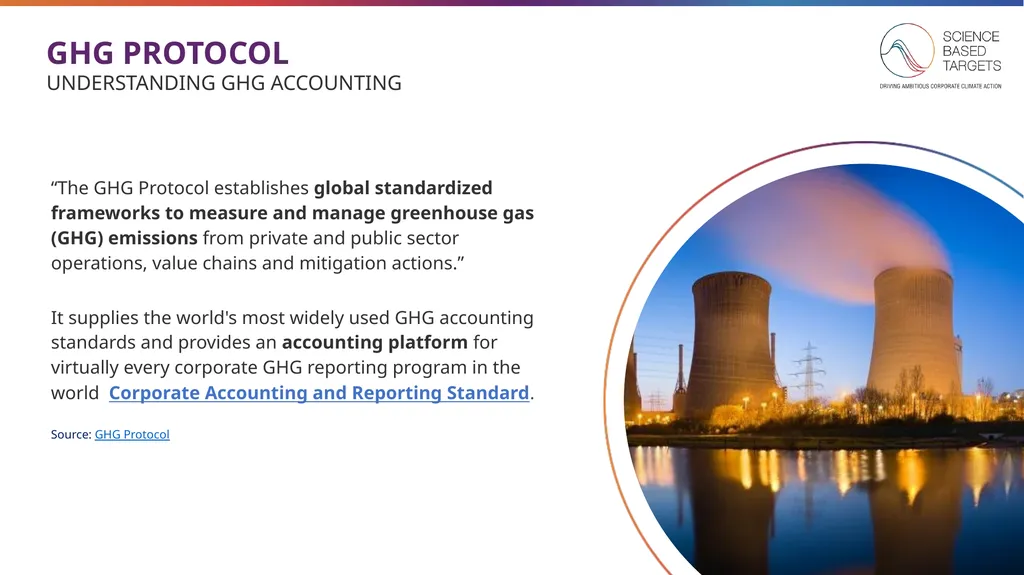
“The GHG Protocol establishes global standardized frameworks to measure and manage greenhouse gas (GHG) emissions from private and public sector operations, value chains and mitigation actions.” It supplies the world's most widely used GHG accounting standards and provides an accounting platform for virtually every corporate GHG reporting program in the world Corporate Accounting and Reporting Standard. Source: GHG Protocol GHG PROTOCOL UNDERSTANDING GHG ACCOUNTING<br>
40
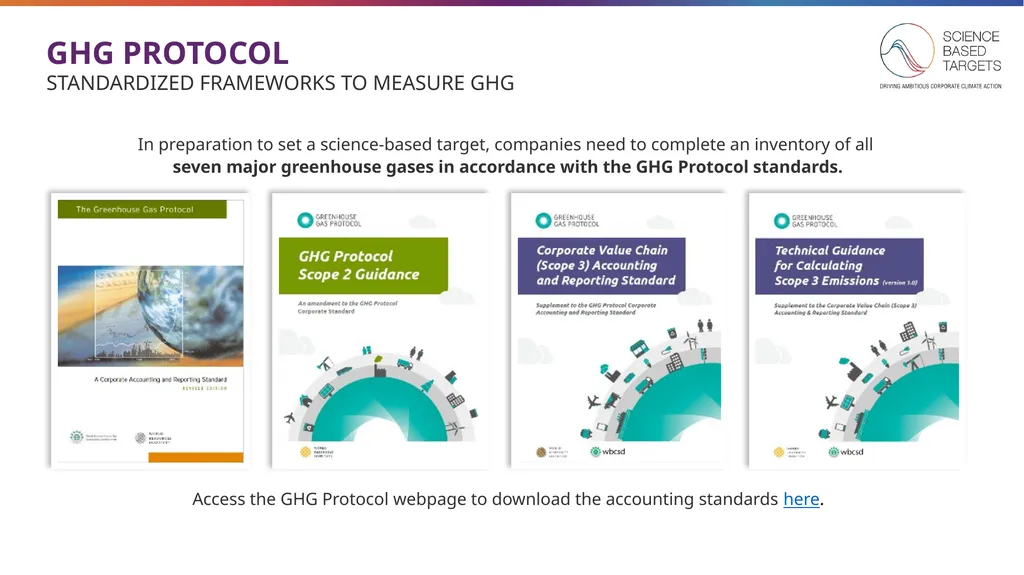
Access the GHG Protocol webpage to download the accounting standards here. In preparation to set a science-based target, companies need to complete an inventory of all
seven major greenhouse gases in accordance with the GHG Protocol standards. GHG PROTOCOL STANDARDIZED FRAMEWORKS TO MEASURE GHG<br>
seven major greenhouse gases in accordance with the GHG Protocol standards. GHG PROTOCOL STANDARDIZED FRAMEWORKS TO MEASURE GHG<br>
41
VII. SCOPES 1, 2 AND 3 ACCOUNTING<br>
42
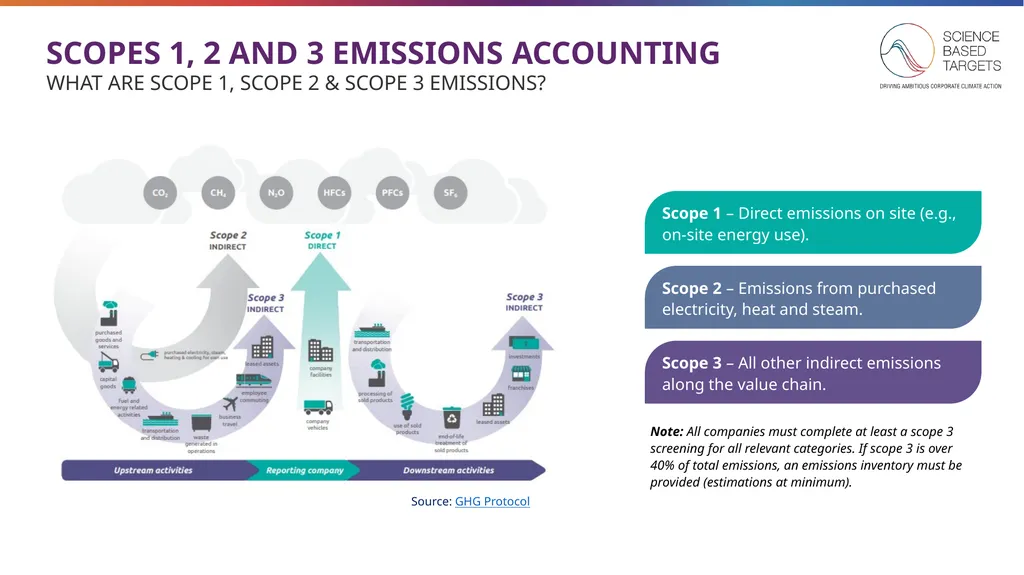
Source: GHG Protocol SCOPES 1, 2 AND 3 EMISSIONS ACCOUNTING WHAT ARE SCOPE 1, SCOPE 2 & SCOPE 3 EMISSIONS?<br>
43
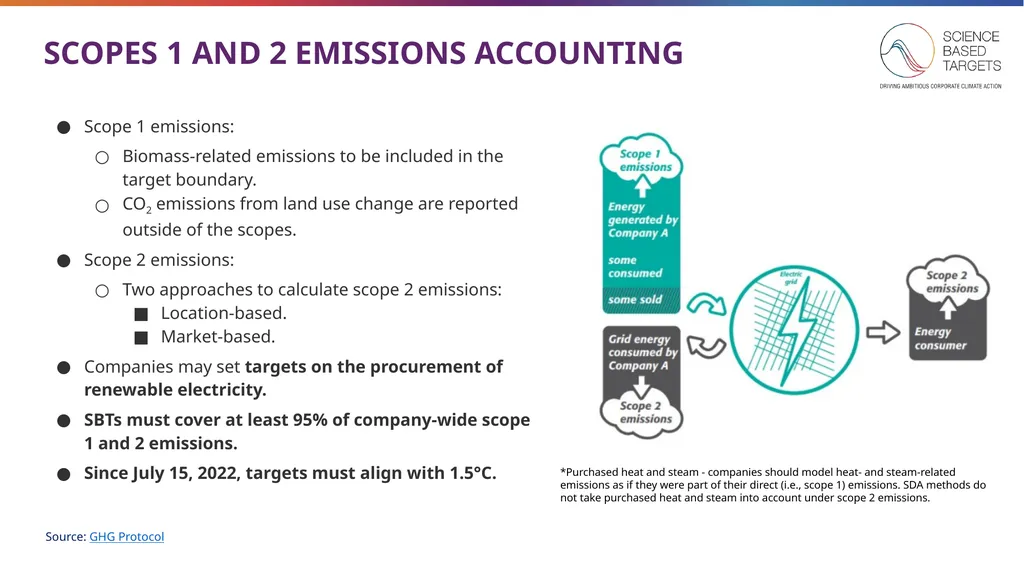
Scope 1 emissions:
Biomass-related emissions to be included in the target boundary.
CO2 emissions from land use change are reported outside of the scopes.
Scope 2 emissions:
Two approaches to calculate scope 2 emissions:
Location-based.
Market-based.
Companies may set targets on the procurement of renewable electricity.
SBTs must cover at least 95% of company-wide scope 1 and 2 emissions.
Since July 15, 2022, targets must align with 1.5°C. *Purchased heat and steam - companies should model heat- and steam-related emissions as if they were part of their direct (i.e., scope 1) emissions. SDA methods do not take purchased heat and steam into account under scope 2 emissions. Source: GHG Protocol SCOPES 1 AND 2 EMISSIONS ACCOUNTING<br>
44
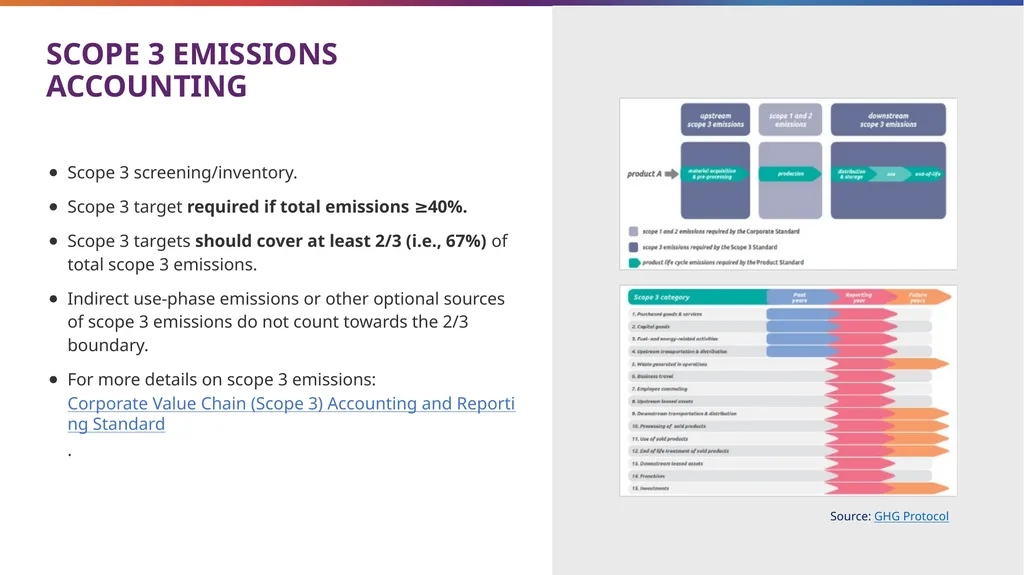
Scope 3 screening/inventory.
Scope 3 target required if total emissions ≥40%.
Scope 3 targets should cover at least 2/3 (i.e., 67%) of total scope 3 emissions.
Indirect use-phase emissions or other optional sources of scope 3 emissions do not count towards the 2/3 boundary.
For more details on scope 3 emissions: Corporate Value Chain (Scope 3) Accounting and Reporting Standard. Source: GHG Protocol SCOPE 3 EMISSIONS
ACCOUNTING<br>
45
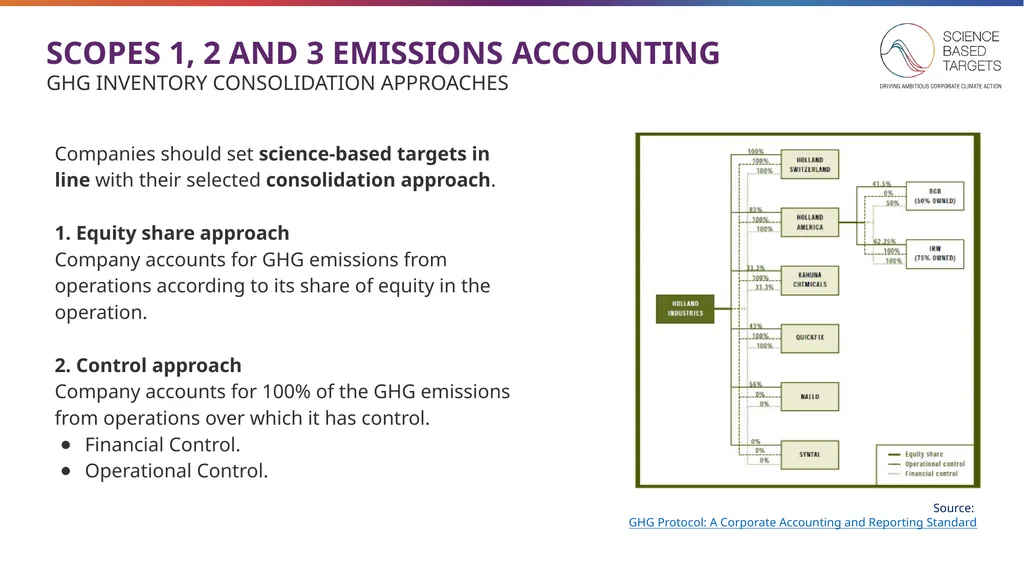
Companies should set science-based targets in line with their selected consolidation approach.
1. Equity share approach
Company accounts for GHG emissions from operations according to its share of equity in the operation.
2. Control approach
Company accounts for 100% of the GHG emissions from operations over which it has control.
Financial Control.
Operational Control. Source: GHG Protocol: A Corporate Accounting and Reporting Standard SCOPES 1, 2 AND 3 EMISSIONS ACCOUNTING GHG INVENTORY CONSOLIDATION APPROACHES<br>
46
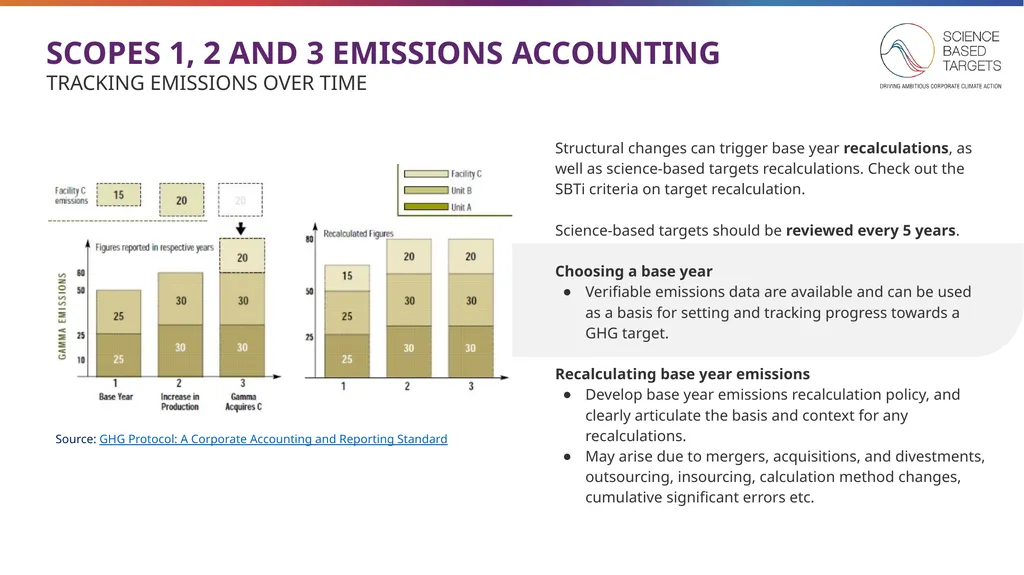
Structural changes can trigger base year recalculations, as well as science-based targets recalculations. Check out the SBTi criteria on target recalculation.
Science-based targets should be reviewed every 5 years.
Choosing a base year
Verifiable emissions data are available and can be used as a basis for setting and tracking progress towards a GHG target.
Recalculating base year emissions
Develop base year emissions recalculation policy, and clearly articulate the basis and context for any recalculations.
May arise due to mergers, acquisitions, and divestments, outsourcing, insourcing, calculation method changes, cumulative significant errors etc. Source: GHG Protocol: A Corporate Accounting and Reporting Standard SCOPES 1, 2 AND 3 EMISSIONS ACCOUNTING TRACKING EMISSIONS OVER TIME<br>
47
Visit the Greenhouse Gas Protocol webpage: www.ghgprotocol.org to learn more about the Protocol and greenhouse gas accounting standards.
You’ll find online learning solutions to get up-to-speed on the world's most widely used GHG accounting standards. SCOPES 1, 2 AND 3 EMISSIONS ACCOUNTING LEARN MORE ABOUT GHG ACCOUNTING STANDARDS<br>
You’ll find online learning solutions to get up-to-speed on the world's most widely used GHG accounting standards. SCOPES 1, 2 AND 3 EMISSIONS ACCOUNTING LEARN MORE ABOUT GHG ACCOUNTING STANDARDS<br>
48
THANK YOU!
For general information and technical queries contact us at: info@sciencebasedtargets.org<br>
For general information and technical queries contact us at: info@sciencebasedtargets.org<br>