
Abnormal Child Psychology Seventh Edition Chapter
BR
Published · 86 slides · 0 views
1 / 1


Description
Abnormal Child Psychology Seventh Edition Chapter 12 Trauma- and Stressor-Related Disorders 2019 Cengage Learning. All Rights Reserved. Introduction Trauma- and stressor-related disorders is new category in DSM-5 Includes: Acute Stress
Related Topics
Share
Embed code
Download this presentation From Below
"Abnormal Child Psychology Seventh Edition Chapter" is the property of its rightful owner. Permission is granted to download and print the materials on this website for personal, non-commercial use only, and to display it on your personal computer provided you do not modify the materials and that you retain all copyright notices contained in the materials. By downloading content from our website, you accept the terms of this agreement.
Presentation Transcript
01
Abnormal Child Psychology Seventh Edition Chapter 12
Trauma- and Stressor-Related Disorders © 2019 Cengage Learning. All Rights Reserved.<br>
Trauma- and Stressor-Related Disorders © 2019 Cengage Learning. All Rights Reserved.<br>
02
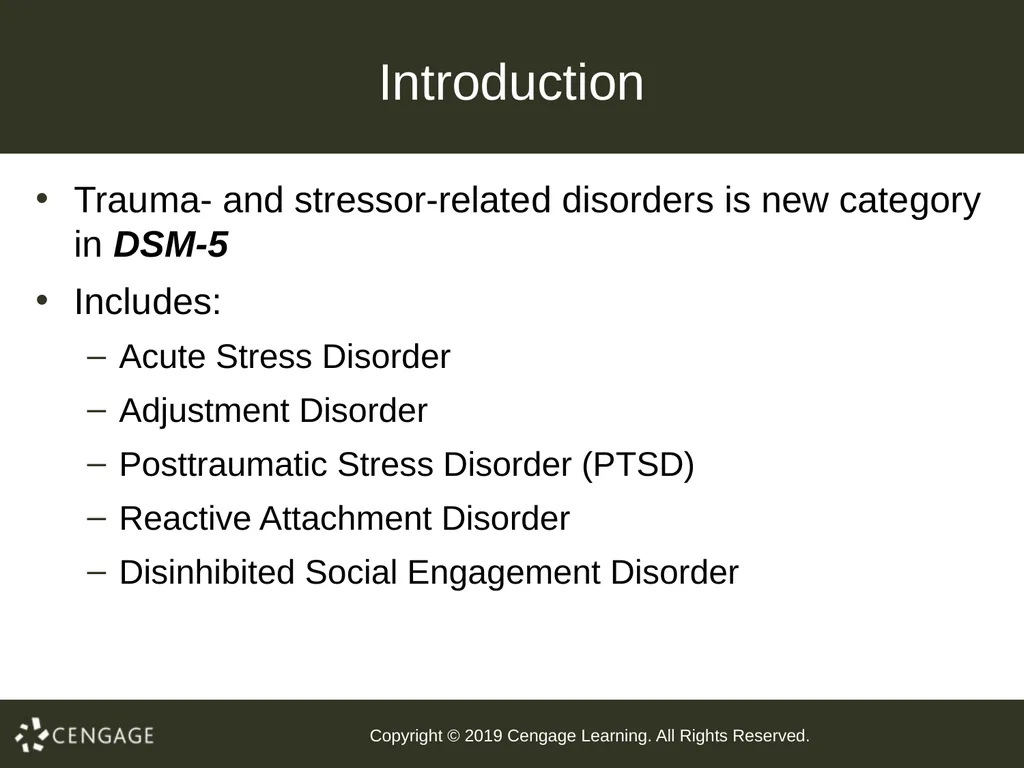
Introduction Trauma- and stressor-related disorders is new category in DSM-5
Includes:
Acute Stress Disorder
Adjustment Disorder
Posttraumatic Stress Disorder (PTSD)
Reactive Attachment Disorder
Disinhibited Social Engagement Disorder<br>
Includes:
Acute Stress Disorder
Adjustment Disorder
Posttraumatic Stress Disorder (PTSD)
Reactive Attachment Disorder
Disinhibited Social Engagement Disorder<br>
03
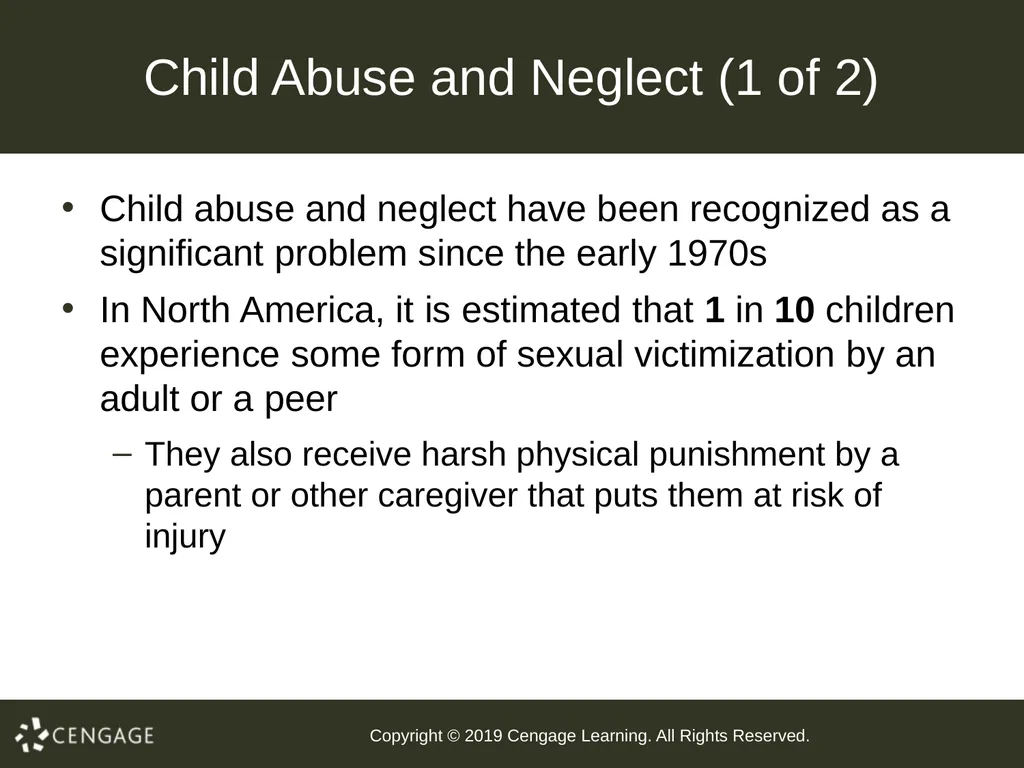
Child Abuse and Neglect (1 of 2) Child abuse and neglect have been recognized as a significant problem since the early 1970s
In North America, it is estimated that 1 in 10 children experience some form of sexual victimization by an adult or a peer
They also receive harsh physical punishment by a parent or other caregiver that puts them at risk of injury<br>
In North America, it is estimated that 1 in 10 children experience some form of sexual victimization by an adult or a peer
They also receive harsh physical punishment by a parent or other caregiver that puts them at risk of injury<br>
04
Child Abuse and Neglect (2 of 2) Four primary acts of child maltreatment
Physical abuse, neglect, sexual abuse, and emotional abuse
Non-accidental trauma
Wide-ranging effects of maltreatment on the child’s physical and emotional development
Victimization
Abuse or mistreatment of someone whose ability to protect himself or herself is limited<br>
Physical abuse, neglect, sexual abuse, and emotional abuse
Non-accidental trauma
Wide-ranging effects of maltreatment on the child’s physical and emotional development
Victimization
Abuse or mistreatment of someone whose ability to protect himself or herself is limited<br>
05
Overview Abused or neglected children face paradoxical dilemmas
The victim wants to stop the violence but also longs to belong to the family in which they are being abused
Affection and attention may coexist with violence and abuse
Violence intensity tends to increase over time, but in some cases, physical violence may decrease or stop<br>
The victim wants to stop the violence but also longs to belong to the family in which they are being abused
Affection and attention may coexist with violence and abuse
Violence intensity tends to increase over time, but in some cases, physical violence may decrease or stop<br>
06
History and Family Context (1 of 2) Major cultural traditions have condoned abuse of family members
Absolute authority over the family by the husband
Roman Law of Chastisement (753 BC)
English common law allowed “moderate and reasonable” chastisement
The right to family privacy<br>
Absolute authority over the family by the husband
Roman Law of Chastisement (753 BC)
English common law allowed “moderate and reasonable” chastisement
The right to family privacy<br>
07
History and Family Context (2 of 2) 1989 Convention on the Rights of Children
Spurred efforts to value the rights and needs of children, to recognize their exploitation and abuse in developed countries
Today, 42 countries have established an official government policy regarding child abuse and neglect<br>
Spurred efforts to value the rights and needs of children, to recognize their exploitation and abuse in developed countries
Today, 42 countries have established an official government policy regarding child abuse and neglect<br>
08
Healthy Families (1 of 2) Healthy parenting includes:
Knowledge of child development and expectations
Adequate coping skills and ways to enhance development through stimulation and attention
Normal parent-child attachment and communication<br>
Knowledge of child development and expectations
Adequate coping skills and ways to enhance development through stimulation and attention
Normal parent-child attachment and communication<br>
09
Healthy Families (2 of 2) A fundamental and expectable environment:
Requires protective and nurturing adults, as well as opportunities for socialization within a culture for infants
Includes a supportive family, peer contact, and opportunities to explore and master their environment for older children
Provides a gradual shift of control from parent to the child and the community<br>
Requires protective and nurturing adults, as well as opportunities for socialization within a culture for infants
Includes a supportive family, peer contact, and opportunities to explore and master their environment for older children
Provides a gradual shift of control from parent to the child and the community<br>
10
Healthy Parenting Home management skills
Shared parenting responsibilities
Provision of social and health services<br>
Shared parenting responsibilities
Provision of social and health services<br>
11
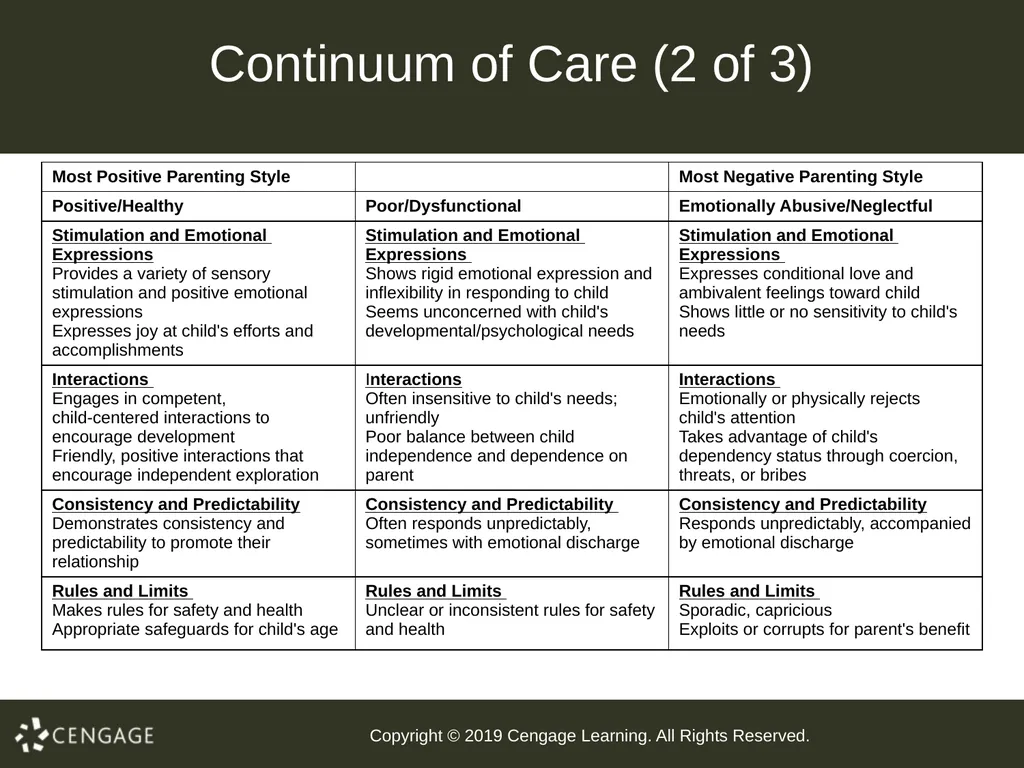
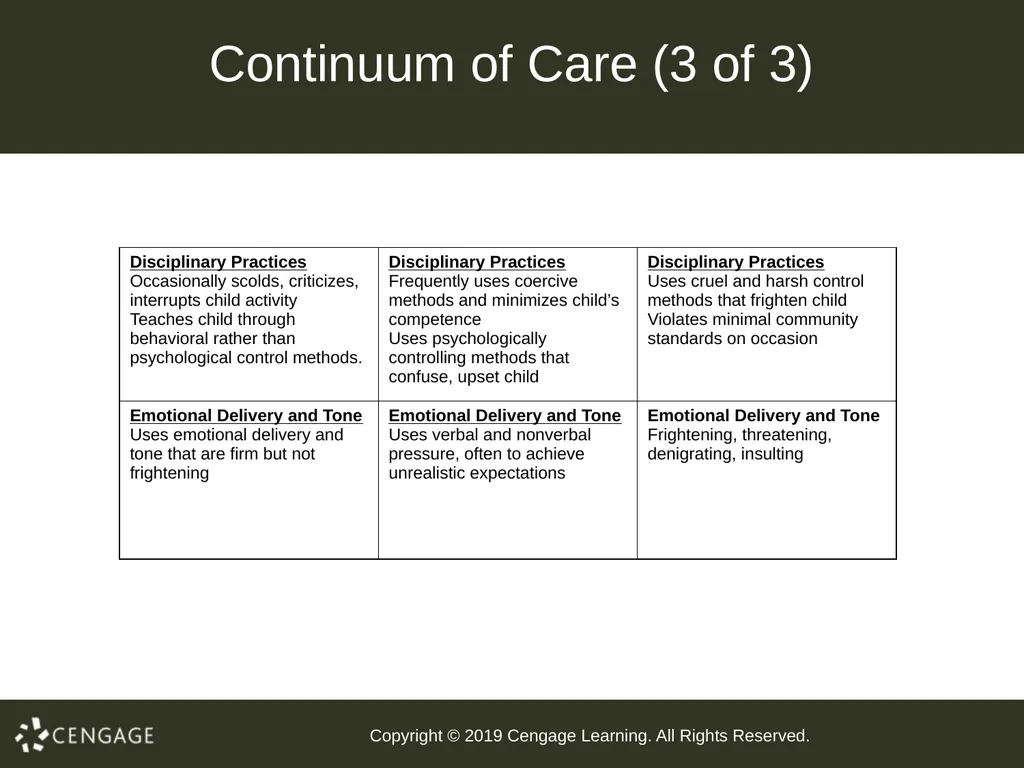
Continuum of Care (1 of 3) Child care along a continuum
Positive end: appropriate and healthy forms of child-rearing actions that promote child development
Middle range: poor/dysfunctional actions represent irresponsible and harmful child care
Negative end: parents who violate their children’s basic needs and dependency status in a physically, sexually, or emotionally intrusive or abusive manner, or by neglect<br>
Positive end: appropriate and healthy forms of child-rearing actions that promote child development
Middle range: poor/dysfunctional actions represent irresponsible and harmful child care
Negative end: parents who violate their children’s basic needs and dependency status in a physically, sexually, or emotionally intrusive or abusive manner, or by neglect<br>
12
Continuum of Care (2 of 3)<br>
13
Continuum of Care (3 of 3)<br>
14
Trauma, Stress, and Maltreatment: Defining Features DSM-5 considers some forms of child stress and maltreatment under the category “Other conditions that may be a focus of clinical attention.”
A child who was abused and also suffering from a clinical disorder (e.g., depression)
The maltreatment would be noted as part of the diagnosis in order to ensure proper treatment<br>
A child who was abused and also suffering from a clinical disorder (e.g., depression)
The maltreatment would be noted as part of the diagnosis in order to ensure proper treatment<br>
15
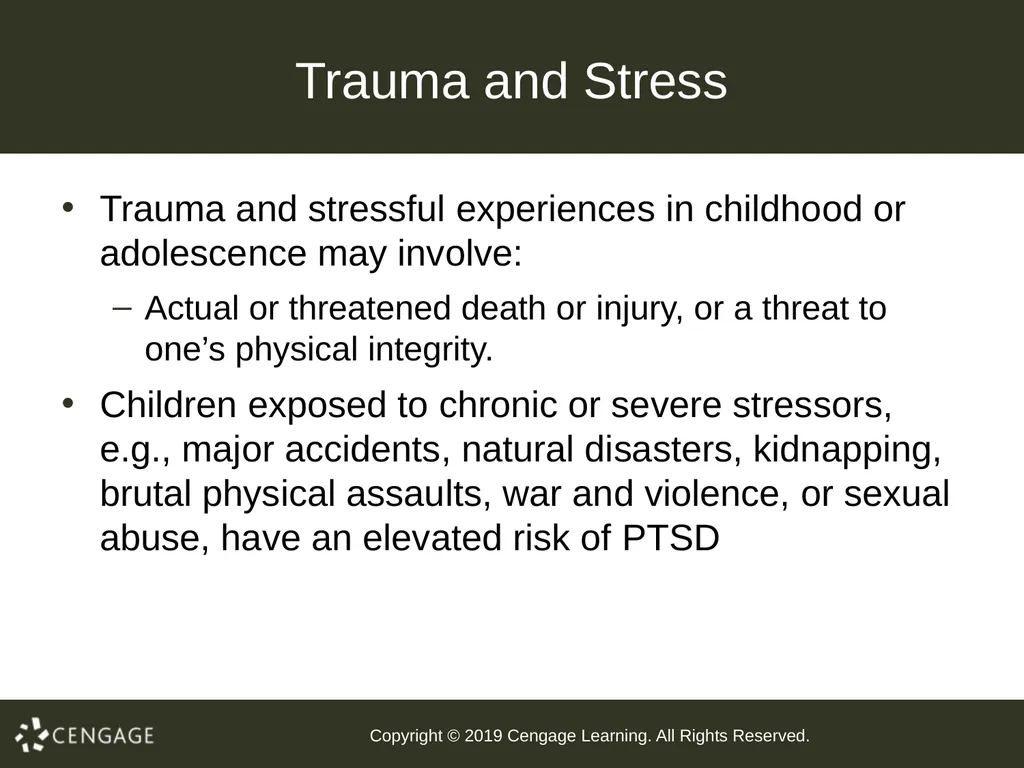
Trauma and Stress Trauma and stressful experiences in childhood or adolescence may involve:
Actual or threatened death or injury, or a threat to one’s physical integrity.
Children exposed to chronic or severe stressors, e.g., major accidents, natural disasters, kidnapping, brutal physical assaults, war and violence, or sexual abuse, have an elevated risk of PTSD<br>
Actual or threatened death or injury, or a threat to one’s physical integrity.
Children exposed to chronic or severe stressors, e.g., major accidents, natural disasters, kidnapping, brutal physical assaults, war and violence, or sexual abuse, have an elevated risk of PTSD<br>
16
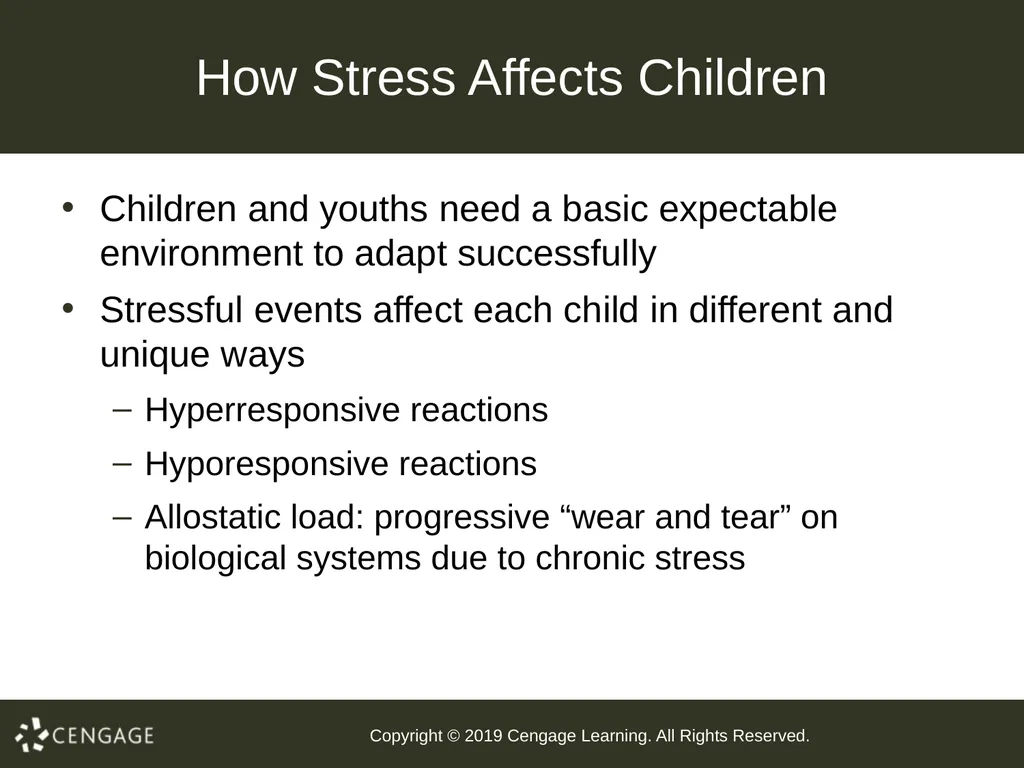
How Stress Affects Children Children and youths need a basic expectable environment to adapt successfully
Stressful events affect each child in different and unique ways
Hyperresponsive reactions
Hyporesponsive reactions
Allostatic load: progressive “wear and tear” on biological systems due to chronic stress<br>
Stressful events affect each child in different and unique ways
Hyperresponsive reactions
Hyporesponsive reactions
Allostatic load: progressive “wear and tear” on biological systems due to chronic stress<br>
17
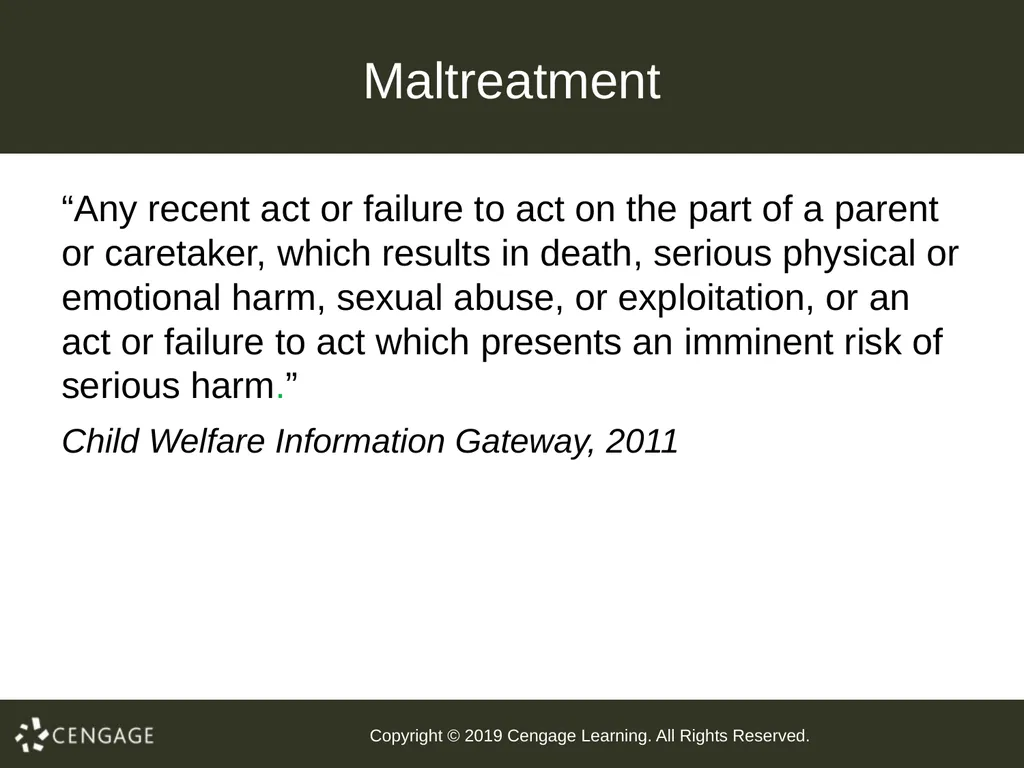
Maltreatment “Any recent act or failure to act on the part of a parent or caretaker, which results in death, serious physical or emotional harm, sexual abuse, or exploitation, or an act or failure to act which presents an imminent risk of serious harm.”
Child Welfare Information Gateway, 2011<br>
Child Welfare Information Gateway, 2011<br>
18
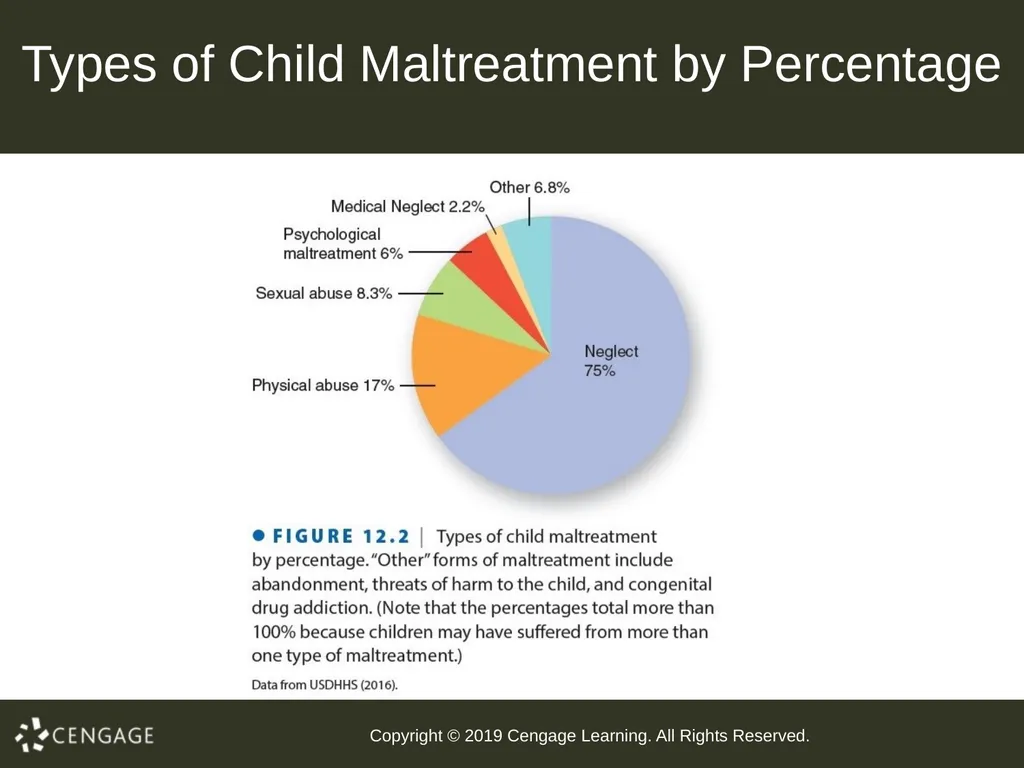
Types of Child Maltreatment by Percentage<br>
19
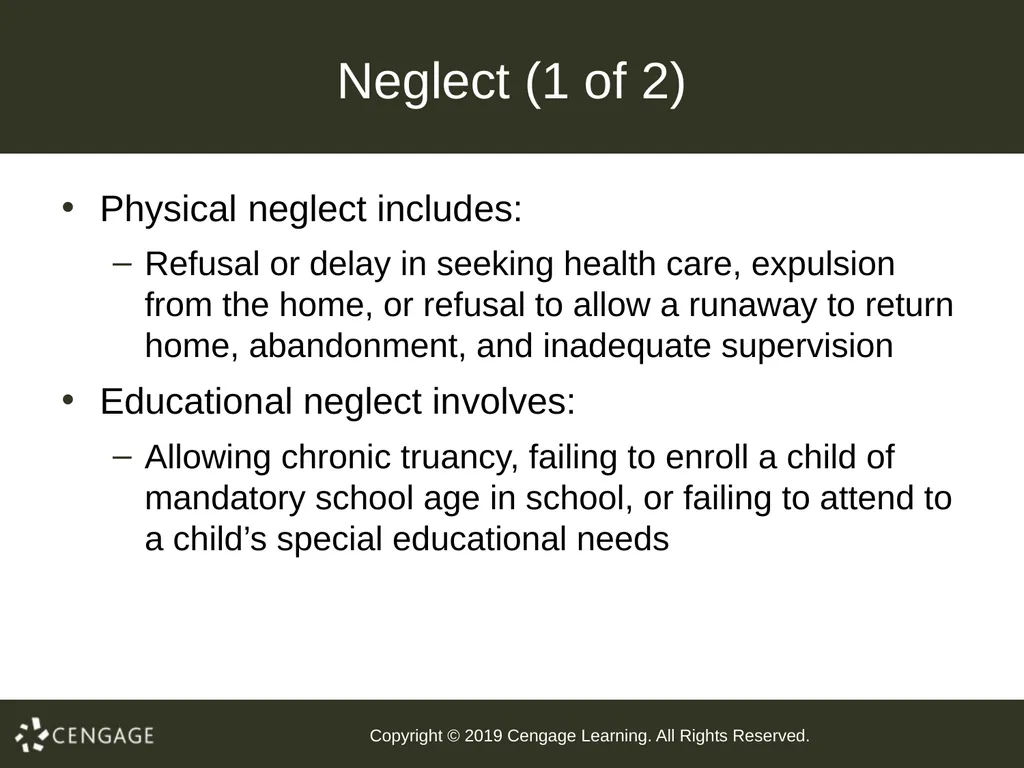
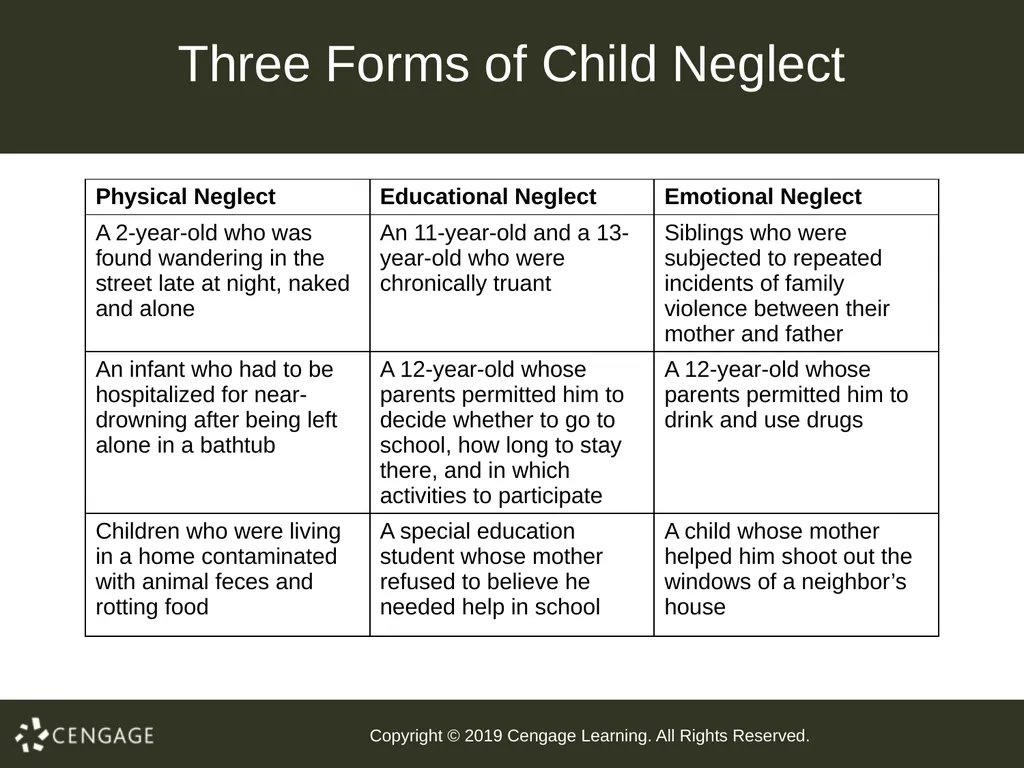
Neglect (1 of 2) Physical neglect includes:
Refusal or delay in seeking health care, expulsion from the home, or refusal to allow a runaway to return home, abandonment, and inadequate supervision
Educational neglect involves:
Allowing chronic truancy, failing to enroll a child of mandatory school age in school, or failing to attend to a child’s special educational needs<br>
Refusal or delay in seeking health care, expulsion from the home, or refusal to allow a runaway to return home, abandonment, and inadequate supervision
Educational neglect involves:
Allowing chronic truancy, failing to enroll a child of mandatory school age in school, or failing to attend to a child’s special educational needs<br>
20
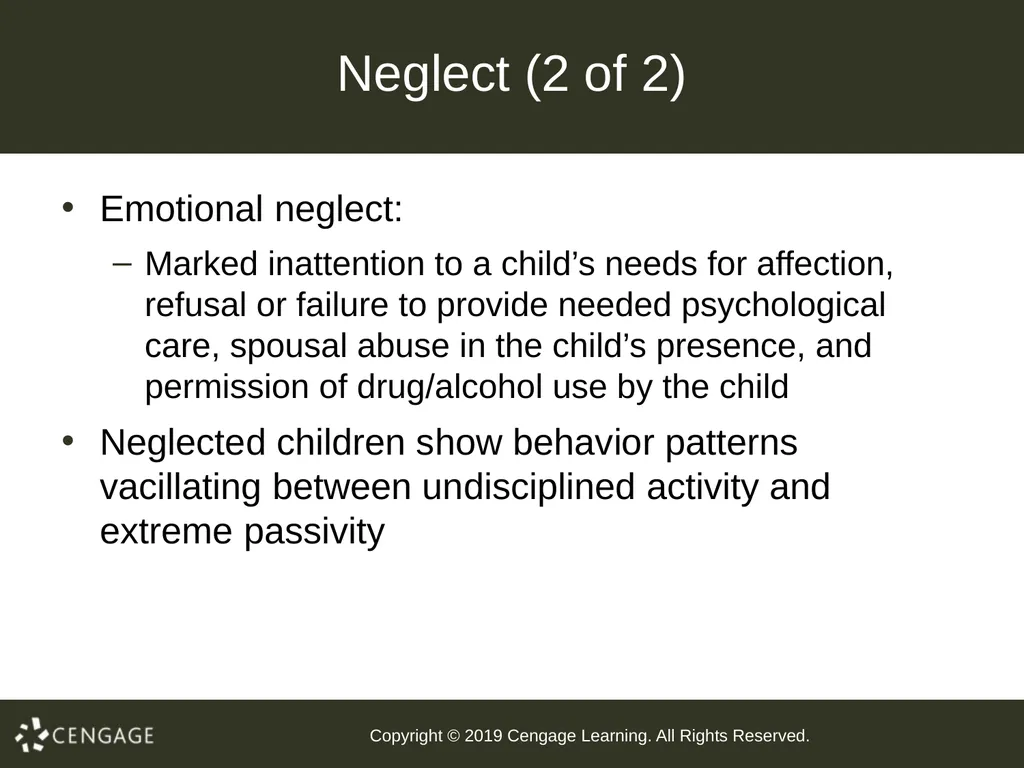
Neglect (2 of 2) Emotional neglect:
Marked inattention to a child’s needs for affection, refusal or failure to provide needed psychological care, spousal abuse in the child’s presence, and permission of drug/alcohol use by the child
Neglected children show behavior patterns vacillating between undisciplined activity and extreme passivity<br>
Marked inattention to a child’s needs for affection, refusal or failure to provide needed psychological care, spousal abuse in the child’s presence, and permission of drug/alcohol use by the child
Neglected children show behavior patterns vacillating between undisciplined activity and extreme passivity<br>
21
Three Forms of Child Neglect<br>
22
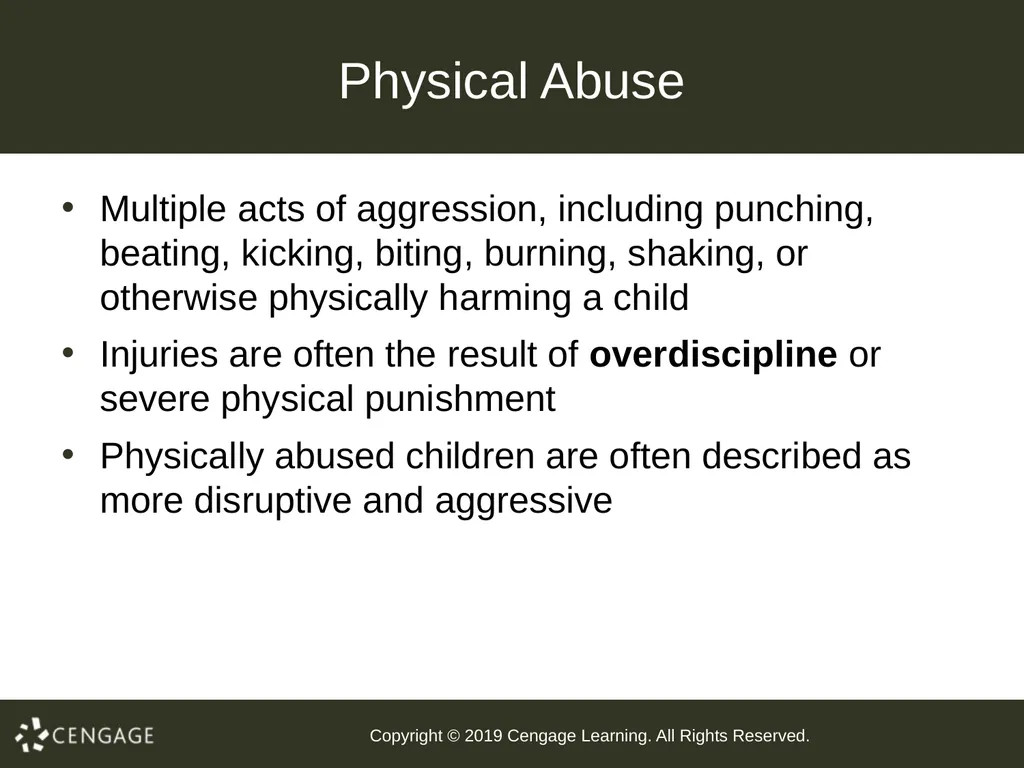
Physical Abuse Multiple acts of aggression, including punching, beating, kicking, biting, burning, shaking, or otherwise physically harming a child
Injuries are often the result of overdiscipline or severe physical punishment
Physically abused children are often described as more disruptive and aggressive<br>
Injuries are often the result of overdiscipline or severe physical punishment
Physically abused children are often described as more disruptive and aggressive<br>
23
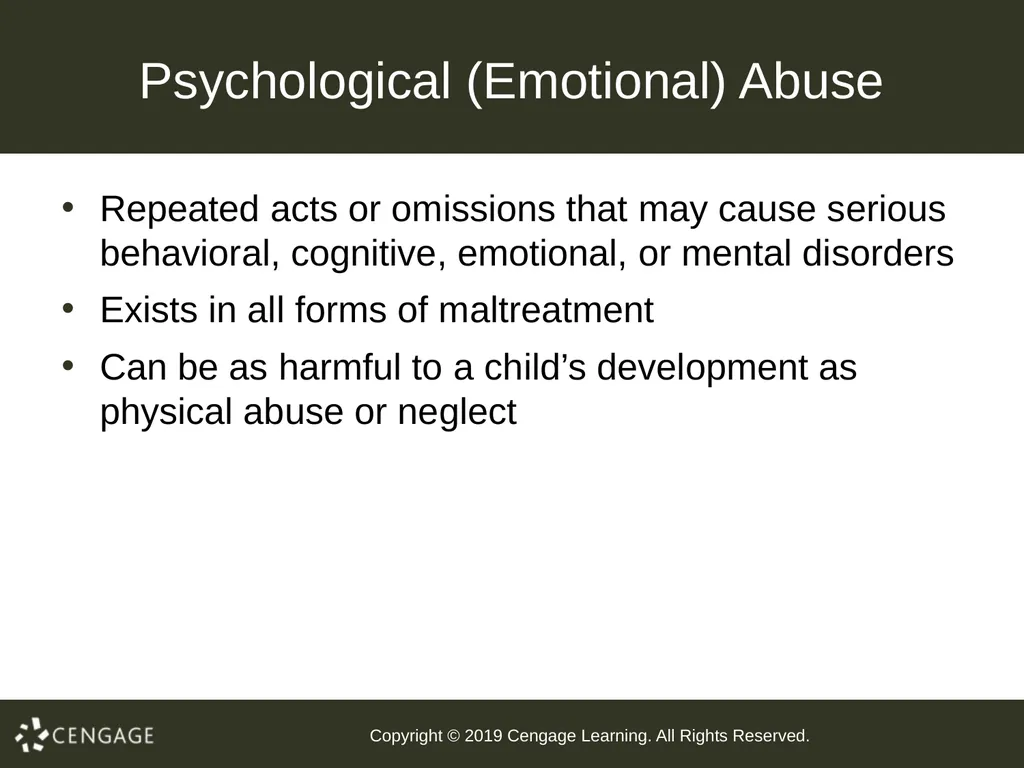
Psychological (Emotional) Abuse Repeated acts or omissions that may cause serious behavioral, cognitive, emotional, or mental disorders
Exists in all forms of maltreatment
Can be as harmful to a child’s development as physical abuse or neglect<br>
Exists in all forms of maltreatment
Can be as harmful to a child’s development as physical abuse or neglect<br>
24
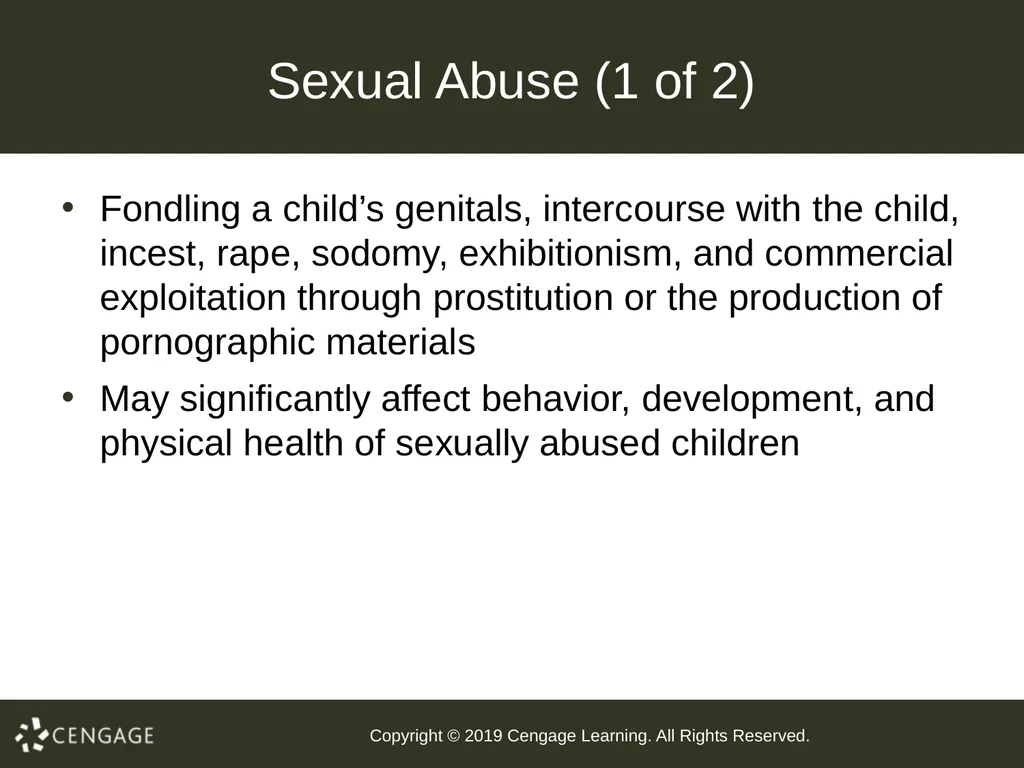
Sexual Abuse (1 of 2) Fondling a child’s genitals, intercourse with the child, incest, rape, sodomy, exhibitionism, and commercial exploitation through prostitution or the production of pornographic materials
May significantly affect behavior, development, and physical health of sexually abused children<br>
May significantly affect behavior, development, and physical health of sexually abused children<br>
25
Sexual Abuse (2 of 2) Reactions and recovery of sexually abused children vary, depending on the nature of the assault and responses of important others
Many acute symptoms resemble children’s common reactions to stress<br>
Many acute symptoms resemble children’s common reactions to stress<br>
26
Exploitation Commercial or sexual exploitation, such as child labor and child prostitution
Significant form of trauma for children and adolescents worldwide
As many as 10 million children may be victims of child prostitution, the sex industry, sex tourism, and pornography<br>
Significant form of trauma for children and adolescents worldwide
As many as 10 million children may be victims of child prostitution, the sex industry, sex tourism, and pornography<br>
27
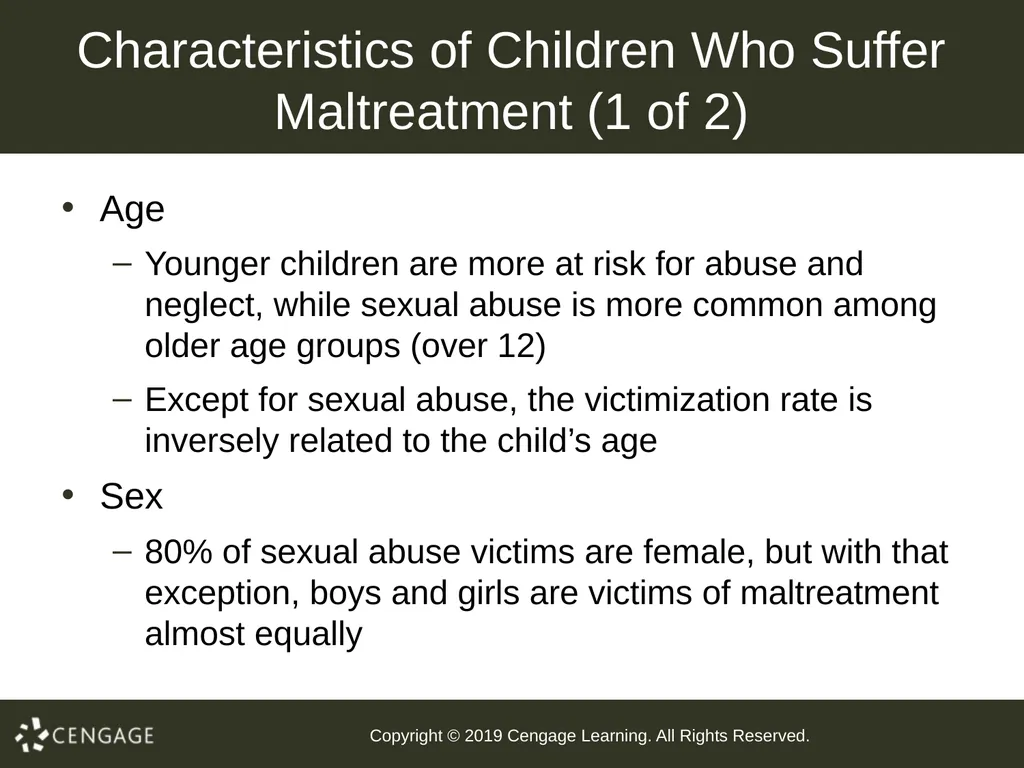
Characteristics of Children Who Suffer Maltreatment (1 of 2) Age
Younger children are more at risk for abuse and neglect, while sexual abuse is more common among older age groups (over 12)
Except for sexual abuse, the victimization rate is inversely related to the child’s age
Sex
80% of sexual abuse victims are female, but with that exception, boys and girls are victims of maltreatment almost equally<br>
Younger children are more at risk for abuse and neglect, while sexual abuse is more common among older age groups (over 12)
Except for sexual abuse, the victimization rate is inversely related to the child’s age
Sex
80% of sexual abuse victims are female, but with that exception, boys and girls are victims of maltreatment almost equally<br>
28
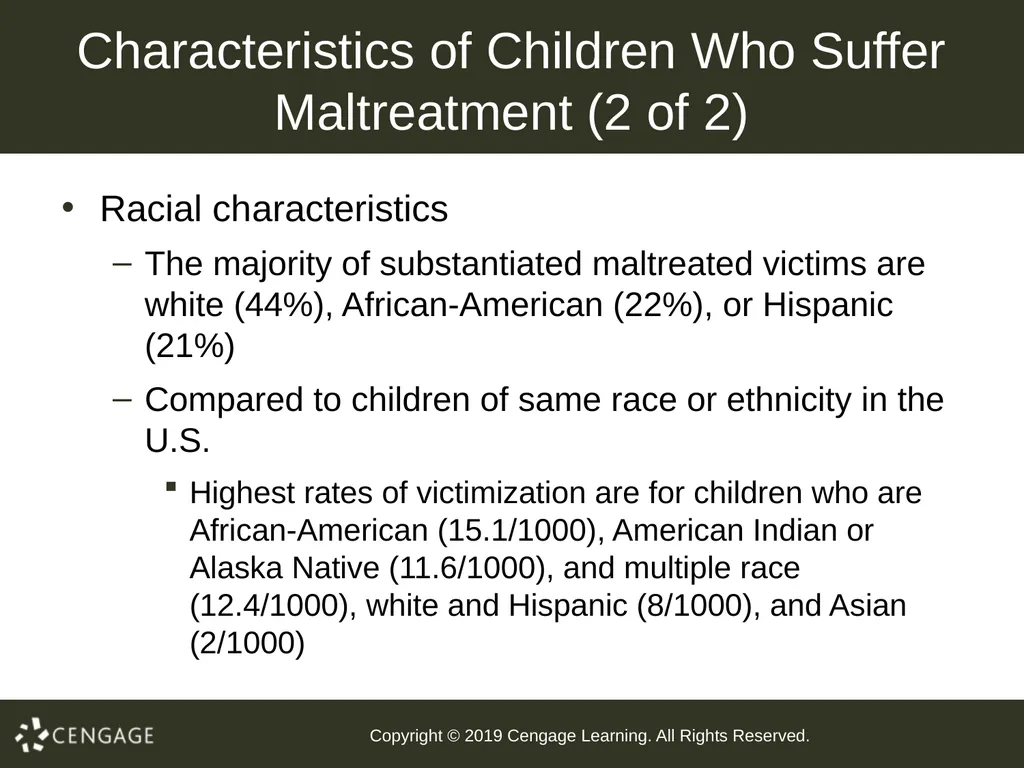
Characteristics of Children Who Suffer Maltreatment (2 of 2) Racial characteristics
The majority of substantiated maltreated victims are white (44%), African-American (22%), or Hispanic (21%)
Compared to children of same race or ethnicity in the U.S.
Highest rates of victimization are for children who are African-American (15.1/1000), American Indian or Alaska Native (11.6/1000), and multiple race (12.4/1000), white and Hispanic (8/1000), and Asian (2/1000)<br>
The majority of substantiated maltreated victims are white (44%), African-American (22%), or Hispanic (21%)
Compared to children of same race or ethnicity in the U.S.
Highest rates of victimization are for children who are African-American (15.1/1000), American Indian or Alaska Native (11.6/1000), and multiple race (12.4/1000), white and Hispanic (8/1000), and Asian (2/1000)<br>
29
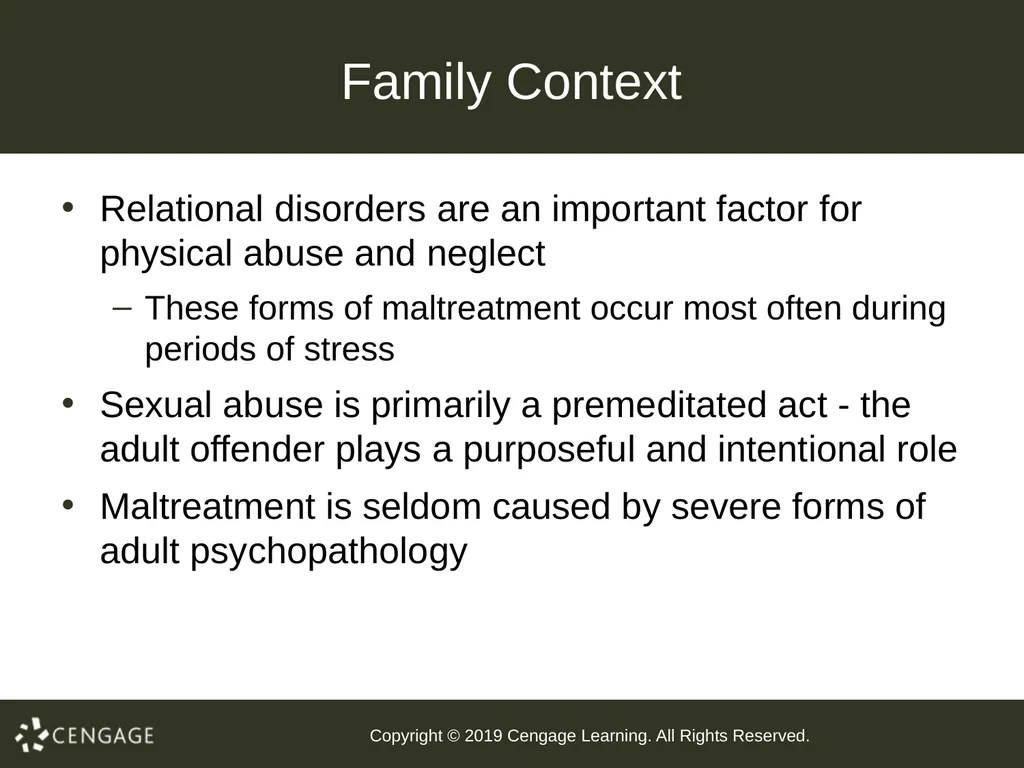
Family Context Relational disorders are an important factor for physical abuse and neglect
These forms of maltreatment occur most often during periods of stress
Sexual abuse is primarily a premeditated act - the adult offender plays a purposeful and intentional role
Maltreatment is seldom caused by severe forms of adult psychopathology<br>
These forms of maltreatment occur most often during periods of stress
Sexual abuse is primarily a premeditated act - the adult offender plays a purposeful and intentional role
Maltreatment is seldom caused by severe forms of adult psychopathology<br>
30
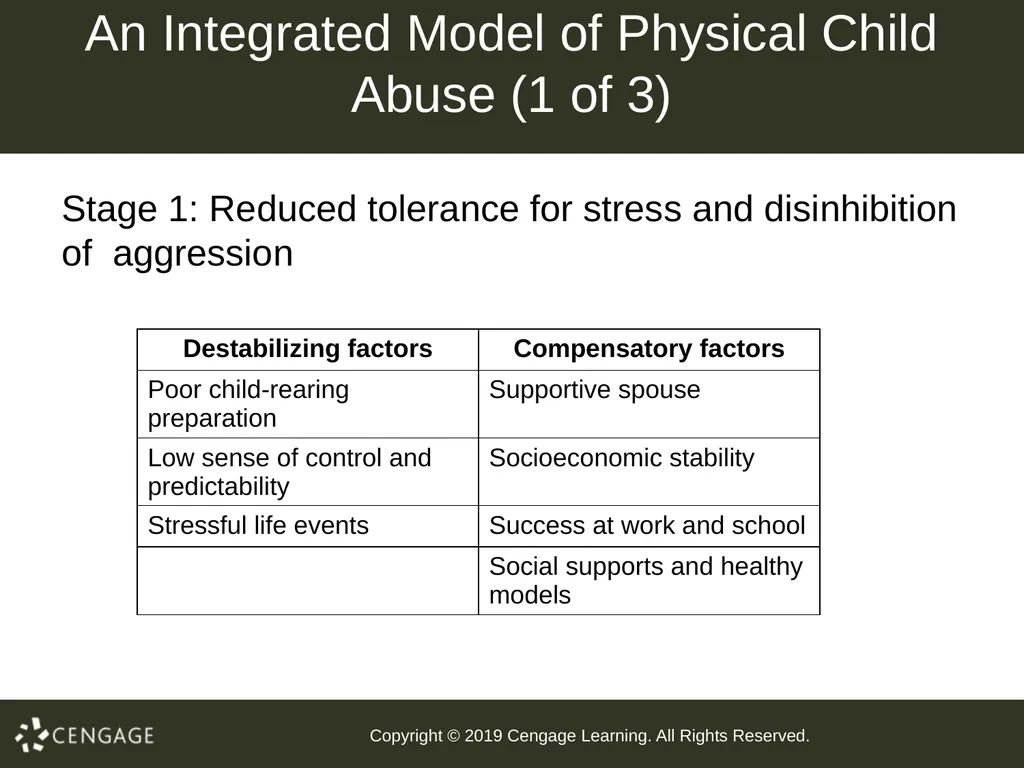
An Integrated Model of Physical Child Abuse (1 of 3) Stage 1: Reduced tolerance for stress and disinhibition of aggression<br>
31
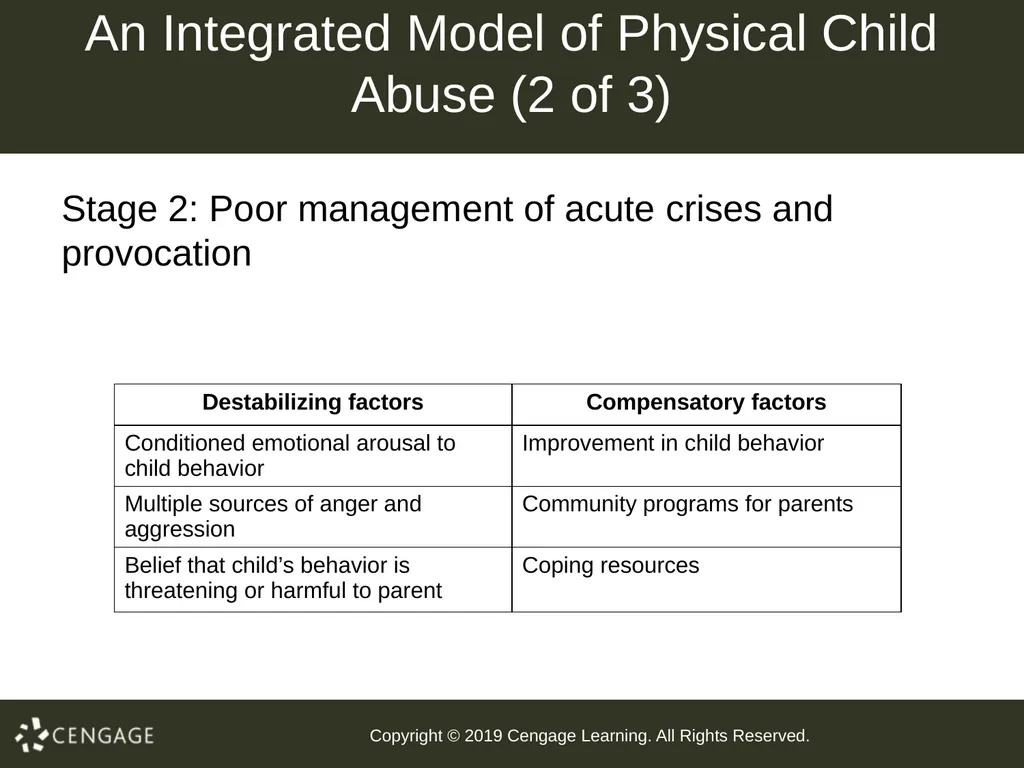
An Integrated Model of Physical Child Abuse (2 of 3) Stage 2: Poor management of acute crises and provocation<br>
32
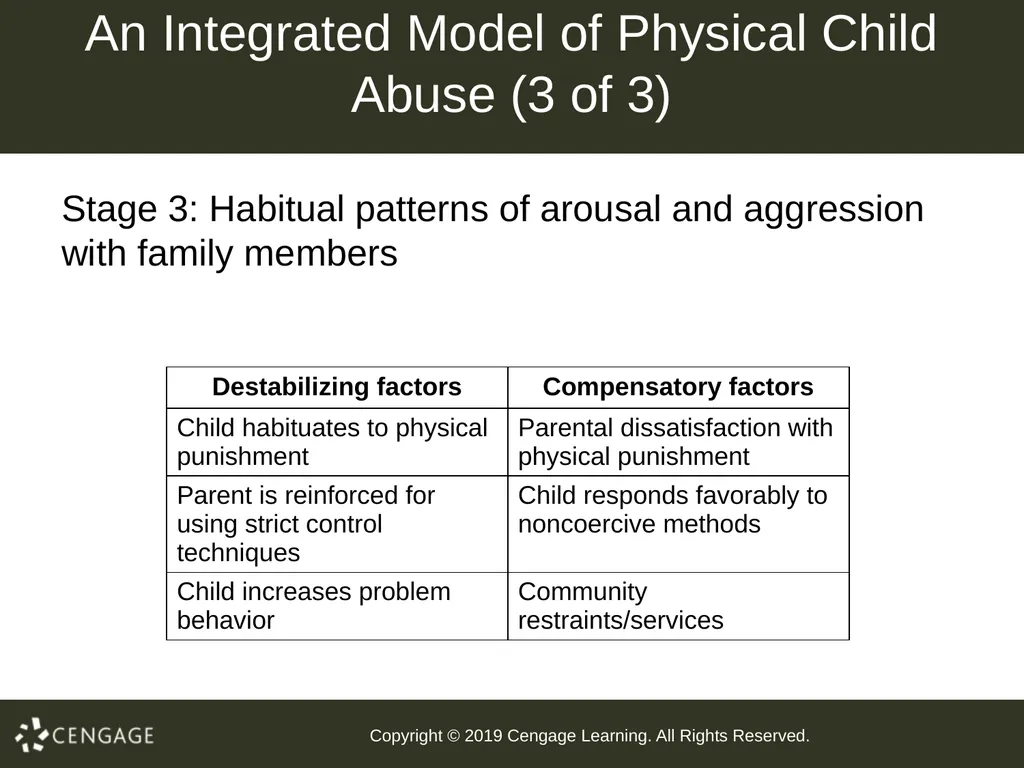
An Integrated Model of Physical Child Abuse (3 of 3) Stage 3: Habitual patterns of arousal and aggression with family members<br>
33
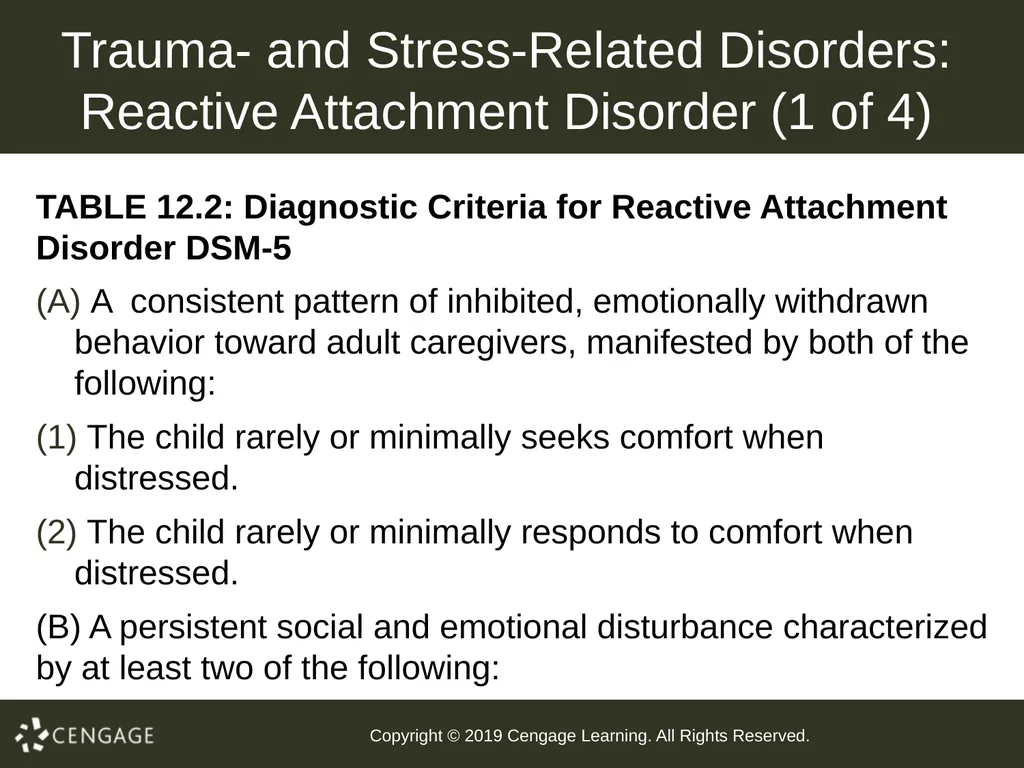
Trauma- and Stress-Related Disorders: Reactive Attachment Disorder (1 of 4) TABLE 12.2: Diagnostic Criteria for Reactive Attachment Disorder DSM-5
A consistent pattern of inhibited, emotionally withdrawn behavior toward adult caregivers, manifested by both of the following:
The child rarely or minimally seeks comfort when distressed.
The child rarely or minimally responds to comfort when distressed.
(B) A persistent social and emotional disturbance characterized by at least two of the following:<br>
A consistent pattern of inhibited, emotionally withdrawn behavior toward adult caregivers, manifested by both of the following:
The child rarely or minimally seeks comfort when distressed.
The child rarely or minimally responds to comfort when distressed.
(B) A persistent social and emotional disturbance characterized by at least two of the following:<br>
34
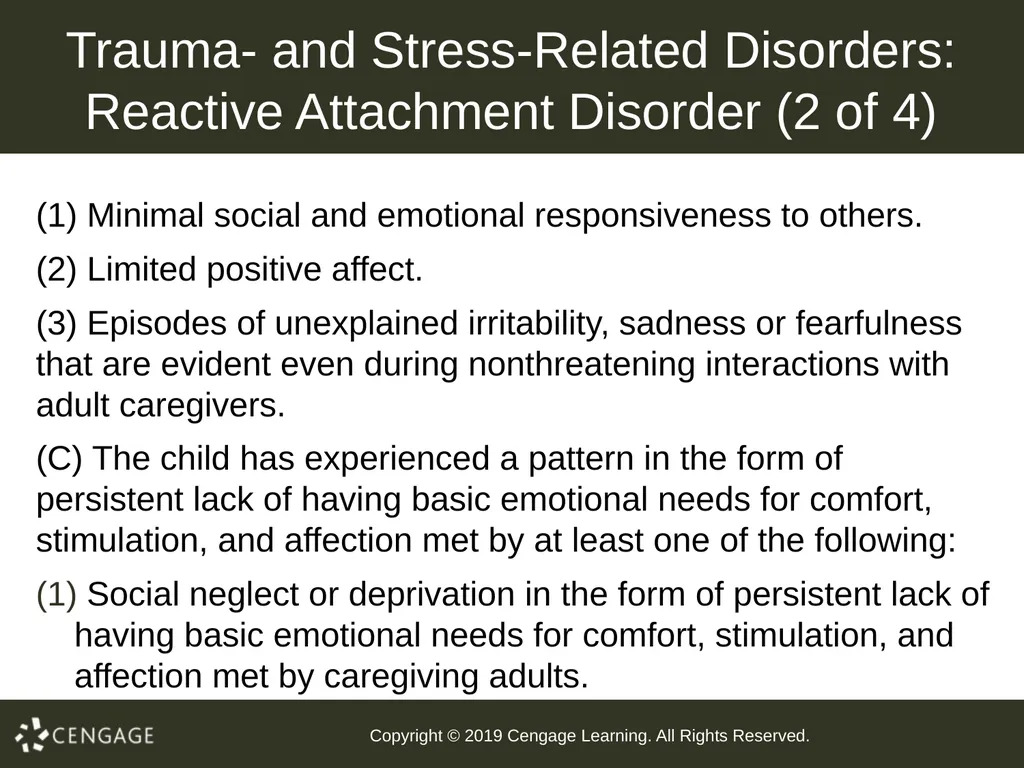
Trauma- and Stress-Related Disorders: Reactive Attachment Disorder (2 of 4) (1) Minimal social and emotional responsiveness to others.
(2) Limited positive affect.
(3) Episodes of unexplained irritability, sadness or fearfulness that are evident even during nonthreatening interactions with adult caregivers.
(C) The child has experienced a pattern in the form of persistent lack of having basic emotional needs for comfort, stimulation, and affection met by at least one of the following:
Social neglect or deprivation in the form of persistent lack of having basic emotional needs for comfort, stimulation, and affection met by caregiving adults.<br>
(2) Limited positive affect.
(3) Episodes of unexplained irritability, sadness or fearfulness that are evident even during nonthreatening interactions with adult caregivers.
(C) The child has experienced a pattern in the form of persistent lack of having basic emotional needs for comfort, stimulation, and affection met by at least one of the following:
Social neglect or deprivation in the form of persistent lack of having basic emotional needs for comfort, stimulation, and affection met by caregiving adults.<br>
35
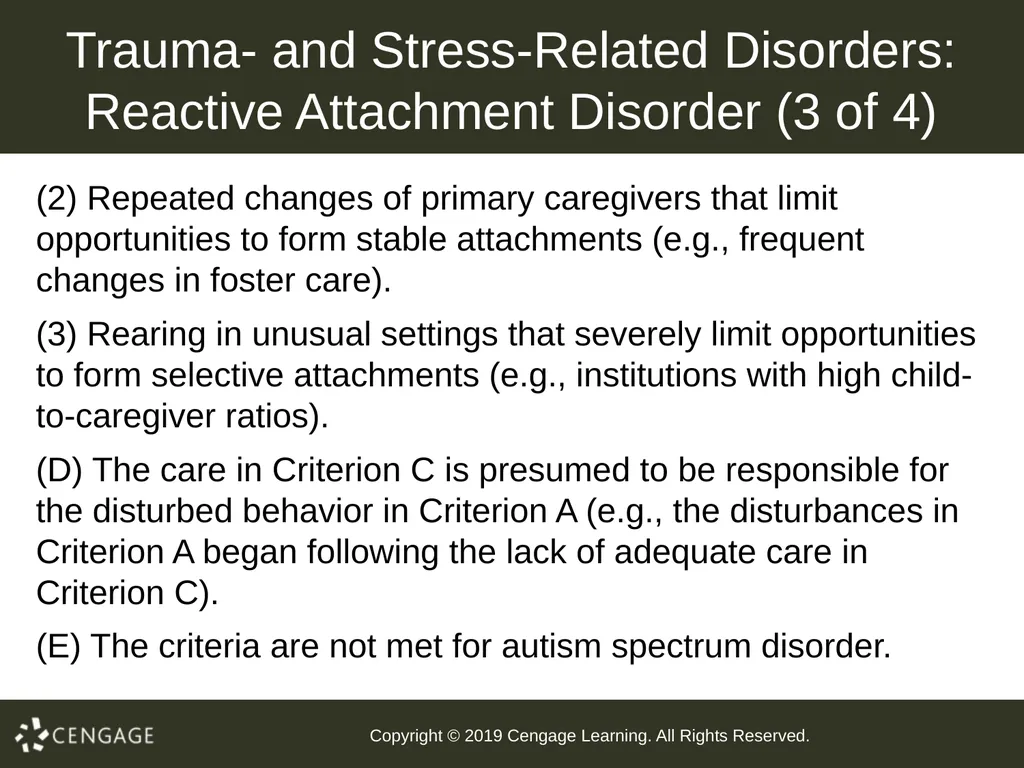
Trauma- and Stress-Related Disorders: Reactive Attachment Disorder (3 of 4) (2) Repeated changes of primary caregivers that limit opportunities to form stable attachments (e.g., frequent changes in foster care).
(3) Rearing in unusual settings that severely limit opportunities to form selective attachments (e.g., institutions with high child-to-caregiver ratios).
(D) The care in Criterion C is presumed to be responsible for the disturbed behavior in Criterion A (e.g., the disturbances in Criterion A began following the lack of adequate care in Criterion C).
(E) The criteria are not met for autism spectrum disorder.<br>
(3) Rearing in unusual settings that severely limit opportunities to form selective attachments (e.g., institutions with high child-to-caregiver ratios).
(D) The care in Criterion C is presumed to be responsible for the disturbed behavior in Criterion A (e.g., the disturbances in Criterion A began following the lack of adequate care in Criterion C).
(E) The criteria are not met for autism spectrum disorder.<br>
36
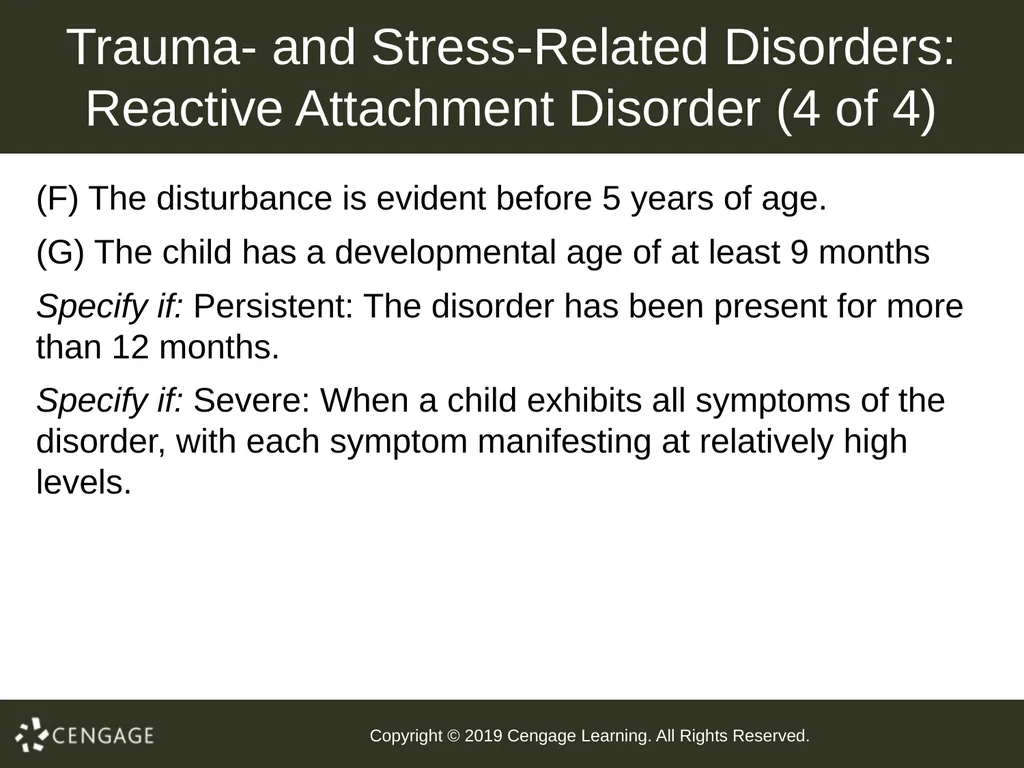
Trauma- and Stress-Related Disorders: Reactive Attachment Disorder (4 of 4) (F) The disturbance is evident before 5 years of age.
(G) The child has a developmental age of at least 9 months
Specify if: Persistent: The disorder has been present for more than 12 months.
Specify if: Severe: When a child exhibits all symptoms of the disorder, with each symptom manifesting at relatively high levels.<br>
(G) The child has a developmental age of at least 9 months
Specify if: Persistent: The disorder has been present for more than 12 months.
Specify if: Severe: When a child exhibits all symptoms of the disorder, with each symptom manifesting at relatively high levels.<br>
37
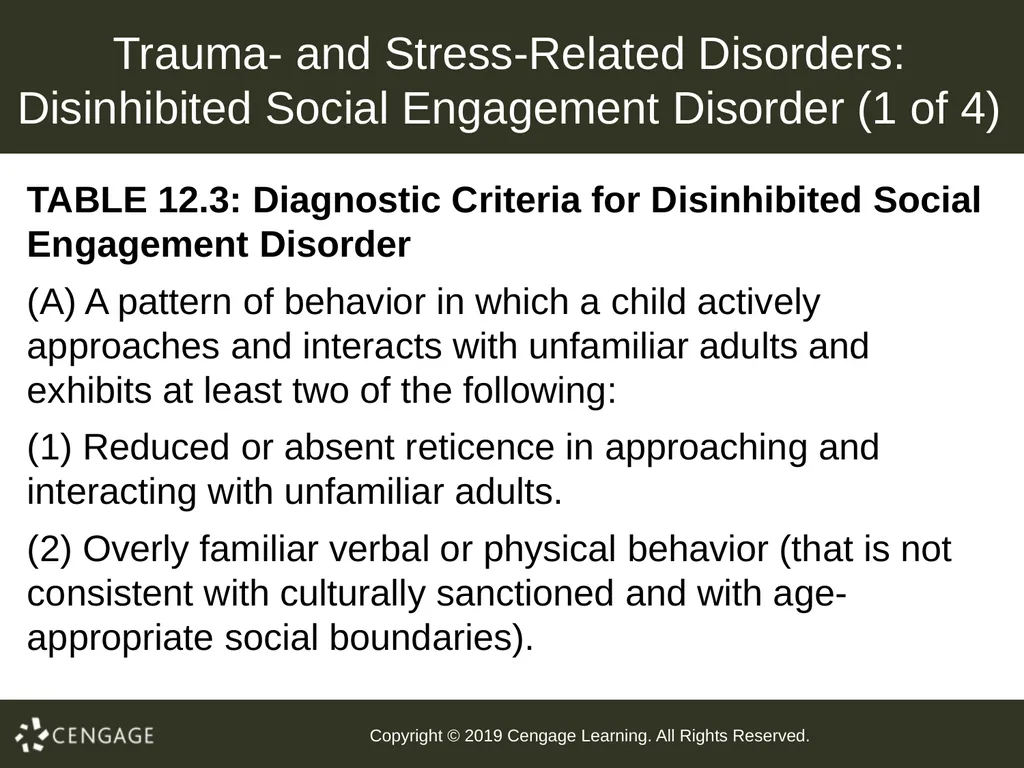
Trauma- and Stress-Related Disorders: Disinhibited Social Engagement Disorder (1 of 4) TABLE 12.3: Diagnostic Criteria for Disinhibited Social Engagement Disorder
(A) A pattern of behavior in which a child actively approaches and interacts with unfamiliar adults and exhibits at least two of the following:
(1) Reduced or absent reticence in approaching and interacting with unfamiliar adults.
(2) Overly familiar verbal or physical behavior (that is not consistent with culturally sanctioned and with age-appropriate social boundaries).<br>
(A) A pattern of behavior in which a child actively approaches and interacts with unfamiliar adults and exhibits at least two of the following:
(1) Reduced or absent reticence in approaching and interacting with unfamiliar adults.
(2) Overly familiar verbal or physical behavior (that is not consistent with culturally sanctioned and with age-appropriate social boundaries).<br>
38
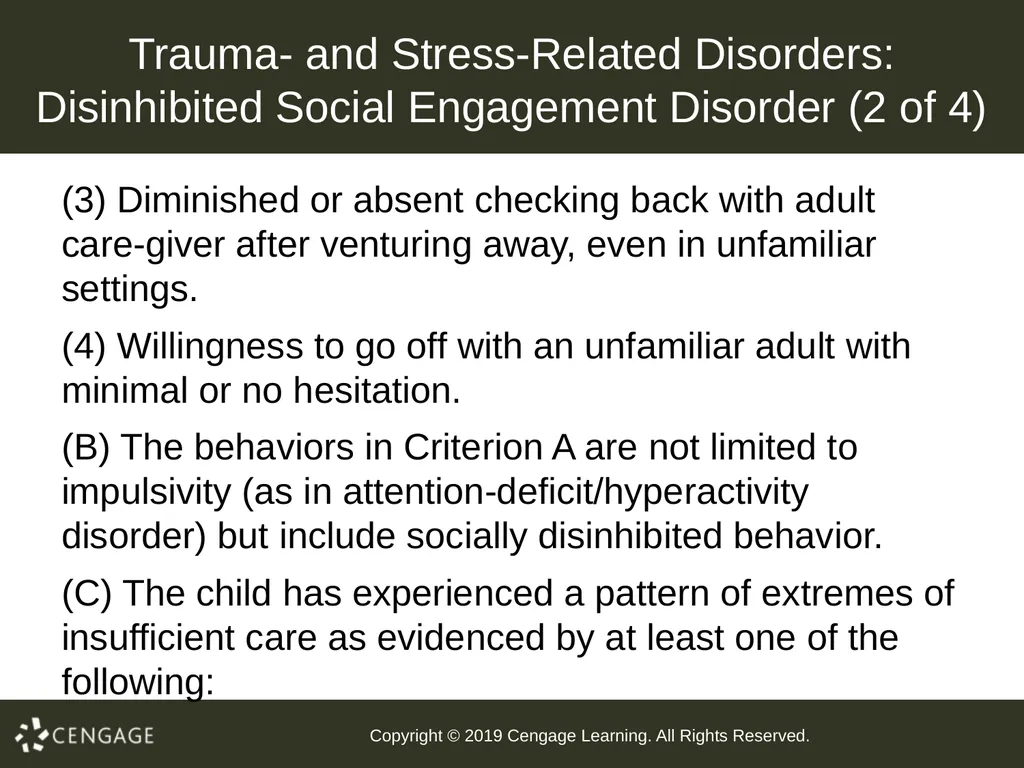
Trauma- and Stress-Related Disorders: Disinhibited Social Engagement Disorder (2 of 4) (3) Diminished or absent checking back with adult care-giver after venturing away, even in unfamiliar settings.
(4) Willingness to go off with an unfamiliar adult with minimal or no hesitation.
(B) The behaviors in Criterion A are not limited to impulsivity (as in attention-deficit/hyperactivity disorder) but include socially disinhibited behavior.
(C) The child has experienced a pattern of extremes of insufficient care as evidenced by at least one of the following:<br>
(4) Willingness to go off with an unfamiliar adult with minimal or no hesitation.
(B) The behaviors in Criterion A are not limited to impulsivity (as in attention-deficit/hyperactivity disorder) but include socially disinhibited behavior.
(C) The child has experienced a pattern of extremes of insufficient care as evidenced by at least one of the following:<br>
39
Trauma- and Stress-Related Disorders: Disinhibited Social Engagement Disorder (3 of 4) (1) Social neglect or deprivation in the form of persistent lack of having basic emotional needs for comfort, stimulation, and affection met by caregiving adults.
(2) Repeated changes of primary caregivers that limit opportunities to form stable attachments (e.g. frequent changes in foster care).
(3) Rearing in unusual settings that severely limit opportunities to form selective attachments (e.g., institutions with high child-to-caregiver ratios).<br>
(2) Repeated changes of primary caregivers that limit opportunities to form stable attachments (e.g. frequent changes in foster care).
(3) Rearing in unusual settings that severely limit opportunities to form selective attachments (e.g., institutions with high child-to-caregiver ratios).<br>
40
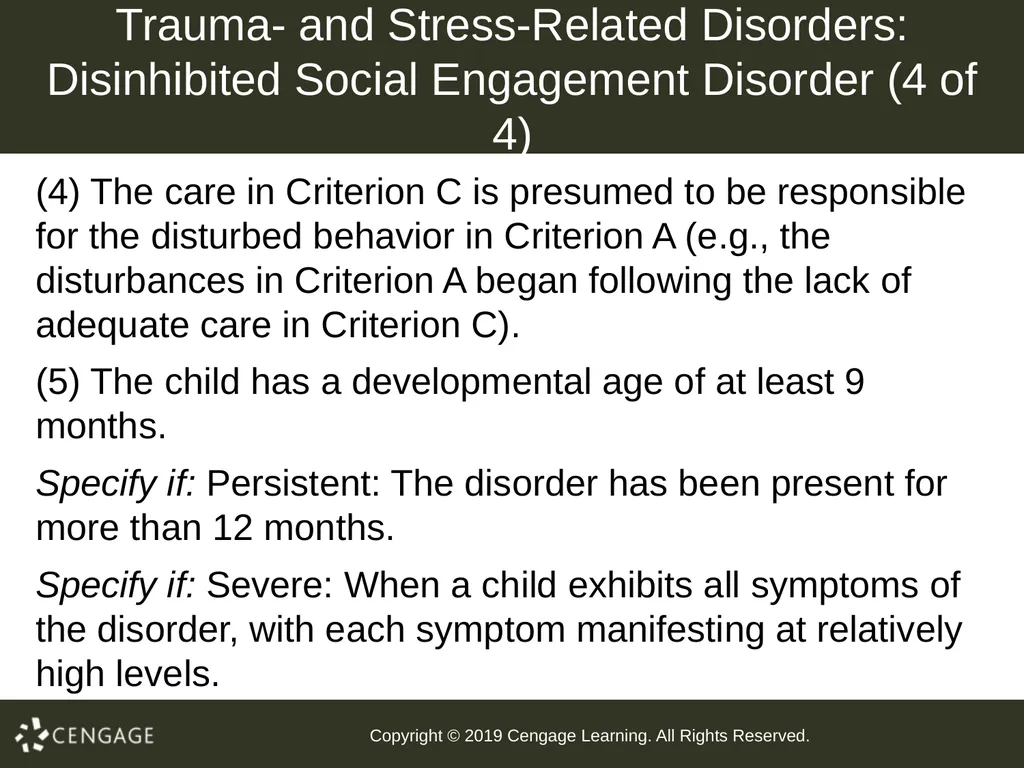
Trauma- and Stress-Related Disorders: Disinhibited Social Engagement Disorder (4 of 4) (4) The care in Criterion C is presumed to be responsible for the disturbed behavior in Criterion A (e.g., the disturbances in Criterion A began following the lack of adequate care in Criterion C).
(5) The child has a developmental age of at least 9 months.
Specify if: Persistent: The disorder has been present for more than 12 months.
Specify if: Severe: When a child exhibits all symptoms of the disorder, with each symptom manifesting at relatively high levels.<br>
(5) The child has a developmental age of at least 9 months.
Specify if: Persistent: The disorder has been present for more than 12 months.
Specify if: Severe: When a child exhibits all symptoms of the disorder, with each symptom manifesting at relatively high levels.<br>
41
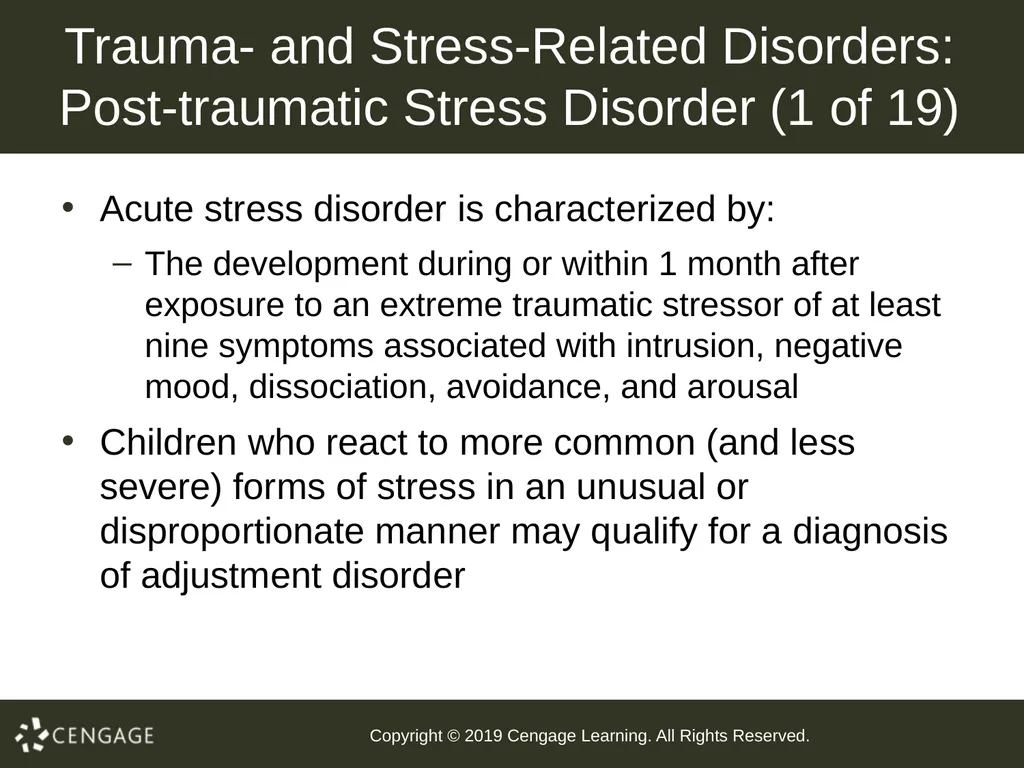
Trauma- and Stress-Related Disorders: Post-traumatic Stress Disorder (1 of 19) Acute stress disorder is characterized by:
The development during or within 1 month after exposure to an extreme traumatic stressor of at least nine symptoms associated with intrusion, negative mood, dissociation, avoidance, and arousal
Children who react to more common (and less severe) forms of stress in an unusual or disproportionate manner may qualify for a diagnosis of adjustment disorder<br>
The development during or within 1 month after exposure to an extreme traumatic stressor of at least nine symptoms associated with intrusion, negative mood, dissociation, avoidance, and arousal
Children who react to more common (and less severe) forms of stress in an unusual or disproportionate manner may qualify for a diagnosis of adjustment disorder<br>
42
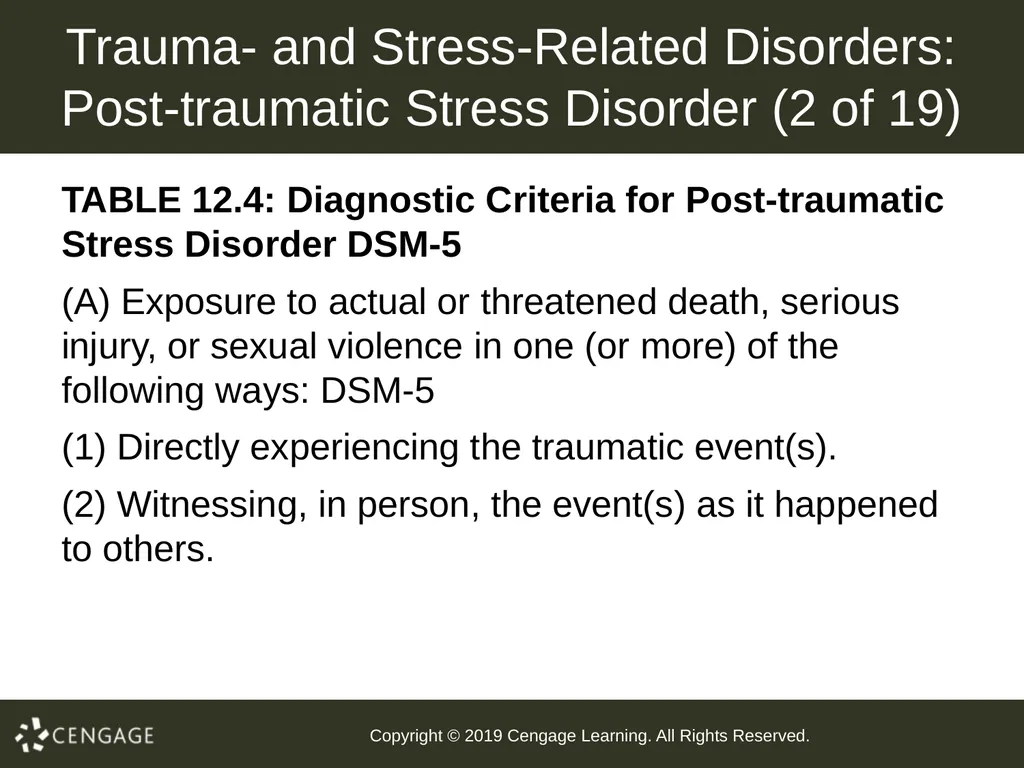
Trauma- and Stress-Related Disorders: Post-traumatic Stress Disorder (2 of 19) TABLE 12.4: Diagnostic Criteria for Post-traumatic Stress Disorder DSM-5
(A) Exposure to actual or threatened death, serious injury, or sexual violence in one (or more) of the following ways: DSM-5
(1) Directly experiencing the traumatic event(s).
(2) Witnessing, in person, the event(s) as it happened to others.<br>
(A) Exposure to actual or threatened death, serious injury, or sexual violence in one (or more) of the following ways: DSM-5
(1) Directly experiencing the traumatic event(s).
(2) Witnessing, in person, the event(s) as it happened to others.<br>
43
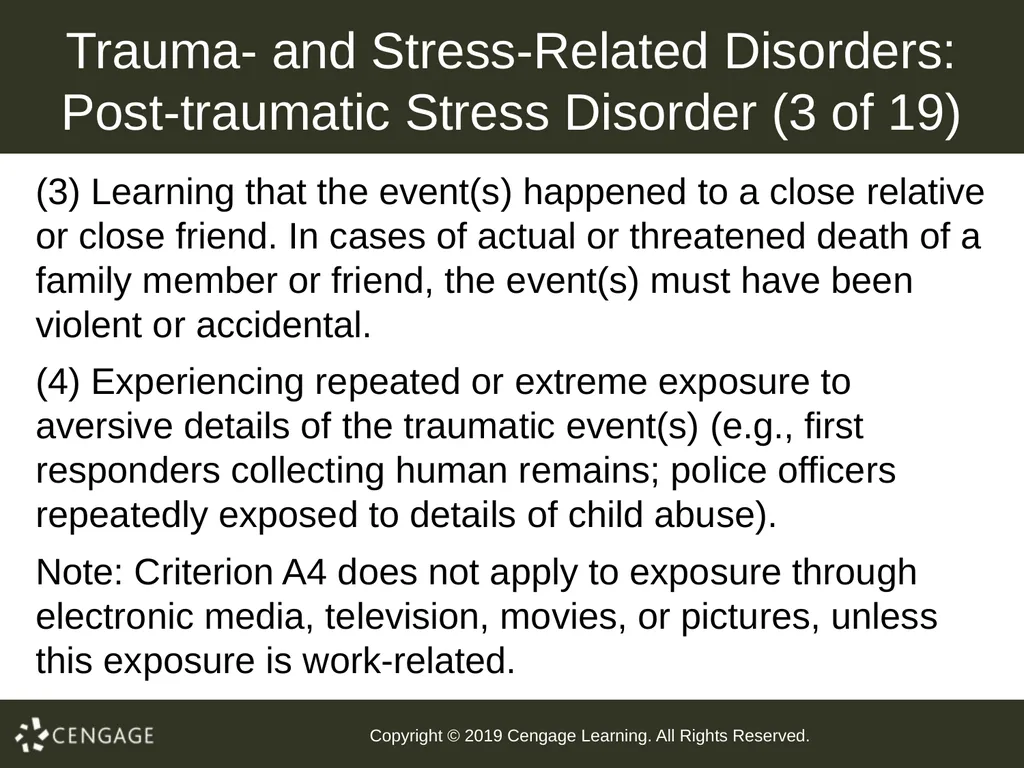
Trauma- and Stress-Related Disorders: Post-traumatic Stress Disorder (3 of 19) (3) Learning that the event(s) happened to a close relative or close friend. In cases of actual or threatened death of a family member or friend, the event(s) must have been violent or accidental.
(4) Experiencing repeated or extreme exposure to aversive details of the traumatic event(s) (e.g., first responders collecting human remains; police officers repeatedly exposed to details of child abuse).
Note: Criterion A4 does not apply to exposure through electronic media, television, movies, or pictures, unless this exposure is work-related.<br>
(4) Experiencing repeated or extreme exposure to aversive details of the traumatic event(s) (e.g., first responders collecting human remains; police officers repeatedly exposed to details of child abuse).
Note: Criterion A4 does not apply to exposure through electronic media, television, movies, or pictures, unless this exposure is work-related.<br>
44
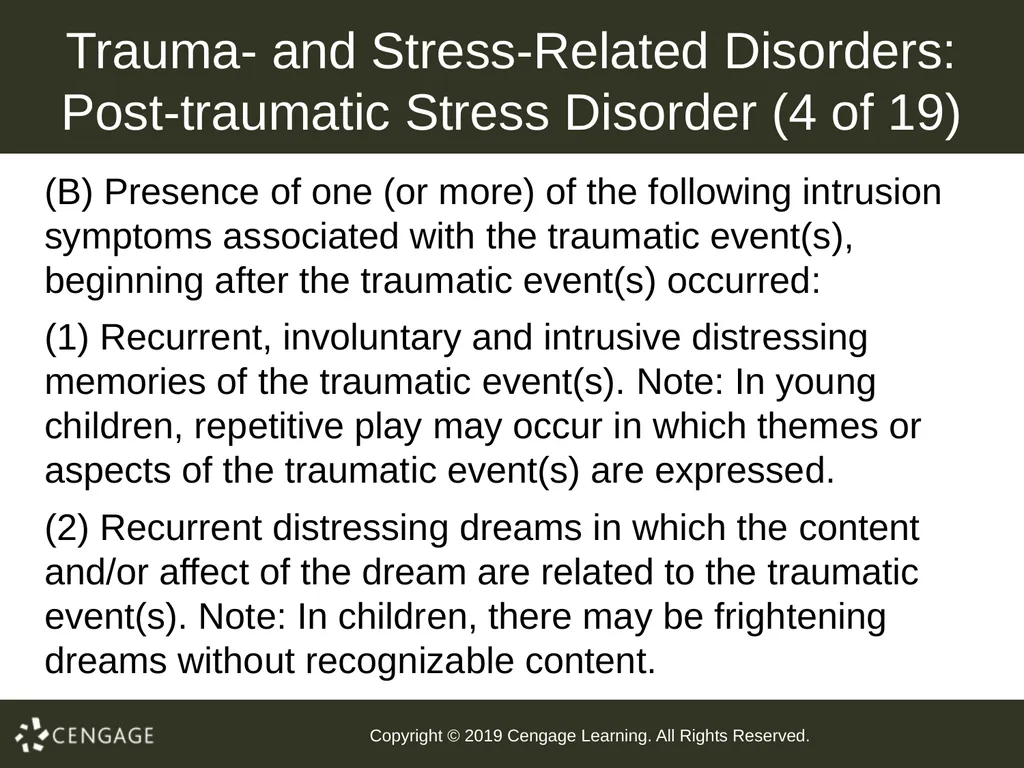
Trauma- and Stress-Related Disorders: Post-traumatic Stress Disorder (4 of 19) (B) Presence of one (or more) of the following intrusion symptoms associated with the traumatic event(s), beginning after the traumatic event(s) occurred:
(1) Recurrent, involuntary and intrusive distressing memories of the traumatic event(s). Note: In young children, repetitive play may occur in which themes or aspects of the traumatic event(s) are expressed.
(2) Recurrent distressing dreams in which the content and/or affect of the dream are related to the traumatic event(s). Note: In children, there may be frightening dreams without recognizable content.<br>
(1) Recurrent, involuntary and intrusive distressing memories of the traumatic event(s). Note: In young children, repetitive play may occur in which themes or aspects of the traumatic event(s) are expressed.
(2) Recurrent distressing dreams in which the content and/or affect of the dream are related to the traumatic event(s). Note: In children, there may be frightening dreams without recognizable content.<br>
45
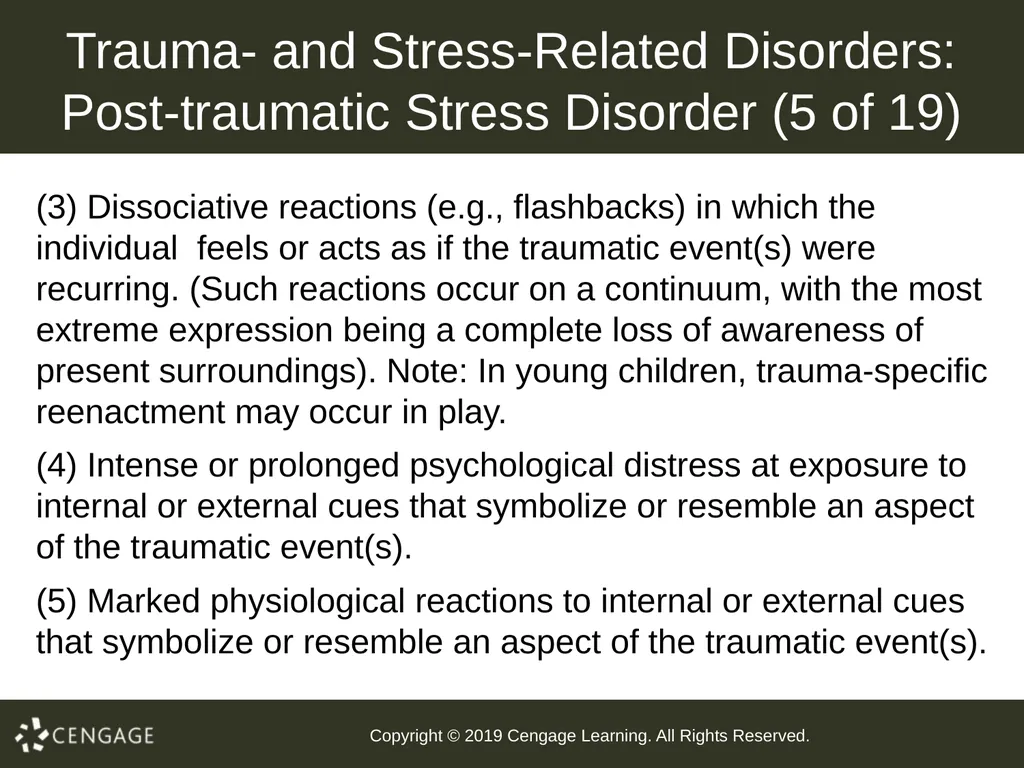
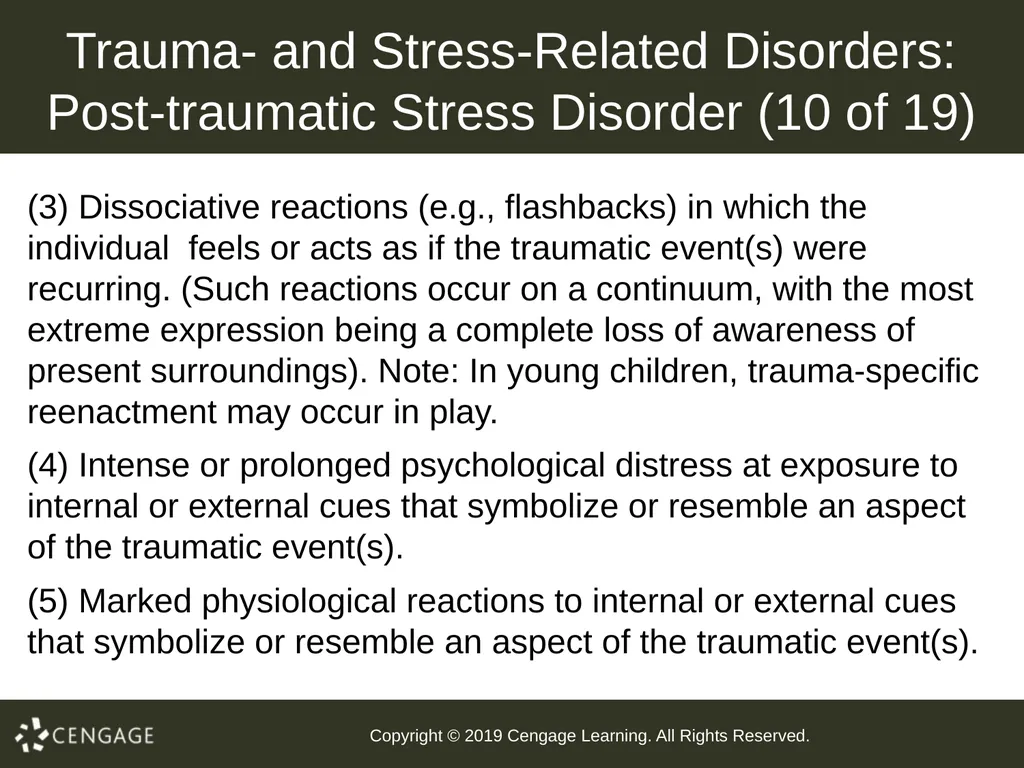
Trauma- and Stress-Related Disorders: Post-traumatic Stress Disorder (5 of 19) (3) Dissociative reactions (e.g., flashbacks) in which the individual feels or acts as if the traumatic event(s) were recurring. (Such reactions occur on a continuum, with the most extreme expression being a complete loss of awareness of present surroundings). Note: In young children, trauma-specific reenactment may occur in play.
(4) Intense or prolonged psychological distress at exposure to internal or external cues that symbolize or resemble an aspect of the traumatic event(s).
(5) Marked physiological reactions to internal or external cues that symbolize or resemble an aspect of the traumatic event(s).<br>
(4) Intense or prolonged psychological distress at exposure to internal or external cues that symbolize or resemble an aspect of the traumatic event(s).
(5) Marked physiological reactions to internal or external cues that symbolize or resemble an aspect of the traumatic event(s).<br>
46
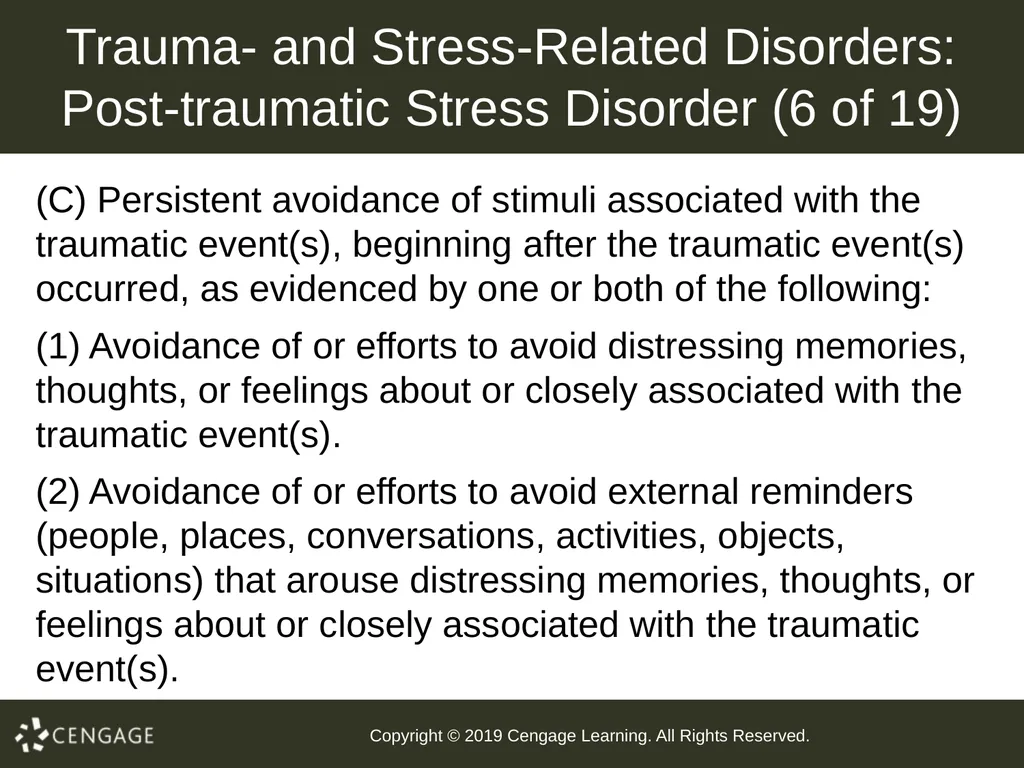
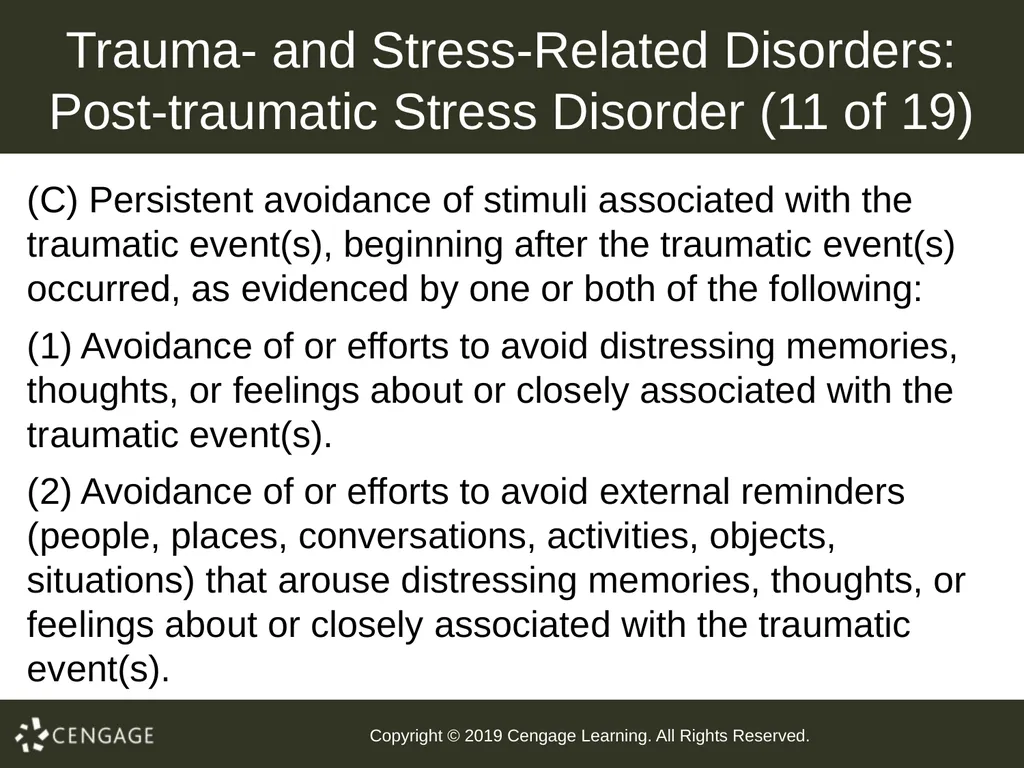
Trauma- and Stress-Related Disorders: Post-traumatic Stress Disorder (6 of 19) (C) Persistent avoidance of stimuli associated with the traumatic event(s), beginning after the traumatic event(s) occurred, as evidenced by one or both of the following:
(1) Avoidance of or efforts to avoid distressing memories, thoughts, or feelings about or closely associated with the traumatic event(s).
(2) Avoidance of or efforts to avoid external reminders (people, places, conversations, activities, objects, situations) that arouse distressing memories, thoughts, or feelings about or closely associated with the traumatic event(s).<br>
(1) Avoidance of or efforts to avoid distressing memories, thoughts, or feelings about or closely associated with the traumatic event(s).
(2) Avoidance of or efforts to avoid external reminders (people, places, conversations, activities, objects, situations) that arouse distressing memories, thoughts, or feelings about or closely associated with the traumatic event(s).<br>
47
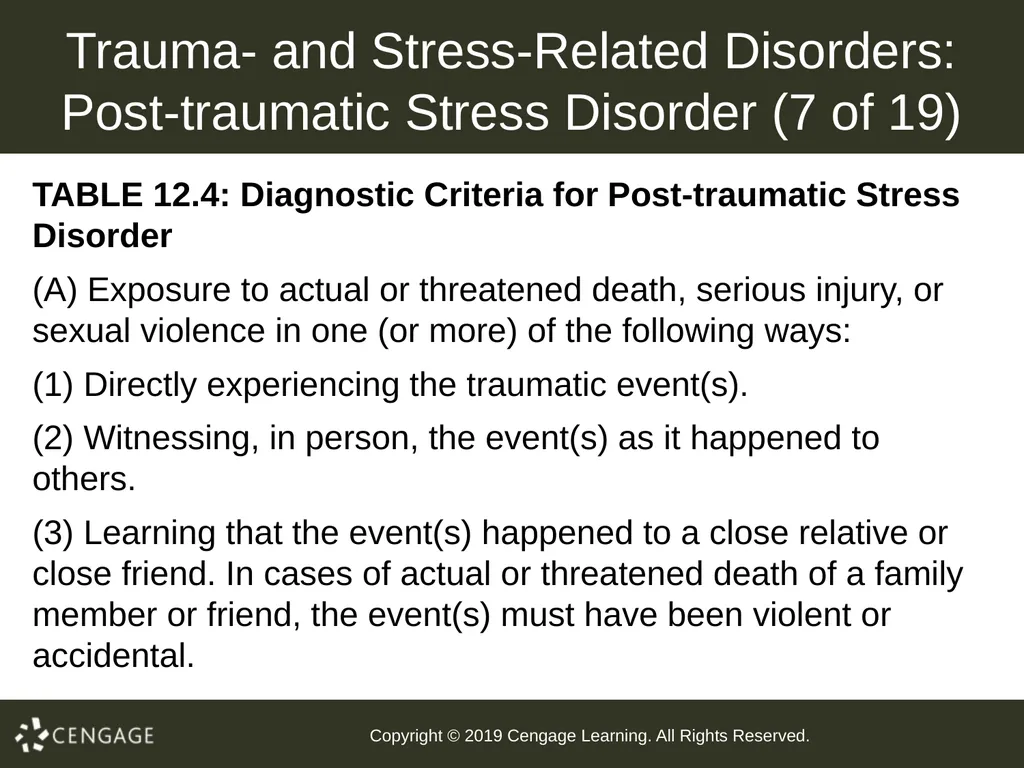
Trauma- and Stress-Related Disorders: Post-traumatic Stress Disorder (7 of 19) TABLE 12.4: Diagnostic Criteria for Post-traumatic Stress Disorder
(A) Exposure to actual or threatened death, serious injury, or sexual violence in one (or more) of the following ways:
(1) Directly experiencing the traumatic event(s).
(2) Witnessing, in person, the event(s) as it happened to others.
(3) Learning that the event(s) happened to a close relative or close friend. In cases of actual or threatened death of a family member or friend, the event(s) must have been violent or accidental.<br>
(A) Exposure to actual or threatened death, serious injury, or sexual violence in one (or more) of the following ways:
(1) Directly experiencing the traumatic event(s).
(2) Witnessing, in person, the event(s) as it happened to others.
(3) Learning that the event(s) happened to a close relative or close friend. In cases of actual or threatened death of a family member or friend, the event(s) must have been violent or accidental.<br>
48
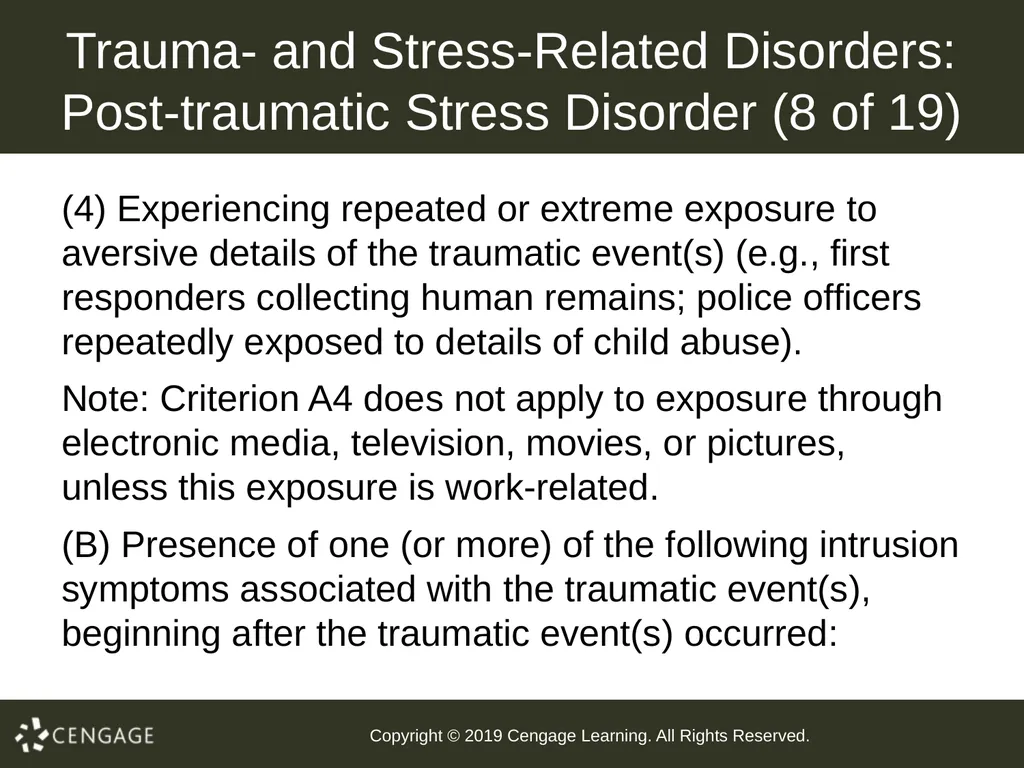
Trauma- and Stress-Related Disorders: Post-traumatic Stress Disorder (8 of 19) (4) Experiencing repeated or extreme exposure to aversive details of the traumatic event(s) (e.g., first responders collecting human remains; police officers repeatedly exposed to details of child abuse).
Note: Criterion A4 does not apply to exposure through electronic media, television, movies, or pictures, unless this exposure is work-related.
(B) Presence of one (or more) of the following intrusion symptoms associated with the traumatic event(s), beginning after the traumatic event(s) occurred:<br>
Note: Criterion A4 does not apply to exposure through electronic media, television, movies, or pictures, unless this exposure is work-related.
(B) Presence of one (or more) of the following intrusion symptoms associated with the traumatic event(s), beginning after the traumatic event(s) occurred:<br>
49
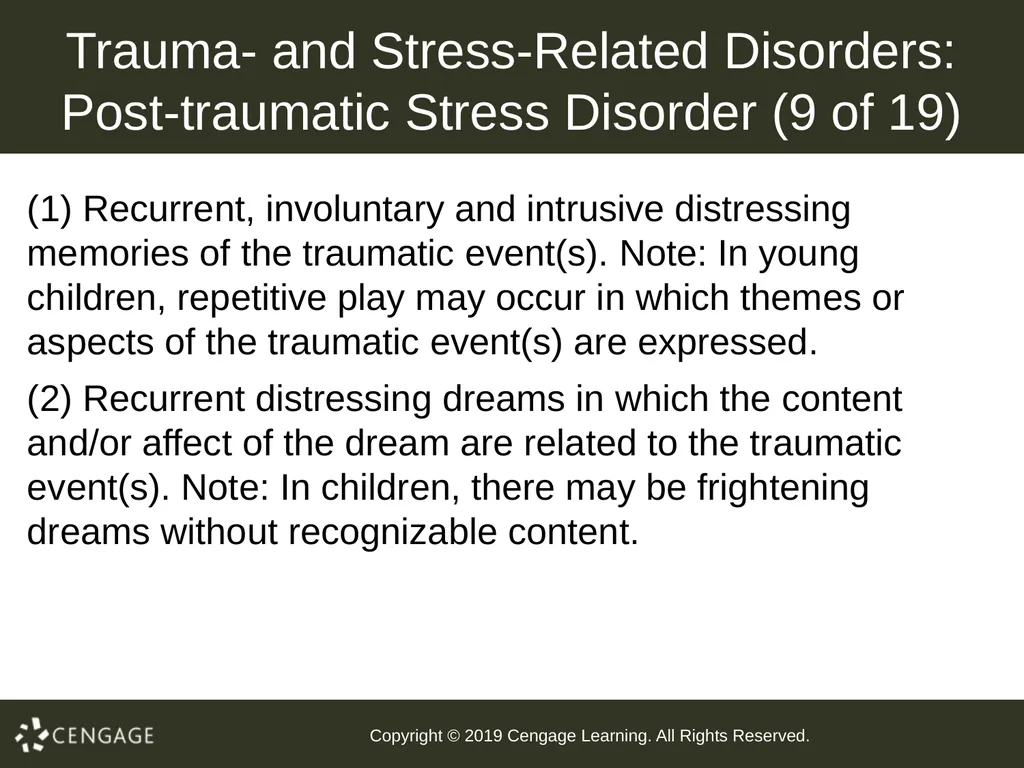
Trauma- and Stress-Related Disorders: Post-traumatic Stress Disorder (9 of 19) (1) Recurrent, involuntary and intrusive distressing memories of the traumatic event(s). Note: In young children, repetitive play may occur in which themes or aspects of the traumatic event(s) are expressed.
(2) Recurrent distressing dreams in which the content and/or affect of the dream are related to the traumatic event(s). Note: In children, there may be frightening dreams without recognizable content.<br>
(2) Recurrent distressing dreams in which the content and/or affect of the dream are related to the traumatic event(s). Note: In children, there may be frightening dreams without recognizable content.<br>
50
Trauma- and Stress-Related Disorders: Post-traumatic Stress Disorder (10 of 19) (3) Dissociative reactions (e.g., flashbacks) in which the individual feels or acts as if the traumatic event(s) were recurring. (Such reactions occur on a continuum, with the most extreme expression being a complete loss of awareness of present surroundings). Note: In young children, trauma-specific reenactment may occur in play.
(4) Intense or prolonged psychological distress at exposure to internal or external cues that symbolize or resemble an aspect of the traumatic event(s).
(5) Marked physiological reactions to internal or external cues that symbolize or resemble an aspect of the traumatic event(s).<br>
(4) Intense or prolonged psychological distress at exposure to internal or external cues that symbolize or resemble an aspect of the traumatic event(s).
(5) Marked physiological reactions to internal or external cues that symbolize or resemble an aspect of the traumatic event(s).<br>
51
Trauma- and Stress-Related Disorders: Post-traumatic Stress Disorder (11 of 19) (C) Persistent avoidance of stimuli associated with the traumatic event(s), beginning after the traumatic event(s) occurred, as evidenced by one or both of the following:
(1) Avoidance of or efforts to avoid distressing memories, thoughts, or feelings about or closely associated with the traumatic event(s).
(2) Avoidance of or efforts to avoid external reminders (people, places, conversations, activities, objects, situations) that arouse distressing memories, thoughts, or feelings about or closely associated with the traumatic event(s).<br>
(1) Avoidance of or efforts to avoid distressing memories, thoughts, or feelings about or closely associated with the traumatic event(s).
(2) Avoidance of or efforts to avoid external reminders (people, places, conversations, activities, objects, situations) that arouse distressing memories, thoughts, or feelings about or closely associated with the traumatic event(s).<br>
52
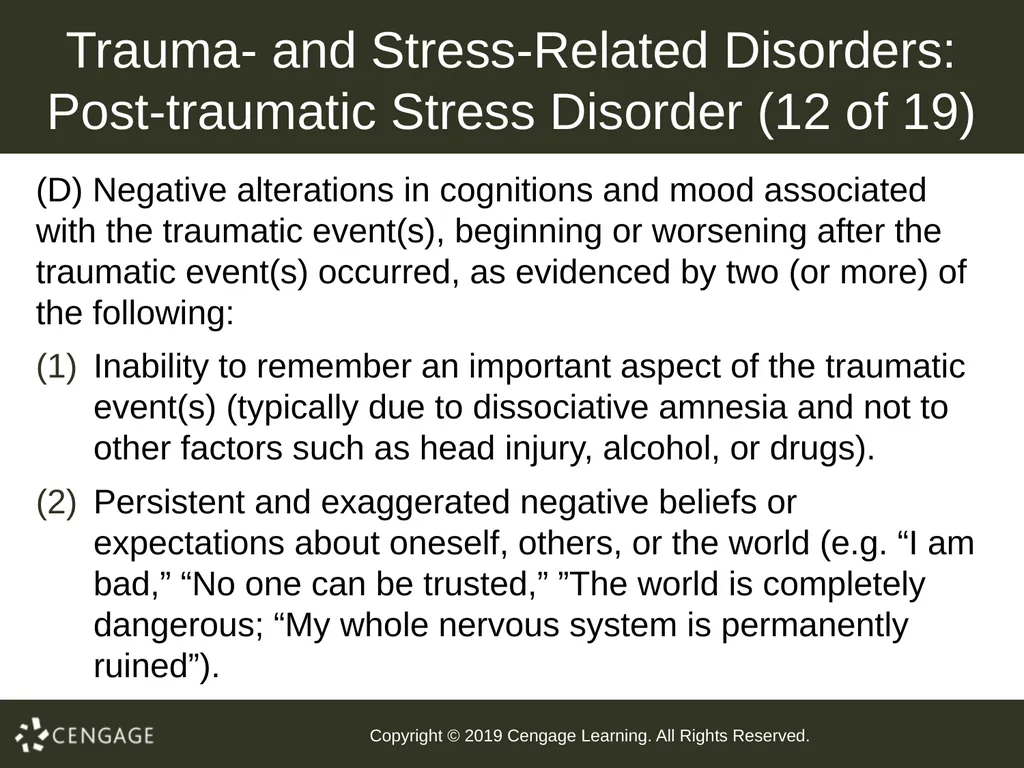
Trauma- and Stress-Related Disorders: Post-traumatic Stress Disorder (12 of 19) (D) Negative alterations in cognitions and mood associated with the traumatic event(s), beginning or worsening after the traumatic event(s) occurred, as evidenced by two (or more) of the following:
Inability to remember an important aspect of the traumatic event(s) (typically due to dissociative amnesia and not to other factors such as head injury, alcohol, or drugs).
Persistent and exaggerated negative beliefs or expectations about oneself, others, or the world (e.g. “I am bad,” “No one can be trusted,” ”The world is completely dangerous; “My whole nervous system is permanently ruined”).<br>
Inability to remember an important aspect of the traumatic event(s) (typically due to dissociative amnesia and not to other factors such as head injury, alcohol, or drugs).
Persistent and exaggerated negative beliefs or expectations about oneself, others, or the world (e.g. “I am bad,” “No one can be trusted,” ”The world is completely dangerous; “My whole nervous system is permanently ruined”).<br>
53
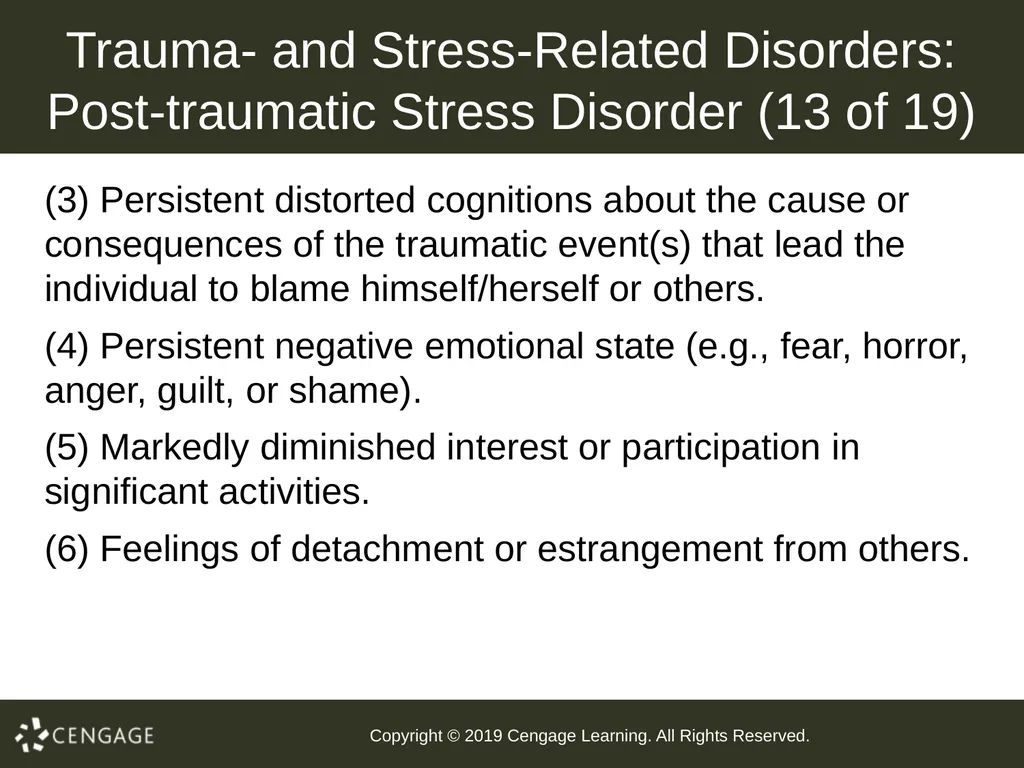
Trauma- and Stress-Related Disorders: Post-traumatic Stress Disorder (13 of 19) (3) Persistent distorted cognitions about the cause or consequences of the traumatic event(s) that lead the individual to blame himself/herself or others.
(4) Persistent negative emotional state (e.g., fear, horror, anger, guilt, or shame).
(5) Markedly diminished interest or participation in significant activities.
(6) Feelings of detachment or estrangement from others.<br>
(4) Persistent negative emotional state (e.g., fear, horror, anger, guilt, or shame).
(5) Markedly diminished interest or participation in significant activities.
(6) Feelings of detachment or estrangement from others.<br>
54
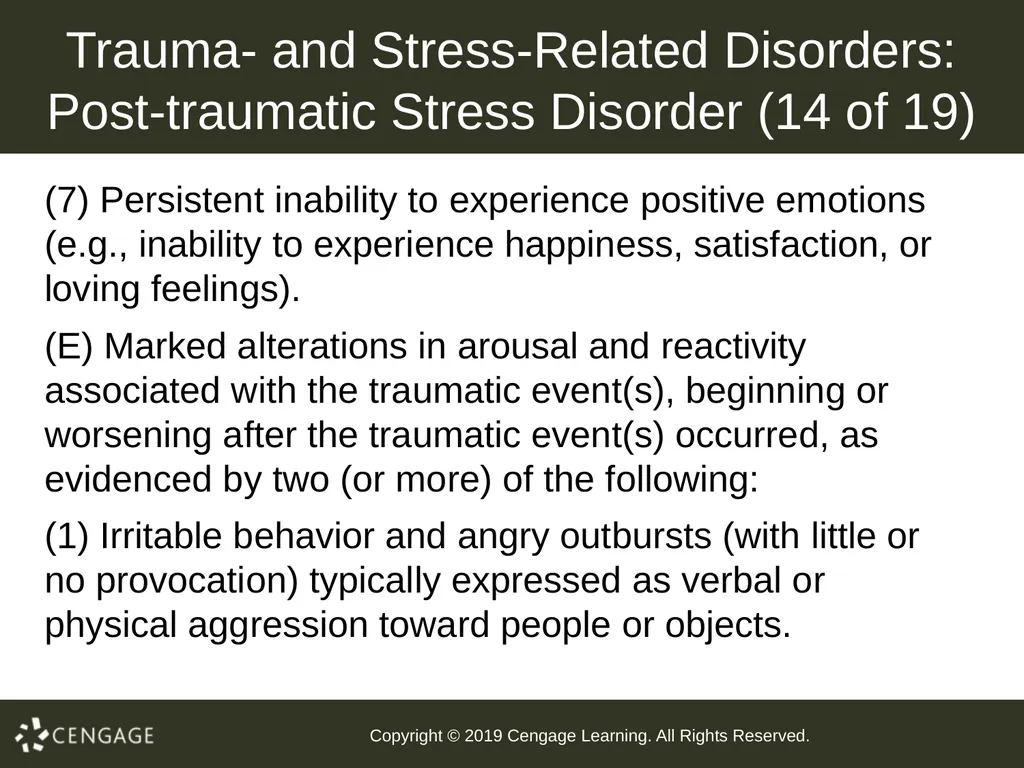
Trauma- and Stress-Related Disorders: Post-traumatic Stress Disorder (14 of 19) (7) Persistent inability to experience positive emotions (e.g., inability to experience happiness, satisfaction, or loving feelings).
(E) Marked alterations in arousal and reactivity associated with the traumatic event(s), beginning or worsening after the traumatic event(s) occurred, as evidenced by two (or more) of the following:
(1) Irritable behavior and angry outbursts (with little or no provocation) typically expressed as verbal or physical aggression toward people or objects.<br>
(E) Marked alterations in arousal and reactivity associated with the traumatic event(s), beginning or worsening after the traumatic event(s) occurred, as evidenced by two (or more) of the following:
(1) Irritable behavior and angry outbursts (with little or no provocation) typically expressed as verbal or physical aggression toward people or objects.<br>
55
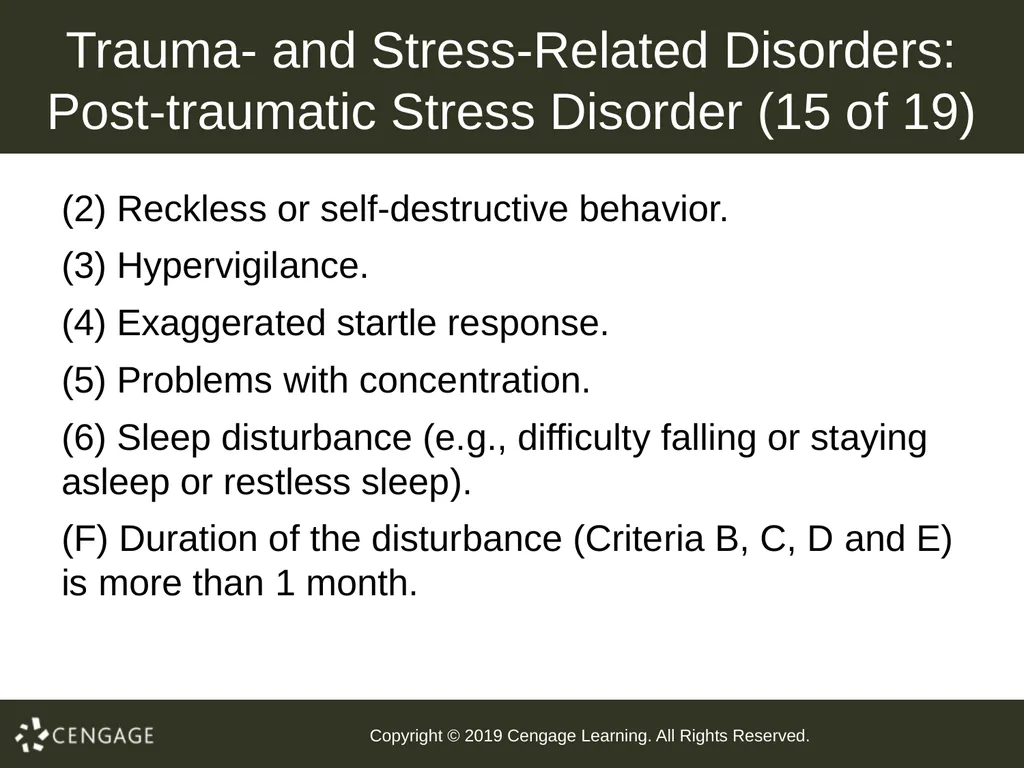
Trauma- and Stress-Related Disorders: Post-traumatic Stress Disorder (15 of 19) (2) Reckless or self-destructive behavior.
(3) Hypervigilance.
(4) Exaggerated startle response.
(5) Problems with concentration.
(6) Sleep disturbance (e.g., difficulty falling or staying asleep or restless sleep).
(F) Duration of the disturbance (Criteria B, C, D and E) is more than 1 month.<br>
(3) Hypervigilance.
(4) Exaggerated startle response.
(5) Problems with concentration.
(6) Sleep disturbance (e.g., difficulty falling or staying asleep or restless sleep).
(F) Duration of the disturbance (Criteria B, C, D and E) is more than 1 month.<br>
56
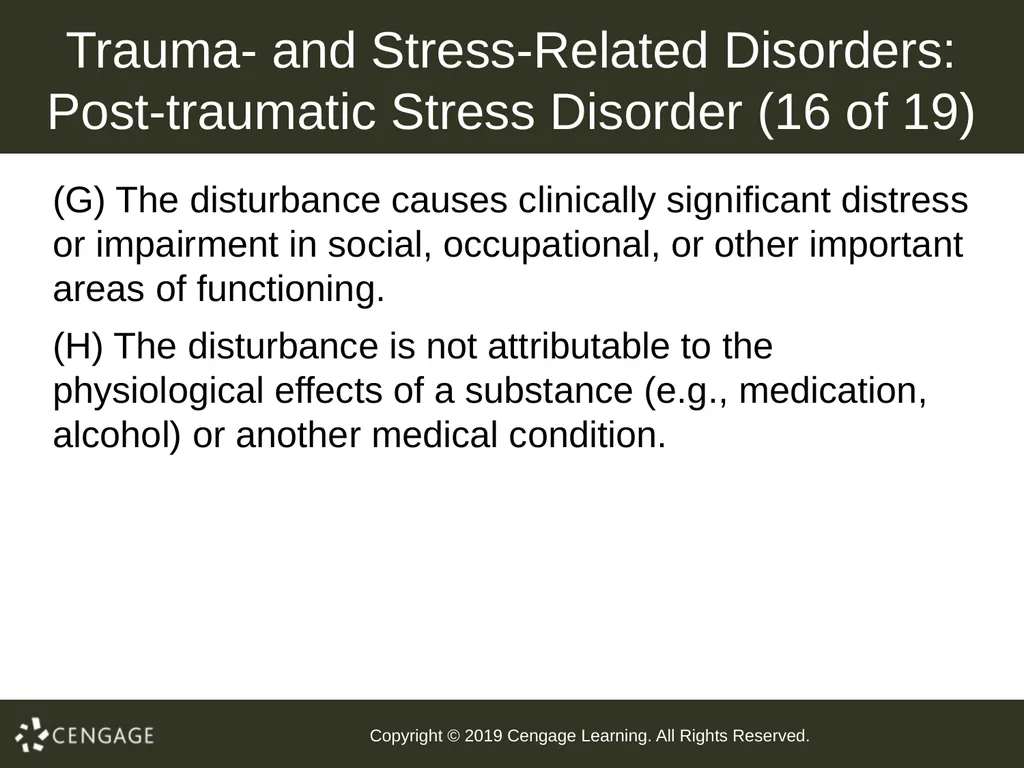
Trauma- and Stress-Related Disorders: Post-traumatic Stress Disorder (16 of 19) (G) The disturbance causes clinically significant distress or impairment in social, occupational, or other important areas of functioning.
(H) The disturbance is not attributable to the physiological effects of a substance (e.g., medication, alcohol) or another medical condition.<br>
(H) The disturbance is not attributable to the physiological effects of a substance (e.g., medication, alcohol) or another medical condition.<br>
57
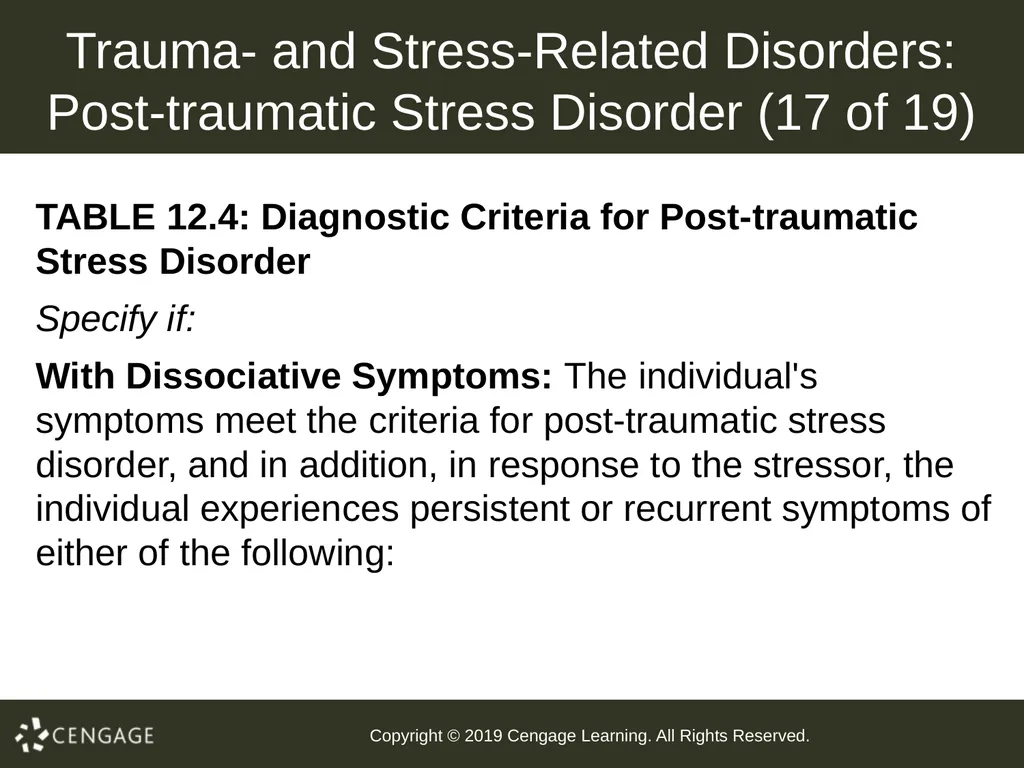
Trauma- and Stress-Related Disorders: Post-traumatic Stress Disorder (17 of 19) TABLE 12.4: Diagnostic Criteria for Post-traumatic Stress Disorder
Specify if:
With Dissociative Symptoms: The individual's symptoms meet the criteria for post-traumatic stress disorder, and in addition, in response to the stressor, the individual experiences persistent or recurrent symptoms of either of the following:<br>
Specify if:
With Dissociative Symptoms: The individual's symptoms meet the criteria for post-traumatic stress disorder, and in addition, in response to the stressor, the individual experiences persistent or recurrent symptoms of either of the following:<br>
58
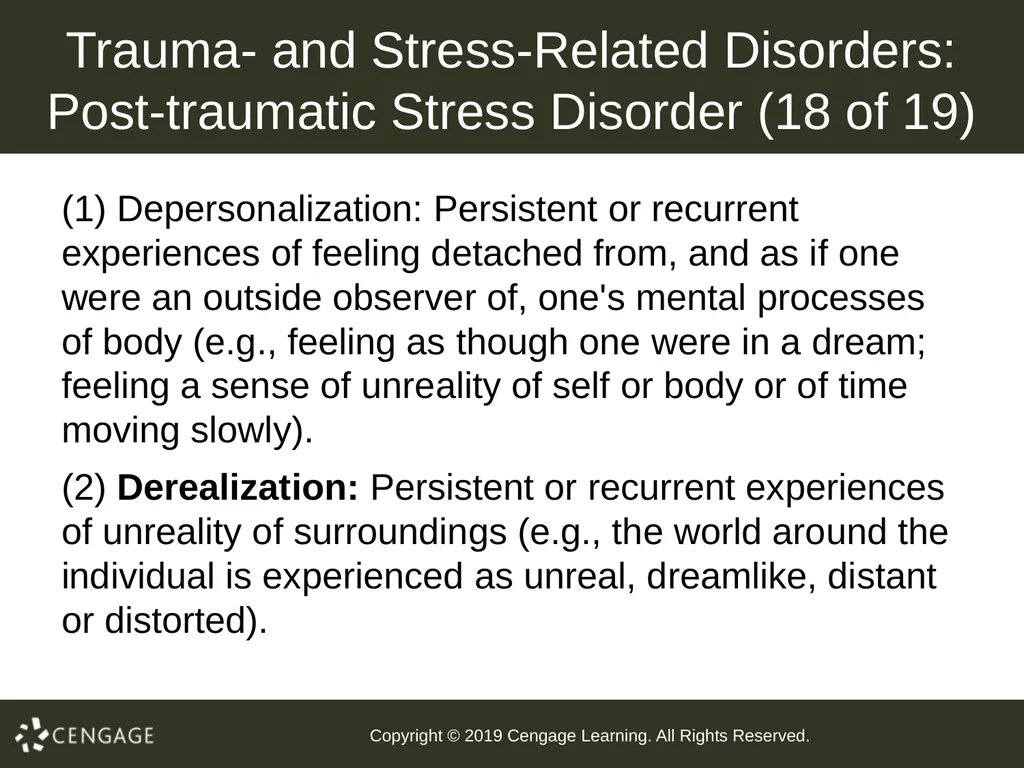
Trauma- and Stress-Related Disorders: Post-traumatic Stress Disorder (18 of 19) (1) Depersonalization: Persistent or recurrent experiences of feeling detached from, and as if one were an outside observer of, one's mental processes of body (e.g., feeling as though one were in a dream; feeling a sense of unreality of self or body or of time moving slowly).
(2) Derealization: Persistent or recurrent experiences of unreality of surroundings (e.g., the world around the individual is experienced as unreal, dreamlike, distant or distorted).<br>
(2) Derealization: Persistent or recurrent experiences of unreality of surroundings (e.g., the world around the individual is experienced as unreal, dreamlike, distant or distorted).<br>
59
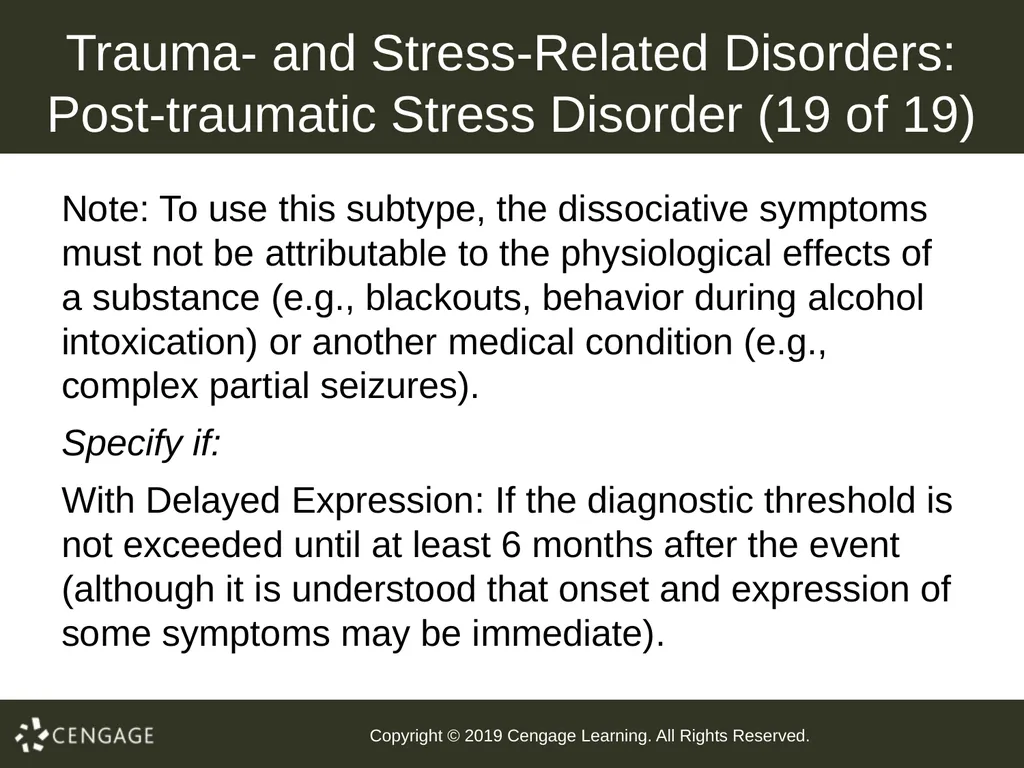
Trauma- and Stress-Related Disorders: Post-traumatic Stress Disorder (19 of 19) Note: To use this subtype, the dissociative symptoms must not be attributable to the physiological effects of a substance (e.g., blackouts, behavior during alcohol intoxication) or another medical condition (e.g., complex partial seizures).
Specify if:
With Delayed Expression: If the diagnostic threshold is not exceeded until at least 6 months after the event (although it is understood that onset and expression of some symptoms may be immediate).<br>
Specify if:
With Delayed Expression: If the diagnostic threshold is not exceeded until at least 6 months after the event (although it is understood that onset and expression of some symptoms may be immediate).<br>
60
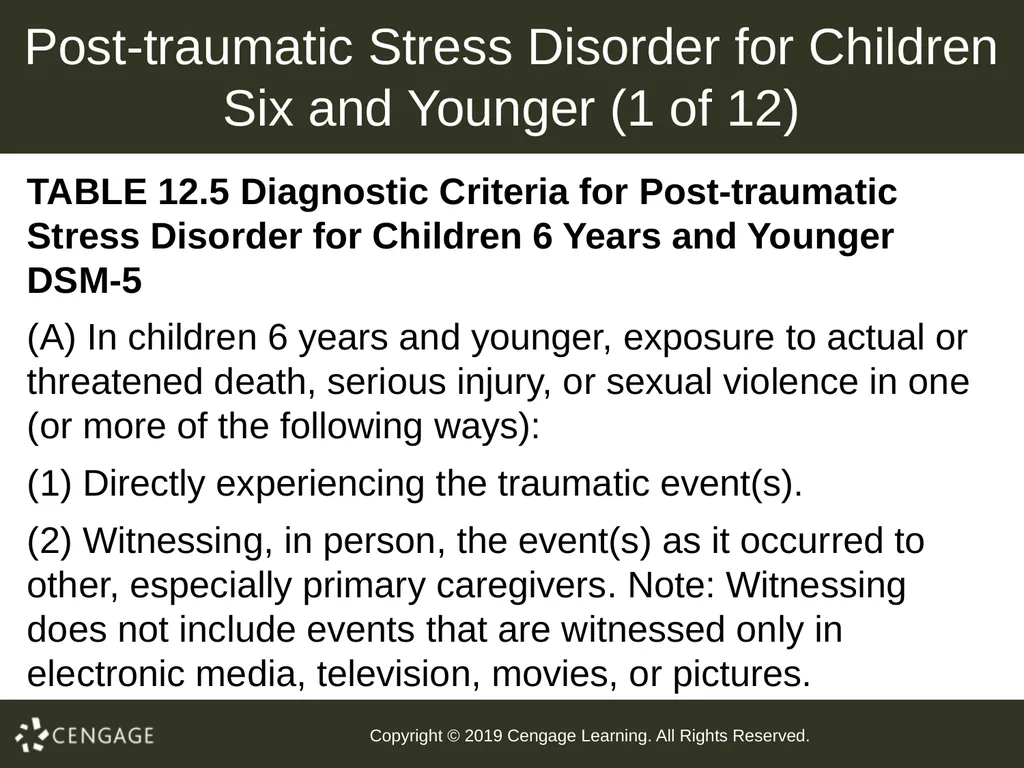
Post-traumatic Stress Disorder for Children Six and Younger (1 of 12) TABLE 12.5 Diagnostic Criteria for Post-traumatic Stress Disorder for Children 6 Years and Younger DSM-5
(A) In children 6 years and younger, exposure to actual or threatened death, serious injury, or sexual violence in one (or more of the following ways):
(1) Directly experiencing the traumatic event(s).
(2) Witnessing, in person, the event(s) as it occurred to other, especially primary caregivers. Note: Witnessing does not include events that are witnessed only in electronic media, television, movies, or pictures.<br>
(A) In children 6 years and younger, exposure to actual or threatened death, serious injury, or sexual violence in one (or more of the following ways):
(1) Directly experiencing the traumatic event(s).
(2) Witnessing, in person, the event(s) as it occurred to other, especially primary caregivers. Note: Witnessing does not include events that are witnessed only in electronic media, television, movies, or pictures.<br>
61
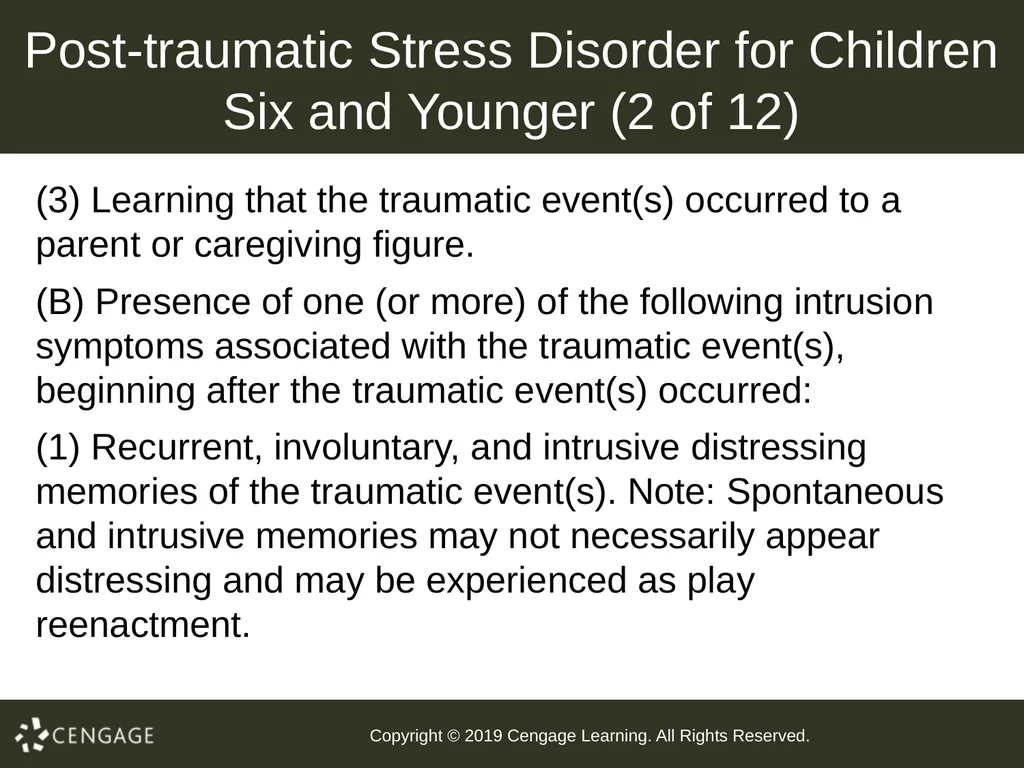
Post-traumatic Stress Disorder for Children Six and Younger (2 of 12) (3) Learning that the traumatic event(s) occurred to a parent or caregiving figure.
(B) Presence of one (or more) of the following intrusion symptoms associated with the traumatic event(s), beginning after the traumatic event(s) occurred:
(1) Recurrent, involuntary, and intrusive distressing memories of the traumatic event(s). Note: Spontaneous and intrusive memories may not necessarily appear distressing and may be experienced as play reenactment.<br>
(B) Presence of one (or more) of the following intrusion symptoms associated with the traumatic event(s), beginning after the traumatic event(s) occurred:
(1) Recurrent, involuntary, and intrusive distressing memories of the traumatic event(s). Note: Spontaneous and intrusive memories may not necessarily appear distressing and may be experienced as play reenactment.<br>
62
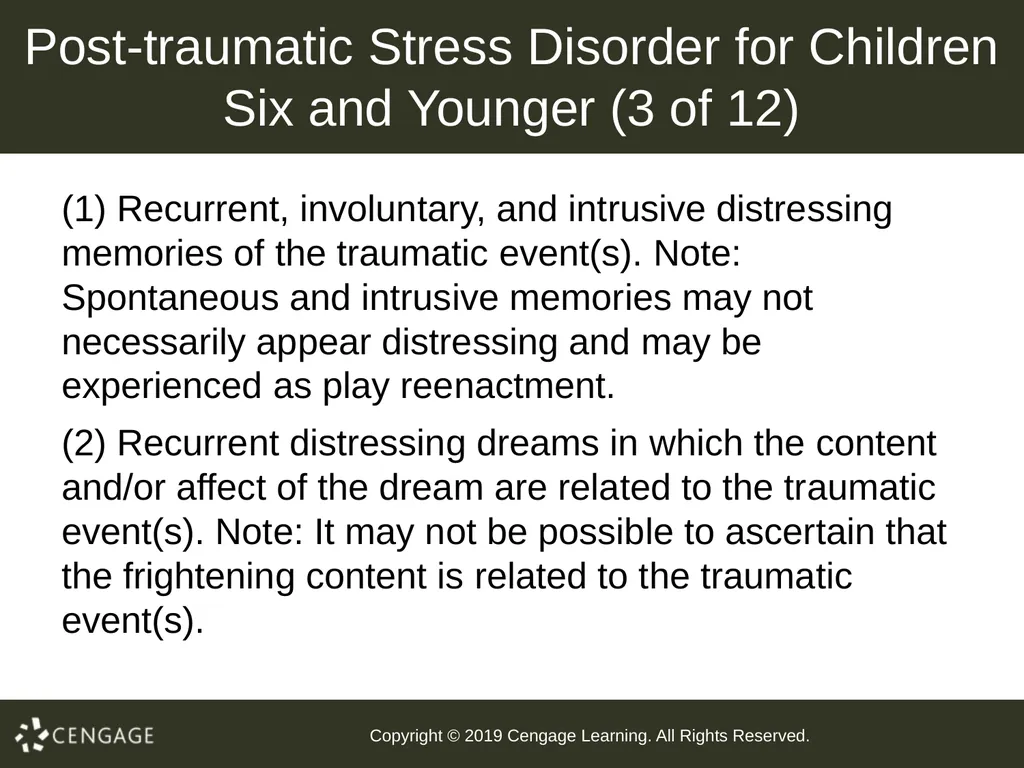
Post-traumatic Stress Disorder for Children Six and Younger (3 of 12) (1) Recurrent, involuntary, and intrusive distressing memories of the traumatic event(s). Note: Spontaneous and intrusive memories may not necessarily appear distressing and may be experienced as play reenactment.
(2) Recurrent distressing dreams in which the content and/or affect of the dream are related to the traumatic event(s). Note: It may not be possible to ascertain that the frightening content is related to the traumatic event(s).<br>
(2) Recurrent distressing dreams in which the content and/or affect of the dream are related to the traumatic event(s). Note: It may not be possible to ascertain that the frightening content is related to the traumatic event(s).<br>
63
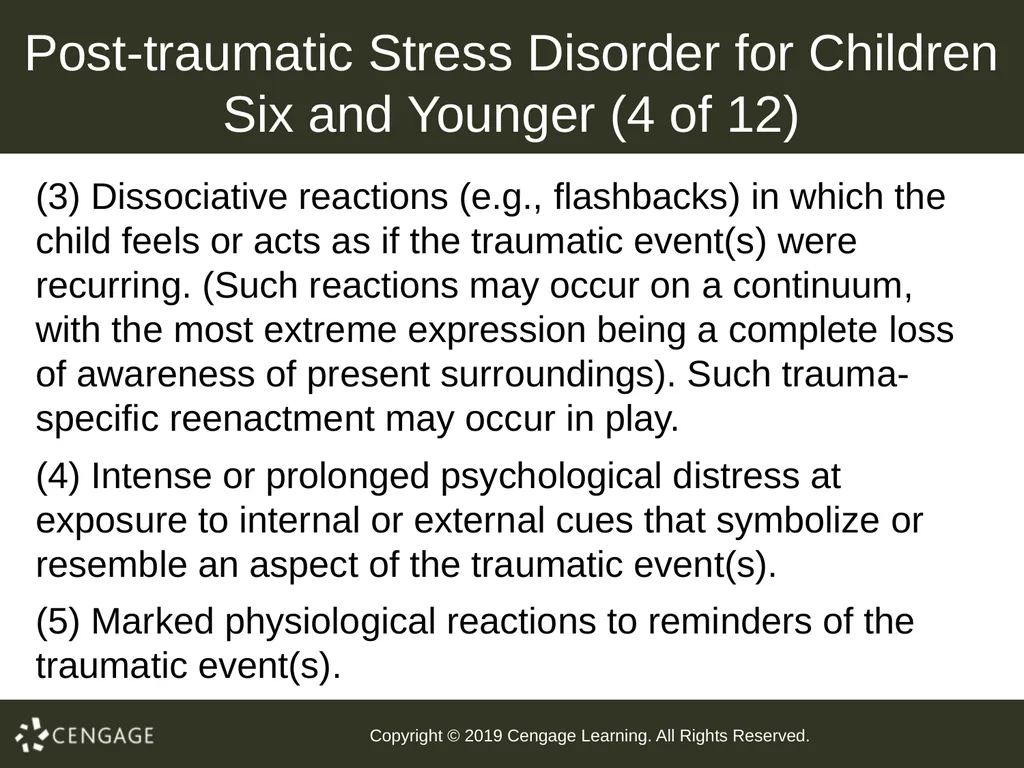
Post-traumatic Stress Disorder for Children Six and Younger (4 of 12) (3) Dissociative reactions (e.g., flashbacks) in which the child feels or acts as if the traumatic event(s) were recurring. (Such reactions may occur on a continuum, with the most extreme expression being a complete loss of awareness of present surroundings). Such trauma-specific reenactment may occur in play.
(4) Intense or prolonged psychological distress at exposure to internal or external cues that symbolize or resemble an aspect of the traumatic event(s).
(5) Marked physiological reactions to reminders of the traumatic event(s).<br>
(4) Intense or prolonged psychological distress at exposure to internal or external cues that symbolize or resemble an aspect of the traumatic event(s).
(5) Marked physiological reactions to reminders of the traumatic event(s).<br>
64
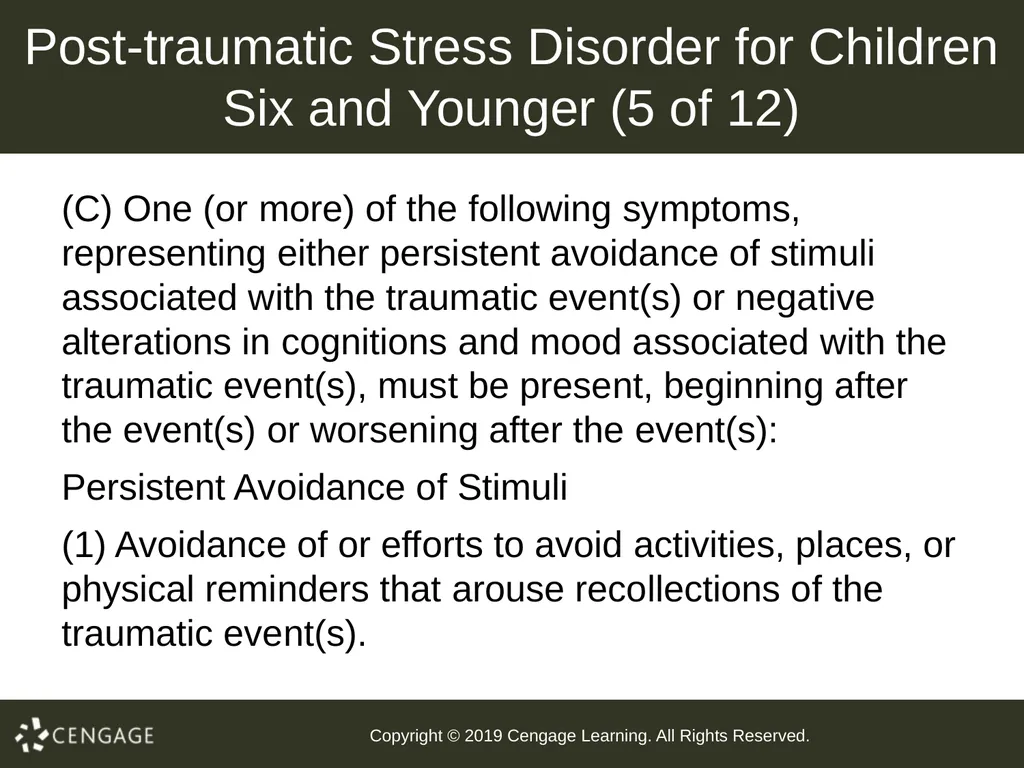
Post-traumatic Stress Disorder for Children Six and Younger (5 of 12) (C) One (or more) of the following symptoms, representing either persistent avoidance of stimuli associated with the traumatic event(s) or negative alterations in cognitions and mood associated with the traumatic event(s), must be present, beginning after the event(s) or worsening after the event(s):
Persistent Avoidance of Stimuli
(1) Avoidance of or efforts to avoid activities, places, or physical reminders that arouse recollections of the traumatic event(s).<br>
Persistent Avoidance of Stimuli
(1) Avoidance of or efforts to avoid activities, places, or physical reminders that arouse recollections of the traumatic event(s).<br>
65
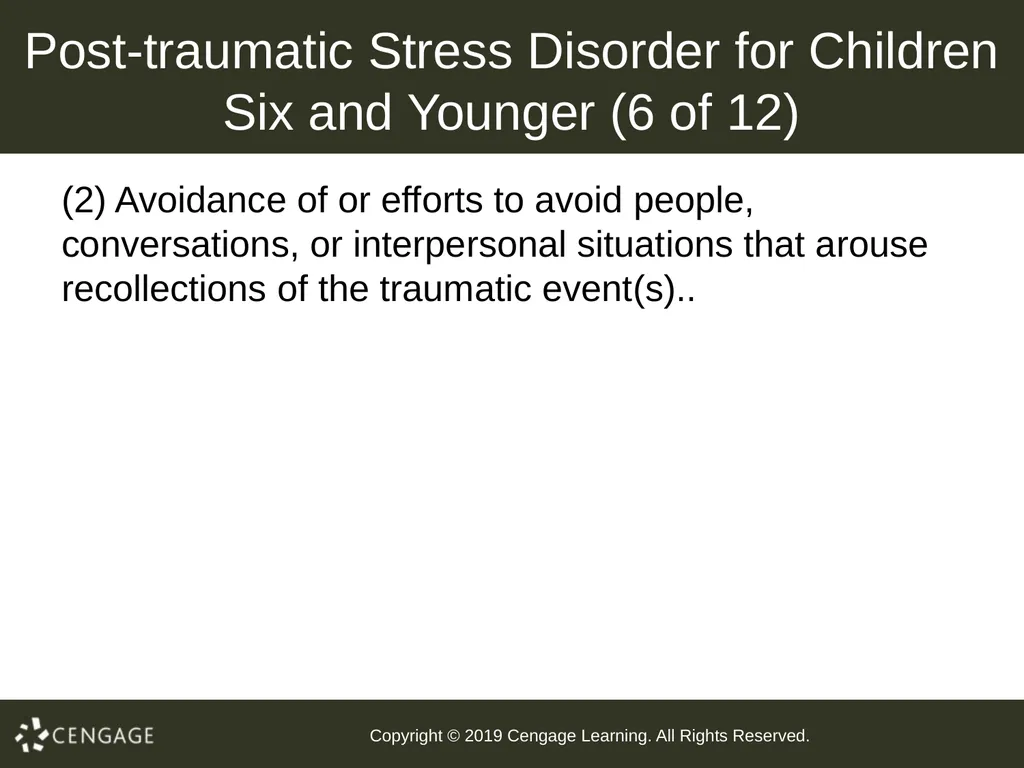
Post-traumatic Stress Disorder for Children Six and Younger (6 of 12) (2) Avoidance of or efforts to avoid people, conversations, or interpersonal situations that arouse recollections of the traumatic event(s)..<br>
66
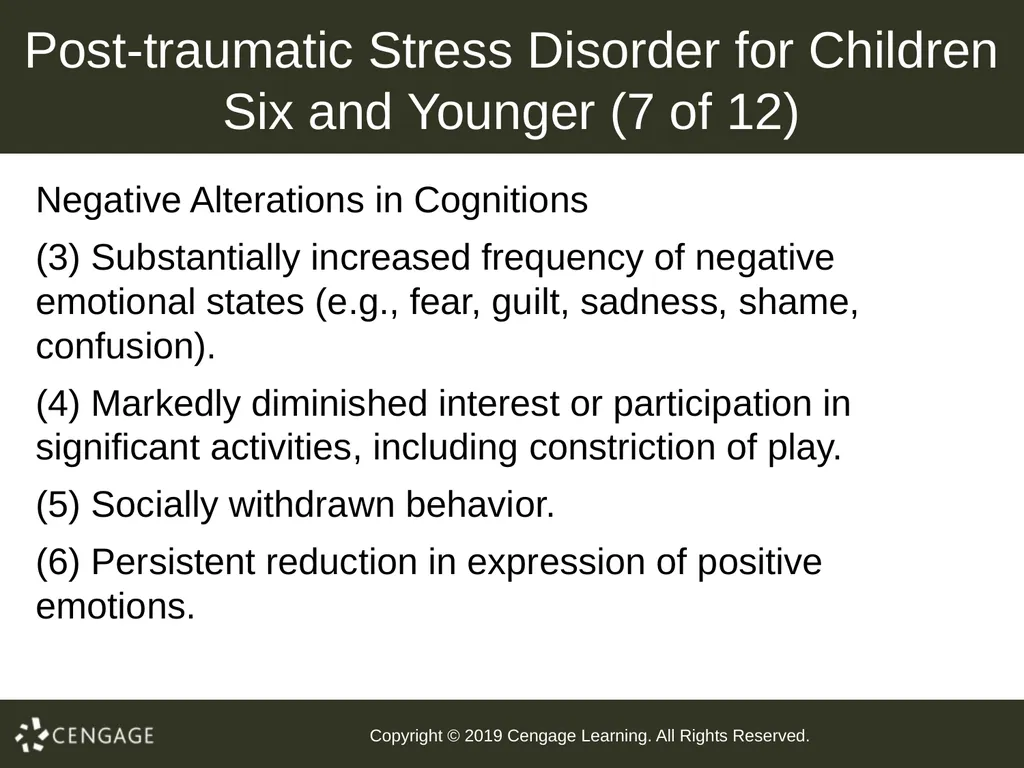
Post-traumatic Stress Disorder for Children Six and Younger (7 of 12) Negative Alterations in Cognitions
(3) Substantially increased frequency of negative emotional states (e.g., fear, guilt, sadness, shame, confusion).
(4) Markedly diminished interest or participation in significant activities, including constriction of play.
(5) Socially withdrawn behavior.
(6) Persistent reduction in expression of positive emotions.<br>
(3) Substantially increased frequency of negative emotional states (e.g., fear, guilt, sadness, shame, confusion).
(4) Markedly diminished interest or participation in significant activities, including constriction of play.
(5) Socially withdrawn behavior.
(6) Persistent reduction in expression of positive emotions.<br>
67
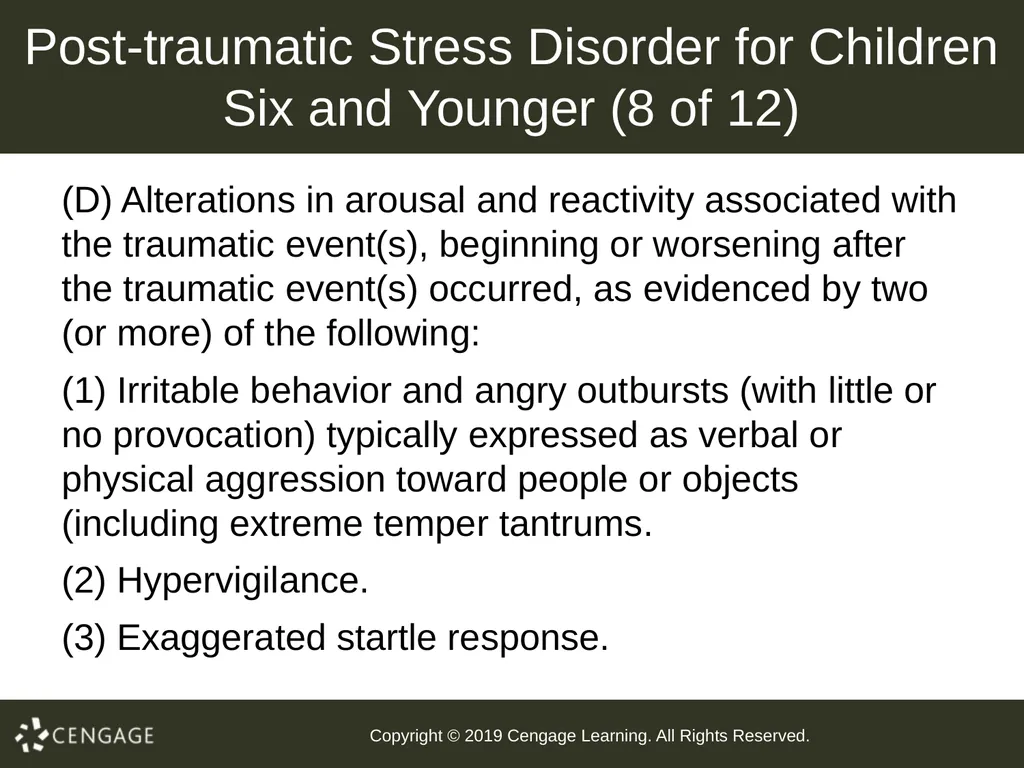
Post-traumatic Stress Disorder for Children Six and Younger (8 of 12) (D) Alterations in arousal and reactivity associated with the traumatic event(s), beginning or worsening after the traumatic event(s) occurred, as evidenced by two (or more) of the following:
(1) Irritable behavior and angry outbursts (with little or no provocation) typically expressed as verbal or physical aggression toward people or objects (including extreme temper tantrums.
(2) Hypervigilance.
(3) Exaggerated startle response.<br>
(1) Irritable behavior and angry outbursts (with little or no provocation) typically expressed as verbal or physical aggression toward people or objects (including extreme temper tantrums.
(2) Hypervigilance.
(3) Exaggerated startle response.<br>
68
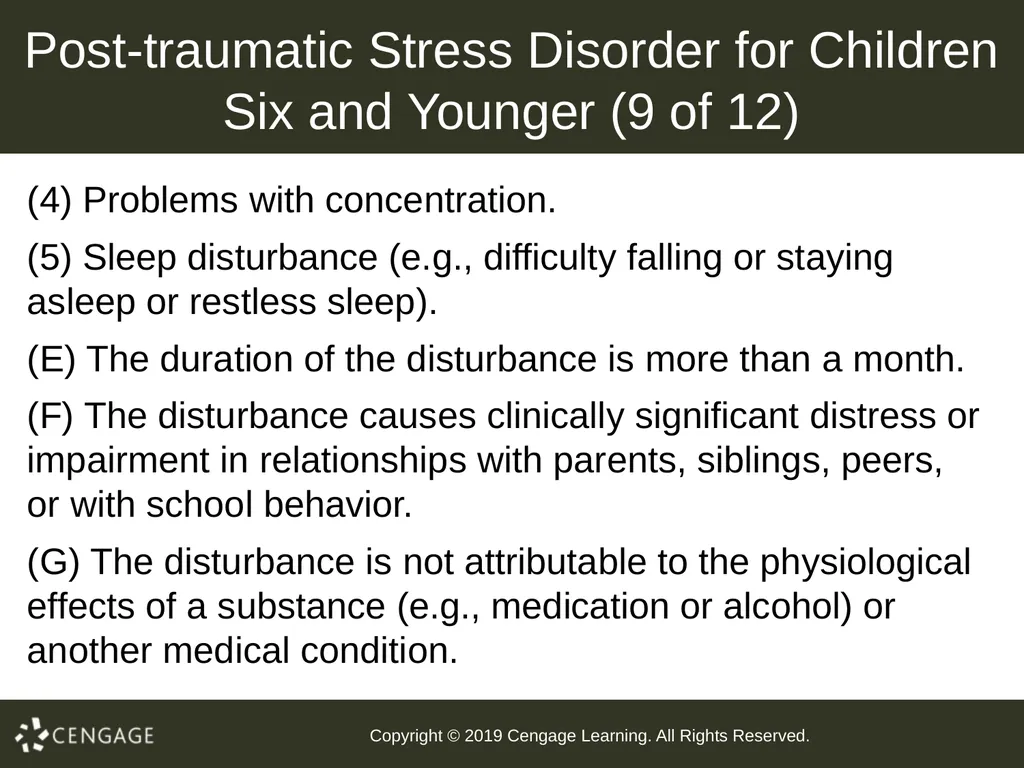
Post-traumatic Stress Disorder for Children Six and Younger (9 of 12) (4) Problems with concentration.
(5) Sleep disturbance (e.g., difficulty falling or staying asleep or restless sleep).
(E) The duration of the disturbance is more than a month.
(F) The disturbance causes clinically significant distress or impairment in relationships with parents, siblings, peers, or with school behavior.
(G) The disturbance is not attributable to the physiological effects of a substance (e.g., medication or alcohol) or another medical condition.<br>
(5) Sleep disturbance (e.g., difficulty falling or staying asleep or restless sleep).
(E) The duration of the disturbance is more than a month.
(F) The disturbance causes clinically significant distress or impairment in relationships with parents, siblings, peers, or with school behavior.
(G) The disturbance is not attributable to the physiological effects of a substance (e.g., medication or alcohol) or another medical condition.<br>
69
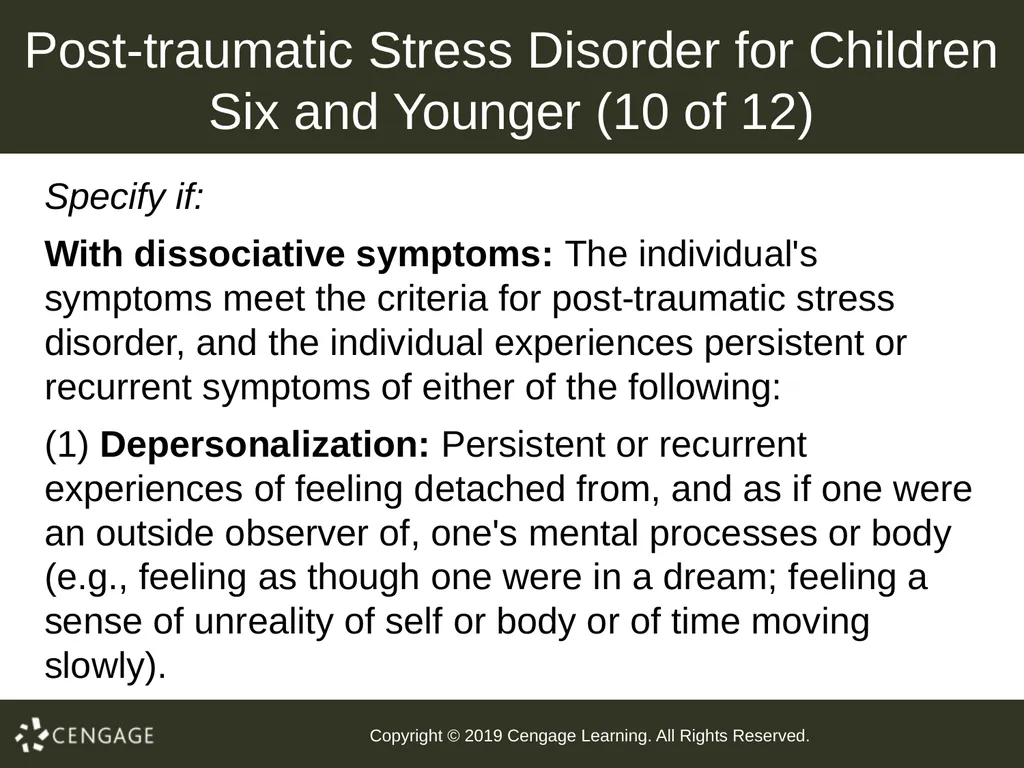
Post-traumatic Stress Disorder for Children Six and Younger (10 of 12) Specify if:
With dissociative symptoms: The individual's symptoms meet the criteria for post-traumatic stress disorder, and the individual experiences persistent or recurrent symptoms of either of the following:
(1) Depersonalization: Persistent or recurrent experiences of feeling detached from, and as if one were an outside observer of, one's mental processes or body (e.g., feeling as though one were in a dream; feeling a sense of unreality of self or body or of time moving slowly).<br>
With dissociative symptoms: The individual's symptoms meet the criteria for post-traumatic stress disorder, and the individual experiences persistent or recurrent symptoms of either of the following:
(1) Depersonalization: Persistent or recurrent experiences of feeling detached from, and as if one were an outside observer of, one's mental processes or body (e.g., feeling as though one were in a dream; feeling a sense of unreality of self or body or of time moving slowly).<br>
70
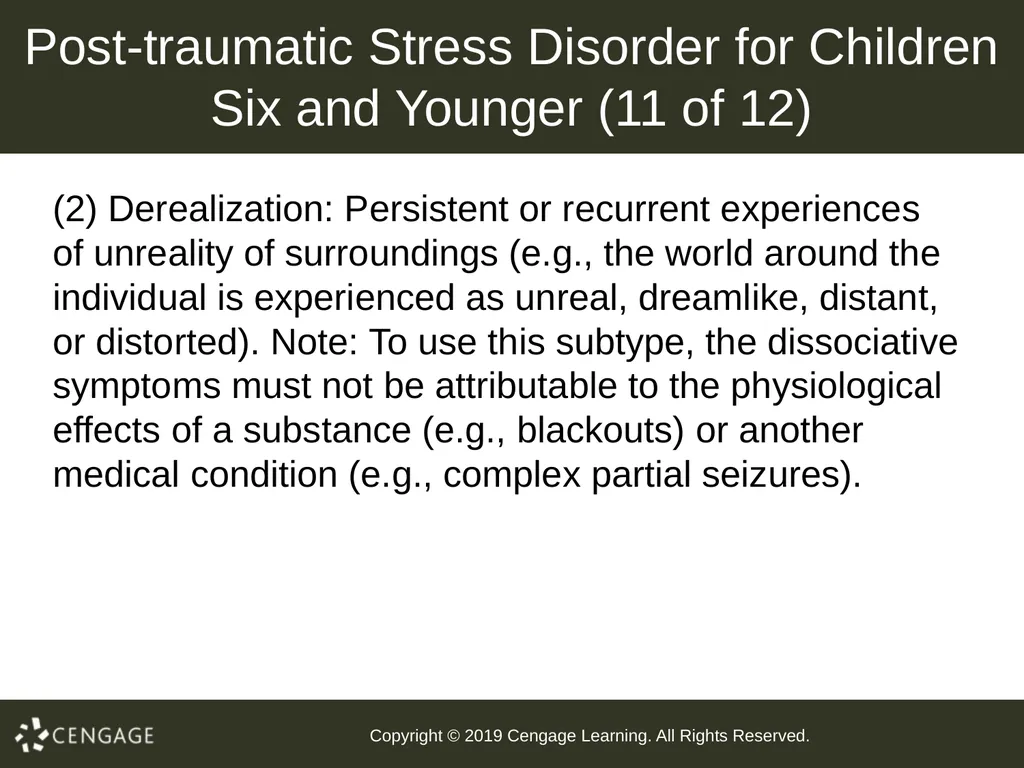
Post-traumatic Stress Disorder for Children Six and Younger (11 of 12) (2) Derealization: Persistent or recurrent experiences of unreality of surroundings (e.g., the world around the individual is experienced as unreal, dreamlike, distant, or distorted). Note: To use this subtype, the dissociative symptoms must not be attributable to the physiological effects of a substance (e.g., blackouts) or another medical condition (e.g., complex partial seizures).<br>
71
Post-traumatic Stress Disorder for Children Six and Younger (12 of 12) Specify if:
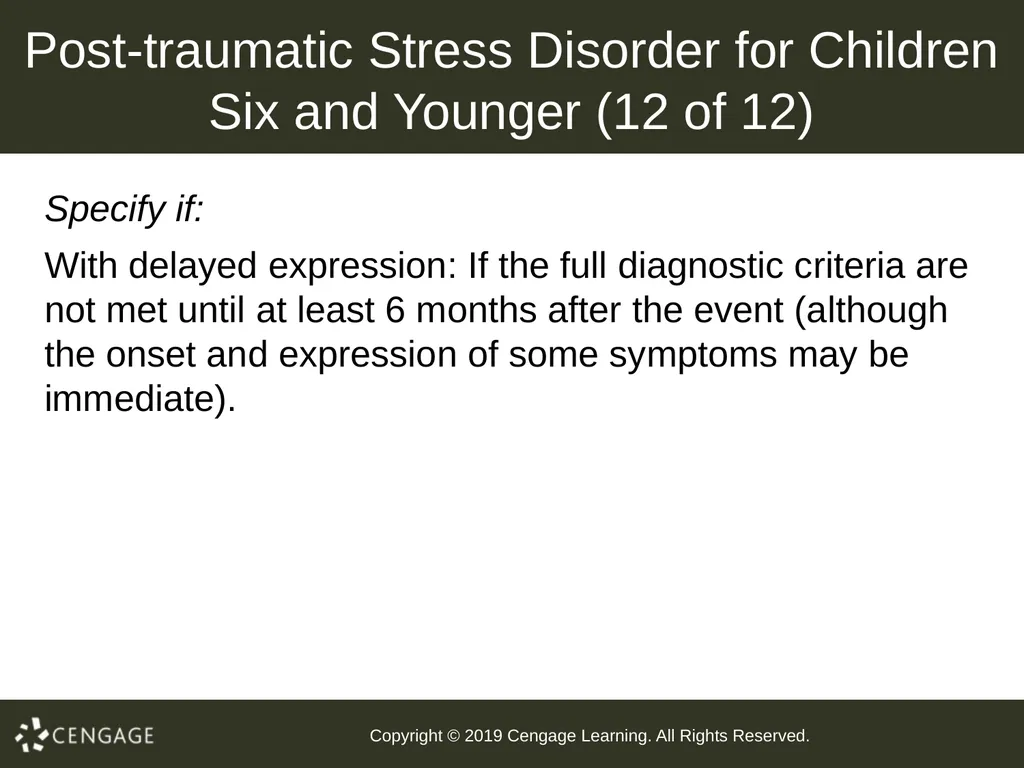
With delayed expression: If the full diagnostic criteria are not met until at least 6 months after the event (although the onset and expression of some symptoms may be immediate).<br>
With delayed expression: If the full diagnostic criteria are not met until at least 6 months after the event (although the onset and expression of some symptoms may be immediate).<br>
72
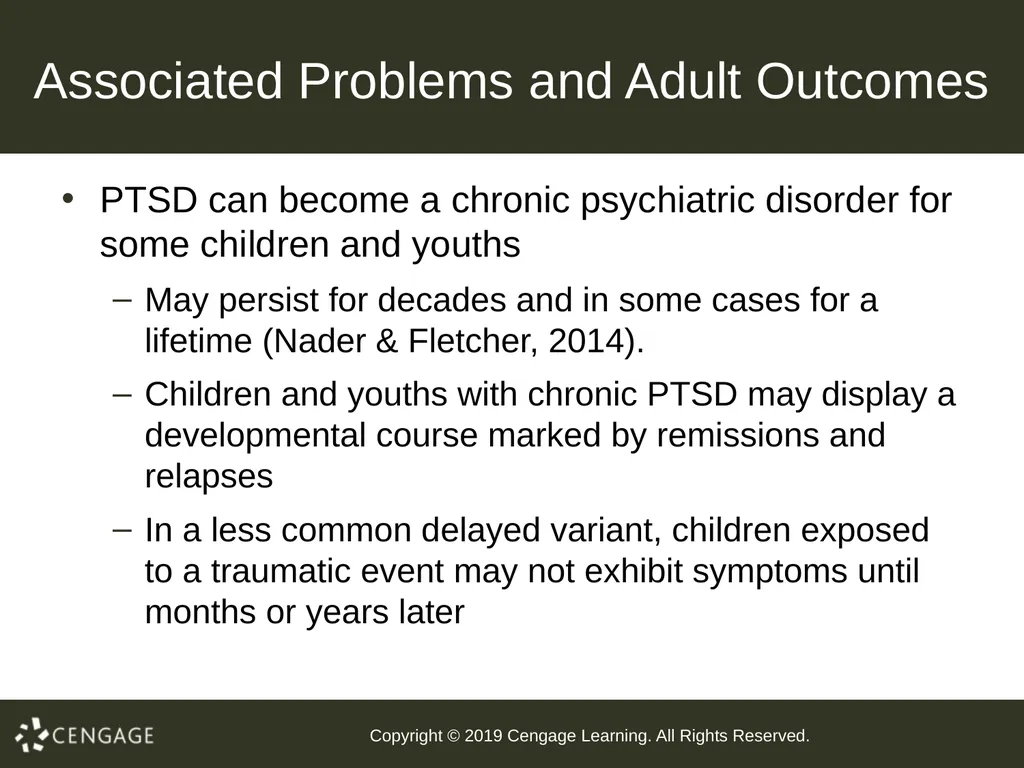
Associated Problems and Adult Outcomes PTSD can become a chronic psychiatric disorder for some children and youths
May persist for decades and in some cases for a lifetime (Nader & Fletcher, 2014).
Children and youths with chronic PTSD may display a developmental course marked by remissions and relapses
In a less common delayed variant, children exposed to a traumatic event may not exhibit symptoms until months or years later<br>
May persist for decades and in some cases for a lifetime (Nader & Fletcher, 2014).
Children and youths with chronic PTSD may display a developmental course marked by remissions and relapses
In a less common delayed variant, children exposed to a traumatic event may not exhibit symptoms until months or years later<br>
73
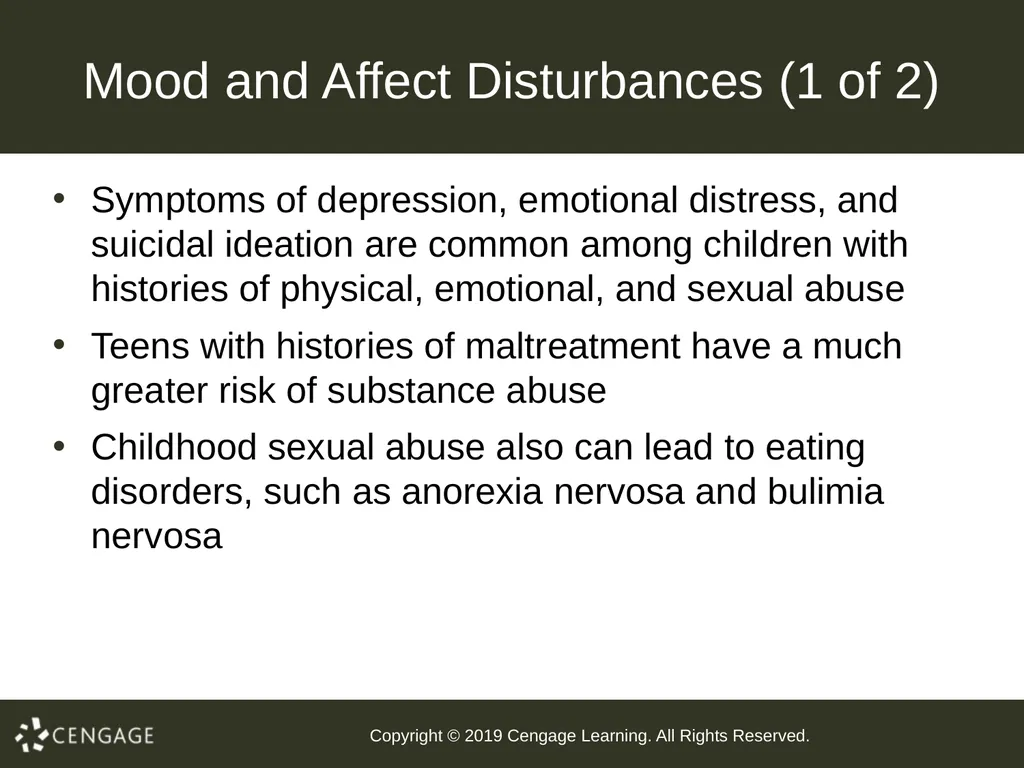
Mood and Affect Disturbances (1 of 2) Symptoms of depression, emotional distress, and suicidal ideation are common among children with histories of physical, emotional, and sexual abuse
Teens with histories of maltreatment have a much greater risk of substance abuse
Childhood sexual abuse also can lead to eating disorders, such as anorexia nervosa and bulimia nervosa<br>
Teens with histories of maltreatment have a much greater risk of substance abuse
Childhood sexual abuse also can lead to eating disorders, such as anorexia nervosa and bulimia nervosa<br>
74
Mood and Affect Disturbances (2 of 2) In reaction to emotional and physical pain from abusive experiences, children or adults voluntarily or involuntarily may induce an altered state of consciousness known as dissociation<br>
75
Sexual Adjustment Sexual abuse, in particular, can lead to traumatic sexualization, in which a child’s sexual knowledge and behavior are shaped in developmentally inappropriate ways<br>
76
Causes: Poor Emotion Regulation Maltreated infants/toddlers have difficulty establishing reciprocal, consistent interaction with caregivers
Exhibit insecure-disorganized attachment
Have difficulty understanding, labeling, and regulating internal emotional states
Learn to inhibit emotional expression and regulation, remaining more fearful and on alert<br>
Exhibit insecure-disorganized attachment
Have difficulty understanding, labeling, and regulating internal emotional states
Learn to inhibit emotional expression and regulation, remaining more fearful and on alert<br>
77
Causes: Emerging View of Self and Others Maltreated children’s emerging views of self and their surroundings are not fostered by healthy parental guidance and control
Emotional and behavioral problems are likely to appear
Negative representational models of self and others develop based on a sense of inner “badness,” self-blame, shame, or rage<br>
Emotional and behavioral problems are likely to appear
Negative representational models of self and others develop based on a sense of inner “badness,” self-blame, shame, or rage<br>
78
Emerging View of Self and Others Feelings of powerlessness and betrayal are internalized as part of the child’s self-identity
Maltreated girls show internalizing signs of distress, such as shame and self-blame, while maltreated boys show heightened levels of verbal and physical aggression<br>
Maltreated girls show internalizing signs of distress, such as shame and self-blame, while maltreated boys show heightened levels of verbal and physical aggression<br>
79
Causes: Neurobiological Development Children and adults with a history of child abuse show long-term alterations in the hypothalamic–pituitary–adrenal (HPA) axis and norepinephrine systems
These alterations have a significant affect on responsiveness to stress
Affected brain areas:
Include the hippocampus, prefrontal cortex, and amygdala<br>
These alterations have a significant affect on responsiveness to stress
Affected brain areas:
Include the hippocampus, prefrontal cortex, and amygdala<br>
80
Neurobiological Development Acute and chronic forms of stress associated with maltreatment may cause changes in brain development and structure from an early age
The neuroendocrine system becomes highly sensitive to stress
Causing neurobiological changes that may account for later psychiatric problems<br>
The neuroendocrine system becomes highly sensitive to stress
Causing neurobiological changes that may account for later psychiatric problems<br>
81
Prevention and Treatment Obstacles to intervention and prevention services for maltreating families
Those most in need are least likely to seek help
They are brought to the attention of professionals after norms or laws have been violated
Parents do not want to admit to problems for fear of losing their children or being charged with a crime<br>
Those most in need are least likely to seek help
They are brought to the attention of professionals after norms or laws have been violated
Parents do not want to admit to problems for fear of losing their children or being charged with a crime<br>
82
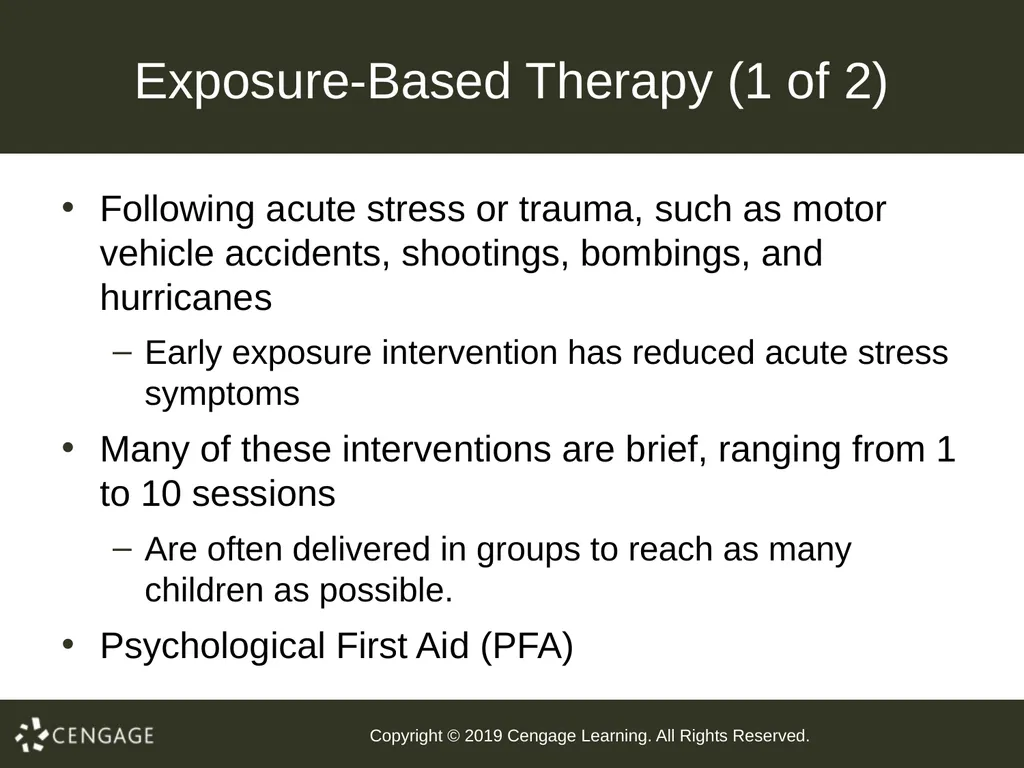
Exposure-Based Therapy (1 of 2) Following acute stress or trauma, such as motor vehicle accidents, shootings, bombings, and hurricanes
Early exposure intervention has reduced acute stress symptoms
Many of these interventions are brief, ranging from 1 to 10 sessions
Are often delivered in groups to reach as many children as possible.
Psychological First Aid (PFA)<br>
Early exposure intervention has reduced acute stress symptoms
Many of these interventions are brief, ranging from 1 to 10 sessions
Are often delivered in groups to reach as many children as possible.
Psychological First Aid (PFA)<br>
83
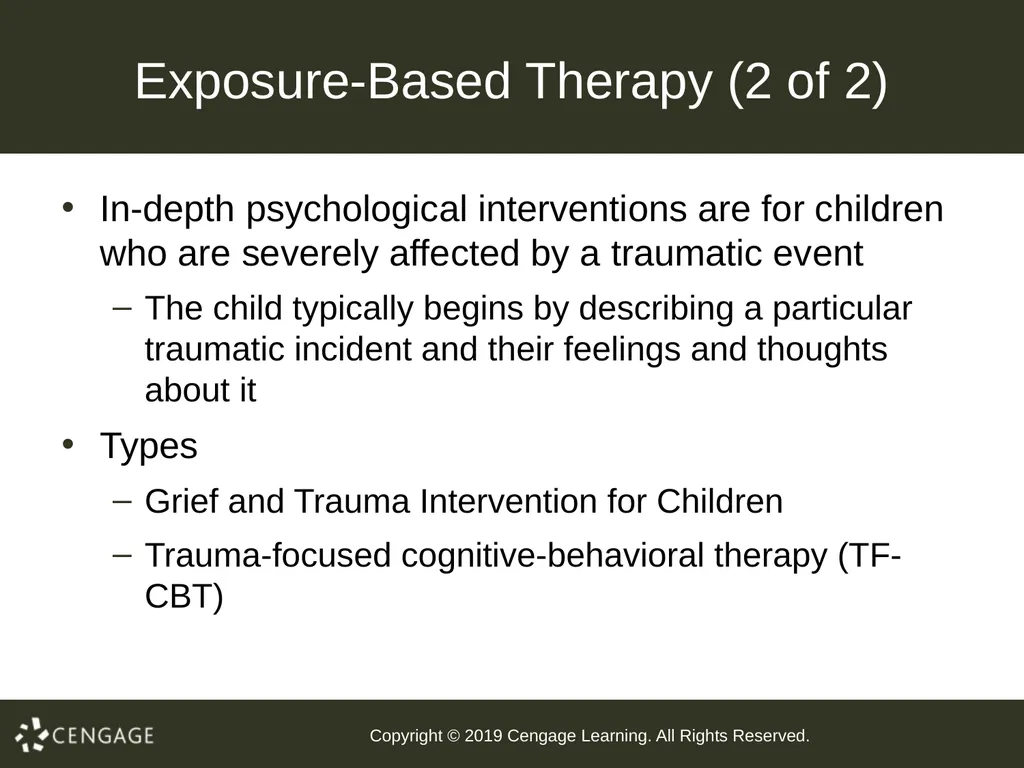
Exposure-Based Therapy (2 of 2) In-depth psychological interventions are for children who are severely affected by a traumatic event
The child typically begins by describing a particular traumatic incident and their feelings and thoughts about it
Types
Grief and Trauma Intervention for Children
Trauma-focused cognitive-behavioral therapy (TF-CBT)<br>
The child typically begins by describing a particular traumatic incident and their feelings and thoughts about it
Types
Grief and Trauma Intervention for Children
Trauma-focused cognitive-behavioral therapy (TF-CBT)<br>
84
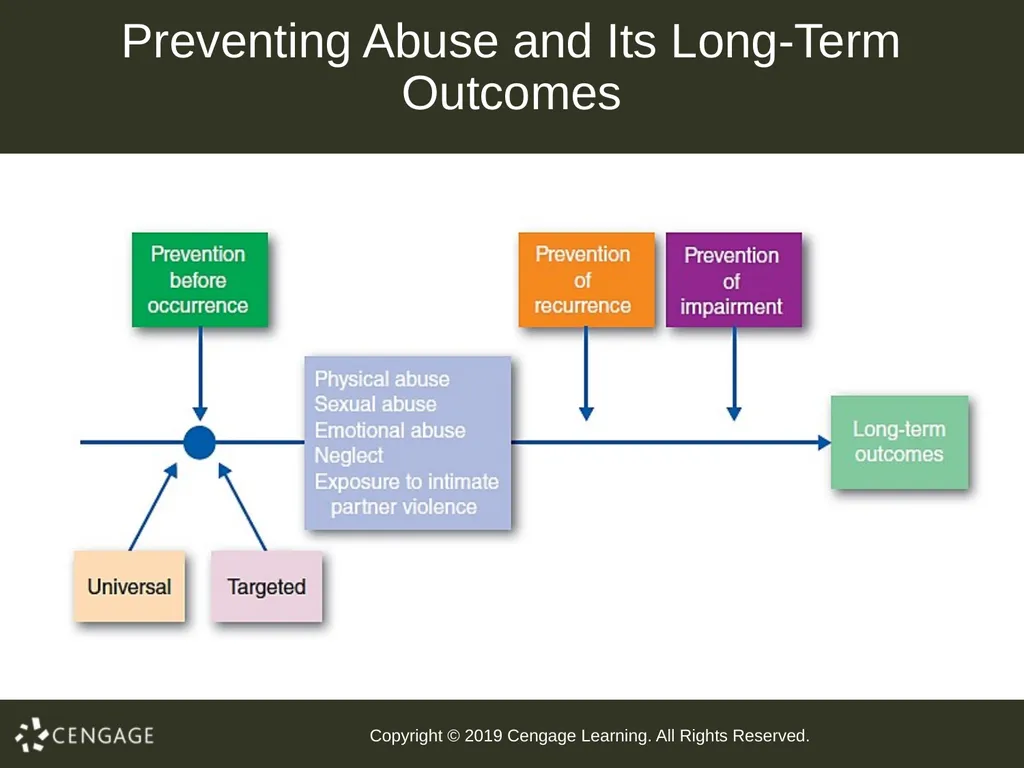
Preventing Abuse and Its Long-Term Outcomes<br>
85
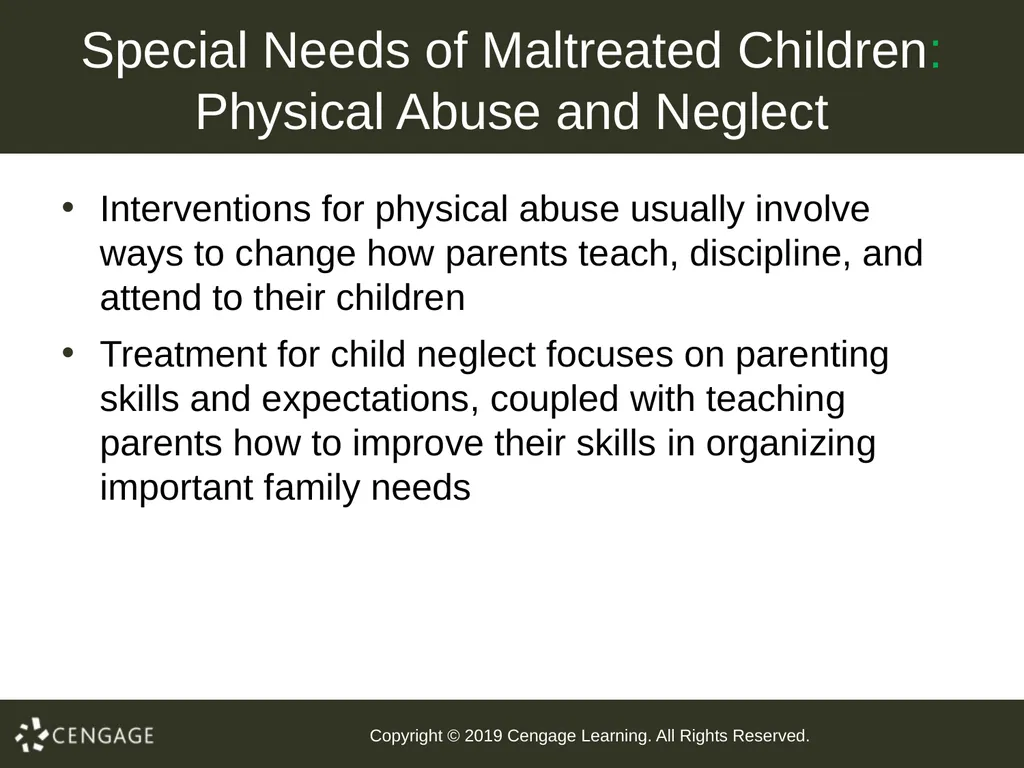
Special Needs of Maltreated Children: Physical Abuse and Neglect Interventions for physical abuse usually involve ways to change how parents teach, discipline, and attend to their children
Treatment for child neglect focuses on parenting skills and expectations, coupled with teaching parents how to improve their skills in organizing important family needs<br>
Treatment for child neglect focuses on parenting skills and expectations, coupled with teaching parents how to improve their skills in organizing important family needs<br>
86
Special Needs of Maltreated Children: Sexual Abuse Treatment programs for children who have been sexually abused provide several crucial elements to restore the child’s sense of trust, safety, and guiltlessness
TF-CBT has been adapted for child sexual abuse victims and others with complex trauma symptoms<br>
TF-CBT has been adapted for child sexual abuse victims and others with complex trauma symptoms<br>