01
Academic Advising Assessment: Perceived Support and Scale Development ��Tracie D. Burt, Erin M. Buchanan, Michael T. Carr, Marilee L. Teasley, Carly A. Yadon, & Adena D. Young-Jones Problem and Empirical Support: Perceived social support has been investigated in academic settings (Chen, 2005; Wang & Castaneda-Sound, 2008), but not at the university level linking perceived support from advisors to outcomes. Key individuals (e.g., staff and faculty academic advisors) influence student retention and academic performance (Habley & McClanahan, 2004; Kuh, 2008). For example, advising influences persistence and graduation rates (Pascarella & Terenzini, 2005) and faculty approachability can predict reenrollment and commitment to a major, which is linked to academic performance (Graunke & Woolsey, 2005). Though numerous educational institutions have created questionnaires to match university goals and mission statements (National Academic Advising Association, 2012), few standardized scales exist to assess student learning outcomes of academic advising. The purpose of this study was to standardize an instrument through which an institution can measure outcomes related to perceived advisor support.
Hypotheses:
Advising Support Scale items will load onto three distinct factors.
Factor loadings and measurement invariance will support reliability of the Advising Support Scale. Participants: Sample 1 (N = 112) and Sample 2 (N = 486) consisted primarily of college students (approximately 18-20 years old) who completed an online survey.
Materials: Researchers created the Advising Perceived Support Scale to investigate perceived advisor support on three dimensions: engagement, interpersonal relationships, and autonomy. Some of the 148 original scale items were new; others were adapted from the Teaching Styles Survey (Grasha & Riechmann-Hruska, 1996); Subject Impressions Questionnaire, and Learning Climate Questionnaire (Williams & Deci, 1996).
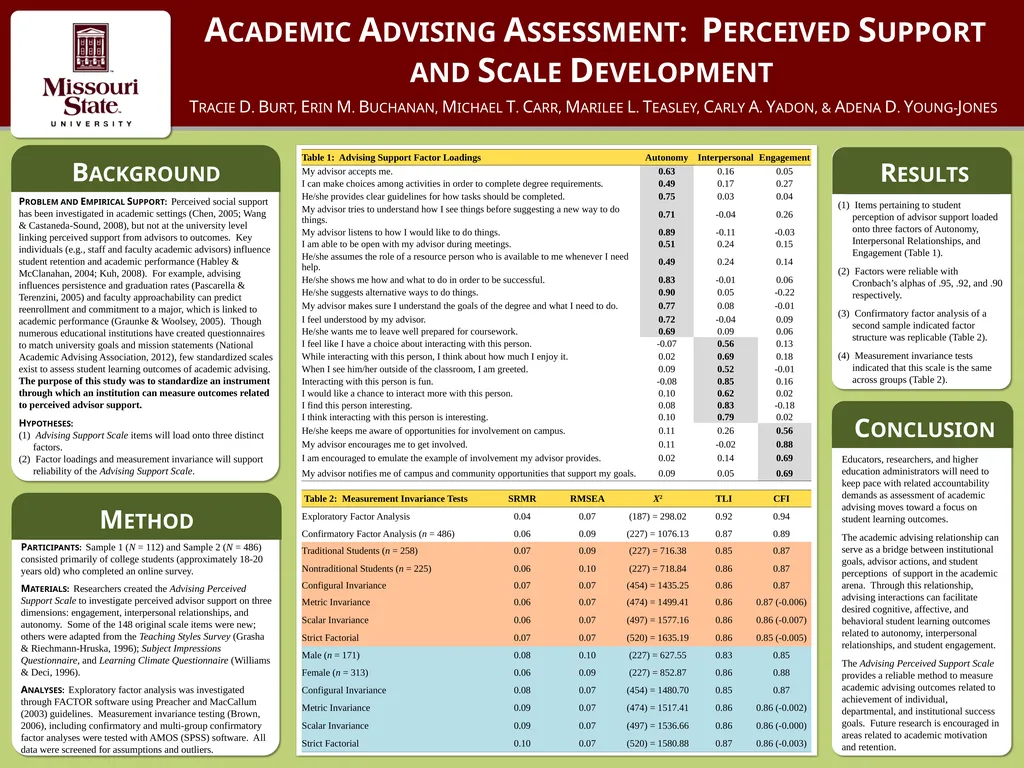
Analyses: Exploratory factor analysis was investigated through FACTOR software using Preacher and MacCallum (2003) guidelines. Measurement invariance testing (Brown, 2006), including confirmatory and multi-group confirmatory factor analyses were tested with AMOS (SPSS) software. All data were screened for assumptions and outliers. Items pertaining to student perception of advisor support loaded onto three factors of Autonomy, Interpersonal Relationships, and Engagement (Table 1).
Factors were reliable with Cronbach’s alphas of .95, .92, and .90 respectively.
Confirmatory factor analysis of a second sample indicated factor structure was replicable (Table 2).
Measurement invariance tests indicated that this scale is the same across groups (Table 2). Method Background Results Conclusion Educators, researchers, and higher education administrators will need to keep pace with related accountability demands as assessment of academic advising moves toward a focus on student learning outcomes.
The academic advising relationship can serve as a bridge between institutional goals, advisor actions, and student perceptions of support in the academic arena. Through this relationship, advising interactions can facilitate desired cognitive, affective, and behavioral student learning outcomes related to autonomy, interpersonal relationships, and student engagement.
The Advising Perceived Support Scale provides a reliable method to measure academic advising outcomes related to achievement of individual, departmental, and institutional success goals. Future research is encouraged in areas related to academic motivation and retention.<br>