
Achieving Audit Quality & Compliance with Peer
Description: Achieving Audit Quality Compliance with Peer Review M S Mathew Achieving Audit Quality Important conversations are taking place worldwide about corporate reporting, audit quality, stakeholder expectations, and corporate governance. The
Related Topics
Download Presentation
"Achieving Audit Quality & Compliance with Peer" is the property of its rightful owner. Permission is granted to download and print the materials on this website for personal, non-commercial use only, and to display it on your personal computer provided you do not modify the materials and that you retain all copyright notices contained in the materials. By downloading content from our website, you accept the terms of this agreement.
Presentation Transcript
slide1. Achieving Audit Quality
&
Compliance with Peer Review
M S Mathew<br>
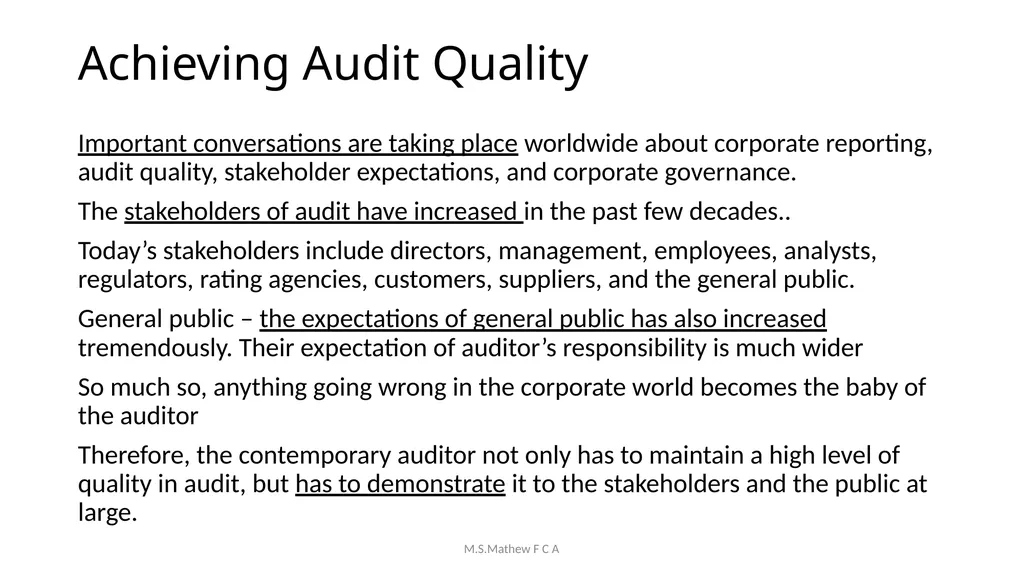
slide2. Achieving Audit Quality Important conversations are taking place worldwide about corporate reporting, audit quality, stakeholder expectations, and corporate governance.
The stakeholders of audit have increased in the past few decades..
Today’s stakeholders include directors, management, employees, analysts, regulators, rating agencies, customers, suppliers, and the general public.
General public – the expectations of general public has also increased tremendously. Their expectation of auditor’s responsibility is much wider
So much so, anything going wrong in the corporate world becomes the baby of the auditor
Therefore, the contemporary auditor not only has to maintain a high level of quality in audit, but has to demonstrate it to the stakeholders and the public at large. M.S.Mathew F C A<br>
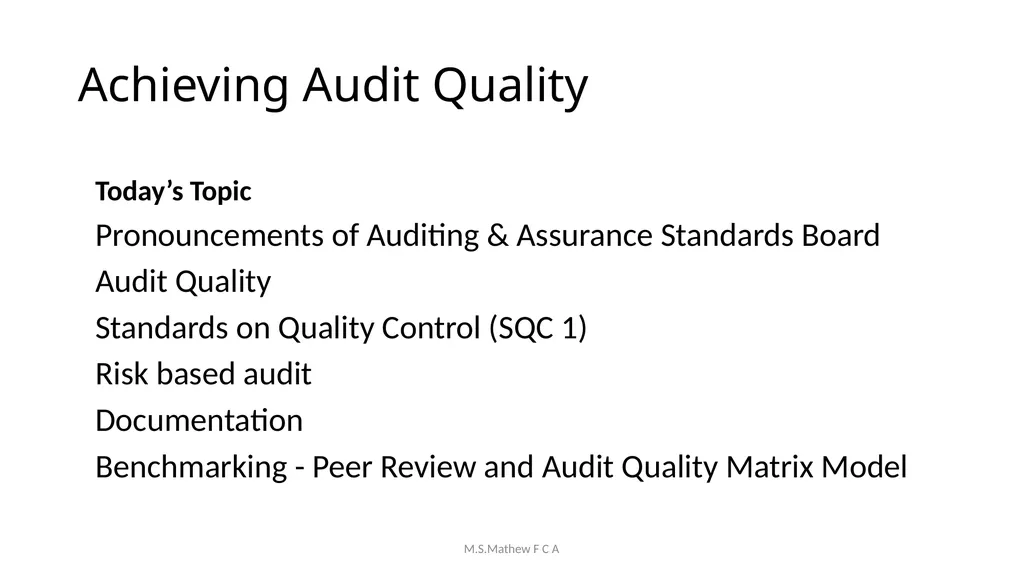
slide3. Achieving Audit Quality Today’s Topic
Pronouncements of Auditing & Assurance Standards Board
Audit Quality
Standards on Quality Control (SQC 1)
Risk based audit
Documentation
Benchmarking - Peer Review and Audit Quality Matrix Model M.S.Mathew F C A<br>
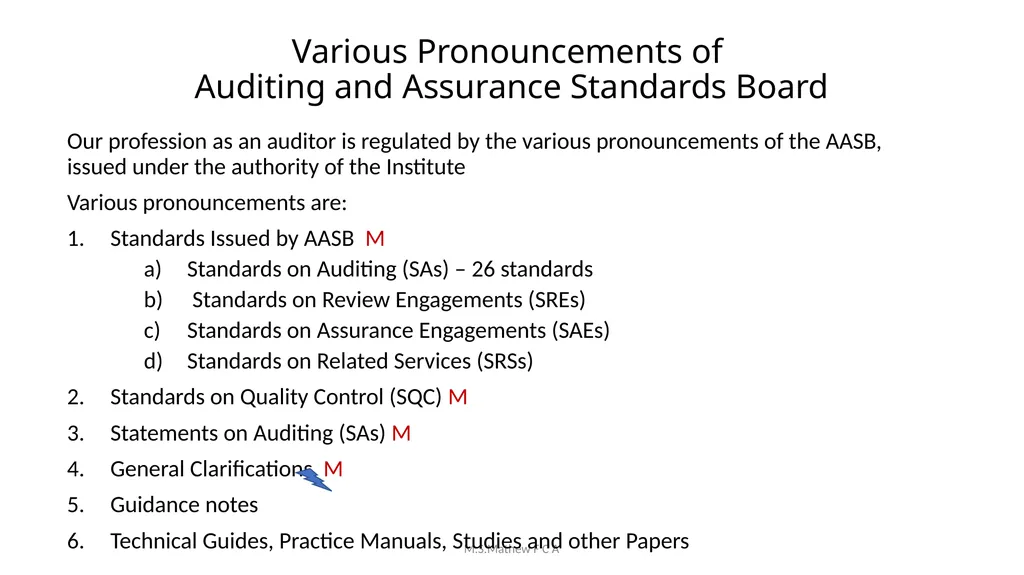
slide4. Various Pronouncements of Auditing and Assurance Standards Board Our profession as an auditor is regulated by the various pronouncements of the AASB, issued under the authority of the Institute
Various pronouncements are:
Standards Issued by AASB M
Standards on Auditing (SAs) – 26 standards
Standards on Review Engagements (SREs)
Standards on Assurance Engagements (SAEs)
Standards on Related Services (SRSs)
Standards on Quality Control (SQC) M
Statements on Auditing (SAs) M
General Clarifications M
Guidance notes
Technical Guides, Practice Manuals, Studies and other Papers M.S.Mathew F C A<br>
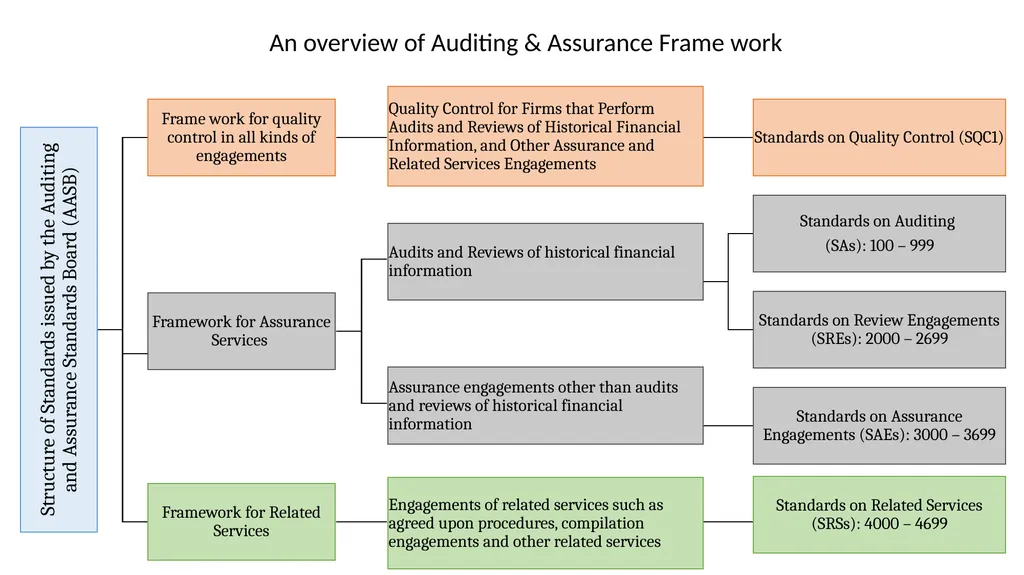
slide5. Structure of Standards issued by the Auditing and Assurance Standards Board (AASB) Frame work for quality control in all kinds of engagements Quality Control for Firms that Perform Audits and Reviews of Historical Financial Information, and Other Assurance and Related Services Engagements Standards on Quality Control (SQC1) Framework for Assurance Services Audits and Reviews of historical financial information Standards on Auditing
(SAs): 100 – 999 Standards on Review Engagements (SREs): 2000 – 2699 Assurance engagements other than audits and reviews of historical financial information Standards on Assurance Engagements (SAEs): 3000 – 3699 Framework for Related Services Engagements of related services such as agreed upon procedures, compilation engagements and other related services Standards on Related Services (SRSs): 4000 – 4699 An overview of Auditing & Assurance Frame work M.S.Mathew F C A<br>
slide6. Benchmarking of Audit Quality M.S.Mathew F C A<br>
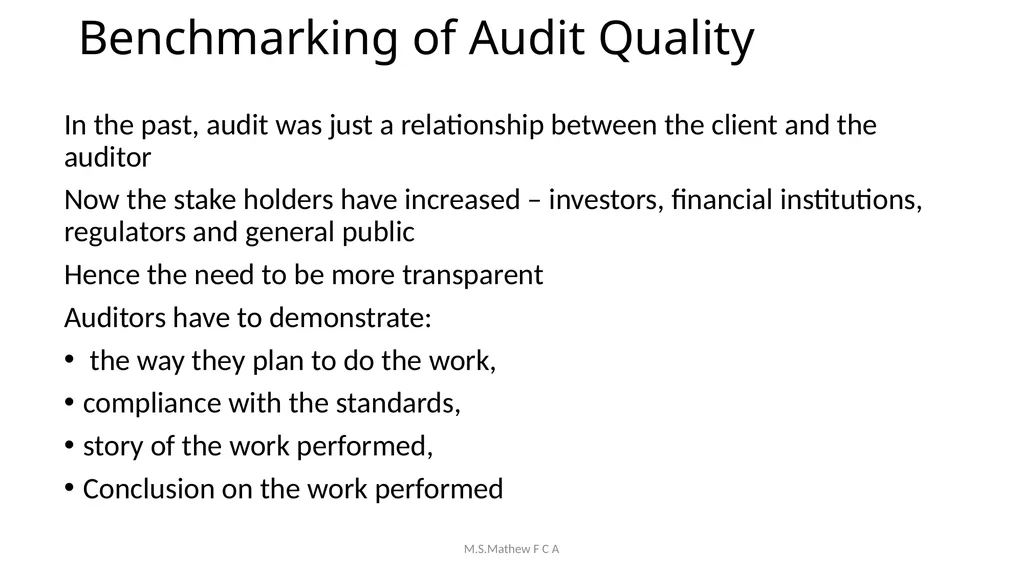
slide7. Benchmarking of Audit Quality In the past, audit was just a relationship between the client and the auditor
Now the stake holders have increased – investors, financial institutions, regulators and general public
Hence the need to be more transparent
Auditors have to demonstrate:
the way they plan to do the work,
compliance with the standards,
story of the work performed,
Conclusion on the work performed M.S.Mathew F C A<br>
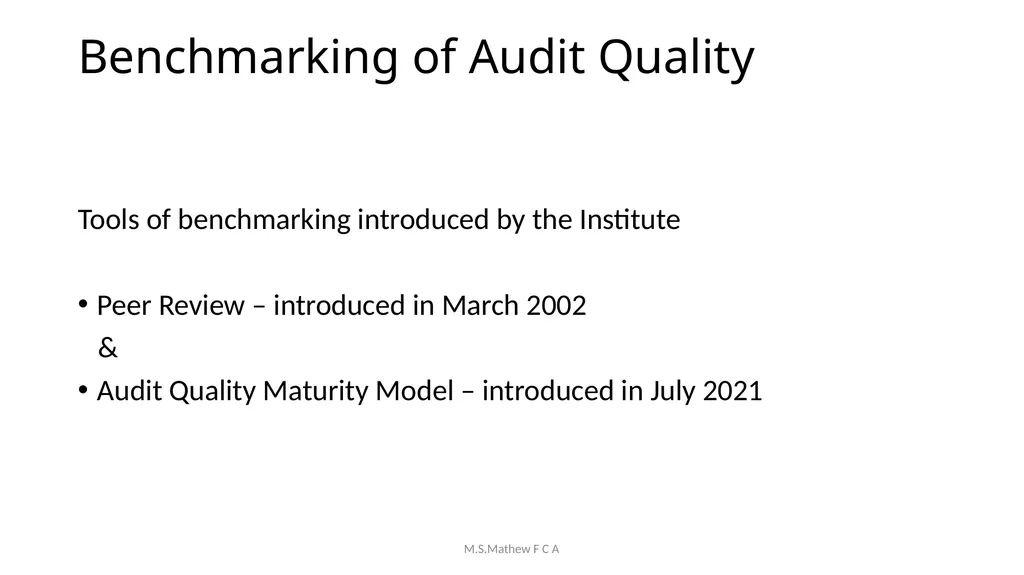
slide8. Benchmarking of Audit Quality Tools of benchmarking introduced by the Institute
Peer Review – introduced in March 2002
&
Audit Quality Maturity Model – introduced in July 2021 M.S.Mathew F C A<br>
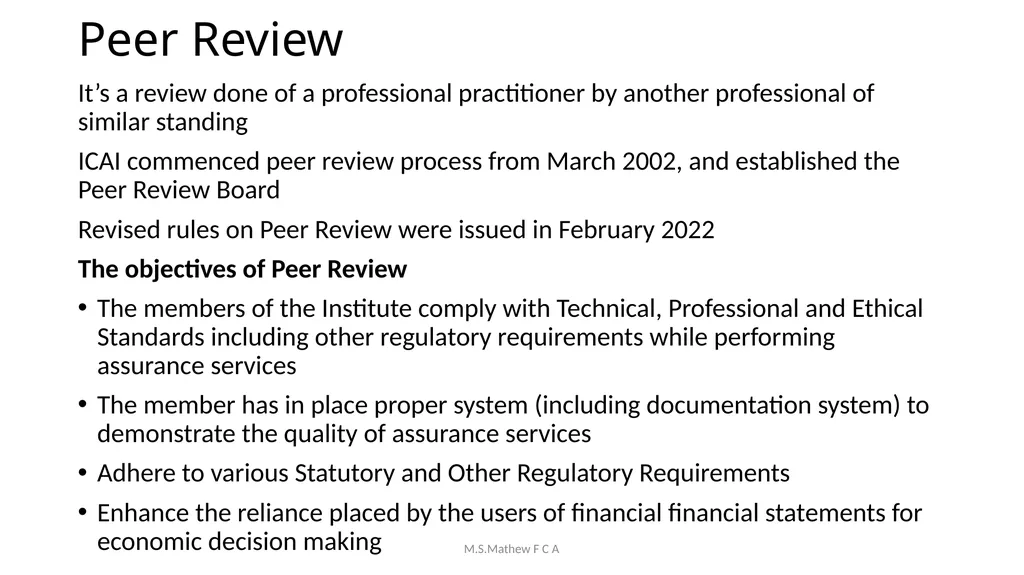
slide9. Peer Review It’s a review done of a professional practitioner by another professional of similar standing
ICAI commenced peer review process from March 2002, and established the Peer Review Board
Revised rules on Peer Review were issued in February 2022
The objectives of Peer Review
The members of the Institute comply with Technical, Professional and Ethical Standards including other regulatory requirements while performing assurance services
The member has in place proper system (including documentation system) to demonstrate the quality of assurance services
Adhere to various Statutory and Other Regulatory Requirements
Enhance the reliance placed by the users of financial financial statements for economic decision making M.S.Mathew F C A<br>
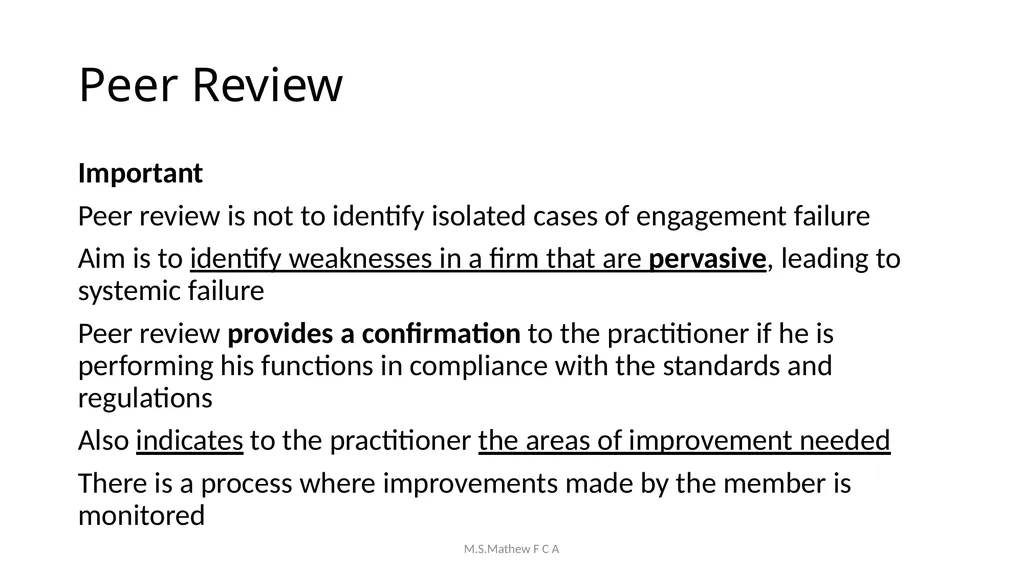
slide10. Peer Review Important
Peer review is not to identify isolated cases of engagement failure
Aim is to identify weaknesses in a firm that are pervasive, leading to systemic failure
Peer review provides a confirmation to the practitioner if he is performing his functions in compliance with the standards and regulations
Also indicates to the practitioner the areas of improvement needed
There is a process where improvements made by the member is monitored M.S.Mathew F C A<br>
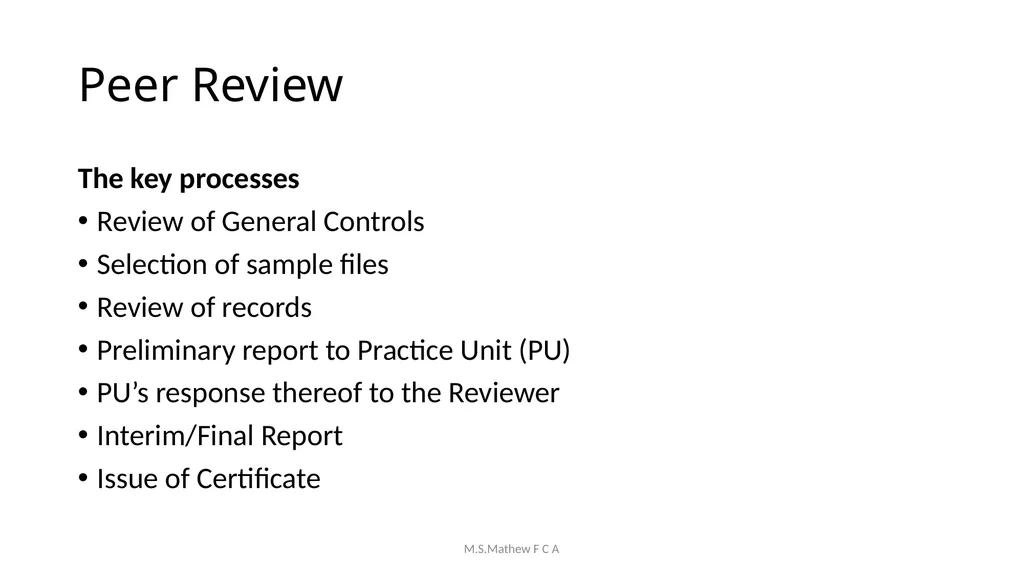
slide11. Peer Review The key processes
Review of General Controls
Selection of sample files
Review of records
Preliminary report to Practice Unit (PU)
PU’s response thereof to the Reviewer
Interim/Final Report
Issue of Certificate M.S.Mathew F C A<br>
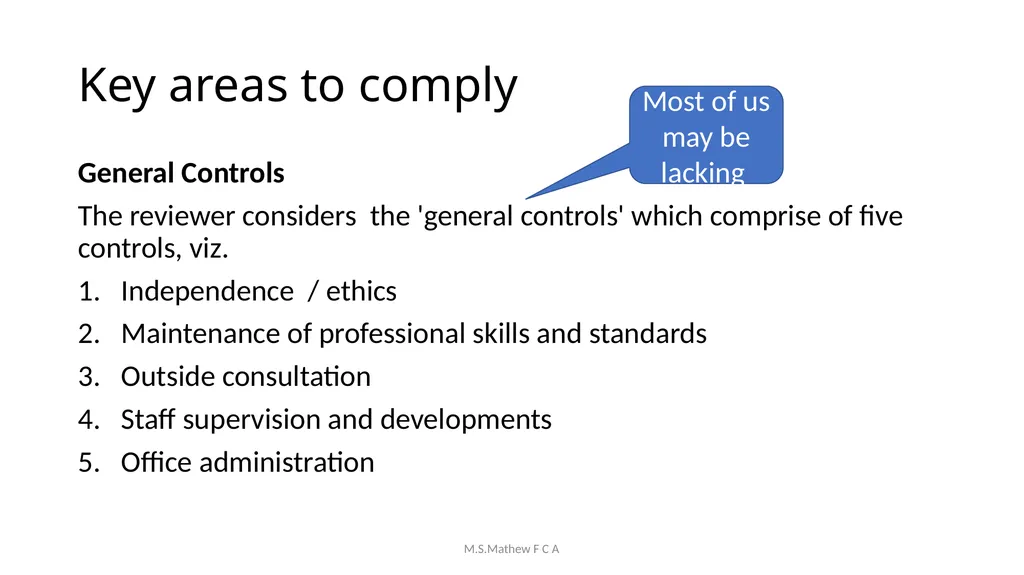
slide12. Key areas to comply General Controls
The reviewer considers the 'general controls' which comprise of five controls, viz.
Independence / ethics
Maintenance of professional skills and standards
Outside consultation
Staff supervision and developments
Office administration Most of us may be lacking M.S.Mathew F C A<br>
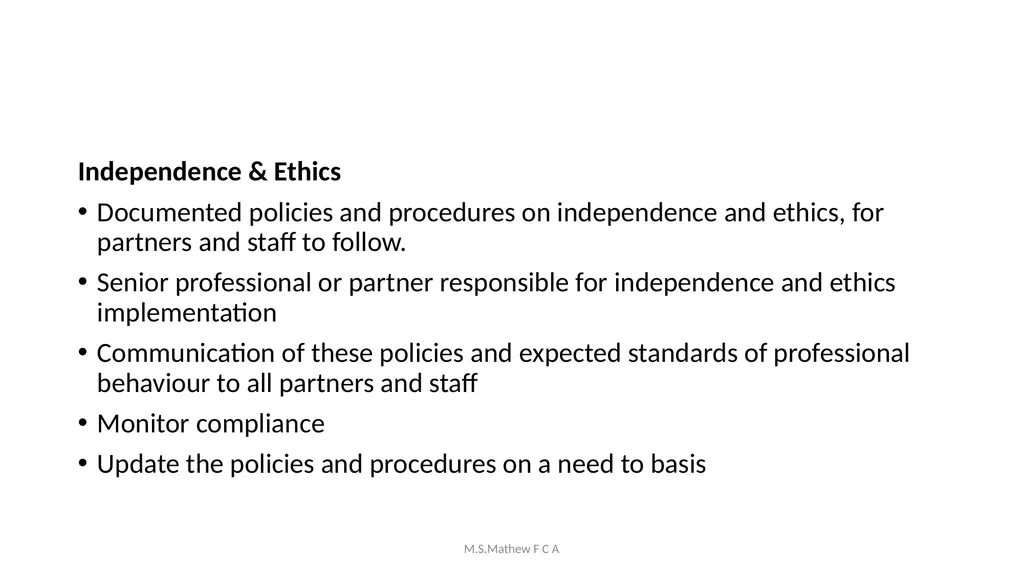
slide13. Independence & Ethics
Documented policies and procedures on independence and ethics, for partners and staff to follow.
Senior professional or partner responsible for independence and ethics implementation
Communication of these policies and expected standards of professional behaviour to all partners and staff
Monitor compliance
Update the policies and procedures on a need to basis M.S.Mathew F C A<br>
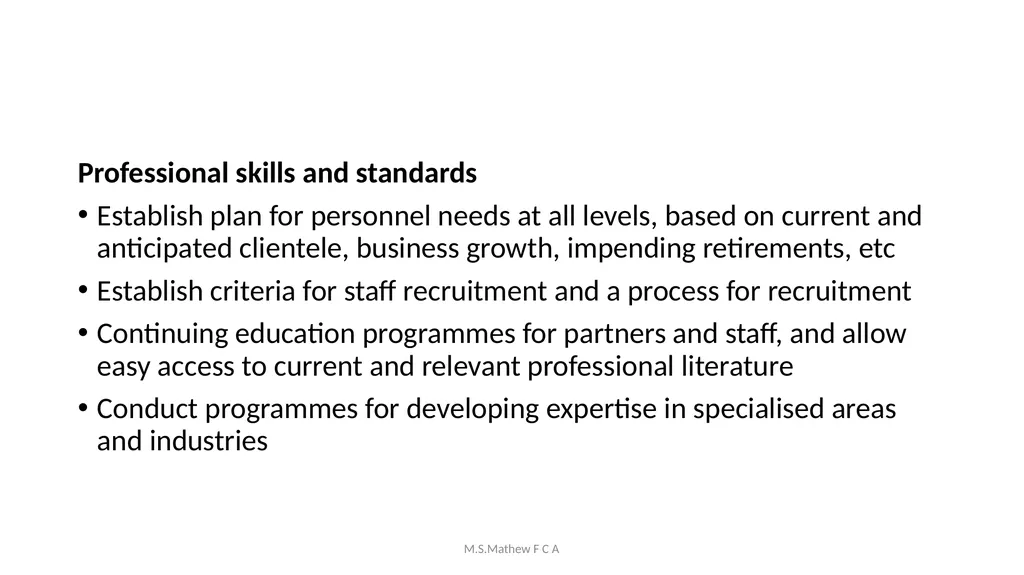
slide14. Professional skills and standards
Establish plan for personnel needs at all levels, based on current and anticipated clientele, business growth, impending retirements, etc
Establish criteria for staff recruitment and a process for recruitment
Continuing education programmes for partners and staff, and allow easy access to current and relevant professional literature
Conduct programmes for developing expertise in specialised areas and industries M.S.Mathew F C A<br>
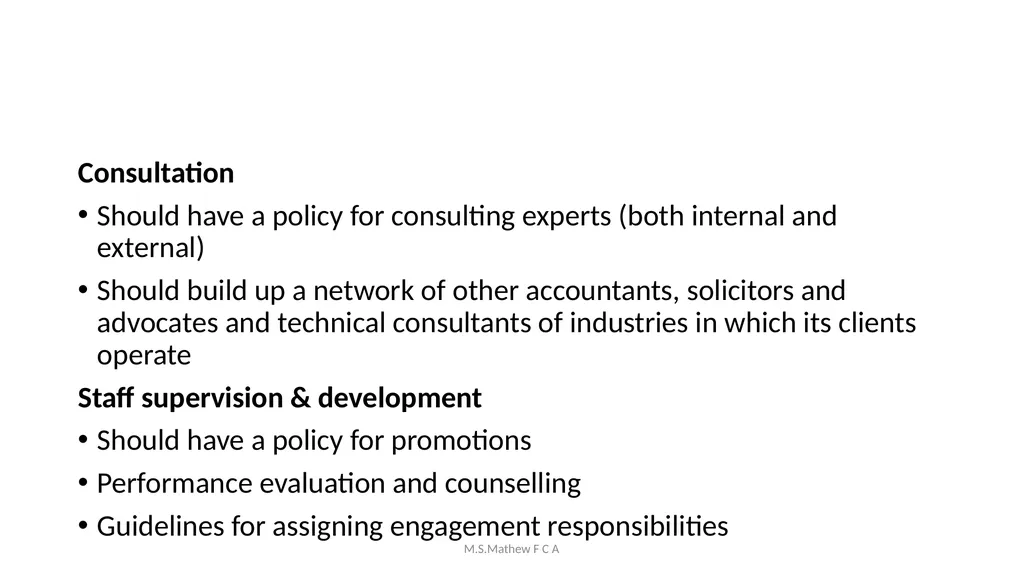
slide15. Consultation
Should have a policy for consulting experts (both internal and external)
Should build up a network of other accountants, solicitors and advocates and technical consultants of industries in which its clients operate
Staff supervision & development
Should have a policy for promotions
Performance evaluation and counselling
Guidelines for assigning engagement responsibilities M.S.Mathew F C A<br>
slide16. Office Administration
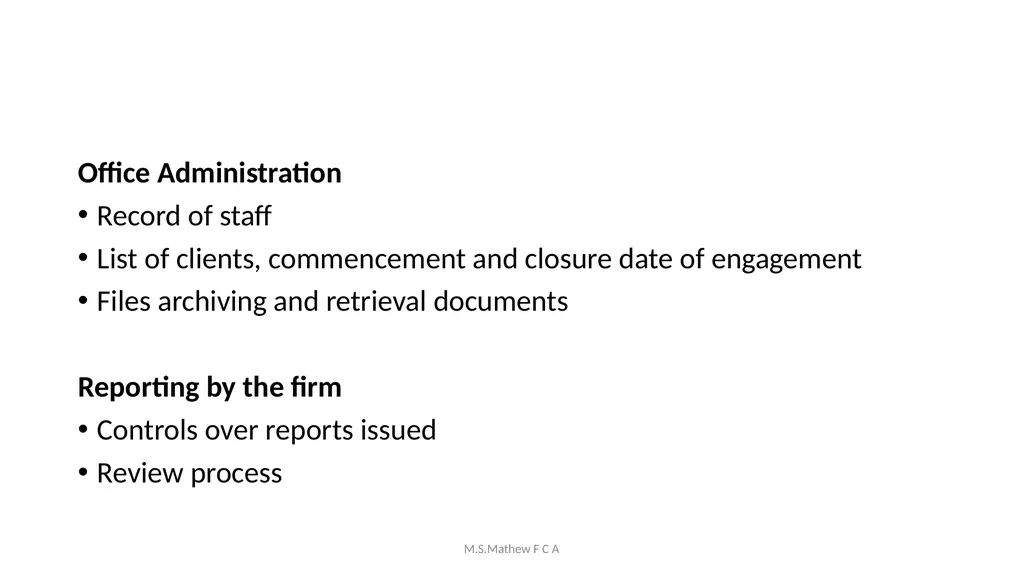
Record of staff
List of clients, commencement and closure date of engagement
Files archiving and retrieval documents
Reporting by the firm
Controls over reports issued
Review process M.S.Mathew F C A<br>
slide17. Peer Review Common observations during peer review
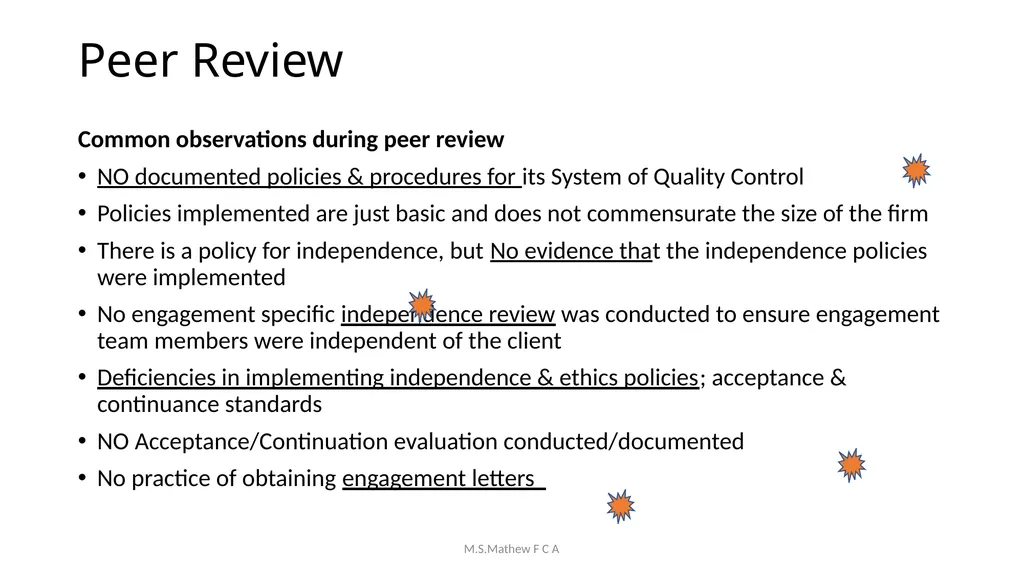
NO documented policies & procedures for its System of Quality Control
Policies implemented are just basic and does not commensurate the size of the firm
There is a policy for independence, but No evidence that the independence policies were implemented
No engagement specific independence review was conducted to ensure engagement team members were independent of the client
Deficiencies in implementing independence & ethics policies; acceptance & continuance standards
NO Acceptance/Continuation evaluation conducted/documented
No practice of obtaining engagement letters M.S.Mathew F C A<br>
slide18. Peer Review Common observations during peer review (contd.)
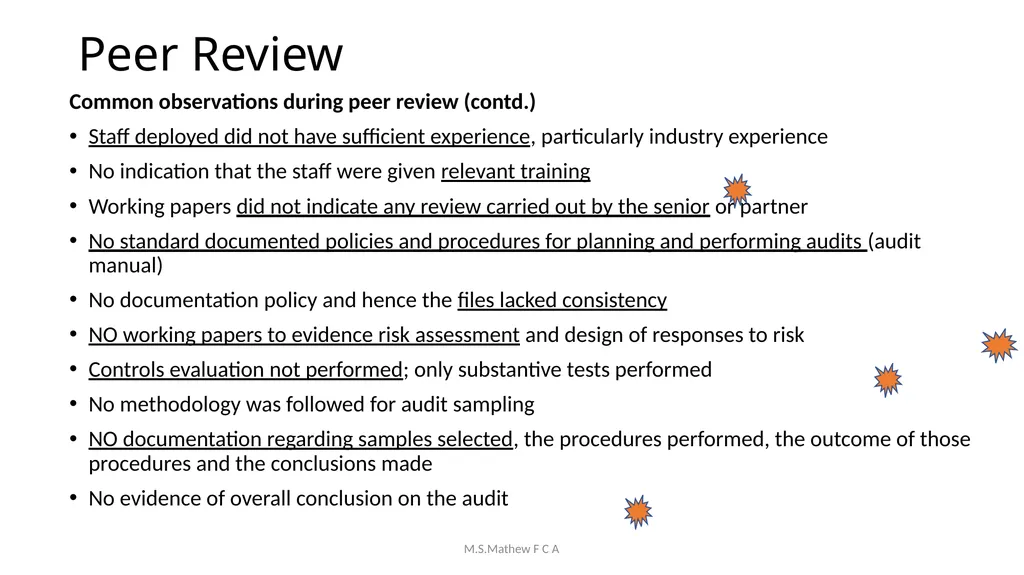
Staff deployed did not have sufficient experience, particularly industry experience
No indication that the staff were given relevant training
Working papers did not indicate any review carried out by the senior or partner
No standard documented policies and procedures for planning and performing audits (audit manual)
No documentation policy and hence the files lacked consistency
NO working papers to evidence risk assessment and design of responses to risk
Controls evaluation not performed; only substantive tests performed
No methodology was followed for audit sampling
NO documentation regarding samples selected, the procedures performed, the outcome of those procedures and the conclusions made
No evidence of overall conclusion on the audit M.S.Mathew F C A<br>
slide19. Peer Review Common observations during peer review (Contd.)
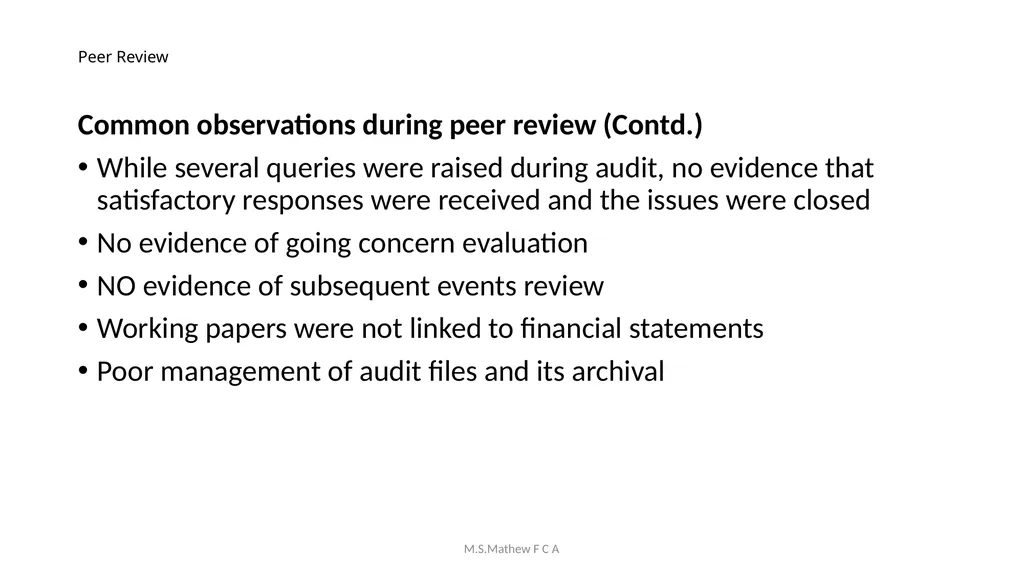
While several queries were raised during audit, no evidence that satisfactory responses were received and the issues were closed
No evidence of going concern evaluation
NO evidence of subsequent events review
Working papers were not linked to financial statements
Poor management of audit files and its archival M.S.Mathew F C A<br>
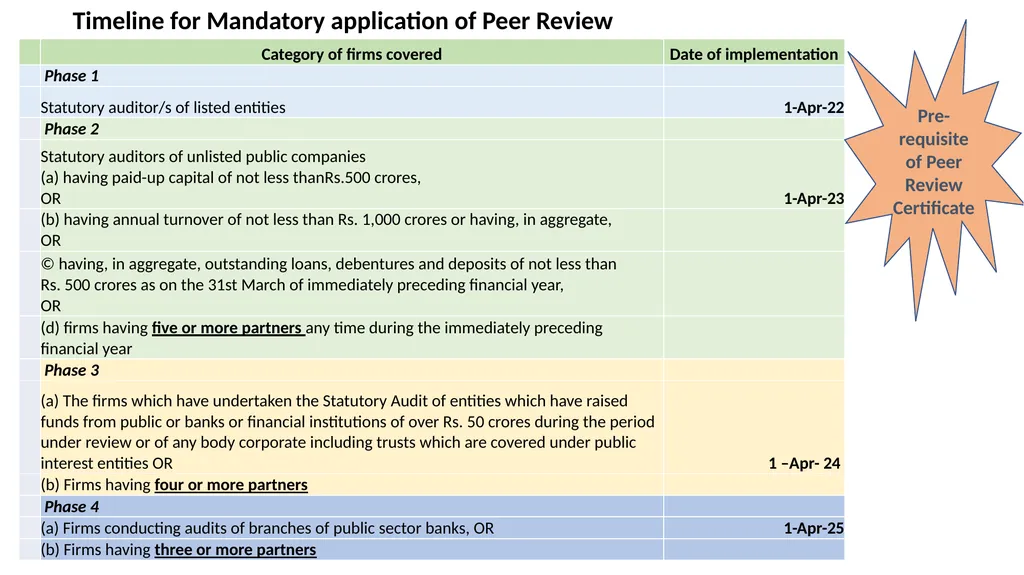
slide20. Timeline for Mandatory application of Peer Review M.S.Mathew F C A Pre-requisite of Peer Review Certificate<br>
slide21. Audit Quality Maturity Model M.S.Mathew F C A<br>
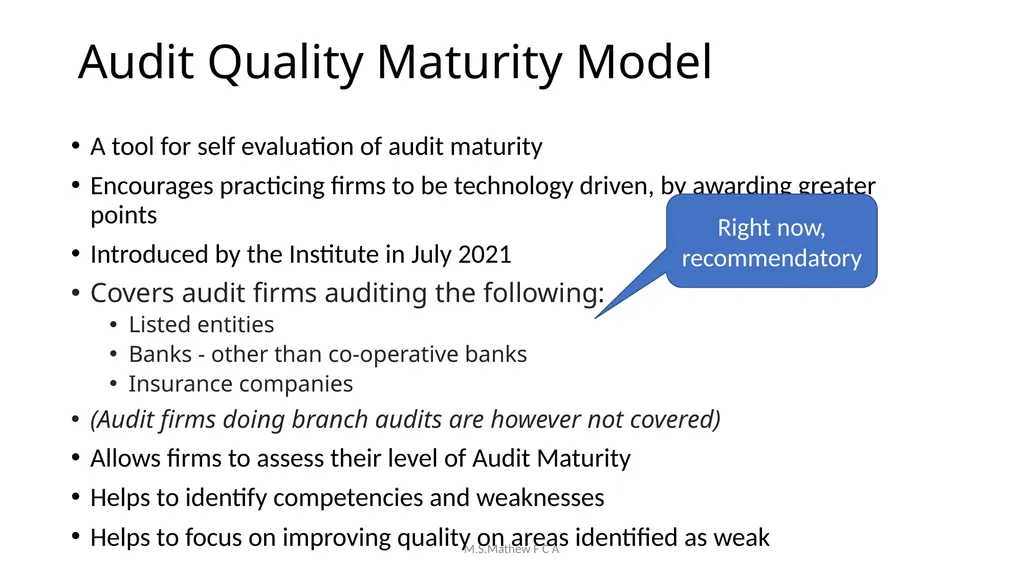
slide22. Audit Quality Maturity Model A tool for self evaluation of audit maturity
Encourages practicing firms to be technology driven, by awarding greater points
Introduced by the Institute in July 2021
Covers audit firms auditing the following:
Listed entities
Banks - other than co-operative banks
Insurance companies
(Audit firms doing branch audits are however not covered)
Allows firms to assess their level of Audit Maturity
Helps to identify competencies and weaknesses
Helps to focus on improving quality on areas identified as weak Right now, recommendatory M.S.Mathew F C A<br>
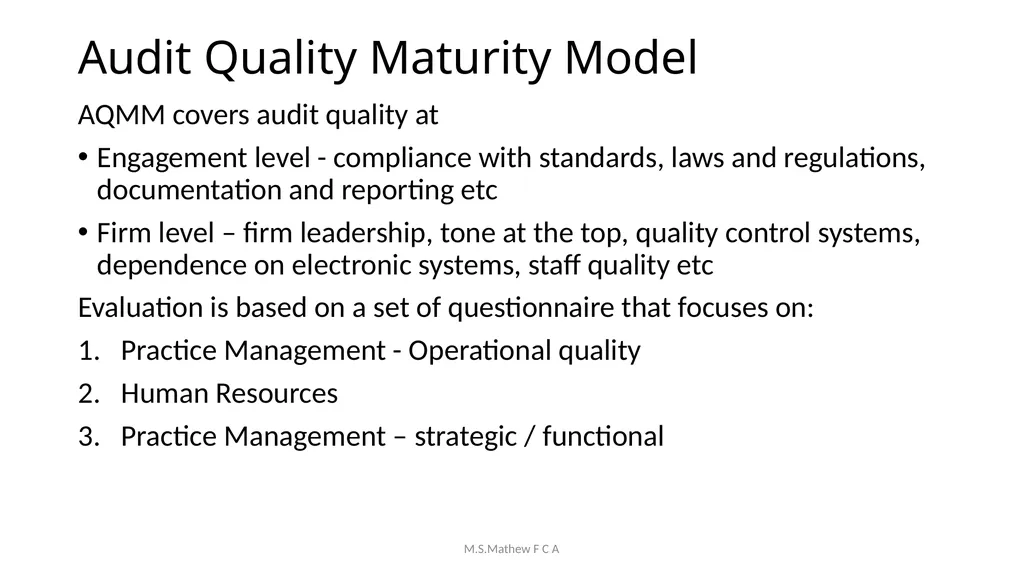
slide23. Audit Quality Maturity Model AQMM covers audit quality at
Engagement level - compliance with standards, laws and regulations, documentation and reporting etc
Firm level – firm leadership, tone at the top, quality control systems, dependence on electronic systems, staff quality etc
Evaluation is based on a set of questionnaire that focuses on:
Practice Management - Operational quality
Human Resources
Practice Management – strategic / functional M.S.Mathew F C A<br>
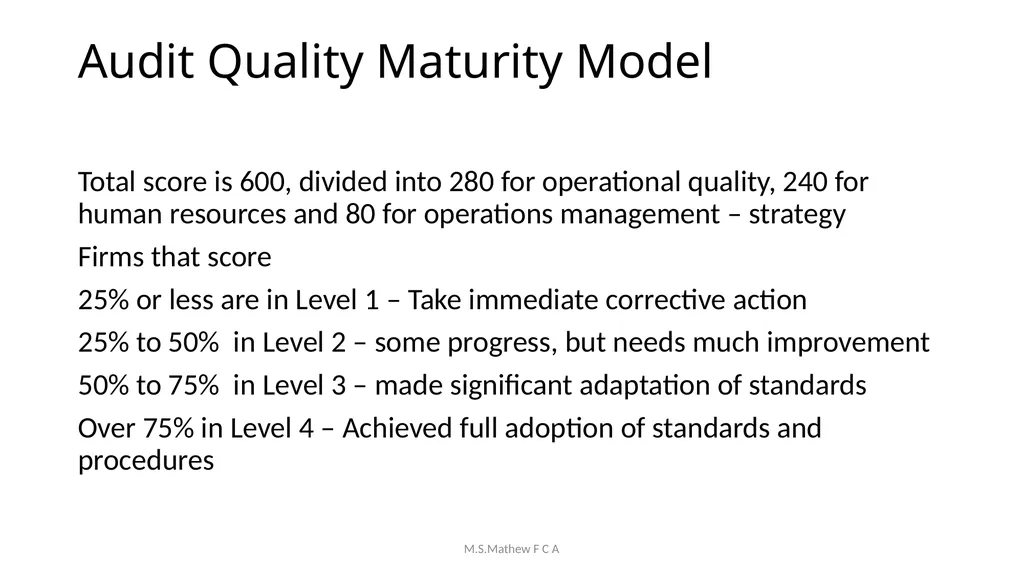
slide24. Audit Quality Maturity Model Total score is 600, divided into 280 for operational quality, 240 for human resources and 80 for operations management – strategy
Firms that score
25% or less are in Level 1 – Take immediate corrective action
25% to 50% in Level 2 – some progress, but needs much improvement
50% to 75% in Level 3 – made significant adaptation of standards
Over 75% in Level 4 – Achieved full adoption of standards and procedures M.S.Mathew F C A<br>
slide25. Audit Quality<br>
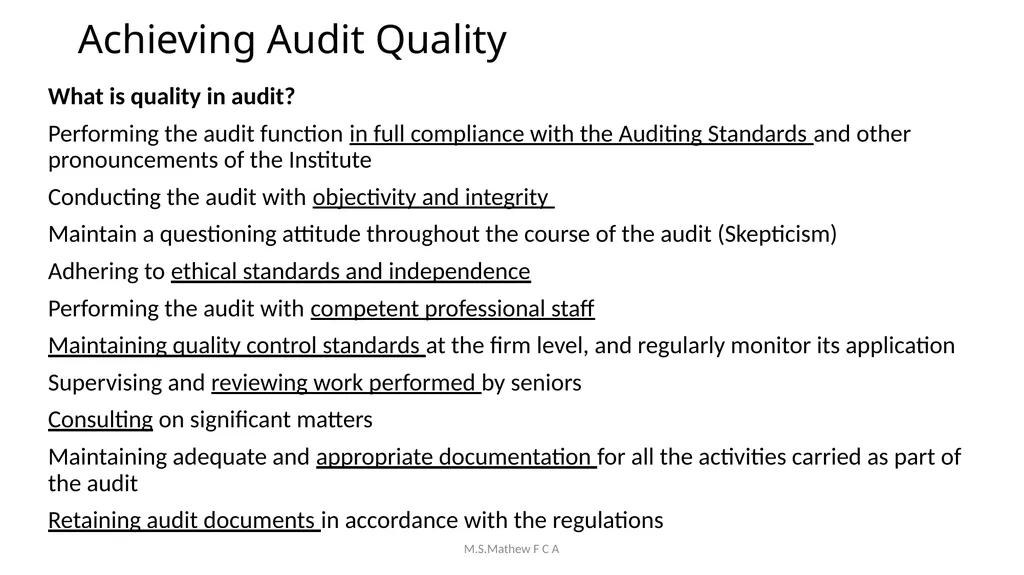
slide26. Achieving Audit Quality What is quality in audit?
Performing the audit function in full compliance with the Auditing Standards and other pronouncements of the Institute
Conducting the audit with objectivity and integrity
Maintain a questioning attitude throughout the course of the audit (Skepticism)
Adhering to ethical standards and independence
Performing the audit with competent professional staff
Maintaining quality control standards at the firm level, and regularly monitor its application
Supervising and reviewing work performed by seniors
Consulting on significant matters
Maintaining adequate and appropriate documentation for all the activities carried as part of the audit
Retaining audit documents in accordance with the regulations M.S.Mathew F C A<br>
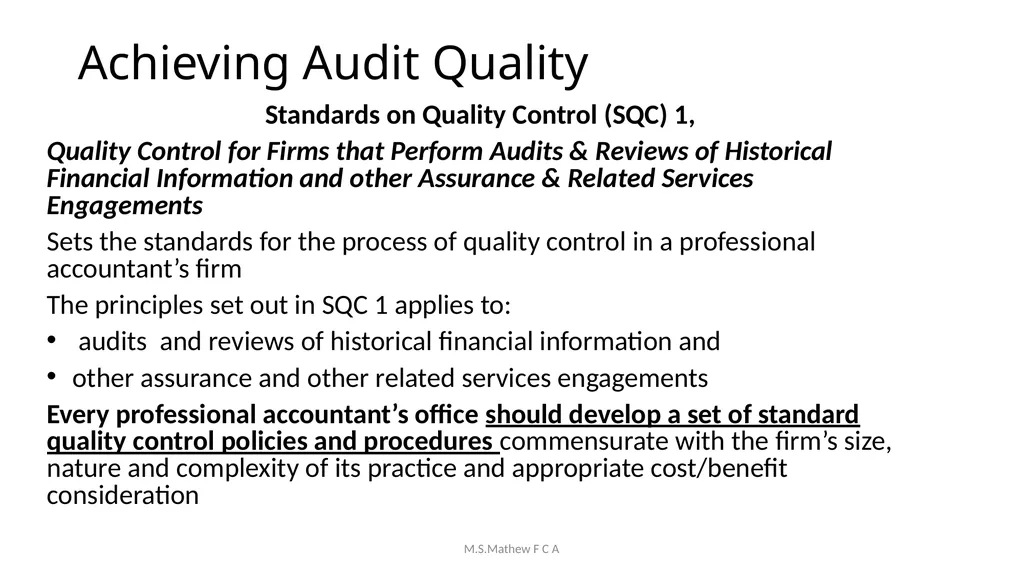
slide27. Achieving Audit Quality Standards on Quality Control (SQC) 1,
Quality Control for Firms that Perform Audits & Reviews of Historical Financial Information and other Assurance & Related Services Engagements
Sets the standards for the process of quality control in a professional accountant’s firm
The principles set out in SQC 1 applies to:
audits and reviews of historical financial information and
other assurance and other related services engagements
Every professional accountant’s office should develop a set of standard quality control policies and procedures commensurate with the firm’s size, nature and complexity of its practice and appropriate cost/benefit consideration M.S.Mathew F C A<br>
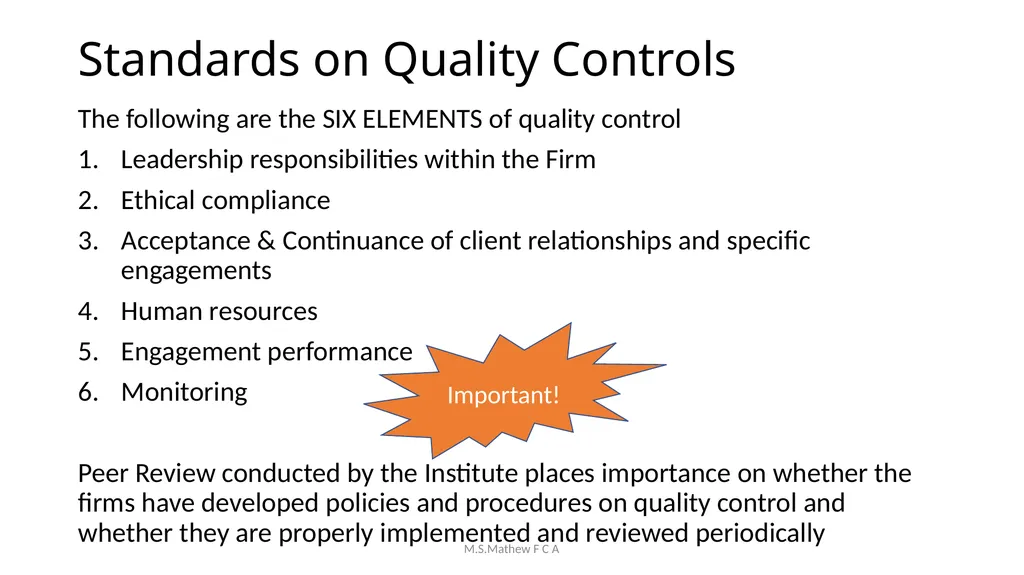
slide28. Standards on Quality Controls The following are the SIX ELEMENTS of quality control
Leadership responsibilities within the Firm
Ethical compliance
Acceptance & Continuance of client relationships and specific engagements
Human resources
Engagement performance
Monitoring
Peer Review conducted by the Institute places importance on whether the firms have developed policies and procedures on quality control and whether they are properly implemented and reviewed periodically M.S.Mathew F C A Important!<br>
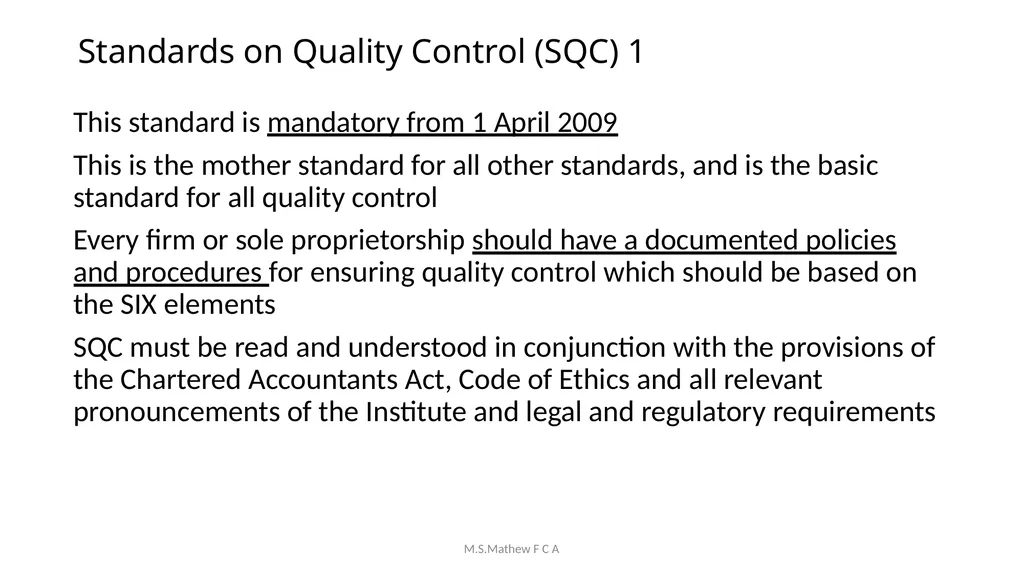
slide29. Standards on Quality Control (SQC) 1 This standard is mandatory from 1 April 2009
This is the mother standard for all other standards, and is the basic standard for all quality control
Every firm or sole proprietorship should have a documented policies and procedures for ensuring quality control which should be based on the SIX elements
SQC must be read and understood in conjunction with the provisions of the Chartered Accountants Act, Code of Ethics and all relevant pronouncements of the Institute and legal and regulatory requirements M.S.Mathew F C A<br>
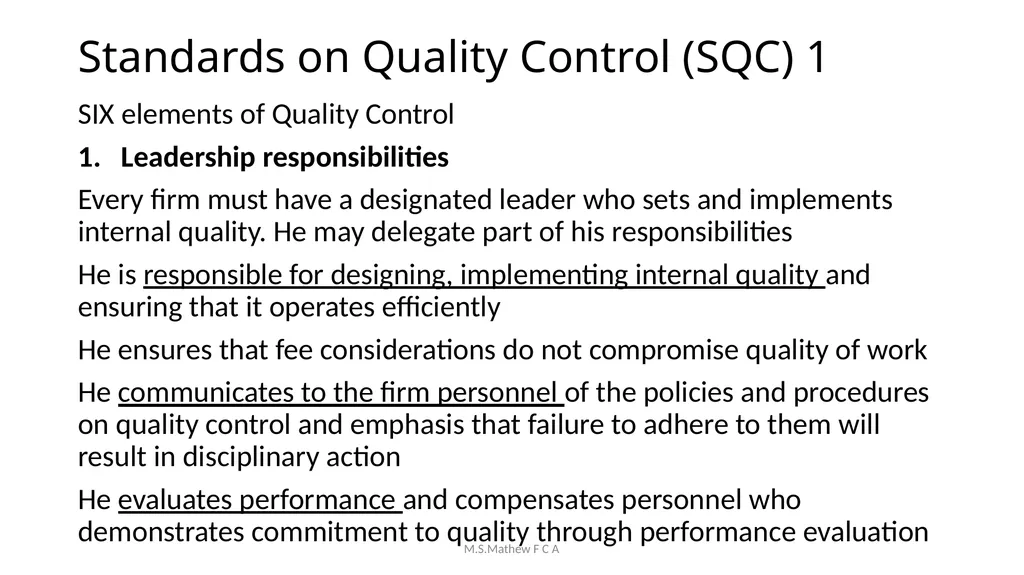
slide30. Standards on Quality Control (SQC) 1 SIX elements of Quality Control
Leadership responsibilities
Every firm must have a designated leader who sets and implements internal quality. He may delegate part of his responsibilities
He is responsible for designing, implementing internal quality and ensuring that it operates efficiently
He ensures that fee considerations do not compromise quality of work
He communicates to the firm personnel of the policies and procedures on quality control and emphasis that failure to adhere to them will result in disciplinary action
He evaluates performance and compensates personnel who demonstrates commitment to quality through performance evaluation M.S.Mathew F C A<br>
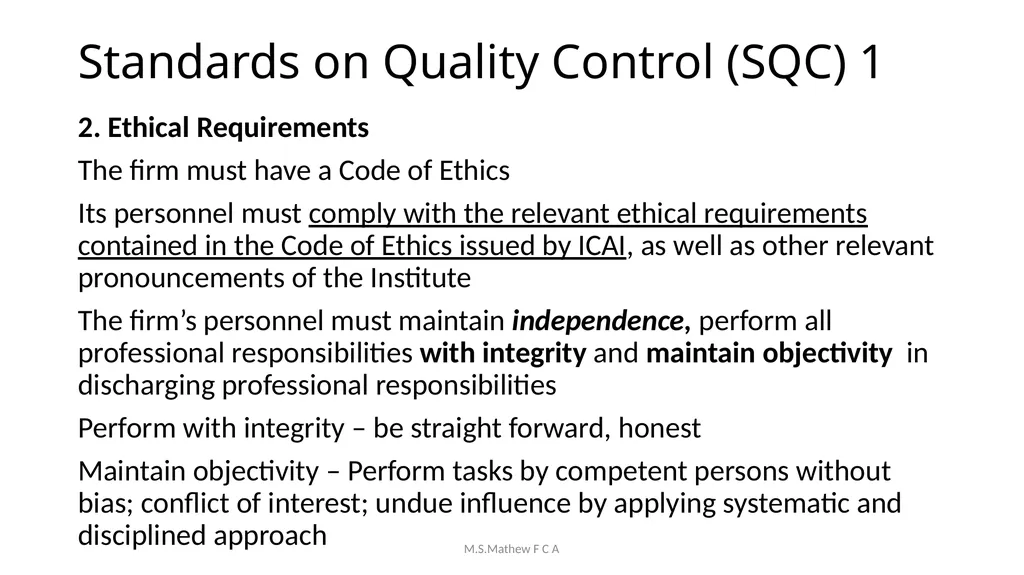
slide31. Standards on Quality Control (SQC) 1 2. Ethical Requirements
The firm must have a Code of Ethics
Its personnel must comply with the relevant ethical requirements contained in the Code of Ethics issued by ICAI, as well as other relevant pronouncements of the Institute
The firm’s personnel must maintain independence, perform all professional responsibilities with integrity and maintain objectivity in discharging professional responsibilities
Perform with integrity – be straight forward, honest
Maintain objectivity – Perform tasks by competent persons without bias; conflict of interest; undue influence by applying systematic and disciplined approach M.S.Mathew F C A<br>
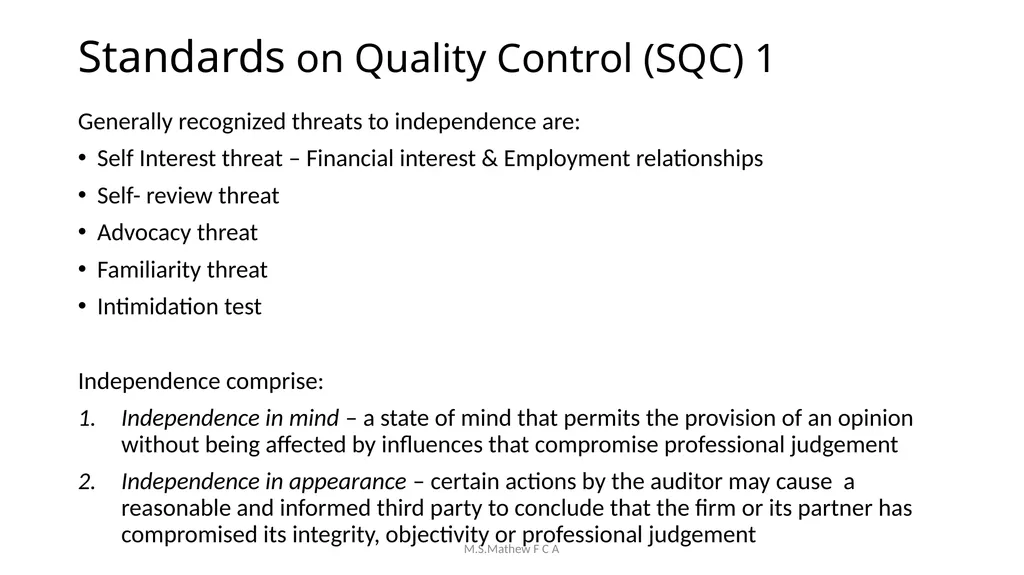
slide32. Standards on Quality Control (SQC) 1 Generally recognized threats to independence are:
Self Interest threat – Financial interest & Employment relationships
Self- review threat
Advocacy threat
Familiarity threat
Intimidation test
Independence comprise:
Independence in mind – a state of mind that permits the provision of an opinion without being affected by influences that compromise professional judgement
Independence in appearance – certain actions by the auditor may cause a reasonable and informed third party to conclude that the firm or its partner has compromised its integrity, objectivity or professional judgement M.S.Mathew F C A<br>
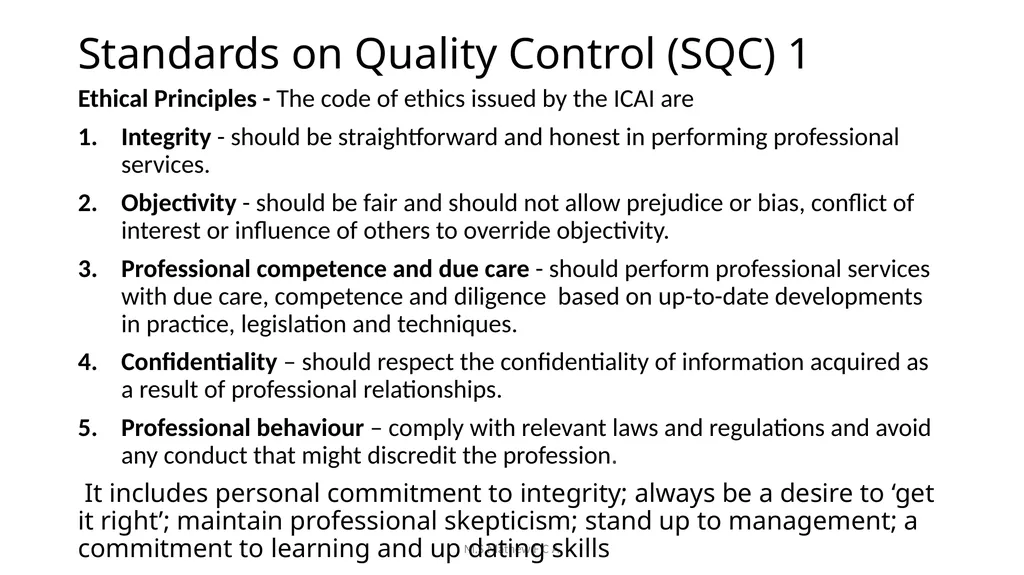
slide33. Standards on Quality Control (SQC) 1 Ethical Principles - The code of ethics issued by the ICAI are
Integrity - should be straightforward and honest in performing professional services.
Objectivity - should be fair and should not allow prejudice or bias, conflict of interest or influence of others to override objectivity.
Professional competence and due care - should perform professional services with due care, competence and diligence based on up-to-date developments in practice, legislation and techniques.
Confidentiality – should respect the confidentiality of information acquired as a result of professional relationships.
Professional behaviour – comply with relevant laws and regulations and avoid any conduct that might discredit the profession.
It includes personal commitment to integrity; always be a desire to ‘get it right’; maintain professional skepticism; stand up to management; a commitment to learning and up dating skills M.S.Mathew F C A<br>
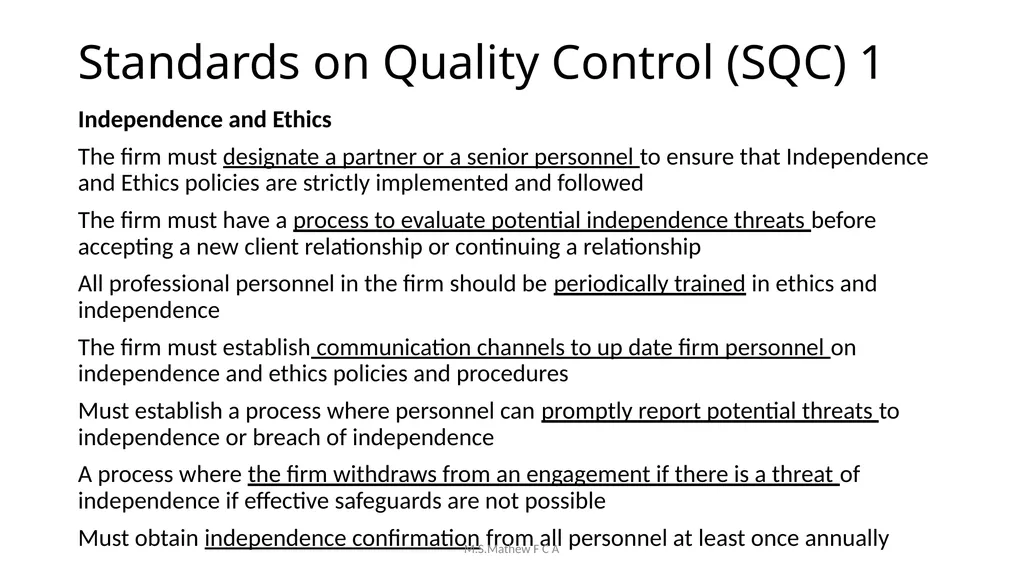
slide34. Standards on Quality Control (SQC) 1 Independence and Ethics
The firm must designate a partner or a senior personnel to ensure that Independence and Ethics policies are strictly implemented and followed
The firm must have a process to evaluate potential independence threats before accepting a new client relationship or continuing a relationship
All professional personnel in the firm should be periodically trained in ethics and independence
The firm must establish communication channels to up date firm personnel on independence and ethics policies and procedures
Must establish a process where personnel can promptly report potential threats to independence or breach of independence
A process where the firm withdraws from an engagement if there is a threat of independence if effective safeguards are not possible
Must obtain independence confirmation from all personnel at least once annually M.S.Mathew F C A<br>
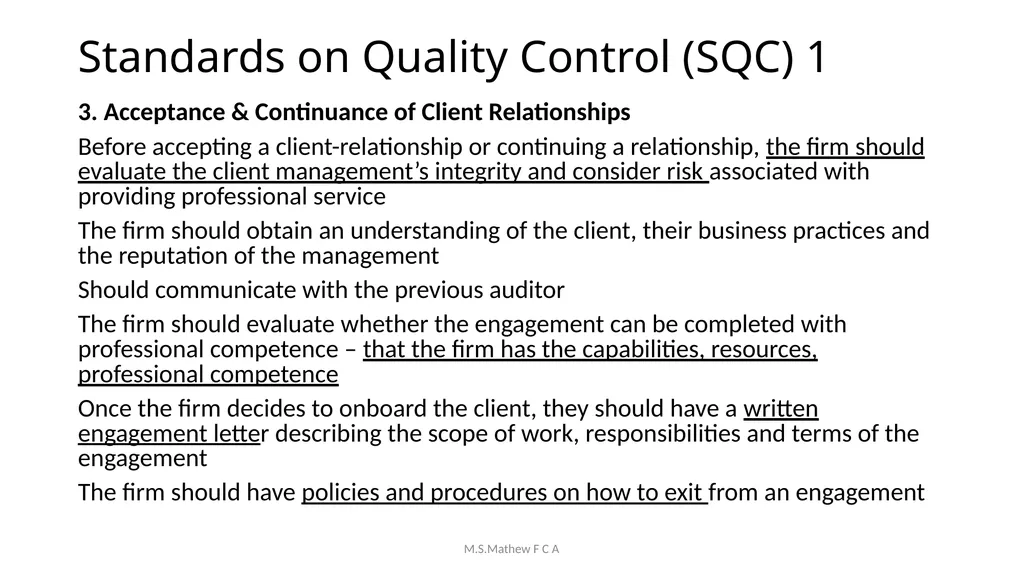
slide35. Standards on Quality Control (SQC) 1 3. Acceptance & Continuance of Client Relationships
Before accepting a client-relationship or continuing a relationship, the firm should evaluate the client management’s integrity and consider risk associated with providing professional service
The firm should obtain an understanding of the client, their business practices and the reputation of the management
Should communicate with the previous auditor
The firm should evaluate whether the engagement can be completed with professional competence – that the firm has the capabilities, resources, professional competence
Once the firm decides to onboard the client, they should have a written engagement letter describing the scope of work, responsibilities and terms of the engagement
The firm should have policies and procedures on how to exit from an engagement M.S.Mathew F C A<br>
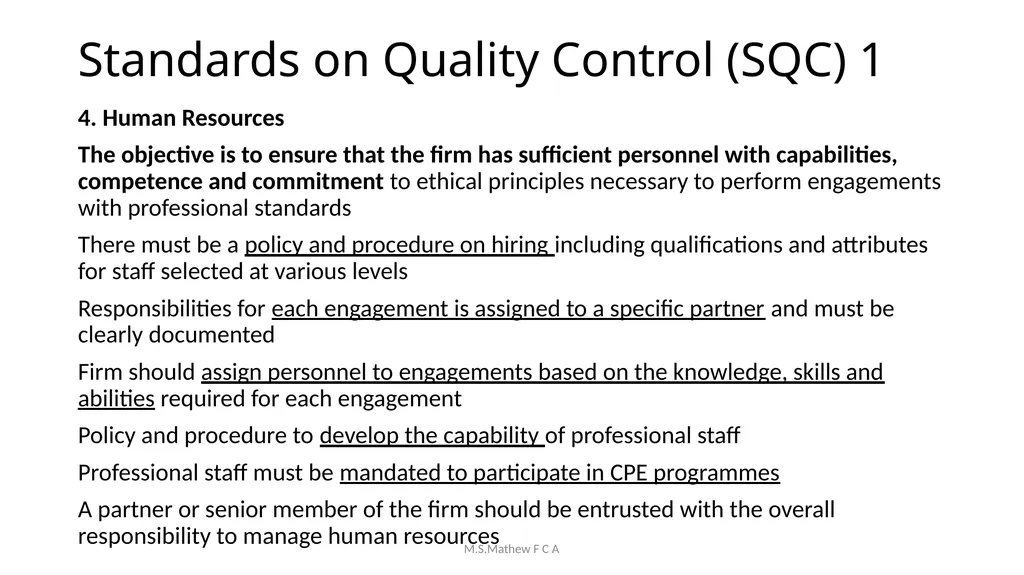
slide36. Standards on Quality Control (SQC) 1 4. Human Resources
The objective is to ensure that the firm has sufficient personnel with capabilities, competence and commitment to ethical principles necessary to perform engagements with professional standards
There must be a policy and procedure on hiring including qualifications and attributes for staff selected at various levels
Responsibilities for each engagement is assigned to a specific partner and must be clearly documented
Firm should assign personnel to engagements based on the knowledge, skills and abilities required for each engagement
Policy and procedure to develop the capability of professional staff
Professional staff must be mandated to participate in CPE programmes
A partner or senior member of the firm should be entrusted with the overall responsibility to manage human resources M.S.Mathew F C A<br>
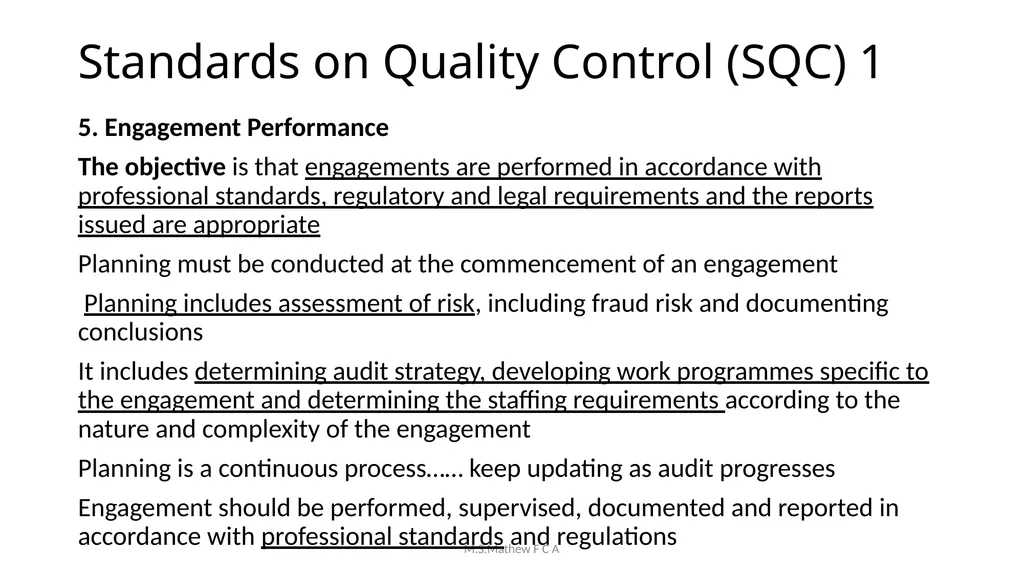
slide37. Standards on Quality Control (SQC) 1 5. Engagement Performance
The objective is that engagements are performed in accordance with professional standards, regulatory and legal requirements and the reports issued are appropriate
Planning must be conducted at the commencement of an engagement
Planning includes assessment of risk, including fraud risk and documenting conclusions
It includes determining audit strategy, developing work programmes specific to the engagement and determining the staffing requirements according to the nature and complexity of the engagement
Planning is a continuous process…… keep updating as audit progresses
Engagement should be performed, supervised, documented and reported in accordance with professional standards and regulations M.S.Mathew F C A<br>
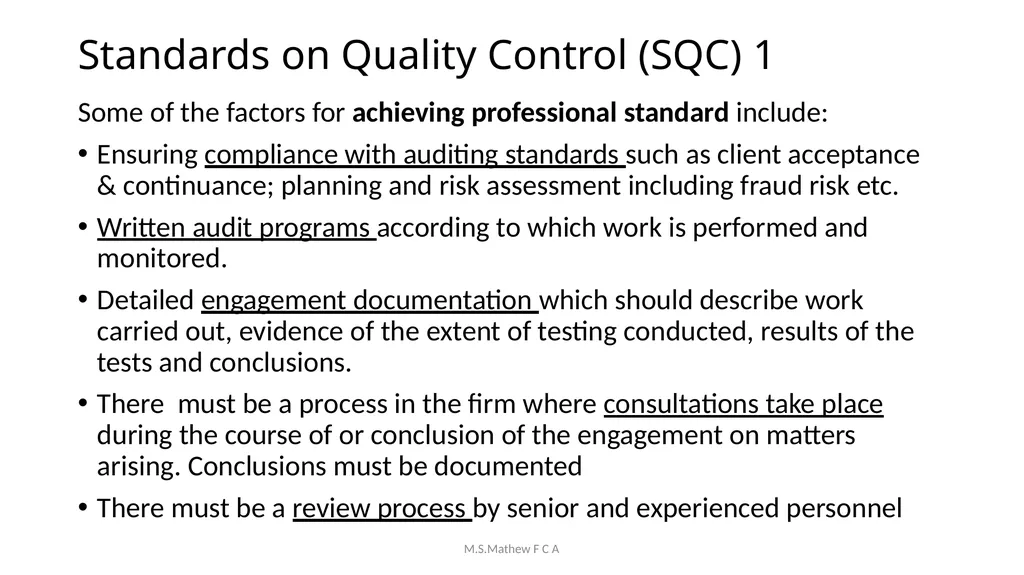
slide38. Standards on Quality Control (SQC) 1 Some of the factors for achieving professional standard include:
Ensuring compliance with auditing standards such as client acceptance & continuance; planning and risk assessment including fraud risk etc.
Written audit programs according to which work is performed and monitored.
Detailed engagement documentation which should describe work carried out, evidence of the extent of testing conducted, results of the tests and conclusions.
There must be a process in the firm where consultations take place during the course of or conclusion of the engagement on matters arising. Conclusions must be documented
There must be a review process by senior and experienced personnel M.S.Mathew F C A<br>
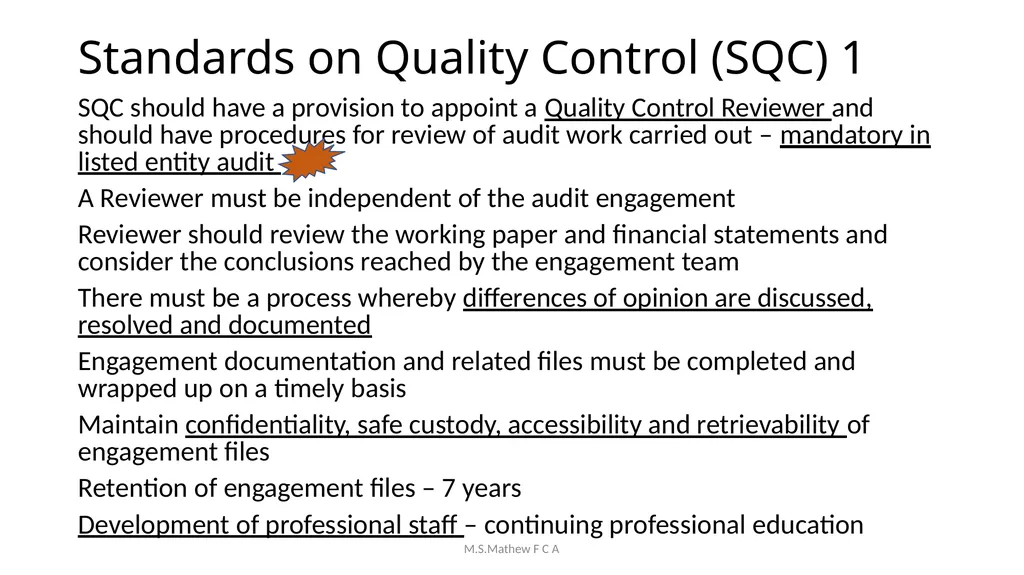
slide39. Standards on Quality Control (SQC) 1 SQC should have a provision to appoint a Quality Control Reviewer and should have procedures for review of audit work carried out – mandatory in listed entity audit
A Reviewer must be independent of the audit engagement
Reviewer should review the working paper and financial statements and consider the conclusions reached by the engagement team
There must be a process whereby differences of opinion are discussed, resolved and documented
Engagement documentation and related files must be completed and wrapped up on a timely basis
Maintain confidentiality, safe custody, accessibility and retrievability of engagement files
Retention of engagement files – 7 years
Development of professional staff – continuing professional education M.S.Mathew F C A<br>
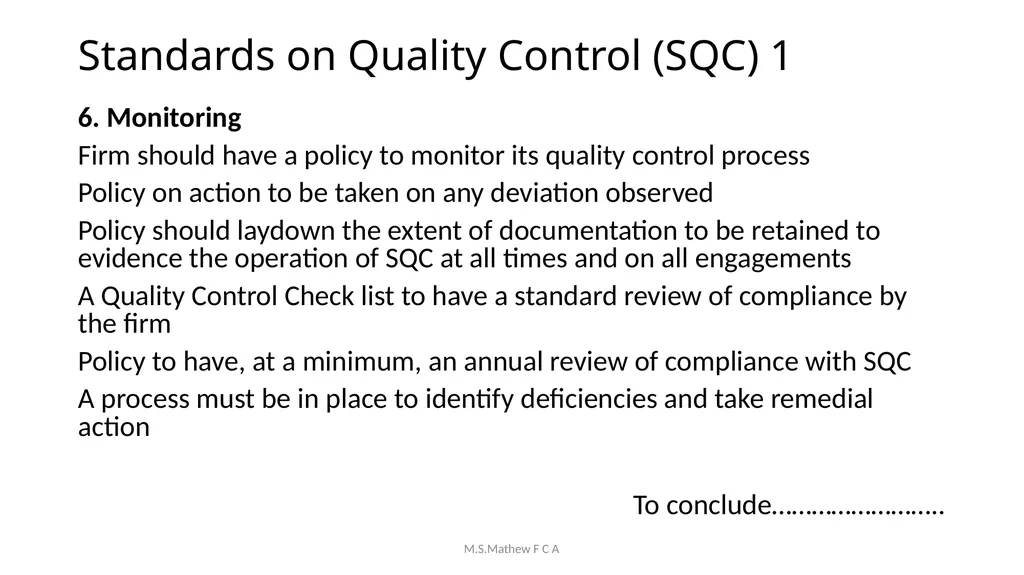
slide40. Standards on Quality Control (SQC) 1 6. Monitoring
Firm should have a policy to monitor its quality control process
Policy on action to be taken on any deviation observed
Policy should laydown the extent of documentation to be retained to evidence the operation of SQC at all times and on all engagements
A Quality Control Check list to have a standard review of compliance by the firm
Policy to have, at a minimum, an annual review of compliance with SQC
A process must be in place to identify deficiencies and take remedial action
To conclude…………………….. M.S.Mathew F C A<br>
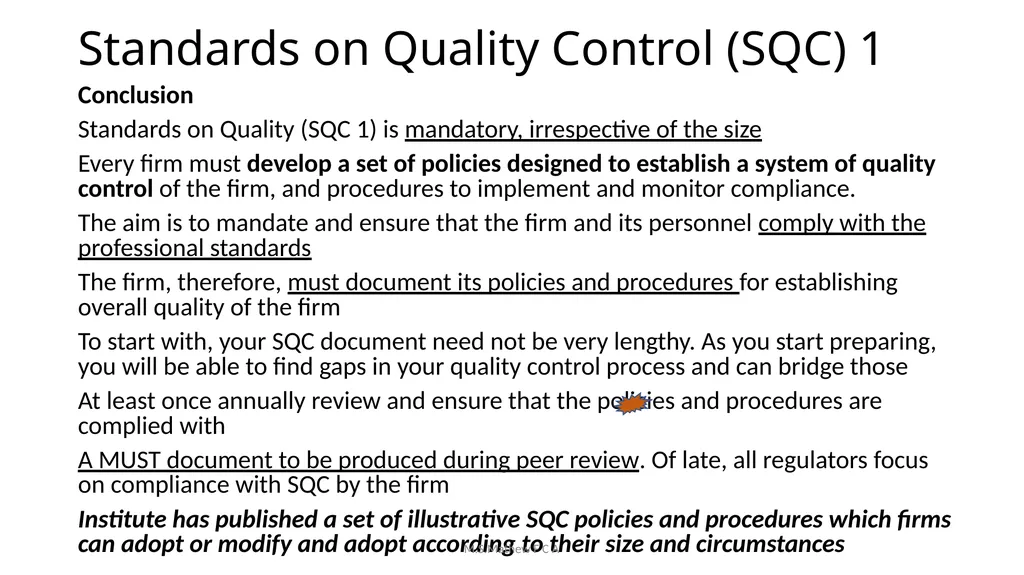
slide41. Standards on Quality Control (SQC) 1 Conclusion
Standards on Quality (SQC 1) is mandatory, irrespective of the size
Every firm must develop a set of policies designed to establish a system of quality control of the firm, and procedures to implement and monitor compliance.
The aim is to mandate and ensure that the firm and its personnel comply with the professional standards
The firm, therefore, must document its policies and procedures for establishing overall quality of the firm
To start with, your SQC document need not be very lengthy. As you start preparing, you will be able to find gaps in your quality control process and can bridge those
At least once annually review and ensure that the policies and procedures are complied with
A MUST document to be produced during peer review. Of late, all regulators focus on compliance with SQC by the firm
Institute has published a set of illustrative SQC policies and procedures which firms can adopt or modify and adopt according to their size and circumstances M.S.Mathew F C A<br>
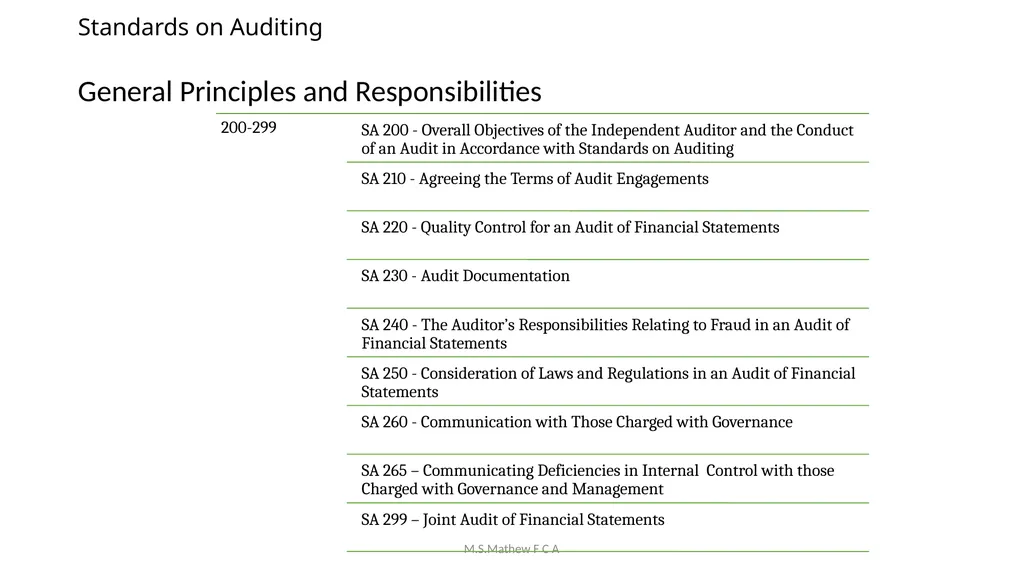
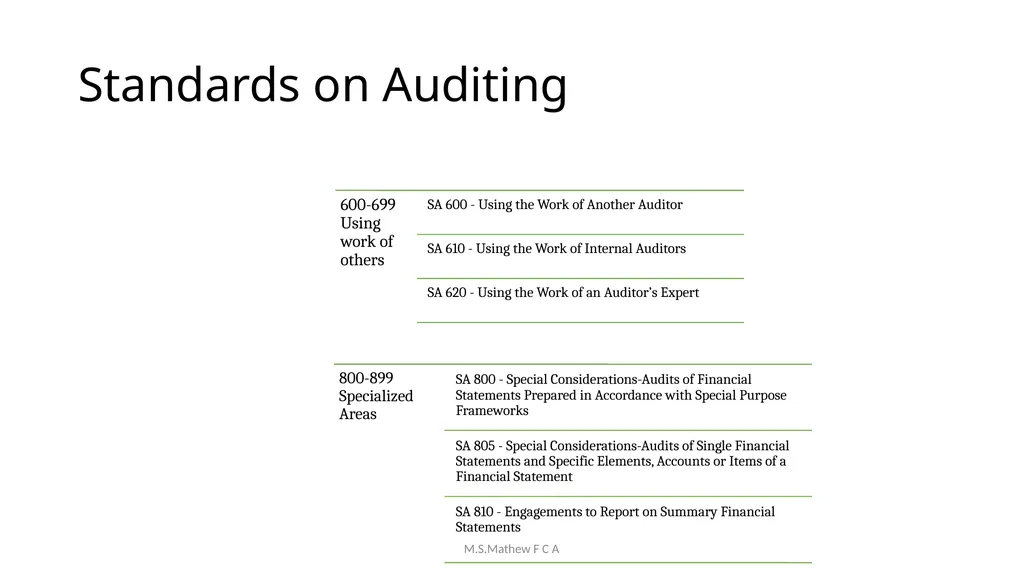
slide42. Standards on Auditing General Principles and Responsibilities M.S.Mathew F C A<br>
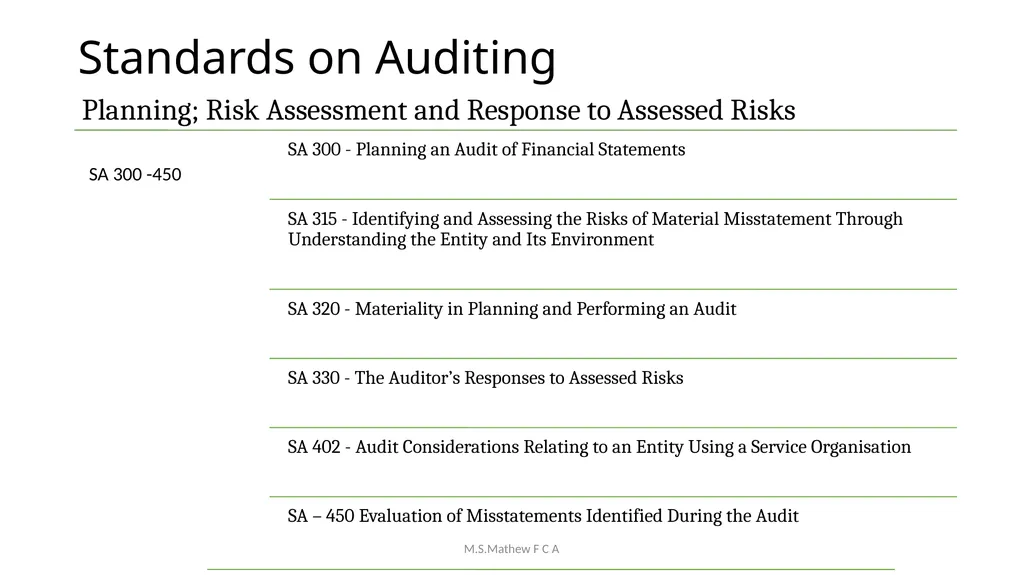
slide43. Standards on Auditing Planning; Risk Assessment and Response to Assessed Risks SA 300 -450 M.S.Mathew F C A<br>
slide44. Standards on Auditing M.S.Mathew F C A<br>
slide45. Standards on Auditing Risk based Audit
(SAs 315 & 330) M.S.Mathew F C A<br>
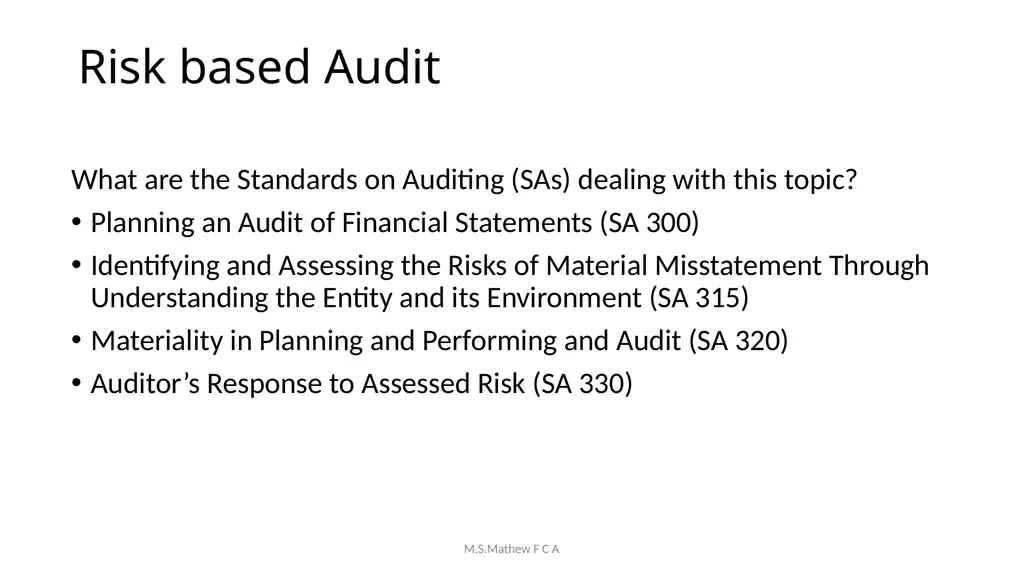
slide46. Risk based Audit What are the Standards on Auditing (SAs) dealing with this topic?
Planning an Audit of Financial Statements (SA 300)
Identifying and Assessing the Risks of Material Misstatement Through Understanding the Entity and its Environment (SA 315)
Materiality in Planning and Performing and Audit (SA 320)
Auditor’s Response to Assessed Risk (SA 330) M.S.Mathew F C A<br>
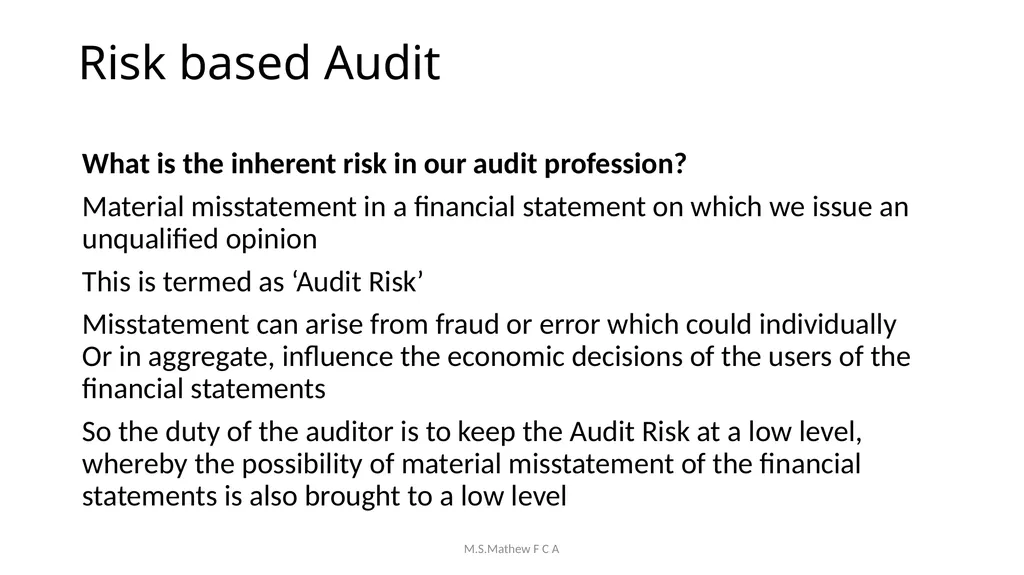
slide47. Risk based Audit What is the inherent risk in our audit profession?
Material misstatement in a financial statement on which we issue an unqualified opinion
This is termed as ‘Audit Risk’
Misstatement can arise from fraud or error which could individually Or in aggregate, influence the economic decisions of the users of the financial statements
So the duty of the auditor is to keep the Audit Risk at a low level, whereby the possibility of material misstatement of the financial statements is also brought to a low level M.S.Mathew F C A<br>
slide48. Risk based audit How could financial statements presented to us for audit be misstated?
Due to the nature of the entity’s business or the low integrity of the management/staff, the entity’s transactions and balances have an inherent risk of material misstatement
Primarily, the entity will put in place controls to mitigate the risks.
However, all inherent risks by nature may not be completely prevented through controls. Controls are managed by client.
The misstatements that could not be prevented due to the weakness of controls are called Control Risks
Control risk is caused by the absence of controls or the ineffectiveness of a control put in place by management
If a risk cannot be prevented by the controls put in place by management, the next possibility to preventing the misstatement is through audit tests conducted by the auditor. (detection tests)
But it may be possible that all misstatements are not detected.
This risk of not detecting the misstatement through audit procedures is called ‘detection risk’ M.S.Mathew F C A<br>
slide49. Risk based Audit M.S.Mathew F C A Inherent risks may be at the entity level or at transaction/ balances level
Factors affecting the Inherent risk at the entity level
Integrity of management
Experience of management
Unusual pressure on management
Nature of entity’s business
Economic/ political conditions affecting the business and the industry
To assess this risk, we evaluate the Control Environment of the client<br>
slide50. Risk based Audit M.S.Mathew F C A Factors affecting the Inherent risk at the account balance and class of transaction levels
Complexity of the underlying transactions
Degree of judgment in determining account balances
Susceptibility of assets to misappropriation
Large volumes of transaction or transactions with high value
High dependence on computer systems
Incapability of the accounting system to handle the transactions
Related party transactions
To assess this risk we need to Understand the Key Business Processes and related transactions of the client<br>
slide51. Risk based Audit The Risk of Material Misstatement is a combination of:
Inherent risk – due to the nature of the business
Control risk – due to the entity’s failure to implement internal control procedures to prevent misstatements from occurring
Detection risk – the auditor’s failure to detect the misstatement through audit procedures
The first two relates to the entity and its management
The third one, namely detection risk, is to be handled by the auditor M.S.Mathew F C A First two relate to entity and its management<br>
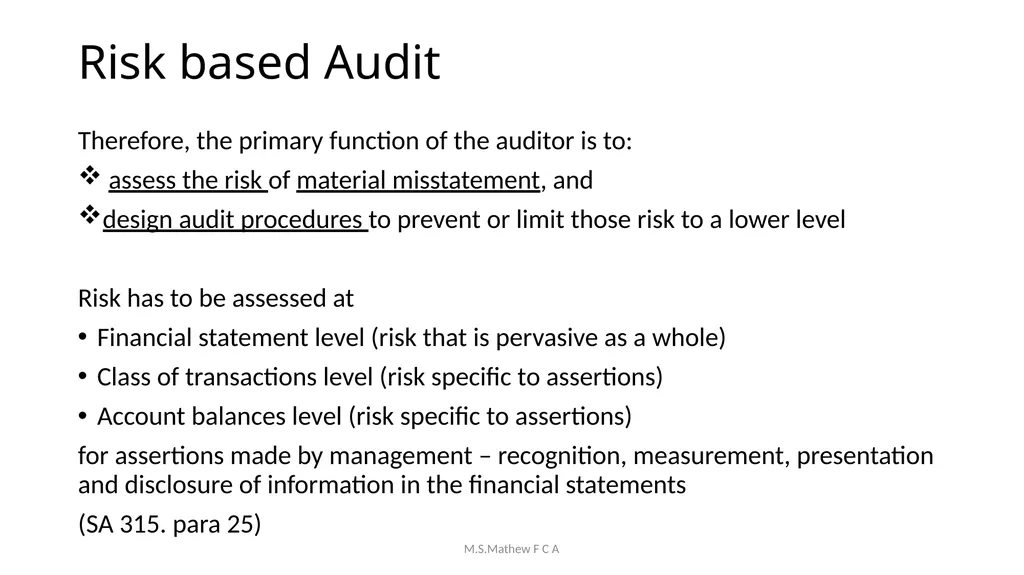
slide52. Risk based Audit Therefore, the primary function of the auditor is to:
assess the risk of material misstatement, and
design audit procedures to prevent or limit those risk to a lower level
Risk has to be assessed at
Financial statement level (risk that is pervasive as a whole)
Class of transactions level (risk specific to assertions)
Account balances level (risk specific to assertions)
for assertions made by management – recognition, measurement, presentation and disclosure of information in the financial statements
(SA 315. para 25) M.S.Mathew F C A<br>
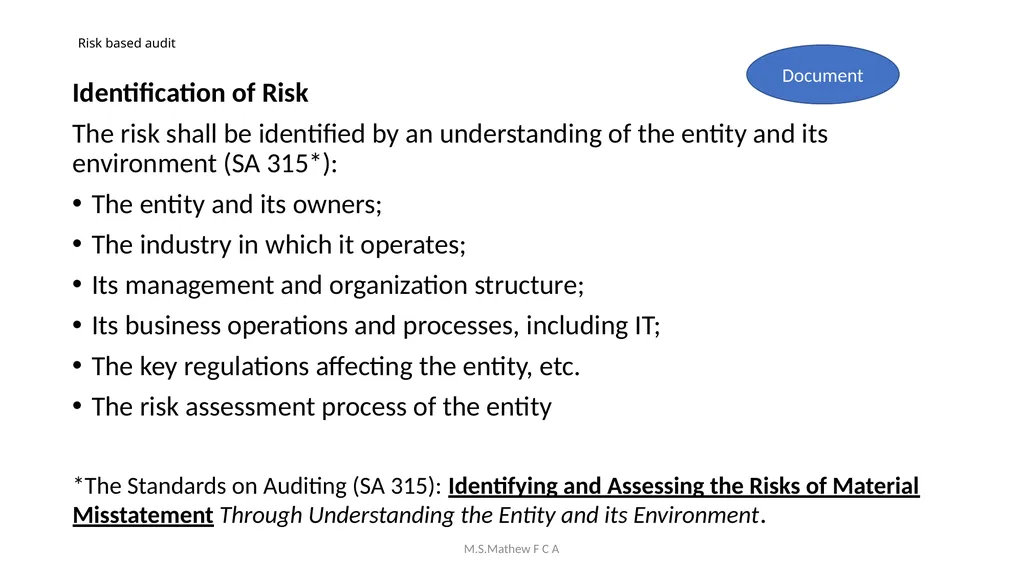
slide53. Risk based audit Identification of Risk
The risk shall be identified by an understanding of the entity and its environment (SA 315*):
The entity and its owners;
The industry in which it operates;
Its management and organization structure;
Its business operations and processes, including IT;
The key regulations affecting the entity, etc.
The risk assessment process of the entity
*The Standards on Auditing (SA 315): Identifying and Assessing the Risks of Material Misstatement Through Understanding the Entity and its Environment. M.S.Mathew F C A Document<br>
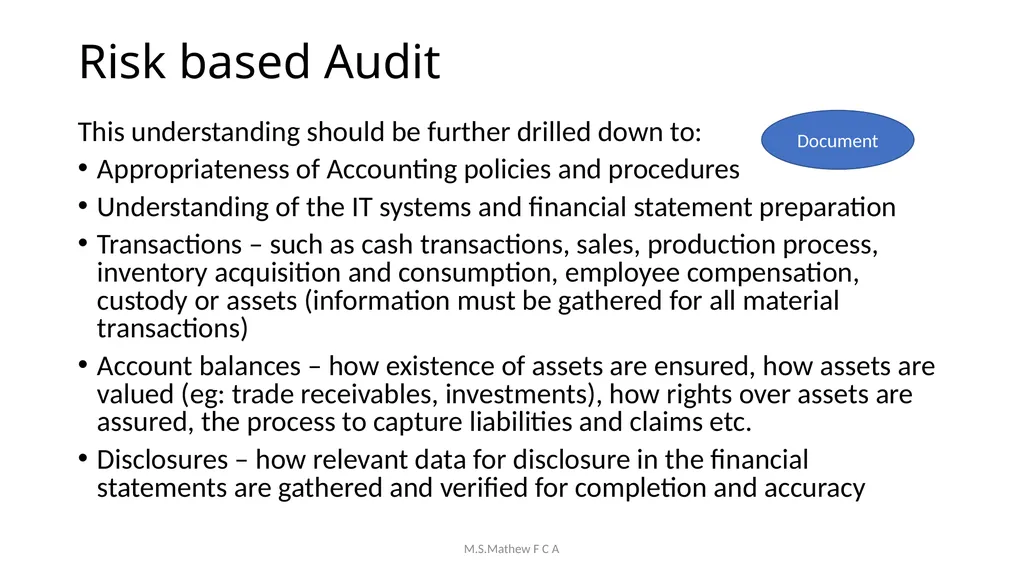
slide54. Risk based Audit This understanding should be further drilled down to:
Appropriateness of Accounting policies and procedures
Understanding of the IT systems and financial statement preparation
Transactions – such as cash transactions, sales, production process, inventory acquisition and consumption, employee compensation, custody or assets (information must be gathered for all material transactions)
Account balances – how existence of assets are ensured, how assets are valued (eg: trade receivables, investments), how rights over assets are assured, the process to capture liabilities and claims etc.
Disclosures – how relevant data for disclosure in the financial statements are gathered and verified for completion and accuracy M.S.Mathew F C A Document<br>
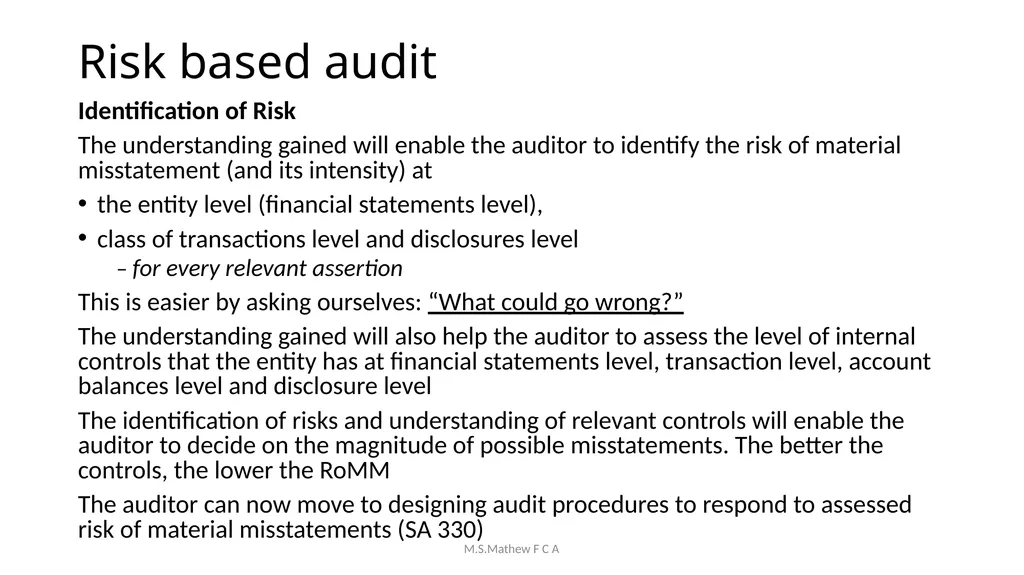
slide55. Risk based audit Identification of Risk
The understanding gained will enable the auditor to identify the risk of material misstatement (and its intensity) at
the entity level (financial statements level),
class of transactions level and disclosures level
– for every relevant assertion
This is easier by asking ourselves: “What could go wrong?”
The understanding gained will also help the auditor to assess the level of internal controls that the entity has at financial statements level, transaction level, account balances level and disclosure level
The identification of risks and understanding of relevant controls will enable the auditor to decide on the magnitude of possible misstatements. The better the controls, the lower the RoMM
The auditor can now move to designing audit procedures to respond to assessed risk of material misstatements (SA 330) M.S.Mathew F C A<br>
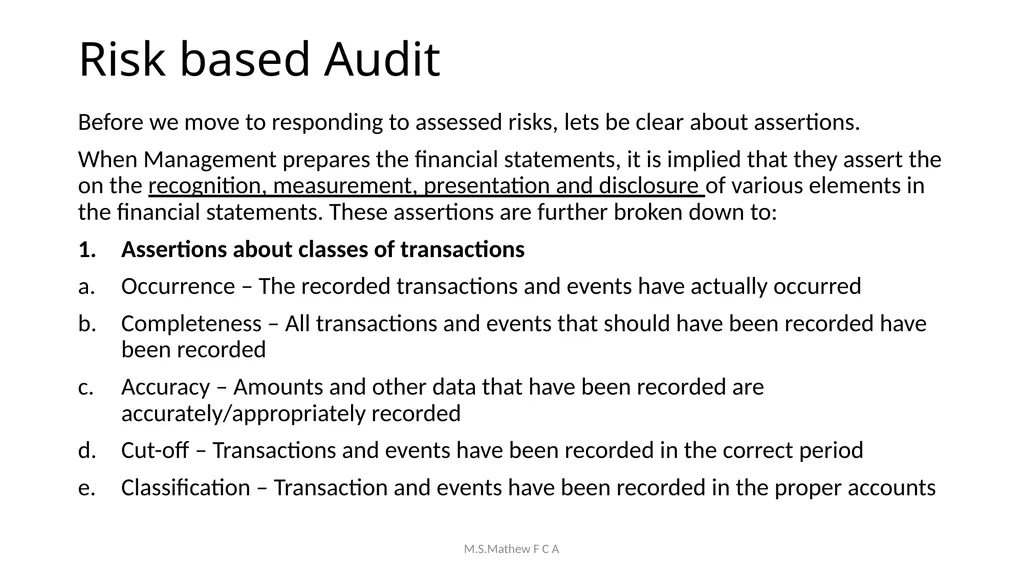
slide56. Risk based Audit Before we move to responding to assessed risks, lets be clear about assertions.
When Management prepares the financial statements, it is implied that they assert the on the recognition, measurement, presentation and disclosure of various elements in the financial statements. These assertions are further broken down to:
Assertions about classes of transactions
Occurrence – The recorded transactions and events have actually occurred
Completeness – All transactions and events that should have been recorded have been recorded
Accuracy – Amounts and other data that have been recorded are accurately/appropriately recorded
Cut-off – Transactions and events have been recorded in the correct period
Classification – Transaction and events have been recorded in the proper accounts M.S.Mathew F C A<br>
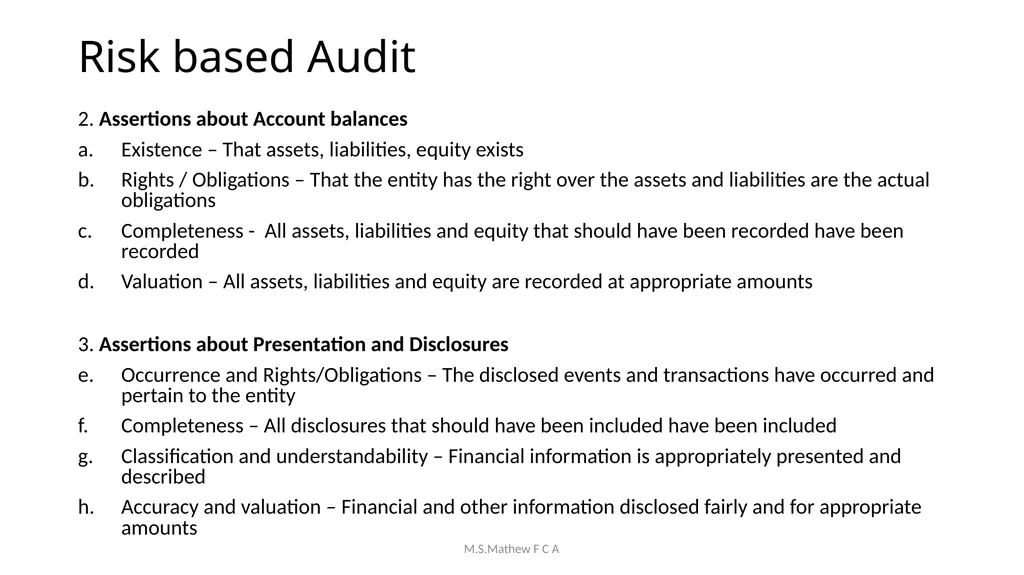
slide57. 2. Assertions about Account balances
Existence – That assets, liabilities, equity exists
Rights / Obligations – That the entity has the right over the assets and liabilities are the actual obligations
Completeness - All assets, liabilities and equity that should have been recorded have been recorded
Valuation – All assets, liabilities and equity are recorded at appropriate amounts
3. Assertions about Presentation and Disclosures
Occurrence and Rights/Obligations – The disclosed events and transactions have occurred and pertain to the entity
Completeness – All disclosures that should have been included have been included
Classification and understandability – Financial information is appropriately presented and described
Accuracy and valuation – Financial and other information disclosed fairly and for appropriate amounts M.S.Mathew F C A Risk based Audit<br>
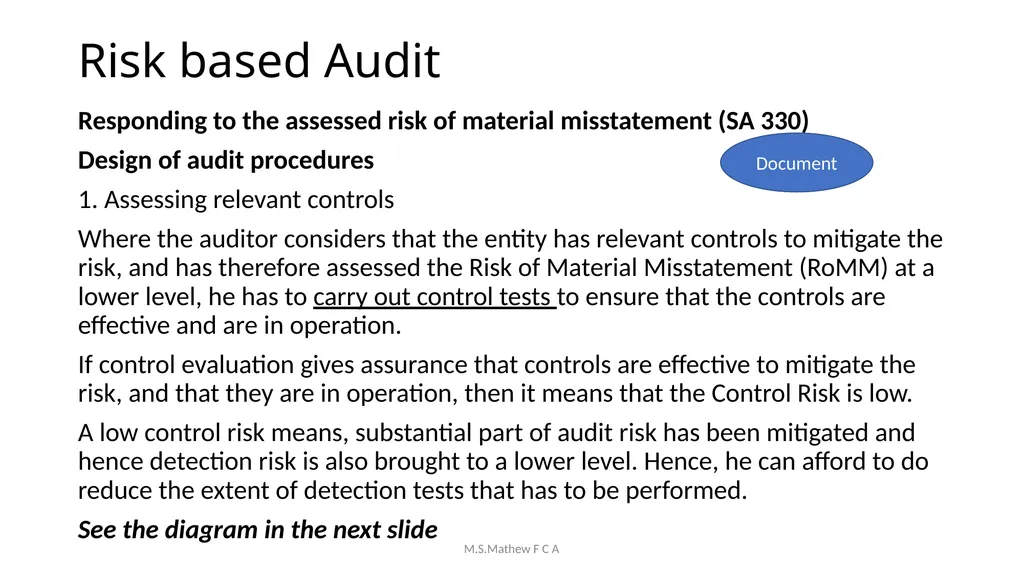
slide58. Responding to the assessed risk of material misstatement (SA 330)
Design of audit procedures
1. Assessing relevant controls
Where the auditor considers that the entity has relevant controls to mitigate the risk, and has therefore assessed the Risk of Material Misstatement (RoMM) at a lower level, he has to carry out control tests to ensure that the controls are effective and are in operation.
If control evaluation gives assurance that controls are effective to mitigate the risk, and that they are in operation, then it means that the Control Risk is low.
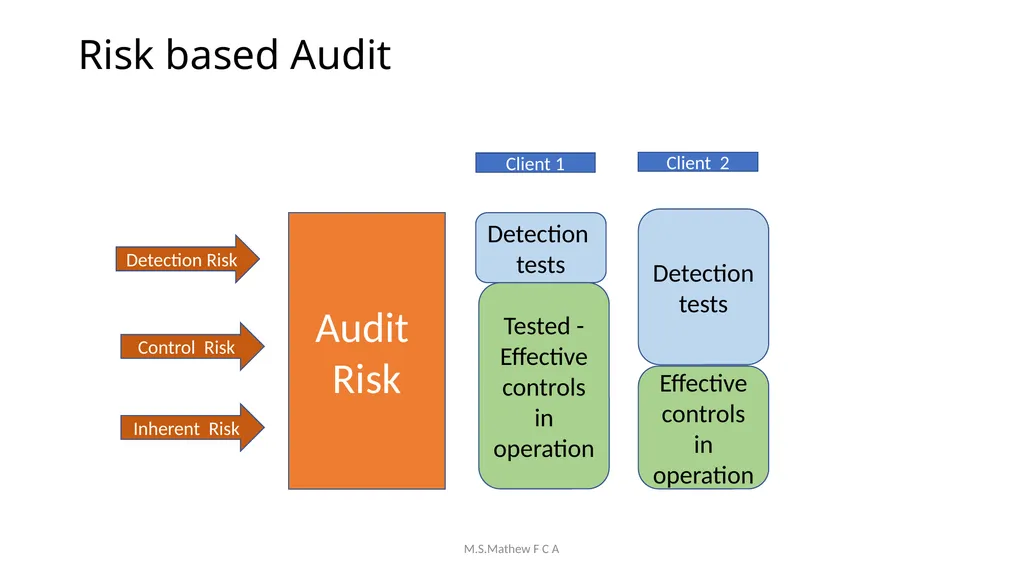
A low control risk means, substantial part of audit risk has been mitigated and hence detection risk is also brought to a lower level. Hence, he can afford to do reduce the extent of detection tests that has to be performed.
See the diagram in the next slide M.S.Mathew F C A Document Risk based Audit<br>
slide59. Risk based Audit M.S.Mathew F C A Audit
Risk Tested - Effective controls in operation Detection
tests Effective controls in operation Detection
tests Client 1 Client 2 Detection Risk Control Risk Inherent Risk<br>
slide60. Risk based Audit 2. Designing detection tests (substantive tests)
(a) Tests of Detail
(b) Analytical Reviews
3. Decide on the nature, extent and timing of tests to be performed M.S.Mathew F C A<br>
slide61. To sum up:
Understand the entity
Understand the key business processes
Identify the risk at the financial statement level – pervasive risks
Identify the risks in each key process– by assertion
Understand the related controls of the identified risks
Conclude on the level of Risk of Material Misstatement (RoMM)
Test controls if RoMM is assessed by relying on controls
Conclude on the existence and effectiveness of controls
Design audit procedures and the nature, timing and extent of tests
Conclude on the result of audit procedures
Draft appropriate audit report M.S.Mathew F C A<br>
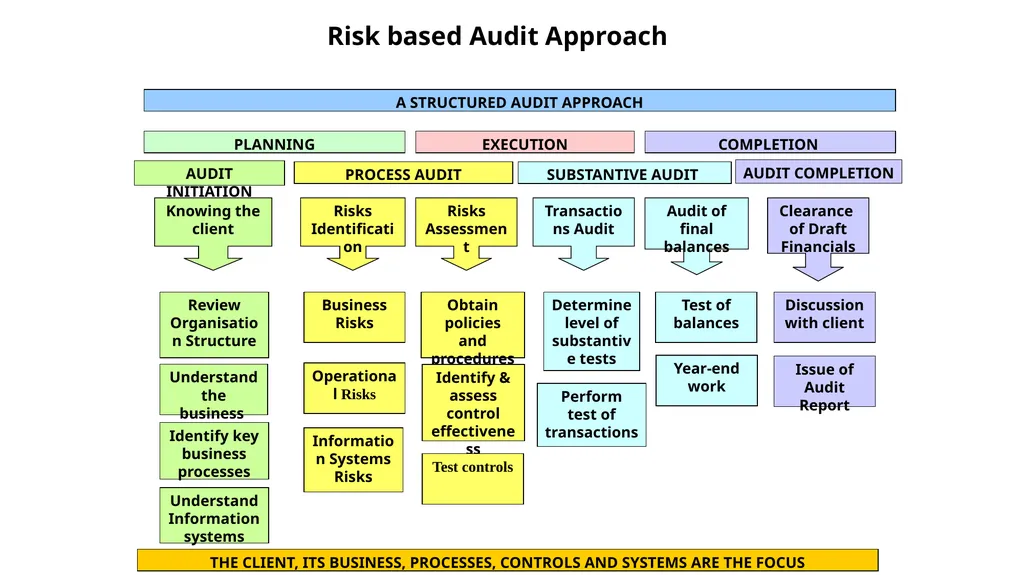
slide62. AUDIT INITIATION PROCESS AUDIT AUDIT COMPLETION A STRUCTURED AUDIT APPROACH Knowing the client Review Organisation Structure Understand the business Understand Information systems Risks Identification Risks Assessment Transactions Audit Audit of final balances Clearance of Draft Financials Business Risks Operational Risks Information Systems Risks Identify key business processes Obtain policies and procedures Identify & assess control effectiveness Determine level of substantive tests Perform test of transactions Test of balances Discussion with client THE CLIENT, ITS BUSINESS, PROCESSES, CONTROLS AND SYSTEMS ARE THE FOCUS SUBSTANTIVE AUDIT PLANNING EXECUTION COMPLETION Test controls Risk based Audit Approach Year-end work Issue of Audit Report<br>
slide63. Planning & Audit Strategy When should the planning for an audit start?
Planning should start at the beginning of the current year audit, by performing the following:
Client acceptance/continuance evaluation(SA 220)
Compliance of ethical requirements and independence of the team
Agree the terms of the engagement (SA 210)
The auditor should develop an overall audit strategy. The audit strategy document shall contain the following:
The characteristic of the engagement
Financial reporting framework
Industry specific reporting requirements, if any
Availability of or planned use of the work of internal auditors
Planned use of auditor’s expert
How to address an entity’s use of service organization
Use of audit evidence obtained in previous years
The impact of IT systems of the client on the audit
Overall timing of the audit and deadlines for issue of report M.S.Mathew F C A<br>
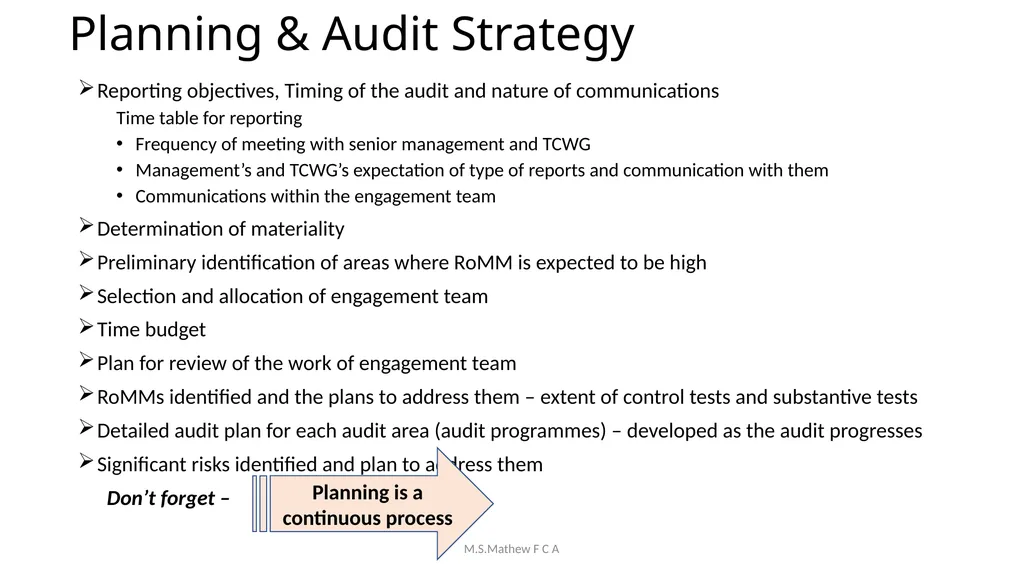
slide64. Planning & Audit Strategy Reporting objectives, Timing of the audit and nature of communications
Time table for reporting
Frequency of meeting with senior management and TCWG
Management’s and TCWG’s expectation of type of reports and communication with them
Communications within the engagement team
Determination of materiality
Preliminary identification of areas where RoMM is expected to be high
Selection and allocation of engagement team
Time budget
Plan for review of the work of engagement team
RoMMs identified and the plans to address them – extent of control tests and substantive tests
Detailed audit plan for each audit area (audit programmes) – developed as the audit progresses
Significant risks identified and plan to address them
Don’t forget – M.S.Mathew F C A Planning is a continuous process<br>
slide65. Achieving Audit Quality Audit Documentation M.S.Mathew F C A<br>
slide66. Audit Documentation Audit Documentation is a record of:
The audit procedures performed,
The relevant audit evidence obtained, and
The conclusions the auditor reached M.S.Mathew F C A<br>
slide67. Audit Documentation Audit Documentation
An essential part of audit
SA 230 deals with Audit Documentation, but this is only with regard to engagements
SQC 1 deals with documentation requirement on the entire functions of a firm
If there is no documentation, then it is presumed that there is no work done
There is more and more focus of regulators on the quality of documentation
Majority of adverse comments from regulators is on the quality and extent of documentation M.S.Mathew F C A<br>
slide68. Audit Documentation Why is audit documentation so important?
Compliance with standards
Guidance for audit team to perform their work – planning document
Leaves a record of and evidence of work performed
Creates accountability
Assists in supervision and review of the work
Highlights significant matters arising from audit
Evidence for conclusions made on the audit
Assists in quality control reviews and in external inspection
Provides transparency
Auditor’s best defense that he planned and executed the audit professionally M.S.Mathew F C A<br>
slide69. Audit Documentation Factors determining the form and content of documentation
Not all audit engagements should have the same level of documentation. It depends on:
Size of the firm
Nature and complexity of the engagement
Specific documentation requirements under regulations, if any
Internal controls of the client
Extent of records maintained by the client and their archiving M.S.Mathew F C A<br>
slide70. Audit Documentation Stages of documentation – what to document?
Client onboarding – acceptance/continuance
Understanding the entity
Planning & Audit Strategy
Risk assessment, including fraud risk and conclusion on RoMM
Response to assessed risk
Audit programs
Work performed, reference to samples tested, results and conclusions
Team discussions
Consultations, how differences of opinion are resolved
Partner review notes, quality control reviews and conclusions
Overall conclusions on audit (Summary Memo)
Minutes of important meetings with client
Communication with TCWG
Letter of representation M.S.Mathew F C A<br>
slide71. Audit Documentation Key essentials of documentation
Name of the client
Period covered by the audit
Subject matter/area of audit covered by the work paper
Details of work performed, with reference to the audit program
Reference to samples tested, findings and conclusions made
Lead schedules, tied to the financial statement
Name/initial of person who performed the work
Name/initial of the person who reviewed the work, including partner and quality reviewer
Final conclusions signed off by audit partner and engagement reviewer M.S.Mathew F C A<br>
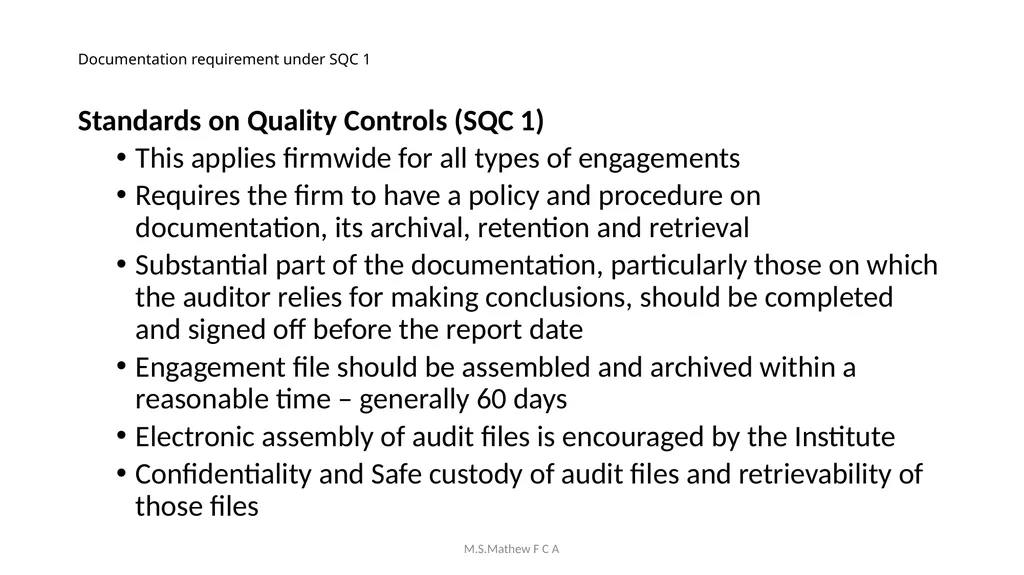
slide72. Documentation requirement under SQC 1 Standards on Quality Controls (SQC 1)
This applies firmwide for all types of engagements
Requires the firm to have a policy and procedure on documentation, its archival, retention and retrieval
Substantial part of the documentation, particularly those on which the auditor relies for making conclusions, should be completed and signed off before the report date
Engagement file should be assembled and archived within a reasonable time – generally 60 days
Electronic assembly of audit files is encouraged by the Institute
Confidentiality and Safe custody of audit files and retrievability of those files M.S.Mathew F C A<br>
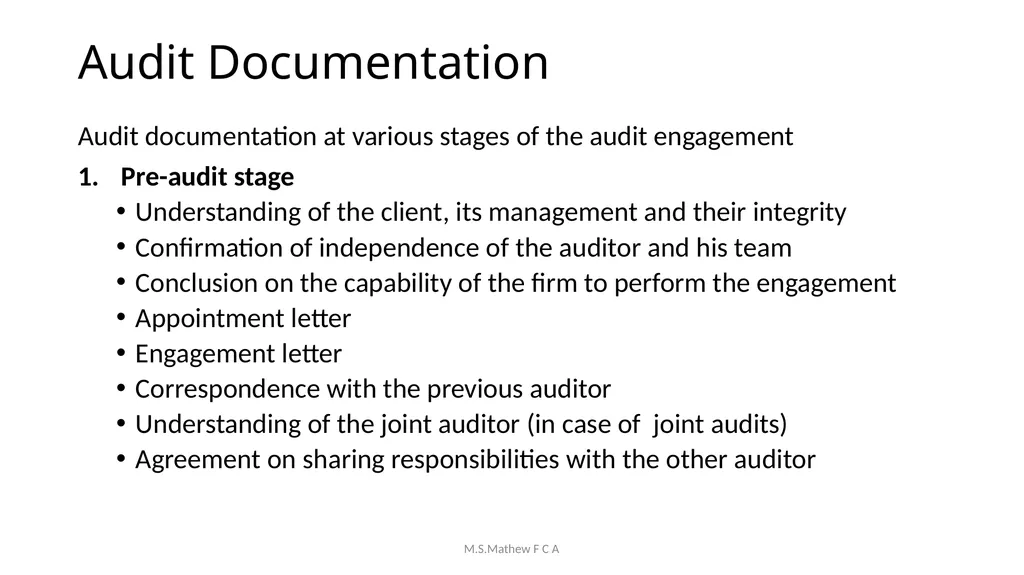
slide73. Audit Documentation Audit documentation at various stages of the audit engagement
Pre-audit stage
Understanding of the client, its management and their integrity
Confirmation of independence of the auditor and his team
Conclusion on the capability of the firm to perform the engagement
Appointment letter
Engagement letter
Correspondence with the previous auditor
Understanding of the joint auditor (in case of joint audits)
Agreement on sharing responsibilities with the other auditor M.S.Mathew F C A<br>
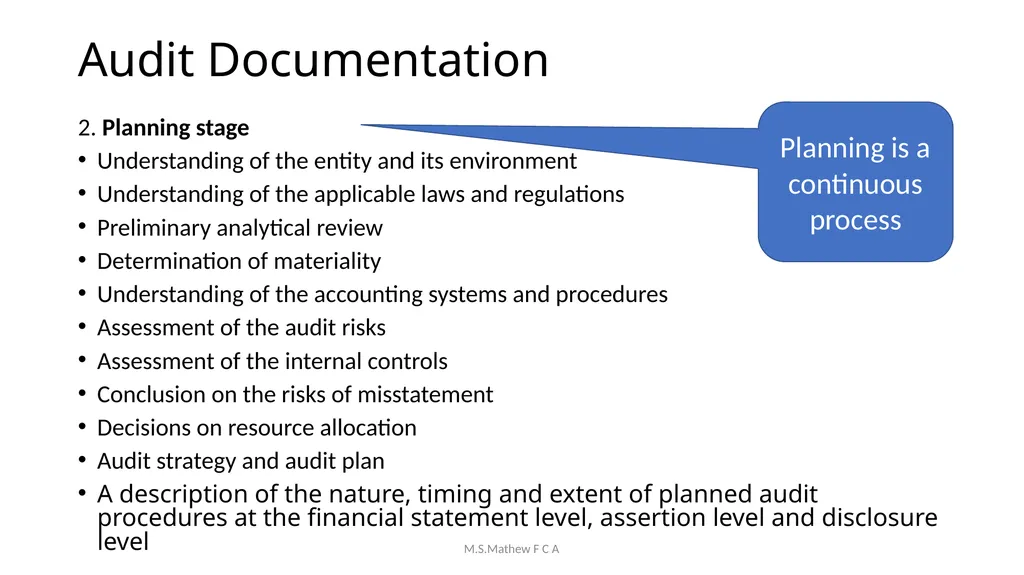
slide74. Audit Documentation 2. Planning stage
Understanding of the entity and its environment
Understanding of the applicable laws and regulations
Preliminary analytical review
Determination of materiality
Understanding of the accounting systems and procedures
Assessment of the audit risks
Assessment of the internal controls
Conclusion on the risks of misstatement
Decisions on resource allocation
Audit strategy and audit plan
A description of the nature, timing and extent of planned audit procedures at the financial statement level, assertion level and disclosure level Planning is a continuous process M.S.Mathew F C A<br>
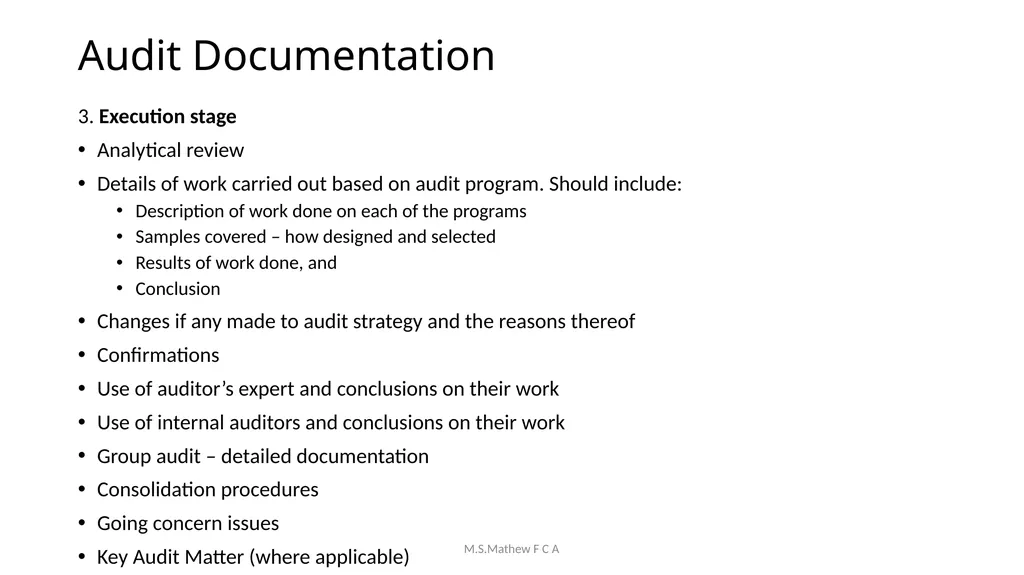
slide75. Audit Documentation 3. Execution stage
Analytical review
Details of work carried out based on audit program. Should include:
Description of work done on each of the programs
Samples covered – how designed and selected
Results of work done, and
Conclusion
Changes if any made to audit strategy and the reasons thereof
Confirmations
Use of auditor’s expert and conclusions on their work
Use of internal auditors and conclusions on their work
Group audit – detailed documentation
Consolidation procedures
Going concern issues
Key Audit Matter (where applicable) M.S.Mathew F C A<br>
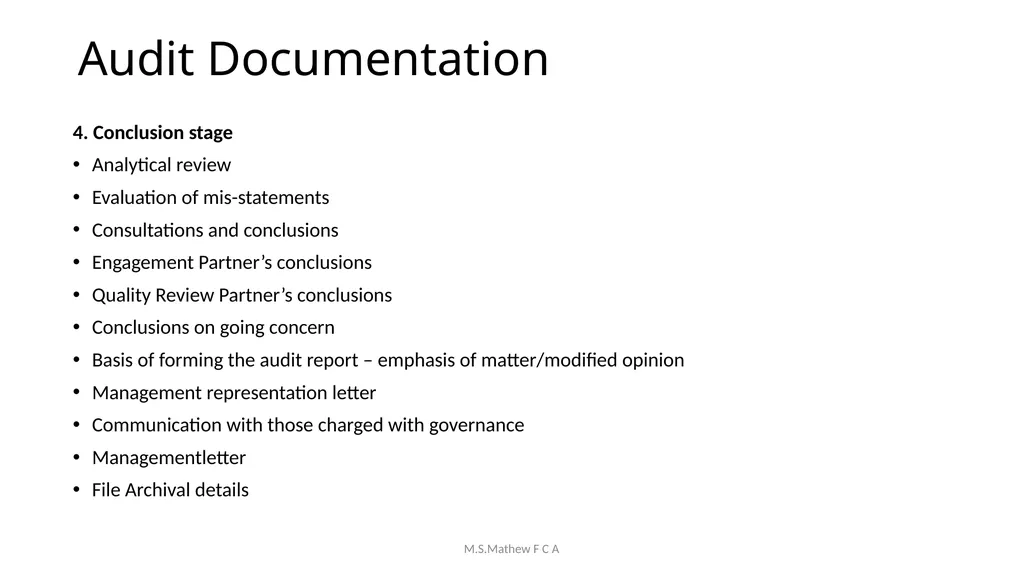
slide76. Audit Documentation 4. Conclusion stage
Analytical review
Evaluation of mis-statements
Consultations and conclusions
Engagement Partner’s conclusions
Quality Review Partner’s conclusions
Conclusions on going concern
Basis of forming the audit report – emphasis of matter/modified opinion
Management representation letter
Communication with those charged with governance
Managementletter
File Archival details M.S.Mathew F C A<br>
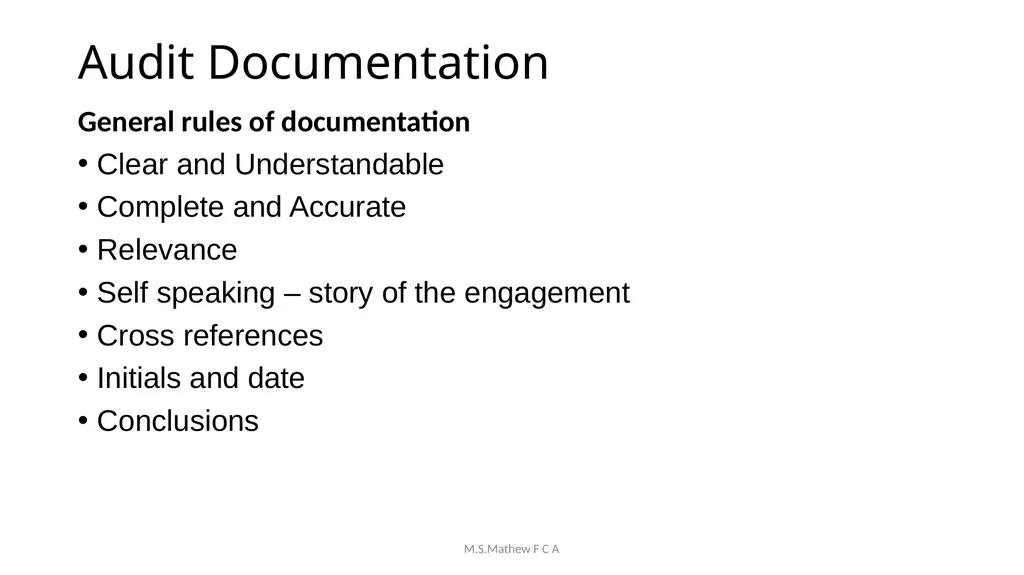
slide77. Audit Documentation General rules of documentation
Clear and Understandable
Complete and Accurate
Relevance
Self speaking – story of the engagement
Cross references
Initials and date
Conclusions M.S.Mathew F C A<br>
slide78. Achieving Audit Quality Thank you very much M.S.Mathew F C A<br>
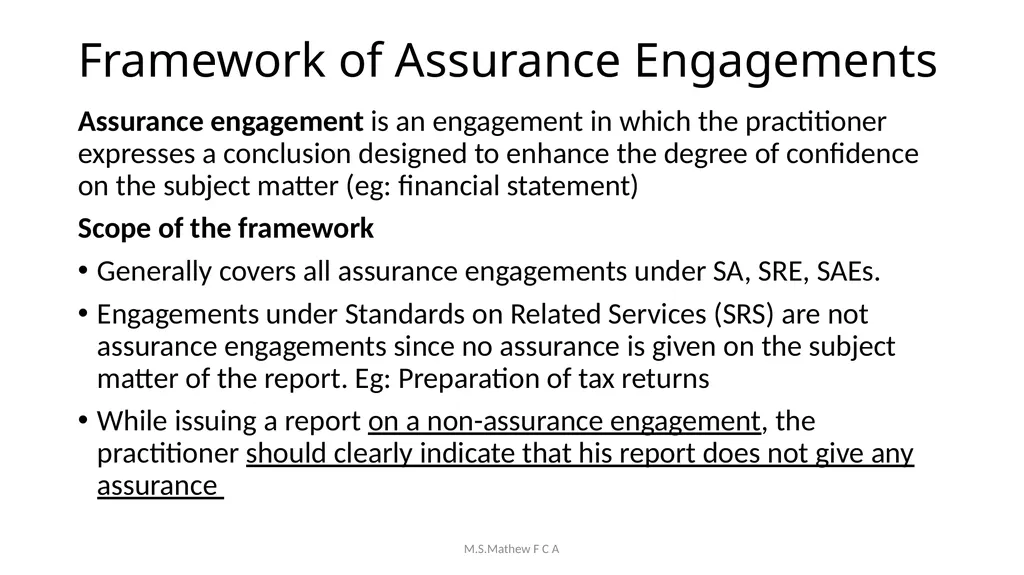
slide79. Framework of Assurance Engagements Assurance engagement is an engagement in which the practitioner expresses a conclusion designed to enhance the degree of confidence on the subject matter (eg: financial statement)
Scope of the framework
Generally covers all assurance engagements under SA, SRE, SAEs.
Engagements under Standards on Related Services (SRS) are not assurance engagements since no assurance is given on the subject matter of the report. Eg: Preparation of tax returns
While issuing a report on a non-assurance engagement, the practitioner should clearly indicate that his report does not give any assurance M.S.Mathew F C A<br>
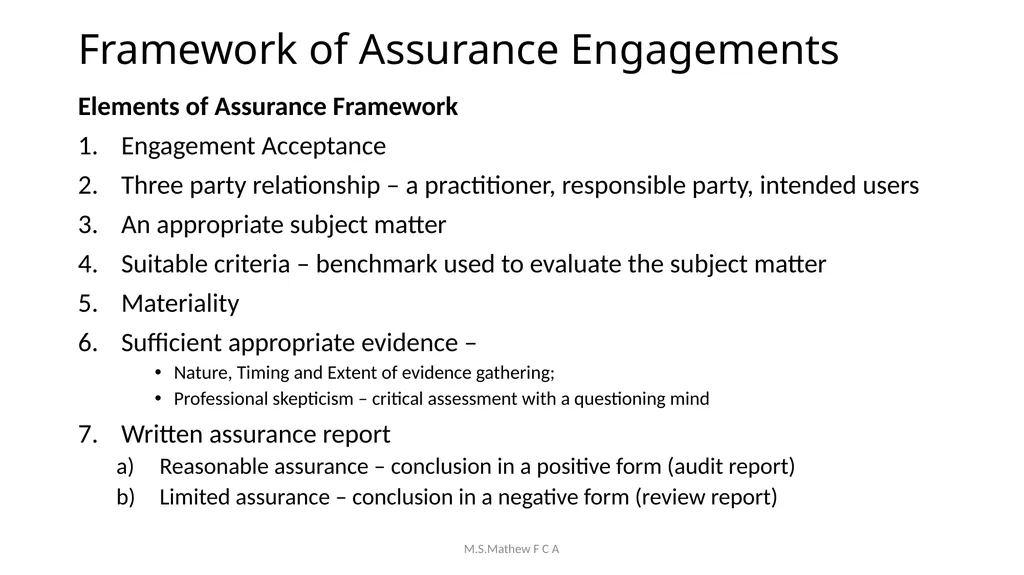
slide80. Framework of Assurance Engagements Elements of Assurance Framework
Engagement Acceptance
Three party relationship – a practitioner, responsible party, intended users
An appropriate subject matter
Suitable criteria – benchmark used to evaluate the subject matter
Materiality
Sufficient appropriate evidence –
Nature, Timing and Extent of evidence gathering;
Professional skepticism – critical assessment with a questioning mind
Written assurance report
Reasonable assurance – conclusion in a positive form (audit report)
Limited assurance – conclusion in a negative form (review report) M.S.Mathew F C A<br>
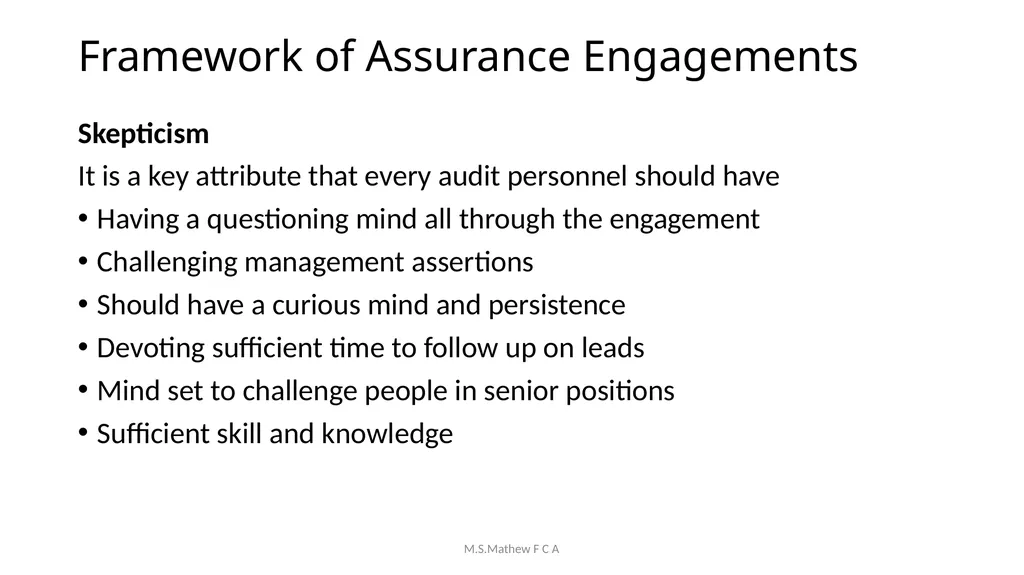
slide81. Framework of Assurance Engagements Skepticism
It is a key attribute that every audit personnel should have
Having a questioning mind all through the engagement
Challenging management assertions
Should have a curious mind and persistence
Devoting sufficient time to follow up on leads
Mind set to challenge people in senior positions
Sufficient skill and knowledge M.S.Mathew F C A<br>
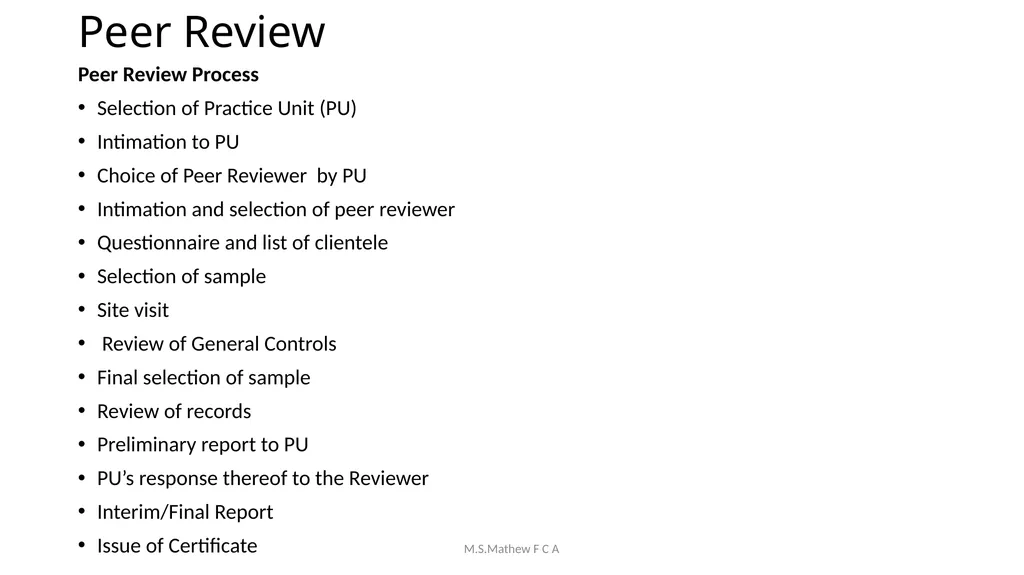
slide82. Peer Review Peer Review Process
Selection of Practice Unit (PU)
Intimation to PU
Choice of Peer Reviewer by PU
Intimation and selection of peer reviewer
Questionnaire and list of clientele
Selection of sample
Site visit
Review of General Controls
Final selection of sample
Review of records
Preliminary report to PU
PU’s response thereof to the Reviewer
Interim/Final Report
Issue of Certificate M.S.Mathew F C A<br>
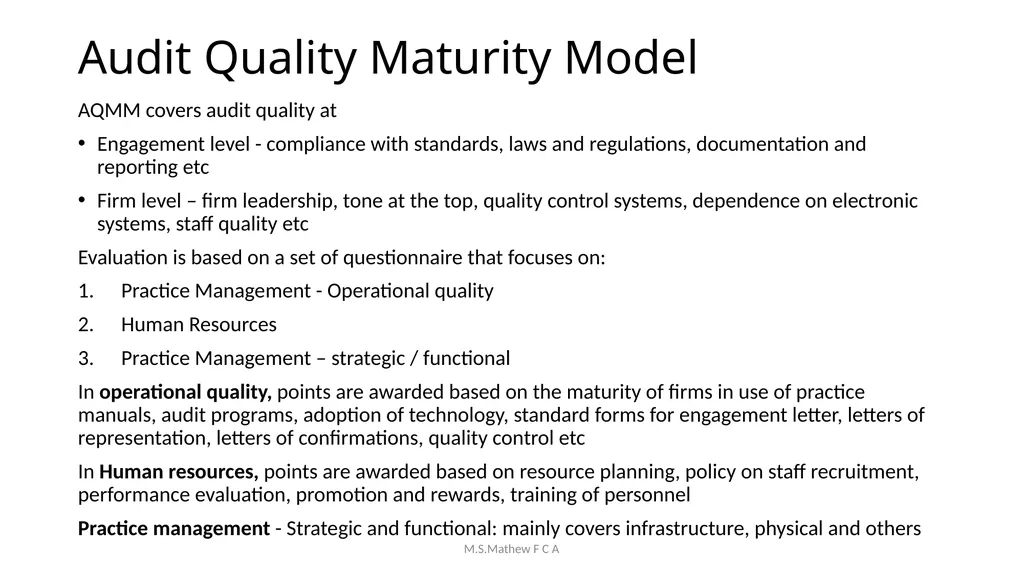
slide83. Audit Quality Maturity Model AQMM covers audit quality at
Engagement level - compliance with standards, laws and regulations, documentation and reporting etc
Firm level – firm leadership, tone at the top, quality control systems, dependence on electronic systems, staff quality etc
Evaluation is based on a set of questionnaire that focuses on:
Practice Management - Operational quality
Human Resources
Practice Management – strategic / functional
In operational quality, points are awarded based on the maturity of firms in use of practice manuals, audit programs, adoption of technology, standard forms for engagement letter, letters of representation, letters of confirmations, quality control etc
In Human resources, points are awarded based on resource planning, policy on staff recruitment, performance evaluation, promotion and rewards, training of personnel
Practice management - Strategic and functional: mainly covers infrastructure, physical and others M.S.Mathew F C A<br>
slide2. Achieving Audit Quality Important conversations are taking place worldwide about corporate reporting, audit quality, stakeholder expectations, and corporate governance.
The stakeholders of audit have increased in the past few decades..
Today’s stakeholders include directors, management, employees, analysts, regulators, rating agencies, customers, suppliers, and the general public.
General public – the expectations of general public has also increased tremendously. Their expectation of auditor’s responsibility is much wider
So much so, anything going wrong in the corporate world becomes the baby of the auditor
Therefore, the contemporary auditor not only has to maintain a high level of quality in audit, but has to demonstrate it to the stakeholders and the public at large. M.S.Mathew F C A<br>
slide3. Achieving Audit Quality Today’s Topic
Pronouncements of Auditing & Assurance Standards Board
Audit Quality
Standards on Quality Control (SQC 1)
Risk based audit
Documentation
Benchmarking - Peer Review and Audit Quality Matrix Model M.S.Mathew F C A<br>
slide4. Various Pronouncements of Auditing and Assurance Standards Board Our profession as an auditor is regulated by the various pronouncements of the AASB, issued under the authority of the Institute
Various pronouncements are:
Standards Issued by AASB M
Standards on Auditing (SAs) – 26 standards
Standards on Review Engagements (SREs)
Standards on Assurance Engagements (SAEs)
Standards on Related Services (SRSs)
Standards on Quality Control (SQC) M
Statements on Auditing (SAs) M
General Clarifications M
Guidance notes
Technical Guides, Practice Manuals, Studies and other Papers M.S.Mathew F C A<br>
slide5. Structure of Standards issued by the Auditing and Assurance Standards Board (AASB) Frame work for quality control in all kinds of engagements Quality Control for Firms that Perform Audits and Reviews of Historical Financial Information, and Other Assurance and Related Services Engagements Standards on Quality Control (SQC1) Framework for Assurance Services Audits and Reviews of historical financial information Standards on Auditing
(SAs): 100 – 999 Standards on Review Engagements (SREs): 2000 – 2699 Assurance engagements other than audits and reviews of historical financial information Standards on Assurance Engagements (SAEs): 3000 – 3699 Framework for Related Services Engagements of related services such as agreed upon procedures, compilation engagements and other related services Standards on Related Services (SRSs): 4000 – 4699 An overview of Auditing & Assurance Frame work M.S.Mathew F C A<br>
slide6. Benchmarking of Audit Quality M.S.Mathew F C A<br>
slide7. Benchmarking of Audit Quality In the past, audit was just a relationship between the client and the auditor
Now the stake holders have increased – investors, financial institutions, regulators and general public
Hence the need to be more transparent
Auditors have to demonstrate:
the way they plan to do the work,
compliance with the standards,
story of the work performed,
Conclusion on the work performed M.S.Mathew F C A<br>
slide8. Benchmarking of Audit Quality Tools of benchmarking introduced by the Institute
Peer Review – introduced in March 2002
&
Audit Quality Maturity Model – introduced in July 2021 M.S.Mathew F C A<br>
slide9. Peer Review It’s a review done of a professional practitioner by another professional of similar standing
ICAI commenced peer review process from March 2002, and established the Peer Review Board
Revised rules on Peer Review were issued in February 2022
The objectives of Peer Review
The members of the Institute comply with Technical, Professional and Ethical Standards including other regulatory requirements while performing assurance services
The member has in place proper system (including documentation system) to demonstrate the quality of assurance services
Adhere to various Statutory and Other Regulatory Requirements
Enhance the reliance placed by the users of financial financial statements for economic decision making M.S.Mathew F C A<br>
slide10. Peer Review Important
Peer review is not to identify isolated cases of engagement failure
Aim is to identify weaknesses in a firm that are pervasive, leading to systemic failure
Peer review provides a confirmation to the practitioner if he is performing his functions in compliance with the standards and regulations
Also indicates to the practitioner the areas of improvement needed
There is a process where improvements made by the member is monitored M.S.Mathew F C A<br>
slide11. Peer Review The key processes
Review of General Controls
Selection of sample files
Review of records
Preliminary report to Practice Unit (PU)
PU’s response thereof to the Reviewer
Interim/Final Report
Issue of Certificate M.S.Mathew F C A<br>
slide12. Key areas to comply General Controls
The reviewer considers the 'general controls' which comprise of five controls, viz.
Independence / ethics
Maintenance of professional skills and standards
Outside consultation
Staff supervision and developments
Office administration Most of us may be lacking M.S.Mathew F C A<br>
slide13. Independence & Ethics
Documented policies and procedures on independence and ethics, for partners and staff to follow.
Senior professional or partner responsible for independence and ethics implementation
Communication of these policies and expected standards of professional behaviour to all partners and staff
Monitor compliance
Update the policies and procedures on a need to basis M.S.Mathew F C A<br>
slide14. Professional skills and standards
Establish plan for personnel needs at all levels, based on current and anticipated clientele, business growth, impending retirements, etc
Establish criteria for staff recruitment and a process for recruitment
Continuing education programmes for partners and staff, and allow easy access to current and relevant professional literature
Conduct programmes for developing expertise in specialised areas and industries M.S.Mathew F C A<br>
slide15. Consultation
Should have a policy for consulting experts (both internal and external)
Should build up a network of other accountants, solicitors and advocates and technical consultants of industries in which its clients operate
Staff supervision & development
Should have a policy for promotions
Performance evaluation and counselling
Guidelines for assigning engagement responsibilities M.S.Mathew F C A<br>
slide16. Office Administration
Record of staff
List of clients, commencement and closure date of engagement
Files archiving and retrieval documents
Reporting by the firm
Controls over reports issued
Review process M.S.Mathew F C A<br>
slide17. Peer Review Common observations during peer review
NO documented policies & procedures for its System of Quality Control
Policies implemented are just basic and does not commensurate the size of the firm
There is a policy for independence, but No evidence that the independence policies were implemented
No engagement specific independence review was conducted to ensure engagement team members were independent of the client
Deficiencies in implementing independence & ethics policies; acceptance & continuance standards
NO Acceptance/Continuation evaluation conducted/documented
No practice of obtaining engagement letters M.S.Mathew F C A<br>
slide18. Peer Review Common observations during peer review (contd.)
Staff deployed did not have sufficient experience, particularly industry experience
No indication that the staff were given relevant training
Working papers did not indicate any review carried out by the senior or partner
No standard documented policies and procedures for planning and performing audits (audit manual)
No documentation policy and hence the files lacked consistency
NO working papers to evidence risk assessment and design of responses to risk
Controls evaluation not performed; only substantive tests performed
No methodology was followed for audit sampling
NO documentation regarding samples selected, the procedures performed, the outcome of those procedures and the conclusions made
No evidence of overall conclusion on the audit M.S.Mathew F C A<br>
slide19. Peer Review Common observations during peer review (Contd.)
While several queries were raised during audit, no evidence that satisfactory responses were received and the issues were closed
No evidence of going concern evaluation
NO evidence of subsequent events review
Working papers were not linked to financial statements
Poor management of audit files and its archival M.S.Mathew F C A<br>
slide20. Timeline for Mandatory application of Peer Review M.S.Mathew F C A Pre-requisite of Peer Review Certificate<br>
slide21. Audit Quality Maturity Model M.S.Mathew F C A<br>
slide22. Audit Quality Maturity Model A tool for self evaluation of audit maturity
Encourages practicing firms to be technology driven, by awarding greater points
Introduced by the Institute in July 2021
Covers audit firms auditing the following:
Listed entities
Banks - other than co-operative banks
Insurance companies
(Audit firms doing branch audits are however not covered)
Allows firms to assess their level of Audit Maturity
Helps to identify competencies and weaknesses
Helps to focus on improving quality on areas identified as weak Right now, recommendatory M.S.Mathew F C A<br>
slide23. Audit Quality Maturity Model AQMM covers audit quality at
Engagement level - compliance with standards, laws and regulations, documentation and reporting etc
Firm level – firm leadership, tone at the top, quality control systems, dependence on electronic systems, staff quality etc
Evaluation is based on a set of questionnaire that focuses on:
Practice Management - Operational quality
Human Resources
Practice Management – strategic / functional M.S.Mathew F C A<br>
slide24. Audit Quality Maturity Model Total score is 600, divided into 280 for operational quality, 240 for human resources and 80 for operations management – strategy
Firms that score
25% or less are in Level 1 – Take immediate corrective action
25% to 50% in Level 2 – some progress, but needs much improvement
50% to 75% in Level 3 – made significant adaptation of standards
Over 75% in Level 4 – Achieved full adoption of standards and procedures M.S.Mathew F C A<br>
slide25. Audit Quality<br>
slide26. Achieving Audit Quality What is quality in audit?
Performing the audit function in full compliance with the Auditing Standards and other pronouncements of the Institute
Conducting the audit with objectivity and integrity
Maintain a questioning attitude throughout the course of the audit (Skepticism)
Adhering to ethical standards and independence
Performing the audit with competent professional staff
Maintaining quality control standards at the firm level, and regularly monitor its application
Supervising and reviewing work performed by seniors
Consulting on significant matters
Maintaining adequate and appropriate documentation for all the activities carried as part of the audit
Retaining audit documents in accordance with the regulations M.S.Mathew F C A<br>
slide27. Achieving Audit Quality Standards on Quality Control (SQC) 1,
Quality Control for Firms that Perform Audits & Reviews of Historical Financial Information and other Assurance & Related Services Engagements
Sets the standards for the process of quality control in a professional accountant’s firm
The principles set out in SQC 1 applies to:
audits and reviews of historical financial information and
other assurance and other related services engagements
Every professional accountant’s office should develop a set of standard quality control policies and procedures commensurate with the firm’s size, nature and complexity of its practice and appropriate cost/benefit consideration M.S.Mathew F C A<br>
slide28. Standards on Quality Controls The following are the SIX ELEMENTS of quality control
Leadership responsibilities within the Firm
Ethical compliance
Acceptance & Continuance of client relationships and specific engagements
Human resources
Engagement performance
Monitoring
Peer Review conducted by the Institute places importance on whether the firms have developed policies and procedures on quality control and whether they are properly implemented and reviewed periodically M.S.Mathew F C A Important!<br>
slide29. Standards on Quality Control (SQC) 1 This standard is mandatory from 1 April 2009
This is the mother standard for all other standards, and is the basic standard for all quality control
Every firm or sole proprietorship should have a documented policies and procedures for ensuring quality control which should be based on the SIX elements
SQC must be read and understood in conjunction with the provisions of the Chartered Accountants Act, Code of Ethics and all relevant pronouncements of the Institute and legal and regulatory requirements M.S.Mathew F C A<br>
slide30. Standards on Quality Control (SQC) 1 SIX elements of Quality Control
Leadership responsibilities
Every firm must have a designated leader who sets and implements internal quality. He may delegate part of his responsibilities
He is responsible for designing, implementing internal quality and ensuring that it operates efficiently
He ensures that fee considerations do not compromise quality of work
He communicates to the firm personnel of the policies and procedures on quality control and emphasis that failure to adhere to them will result in disciplinary action
He evaluates performance and compensates personnel who demonstrates commitment to quality through performance evaluation M.S.Mathew F C A<br>
slide31. Standards on Quality Control (SQC) 1 2. Ethical Requirements
The firm must have a Code of Ethics
Its personnel must comply with the relevant ethical requirements contained in the Code of Ethics issued by ICAI, as well as other relevant pronouncements of the Institute
The firm’s personnel must maintain independence, perform all professional responsibilities with integrity and maintain objectivity in discharging professional responsibilities
Perform with integrity – be straight forward, honest
Maintain objectivity – Perform tasks by competent persons without bias; conflict of interest; undue influence by applying systematic and disciplined approach M.S.Mathew F C A<br>
slide32. Standards on Quality Control (SQC) 1 Generally recognized threats to independence are:
Self Interest threat – Financial interest & Employment relationships
Self- review threat
Advocacy threat
Familiarity threat
Intimidation test
Independence comprise:
Independence in mind – a state of mind that permits the provision of an opinion without being affected by influences that compromise professional judgement
Independence in appearance – certain actions by the auditor may cause a reasonable and informed third party to conclude that the firm or its partner has compromised its integrity, objectivity or professional judgement M.S.Mathew F C A<br>
slide33. Standards on Quality Control (SQC) 1 Ethical Principles - The code of ethics issued by the ICAI are
Integrity - should be straightforward and honest in performing professional services.
Objectivity - should be fair and should not allow prejudice or bias, conflict of interest or influence of others to override objectivity.
Professional competence and due care - should perform professional services with due care, competence and diligence based on up-to-date developments in practice, legislation and techniques.
Confidentiality – should respect the confidentiality of information acquired as a result of professional relationships.
Professional behaviour – comply with relevant laws and regulations and avoid any conduct that might discredit the profession.
It includes personal commitment to integrity; always be a desire to ‘get it right’; maintain professional skepticism; stand up to management; a commitment to learning and up dating skills M.S.Mathew F C A<br>
slide34. Standards on Quality Control (SQC) 1 Independence and Ethics
The firm must designate a partner or a senior personnel to ensure that Independence and Ethics policies are strictly implemented and followed
The firm must have a process to evaluate potential independence threats before accepting a new client relationship or continuing a relationship
All professional personnel in the firm should be periodically trained in ethics and independence
The firm must establish communication channels to up date firm personnel on independence and ethics policies and procedures
Must establish a process where personnel can promptly report potential threats to independence or breach of independence
A process where the firm withdraws from an engagement if there is a threat of independence if effective safeguards are not possible
Must obtain independence confirmation from all personnel at least once annually M.S.Mathew F C A<br>
slide35. Standards on Quality Control (SQC) 1 3. Acceptance & Continuance of Client Relationships
Before accepting a client-relationship or continuing a relationship, the firm should evaluate the client management’s integrity and consider risk associated with providing professional service
The firm should obtain an understanding of the client, their business practices and the reputation of the management
Should communicate with the previous auditor
The firm should evaluate whether the engagement can be completed with professional competence – that the firm has the capabilities, resources, professional competence
Once the firm decides to onboard the client, they should have a written engagement letter describing the scope of work, responsibilities and terms of the engagement
The firm should have policies and procedures on how to exit from an engagement M.S.Mathew F C A<br>
slide36. Standards on Quality Control (SQC) 1 4. Human Resources
The objective is to ensure that the firm has sufficient personnel with capabilities, competence and commitment to ethical principles necessary to perform engagements with professional standards
There must be a policy and procedure on hiring including qualifications and attributes for staff selected at various levels
Responsibilities for each engagement is assigned to a specific partner and must be clearly documented
Firm should assign personnel to engagements based on the knowledge, skills and abilities required for each engagement
Policy and procedure to develop the capability of professional staff
Professional staff must be mandated to participate in CPE programmes
A partner or senior member of the firm should be entrusted with the overall responsibility to manage human resources M.S.Mathew F C A<br>
slide37. Standards on Quality Control (SQC) 1 5. Engagement Performance
The objective is that engagements are performed in accordance with professional standards, regulatory and legal requirements and the reports issued are appropriate
Planning must be conducted at the commencement of an engagement
Planning includes assessment of risk, including fraud risk and documenting conclusions
It includes determining audit strategy, developing work programmes specific to the engagement and determining the staffing requirements according to the nature and complexity of the engagement
Planning is a continuous process…… keep updating as audit progresses
Engagement should be performed, supervised, documented and reported in accordance with professional standards and regulations M.S.Mathew F C A<br>
slide38. Standards on Quality Control (SQC) 1 Some of the factors for achieving professional standard include:
Ensuring compliance with auditing standards such as client acceptance & continuance; planning and risk assessment including fraud risk etc.
Written audit programs according to which work is performed and monitored.
Detailed engagement documentation which should describe work carried out, evidence of the extent of testing conducted, results of the tests and conclusions.
There must be a process in the firm where consultations take place during the course of or conclusion of the engagement on matters arising. Conclusions must be documented
There must be a review process by senior and experienced personnel M.S.Mathew F C A<br>
slide39. Standards on Quality Control (SQC) 1 SQC should have a provision to appoint a Quality Control Reviewer and should have procedures for review of audit work carried out – mandatory in listed entity audit
A Reviewer must be independent of the audit engagement
Reviewer should review the working paper and financial statements and consider the conclusions reached by the engagement team
There must be a process whereby differences of opinion are discussed, resolved and documented
Engagement documentation and related files must be completed and wrapped up on a timely basis
Maintain confidentiality, safe custody, accessibility and retrievability of engagement files
Retention of engagement files – 7 years
Development of professional staff – continuing professional education M.S.Mathew F C A<br>
slide40. Standards on Quality Control (SQC) 1 6. Monitoring
Firm should have a policy to monitor its quality control process
Policy on action to be taken on any deviation observed
Policy should laydown the extent of documentation to be retained to evidence the operation of SQC at all times and on all engagements
A Quality Control Check list to have a standard review of compliance by the firm
Policy to have, at a minimum, an annual review of compliance with SQC
A process must be in place to identify deficiencies and take remedial action
To conclude…………………….. M.S.Mathew F C A<br>
slide41. Standards on Quality Control (SQC) 1 Conclusion
Standards on Quality (SQC 1) is mandatory, irrespective of the size
Every firm must develop a set of policies designed to establish a system of quality control of the firm, and procedures to implement and monitor compliance.
The aim is to mandate and ensure that the firm and its personnel comply with the professional standards
The firm, therefore, must document its policies and procedures for establishing overall quality of the firm
To start with, your SQC document need not be very lengthy. As you start preparing, you will be able to find gaps in your quality control process and can bridge those
At least once annually review and ensure that the policies and procedures are complied with
A MUST document to be produced during peer review. Of late, all regulators focus on compliance with SQC by the firm
Institute has published a set of illustrative SQC policies and procedures which firms can adopt or modify and adopt according to their size and circumstances M.S.Mathew F C A<br>
slide42. Standards on Auditing General Principles and Responsibilities M.S.Mathew F C A<br>
slide43. Standards on Auditing Planning; Risk Assessment and Response to Assessed Risks SA 300 -450 M.S.Mathew F C A<br>
slide44. Standards on Auditing M.S.Mathew F C A<br>
slide45. Standards on Auditing Risk based Audit
(SAs 315 & 330) M.S.Mathew F C A<br>
slide46. Risk based Audit What are the Standards on Auditing (SAs) dealing with this topic?
Planning an Audit of Financial Statements (SA 300)
Identifying and Assessing the Risks of Material Misstatement Through Understanding the Entity and its Environment (SA 315)
Materiality in Planning and Performing and Audit (SA 320)
Auditor’s Response to Assessed Risk (SA 330) M.S.Mathew F C A<br>
slide47. Risk based Audit What is the inherent risk in our audit profession?
Material misstatement in a financial statement on which we issue an unqualified opinion
This is termed as ‘Audit Risk’
Misstatement can arise from fraud or error which could individually Or in aggregate, influence the economic decisions of the users of the financial statements
So the duty of the auditor is to keep the Audit Risk at a low level, whereby the possibility of material misstatement of the financial statements is also brought to a low level M.S.Mathew F C A<br>
slide48. Risk based audit How could financial statements presented to us for audit be misstated?
Due to the nature of the entity’s business or the low integrity of the management/staff, the entity’s transactions and balances have an inherent risk of material misstatement
Primarily, the entity will put in place controls to mitigate the risks.
However, all inherent risks by nature may not be completely prevented through controls. Controls are managed by client.
The misstatements that could not be prevented due to the weakness of controls are called Control Risks
Control risk is caused by the absence of controls or the ineffectiveness of a control put in place by management
If a risk cannot be prevented by the controls put in place by management, the next possibility to preventing the misstatement is through audit tests conducted by the auditor. (detection tests)
But it may be possible that all misstatements are not detected.
This risk of not detecting the misstatement through audit procedures is called ‘detection risk’ M.S.Mathew F C A<br>
slide49. Risk based Audit M.S.Mathew F C A Inherent risks may be at the entity level or at transaction/ balances level
Factors affecting the Inherent risk at the entity level
Integrity of management
Experience of management
Unusual pressure on management
Nature of entity’s business
Economic/ political conditions affecting the business and the industry
To assess this risk, we evaluate the Control Environment of the client<br>
slide50. Risk based Audit M.S.Mathew F C A Factors affecting the Inherent risk at the account balance and class of transaction levels
Complexity of the underlying transactions
Degree of judgment in determining account balances
Susceptibility of assets to misappropriation
Large volumes of transaction or transactions with high value
High dependence on computer systems
Incapability of the accounting system to handle the transactions
Related party transactions
To assess this risk we need to Understand the Key Business Processes and related transactions of the client<br>
slide51. Risk based Audit The Risk of Material Misstatement is a combination of:
Inherent risk – due to the nature of the business
Control risk – due to the entity’s failure to implement internal control procedures to prevent misstatements from occurring
Detection risk – the auditor’s failure to detect the misstatement through audit procedures
The first two relates to the entity and its management
The third one, namely detection risk, is to be handled by the auditor M.S.Mathew F C A First two relate to entity and its management<br>
slide52. Risk based Audit Therefore, the primary function of the auditor is to:
assess the risk of material misstatement, and
design audit procedures to prevent or limit those risk to a lower level
Risk has to be assessed at
Financial statement level (risk that is pervasive as a whole)
Class of transactions level (risk specific to assertions)
Account balances level (risk specific to assertions)
for assertions made by management – recognition, measurement, presentation and disclosure of information in the financial statements
(SA 315. para 25) M.S.Mathew F C A<br>
slide53. Risk based audit Identification of Risk
The risk shall be identified by an understanding of the entity and its environment (SA 315*):
The entity and its owners;
The industry in which it operates;
Its management and organization structure;
Its business operations and processes, including IT;
The key regulations affecting the entity, etc.
The risk assessment process of the entity
*The Standards on Auditing (SA 315): Identifying and Assessing the Risks of Material Misstatement Through Understanding the Entity and its Environment. M.S.Mathew F C A Document<br>
slide54. Risk based Audit This understanding should be further drilled down to:
Appropriateness of Accounting policies and procedures
Understanding of the IT systems and financial statement preparation
Transactions – such as cash transactions, sales, production process, inventory acquisition and consumption, employee compensation, custody or assets (information must be gathered for all material transactions)
Account balances – how existence of assets are ensured, how assets are valued (eg: trade receivables, investments), how rights over assets are assured, the process to capture liabilities and claims etc.
Disclosures – how relevant data for disclosure in the financial statements are gathered and verified for completion and accuracy M.S.Mathew F C A Document<br>
slide55. Risk based audit Identification of Risk
The understanding gained will enable the auditor to identify the risk of material misstatement (and its intensity) at
the entity level (financial statements level),
class of transactions level and disclosures level
– for every relevant assertion
This is easier by asking ourselves: “What could go wrong?”
The understanding gained will also help the auditor to assess the level of internal controls that the entity has at financial statements level, transaction level, account balances level and disclosure level
The identification of risks and understanding of relevant controls will enable the auditor to decide on the magnitude of possible misstatements. The better the controls, the lower the RoMM
The auditor can now move to designing audit procedures to respond to assessed risk of material misstatements (SA 330) M.S.Mathew F C A<br>
slide56. Risk based Audit Before we move to responding to assessed risks, lets be clear about assertions.
When Management prepares the financial statements, it is implied that they assert the on the recognition, measurement, presentation and disclosure of various elements in the financial statements. These assertions are further broken down to:
Assertions about classes of transactions
Occurrence – The recorded transactions and events have actually occurred
Completeness – All transactions and events that should have been recorded have been recorded
Accuracy – Amounts and other data that have been recorded are accurately/appropriately recorded
Cut-off – Transactions and events have been recorded in the correct period
Classification – Transaction and events have been recorded in the proper accounts M.S.Mathew F C A<br>
slide57. 2. Assertions about Account balances
Existence – That assets, liabilities, equity exists
Rights / Obligations – That the entity has the right over the assets and liabilities are the actual obligations
Completeness - All assets, liabilities and equity that should have been recorded have been recorded
Valuation – All assets, liabilities and equity are recorded at appropriate amounts
3. Assertions about Presentation and Disclosures
Occurrence and Rights/Obligations – The disclosed events and transactions have occurred and pertain to the entity
Completeness – All disclosures that should have been included have been included
Classification and understandability – Financial information is appropriately presented and described
Accuracy and valuation – Financial and other information disclosed fairly and for appropriate amounts M.S.Mathew F C A Risk based Audit<br>
slide58. Responding to the assessed risk of material misstatement (SA 330)
Design of audit procedures
1. Assessing relevant controls
Where the auditor considers that the entity has relevant controls to mitigate the risk, and has therefore assessed the Risk of Material Misstatement (RoMM) at a lower level, he has to carry out control tests to ensure that the controls are effective and are in operation.
If control evaluation gives assurance that controls are effective to mitigate the risk, and that they are in operation, then it means that the Control Risk is low.
A low control risk means, substantial part of audit risk has been mitigated and hence detection risk is also brought to a lower level. Hence, he can afford to do reduce the extent of detection tests that has to be performed.
See the diagram in the next slide M.S.Mathew F C A Document Risk based Audit<br>
slide59. Risk based Audit M.S.Mathew F C A Audit
Risk Tested - Effective controls in operation Detection
tests Effective controls in operation Detection
tests Client 1 Client 2 Detection Risk Control Risk Inherent Risk<br>
slide60. Risk based Audit 2. Designing detection tests (substantive tests)
(a) Tests of Detail
(b) Analytical Reviews
3. Decide on the nature, extent and timing of tests to be performed M.S.Mathew F C A<br>
slide61. To sum up:
Understand the entity
Understand the key business processes
Identify the risk at the financial statement level – pervasive risks
Identify the risks in each key process– by assertion
Understand the related controls of the identified risks
Conclude on the level of Risk of Material Misstatement (RoMM)
Test controls if RoMM is assessed by relying on controls
Conclude on the existence and effectiveness of controls
Design audit procedures and the nature, timing and extent of tests
Conclude on the result of audit procedures
Draft appropriate audit report M.S.Mathew F C A<br>
slide62. AUDIT INITIATION PROCESS AUDIT AUDIT COMPLETION A STRUCTURED AUDIT APPROACH Knowing the client Review Organisation Structure Understand the business Understand Information systems Risks Identification Risks Assessment Transactions Audit Audit of final balances Clearance of Draft Financials Business Risks Operational Risks Information Systems Risks Identify key business processes Obtain policies and procedures Identify & assess control effectiveness Determine level of substantive tests Perform test of transactions Test of balances Discussion with client THE CLIENT, ITS BUSINESS, PROCESSES, CONTROLS AND SYSTEMS ARE THE FOCUS SUBSTANTIVE AUDIT PLANNING EXECUTION COMPLETION Test controls Risk based Audit Approach Year-end work Issue of Audit Report<br>
slide63. Planning & Audit Strategy When should the planning for an audit start?
Planning should start at the beginning of the current year audit, by performing the following:
Client acceptance/continuance evaluation(SA 220)
Compliance of ethical requirements and independence of the team
Agree the terms of the engagement (SA 210)
The auditor should develop an overall audit strategy. The audit strategy document shall contain the following:
The characteristic of the engagement
Financial reporting framework
Industry specific reporting requirements, if any
Availability of or planned use of the work of internal auditors
Planned use of auditor’s expert
How to address an entity’s use of service organization
Use of audit evidence obtained in previous years
The impact of IT systems of the client on the audit
Overall timing of the audit and deadlines for issue of report M.S.Mathew F C A<br>
slide64. Planning & Audit Strategy Reporting objectives, Timing of the audit and nature of communications
Time table for reporting
Frequency of meeting with senior management and TCWG
Management’s and TCWG’s expectation of type of reports and communication with them
Communications within the engagement team
Determination of materiality
Preliminary identification of areas where RoMM is expected to be high
Selection and allocation of engagement team
Time budget
Plan for review of the work of engagement team
RoMMs identified and the plans to address them – extent of control tests and substantive tests
Detailed audit plan for each audit area (audit programmes) – developed as the audit progresses
Significant risks identified and plan to address them
Don’t forget – M.S.Mathew F C A Planning is a continuous process<br>
slide65. Achieving Audit Quality Audit Documentation M.S.Mathew F C A<br>
slide66. Audit Documentation Audit Documentation is a record of:
The audit procedures performed,
The relevant audit evidence obtained, and
The conclusions the auditor reached M.S.Mathew F C A<br>
slide67. Audit Documentation Audit Documentation
An essential part of audit
SA 230 deals with Audit Documentation, but this is only with regard to engagements
SQC 1 deals with documentation requirement on the entire functions of a firm
If there is no documentation, then it is presumed that there is no work done
There is more and more focus of regulators on the quality of documentation
Majority of adverse comments from regulators is on the quality and extent of documentation M.S.Mathew F C A<br>
slide68. Audit Documentation Why is audit documentation so important?
Compliance with standards
Guidance for audit team to perform their work – planning document
Leaves a record of and evidence of work performed
Creates accountability
Assists in supervision and review of the work
Highlights significant matters arising from audit
Evidence for conclusions made on the audit
Assists in quality control reviews and in external inspection
Provides transparency
Auditor’s best defense that he planned and executed the audit professionally M.S.Mathew F C A<br>
slide69. Audit Documentation Factors determining the form and content of documentation
Not all audit engagements should have the same level of documentation. It depends on:
Size of the firm
Nature and complexity of the engagement
Specific documentation requirements under regulations, if any
Internal controls of the client
Extent of records maintained by the client and their archiving M.S.Mathew F C A<br>
slide70. Audit Documentation Stages of documentation – what to document?
Client onboarding – acceptance/continuance
Understanding the entity
Planning & Audit Strategy
Risk assessment, including fraud risk and conclusion on RoMM
Response to assessed risk
Audit programs
Work performed, reference to samples tested, results and conclusions
Team discussions
Consultations, how differences of opinion are resolved
Partner review notes, quality control reviews and conclusions
Overall conclusions on audit (Summary Memo)
Minutes of important meetings with client
Communication with TCWG
Letter of representation M.S.Mathew F C A<br>
slide71. Audit Documentation Key essentials of documentation
Name of the client
Period covered by the audit
Subject matter/area of audit covered by the work paper
Details of work performed, with reference to the audit program
Reference to samples tested, findings and conclusions made
Lead schedules, tied to the financial statement
Name/initial of person who performed the work
Name/initial of the person who reviewed the work, including partner and quality reviewer
Final conclusions signed off by audit partner and engagement reviewer M.S.Mathew F C A<br>
slide72. Documentation requirement under SQC 1 Standards on Quality Controls (SQC 1)
This applies firmwide for all types of engagements
Requires the firm to have a policy and procedure on documentation, its archival, retention and retrieval
Substantial part of the documentation, particularly those on which the auditor relies for making conclusions, should be completed and signed off before the report date
Engagement file should be assembled and archived within a reasonable time – generally 60 days
Electronic assembly of audit files is encouraged by the Institute
Confidentiality and Safe custody of audit files and retrievability of those files M.S.Mathew F C A<br>
slide73. Audit Documentation Audit documentation at various stages of the audit engagement
Pre-audit stage
Understanding of the client, its management and their integrity
Confirmation of independence of the auditor and his team
Conclusion on the capability of the firm to perform the engagement
Appointment letter
Engagement letter
Correspondence with the previous auditor
Understanding of the joint auditor (in case of joint audits)
Agreement on sharing responsibilities with the other auditor M.S.Mathew F C A<br>
slide74. Audit Documentation 2. Planning stage
Understanding of the entity and its environment
Understanding of the applicable laws and regulations
Preliminary analytical review
Determination of materiality
Understanding of the accounting systems and procedures
Assessment of the audit risks
Assessment of the internal controls
Conclusion on the risks of misstatement
Decisions on resource allocation
Audit strategy and audit plan
A description of the nature, timing and extent of planned audit procedures at the financial statement level, assertion level and disclosure level Planning is a continuous process M.S.Mathew F C A<br>
slide75. Audit Documentation 3. Execution stage
Analytical review
Details of work carried out based on audit program. Should include:
Description of work done on each of the programs
Samples covered – how designed and selected
Results of work done, and
Conclusion
Changes if any made to audit strategy and the reasons thereof
Confirmations
Use of auditor’s expert and conclusions on their work
Use of internal auditors and conclusions on their work
Group audit – detailed documentation
Consolidation procedures
Going concern issues
Key Audit Matter (where applicable) M.S.Mathew F C A<br>
slide76. Audit Documentation 4. Conclusion stage
Analytical review
Evaluation of mis-statements
Consultations and conclusions
Engagement Partner’s conclusions
Quality Review Partner’s conclusions
Conclusions on going concern
Basis of forming the audit report – emphasis of matter/modified opinion
Management representation letter
Communication with those charged with governance
Managementletter
File Archival details M.S.Mathew F C A<br>
slide77. Audit Documentation General rules of documentation
Clear and Understandable
Complete and Accurate
Relevance
Self speaking – story of the engagement
Cross references
Initials and date
Conclusions M.S.Mathew F C A<br>
slide78. Achieving Audit Quality Thank you very much M.S.Mathew F C A<br>
slide79. Framework of Assurance Engagements Assurance engagement is an engagement in which the practitioner expresses a conclusion designed to enhance the degree of confidence on the subject matter (eg: financial statement)
Scope of the framework
Generally covers all assurance engagements under SA, SRE, SAEs.
Engagements under Standards on Related Services (SRS) are not assurance engagements since no assurance is given on the subject matter of the report. Eg: Preparation of tax returns
While issuing a report on a non-assurance engagement, the practitioner should clearly indicate that his report does not give any assurance M.S.Mathew F C A<br>
slide80. Framework of Assurance Engagements Elements of Assurance Framework
Engagement Acceptance
Three party relationship – a practitioner, responsible party, intended users
An appropriate subject matter
Suitable criteria – benchmark used to evaluate the subject matter
Materiality
Sufficient appropriate evidence –
Nature, Timing and Extent of evidence gathering;
Professional skepticism – critical assessment with a questioning mind
Written assurance report
Reasonable assurance – conclusion in a positive form (audit report)
Limited assurance – conclusion in a negative form (review report) M.S.Mathew F C A<br>
slide81. Framework of Assurance Engagements Skepticism
It is a key attribute that every audit personnel should have
Having a questioning mind all through the engagement
Challenging management assertions
Should have a curious mind and persistence
Devoting sufficient time to follow up on leads
Mind set to challenge people in senior positions
Sufficient skill and knowledge M.S.Mathew F C A<br>
slide82. Peer Review Peer Review Process
Selection of Practice Unit (PU)
Intimation to PU
Choice of Peer Reviewer by PU
Intimation and selection of peer reviewer
Questionnaire and list of clientele
Selection of sample
Site visit
Review of General Controls
Final selection of sample
Review of records
Preliminary report to PU
PU’s response thereof to the Reviewer
Interim/Final Report
Issue of Certificate M.S.Mathew F C A<br>
slide83. Audit Quality Maturity Model AQMM covers audit quality at
Engagement level - compliance with standards, laws and regulations, documentation and reporting etc
Firm level – firm leadership, tone at the top, quality control systems, dependence on electronic systems, staff quality etc
Evaluation is based on a set of questionnaire that focuses on:
Practice Management - Operational quality
Human Resources
Practice Management – strategic / functional
In operational quality, points are awarded based on the maturity of firms in use of practice manuals, audit programs, adoption of technology, standard forms for engagement letter, letters of representation, letters of confirmations, quality control etc
In Human resources, points are awarded based on resource planning, policy on staff recruitment, performance evaluation, promotion and rewards, training of personnel
Practice management - Strategic and functional: mainly covers infrastructure, physical and others M.S.Mathew F C A<br>