Acoramidis May Improve Cardiac Function and Promote Regression in Transthyretin Amyloid Cardiomyopathy: Data From the ATTRibute-CM Cardiac Magnetic Resonance Substudy Yousuf Razvi,1 Daniel P. Judge,2 Ana Martinez-Naharro,1 Adam Ioannou,1
"Acoramidis May Improve Cardiac Function and" is the property of its rightful owner. Permission is granted to
download and print the materials on this website for personal, non-commercial use only, and to display it
on your personal computer provided you do not modify the materials and that you retain all copyright
notices contained in the materials. By downloading content from our website, you accept the terms of this
agreement.
Share
Embed code
Presentation Transcript
01
Acoramidis May Improve Cardiac Function and Promote Regression in Transthyretin Amyloid Cardiomyopathy: Data From the ATTRibute-CM Cardiac Magnetic Resonance Substudy Yousuf Razvi,1 Daniel P. Judge,2 Ana Martinez-Naharro,1 Adam Ioannou,1 Lucia Venneri,3 Rishi Patel,1 Julian D. Gillmore,1 Laura Edwards,4 Thomas York,4 Jorg Taubel,4 Jing Du,5 Jean-François Tamby,5 Suresh Siddhanti,5 Lenny Katz,5 Jonathan Fox,5 Marianna Fontana1
1 University College London, Royal Free Hospital, London, UK; 2 The Medical University of South Carolina, Charleston, SC, USA; 3 Royal Brompton and Harefield NHS Foundation Trust, London, UK; 4 Richmond Pharmacology, London, UK; 5 Eidos Therapeutics, affiliate of BridgeBio Pharma, San Francisco, CA, USA Presenter at ACC 2024: Yousuf Razvi Confidential – Content is under embargo. Please do not publish/distribute externally prior to presentation at ACC 2024<br>
02
Background ATTR-CM is caused by deposition of TTR amyloid fibrils in the myocardium, which can lead to progressive heart failure, significantly impaired quality of life, hospitalization, and premature death1-7
Acoramidis is a next-generation, oral, near-complete TTR stabilizer inhibits dissociation of tetrameric TTR into monomers that can form amyloid fibrils8
In ATTRibute-CM*, acoramidis met its primary hierarchical endpoint of mortality, cardiovascular-related hospitalization, change in NT-proBNP and 6MWD (P <0.0001)10
CMR with ECV mapping has proven utility in tracking response to treatment in cardiac amyloidosis by assessing changes in cardiac structure, function, and amyloid burden.11 6MWD, 6-minute walking distance; ATTR-CM, transthyretin amyloid cardiomyopathy; CMR, cardiac magnetic resonance; ECV, extracellular volume; NT-proBNP, N-terminal pro-B-type natriuretic peptide; TTR, transthyretin.
1. Liz MA, et al. Neurol Ther. 2020;9(2):395-402; 2. Vieira M, Saraiva MJ. Biomol Concepts. 2014;5(1):45-54; 3. Witteles RM, et al. JACC Heart Fail. 2019;7(8):709-716; 4. Rintell D, et al. Orphanet J Rare Dis. 2021;16(1):70; 5. Hanna M, et al. Am J Cardiol. 2021;141:98-105; 6. Stewart M, et al. Neurol Ther. 2018;7(2):349-364; 7. Lauppe R, et al. ESC Heart Fail. 2022;9(3):2528-2537; 8. Fox JC, et al. Clin Pharmacol Drug Dev. 2020;9(1):115-129; 9. Ji A, et al. Presented at: 2020 International Symposium on Amyloidosis; September 14-18, 2020; 10. Gillmore JD, et al. N Engl J Med. 2024;390(2):132-142; 11. Fontana F, et al. JACC Cardiovasc Imaging. 2021; 14 (1): 189-199. Objective:
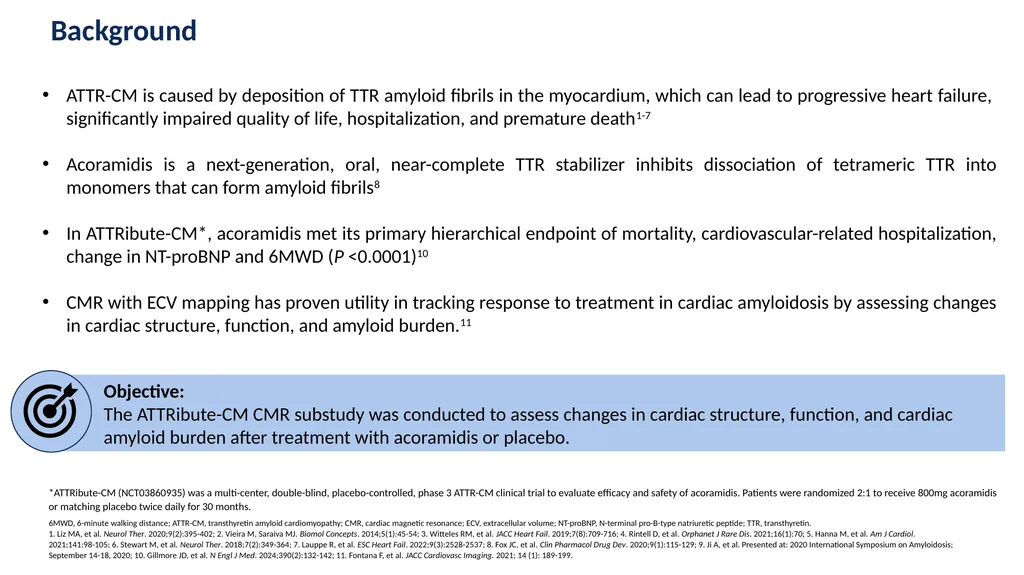
The ATTRibute-CM CMR substudy was conducted to assess changes in cardiac structure, function, and cardiac amyloid burden after treatment with acoramidis or placebo. *ATTRibute-CM (NCT03860935) was a multi-center, double-blind, placebo-controlled, phase 3 ATTR-CM clinical trial to evaluate efficacy and safety of acoramidis. Patients were randomized 2:1 to receive 800mg acoramidis or matching placebo twice daily for 30 months.<br>
03
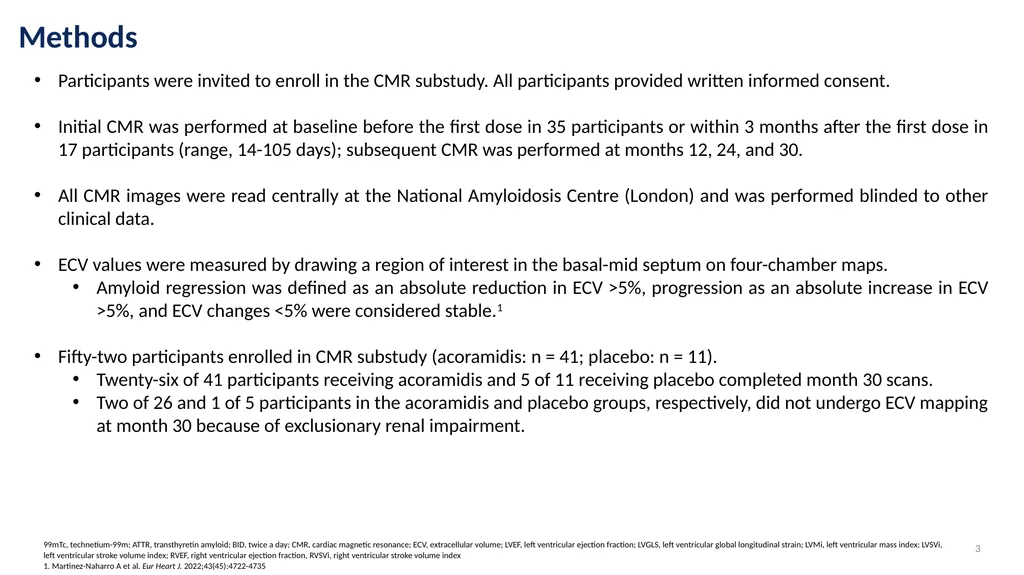
Methods ‹#› Participants were invited to enroll in the CMR substudy. All participants provided written informed consent.
Initial CMR was performed at baseline before the first dose in 35 participants or within 3 months after the first dose in 17 participants (range, 14-105 days); subsequent CMR was performed at months 12, 24, and 30.
All CMR images were read centrally at the National Amyloidosis Centre (London) and was performed blinded to other clinical data.
ECV values were measured by drawing a region of interest in the basal-mid septum on four-chamber maps.
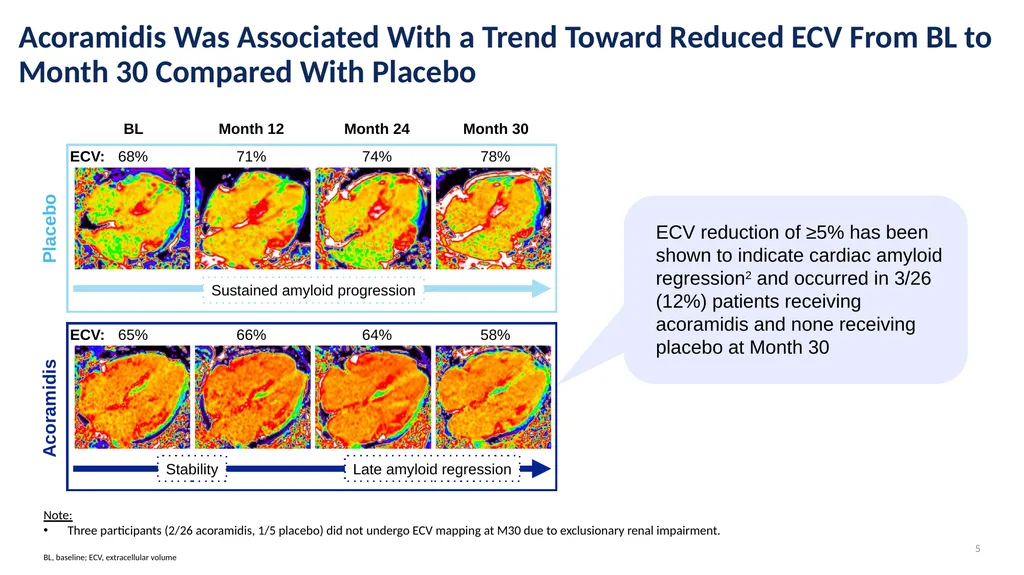
Amyloid regression was defined as an absolute reduction in ECV >5%, progression as an absolute increase in ECV >5%, and ECV changes <5% were considered stable.1
Fifty-two participants enrolled in CMR substudy (acoramidis: n = 41; placebo: n = 11).
Twenty-six of 41 participants receiving acoramidis and 5 of 11 receiving placebo completed month 30 scans.
Two of 26 and 1 of 5 participants in the acoramidis and placebo groups, respectively, did not undergo ECV mapping at month 30 because of exclusionary renal impairment. 99mTc, technetium-99m; ATTR, transthyretin amyloid; BID, twice a day; CMR, cardiac magnetic resonance; ECV, extracellular volume; LVEF, left ventricular ejection fraction; LVGLS, left ventricular global longitudinal strain; LVMi, left ventricular mass index; LVSVi, left ventricular stroke volume index; RVEF, right ventricular ejection fraction, RVSVi, right ventricular stroke volume index
1. Martinez-Naharro A et al. Eur Heart J. 2022;43(45):4722-4735<br>
04
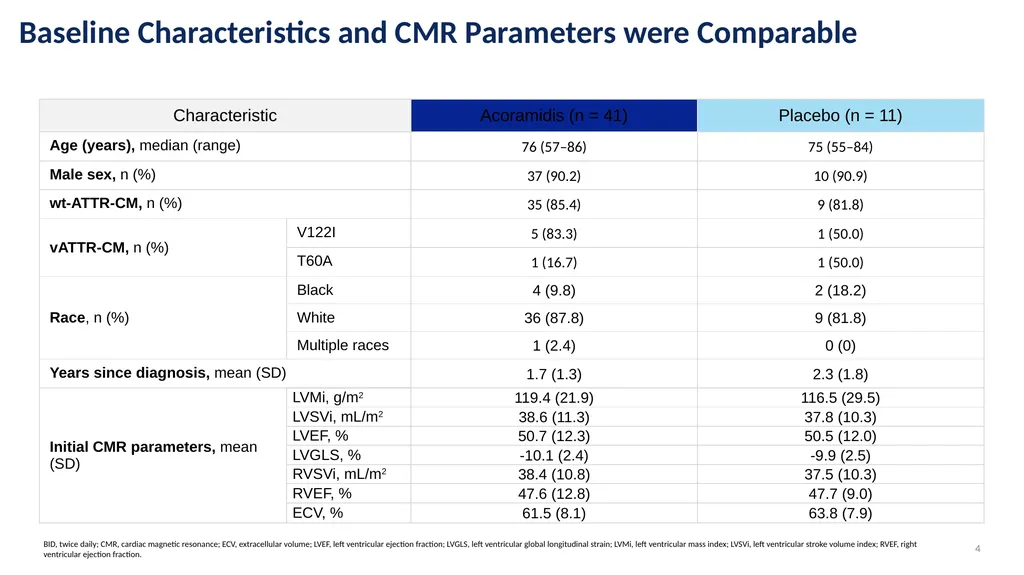
Baseline Characteristics and CMR Parameters were Comparable ‹#› BID, twice daily; CMR, cardiac magnetic resonance; ECV, extracellular volume; LVEF, left ventricular ejection fraction; LVGLS, left ventricular global longitudinal strain; LVMi, left ventricular mass index; LVSVi, left ventricular stroke volume index; RVEF, right ventricular ejection fraction.<br>
05
Acoramidis Was Associated With a Trend Toward Reduced ECV From BL to Month 30 Compared With Placebo ‹#› Placebo Acoramidis 68% 71% 74% 78% ECV: 65% 66% 64% 58% ECV: Sustained amyloid progression Stability Late amyloid regression BL Month 12 Month 24 Month 30 ECV reduction of ≥5% has been shown to indicate cardiac amyloid regression2 and occurred in 3/26 (12%) patients receiving acoramidis and none receiving placebo at Month 30 BL, baseline; ECV, extracellular volume Note:
Three participants (2/26 acoramidis, 1/5 placebo) did not undergo ECV mapping at M30 due to exclusionary renal impairment.<br>
06
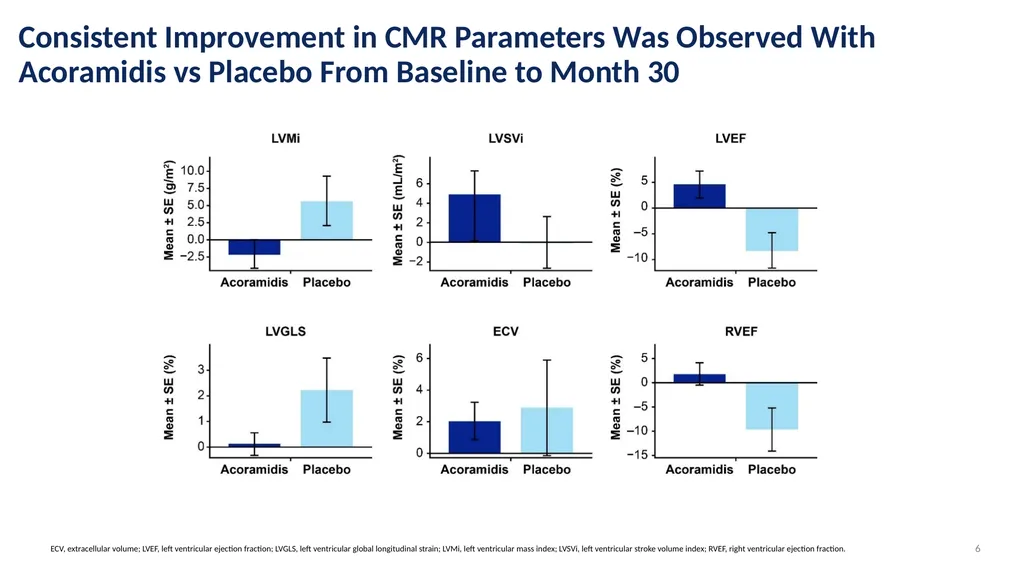
Consistent Improvement in CMR Parameters Was Observed With Acoramidis vs Placebo From Baseline to Month 30 ‹#› ECV, extracellular volume; LVEF, left ventricular ejection fraction; LVGLS, left ventricular global longitudinal strain; LVMi, left ventricular mass index; LVSVi, left ventricular stroke volume index; RVEF, right ventricular ejection fraction.<br>
07
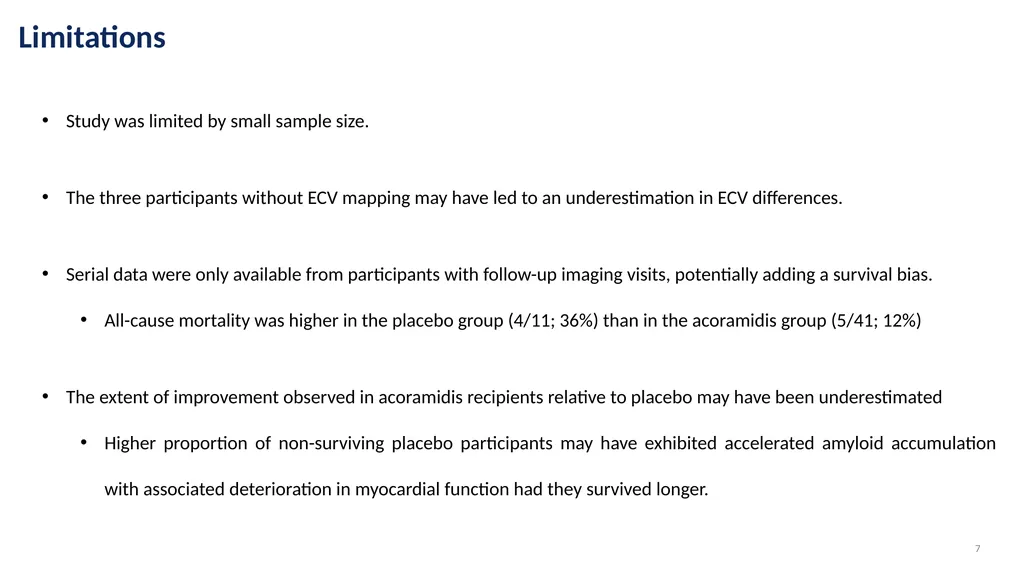
Limitations ‹#› Study was limited by small sample size.
The three participants without ECV mapping may have led to an underestimation in ECV differences.
Serial data were only available from participants with follow-up imaging visits, potentially adding a survival bias.
All-cause mortality was higher in the placebo group (4/11; 36%) than in the acoramidis group (5/41; 12%)
The extent of improvement observed in acoramidis recipients relative to placebo may have been underestimated
Higher proportion of non-surviving placebo participants may have exhibited accelerated amyloid accumulation with associated deterioration in myocardial function had they survived longer.<br>
08
Conclusion ‹#› This is the first longitudinal CMR evaluation included within a phase 3 ATTR-CM clinical trial.
Treatment with acoramidis was associated with cardiac amyloid regression in some participants and a trend toward cardiac structural and functional improvement compared with placebo.
TTR stabilization with acoramidis may allow the rate of innate amyloid clearance mechanisms to exceed the rate of amyloid formation, thereby enabling cardiac remodelling and functional recovery.<br>