
Acquiring Cloud A Contracting Officer’s and
LV
Published · 41 slides · 0 views
1 / 1
Description
Acquiring Cloud A Contracting Officers and Attorneys perspective Scott M. Stewart Defense Information Systems Agency Jodi L. Cramer U.S. Air Force Agenda The objective of this presentation is to help components efficiently and
Related Topics
Share
Embed code
Download this presentation From Below
"Acquiring Cloud A Contracting Officer’s and" is the property of its rightful owner. Permission is granted to download and print the materials on this website for personal, non-commercial use only, and to display it on your personal computer provided you do not modify the materials and that you retain all copyright notices contained in the materials. By downloading content from our website, you accept the terms of this agreement.
Presentation Transcript
01
Acquiring Cloud
A Contracting Officer’s and Attorney’s perspective Scott M. Stewart
Defense Information Systems Agency
&
Jodi L. Cramer
U.S. Air Force<br>
Defense Information Systems Agency
&
Jodi L. Cramer
U.S. Air Force<br>
02
Agenda The objective of this presentation is to help components efficiently and effectively acquire cloud services.
Benefits of Cloud Computing
Service Models
Deployment Models
Security and Impact Levels
Acquisition Guidance and Regulations
Process for Acquiring Cloud Services
Summary
Questions 2<br>
Benefits of Cloud Computing
Service Models
Deployment Models
Security and Impact Levels
Acquisition Guidance and Regulations
Process for Acquiring Cloud Services
Summary
Questions 2<br>
03
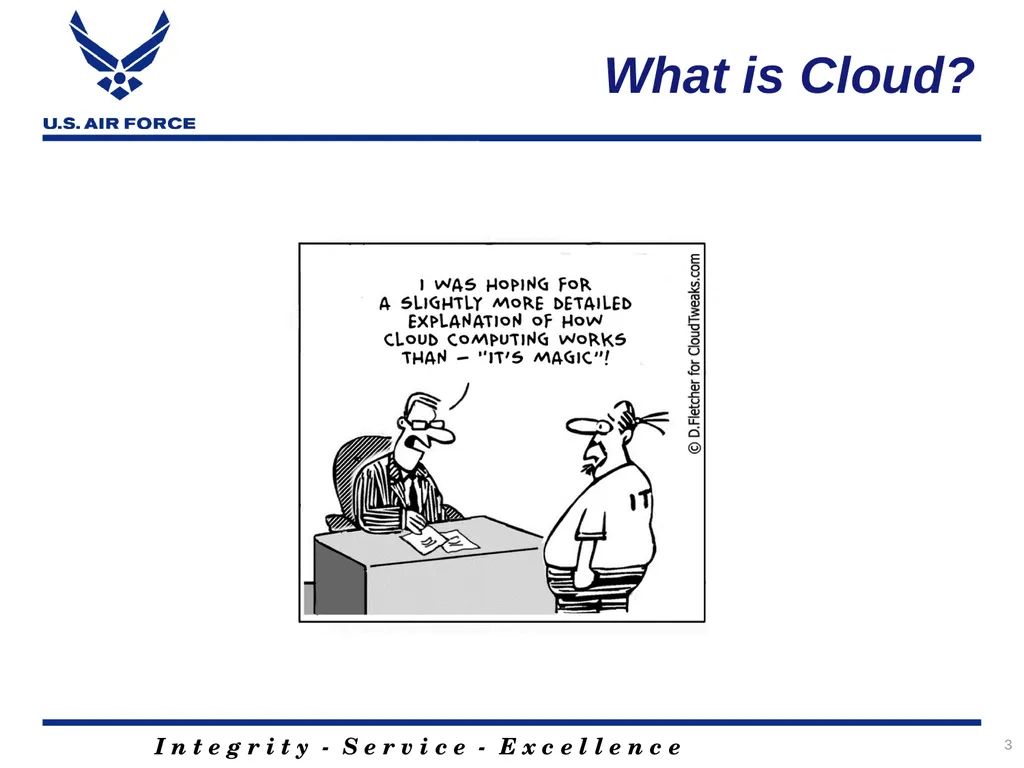
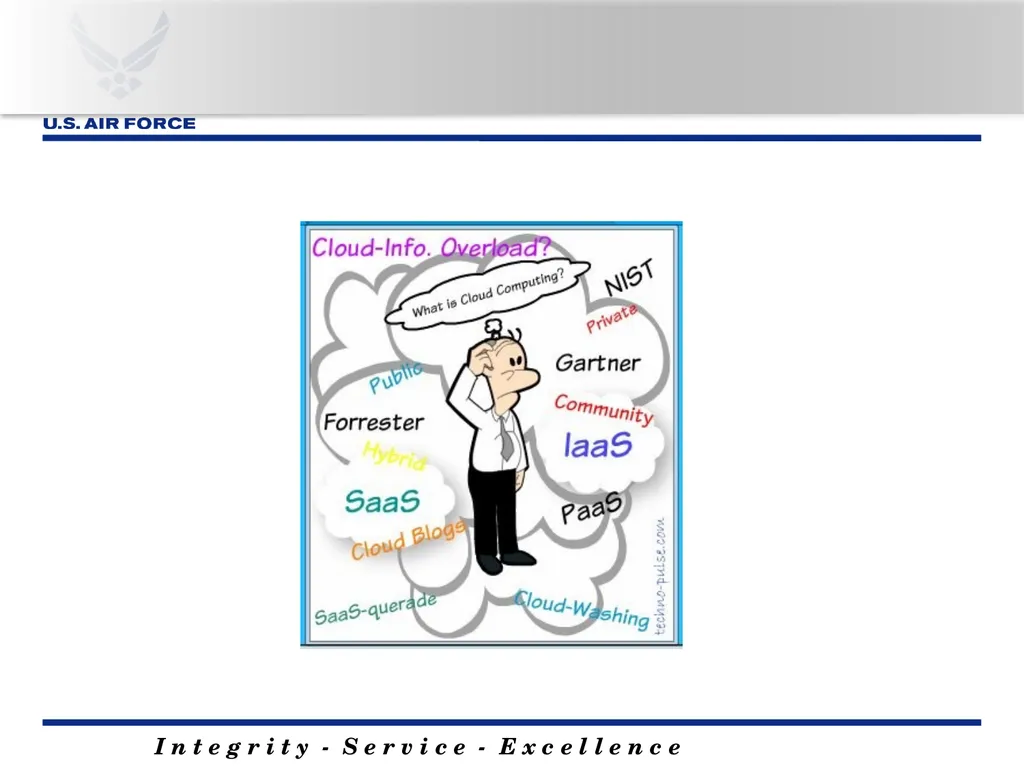
What is Cloud? 3<br>
04
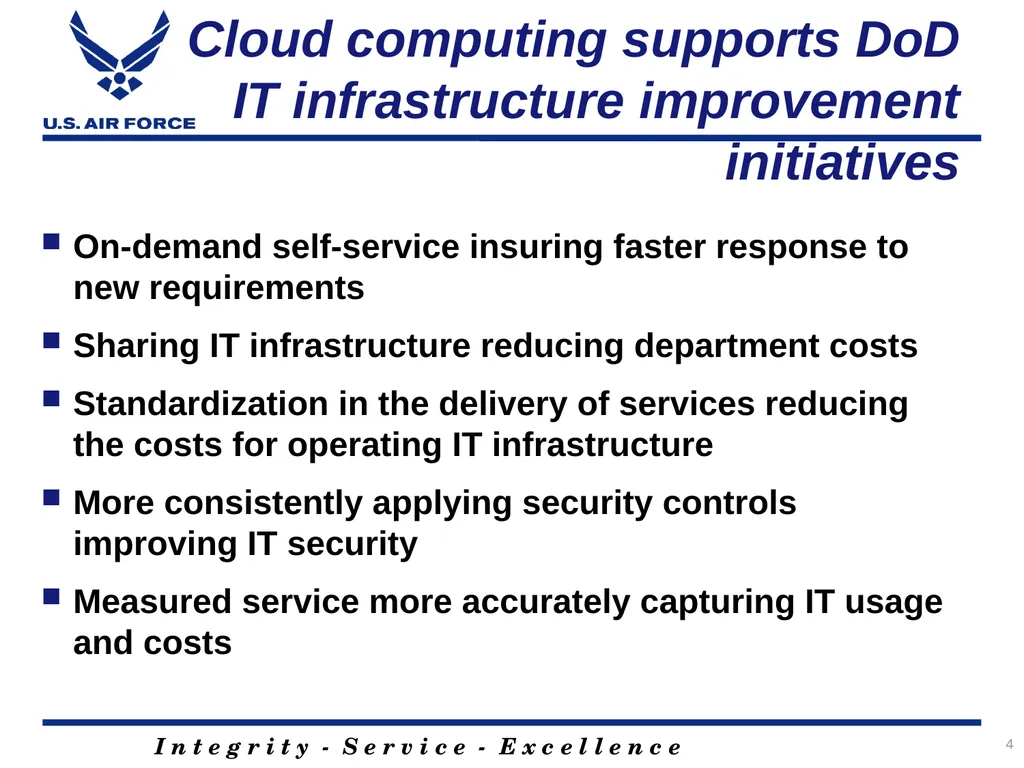
Cloud computing supports DoD IT infrastructure improvement initiatives On-demand self-service insuring faster response to new requirements
Sharing IT infrastructure reducing department costs
Standardization in the delivery of services reducing the costs for operating IT infrastructure
More consistently applying security controls improving IT security
Measured service more accurately capturing IT usage and costs 4<br>
Sharing IT infrastructure reducing department costs
Standardization in the delivery of services reducing the costs for operating IT infrastructure
More consistently applying security controls improving IT security
Measured service more accurately capturing IT usage and costs 4<br>
05
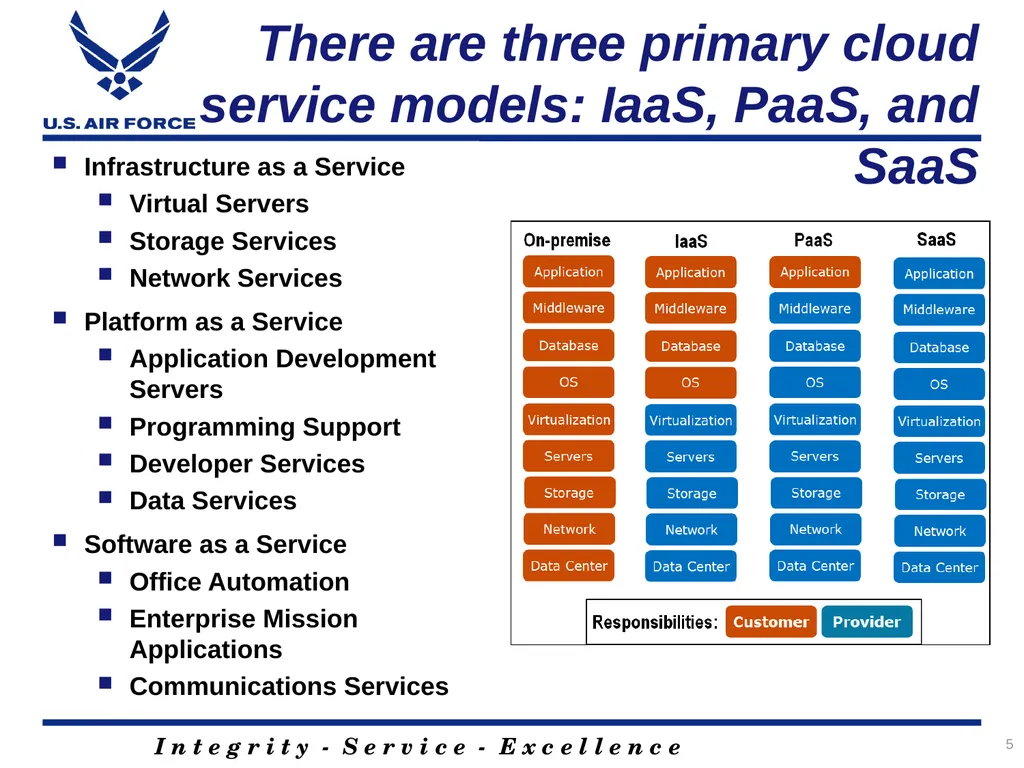
There are three primary cloud service models: IaaS, PaaS, and SaaS Infrastructure as a Service
Virtual Servers
Storage Services
Network Services
Platform as a Service
Application Development Servers
Programming Support
Developer Services
Data Services
Software as a Service
Office Automation
Enterprise Mission Applications
Communications Services 5<br>
Virtual Servers
Storage Services
Network Services
Platform as a Service
Application Development Servers
Programming Support
Developer Services
Data Services
Software as a Service
Office Automation
Enterprise Mission Applications
Communications Services 5<br>
06
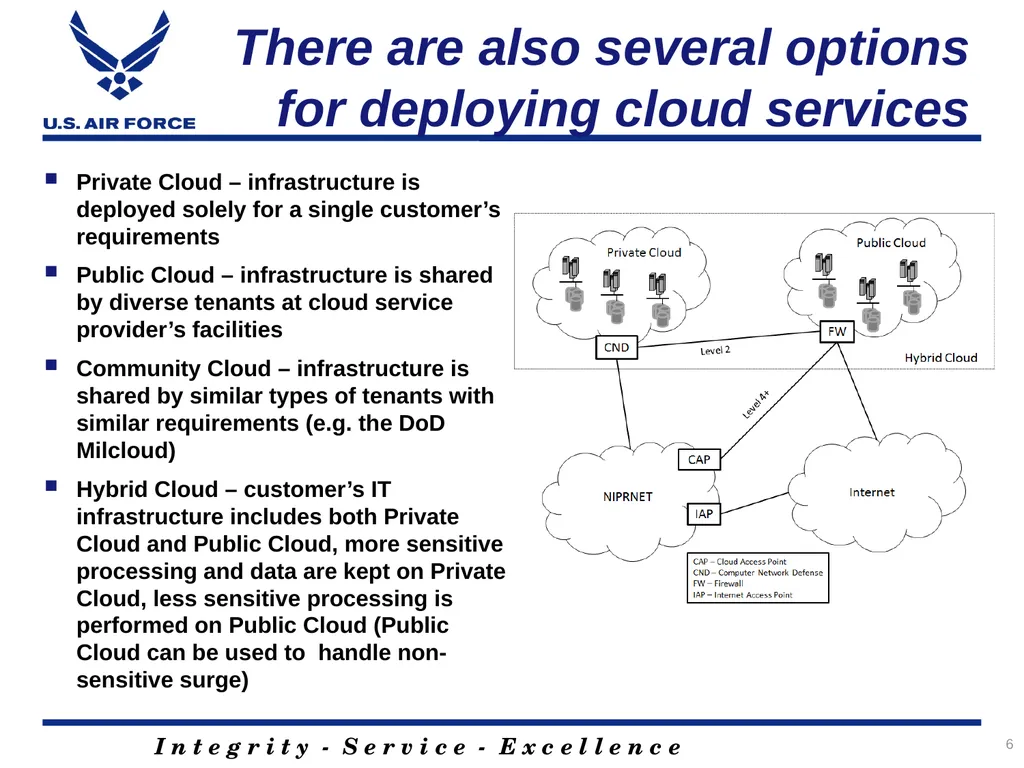
There are also several options for deploying cloud services Private Cloud – infrastructure is deployed solely for a single customer’s requirements
Public Cloud – infrastructure is shared by diverse tenants at cloud service provider’s facilities
Community Cloud – infrastructure is shared by similar types of tenants with similar requirements (e.g. the DoD Milcloud)
Hybrid Cloud – customer’s IT infrastructure includes both Private Cloud and Public Cloud, more sensitive processing and data are kept on Private Cloud, less sensitive processing is performed on Public Cloud (Public Cloud can be used to handle non-sensitive surge) 6<br>
Public Cloud – infrastructure is shared by diverse tenants at cloud service provider’s facilities
Community Cloud – infrastructure is shared by similar types of tenants with similar requirements (e.g. the DoD Milcloud)
Hybrid Cloud – customer’s IT infrastructure includes both Private Cloud and Public Cloud, more sensitive processing and data are kept on Private Cloud, less sensitive processing is performed on Public Cloud (Public Cloud can be used to handle non-sensitive surge) 6<br>
07
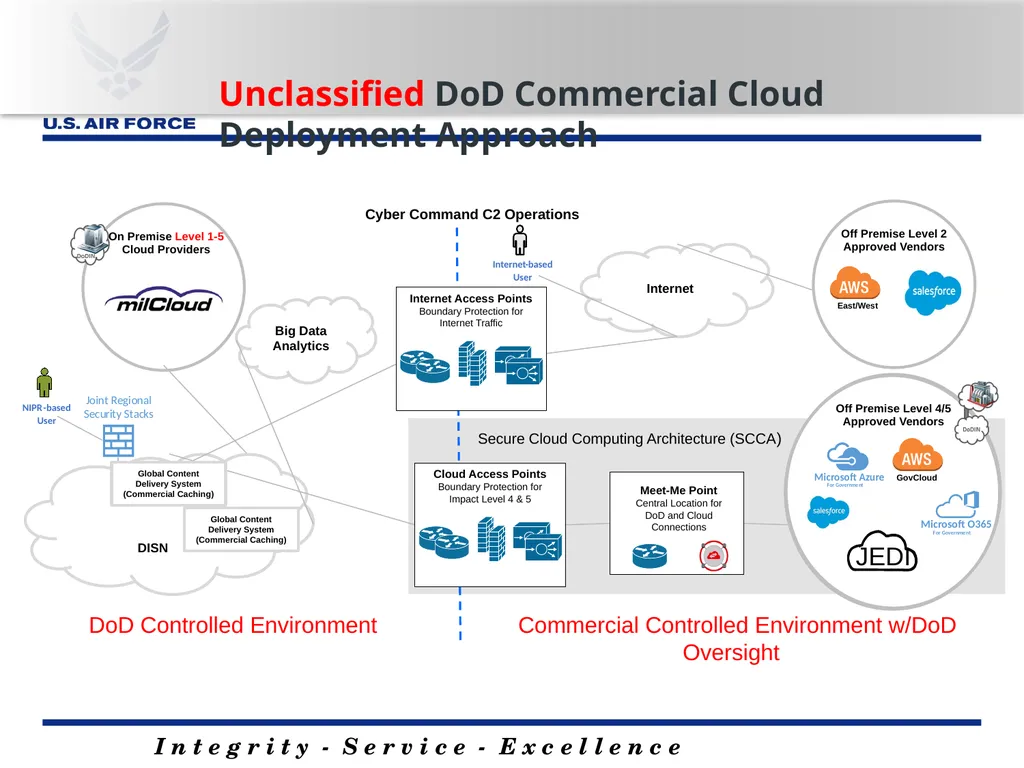
Unclassified DoD Commercial Cloud Deployment Approach Cyber Command C2 Operations Internet DISN Big Data Analytics Global Content Delivery System (Commercial Caching) Secure Cloud Computing Architecture (SCCA) Off Premise Level 4/5 Approved Vendors GovCloud Global Content Delivery System (Commercial Caching) Internet Access Points
Boundary Protection for Internet Traffic DoD Controlled Environment Commercial Controlled Environment w/DoD Oversight *Vendors named within are approved or under contract to provide specified services to DISA or DOD*<br>
Boundary Protection for Internet Traffic DoD Controlled Environment Commercial Controlled Environment w/DoD Oversight *Vendors named within are approved or under contract to provide specified services to DISA or DOD*<br>
08
DoD Use Two types:
Government system
DoD Security and Contract Language
Contractor/Grantee System
Requirement is FedRamp Moderate<br>
Government system
DoD Security and Contract Language
Contractor/Grantee System
Requirement is FedRamp Moderate<br>
09
Government Information System Information system used or operated by an agency or by a contractor of an agency or by another organization on behalf of an agency.
OMB Circular A-130<br>
OMB Circular A-130<br>
10
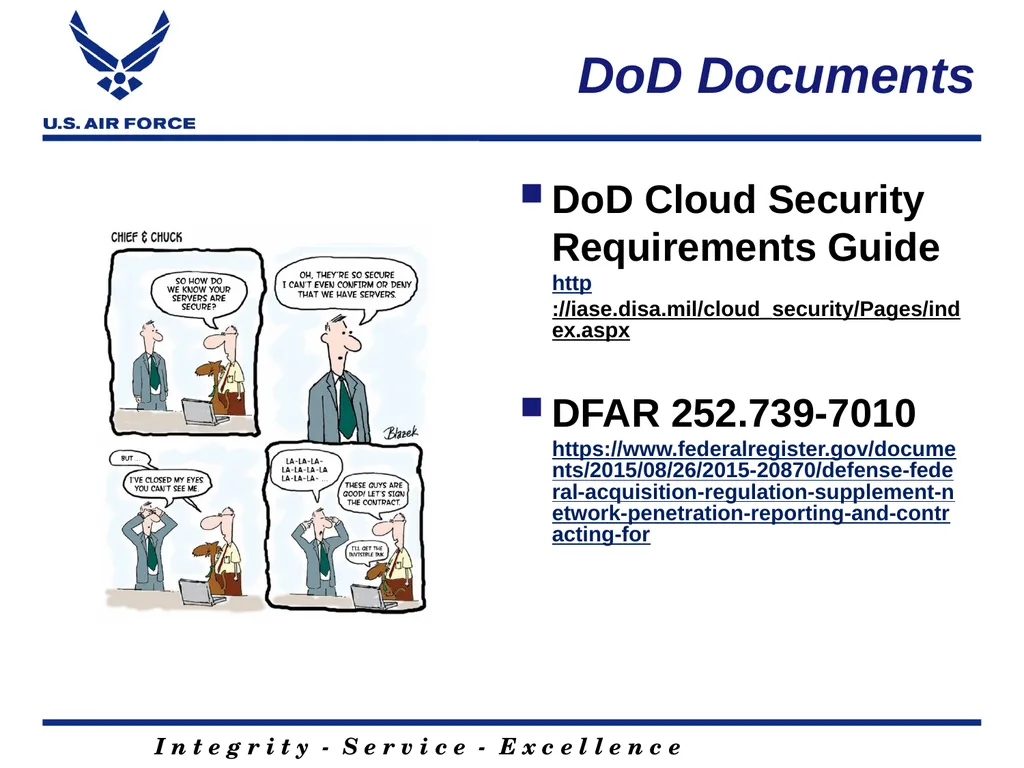
DoD Documents DoD Cloud Security Requirements Guide http://iase.disa.mil/cloud_security/Pages/index.aspx
DFAR 252.739-7010 https://www.federalregister.gov/documents/2015/08/26/2015-20870/defense-federal-acquisition-regulation-supplement-network-penetration-reporting-and-contracting-for<br>
DFAR 252.739-7010 https://www.federalregister.gov/documents/2015/08/26/2015-20870/defense-federal-acquisition-regulation-supplement-network-penetration-reporting-and-contracting-for<br>
11
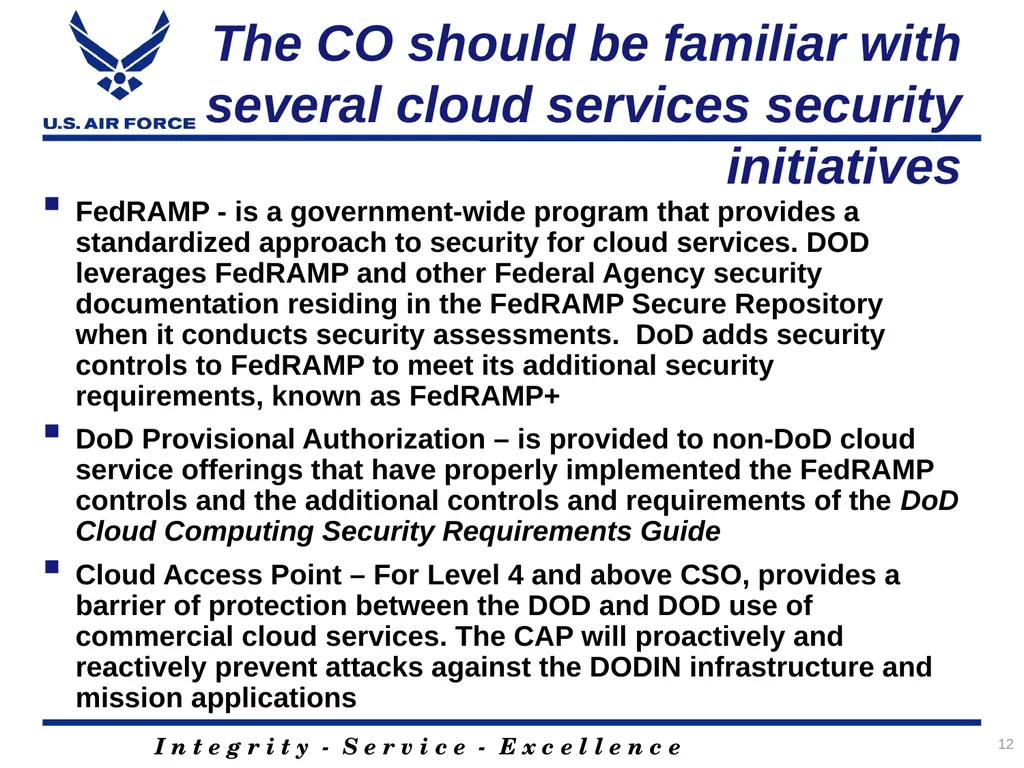
The CO should be familiar with several cloud services security initiatives FedRAMP - is a government-wide program that provides a standardized approach to security for cloud services. DOD leverages FedRAMP and other Federal Agency security documentation residing in the FedRAMP Secure Repository when it conducts security assessments. DoD adds security controls to FedRAMP to meet its additional security requirements, known as FedRAMP+
DoD Provisional Authorization – is provided to non-DoD cloud service offerings that have properly implemented the FedRAMP controls and the additional controls and requirements of the DoD Cloud Computing Security Requirements Guide
Cloud Access Point – For Level 4 and above CSO, provides a barrier of protection between the DOD and DOD use of commercial cloud services. The CAP will proactively and reactively prevent attacks against the DODIN infrastructure and mission applications 12<br>
DoD Provisional Authorization – is provided to non-DoD cloud service offerings that have properly implemented the FedRAMP controls and the additional controls and requirements of the DoD Cloud Computing Security Requirements Guide
Cloud Access Point – For Level 4 and above CSO, provides a barrier of protection between the DOD and DOD use of commercial cloud services. The CAP will proactively and reactively prevent attacks against the DODIN infrastructure and mission applications 12<br>
12
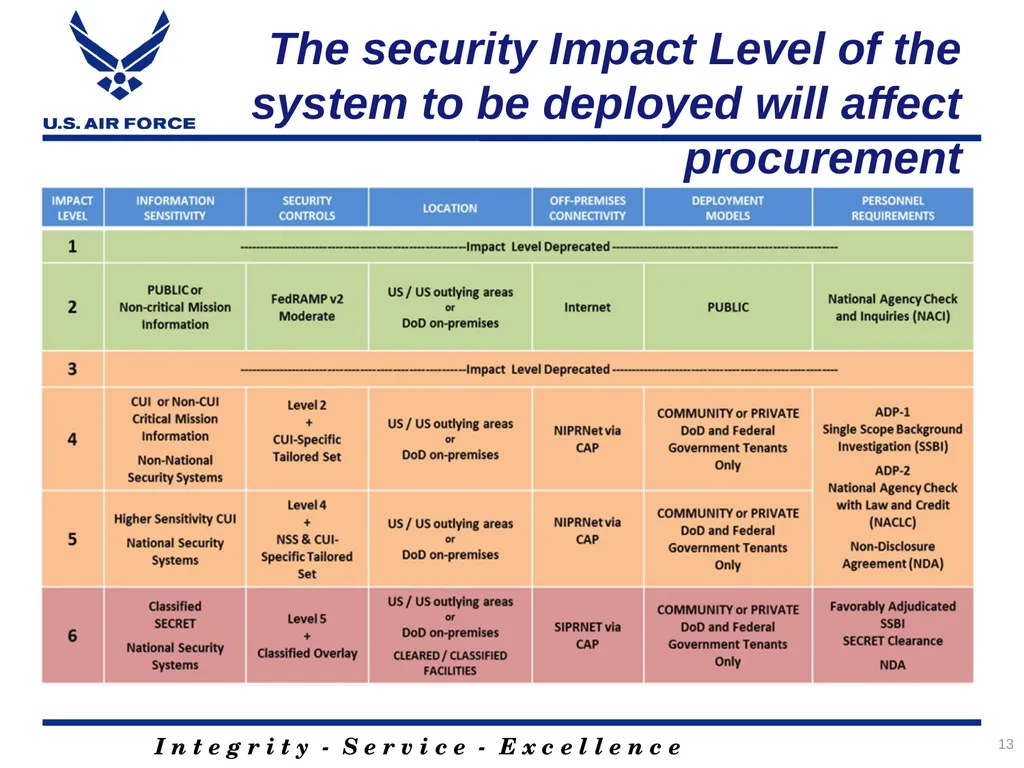
The security Impact Level of the system to be deployed will affect procurement 13<br>
13
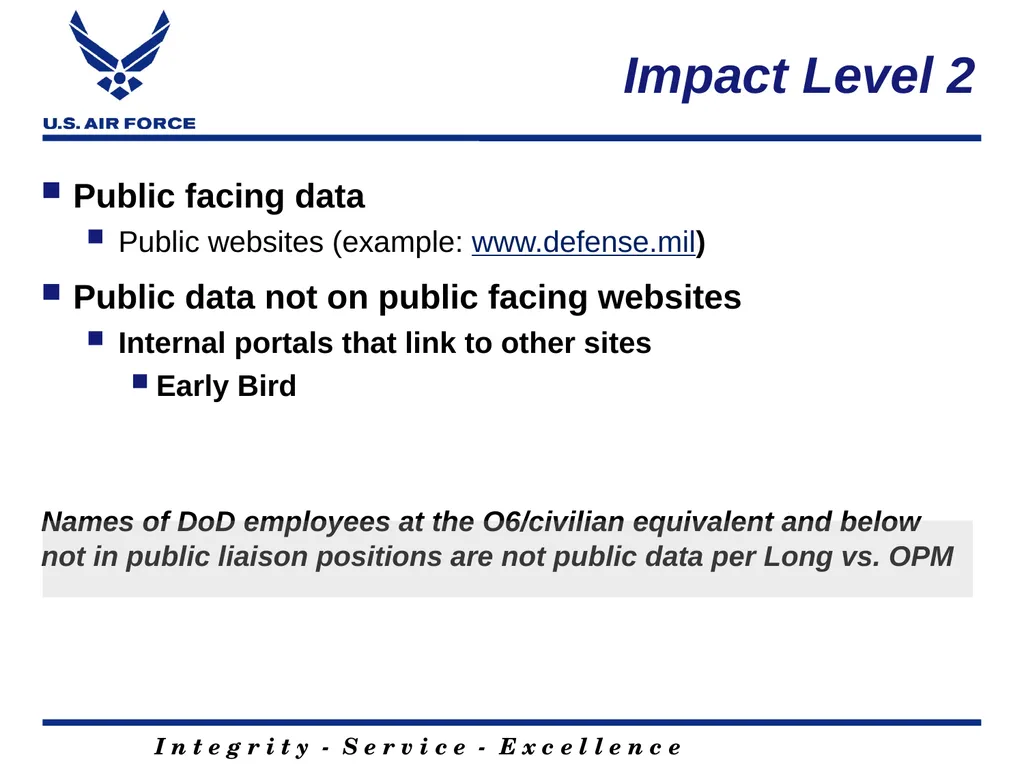
Impact Level 2 Public facing data
Public websites (example: www.defense.mil)
Public data not on public facing websites
Internal portals that link to other sites
Early Bird
Names of DoD employees at the O6/civilian equivalent and below not in public liaison positions are not public data per Long vs. OPM<br>
Public websites (example: www.defense.mil)
Public data not on public facing websites
Internal portals that link to other sites
Early Bird
Names of DoD employees at the O6/civilian equivalent and below not in public liaison positions are not public data per Long vs. OPM<br>
14
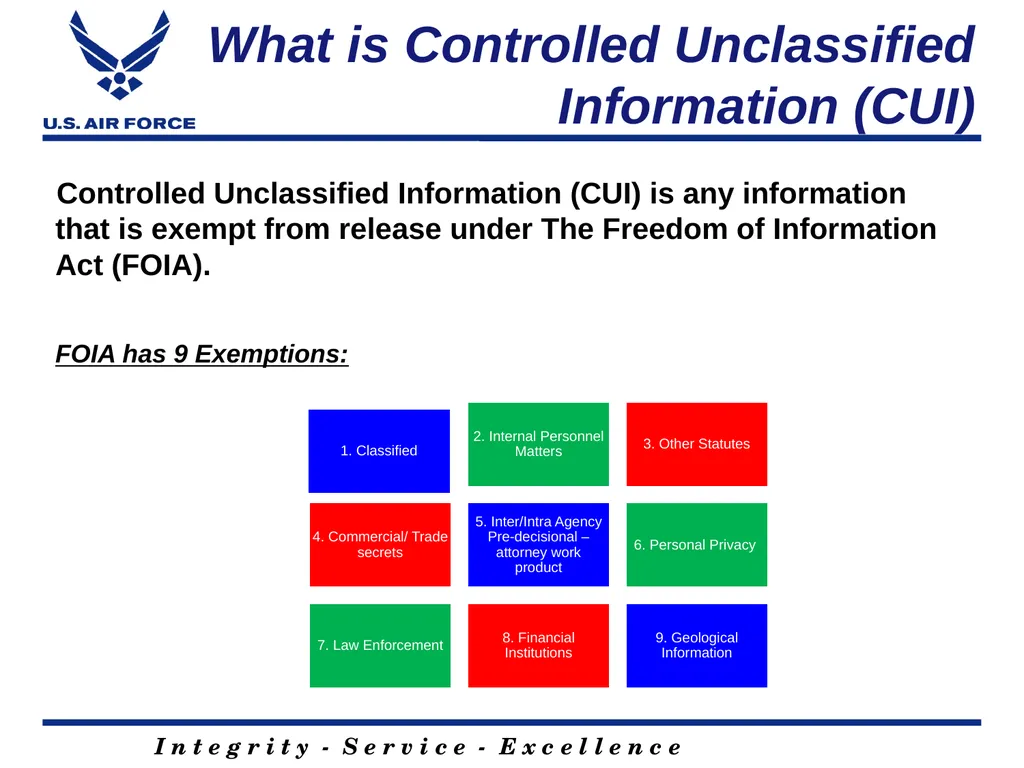
What is Controlled Unclassified Information (CUI) Controlled Unclassified Information (CUI) is any information that is exempt from release under The Freedom of Information Act (FOIA).
FOIA has 9 Exemptions:<br>
FOIA has 9 Exemptions:<br>
15
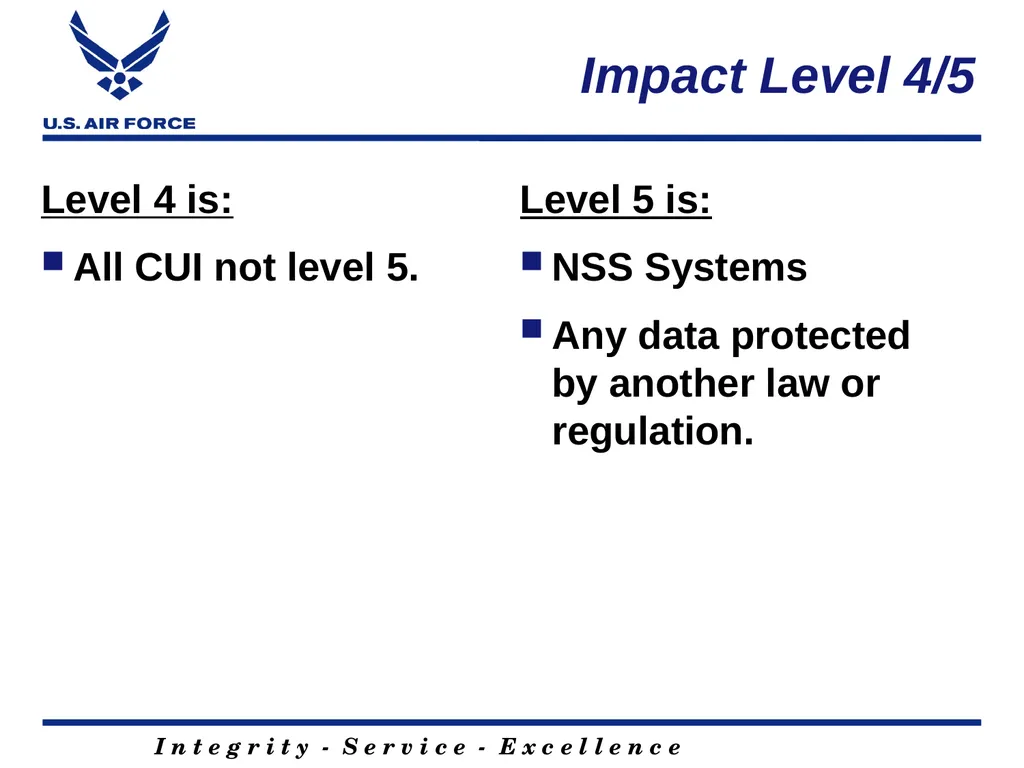
Impact Level 4/5 Level 4 is:
All CUI not level 5. Level 5 is:
NSS Systems
Any data protected by another law or regulation. 13 AUG 2013 -- 1630 16<br>
All CUI not level 5. Level 5 is:
NSS Systems
Any data protected by another law or regulation. 13 AUG 2013 -- 1630 16<br>
16
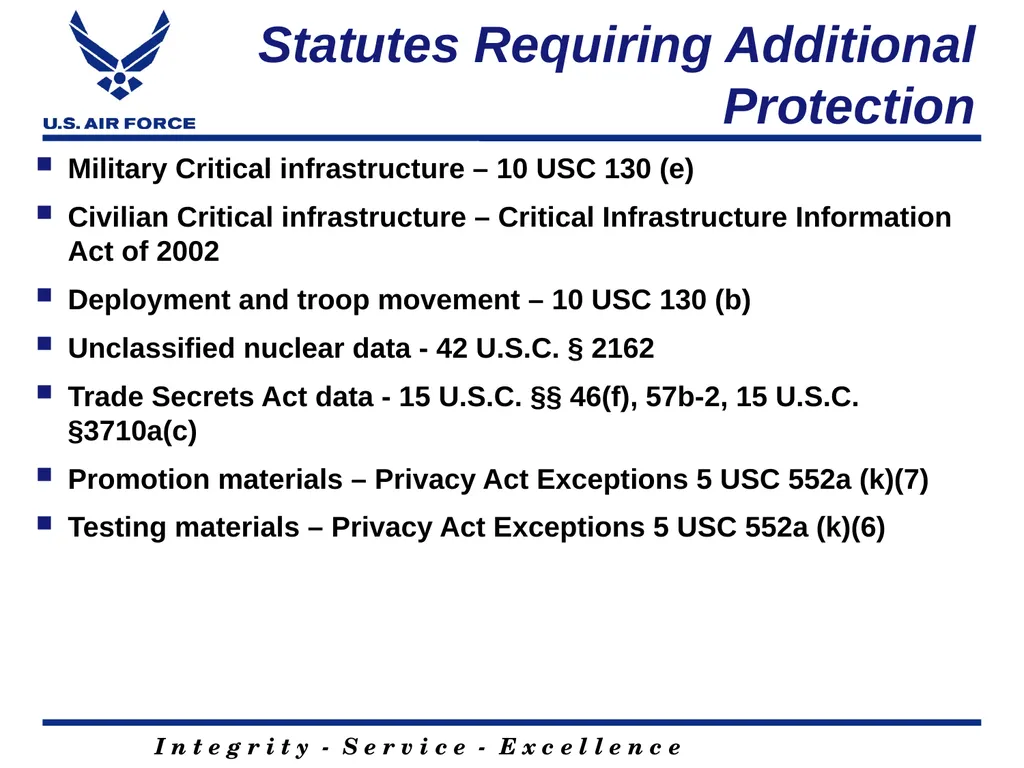
Statutes Requiring Additional Protection Military Critical infrastructure – 10 USC 130 (e)
Civilian Critical infrastructure – Critical Infrastructure Information Act of 2002
Deployment and troop movement – 10 USC 130 (b)
Unclassified nuclear data - 42 U.S.C. § 2162
Trade Secrets Act data - 15 U.S.C. §§ 46(f), 57b-2, 15 U.S.C. §3710a(c)
Promotion materials – Privacy Act Exceptions 5 USC 552a (k)(7)
Testing materials – Privacy Act Exceptions 5 USC 552a (k)(6)<br>
Civilian Critical infrastructure – Critical Infrastructure Information Act of 2002
Deployment and troop movement – 10 USC 130 (b)
Unclassified nuclear data - 42 U.S.C. § 2162
Trade Secrets Act data - 15 U.S.C. §§ 46(f), 57b-2, 15 U.S.C. §3710a(c)
Promotion materials – Privacy Act Exceptions 5 USC 552a (k)(7)
Testing materials – Privacy Act Exceptions 5 USC 552a (k)(6)<br>
17
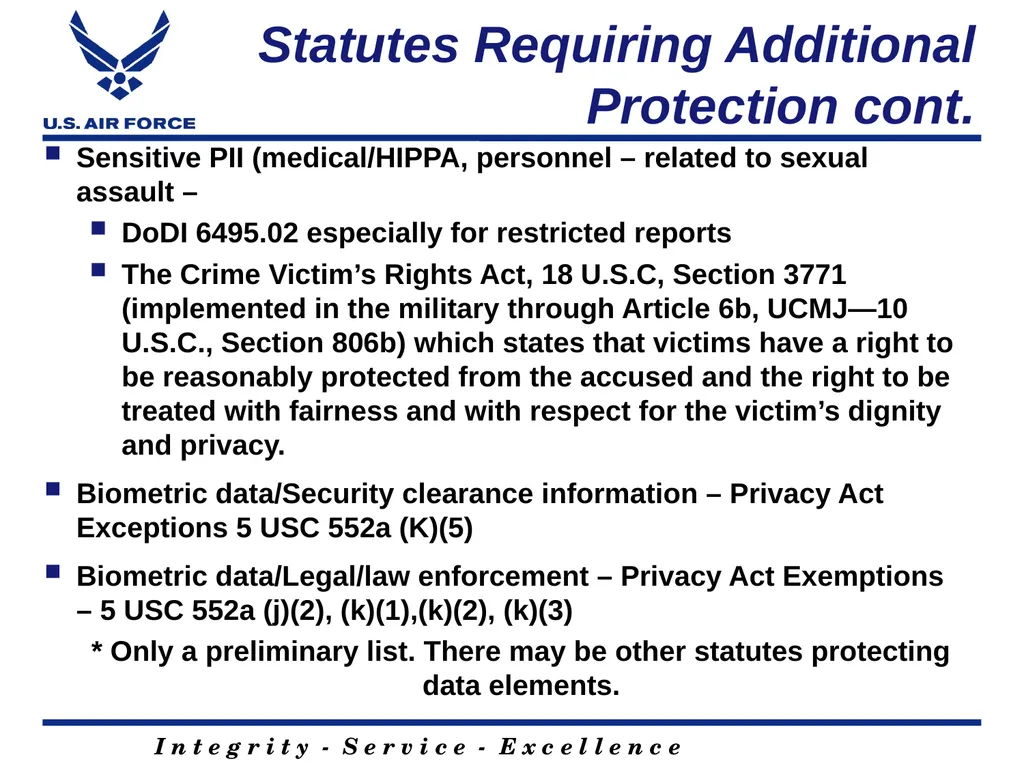
Statutes Requiring Additional Protection cont. Sensitive PII (medical/HIPPA, personnel – related to sexual assault –
DoDI 6495.02 especially for restricted reports
The Crime Victim’s Rights Act, 18 U.S.C, Section 3771 (implemented in the military through Article 6b, UCMJ—10 U.S.C., Section 806b) which states that victims have a right to be reasonably protected from the accused and the right to be treated with fairness and with respect for the victim’s dignity and privacy.
Biometric data/Security clearance information – Privacy Act Exceptions 5 USC 552a (K)(5)
Biometric data/Legal/law enforcement – Privacy Act Exemptions – 5 USC 552a (j)(2), (k)(1),(k)(2), (k)(3)
* Only a preliminary list. There may be other statutes protecting data elements.<br>
DoDI 6495.02 especially for restricted reports
The Crime Victim’s Rights Act, 18 U.S.C, Section 3771 (implemented in the military through Article 6b, UCMJ—10 U.S.C., Section 806b) which states that victims have a right to be reasonably protected from the accused and the right to be treated with fairness and with respect for the victim’s dignity and privacy.
Biometric data/Security clearance information – Privacy Act Exceptions 5 USC 552a (K)(5)
Biometric data/Legal/law enforcement – Privacy Act Exemptions – 5 USC 552a (j)(2), (k)(1),(k)(2), (k)(3)
* Only a preliminary list. There may be other statutes protecting data elements.<br>
18
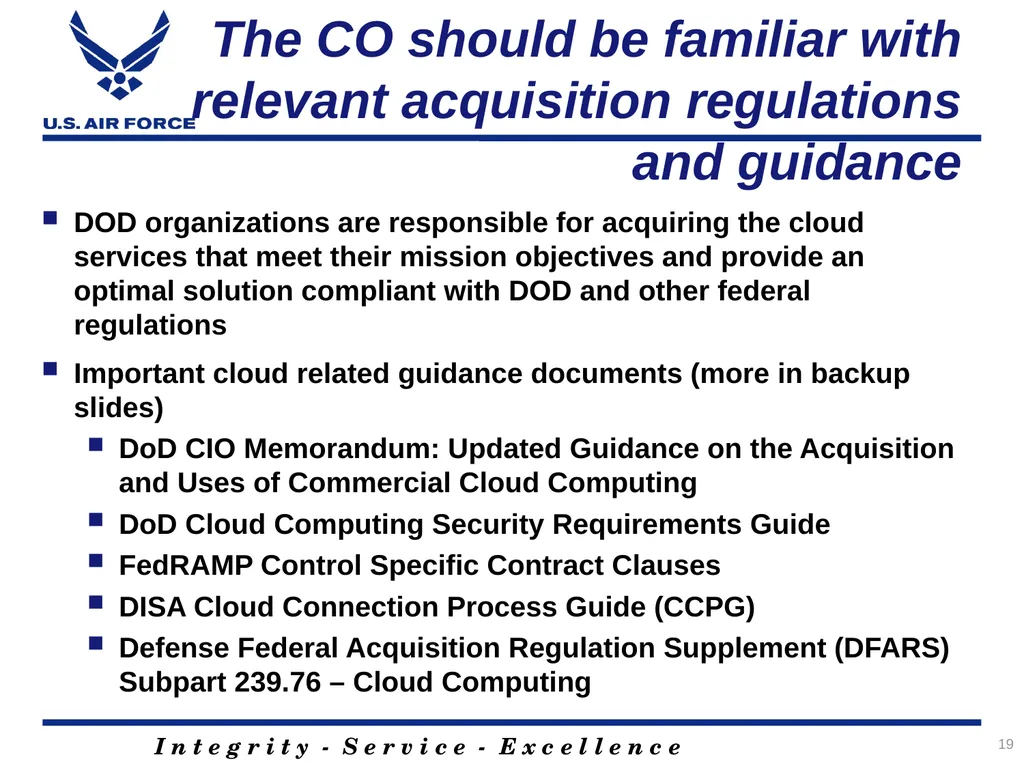
The CO should be familiar with relevant acquisition regulations and guidance DOD organizations are responsible for acquiring the cloud services that meet their mission objectives and provide an optimal solution compliant with DOD and other federal regulations
Important cloud related guidance documents (more in backup slides)
DoD CIO Memorandum: Updated Guidance on the Acquisition and Uses of Commercial Cloud Computing
DoD Cloud Computing Security Requirements Guide
FedRAMP Control Specific Contract Clauses
DISA Cloud Connection Process Guide (CCPG)
Defense Federal Acquisition Regulation Supplement (DFARS) Subpart 239.76 – Cloud Computing 19<br>
Important cloud related guidance documents (more in backup slides)
DoD CIO Memorandum: Updated Guidance on the Acquisition and Uses of Commercial Cloud Computing
DoD Cloud Computing Security Requirements Guide
FedRAMP Control Specific Contract Clauses
DISA Cloud Connection Process Guide (CCPG)
Defense Federal Acquisition Regulation Supplement (DFARS) Subpart 239.76 – Cloud Computing 19<br>
19
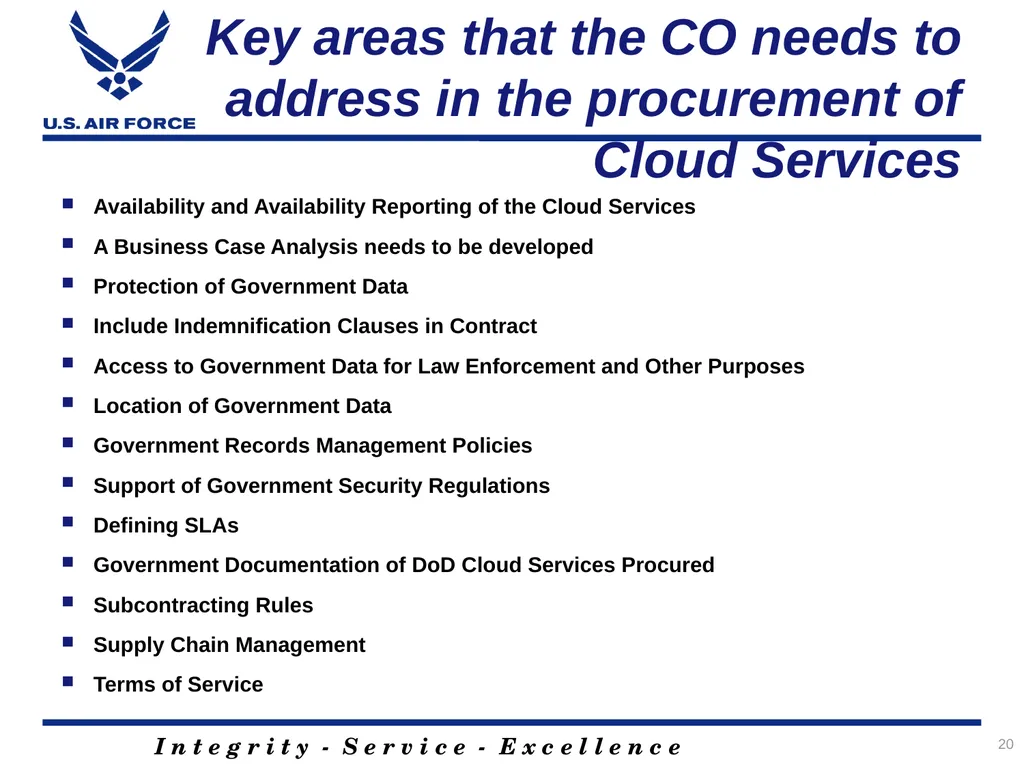
Key areas that the CO needs to address in the procurement of Cloud Services Availability and Availability Reporting of the Cloud Services
A Business Case Analysis needs to be developed
Protection of Government Data
Include Indemnification Clauses in Contract
Access to Government Data for Law Enforcement and Other Purposes
Location of Government Data
Government Records Management Policies
Support of Government Security Regulations
Defining SLAs
Government Documentation of DoD Cloud Services Procured
Subcontracting Rules
Supply Chain Management
Terms of Service 20<br>
A Business Case Analysis needs to be developed
Protection of Government Data
Include Indemnification Clauses in Contract
Access to Government Data for Law Enforcement and Other Purposes
Location of Government Data
Government Records Management Policies
Support of Government Security Regulations
Defining SLAs
Government Documentation of DoD Cloud Services Procured
Subcontracting Rules
Supply Chain Management
Terms of Service 20<br>
20
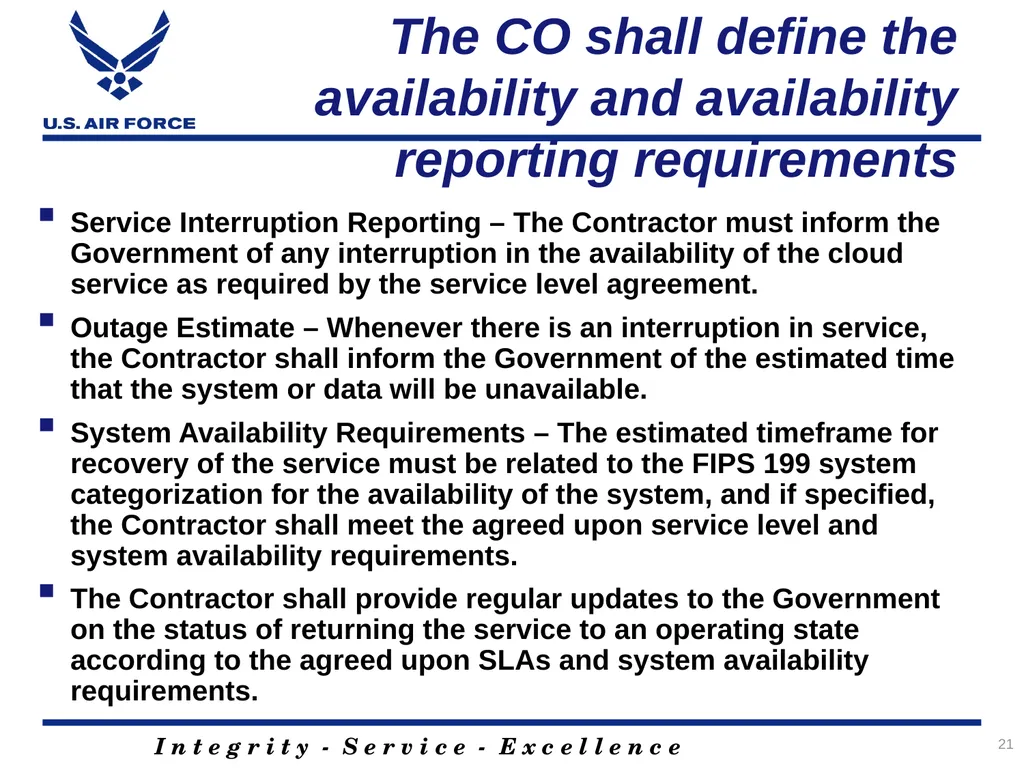
The CO shall define the availability and availability reporting requirements Service Interruption Reporting – The Contractor must inform the Government of any interruption in the availability of the cloud service as required by the service level agreement.
Outage Estimate – Whenever there is an interruption in service, the Contractor shall inform the Government of the estimated time that the system or data will be unavailable.
System Availability Requirements – The estimated timeframe for recovery of the service must be related to the FIPS 199 system categorization for the availability of the system, and if specified, the Contractor shall meet the agreed upon service level and system availability requirements.
The Contractor shall provide regular updates to the Government on the status of returning the service to an operating state according to the agreed upon SLAs and system availability requirements. 21<br>
Outage Estimate – Whenever there is an interruption in service, the Contractor shall inform the Government of the estimated time that the system or data will be unavailable.
System Availability Requirements – The estimated timeframe for recovery of the service must be related to the FIPS 199 system categorization for the availability of the system, and if specified, the Contractor shall meet the agreed upon service level and system availability requirements.
The Contractor shall provide regular updates to the Government on the status of returning the service to an operating state according to the agreed upon SLAs and system availability requirements. 21<br>
21
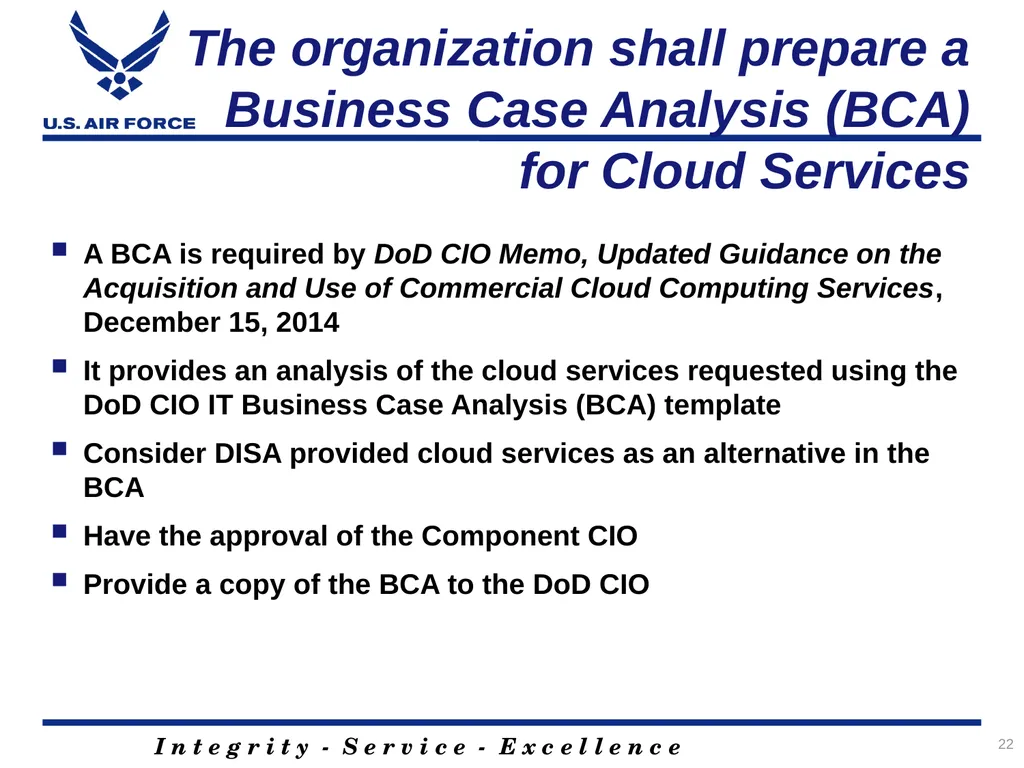
The organization shall prepare a Business Case Analysis (BCA) for Cloud Services A BCA is required by DoD CIO Memo, Updated Guidance on the Acquisition and Use of Commercial Cloud Computing Services, December 15, 2014
It provides an analysis of the cloud services requested using the DoD CIO IT Business Case Analysis (BCA) template
Consider DISA provided cloud services as an alternative in the BCA
Have the approval of the Component CIO
Provide a copy of the BCA to the DoD CIO 22<br>
It provides an analysis of the cloud services requested using the DoD CIO IT Business Case Analysis (BCA) template
Consider DISA provided cloud services as an alternative in the BCA
Have the approval of the Component CIO
Provide a copy of the BCA to the DoD CIO 22<br>
22
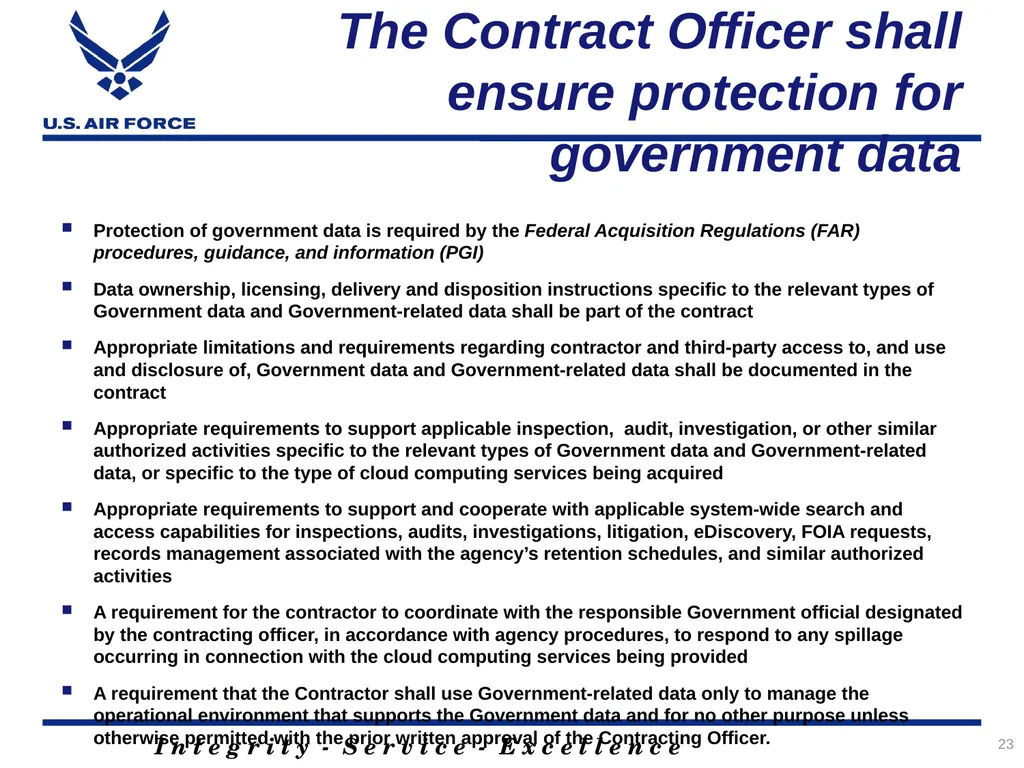
The Contract Officer shall ensure protection for government data Protection of government data is required by the Federal Acquisition Regulations (FAR) procedures, guidance, and information (PGI)
Data ownership, licensing, delivery and disposition instructions specific to the relevant types of Government data and Government-related data shall be part of the contract
Appropriate limitations and requirements regarding contractor and third-party access to, and use and disclosure of, Government data and Government-related data shall be documented in the contract
Appropriate requirements to support applicable inspection, audit, investigation, or other similar authorized activities specific to the relevant types of Government data and Government-related data, or specific to the type of cloud computing services being acquired
Appropriate requirements to support and cooperate with applicable system-wide search and access capabilities for inspections, audits, investigations, litigation, eDiscovery, FOIA requests, records management associated with the agency’s retention schedules, and similar authorized activities
A requirement for the contractor to coordinate with the responsible Government official designated by the contracting officer, in accordance with agency procedures, to respond to any spillage occurring in connection with the cloud computing services being provided
A requirement that the Contractor shall use Government-related data only to manage the operational environment that supports the Government data and for no other purpose unless otherwise permitted with the prior written approval of the Contracting Officer. 23<br>
Data ownership, licensing, delivery and disposition instructions specific to the relevant types of Government data and Government-related data shall be part of the contract
Appropriate limitations and requirements regarding contractor and third-party access to, and use and disclosure of, Government data and Government-related data shall be documented in the contract
Appropriate requirements to support applicable inspection, audit, investigation, or other similar authorized activities specific to the relevant types of Government data and Government-related data, or specific to the type of cloud computing services being acquired
Appropriate requirements to support and cooperate with applicable system-wide search and access capabilities for inspections, audits, investigations, litigation, eDiscovery, FOIA requests, records management associated with the agency’s retention schedules, and similar authorized activities
A requirement for the contractor to coordinate with the responsible Government official designated by the contracting officer, in accordance with agency procedures, to respond to any spillage occurring in connection with the cloud computing services being provided
A requirement that the Contractor shall use Government-related data only to manage the operational environment that supports the Government data and for no other purpose unless otherwise permitted with the prior written approval of the Contracting Officer. 23<br>
23
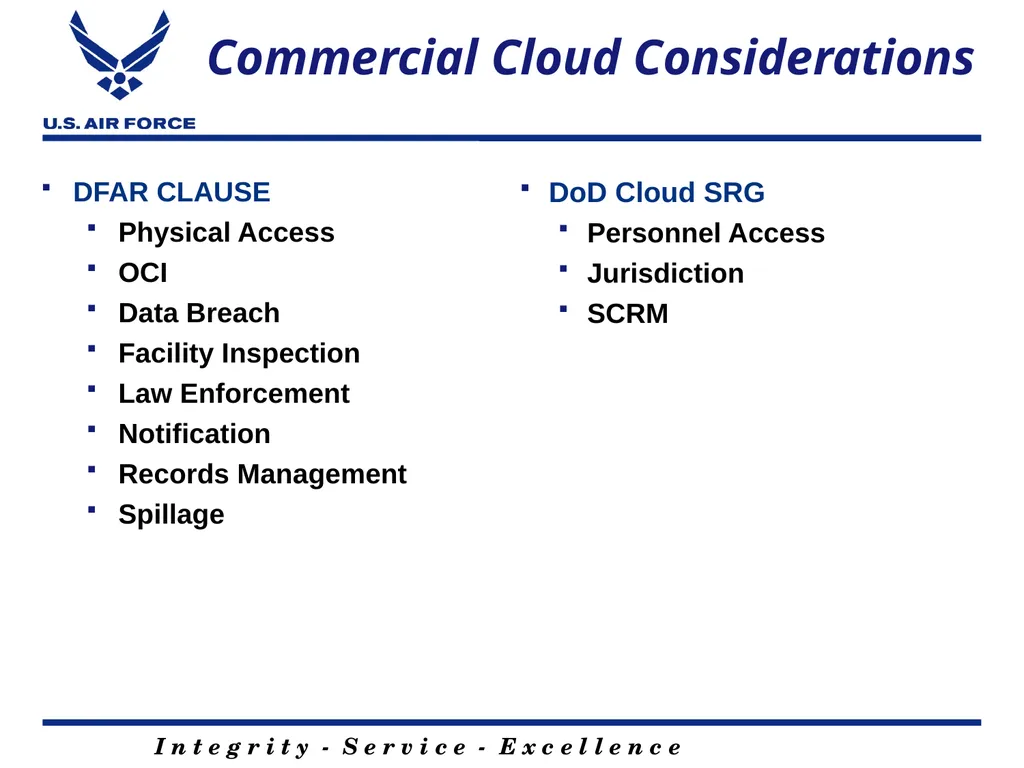
Commercial Cloud Considerations DFAR CLAUSE
Physical Access
OCI
Data Breach
Facility Inspection
Law Enforcement
Notification
Records Management
Spillage DoD Cloud SRG
Personnel Access
Jurisdiction
SCRM<br>
Physical Access
OCI
Data Breach
Facility Inspection
Law Enforcement
Notification
Records Management
Spillage DoD Cloud SRG
Personnel Access
Jurisdiction
SCRM<br>
24
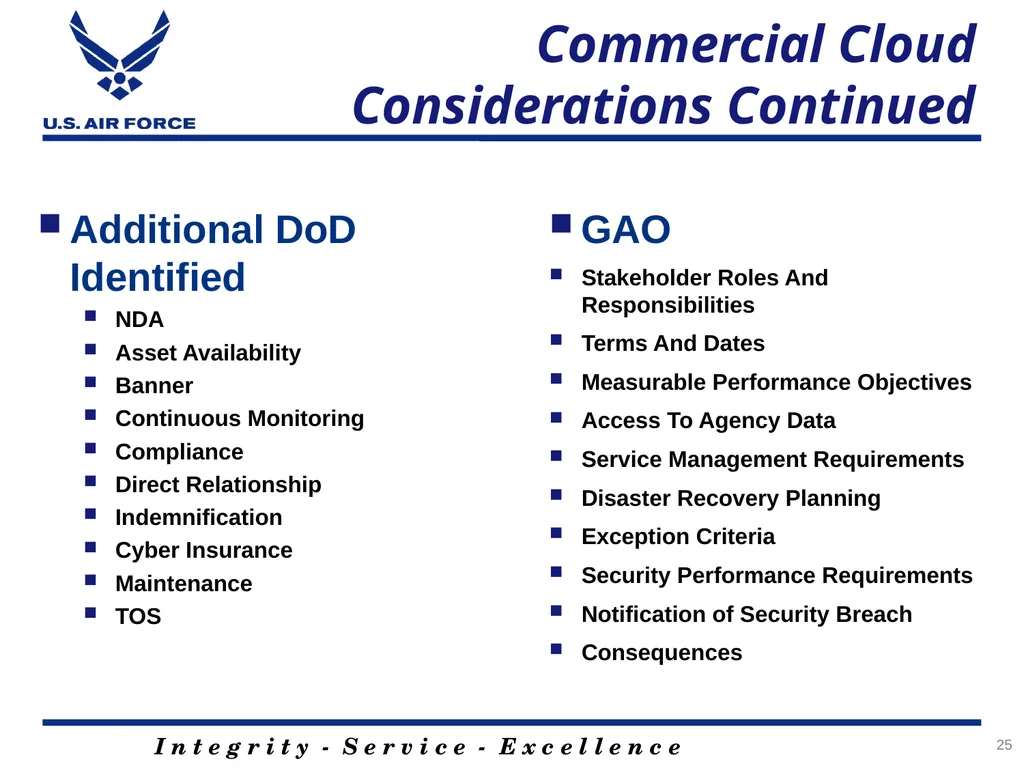
Commercial Cloud Considerations Continued GAO
Stakeholder Roles And Responsibilities
Terms And Dates
Measurable Performance Objectives
Access To Agency Data
Service Management Requirements
Disaster Recovery Planning
Exception Criteria
Security Performance Requirements
Notification of Security Breach
Consequences Additional DoD Identified
NDA
Asset Availability
Banner
Continuous Monitoring
Compliance
Direct Relationship
Indemnification
Cyber Insurance
Maintenance
TOS 25<br>
Stakeholder Roles And Responsibilities
Terms And Dates
Measurable Performance Objectives
Access To Agency Data
Service Management Requirements
Disaster Recovery Planning
Exception Criteria
Security Performance Requirements
Notification of Security Breach
Consequences Additional DoD Identified
NDA
Asset Availability
Banner
Continuous Monitoring
Compliance
Direct Relationship
Indemnification
Cyber Insurance
Maintenance
TOS 25<br>
25
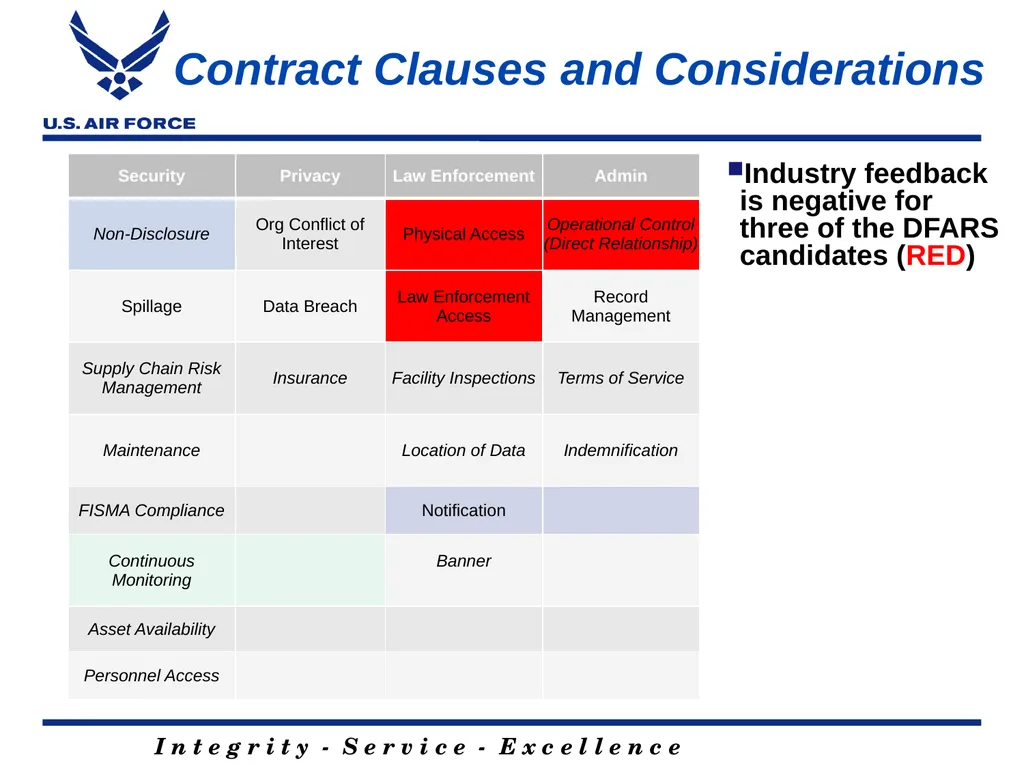
Industry feedback is negative for three of the DFARS candidates (RED) Contract Clauses and Considerations 26<br>
26
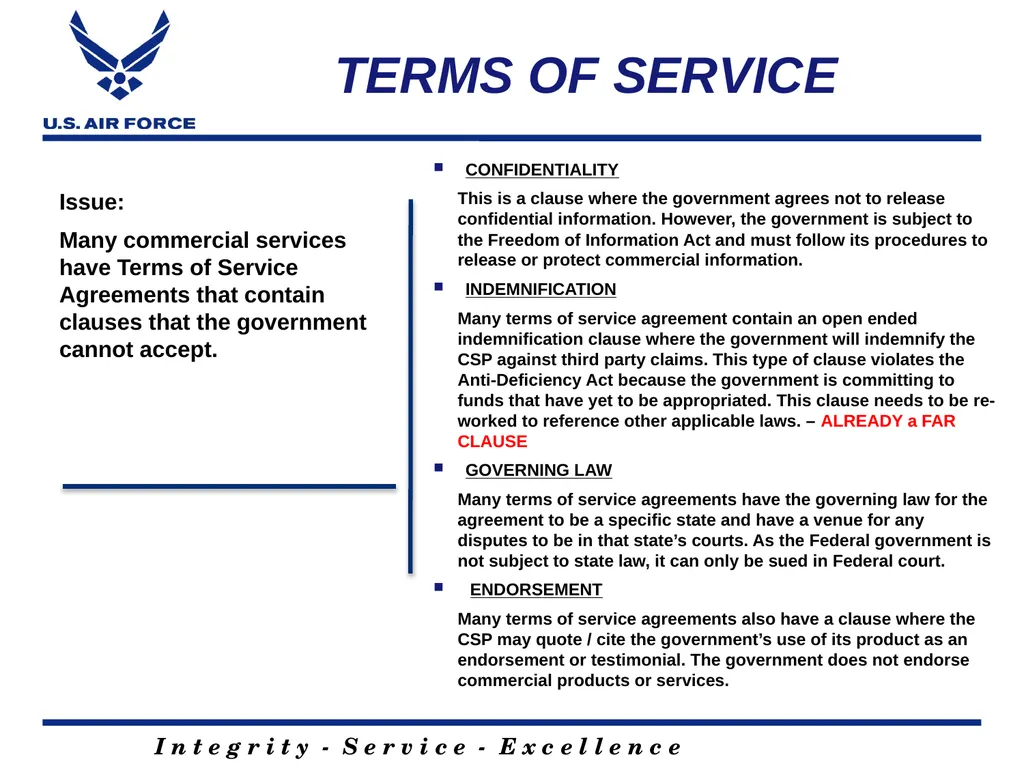
TERMS OF SERVICE Issue:
Many commercial services have Terms of Service Agreements that contain clauses that the government cannot accept. CONFIDENTIALITY
This is a clause where the government agrees not to release confidential information. However, the government is subject to the Freedom of Information Act and must follow its procedures to release or protect commercial information.
INDEMNIFICATION
Many terms of service agreement contain an open ended indemnification clause where the government will indemnify the CSP against third party claims. This type of clause violates the Anti-Deficiency Act because the government is committing to funds that have yet to be appropriated. This clause needs to be re-worked to reference other applicable laws. – ALREADY a FAR CLAUSE
GOVERNING LAW
Many terms of service agreements have the governing law for the agreement to be a specific state and have a venue for any disputes to be in that state’s courts. As the Federal government is not subject to state law, it can only be sued in Federal court.
ENDORSEMENT
Many terms of service agreements also have a clause where the CSP may quote / cite the government’s use of its product as an endorsement or testimonial. The government does not endorse commercial products or services.<br>
Many commercial services have Terms of Service Agreements that contain clauses that the government cannot accept. CONFIDENTIALITY
This is a clause where the government agrees not to release confidential information. However, the government is subject to the Freedom of Information Act and must follow its procedures to release or protect commercial information.
INDEMNIFICATION
Many terms of service agreement contain an open ended indemnification clause where the government will indemnify the CSP against third party claims. This type of clause violates the Anti-Deficiency Act because the government is committing to funds that have yet to be appropriated. This clause needs to be re-worked to reference other applicable laws. – ALREADY a FAR CLAUSE
GOVERNING LAW
Many terms of service agreements have the governing law for the agreement to be a specific state and have a venue for any disputes to be in that state’s courts. As the Federal government is not subject to state law, it can only be sued in Federal court.
ENDORSEMENT
Many terms of service agreements also have a clause where the CSP may quote / cite the government’s use of its product as an endorsement or testimonial. The government does not endorse commercial products or services.<br>
27
BANNER Issue:
Banners or consent to monitor language allows Federal law enforcement the right to access and review government data including email created on a government system without a warrant or a subpoena. When a Government is only procuring hosting the banner will be a requirement of the government or contractor who developed the system, however, when the government procures software as a service, the Agency must require the CSP to display the Agency’s approved banner language prior to allowing a user access to the system. All users of DoD systems have constructively consented through the banner language to monitoring of their use of a DoD system and use of that data for law enforcement purposes. As such, Federal law enforcement, investigative, and auditing officials do not need a warrant or a subpoena to access Government data on a Government system.<br>
Banners or consent to monitor language allows Federal law enforcement the right to access and review government data including email created on a government system without a warrant or a subpoena. When a Government is only procuring hosting the banner will be a requirement of the government or contractor who developed the system, however, when the government procures software as a service, the Agency must require the CSP to display the Agency’s approved banner language prior to allowing a user access to the system. All users of DoD systems have constructively consented through the banner language to monitoring of their use of a DoD system and use of that data for law enforcement purposes. As such, Federal law enforcement, investigative, and auditing officials do not need a warrant or a subpoena to access Government data on a Government system.<br>
28
OPERATIONAL CONTOL
Direct Relationship Issue:
When subcontracting, the Agency should ensure the prime retains operational configuration and control of DoD data. This is particularly important in the event of a data breach. Definitions of Operational Configuration and Control:
“Configuration control” means having the authority to approve or disapprove any and all changes to the hardware and software used in the data repository systems.
“Operational control” means having the authority over the components of the data repository systems to include the hardware, software, processes and personnel used to process or store government data.<br>
When subcontracting, the Agency should ensure the prime retains operational configuration and control of DoD data. This is particularly important in the event of a data breach. Definitions of Operational Configuration and Control:
“Configuration control” means having the authority to approve or disapprove any and all changes to the hardware and software used in the data repository systems.
“Operational control” means having the authority over the components of the data repository systems to include the hardware, software, processes and personnel used to process or store government data.<br>
29
INSURANCE Issue:
The Agency must require a CSP to have the necessary insurance to pay for any costs stemming from a breach of DoD data or to replace any damages to the DoD system.
Note: Insurance amounts varies on type of data. Program managers need to assist the KO in determining the amount of cyber insurance the CSP needs for the data.<br>
The Agency must require a CSP to have the necessary insurance to pay for any costs stemming from a breach of DoD data or to replace any damages to the DoD system.
Note: Insurance amounts varies on type of data. Program managers need to assist the KO in determining the amount of cyber insurance the CSP needs for the data.<br>
30
NDA Issue:
The Agency must require CSP employees with access to government data and other government confidential information to sign a non-disclosure agreement that would legally prevent a CSP employee from disclosing non-public government information. As with background checks, Program managers need to determine which CSP employees need to sign NDAs.<br>
The Agency must require CSP employees with access to government data and other government confidential information to sign a non-disclosure agreement that would legally prevent a CSP employee from disclosing non-public government information. As with background checks, Program managers need to determine which CSP employees need to sign NDAs.<br>
31
SLAs are important in a cloud environment since the organization is giving up control over certain aspects of their IT services The CO procuring cloud services shall incorporate a SLA into the contract with the Contractor
The SLA shall clearly define the contract performance standards, how the contractor will measure and report the service performance, and the enforcement mechanisms for SLA compliance.
The CO shall also ensure that the contract clearly specifies whether there are any maintenance windows when service can be disrupted and notification procedures for planned and unplanned outages.
The CO should also clearly define any monitoring and metering requirements the organization has for monitoring the performance of the CSP and capturing the organization’s usage patterns and for charging the organization’s clients for services. 32<br>
The SLA shall clearly define the contract performance standards, how the contractor will measure and report the service performance, and the enforcement mechanisms for SLA compliance.
The CO shall also ensure that the contract clearly specifies whether there are any maintenance windows when service can be disrupted and notification procedures for planned and unplanned outages.
The CO should also clearly define any monitoring and metering requirements the organization has for monitoring the performance of the CSP and capturing the organization’s usage patterns and for charging the organization’s clients for services. 32<br>
32
33<br>
33
The Component shall ensure they properly document their cloud service SNAP. The CSO needs to be documented in the Systems Network Approval Process (SNAP) database, so that DISA, on behalf of the DoD CIO can track all CSPs hosting DOD information and for the DoD Information Network (DoDIN) documentation and tracking purposes. It is a OSD/CAPE web tool on both SIPRNET & NIPRNET
SNaP-IT. The Component shall report in the Select and Native Programming Data Input System for Information Technology (SNaP-IT) the procurement of cloud services. The SNaP-IT repository is a DOD CIO tool and is the authoritative source of budget information about DOD IT that is used for reporting to Congress and OMB.
FedRAMP. The Component’s Security Team should document the security assessment documentation in the FedRAMP Secure Repository for the benefit of other US Federal organizations 34<br>
SNaP-IT. The Component shall report in the Select and Native Programming Data Input System for Information Technology (SNaP-IT) the procurement of cloud services. The SNaP-IT repository is a DOD CIO tool and is the authoritative source of budget information about DOD IT that is used for reporting to Congress and OMB.
FedRAMP. The Component’s Security Team should document the security assessment documentation in the FedRAMP Secure Repository for the benefit of other US Federal organizations 34<br>
34
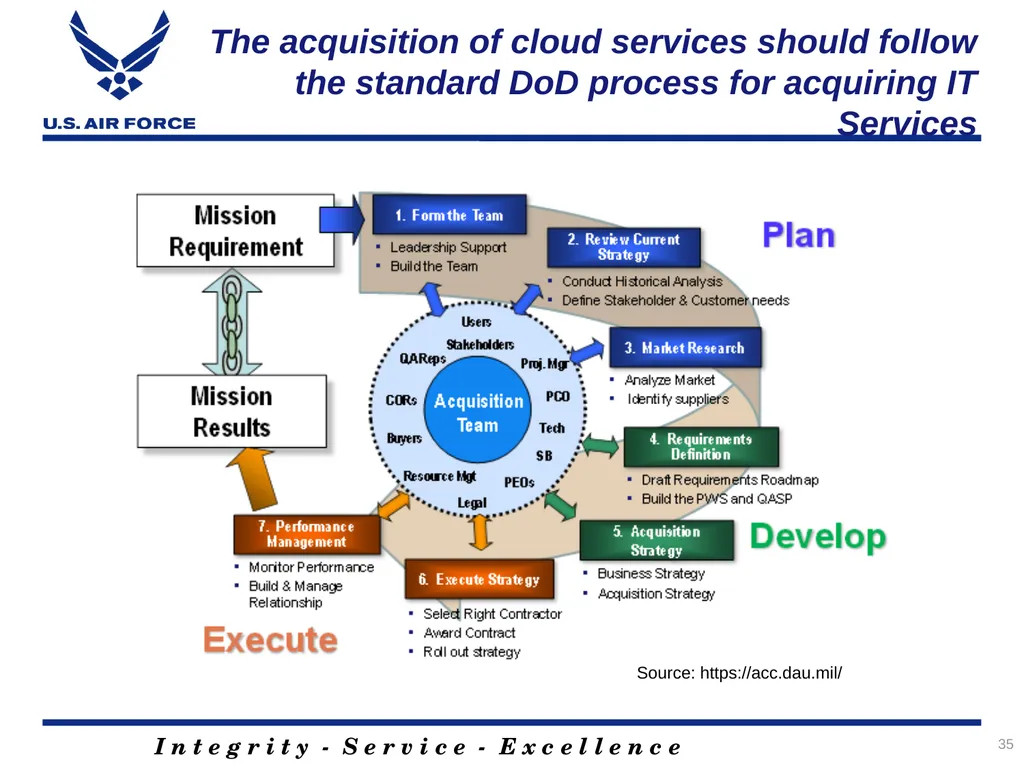
The acquisition of cloud services should follow the standard DoD process for acquiring IT Services 35 Source: https://acc.dau.mil/<br>
35
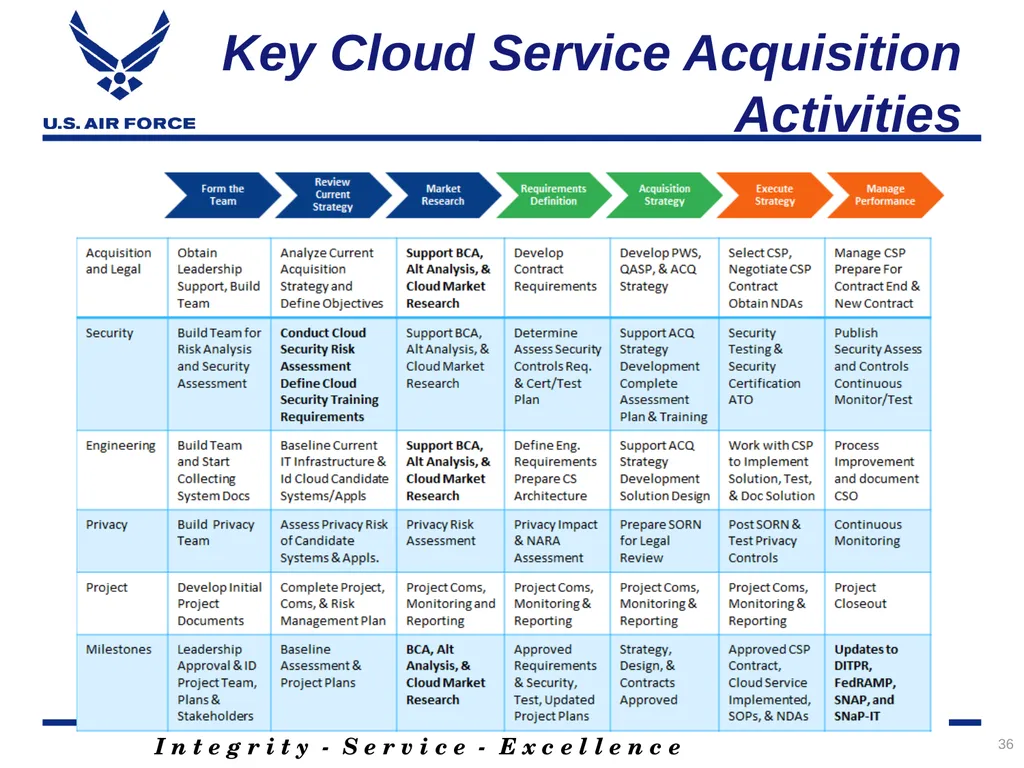
Key Cloud Service Acquisition Activities 36<br>
36
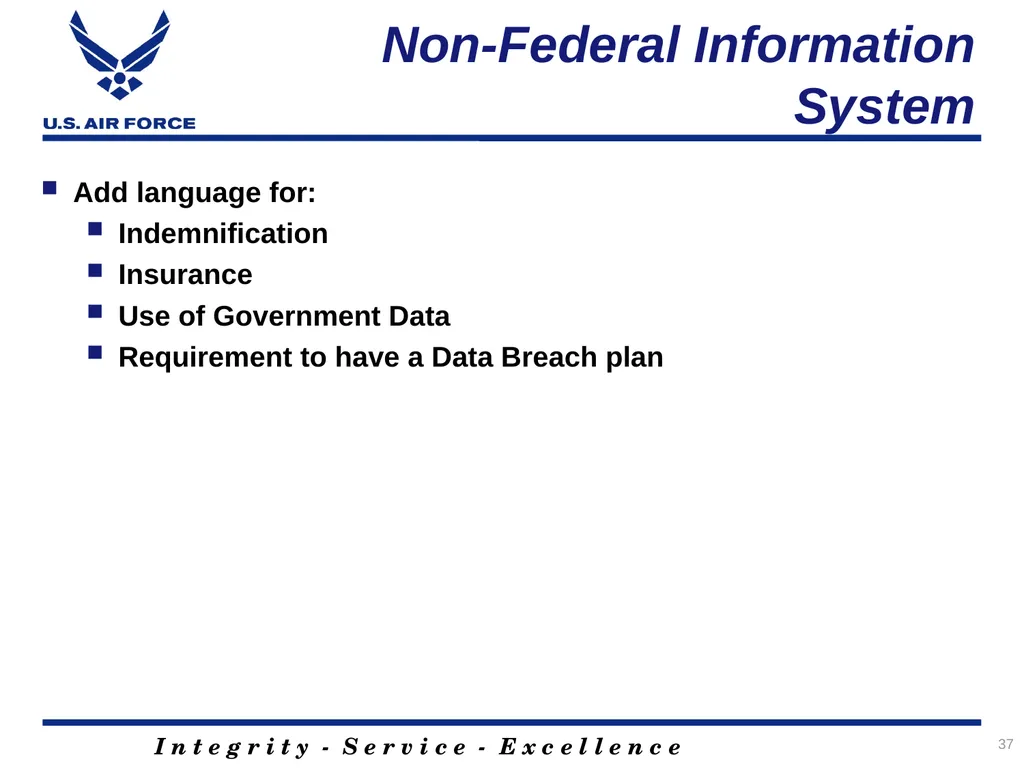
Non-Federal Information System Add language for:
Indemnification
Insurance
Use of Government Data
Requirement to have a Data Breach plan 37<br>
Indemnification
Insurance
Use of Government Data
Requirement to have a Data Breach plan 37<br>
37
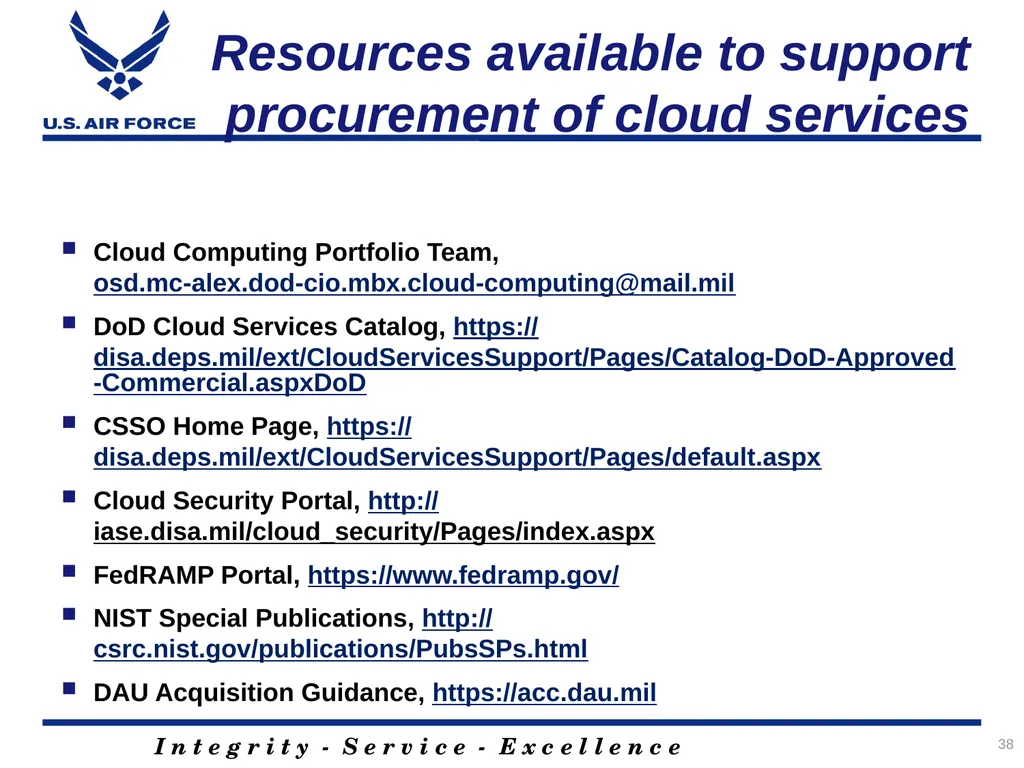
Resources available to support procurement of cloud services Cloud Computing Portfolio Team, osd.mc-alex.dod-cio.mbx.cloud-computing@mail.mil
DoD Cloud Services Catalog, https://disa.deps.mil/ext/CloudServicesSupport/Pages/Catalog-DoD-Approved-Commercial.aspxDoD
CSSO Home Page, https://disa.deps.mil/ext/CloudServicesSupport/Pages/default.aspx
Cloud Security Portal, http://iase.disa.mil/cloud_security/Pages/index.aspx
FedRAMP Portal, https://www.fedramp.gov/
NIST Special Publications, http://csrc.nist.gov/publications/PubsSPs.html
DAU Acquisition Guidance, https://acc.dau.mil 38<br>
DoD Cloud Services Catalog, https://disa.deps.mil/ext/CloudServicesSupport/Pages/Catalog-DoD-Approved-Commercial.aspxDoD
CSSO Home Page, https://disa.deps.mil/ext/CloudServicesSupport/Pages/default.aspx
Cloud Security Portal, http://iase.disa.mil/cloud_security/Pages/index.aspx
FedRAMP Portal, https://www.fedramp.gov/
NIST Special Publications, http://csrc.nist.gov/publications/PubsSPs.html
DAU Acquisition Guidance, https://acc.dau.mil 38<br>
38
Questions? 39<br>
39
BACK UPS 40<br>
40
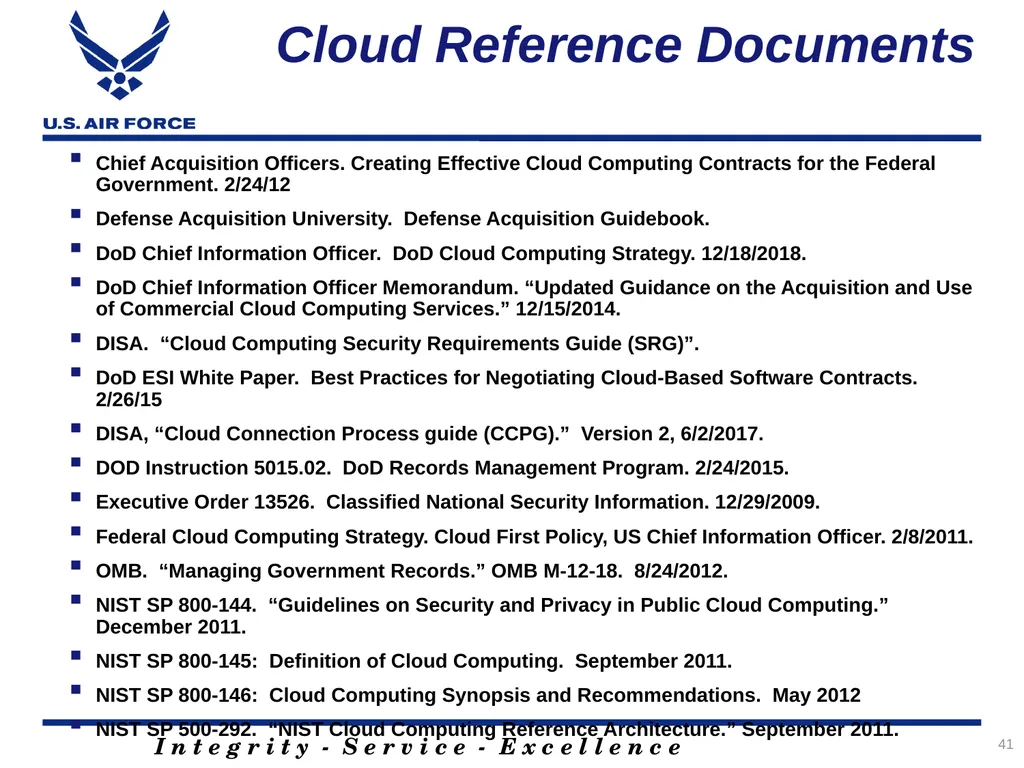
Cloud Reference Documents Chief Acquisition Officers. Creating Effective Cloud Computing Contracts for the Federal Government. 2/24/12
Defense Acquisition University. Defense Acquisition Guidebook.
DoD Chief Information Officer. DoD Cloud Computing Strategy. 12/18/2018.
DoD Chief Information Officer Memorandum. “Updated Guidance on the Acquisition and Use of Commercial Cloud Computing Services.” 12/15/2014.
DISA. “Cloud Computing Security Requirements Guide (SRG)”.
DoD ESI White Paper. Best Practices for Negotiating Cloud-Based Software Contracts. 2/26/15
DISA, “Cloud Connection Process guide (CCPG).” Version 2, 6/2/2017.
DOD Instruction 5015.02. DoD Records Management Program. 2/24/2015.
Executive Order 13526. Classified National Security Information. 12/29/2009.
Federal Cloud Computing Strategy. Cloud First Policy, US Chief Information Officer. 2/8/2011.
OMB. “Managing Government Records.” OMB M-12-18. 8/24/2012.
NIST SP 800-144. “Guidelines on Security and Privacy in Public Cloud Computing.” December 2011.
NIST SP 800-145: Definition of Cloud Computing. September 2011.
NIST SP 800-146: Cloud Computing Synopsis and Recommendations. May 2012
NIST SP 500-292. “NIST Cloud Computing Reference Architecture.” September 2011. 41<br>
Defense Acquisition University. Defense Acquisition Guidebook.
DoD Chief Information Officer. DoD Cloud Computing Strategy. 12/18/2018.
DoD Chief Information Officer Memorandum. “Updated Guidance on the Acquisition and Use of Commercial Cloud Computing Services.” 12/15/2014.
DISA. “Cloud Computing Security Requirements Guide (SRG)”.
DoD ESI White Paper. Best Practices for Negotiating Cloud-Based Software Contracts. 2/26/15
DISA, “Cloud Connection Process guide (CCPG).” Version 2, 6/2/2017.
DOD Instruction 5015.02. DoD Records Management Program. 2/24/2015.
Executive Order 13526. Classified National Security Information. 12/29/2009.
Federal Cloud Computing Strategy. Cloud First Policy, US Chief Information Officer. 2/8/2011.
OMB. “Managing Government Records.” OMB M-12-18. 8/24/2012.
NIST SP 800-144. “Guidelines on Security and Privacy in Public Cloud Computing.” December 2011.
NIST SP 800-145: Definition of Cloud Computing. September 2011.
NIST SP 800-146: Cloud Computing Synopsis and Recommendations. May 2012
NIST SP 500-292. “NIST Cloud Computing Reference Architecture.” September 2011. 41<br>