Act 1, Scene 2 A reminder: the Assessment Objectives become our framework for interrogating the text. They should equip you with a way to organise your ideas. AO2 looking at dramatic, narrative, poetic means Shaping of the action Language
"Act 1, Scene 2 A reminder: the Assessment" is the property of its rightful owner. Permission is granted to
download and print the materials on this website for personal, non-commercial use only, and to display it
on your personal computer provided you do not modify the materials and that you retain all copyright
notices contained in the materials. By downloading content from our website, you accept the terms of this
agreement.
Presentation Transcript
01
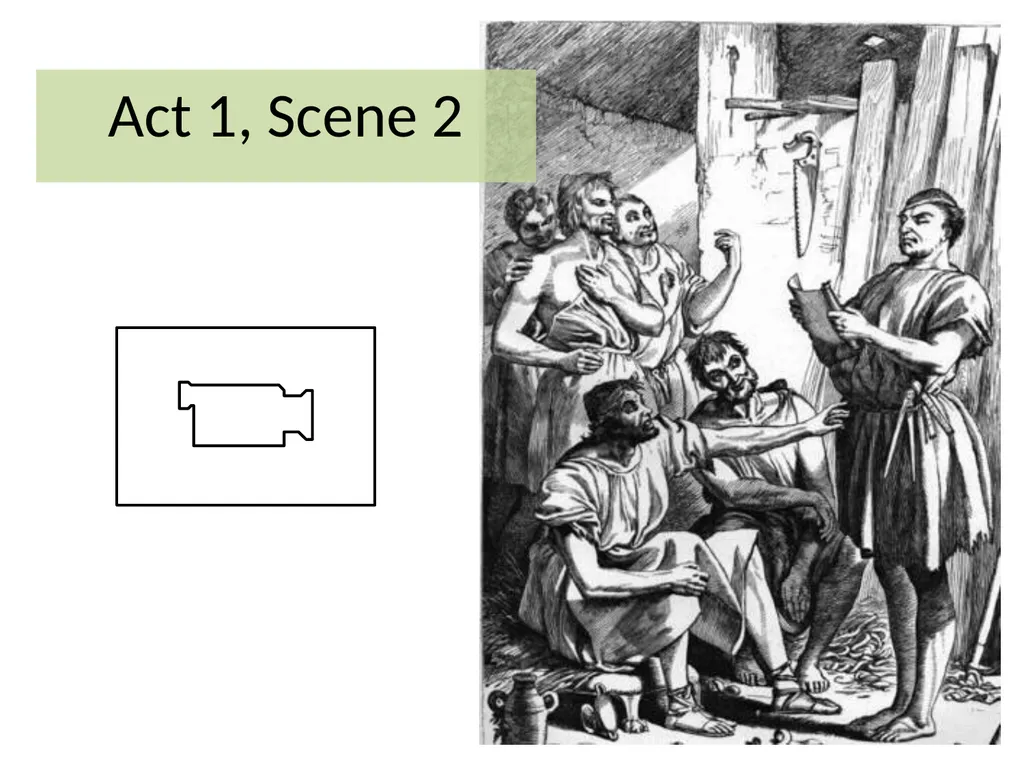
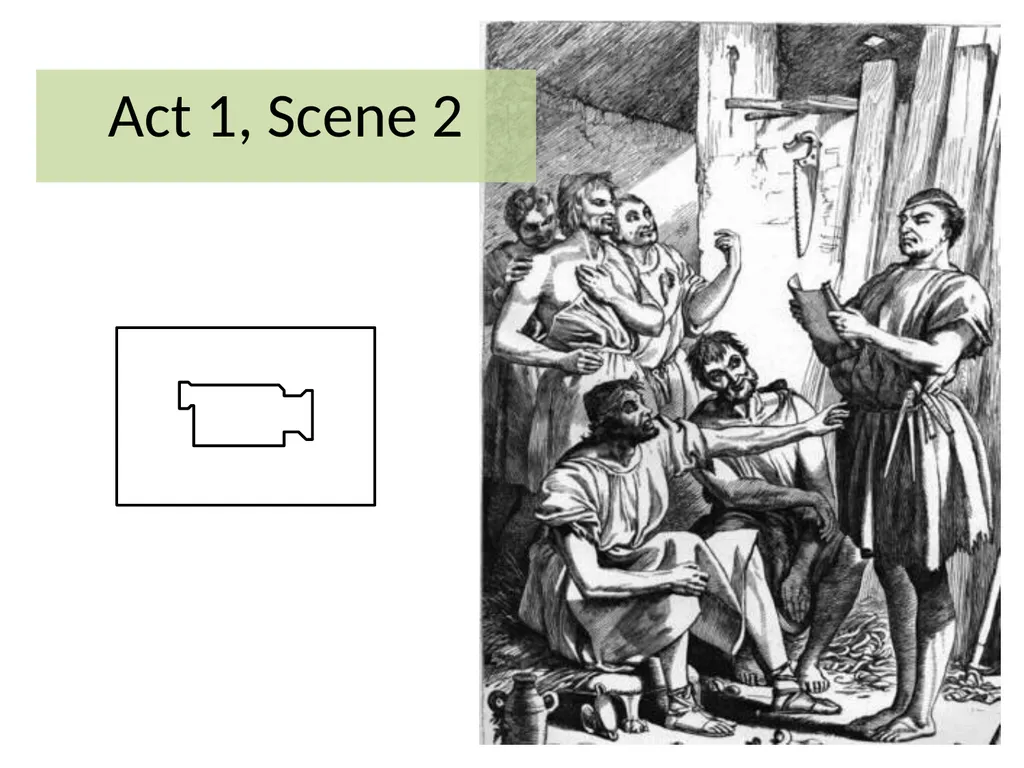
Act 1, Scene 2<br>
02
A reminder: the Assessment Objectives become our framework for interrogating the text. They should equip you with a way to organise your ideas. AO2 looking at dramatic, narrative, poetic means
Shaping of the action
Language of dialogue
Verse? Prose?
Language register, from formal to intimate
AO3 Views of the action
within the text (characters on each other)
critics
productions
AO4 Looking at context
Issues of the time (including language - overlaps with AO2)
Reflections of the age - then
Reflections of the age - now
How the play works for modern audiences<br>
03
Enter Quince the carpenter, Snug the joiner, Bottom the weaver, Flute the bellows-mender, Snout the tinker and Starveling the tailor. We know that the names of the craftsmen (or ‘mechanicals’) reflect their jobs.
Quince – carpenters used wedges called ‘quines’ or ‘quoins’
Snug – joiners made snugly tight wooden joints
Flute – suggests a pipe on a bellows-powered church organ (also, his voice which has not yet broken)
Snout – a tinker would mend the spout (or snouts) of kettles; could also be a reference to the nose of the particular actor originally cast in this role
Starveling – tailors were often said to be poor and thin; the original actor cast in this role was very thin
Bottom – weavers unwind thread from a bottom or reel But what else do we know about them?
AO3: How would you cast the mechanicals and stage their first scene for maximum impact on the audience? What first impression should they create?
[N.B. Shakespeare gives no clues as to where this scene takes place.]<br>
04
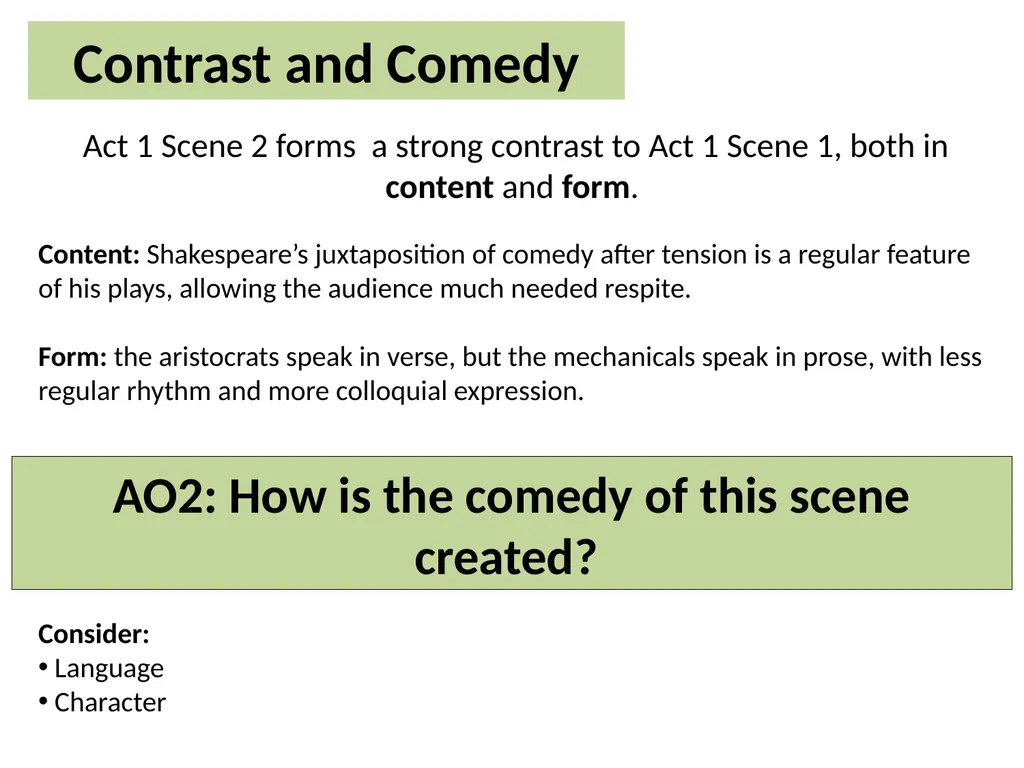
Contrast and Comedy Act 1 Scene 2 forms a strong contrast to Act 1 Scene 1, both in content and form.
Content: Shakespeare’s juxtaposition of comedy after tension is a regular feature of his plays, allowing the audience much needed respite.
Form: the aristocrats speak in verse, but the mechanicals speak in prose, with less regular rhythm and more colloquial expression. AO2: How is the comedy of this scene created? Consider:
Language
Character<br>
05
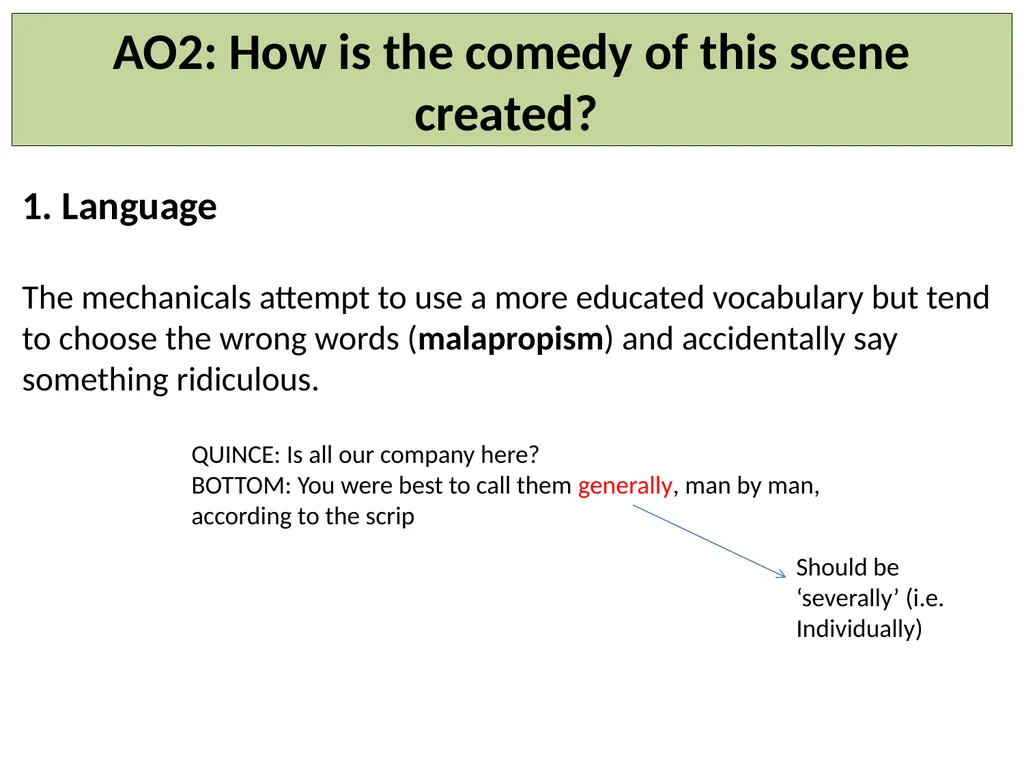
AO2: How is the comedy of this scene created? 1. Language
The mechanicals attempt to use a more educated vocabulary but tend to choose the wrong words (malapropism) and accidentally say something ridiculous. QUINCE: Is all our company here?
BOTTOM: You were best to call them generally, man by man, according to the scrip Should be ‘severally’ (i.e. Individually)<br>
06
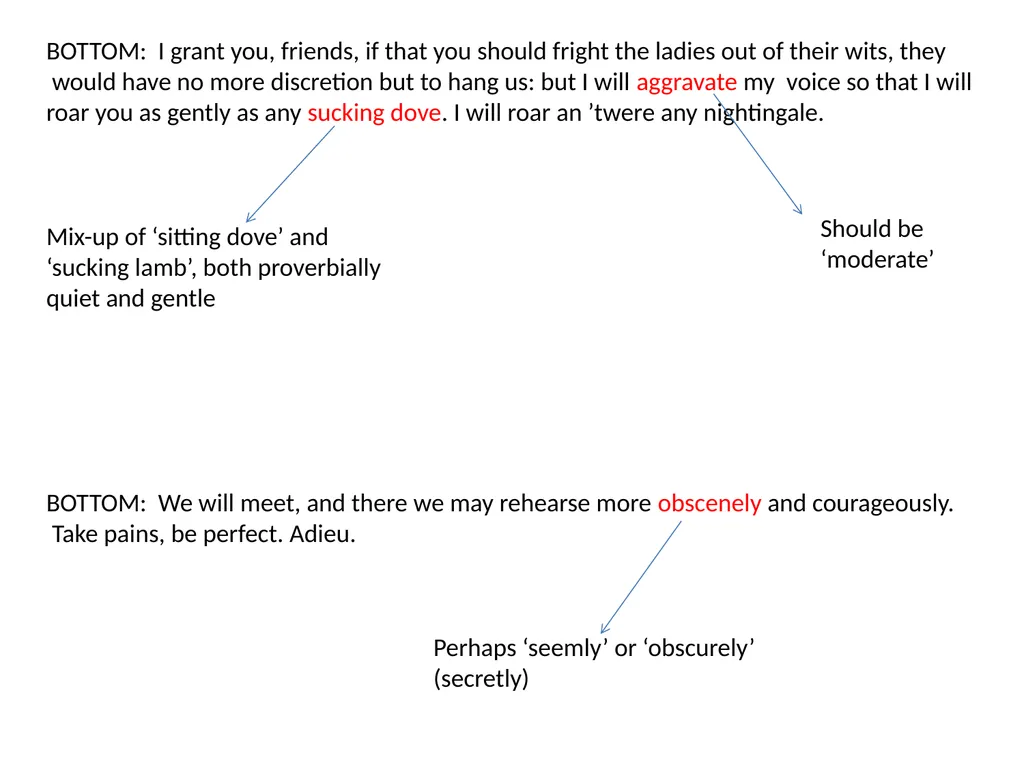
BOTTOM: I grant you, friends, if that you should fright the ladies out of their wits, they
would have no more discretion but to hang us: but I will aggravate my voice so that I will roar you as gently as any sucking dove. I will roar an ’twere any nightingale. Should be ‘moderate’ Mix-up of ‘sitting dove’ and ‘sucking lamb’, both proverbially quiet and gentle BOTTOM: We will meet, and there we may rehearse more obscenely and courageously.
Take pains, be perfect. Adieu. Perhaps ‘seemly’ or ‘obscurely’ (secretly)<br>
07
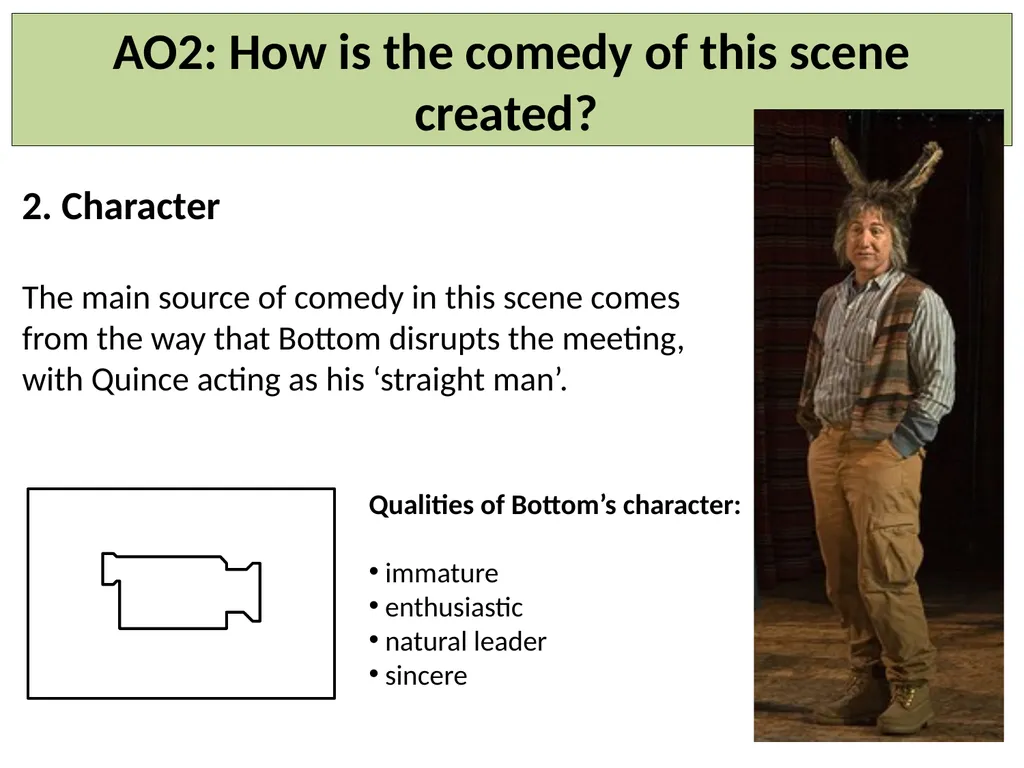
AO2: How is the comedy of this scene created? 2. Character
The main source of comedy in this scene comes from the way that Bottom disrupts the meeting, with Quince acting as his ‘straight man’. Qualities of Bottom’s character:
immature
enthusiastic
natural leader
sincere<br>
08
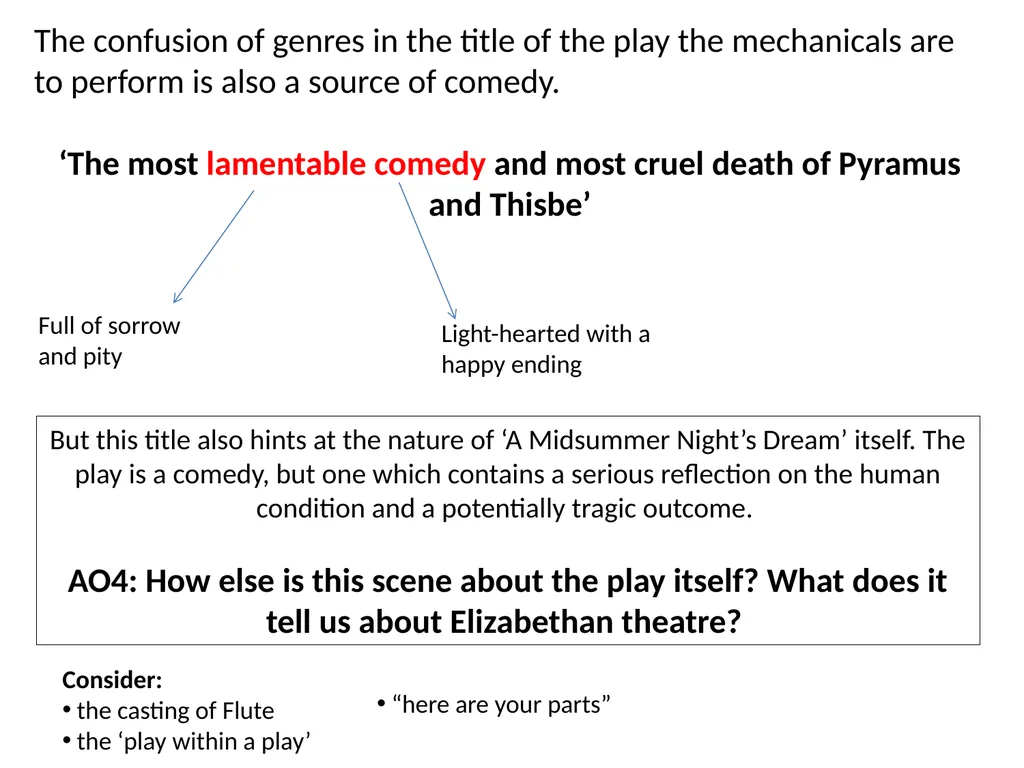
The confusion of genres in the title of the play the mechanicals are to perform is also a source of comedy.
‘The most lamentable comedy and most cruel death of Pyramus and Thisbe’ Full of sorrow and pity Light-hearted with a happy ending But this title also hints at the nature of ‘A Midsummer Night’s Dream’ itself. The play is a comedy, but one which contains a serious reflection on the human condition and a potentially tragic outcome.
AO4: How else is this scene about the play itself? What does it tell us about Elizabethan theatre? Consider:
the casting of Flute
the ‘play within a play’ “here are your parts”<br>
09
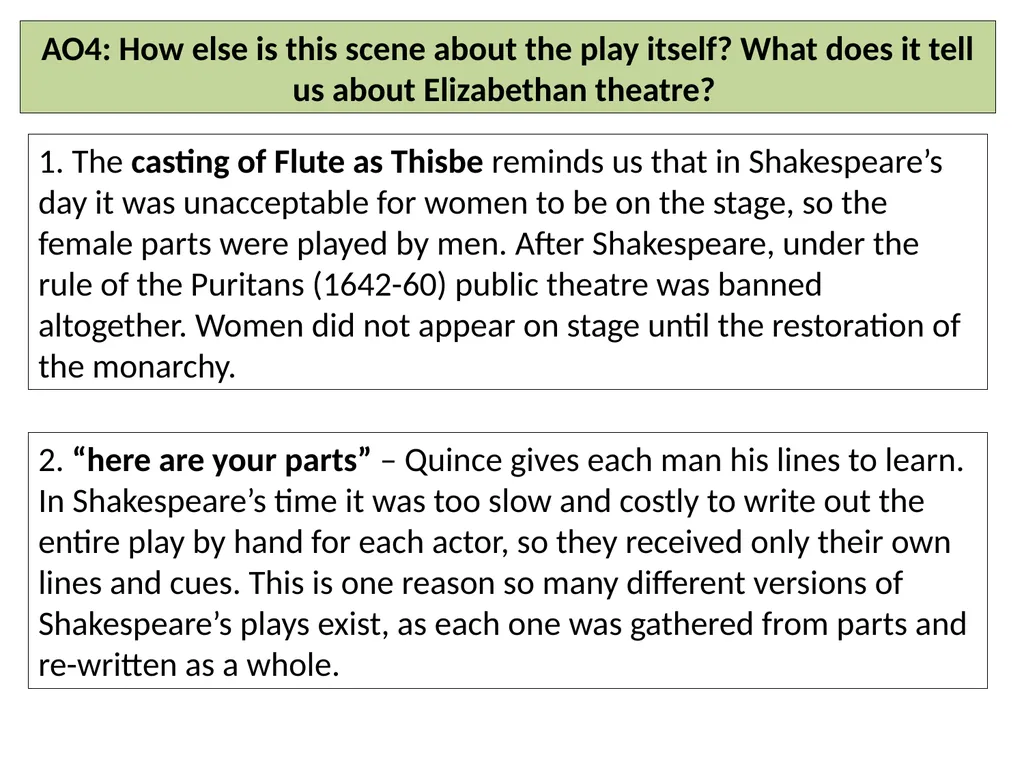
AO4: How else is this scene about the play itself? What does it tell us about Elizabethan theatre? 1. The casting of Flute as Thisbe reminds us that in Shakespeare’s day it was unacceptable for women to be on the stage, so the female parts were played by men. After Shakespeare, under the rule of the Puritans (1642-60) public theatre was banned altogether. Women did not appear on stage until the restoration of the monarchy. 2. “here are your parts” – Quince gives each man his lines to learn. In Shakespeare’s time it was too slow and costly to write out the entire play by hand for each actor, so they received only their own lines and cues. This is one reason so many different versions of Shakespeare’s plays exist, as each one was gathered from parts and re-written as a whole.<br>
10
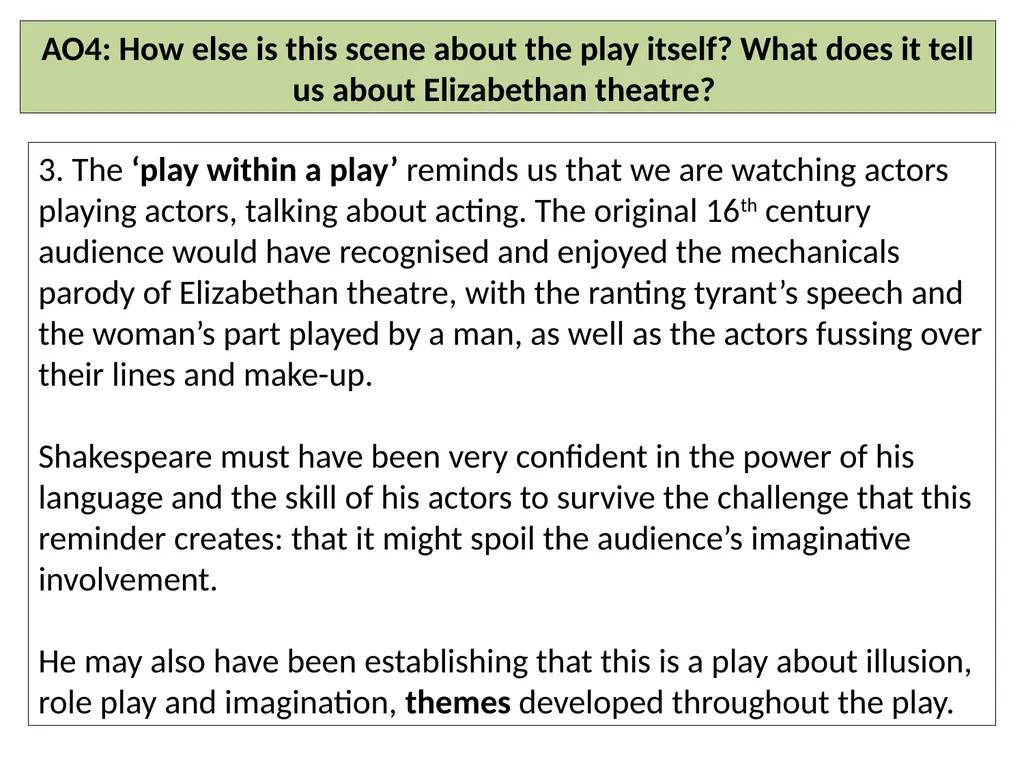
3. The ‘play within a play’ reminds us that we are watching actors playing actors, talking about acting. The original 16th century audience would have recognised and enjoyed the mechanicals parody of Elizabethan theatre, with the ranting tyrant’s speech and the woman’s part played by a man, as well as the actors fussing over their lines and make-up.
Shakespeare must have been very confident in the power of his language and the skill of his actors to survive the challenge that this reminder creates: that it might spoil the audience’s imaginative involvement.
He may also have been establishing that this is a play about illusion, role play and imagination, themes developed throughout the play. AO4: How else is this scene about the play itself? What does it tell us about Elizabethan theatre?<br>