
Action Learning Set Facilitator training for



Description: Action Learning Set Facilitator training for Social Prescribing Link Workers, Care Coordinators and Health and Wellbeing Coaches across London Feedback, learnings and next steps Oct 2023 In partnership with NHS Leadership Academy, 14 people
Related Topics
Download Presentation
"Action Learning Set Facilitator training for" is the property of its rightful owner. Permission is granted to download and print the materials on this website for personal, non-commercial use only, and to display it on your personal computer provided you do not modify the materials and that you retain all copyright notices contained in the materials. By downloading content from our website, you accept the terms of this agreement.
Presentation Transcript
slide1. Action Learning Set Facilitator training for Social Prescribing Link Workers, Care Coordinators and Health and Wellbeing Coaches across London
Feedback, learnings and next steps Oct 2023<br>
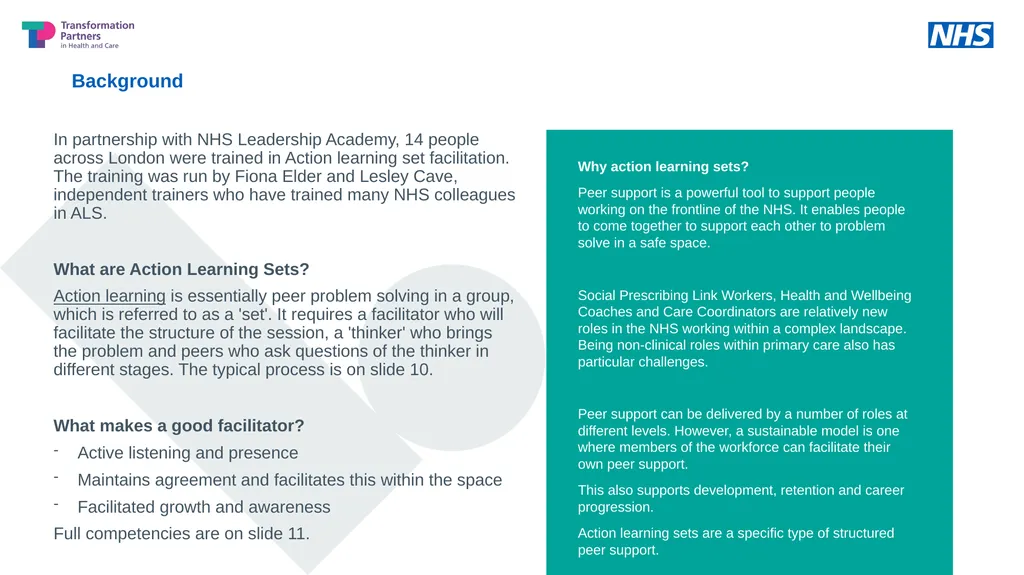
slide2. In partnership with NHS Leadership Academy, 14 people across London were trained in Action learning set facilitation. The training was run by Fiona Elder and Lesley Cave, independent trainers who have trained many NHS colleagues in ALS.
What are Action Learning Sets?
Action learning is essentially peer problem solving in a group, which is referred to as a 'set'. It requires a facilitator who will facilitate the structure of the session, a 'thinker' who brings the problem and peers who ask questions of the thinker in different stages. The typical process is on slide 10.
What makes a good facilitator?
Active listening and presence
Maintains agreement and facilitates this within the space
Facilitated growth and awareness
Full competencies are on slide 11. Background Why action learning sets?
Peer support is a powerful tool to support people working on the frontline of the NHS. It enables people to come together to support each other to problem solve in a safe space.
Social Prescribing Link Workers, Health and Wellbeing Coaches and Care Coordinators are relatively new roles in the NHS working within a complex landscape. Being non-clinical roles within primary care also has particular challenges.
Peer support can be delivered by a number of roles at different levels. However, a sustainable model is one where members of the workforce can facilitate their own peer support.
This also supports development, retention and career progression.
Action learning sets are a specific type of structured peer support.<br>
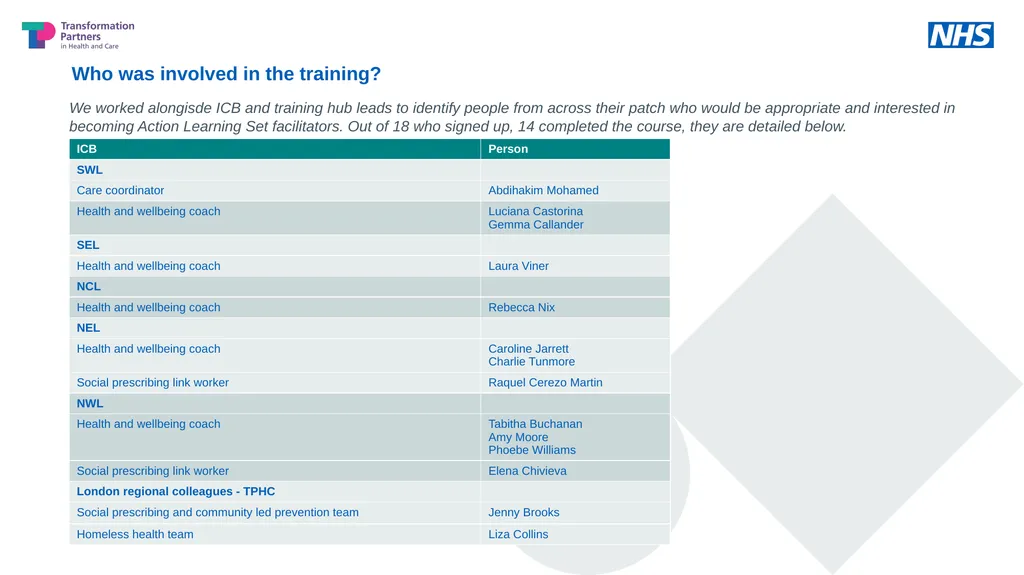
slide3. We worked alongisde ICB and training hub leads to identify people from across their patch who would be appropriate and interested in becoming Action Learning Set facilitators. Out of 18 who signed up, 14 completed the course, they are detailed below. Who was involved in the training?<br>
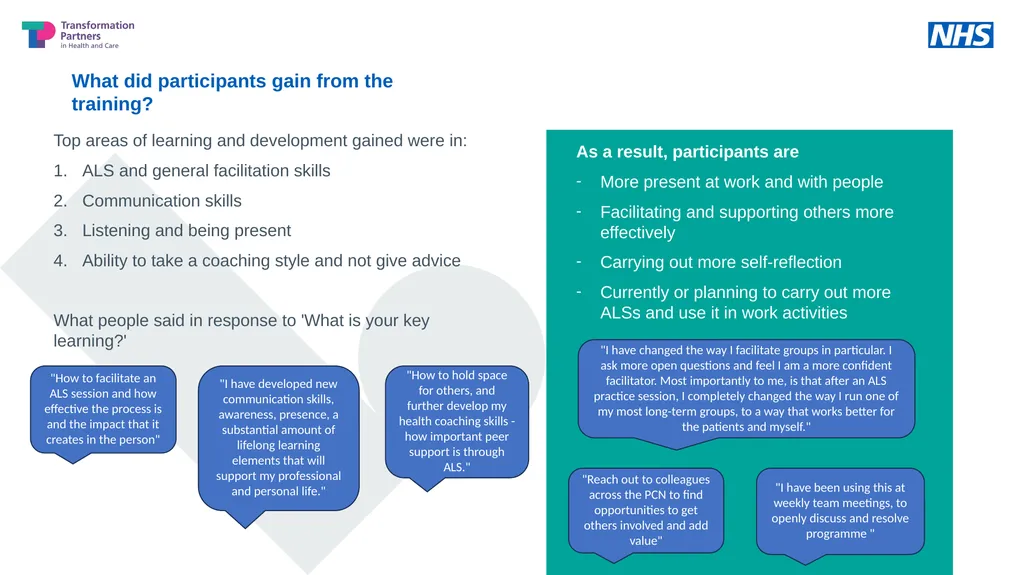
slide4. Top areas of learning and development gained were in:
ALS and general facilitation skills
Communication skills
Listening and being present
Ability to take a coaching style and not give advice
What people said in response to 'What is your key learning?' What did participants gain from the training? As a result, participants are
More present at work and with people
Facilitating and supporting others more effectively
Carrying out more self-reflection
Currently or planning to carry out more ALSs and use it in work activities "How to facilitate an ALS session and how effective the process is and the impact that it creates in the person" "I have developed new communication skills, awareness, presence, a substantial amount of lifelong learning elements that will support my professional and personal life." "How to hold space for others, and further develop my health coaching skills - how important peer support is through ALS." "I have changed the way I facilitate groups in particular. I ask more open questions and feel I am a more confident facilitator. Most importantly to me, is that after an ALS practice session, I completely changed the way I run one of my most long-term groups, to a way that works better for the patients and myself." "I have been using this at weekly team meetings, to openly discuss and resolve programme " "Reach out to colleagues across the PCN to find opportunities to get others involved and add value"<br>
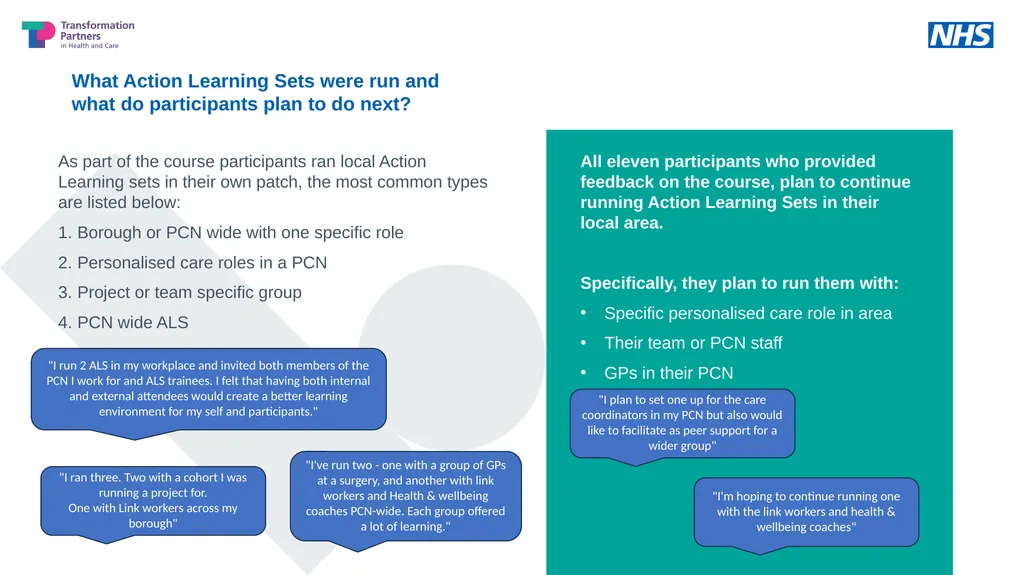
slide5. As part of the course participants ran local Action Learning sets in their own patch, the most common types are listed below:
Borough or PCN wide with one specific role
Personalised care roles in a PCN
Project or team specific group
PCN wide ALS What Action Learning Sets were run and what do participants plan to do next? All eleven participants who provided feedback on the course, plan to continue running Action Learning Sets in their local area.
Specifically, they plan to run them with:
Specific personalised care role in area
Their team or PCN staff
GPs in their PCN "I ran three. Two with a cohort I was running a project for. One with Link workers across my borough" "I've run two - one with a group of GPs at a surgery, and another with link workers and Health & wellbeing coaches PCN-wide. Each group offered a lot of learning." "I run 2 ALS in my workplace and invited both members of the PCN I work for and ALS trainees. I felt that having both internal and external attendees would create a better learning environment for my self and participants." "I plan to set one up for the care coordinators in my PCN but also would like to facilitate as peer support for a wider group" "I'm hoping to continue running one with the link workers and health & wellbeing coaches"<br>
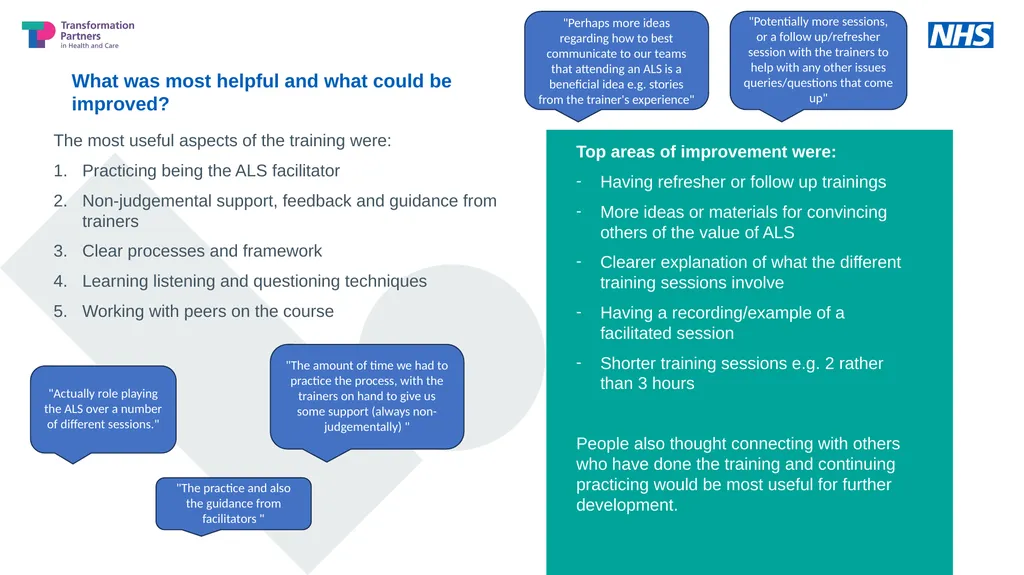
slide6. The most useful aspects of the training were:
Practicing being the ALS facilitator
Non-judgemental support, feedback and guidance from trainers
Clear processes and framework
Learning listening and questioning techniques
Working with peers on the course What was most helpful and what could be improved? Top areas of improvement were:
Having refresher or follow up trainings
More ideas or materials for convincing others of the value of ALS
Clearer explanation of what the different training sessions involve
Having a recording/example of a facilitated session
Shorter training sessions e.g. 2 rather than 3 hours
People also thought connecting with others who have done the training and continuing practicing would be most useful for further development. "Actually role playing the ALS over a number of different sessions." "The amount of time we had to practice the process, with the trainers on hand to give us some support (always non-judgementally) " "Perhaps more ideas regarding how to best communicate to our teams that attending an ALS is a beneficial idea e.g. stories from the trainer's experience" "Potentially more sessions, or a follow up/refresher session with the trainers to help with any other issues queries/questions that come up" "The practice and also the guidance from facilitators "<br>
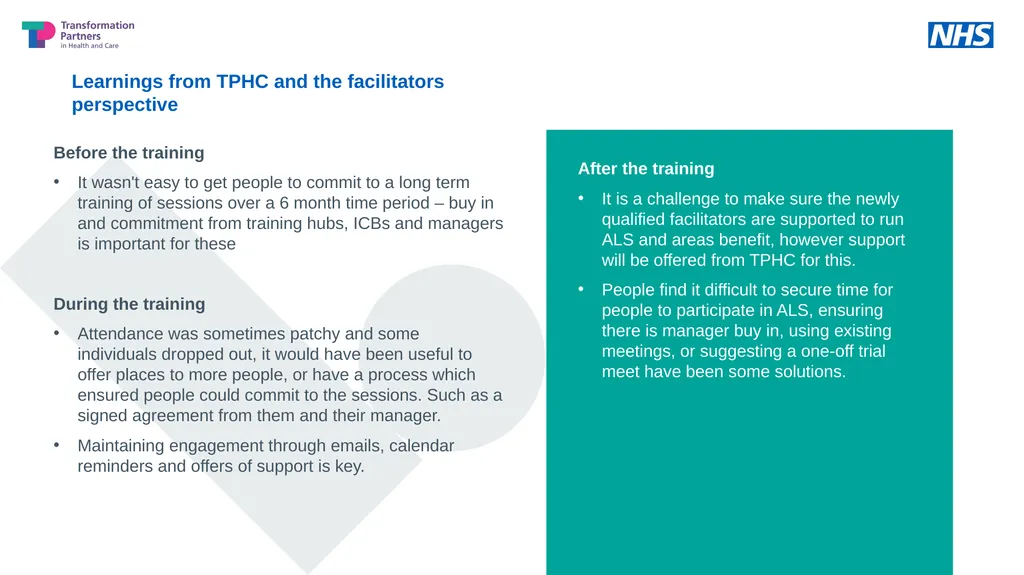
slide7. Before the training
It wasn't easy to get people to commit to a long term training of sessions over a 6 month time period – buy in and commitment from training hubs, ICBs and managers is important for these
During the training
Attendance was sometimes patchy and some individuals dropped out, it would have been useful to offer places to more people, or have a process which ensured people could commit to the sessions. Such as a signed agreement from them and their manager.
Maintaining engagement through emails, calendar reminders and offers of support is key. Learnings from TPHC and the facilitators perspective After the training
It is a challenge to make sure the newly qualified facilitators are supported to run ALS and areas benefit, however support will be offered from TPHC for this.
People find it difficult to secure time for people to participate in ALS, ensuring there is manager buy in, using existing meetings, or suggesting a one-off trial meet have been some solutions.<br>
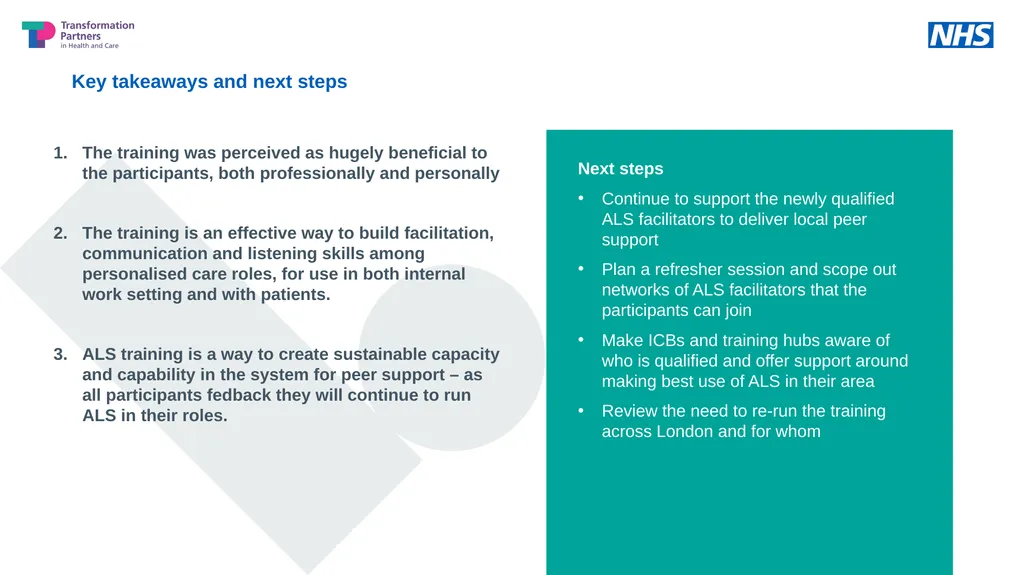
slide8. The training was perceived as hugely beneficial to the participants, both professionally and personally
The training is an effective way to build facilitation, communication and listening skills among personalised care roles, for use in both internal work setting and with patients.
ALS training is a way to create sustainable capacity and capability in the system for peer support – as all participants fedback they will continue to run ALS in their roles. Key takeaways and next steps Next steps
Continue to support the newly qualified ALS facilitators to deliver local peer support
Plan a refresher session and scope out networks of ALS facilitators that the participants can join
Make ICBs and training hubs aware of who is qualified and offer support around making best use of ALS in their area
Review the need to re-run the training across London and for whom<br>
slide9. Appendices<br>
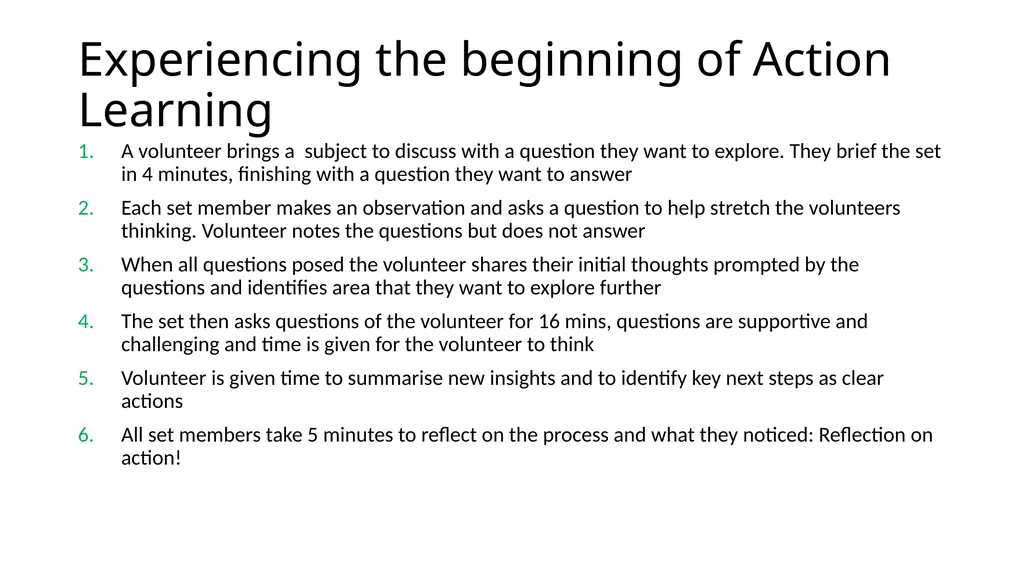
slide10. Experiencing the beginning of Action Learning A volunteer brings a subject to discuss with a question they want to explore. They brief the set in 4 minutes, finishing with a question they want to answer
Each set member makes an observation and asks a question to help stretch the volunteers thinking. Volunteer notes the questions but does not answer
When all questions posed the volunteer shares their initial thoughts prompted by the questions and identifies area that they want to explore further
The set then asks questions of the volunteer for 16 mins, questions are supportive and challenging and time is given for the volunteer to think
Volunteer is given time to summarise new insights and to identify key next steps as clear actions
All set members take 5 minutes to reflect on the process and what they noticed: Reflection on action!<br>
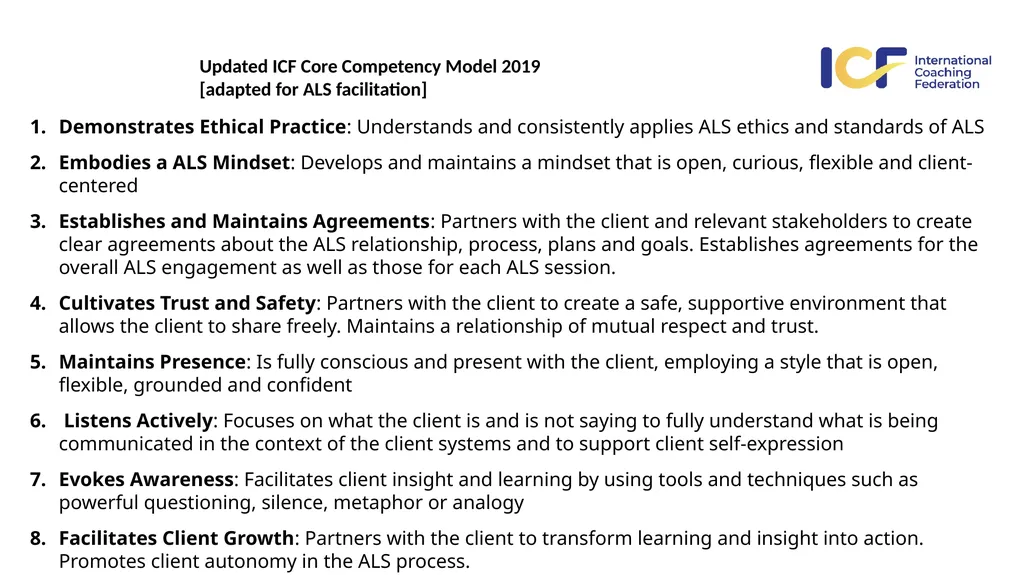
slide11. Updated ICF Core Competency Model 2019 [adapted for ALS facilitation] Demonstrates Ethical Practice: Understands and consistently applies ALS ethics and standards of ALS
Embodies a ALS Mindset: Develops and maintains a mindset that is open, curious, flexible and client-centered
Establishes and Maintains Agreements: Partners with the client and relevant stakeholders to create clear agreements about the ALS relationship, process, plans and goals. Establishes agreements for the overall ALS engagement as well as those for each ALS session.
Cultivates Trust and Safety: Partners with the client to create a safe, supportive environment that allows the client to share freely. Maintains a relationship of mutual respect and trust.
Maintains Presence: Is fully conscious and present with the client, employing a style that is open, flexible, grounded and confident
Listens Actively: Focuses on what the client is and is not saying to fully understand what is being communicated in the context of the client systems and to support client self-expression
Evokes Awareness: Facilitates client insight and learning by using tools and techniques such as powerful questioning, silence, metaphor or analogy
Facilitates Client Growth: Partners with the client to transform learning and insight into action. Promotes client autonomy in the ALS process.<br>
Feedback, learnings and next steps Oct 2023<br>
slide2. In partnership with NHS Leadership Academy, 14 people across London were trained in Action learning set facilitation. The training was run by Fiona Elder and Lesley Cave, independent trainers who have trained many NHS colleagues in ALS.
What are Action Learning Sets?
Action learning is essentially peer problem solving in a group, which is referred to as a 'set'. It requires a facilitator who will facilitate the structure of the session, a 'thinker' who brings the problem and peers who ask questions of the thinker in different stages. The typical process is on slide 10.
What makes a good facilitator?
Active listening and presence
Maintains agreement and facilitates this within the space
Facilitated growth and awareness
Full competencies are on slide 11. Background Why action learning sets?
Peer support is a powerful tool to support people working on the frontline of the NHS. It enables people to come together to support each other to problem solve in a safe space.
Social Prescribing Link Workers, Health and Wellbeing Coaches and Care Coordinators are relatively new roles in the NHS working within a complex landscape. Being non-clinical roles within primary care also has particular challenges.
Peer support can be delivered by a number of roles at different levels. However, a sustainable model is one where members of the workforce can facilitate their own peer support.
This also supports development, retention and career progression.
Action learning sets are a specific type of structured peer support.<br>
slide3. We worked alongisde ICB and training hub leads to identify people from across their patch who would be appropriate and interested in becoming Action Learning Set facilitators. Out of 18 who signed up, 14 completed the course, they are detailed below. Who was involved in the training?<br>
slide4. Top areas of learning and development gained were in:
ALS and general facilitation skills
Communication skills
Listening and being present
Ability to take a coaching style and not give advice
What people said in response to 'What is your key learning?' What did participants gain from the training? As a result, participants are
More present at work and with people
Facilitating and supporting others more effectively
Carrying out more self-reflection
Currently or planning to carry out more ALSs and use it in work activities "How to facilitate an ALS session and how effective the process is and the impact that it creates in the person" "I have developed new communication skills, awareness, presence, a substantial amount of lifelong learning elements that will support my professional and personal life." "How to hold space for others, and further develop my health coaching skills - how important peer support is through ALS." "I have changed the way I facilitate groups in particular. I ask more open questions and feel I am a more confident facilitator. Most importantly to me, is that after an ALS practice session, I completely changed the way I run one of my most long-term groups, to a way that works better for the patients and myself." "I have been using this at weekly team meetings, to openly discuss and resolve programme " "Reach out to colleagues across the PCN to find opportunities to get others involved and add value"<br>
slide5. As part of the course participants ran local Action Learning sets in their own patch, the most common types are listed below:
Borough or PCN wide with one specific role
Personalised care roles in a PCN
Project or team specific group
PCN wide ALS What Action Learning Sets were run and what do participants plan to do next? All eleven participants who provided feedback on the course, plan to continue running Action Learning Sets in their local area.
Specifically, they plan to run them with:
Specific personalised care role in area
Their team or PCN staff
GPs in their PCN "I ran three. Two with a cohort I was running a project for. One with Link workers across my borough" "I've run two - one with a group of GPs at a surgery, and another with link workers and Health & wellbeing coaches PCN-wide. Each group offered a lot of learning." "I run 2 ALS in my workplace and invited both members of the PCN I work for and ALS trainees. I felt that having both internal and external attendees would create a better learning environment for my self and participants." "I plan to set one up for the care coordinators in my PCN but also would like to facilitate as peer support for a wider group" "I'm hoping to continue running one with the link workers and health & wellbeing coaches"<br>
slide6. The most useful aspects of the training were:
Practicing being the ALS facilitator
Non-judgemental support, feedback and guidance from trainers
Clear processes and framework
Learning listening and questioning techniques
Working with peers on the course What was most helpful and what could be improved? Top areas of improvement were:
Having refresher or follow up trainings
More ideas or materials for convincing others of the value of ALS
Clearer explanation of what the different training sessions involve
Having a recording/example of a facilitated session
Shorter training sessions e.g. 2 rather than 3 hours
People also thought connecting with others who have done the training and continuing practicing would be most useful for further development. "Actually role playing the ALS over a number of different sessions." "The amount of time we had to practice the process, with the trainers on hand to give us some support (always non-judgementally) " "Perhaps more ideas regarding how to best communicate to our teams that attending an ALS is a beneficial idea e.g. stories from the trainer's experience" "Potentially more sessions, or a follow up/refresher session with the trainers to help with any other issues queries/questions that come up" "The practice and also the guidance from facilitators "<br>
slide7. Before the training
It wasn't easy to get people to commit to a long term training of sessions over a 6 month time period – buy in and commitment from training hubs, ICBs and managers is important for these
During the training
Attendance was sometimes patchy and some individuals dropped out, it would have been useful to offer places to more people, or have a process which ensured people could commit to the sessions. Such as a signed agreement from them and their manager.
Maintaining engagement through emails, calendar reminders and offers of support is key. Learnings from TPHC and the facilitators perspective After the training
It is a challenge to make sure the newly qualified facilitators are supported to run ALS and areas benefit, however support will be offered from TPHC for this.
People find it difficult to secure time for people to participate in ALS, ensuring there is manager buy in, using existing meetings, or suggesting a one-off trial meet have been some solutions.<br>
slide8. The training was perceived as hugely beneficial to the participants, both professionally and personally
The training is an effective way to build facilitation, communication and listening skills among personalised care roles, for use in both internal work setting and with patients.
ALS training is a way to create sustainable capacity and capability in the system for peer support – as all participants fedback they will continue to run ALS in their roles. Key takeaways and next steps Next steps
Continue to support the newly qualified ALS facilitators to deliver local peer support
Plan a refresher session and scope out networks of ALS facilitators that the participants can join
Make ICBs and training hubs aware of who is qualified and offer support around making best use of ALS in their area
Review the need to re-run the training across London and for whom<br>
slide9. Appendices<br>
slide10. Experiencing the beginning of Action Learning A volunteer brings a subject to discuss with a question they want to explore. They brief the set in 4 minutes, finishing with a question they want to answer
Each set member makes an observation and asks a question to help stretch the volunteers thinking. Volunteer notes the questions but does not answer
When all questions posed the volunteer shares their initial thoughts prompted by the questions and identifies area that they want to explore further
The set then asks questions of the volunteer for 16 mins, questions are supportive and challenging and time is given for the volunteer to think
Volunteer is given time to summarise new insights and to identify key next steps as clear actions
All set members take 5 minutes to reflect on the process and what they noticed: Reflection on action!<br>
slide11. Updated ICF Core Competency Model 2019 [adapted for ALS facilitation] Demonstrates Ethical Practice: Understands and consistently applies ALS ethics and standards of ALS
Embodies a ALS Mindset: Develops and maintains a mindset that is open, curious, flexible and client-centered
Establishes and Maintains Agreements: Partners with the client and relevant stakeholders to create clear agreements about the ALS relationship, process, plans and goals. Establishes agreements for the overall ALS engagement as well as those for each ALS session.
Cultivates Trust and Safety: Partners with the client to create a safe, supportive environment that allows the client to share freely. Maintains a relationship of mutual respect and trust.
Maintains Presence: Is fully conscious and present with the client, employing a style that is open, flexible, grounded and confident
Listens Actively: Focuses on what the client is and is not saying to fully understand what is being communicated in the context of the client systems and to support client self-expression
Evokes Awareness: Facilitates client insight and learning by using tools and techniques such as powerful questioning, silence, metaphor or analogy
Facilitates Client Growth: Partners with the client to transform learning and insight into action. Promotes client autonomy in the ALS process.<br>