ACTION RESEARCH Course:8(A) Dr. Kalyani Biswal Asst. Prof. Teacher Education (Educational Studies) BJB(Auto)College, Bhubaneswar, Odisha 1 Contents Types of Research Derivation of Action Research Meaning of Action Research Definition of
"ACTION RESEARCH Course:8(A) Dr. Kalyani Biswal" is the property of its rightful owner. Permission is granted to
download and print the materials on this website for personal, non-commercial use only, and to display it
on your personal computer provided you do not modify the materials and that you retain all copyright
notices contained in the materials. By downloading content from our website, you accept the terms of this
agreement.
Presentation Transcript
01
ACTION RESEARCH Course:8(A) Dr. Kalyani Biswal
Asst. Prof. Teacher Education (Educational Studies)
BJB(Auto)College, Bhubaneswar, Odisha 1<br>
02
Contents Types of Research
Derivation of Action Research
Meaning of Action Research
Definition of Action Research
Importance of Action Research
Characteristics of Action Research
Scope of Action Research
Types of Action Research Design
Steps of Action Research
Detailed format of Action Research Synopsis 2<br>
03
Types of Research Basic or Fundamental Research: Generate Knowledge (Theories, Laws, Principles)
Applied Research: See the applicability of already generated knowledge in real situation
Action Research: Solution of problem that is encountered 3<br>
04
Kurt Lewin, a German social psychologist,
has been credited with the development of the idea of action research.
“action research”-
refers to the particular approach to classroom research by the teachers.
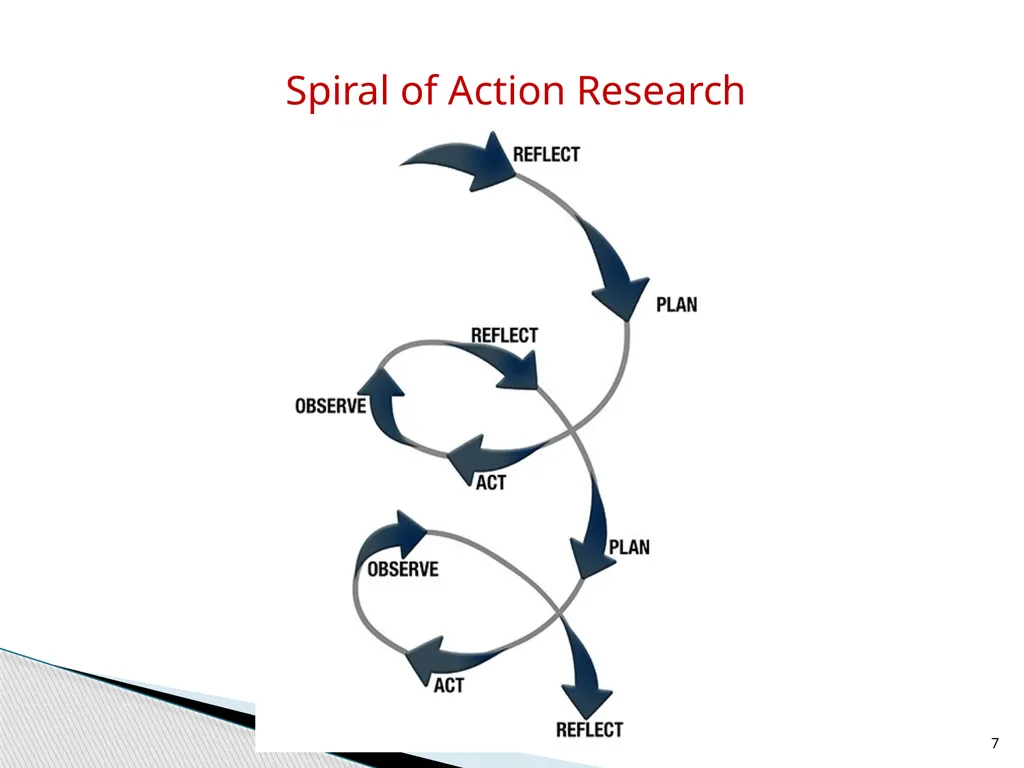
this type of research uses “a spiral step,” each of
which is “composed of a circle of planning, action and fact-finding about the result of the action”.
- Kurt Lewin Derivation of Action Research 4<br>
05
“Educational action research is founded
after John Dewey, an American educational
philosopher, who held that professional
educators should become involved in
community problem-solving”.
Naturally, it concentrates on development of curriculum, professional improvement, and applying learning in a social context. 5<br>
06
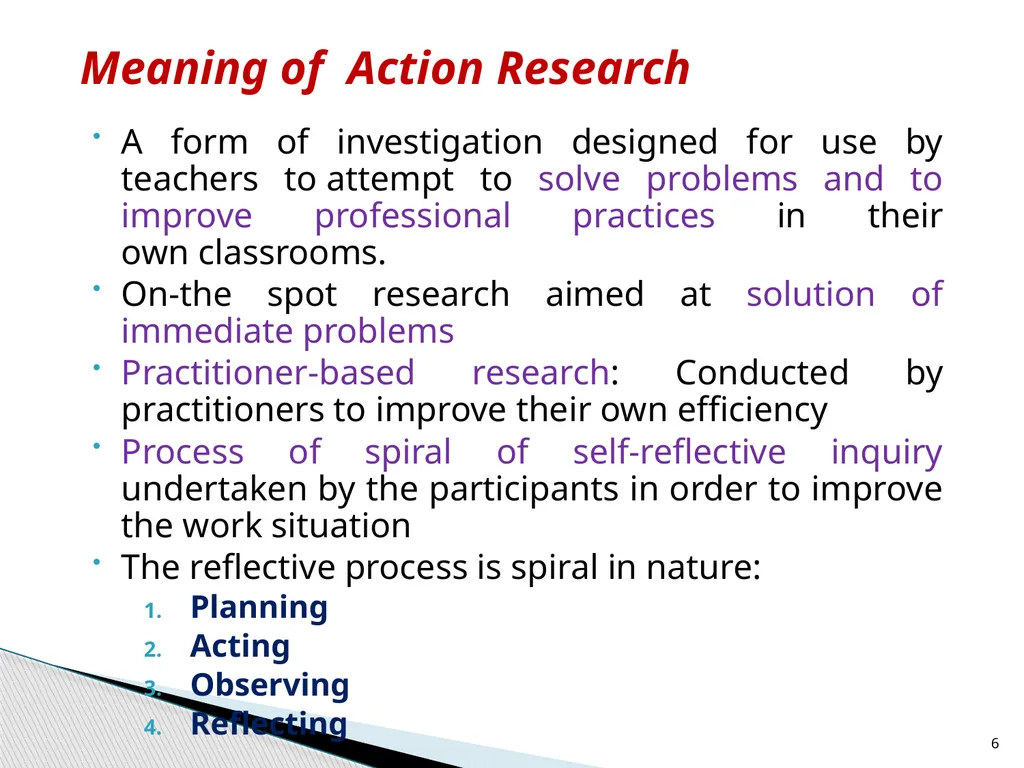
Meaning of Action Research A form of investigation designed for use by teachers to attempt to solve problems and to improve professional practices in their own classrooms.
On-the spot research aimed at solution of immediate problems
Practitioner-based research: Conducted by practitioners to improve their own efficiency
Process of spiral of self-reflective inquiry undertaken by the participants in order to improve the work situation
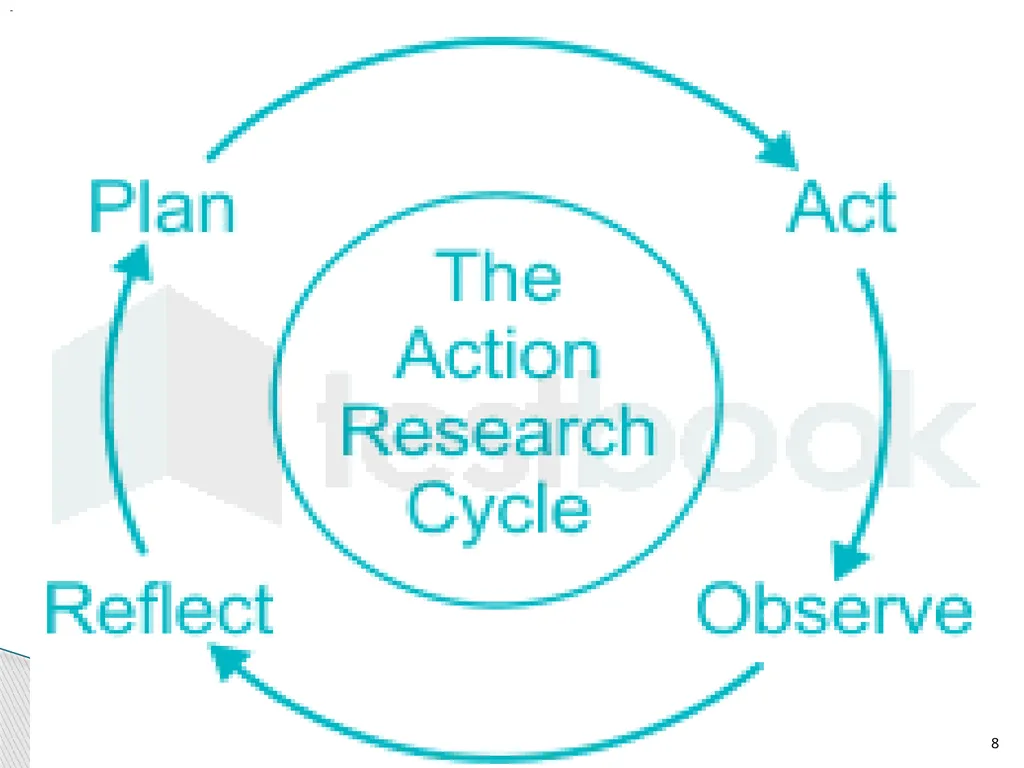
The reflective process is spiral in nature:
Planning
Acting
Observing
Reflecting 6<br>
07
Spiral of Action Research 7<br>
08
- 8<br>
09
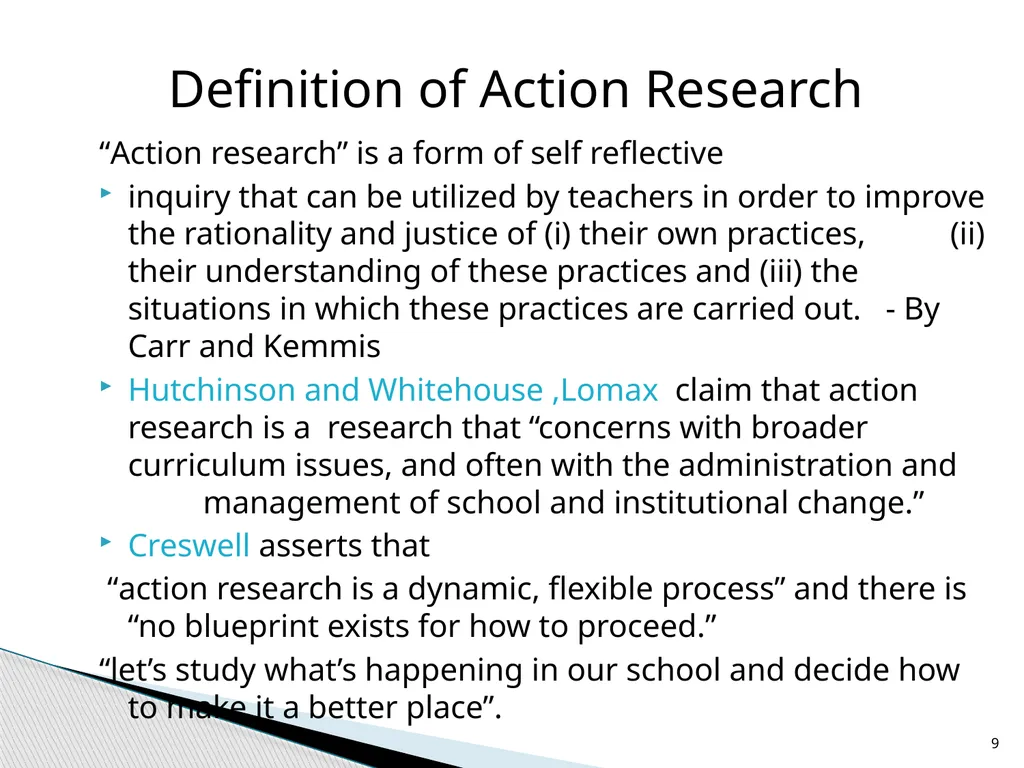
“Action research” is a form of self reflective
inquiry that can be utilized by teachers in order to improve the rationality and justice of (i) their own practices, (ii) their understanding of these practices and (iii) the situations in which these practices are carried out. - By Carr and Kemmis
Hutchinson and Whitehouse ,Lomax claim that action research is a research that “concerns with broader curriculum issues, and often with the administration and management of school and institutional change.”
Creswell asserts that
“action research is a dynamic, flexible process” and there is “no blueprint exists for how to proceed.”
“let’s study what’s happening in our school and decide how to make it a better place”. Definition of Action Research 9<br>
10
Teachers investigate their own practice in new ways, looking deeper in what they and their students actually do and fail to do.
Teachers develop a deeper understanding of students, the teacher learning process and their role in the education of both teachers and students.
Teachers are viewed as equal partners in deciding what works best and what needs improvement in their classroom or classrooms.
In most cases, solutions for identified problems are arrived cooperatively among teachers.
Encourages change in schools
Fosters a democratic approach to education;
Positions teachers and other educators as learners who seek to narrow the gap between practice and their vision education
By Borgia and Schuler [15], Mills [21] Importance of Action Research in Education 10<br>
11
It is participant-driven and reflective;
It is collaborative;
It leads to change and the improvement of
practice not just knowledge in itself; and
It is context-specific. By McDonough
It is carried out by practitioners (classroom teachers) rather than outside researchers;
It is collaborative; and
It aims at changing things.
By Kemmis and Mc Taggart Characteristics of Action Research 11<br>
12
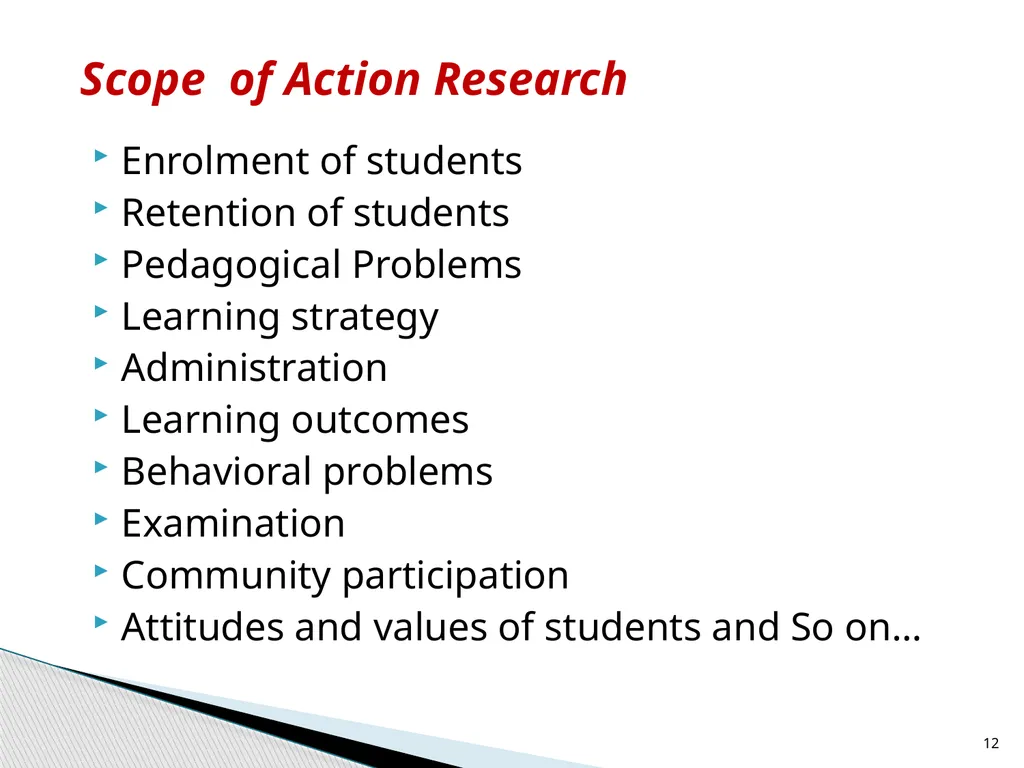
Scope of Action Research Enrolment of students
Retention of students
Pedagogical Problems
Learning strategy
Administration
Learning outcomes
Behavioral problems
Examination
Community participation
Attitudes and values of students and So on… 12<br>
13
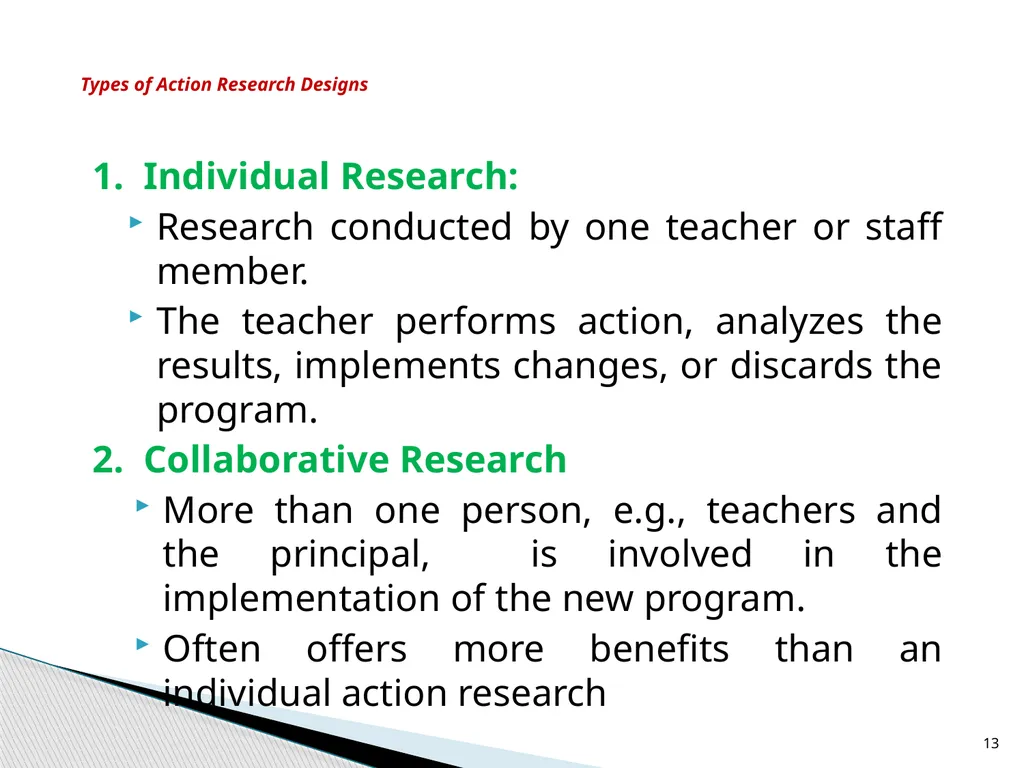
Types of Action Research Designs 1. Individual Research:
Research conducted by one teacher or staff member.
The teacher performs action, analyzes the results, implements changes, or discards the program.
2. Collaborative Research
More than one person, e.g., teachers and the principal, is involved in the implementation of the new program.
Often offers more benefits than an individual action research 13<br>
14
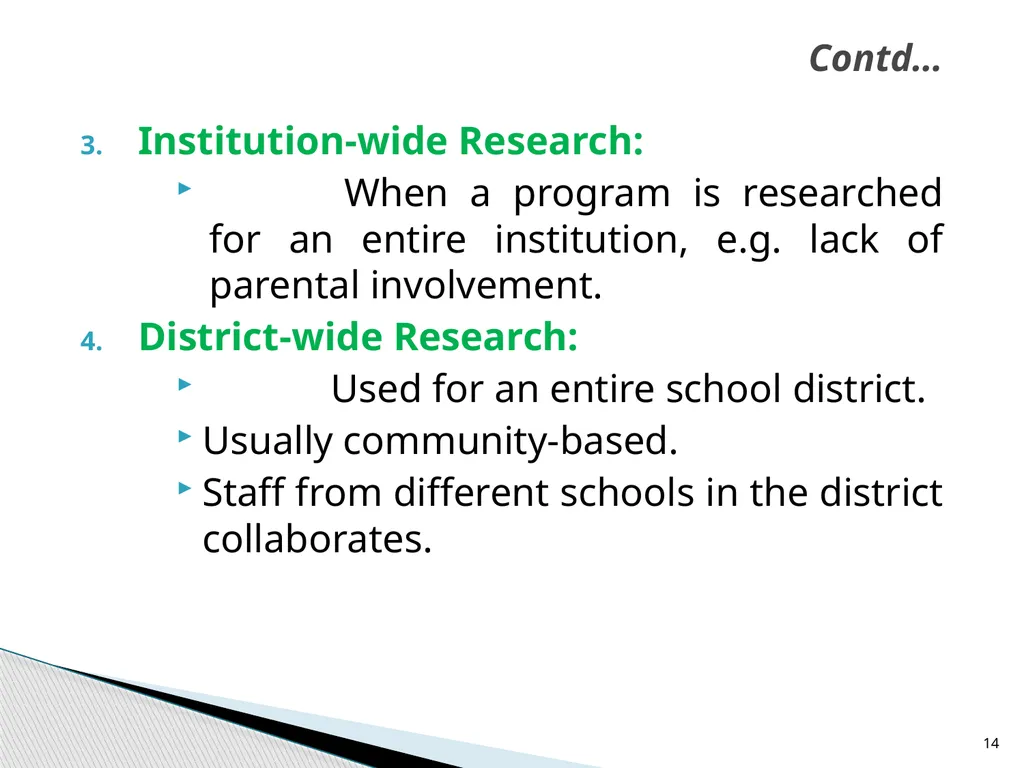
Contd… Institution-wide Research:
When a program is researched for an entire institution, e.g. lack of parental involvement.
District-wide Research:
Used for an entire school district.
Usually community-based.
Staff from different schools in the district collaborates. 14<br>
15
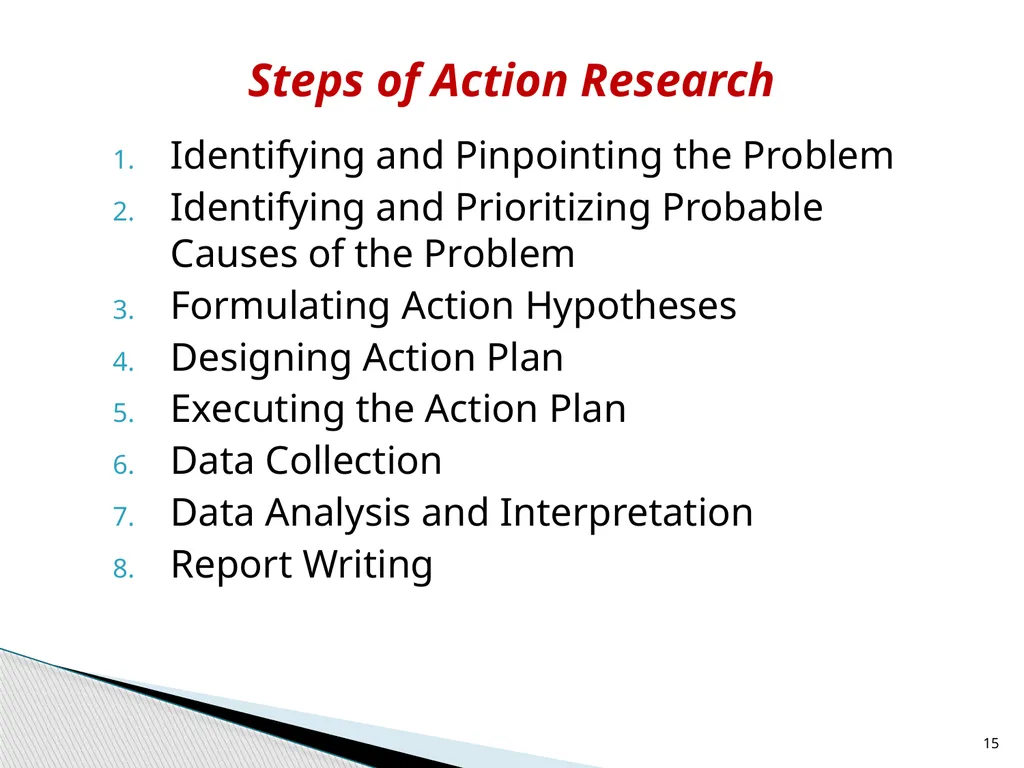
Steps of Action Research Identifying and Pinpointing the Problem
Identifying and Prioritizing Probable Causes of the Problem
Formulating Action Hypotheses
Designing Action Plan
Executing the Action Plan
Data Collection
Data Analysis and Interpretation
Report Writing 15<br>
16
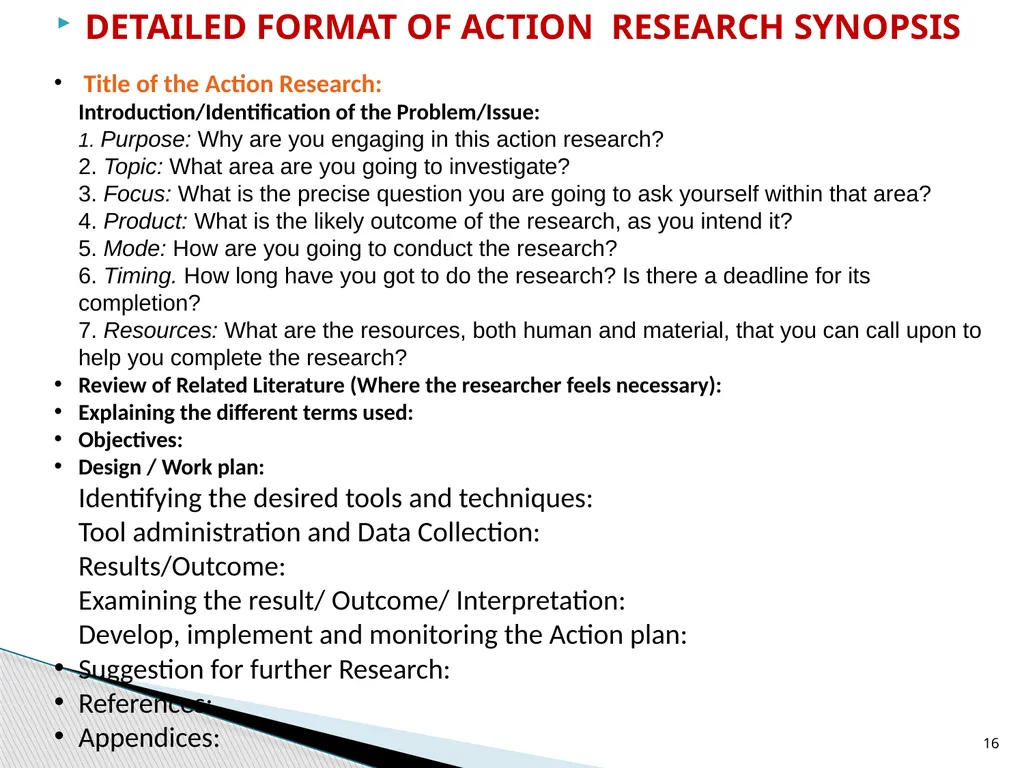
DETAILED FORMAT OF ACTION RESEARCH SYNOPSIS Title of the Action Research:
Introduction/Identification of the Problem/Issue:
1. Purpose: Why are you engaging in this action research?
2. Topic: What area are you going to investigate?
3. Focus: What is the precise question you are going to ask yourself within that area?
4. Product: What is the likely outcome of the research, as you intend it?
5. Mode: How are you going to conduct the research?
6. Timing. How long have you got to do the research? Is there a deadline for its completion?
7. Resources: What are the resources, both human and material, that you can call upon to help you complete the research?
Review of Related Literature (Where the researcher feels necessary):
Explaining the different terms used:
Objectives:
Design / Work plan:
Identifying the desired tools and techniques:
Tool administration and Data Collection:
Results/Outcome:
Examining the result/ Outcome/ Interpretation:
Develop, implement and monitoring the Action plan:
Suggestion for further Research:
References:
Appendices: 16<br>