
Add: Trainer Name Training Date Additional


Description: Add: Trainer Name Training Date Additional Information Observation, Screening, Assessment, and Documentation Reflection Agenda Observation Screening and Referral Assessment Documentation Tying it All Together: Learning Stories
Related Topics
Download Presentation
"Add: Trainer Name Training Date Additional" is the property of its rightful owner. Permission is granted to download and print the materials on this website for personal, non-commercial use only, and to display it on your personal computer provided you do not modify the materials and that you retain all copyright notices contained in the materials. By downloading content from our website, you accept the terms of this agreement.
Presentation Transcript
slide1. Add:
Trainer Name
Training Date
Additional Information Observation, Screening, Assessment, and Documentation<br>
slide2. Reflection<br>
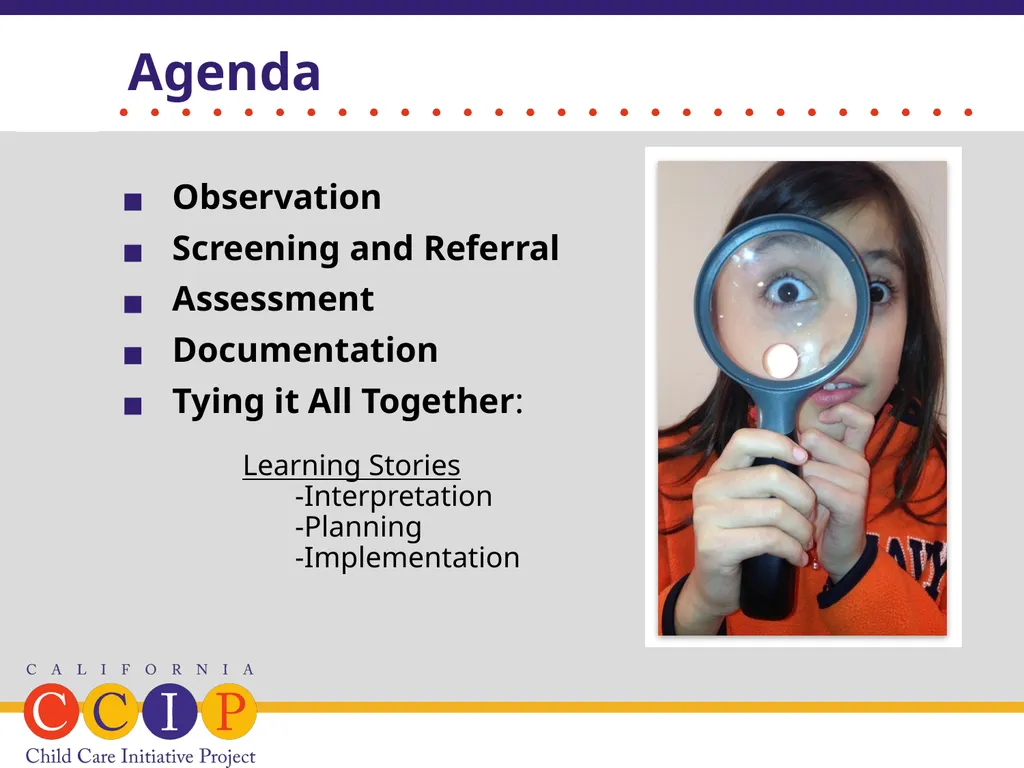
slide3. Agenda Observation
Screening and Referral
Assessment
Documentation
Tying it All Together:
Learning Stories -Interpretation -Planning -Implementation<br>
slide4. Framing Questions How does observation help you discover more about the children in your FCC program?
How does observation help you build on children's learning and plan activities for them?
How can using documentation make children's learning visible?
How can you partner with families to take what you learn from observing their children to another level? http://ececompsat.org/competencies/osad/osad.html<br>
slide5. Exploring Observation<br>
slide6. Exploring Observation WHAT is observation?
WHY do we do it?
HOW do we do it?<br>
slide7. Observation and Values Respectful observation reflects our belief that the way infants and young children behave has purpose, meaning and is worthy of attention.
Observation gives us the opportunity to get important information about the children we provide care for. It effects our work with children and can enhance our communication with their families.<br>
slide8. Observation in Familiar Settings is Key Young children learn by doing; showing knowledge and skills through their activities. Assessment of children during daily activities, routines, and interactions usually produces the most valuable information.
Observe young children engaged in spontaneous behaviors in familiar settings and with people they know. Washington State Office of Superintendent of Public Instruction. (2008). A Guide to Assessment in Early Childhood; Infancy to Age Eight. Retrieved from: http://www.k12.wa.us/EarlyLearning/pubdocs/assessment_print.pdf<br>
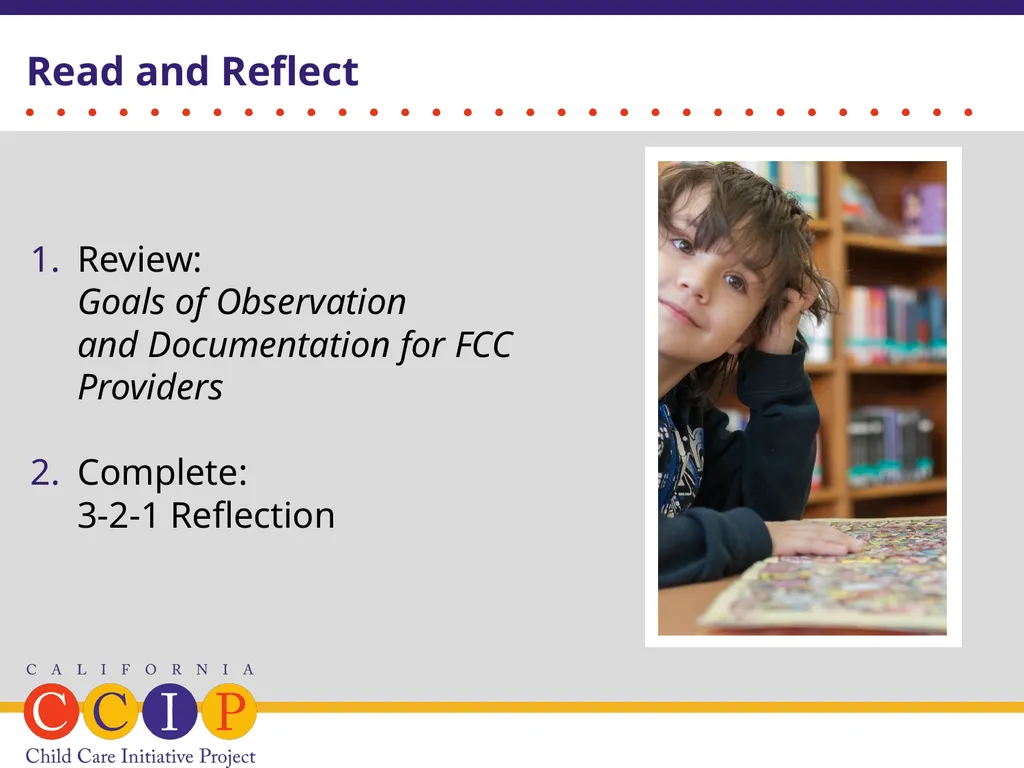
slide9. Read and Reflect Review: Goals of Observation and Documentation for FCC Providers
Complete: 3-2-1 Reflection<br>
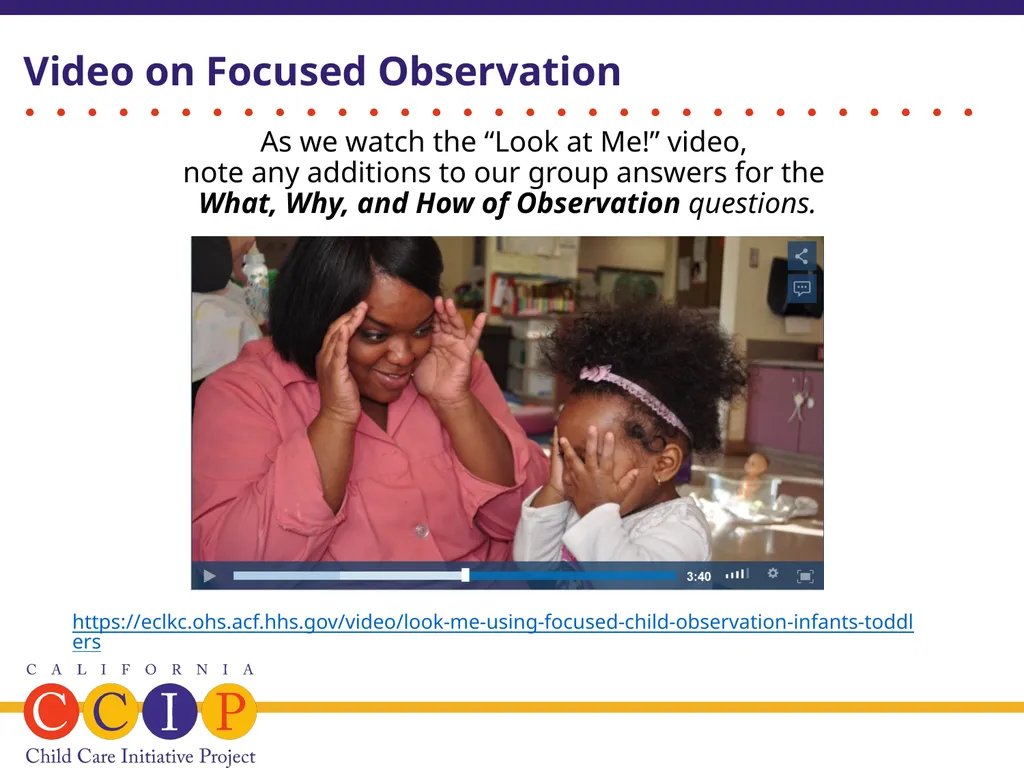
slide10. Video on Focused Observation As we watch the “Look at Me!” video,
note any additions to our group answers for the
What, Why, and How of Observation questions.
https://eclkc.ohs.acf.hhs.gov/video/look-me-using-focused-child-observation-infants-toddlers<br>
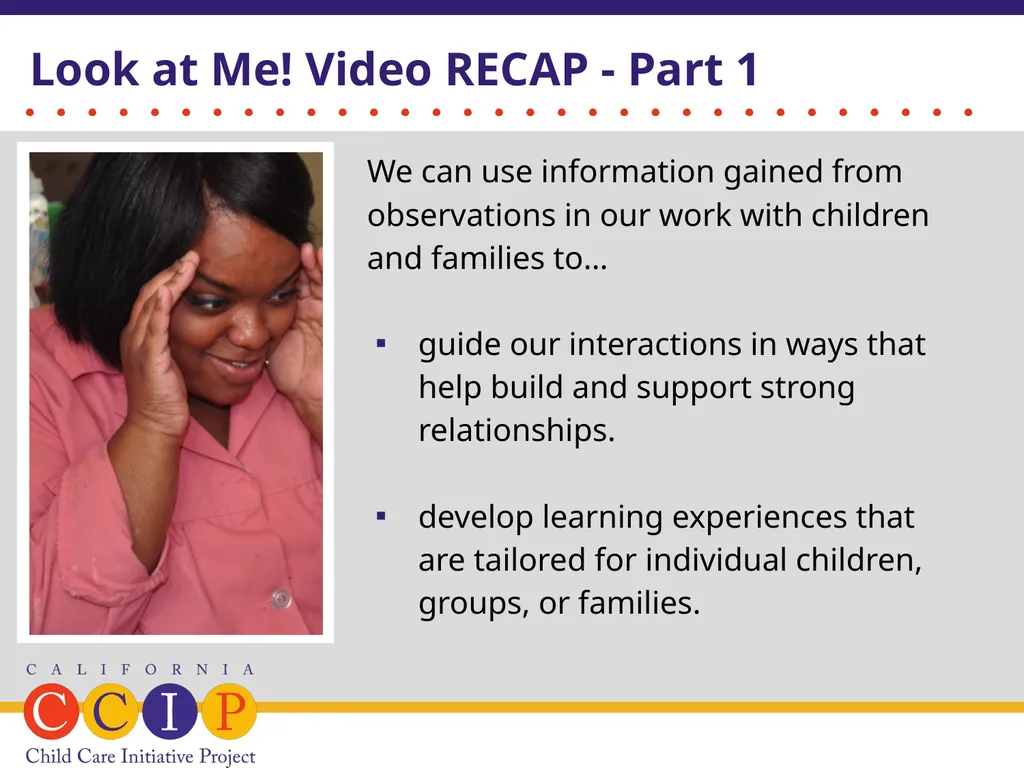
slide11. Look at Me! Video RECAP - Part 1 We can use information gained from observations in our work with children and families to…
guide our interactions in ways that help build and support strong relationships.
develop learning experiences that are tailored for individual children, groups, or families.<br>
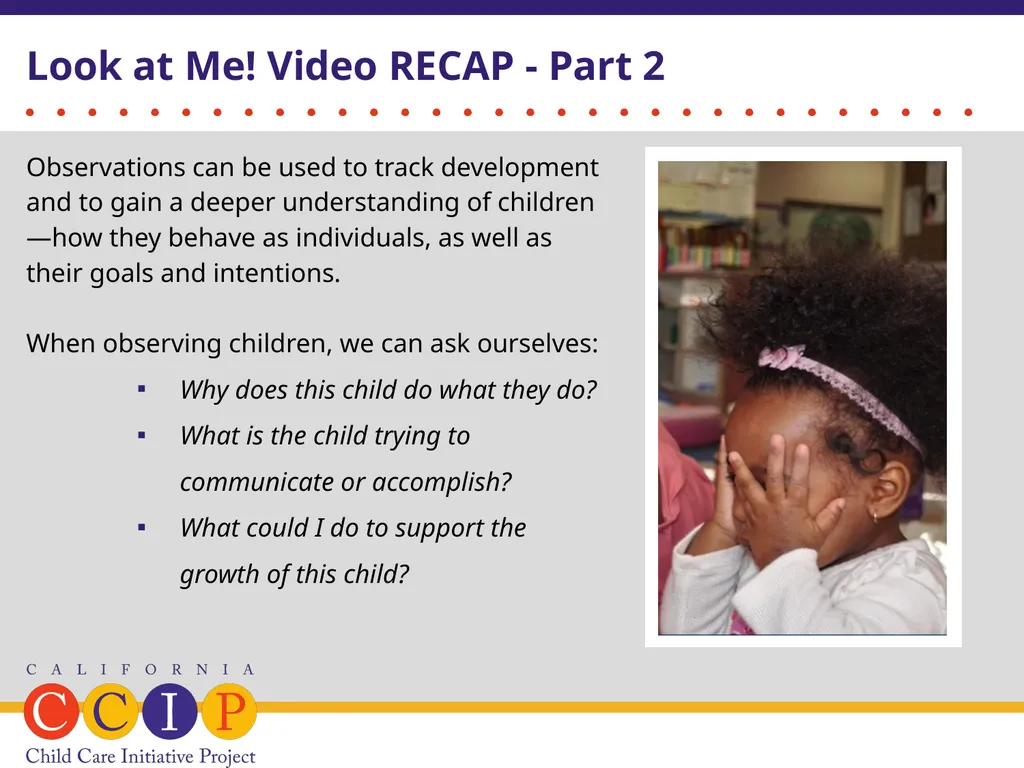
slide12. Look at Me! Video RECAP - Part 2 Observations can be used to track development and to gain a deeper understanding of children—how they behave as individuals, as well as their goals and intentions.
When observing children, we can ask ourselves:
Why does this child do what they do?
What is the child trying to communicate or accomplish?
What could I do to support the growth of this child?<br>
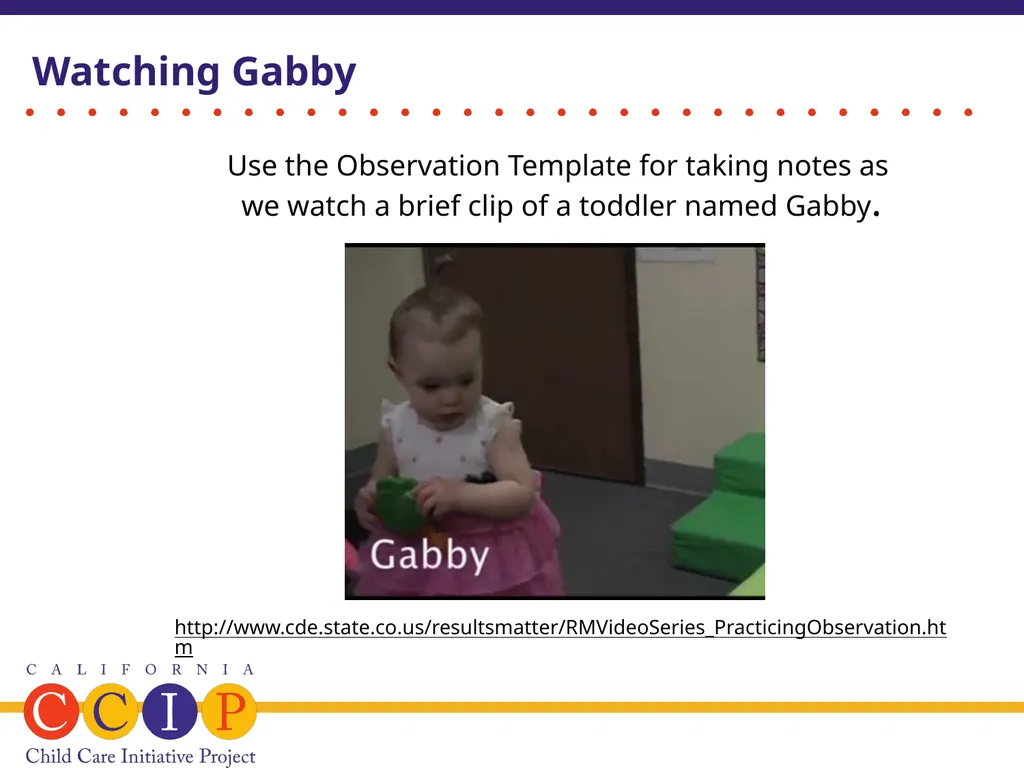
slide13. Watching Gabby Use the Observation Template for taking notes as
we watch a brief clip of a toddler named Gabby.
http://www.cde.state.co.us/resultsmatter/RMVideoSeries_PracticingObservation.htm<br>
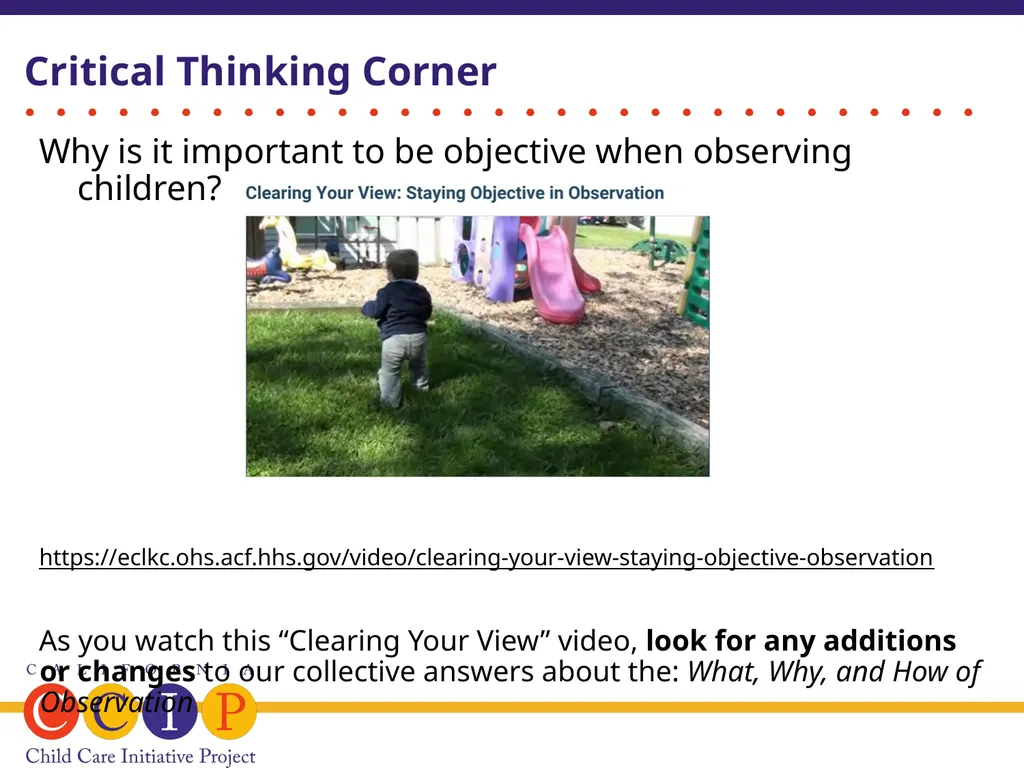
slide14. Critical Thinking Corner Why is it important to be objective when observing children?
https://eclkc.ohs.acf.hhs.gov/video/clearing-your-view-staying-objective-observation
As you watch this “Clearing Your View” video, look for any additions or changes to our collective answers about the: What, Why, and How of Observation<br>
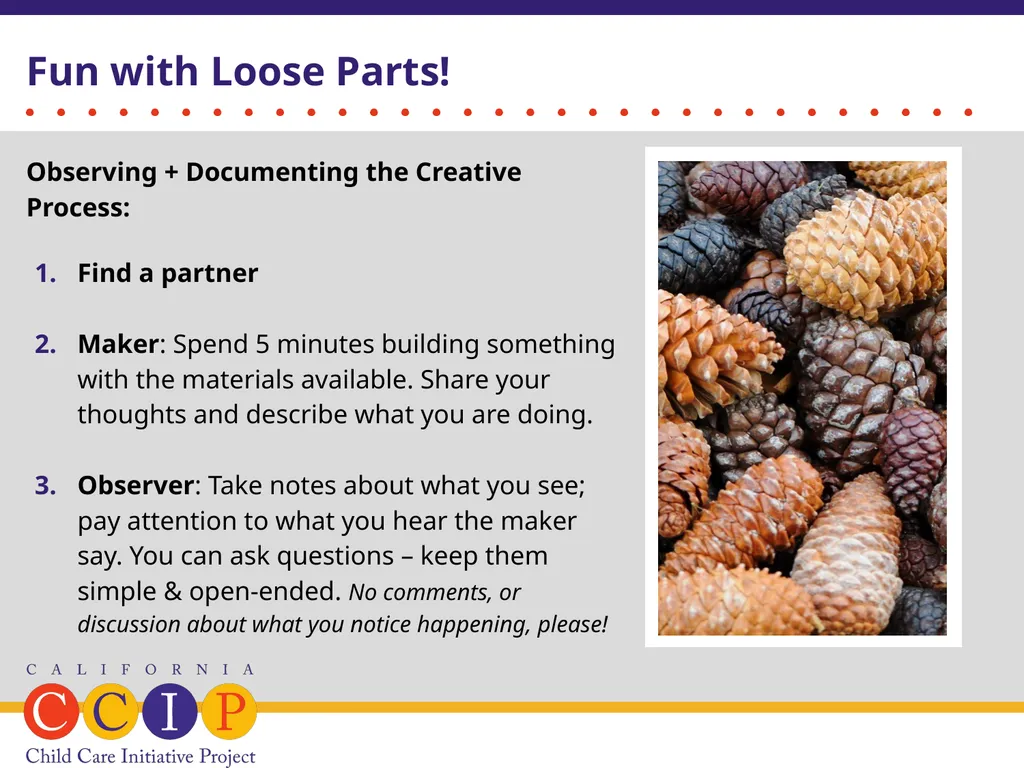
slide15. Fun with Loose Parts! Observing + Documenting the Creative Process:
Find a partner
Maker: Spend 5 minutes building something with the materials available. Share your thoughts and describe what you are doing.
Observer: Take notes about what you see; pay attention to what you hear the maker say. You can ask questions – keep them simple & open-ended. No comments, or discussion about what you notice happening, please!<br>
slide16. Loose Parts: Reflecting on the Observation Observer: What did you notice as you watched and listened?
Maker: What was it like to have open-ended materials to build with?<br>
slide17. Revisiting Observation WHAT is observation?
WHY do we do it?
HOW do we do it?<br>
slide18. Pausing to Reflect on Observation How does observation help you discover more about the children in your care?<br>
slide19. What does OBSERVATION have to do with SCREENING and ASSESSMENT?<br>
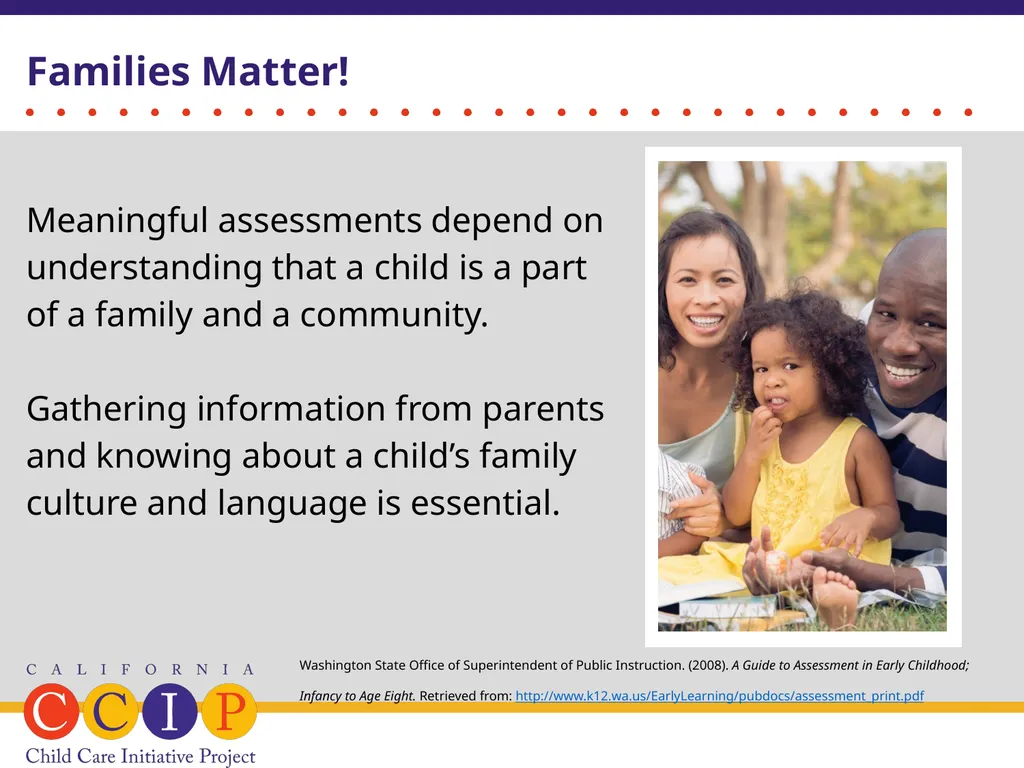
slide20. Families Matter! Meaningful assessments depend on understanding that a child is a part of a family and a community. Gathering information from parents and knowing about a child’s family culture and language is essential. Washington State Office of Superintendent of Public Instruction. (2008). A Guide to Assessment in Early Childhood; Infancy to Age Eight. Retrieved from: http://www.k12.wa.us/EarlyLearning/pubdocs/assessment_print.pdf<br>
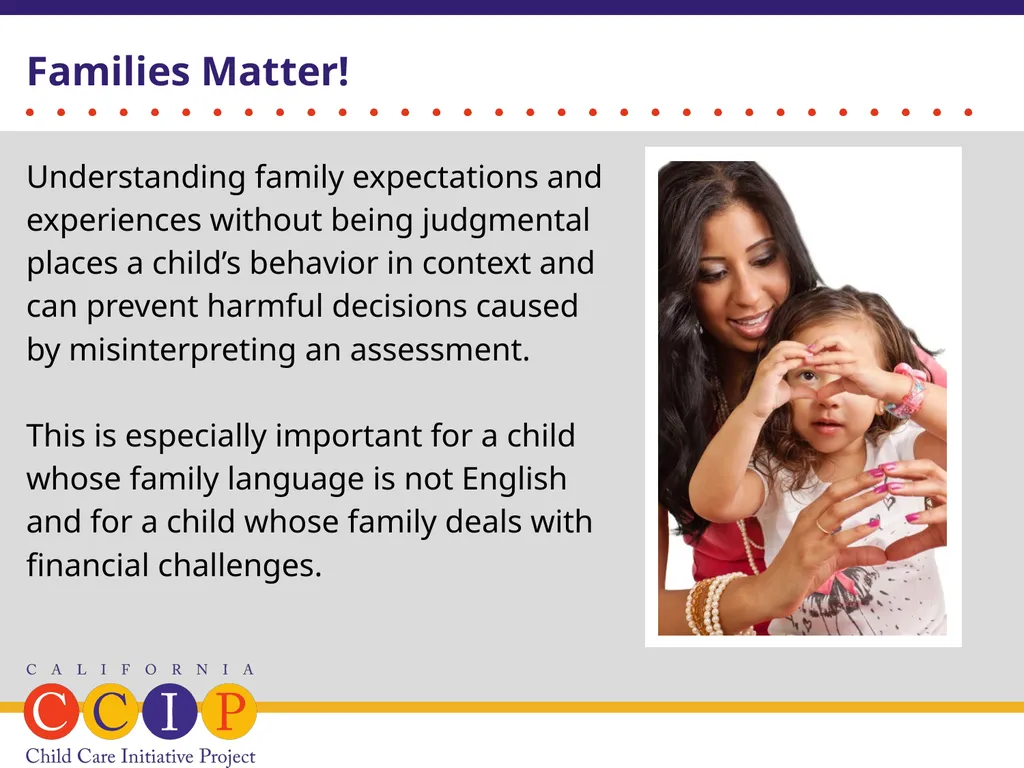
slide21. Families Matter! Understanding family expectations and experiences without being judgmental places a child’s behavior in context and can prevent harmful decisions caused by misinterpreting an assessment. This is especially important for a child whose family language is not English and for a child whose family deals with financial challenges.<br>
slide22. Assessment Discussion What words come to mind when you think of ASSESSMENT?
What does SCREENING mean to you? What kinds of Assessment tools can we name?
Do you use any Assessments in your FCC? Which ones?<br>
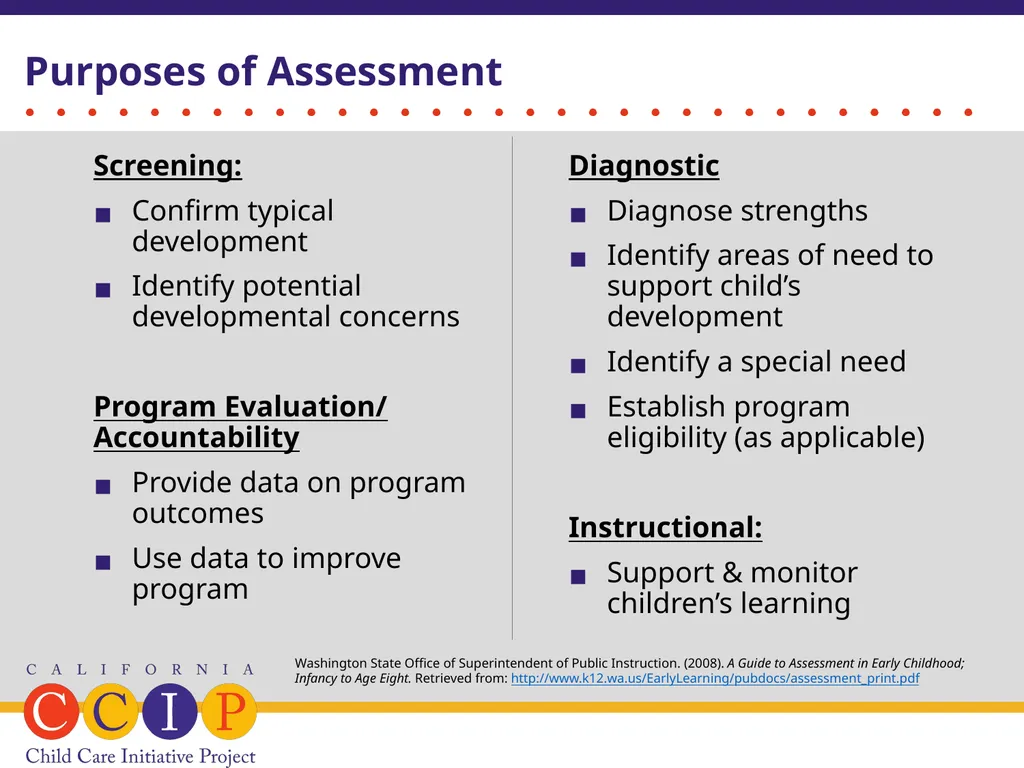
slide23. Purposes of Assessment Screening:
Confirm typical development
Identify potential developmental concerns
Program Evaluation/ Accountability
Provide data on program outcomes
Use data to improve program Diagnostic
Diagnose strengths
Identify areas of need to support child’s development
Identify a special need
Establish program eligibility (as applicable)
Instructional:
Support & monitor children’s learning Washington State Office of Superintendent of Public Instruction. (2008). A Guide to Assessment in Early Childhood; Infancy to Age Eight. Retrieved from: http://www.k12.wa.us/EarlyLearning/pubdocs/assessment_print.pdf<br>
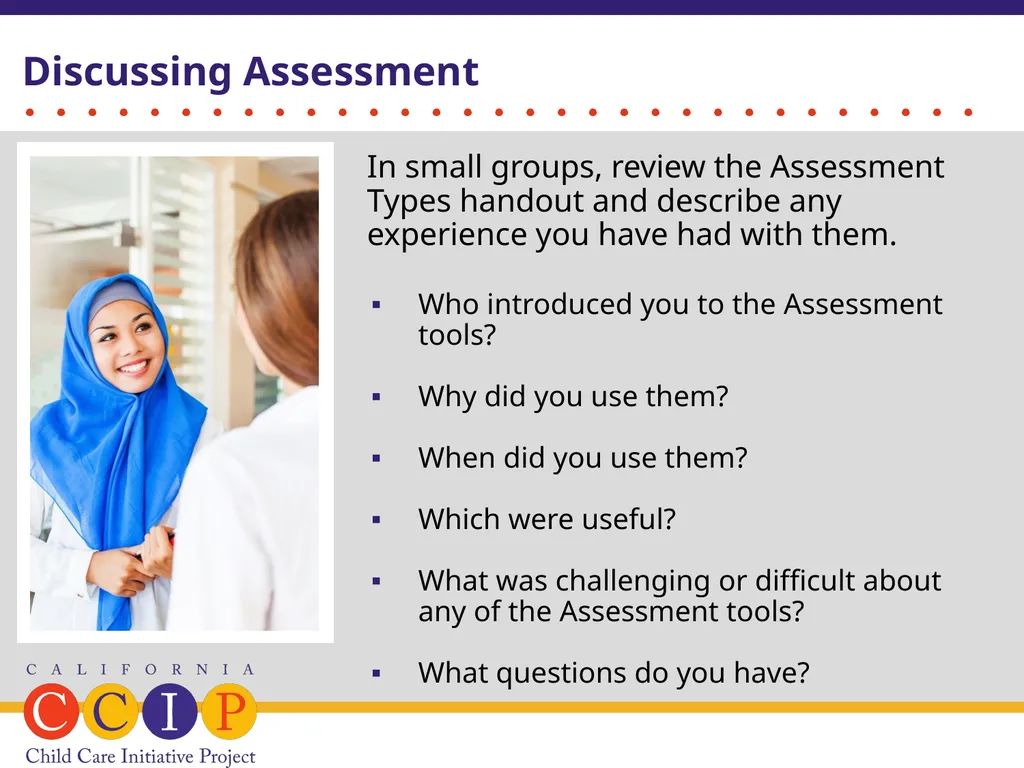
slide24. Discussing Assessment In small groups, review the Assessment Types handout and describe any experience you have had with them.
Who introduced you to the Assessment tools?
Why did you use them?
When did you use them?
Which were useful?
What was challenging or difficult about any of the Assessment tools?
What questions do you have?<br>
slide25. A Different Approach The New Zealand approach to assessment asks educators to consider questions from the child's perspective.
These questions are built on the principles of the Te Whāriki* (Maori phrase for “the woven mat”) curriculum, which provides the framework for defining learning and what is to be learned.
The goals are based on clearly defined values and reflect
five strands… Curtis, D., & Carter, M. (2008). Learning together with young children: A curriculum framework for
reflective teachers. St. Paul: Redleaf as cited in CompSat. (2018). Observation, screening, assessment,
and documentation: Consider the child’s point of view. Retrieved from: http://ececompsat.org/competencies/osad/osad-childview.html<br>
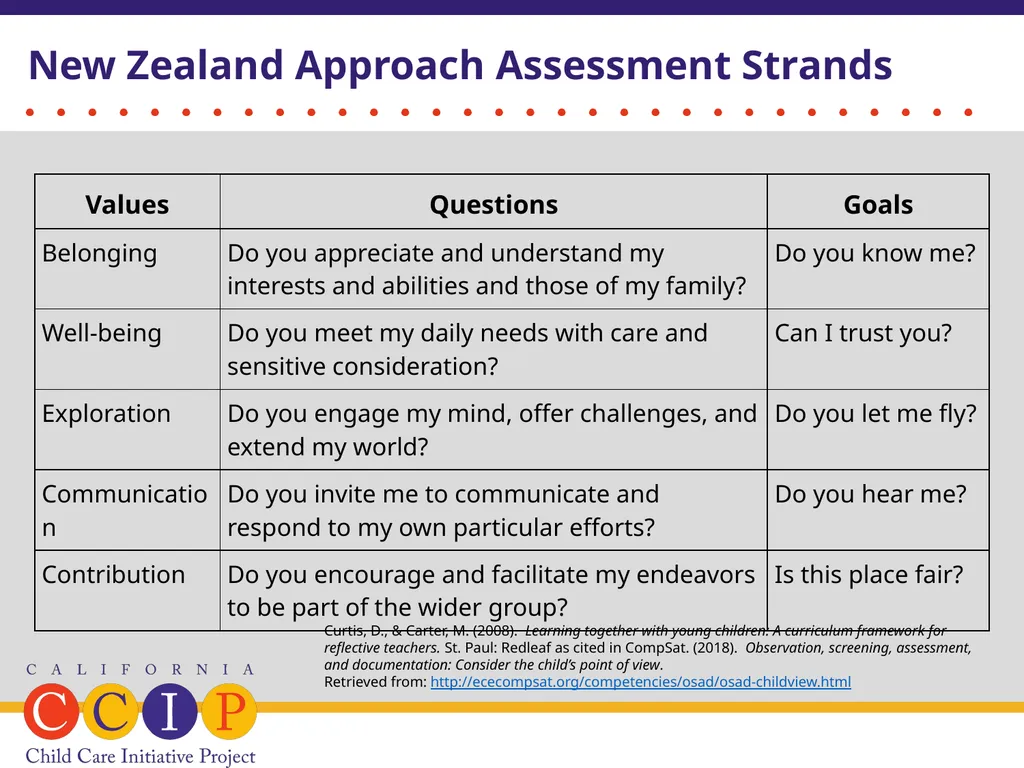
slide26. New Zealand Approach Assessment Strands Curtis, D., & Carter, M. (2008). Learning together with young children: A curriculum framework for reflective teachers. St. Paul: Redleaf as cited in CompSat. (2018). Observation, screening, assessment, and documentation: Consider the child’s point of view. Retrieved from: http://ececompsat.org/competencies/osad/osad-childview.html<br>
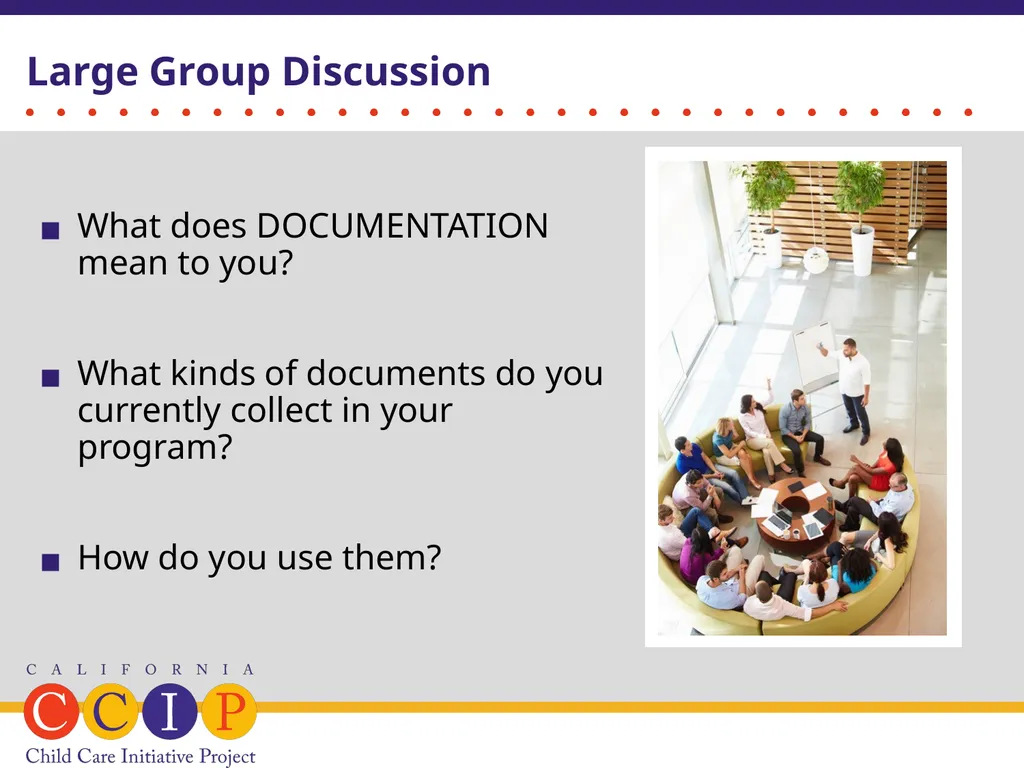
slide27. Large Group Discussion What does DOCUMENTATION mean to you?
What kinds of documents do you currently collect in your program?
How do you use them?<br>
slide28. Documentation: Text Coding As you read the handout, please use these symbols to “code” the text:
! Engaging or gripping, new information
✔ I knew that—good reminder
? Question
≠ Disconnect/confusion/discomfort
★ New ideas or “ah-ha!” moments<br>
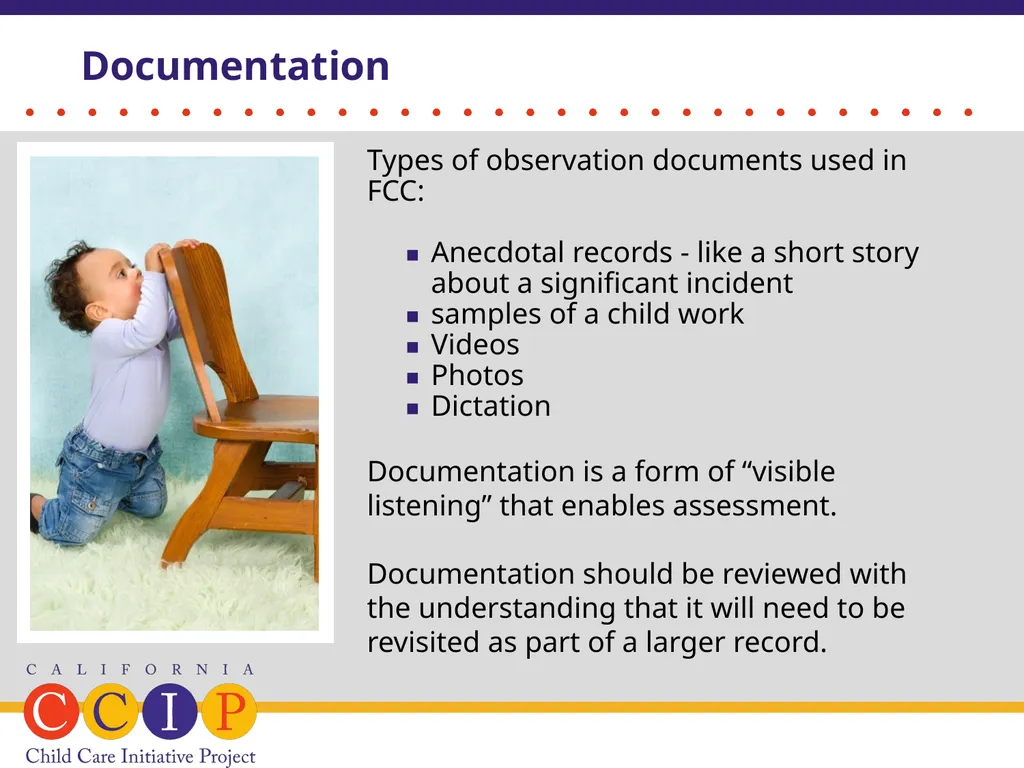
slide29. Documentation Types of observation documents used in FCC:
Anecdotal records - like a short story about a significant incident
samples of a child work
Videos
Photos
Dictation
Documentation is a form of “visible listening” that enables assessment.
Documentation should be reviewed with the understanding that it will need to be revisited as part of a larger record.<br>
slide30. Tying it all together… with LEARNING STORIES!<br>
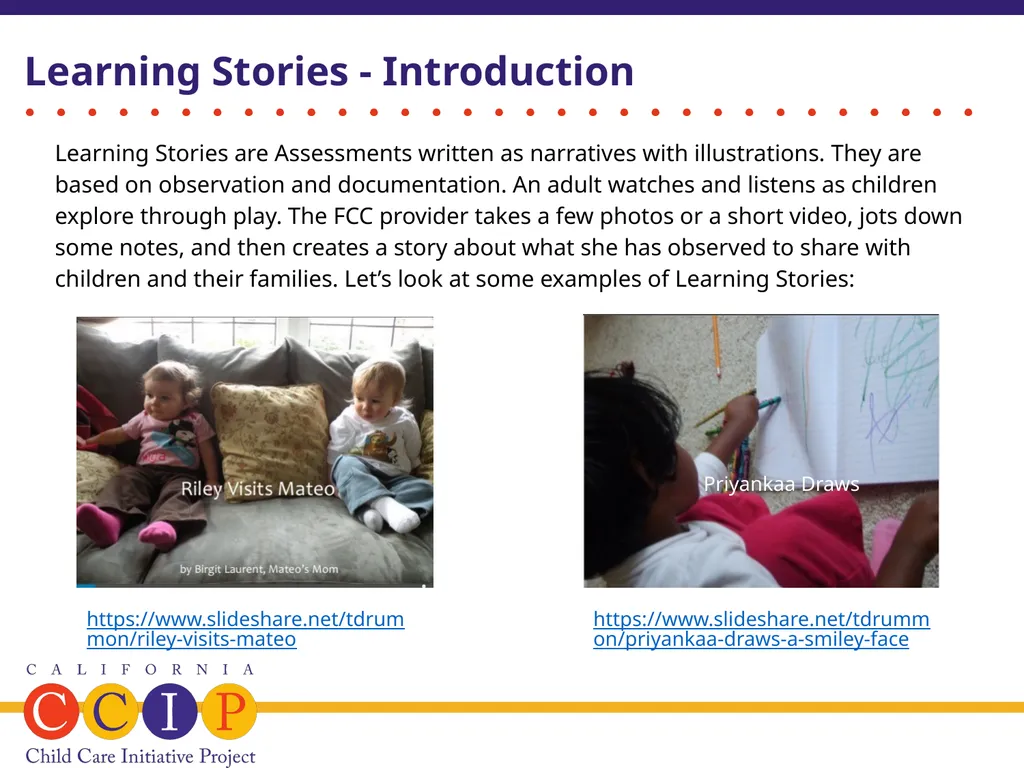
slide31. Learning Stories - Introduction Learning Stories are Assessments written as narratives with illustrations. They are based on observation and documentation. An adult watches and listens as children explore through play. The FCC provider takes a few photos or a short video, jots down some notes, and then creates a story about what she has observed to share with children and their families. Let’s look at some examples of Learning Stories: Priyankaa Draws https://www.slideshare.net/tdrummon/priyankaa-draws-a-smiley-face https://www.slideshare.net/tdrummon/riley-visits-mateo<br>
slide32. Why Use Learning Stories? Benefits for Children
By listening to, observing, and recording children’s explorations, you send a clear message that you value their ideas and thinking.
The child has an opportunity to reflect on her/his own thinking and learning.
All the children in the FCC program have the chance to listen to and participate in each other’s stories and ideas.
“My child is one of those quiet ones who is hard to read. After she shared her Learning Story she became more expressive.” Adapted from http://www.naeyc.org/tyc/article/learning-stories and http://tomdrummond.com/looking-closely-at-children/writing-learning-stories/ both accessed June 21, 2017<br>
slide33. “A child said to me, ‘Teacher, I want a story like that.’”
“The story I wrote was about how two 10-month-olds were so happy to see each other and handed each other toys. Since I read the story to them more connections are forming between the other children as well.” Effect of Learning Stories on Other Children Adapted from http://www.naeyc.org/tyc/article/learning-stories and http://tomdrummond.com/looking-closely-at-children/writing-learning-stories/ both accessed June 21, 2017<br>
slide34. “I had a parent conference after [sharing] the story of their child. A much deeper disclosure happened, not about the story but about the issues they faced at home. This had the effect of opening a non-threatening invitation to share new things about their family with me.”
“The story was given to the family in Chinese. The family read it over and over again. The grandfather, who speaks no English and I had no way to communicate with, was in tears when he read it.” Effect of Learning Stories on Families Adapted from http://www.naeyc.org/tyc/article/learning-stories and http://tomdrummond.com/looking-closely-at-children/writing-learning-stories/ both accessed June 21, 2017<br>
slide35. Learning Stories…
Show how much providers value the children in their FCC.
Provide information about children’s strengths in a friendly, authentic format that demonstrates how children learn through play.
Spotlight how children are capable as natural learners, problem solvers, and eager investigators.
Open a door for continuing conversations with parents and show parents that FCC providers value their input.
Provide parents with insight about how FCC providers plan for their children’s learning.
Provide a way to help families and children share and talk about children’s experiences in family child care. Benefits for Families and the Provider/Family Relationship Adapted from http://www.naeyc.org/tyc/article/learning-stories and http://tomdrummond.com/looking-closely-at-children/writing-learning-stories/ both accessed June 21, 2017<br>
slide36. The provider
Learning stories help FCC providers learn more about the children in their program, how they learn, and child development in general.
The stories provide insight into the best way to plan for more meaningful curriculum.
The stories become part of the child’s portfolio and capture moments in the child’s daily life that will provide a comprehensive profile of the child.
The community
Learning stories can be used as discussion prompts at provider meetings and/or for collaboration with colleagues.
Share learning stories in books, displays, or slides for children, families, other ECE professionals, and community members, to share the message that young children learn through play and are capable. Benefits for Providers and the Community Adapted from http://www.naeyc.org/tyc/article/learning-stories and http://tomdrummond.com/looking-closely-at-children/writing-learning-stories/ both accessed June 21, 2017<br>
slide37. Be curious about how children learn and think.
Regard children’s ideas as worthwhile and interesting.
Believe in the importance of connecting with parents in meaningful ways.
Be self-reflective and willing to use the stories as a catalyst for further understanding, growth, and action. To Embrace Learning Stories FCC Providers Need to… Adapted from http://www.naeyc.org/tyc/article/learning-stories and http://tomdrummond.com/looking-closely-at-children/writing-learning-stories/ both accessed June 21, 2017<br>
slide38. Child-initiated play. The play comes from the child’s ideas, interests, or discoveries.
Engagement. The child is very involved in playing and keeps up the activity or investigation for awhile.
Intentionality. The child has a plan or goal in mind.
Relationships. The child is involved with others or using materials in a way that interests the caregiver.
Learning disposition. The child’s way of learning or approach to figuring things out is shown. What to Look for When Documenting a Learning Story Adapted from http://www.naeyc.org/tyc/article/learning-stories and http://tomdrummond.com/looking-closely-at-children/writing-learning-stories/ both accessed June 21, 2017<br>
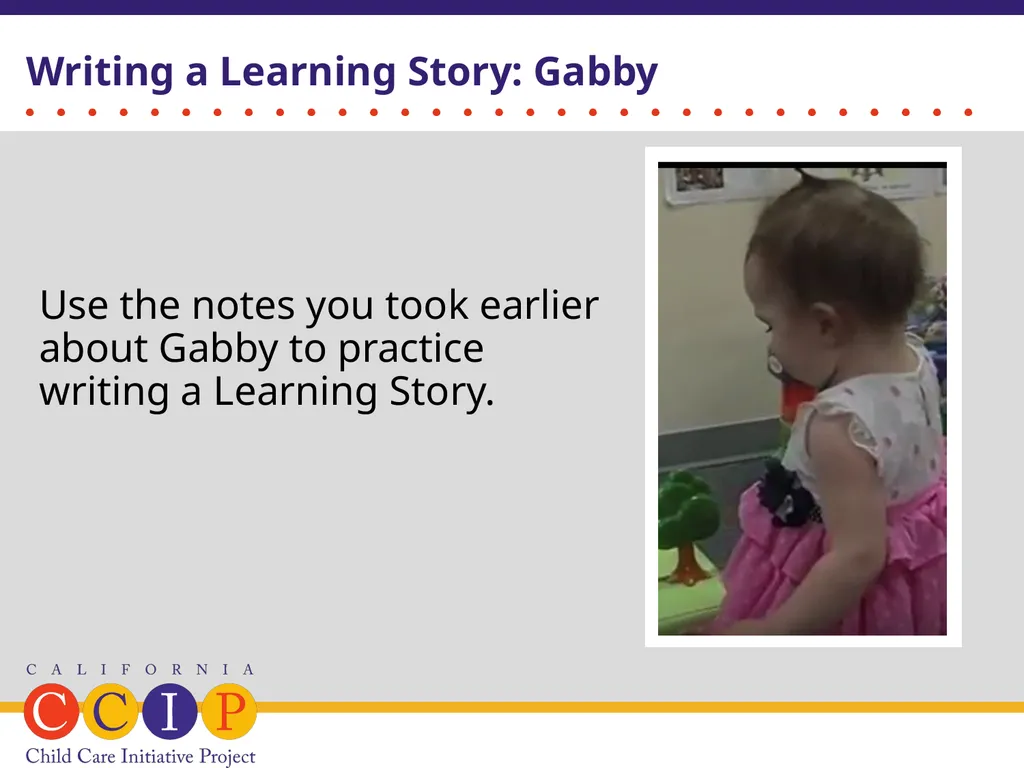
slide39. Writing a Learning Story: Gabby Use the notes you took earlier about Gabby to practice writing a Learning Story.<br>
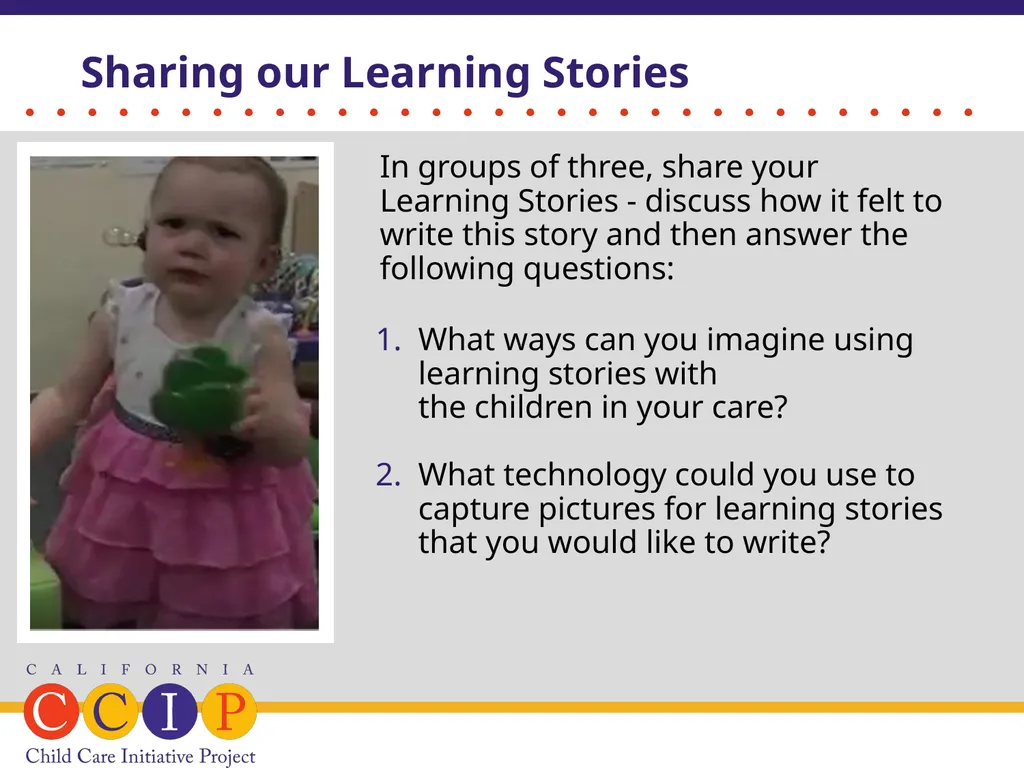
slide40. Sharing our Learning Stories In groups of three, share your Learning Stories - discuss how it felt to write this story and then answer the following questions:
What ways can you imagine using learning stories with the children in your care?
What technology could you use to capture pictures for learning stories that you would like to write?<br>
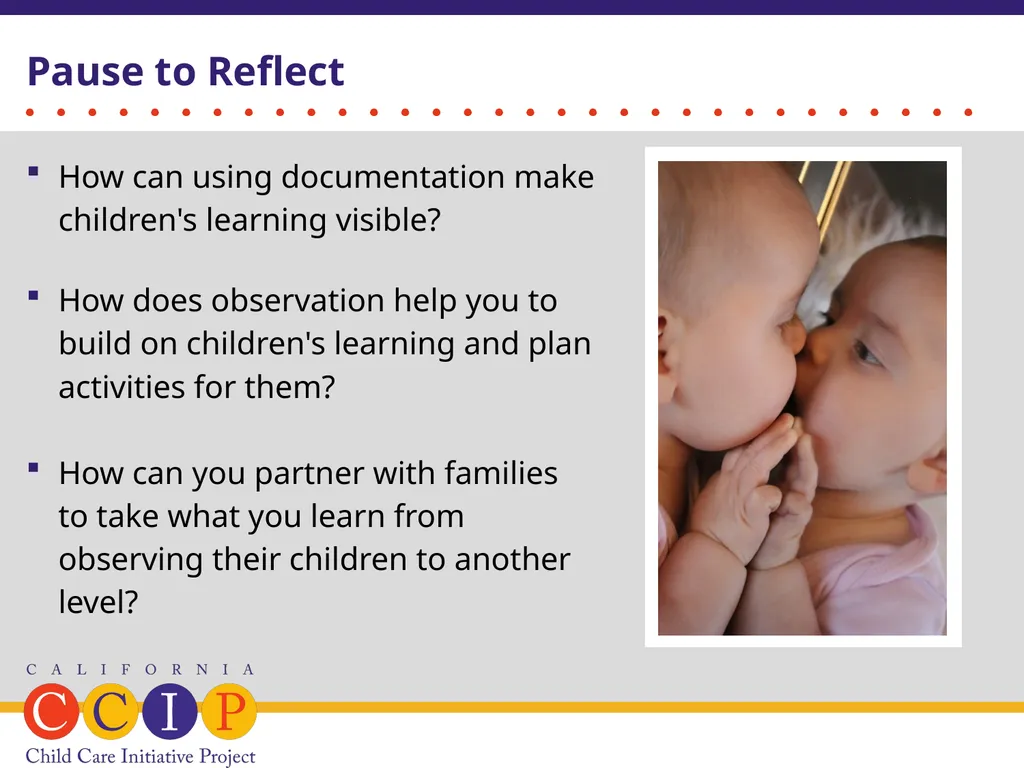
slide41. Pause to Reflect How can using documentation make children's learning visible?
How does observation help you to build on children's learning and plan activities for them?
How can you partner with families to take what you learn from observing their children to another level?<br>
slide42. Reflection What you learn matters!<br>
slide43. Thank you for participating! Closing thoughts?
Most important takeaways?<br>
Trainer Name
Training Date
Additional Information Observation, Screening, Assessment, and Documentation<br>
slide2. Reflection<br>
slide3. Agenda Observation
Screening and Referral
Assessment
Documentation
Tying it All Together:
Learning Stories -Interpretation -Planning -Implementation<br>
slide4. Framing Questions How does observation help you discover more about the children in your FCC program?
How does observation help you build on children's learning and plan activities for them?
How can using documentation make children's learning visible?
How can you partner with families to take what you learn from observing their children to another level? http://ececompsat.org/competencies/osad/osad.html<br>
slide5. Exploring Observation<br>
slide6. Exploring Observation WHAT is observation?
WHY do we do it?
HOW do we do it?<br>
slide7. Observation and Values Respectful observation reflects our belief that the way infants and young children behave has purpose, meaning and is worthy of attention.
Observation gives us the opportunity to get important information about the children we provide care for. It effects our work with children and can enhance our communication with their families.<br>
slide8. Observation in Familiar Settings is Key Young children learn by doing; showing knowledge and skills through their activities. Assessment of children during daily activities, routines, and interactions usually produces the most valuable information.
Observe young children engaged in spontaneous behaviors in familiar settings and with people they know. Washington State Office of Superintendent of Public Instruction. (2008). A Guide to Assessment in Early Childhood; Infancy to Age Eight. Retrieved from: http://www.k12.wa.us/EarlyLearning/pubdocs/assessment_print.pdf<br>
slide9. Read and Reflect Review: Goals of Observation and Documentation for FCC Providers
Complete: 3-2-1 Reflection<br>
slide10. Video on Focused Observation As we watch the “Look at Me!” video,
note any additions to our group answers for the
What, Why, and How of Observation questions.
https://eclkc.ohs.acf.hhs.gov/video/look-me-using-focused-child-observation-infants-toddlers<br>
slide11. Look at Me! Video RECAP - Part 1 We can use information gained from observations in our work with children and families to…
guide our interactions in ways that help build and support strong relationships.
develop learning experiences that are tailored for individual children, groups, or families.<br>
slide12. Look at Me! Video RECAP - Part 2 Observations can be used to track development and to gain a deeper understanding of children—how they behave as individuals, as well as their goals and intentions.
When observing children, we can ask ourselves:
Why does this child do what they do?
What is the child trying to communicate or accomplish?
What could I do to support the growth of this child?<br>
slide13. Watching Gabby Use the Observation Template for taking notes as
we watch a brief clip of a toddler named Gabby.
http://www.cde.state.co.us/resultsmatter/RMVideoSeries_PracticingObservation.htm<br>
slide14. Critical Thinking Corner Why is it important to be objective when observing children?
https://eclkc.ohs.acf.hhs.gov/video/clearing-your-view-staying-objective-observation
As you watch this “Clearing Your View” video, look for any additions or changes to our collective answers about the: What, Why, and How of Observation<br>
slide15. Fun with Loose Parts! Observing + Documenting the Creative Process:
Find a partner
Maker: Spend 5 minutes building something with the materials available. Share your thoughts and describe what you are doing.
Observer: Take notes about what you see; pay attention to what you hear the maker say. You can ask questions – keep them simple & open-ended. No comments, or discussion about what you notice happening, please!<br>
slide16. Loose Parts: Reflecting on the Observation Observer: What did you notice as you watched and listened?
Maker: What was it like to have open-ended materials to build with?<br>
slide17. Revisiting Observation WHAT is observation?
WHY do we do it?
HOW do we do it?<br>
slide18. Pausing to Reflect on Observation How does observation help you discover more about the children in your care?<br>
slide19. What does OBSERVATION have to do with SCREENING and ASSESSMENT?<br>
slide20. Families Matter! Meaningful assessments depend on understanding that a child is a part of a family and a community. Gathering information from parents and knowing about a child’s family culture and language is essential. Washington State Office of Superintendent of Public Instruction. (2008). A Guide to Assessment in Early Childhood; Infancy to Age Eight. Retrieved from: http://www.k12.wa.us/EarlyLearning/pubdocs/assessment_print.pdf<br>
slide21. Families Matter! Understanding family expectations and experiences without being judgmental places a child’s behavior in context and can prevent harmful decisions caused by misinterpreting an assessment. This is especially important for a child whose family language is not English and for a child whose family deals with financial challenges.<br>
slide22. Assessment Discussion What words come to mind when you think of ASSESSMENT?
What does SCREENING mean to you? What kinds of Assessment tools can we name?
Do you use any Assessments in your FCC? Which ones?<br>
slide23. Purposes of Assessment Screening:
Confirm typical development
Identify potential developmental concerns
Program Evaluation/ Accountability
Provide data on program outcomes
Use data to improve program Diagnostic
Diagnose strengths
Identify areas of need to support child’s development
Identify a special need
Establish program eligibility (as applicable)
Instructional:
Support & monitor children’s learning Washington State Office of Superintendent of Public Instruction. (2008). A Guide to Assessment in Early Childhood; Infancy to Age Eight. Retrieved from: http://www.k12.wa.us/EarlyLearning/pubdocs/assessment_print.pdf<br>
slide24. Discussing Assessment In small groups, review the Assessment Types handout and describe any experience you have had with them.
Who introduced you to the Assessment tools?
Why did you use them?
When did you use them?
Which were useful?
What was challenging or difficult about any of the Assessment tools?
What questions do you have?<br>
slide25. A Different Approach The New Zealand approach to assessment asks educators to consider questions from the child's perspective.
These questions are built on the principles of the Te Whāriki* (Maori phrase for “the woven mat”) curriculum, which provides the framework for defining learning and what is to be learned.
The goals are based on clearly defined values and reflect
five strands… Curtis, D., & Carter, M. (2008). Learning together with young children: A curriculum framework for
reflective teachers. St. Paul: Redleaf as cited in CompSat. (2018). Observation, screening, assessment,
and documentation: Consider the child’s point of view. Retrieved from: http://ececompsat.org/competencies/osad/osad-childview.html<br>
slide26. New Zealand Approach Assessment Strands Curtis, D., & Carter, M. (2008). Learning together with young children: A curriculum framework for reflective teachers. St. Paul: Redleaf as cited in CompSat. (2018). Observation, screening, assessment, and documentation: Consider the child’s point of view. Retrieved from: http://ececompsat.org/competencies/osad/osad-childview.html<br>
slide27. Large Group Discussion What does DOCUMENTATION mean to you?
What kinds of documents do you currently collect in your program?
How do you use them?<br>
slide28. Documentation: Text Coding As you read the handout, please use these symbols to “code” the text:
! Engaging or gripping, new information
✔ I knew that—good reminder
? Question
≠ Disconnect/confusion/discomfort
★ New ideas or “ah-ha!” moments<br>
slide29. Documentation Types of observation documents used in FCC:
Anecdotal records - like a short story about a significant incident
samples of a child work
Videos
Photos
Dictation
Documentation is a form of “visible listening” that enables assessment.
Documentation should be reviewed with the understanding that it will need to be revisited as part of a larger record.<br>
slide30. Tying it all together… with LEARNING STORIES!<br>
slide31. Learning Stories - Introduction Learning Stories are Assessments written as narratives with illustrations. They are based on observation and documentation. An adult watches and listens as children explore through play. The FCC provider takes a few photos or a short video, jots down some notes, and then creates a story about what she has observed to share with children and their families. Let’s look at some examples of Learning Stories: Priyankaa Draws https://www.slideshare.net/tdrummon/priyankaa-draws-a-smiley-face https://www.slideshare.net/tdrummon/riley-visits-mateo<br>
slide32. Why Use Learning Stories? Benefits for Children
By listening to, observing, and recording children’s explorations, you send a clear message that you value their ideas and thinking.
The child has an opportunity to reflect on her/his own thinking and learning.
All the children in the FCC program have the chance to listen to and participate in each other’s stories and ideas.
“My child is one of those quiet ones who is hard to read. After she shared her Learning Story she became more expressive.” Adapted from http://www.naeyc.org/tyc/article/learning-stories and http://tomdrummond.com/looking-closely-at-children/writing-learning-stories/ both accessed June 21, 2017<br>
slide33. “A child said to me, ‘Teacher, I want a story like that.’”
“The story I wrote was about how two 10-month-olds were so happy to see each other and handed each other toys. Since I read the story to them more connections are forming between the other children as well.” Effect of Learning Stories on Other Children Adapted from http://www.naeyc.org/tyc/article/learning-stories and http://tomdrummond.com/looking-closely-at-children/writing-learning-stories/ both accessed June 21, 2017<br>
slide34. “I had a parent conference after [sharing] the story of their child. A much deeper disclosure happened, not about the story but about the issues they faced at home. This had the effect of opening a non-threatening invitation to share new things about their family with me.”
“The story was given to the family in Chinese. The family read it over and over again. The grandfather, who speaks no English and I had no way to communicate with, was in tears when he read it.” Effect of Learning Stories on Families Adapted from http://www.naeyc.org/tyc/article/learning-stories and http://tomdrummond.com/looking-closely-at-children/writing-learning-stories/ both accessed June 21, 2017<br>
slide35. Learning Stories…
Show how much providers value the children in their FCC.
Provide information about children’s strengths in a friendly, authentic format that demonstrates how children learn through play.
Spotlight how children are capable as natural learners, problem solvers, and eager investigators.
Open a door for continuing conversations with parents and show parents that FCC providers value their input.
Provide parents with insight about how FCC providers plan for their children’s learning.
Provide a way to help families and children share and talk about children’s experiences in family child care. Benefits for Families and the Provider/Family Relationship Adapted from http://www.naeyc.org/tyc/article/learning-stories and http://tomdrummond.com/looking-closely-at-children/writing-learning-stories/ both accessed June 21, 2017<br>
slide36. The provider
Learning stories help FCC providers learn more about the children in their program, how they learn, and child development in general.
The stories provide insight into the best way to plan for more meaningful curriculum.
The stories become part of the child’s portfolio and capture moments in the child’s daily life that will provide a comprehensive profile of the child.
The community
Learning stories can be used as discussion prompts at provider meetings and/or for collaboration with colleagues.
Share learning stories in books, displays, or slides for children, families, other ECE professionals, and community members, to share the message that young children learn through play and are capable. Benefits for Providers and the Community Adapted from http://www.naeyc.org/tyc/article/learning-stories and http://tomdrummond.com/looking-closely-at-children/writing-learning-stories/ both accessed June 21, 2017<br>
slide37. Be curious about how children learn and think.
Regard children’s ideas as worthwhile and interesting.
Believe in the importance of connecting with parents in meaningful ways.
Be self-reflective and willing to use the stories as a catalyst for further understanding, growth, and action. To Embrace Learning Stories FCC Providers Need to… Adapted from http://www.naeyc.org/tyc/article/learning-stories and http://tomdrummond.com/looking-closely-at-children/writing-learning-stories/ both accessed June 21, 2017<br>
slide38. Child-initiated play. The play comes from the child’s ideas, interests, or discoveries.
Engagement. The child is very involved in playing and keeps up the activity or investigation for awhile.
Intentionality. The child has a plan or goal in mind.
Relationships. The child is involved with others or using materials in a way that interests the caregiver.
Learning disposition. The child’s way of learning or approach to figuring things out is shown. What to Look for When Documenting a Learning Story Adapted from http://www.naeyc.org/tyc/article/learning-stories and http://tomdrummond.com/looking-closely-at-children/writing-learning-stories/ both accessed June 21, 2017<br>
slide39. Writing a Learning Story: Gabby Use the notes you took earlier about Gabby to practice writing a Learning Story.<br>
slide40. Sharing our Learning Stories In groups of three, share your Learning Stories - discuss how it felt to write this story and then answer the following questions:
What ways can you imagine using learning stories with the children in your care?
What technology could you use to capture pictures for learning stories that you would like to write?<br>
slide41. Pause to Reflect How can using documentation make children's learning visible?
How does observation help you to build on children's learning and plan activities for them?
How can you partner with families to take what you learn from observing their children to another level?<br>
slide42. Reflection What you learn matters!<br>
slide43. Thank you for participating! Closing thoughts?
Most important takeaways?<br>