
Addressing Autism in Early Intervention Practice
SB
Published · 53 slides · 0 views
1 / 1
Description
Addressing Autism in Early Intervention Practice Part 2 Intervention Approaches for Young Children with ASD: Naturalistic Behavioral Developmental Interventions Autism Modules 1 and 2: Introduction This resource, consisting of 2 modules, is
Related Topics
Share
Embed code
Download this presentation From Below
"Addressing Autism in Early Intervention Practice" is the property of its rightful owner. Permission is granted to download and print the materials on this website for personal, non-commercial use only, and to display it on your personal computer provided you do not modify the materials and that you retain all copyright notices contained in the materials. By downloading content from our website, you accept the terms of this agreement.
Presentation Transcript
01
Addressing Autism in Early Intervention Practice
Part 2 Intervention Approaches for Young Children with ASD: Naturalistic Behavioral Developmental Interventions<br>
02
Autism Modules 1 and 2: Introduction This resource, consisting of 2 modules, is designed to provide EI/ECSE professionals with a functional understanding of autism spectrum disorder (ASD) in young children, how to support early identification, diagnosis, and referral to services, and to review effective, evidence-based interventions designed for use with this population.
Before you get started with this module, please create a sign-in name and password at Autism Navigator Resources: https://resources.autismnavigator.com/. After you sign in, you will have access to each of the video activities you will complete over the course of the Module.<br>
Before you get started with this module, please create a sign-in name and password at Autism Navigator Resources: https://resources.autismnavigator.com/. After you sign in, you will have access to each of the video activities you will complete over the course of the Module.<br>
03
Overview of Module 2 Thanks to early screening efforts, thousands of children are now being diagnosed before their third birthday and referred to early intervention. Although EI/ECSE professionals are often trained in the use of ASD interventions designed for children over the age of 5 years, the EI/ECSE workforce requires access to information about evidence-based intervention models for use with the youngest children with ASD and their families, including toddlers. In this presentation, we review the elements of Naturalistic Developmental Behavior Interventions, an umbrella term for evidence-based approaches that combine the tenets of behavioral and developmental theory to integrate intervention into everyday caregiving and play routines of very young children and their families.<br>
04
Objectives Describe the history of interventions for children with ASD since the 1950’s to the present day
Identify the 2 theoretical approaches that inform Naturalistic Developmental Behavior Interventions (NDBIs)
Identify specific ways in NDBI procedures meet the specific needs of young children with ASD
List examples of commonly-used research-validated NDBI models designed for use with young children
List common elements often used by NDBI interventions designed for use with young children<br>
05
A Brief History of Autism Interventions for Children Until the 1960’s, it was thought that children with ASD unlikely to respond to treatment
Across the 60’s and 70’s studies with children (generally over the age of three) indicated effectiveness of operant conditioning to teach language, social skills, adaptive behaviors, and reduce challenging behaviors
Implemented directly with children by experts, parents were also often taught to be interventionists
New field of Applied Behavior Analysis (ABA) emerged - the science of how environmental changes affect human behaviors<br>
06
Lovaas Study In 1987, a study was published that demonstrated huge improvements and even recovery for almost half of the children in typical school placements
Led to 2 new trends:
Parents advocated for early intensive behavioral treatment and insurance reform
Discrete Trial Training (DTT) became increasingly popular
Lovaas, O. I. (1987). Behavioral treatment and normal educational and intellectual functioning in young autistic children. Journal of Consulting and Clinical Psychology, 55, 3–9.<br>
07
Discrete Trial Training (DTT) A highly structured operant methodology: skills are broken down into components and taught one at a time in discrete trials
Used to teach basic skills to children who have not learned these skills in their natural environment
An expert interventionist develops an individualized plan for the child, and uses a system of prompts and reinforcement to elicit targeted behaviors
Used in Early Intensive Behavioral Intervention (EIBI) for use with children under the age of 5<br>
08
Activity: Discrete Trial Training/EIBI Access the Autism Navigator site and sign into the Video Glossary. On the left menu, select Treatments and click on Discrete Trial Training. View the first video on the left.
What behaviors was the interventionist targeting? What kind of reinforcement was being used? How would you describe the context/setting of the intervention?<br>
What behaviors was the interventionist targeting? What kind of reinforcement was being used? How would you describe the context/setting of the intervention?<br>
09
Discrete Trial Training, continued While demonstrated to be moderately effective in teaching specific skills, limitations in functional benefits:
Children less likely to generalize new skills across multiple environments/contexts
Escape/avoidance challenging behaviors common
Lack of spontaneous use of new skills
Overdependence on prompts
Led to changes in ABA designed for use with younger children<br>
Children less likely to generalize new skills across multiple environments/contexts
Escape/avoidance challenging behaviors common
Lack of spontaneous use of new skills
Overdependence on prompts
Led to changes in ABA designed for use with younger children<br>
10
Combining Theoretical Constructs: Developmental Theory and ASD Intervention In the second half of the 20th century, research led to an increased understanding of predictable developmental sequences and early brain development<br>
11
Emerging developmental theory and ASD intervention Recognition of the role of key precursors to language development, including social orienting, social engagement, joint attention and imitation<br>
12
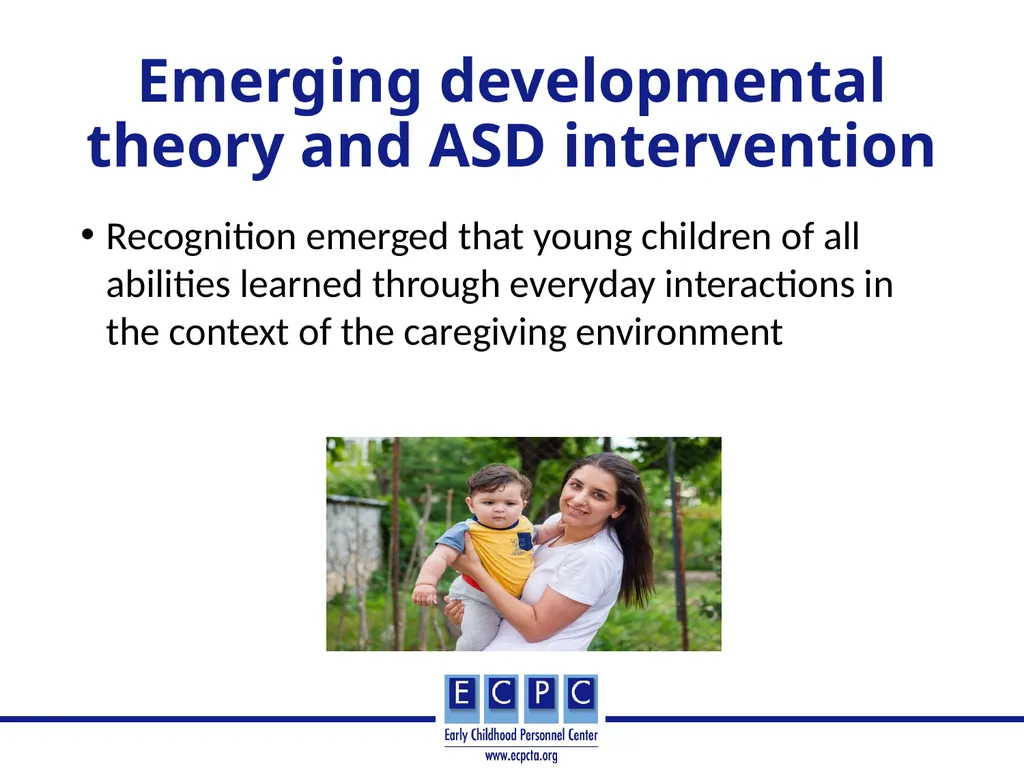
Emerging developmental theory and ASD intervention Recognition emerged that young children of all abilities learned through everyday interactions in the context of the caregiving environment<br>
13
Contribution of developmental principles to interventions for young children with ASD The work of Piaget, Bruner, Vygotsky and others demonstrates that children learn best when they are actively engaged with their everyday surroundings<br>
14
Contribution of developmental principles to interventions for young children with ASD Children acquire new skills that are just beyond their present knowledge in the context of affectively connected interactions with familiar adults and older children (e.g., Vygotsky)<br>
15
Contribution of developmental principles to interventions for young children with ASD Learning is acquired in typical sequences across domains by all children, with some exceptions (e.g., Bruner, Gibson, Mundy)
Learning experiences need to be planned in a systematic manner to connect new experiences with existing knowledge (e.g., Piaget)<br>
Learning experiences need to be planned in a systematic manner to connect new experiences with existing knowledge (e.g., Piaget)<br>
16
Contribution of developmental principles to interventions for young children with ASD Everyday routines provide a uniquely relevant and rich context for interventions for young children with ASD<br>
17
Pause and Reflect A two-year-old with ASD spends most of his day completing his favorite puzzles, does not yet use communicative gestures or words, and most often leaves the interaction when his parents prompt him to imitate their words and to point to objects during play.
Using a developmental lens, what skills should be prioritized?<br>
Using a developmental lens, what skills should be prioritized?<br>
18
Naturalistic Developmental Behavior Interventions (NDBIs): Merging Behavioral and Developmental theory
How NDBI models combine the use of evidence-based strategies can differ, but always include the use of foundational behavioral and developmental tenets
Strategies implemented in a multi-tiered manner to build acquisition of targeted capacities and skills over time
The application of NDBI’s in children’s natural environments promotes generalization across behaviors and settings<br>
19
NDBI Learning Targets Skills not taught in isolation – linked to skills that are naturally used together in functional contexts
Provide framework to promote functional skills, particular social communication learning - that facilitate social interactions and increase meaningful participation
Range of skills that scaffold social engagement and joint attention, sharing emotions and interests, and using communication in all forms – words, gestures, phrases, expressions and words<br>
20
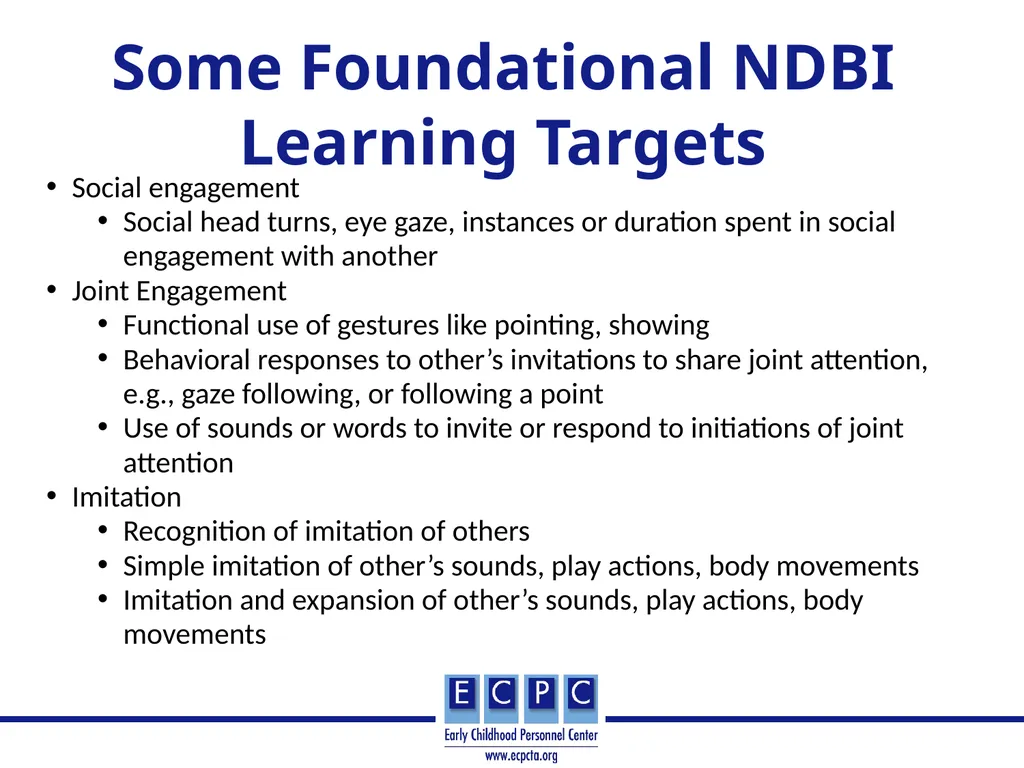
Some Foundational NDBI Learning Targets Social engagement
Social head turns, eye gaze, instances or duration spent in social engagement with another
Joint Engagement
Functional use of gestures like pointing, showing
Behavioral responses to other’s invitations to share joint attention, e.g., gaze following, or following a point
Use of sounds or words to invite or respond to initiations of joint attention
Imitation
Recognition of imitation of others
Simple imitation of other’s sounds, play actions, body movements
Imitation and expansion of other’s sounds, play actions, body movements<br>
21
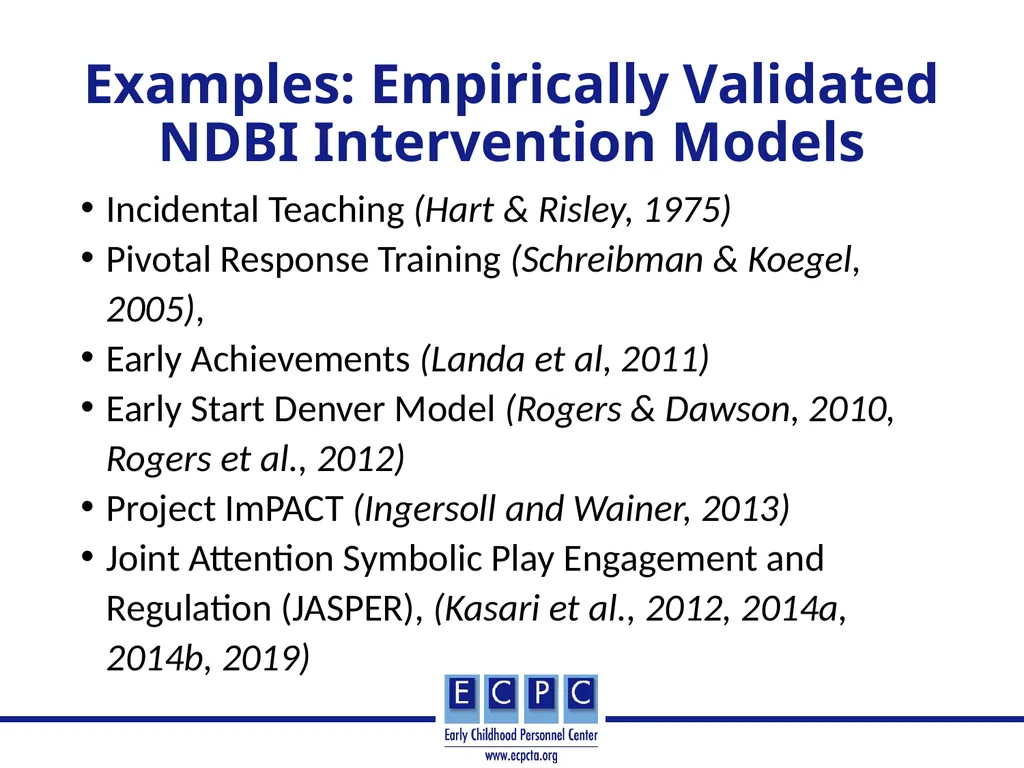
Examples: Empirically Validated NDBI Intervention Models Incidental Teaching (Hart & Risley, 1975)
Pivotal Response Training (Schreibman & Koegel, 2005),
Early Achievements (Landa et al, 2011)
Early Start Denver Model (Rogers & Dawson, 2010, Rogers et al., 2012)
Project ImPACT (Ingersoll and Wainer, 2013)
Joint Attention Symbolic Play Engagement and Regulation (JASPER), (Kasari et al., 2012, 2014a, 2014b, 2019)<br>
22
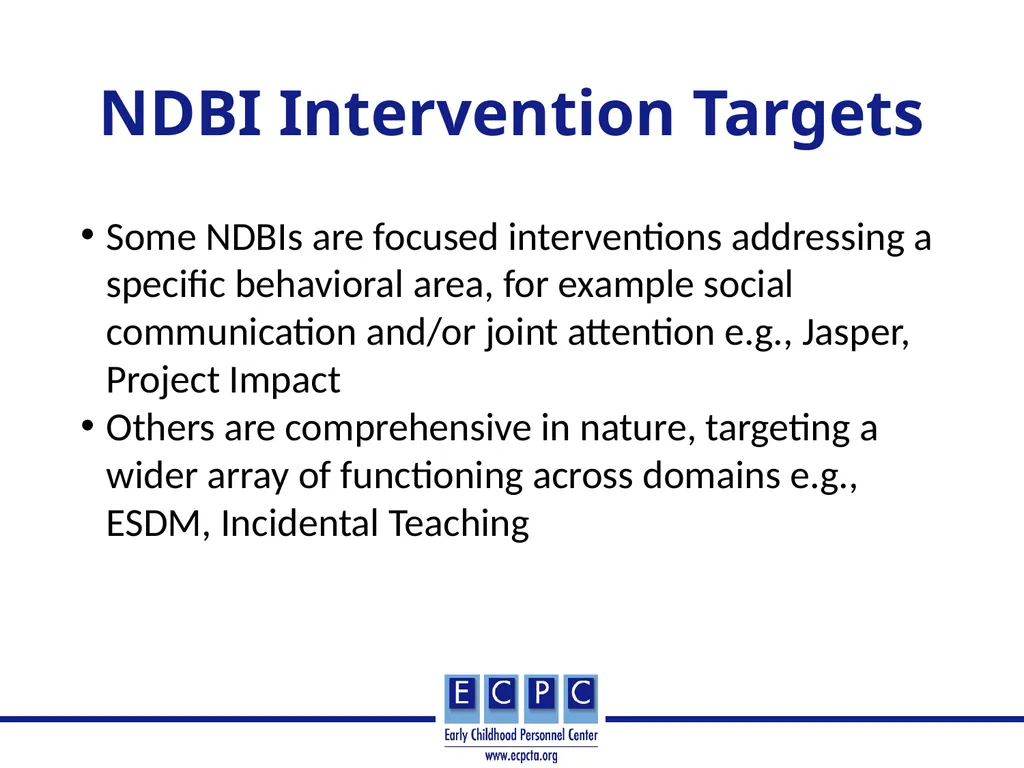
NDBI Intervention Targets Some NDBIs are focused interventions addressing a specific behavioral area, for example social communication and/or joint attention e.g., Jasper, Project Impact
Others are comprehensive in nature, targeting a wider array of functioning across domains e.g., ESDM, Incidental Teaching<br>
Others are comprehensive in nature, targeting a wider array of functioning across domains e.g., ESDM, Incidental Teaching<br>
23
Activity Access the Autism Navigator Website and sign Into the Video Glossary, then select Treatments
View each of the following videos about a specific NDBI approach under Toddler Treatment Models
Early Start Denver Model
JASPER
Identify the primary intervention targets for each approach<br>
View each of the following videos about a specific NDBI approach under Toddler Treatment Models
Early Start Denver Model
JASPER
Identify the primary intervention targets for each approach<br>
24
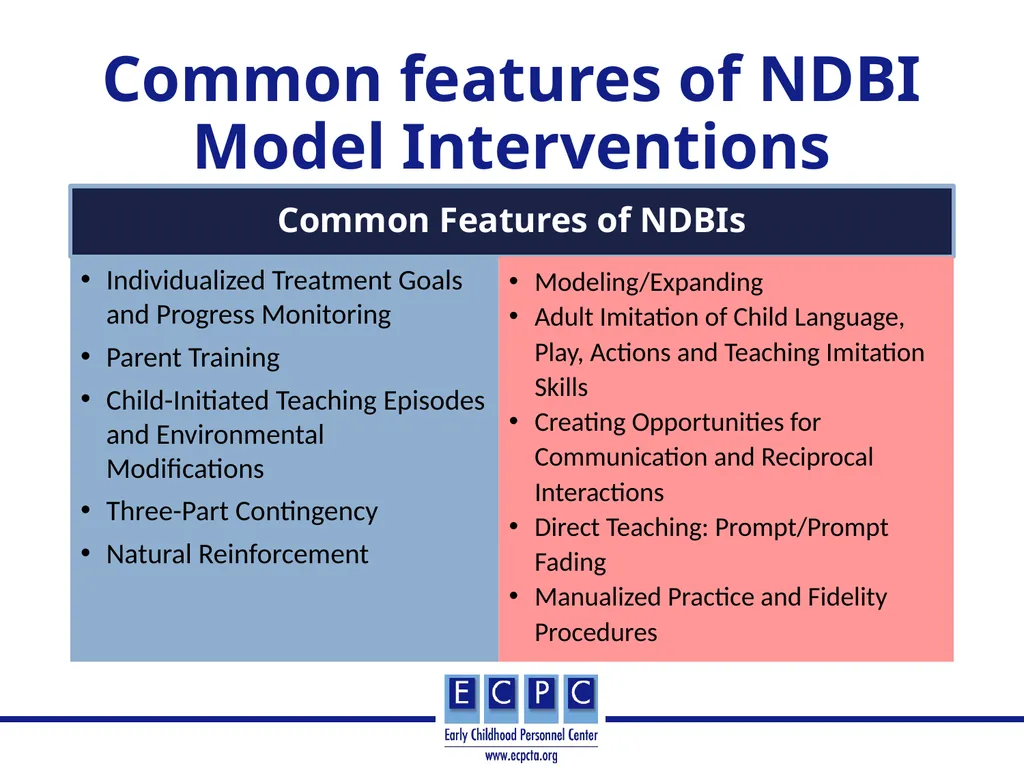
Common features of NDBI Model Interventions Individualized Treatment Goals and Progress Monitoring
Parent Training
Child-Initiated Teaching Episodes and Environmental Modifications
Three-Part Contingency
Natural Reinforcement Common Features of NDBIs Modeling/Expanding
Adult Imitation of Child Language, Play, Actions and Teaching Imitation Skills
Creating Opportunities for Communication and Reciprocal Interactions
Direct Teaching: Prompt/Prompt Fading
Manualized Practice and Fidelity Procedures<br>
25
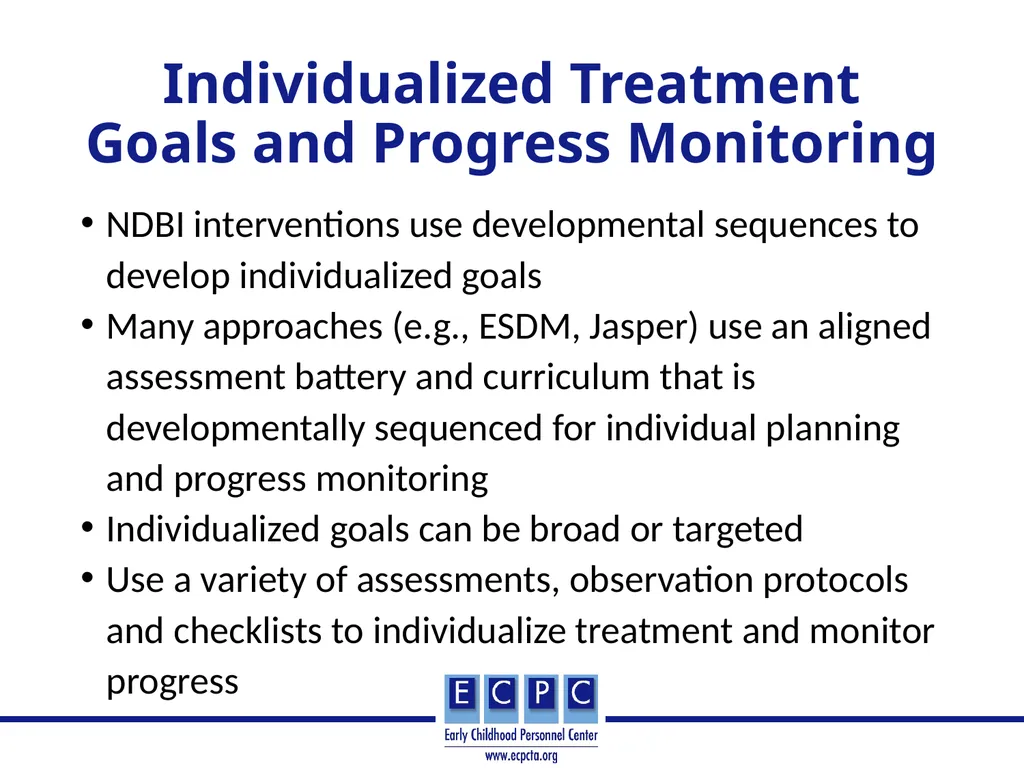
Individualized Treatment Goals and Progress Monitoring NDBI interventions use developmental sequences to develop individualized goals
Many approaches (e.g., ESDM, Jasper) use an aligned assessment battery and curriculum that is developmentally sequenced for individual planning and progress monitoring
Individualized goals can be broad or targeted
Use a variety of assessments, observation protocols and checklists to individualize treatment and monitor progress<br>
26
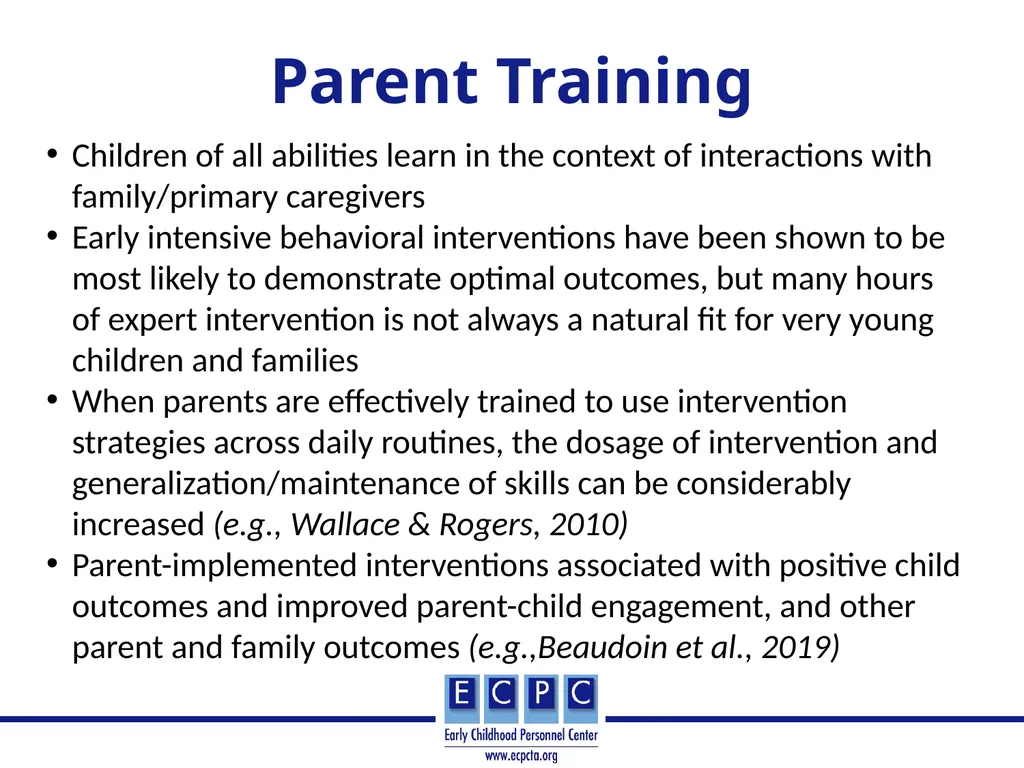
Parent Training Children of all abilities learn in the context of interactions with family/primary caregivers
Early intensive behavioral interventions have been shown to be most likely to demonstrate optimal outcomes, but many hours of expert intervention is not always a natural fit for very young children and families
When parents are effectively trained to use intervention strategies across daily routines, the dosage of intervention and generalization/maintenance of skills can be considerably increased (e.g., Wallace & Rogers, 2010)
Parent-implemented interventions associated with positive child outcomes and improved parent-child engagement, and other parent and family outcomes (e.g.,Beaudoin et al., 2019)<br>
27
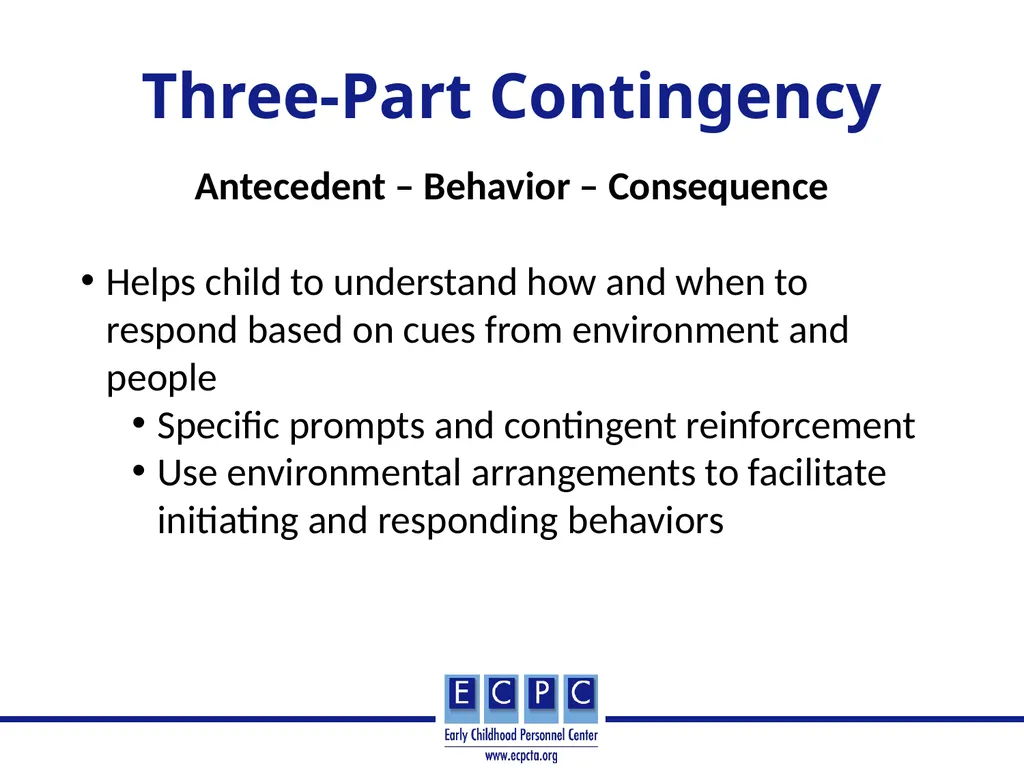
Three-Part Contingency Antecedent – Behavior – Consequence
Helps child to understand how and when to respond based on cues from environment and people
Specific prompts and contingent reinforcement
Use environmental arrangements to facilitate initiating and responding behaviors<br>
Helps child to understand how and when to respond based on cues from environment and people
Specific prompts and contingent reinforcement
Use environmental arrangements to facilitate initiating and responding behaviors<br>
28
Activity: Identify the ABCs Watch the video on the next slide
What were the antecedents in this example?
What was the behavioral response to the antecedents you observed?
What were the consequences of this behavior?
What might have been the purpose of this behavior?<br>
What were the antecedents in this example?
What was the behavioral response to the antecedents you observed?
What were the consequences of this behavior?
What might have been the purpose of this behavior?<br>
29
ABC example activity<br>
30
Environmental Modifications Setting up a child’s environment to minimize distractions and overstimulation, and to increase comfort and predictability
Minimize number of toys available at one time
Create predictable routines
Create effective boundaries in play areas of home, school
Minimize screens, noise, bright lights
Provide access to materials/music that support sensory regulation<br>
Minimize number of toys available at one time
Create predictable routines
Create effective boundaries in play areas of home, school
Minimize screens, noise, bright lights
Provide access to materials/music that support sensory regulation<br>
31
Environmental Modifications, continued Modification of a child’s play area can optimize face-to-face interactions, child choice-making, make it easy to join the child in play, and broaden attentional focus
Opportunity to choose from several toys/activities
Multiple sets of preferred toys to that adults can join and imitate/mode/expand play
Include mirrors, pillows, table with chairs that face each other for face-to-face engagement<br>
Opportunity to choose from several toys/activities
Multiple sets of preferred toys to that adults can join and imitate/mode/expand play
Include mirrors, pillows, table with chairs that face each other for face-to-face engagement<br>
32
Natural Reinforcement Avoiding the use of reinforcement that is not related directly to the targeted behavior, e.g., stickers, candy, tokens
Natural reinforcement occurs when a child is pleased with the consequences of his or her response – for instance, after a child is imitated by an adult and the child initiates social eye gaze and smiles, or when the child gains access to a preferred toy or sensory activity when he or she successfully uses a communicative gesture, sound, or word<br>
Natural reinforcement occurs when a child is pleased with the consequences of his or her response – for instance, after a child is imitated by an adult and the child initiates social eye gaze and smiles, or when the child gains access to a preferred toy or sensory activity when he or she successfully uses a communicative gesture, sound, or word<br>
33
Child-Initiated Teaching Episodes Following a child’s lead – child selects activity
Adults create space for the child to focus on interest and join them in face-to-face play:
Using imitation, comments, language and play models/expansions to provide social learning and to keep children socially engaged
Adults introduce paced prompts for target skills in the context of child-selected activities without re-directing their play<br>
34
Supporting Joint Attention Initiations and Responses Children with ASD do not develop the capacity to initiate and respond to joint attention the way that typical children do – a core deficit of individuals with ASD
Effective early interventions include strategies to facilitate joint attention initiations and responses by children to share attention to objects and events
Strategies include arranging the child’s environment to optimize social interactions and allowing time for the child to make a social bid for shared attention, and to respond to social bids by others<br>
35
Activity Watch this video created by Dr. Connie Kasari at the UCLA Autism Research lab to minute 1:33, which includes an explanation by Dr. Peter Mundy about the importance of joint attention as a primary intervention target
Why does Dr. Mundy say that the ability to coordinate joint attention through gaze shifts from face to face, gaze following, head turns, pointing/showing are needed for functional language to develop?<br>
Why does Dr. Mundy say that the ability to coordinate joint attention through gaze shifts from face to face, gaze following, head turns, pointing/showing are needed for functional language to develop?<br>
36
Models/Expansions and Simplified Communication Models: Adult/peer demonstration of a behavior that follows the child’s interest or focus and demonstrates the targeted skill e.g., gestures, language, play action
Expansions: Simple models can be expanded to show the child a slightly more complex example of the behavior, “Green truck!” and saying “vroom” when pushing the truck along
Simplified Communication: Adults use language that matches the child’s language level e.g., one or two words for preverbal children, adding just a step more complexity than the child currently uses<br>
37
Activity: Child-Led Activities and Models/Expansions Returning to the video from the Kasari Autism Research Lab at UCLA, watch from 1:33 to 4:16
Identify examples of modeling, expanding, and simplified language you saw this therapist use
Was she following Parker’s lead in the activity throughout?
What did you hear her say about the use of modeling – does she use it all of the time? How does she pace the use of language and play models? What cues does she use to decide how she uses these strategies?<br>
38
Creating Opportunities to Initiate Communication/Requests Using environmental modification and interactional strategies to encourage initiations of communication/requests:
Put preferred items in sight and out of reach
Control access to objects the child desired access to, like the next piece in a puzzle, or the next block
Include activities that need the adult to help to encourage requests
Pretend that you don’t know how to do something child knows how to do and make it silly – e.g., shoe on hand<br>
39
Creating Opportunities to Access Sensory Regulation Children with ASD most often have sensory challenges that limit their ability to access a regulated state
When children have access to calming sensory activities through the use of movement, music, sensory materials, jumping or climbing – they are more likely to connect with others and attend to social interactions
Sensory activities are prioritized in some NDBI models for children who are not yet consistently interested in object play and/or are often highly dysregulated (e.g., JASPER).<br>
40
Adult Animation Children of all abilities are naturally drawn to adults who are using a lot of positive affect, excited voices, and using expressions and gestures that convey that they are enjoying the interaction
In the use of NDBI interventions, adults (interventionists, parents) are trained to use a high level of positive animation throughout their interactions with children<br>
In the use of NDBI interventions, adults (interventionists, parents) are trained to use a high level of positive animation throughout their interactions with children<br>
41
Adult Imitation of Child’s Actions,
Play, Sounds/Words Contingent imitation/mirroring – imitating the child’s actions, sounds, words to signal to the child that others can see what he is doing, and are interested in joining the interaction without placing a demand for a specific response
Provides an opportunity to return the imitation, or even expand on the imitation
Evidence suggests that contingent imitation is effective to increase a child’s attention to a social partner, especially very young children or preverbal learners (e.g., Haebig, 2013)<br>
Provides an opportunity to return the imitation, or even expand on the imitation
Evidence suggests that contingent imitation is effective to increase a child’s attention to a social partner, especially very young children or preverbal learners (e.g., Haebig, 2013)<br>
42
Creating Opportunities for Reciprocal Interactions When joining child in play, offer trade of toys when both toys are interesting to the child
Adult can take a short turn with a toy of interest and model a play action/expansion, and then return to the child so that he or she can take a turn
Use predictable short phrase so that child knows that turn is coming up e.g., “my turn!” then “your turn!”
Pace turns so that activity is enjoyable rather than frustrating<br>
43
Direct Teaching: Prompting Procedures and Reinforcement Direct teaching is most effective when the young child is motivated to attend to the teaching target
Should be used when child is relatively well-regulated and engaged in the interaction
Prompts are introduced to help child use a new skill that is just slightly more complex that what he or she is currently using<br>
Should be used when child is relatively well-regulated and engaged in the interaction
Prompts are introduced to help child use a new skill that is just slightly more complex that what he or she is currently using<br>
44
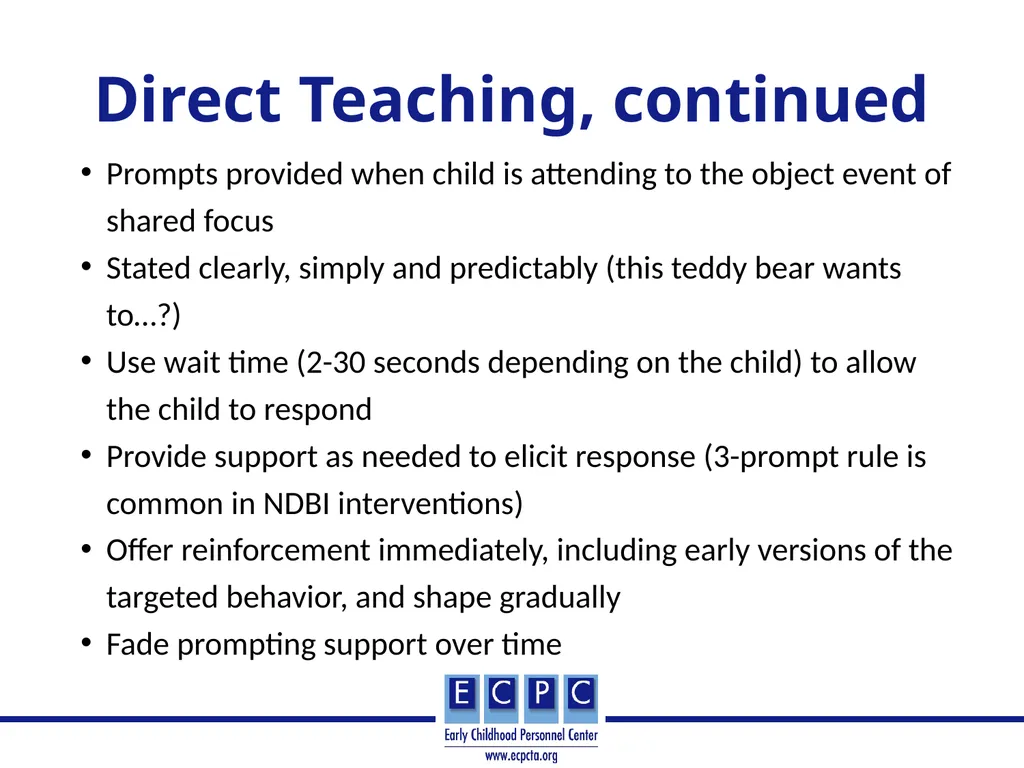
Direct Teaching, continued Prompts provided when child is attending to the object event of shared focus
Stated clearly, simply and predictably (this teddy bear wants to…?)
Use wait time (2-30 seconds depending on the child) to allow the child to respond
Provide support as needed to elicit response (3-prompt rule is common in NDBI interventions)
Offer reinforcement immediately, including early versions of the targeted behavior, and shape gradually
Fade prompting support over time<br>
45
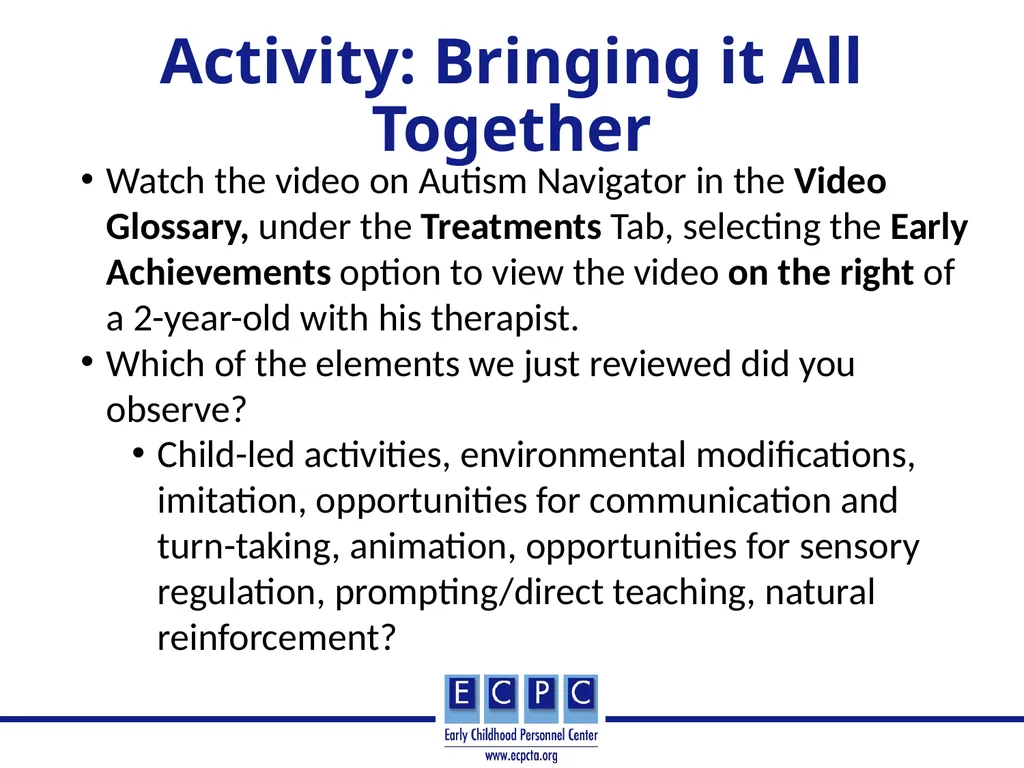
Activity: Bringing it All Together Watch the video on Autism Navigator in the Video Glossary, under the Treatments Tab, selecting the Early Achievements option to view the video on the right of a 2-year-old with his therapist.
Which of the elements we just reviewed did you observe?
Child-led activities, environmental modifications, imitation, opportunities for communication and turn-taking, animation, opportunities for sensory regulation, prompting/direct teaching, natural reinforcement?<br>
Which of the elements we just reviewed did you observe?
Child-led activities, environmental modifications, imitation, opportunities for communication and turn-taking, animation, opportunities for sensory regulation, prompting/direct teaching, natural reinforcement?<br>
46
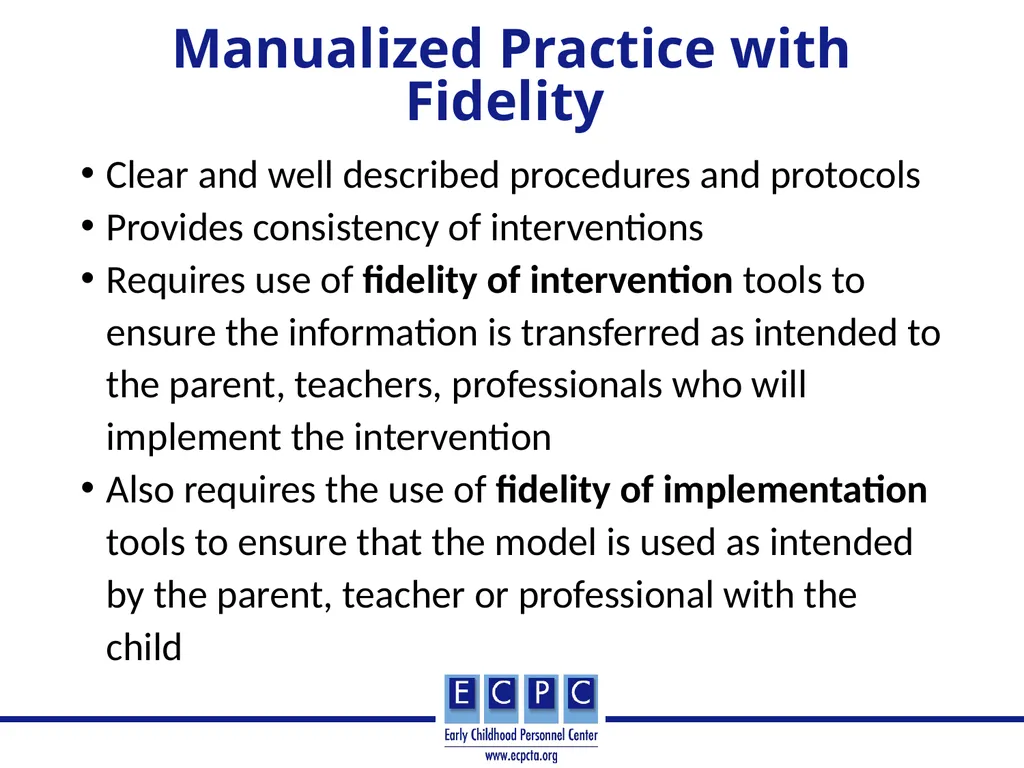
Manualized Practice with Fidelity Clear and well described procedures and protocols
Provides consistency of interventions
Requires use of fidelity of intervention tools to ensure the information is transferred as intended to the parent, teachers, professionals who will implement the intervention
Also requires the use of fidelity of implementation tools to ensure that the model is used as intended by the parent, teacher or professional with the child<br>
47
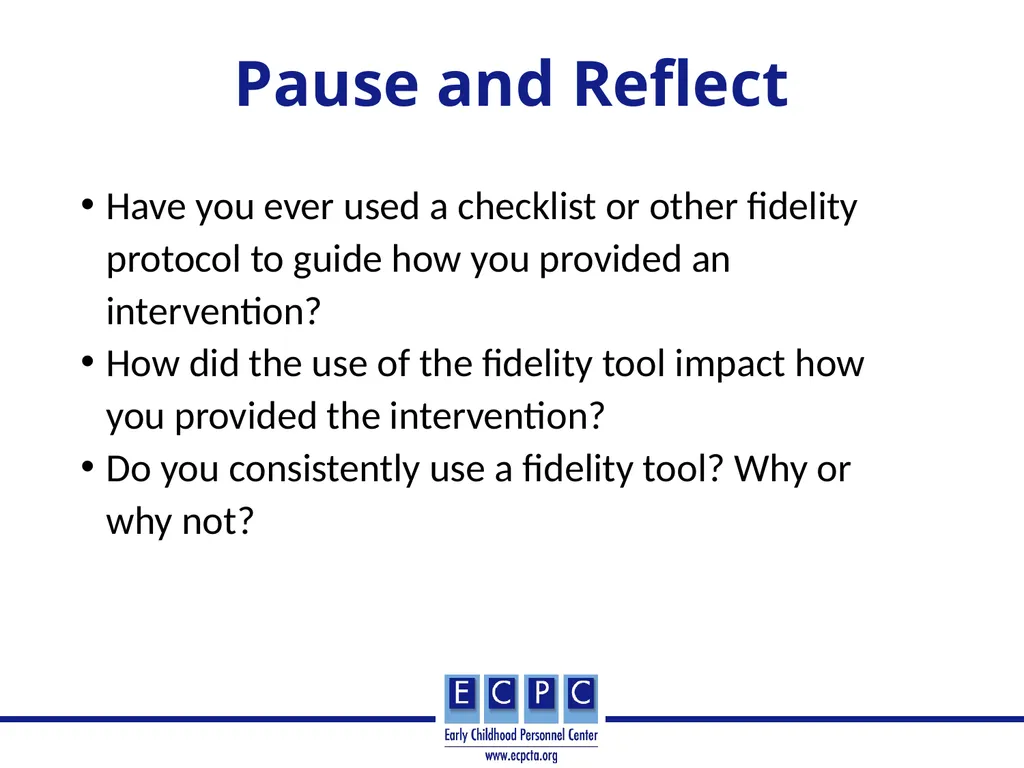
Pause and Reflect Have you ever used a checklist or other fidelity protocol to guide how you provided an intervention?
How did the use of the fidelity tool impact how you provided the intervention?
Do you consistently use a fidelity tool? Why or why not?<br>
How did the use of the fidelity tool impact how you provided the intervention?
Do you consistently use a fidelity tool? Why or why not?<br>
48
References Beaudoin, A. J., Sébire, G., & Couture, M. (2019). Parent-mediated intervention tends to improve parent-child engagement, and behavioral outcomes of toddlers with ASD-positive screening: A randomized crossover trial. Research in Autism Spectrum Disorders, 66, 101416. https://doi.org/https://doi.org/10.1016/j.rasd.2019.101416
Dawson, G., Rogers, S., Munson, J., Smith, M., Winter, J., Greenson, J., Donaldson, A., & Varley, J. (2010). Randomized, controlled trial of an intervention for toddlers with autism: the Early Start Denver Model. Pediatrics, 125(1), e17-e23. doi: 10.1542/peds.2009-0958
Gulsrud, A. C., Hellemann, G., Shire, S., & Kasari, C. (2016). Isolating active ingredients in a parent‐mediated social communication intervention for toddlers with autism spectrum disorder. Journal of Child Psychology and Psychiatry, 57(5), 606-613. doi: 10.1111/jcpp.12481
Haebig, E., McDuffie, A., & Ellis Weismer, S. (2013). Brief report: Parent verbal responsiveness and language development in toddlers on the autism spectrum. Journal of Autism and Developmental Disorders, 43(9), 2218-2227.doi: 10.1044/1058-0360(2012/11-0004)<br>
49
References Hart, B. & Risley, T. R. (1975). Incidental teaching of language in the preschool 1. Journal of applied behavior analysis, 8(4), 411-420.
Ingersoll, B. & Wainer, A. (2013). Initial efficacy of Project ImPACT: A parent-mediated social communication intervention for young children with ASD. Journal of autism and developmental disorders, 43(12), 2943-2952. doi: 10.1007/s10803-013-1840-9
Kasari, C. & Patterson, S. (2012). Interventions addressing social impairment in autism. Current Psychiatry Reports, 14(6), 713-725. doi.org/10.1007/s11920-012-0317-4
Kasari, C., Lawton, K., Shih, W., Barker, T. V., Landa, R., Lord, C., Orlich, F., King, B., Wetherby, A., & Senturk, D. (2014). Caregiver-mediated intervention for low-resourced preschoolers with autism: an RCT. Pediatrics, 134(1), e72–e79. https://doi.org/10.1542/peds.2013-3229<br>
50
References Landa, R. J., Holman, K. C., O’Neill, A. H., & Stuart, E. A. (2011). Intervention targeting development of socially synchronous engagement in toddlers with autism spectrum disorder: A randomized controlled trial. Journal of Child Psychology and Psychiatry, 52(1), 13-21. doi: 10.1111/j.1469-7610.2010.02288.x
Lovaas, O. I. (1987). Behavioral treatment and normal educational and intellectual functioning in young autistic children. Journal of Consulting and Clinical Psychology, 55, 3–9.
Reichow, B., Barton, E. E., Boyd, B. A., & Hume, K. (2012). Early intensive behavioral intervention (EIBI) for young children with autism spectrum disorders (ASD). Cochrane Database of Systematic Reviews, Issue 10, Art. No.: CD009260. doi: 10.1002/14651858.cd009260.pub2
Rogers, S. J., Estes, A., Lord, C., Vismara, L., Winter, J., Fitzpatrick, A., Guo, M., & Dawson, G. (2012). Effects of a brief Early Start Denver Model (ESDM)–based parent intervention on toddlers at risk for autism spectrum disorders: A randomized controlled trial. Journal of the American Academy of Child & Adolescent Psychiatry, 51(10), 1052-1065. doi: 10.1016/j.jaac.2012.08.003<br>
51
References Shire, S. Y., Shih, W., Chang, Y.-C., Bracaglia, S., Kodjoe, M., & Kasari, C. (2019). Sustained Community Implementation of JASPER Intervention with Toddlers with Autism. Journal of Autism & Developmental Disorders, 49(5), 1863–1875. https://doi.org/10.1007/s10803-018-03875-0
Wallace, K.S. and Rogers, S.J. (2010), Intervening in infancy: implications for autism spectrum disorders. Journal of Child Psychology and Psychiatry, 51: 1300-1320. https://doi.org/10.1111/j.1469-7610.2010.02308.x
Wong, C., & Kasari, C. (2012). Play and Joint Attention of Children with Autism in the Preschool Special Education Classroom. Journal of Autism & Developmental Disorders, 42(10), 2152–2161. https://doi.org/10.1007/s10803-012-1467-2<br>
52
References Schreibman, L., Dawson, G., Stahmer, A. C., Landa, R., Rogers, S. J., McGee, G. G., ... & Halladay, A. (2015). Naturalistic developmental behavioral interventions: Empirically validated treatments for autism spectrum disorder. Journal of autism and developmental disorders, 45(8), 2411-2428. doi: 10.1007/s10803-015-2407-8
Schreibman, L., & Koegel, R. L. (2005). Training for parents of children with autism: Pivotal responses, generalization, and individualization of interventions.<br>
Schreibman, L., & Koegel, R. L. (2005). Training for parents of children with autism: Pivotal responses, generalization, and individualization of interventions.<br>
53
Resources Autism Navigator - https://autismnavigator.com/
Kasari Autism Research Lab at UCLA - http://www.kasarilab.org/ This is a product of the Early Childhood Personnel Center (ECPC) awarded to the University of Connecticut Center for Excellence in Developmental Disabilities and was made possible by Cooperative Agreement #H325B170008 which is funded by the U.S. Department of Education, Office of Special Education Programs. However, those contents do not necessarily represent the policy of the Department of Education, and you should not assume endorsement by the Federal Government.<br>
Kasari Autism Research Lab at UCLA - http://www.kasarilab.org/ This is a product of the Early Childhood Personnel Center (ECPC) awarded to the University of Connecticut Center for Excellence in Developmental Disabilities and was made possible by Cooperative Agreement #H325B170008 which is funded by the U.S. Department of Education, Office of Special Education Programs. However, those contents do not necessarily represent the policy of the Department of Education, and you should not assume endorsement by the Federal Government.<br>