
ADHD Theories Presentation Gretchen Day Department
TD
Published · 16 slides · 0 views

1 / 1

Description
ADHD Theories Presentation Gretchen Day Department of Psychology, North Central University Psychology 6708-2 ADHD Autistic Spectrum Dr. Bettye Griffin December 17, 2023 Historical Development of ADHD Terminology (Smith, 2012). Medical,
Related Topics
Share
Embed code
Download this presentation From Below
"ADHD Theories Presentation Gretchen Day Department" is the property of its rightful owner. Permission is granted to download and print the materials on this website for personal, non-commercial use only, and to display it on your personal computer provided you do not modify the materials and that you retain all copyright notices contained in the materials. By downloading content from our website, you accept the terms of this agreement.
Presentation Transcript
01
ADHD Theories Presentation
Gretchen Day
Department of Psychology, North Central University
Psychology 6708-2
ADHD & Autistic Spectrum
Dr. Bettye Griffin
December 17, 2023<br>
02
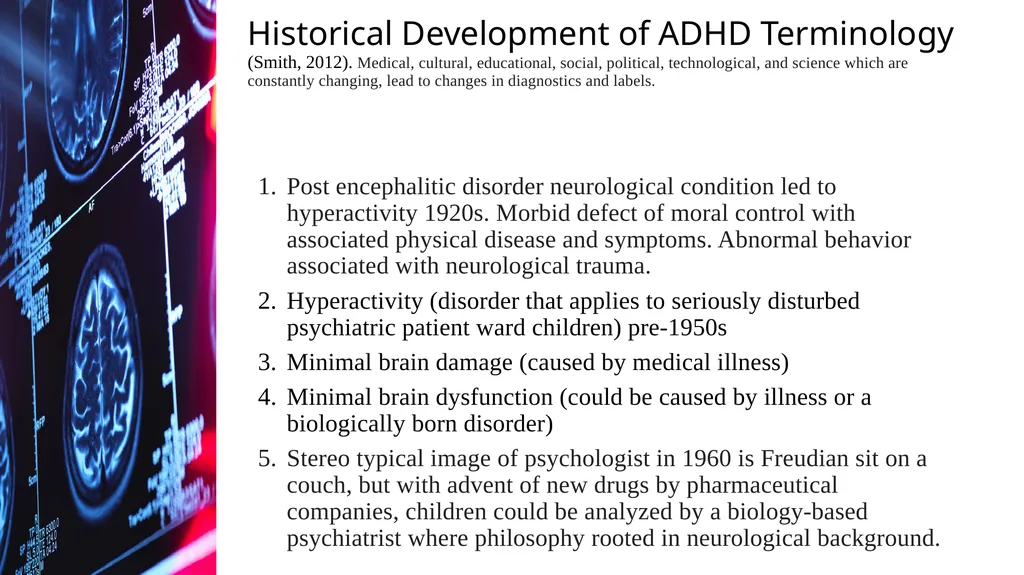
Historical Development of ADHD Terminology
(Smith, 2012). Medical, cultural, educational, social, political, technological, and science which are constantly changing, lead to changes in diagnostics and labels. Post encephalitic disorder neurological condition led to hyperactivity 1920s. Morbid defect of moral control with associated physical disease and symptoms. Abnormal behavior associated with neurological trauma.
Hyperactivity (disorder that applies to seriously disturbed psychiatric patient ward children) pre-1950s
Minimal brain damage (caused by medical illness)
Minimal brain dysfunction (could be caused by illness or a biologically born disorder)
Stereo typical image of psychologist in 1960 is Freudian sit on a couch, but with advent of new drugs by pharmaceutical companies, children could be analyzed by a biology-based psychiatrist where philosophy rooted in neurological background.<br>
Hyperactivity (disorder that applies to seriously disturbed psychiatric patient ward children) pre-1950s
Minimal brain damage (caused by medical illness)
Minimal brain dysfunction (could be caused by illness or a biologically born disorder)
Stereo typical image of psychologist in 1960 is Freudian sit on a couch, but with advent of new drugs by pharmaceutical companies, children could be analyzed by a biology-based psychiatrist where philosophy rooted in neurological background.<br>
03
Historical Development of ADHD Terminology Cont. (Smith, 2012) *Changes in labels and terminology has changed how hyperactivity is understood/theorized.
Laufer and Denhoff called it Hyperkinetic Impulse Disorder (1957). Laufer and Denhoff first to restrict study and treatment of hyperactivity to children’s schoolwork, not just violent and immoral behavior and extreme psychiatric cases.
Made term applicable to millions of children instead of a select few.
1st to consider it very common.
Can apply to a large population instead of a small number of disturbed children.
Some of these characteristics are found normal in the course of all children.
American Psychiatry DSM-II 1968=Hyperkinetic Reaction of Childhood (Adolescence)
Hyperactivity prevalent term used by general population 1960s-1980s. Disorder could contribute to educational problems and lead to academic disturbances.
DSM-III Attention Deficit Disorder/ADD 1980 (focus attention deficit & distractibility).
DSM-IIIR Attention-deficit Hyperactivity Disorder ADHD 1987 (focus was on hyperactivity/once labeled the label sticks children, adolescents and adults).
(Smith, 2012)<br>
Laufer and Denhoff called it Hyperkinetic Impulse Disorder (1957). Laufer and Denhoff first to restrict study and treatment of hyperactivity to children’s schoolwork, not just violent and immoral behavior and extreme psychiatric cases.
Made term applicable to millions of children instead of a select few.
1st to consider it very common.
Can apply to a large population instead of a small number of disturbed children.
Some of these characteristics are found normal in the course of all children.
American Psychiatry DSM-II 1968=Hyperkinetic Reaction of Childhood (Adolescence)
Hyperactivity prevalent term used by general population 1960s-1980s. Disorder could contribute to educational problems and lead to academic disturbances.
DSM-III Attention Deficit Disorder/ADD 1980 (focus attention deficit & distractibility).
DSM-IIIR Attention-deficit Hyperactivity Disorder ADHD 1987 (focus was on hyperactivity/once labeled the label sticks children, adolescents and adults).
(Smith, 2012)<br>
04
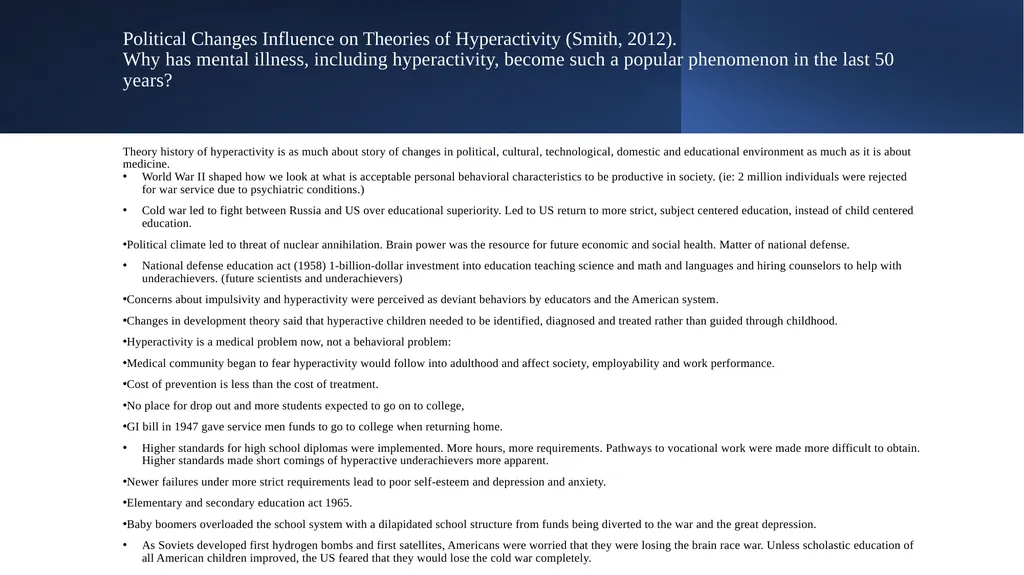
Political Changes Influence on Theories of Hyperactivity (Smith, 2012).
Why has mental illness, including hyperactivity, become such a popular phenomenon in the last 50 years? Theory history of hyperactivity is as much about story of changes in political, cultural, technological, domestic and educational environment as much as it is about medicine.
World War II shaped how we look at what is acceptable personal behavioral characteristics to be productive in society. (ie: 2 million individuals were rejected for war service due to psychiatric conditions.)
Cold war led to fight between Russia and US over educational superiority. Led to US return to more strict, subject centered education, instead of child centered education.
Political climate led to threat of nuclear annihilation. Brain power was the resource for future economic and social health. Matter of national defense.
National defense education act (1958) 1-billion-dollar investment into education teaching science and math and languages and hiring counselors to help with underachievers. (future scientists and underachievers)
Concerns about impulsivity and hyperactivity were perceived as deviant behaviors by educators and the American system.
Changes in development theory said that hyperactive children needed to be identified, diagnosed and treated rather than guided through childhood.
Hyperactivity is a medical problem now, not a behavioral problem:
Medical community began to fear hyperactivity would follow into adulthood and affect society, employability and work performance.
Cost of prevention is less than the cost of treatment.
No place for drop out and more students expected to go on to college,
GI bill in 1947 gave service men funds to go to college when returning home.
Higher standards for high school diplomas were implemented. More hours, more requirements. Pathways to vocational work were made more difficult to obtain. Higher standards made short comings of hyperactive underachievers more apparent.
Newer failures under more strict requirements lead to poor self-esteem and depression and anxiety.
Elementary and secondary education act 1965.
Baby boomers overloaded the school system with a dilapidated school structure from funds being diverted to the war and the great depression.
As Soviets developed first hydrogen bombs and first satellites, Americans were worried that they were losing the brain race war. Unless scholastic education of all American children improved, the US feared that they would lose the cold war completely.<br>
World War II shaped how we look at what is acceptable personal behavioral characteristics to be productive in society. (ie: 2 million individuals were rejected for war service due to psychiatric conditions.)
Cold war led to fight between Russia and US over educational superiority. Led to US return to more strict, subject centered education, instead of child centered education.
Political climate led to threat of nuclear annihilation. Brain power was the resource for future economic and social health. Matter of national defense.
National defense education act (1958) 1-billion-dollar investment into education teaching science and math and languages and hiring counselors to help with underachievers. (future scientists and underachievers)
Concerns about impulsivity and hyperactivity were perceived as deviant behaviors by educators and the American system.
Changes in development theory said that hyperactive children needed to be identified, diagnosed and treated rather than guided through childhood.
Hyperactivity is a medical problem now, not a behavioral problem:
Medical community began to fear hyperactivity would follow into adulthood and affect society, employability and work performance.
Cost of prevention is less than the cost of treatment.
No place for drop out and more students expected to go on to college,
GI bill in 1947 gave service men funds to go to college when returning home.
Higher standards for high school diplomas were implemented. More hours, more requirements. Pathways to vocational work were made more difficult to obtain. Higher standards made short comings of hyperactive underachievers more apparent.
Newer failures under more strict requirements lead to poor self-esteem and depression and anxiety.
Elementary and secondary education act 1965.
Baby boomers overloaded the school system with a dilapidated school structure from funds being diverted to the war and the great depression.
As Soviets developed first hydrogen bombs and first satellites, Americans were worried that they were losing the brain race war. Unless scholastic education of all American children improved, the US feared that they would lose the cold war completely.<br>
05
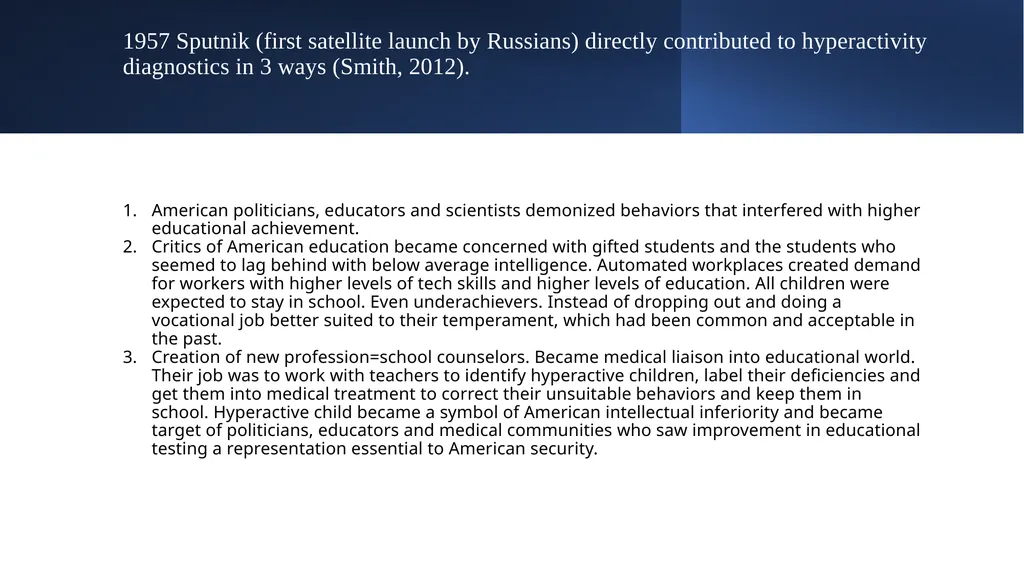
1957 Sputnik (first satellite launch by Russians) directly contributed to hyperactivity diagnostics in 3 ways (Smith, 2012). American politicians, educators and scientists demonized behaviors that interfered with higher educational achievement.
Critics of American education became concerned with gifted students and the students who seemed to lag behind with below average intelligence. Automated workplaces created demand for workers with higher levels of tech skills and higher levels of education. All children were expected to stay in school. Even underachievers. Instead of dropping out and doing a vocational job better suited to their temperament, which had been common and acceptable in the past.
Creation of new profession=school counselors. Became medical liaison into educational world. Their job was to work with teachers to identify hyperactive children, label their deficiencies and get them into medical treatment to correct their unsuitable behaviors and keep them in school. Hyperactive child became a symbol of American intellectual inferiority and became target of politicians, educators and medical communities who saw improvement in educational testing a representation essential to American security.<br>
Critics of American education became concerned with gifted students and the students who seemed to lag behind with below average intelligence. Automated workplaces created demand for workers with higher levels of tech skills and higher levels of education. All children were expected to stay in school. Even underachievers. Instead of dropping out and doing a vocational job better suited to their temperament, which had been common and acceptable in the past.
Creation of new profession=school counselors. Became medical liaison into educational world. Their job was to work with teachers to identify hyperactive children, label their deficiencies and get them into medical treatment to correct their unsuitable behaviors and keep them in school. Hyperactive child became a symbol of American intellectual inferiority and became target of politicians, educators and medical communities who saw improvement in educational testing a representation essential to American security.<br>
06
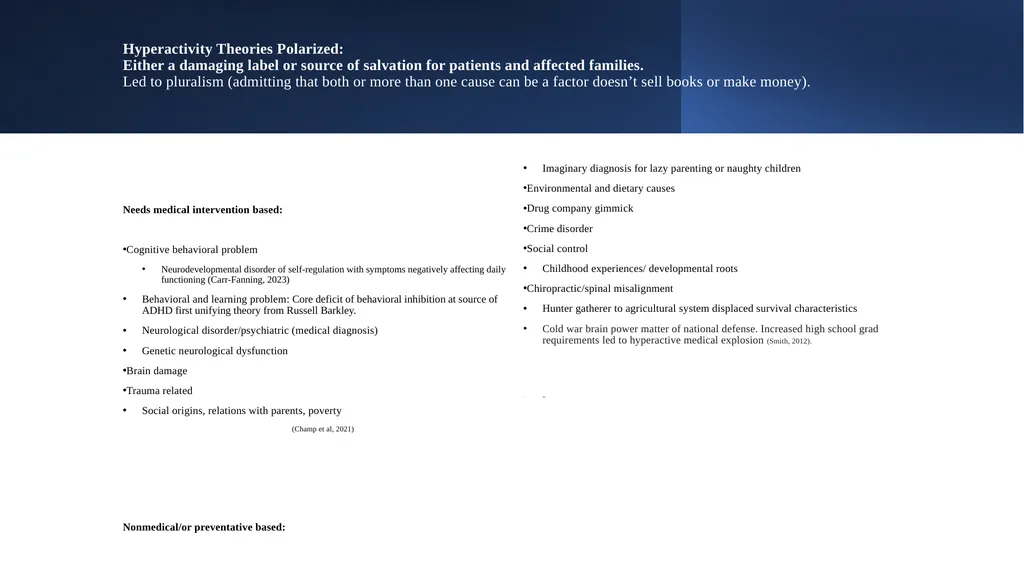
Hyperactivity Theories Polarized:
Either a damaging label or source of salvation for patients and affected families.
Led to pluralism (admitting that both or more than one cause can be a factor doesn’t sell books or make money). Needs medical intervention based:
Cognitive behavioral problem
Neurodevelopmental disorder of self-regulation with symptoms negatively affecting daily functioning (Carr-Fanning, 2023)
Behavioral and learning problem: Core deficit of behavioral inhibition at source of ADHD first unifying theory from Russell Barkley.
Neurological disorder/psychiatric (medical diagnosis)
Genetic neurological dysfunction
Brain damage
Trauma related
Social origins, relations with parents, poverty
(Champ et al, 2021)
Nonmedical/or preventative based:
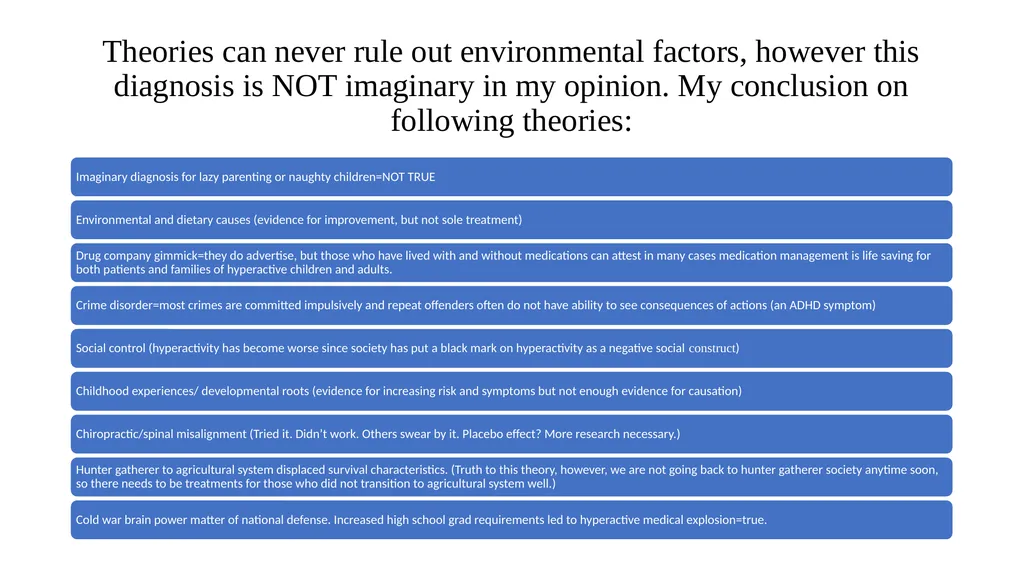
Imaginary diagnosis for lazy parenting or naughty children
Environmental and dietary causes
Drug company gimmick
Crime disorder
Social control
Childhood experiences/ developmental roots
Chiropractic/spinal misalignment
Hunter gatherer to agricultural system displaced survival characteristics
Cold war brain power matter of national defense. Increased high school grad requirements led to hyperactive medical explosion (Smith, 2012).
12)<br>
Cognitive behavioral problem
Neurodevelopmental disorder of self-regulation with symptoms negatively affecting daily functioning (Carr-Fanning, 2023)
Behavioral and learning problem: Core deficit of behavioral inhibition at source of ADHD first unifying theory from Russell Barkley.
Neurological disorder/psychiatric (medical diagnosis)
Genetic neurological dysfunction
Brain damage
Trauma related
Social origins, relations with parents, poverty
(Champ et al, 2021)
Nonmedical/or preventative based:
Imaginary diagnosis for lazy parenting or naughty children
Environmental and dietary causes
Drug company gimmick
Crime disorder
Social control
Childhood experiences/ developmental roots
Chiropractic/spinal misalignment
Hunter gatherer to agricultural system displaced survival characteristics
Cold war brain power matter of national defense. Increased high school grad requirements led to hyperactive medical explosion (Smith, 2012).
12)<br>
07
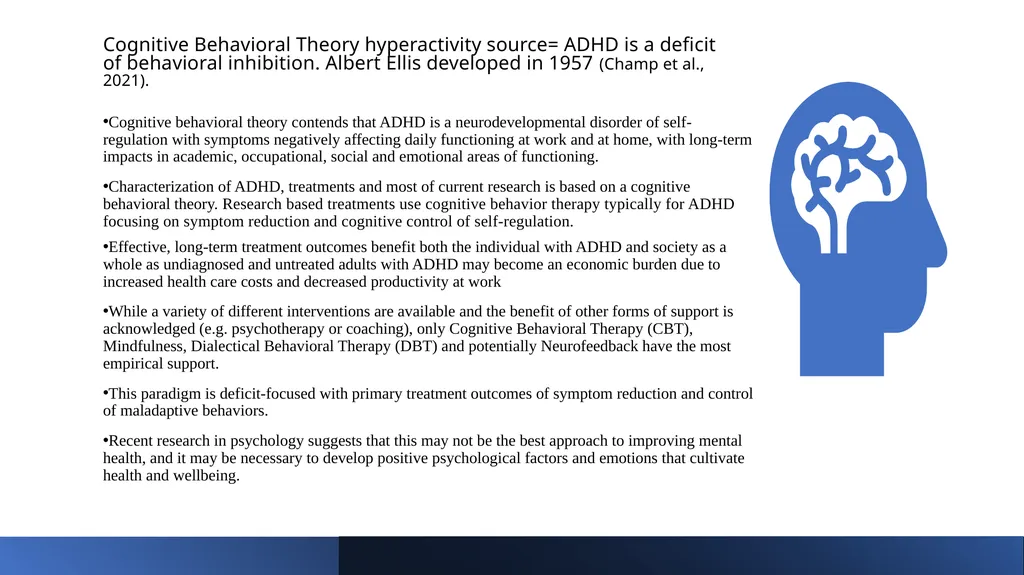
Cognitive Behavioral Theory hyperactivity source= ADHD is a deficit of behavioral inhibition. Albert Ellis developed in 1957 (Champ et al., 2021). Cognitive behavioral theory contends that ADHD is a neurodevelopmental disorder of self-regulation with symptoms negatively affecting daily functioning at work and at home, with long-term impacts in academic, occupational, social and emotional areas of functioning.
Characterization of ADHD, treatments and most of current research is based on a cognitive behavioral theory. Research based treatments use cognitive behavior therapy typically for ADHD focusing on symptom reduction and cognitive control of self-regulation.
Effective, long-term treatment outcomes benefit both the individual with ADHD and society as a whole as undiagnosed and untreated adults with ADHD may become an economic burden due to increased health care costs and decreased productivity at work
While a variety of different interventions are available and the benefit of other forms of support is acknowledged (e.g. psychotherapy or coaching), only Cognitive Behavioral Therapy (CBT), Mindfulness, Dialectical Behavioral Therapy (DBT) and potentially Neurofeedback have the most empirical support.
This paradigm is deficit-focused with primary treatment outcomes of symptom reduction and control of maladaptive behaviors.
Recent research in psychology suggests that this may not be the best approach to improving mental health, and it may be necessary to develop positive psychological factors and emotions that cultivate health and wellbeing.<br>
Characterization of ADHD, treatments and most of current research is based on a cognitive behavioral theory. Research based treatments use cognitive behavior therapy typically for ADHD focusing on symptom reduction and cognitive control of self-regulation.
Effective, long-term treatment outcomes benefit both the individual with ADHD and society as a whole as undiagnosed and untreated adults with ADHD may become an economic burden due to increased health care costs and decreased productivity at work
While a variety of different interventions are available and the benefit of other forms of support is acknowledged (e.g. psychotherapy or coaching), only Cognitive Behavioral Therapy (CBT), Mindfulness, Dialectical Behavioral Therapy (DBT) and potentially Neurofeedback have the most empirical support.
This paradigm is deficit-focused with primary treatment outcomes of symptom reduction and control of maladaptive behaviors.
Recent research in psychology suggests that this may not be the best approach to improving mental health, and it may be necessary to develop positive psychological factors and emotions that cultivate health and wellbeing.<br>
08
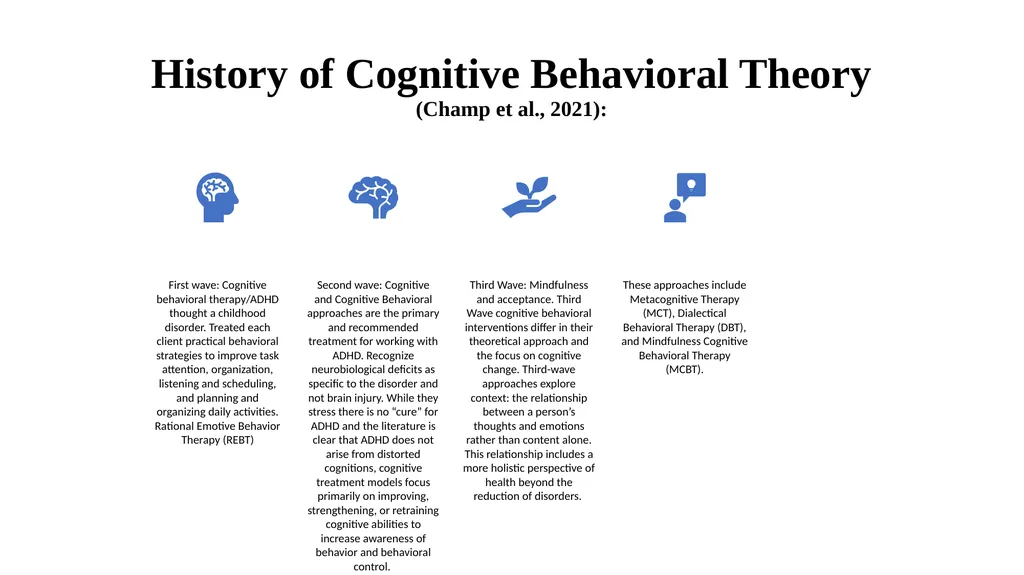
History of Cognitive Behavioral Theory
(Champ et al., 2021):<br>
09
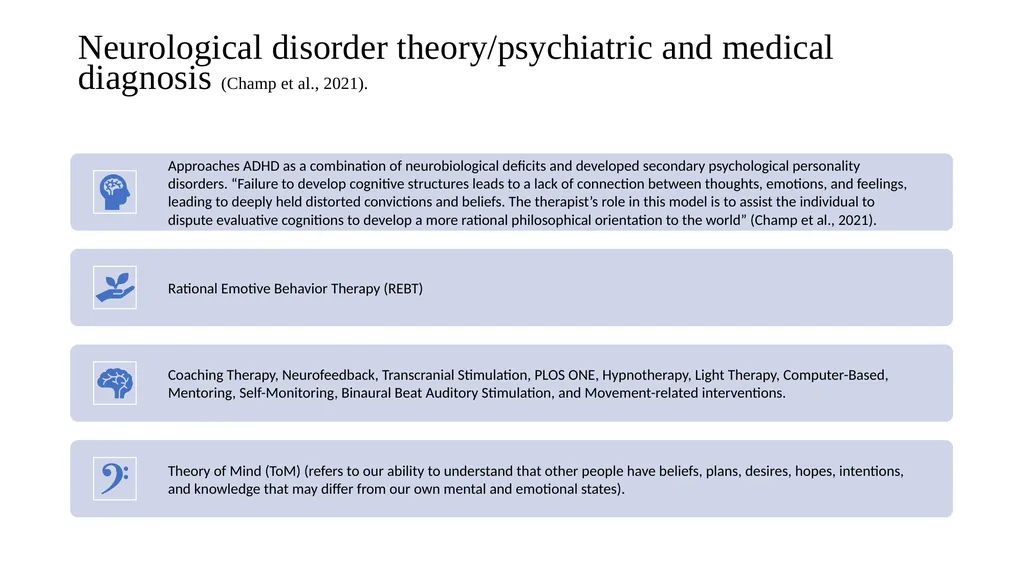
Neurological disorder theory/psychiatric and medical diagnosis (Champ et al., 2021).<br>
10
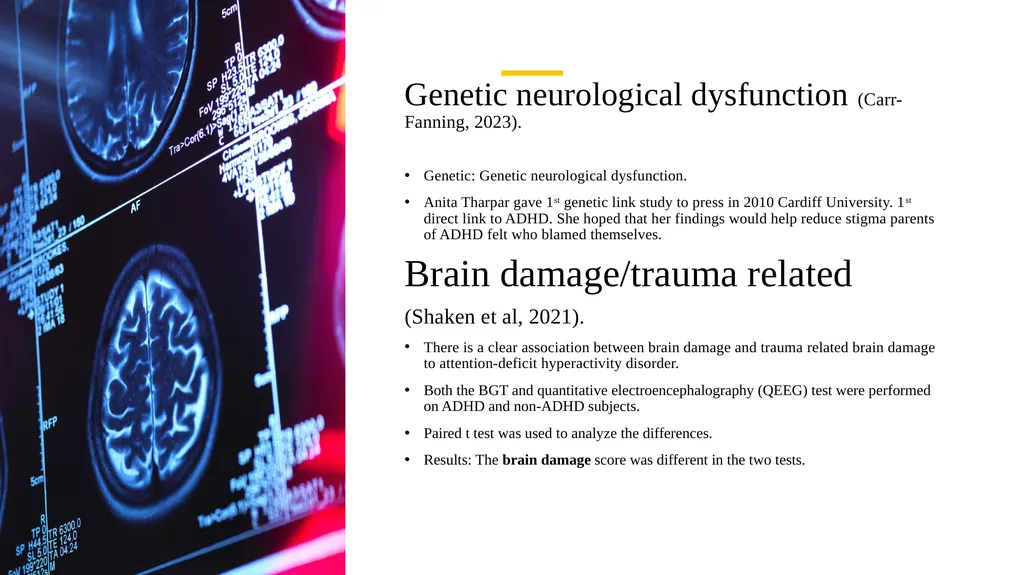
Genetic neurological dysfunction (Carr-Fanning, 2023). Genetic: Genetic neurological dysfunction.
Anita Tharpar gave 1st genetic link study to press in 2010 Cardiff University. 1st direct link to ADHD. She hoped that her findings would help reduce stigma parents of ADHD felt who blamed themselves.
Brain damage/trauma related
(Shaken et al, 2021).
There is a clear association between brain damage and trauma related brain damage to attention-deficit hyperactivity disorder.
Both the BGT and quantitative electroencephalography (QEEG) test were performed on ADHD and non-ADHD subjects.
Paired t test was used to analyze the differences.
Results: The brain damage score was different in the two tests.<br>
Anita Tharpar gave 1st genetic link study to press in 2010 Cardiff University. 1st direct link to ADHD. She hoped that her findings would help reduce stigma parents of ADHD felt who blamed themselves.
Brain damage/trauma related
(Shaken et al, 2021).
There is a clear association between brain damage and trauma related brain damage to attention-deficit hyperactivity disorder.
Both the BGT and quantitative electroencephalography (QEEG) test were performed on ADHD and non-ADHD subjects.
Paired t test was used to analyze the differences.
Results: The brain damage score was different in the two tests.<br>
11
Theories can never rule out environmental factors, however this diagnosis is NOT imaginary in my opinion. My conclusion on following theories:<br>
12
Personal experience with dismissing ADHD as a medical diagnosis and blaming it on a school system construct in the early 2000s 2 hyperactive sons in early 2000s
Public school psychiatrist said medication would be necessary for them to be in public school. Medication was refused.
I then homeschooled them, along with other siblings, until fourth grade. Behavioral school program, as well.
Changing the classroom environment did help both accomplish more learning in a less rigid environment.
Hyperactivity ruined my teaching experience and even most of my parental experiences with them as well as ruined relationships with their siblings, as they were constantly getting into trouble. Neither could control their attention, hyperactivity, or impulsiveness.
This led to depression and anxiety in their teen years.
One had no friends and completely lacked social skills. This would lead to a sleep disorder, anxiety, depression and as a young adult about four major psych ward breakdowns with an eventual comorbid diagnosis of ADHD, severe bi-polar and psychotic tendencies. As an adult he is now on medications that have changed his life, although, at 24 I still have to take care of him.
The second son graduated from high school, but has been in and out of trouble with the law and drug court for substance abuse. Makes friends easily, but the wrong kind.
I relented and got medication for both in their late teens and a diagnosis of ADHD and bi-polar. The medication has helped tremendously. However, due to impulsivity and lack of attention, they are not good at taking their medications.
I often look back and wonder if I had agreed to medicate them earlier in life if maybe they wouldn’t have broken down later in life or been less depressed or anxious.<br>
Public school psychiatrist said medication would be necessary for them to be in public school. Medication was refused.
I then homeschooled them, along with other siblings, until fourth grade. Behavioral school program, as well.
Changing the classroom environment did help both accomplish more learning in a less rigid environment.
Hyperactivity ruined my teaching experience and even most of my parental experiences with them as well as ruined relationships with their siblings, as they were constantly getting into trouble. Neither could control their attention, hyperactivity, or impulsiveness.
This led to depression and anxiety in their teen years.
One had no friends and completely lacked social skills. This would lead to a sleep disorder, anxiety, depression and as a young adult about four major psych ward breakdowns with an eventual comorbid diagnosis of ADHD, severe bi-polar and psychotic tendencies. As an adult he is now on medications that have changed his life, although, at 24 I still have to take care of him.
The second son graduated from high school, but has been in and out of trouble with the law and drug court for substance abuse. Makes friends easily, but the wrong kind.
I relented and got medication for both in their late teens and a diagnosis of ADHD and bi-polar. The medication has helped tremendously. However, due to impulsivity and lack of attention, they are not good at taking their medications.
I often look back and wonder if I had agreed to medicate them earlier in life if maybe they wouldn’t have broken down later in life or been less depressed or anxious.<br>
13
Personal experience with treating ADHD as a medical disorder and using prescriber and therapy joint solutions with my daughter: For some patients' medication is like turning on a switch and immediately life changing.
Medication management, is prescribed to reduce symptoms and minimize anxiety and depression related to and often co-morbid with ADHD.
It is not an exact science at all. That’s why the doctor calls it a, ‘practice.’ Each medication that is tried, requires adult supervision and watching to see if symptoms get worse, especially if the medication increases and brings on suicidal ideation.
Medication management is still a guessing game, even with al the MRI capabilities and all the research behind them, each individual patient has unique genetics, environment, brain capacities, etc.
When my daughter was diagnosed with ADHD and an anxiety disorder, learning from her older brothers, I began medication management, therapy and program educational management (IOP) for her as the research for medications a decade later was much stronger and less laced with stigma.
For two years now, however, she has been psychiatric hospitalized twice during medication changes and there are negative side effects, such as sleepiness, or numbness of feeling.
Sometimes it feels like a roulette game trying to medicate her major symptoms and get her relief. However, combined with a great therapist or behavioral program, I believe it is the best option for most ADHD diagnosis to date.<br>
Medication management, is prescribed to reduce symptoms and minimize anxiety and depression related to and often co-morbid with ADHD.
It is not an exact science at all. That’s why the doctor calls it a, ‘practice.’ Each medication that is tried, requires adult supervision and watching to see if symptoms get worse, especially if the medication increases and brings on suicidal ideation.
Medication management is still a guessing game, even with al the MRI capabilities and all the research behind them, each individual patient has unique genetics, environment, brain capacities, etc.
When my daughter was diagnosed with ADHD and an anxiety disorder, learning from her older brothers, I began medication management, therapy and program educational management (IOP) for her as the research for medications a decade later was much stronger and less laced with stigma.
For two years now, however, she has been psychiatric hospitalized twice during medication changes and there are negative side effects, such as sleepiness, or numbness of feeling.
Sometimes it feels like a roulette game trying to medicate her major symptoms and get her relief. However, combined with a great therapist or behavioral program, I believe it is the best option for most ADHD diagnosis to date.<br>
14
What I believe about ADHD theory and why/main points summary:
Using a combination of theories with the influence of environmental factors includes all relevant information. Cognitive behavioral theory contends that ADHD is a neurodevelopmental disorder of self-regulation with symptoms negatively affecting daily functioning at work and at home, with long-term impacts in academic, occupational, social and emotional areas of functioning. This has the most compelling evidence, however, there is no reason to not include other theory factors that have evidence as well.
Working with a team of professionals both medical prescribers and therapy-based solutions using theories from cognitive behavioral therapy, genetic neurological dysfunction, brain damage and trauma related theories combined gives each patient the best chance of succeeding into today’s society.
Early intervention for ADHD children and adolescents from a cognitive behavioral approach and a genetic neurobiological medical diagnosis is always a plus with little downside, as well as early diagnosis can help these children into government funded programs, schools, and insurances and give them a better chance in the future.
Proponents' arguments against CBT and a medical diagnostic would blame ADHD on all kinds of environmental factors. Environmental factors can increase or reduce symptoms, however, environmental theories lack empirical evidence to be proven as causation.<br>
Working with a team of professionals both medical prescribers and therapy-based solutions using theories from cognitive behavioral therapy, genetic neurological dysfunction, brain damage and trauma related theories combined gives each patient the best chance of succeeding into today’s society.
Early intervention for ADHD children and adolescents from a cognitive behavioral approach and a genetic neurobiological medical diagnosis is always a plus with little downside, as well as early diagnosis can help these children into government funded programs, schools, and insurances and give them a better chance in the future.
Proponents' arguments against CBT and a medical diagnostic would blame ADHD on all kinds of environmental factors. Environmental factors can increase or reduce symptoms, however, environmental theories lack empirical evidence to be proven as causation.<br>
15
A Cognitive Behavioral approach with Medication Management and medical diagnosis combined have the most research backed therapies and medications. Medication is more helpful than hurtful
Approved medications today for ADHD symptoms are much more reliable than twenty years ago, but still have tremendous side effects that need to be taken into consideration.
Effective, long-term treatment outcomes benefit both the individual with ADHD and society as a whole as undiagnosed and untreated adults with ADHD may become an economic burden due to increased health care costs and decreased productivity at work.
The severity of the problem, especially if it has led to suicidal ideation or suicidal depression, on a severe scale that medication can typically help tremendously.
Getting children and adolescents who are severely affected by their ADHD symptoms at home and in school on medication that helps them not be in trouble all the time can increase their self-esteem.
Each child should be on a case-by-case basis, with the medical provider taking into consideration parental observation, genetics, med management, therapeutic programs, schools, and the severity of interfering with everyday life for the child.<br>
Approved medications today for ADHD symptoms are much more reliable than twenty years ago, but still have tremendous side effects that need to be taken into consideration.
Effective, long-term treatment outcomes benefit both the individual with ADHD and society as a whole as undiagnosed and untreated adults with ADHD may become an economic burden due to increased health care costs and decreased productivity at work.
The severity of the problem, especially if it has led to suicidal ideation or suicidal depression, on a severe scale that medication can typically help tremendously.
Getting children and adolescents who are severely affected by their ADHD symptoms at home and in school on medication that helps them not be in trouble all the time can increase their self-esteem.
Each child should be on a case-by-case basis, with the medical provider taking into consideration parental observation, genetics, med management, therapeutic programs, schools, and the severity of interfering with everyday life for the child.<br>
16
References Carr-Fanning, K. (2023). Meaning-making within inclusion: Exploring parents, teachers and students lay theories of adhd and their implications for inclusive practice. Journal of Research in Special Educational Needs.
Champ, R. E. Adamou, M., Tolchard, B. (2021). The impact on the psychological theory treatment of Attention-deficit
Hyperactivity Disorder in adults. A scoping review. PLoS ONE 16(12).
https://doi.org/10.1371/ journal.pone.0261247
Shaken, S., Bidaki, R. Mirhosseini, H., Kiani, M. (2021). Comparing bender-gestalt test and quantitative electroencephalography for
brain trauma diagnosis in depressive and attention deficit hyperactivity disorder. International Clinical Neuroscience
Journal, 8(3), 144-148.
Smith, M. (2012). Hyperactive: The controversial history of ADHD.
https://ebookcentral.proquest.com/lib/nu/detail.action?docID=1127631<br>
Champ, R. E. Adamou, M., Tolchard, B. (2021). The impact on the psychological theory treatment of Attention-deficit
Hyperactivity Disorder in adults. A scoping review. PLoS ONE 16(12).
https://doi.org/10.1371/ journal.pone.0261247
Shaken, S., Bidaki, R. Mirhosseini, H., Kiani, M. (2021). Comparing bender-gestalt test and quantitative electroencephalography for
brain trauma diagnosis in depressive and attention deficit hyperactivity disorder. International Clinical Neuroscience
Journal, 8(3), 144-148.
Smith, M. (2012). Hyperactive: The controversial history of ADHD.
https://ebookcentral.proquest.com/lib/nu/detail.action?docID=1127631<br>