04
Instead, good writers usually use plain English words, well structured sentences and avoid slang language, so, sentences will be simple, formal and clear.
You may use subordinate clauses but keep them short.
Write well structured paragraphs using the following structure:
-Topic sentences.
-Supporting details.
-A concluding sentence.<br>
05
When you write, you need to clearly express its contents and always check for:
Punctuation.
Spelling.
Grammar (verb tenses, agreement, etc.)
Each subject discipline will have certain writing vocabulary that you will become familiar with over the course of your degree. However, there are some general characteristics of academic writing that are common in all disciplines. For example, it is:
Planned and focused: answers the question and demonstrates an understanding of the subject.<br>
06
Structured: is coherent, written in a logical order, and brings together related points and material.
Evidenced: demonstrates knowledge of the subject area, supports opinions and arguments with evidence, and is referenced accurately.
Formal in tone and style: uses appropriate language and tenses.<br>
07
Punctuation Punctuation marks are an essential tool of organization. They are symbols used to:
organize the structure of written language, and
to indicate intonation (rise and fall/or speech pattern) and pauses to be observed when reading aloud.
*Punctuation marks are also used to avoid ambiguity (vagueness). For example:
“woman, without her man, is nothing”
But it has a different meaning when you say:
“woman: without her, man is nothing”<br>
08
Summary of punctuation rules End punctuation marks:
1. Full stop , or period (.)
• Used at the end of a sentence:
She stood up and went away. She was angry.
• Used for abbreviations:
Co. = (Company)
Ph. D. = (Philosophy Doctor)
2. Question marks (?)
• Question marks are used at the end of direct questions:
Where do you live?
Did you do the homework?<br>
09
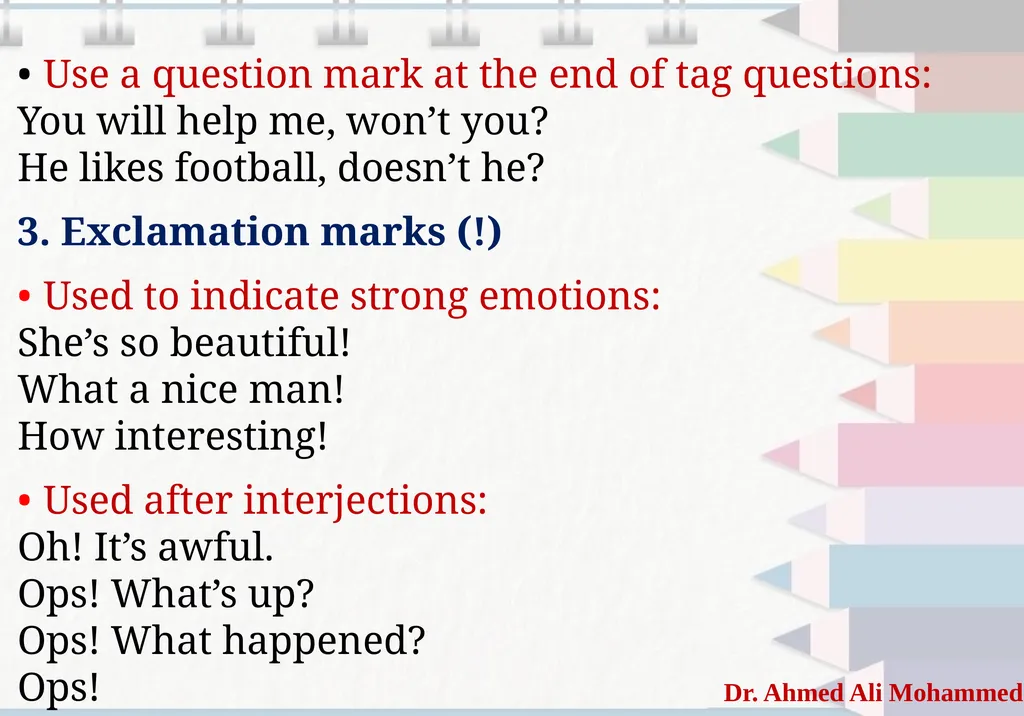
• Use a question mark at the end of tag questions:
You will help me, won’t you?
He likes football, doesn’t he?
3. Exclamation marks (!)
• Used to indicate strong emotions:
She’s so beautiful!
What a nice man!
How interesting!
• Used after interjections:
Oh! It’s awful.
Ops! What’s up?
Ops! What happened?
Ops!<br>
10
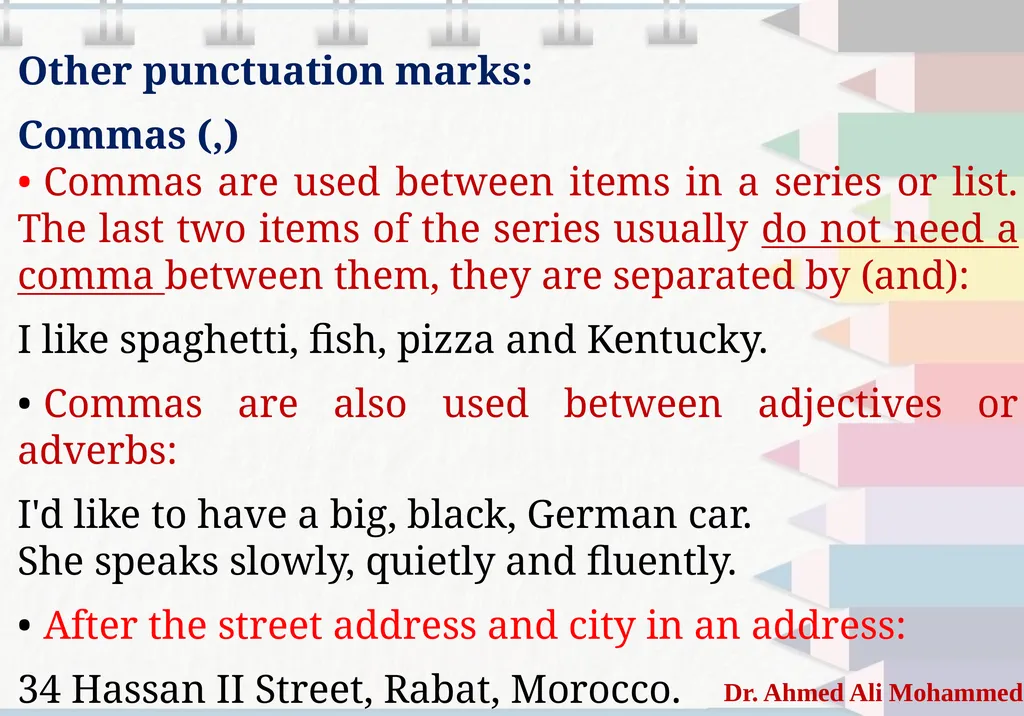
Other punctuation marks:
Commas (,)
• Commas are used between items in a series or list. The last two items of the series usually do not need a comma between them, they are separated by (and):
I like spaghetti, fish, pizza and Kentucky.
• Commas are also used between adjectives or adverbs:
I'd like to have a big, black, German car.
She speaks slowly, quietly and fluently.
• After the street address and city in an address:
34 Hassan II Street, Rabat, Morocco.<br>
11
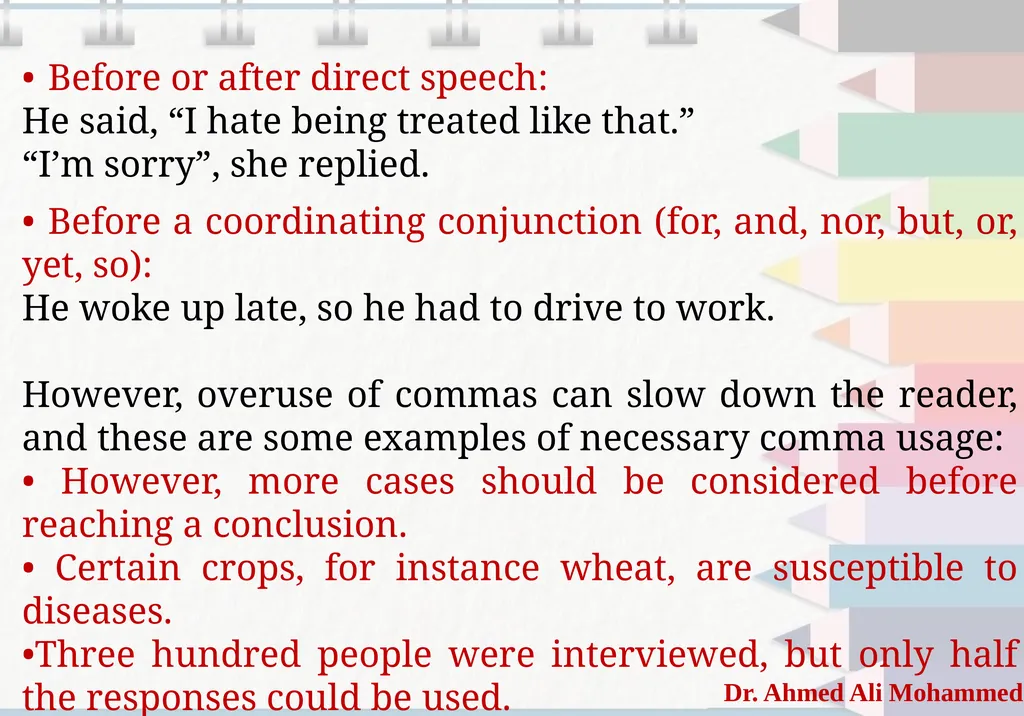
• Before or after direct speech:
He said, “I hate being treated like that.”
“I’m sorry”, she replied.
• Before a coordinating conjunction (for, and, nor, but, or, yet, so):
He woke up late, so he had to drive to work.
However, overuse of commas can slow down the reader, and these are some examples of necessary comma usage:
• However, more cases should be considered before reaching a conclusion.
• Certain crops, for instance wheat, are susceptible to diseases.
•Three hundred people were interviewed, but only half the responses could be used.<br>
12
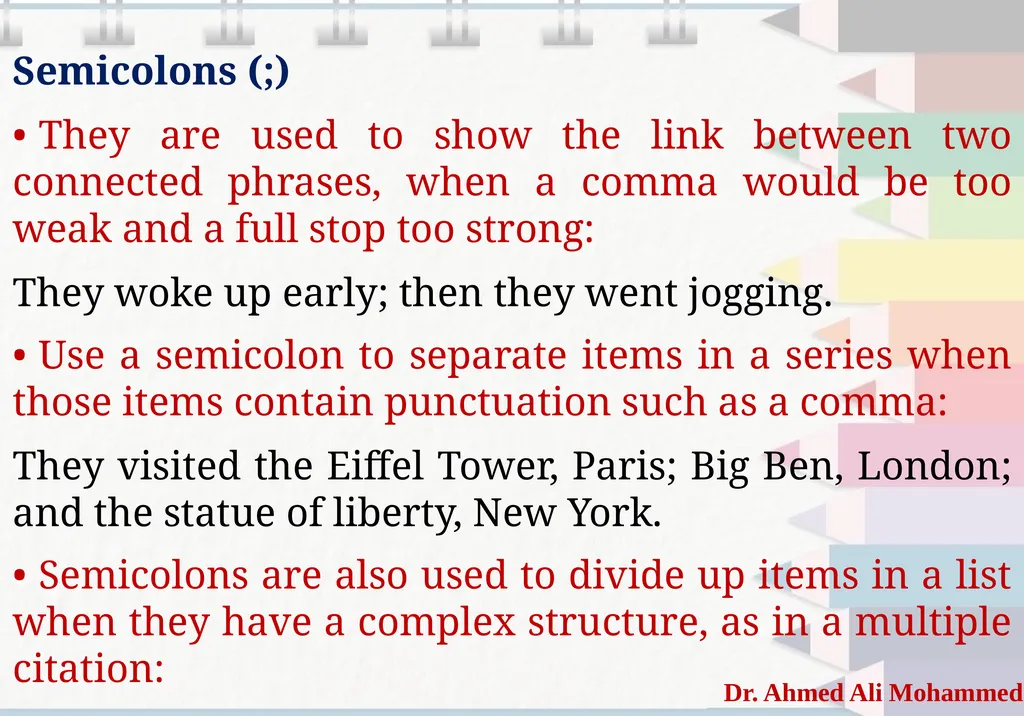
Semicolons (;)
• They are used to show the link between two connected phrases, when a comma would be too weak and a full stop too strong:
They woke up early; then they went jogging.
• Use a semicolon to separate items in a series when those items contain punctuation such as a comma:
They visited the Eiffel Tower, Paris; Big Ben, London; and the statue of liberty, New York.
• Semicolons are also used to divide up items in a list when they have a complex structure, as in a multiple citation:<br>
13
(Maitland, 2006; Rosenor, 1997; New Scientist, 2006b; University of Michigan, 2000).
Colons (:)
• Use a colon to introduce a list:
He visited three cities last summer holiday: Madrid, Roma and Athens.
• To introduce an idea or an explanation:
He had one idea in his mind: to see her as soon as possible.
• To introduce direct speech or a quotation:
The secretary whispered in his ear: “Your wife is on the phone.”<br>
14
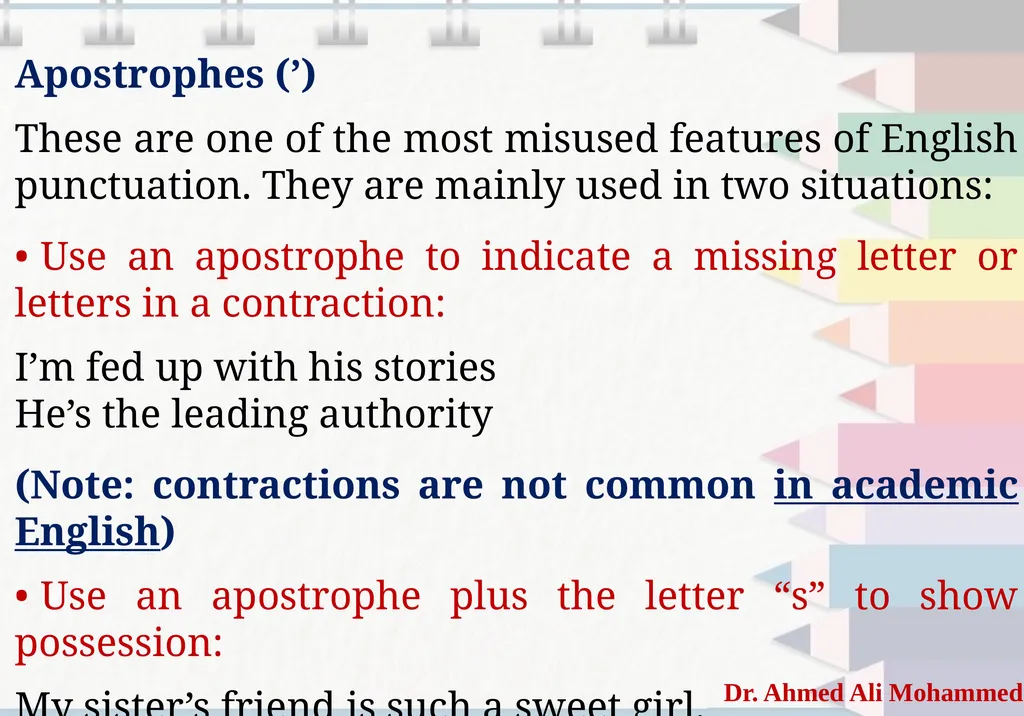
Apostrophes (’)
These are one of the most misused features of English punctuation. They are mainly used in two situations:
• Use an apostrophe to indicate a missing letter or letters in a contraction:
I’m fed up with his stories
He’s the leading authority
(Note: contractions are not common in academic English)
• Use an apostrophe plus the letter “s” to show possession:
My sister’s friend is such a sweet girl.<br>
15
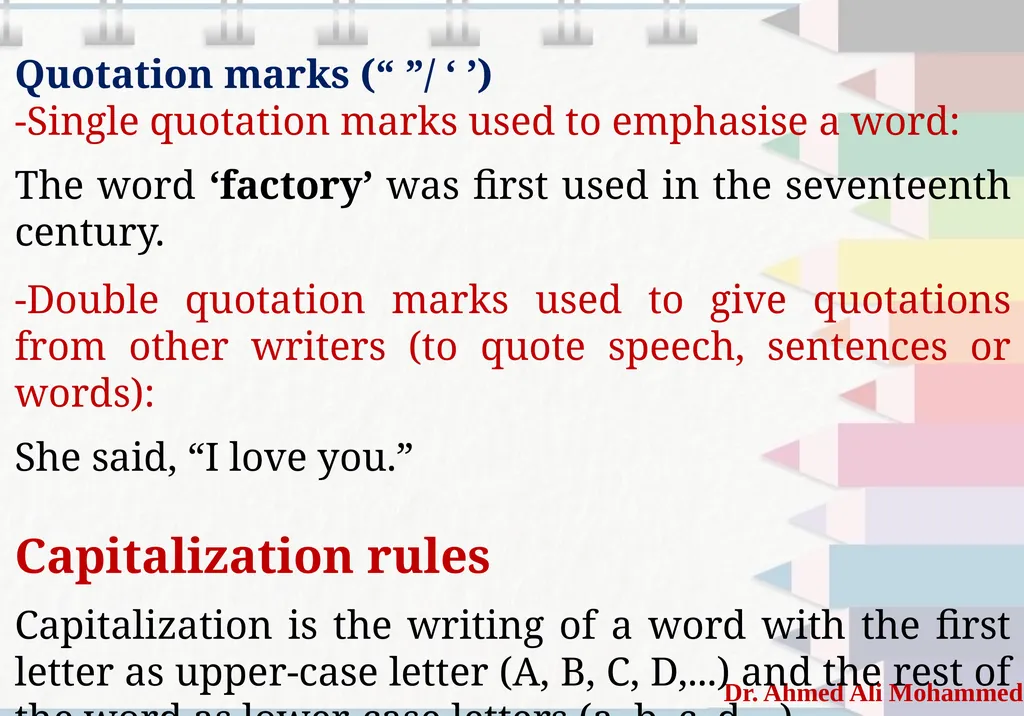
Quotation marks (“ ”/ ‘ ’)
-Single quotation marks used to emphasise a word:
The word ‘factory’ was first used in the seventeenth century.
-Double quotation marks used to give quotations from other writers (to quote speech, sentences or words):
She said, “I love you.”
Capitalization rules
Capitalization is the writing of a word with the first letter as upper-case letter (A, B, C, D,...) and the rest of the word as lower-case letters (a, b, c, d,...)<br>
16
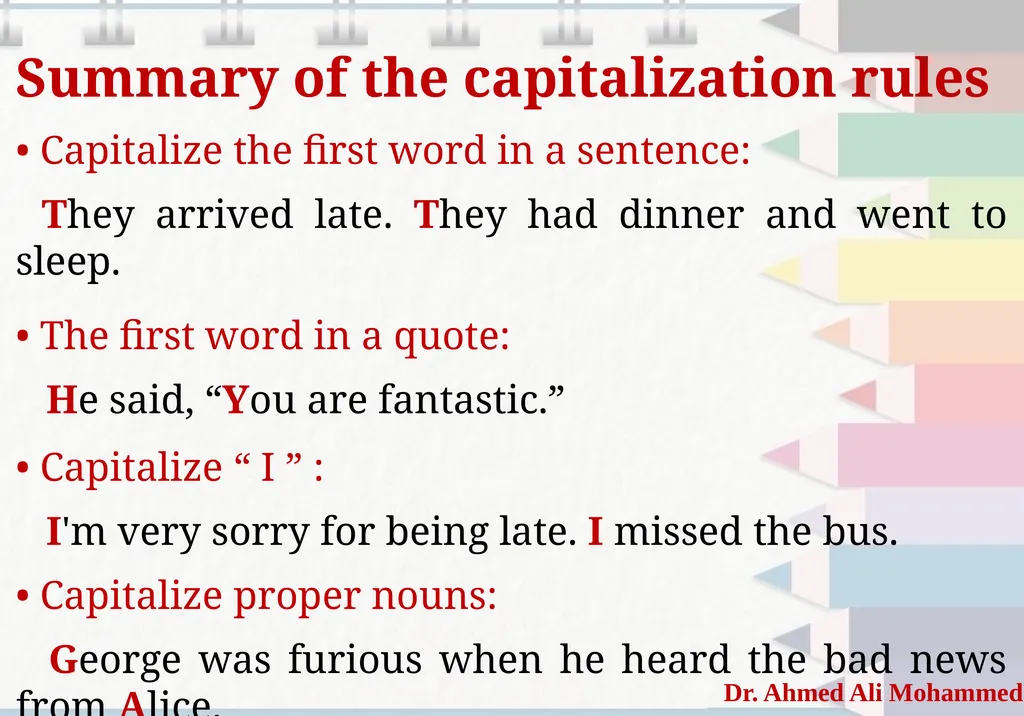
Summary of the capitalization rules
• Capitalize the first word in a sentence:
They arrived late. They had dinner and went to sleep.
• The first word in a quote:
He said, “You are fantastic.”
• Capitalize “ I ” :
I'm very sorry for being late. I missed the bus.
• Capitalize proper nouns:
George was furious when he heard the bad news from Alice.<br>
17
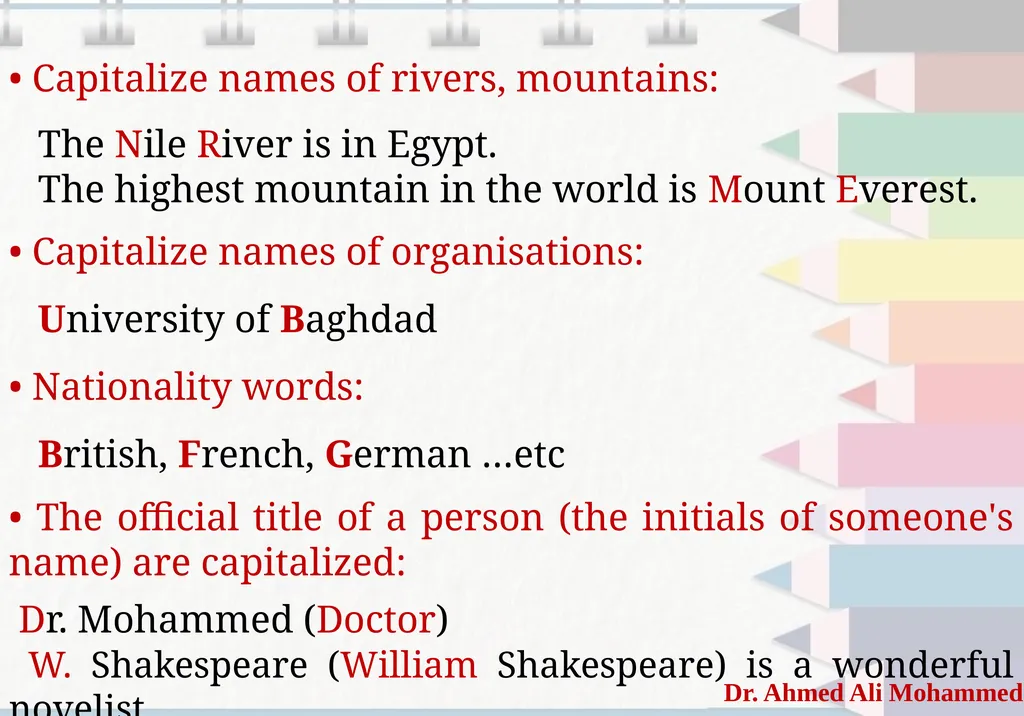
• Capitalize names of rivers, mountains:
The Nile River is in Egypt.
The highest mountain in the world is Mount Everest.
• Capitalize names of organisations:
University of Baghdad
• Nationality words:
British, French, German …etc
• The official title of a person (the initials of someone's name) are capitalized:
Dr. Mohammed (Doctor)
W. Shakespeare (William Shakespeare) is a wonderful novelist<br>
18
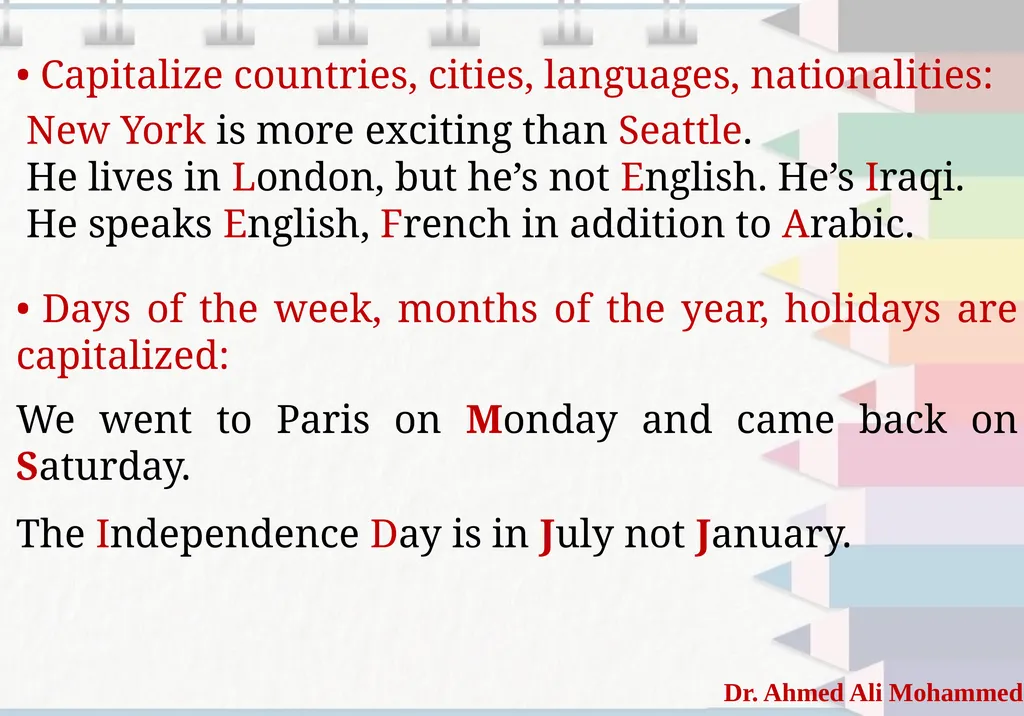
• Capitalize countries, cities, languages, nationalities:
New York is more exciting than Seattle.
He lives in London, but he’s not English. He’s Iraqi.
He speaks English, French in addition to Arabic.
• Days of the week, months of the year, holidays are capitalized:
We went to Paris on Monday and came back on Saturday.
The Independence Day is in July not January.<br>
19
Thank You For
Your Listening
See You Next
Lecture<br>