
ADVANCED STRATEGIC MANAGEMENT Chapter Three The
TF
Published · 45 slides · 0 views
1 / 1

Description
ADVANCED STRATEGIC MANAGEMENT Chapter Three The Business Vision and Mission Statements By: Y.H November, 2019 Debre Tabor, Ethiopia 1 Contents 3.1 The Nature of Business Vision and Mission 3.2. Components of A Mission Statement 3.3. The
Related Topics
Share
Embed code
Download this presentation From Below
"ADVANCED STRATEGIC MANAGEMENT Chapter Three The" is the property of its rightful owner. Permission is granted to download and print the materials on this website for personal, non-commercial use only, and to display it on your personal computer provided you do not modify the materials and that you retain all copyright notices contained in the materials. By downloading content from our website, you accept the terms of this agreement.
Presentation Transcript
01
ADVANCED STRATEGIC MANAGEMENT Chapter Three
The Business Vision and Mission Statements
By: Y.H
November, 2019
Debre Tabor, Ethiopia 1<br>
The Business Vision and Mission Statements
By: Y.H
November, 2019
Debre Tabor, Ethiopia 1<br>
02
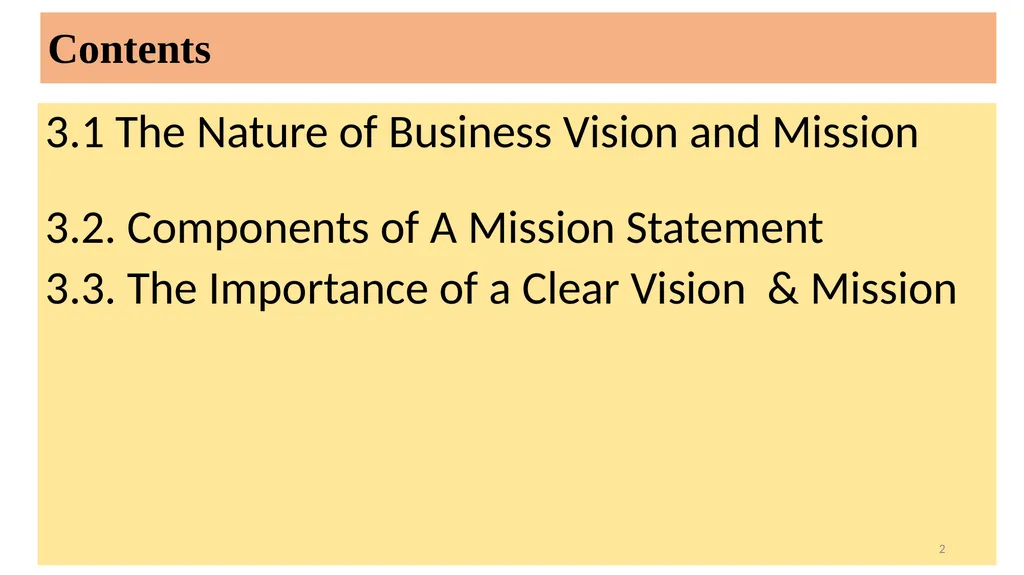
Contents 3.1 The Nature of Business Vision and Mission
3.2. Components of A Mission Statement
3.3. The Importance of a Clear Vision & Mission 2<br>
3.2. Components of A Mission Statement
3.3. The Importance of a Clear Vision & Mission 2<br>
03
3.1. The Nature of Vision & Mission Statements<br>
04
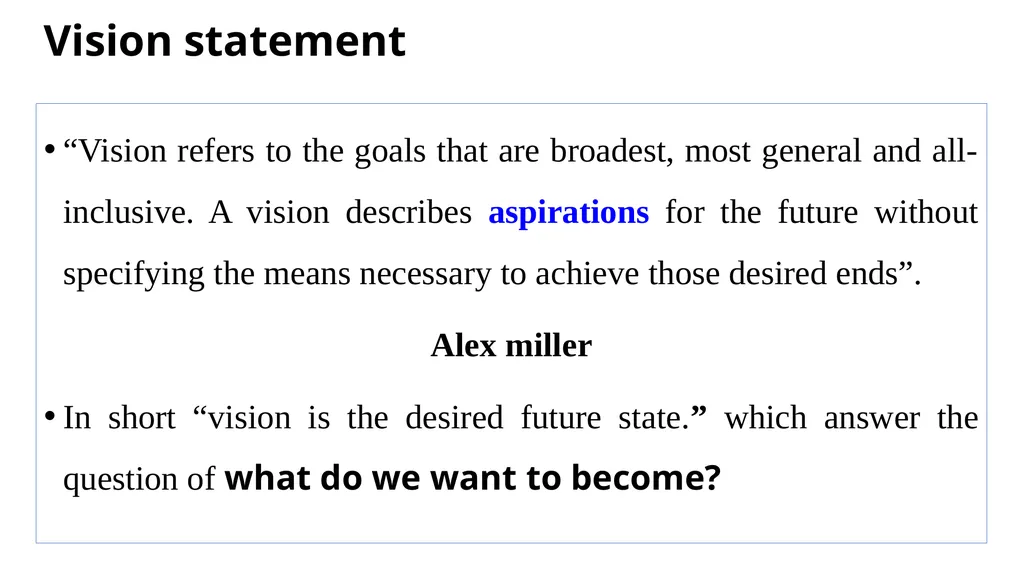
Vision statement “Vision refers to the goals that are broadest, most general and all‐inclusive. A vision describes aspirations for the future without specifying the means necessary to achieve those desired ends”.
Alex miller
In short “vision is the desired future state.” which answer the question of what do we want to become?<br>
Alex miller
In short “vision is the desired future state.” which answer the question of what do we want to become?<br>
05
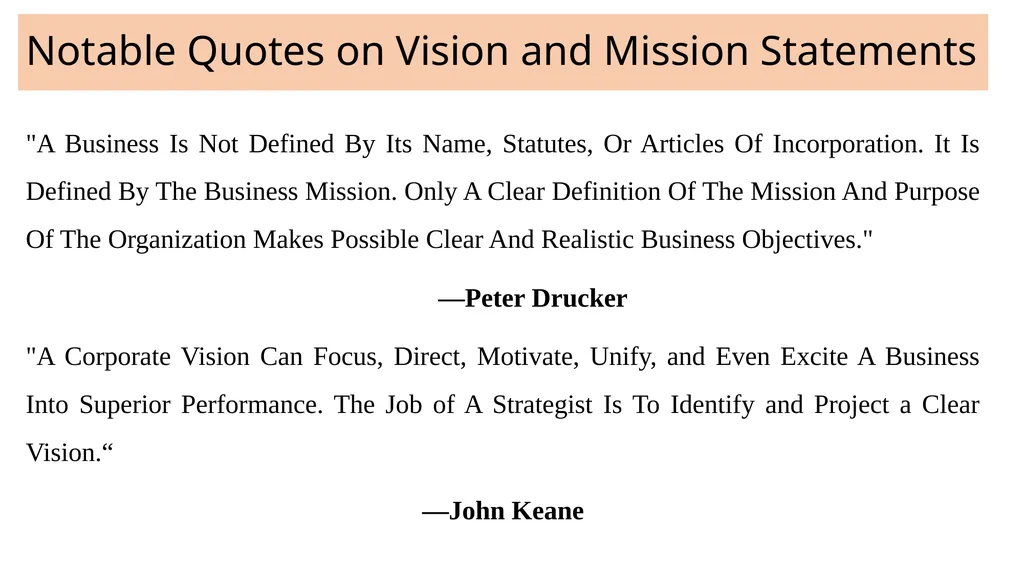
Notable Quotes on Vision and Mission Statements "A Business Is Not Defined By Its Name, Statutes, Or Articles Of Incorporation. It Is Defined By The Business Mission. Only A Clear Definition Of The Mission And Purpose Of The Organization Makes Possible Clear And Realistic Business Objectives."
—Peter Drucker
"A Corporate Vision Can Focus, Direct, Motivate, Unify, and Even Excite A Business Into Superior Performance. The Job of A Strategist Is To Identify and Project a Clear Vision.“
—John Keane<br>
—Peter Drucker
"A Corporate Vision Can Focus, Direct, Motivate, Unify, and Even Excite A Business Into Superior Performance. The Job of A Strategist Is To Identify and Project a Clear Vision.“
—John Keane<br>
06
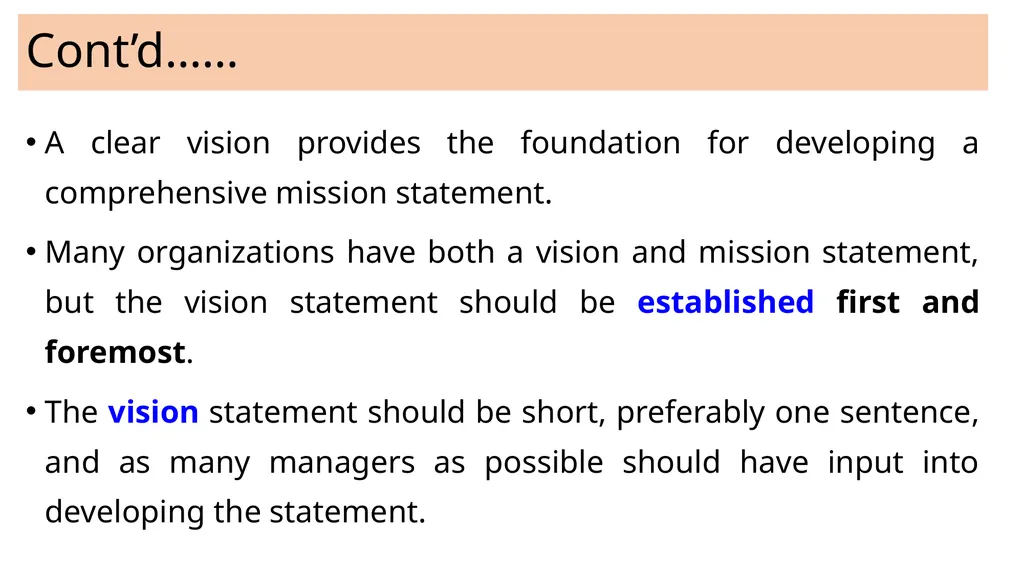
Cont’d…… A clear vision provides the foundation for developing a comprehensive mission statement.
Many organizations have both a vision and mission statement, but the vision statement should be established first and foremost.
The vision statement should be short, preferably one sentence, and as many managers as possible should have input into developing the statement.<br>
Many organizations have both a vision and mission statement, but the vision statement should be established first and foremost.
The vision statement should be short, preferably one sentence, and as many managers as possible should have input into developing the statement.<br>
07
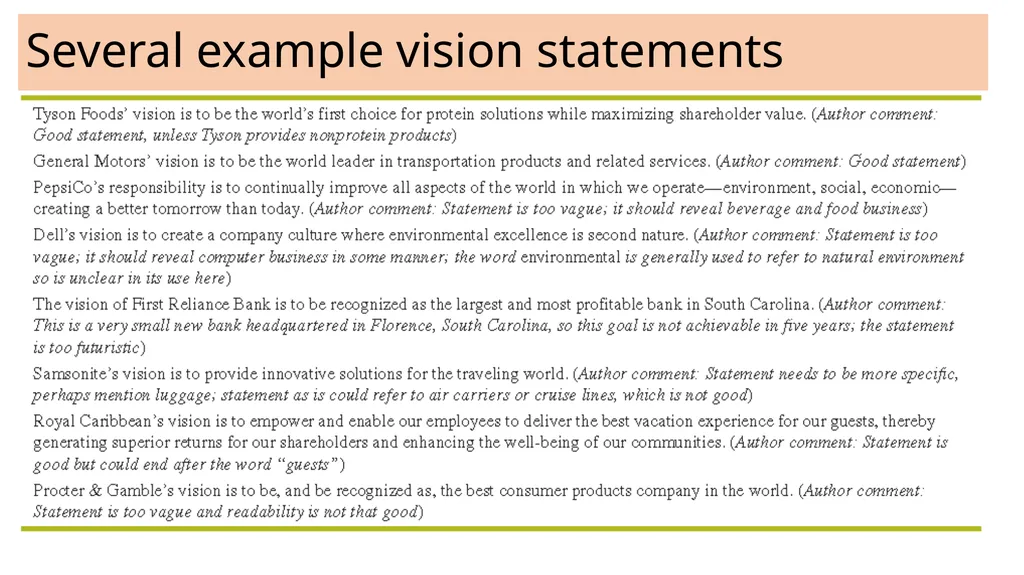
Several example vision statements<br>
08
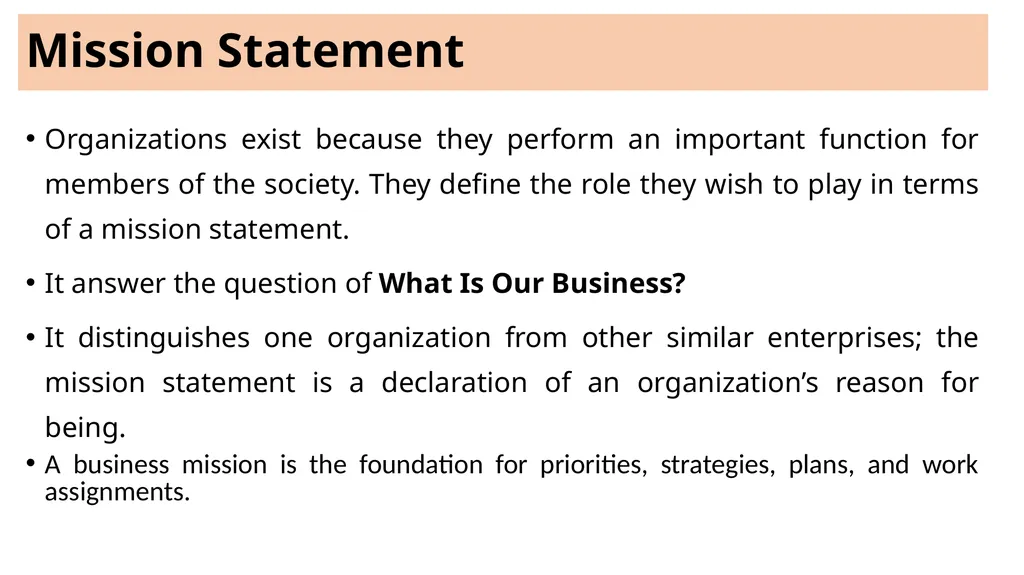
Mission Statement Organizations exist because they perform an important function for members of the society. They define the role they wish to play in terms of a mission statement.
It answer the question of What Is Our Business?
It distinguishes one organization from other similar enterprises; the mission statement is a declaration of an organization’s reason for being.
A business mission is the foundation for priorities, strategies, plans, and work assignments.<br>
It answer the question of What Is Our Business?
It distinguishes one organization from other similar enterprises; the mission statement is a declaration of an organization’s reason for being.
A business mission is the foundation for priorities, strategies, plans, and work assignments.<br>
09
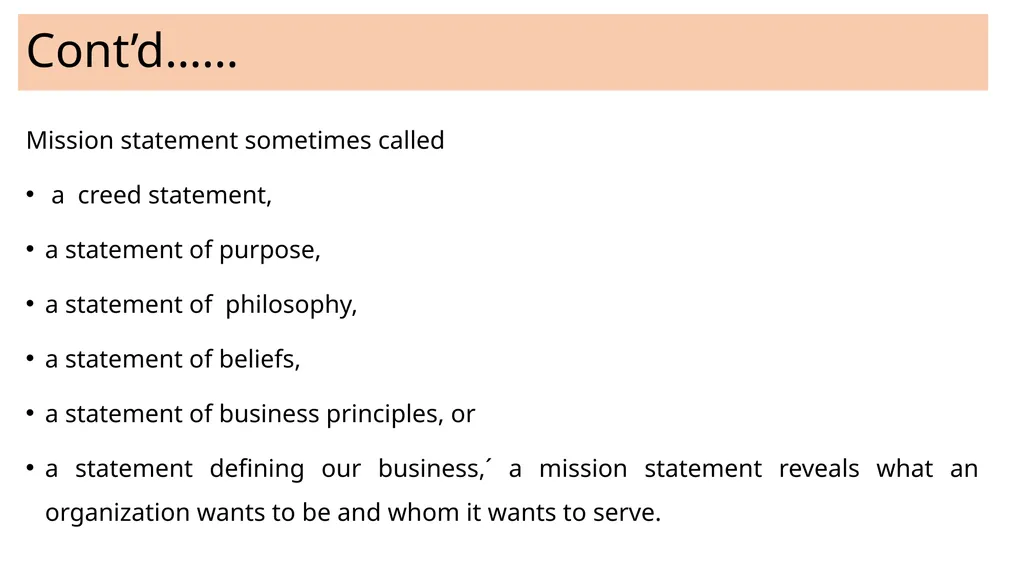
Cont’d…… Mission statement sometimes called
a creed statement,
a statement of purpose,
a statement of philosophy,
a statement of beliefs,
a statement of business principles, or
a statement defining our business,´ a mission statement reveals what an organization wants to be and whom it wants to serve.<br>
a creed statement,
a statement of purpose,
a statement of philosophy,
a statement of beliefs,
a statement of business principles, or
a statement defining our business,´ a mission statement reveals what an organization wants to be and whom it wants to serve.<br>
10
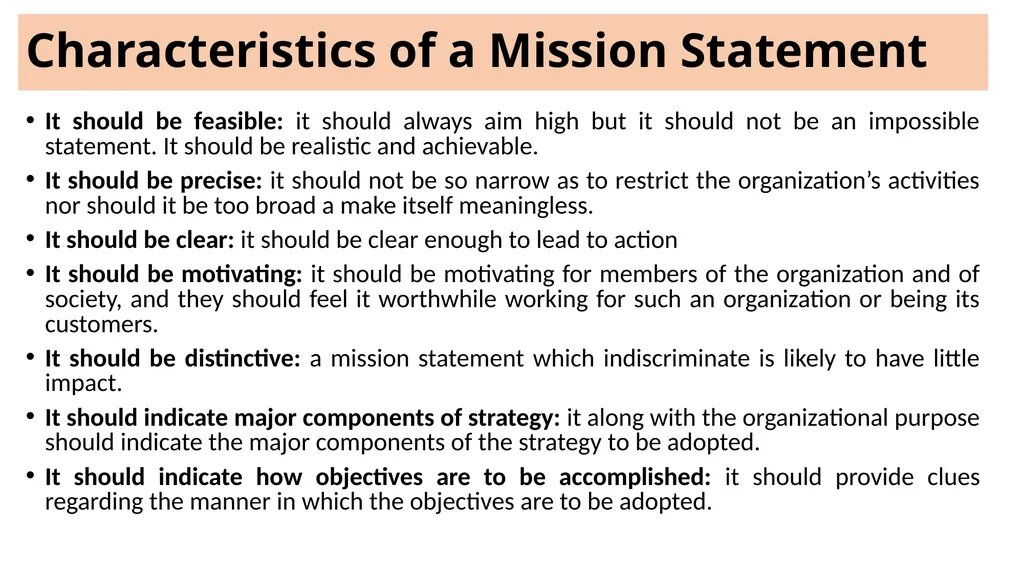
Characteristics of a Mission Statement It should be feasible: it should always aim high but it should not be an impossible statement. It should be realistic and achievable.
It should be precise: it should not be so narrow as to restrict the organization’s activities nor should it be too broad a make itself meaningless.
It should be clear: it should be clear enough to lead to action
It should be motivating: it should be motivating for members of the organization and of society, and they should feel it worthwhile working for such an organization or being its customers.
It should be distinctive: a mission statement which indiscriminate is likely to have little impact.
It should indicate major components of strategy: it along with the organizational purpose should indicate the major components of the strategy to be adopted.
It should indicate how objectives are to be accomplished: it should provide clues regarding the manner in which the objectives are to be adopted.<br>
It should be precise: it should not be so narrow as to restrict the organization’s activities nor should it be too broad a make itself meaningless.
It should be clear: it should be clear enough to lead to action
It should be motivating: it should be motivating for members of the organization and of society, and they should feel it worthwhile working for such an organization or being its customers.
It should be distinctive: a mission statement which indiscriminate is likely to have little impact.
It should indicate major components of strategy: it along with the organizational purpose should indicate the major components of the strategy to be adopted.
It should indicate how objectives are to be accomplished: it should provide clues regarding the manner in which the objectives are to be adopted.<br>
11
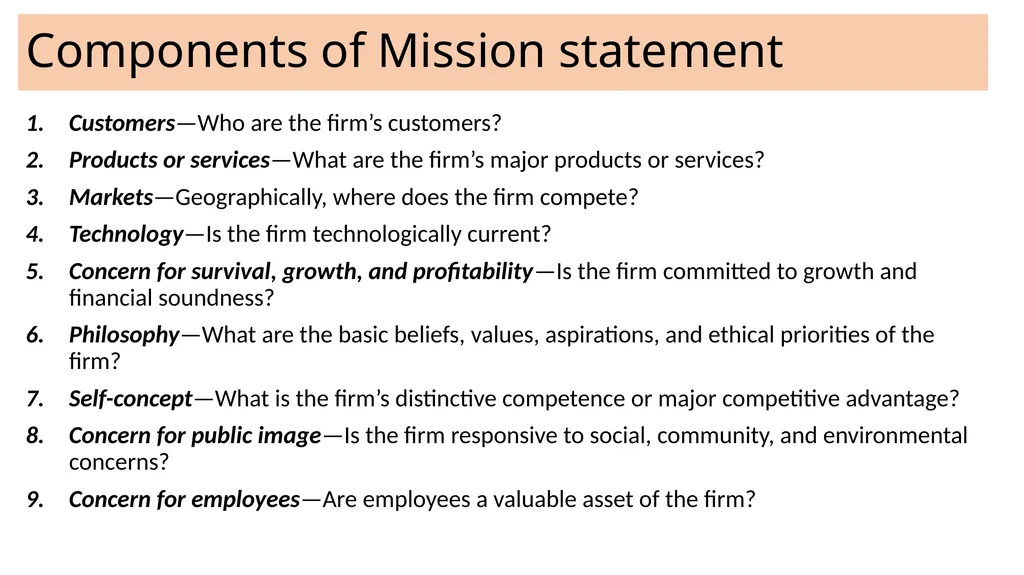
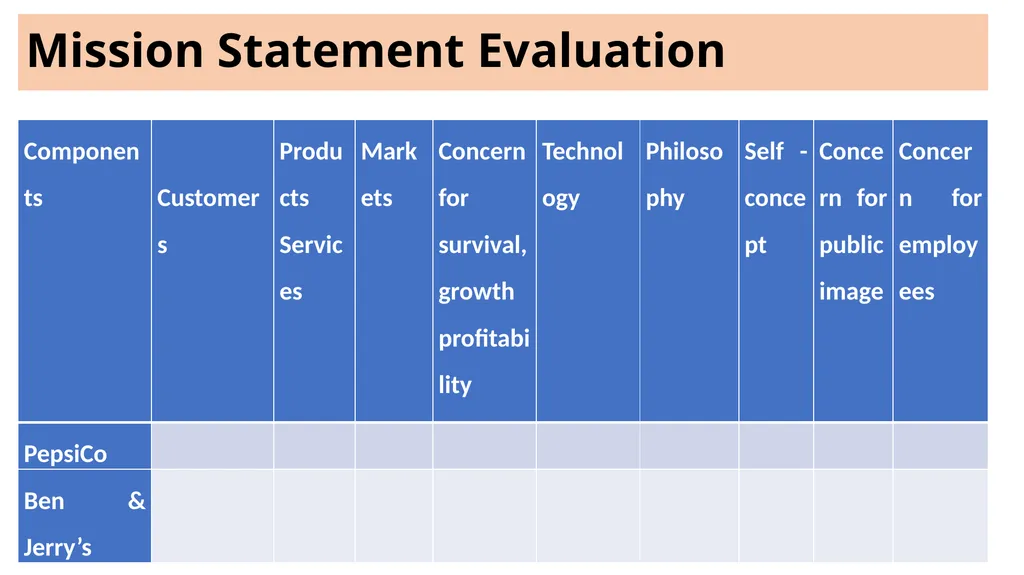
Components of Mission statement Customers—Who are the firm’s customers?
Products or services—What are the firm’s major products or services?
Markets—Geographically, where does the firm compete?
Technology—Is the firm technologically current?
Concern for survival, growth, and profitability—Is the firm committed to growth and financial soundness?
Philosophy—What are the basic beliefs, values, aspirations, and ethical priorities of the firm?
Self-concept—What is the firm’s distinctive competence or major competitive advantage?
Concern for public image—Is the firm responsive to social, community, and environmental concerns?
Concern for employees—Are employees a valuable asset of the firm?<br>
Products or services—What are the firm’s major products or services?
Markets—Geographically, where does the firm compete?
Technology—Is the firm technologically current?
Concern for survival, growth, and profitability—Is the firm committed to growth and financial soundness?
Philosophy—What are the basic beliefs, values, aspirations, and ethical priorities of the firm?
Self-concept—What is the firm’s distinctive competence or major competitive advantage?
Concern for public image—Is the firm responsive to social, community, and environmental concerns?
Concern for employees—Are employees a valuable asset of the firm?<br>
12
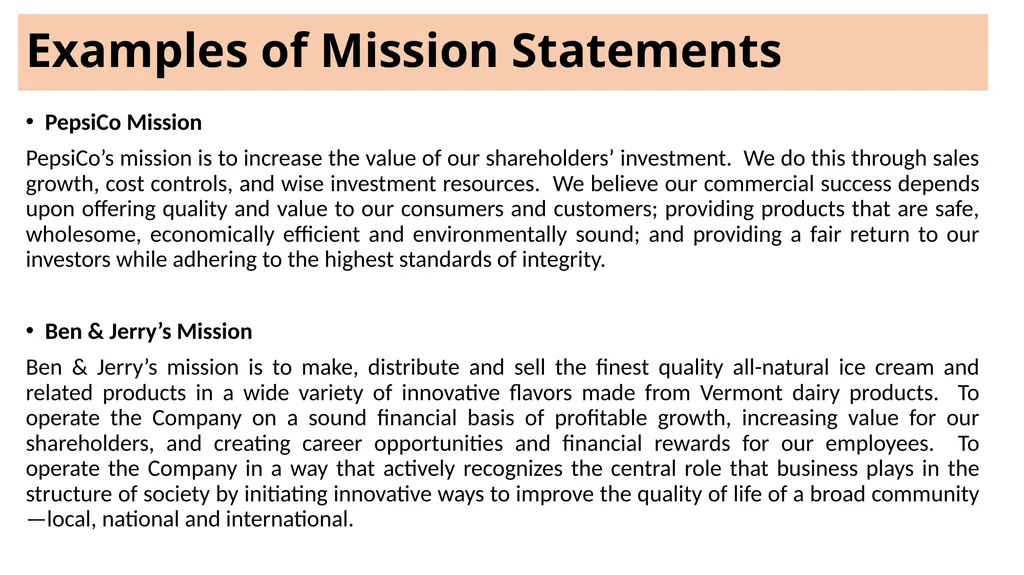
Examples of Mission Statements PepsiCo Mission
PepsiCo’s mission is to increase the value of our shareholders’ investment. We do this through sales growth, cost controls, and wise investment resources. We believe our commercial success depends upon offering quality and value to our consumers and customers; providing products that are safe, wholesome, economically efficient and environmentally sound; and providing a fair return to our investors while adhering to the highest standards of integrity.
Ben & Jerry’s Mission
Ben & Jerry’s mission is to make, distribute and sell the finest quality all-natural ice cream and related products in a wide variety of innovative flavors made from Vermont dairy products. To operate the Company on a sound financial basis of profitable growth, increasing value for our shareholders, and creating career opportunities and financial rewards for our employees. To operate the Company in a way that actively recognizes the central role that business plays in the structure of society by initiating innovative ways to improve the quality of life of a broad community—local, national and international.<br>
PepsiCo’s mission is to increase the value of our shareholders’ investment. We do this through sales growth, cost controls, and wise investment resources. We believe our commercial success depends upon offering quality and value to our consumers and customers; providing products that are safe, wholesome, economically efficient and environmentally sound; and providing a fair return to our investors while adhering to the highest standards of integrity.
Ben & Jerry’s Mission
Ben & Jerry’s mission is to make, distribute and sell the finest quality all-natural ice cream and related products in a wide variety of innovative flavors made from Vermont dairy products. To operate the Company on a sound financial basis of profitable growth, increasing value for our shareholders, and creating career opportunities and financial rewards for our employees. To operate the Company in a way that actively recognizes the central role that business plays in the structure of society by initiating innovative ways to improve the quality of life of a broad community—local, national and international.<br>
13
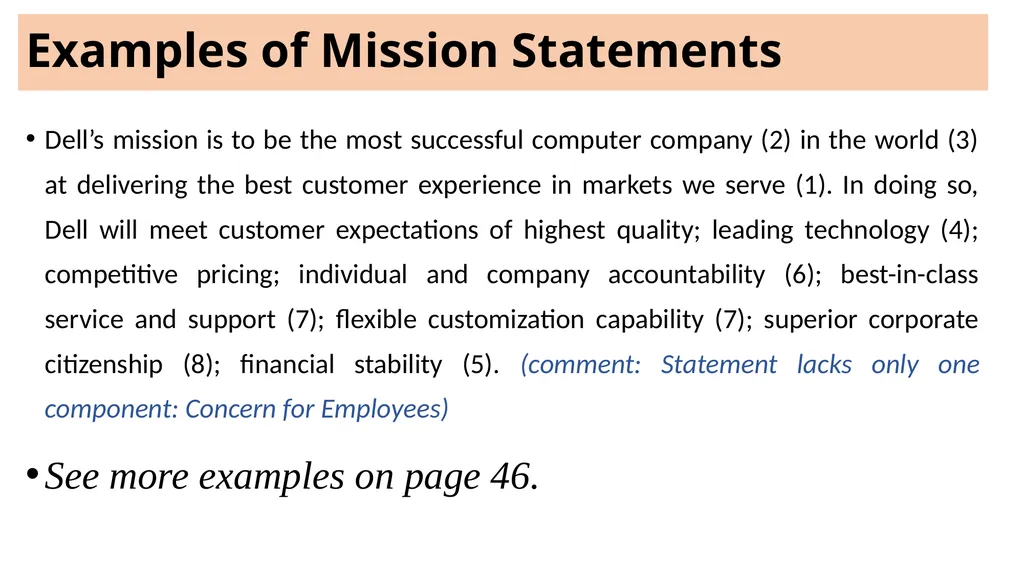
Examples of Mission Statements Dell’s mission is to be the most successful computer company (2) in the world (3) at delivering the best customer experience in markets we serve (1). In doing so, Dell will meet customer expectations of highest quality; leading technology (4); competitive pricing; individual and company accountability (6); best-in-class service and support (7); flexible customization capability (7); superior corporate citizenship (8); financial stability (5). (comment: Statement lacks only one component: Concern for Employees)
See more examples on page 46.<br>
See more examples on page 46.<br>
14
Mission Statement Evaluation<br>
15
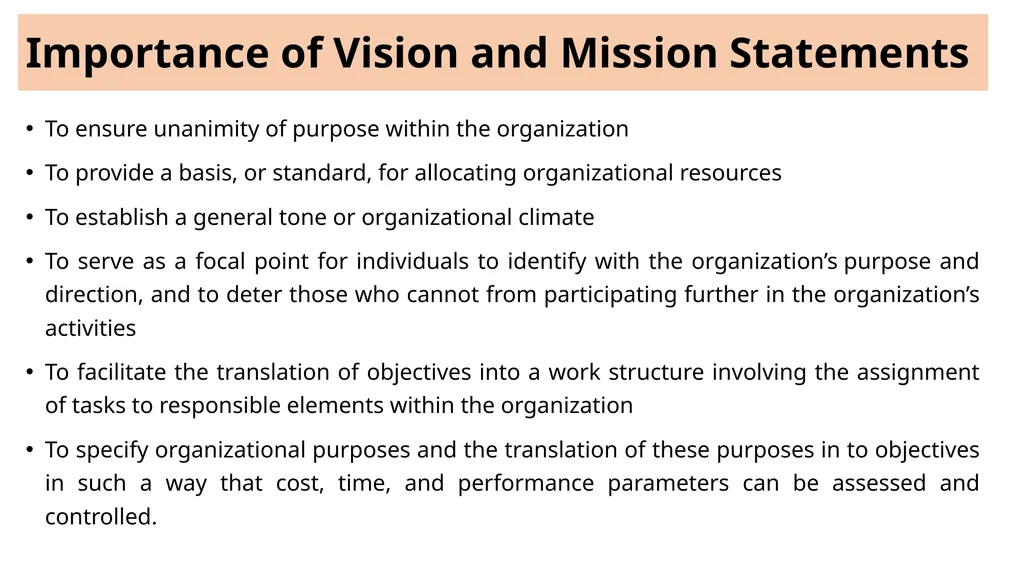
Importance of Vision and Mission Statements To ensure unanimity of purpose within the organization
To provide a basis, or standard, for allocating organizational resources
To establish a general tone or organizational climate
To serve as a focal point for individuals to identify with the organization’s purpose and direction, and to deter those who cannot from participating further in the organization’s activities
To facilitate the translation of objectives into a work structure involving the assignment of tasks to responsible elements within the organization
To specify organizational purposes and the translation of these purposes in to objectives in such a way that cost, time, and performance parameters can be assessed and controlled.<br>
To provide a basis, or standard, for allocating organizational resources
To establish a general tone or organizational climate
To serve as a focal point for individuals to identify with the organization’s purpose and direction, and to deter those who cannot from participating further in the organization’s activities
To facilitate the translation of objectives into a work structure involving the assignment of tasks to responsible elements within the organization
To specify organizational purposes and the translation of these purposes in to objectives in such a way that cost, time, and performance parameters can be assessed and controlled.<br>
16
ADVANCED STRATEGIC MANAGEMENT Chapter Four
ENVIRONMENTAL ANALYSIS
By: Y.H
November, 2019
Debre Tabor, Ethiopia 16<br>
ENVIRONMENTAL ANALYSIS
By: Y.H
November, 2019
Debre Tabor, Ethiopia 16<br>
17
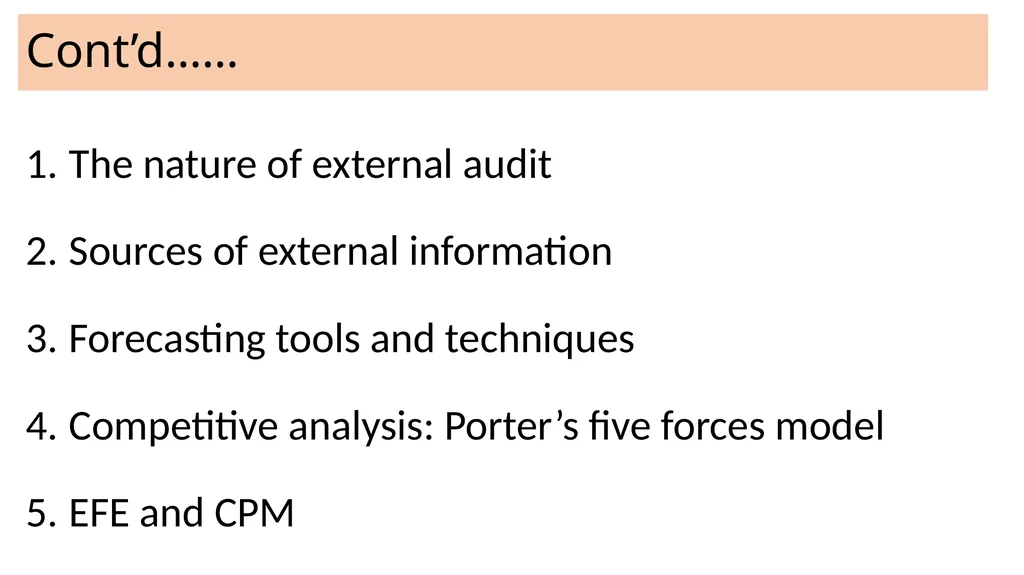
Cont’d…… The nature of external audit
Sources of external information
Forecasting tools and techniques
Competitive analysis: Porter’s five forces model
EFE and CPM<br>
Sources of external information
Forecasting tools and techniques
Competitive analysis: Porter’s five forces model
EFE and CPM<br>
18
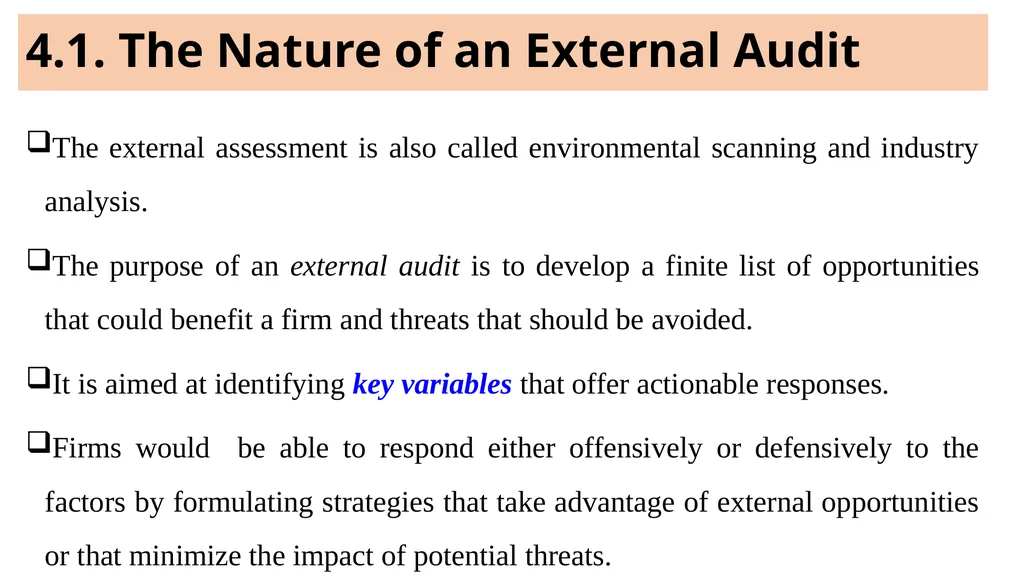
4.1. The Nature of an External Audit The external assessment is also called environmental scanning and industry analysis.
The purpose of an external audit is to develop a finite list of opportunities that could benefit a firm and threats that should be avoided.
It is aimed at identifying key variables that offer actionable responses.
Firms would be able to respond either offensively or defensively to the factors by formulating strategies that take advantage of external opportunities or that minimize the impact of potential threats.<br>
The purpose of an external audit is to develop a finite list of opportunities that could benefit a firm and threats that should be avoided.
It is aimed at identifying key variables that offer actionable responses.
Firms would be able to respond either offensively or defensively to the factors by formulating strategies that take advantage of external opportunities or that minimize the impact of potential threats.<br>
19
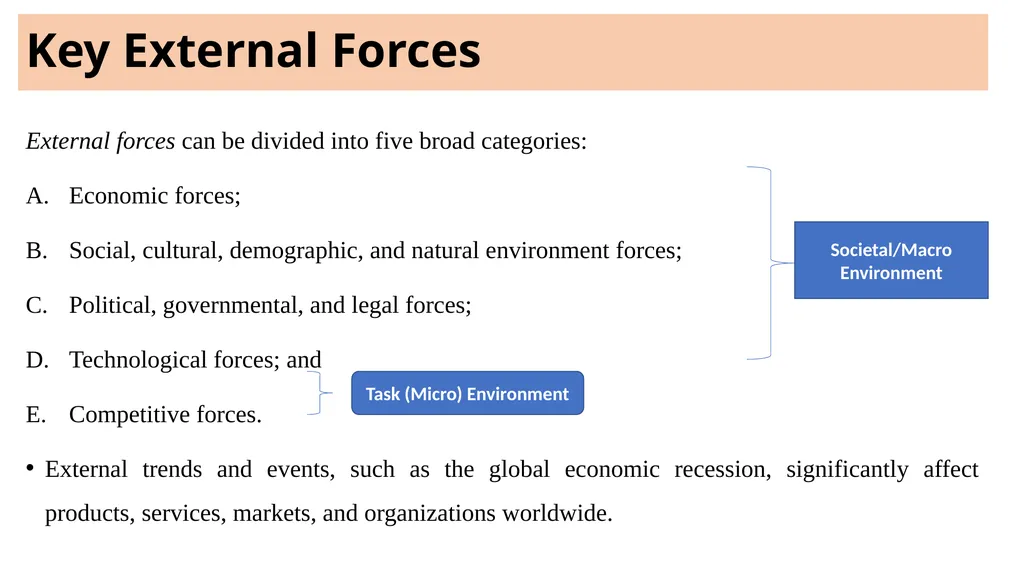
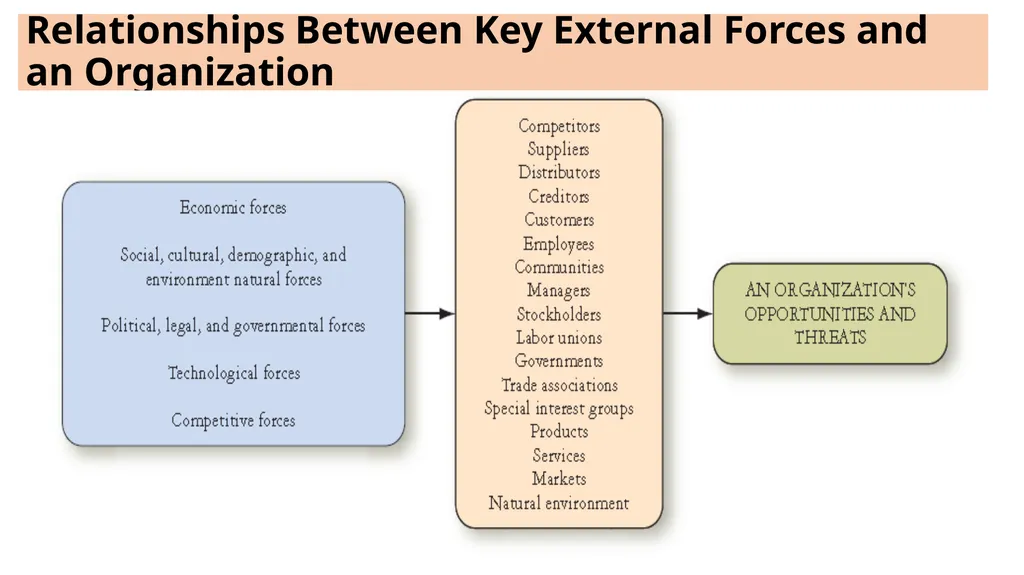
Key External Forces External forces can be divided into five broad categories:
Economic forces;
Social, cultural, demographic, and natural environment forces;
Political, governmental, and legal forces;
Technological forces; and
Competitive forces.
External trends and events, such as the global economic recession, significantly affect products, services, markets, and organizations worldwide. Societal/Macro Environment Task (Micro) Environment<br>
Economic forces;
Social, cultural, demographic, and natural environment forces;
Political, governmental, and legal forces;
Technological forces; and
Competitive forces.
External trends and events, such as the global economic recession, significantly affect products, services, markets, and organizations worldwide. Societal/Macro Environment Task (Micro) Environment<br>
20
Cont’d…… External trends and events significantly affect all products, services, markets, and organizations in the world.
Changes in external forces translate into changes in consumer demand for both industrial and consumer products and services.<br>
Changes in external forces translate into changes in consumer demand for both industrial and consumer products and services.<br>
21
Relationships Between Key External Forces and an Organization<br>
22
The Process of Performing an External Audit The process of performing an external audit must involve as many managers and employees which intern leads to create understanding and commitment.
To perform an external audit, a company first must gather competitive intelligence and information about social, cultural, demographic, environmental, economic, political, legal, governmental, and technological trends.
Individuals can be asked to monitor various sources of information, such as key magazines, trade journals, and newspapers.<br>
To perform an external audit, a company first must gather competitive intelligence and information about social, cultural, demographic, environmental, economic, political, legal, governmental, and technological trends.
Individuals can be asked to monitor various sources of information, such as key magazines, trade journals, and newspapers.<br>
23
Cont’d…… The Internet is another source for gathering strategic information, as are corporate, university, and public libraries.
Suppliers, distributors, salespersons, customers, and competitors represent other sources of vital information.
Once information is gathered, it should be assimilated, evaluated, and prioritized from 1 for the most important opportunity/threat to 20 for the least important opportunity/threat.
These key external factors can vary over time and by industry.<br>
Suppliers, distributors, salespersons, customers, and competitors represent other sources of vital information.
Once information is gathered, it should be assimilated, evaluated, and prioritized from 1 for the most important opportunity/threat to 20 for the least important opportunity/threat.
These key external factors can vary over time and by industry.<br>
24
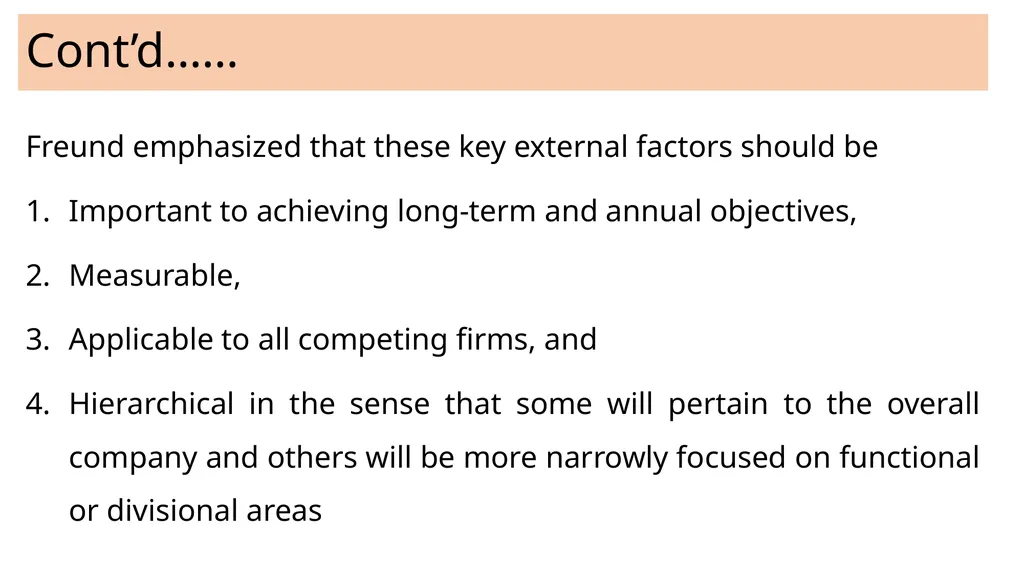
Cont’d…… Freund emphasized that these key external factors should be
Important to achieving long-term and annual objectives,
Measurable,
Applicable to all competing firms, and
Hierarchical in the sense that some will pertain to the overall company and others will be more narrowly focused on functional or divisional areas<br>
Important to achieving long-term and annual objectives,
Measurable,
Applicable to all competing firms, and
Hierarchical in the sense that some will pertain to the overall company and others will be more narrowly focused on functional or divisional areas<br>
25
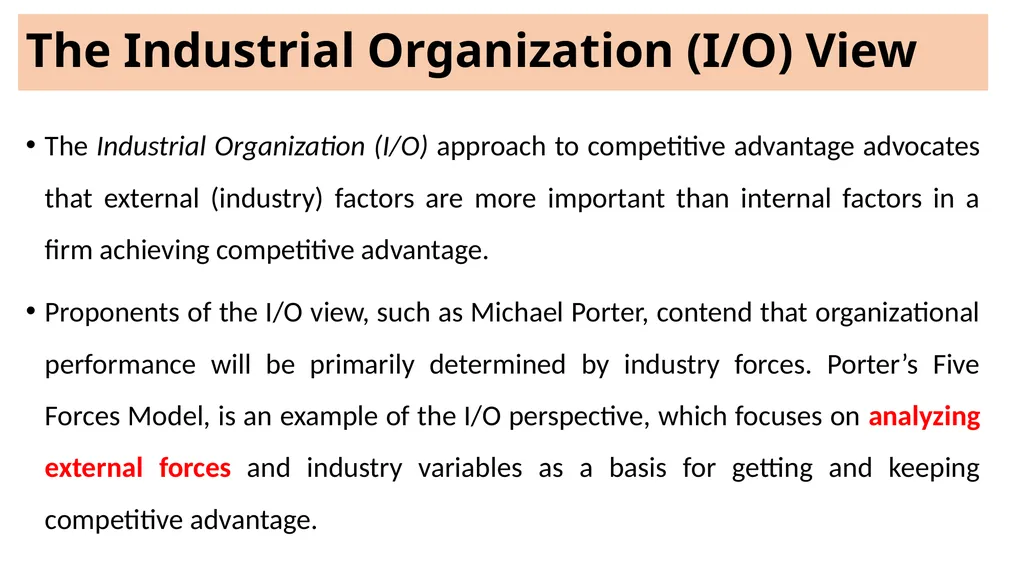
The Industrial Organization (I/O) View The Industrial Organization (I/O) approach to competitive advantage advocates that external (industry) factors are more important than internal factors in a firm achieving competitive advantage.
Proponents of the I/O view, such as Michael Porter, contend that organizational performance will be primarily determined by industry forces. Porter’s Five Forces Model, is an example of the I/O perspective, which focuses on analyzing external forces and industry variables as a basis for getting and keeping competitive advantage.<br>
Proponents of the I/O view, such as Michael Porter, contend that organizational performance will be primarily determined by industry forces. Porter’s Five Forces Model, is an example of the I/O perspective, which focuses on analyzing external forces and industry variables as a basis for getting and keeping competitive advantage.<br>
26
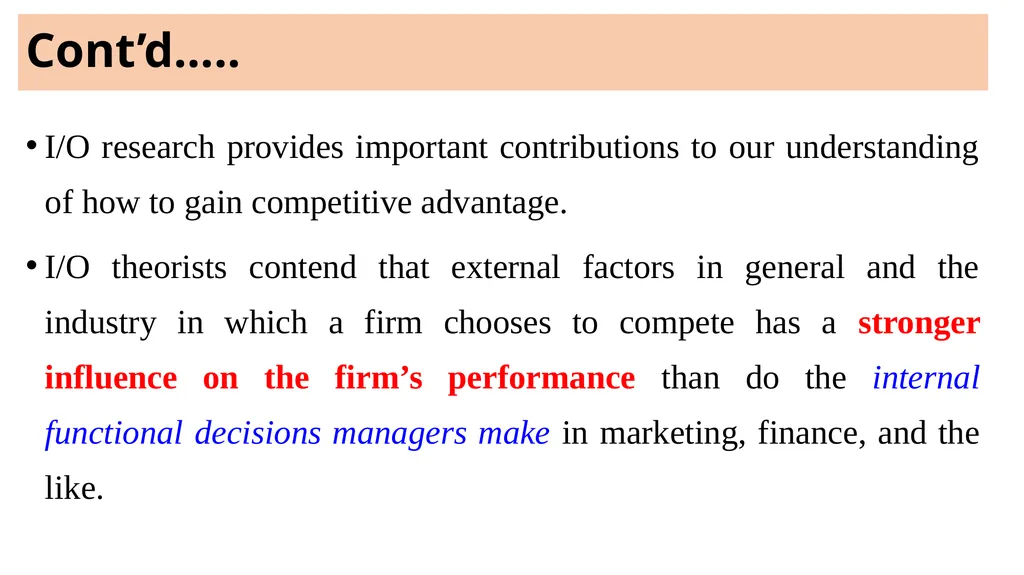
Cont’d….. I/O research provides important contributions to our understanding of how to gain competitive advantage.
I/O theorists contend that external factors in general and the industry in which a firm chooses to compete has a stronger influence on the firm’s performance than do the internal functional decisions managers make in marketing, finance, and the like.<br>
I/O theorists contend that external factors in general and the industry in which a firm chooses to compete has a stronger influence on the firm’s performance than do the internal functional decisions managers make in marketing, finance, and the like.<br>
27
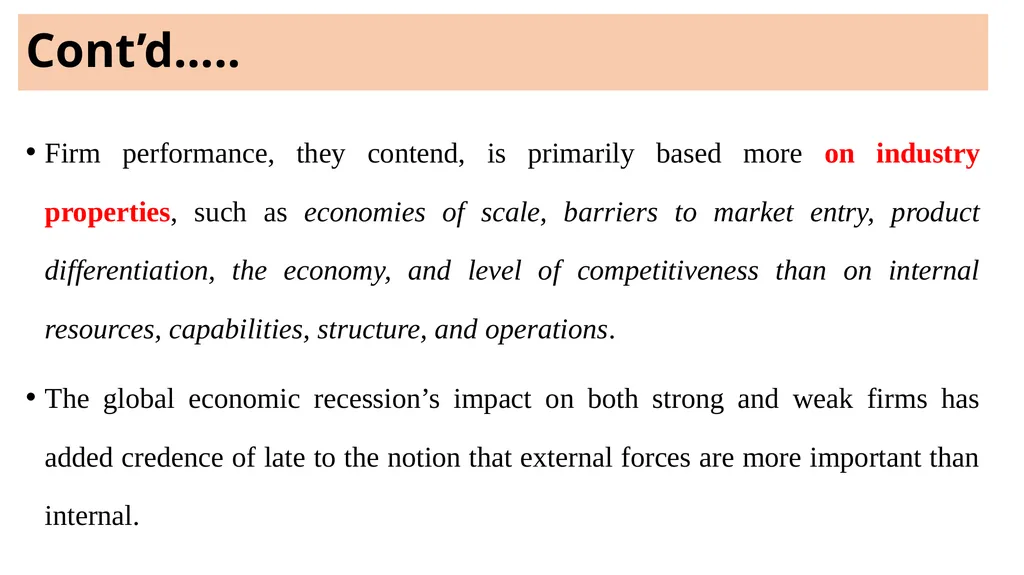
Cont’d….. Firm performance, they contend, is primarily based more on industry properties, such as economies of scale, barriers to market entry, product differentiation, the economy, and level of competitiveness than on internal resources, capabilities, structure, and operations.
The global economic recession’s impact on both strong and weak firms has added credence of late to the notion that external forces are more important than internal.<br>
The global economic recession’s impact on both strong and weak firms has added credence of late to the notion that external forces are more important than internal.<br>
28
Cont’d….. The I/O view has enhanced our understanding of strategic management. However, it is not a question of whether external or internal factors are more important in gaining and maintaining competitive advantage. Effective integration and understanding of both external and internal factors is the key to securing and keeping a competitive advantage.<br>
29
Sources of External Information A wealth of strategic information is available to organizations from both published and unpublished sources.
Unpublished sources include customer surveys, market research, speeches at professional and shareholders’ meetings, television programs, interviews, and conversations with stakeholders.
Published sources of strategic information include periodicals, journals, reports, government documents, abstracts, books, directories, newspapers, and manuals.
The Internet has made it easier for firms to gather, assimilate, and evaluate information.
There are many excellent Web sites for gathering strategic information<br>
Unpublished sources include customer surveys, market research, speeches at professional and shareholders’ meetings, television programs, interviews, and conversations with stakeholders.
Published sources of strategic information include periodicals, journals, reports, government documents, abstracts, books, directories, newspapers, and manuals.
The Internet has made it easier for firms to gather, assimilate, and evaluate information.
There are many excellent Web sites for gathering strategic information<br>
30
Forecasting Tools and Techniques Forecasts are educated assumptions about future trends and events.
Forecasting is a complex activity because of factors such as technological innovation, cultural changes, new products, improved services, stronger competitors, shifts in government priorities, changing social values, unstable economic conditions, and unforeseen events.
Managers often must rely on published forecasts to effectively identify key external opportunities and threats.<br>
Forecasting is a complex activity because of factors such as technological innovation, cultural changes, new products, improved services, stronger competitors, shifts in government priorities, changing social values, unstable economic conditions, and unforeseen events.
Managers often must rely on published forecasts to effectively identify key external opportunities and threats.<br>
31
Forecasting Tools and Techniques Forecasting tools can be broadly categorized into two groups: quantitative and qualitative techniques.
Qualitative forecasts such as (1) sales force estimates, (2) juries of executive opinions, (3) anticipatory surveys or market research, (4) scenario forecasts, (5) Delphi forecasts, and (6) brainstorming.
Quantitative forecasts are most appropriate when historical data are available and when the relationships among key variables are expected to remain the same in the future. Linear regression.
No forecast is perfect, and some forecasts are even wildly inaccurate.
Key external opportunities and threats can be effectively identified only through good forecasts.
Accurate forecasts can provide major competitive advantages for organizations.<br>
Qualitative forecasts such as (1) sales force estimates, (2) juries of executive opinions, (3) anticipatory surveys or market research, (4) scenario forecasts, (5) Delphi forecasts, and (6) brainstorming.
Quantitative forecasts are most appropriate when historical data are available and when the relationships among key variables are expected to remain the same in the future. Linear regression.
No forecast is perfect, and some forecasts are even wildly inaccurate.
Key external opportunities and threats can be effectively identified only through good forecasts.
Accurate forecasts can provide major competitive advantages for organizations.<br>
32
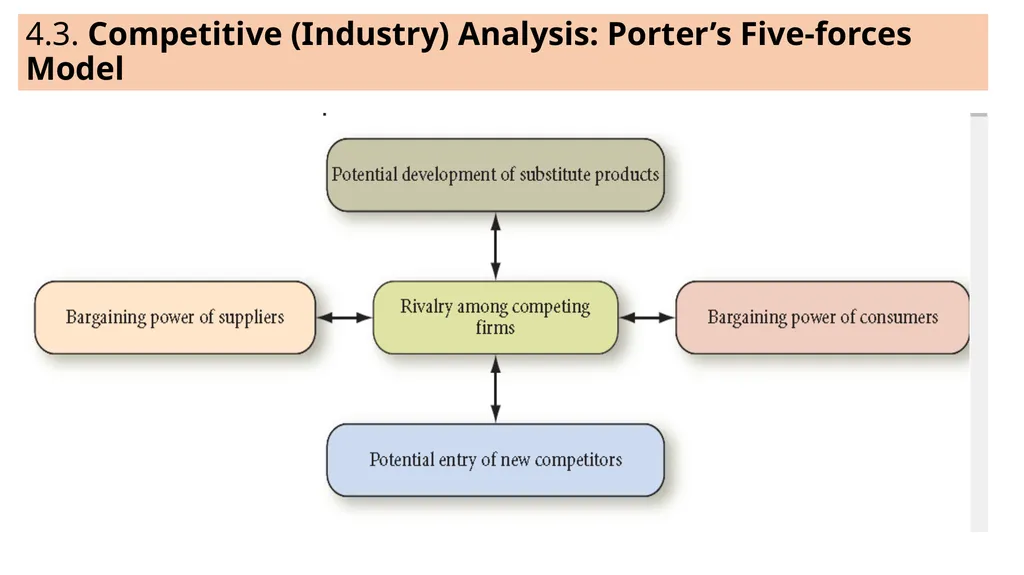
4.3. Competitive (Industry) Analysis: Porter’s Five-forces Model<br>
33
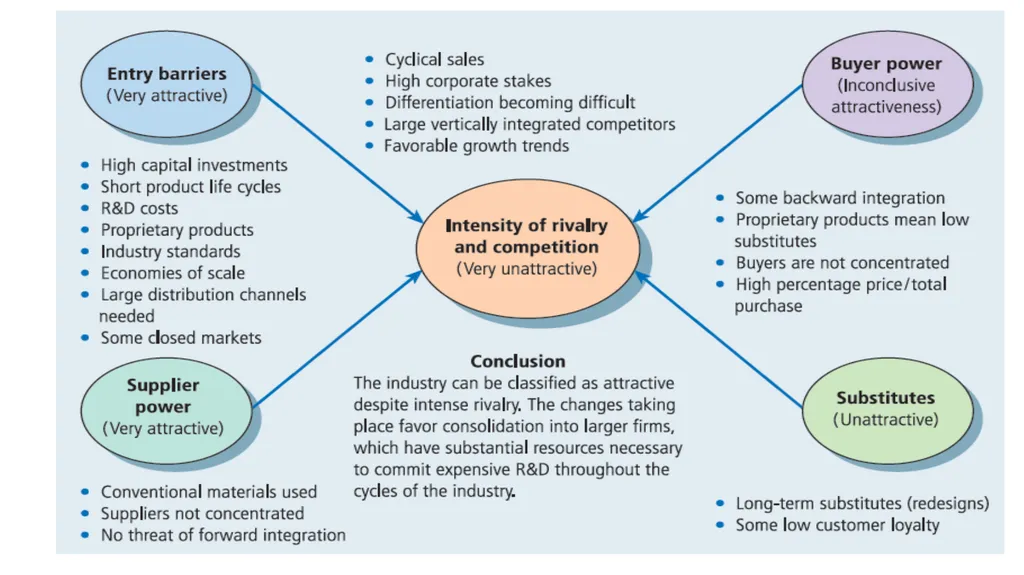
Cont’d…… Porter’s Five-Forces Model of competitive analysis is a widely used approach for developing strategies in many industries.
The intensity of competition among firms varies widely across industries.<br>
The intensity of competition among firms varies widely across industries.<br>
34
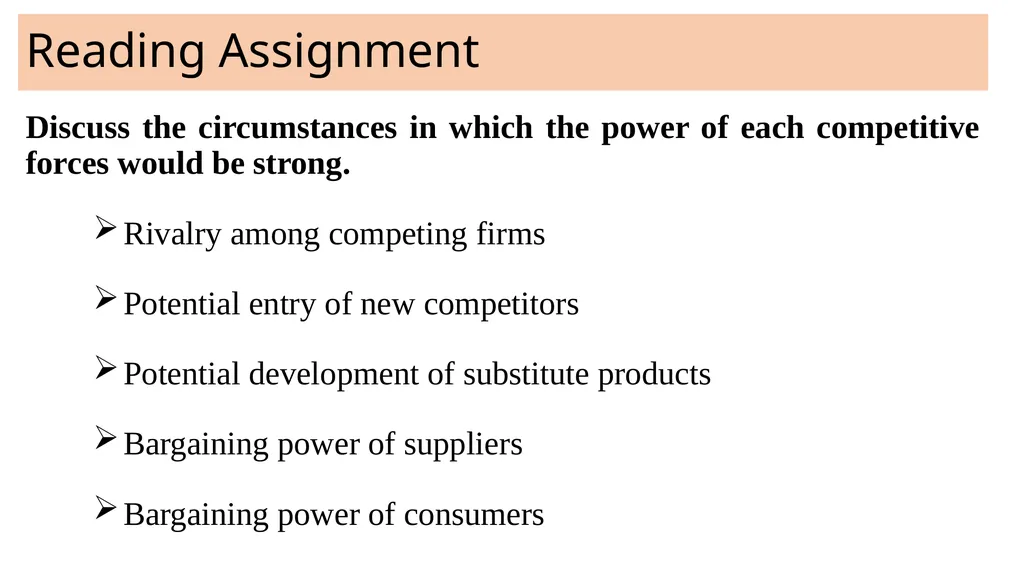
Reading Assignment Discuss the circumstances in which the power of each competitive forces would be strong.
Rivalry among competing firms
Potential entry of new competitors
Potential development of substitute products
Bargaining power of suppliers
Bargaining power of consumers<br>
Rivalry among competing firms
Potential entry of new competitors
Potential development of substitute products
Bargaining power of suppliers
Bargaining power of consumers<br>
35
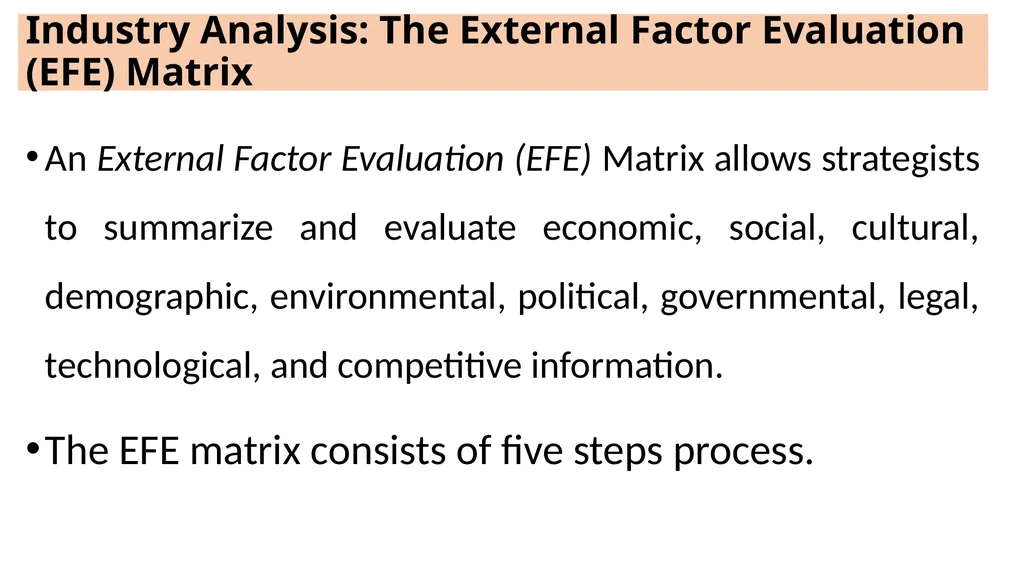
Industry Analysis: The External Factor Evaluation (EFE) Matrix An External Factor Evaluation (EFE) Matrix allows strategists to summarize and evaluate economic, social, cultural, demographic, environmental, political, governmental, legal, technological, and competitive information.
The EFE matrix consists of five steps process.<br>
The EFE matrix consists of five steps process.<br>
36
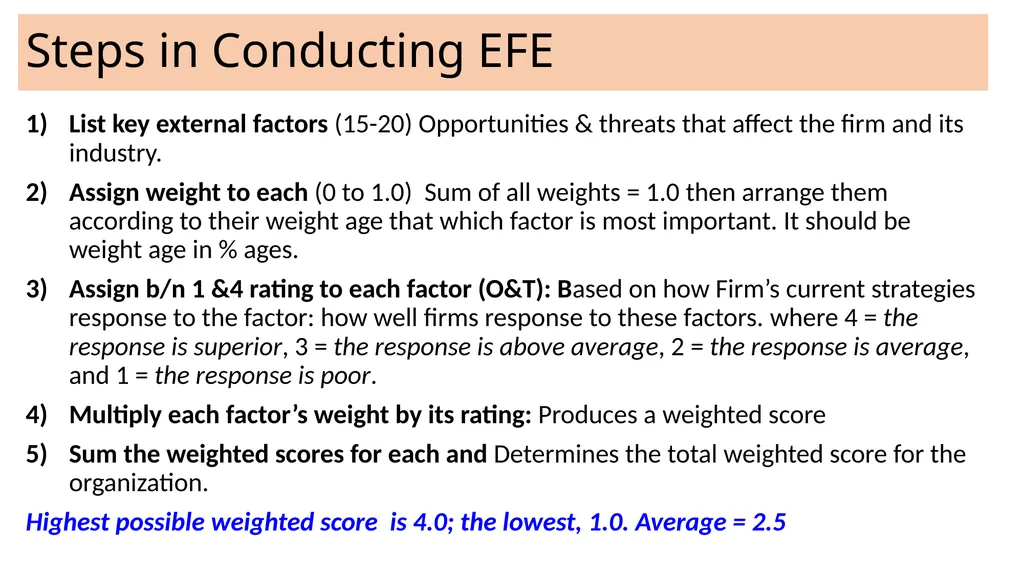
Steps in Conducting EFE List key external factors (15-20) Opportunities & threats that affect the firm and its industry.
Assign weight to each (0 to 1.0) Sum of all weights = 1.0 then arrange them according to their weight age that which factor is most important. It should be weight age in % ages.
Assign b/n 1 &4 rating to each factor (O&T): Based on how Firm’s current strategies response to the factor: how well firms response to these factors. where 4 = the response is superior, 3 = the response is above average, 2 = the response is average, and 1 = the response is poor.
Multiply each factor’s weight by its rating: Produces a weighted score
Sum the weighted scores for each and Determines the total weighted score for the organization.
Highest possible weighted score is 4.0; the lowest, 1.0. Average = 2.5<br>
Assign weight to each (0 to 1.0) Sum of all weights = 1.0 then arrange them according to their weight age that which factor is most important. It should be weight age in % ages.
Assign b/n 1 &4 rating to each factor (O&T): Based on how Firm’s current strategies response to the factor: how well firms response to these factors. where 4 = the response is superior, 3 = the response is above average, 2 = the response is average, and 1 = the response is poor.
Multiply each factor’s weight by its rating: Produces a weighted score
Sum the weighted scores for each and Determines the total weighted score for the organization.
Highest possible weighted score is 4.0; the lowest, 1.0. Average = 2.5<br>
37
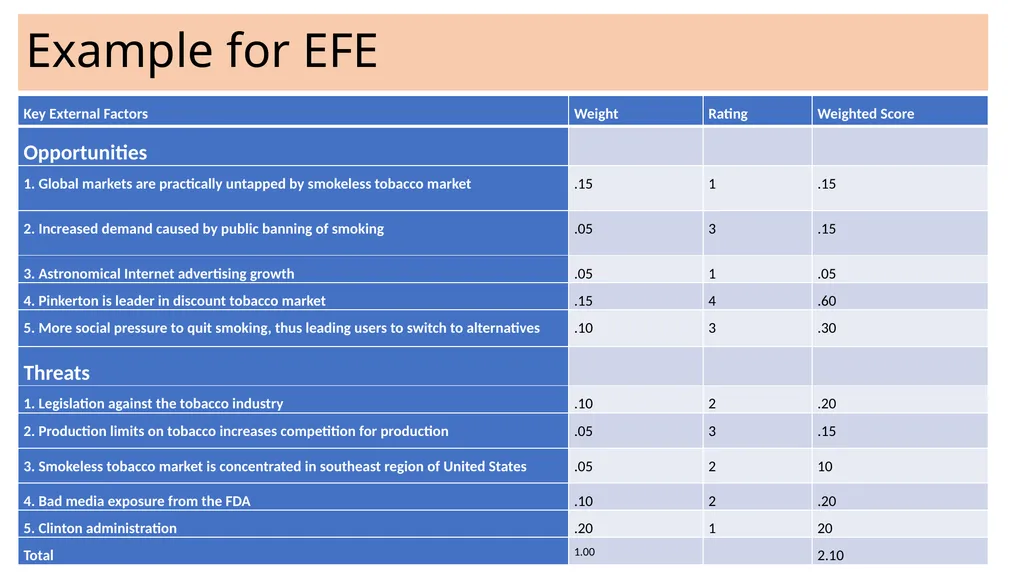
Example for EFE<br>
38
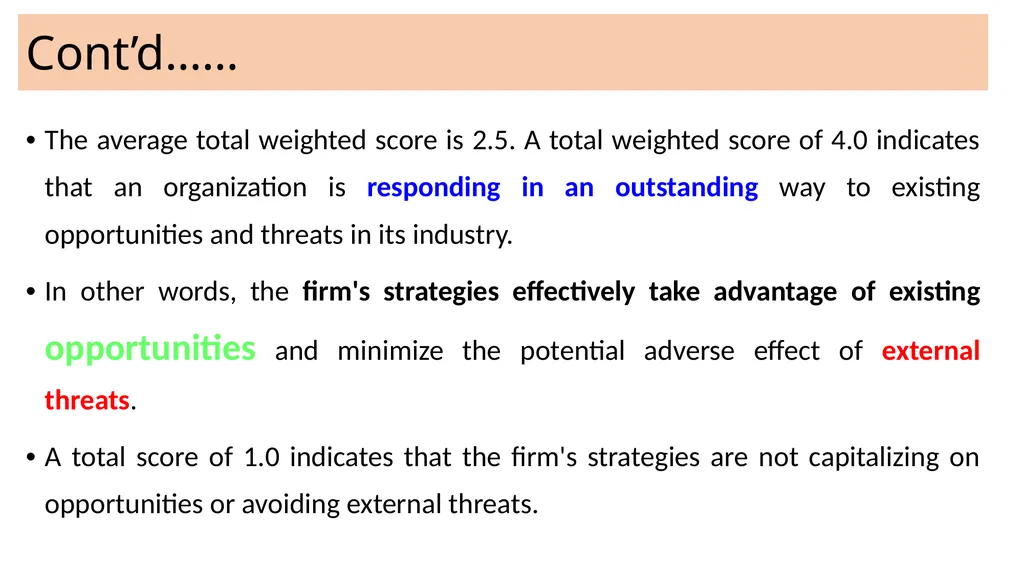
Cont’d…… The average total weighted score is 2.5. A total weighted score of 4.0 indicates that an organization is responding in an outstanding way to existing opportunities and threats in its industry.
In other words, the firm's strategies effectively take advantage of existing opportunities and minimize the potential adverse effect of external threats.
A total score of 1.0 indicates that the firm's strategies are not capitalizing on opportunities or avoiding external threats.<br>
In other words, the firm's strategies effectively take advantage of existing opportunities and minimize the potential adverse effect of external threats.
A total score of 1.0 indicates that the firm's strategies are not capitalizing on opportunities or avoiding external threats.<br>
39
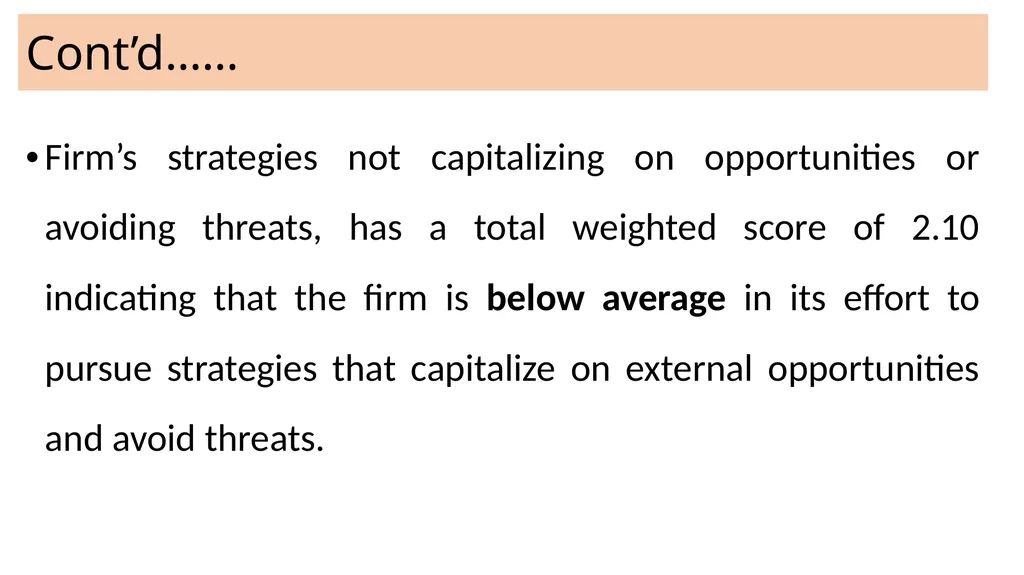
Cont’d…… Firm’s strategies not capitalizing on opportunities or avoiding threats, has a total weighted score of 2.10 indicating that the firm is below average in its effort to pursue strategies that capitalize on external opportunities and avoid threats.<br>
40
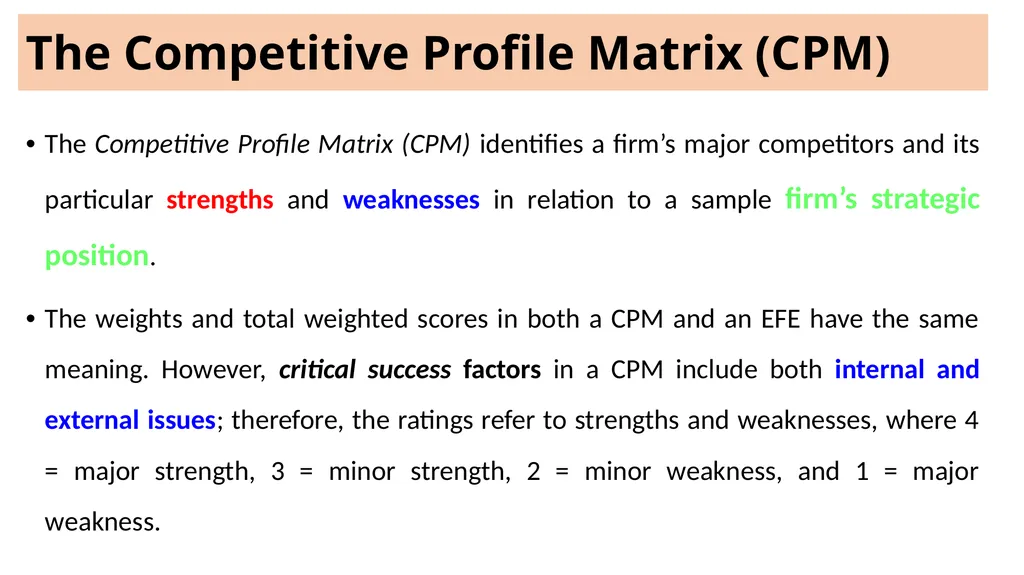
The Competitive Profile Matrix (CPM) The Competitive Profile Matrix (CPM) identifies a firm’s major competitors and its particular strengths and weaknesses in relation to a sample firm’s strategic position.
The weights and total weighted scores in both a CPM and an EFE have the same meaning. However, critical success factors in a CPM include both internal and external issues; therefore, the ratings refer to strengths and weaknesses, where 4 = major strength, 3 = minor strength, 2 = minor weakness, and 1 = major weakness.<br>
The weights and total weighted scores in both a CPM and an EFE have the same meaning. However, critical success factors in a CPM include both internal and external issues; therefore, the ratings refer to strengths and weaknesses, where 4 = major strength, 3 = minor strength, 2 = minor weakness, and 1 = major weakness.<br>
41
Example for CPM<br>
42
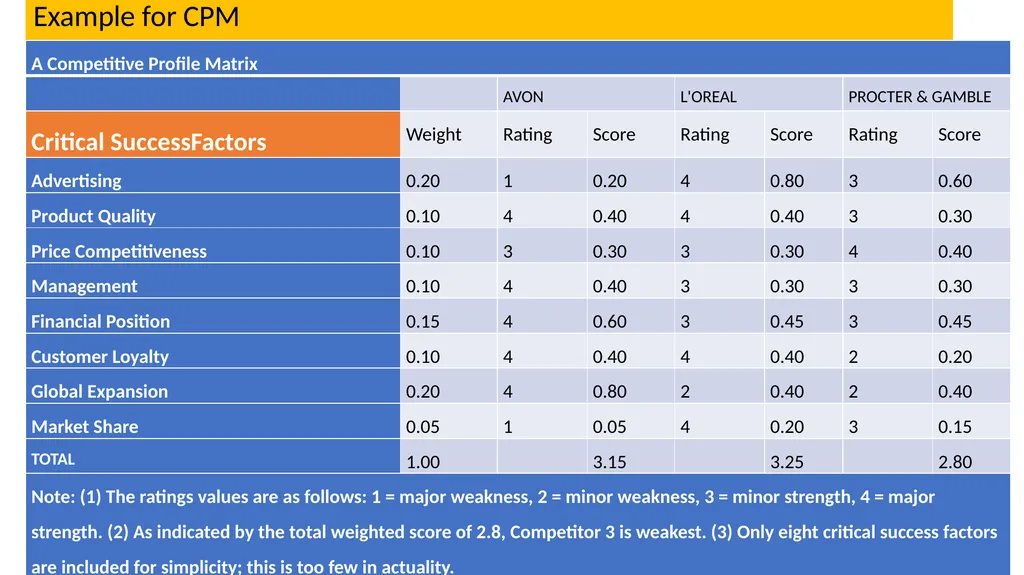
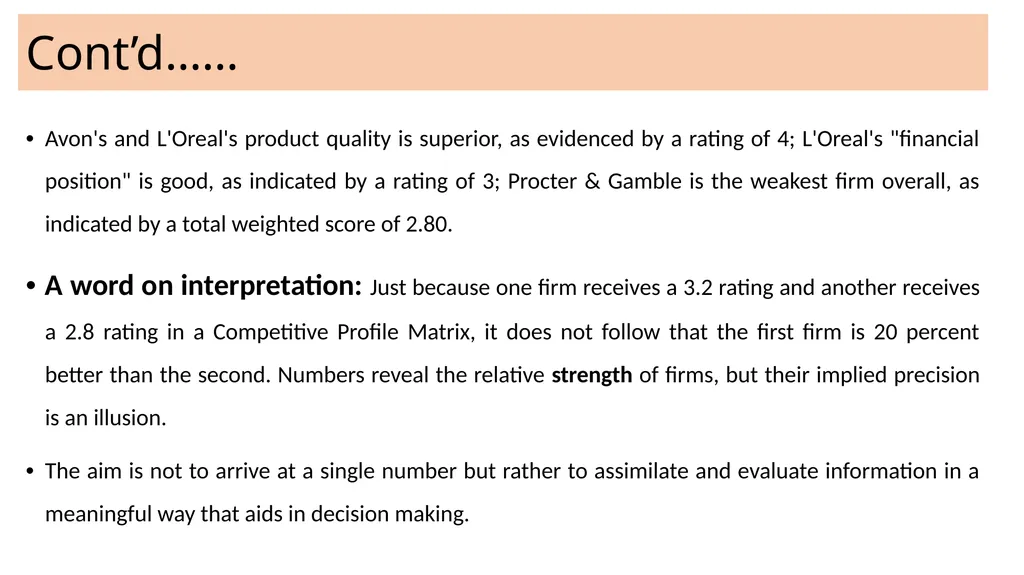
Cont’d…… Avon's and L'Oreal's product quality is superior, as evidenced by a rating of 4; L'Oreal's "financial position" is good, as indicated by a rating of 3; Procter & Gamble is the weakest firm overall, as indicated by a total weighted score of 2.80.
A word on interpretation: Just because one firm receives a 3.2 rating and another receives a 2.8 rating in a Competitive Profile Matrix, it does not follow that the first firm is 20 percent better than the second. Numbers reveal the relative strength of firms, but their implied precision is an illusion.
The aim is not to arrive at a single number but rather to assimilate and evaluate information in a meaningful way that aids in decision making.<br>
A word on interpretation: Just because one firm receives a 3.2 rating and another receives a 2.8 rating in a Competitive Profile Matrix, it does not follow that the first firm is 20 percent better than the second. Numbers reveal the relative strength of firms, but their implied precision is an illusion.
The aim is not to arrive at a single number but rather to assimilate and evaluate information in a meaningful way that aids in decision making.<br>
43
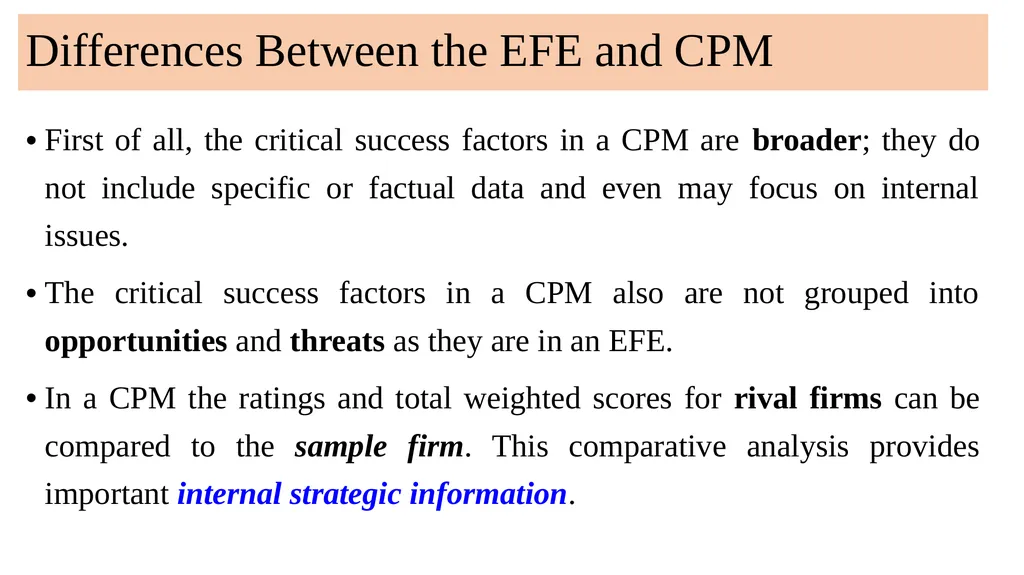
Differences Between the EFE and CPM First of all, the critical success factors in a CPM are broader; they do not include specific or factual data and even may focus on internal issues.
The critical success factors in a CPM also are not grouped into opportunities and threats as they are in an EFE.
In a CPM the ratings and total weighted scores for rival firms can be compared to the sample firm. This comparative analysis provides important internal strategic information.<br>
The critical success factors in a CPM also are not grouped into opportunities and threats as they are in an EFE.
In a CPM the ratings and total weighted scores for rival firms can be compared to the sample firm. This comparative analysis provides important internal strategic information.<br>
44
Any Questions
Welcome!!!<br>
Welcome!!!<br>