
Advancing Multiple Micronutrient Supplementation 1
FD
Published · 59 slides · 0 views
1 / 1




Description
Advancing Multiple Micronutrient Supplementation 1 2 Facilitate dialogue create consensus View these slides as a resource for anyone wanting to communicate the evidence and benefits of MMS for pregnant women and their babies. Our goal is
Related Topics
Share
Embed code
Download this presentation From Below
"Advancing Multiple Micronutrient Supplementation 1" is the property of its rightful owner. Permission is granted to download and print the materials on this website for personal, non-commercial use only, and to display it on your personal computer provided you do not modify the materials and that you retain all copyright notices contained in the materials. By downloading content from our website, you accept the terms of this agreement.
Presentation Transcript
01
Advancing Multiple Micronutrient Supplementation 1<br>
02
2 Facilitate dialogue & create consensus
View these slides as a resource for anyone wanting to communicate the evidence and benefits of MMS for pregnant women and their babies. Our goal is to equip the presenter of these slides with key messages that can be delivered to decision makers or to those considering piloting, scaling, and implementation of MMS. Customize dialogue
Speaker notes are provided with each slide, but they are not intended to be read word-for-word. Tailor and add your own speaking notes to make this relevant for your audience. ADAPT to Your Audience
Content in red font should be tailored, then updated to black font. Slides labeled ‘National impact and investment case’ should be tailored with data and statistics from your country and made relevant for your audience. Slides or entire sections can be removed or re-ordered. Additional resources can be found at the end of the presentation. How to use this slide deck We’d like to hear from you! Contact HMHBConsortium@micronutrientforum.org if you have questions or would like additional support.<br>
View these slides as a resource for anyone wanting to communicate the evidence and benefits of MMS for pregnant women and their babies. Our goal is to equip the presenter of these slides with key messages that can be delivered to decision makers or to those considering piloting, scaling, and implementation of MMS. Customize dialogue
Speaker notes are provided with each slide, but they are not intended to be read word-for-word. Tailor and add your own speaking notes to make this relevant for your audience. ADAPT to Your Audience
Content in red font should be tailored, then updated to black font. Slides labeled ‘National impact and investment case’ should be tailored with data and statistics from your country and made relevant for your audience. Slides or entire sections can be removed or re-ordered. Additional resources can be found at the end of the presentation. How to use this slide deck We’d like to hear from you! Contact HMHBConsortium@micronutrientforum.org if you have questions or would like additional support.<br>
03
3 Advocates & Public Health Professionals
Suggested sections include A-E National health officials & NGOS
Suggested sections include A-E Research & Academia
Suggested sections include B-D Audiences for this slide deck Local providers & Distributors
Suggested sections include B This presentation provides an overview of maternal nutrition and the evidence on multiple micronutrient supplements (MMS), providing key messages and slides that can be tailored with country-specific data to support the introduction, piloting, and scaling of MMS.
You may wish to include (or omit) specific sections of the presentation. Suggested sections for each audience are included here. See the section descriptions on Slide 5.<br>
Suggested sections include A-E National health officials & NGOS
Suggested sections include A-E Research & Academia
Suggested sections include B-D Audiences for this slide deck Local providers & Distributors
Suggested sections include B This presentation provides an overview of maternal nutrition and the evidence on multiple micronutrient supplements (MMS), providing key messages and slides that can be tailored with country-specific data to support the introduction, piloting, and scaling of MMS.
You may wish to include (or omit) specific sections of the presentation. Suggested sections for each audience are included here. See the section descriptions on Slide 5.<br>
04
Meeting Objectives Optional slide to add meeting agenda and/or objectives 4 TEMPLATE to be adapted. Remove this box once updated.<br>
05
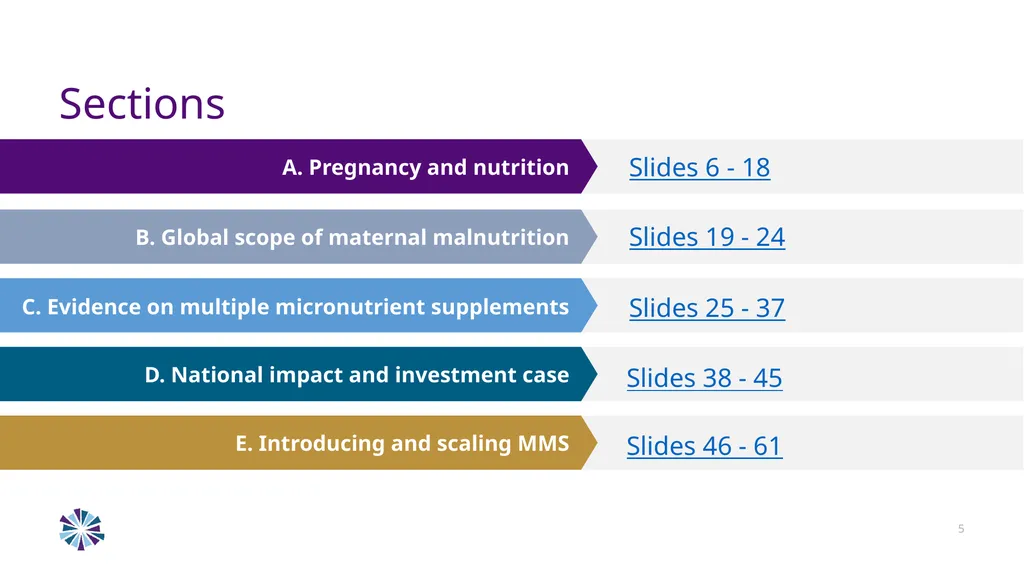
Slides 19 - 24 Slides 25 - 37 Slides 38 - 45 Slides 46 - 61 B. Global scope of maternal malnutrition C. Evidence on multiple micronutrient supplements D. National impact and investment case E. Introducing and scaling MMS Sections 5 A. Pregnancy and nutrition Slides 6 - 18<br>
06
Pregnancy and nutrition<br>
07
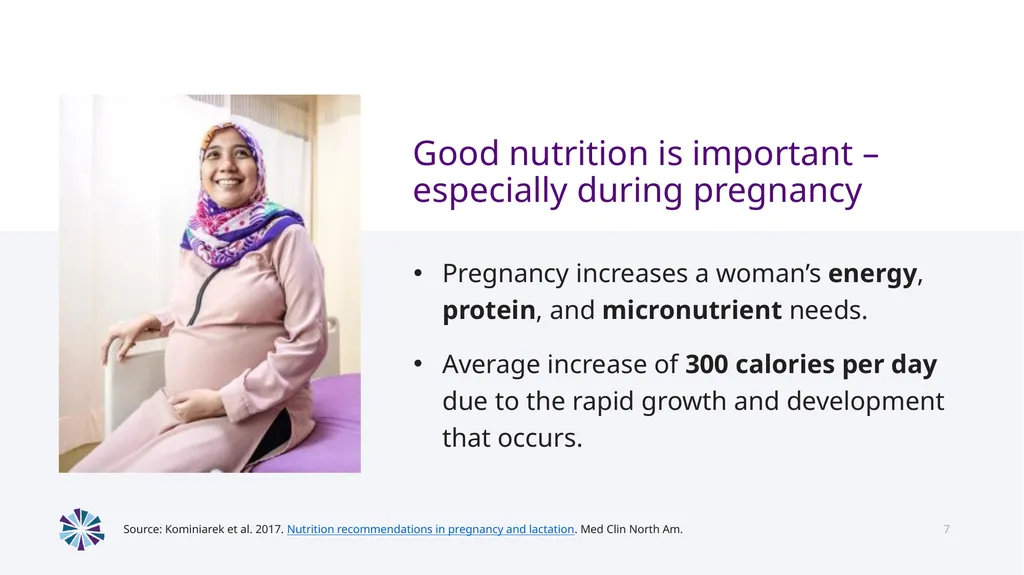
Good nutrition is important – especially during pregnancy Pregnancy increases a woman’s energy, protein, and micronutrient needs.
Average increase of 300 calories per day due to the rapid growth and development that occurs. 7 Source: Kominiarek et al. 2017. Nutrition recommendations in pregnancy and lactation. Med Clin North Am.<br>
Average increase of 300 calories per day due to the rapid growth and development that occurs. 7 Source: Kominiarek et al. 2017. Nutrition recommendations in pregnancy and lactation. Med Clin North Am.<br>
08
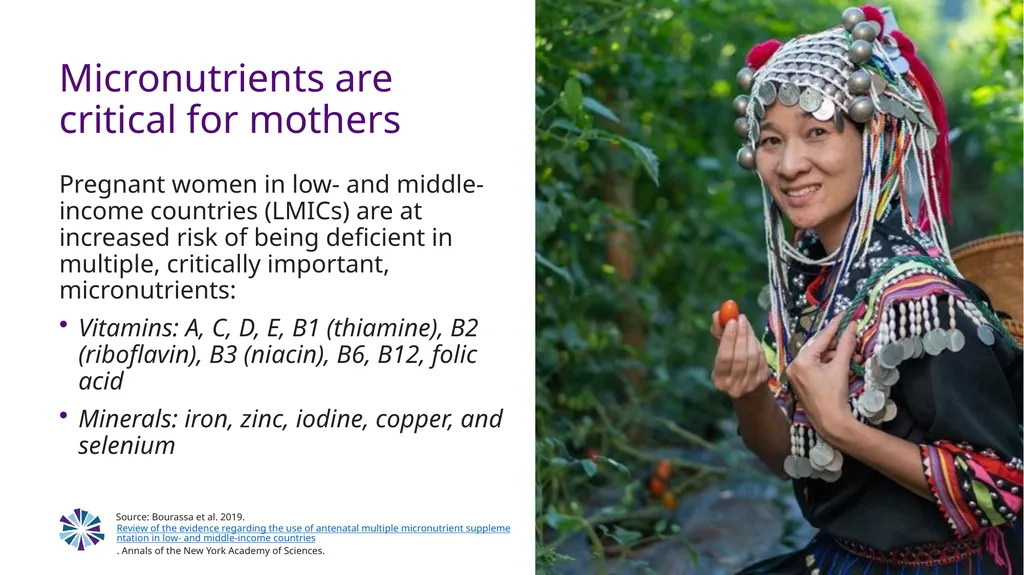
Micronutrients are critical for mothers 8 Source: Bourassa et al. 2019. Review of the evidence regarding the use of antenatal multiple micronutrient supplementation in low- and middle-income countries. Annals of the New York Academy of Sciences. Pregnant women in low- and middle-income countries (LMICs) are at increased risk of being deficient in multiple, critically important, micronutrients:
Vitamins: A, C, D, E, B1 (thiamine), B2 (riboflavin), B3 (niacin), B6, B12, folic acid
Minerals: iron, zinc, iodine, copper, and selenium<br>
Vitamins: A, C, D, E, B1 (thiamine), B2 (riboflavin), B3 (niacin), B6, B12, folic acid
Minerals: iron, zinc, iodine, copper, and selenium<br>
09
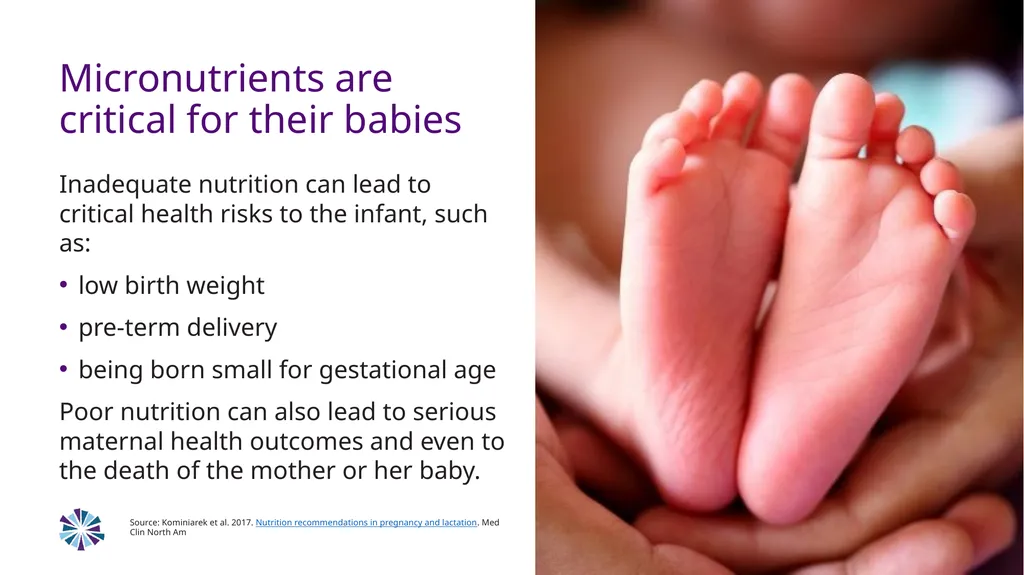
Micronutrients are critical for their babies Inadequate nutrition can lead to critical health risks to the infant, such as:
low birth weight
pre-term delivery
being born small for gestational age
Poor nutrition can also lead to serious maternal health outcomes and even to the death of the mother or her baby. 9 Source: Kominiarek et al. 2017. Nutrition recommendations in pregnancy and lactation. Med Clin North Am<br>
low birth weight
pre-term delivery
being born small for gestational age
Poor nutrition can also lead to serious maternal health outcomes and even to the death of the mother or her baby. 9 Source: Kominiarek et al. 2017. Nutrition recommendations in pregnancy and lactation. Med Clin North Am<br>
10
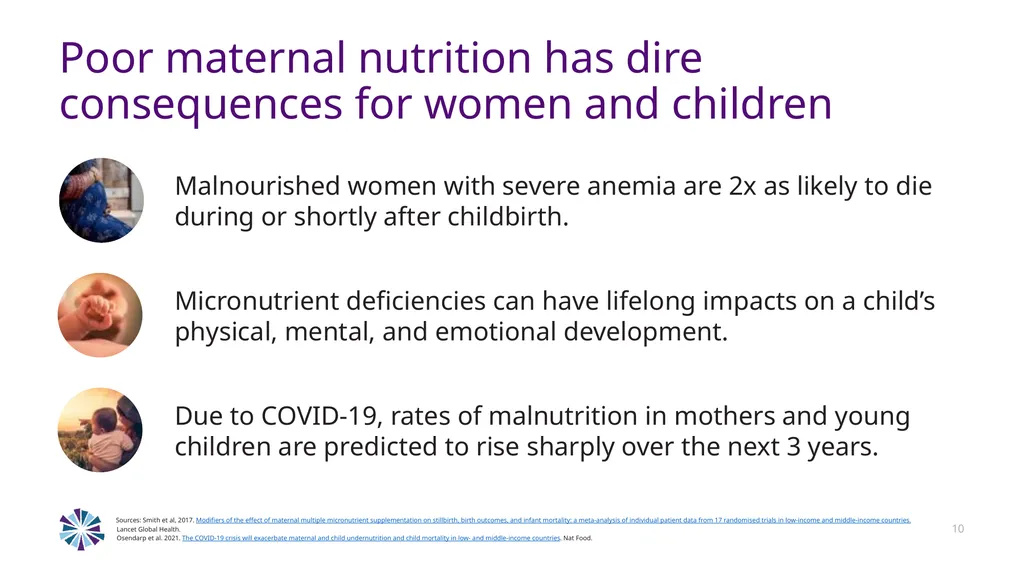
Poor maternal nutrition has dire consequences for women and children Malnourished women with severe anemia are 2x as likely to die
during or shortly after childbirth. 10 Sources: Smith et al, 2017. Modifiers of the effect of maternal multiple micronutrient supplementation on stillbirth, birth outcomes, and infant mortality: a meta-analysis of individual patient data from 17 randomised trials in low-income and middle-income countries. Lancet Global Health.
Osendarp et al. 2021. The COVID-19 crisis will exacerbate maternal and child undernutrition and child mortality in low- and middle-income countries. Nat Food. Micronutrient deficiencies can have lifelong impacts on a child’s physical, mental, and emotional development. Due to COVID-19, rates of malnutrition in mothers and young children are predicted to rise sharply over the next 3 years.<br>
11
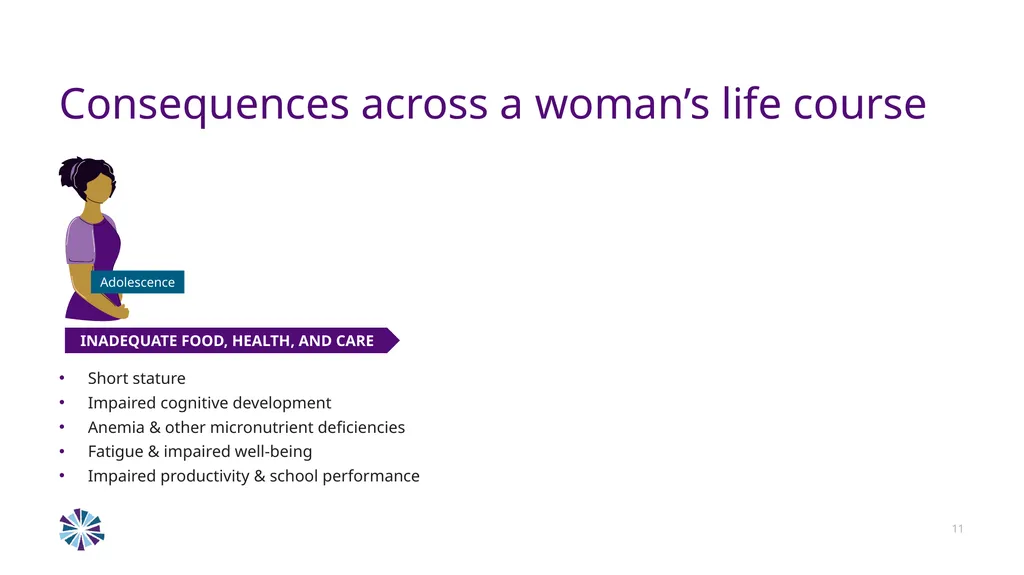
Consequences across a woman’s life course Short stature
Impaired cognitive development
Anemia & other micronutrient deficiencies
Fatigue & impaired well-being
Impaired productivity & school performance 11 Adolescence INADEQUATE FOOD, HEALTH, AND CARE<br>
Impaired cognitive development
Anemia & other micronutrient deficiencies
Fatigue & impaired well-being
Impaired productivity & school performance 11 Adolescence INADEQUATE FOOD, HEALTH, AND CARE<br>
12
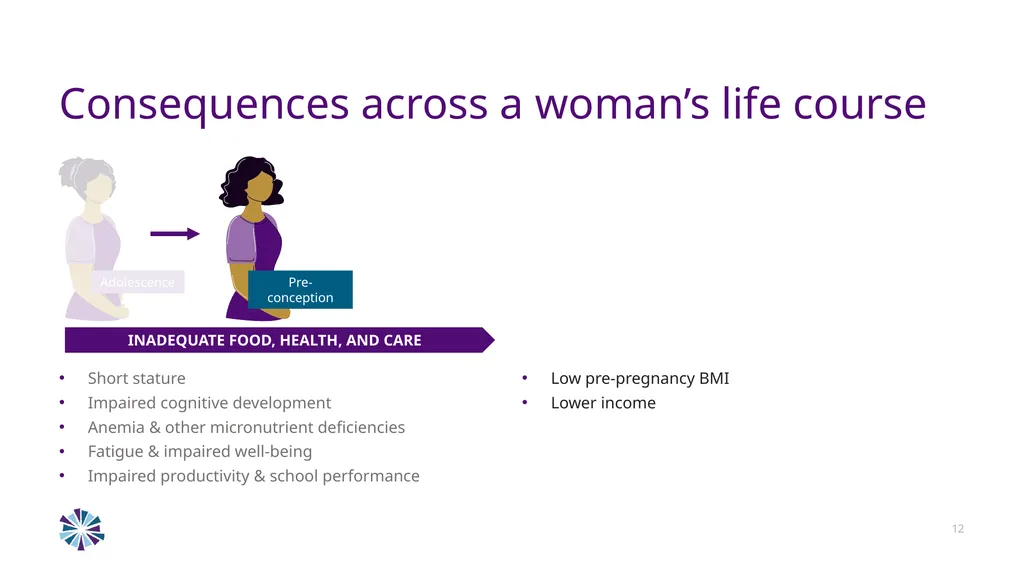
Consequences across a woman’s life course Short stature
Impaired cognitive development
Anemia & other micronutrient deficiencies
Fatigue & impaired well-being
Impaired productivity & school performance 12 Low pre-pregnancy BMI
Lower income Adolescence Pre-conception INADEQUATE FOOD, HEALTH, AND CARE<br>
Impaired cognitive development
Anemia & other micronutrient deficiencies
Fatigue & impaired well-being
Impaired productivity & school performance 12 Low pre-pregnancy BMI
Lower income Adolescence Pre-conception INADEQUATE FOOD, HEALTH, AND CARE<br>
13
Consequences across a woman’s life course Short stature
Impaired cognitive development
Anemia & other micronutrient deficiencies
Fatigue & impaired well-being
Impaired productivity & school performance 13 Low pre-pregnancy BMI
Lower income
Obstructed/prolonged labour
Eclampsia & pre-eclampsia
Maternal mortality Adolescence Pre-conception Pregnancy INADEQUATE FOOD, HEALTH, AND CARE<br>
Impaired cognitive development
Anemia & other micronutrient deficiencies
Fatigue & impaired well-being
Impaired productivity & school performance 13 Low pre-pregnancy BMI
Lower income
Obstructed/prolonged labour
Eclampsia & pre-eclampsia
Maternal mortality Adolescence Pre-conception Pregnancy INADEQUATE FOOD, HEALTH, AND CARE<br>
14
Consequences across a woman’s life course 14 Adolescence Pre-conception Pregnancy INADEQUATE FOOD, HEALTH, AND CARE Post-natal Short stature
Impaired cognitive development
Anemia & other micronutrient deficiencies
Fatigue & impaired well-being
Impaired productivity & school performance Low pre-pregnancy BMI
Lower income
Obstructed/prolonged labour
Eclampsia & pre-eclampsia
Maternal mortality Consequences for infants and children:
Low birthweight, small-for-gestational age
Pre-term birth, stillbirth
Spina bifida, congenital defects
Child mortality and morbidity
Poor post-natal physical and cognitive growth and development<br>
Impaired cognitive development
Anemia & other micronutrient deficiencies
Fatigue & impaired well-being
Impaired productivity & school performance Low pre-pregnancy BMI
Lower income
Obstructed/prolonged labour
Eclampsia & pre-eclampsia
Maternal mortality Consequences for infants and children:
Low birthweight, small-for-gestational age
Pre-term birth, stillbirth
Spina bifida, congenital defects
Child mortality and morbidity
Poor post-natal physical and cognitive growth and development<br>
15
Consequences across a woman’s life course Short stature
Impaired cognitive development
Anemia & other micronutrient deficiencies
Fatigue & impaired well-being
Impaired productivity & school performance 15 Low pre-pregnancy BMI
Lower income
Obstructed/prolonged labour
Eclampsia & pre-eclampsia
Maternal mortality Adolescence Pre-conception Pregnancy Post-natal INADEQUATE FOOD, HEALTH, AND CARE Consequences for infants and children:
Low birthweight, small-for-gestational age
Pre-term birth, stillbirth
Spina bifida, congenital defects
Child mortality and morbidity
Poor post-natal physical and cognitive growth and development Sources: Gernand et al. 2016. Micronutrient deficiencies in pregnancy worldwide: Health effects and prevention. Nature Publishing Group. Aviram et al. 2011. Maternal obesity: implications for pregnancy outcome and long-term risks-a link to maternal nutrition. Int J Gynaecol Obstet.<br>
Impaired cognitive development
Anemia & other micronutrient deficiencies
Fatigue & impaired well-being
Impaired productivity & school performance 15 Low pre-pregnancy BMI
Lower income
Obstructed/prolonged labour
Eclampsia & pre-eclampsia
Maternal mortality Adolescence Pre-conception Pregnancy Post-natal INADEQUATE FOOD, HEALTH, AND CARE Consequences for infants and children:
Low birthweight, small-for-gestational age
Pre-term birth, stillbirth
Spina bifida, congenital defects
Child mortality and morbidity
Poor post-natal physical and cognitive growth and development Sources: Gernand et al. 2016. Micronutrient deficiencies in pregnancy worldwide: Health effects and prevention. Nature Publishing Group. Aviram et al. 2011. Maternal obesity: implications for pregnancy outcome and long-term risks-a link to maternal nutrition. Int J Gynaecol Obstet.<br>
16
Gender inequality in women’s nutrition Poor services
Women often lack available, accessible, and affordable health services and interventions to properly care for their health. 16 Source: Brinda et al. 2015. Association between gender inequality index and child mortality rates: a cross-national study of 138 countries. BMC Public Health. Low decision-making power
Polices, guidelines, and programs regarding women’s nutrition programs are low priority and lack funding. Poor quality diets
Women eat last and least in terms of nutritious foods, good quality food is unaffordable to them.<br>
Women often lack available, accessible, and affordable health services and interventions to properly care for their health. 16 Source: Brinda et al. 2015. Association between gender inequality index and child mortality rates: a cross-national study of 138 countries. BMC Public Health. Low decision-making power
Polices, guidelines, and programs regarding women’s nutrition programs are low priority and lack funding. Poor quality diets
Women eat last and least in terms of nutritious foods, good quality food is unaffordable to them.<br>
17
Women’s Voices:
Agurash from Ethiopia “I am the wife of a farmer, so I do not rest. We work bent all day on the farm and walk long distances.
I worry about a few things about my pregnancy now. The first is my health. And second is fulfilling everything that is needed for the baby.
When food is served, I am happy if my family eats before me. If I am hungry, I keep it to myself, because I run the house.
After others, the woman can eat the leftovers. If there are no leftovers, she can survive that too.” 17 Agurash, in her third trimester of pregnancy<br>
I worry about a few things about my pregnancy now. The first is my health. And second is fulfilling everything that is needed for the baby.
When food is served, I am happy if my family eats before me. If I am hungry, I keep it to myself, because I run the house.
After others, the woman can eat the leftovers. If there are no leftovers, she can survive that too.” 17 Agurash, in her third trimester of pregnancy<br>
18
Women’s Voices:
Shakuntala from India “You could say health workers like me are ‘walking hospitals.’
Pregnant women in the village cannot even afford two proper meals per day.
After everyone is done, she only has the leftovers. That is the main reason for malnourishment in pregnant women.
When these women give birth, their babies are malnourished too.” 18 Shakuntala, health worker (on left) weighs a pregnant woman.<br>
Pregnant women in the village cannot even afford two proper meals per day.
After everyone is done, she only has the leftovers. That is the main reason for malnourishment in pregnant women.
When these women give birth, their babies are malnourished too.” 18 Shakuntala, health worker (on left) weighs a pregnant woman.<br>
19
Global scope of maternal malnutrition<br>
20
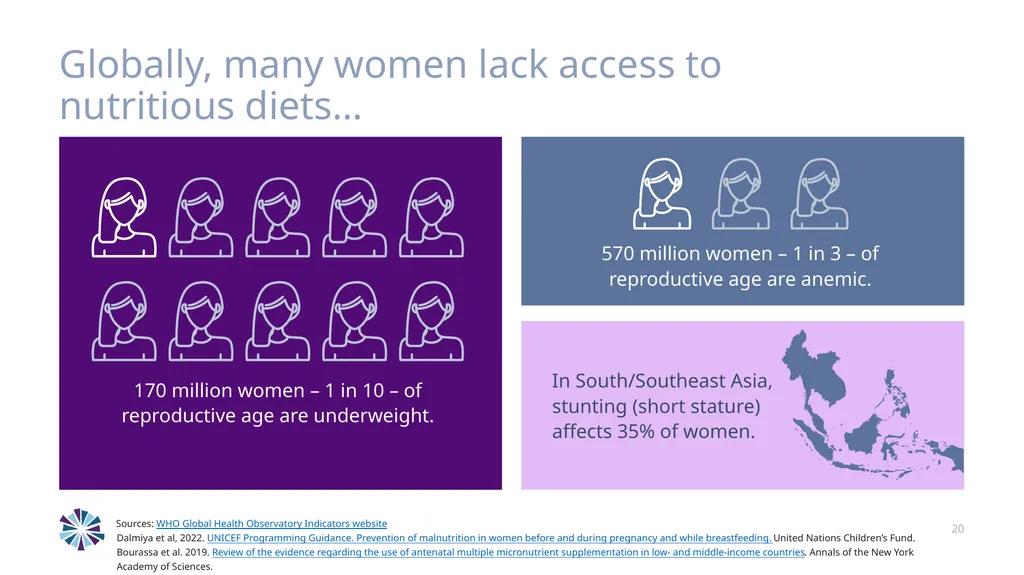
Globally, many women lack access to
nutritious diets… 20 Sources: WHO Global Health Observatory Indicators website
Dalmiya et al, 2022. UNICEF Programming Guidance. Prevention of malnutrition in women before and during pregnancy and while breastfeeding. United Nations Children’s Fund.
Bourassa et al. 2019. Review of the evidence regarding the use of antenatal multiple micronutrient supplementation in low- and middle-income countries. Annals of the New York Academy of Sciences. 170 million women – 1 in 10 – of
reproductive age are underweight. In South/Southeast Asia,
stunting (short stature)
affects 35% of women. 570 million women – 1 in 3 – of
reproductive age are anemic.<br>
21
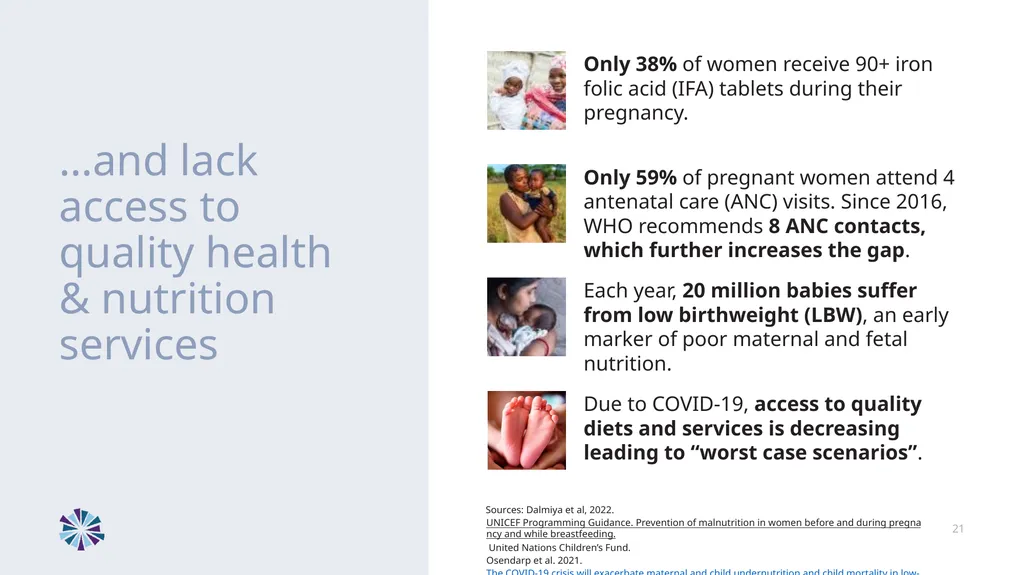
…and lack access to quality health
& nutrition services Only 59% of pregnant women attend 4 antenatal care (ANC) visits. Since 2016, WHO recommends 8 ANC contacts, which further increases the gap. 21 Sources: Dalmiya et al, 2022. UNICEF Programming Guidance. Prevention of malnutrition in women before and during pregnancy and while breastfeeding. United Nations Children’s Fund.
Osendarp et al. 2021. The COVID-19 crisis will exacerbate maternal and child undernutrition and child mortality in low- and middle-income countries. Nat Food. Only 38% of women receive 90+ iron folic acid (IFA) tablets during their pregnancy. Each year, 20 million babies suffer from low birthweight (LBW), an early marker of poor maternal and fetal nutrition. Due to COVID-19, access to quality diets and services is decreasing leading to “worst case scenarios”.<br>
22
Poor maternal nutrition has dire consequences for communities and the world The economic consequences of poor nutrition can affect an individual for 30+ years and their families for generations. 22 Source: Halim et al, 2015. The economic consequences of selected maternal and child nutrition interventions in low- and middle- income countries: A systematic review of recent literature, 2000–2013. BMC Women’s Health. Good nutrition is linked to improved school performance and increased productivity. This leads to long-term economic benefits on individual, national, and global scales. Investing in nutrition could reach USD $5.7 trillion a year in economic gains to society by 2030.<br>
23
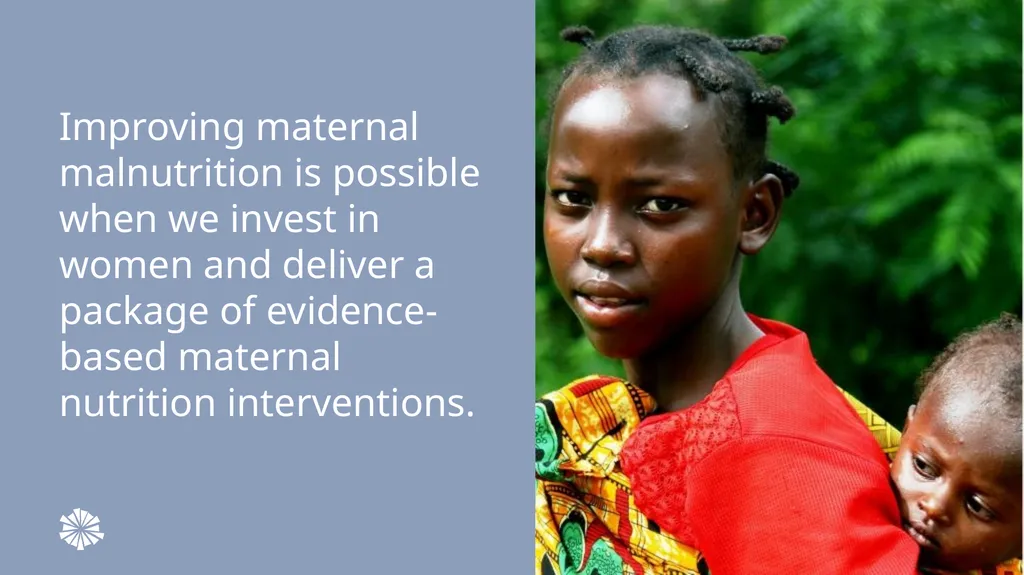
Improving maternal malnutrition is possible when we invest in women and deliver a package of evidence-based maternal nutrition interventions.<br>
24
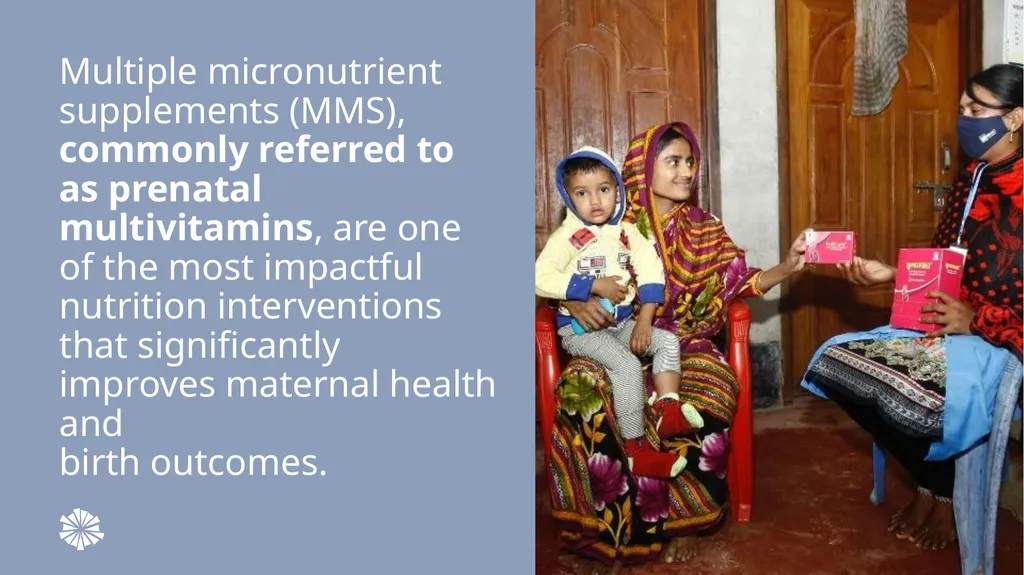
Multiple micronutrient supplements (MMS), commonly referred to as prenatal multivitamins, are one of the most impactful nutrition interventions that significantly improves maternal health and
birth outcomes.<br>
25
Evidence on multiple micronutrient supplements (MMS)<br>
26
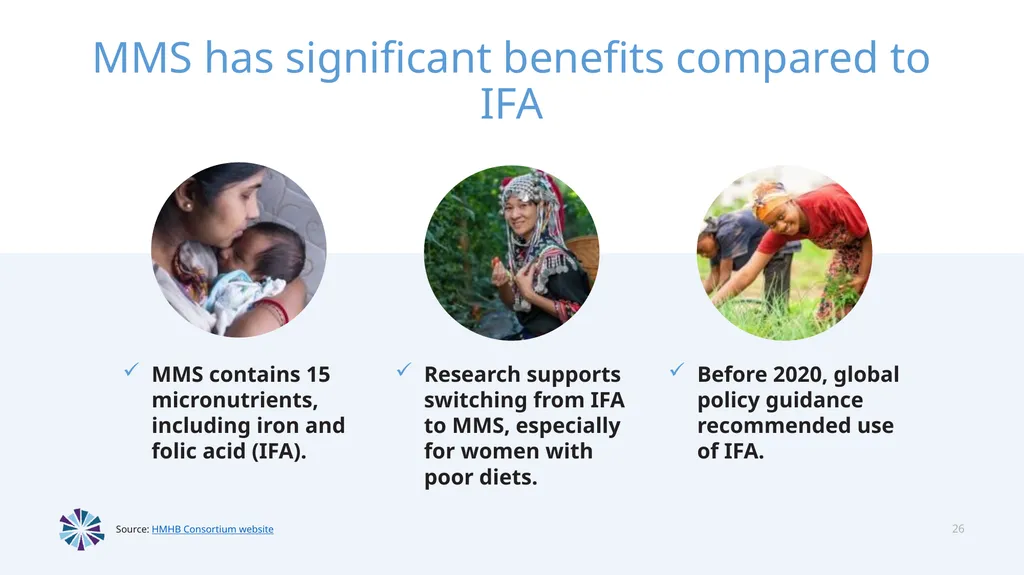
MMS contains 15 micronutrients, including iron and folic acid (IFA). Research supports switching from IFA to MMS, especially for women with poor diets. Before 2020, global policy guidance recommended use of IFA. 26 Source: HMHB Consortium website MMS has significant benefits compared to IFA<br>
27
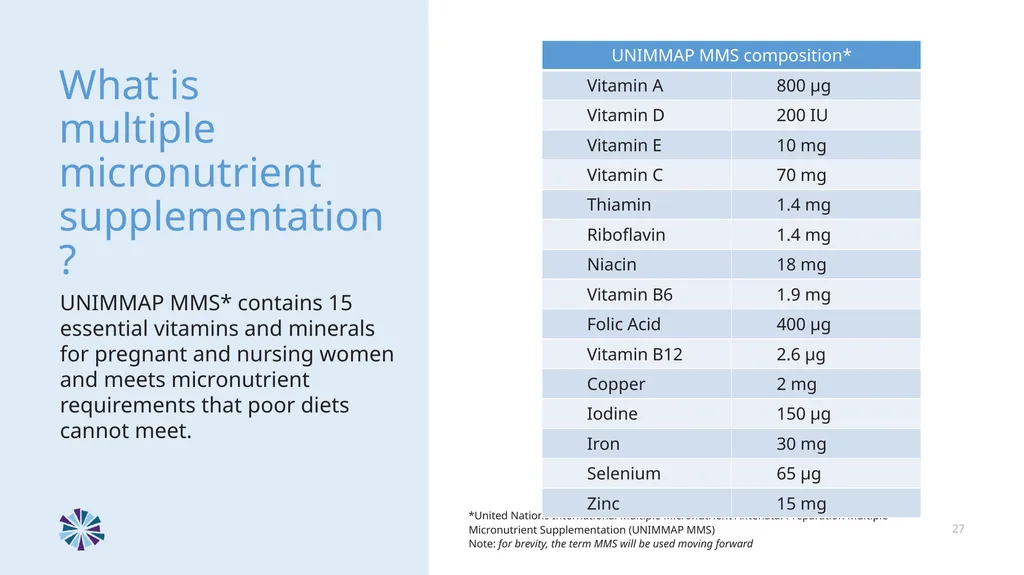
*United Nations International Multiple Micronutrient Antenatal Preparation Multiple Micronutrient Supplementation (UNIMMAP MMS)
Note: for brevity, the term MMS will be used moving forward What is
multiple
micronutrient supplementation?
UNIMMAP MMS* contains 15 essential vitamins and minerals for pregnant and nursing women and meets micronutrient requirements that poor diets cannot meet. 27<br>
UNIMMAP MMS* contains 15 essential vitamins and minerals for pregnant and nursing women and meets micronutrient requirements that poor diets cannot meet. 27<br>
28
How does MMS compare to IFA?
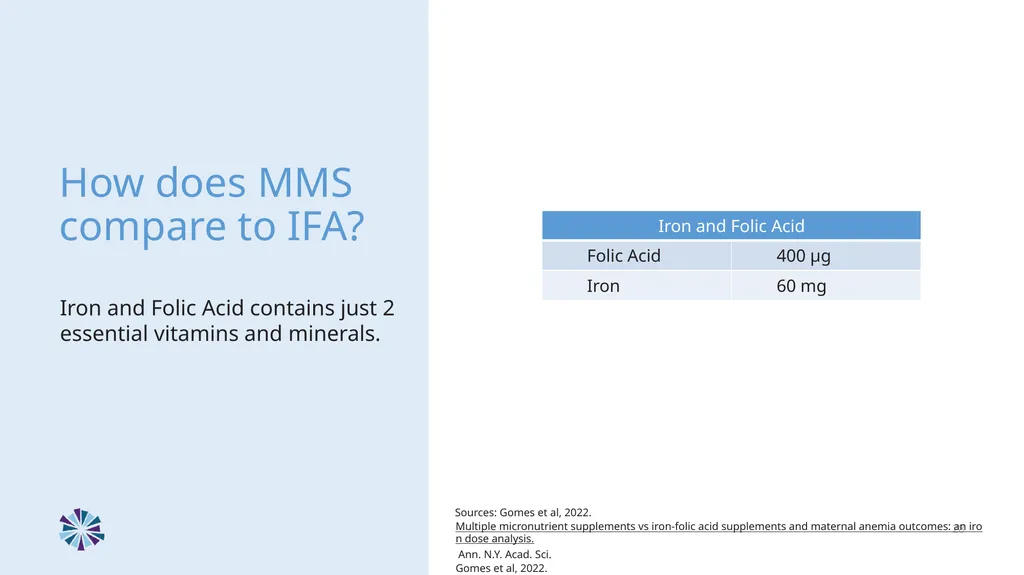
Iron and Folic Acid contains just 2 essential vitamins and minerals. 28 Sources: Gomes et al, 2022. Multiple micronutrient supplements vs iron-folic acid supplements and maternal anemia outcomes: an iron dose analysis. Ann. N.Y. Acad. Sci. Gomes et al, 2022. Effect of multiple micronutrient supplements vs iron and folic acid supplements on neonatal mortality: a reanalysis by iron dose. Public Health Nutr.<br>
Iron and Folic Acid contains just 2 essential vitamins and minerals. 28 Sources: Gomes et al, 2022. Multiple micronutrient supplements vs iron-folic acid supplements and maternal anemia outcomes: an iron dose analysis. Ann. N.Y. Acad. Sci. Gomes et al, 2022. Effect of multiple micronutrient supplements vs iron and folic acid supplements on neonatal mortality: a reanalysis by iron dose. Public Health Nutr.<br>
29
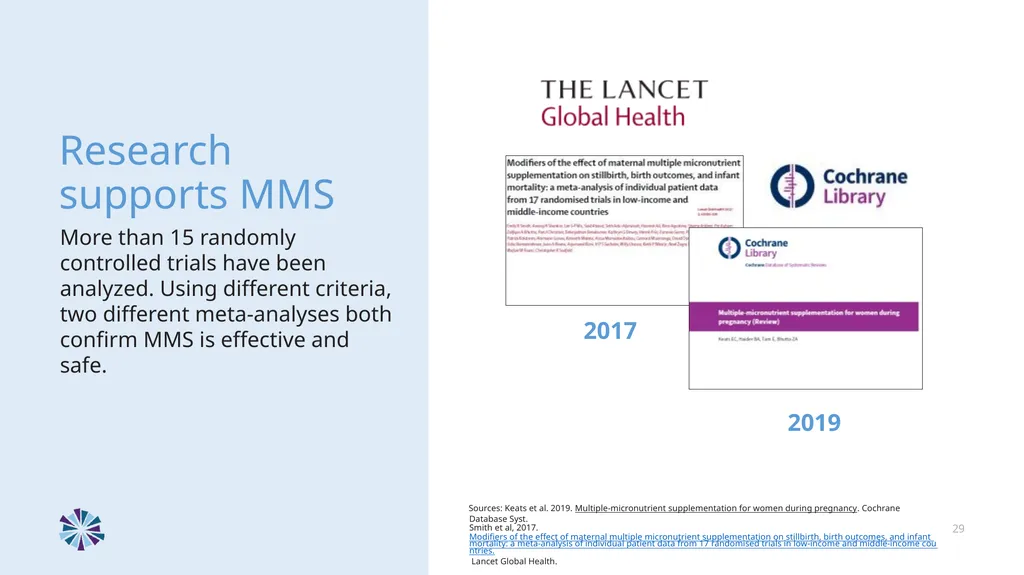
29 Sources: Keats et al. 2019. Multiple-micronutrient supplementation for women during pregnancy. Cochrane Database Syst.
Smith et al, 2017. Modifiers of the effect of maternal multiple micronutrient supplementation on stillbirth, birth outcomes, and infant mortality: a meta-analysis of individual patient data from 17 randomised trials in low-income and middle-income countries. Lancet Global Health. Research
supports MMS
More than 15 randomly controlled trials have been analyzed. Using different criteria, two different meta-analyses both confirm MMS is effective and safe. 2017 2019<br>
More than 15 randomly controlled trials have been analyzed. Using different criteria, two different meta-analyses both confirm MMS is effective and safe. 2017 2019<br>
30
Global guidance supports MMS
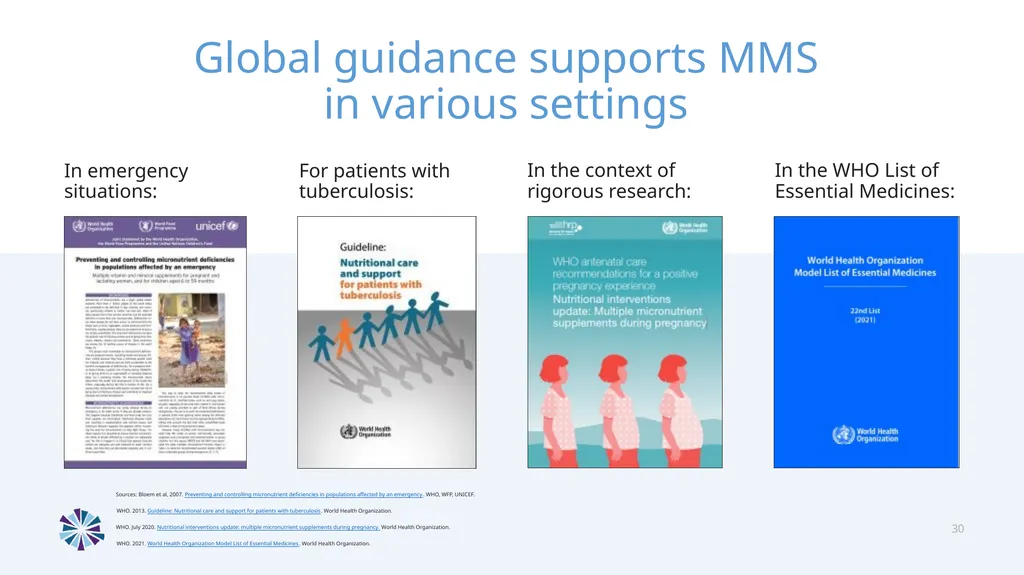
in various settings 30 Sources: Bloem et al, 2007. Preventing and controlling micronutrient deficiencies in populations affected by an emergency. WHO, WFP, UNICEF.
WHO. 2013. Guideline: Nutritional care and support for patients with tuberculosis. World Health Organization.
WHO. July 2020. Nutritional interventions update: multiple micronutrient supplements during pregnancy. World Health Organization.
WHO. 2021. World Health Organization Model List of Essential Medicines. World Health Organization. In emergency situations: For patients with tuberculosis: In the context of rigorous research: In the WHO List of Essential Medicines:<br>
WHO. 2013. Guideline: Nutritional care and support for patients with tuberculosis. World Health Organization.
WHO. July 2020. Nutritional interventions update: multiple micronutrient supplements during pregnancy. World Health Organization.
WHO. 2021. World Health Organization Model List of Essential Medicines. World Health Organization. In emergency situations: For patients with tuberculosis: In the context of rigorous research: In the WHO List of Essential Medicines:<br>
31
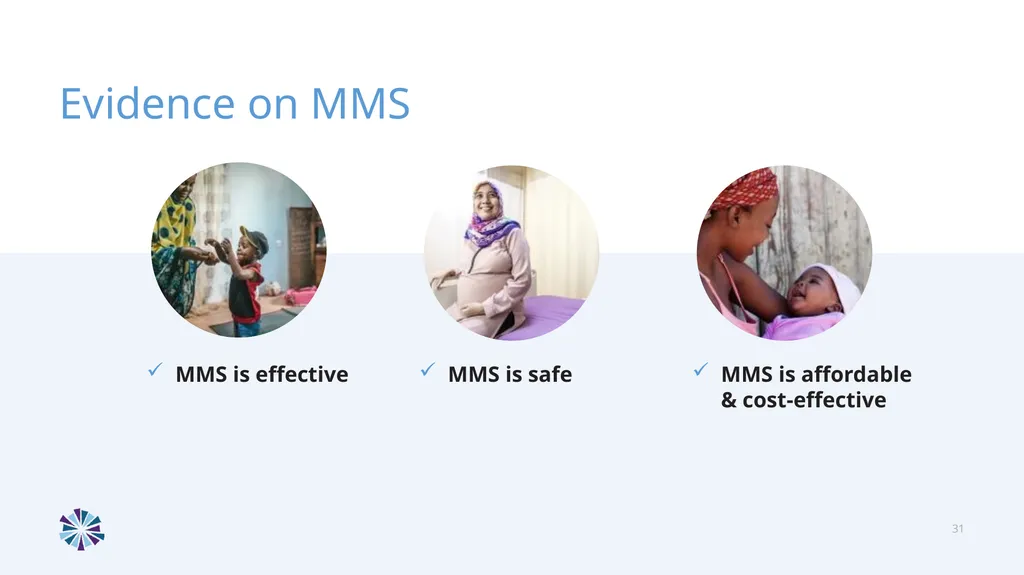
31 Evidence on MMS MMS is effective MMS is safe MMS is affordable & cost-effective<br>
32
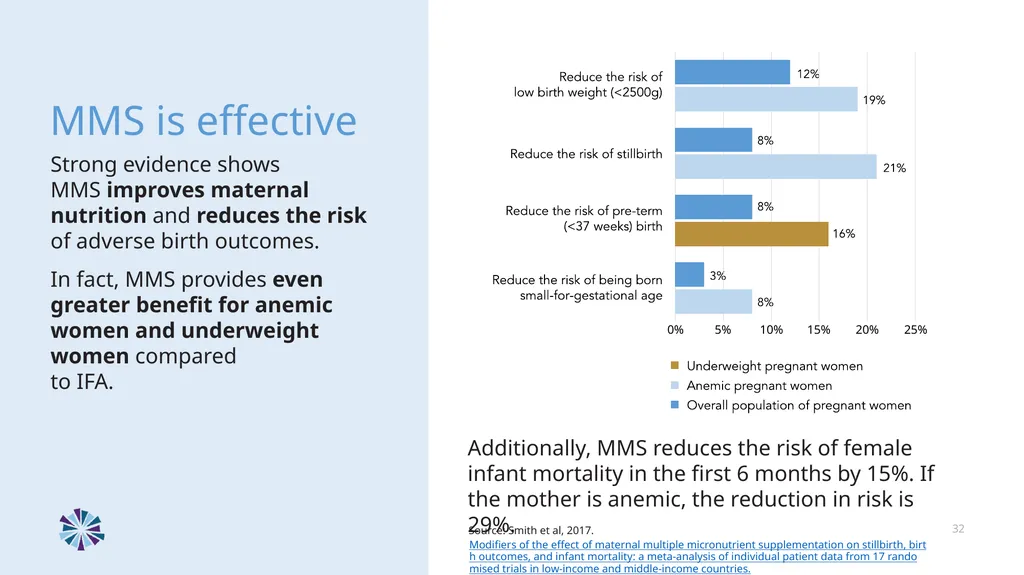
Source: Smith et al, 2017. Modifiers of the effect of maternal multiple micronutrient supplementation on stillbirth, birth outcomes, and infant mortality: a meta-analysis of individual patient data from 17 randomised trials in low-income and middle-income countries. Lancet Global Health. MMS is effective
Strong evidence shows MMS improves maternal nutrition and reduces the risk of adverse birth outcomes.
In fact, MMS provides even greater benefit for anemic women and underweight women compared to IFA. 32 Additionally, MMS reduces the risk of female infant mortality in the first 6 months by 15%. If the mother is anemic, the reduction in risk is 29%.<br>
Strong evidence shows MMS improves maternal nutrition and reduces the risk of adverse birth outcomes.
In fact, MMS provides even greater benefit for anemic women and underweight women compared to IFA. 32 Additionally, MMS reduces the risk of female infant mortality in the first 6 months by 15%. If the mother is anemic, the reduction in risk is 29%.<br>
33
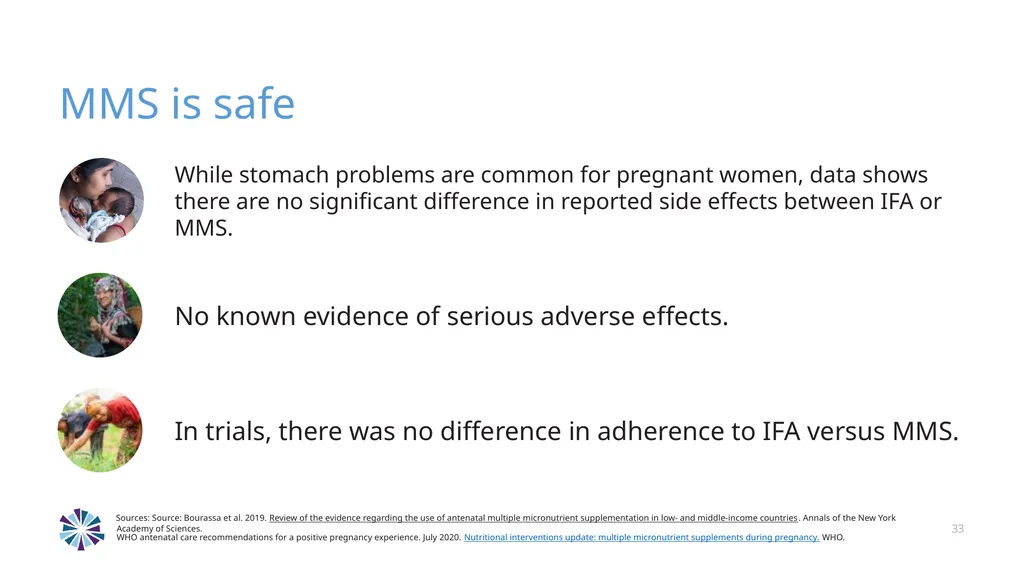
MMS is safe While stomach problems are common for pregnant women, data shows there are no significant difference in reported side effects between IFA or MMS. 33 Sources: Source: Bourassa et al. 2019. Review of the evidence regarding the use of antenatal multiple micronutrient supplementation in low- and middle-income countries. Annals of the New York Academy of Sciences.
WHO antenatal care recommendations for a positive pregnancy experience. July 2020. Nutritional interventions update: multiple micronutrient supplements during pregnancy. WHO. No known evidence of serious adverse effects. In trials, there was no difference in adherence to IFA versus MMS.<br>
34
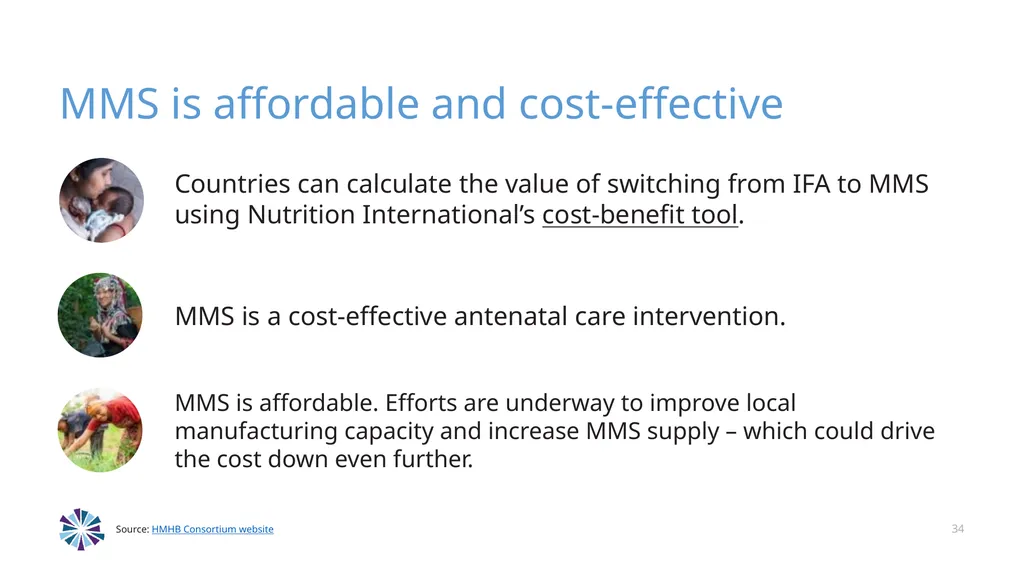
MMS is affordable and cost-effective Countries can calculate the value of switching from IFA to MMS using Nutrition International’s cost-benefit tool. 34 Source: HMHB Consortium website MMS is a cost-effective antenatal care intervention. MMS is affordable. Efforts are underway to improve local manufacturing capacity and increase MMS supply – which could drive the cost down even further.<br>
35
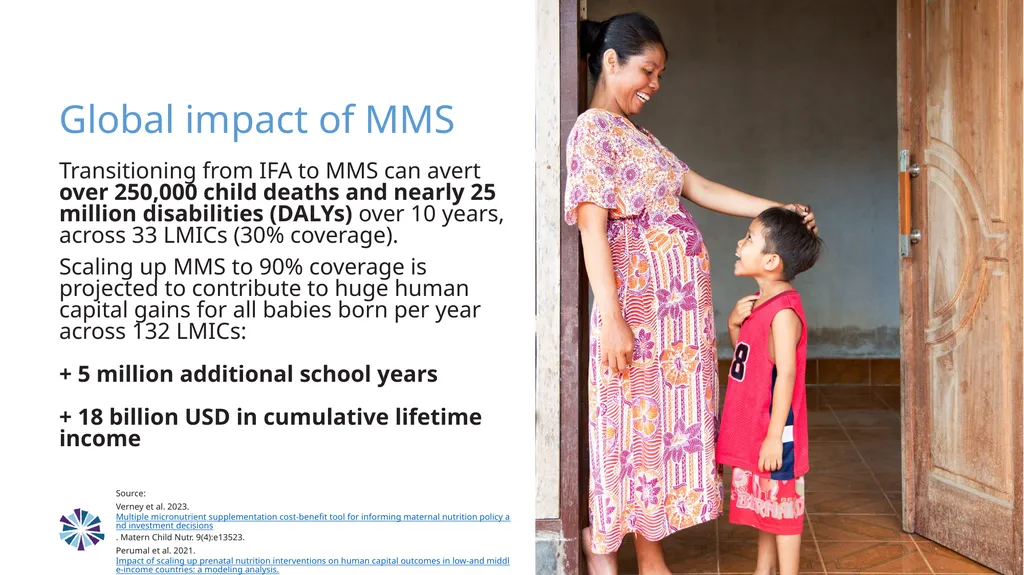
Global impact of MMS Transitioning from IFA to MMS can avert over 250,000 child deaths and nearly 25 million disabilities (DALYs) over 10 years, across 33 LMICs (30% coverage).
Scaling up MMS to 90% coverage is projected to contribute to huge human capital gains for all babies born per year across 132 LMICs: + 5 million additional school years + 18 billion USD in cumulative lifetime income 35 Source:
Verney et al. 2023. Multiple micronutrient supplementation cost-benefit tool for informing maternal nutrition policy and investment decisions. Matern Child Nutr. 9(4):e13523.
Perumal et al. 2021. Impact of scaling up prenatal nutrition interventions on human capital outcomes in low-and middle-income countries: a modeling analysis. American Journal of Clinical Nutrition. 114(5):1708-1718<br>
Scaling up MMS to 90% coverage is projected to contribute to huge human capital gains for all babies born per year across 132 LMICs: + 5 million additional school years + 18 billion USD in cumulative lifetime income 35 Source:
Verney et al. 2023. Multiple micronutrient supplementation cost-benefit tool for informing maternal nutrition policy and investment decisions. Matern Child Nutr. 9(4):e13523.
Perumal et al. 2021. Impact of scaling up prenatal nutrition interventions on human capital outcomes in low-and middle-income countries: a modeling analysis. American Journal of Clinical Nutrition. 114(5):1708-1718<br>
36
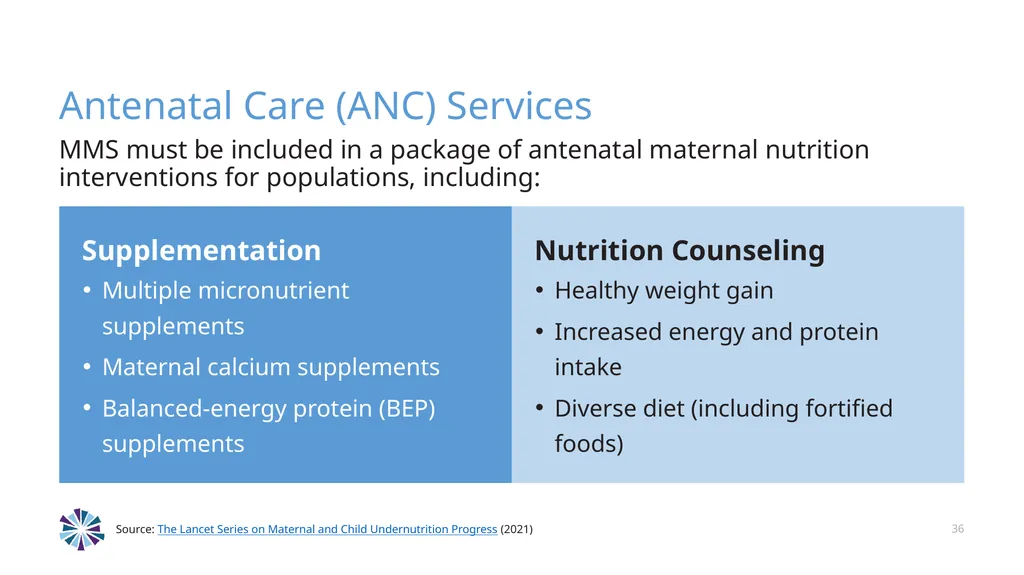
Antenatal Care (ANC) Services Supplementation
Multiple micronutrient supplements
Maternal calcium supplements
Balanced-energy protein (BEP) supplements 36 Source: The Lancet Series on Maternal and Child Undernutrition Progress (2021) MMS must be included in a package of antenatal maternal nutrition interventions for populations, including: Nutrition Counseling
Healthy weight gain
Increased energy and protein intake
Diverse diet (including fortified foods)<br>
Multiple micronutrient supplements
Maternal calcium supplements
Balanced-energy protein (BEP) supplements 36 Source: The Lancet Series on Maternal and Child Undernutrition Progress (2021) MMS must be included in a package of antenatal maternal nutrition interventions for populations, including: Nutrition Counseling
Healthy weight gain
Increased energy and protein intake
Diverse diet (including fortified foods)<br>
37
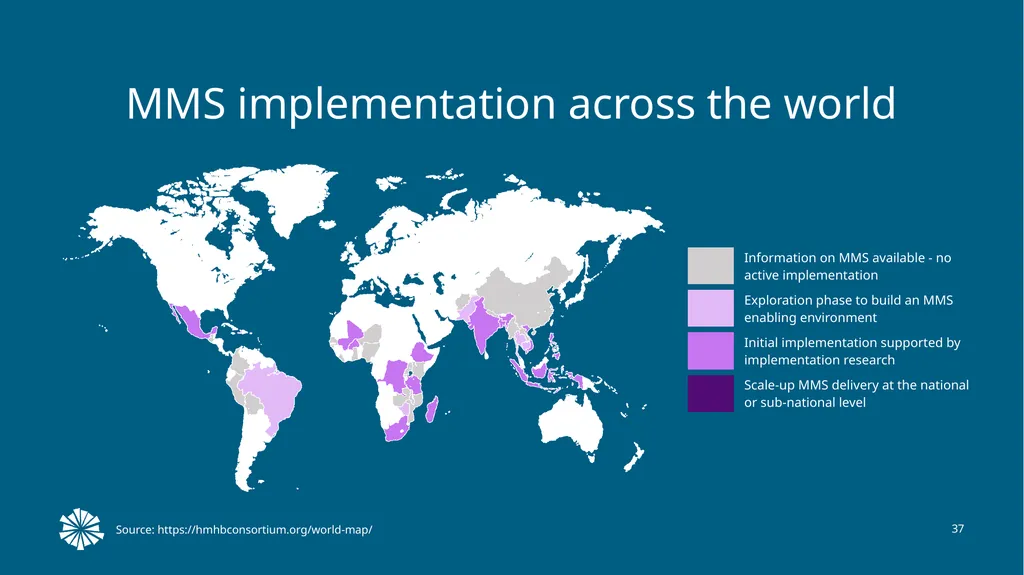
MMS implementation across the world 37 Source: https://hmhbconsortium.org/world-map/<br>
38
National impact and investment case for
<insert country><br>
39
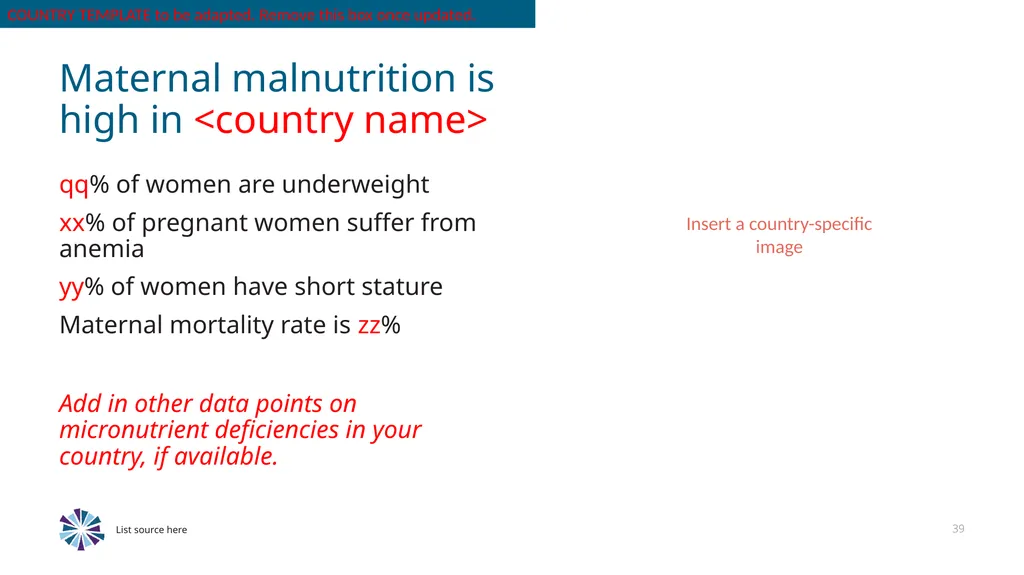
Maternal malnutrition is high in <country name> qq% of women are underweight
xx% of pregnant women suffer from anemia
yy% of women have short stature
Maternal mortality rate is zz%
Add in other data points on micronutrient deficiencies in your country, if available. 39 List source here COUNTRY TEMPLATE to be adapted. Remove this box once updated. Insert a country-specific image<br>
xx% of pregnant women suffer from anemia
yy% of women have short stature
Maternal mortality rate is zz%
Add in other data points on micronutrient deficiencies in your country, if available. 39 List source here COUNTRY TEMPLATE to be adapted. Remove this box once updated. Insert a country-specific image<br>
40
Maternal malnutrition in <country name> is impacted by: Optional slide to add related country or region-specific topics, such as:
Data on COVID-19’s impact on food shortages
High rates of HIV, TB, etc. that may lead to higher rates of malnutrition
Severity of anemia or high obesity rates 40 List source here COUNTRY TEMPLATE to be adapted. Remove this box once updated.<br>
Data on COVID-19’s impact on food shortages
High rates of HIV, TB, etc. that may lead to higher rates of malnutrition
Severity of anemia or high obesity rates 40 List source here COUNTRY TEMPLATE to be adapted. Remove this box once updated.<br>
41
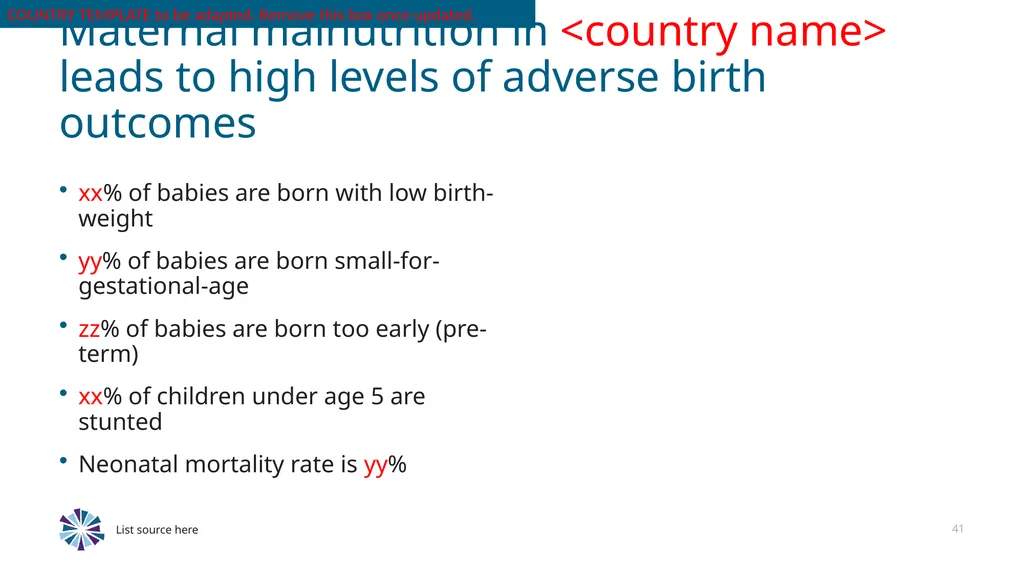
41 Maternal malnutrition in <country name> leads to high levels of adverse birth outcomes xx% of babies are born with low birth- weight
yy% of babies are born small-for-gestational-age
zz% of babies are born too early (pre-term)
xx% of children under age 5 are stunted
Neonatal mortality rate is yy% List source here COUNTRY TEMPLATE to be adapted. Remove this box once updated.<br>
yy% of babies are born small-for-gestational-age
zz% of babies are born too early (pre-term)
xx% of children under age 5 are stunted
Neonatal mortality rate is yy% List source here COUNTRY TEMPLATE to be adapted. Remove this box once updated.<br>
42
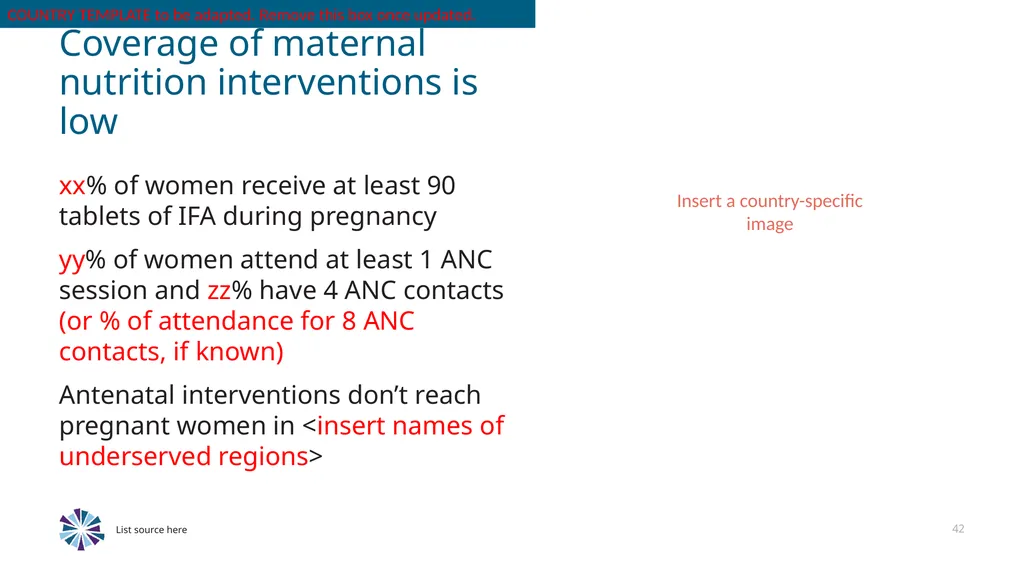
Coverage of maternal nutrition interventions is low xx% of women receive at least 90 tablets of IFA during pregnancy
yy% of women attend at least 1 ANC session and zz% have 4 ANC contacts (or % of attendance for 8 ANC contacts, if known)
Antenatal interventions don’t reach pregnant women in <insert names of underserved regions> 42 List source here COUNTRY TEMPLATE to be adapted. Remove this box once updated. Insert a country-specific image<br>
yy% of women attend at least 1 ANC session and zz% have 4 ANC contacts (or % of attendance for 8 ANC contacts, if known)
Antenatal interventions don’t reach pregnant women in <insert names of underserved regions> 42 List source here COUNTRY TEMPLATE to be adapted. Remove this box once updated. Insert a country-specific image<br>
43
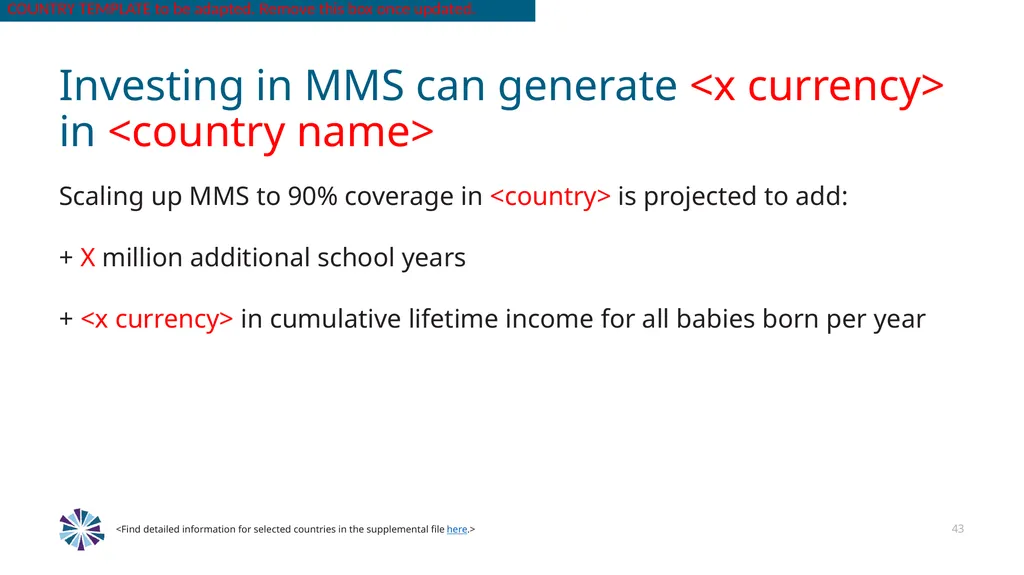
Investing in MMS can generate <x currency>
in <country name> Scaling up MMS to 90% coverage in <country> is projected to add:
+ X million additional school years
+ <x currency> in cumulative lifetime income for all babies born per year 43 <Find detailed information for selected countries in the supplemental file here.> COUNTRY TEMPLATE to be adapted. Remove this box once updated.<br>
44
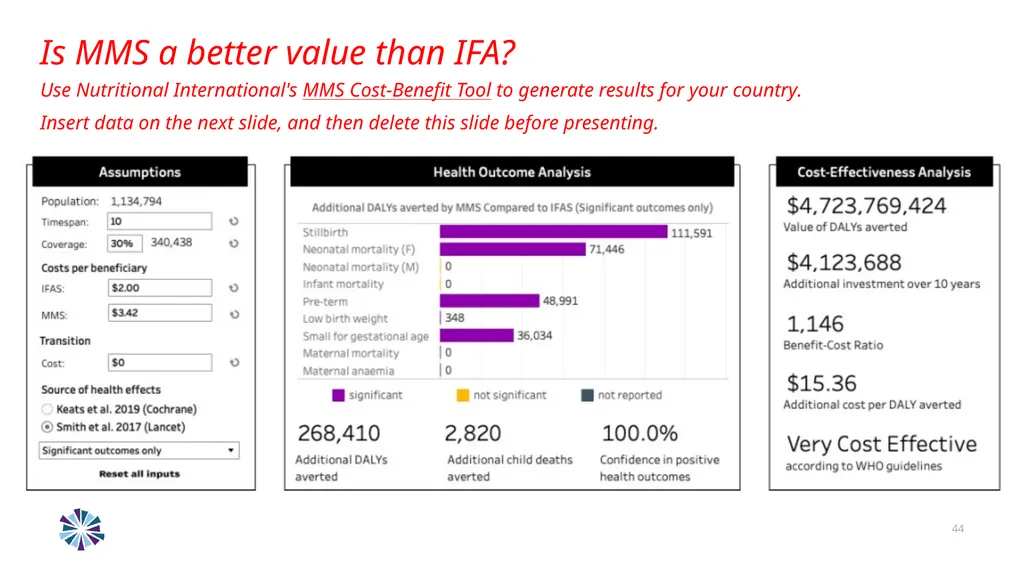
Is MMS a better value than IFA?
Use Nutritional International's MMS Cost-Benefit Tool to generate results for your country.
Insert data on the next slide, and then delete this slide before presenting. 44<br>
Use Nutritional International's MMS Cost-Benefit Tool to generate results for your country.
Insert data on the next slide, and then delete this slide before presenting. 44<br>
45
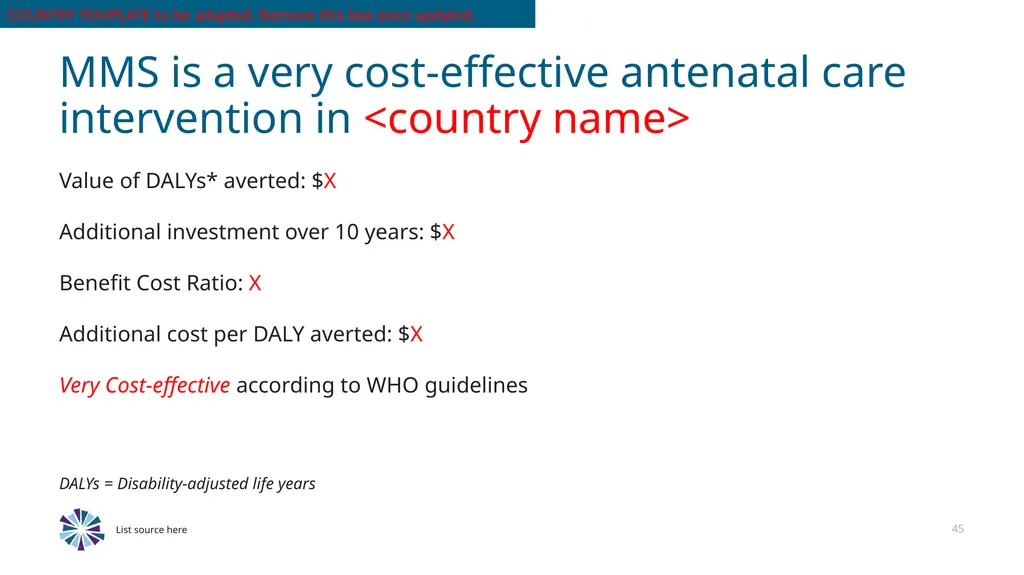
MMS is a very cost-effective antenatal care intervention in <country name> Value of DALYs* averted: $X
Additional investment over 10 years: $X
Benefit Cost Ratio: X
Additional cost per DALY averted: $X
Very Cost-effective according to WHO guidelines
DALYs = Disability-adjusted life years 45 List source here COUNTRY TEMPLATE to be adapted. Remove this box once updated.<br>
Additional investment over 10 years: $X
Benefit Cost Ratio: X
Additional cost per DALY averted: $X
Very Cost-effective according to WHO guidelines
DALYs = Disability-adjusted life years 45 List source here COUNTRY TEMPLATE to be adapted. Remove this box once updated.<br>
46
Introducing and scaling MMS<br>
47
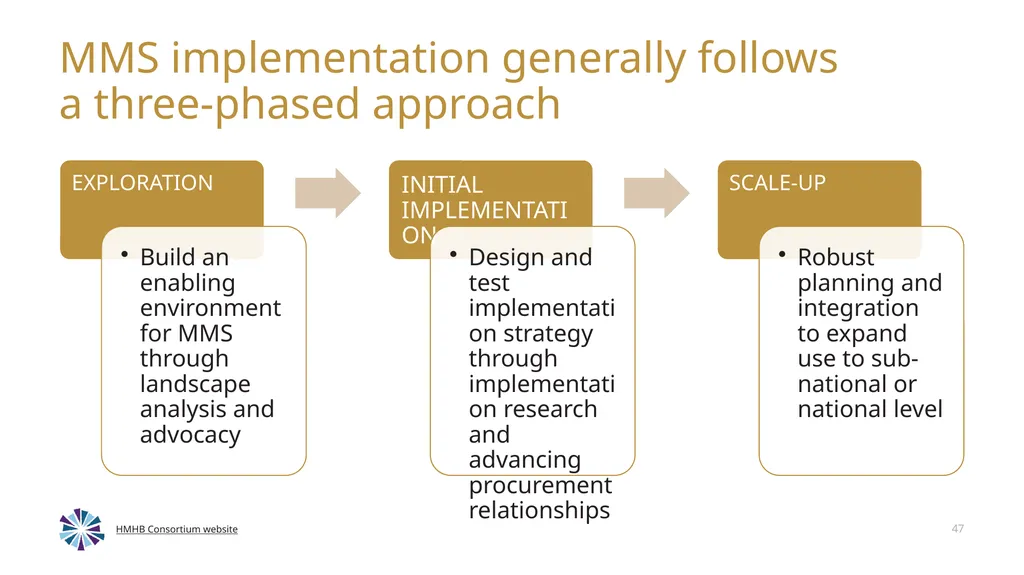
MMS implementation generally follows
a three-phased approach 47 HMHB Consortium website<br>
48
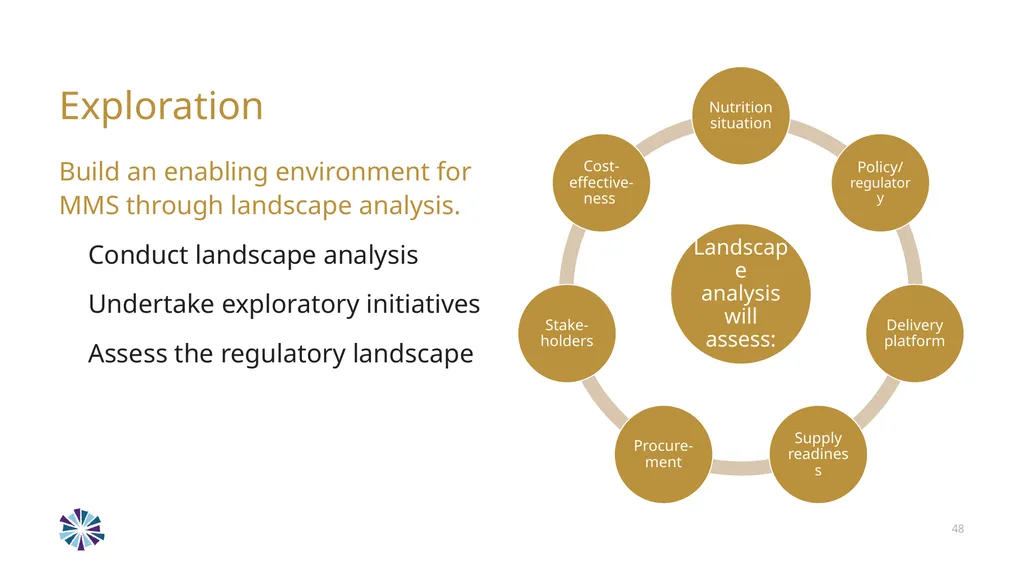
Exploration Build an enabling environment for MMS through landscape analysis.
Conduct landscape analysis
Undertake exploratory initiatives
Assess the regulatory landscape 48<br>
Conduct landscape analysis
Undertake exploratory initiatives
Assess the regulatory landscape 48<br>
49
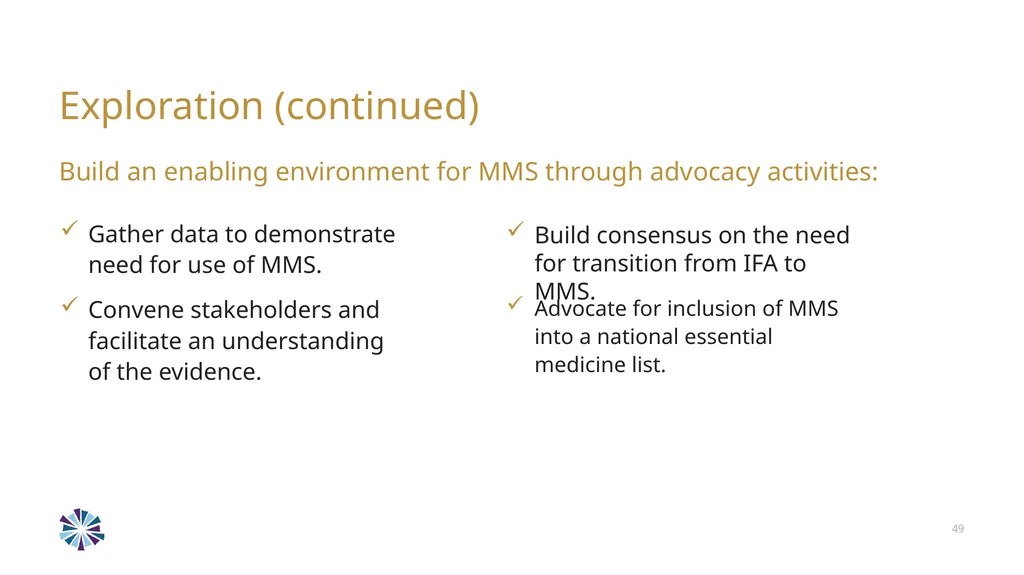
Exploration (continued) Build an enabling environment for MMS through advocacy activities: 49 Gather data to demonstrate need for use of MMS. Convene stakeholders and facilitate an understanding of the evidence. Build consensus on the need for transition from IFA to MMS. Advocate for inclusion of MMS into a national essential medicine list.<br>
50
Phase 2: Initial Implementation Design and test implementation strategy through implementation research and advancing procurement relationships.
Conduct implementation research
Create & execute implementation plan
Explore MMS supply or procurement plans 50<br>
Conduct implementation research
Create & execute implementation plan
Explore MMS supply or procurement plans 50<br>
51
Phase 3: Scale Up Robust planning and integration to expand coverage and use to sub-national or national level.
Capacity-building
Monitoring and evaluation (M&E)
Social and Behavior Change Communications (SBCC) planning
Financing, sourcing, and procurement 51<br>
Capacity-building
Monitoring and evaluation (M&E)
Social and Behavior Change Communications (SBCC) planning
Financing, sourcing, and procurement 51<br>
52
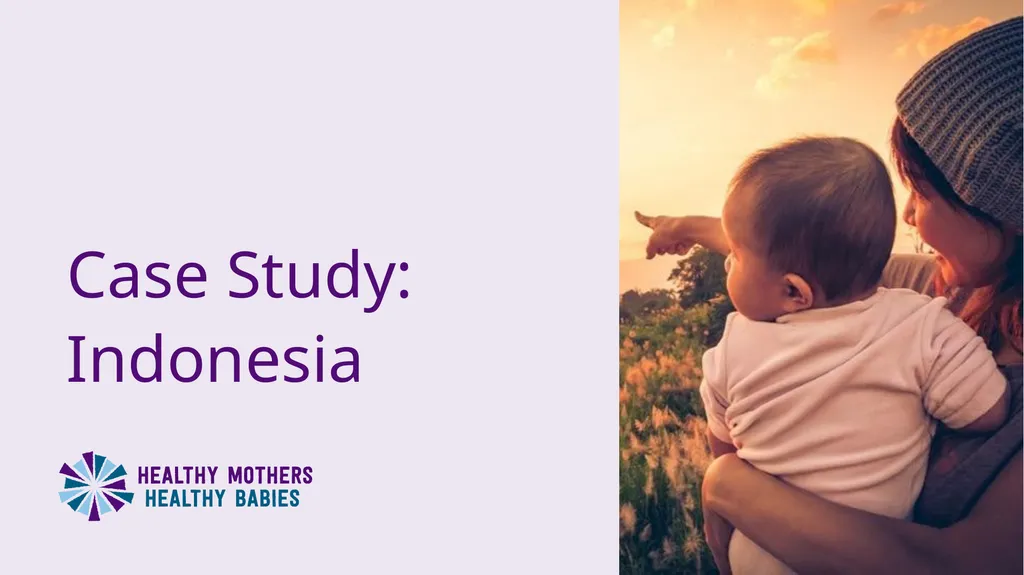
Case Study: Indonesia<br>
53
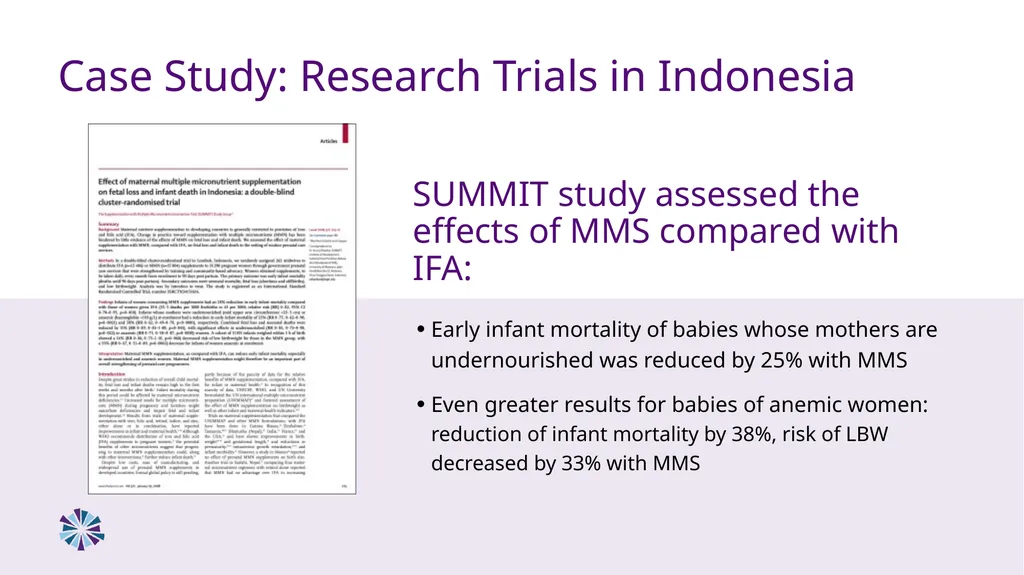
SUMMIT study assessed the effects of MMS compared with IFA: Early infant mortality of babies whose mothers are undernourished was reduced by 25% with MMS
Even greater results for babies of anemic women: reduction of infant mortality by 38%, risk of LBW decreased by 33% with MMS Case Study: Research Trials in Indonesia<br>
Even greater results for babies of anemic women: reduction of infant mortality by 38%, risk of LBW decreased by 33% with MMS Case Study: Research Trials in Indonesia<br>
54
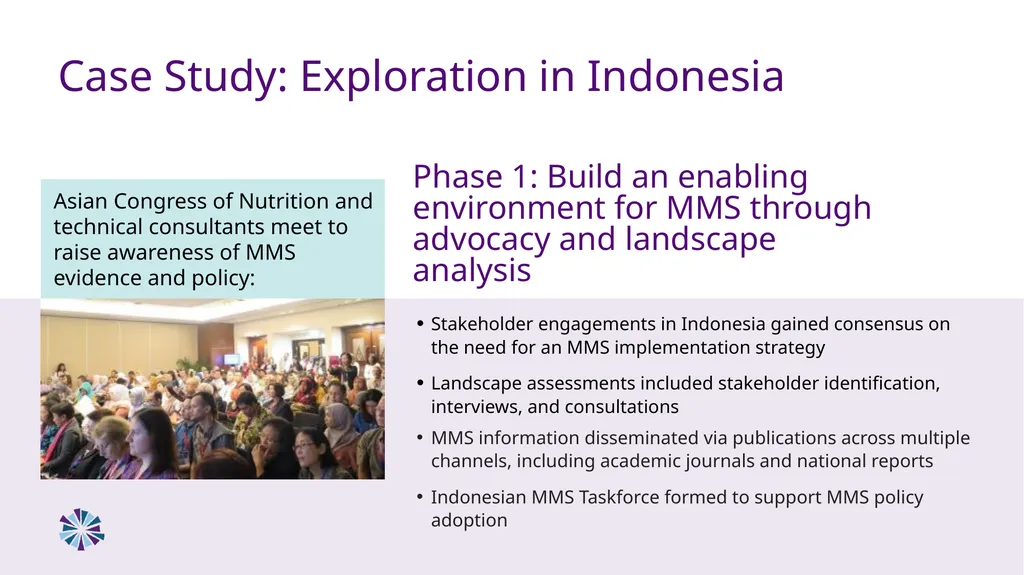
Phase 1: Build an enabling environment for MMS through advocacy and landscape analysis Stakeholder engagements in Indonesia gained consensus on the need for an MMS implementation strategy
Landscape assessments included stakeholder identification, interviews, and consultations
MMS information disseminated via publications across multiple channels, including academic journals and national reports
Indonesian MMS Taskforce formed to support MMS policy adoption Case Study: Exploration in Indonesia Asian Congress of Nutrition and technical consultants meet to raise awareness of MMS evidence and policy:<br>
Landscape assessments included stakeholder identification, interviews, and consultations
MMS information disseminated via publications across multiple channels, including academic journals and national reports
Indonesian MMS Taskforce formed to support MMS policy adoption Case Study: Exploration in Indonesia Asian Congress of Nutrition and technical consultants meet to raise awareness of MMS evidence and policy:<br>
55
Phase 2: Design and test implementation strategy through implementation research and advancing procurement relationships In coordination with the Indonesian Ministry of Health,
Johns Hopkins University and 3 Indonesian universities:
Conducted formative research
Designed and implemented implementation strategy
Identified and engaged with potential local MMS manufacturers
Monitored and evaluated implementation strategy Case Study: Initial Implementation in Indonesia<br>
Conducted formative research
Designed and implemented implementation strategy
Identified and engaged with potential local MMS manufacturers
Monitored and evaluated implementation strategy Case Study: Initial Implementation in Indonesia<br>
56
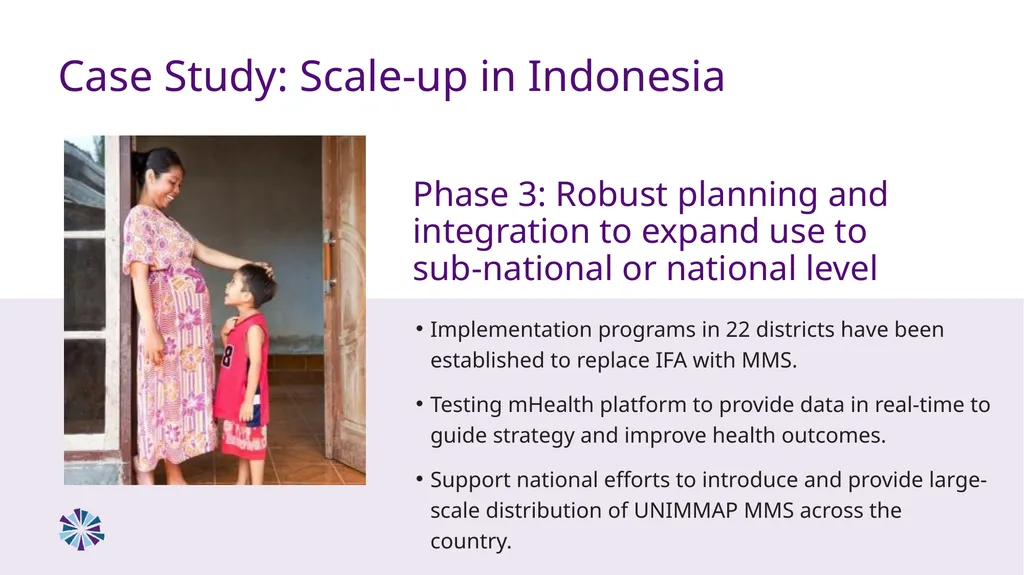
Phase 3: Robust planning and integration to expand use to sub-national or national level Implementation programs in 22 districts have been established to replace IFA with MMS.
Testing mHealth platform to provide data in real-time to guide strategy and improve health outcomes.
Support national efforts to introduce and provide large-scale distribution of UNIMMAP MMS across the country. Case Study: Scale-up in Indonesia<br>
Testing mHealth platform to provide data in real-time to guide strategy and improve health outcomes.
Support national efforts to introduce and provide large-scale distribution of UNIMMAP MMS across the country. Case Study: Scale-up in Indonesia<br>
57
Next Steps Optional slide to add next step or key takeaways 57 TEMPLATE to be adapted. Remove this box once updated.<br>
58
Keep In Touch Optional slide to add website URL, social handles, and/or email address. 58 TEMPLATE to be adapted. Remove this box once updated.<br>
59
Key publications Bloem et al, 2007. Preventing and controlling micronutrient deficiencies in populations affected by an emergency. WHO, WFP, UNICEF.
Smith et al, 2017. Modifiers of the effect of maternal multiple micronutrient supplementation on stillbirth, birth outcomes, and infant mortality: a meta-analysis of individual patient data from 17 randomised trials in low-income and middle-income countries. Lancet Global Health.
Prado et al, 2017. Maternal multiple micronutrient supplementation and other biomedical and socio environmental influences on children’s cognition at age 9-12 years in Indonesia: follow up of the SUMMIT randomised trial.
WHO antenatal care recommendations for a positive pregnancy experience. July 2020. Nutritional interventions update: multiple micronutrient supplements during pregnancy. World Health Organization.
Perumal et al. July 2021. Impact of scaling up prenatal nutrition interventions on human capital outcomes in low-and middle-income countries: a modeling analysis. American Journal of Clinical Nutrition.
May 2020. Use of MMS for maternal nutrition and birth outcomes during COVID-19. MMS TAG.
Dalmiya et al. January 2022. Maternal Nutrition: Prevention of malnutrition in women before and during pregnancy and while breastfeeding. UNICEF.
Gomes et al, 2022. Multiple micronutrient supplements vs iron-folic acid supplements and maternal anemia outcomes: an iron dose analysis. Ann. N.Y. Acad. Sci.
Gomes et al, 2022. Effect of multiple micronutrient supplements vs iron and folic acid supplements on neonatal mortality: a reanalysis by iron dose. Public Health Nutr. 59<br>
Smith et al, 2017. Modifiers of the effect of maternal multiple micronutrient supplementation on stillbirth, birth outcomes, and infant mortality: a meta-analysis of individual patient data from 17 randomised trials in low-income and middle-income countries. Lancet Global Health.
Prado et al, 2017. Maternal multiple micronutrient supplementation and other biomedical and socio environmental influences on children’s cognition at age 9-12 years in Indonesia: follow up of the SUMMIT randomised trial.
WHO antenatal care recommendations for a positive pregnancy experience. July 2020. Nutritional interventions update: multiple micronutrient supplements during pregnancy. World Health Organization.
Perumal et al. July 2021. Impact of scaling up prenatal nutrition interventions on human capital outcomes in low-and middle-income countries: a modeling analysis. American Journal of Clinical Nutrition.
May 2020. Use of MMS for maternal nutrition and birth outcomes during COVID-19. MMS TAG.
Dalmiya et al. January 2022. Maternal Nutrition: Prevention of malnutrition in women before and during pregnancy and while breastfeeding. UNICEF.
Gomes et al, 2022. Multiple micronutrient supplements vs iron-folic acid supplements and maternal anemia outcomes: an iron dose analysis. Ann. N.Y. Acad. Sci.
Gomes et al, 2022. Effect of multiple micronutrient supplements vs iron and folic acid supplements on neonatal mortality: a reanalysis by iron dose. Public Health Nutr. 59<br>
60
Healthy Mothers Healthy Babies resources HMHB Knowledge Hub
HMHB Knowledge Bytes
HMHB MMS Interactive World Map
HMHB FAQ and Advocacy Brief on the Inclusion of MMS on the Essential Medicine List
HMHB Launch Video HMHB Commitment-making Guide for Nutrition for Growth
Watch the HMHB Powering Women, Promising Futures Nutrition for Growth side event
Maternal Nutrition in Focus: HMHB at FIGO 2021 World Conference 60 Join us! Visit www.hmhbconsortium.org to become a member.<br>
HMHB Knowledge Bytes
HMHB MMS Interactive World Map
HMHB FAQ and Advocacy Brief on the Inclusion of MMS on the Essential Medicine List
HMHB Launch Video HMHB Commitment-making Guide for Nutrition for Growth
Watch the HMHB Powering Women, Promising Futures Nutrition for Growth side event
Maternal Nutrition in Focus: HMHB at FIGO 2021 World Conference 60 Join us! Visit www.hmhbconsortium.org to become a member.<br>
61
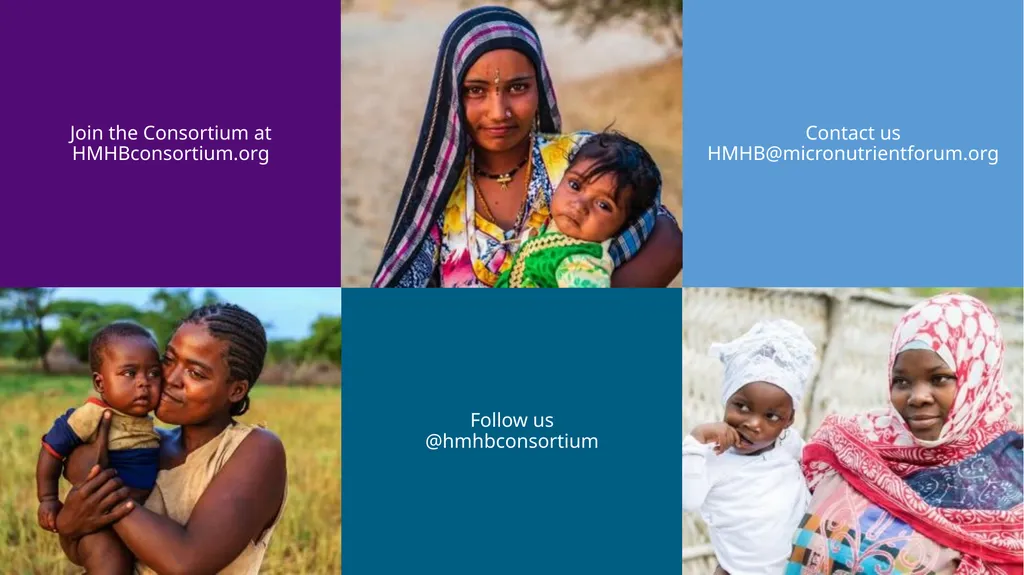
Join the Consortium at
HMHBconsortium.org Contact us
HMHB@micronutrientforum.org Follow us
@hmhbconsortium<br>