Agility Root Cause Analysis Root Cause Analysis (RCA) 2 Root Cause Analysis (RCA) It is the use of one or more tools to identify the real cause of a problem or situation. Root cause can be referred as the precise point in the causal
"Agility – Root Cause Analysis Root Cause Analysis" is the property of its rightful owner. Permission is granted to
download and print the materials on this website for personal, non-commercial use only, and to display it
on your personal computer provided you do not modify the materials and that you retain all copyright
notices contained in the materials. By downloading content from our website, you accept the terms of this
agreement.
Presentation Transcript
01
Agility – Root Cause Analysis<br>
02
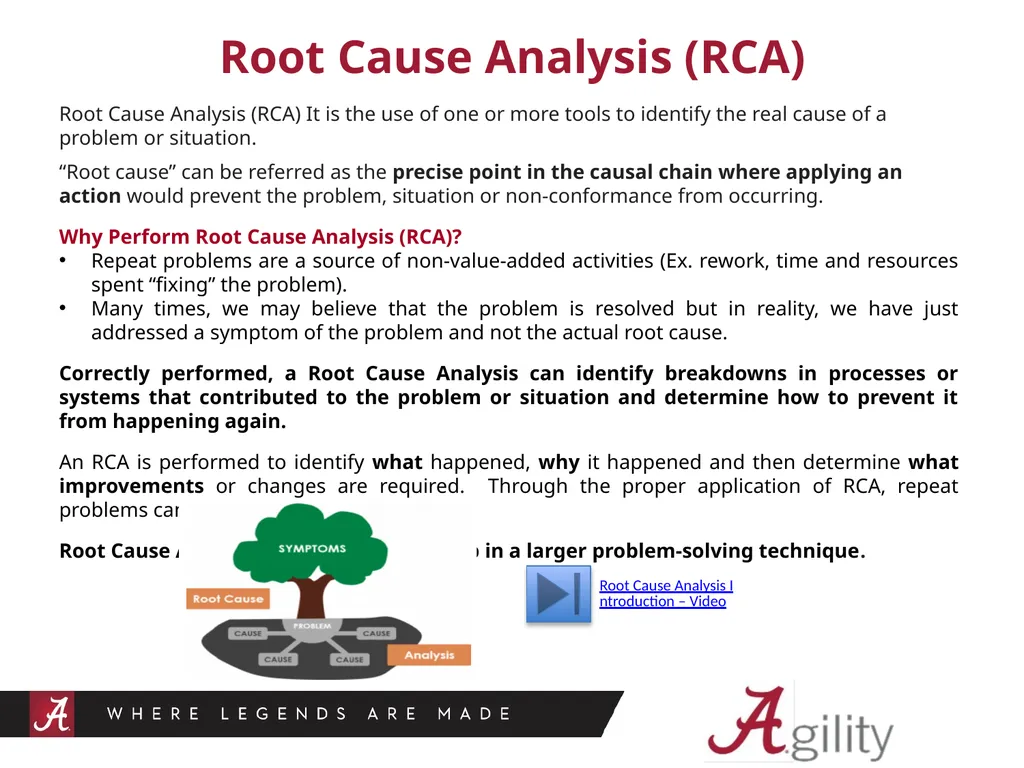
Root Cause Analysis (RCA) 2 Root Cause Analysis (RCA) It is the use of one or more tools to identify the real cause of a problem or situation.
“Root cause” can be referred as the precise point in the causal chain where applying an action would prevent the problem, situation or non-conformance from occurring.
Why Perform Root Cause Analysis (RCA)?
Repeat problems are a source of non-value-added activities (Ex. rework, time and resources spent “fixing” the problem).
Many times, we may believe that the problem is resolved but in reality, we have just addressed a symptom of the problem and not the actual root cause.
Correctly performed, a Root Cause Analysis can identify breakdowns in processes or systems that contributed to the problem or situation and determine how to prevent it from happening again.
An RCA is performed to identify what happened, why it happened and then determine what improvements or changes are required. Through the proper application of RCA, repeat problems can be eliminated.
Root Cause Analysis (RCA) is usually a step in a larger problem-solving technique.<br>
03
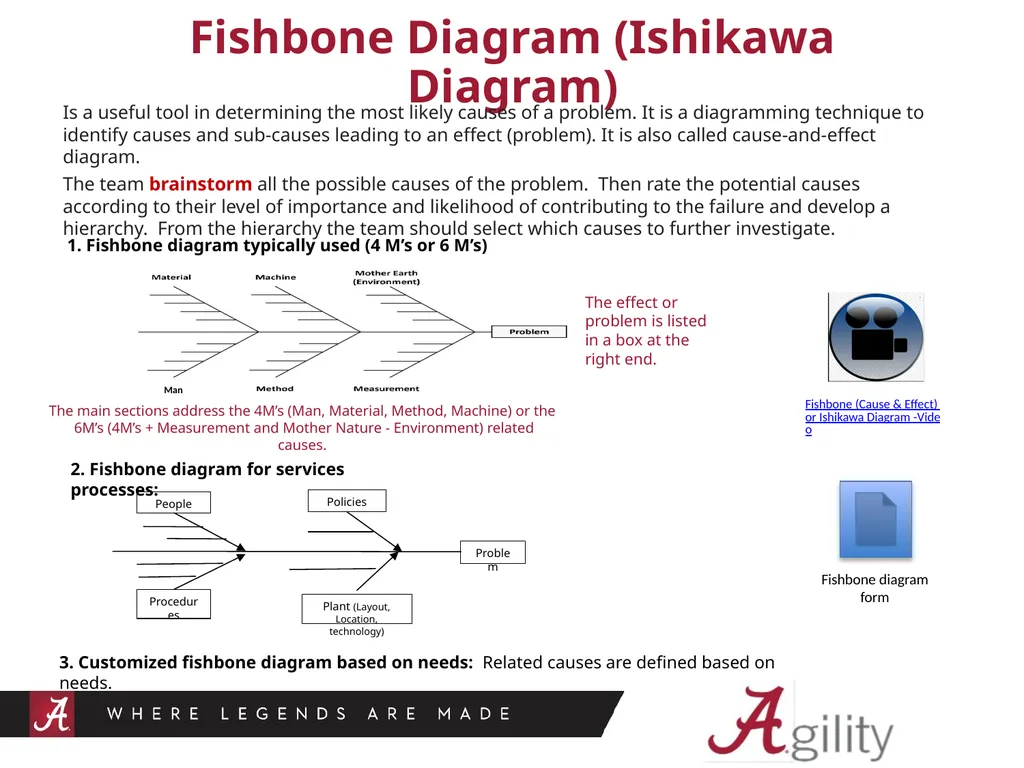
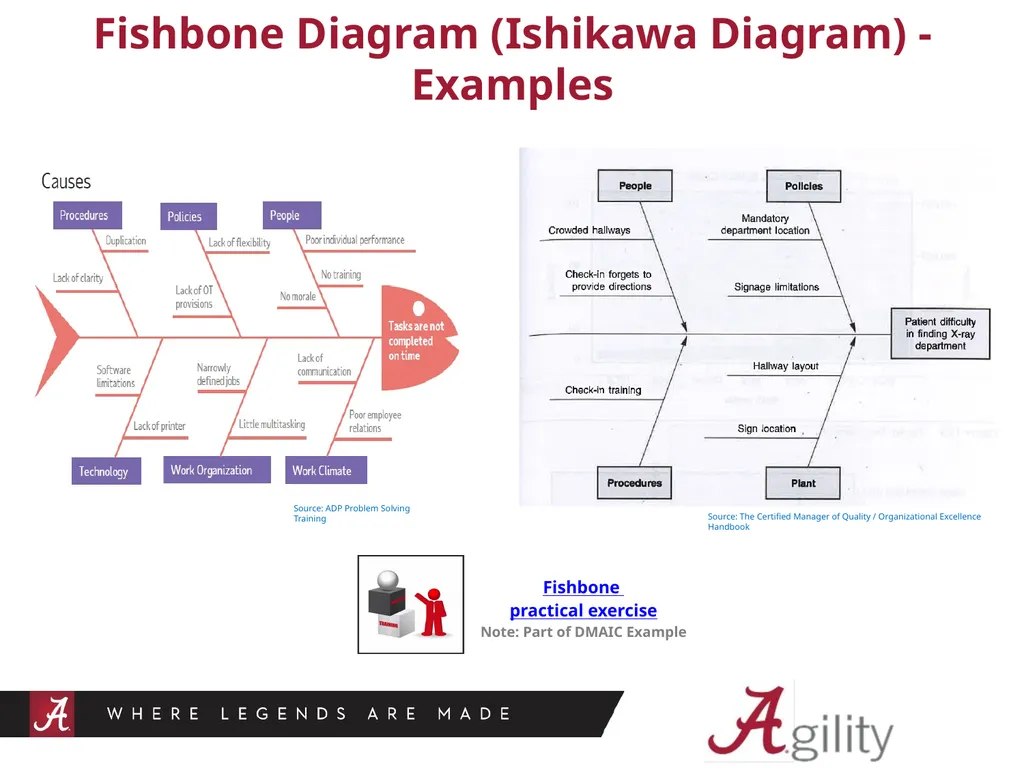
Fishbone Diagram (Ishikawa Diagram) 3 Is a useful tool in determining the most likely causes of a problem. It is a diagramming technique to identify causes and sub-causes leading to an effect (problem). It is also called cause-and-effect diagram.
The team brainstorm all the possible causes of the problem. Then rate the potential causes according to their level of importance and likelihood of contributing to the failure and develop a hierarchy. From the hierarchy the team should select which causes to further investigate. 1. Fishbone diagram typically used (4 M’s or 6 M’s) The effect or problem is listed in a box at the right end. The main sections address the 4M’s (Man, Material, Method, Machine) or the
6M’s (4M’s + Measurement and Mother Nature - Environment) related causes. 2. Fishbone diagram for services processes: 3. Customized fishbone diagram based on needs: Related causes are defined based on needs.<br>
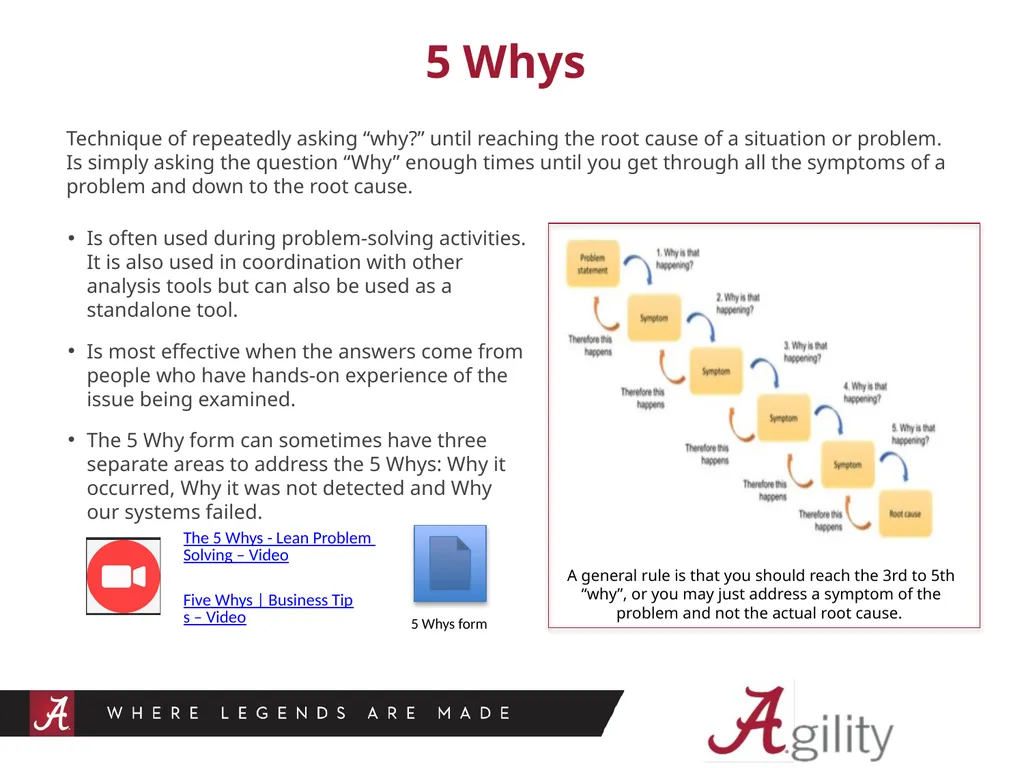
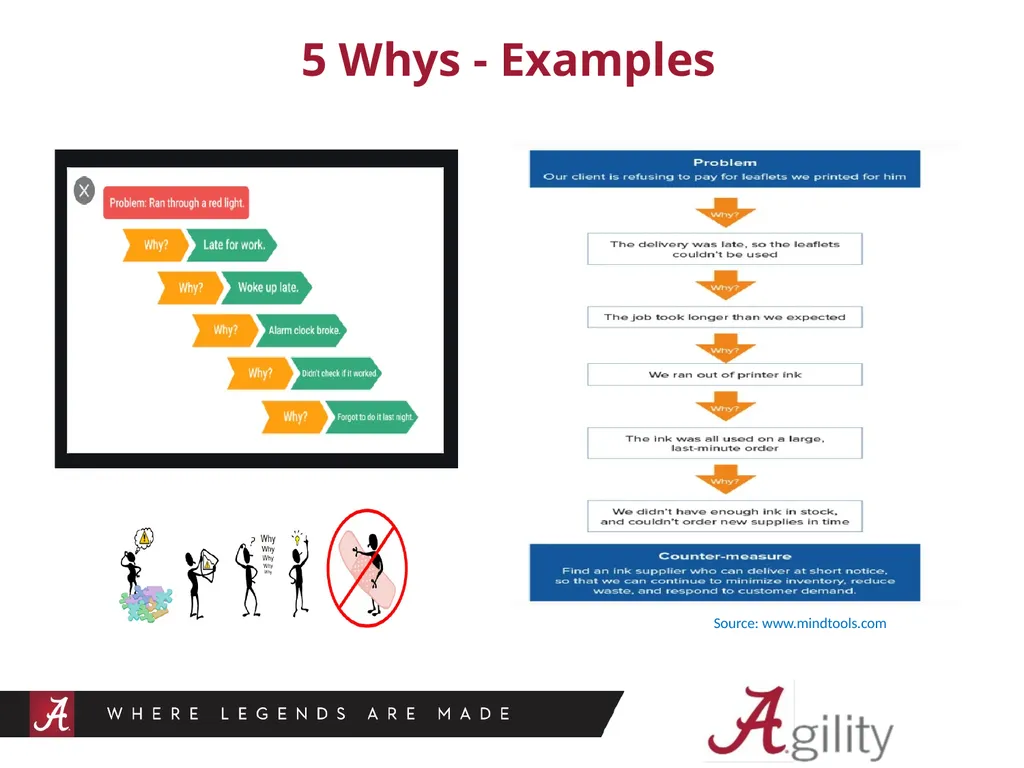
5 Whys 5 Technique of repeatedly asking “why?” until reaching the root cause of a situation or problem.
Is simply asking the question “Why” enough times until you get through all the symptoms of a problem and down to the root cause. Is often used during problem-solving activities. It is also used in coordination with other analysis tools but can also be used as a standalone tool.
Is most effective when the answers come from people who have hands-on experience of the issue being examined.
The 5 Why form can sometimes have three separate areas to address the 5 Whys: Why it occurred, Why it was not detected and Why our systems failed. A general rule is that you should reach the 3rd to 5th “why”, or you may just address a symptom of the problem and not the actual root cause. The 5 Whys - Lean Problem Solving – Video Five Whys | Business Tips – Video<br>
06
5 Whys - Examples 6<br>
07
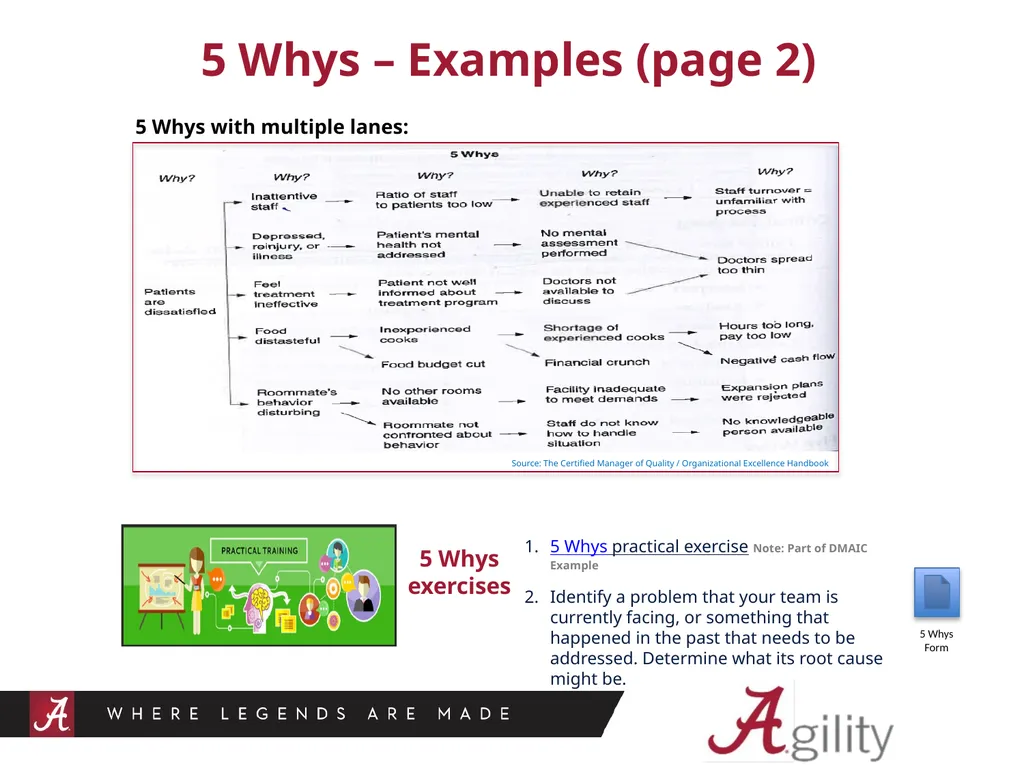
5 Whys – Examples (page 2) 7 5 Whys with multiple lanes: 5 Whys exercises 5 Whys practical exercise Note: Part of DMAIC Example
Identify a problem that your team is currently facing, or something that happened in the past that needs to be addressed. Determine what its root cause might be.<br>
08
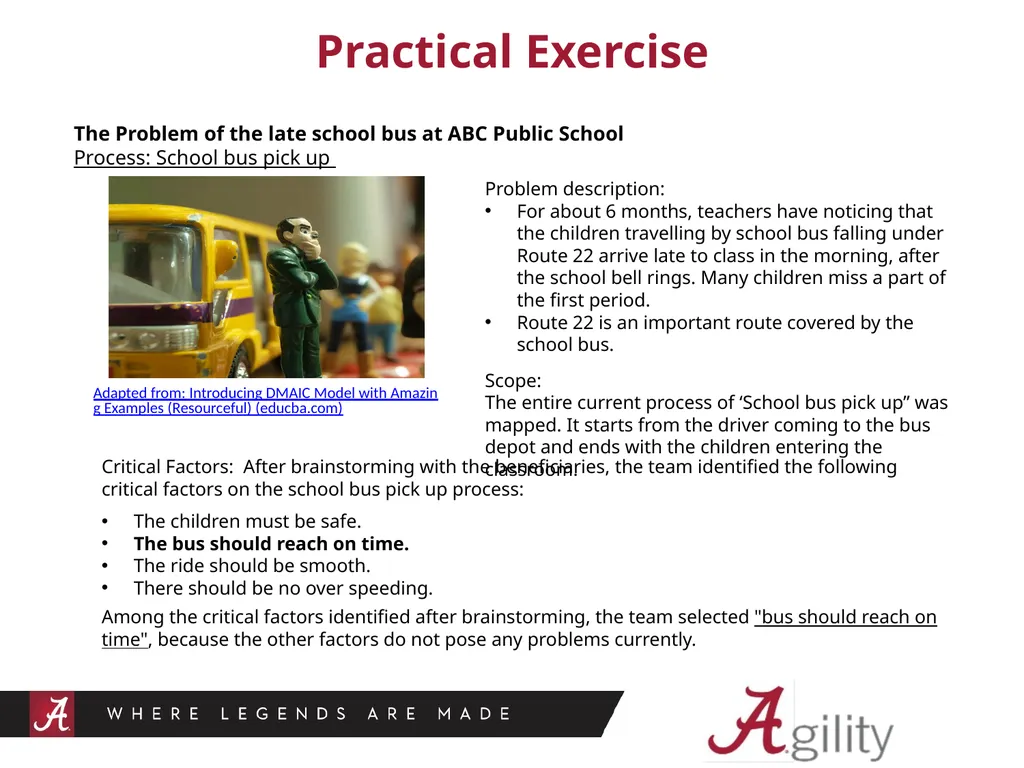
Practical Exercise 8 The Problem of the late school bus at ABC Public School
Process: School bus pick up Adapted from: Introducing DMAIC Model with Amazing Examples (Resourceful) (educba.com) Problem description:
For about 6 months, teachers have noticing that the children travelling by school bus falling under Route 22 arrive late to class in the morning, after the school bell rings. Many children miss a part of the first period.
Route 22 is an important route covered by the school bus.
Scope:
The entire current process of ‘School bus pick up” was mapped. It starts from the driver coming to the bus depot and ends with the children entering the classroom. Critical Factors: After brainstorming with the beneficiaries, the team identified the following critical factors on the school bus pick up process:
The children must be safe.
The bus should reach on time.
The ride should be smooth.
There should be no over speeding.
Among the critical factors identified after brainstorming, the team selected "bus should reach on time", because the other factors do not pose any problems currently.<br>
09
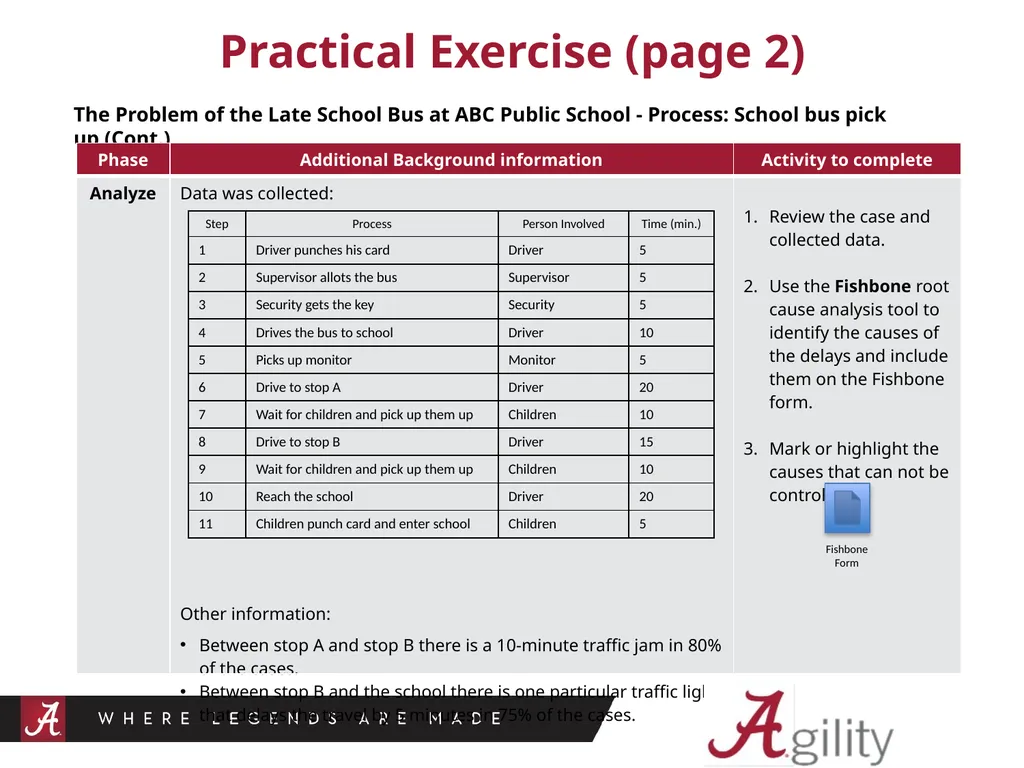
Practical Exercise (page 2) 9 The Problem of the Late School Bus at ABC Public School - Process: School bus pick up (Cont.)<br>
10
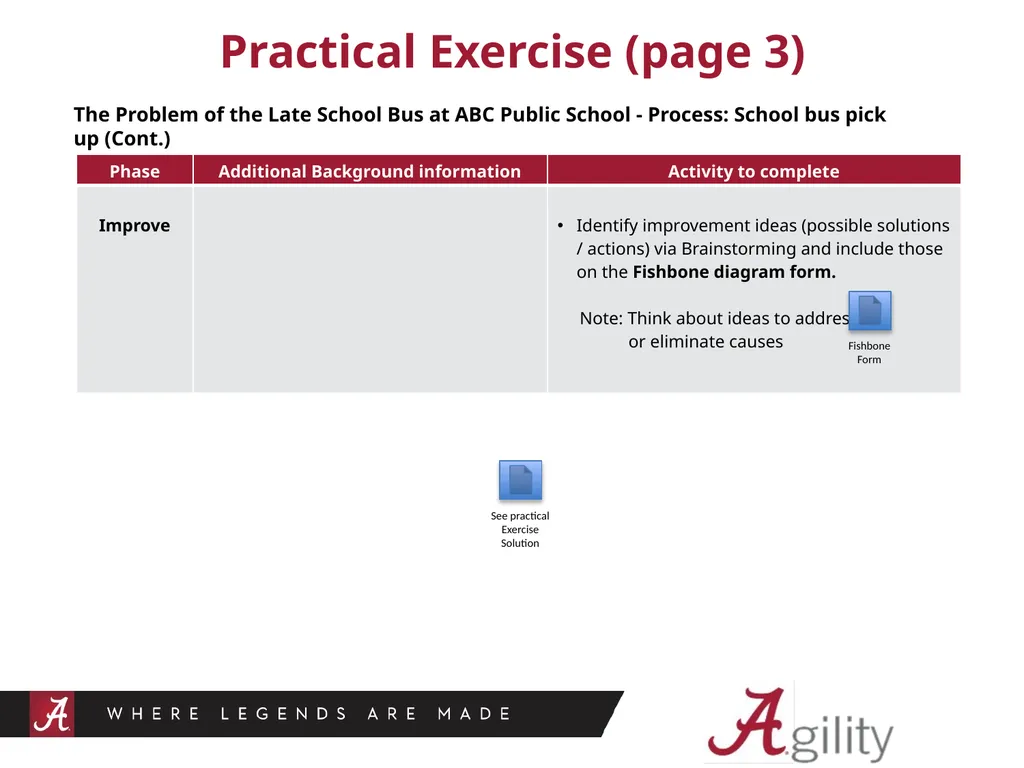
Practical Exercise (page 3) 10 The Problem of the Late School Bus at ABC Public School - Process: School bus pick up (Cont.)<br>
11
Sources 11 ASQ Quality Management Division. The Certified Manager of Quality / Organizational Excellence Handbook. Fourth Edition.
ASQ (American Society for Quality) - asq.org/quality-resources.
William K. Balzer. 2020. Lean Higher Education Increasing the Value and Performance of University Processes. Second Edition.
Lean Enterprise Institute - Lean.org
The University of Iowa (uiowa.edu) - hr.uiowa.edu/development/organizational-development/lean/waste-identification.
Q-1 Quality-One International - quality-one.com.<br>