Agriculture Forestry Part II Section I: Forest, Rangelands, and Wildlife Ecological security, livelihoods, and climate resilience assets Importance and significance of forests, rangelands, and wildlife Guardian Angel CSS Agriculture
"Agriculture & Forestry Part II Section I: Forest," is the property of its rightful owner. Permission is granted to
download and print the materials on this website for personal, non-commercial use only, and to display it
on your personal computer provided you do not modify the materials and that you retain all copyright
notices contained in the materials. By downloading content from our website, you accept the terms of this
agreement.
Presentation Transcript
01
Agriculture & Forestry Part II Section I: Forest, Rangelands, and Wildlife Ecological security, livelihoods, and climate resilience assets
Importance and significance of forests, rangelands, and wildlife Guardian Angel | CSS Agriculture & Forestry Lecture Series<br>
02
Section I Roadmap Significance and strategic value Conceptual understanding of forests, rangelands, and wildlife systems.
Ecological functions and ecosystem service values.
Economic and livelihood significance at local and national levels.
Social, cultural, and health dimensions of natural landscapes.
Major threats and governance implications in Pakistan context.
Exam method: classify value domains and propose management pathways. Guardian Angel | CSS Agriculture & Forestry Lecture Series<br>
03
1) Conceptual Foundation Forests are tree-dominated ecosystems supporting biodiversity, carbon storage, and hydrological regulation.
Rangelands are grass-shrub ecosystems sustaining livestock and rural pastoral livelihoods.
Wildlife includes wild flora and fauna that maintain ecosystem balance and resilience.
These systems are interlinked through nutrient cycles, habitat networks, and landscape processes.
Exam line: forestry resources are productive assets and ecological infrastructure simultaneously. Guardian Angel | CSS Agriculture & Forestry Lecture Series<br>
04
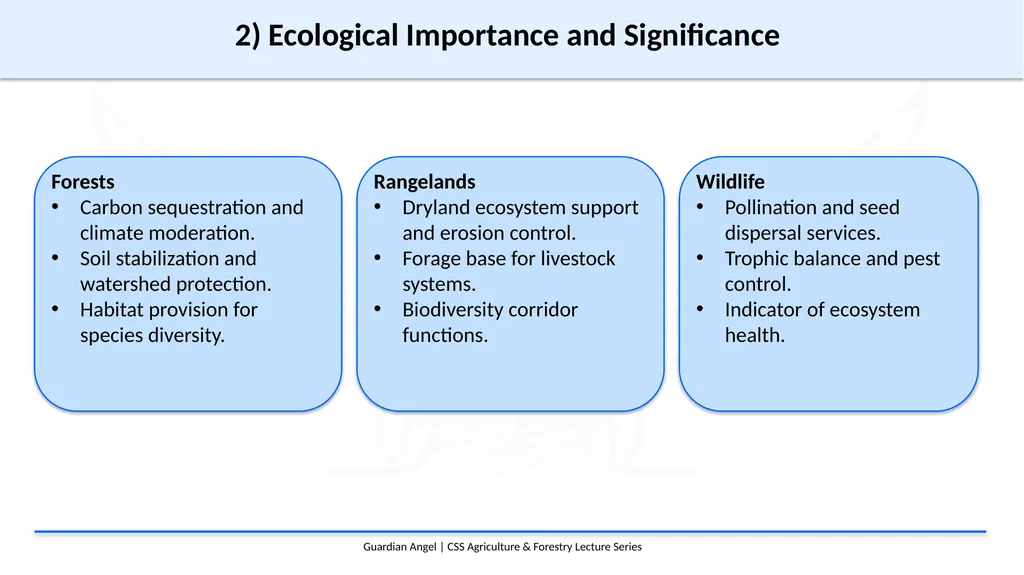
2) Ecological Importance and Significance Forests
Carbon sequestration and climate moderation.
Soil stabilization and watershed protection.
Habitat provision for species diversity. Rangelands
Dryland ecosystem support and erosion control.
Forage base for livestock systems.
Biodiversity corridor functions. Wildlife
Pollination and seed dispersal services.
Trophic balance and pest control.
Indicator of ecosystem health. Guardian Angel | CSS Agriculture & Forestry Lecture Series<br>
05
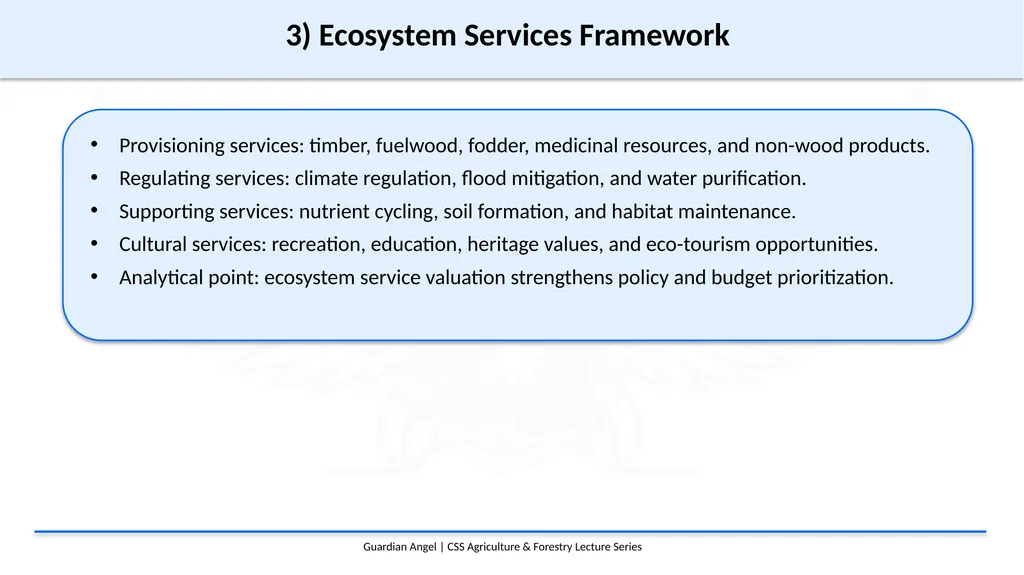
3) Ecosystem Services Framework Provisioning services: timber, fuelwood, fodder, medicinal resources, and non-wood products.
Regulating services: climate regulation, flood mitigation, and water purification.
Supporting services: nutrient cycling, soil formation, and habitat maintenance.
Cultural services: recreation, education, heritage values, and eco-tourism opportunities.
Analytical point: ecosystem service valuation strengthens policy and budget prioritization. Guardian Angel | CSS Agriculture & Forestry Lecture Series<br>
06
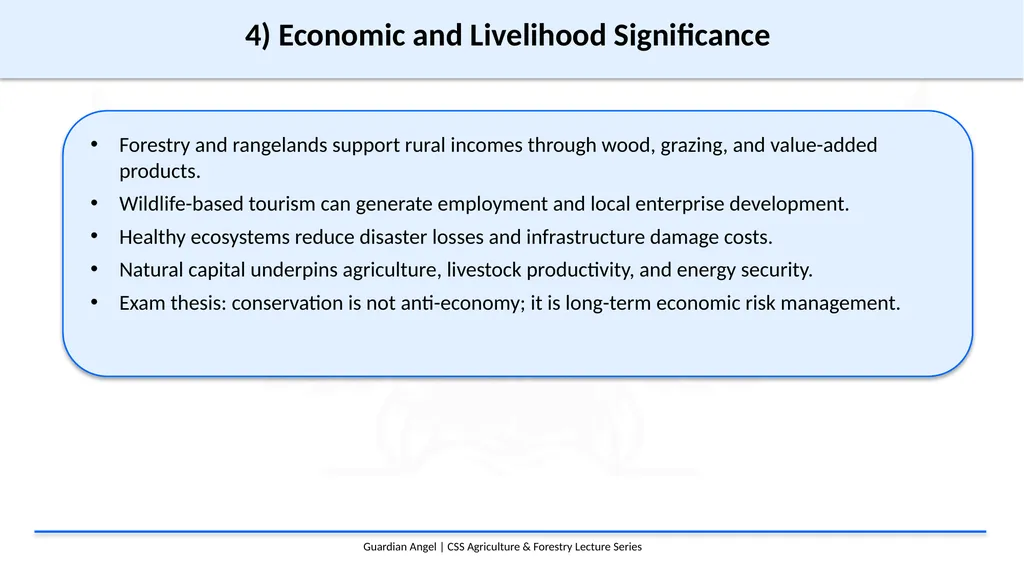
4) Economic and Livelihood Significance Forestry and rangelands support rural incomes through wood, grazing, and value-added products.
Wildlife-based tourism can generate employment and local enterprise development.
Healthy ecosystems reduce disaster losses and infrastructure damage costs.
Natural capital underpins agriculture, livestock productivity, and energy security.
Exam thesis: conservation is not anti-economy; it is long-term economic risk management. Guardian Angel | CSS Agriculture & Forestry Lecture Series<br>
07
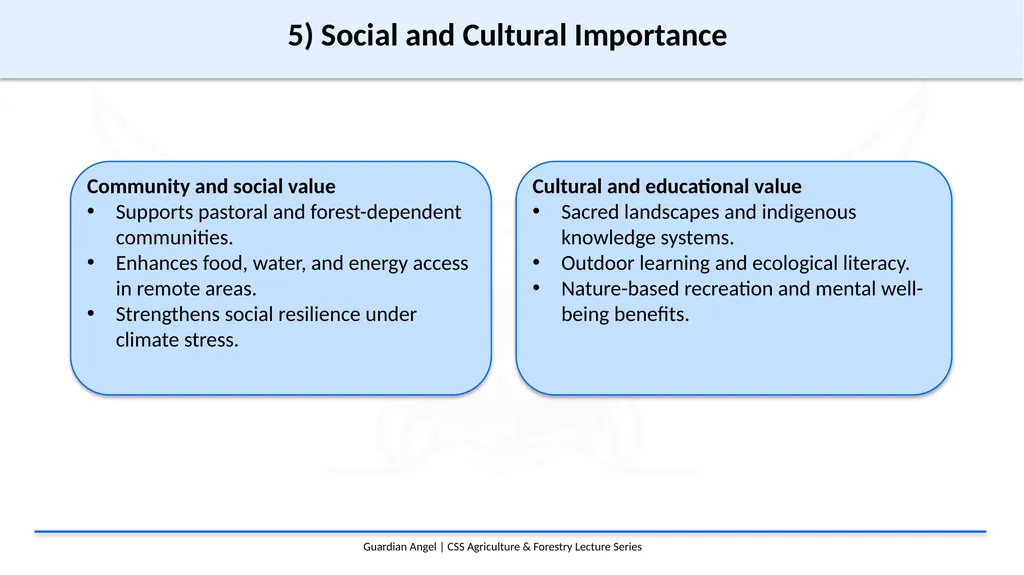
5) Social and Cultural Importance Community and social value
Supports pastoral and forest-dependent communities.
Enhances food, water, and energy access in remote areas.
Strengthens social resilience under climate stress. Cultural and educational value
Sacred landscapes and indigenous knowledge systems.
Outdoor learning and ecological literacy.
Nature-based recreation and mental well-being benefits. Guardian Angel | CSS Agriculture & Forestry Lecture Series<br>
08
6) Major Threats and Degradation Drivers Deforestation, overgrazing, habitat fragmentation, and illegal hunting reduce ecosystem integrity.
Climate change amplifies drought, fire risk, species stress, and ecological instability.
Land conversion and unplanned development disrupt habitat connectivity.
Weak enforcement and institutional fragmentation undermine conservation outcomes.
Exam line: degradation is governance and incentive failure, not only resource scarcity. Guardian Angel | CSS Agriculture & Forestry Lecture Series<br>
09
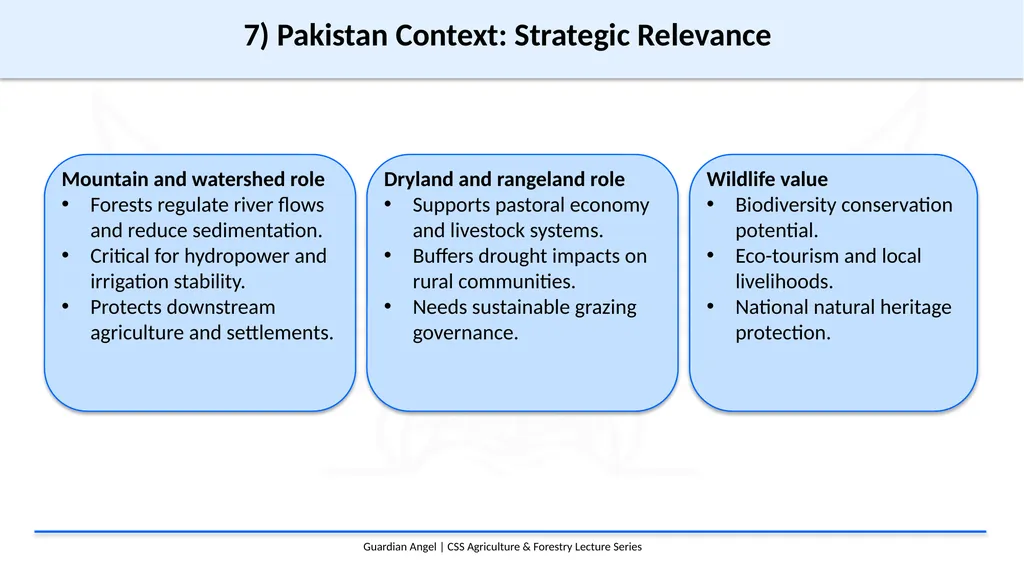
7) Pakistan Context: Strategic Relevance Mountain and watershed role
Forests regulate river flows and reduce sedimentation.
Critical for hydropower and irrigation stability.
Protects downstream agriculture and settlements. Dryland and rangeland role
Supports pastoral economy and livestock systems.
Buffers drought impacts on rural communities.
Needs sustainable grazing governance. Wildlife value
Biodiversity conservation potential.
Eco-tourism and local livelihoods.
National natural heritage protection. Guardian Angel | CSS Agriculture & Forestry Lecture Series<br>
10
8) Governance and Management Pathway Adopt landscape-level planning integrating forests, rangelands, agriculture, and settlements.
Strengthen community-based management with benefit-sharing and local stewardship rights.
Improve monitoring through GIS, remote sensing, and wildlife census systems.
Align conservation financing with livelihood incentives and eco-enterprise models.
Policy goal: balance utilization, regeneration, and biodiversity protection. Guardian Angel | CSS Agriculture & Forestry Lecture Series<br>
11
Section I Synthesis for CSS Answers Forests, rangelands, and wildlife are foundational to ecological and economic security.
Their significance spans provisioning, regulating, supporting, and cultural value domains.
Degradation imposes long-term costs on agriculture, water systems, and rural livelihoods.
Sustainable governance requires institutional coordination and community-centered management.
Answer flow: definitions -> ecological/economic/social value -> threats -> governance strategy. Guardian Angel | CSS Agriculture & Forestry Lecture Series<br>
12
How to Attempt Part II Section I Questions Begin with concise definitions and one-line thesis on strategic significance.
Organize body using value categories: ecological, economic, social, and climate.
Add Pakistan-specific examples for watershed, dryland, and biodiversity contexts.
Identify key degradation drivers and explain governance failures.
Conclude with practical management package: conservation, livelihoods, and monitoring. Guardian Angel | CSS Agriculture & Forestry Lecture Series<br>