
AHE Research Methods Workshop 17th January 2020 Dr


Description: AHE Research Methods Workshop 17th January 2020 Dr Sara Stevano Qualitative Methods for Economic Research Questions What types of economic questions can be addressed with qualitative methodsdata? How can qualitative methods be used for the
Related Topics
Download Presentation
"AHE Research Methods Workshop 17th January 2020 Dr" is the property of its rightful owner. Permission is granted to download and print the materials on this website for personal, non-commercial use only, and to display it on your personal computer provided you do not modify the materials and that you retain all copyright notices contained in the materials. By downloading content from our website, you accept the terms of this agreement.
Presentation Transcript
slide1. AHE Research Methods Workshop
17th January 2020
Dr Sara Stevano Qualitative Methods for Economic Research<br>
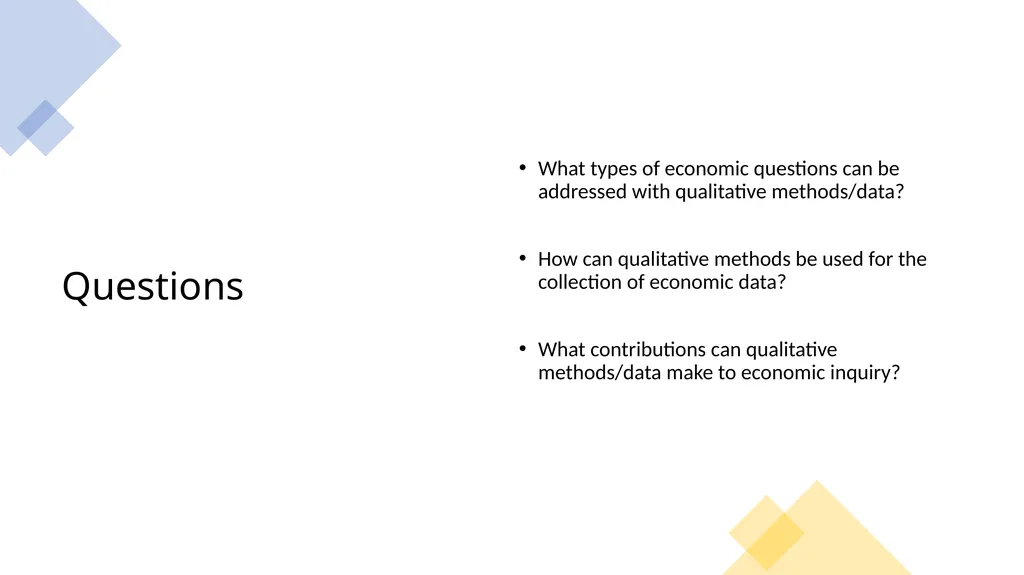
slide2. Questions What types of economic questions can be addressed with qualitative methods/data?
How can qualitative methods be used for the collection of economic data?
What contributions can qualitative methods/data make to economic inquiry?<br>
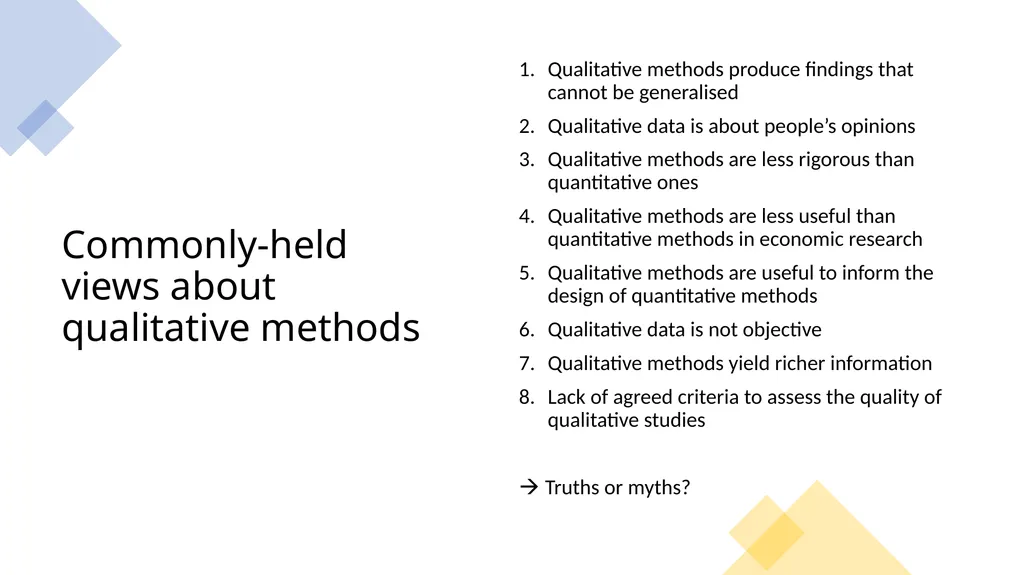
slide3. Commonly-held views about qualitative methods Qualitative methods produce findings that cannot be generalised
Qualitative data is about people’s opinions
Qualitative methods are less rigorous than quantitative ones
Qualitative methods are less useful than quantitative methods in economic research
Qualitative methods are useful to inform the design of quantitative methods
Qualitative data is not objective
Qualitative methods yield richer information
Lack of agreed criteria to assess the quality of qualitative studies
Truths or myths?<br>
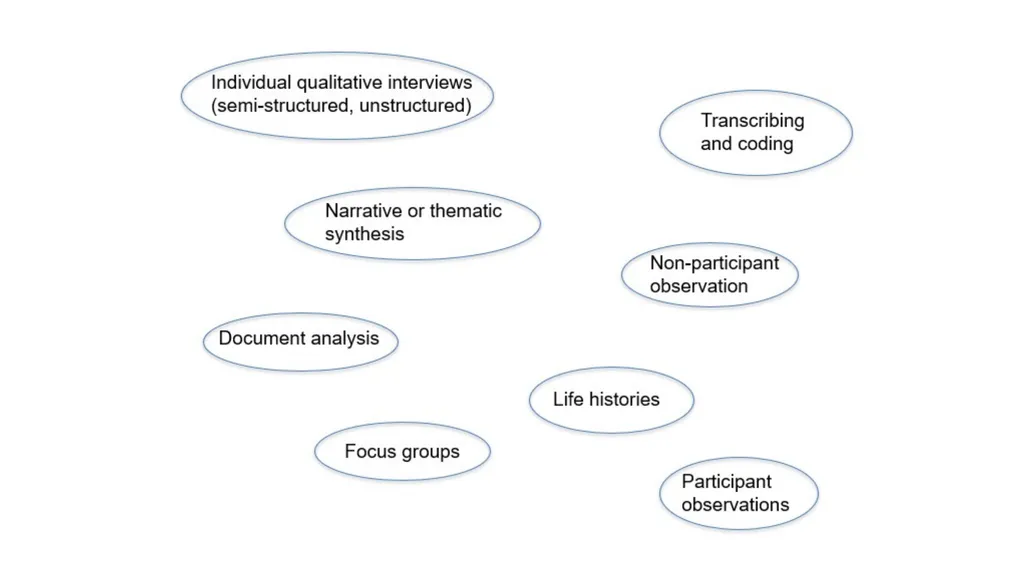
slide4. What is a qualitative method? What examples can you think of?<br>
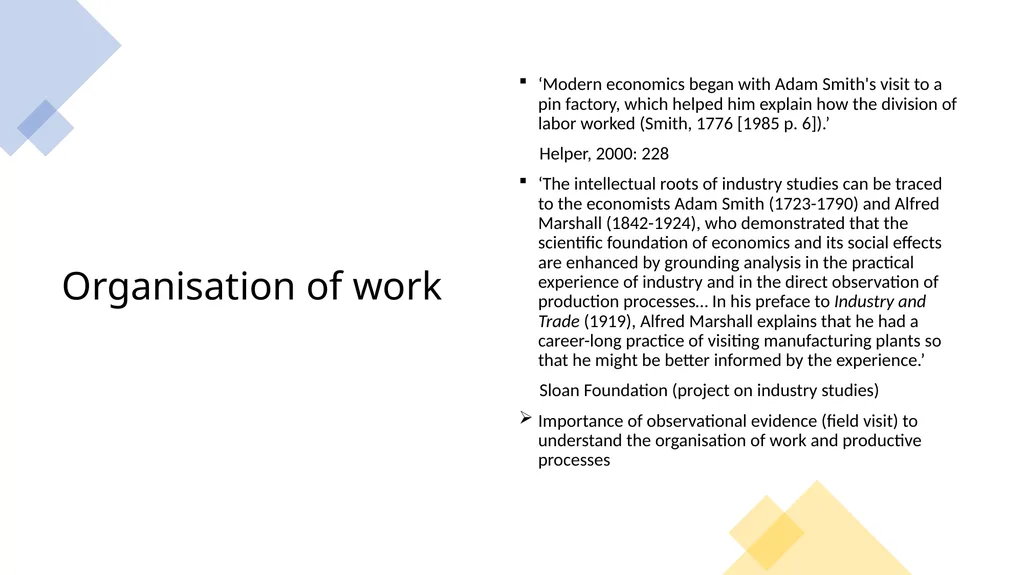
slide7. Organisation of work ‘Modern economics began with Adam Smith's visit to a pin factory, which helped him explain how the division of labor worked (Smith, 1776 [1985 p. 6]).’
Helper, 2000: 228
‘The intellectual roots of industry studies can be traced to the economists Adam Smith (1723-1790) and Alfred Marshall (1842-1924), who demonstrated that the scientific foundation of economics and its social effects are enhanced by grounding analysis in the practical experience of industry and in the direct observation of production processes… In his preface to Industry and Trade (1919), Alfred Marshall explains that he had a career-long practice of visiting manufacturing plants so that he might be better informed by the experience.’
Sloan Foundation (project on industry studies)
Importance of observational evidence (field visit) to understand the organisation of work and productive processes<br>
slide8. Economic decisions Blinder, A. (1994) ‘On Sticky Prices: Academic Theories Meet the Real World’, in N. G. Mankiw, ed. Monetary Policy, Chicago: University of Chicago Press.
Market-clearing hypothesis works in the long run, not in the short run – prices adjust with a certain delay (‘sticky prices’ hypothesis)
Why do firms not adjust prices more quickly to respond to changing economic conditions?
Interviews with business people responsible for setting prices in their firms (structured interviews with open-ended questions)
Two key findings:
Sticky prices are common
Firms typically review prices only once or twice a year – none of 12 theories of price stickiness emerged as the overwhelming explanation for not adjusting prices more often
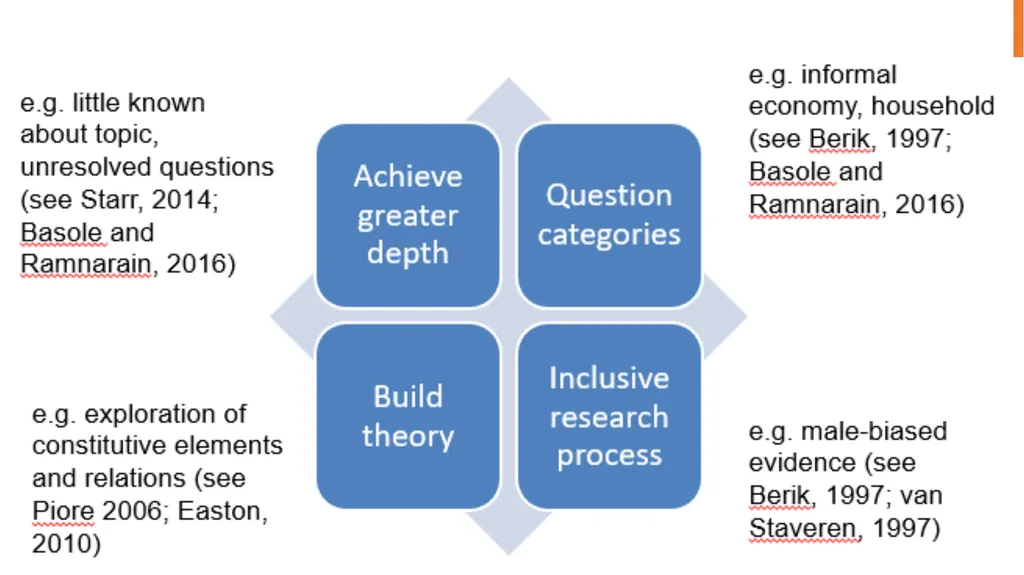
Value of asking economic actors why they make the decisions they make; could achieve greater depth by exploring the contexts in which decisions are<br>
slide9. What questions? ‘Whoever studies Marx can never forget the grandiosity of the questions that are being asked. For such a student then using supply and demand curves to determine the cost of pizza in his town will indeed be acceptable, but surely will never be seen as the prime or the most important role of economics as a social science.’
Milanovic, 2018 blogpost
Expansion of themes investigated in economics, but what about type of questions?
Theoretical and methodological issue – research questions rather than methods should drive the research, methods can be applied differently (Berik, 1997)
Essential to think about methods in relation to research questions (handout 1)<br>
slide10. Exercise 1: Linking Research Questions to Research Methods<br>
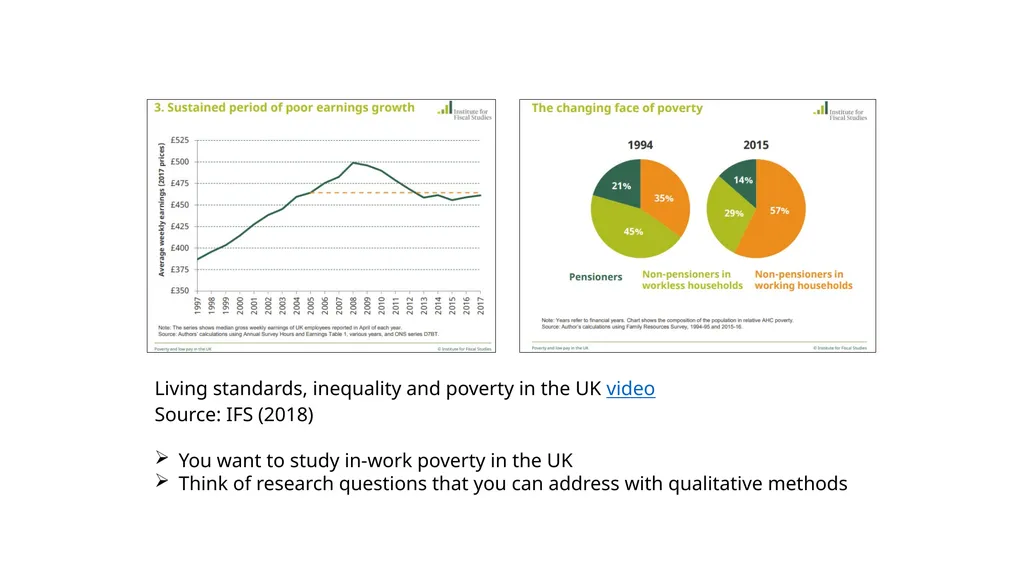
slide11. Living standards, inequality and poverty in the UK video
Source: IFS (2018)
You want to study in-work poverty in the UK
Think of research questions that you can address with qualitative methods<br>
slide13. Exercise 2: What can qualitative methods uncover about economic policy making?<br>
slide14. 1) You want to investigate why a specific organization/institution chooses to implement specific types of fiscal/monetary/trade policy
2) Select a policy-making institution (Bank of England, Financial Conduct Authority, World Bank, IMF)
3) How would you use qualitative methods to do explore the reasons underpinning the choice of a policy approach?
4) How would you go about implementing your qualitative method(s)?<br>
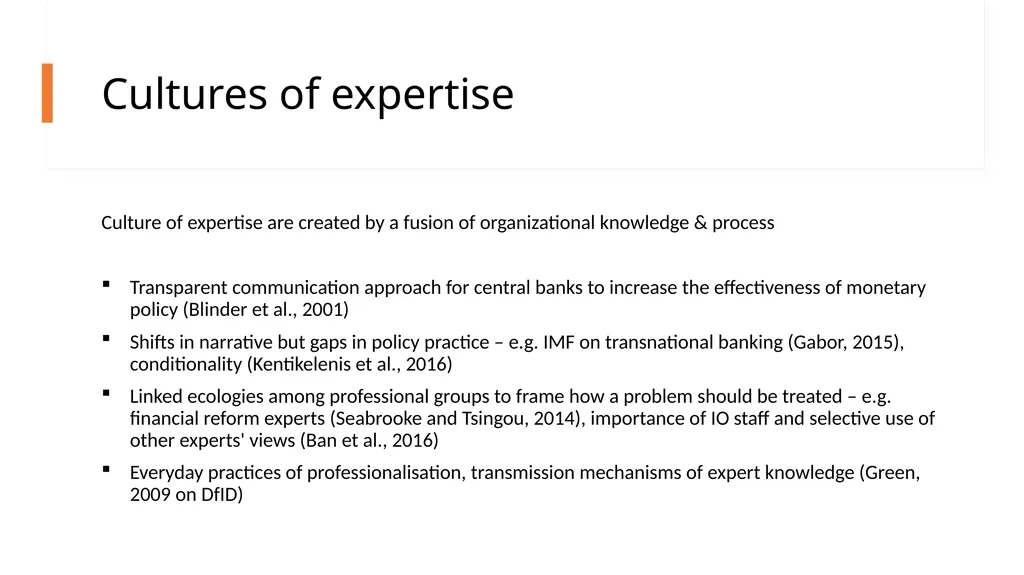
slide15. Cultures of expertise Culture of expertise are created by a fusion of organizational knowledge & process
Transparent communication approach for central banks to increase the effectiveness of monetary policy (Blinder et al., 2001)
Shifts in narrative but gaps in policy practice – e.g. IMF on transnational banking (Gabor, 2015), conditionality (Kentikelenis et al., 2016)
Linked ecologies among professional groups to frame how a problem should be treated – e.g. financial reform experts (Seabrooke and Tsingou, 2014), importance of IO staff and selective use of other experts' views (Ban et al., 2016)
Everyday practices of professionalisation, transmission mechanisms of expert knowledge (Green, 2009 on DfID)<br>
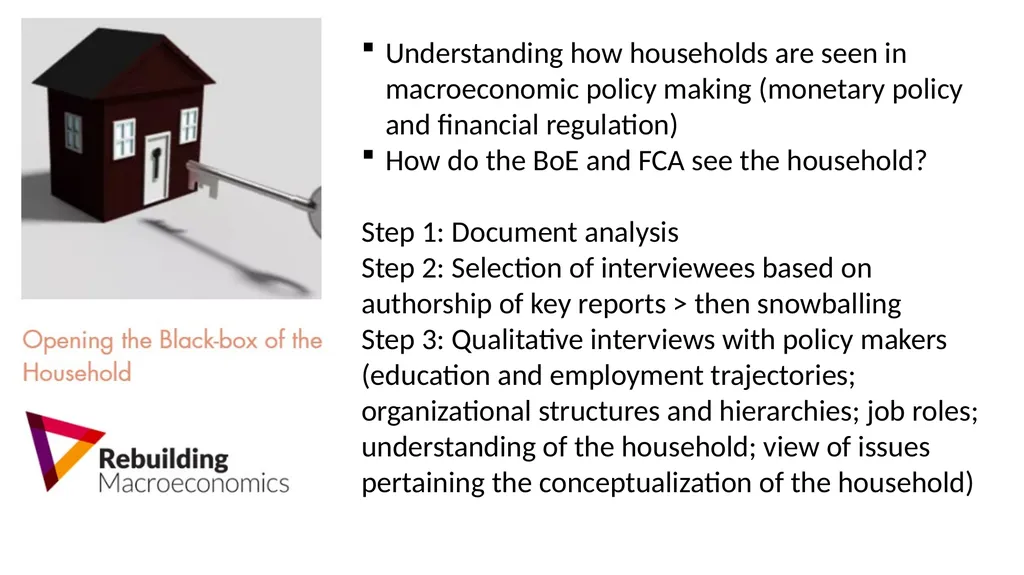
slide16. Understanding how households are seen in macroeconomic policy making (monetary policy and financial regulation)
How do the BoE and FCA see the household?
Step 1: Document analysis
Step 2: Selection of interviewees based on authorship of key reports > then snowballing
Step 3: Qualitative interviews with policy makers (education and employment trajectories; organizational structures and hierarchies; job roles; understanding of the household; view of issues pertaining the conceptualization of the household)<br>
slide17. Exercise 3: Power relations in primary data collection<br>
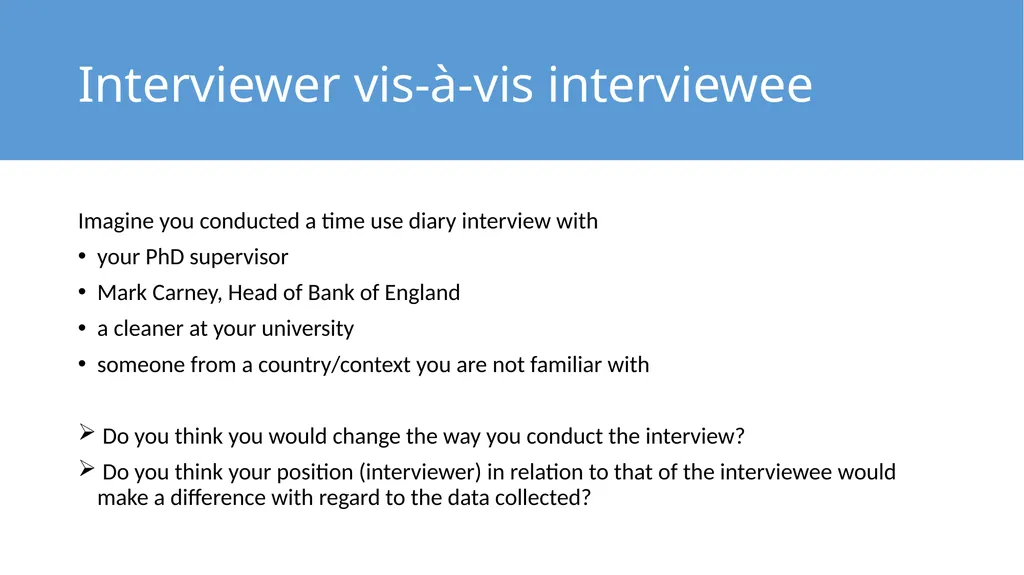
slide18. Interviewer vis-à-vis interviewee Imagine you conducted a time use diary interview with
your PhD supervisor
Mark Carney, Head of Bank of England
a cleaner at your university
someone from a country/context you are not familiar with
Do you think you would change the way you conduct the interview?
Do you think your position (interviewer) in relation to that of the interviewee would make a difference with regard to the data collected?<br>
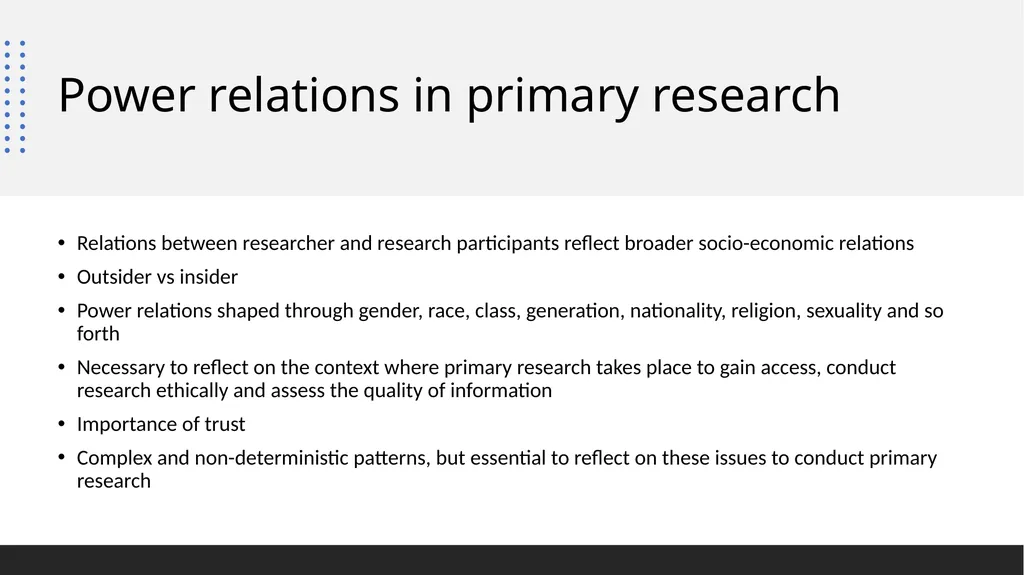
slide19. Power relations in primary research Relations between researcher and research participants reflect broader socio-economic relations
Outsider vs insider
Power relations shaped through gender, race, class, generation, nationality, religion, sexuality and so forth
Necessary to reflect on the context where primary research takes place to gain access, conduct research ethically and assess the quality of information
Importance of trust
Complex and non-deterministic patterns, but essential to reflect on these issues to conduct primary research<br>
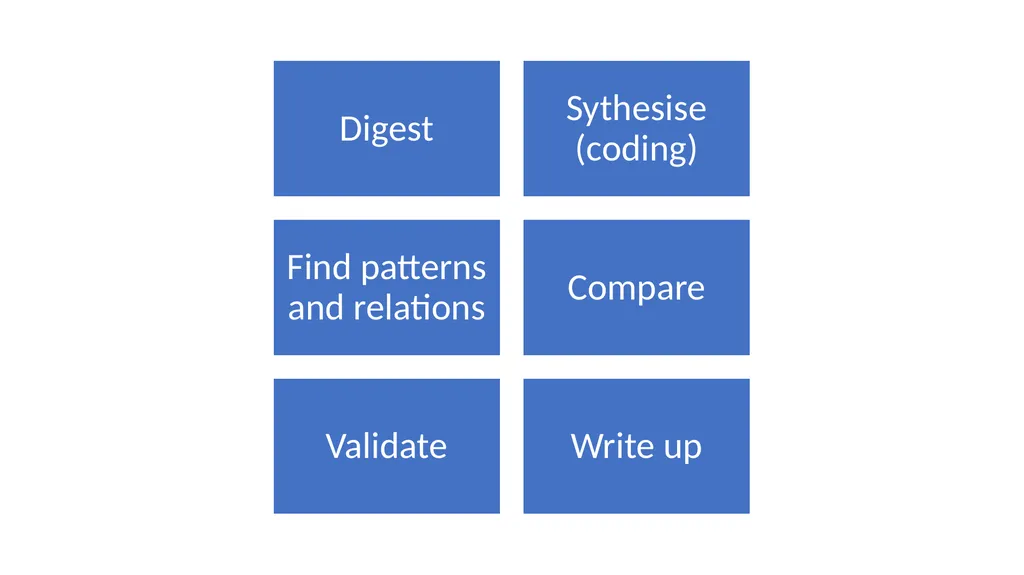
slide20. Qualitative analysis<br>
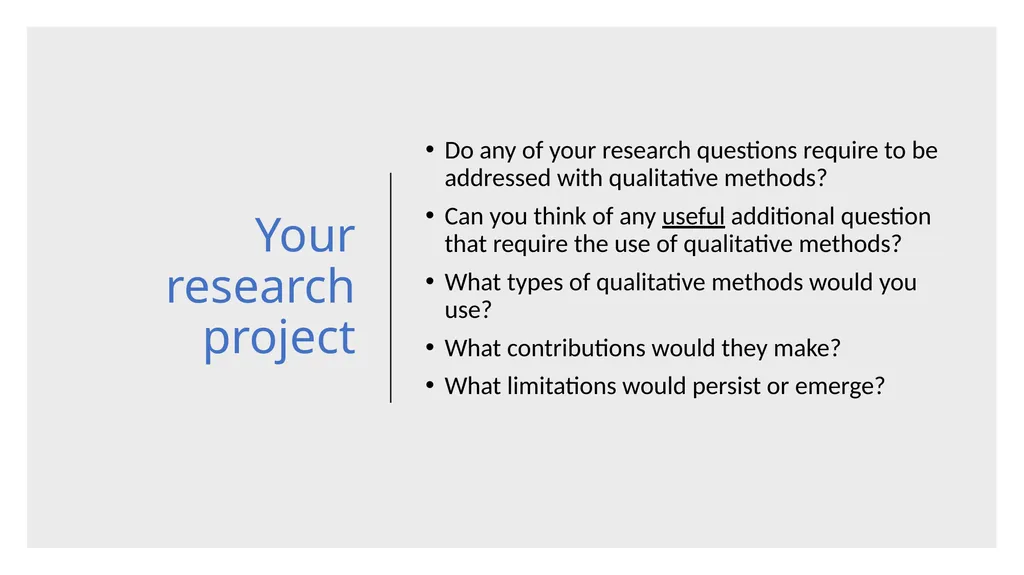
slide22. Your research project Do any of your research questions require to be addressed with qualitative methods?
Can you think of any useful additional question that require the use of qualitative methods?
What types of qualitative methods would you use?
What contributions would they make?
What limitations would persist or emerge?<br>
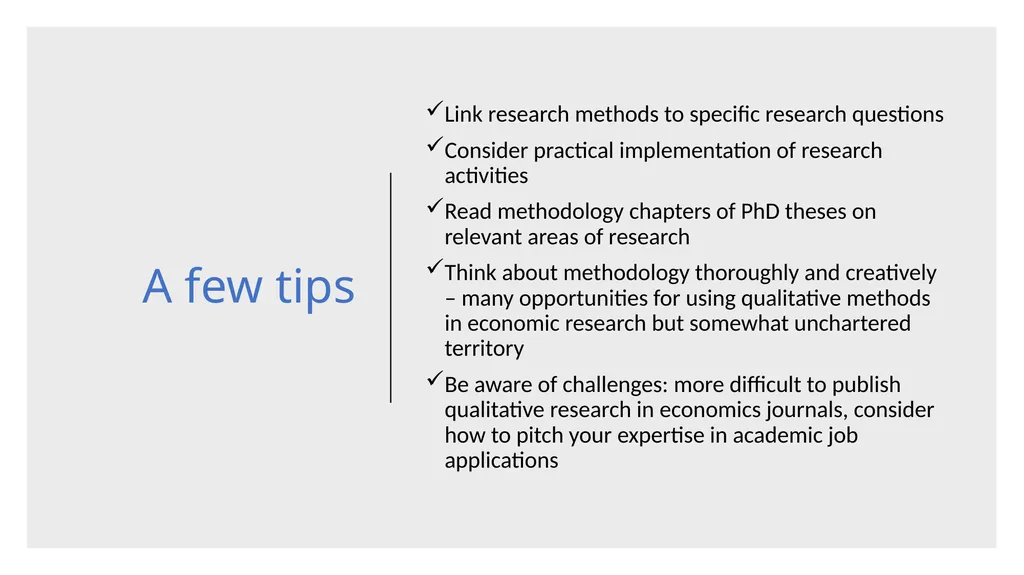
slide23. A few tips Link research methods to specific research questions
Consider practical implementation of research activities
Read methodology chapters of PhD theses on relevant areas of research
Think about methodology thoroughly and creatively – many opportunities for using qualitative methods in economic research but somewhat unchartered territory
Be aware of challenges: more difficult to publish qualitative research in economics journals, consider how to pitch your expertise in academic job applications<br>
slide24. Thank you and best of luck with your research projects!
References available on handout
Email: ss129@soas.ac.uk<br>
17th January 2020
Dr Sara Stevano Qualitative Methods for Economic Research<br>
slide2. Questions What types of economic questions can be addressed with qualitative methods/data?
How can qualitative methods be used for the collection of economic data?
What contributions can qualitative methods/data make to economic inquiry?<br>
slide3. Commonly-held views about qualitative methods Qualitative methods produce findings that cannot be generalised
Qualitative data is about people’s opinions
Qualitative methods are less rigorous than quantitative ones
Qualitative methods are less useful than quantitative methods in economic research
Qualitative methods are useful to inform the design of quantitative methods
Qualitative data is not objective
Qualitative methods yield richer information
Lack of agreed criteria to assess the quality of qualitative studies
Truths or myths?<br>
slide4. What is a qualitative method? What examples can you think of?<br>
slide7. Organisation of work ‘Modern economics began with Adam Smith's visit to a pin factory, which helped him explain how the division of labor worked (Smith, 1776 [1985 p. 6]).’
Helper, 2000: 228
‘The intellectual roots of industry studies can be traced to the economists Adam Smith (1723-1790) and Alfred Marshall (1842-1924), who demonstrated that the scientific foundation of economics and its social effects are enhanced by grounding analysis in the practical experience of industry and in the direct observation of production processes… In his preface to Industry and Trade (1919), Alfred Marshall explains that he had a career-long practice of visiting manufacturing plants so that he might be better informed by the experience.’
Sloan Foundation (project on industry studies)
Importance of observational evidence (field visit) to understand the organisation of work and productive processes<br>
slide8. Economic decisions Blinder, A. (1994) ‘On Sticky Prices: Academic Theories Meet the Real World’, in N. G. Mankiw, ed. Monetary Policy, Chicago: University of Chicago Press.
Market-clearing hypothesis works in the long run, not in the short run – prices adjust with a certain delay (‘sticky prices’ hypothesis)
Why do firms not adjust prices more quickly to respond to changing economic conditions?
Interviews with business people responsible for setting prices in their firms (structured interviews with open-ended questions)
Two key findings:
Sticky prices are common
Firms typically review prices only once or twice a year – none of 12 theories of price stickiness emerged as the overwhelming explanation for not adjusting prices more often
Value of asking economic actors why they make the decisions they make; could achieve greater depth by exploring the contexts in which decisions are<br>
slide9. What questions? ‘Whoever studies Marx can never forget the grandiosity of the questions that are being asked. For such a student then using supply and demand curves to determine the cost of pizza in his town will indeed be acceptable, but surely will never be seen as the prime or the most important role of economics as a social science.’
Milanovic, 2018 blogpost
Expansion of themes investigated in economics, but what about type of questions?
Theoretical and methodological issue – research questions rather than methods should drive the research, methods can be applied differently (Berik, 1997)
Essential to think about methods in relation to research questions (handout 1)<br>
slide10. Exercise 1: Linking Research Questions to Research Methods<br>
slide11. Living standards, inequality and poverty in the UK video
Source: IFS (2018)
You want to study in-work poverty in the UK
Think of research questions that you can address with qualitative methods<br>
slide13. Exercise 2: What can qualitative methods uncover about economic policy making?<br>
slide14. 1) You want to investigate why a specific organization/institution chooses to implement specific types of fiscal/monetary/trade policy
2) Select a policy-making institution (Bank of England, Financial Conduct Authority, World Bank, IMF)
3) How would you use qualitative methods to do explore the reasons underpinning the choice of a policy approach?
4) How would you go about implementing your qualitative method(s)?<br>
slide15. Cultures of expertise Culture of expertise are created by a fusion of organizational knowledge & process
Transparent communication approach for central banks to increase the effectiveness of monetary policy (Blinder et al., 2001)
Shifts in narrative but gaps in policy practice – e.g. IMF on transnational banking (Gabor, 2015), conditionality (Kentikelenis et al., 2016)
Linked ecologies among professional groups to frame how a problem should be treated – e.g. financial reform experts (Seabrooke and Tsingou, 2014), importance of IO staff and selective use of other experts' views (Ban et al., 2016)
Everyday practices of professionalisation, transmission mechanisms of expert knowledge (Green, 2009 on DfID)<br>
slide16. Understanding how households are seen in macroeconomic policy making (monetary policy and financial regulation)
How do the BoE and FCA see the household?
Step 1: Document analysis
Step 2: Selection of interviewees based on authorship of key reports > then snowballing
Step 3: Qualitative interviews with policy makers (education and employment trajectories; organizational structures and hierarchies; job roles; understanding of the household; view of issues pertaining the conceptualization of the household)<br>
slide17. Exercise 3: Power relations in primary data collection<br>
slide18. Interviewer vis-à-vis interviewee Imagine you conducted a time use diary interview with
your PhD supervisor
Mark Carney, Head of Bank of England
a cleaner at your university
someone from a country/context you are not familiar with
Do you think you would change the way you conduct the interview?
Do you think your position (interviewer) in relation to that of the interviewee would make a difference with regard to the data collected?<br>
slide19. Power relations in primary research Relations between researcher and research participants reflect broader socio-economic relations
Outsider vs insider
Power relations shaped through gender, race, class, generation, nationality, religion, sexuality and so forth
Necessary to reflect on the context where primary research takes place to gain access, conduct research ethically and assess the quality of information
Importance of trust
Complex and non-deterministic patterns, but essential to reflect on these issues to conduct primary research<br>
slide20. Qualitative analysis<br>
slide22. Your research project Do any of your research questions require to be addressed with qualitative methods?
Can you think of any useful additional question that require the use of qualitative methods?
What types of qualitative methods would you use?
What contributions would they make?
What limitations would persist or emerge?<br>
slide23. A few tips Link research methods to specific research questions
Consider practical implementation of research activities
Read methodology chapters of PhD theses on relevant areas of research
Think about methodology thoroughly and creatively – many opportunities for using qualitative methods in economic research but somewhat unchartered territory
Be aware of challenges: more difficult to publish qualitative research in economics journals, consider how to pitch your expertise in academic job applications<br>
slide24. Thank you and best of luck with your research projects!
References available on handout
Email: ss129@soas.ac.uk<br>