Aim: How to write chemical equations? DO NOW: Answer the following questions based on the diagram. 1) How many atoms of hydrogen and oxygen are in 1 molecule of water, H2O? 2) How many atoms of hydrogen and oxygen are in 1 molecule of H2O2,
"Aim: How to write chemical equations? DO NOW:" is the property of its rightful owner. Permission is granted to
download and print the materials on this website for personal, non-commercial use only, and to display it
on your personal computer provided you do not modify the materials and that you retain all copyright
notices contained in the materials. By downloading content from our website, you accept the terms of this
agreement.
Presentation Transcript
01
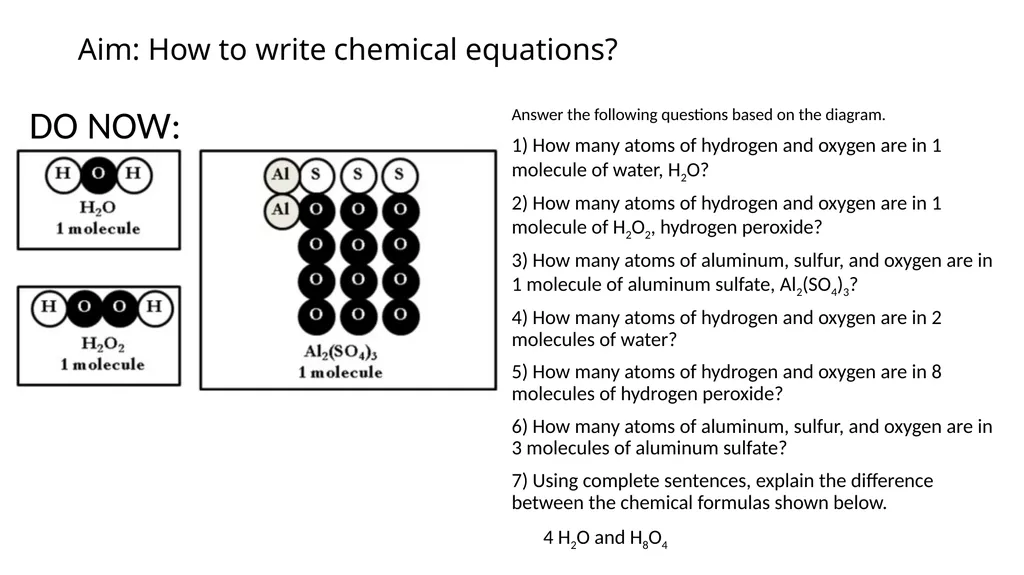
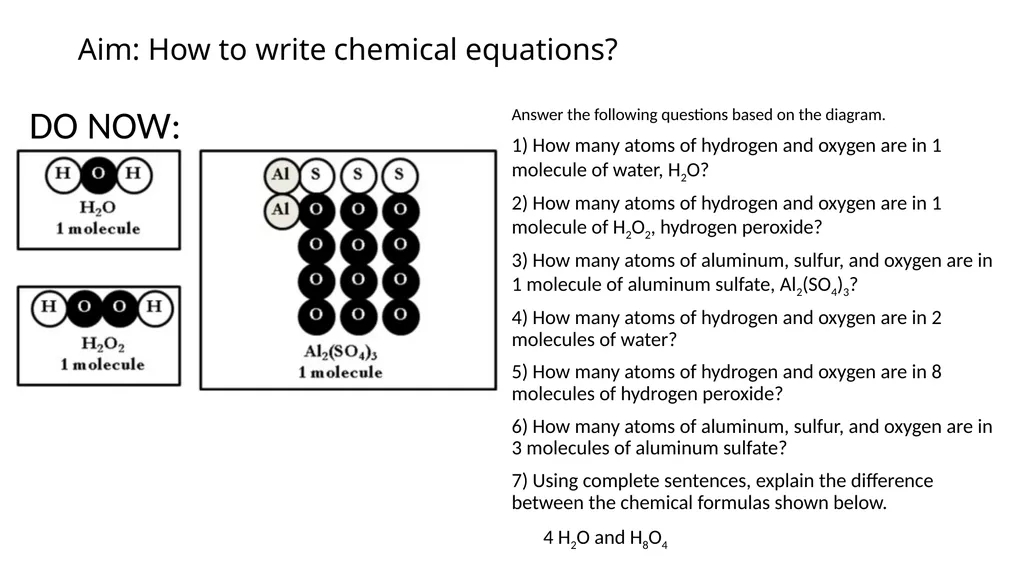
Aim: How to write chemical equations? DO NOW: Answer the following questions based on the diagram.
1) How many atoms of hydrogen and oxygen are in 1 molecule of water, H2O?
2) How many atoms of hydrogen and oxygen are in 1 molecule of H2O2, hydrogen peroxide?
3) How many atoms of aluminum, sulfur, and oxygen are in 1 molecule of aluminum sulfate, Al2(SO4)3?
4) How many atoms of hydrogen and oxygen are in 2 molecules of water?
5) How many atoms of hydrogen and oxygen are in 8 molecules of hydrogen peroxide?
6) How many atoms of aluminum, sulfur, and oxygen are in 3 molecules of aluminum sulfate?
7) Using complete sentences, explain the difference between the chemical formulas shown below.
4 H2O and H8O4<br>
02
What is a Chemical Reaction? A reaction in which the substance goes through a chemical change.
Evidence of a chemical reaction:
Release of heat or light
Color change
Production of gas
Formation of a precipitate (solid)<br>
03
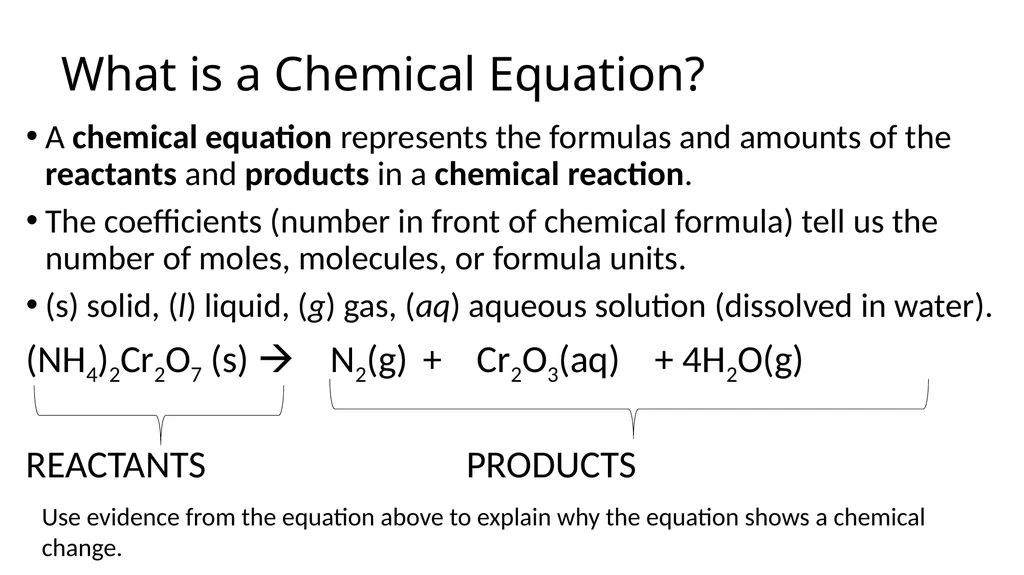
What is a Chemical Equation? A chemical equation represents the formulas and amounts of the reactants and products in a chemical reaction.
The coefficients (number in front of chemical formula) tell us the number of moles, molecules, or formula units.
(s) solid, (l) liquid, (g) gas, (aq) aqueous solution (dissolved in water).
(NH4)2Cr2O7 (s) N2(g) + Cr2O3(aq) + 4H2O(g)
REACTANTS PRODUCTS Use evidence from the equation above to explain why the equation shows a chemical change.<br>
04
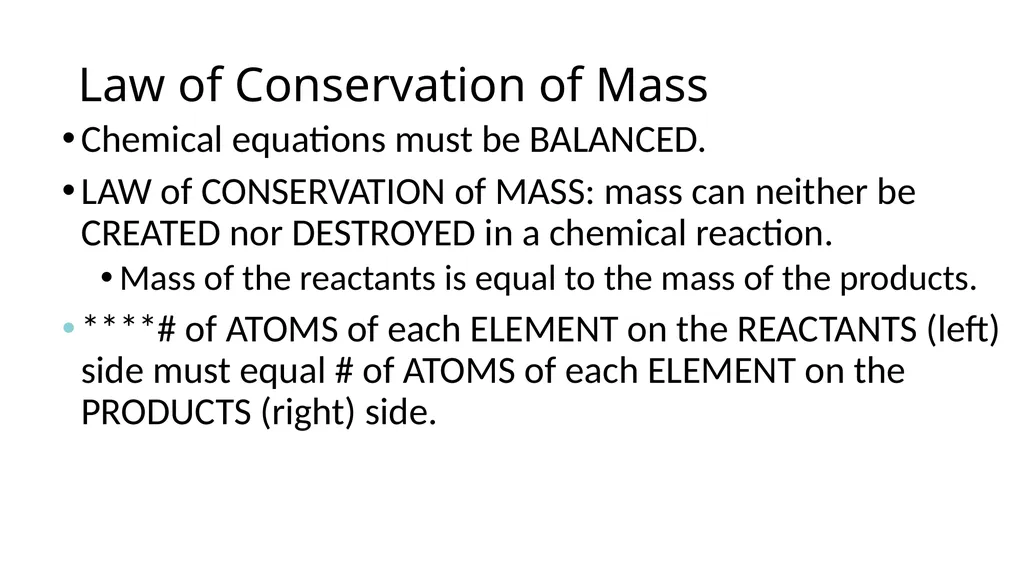
Law of Conservation of Mass Chemical equations must be BALANCED.
LAW of CONSERVATION of MASS: mass can neither be CREATED nor DESTROYED in a chemical reaction.
Mass of the reactants is equal to the mass of the products.
****# of ATOMS of each ELEMENT on the REACTANTS (left) side must equal # of ATOMS of each ELEMENT on the PRODUCTS (right) side.<br>
05
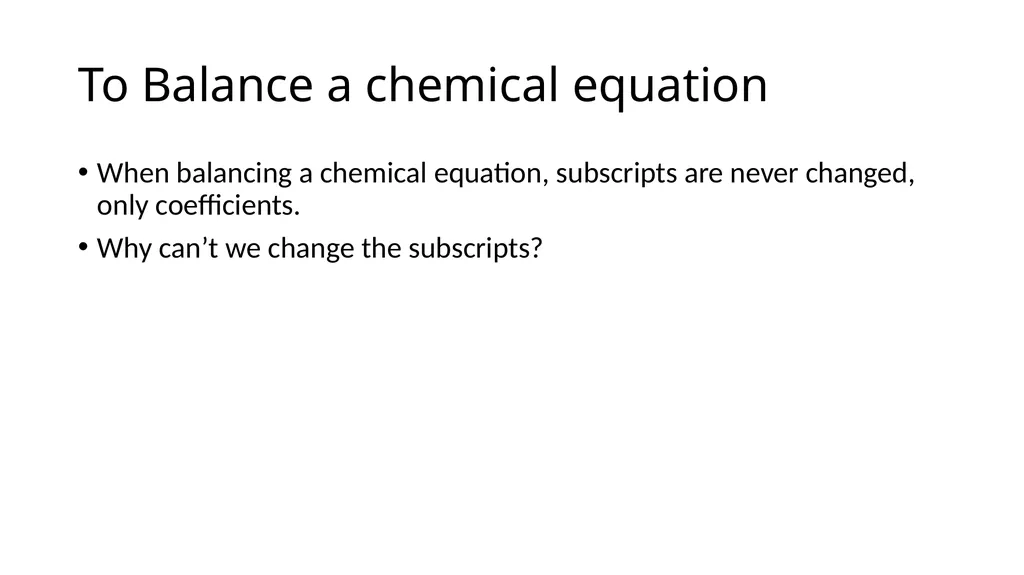
To Balance a chemical equation When balancing a chemical equation, subscripts are never changed, only coefficients.
Why can’t we change the subscripts?<br>
06
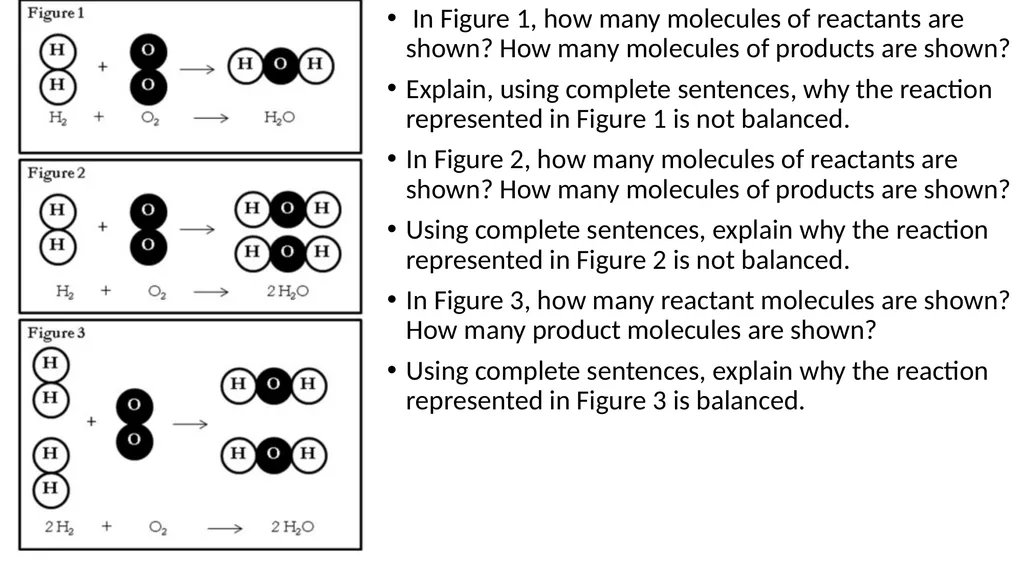
In Figure 1, how many molecules of reactants are shown? How many molecules of products are shown?
Explain, using complete sentences, why the reaction represented in Figure 1 is not balanced.
In Figure 2, how many molecules of reactants are shown? How many molecules of products are shown?
Using complete sentences, explain why the reaction represented in Figure 2 is not balanced.
In Figure 3, how many reactant molecules are shown? How many product molecules are shown?
Using complete sentences, explain why the reaction represented in Figure 3 is balanced.<br>
07
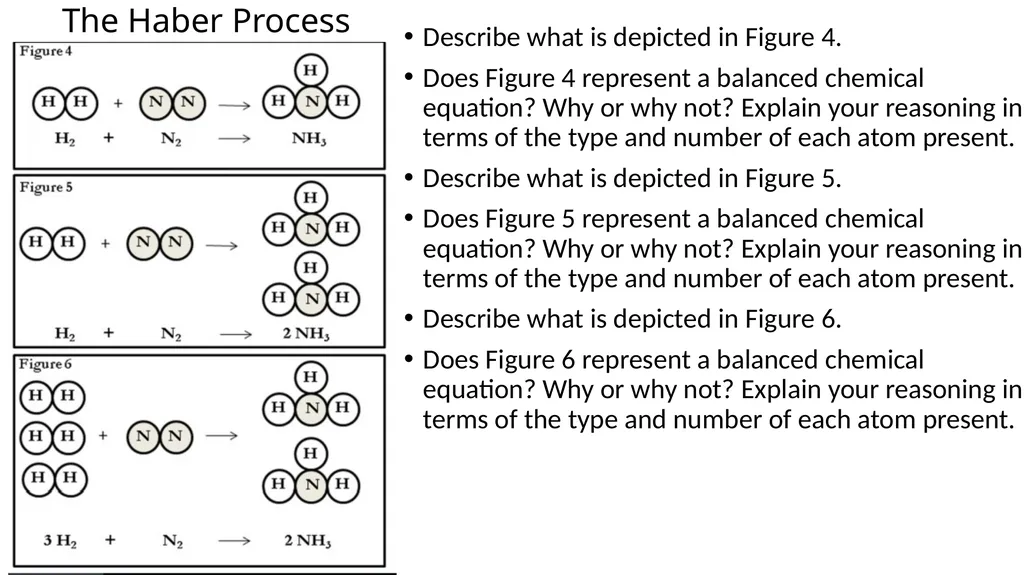
The Haber Process Describe what is depicted in Figure 4.
Does Figure 4 represent a balanced chemical equation? Why or why not? Explain your reasoning in terms of the type and number of each atom present.
Describe what is depicted in Figure 5.
Does Figure 5 represent a balanced chemical equation? Why or why not? Explain your reasoning in terms of the type and number of each atom present.
Describe what is depicted in Figure 6.
Does Figure 6 represent a balanced chemical equation? Why or why not? Explain your reasoning in terms of the type and number of each atom present.<br>
08
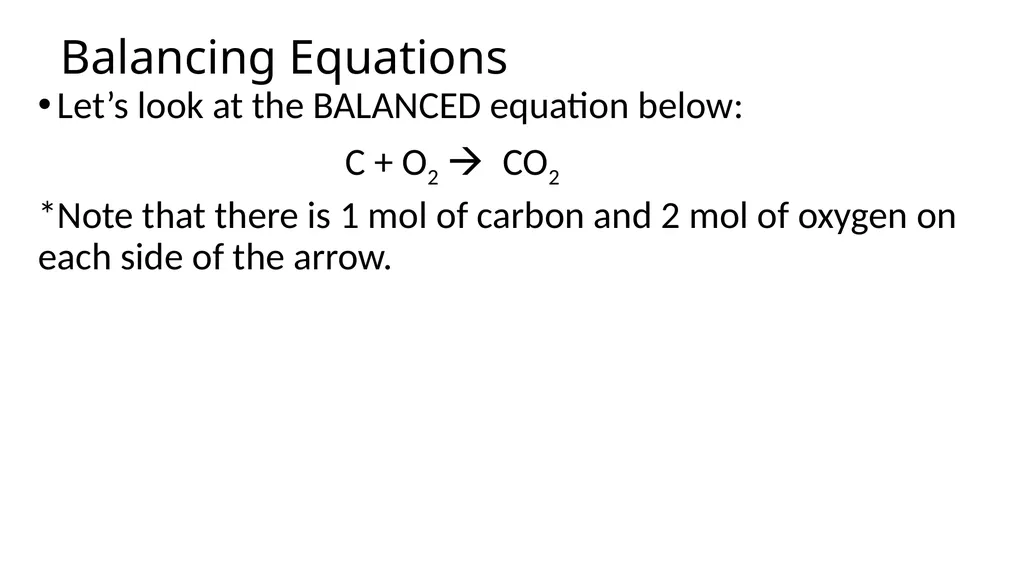
Balancing Equations Let’s look at the BALANCED equation below:
C + O2 CO2
*Note that there is 1 mol of carbon and 2 mol of oxygen on each side of the arrow.<br>
09
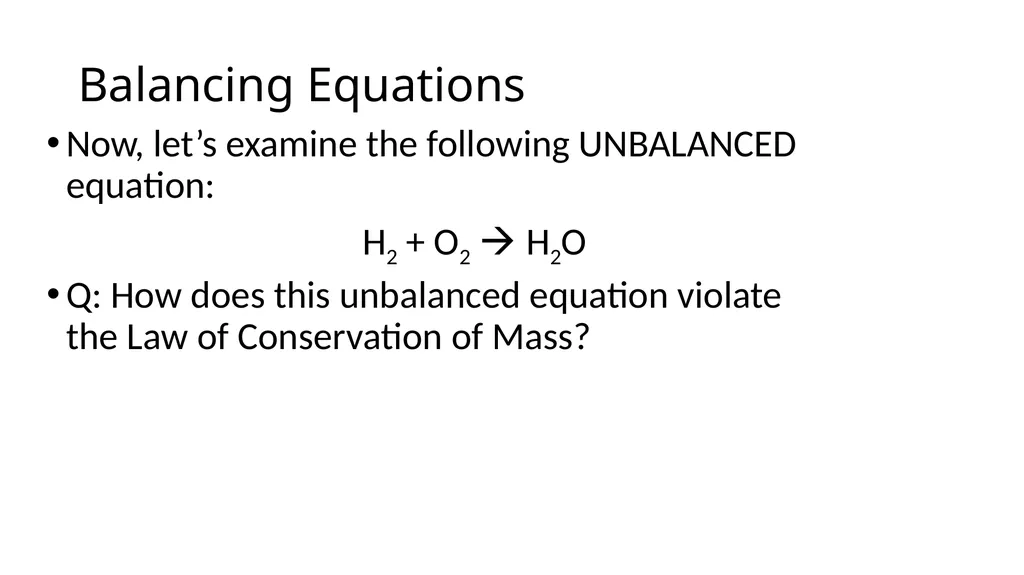
Balancing Equations Now, let’s examine the following UNBALANCED equation:
H2 + O2 H2O
Q: How does this unbalanced equation violate the Law of Conservation of Mass?<br>
10
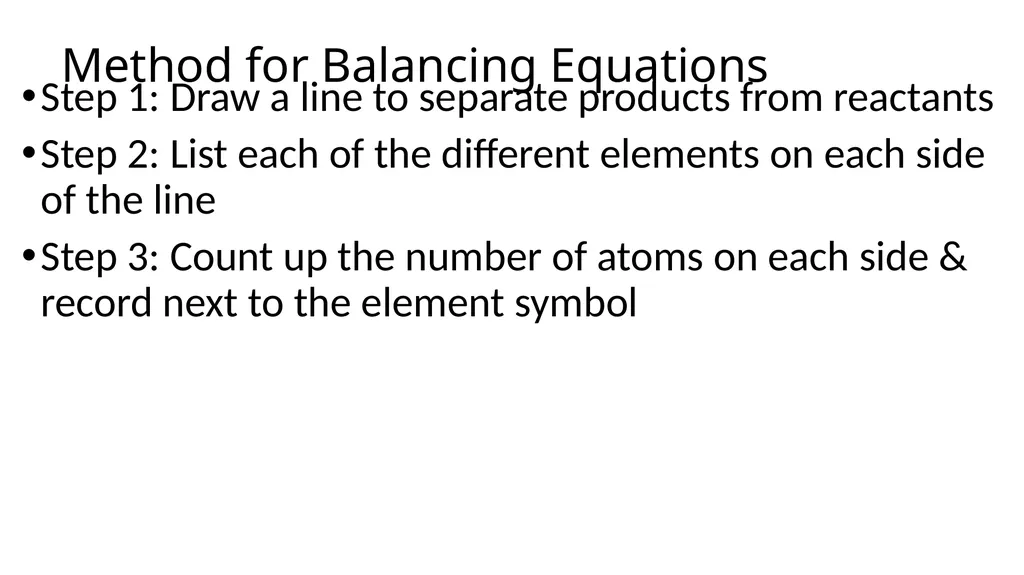
Method for Balancing Equations Step 1: Draw a line to separate products from reactants
Step 2: List each of the different elements on each side of the line
Step 3: Count up the number of atoms on each side & record next to the element symbol<br>
11
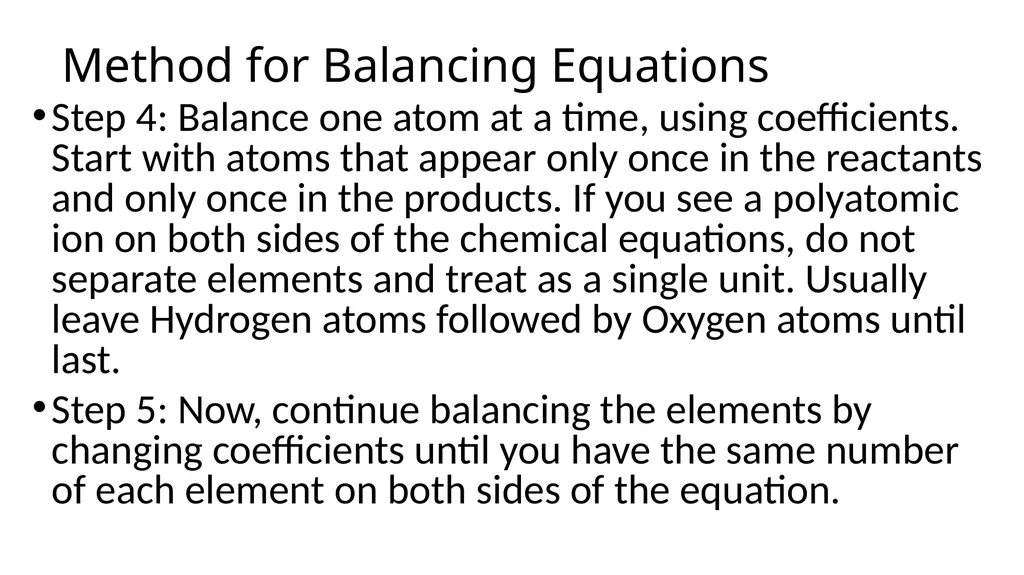
Method for Balancing Equations Step 4: Balance one atom at a time, using coefficients. Start with atoms that appear only once in the reactants and only once in the products. If you see a polyatomic ion on both sides of the chemical equations, do not separate elements and treat as a single unit. Usually leave Hydrogen atoms followed by Oxygen atoms until last.
Step 5: Now, continue balancing the elements by changing coefficients until you have the same number of each element on both sides of the equation.<br>
12
NOTE: WE NEVER CHANGE THE SUBSCRIPTS IN A FORMULA! ONLY CHANGE COEFFICENT.<br>
13
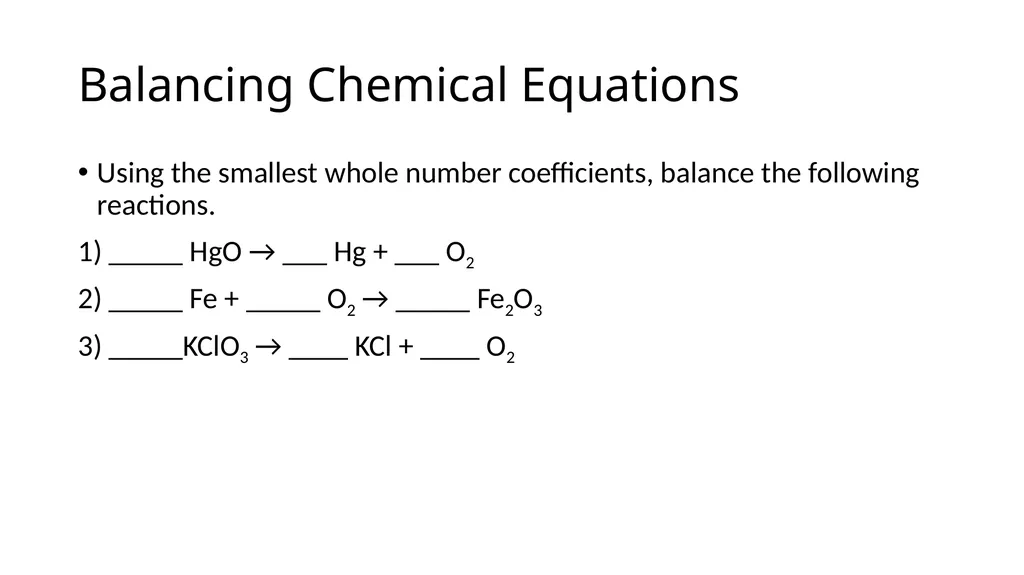
Balancing Chemical Equations Using the smallest whole number coefficients, balance the following reactions.
1) _____ HgO → ___ Hg + ___ O2
2) _____ Fe + _____ O2 → _____ Fe2O3
3) _____KClO3 → ____ KCl + ____ O2<br>
14
Write and balance the chemical equation. Zinc and lead (II) nitrate react to form zinc nitrate and lead.
2. Potassium metal and chlorine gas combine to form potassium chloride Zn + Pb(NO3)2 Zn(NO3)2 + Pb 2K + Cl2 2KCl<br>