
Air Pressure and Winds- Connect your learning



Description: Air Pressure and Winds- Connect your learning http:earth.nullschool.net Can you identify: Areas of High and Low pressure? Areas where the wind is being deflected? Water in the atmosphere Water in the Atmosphere Objectives To understand
Related Topics
Download Presentation
"Air Pressure and Winds- Connect your learning" is the property of its rightful owner. Permission is granted to download and print the materials on this website for personal, non-commercial use only, and to display it on your personal computer provided you do not modify the materials and that you retain all copyright notices contained in the materials. By downloading content from our website, you accept the terms of this agreement.
Presentation Transcript
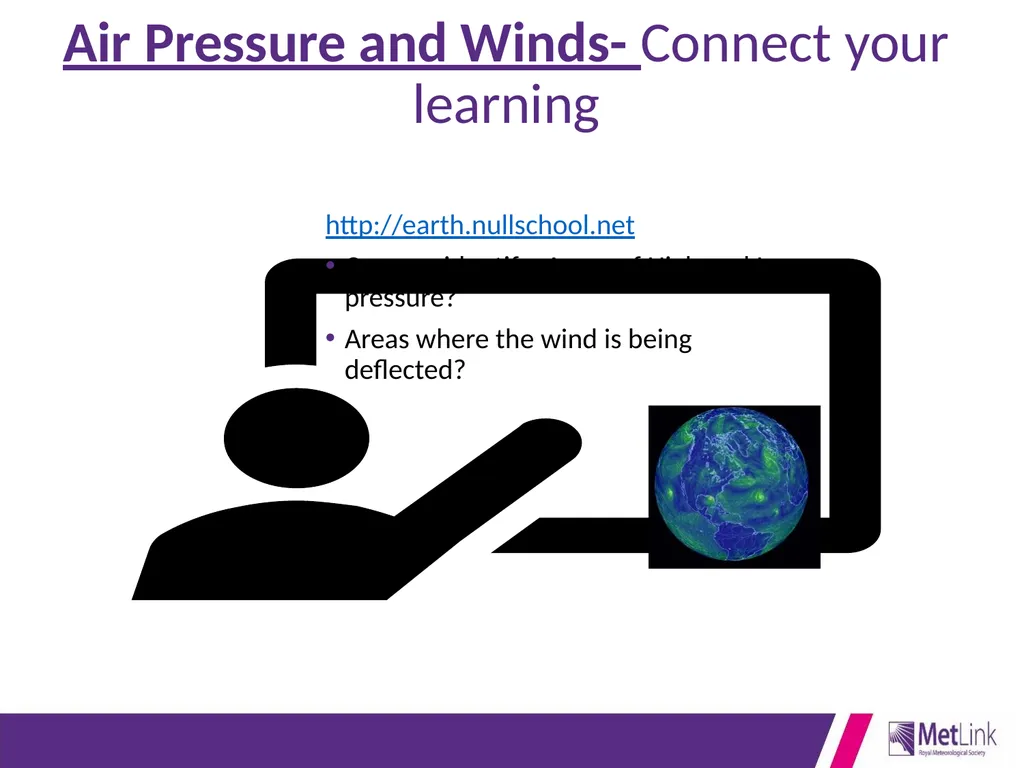
slide1. Air Pressure and Winds- Connect your learning http://earth.nullschool.net
Can you identify: Areas of High and Low pressure?
Areas where the wind is being deflected?<br>
slide2. Water in the atmosphere<br>
slide3. Water in the Atmosphere Objectives To understand why clouds form within the atmosphere.
To be able to explain 2 ways in which cloud formation can take place. Outcomes A completed set of video tasks explaining the relationship between evaporation and condensation.
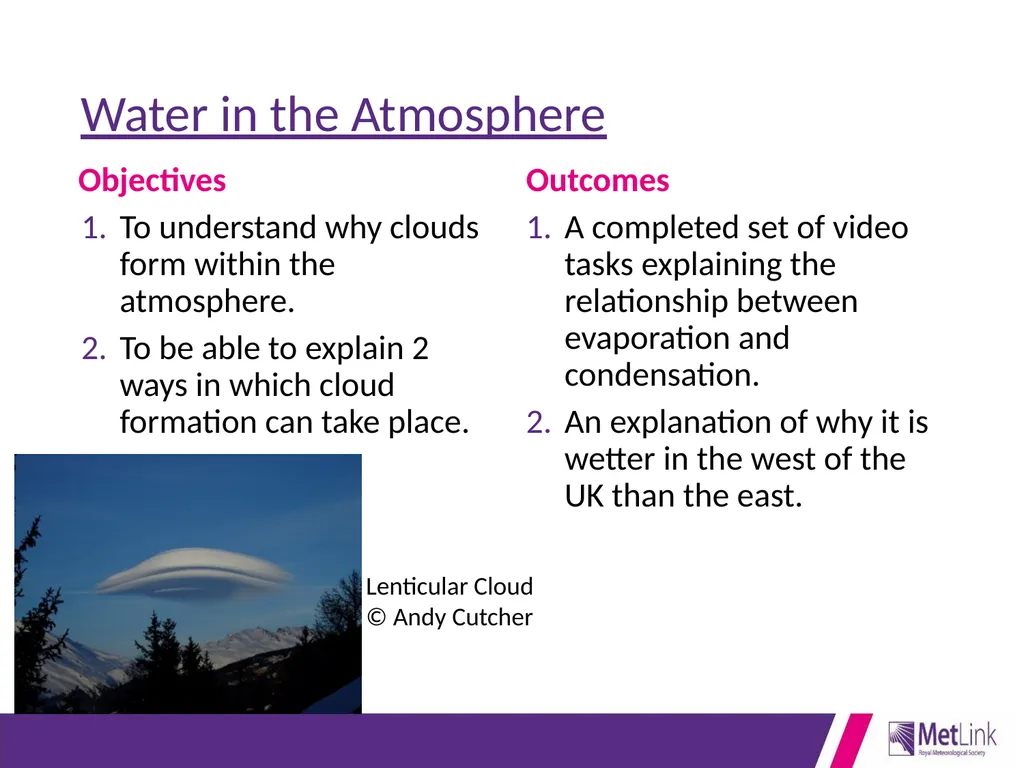
An explanation of why it is wetter in the west of the UK than the east. Lenticular Cloud
© Andy Cutcher<br>
slide4. Facts about water in the atmosphere One estimate of global water distribution (Percentages are rounded, so will not add to 100) Source: Igor Shiklomanov's chapter "World fresh water resources" in Peter H. Gleick (editor), 1993, Water in Crisis: A Guide to the World's Fresh Water Resources (Oxford University Press, New York). What does this resource show you about the amount of water in our atmosphere compared to water in other sources?
Why is the amount of water in our atmosphere only very small compared to the global total?<br>
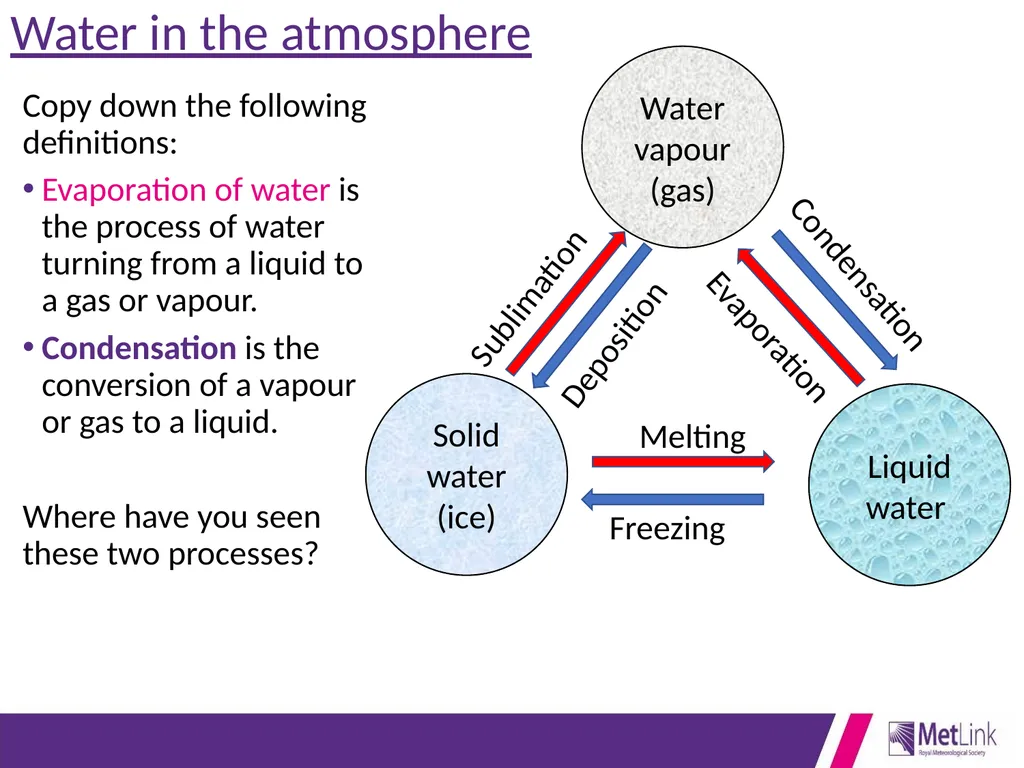
slide5. Water in the atmosphere Copy down the following definitions:
Evaporation of water is the process of water turning from a liquid to a gas or vapour.
Condensation is the conversion of a vapour or gas to a liquid.
Where have you seen these two processes? Water vapour (gas) Liquid water Solid water (ice) Sublimation Deposition Condensation Evaporation Melting Freezing<br>
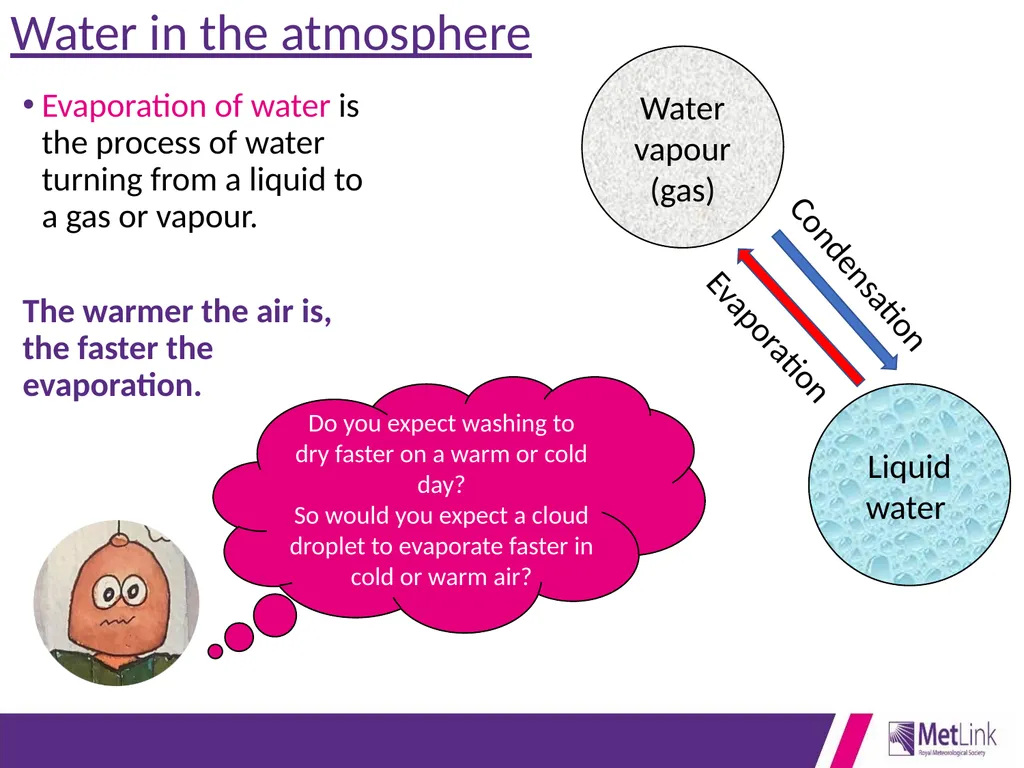
slide6. Water in the atmosphere Evaporation of water is the process of water turning from a liquid to a gas or vapour.
The warmer the air is, the faster the evaporation. Water vapour (gas) Liquid water Condensation Evaporation Do you expect washing to dry faster on a warm or cold day?
So would you expect a cloud droplet to evaporate faster in cold or warm air?<br>
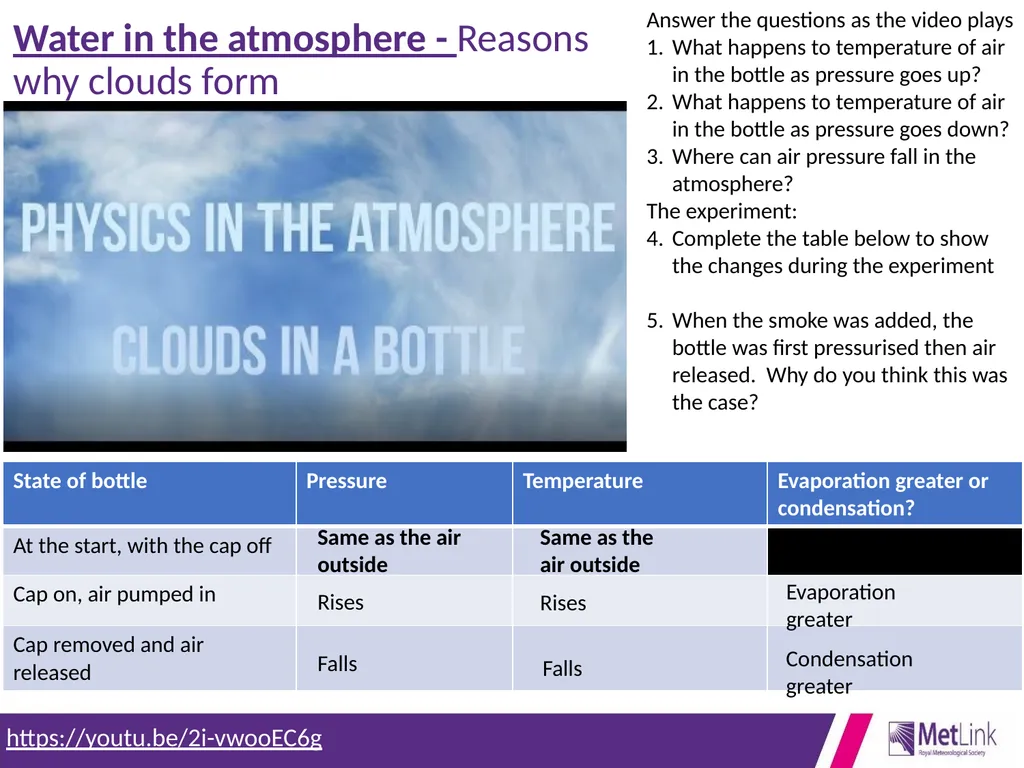
slide7. Water in the atmosphere - Reasons why clouds form https://youtu.be/2i-vwooEC6g Answer the questions as the video plays
What happens to temperature of air in the bottle as pressure goes up?
What happens to temperature of air in the bottle as pressure goes down?
Where can air pressure fall in the atmosphere?
The experiment:
Complete the table below to show the changes during the experiment
When the smoke was added, the bottle was first pressurised then air released. Why do you think this was the case? Same as the air outside Same as the air outside Rises Rises Evaporation greater Condensation greater Falls Falls<br>
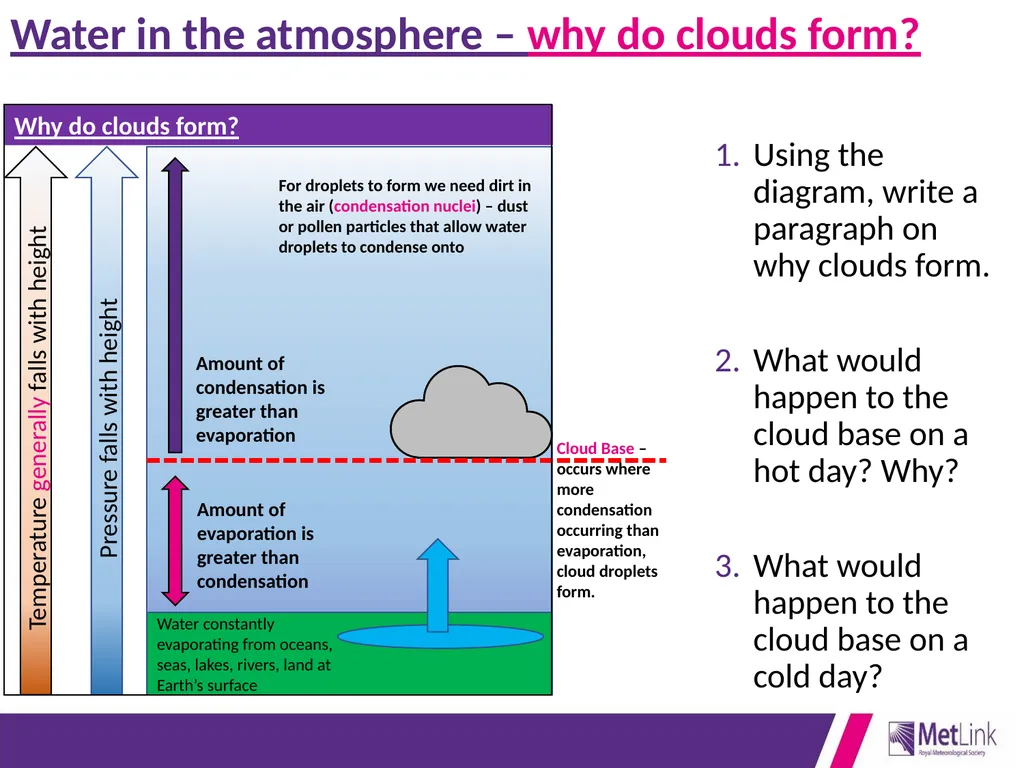
slide8. Water in the atmosphere – why do clouds form? Amount of evaporation is greater than condensation Amount of condensation is greater than evaporation Temperature generally falls with height Pressure falls with height Cloud Base – occurs where more condensation occurring than evaporation, cloud droplets form. Water constantly evaporating from oceans, seas, lakes, rivers, land at Earth’s surface Using the diagram, write a paragraph on why clouds form.
What would happen to the cloud base on a hot day? Why?
What would happen to the cloud base on a cold day? For droplets to form we need dirt in the air (condensation nuclei) – dust or pollen particles that allow water droplets to condense onto Why do clouds form?<br>
slide9. Water in the atmosphere – Back to Back Get into pairs
Sit back to back
One of you will be given an image, your job is to describe the image and EVERYTHING on it to your partner
The other person in the pair has to draw exactly what is described
How did you do? Look at the image on the next slide to find out Describing Thinking and drawing<br>
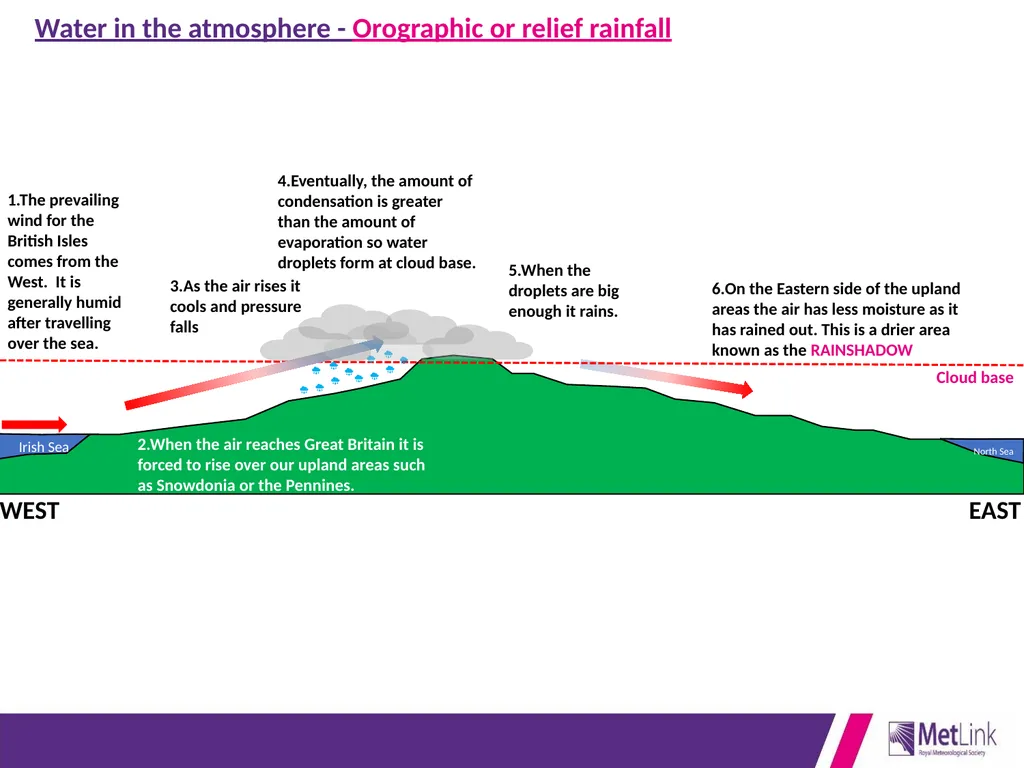
slide10. Water in the atmosphere - Orographic or relief rainfall Irish Sea WEST EAST North Sea 1.The prevailing wind for the British Isles comes from the West. It is generally humid after travelling over the sea. 2.When the air reaches Great Britain it is forced to rise over our upland areas such as Snowdonia or the Pennines. 3.As the air rises it cools and pressure falls 4.Eventually, the amount of condensation is greater than the amount of evaporation so water droplets form at cloud base. 5.When the droplets are big enough it rains. 6.On the Eastern side of the upland areas the air has less moisture as it has rained out. This is a drier area known as the RAINSHADOW Cloud base<br>
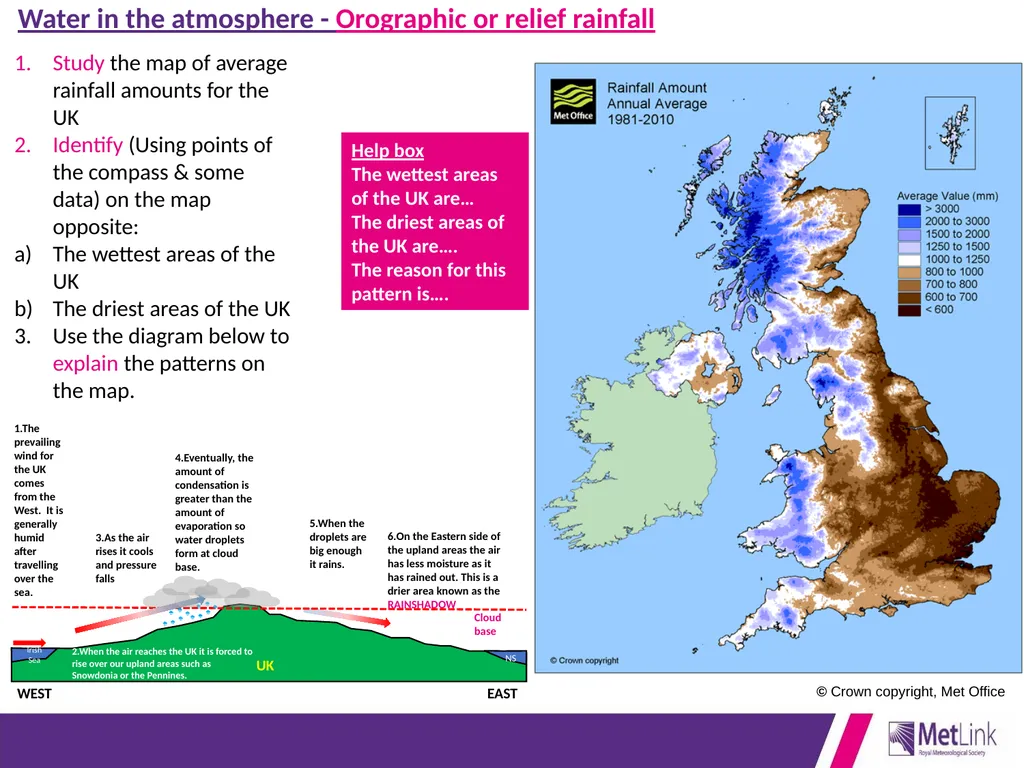
slide11. Water in the atmosphere - Orographic or relief rainfall Study the map of average rainfall amounts for the UK
Identify (Using points of the compass & some data) on the map opposite:
The wettest areas of the UK
The driest areas of the UK
Use the diagram below to explain the patterns on the map. Help box
The wettest areas of the UK are…
The driest areas of the UK are….
The reason for this pattern is…. © Crown copyright, Met Office<br>
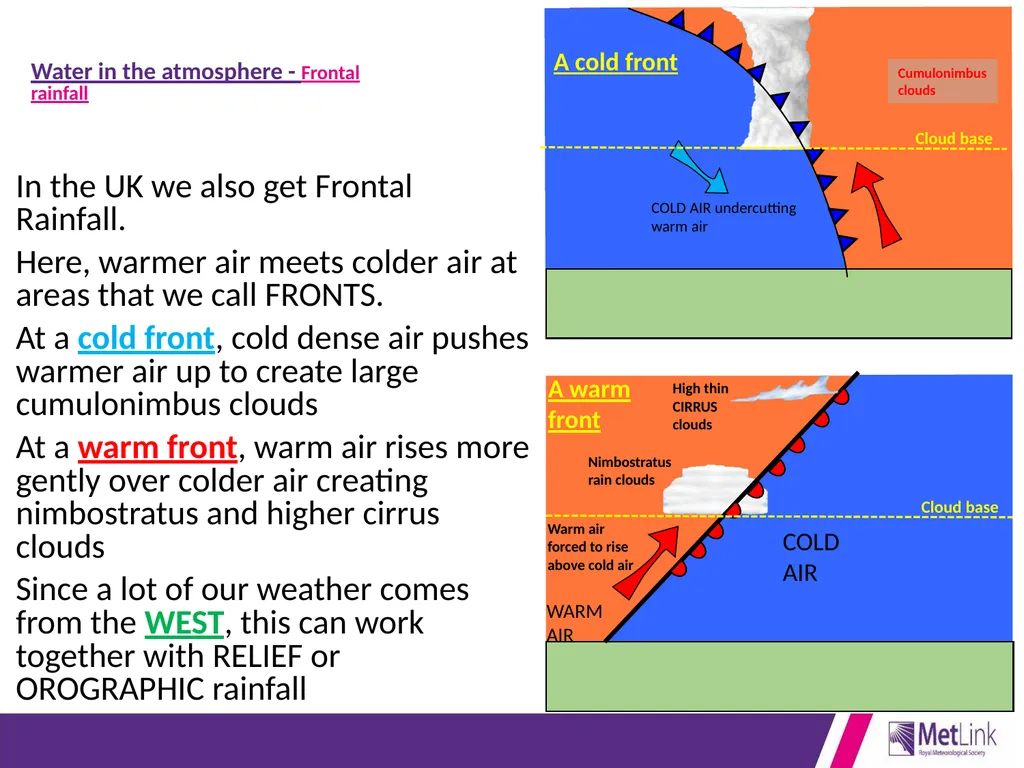
slide12. Water in the atmosphere - Frontal rainfall WARM AIR COLD AIR Warm air forced to rise above cold air High thin CIRRUS clouds Nimbostratus rain clouds COLD AIR undercutting warm air Cumulonimbus clouds In the UK we also get Frontal Rainfall.
Here, warmer air meets colder air at areas that we call FRONTS.
At a cold front, cold dense air pushes warmer air up to create large cumulonimbus clouds
At a warm front, warm air rises more gently over colder air creating nimbostratus and higher cirrus clouds
Since a lot of our weather comes from the WEST, this can work together with RELIEF or OROGRAPHIC rainfall Cloud base Cloud base A cold front A warm front<br>
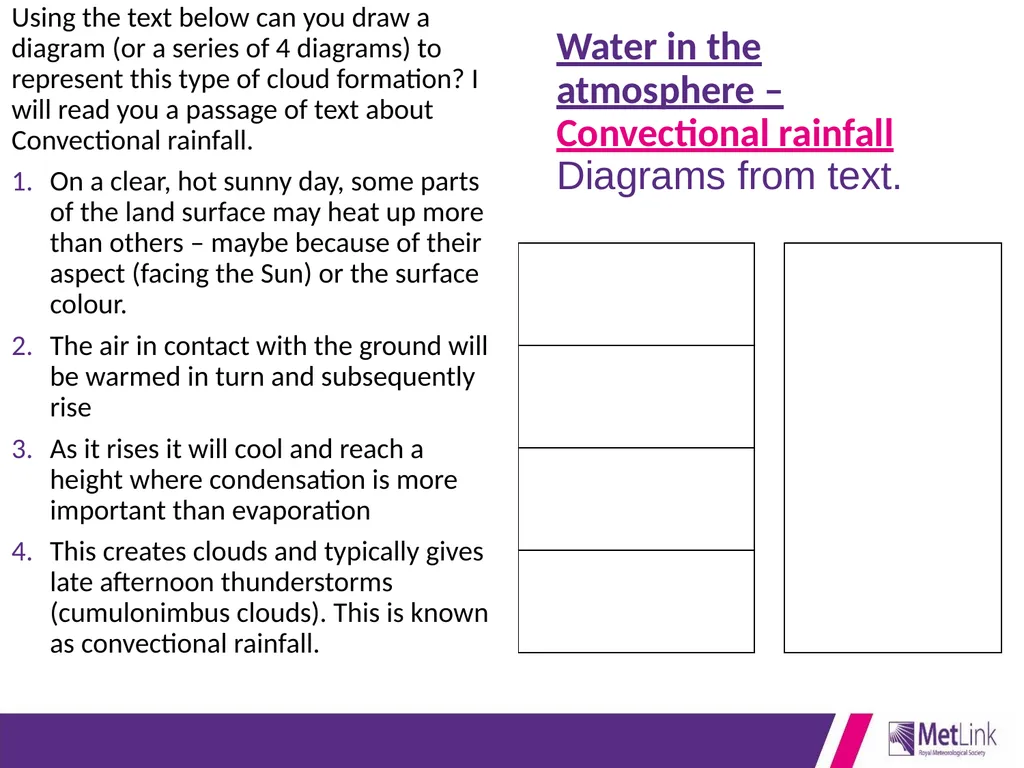
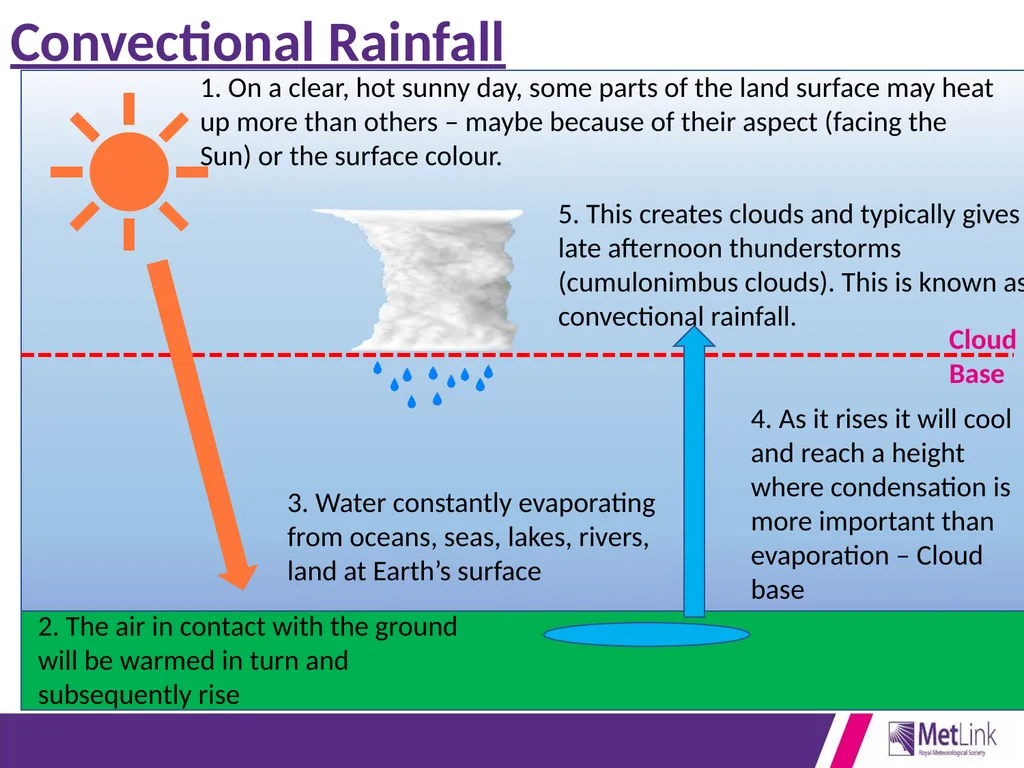
slide13. Water in the atmosphere – Convectional rainfall Diagrams from text. Using the text below can you draw a diagram (or a series of 4 diagrams) to represent this type of cloud formation? I will read you a passage of text about Convectional rainfall.
On a clear, hot sunny day, some parts of the land surface may heat up more than others – maybe because of their aspect (facing the Sun) or the surface colour.
The air in contact with the ground will be warmed in turn and subsequently rise
As it rises it will cool and reach a height where condensation is more important than evaporation
This creates clouds and typically gives late afternoon thunderstorms (cumulonimbus clouds). This is known as convectional rainfall.<br>
slide14. Convectional Rainfall Cloud Base 3. Water constantly evaporating from oceans, seas, lakes, rivers, land at Earth’s surface 5. This creates clouds and typically gives late afternoon thunderstorms (cumulonimbus clouds). This is known as convectional rainfall. 1. On a clear, hot sunny day, some parts of the land surface may heat up more than others – maybe because of their aspect (facing the Sun) or the surface colour. 2. The air in contact with the ground will be warmed in turn and subsequently rise 4. As it rises it will cool and reach a height where condensation is more important than evaporation – Cloud base<br>
slide15. Challenge – We have looked at 3 processes for how clouds form. Can you think of why cloud formation in the UK might be more complicated than 3 separate processes? The 3 processes are relief, frontal and convection
Could more than one process operate at the same time?
Could some locations in the UK get more of one process than the others? Why?
Will these processes change with the seasons?
Could these processes change during a day?<br>
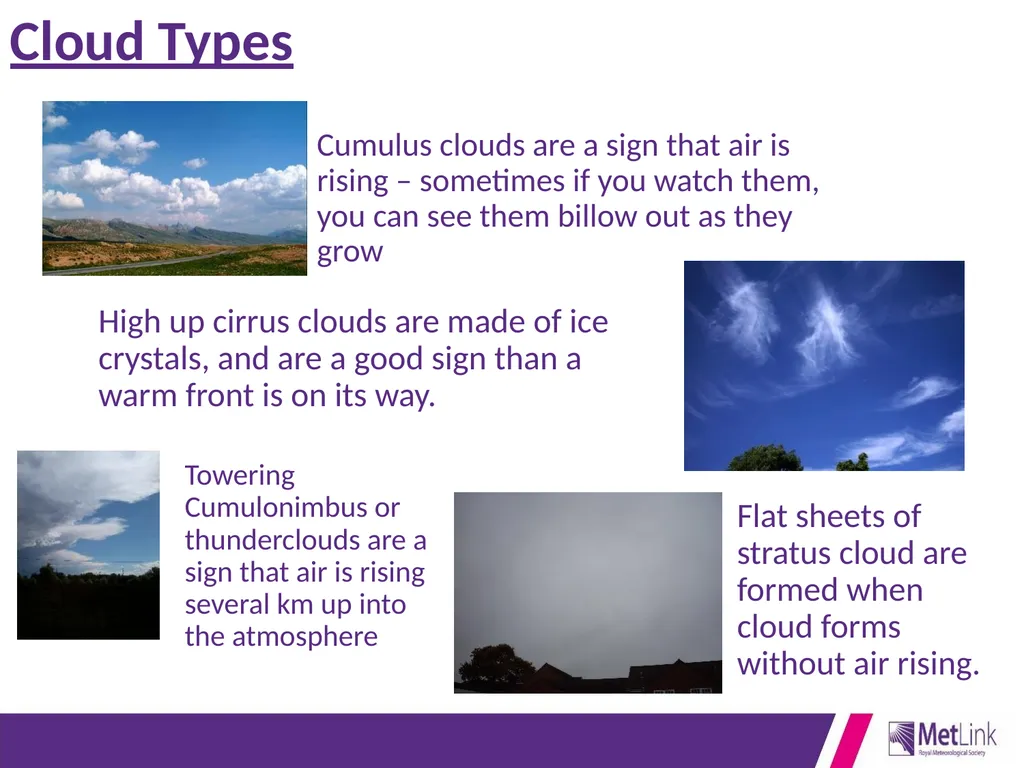
slide16. Cloud Types Cumulus clouds are a sign that air is rising – sometimes if you watch them, you can see them billow out as they grow High up cirrus clouds are made of ice crystals, and are a good sign than a warm front is on its way. Towering Cumulonimbus or thunderclouds are a sign that air is rising several km up into the atmosphere Flat sheets of stratus cloud are formed when cloud forms without air rising.<br>
slide17. Review Quick sketch!
You have 3 minutes to draw 3 diagrams explaining convection, relief and frontal rainfall 180 seconds! https://quizlet.com/_8y57vx?x=1jqt&i=38anvz<br>
slide18. Water in the atmosphere and climate change 1850 2018 1900 1950 2000 As the climate warms, the water cycle intensifies. What positive consequences might that have around the world?<br>
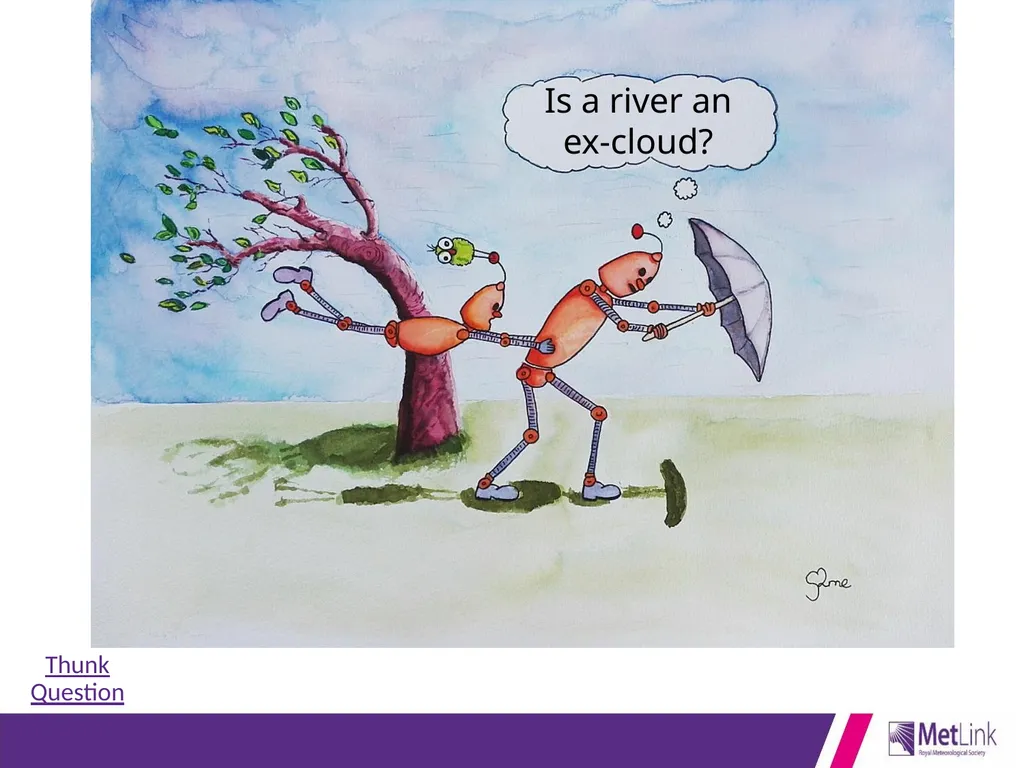
slide19. Thunk Question Is a river an ex-cloud?<br>
Can you identify: Areas of High and Low pressure?
Areas where the wind is being deflected?<br>
slide2. Water in the atmosphere<br>
slide3. Water in the Atmosphere Objectives To understand why clouds form within the atmosphere.
To be able to explain 2 ways in which cloud formation can take place. Outcomes A completed set of video tasks explaining the relationship between evaporation and condensation.
An explanation of why it is wetter in the west of the UK than the east. Lenticular Cloud
© Andy Cutcher<br>
slide4. Facts about water in the atmosphere One estimate of global water distribution (Percentages are rounded, so will not add to 100) Source: Igor Shiklomanov's chapter "World fresh water resources" in Peter H. Gleick (editor), 1993, Water in Crisis: A Guide to the World's Fresh Water Resources (Oxford University Press, New York). What does this resource show you about the amount of water in our atmosphere compared to water in other sources?
Why is the amount of water in our atmosphere only very small compared to the global total?<br>
slide5. Water in the atmosphere Copy down the following definitions:
Evaporation of water is the process of water turning from a liquid to a gas or vapour.
Condensation is the conversion of a vapour or gas to a liquid.
Where have you seen these two processes? Water vapour (gas) Liquid water Solid water (ice) Sublimation Deposition Condensation Evaporation Melting Freezing<br>
slide6. Water in the atmosphere Evaporation of water is the process of water turning from a liquid to a gas or vapour.
The warmer the air is, the faster the evaporation. Water vapour (gas) Liquid water Condensation Evaporation Do you expect washing to dry faster on a warm or cold day?
So would you expect a cloud droplet to evaporate faster in cold or warm air?<br>
slide7. Water in the atmosphere - Reasons why clouds form https://youtu.be/2i-vwooEC6g Answer the questions as the video plays
What happens to temperature of air in the bottle as pressure goes up?
What happens to temperature of air in the bottle as pressure goes down?
Where can air pressure fall in the atmosphere?
The experiment:
Complete the table below to show the changes during the experiment
When the smoke was added, the bottle was first pressurised then air released. Why do you think this was the case? Same as the air outside Same as the air outside Rises Rises Evaporation greater Condensation greater Falls Falls<br>
slide8. Water in the atmosphere – why do clouds form? Amount of evaporation is greater than condensation Amount of condensation is greater than evaporation Temperature generally falls with height Pressure falls with height Cloud Base – occurs where more condensation occurring than evaporation, cloud droplets form. Water constantly evaporating from oceans, seas, lakes, rivers, land at Earth’s surface Using the diagram, write a paragraph on why clouds form.
What would happen to the cloud base on a hot day? Why?
What would happen to the cloud base on a cold day? For droplets to form we need dirt in the air (condensation nuclei) – dust or pollen particles that allow water droplets to condense onto Why do clouds form?<br>
slide9. Water in the atmosphere – Back to Back Get into pairs
Sit back to back
One of you will be given an image, your job is to describe the image and EVERYTHING on it to your partner
The other person in the pair has to draw exactly what is described
How did you do? Look at the image on the next slide to find out Describing Thinking and drawing<br>
slide10. Water in the atmosphere - Orographic or relief rainfall Irish Sea WEST EAST North Sea 1.The prevailing wind for the British Isles comes from the West. It is generally humid after travelling over the sea. 2.When the air reaches Great Britain it is forced to rise over our upland areas such as Snowdonia or the Pennines. 3.As the air rises it cools and pressure falls 4.Eventually, the amount of condensation is greater than the amount of evaporation so water droplets form at cloud base. 5.When the droplets are big enough it rains. 6.On the Eastern side of the upland areas the air has less moisture as it has rained out. This is a drier area known as the RAINSHADOW Cloud base<br>
slide11. Water in the atmosphere - Orographic or relief rainfall Study the map of average rainfall amounts for the UK
Identify (Using points of the compass & some data) on the map opposite:
The wettest areas of the UK
The driest areas of the UK
Use the diagram below to explain the patterns on the map. Help box
The wettest areas of the UK are…
The driest areas of the UK are….
The reason for this pattern is…. © Crown copyright, Met Office<br>
slide12. Water in the atmosphere - Frontal rainfall WARM AIR COLD AIR Warm air forced to rise above cold air High thin CIRRUS clouds Nimbostratus rain clouds COLD AIR undercutting warm air Cumulonimbus clouds In the UK we also get Frontal Rainfall.
Here, warmer air meets colder air at areas that we call FRONTS.
At a cold front, cold dense air pushes warmer air up to create large cumulonimbus clouds
At a warm front, warm air rises more gently over colder air creating nimbostratus and higher cirrus clouds
Since a lot of our weather comes from the WEST, this can work together with RELIEF or OROGRAPHIC rainfall Cloud base Cloud base A cold front A warm front<br>
slide13. Water in the atmosphere – Convectional rainfall Diagrams from text. Using the text below can you draw a diagram (or a series of 4 diagrams) to represent this type of cloud formation? I will read you a passage of text about Convectional rainfall.
On a clear, hot sunny day, some parts of the land surface may heat up more than others – maybe because of their aspect (facing the Sun) or the surface colour.
The air in contact with the ground will be warmed in turn and subsequently rise
As it rises it will cool and reach a height where condensation is more important than evaporation
This creates clouds and typically gives late afternoon thunderstorms (cumulonimbus clouds). This is known as convectional rainfall.<br>
slide14. Convectional Rainfall Cloud Base 3. Water constantly evaporating from oceans, seas, lakes, rivers, land at Earth’s surface 5. This creates clouds and typically gives late afternoon thunderstorms (cumulonimbus clouds). This is known as convectional rainfall. 1. On a clear, hot sunny day, some parts of the land surface may heat up more than others – maybe because of their aspect (facing the Sun) or the surface colour. 2. The air in contact with the ground will be warmed in turn and subsequently rise 4. As it rises it will cool and reach a height where condensation is more important than evaporation – Cloud base<br>
slide15. Challenge – We have looked at 3 processes for how clouds form. Can you think of why cloud formation in the UK might be more complicated than 3 separate processes? The 3 processes are relief, frontal and convection
Could more than one process operate at the same time?
Could some locations in the UK get more of one process than the others? Why?
Will these processes change with the seasons?
Could these processes change during a day?<br>
slide16. Cloud Types Cumulus clouds are a sign that air is rising – sometimes if you watch them, you can see them billow out as they grow High up cirrus clouds are made of ice crystals, and are a good sign than a warm front is on its way. Towering Cumulonimbus or thunderclouds are a sign that air is rising several km up into the atmosphere Flat sheets of stratus cloud are formed when cloud forms without air rising.<br>
slide17. Review Quick sketch!
You have 3 minutes to draw 3 diagrams explaining convection, relief and frontal rainfall 180 seconds! https://quizlet.com/_8y57vx?x=1jqt&i=38anvz<br>
slide18. Water in the atmosphere and climate change 1850 2018 1900 1950 2000 As the climate warms, the water cycle intensifies. What positive consequences might that have around the world?<br>
slide19. Thunk Question Is a river an ex-cloud?<br>