
Alternative Futures ↖ ↗ ← → ↙ ↘ ALTERNATIVE

Alternative Futures ↖ ↗ ← → ↙ ↘ ALTERNATIVE
1 / 1
Alternative Futures ↖ ↗ ← → ↙ ↘ ALTERNATIVE - slide 1 of 3 Alternative Futures ↖ ↗ ← → ↙ ↘ ALTERNATIVE - slide 2 of 3 Alternative Futures ↖ ↗ ← → ↙ ↘ ALTERNATIVE - slide 3 of 3
Alternative Futures ALTERNATIVE FUTURES Alternative Futures Scenario types Alternative Futures Adapted from Alternative Futures at the Manoa school by Jim Dator, 1979 Growth Work and expectations continue to grow into the

Related Topics

Download this presentation From Below

"Alternative Futures ↖ ↗ ← → ↙ ↘ ALTERNATIVE" is the property of its rightful owner. Permission is granted to download and print the materials on this website for personal, non-commercial use only, and to display it on your personal computer provided you do not modify the materials and that you retain all copyright notices contained in the materials. By downloading content from our website, you accept the terms of this agreement.

Presentation Transcript

01
Alternative Futures ↖ ↗
← →
↙ ↘ ALTERNATIVE FUTURES<br>
02
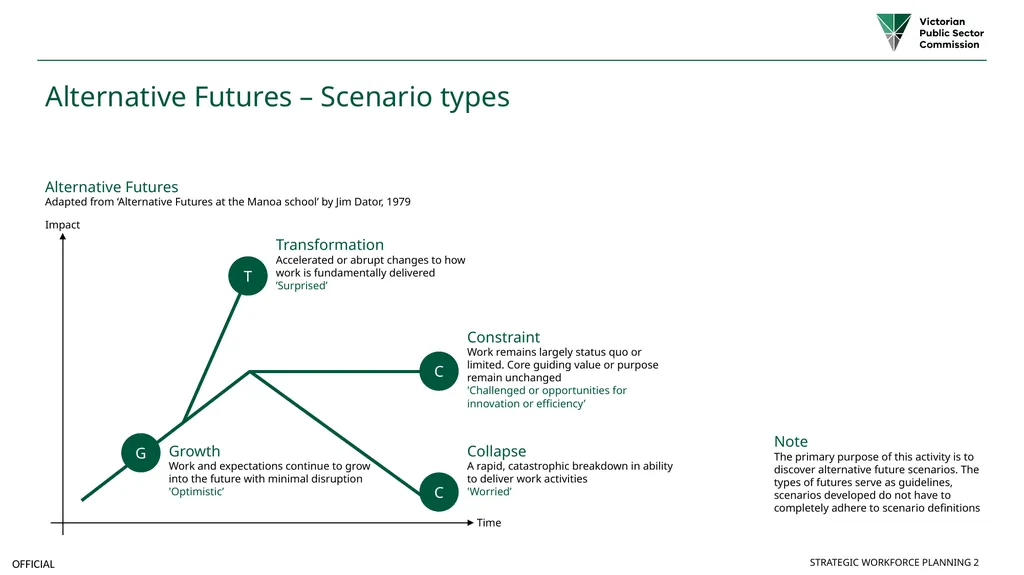
Alternative Futures – Scenario types Alternative Futures
Adapted from ‘Alternative Futures at the Manoa school’ by Jim Dator, 1979 Growth
Work and expectations continue to grow into the future with minimal disruption
'Optimistic’ Transformation
Accelerated or abrupt changes to how work is fundamentally delivered
’Surprised’ Constraint
Work remains largely status quo or limited. Core guiding value or purpose remain unchanged
'Challenged or opportunities for innovation or efficiency’ Collapse
A rapid, catastrophic breakdown in ability to deliver work activities
'Worried’ Note
The primary purpose of this activity is to discover alternative future scenarios. The types of futures serve as guidelines, scenarios developed do not have to completely adhere to scenario definitions Strategic Workforce Planning 2<br>
03
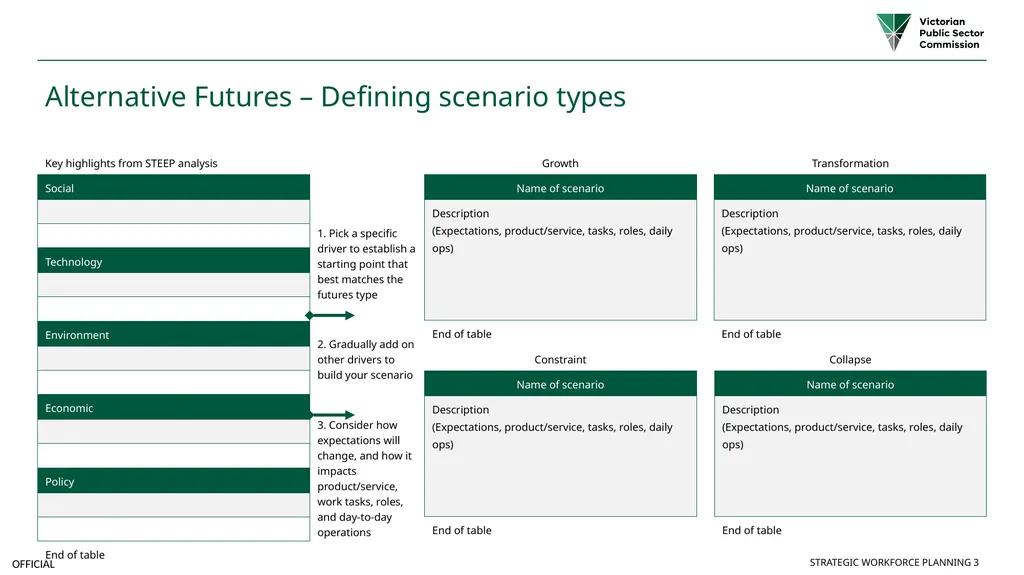
Alternative Futures – Defining scenario types Key highlights from STEEP analysis 1. Pick a specific driver to establish a starting point that best matches the futures type

2. Gradually add on other drivers to build your scenario

3. Consider how expectations will change, and how it impacts product/service, work tasks, roles, and day-to-day operations Growth Transformation Constraint Collapse Strategic Workforce Planning 3<br>