
American International Group Tom Olson Tommy Yip



Description: American International Group Tom Olson Tommy Yip Gordon Tang Michael Chiu Pauls Sugiarto Agenda Industry Overview Regulations Company Overview Financial Statement Risk Factors and Management Industry Overview The Insurance Industry
Related Topics
Download Presentation
"American International Group Tom Olson Tommy Yip" is the property of its rightful owner. Permission is granted to download and print the materials on this website for personal, non-commercial use only, and to display it on your personal computer provided you do not modify the materials and that you retain all copyright notices contained in the materials. By downloading content from our website, you accept the terms of this agreement.
Presentation Transcript
slide1. American International Group Tom Olson
Tommy Yip
Gordon Tang
Michael Chiu
Paul’s Sugiarto<br>
slide2. Agenda Industry Overview
Regulations
Company Overview
Financial Statement
Risk Factors and Management<br>
slide3. Industry Overview<br>
slide4. The Insurance Industry Insurance companies generally have two branches of business
Life & Health Insurance
Individual’s well being
Property and Casualty Insurance
Protection against losses of a physical property, or its ability to generate income<br>
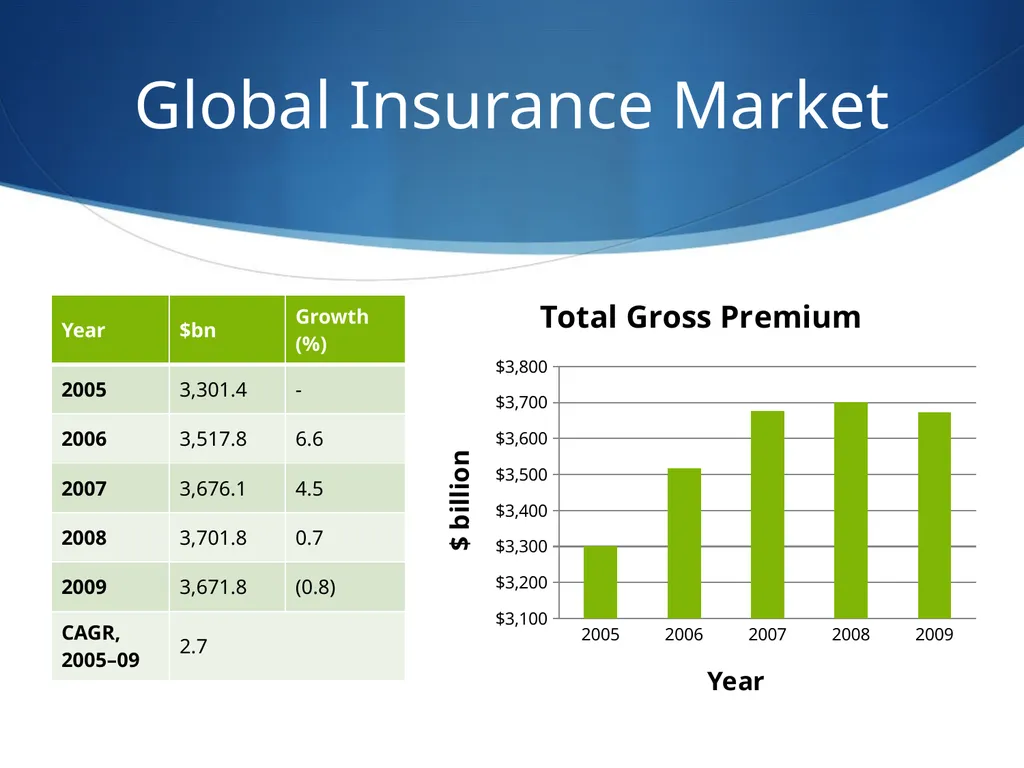
slide5. Global Insurance Market $3,671.7 billion in gross premiums in 2009
Life insurance makes up approximately 57% of the insurance industry
Growth rate of 2.7% per year<br>
slide6. Global Insurance Market<br>
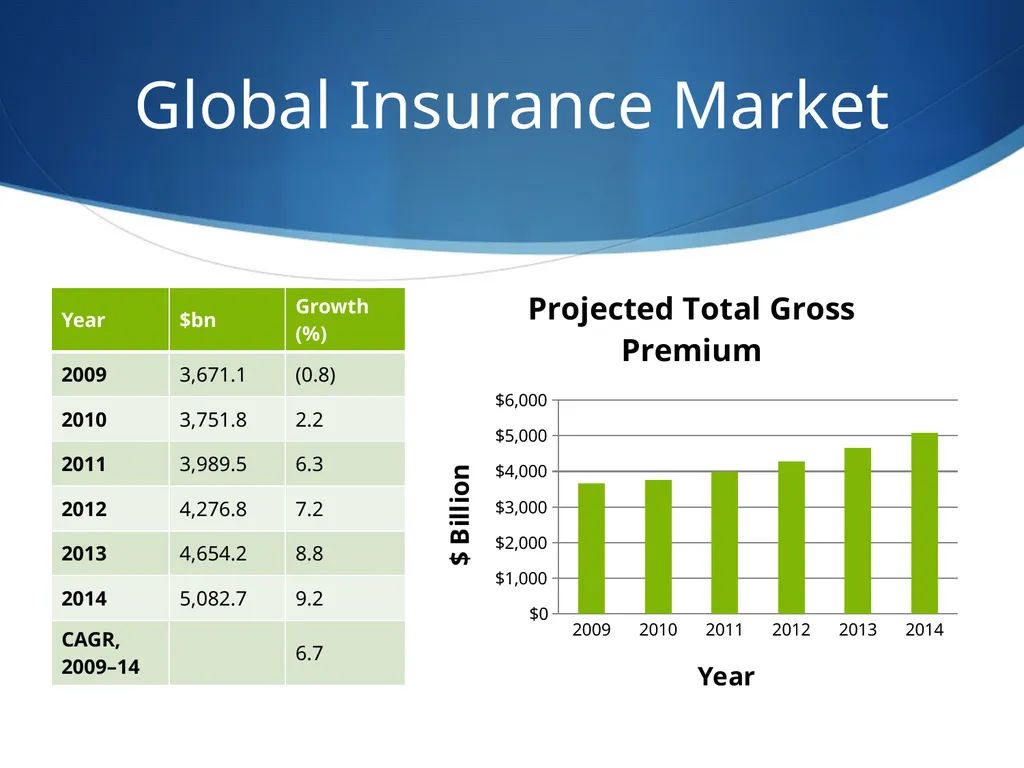
slide7. Global Insurance Market Projected to have gross premiums of $5,082.7 billion in 2014
Average growth rate of 6.7% per year, 38.4% up from 2009<br>
slide8. Global Insurance Market<br>
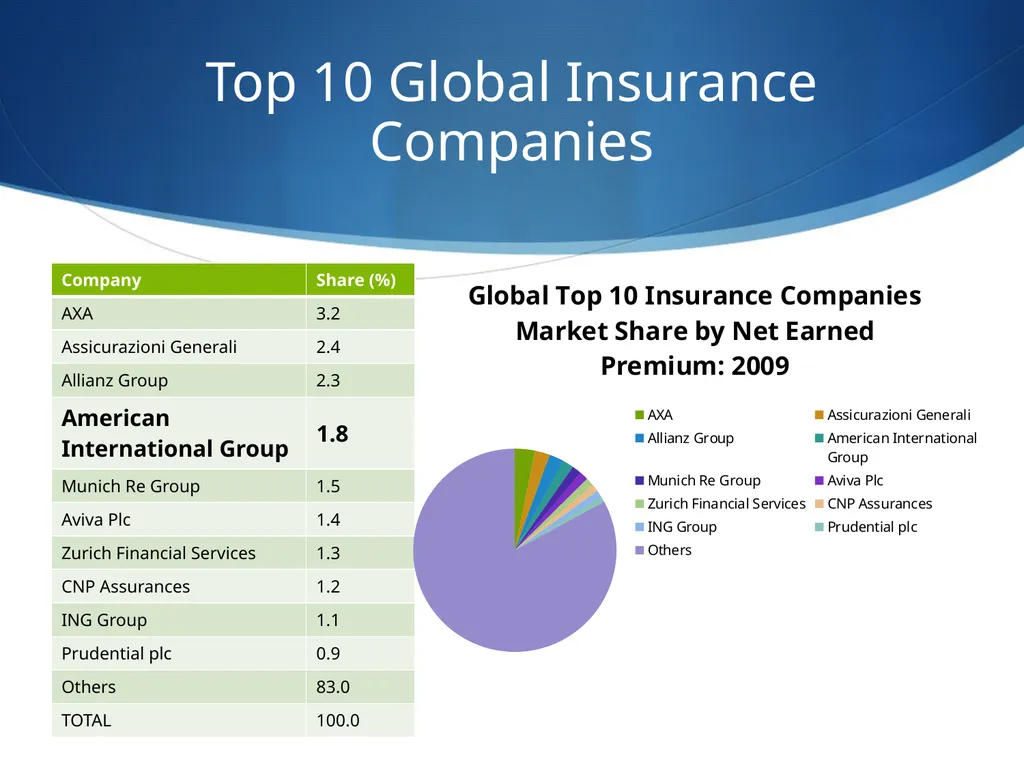
slide9. Top 10 Global Insurance Companies<br>
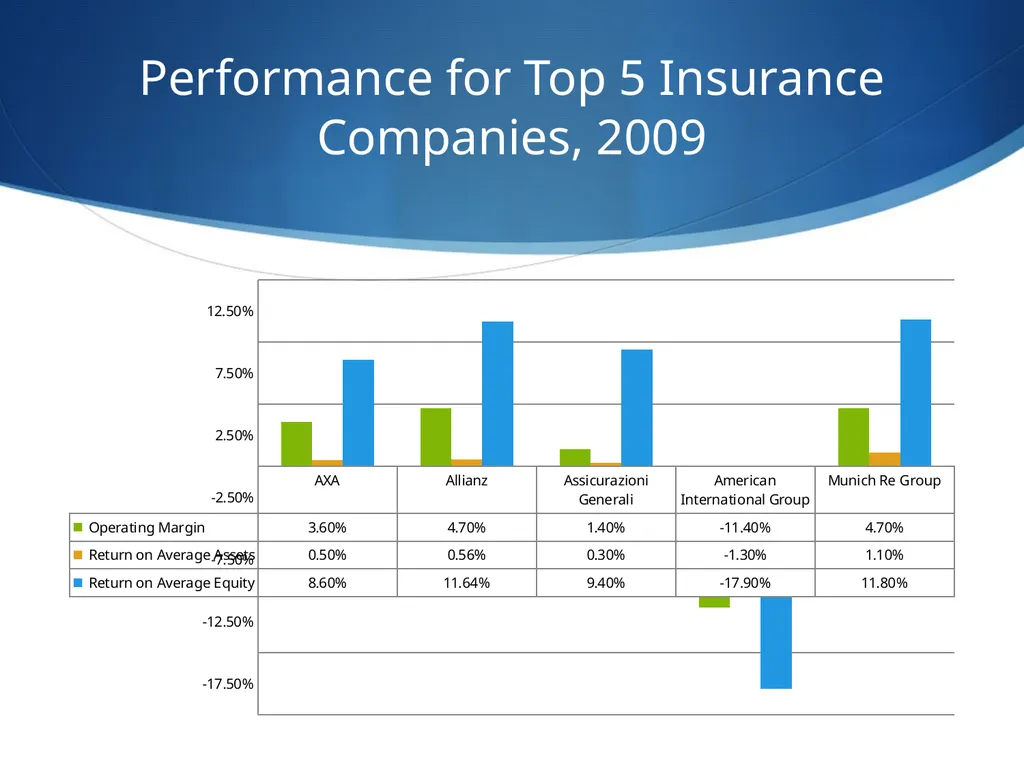
slide10. Performance for Top 5 Insurance Companies, 2009<br>
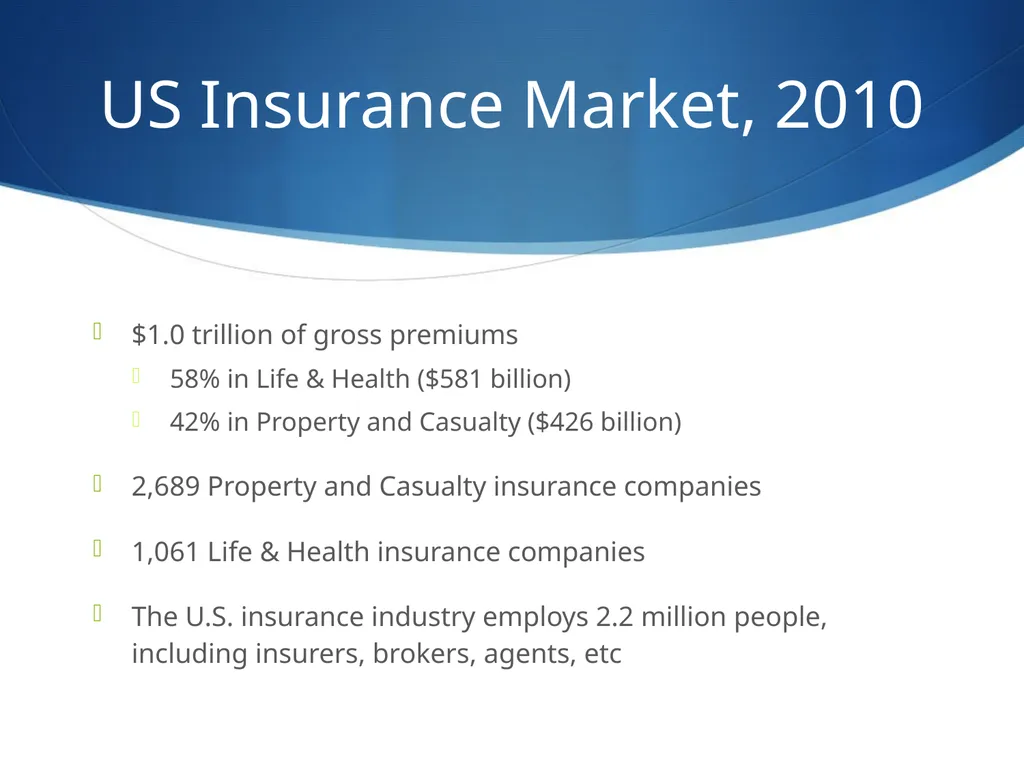
slide11. US Insurance Market, 2010 $1.0 trillion of gross premiums
58% in Life & Health ($581 billion)
42% in Property and Casualty ($426 billion)
2,689 Property and Casualty insurance companies
1,061 Life & Health insurance companies
The U.S. insurance industry employs 2.2 million people, including insurers, brokers, agents, etc<br>
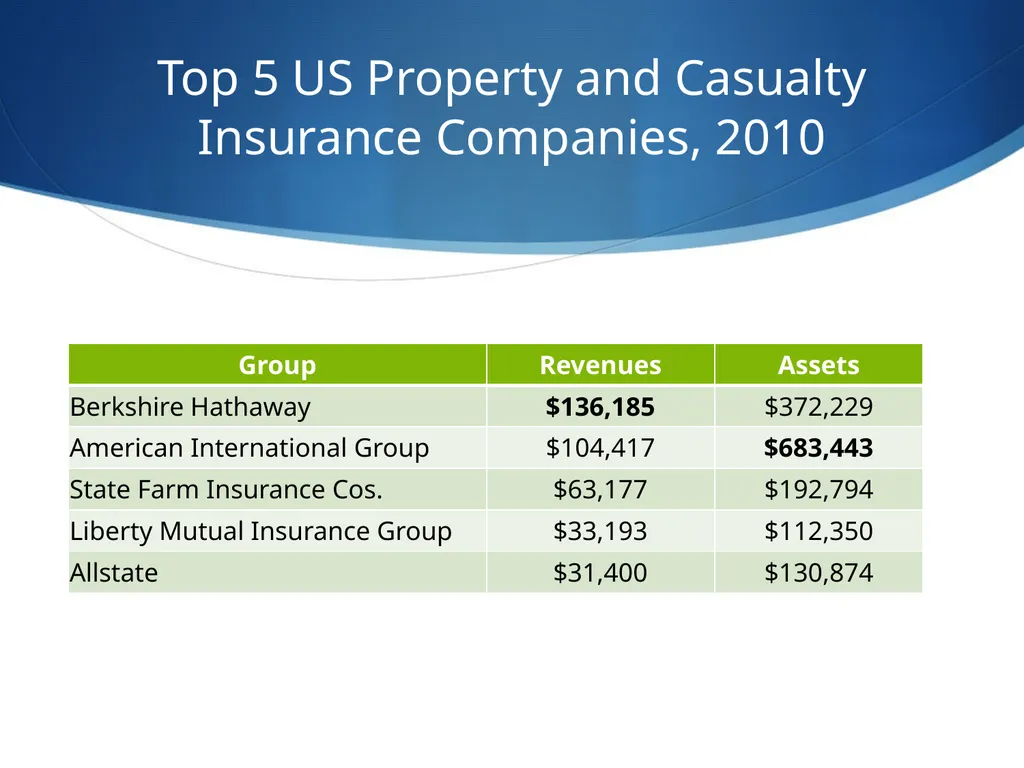
slide12. Top 5 US Property and Casualty Insurance Companies, 2010<br>
slide13. Regulations<br>
slide14. Regulations The scope of regulation extends beyond the prudential oversight of insurance companies and their capital adequacy
Ensures policy holders (person buying the insurance) are protected against
bad faith claims
premiums are not unduly high
policies issued meet a minimum standard<br>
slide15. Regulations Insurance companies (in US) are not subject to federal regulation and only state level regulation exists for insurance companies
Therefore, regulation is different from state to state
State agencies usually called Department of Insurance with their head officials named Insurance Commissioner
Insurance commissioners are members of NAIC<br>
slide16. What is NAIC National Association of Insurance Commissioners
Formed in 1871
Non-profit organization which seeks to organize the regulatory and supervisory efforts of the various state insurance commissioners from around the United States
Forum for the creation of model laws and regulations
Is NOT a regulator!<br>
slide17. NAIC Acts at the national level to advance laws and policies supported by state insurance regulators
Responsible for creating the Statutory Accounting Principles (SAP), which is required accounting for insurance companies, in addition to the state GAAP
SAP is notable for its very conservative valuation methods—aiming to keep reserve high in order and keeping the insurance companies solvent<br>
slide18. Company Overview<br>
slide19. AIG American International Group, Inc. (AIG) is a leading American multinational insurance organization serving customers in more than 130 countries
In 2000, AIG was the 29th-largest public company in the world; listed on the DOWJONES (2004-2008)
AIG common stock is listed on the New York Stock Exchange, as well as the stock exchanges in Ireland and Tokyo<br>
slide20. Businesses Chartis Insurance
International Lease Finance Corporation
AIG Bank
AIG Direct
SunAmerica Financial Group
United Guaranty Corporation<br>
slide21. Chartis Insurance World leading property-casualty and general insurance organization
Provides the following insurances: Executive Liability
Environmental
Alternative Risk and Collateral
Travelling
Workers' Compensation
Property
Global Marine and Energy
Casualty
Accident and Health
Specialty<br>
slide22. International Lease Finance Corporation The world's largest aircraft lessor by value
Leases Boeing and Airbus aircraft to major airlines worldwide such as American Airlines, Alaska Airlines, Emirates Airlines, Air Canada, Cathay Pacific, Lufthansa and other airlines
September 2, 2011 - AIG filled with the SEC to make an IPO<br>
slide23. AIG Bank Offers service on mortgages for refinance and purchase, home equity lines of credit, money market savings, & certificates of deposit
Provides specialized Federal Deposit Insurance Corporation insured deposit products, loan products, and banking services to the core customer groups nationwide
Serving consumers, small businesses, AIG policyholders and AIG employees<br>
slide24. AIG Direct Marketing name: Matrix Direct
Provides reliable and affordable term life insurance
Offers customized, personalized life insurance<br>
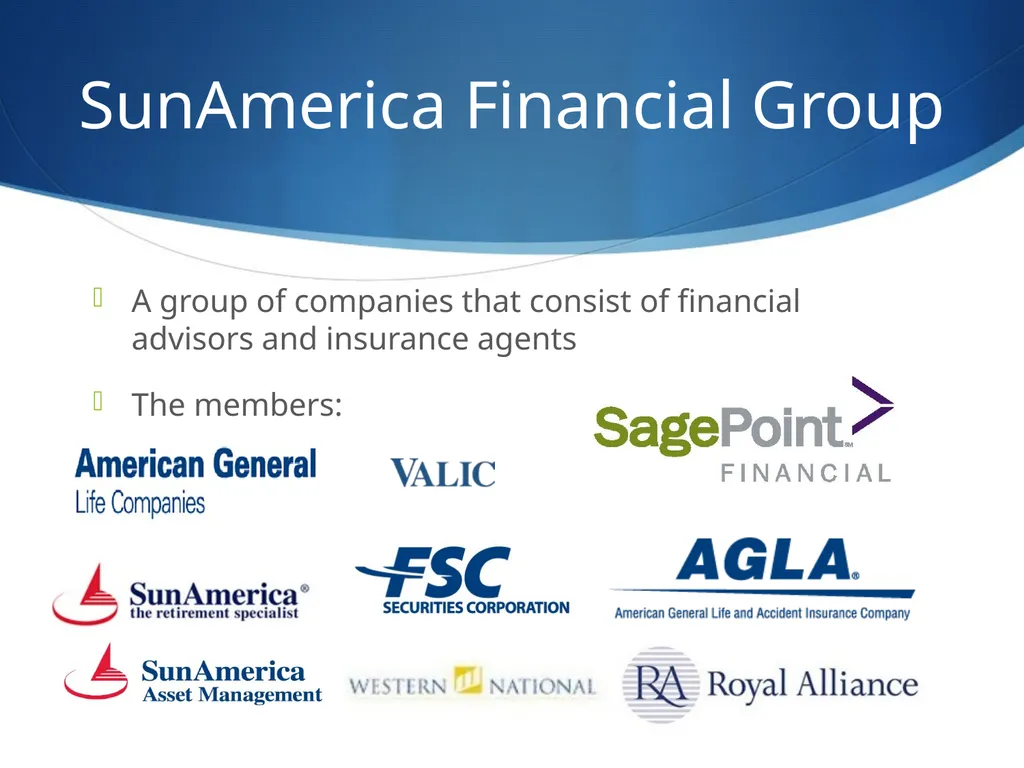
slide25. SunAmerica Financial Group A group of companies that consist of financial advisors and insurance agents
The members:<br>
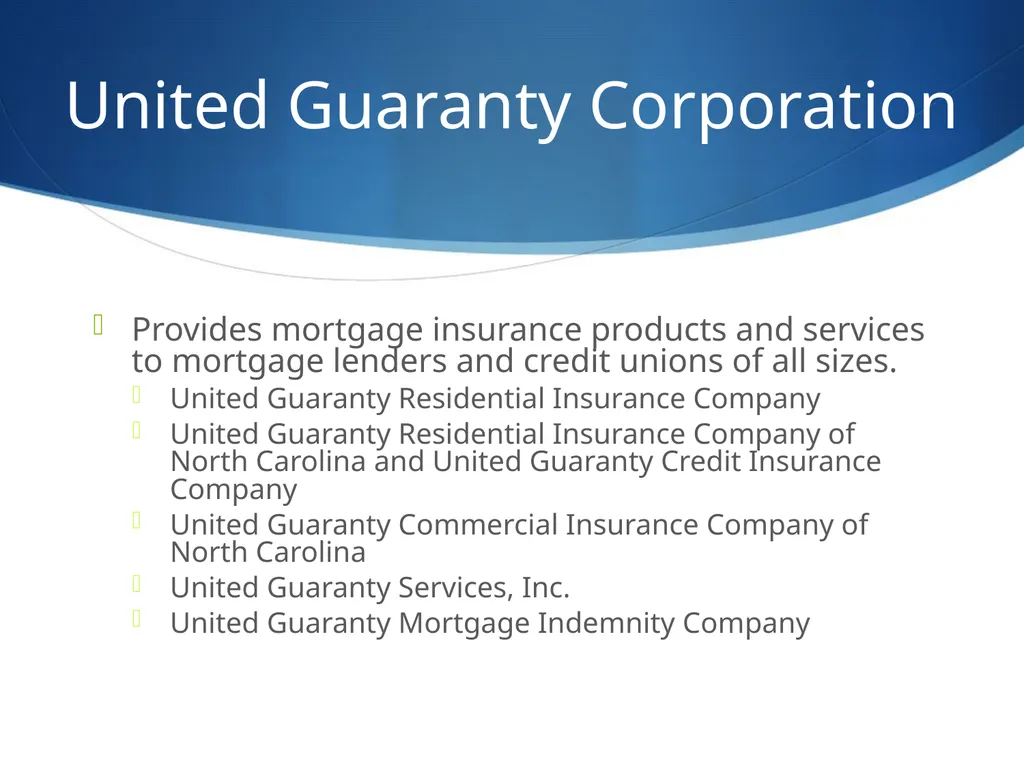
slide26. United Guaranty Corporation Provides mortgage insurance products and services to mortgage lenders and credit unions of all sizes.
United Guaranty Residential Insurance Company
United Guaranty Residential Insurance Company of North Carolina and United Guaranty Credit Insurance Company
United Guaranty Commercial Insurance Company of North Carolina
United Guaranty Services, Inc.
United Guaranty Mortgage Indemnity Company<br>
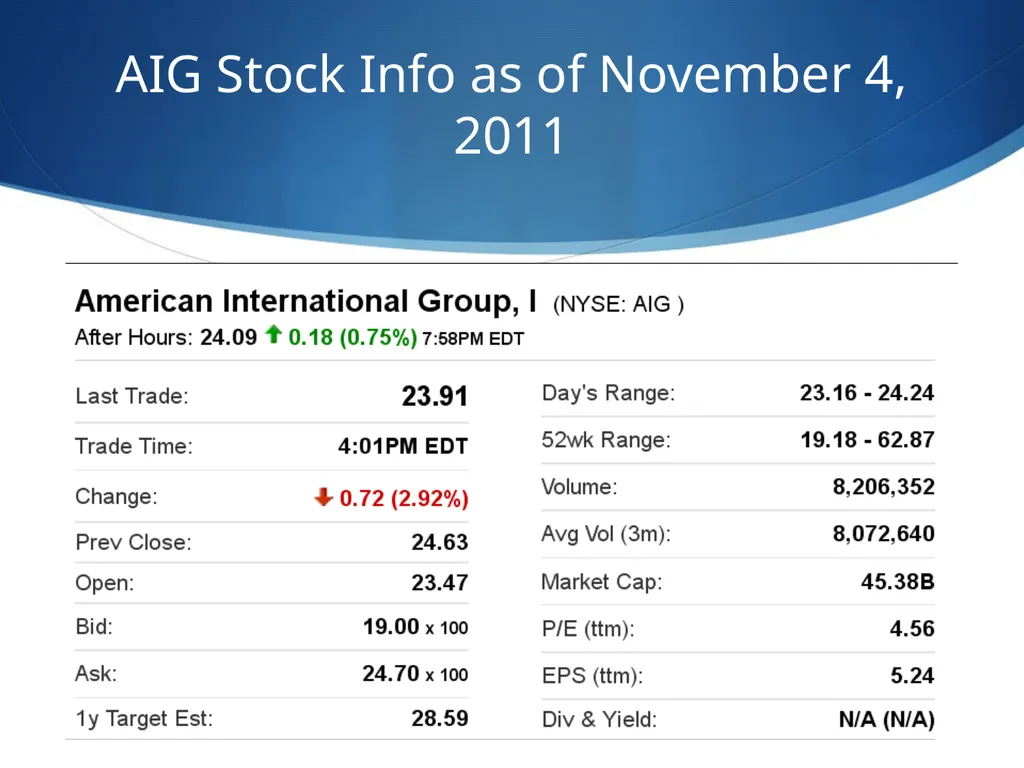
slide27. AIG Stock Info as of November 4, 2011<br>
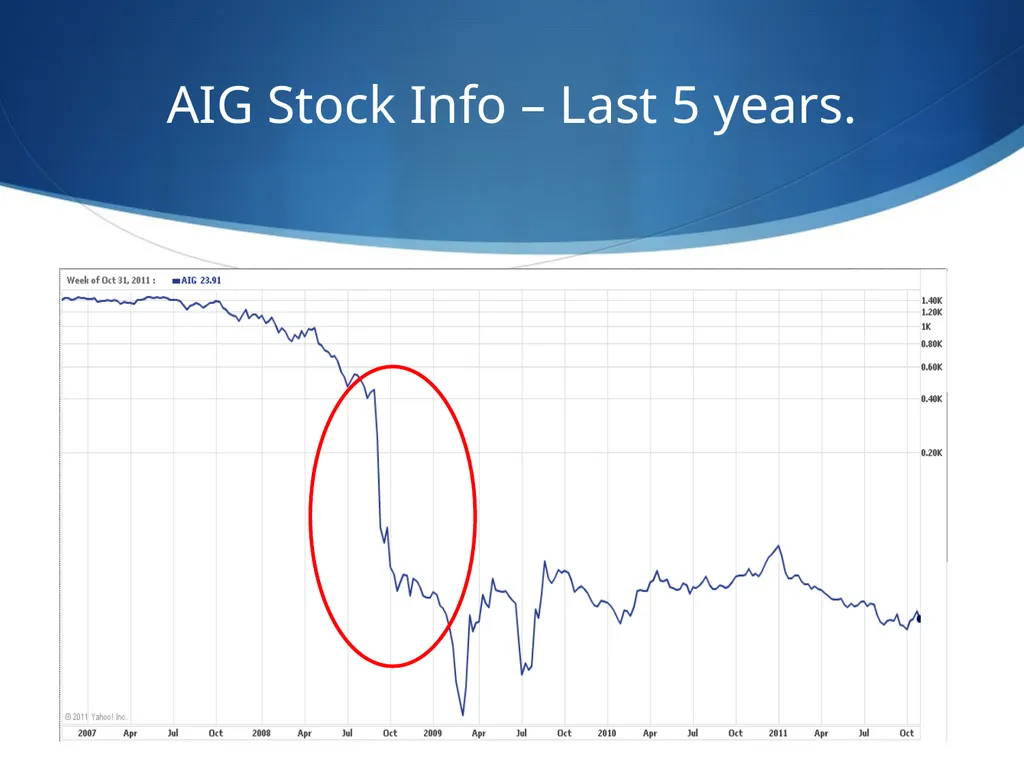
slide28. AIG Stock Info – Last 5 years.<br>
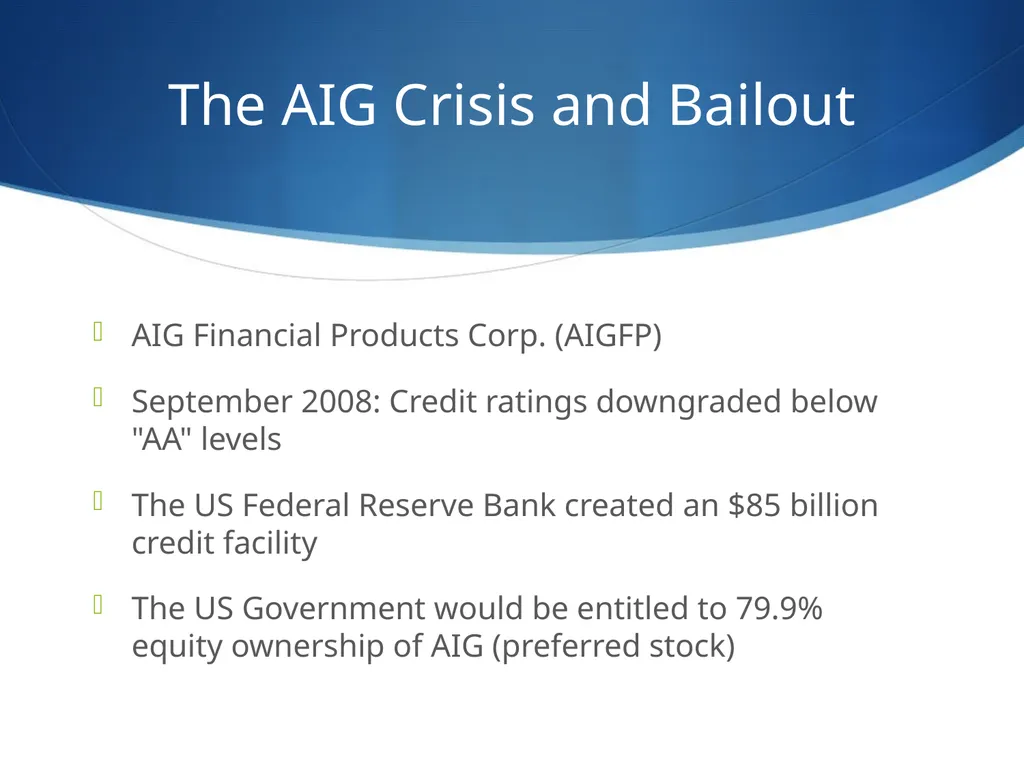
slide29. The AIG Crisis and Bailout AIG Financial Products Corp. (AIGFP)
September 2008: Credit ratings downgraded below "AA" levels
The US Federal Reserve Bank created an $85 billion credit facility
The US Government would be entitled to 79.9% equity ownership of AIG (preferred stock)<br>
slide30. The AIG Crisis and Bailout – Cont. November 2008, came up with :
Maiden Lane II (Lending Division)
Maiden Lane III (Credit default swap Division)
The US Treasury purchased $40 billion of newly issued AIG perpetual preferred shares through TARP
By 2009: $182.5 billion available financial support
Sold a few subsidiaries and assets<br>
slide31. Financial Statements<br>
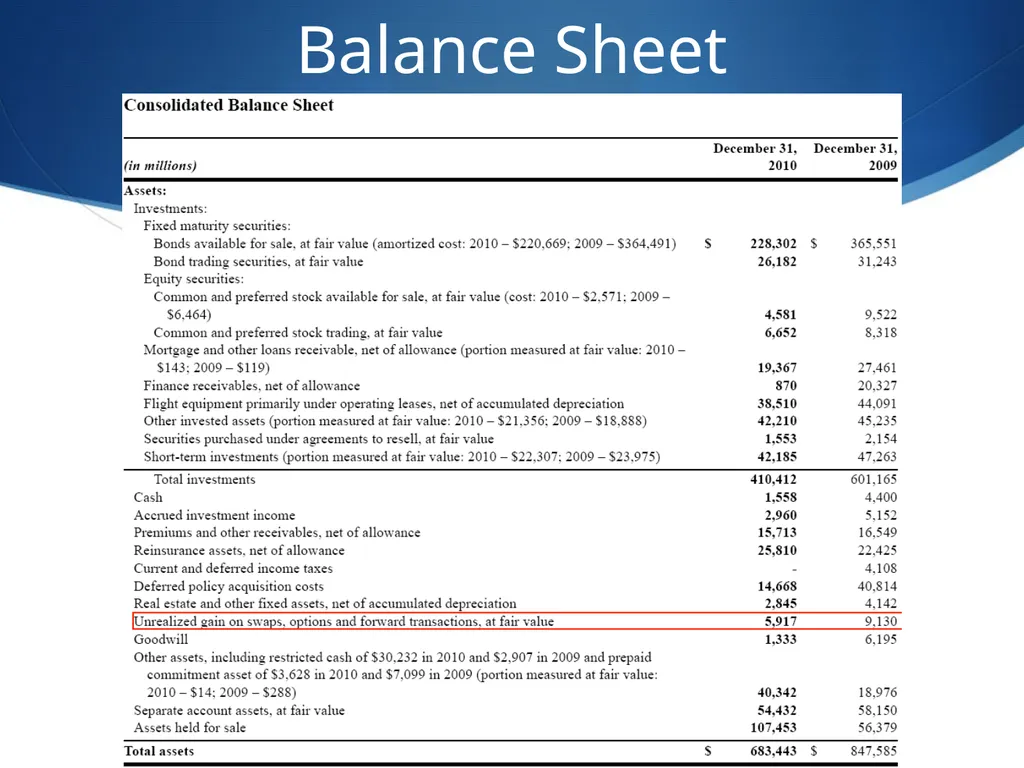
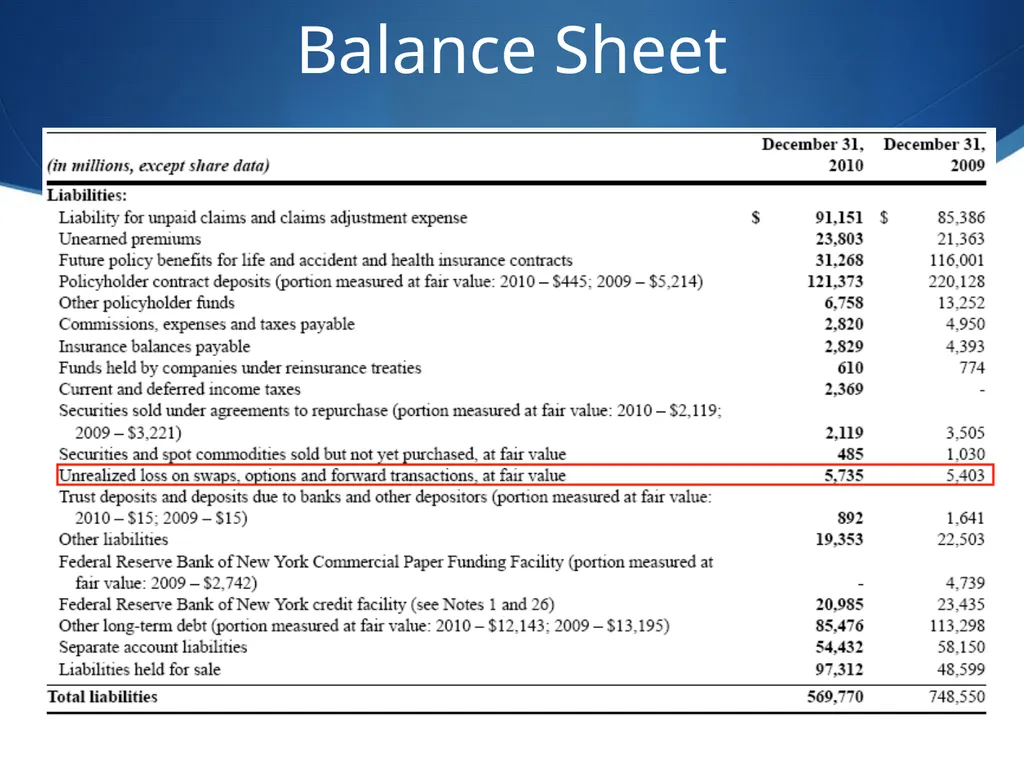
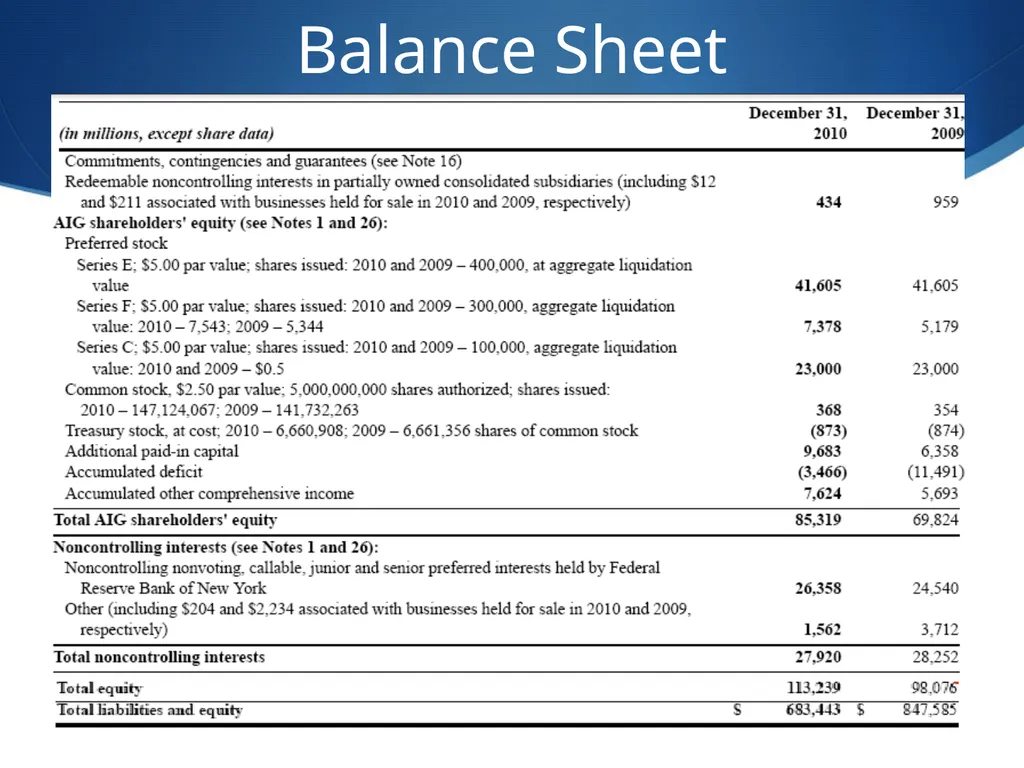
slide32. Balance Sheet<br>
slide33. Balance Sheet<br>
slide34. Balance Sheet<br>
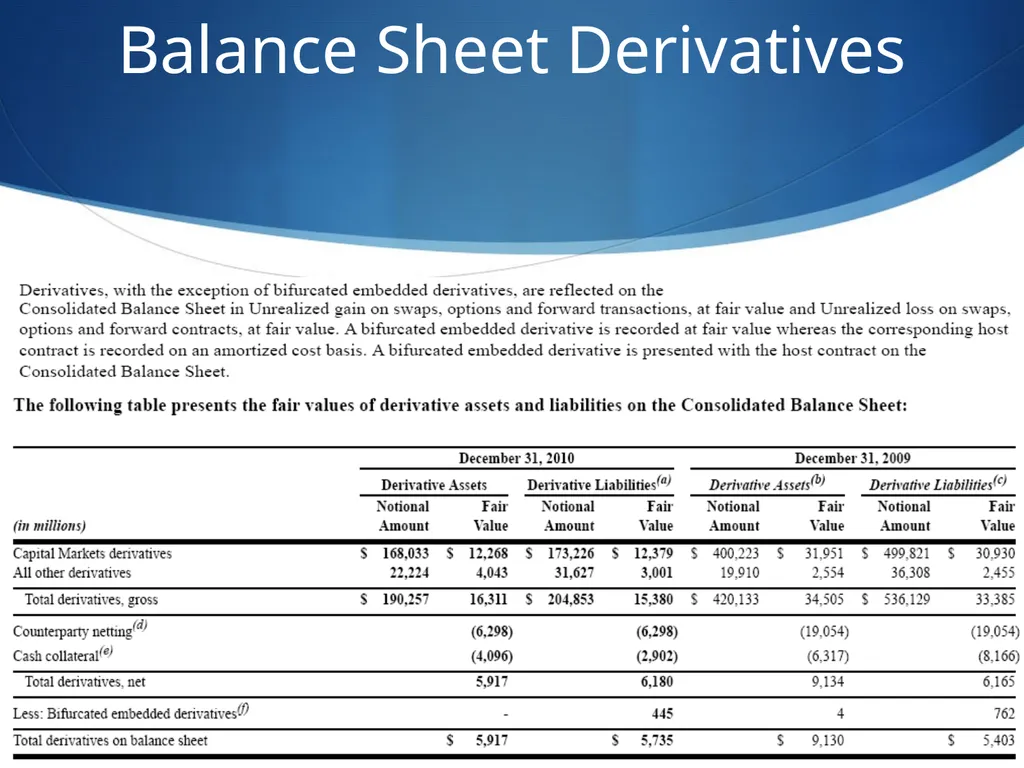
slide35. Balance Sheet Derivatives<br>
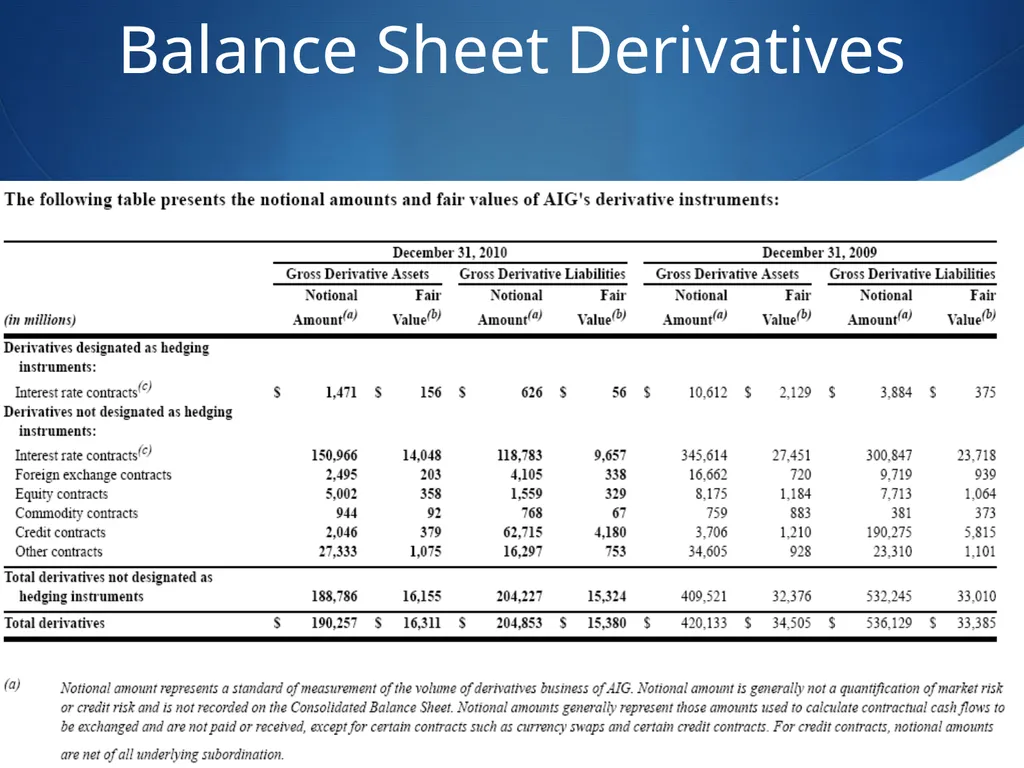
slide36. Balance Sheet Derivatives<br>
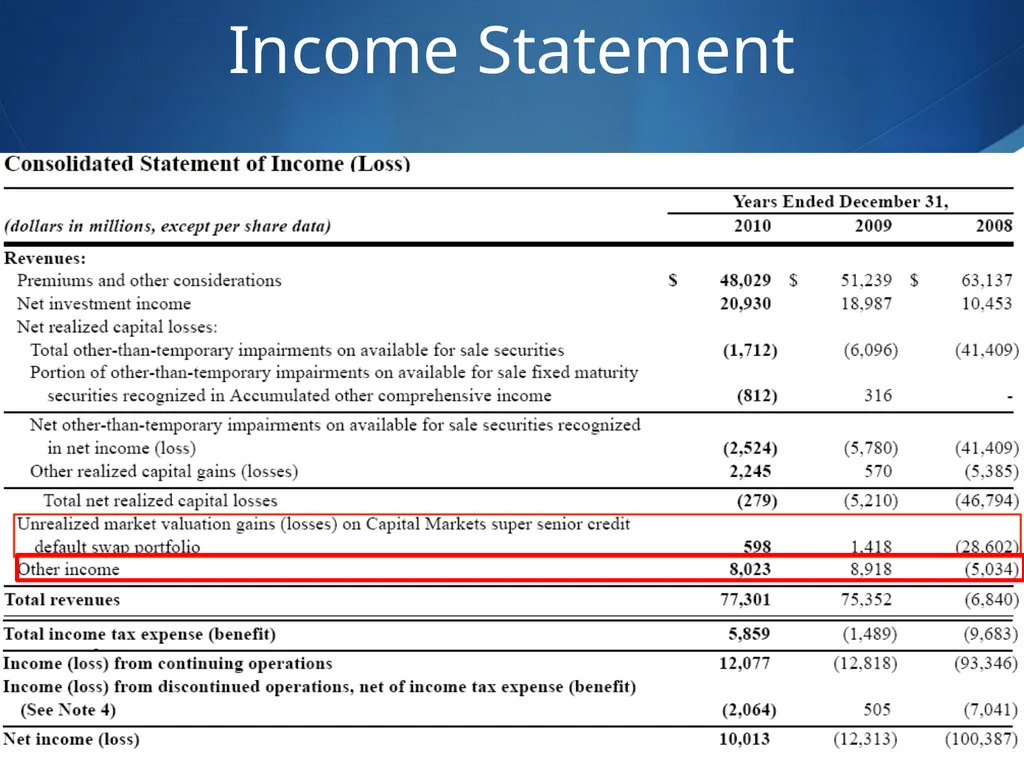
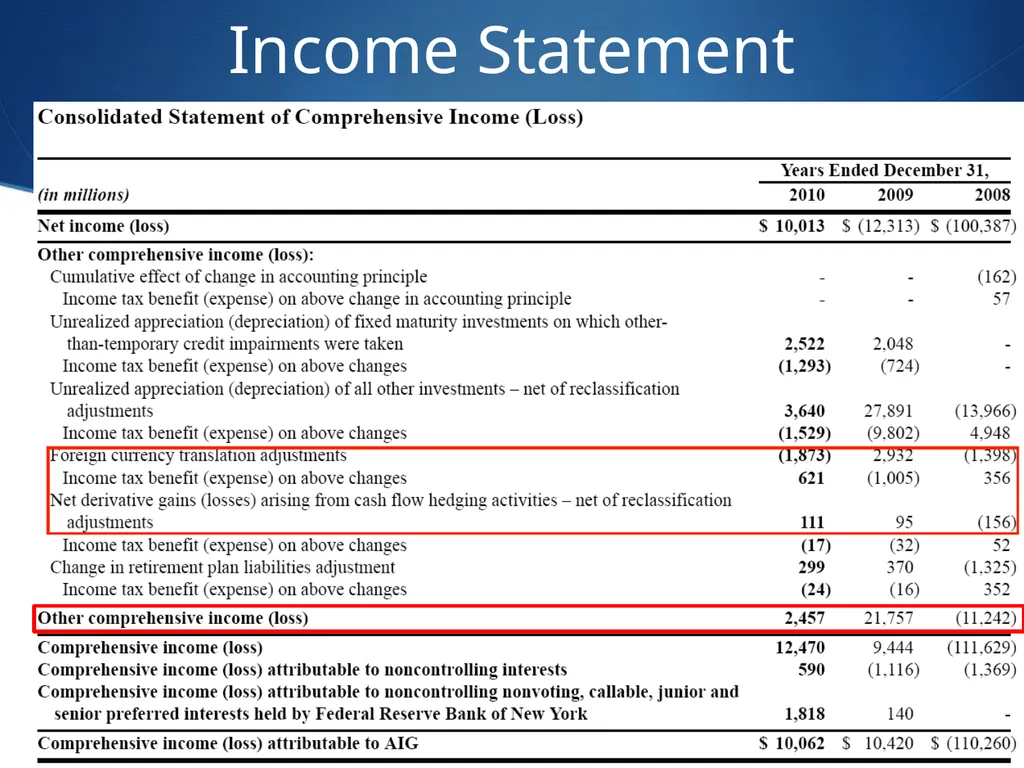
slide37. Income Statement<br>
slide38. Income Statement<br>
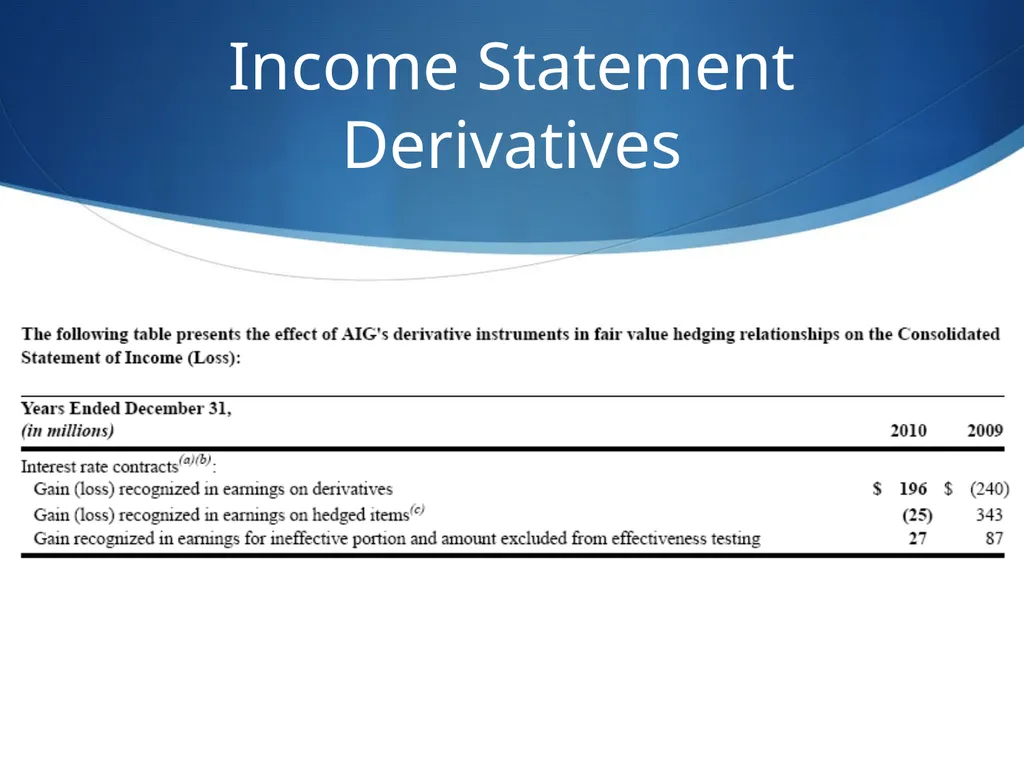
slide39. Income Statement Derivatives<br>
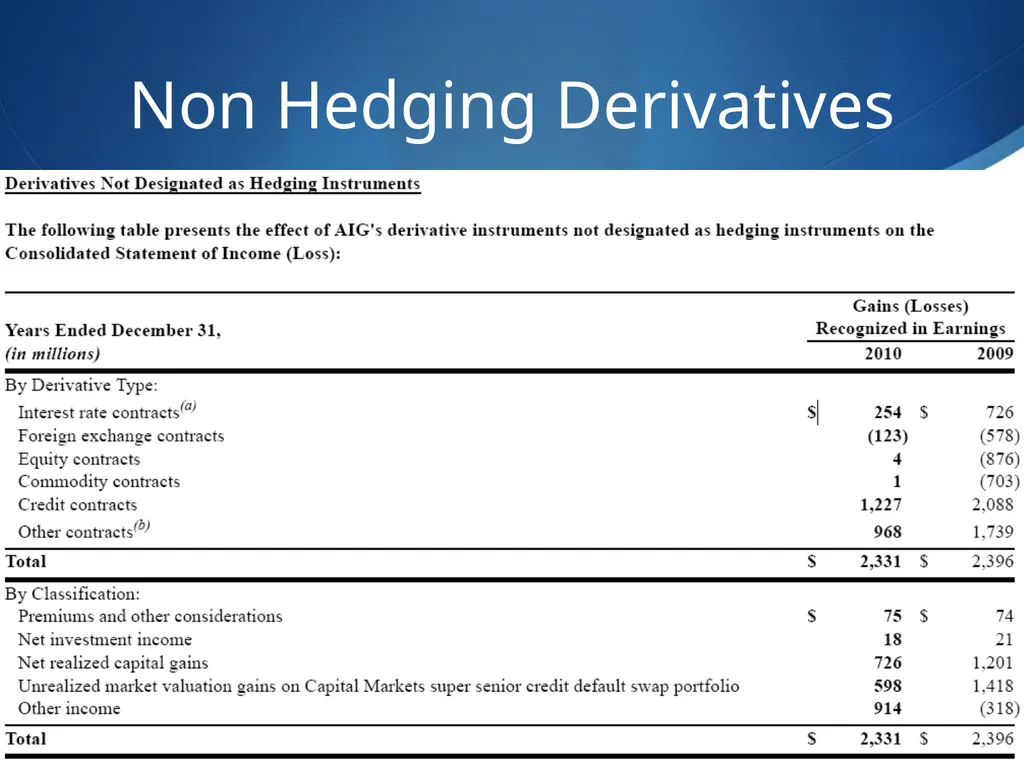
slide40. Non Hedging Derivatives<br>
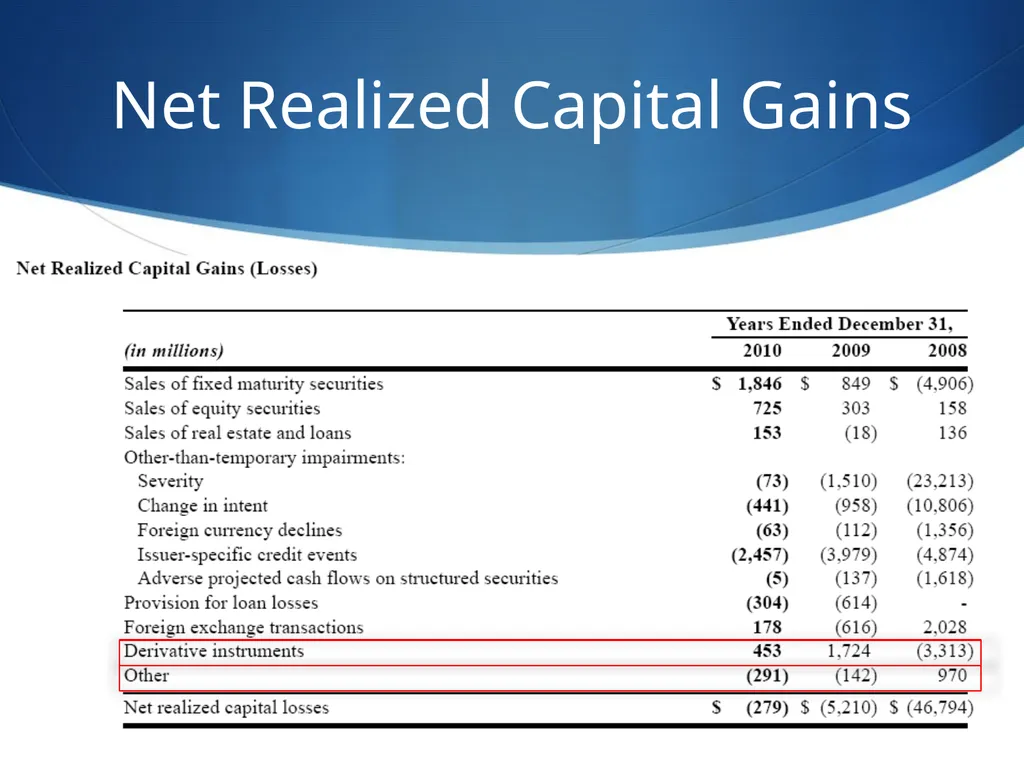
slide41. Net Realized Capital Gains<br>
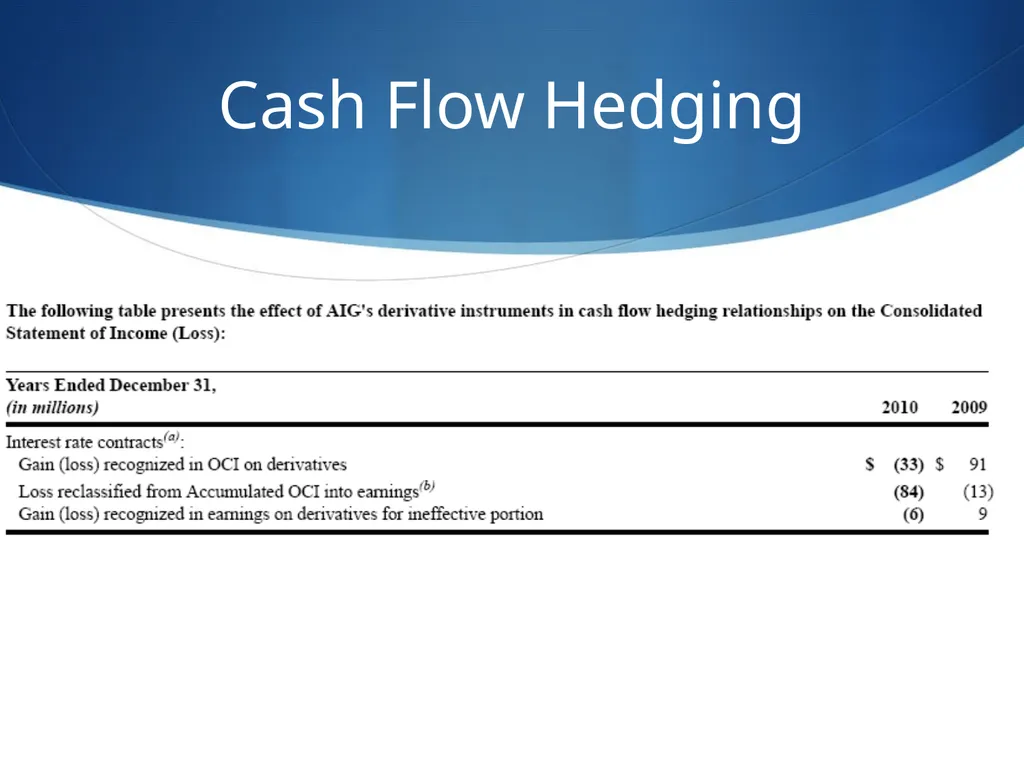
slide42. Cash Flow Hedging<br>
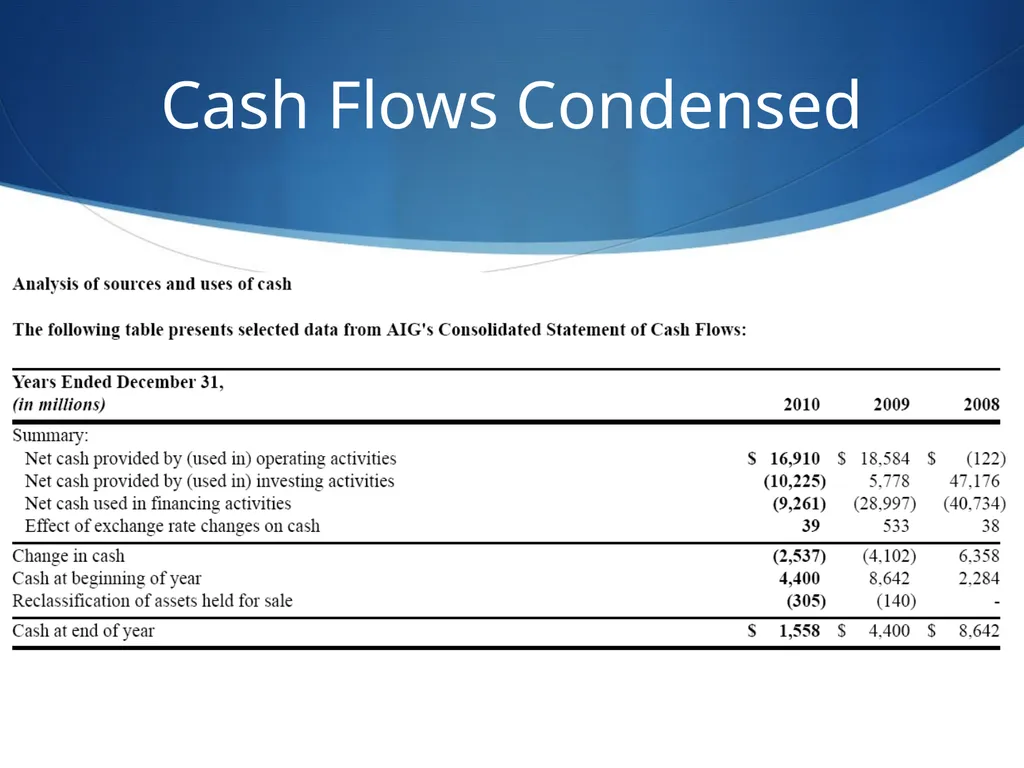
slide43. Cash Flows Condensed<br>
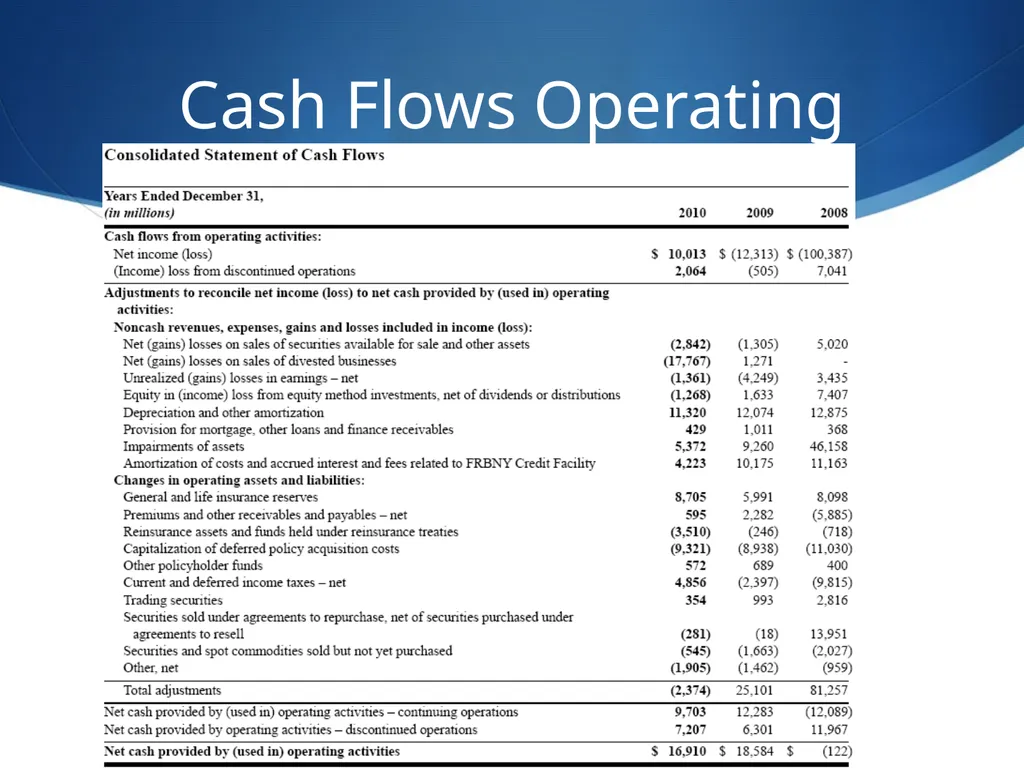
slide44. Cash Flows Operating<br>
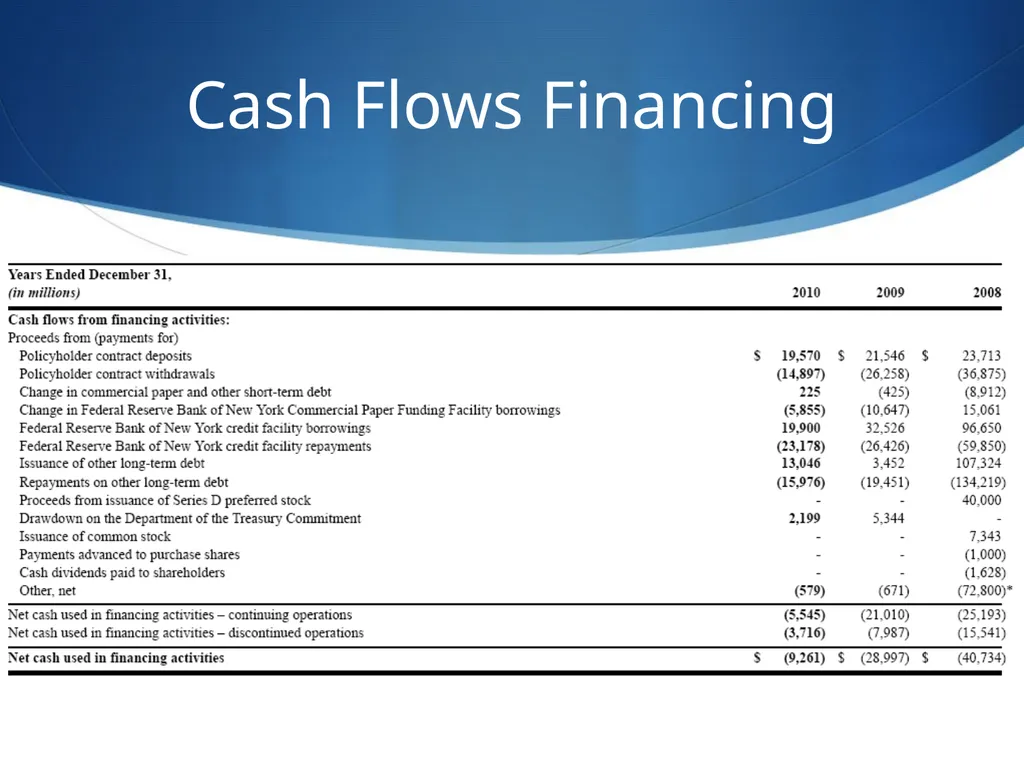
slide45. Cash Flows Financing<br>
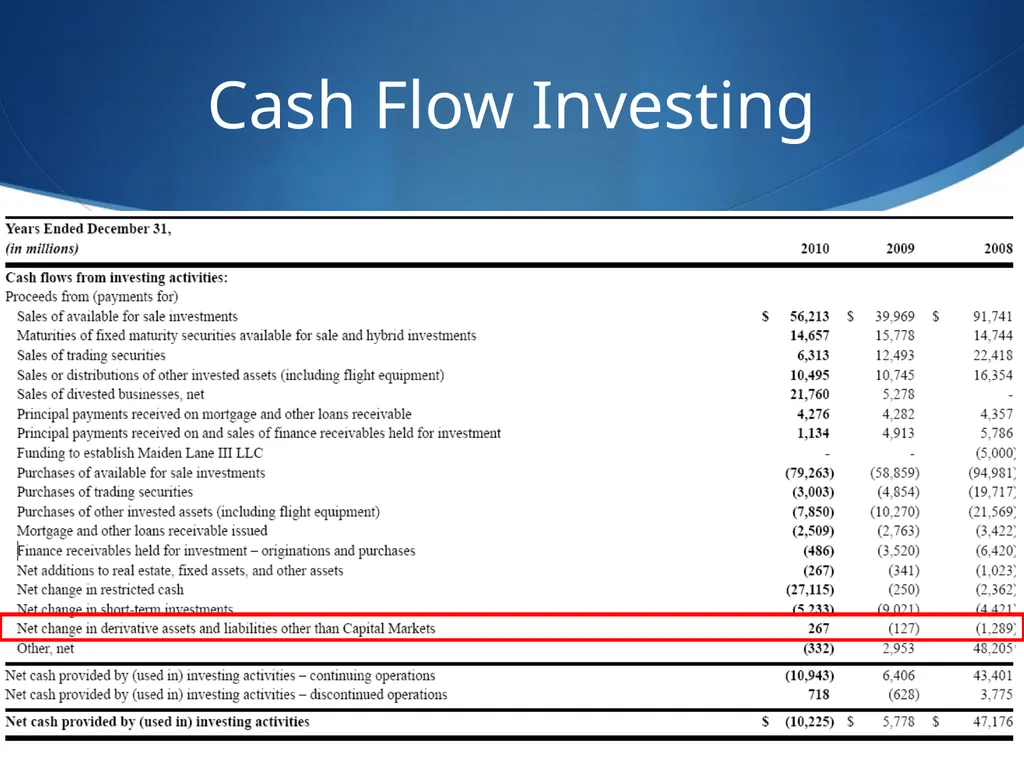
slide46. Cash Flow Investing<br>
slide47. Risk Factors<br>
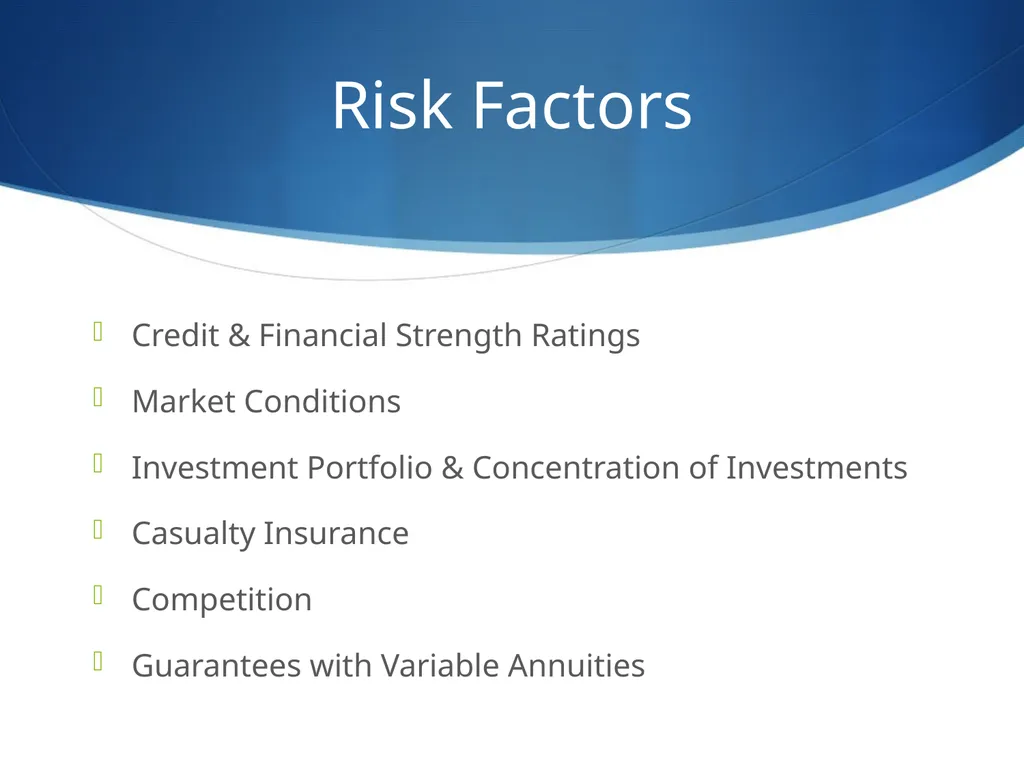
slide48. Risk Factors Credit & Financial Strength Ratings
Market Conditions
Investment Portfolio & Concentration of Investments
Casualty Insurance
Competition
Guarantees with Variable Annuities<br>
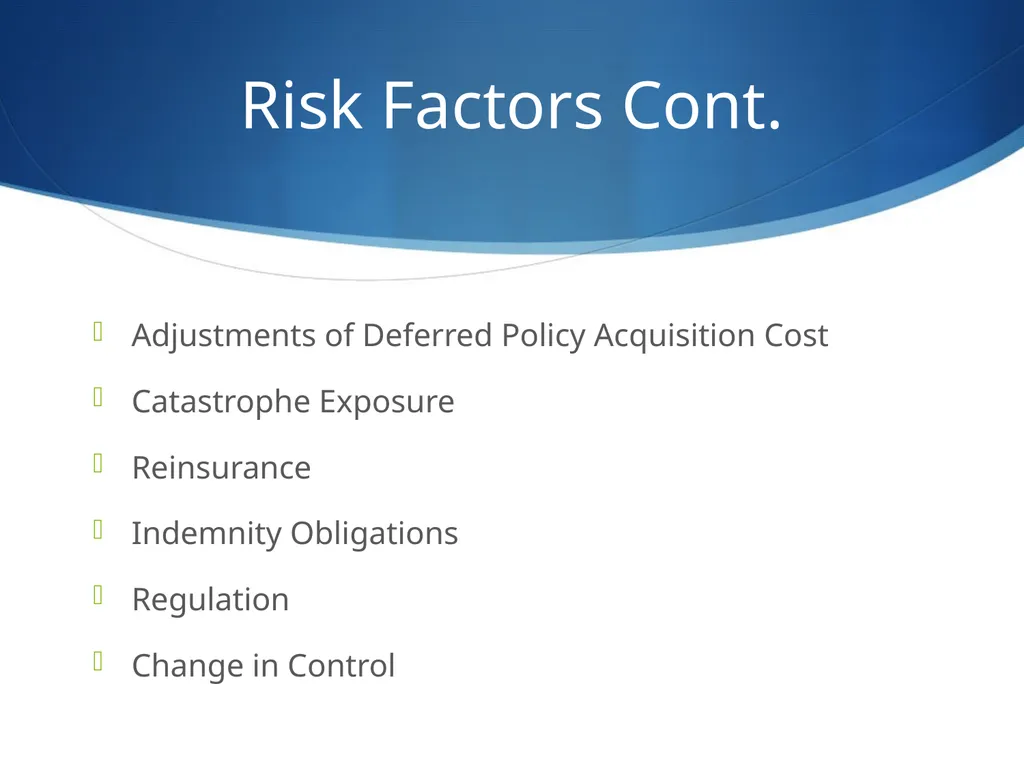
slide49. Risk Factors Cont. Adjustments of Deferred Policy Acquisition Cost
Catastrophe Exposure
Reinsurance
Indemnity Obligations
Regulation
Change in Control<br>
slide50. Risk Factors Cont. Foreign Operations
Legal Proceedings
Use of Estimates
Aircraft Leasing Business
Liquidity<br>
slide51. Risk Factors Cont. Special Purpose Vehicle Intercompany Loans
Controlling Shareholder
Employees
Electronic Data Systems
Regulatory Capital Credit Default Swap Portfolios<br>
slide52. Credit & Financial Strength Ratings Credit and Financial Strength ratings measure the ability of the company to meet contract obligations
Establishes the company’s position relative to other companies
If ratings drop
Could limit new business
Lose current customers/business
Could require AIG to post additional collateral<br>
slide53. Market Conditions Insurance business is highly dependent on the business environment
If markets return to what they were a few years ago AIG could be affected by:
Decline in value of investment portfolio
Unrealized market valuation losses on investments
Impairments of good-will and other long lived assets
Increased liability from interest rate guarantees
Increase in policy surrenders and cancellations<br>
slide54. Investment Portfolios & Concentration of Investments Investment portfolio’s value affected by interest rates:
Can change from monetary policy changes, domestic and international political issues, and other factors
Concentration of investments:
Ability to sell may be limited because of others trying to sell in the same concentration
Ex. AIG has a large exposure to residential mortgage-backed securities, commercial mortgage-backed securities, and commercial mortgage loans<br>
slide55. Casualty Insurance Liabilities are difficult to predict
could exceed current reserves
Historical loss factors used to project future loss development
No guarantee that the future loss will follow the same pattern<br>
slide56. Competition Highly competitive market both domestically and overseas
Competing with insurance companies, banks, investment banks
1800 US life insurance co.
3300 other stock co. (competing with Chartis subsidiaries)
Position affected by credit ratings
Competing through: risk acceptance criteria, product pricing, and terms and conditions<br>
slide57. Guarantees with Variable Annuities Certain policies offered guarantee customers:
Guaranteed minimum death benefits, guaranteed minimum income benefits, guaranteed minimum withdrawal benefits, and guaranteed minimum account benefits
AIG uses derivatives and reinsurance to hedge some of this risk, not fully hedged<br>
slide58. Adjustments of Deferred Policy Acquisition Cost Interest rate changes, increased cancellations, increased investment returns may lead to accelerated amortization of deferred policy acquisition costs
Higher interest rates and investment returns cause an increase in the number of contracts surrendered
Forcing subsidiaries to accelerate the amortization of DACs
If this cost exceeds the cost of surrenders and withdrawals, business could be negatively affected<br>
slide59. Catastrophe Exposure Could cause widespread claim costs: property damage, worker’s compensation, morality and morbidity claims
Leads to a loss from declining value of investment assets<br>
slide60. Reinsurance The company reinsuring may not be able or willing to pay
Relying on a outside company
Bear credit risk with respect to reinsurers
If reinsurer can’t pay in time, AIG is still responsible to the policy holder<br>
slide61. Indemnity Obligations If indemnity claim is material:
AIG will be forced to obliged these claims
Will restrict cash flow, liquidity, and operations<br>
slide62. Regulation July 21, 2010 – Dodd-Frank Wall St. Reform and Consumer Protection Act
Can’t predict the requirements of the regulations that will be adopted and what their effect on AIG will be
May become subject to enforcer/supervisor authority as a savings and loan holding co.
May be forced to place financial activity in a intermediate holding co.
Designated Financial Company
Stress tests – whether or not AIG has necessary cap under adverse economic conditions<br>
slide63. Regulation Cont. If Designated Financial co. gave threat to US financial stability
Would be required to maintain a debt to equity ratio of no more than 15:1
Limit the ability of AIG to merge, acquire, consolidate, or become affiliated with other companies
Restrictions on the financial products offered
Required to terminate some current activities
Could be forced to sell or transfer assets to unaffiliated entities<br>
slide64. Regulation Cont. Valker Rule
If AIG continues to control AIG Federal Savings bank could be subject to this rule
Limits proprietary trading and the sponsorship/investment in hedge, private equity or similar funds
USA Patriot Act – 2001
Requires companies to know certain information about their clients and to monitor their transactions for suspicious activities<br>
slide65. Change in Control Ability to utilize tax losses and credit carryforwards to offset future taxable income may be limited under the Internal Revenue Code
Entities that experience ownership change generally subject to annual limitation on its pre-ownership change tax losses and credit carryforwards equal to the equity value of the corporation multiplied by the long-term, tax exempt rate
Ownership change could occur if Department of Treasury’s position falls bellow 50% of the current shares<br>
slide66. Foreign Operations Provides insurance, investment and other financial products and services in over 130 countries
Can be affected by regional economic downturns, foreign exchange rate fluctuations, political upheaval, nationalism and other restrictive government actions
Licenses issued to AIG subsidiaries could be modified or revoked
Insurance subsidiaries could be restricted from doing future business in certain countries<br>
slide67. Legal Proceedings Security class actions, and regulatory and government investigations
Unable to predict the maximum liability of these claims
No precise damage claims, and the types of claims are uncertain<br>
slide68. Use of Estimates Generally Accepted Accounting Principles:
Require some sections with significant degrees of judgment/estimation
Estimates could turn out to be inaccurate<br>
slide69. Aircraft Leasing Business Aircraft business depends on lease payments
Exposes AIG to several risks:
Lessee non-performance
Aircrafts become obsolete
Decline in demand of product<br>
slide70. Liquidity Need liquidity to pay operating expenses, interest on debt, to meet capital requirements of AIG’s subsidiaries
Payments to AIG Parent
Require funs (dividends) from subsidiaries to fund payments due on obligations
Some investments by subsidiaries are illiquid or difficult to sell
AIG Parent may be unable to assist subsidiaries with unexpected cash flow obligations – may be difficult for subsidiaries to generate liquidity because of these assets<br>
slide71. Special Purpose Vehicle Intercompany Loans If AIG is unable to satisfy obligations made, secured parties may have the right to foreclose upon and sell the assets that secure the loans
Would negatively affect the designated subsidiaries<br>
slide72. Controlling Shareholder The Department of the Treasury is AIG’s controlling shareholder with over 50% of current shares
This gives them control over:
Approval of mergers or other business combinations
A sale of all or substantially all of AIG’s assets
Amendments to AIG Parents amended certificate of incorporation
Other matters that might be favorable to the Department of the Treasury but not other shareholders<br>
slide73. Controlling Shareholder Cont. Department of the Treasury could transfer control to another entity
Department of the Treasury is granted registration rights with respect to shares of common stock issued for recapitalization
Right to participate in any registered offering of AIG common stock
Right to engage in at the market offerings
Right to approve the terms, conditions, and pricing of any registered offering in which it participates until ownership falls bellow 33%<br>
slide74. Employees President and Chief Executive Offers of AIG – Mr. Robert Benmosche
Diagnosed with cancer and may be unable to provide his services
American Recovery and Reinvestment Act of 2009
Restricts bonuses and other incentives payable to employees
Risk of employee fraud, error, failure to document properly or to obtain proper internal authorization, failure to comply with regulatory restrictions<br>
slide75. Electronic Data Systems Computer systems used to store, retrieve, evaluate, and utilize customer and company data
Systems rely on a 3rd party
If the system fails and employees are unable to access the data – business operations could be forced on hold until the system is repaired
Confidential information may be misused or mishandled leading to legal liabilities<br>
slide76. Regulatory Capital Credit Default Swap Portfolio Deterioration in credit markets may cause AIG to experience unrealized market valuation losses
Could be required to post additional collateral
Net of $38.1 Billion in credit default portfolio for providing capital relief rather than for arbitrage purposes<br>
slide77. Management of Risk Factors<br>
slide78. Major Risk Factors AIG identifies four major risk to which the corporation is exposed to
Credit Risk
Market Risk
Operation Risk
Insurance Risk<br>
slide79. Credit Risk Potential loss arising from an obligor’s inability or unwillingness to meet its obligations to AIG.
Direct and indirect credit exposures
fixed income investments
deposits
corporate and consumer loans
counterparty risk in derivatives activities
cessions of insurance risk to reinsurers and customers
credit risk assumed through credit derivatives written<br>
slide80. Managing Credit Risk Managed at a corporate level by the AIG Credit Risk Management (CRM) department, lead by the Chief Credit Officer (CCO)
delegated credit authorities among executives and officers
manage the credit limits, program limits and credit
administer portfolio credit reviews of all business units, and recommend any corrective actions where required
develop methodologies for quantification and assessment of credit risks
approve appropriate credit reserves and methodologies at the business unit and enterprise levels<br>
slide81. Managing Credit Risk Uses third-party guarantees, reinsurance recoverable, letters of credit and trust accounts to minimize level of credit risk
Also manages industry concentrations
Current largest industry credit exposure is global financial institutions sector<br>
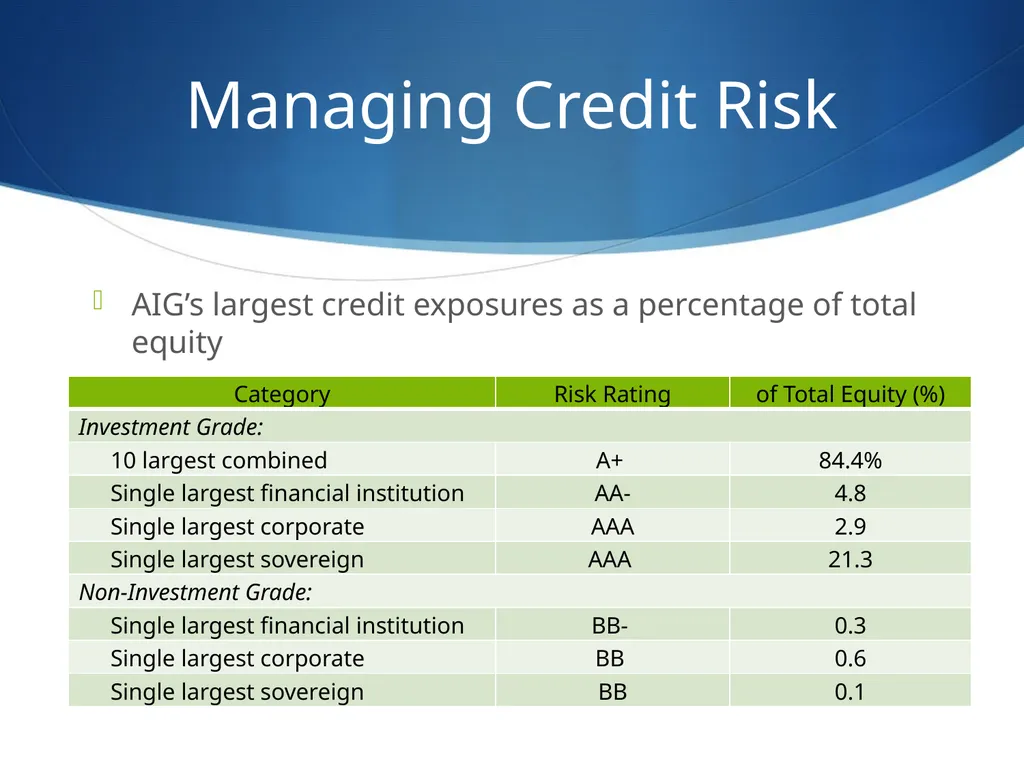
slide82. Managing Credit Risk AIG’s largest credit exposures as a percentage of total equity<br>
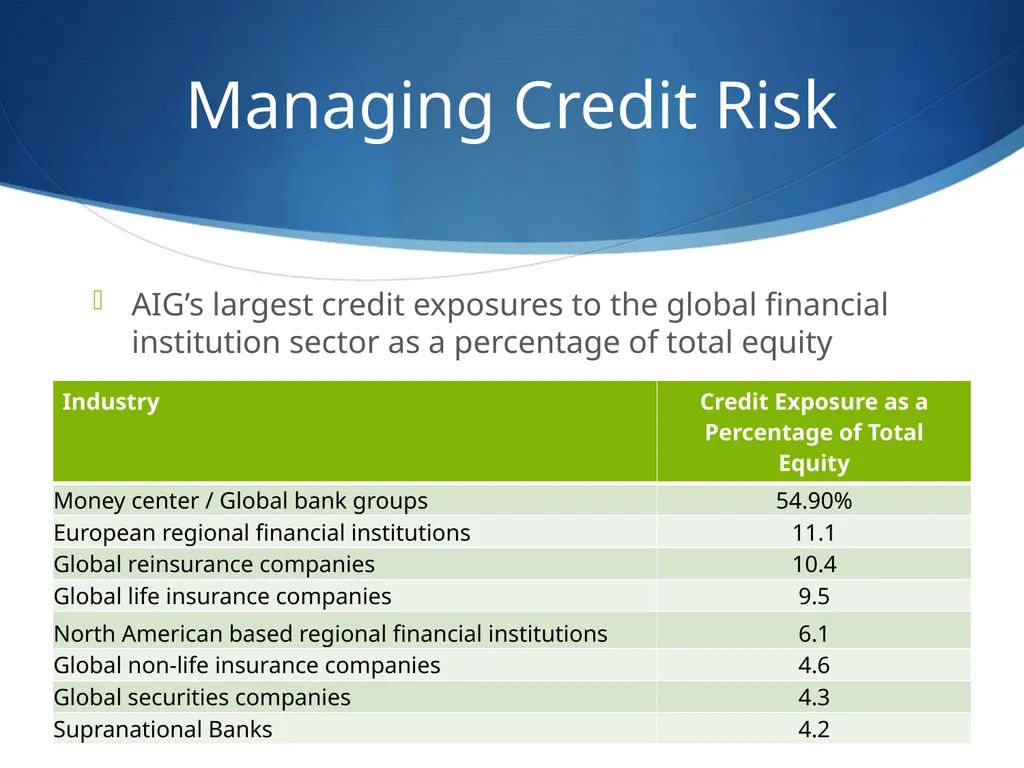
slide83. Managing Credit Risk AIG’s largest credit exposures to the global financial institution sector as a percentage of total equity<br>
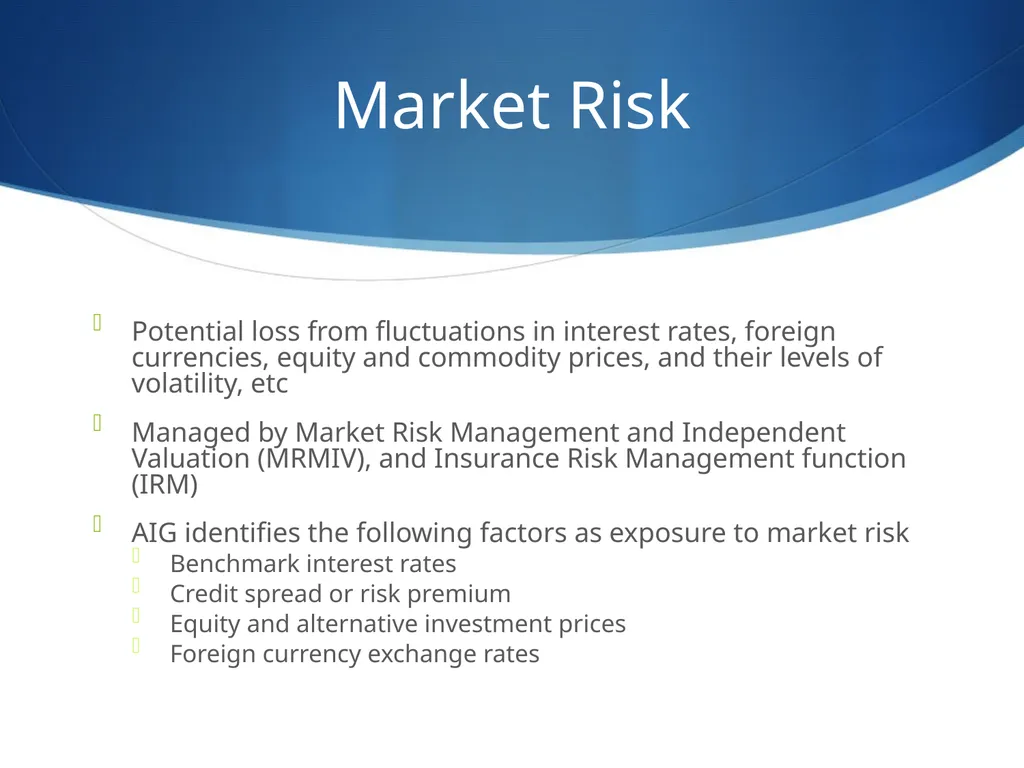
slide84. Market Risk Potential loss from fluctuations in interest rates, foreign currencies, equity and commodity prices, and their levels of volatility, etc
Managed by Market Risk Management and Independent Valuation (MRMIV), and Insurance Risk Management function (IRM)
AIG identifies the following factors as exposure to market risk
Benchmark interest rates
Credit spread or risk premium
Equity and alternative investment prices
Foreign currency exchange rates<br>
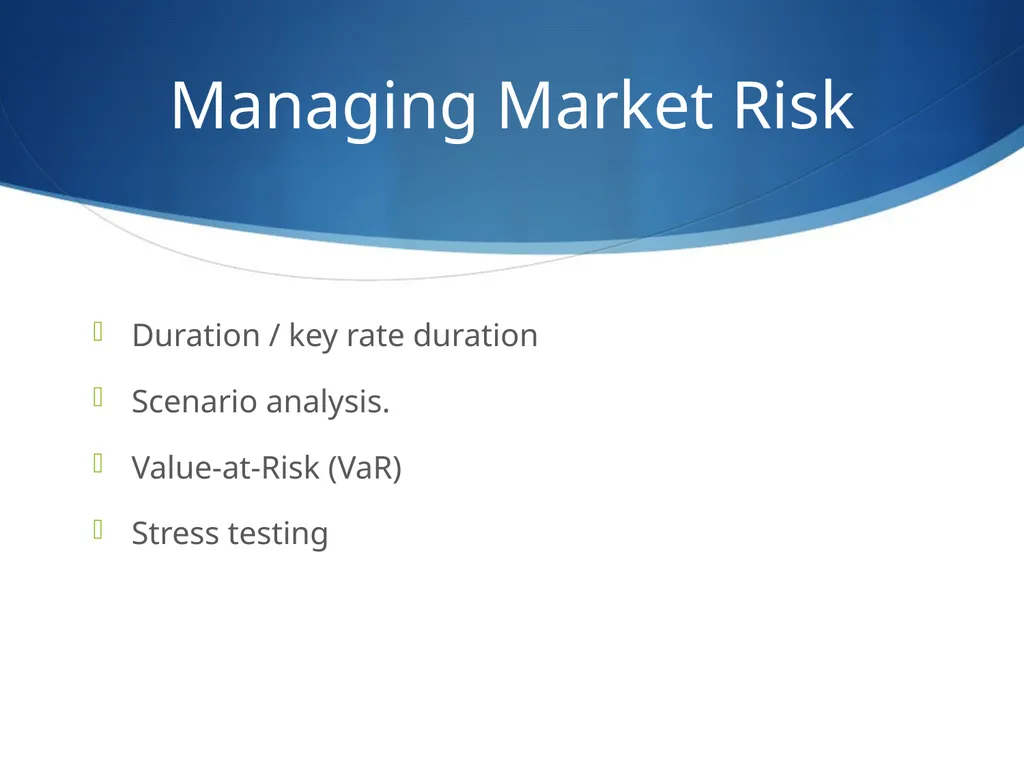
slide85. Managing Market Risk Duration / key rate duration
Scenario analysis.
Value-at-Risk (VaR)
Stress testing<br>
slide86. Operational Risk Potential loss resulting from inadequate or failed internal processes, people, and systems, or from external events
Each business unit is responsible for its operational risk
pro-actively address potential operational risk issues
assign ownership and accountability for addressing identified issues.<br>
slide87. Insurance Risks Of all the insurance risks, liquidity risk is the fundamental risk for insurance companies.
Potential loss resulting from inadequate premiums, insufficient reserves and catastrophic exposures.
Main contributors to solvency issues.<br>
slide88. How AIG Manages Liquidity Risk Compliance with financial reporting and capital and solvency targets.
Extensive use of reinsurance, both internal and third-party.
Review and establishment of reserves.<br>
slide89. Insurance Risks Specific types of risks to these areas of insurance
Life Insurance
Property and Casualty Insurance<br>
slide90. Life Insurance Risk Potential loss resulting from experience deviating from expectations for mortality, morbidity and termination rates in the insurance-oriented products and insufficient cash flows to cover contract liabilities in the retirement savings products.
SunAmerica has life insurance risks<br>
slide91. Primary Risks of SunAmerica Pricing risk
Investment risk
Interest rate risk
Equity market risk<br>
slide92. Ways to Manage Life Insurance Risks Appropriate product design
Sound medical underwriting
Active management of the asset-liability relationship
External reinsurance programs
SunAmerica generally limit their maximum underwriting exposure on life insurance of a single life to $15 million<br>
slide93. Property and Casualty Insurance Risks Chartis and Mortgage Guaranty have P&C risks
The mortgage insurance business (Mortgage Guaranty) manages risks through:
geographic location of the insured properties
the relative economic conditions in the local housing markets
credit attributes of the borrowers
the loan amount relative to the value of the respective collateral<br>
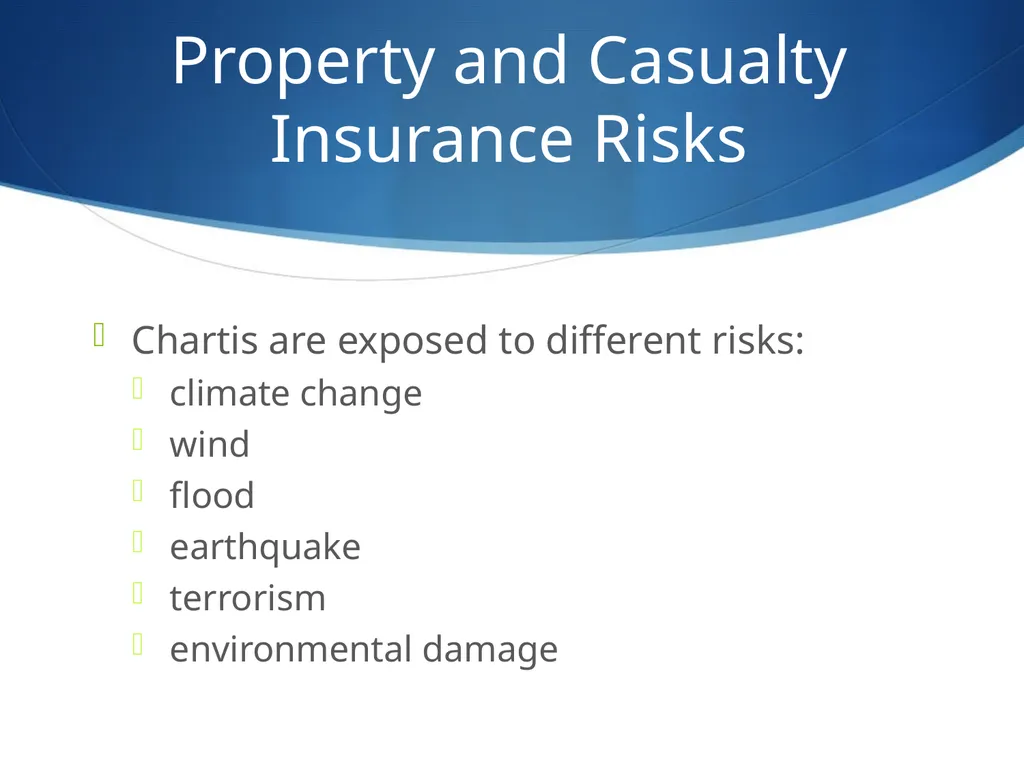
slide94. Property and Casualty Insurance Risks Chartis are exposed to different risks:
climate change
wind
flood
earthquake
terrorism
environmental damage<br>
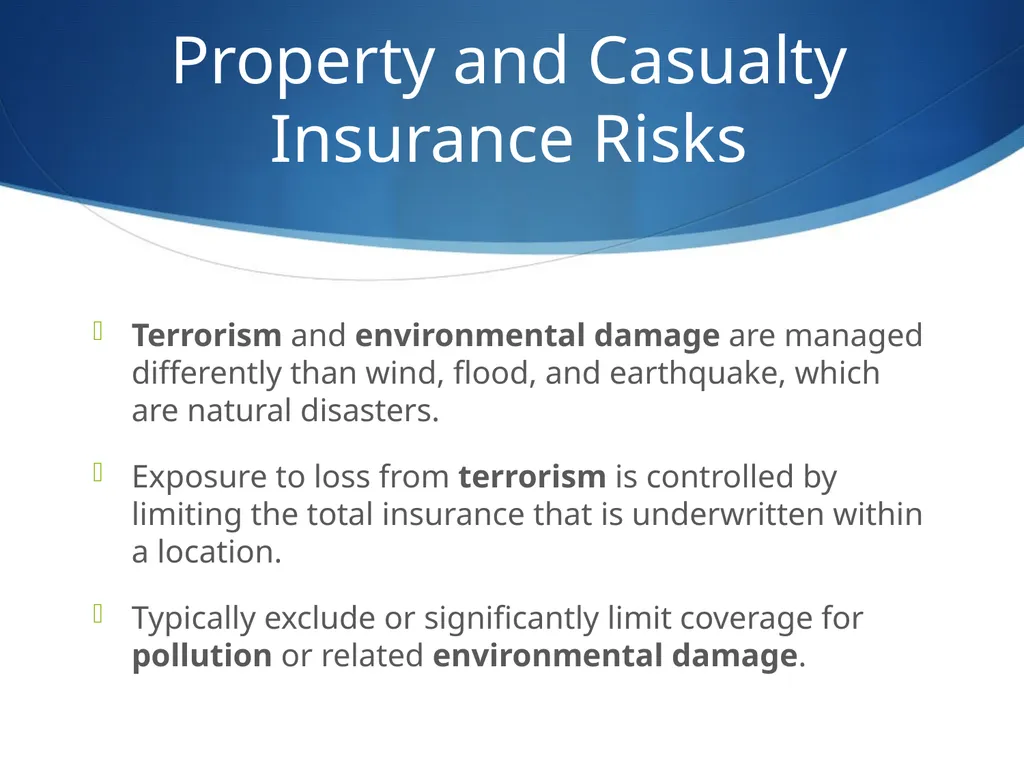
slide95. Property and Casualty Insurance Risks Terrorism and environmental damage are managed differently than wind, flood, and earthquake, which are natural disasters.
Exposure to loss from terrorism is controlled by limiting the total insurance that is underwritten within a location.
Typically exclude or significantly limit coverage for pollution or related environmental damage.<br>
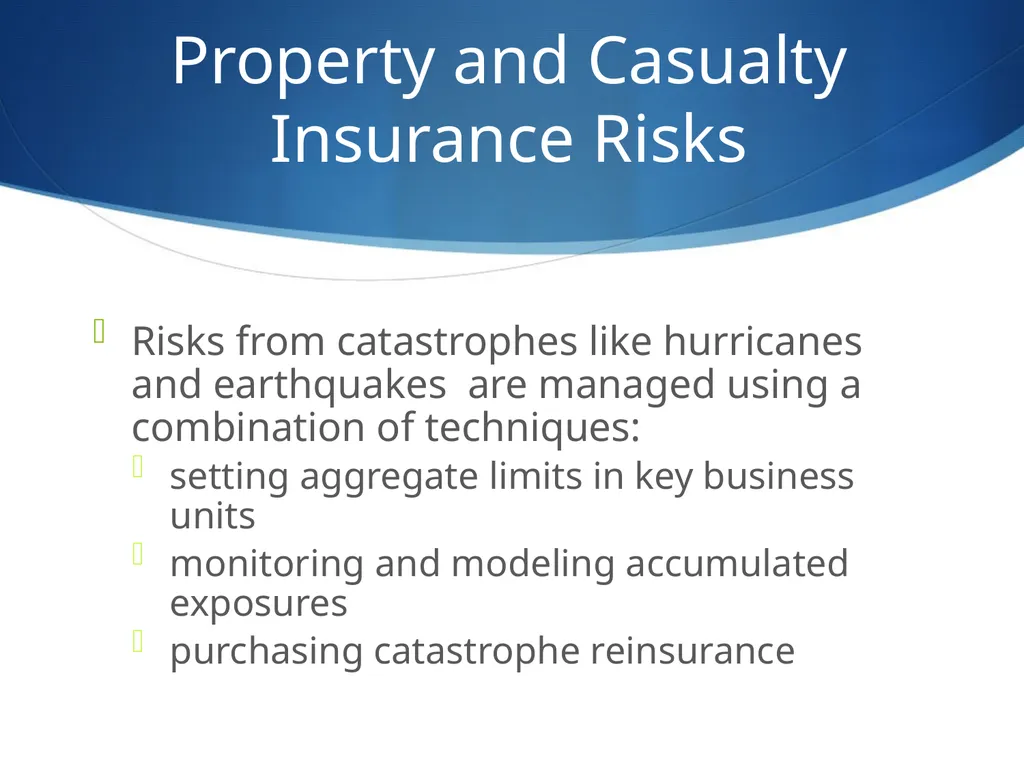
slide96. Property and Casualty Insurance Risks Risks from catastrophes like hurricanes and earthquakes are managed using a combination of techniques:
setting aggregate limits in key business units
monitoring and modeling accumulated exposures
purchasing catastrophe reinsurance<br>
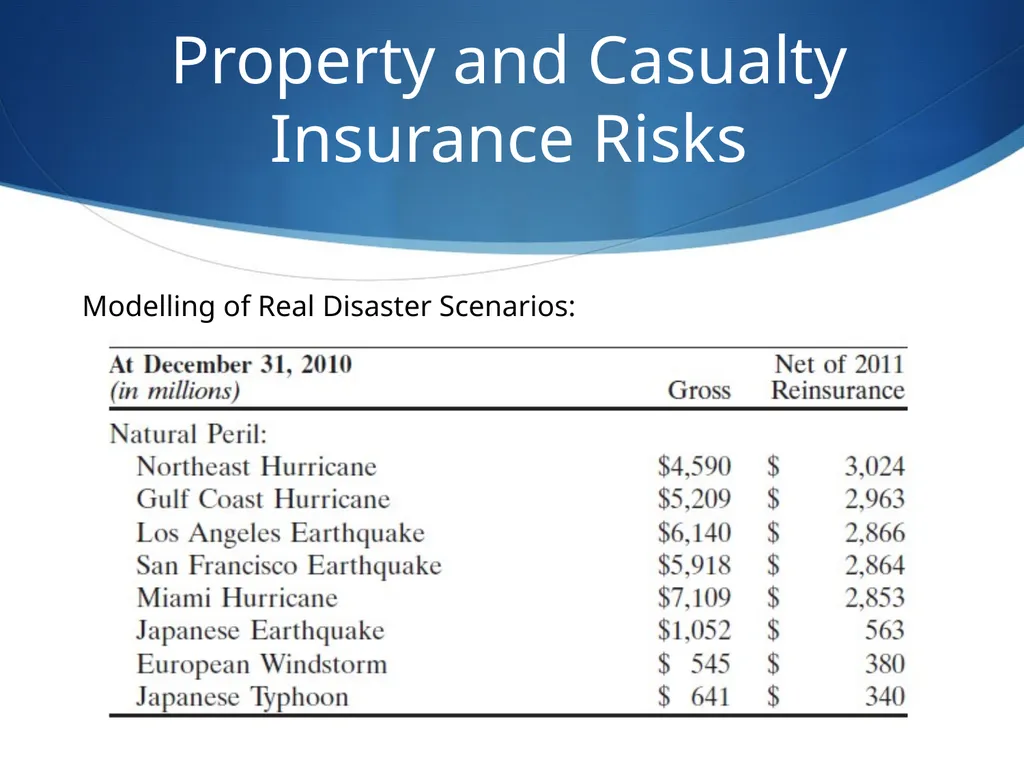
slide97. Property and Casualty Insurance Risks Modelling of Real Disaster Scenarios:<br>
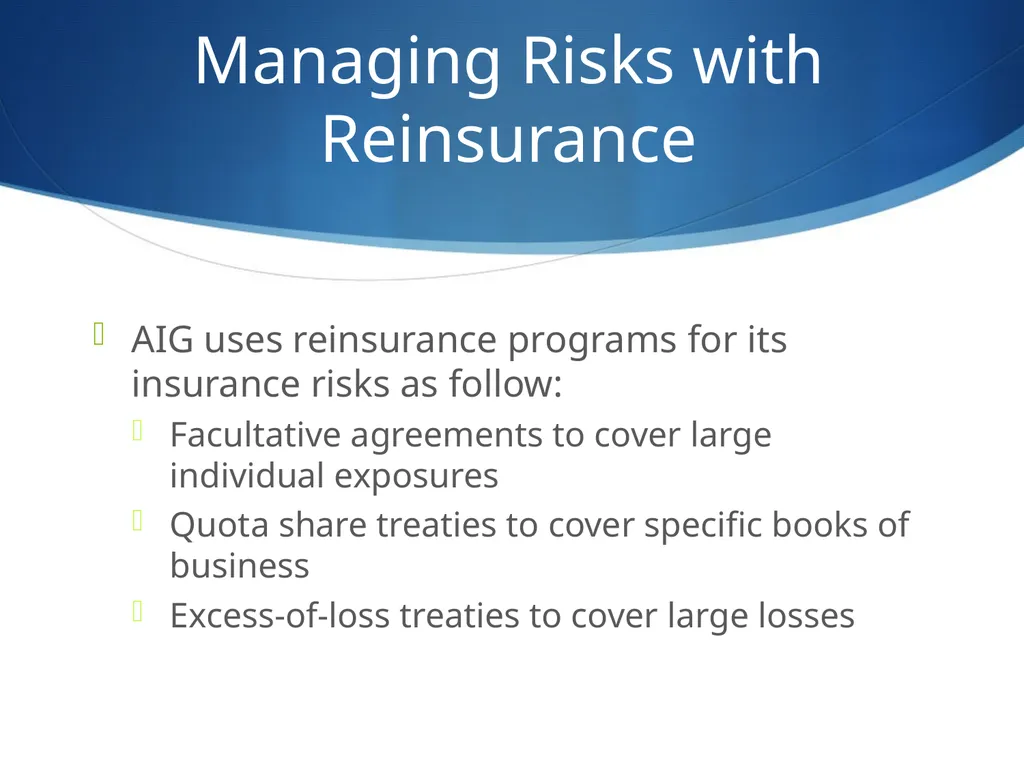
slide98. Managing Risks with Reinsurance AIG uses reinsurance programs for its insurance risks as follow:
Facultative agreements to cover large individual exposures
Quota share treaties to cover specific books of business
Excess-of-loss treaties to cover large losses<br>
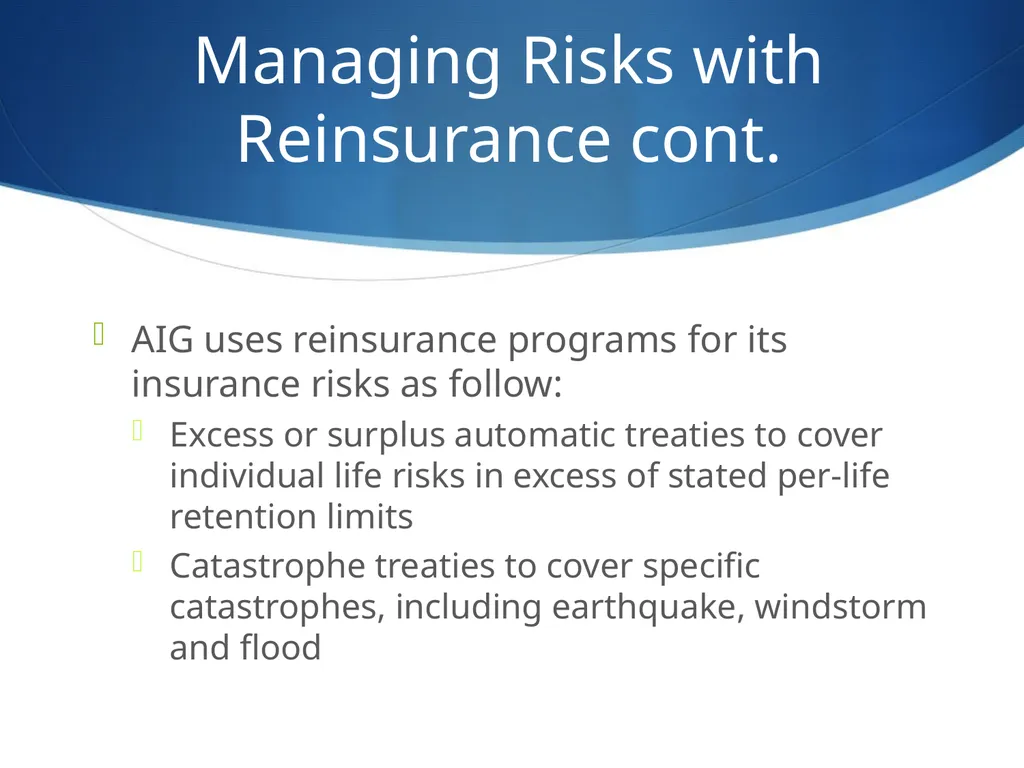
slide99. Managing Risks with Reinsurance cont. AIG uses reinsurance programs for its insurance risks as follow:
Excess or surplus automatic treaties to cover individual life risks in excess of stated per-life retention limits
Catastrophe treaties to cover specific catastrophes, including earthquake, windstorm and flood<br>
slide100. Risk Management Recommendations<br>
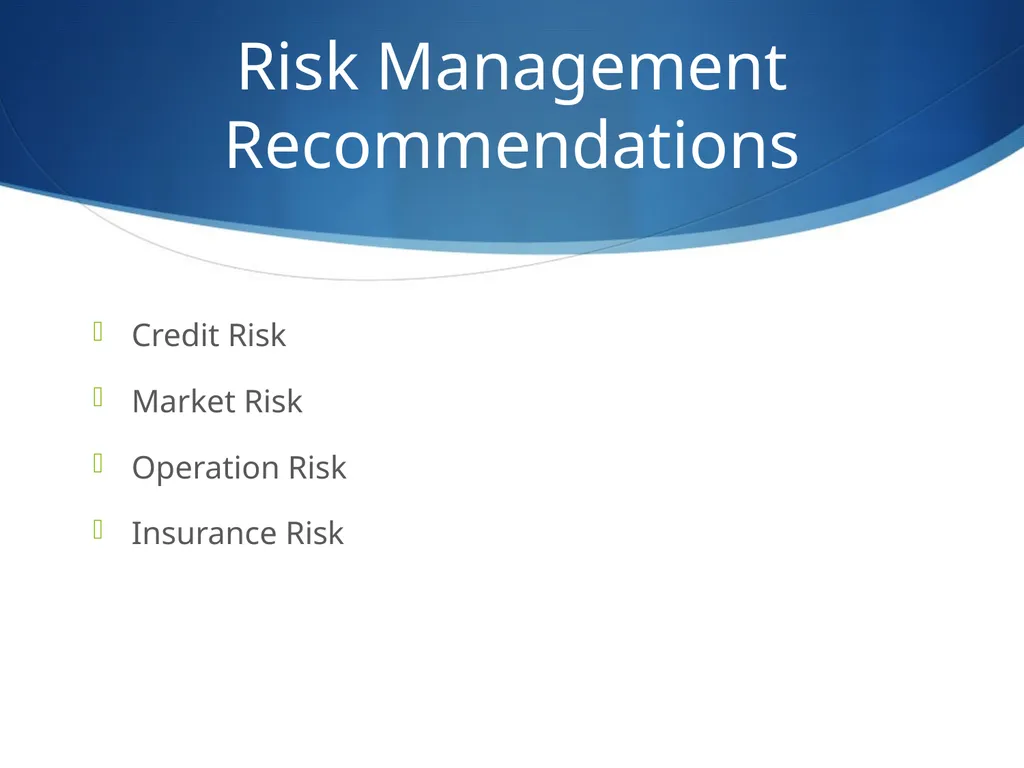
slide101. Risk Management Recommendations Credit Risk
Market Risk
Operation Risk
Insurance Risk<br>
slide102. Questions?<br>
Tommy Yip
Gordon Tang
Michael Chiu
Paul’s Sugiarto<br>
slide2. Agenda Industry Overview
Regulations
Company Overview
Financial Statement
Risk Factors and Management<br>
slide3. Industry Overview<br>
slide4. The Insurance Industry Insurance companies generally have two branches of business
Life & Health Insurance
Individual’s well being
Property and Casualty Insurance
Protection against losses of a physical property, or its ability to generate income<br>
slide5. Global Insurance Market $3,671.7 billion in gross premiums in 2009
Life insurance makes up approximately 57% of the insurance industry
Growth rate of 2.7% per year<br>
slide6. Global Insurance Market<br>
slide7. Global Insurance Market Projected to have gross premiums of $5,082.7 billion in 2014
Average growth rate of 6.7% per year, 38.4% up from 2009<br>
slide8. Global Insurance Market<br>
slide9. Top 10 Global Insurance Companies<br>
slide10. Performance for Top 5 Insurance Companies, 2009<br>
slide11. US Insurance Market, 2010 $1.0 trillion of gross premiums
58% in Life & Health ($581 billion)
42% in Property and Casualty ($426 billion)
2,689 Property and Casualty insurance companies
1,061 Life & Health insurance companies
The U.S. insurance industry employs 2.2 million people, including insurers, brokers, agents, etc<br>
slide12. Top 5 US Property and Casualty Insurance Companies, 2010<br>
slide13. Regulations<br>
slide14. Regulations The scope of regulation extends beyond the prudential oversight of insurance companies and their capital adequacy
Ensures policy holders (person buying the insurance) are protected against
bad faith claims
premiums are not unduly high
policies issued meet a minimum standard<br>
slide15. Regulations Insurance companies (in US) are not subject to federal regulation and only state level regulation exists for insurance companies
Therefore, regulation is different from state to state
State agencies usually called Department of Insurance with their head officials named Insurance Commissioner
Insurance commissioners are members of NAIC<br>
slide16. What is NAIC National Association of Insurance Commissioners
Formed in 1871
Non-profit organization which seeks to organize the regulatory and supervisory efforts of the various state insurance commissioners from around the United States
Forum for the creation of model laws and regulations
Is NOT a regulator!<br>
slide17. NAIC Acts at the national level to advance laws and policies supported by state insurance regulators
Responsible for creating the Statutory Accounting Principles (SAP), which is required accounting for insurance companies, in addition to the state GAAP
SAP is notable for its very conservative valuation methods—aiming to keep reserve high in order and keeping the insurance companies solvent<br>
slide18. Company Overview<br>
slide19. AIG American International Group, Inc. (AIG) is a leading American multinational insurance organization serving customers in more than 130 countries
In 2000, AIG was the 29th-largest public company in the world; listed on the DOWJONES (2004-2008)
AIG common stock is listed on the New York Stock Exchange, as well as the stock exchanges in Ireland and Tokyo<br>
slide20. Businesses Chartis Insurance
International Lease Finance Corporation
AIG Bank
AIG Direct
SunAmerica Financial Group
United Guaranty Corporation<br>
slide21. Chartis Insurance World leading property-casualty and general insurance organization
Provides the following insurances: Executive Liability
Environmental
Alternative Risk and Collateral
Travelling
Workers' Compensation
Property
Global Marine and Energy
Casualty
Accident and Health
Specialty<br>
slide22. International Lease Finance Corporation The world's largest aircraft lessor by value
Leases Boeing and Airbus aircraft to major airlines worldwide such as American Airlines, Alaska Airlines, Emirates Airlines, Air Canada, Cathay Pacific, Lufthansa and other airlines
September 2, 2011 - AIG filled with the SEC to make an IPO<br>
slide23. AIG Bank Offers service on mortgages for refinance and purchase, home equity lines of credit, money market savings, & certificates of deposit
Provides specialized Federal Deposit Insurance Corporation insured deposit products, loan products, and banking services to the core customer groups nationwide
Serving consumers, small businesses, AIG policyholders and AIG employees<br>
slide24. AIG Direct Marketing name: Matrix Direct
Provides reliable and affordable term life insurance
Offers customized, personalized life insurance<br>
slide25. SunAmerica Financial Group A group of companies that consist of financial advisors and insurance agents
The members:<br>
slide26. United Guaranty Corporation Provides mortgage insurance products and services to mortgage lenders and credit unions of all sizes.
United Guaranty Residential Insurance Company
United Guaranty Residential Insurance Company of North Carolina and United Guaranty Credit Insurance Company
United Guaranty Commercial Insurance Company of North Carolina
United Guaranty Services, Inc.
United Guaranty Mortgage Indemnity Company<br>
slide27. AIG Stock Info as of November 4, 2011<br>
slide28. AIG Stock Info – Last 5 years.<br>
slide29. The AIG Crisis and Bailout AIG Financial Products Corp. (AIGFP)
September 2008: Credit ratings downgraded below "AA" levels
The US Federal Reserve Bank created an $85 billion credit facility
The US Government would be entitled to 79.9% equity ownership of AIG (preferred stock)<br>
slide30. The AIG Crisis and Bailout – Cont. November 2008, came up with :
Maiden Lane II (Lending Division)
Maiden Lane III (Credit default swap Division)
The US Treasury purchased $40 billion of newly issued AIG perpetual preferred shares through TARP
By 2009: $182.5 billion available financial support
Sold a few subsidiaries and assets<br>
slide31. Financial Statements<br>
slide32. Balance Sheet<br>
slide33. Balance Sheet<br>
slide34. Balance Sheet<br>
slide35. Balance Sheet Derivatives<br>
slide36. Balance Sheet Derivatives<br>
slide37. Income Statement<br>
slide38. Income Statement<br>
slide39. Income Statement Derivatives<br>
slide40. Non Hedging Derivatives<br>
slide41. Net Realized Capital Gains<br>
slide42. Cash Flow Hedging<br>
slide43. Cash Flows Condensed<br>
slide44. Cash Flows Operating<br>
slide45. Cash Flows Financing<br>
slide46. Cash Flow Investing<br>
slide47. Risk Factors<br>
slide48. Risk Factors Credit & Financial Strength Ratings
Market Conditions
Investment Portfolio & Concentration of Investments
Casualty Insurance
Competition
Guarantees with Variable Annuities<br>
slide49. Risk Factors Cont. Adjustments of Deferred Policy Acquisition Cost
Catastrophe Exposure
Reinsurance
Indemnity Obligations
Regulation
Change in Control<br>
slide50. Risk Factors Cont. Foreign Operations
Legal Proceedings
Use of Estimates
Aircraft Leasing Business
Liquidity<br>
slide51. Risk Factors Cont. Special Purpose Vehicle Intercompany Loans
Controlling Shareholder
Employees
Electronic Data Systems
Regulatory Capital Credit Default Swap Portfolios<br>
slide52. Credit & Financial Strength Ratings Credit and Financial Strength ratings measure the ability of the company to meet contract obligations
Establishes the company’s position relative to other companies
If ratings drop
Could limit new business
Lose current customers/business
Could require AIG to post additional collateral<br>
slide53. Market Conditions Insurance business is highly dependent on the business environment
If markets return to what they were a few years ago AIG could be affected by:
Decline in value of investment portfolio
Unrealized market valuation losses on investments
Impairments of good-will and other long lived assets
Increased liability from interest rate guarantees
Increase in policy surrenders and cancellations<br>
slide54. Investment Portfolios & Concentration of Investments Investment portfolio’s value affected by interest rates:
Can change from monetary policy changes, domestic and international political issues, and other factors
Concentration of investments:
Ability to sell may be limited because of others trying to sell in the same concentration
Ex. AIG has a large exposure to residential mortgage-backed securities, commercial mortgage-backed securities, and commercial mortgage loans<br>
slide55. Casualty Insurance Liabilities are difficult to predict
could exceed current reserves
Historical loss factors used to project future loss development
No guarantee that the future loss will follow the same pattern<br>
slide56. Competition Highly competitive market both domestically and overseas
Competing with insurance companies, banks, investment banks
1800 US life insurance co.
3300 other stock co. (competing with Chartis subsidiaries)
Position affected by credit ratings
Competing through: risk acceptance criteria, product pricing, and terms and conditions<br>
slide57. Guarantees with Variable Annuities Certain policies offered guarantee customers:
Guaranteed minimum death benefits, guaranteed minimum income benefits, guaranteed minimum withdrawal benefits, and guaranteed minimum account benefits
AIG uses derivatives and reinsurance to hedge some of this risk, not fully hedged<br>
slide58. Adjustments of Deferred Policy Acquisition Cost Interest rate changes, increased cancellations, increased investment returns may lead to accelerated amortization of deferred policy acquisition costs
Higher interest rates and investment returns cause an increase in the number of contracts surrendered
Forcing subsidiaries to accelerate the amortization of DACs
If this cost exceeds the cost of surrenders and withdrawals, business could be negatively affected<br>
slide59. Catastrophe Exposure Could cause widespread claim costs: property damage, worker’s compensation, morality and morbidity claims
Leads to a loss from declining value of investment assets<br>
slide60. Reinsurance The company reinsuring may not be able or willing to pay
Relying on a outside company
Bear credit risk with respect to reinsurers
If reinsurer can’t pay in time, AIG is still responsible to the policy holder<br>
slide61. Indemnity Obligations If indemnity claim is material:
AIG will be forced to obliged these claims
Will restrict cash flow, liquidity, and operations<br>
slide62. Regulation July 21, 2010 – Dodd-Frank Wall St. Reform and Consumer Protection Act
Can’t predict the requirements of the regulations that will be adopted and what their effect on AIG will be
May become subject to enforcer/supervisor authority as a savings and loan holding co.
May be forced to place financial activity in a intermediate holding co.
Designated Financial Company
Stress tests – whether or not AIG has necessary cap under adverse economic conditions<br>
slide63. Regulation Cont. If Designated Financial co. gave threat to US financial stability
Would be required to maintain a debt to equity ratio of no more than 15:1
Limit the ability of AIG to merge, acquire, consolidate, or become affiliated with other companies
Restrictions on the financial products offered
Required to terminate some current activities
Could be forced to sell or transfer assets to unaffiliated entities<br>
slide64. Regulation Cont. Valker Rule
If AIG continues to control AIG Federal Savings bank could be subject to this rule
Limits proprietary trading and the sponsorship/investment in hedge, private equity or similar funds
USA Patriot Act – 2001
Requires companies to know certain information about their clients and to monitor their transactions for suspicious activities<br>
slide65. Change in Control Ability to utilize tax losses and credit carryforwards to offset future taxable income may be limited under the Internal Revenue Code
Entities that experience ownership change generally subject to annual limitation on its pre-ownership change tax losses and credit carryforwards equal to the equity value of the corporation multiplied by the long-term, tax exempt rate
Ownership change could occur if Department of Treasury’s position falls bellow 50% of the current shares<br>
slide66. Foreign Operations Provides insurance, investment and other financial products and services in over 130 countries
Can be affected by regional economic downturns, foreign exchange rate fluctuations, political upheaval, nationalism and other restrictive government actions
Licenses issued to AIG subsidiaries could be modified or revoked
Insurance subsidiaries could be restricted from doing future business in certain countries<br>
slide67. Legal Proceedings Security class actions, and regulatory and government investigations
Unable to predict the maximum liability of these claims
No precise damage claims, and the types of claims are uncertain<br>
slide68. Use of Estimates Generally Accepted Accounting Principles:
Require some sections with significant degrees of judgment/estimation
Estimates could turn out to be inaccurate<br>
slide69. Aircraft Leasing Business Aircraft business depends on lease payments
Exposes AIG to several risks:
Lessee non-performance
Aircrafts become obsolete
Decline in demand of product<br>
slide70. Liquidity Need liquidity to pay operating expenses, interest on debt, to meet capital requirements of AIG’s subsidiaries
Payments to AIG Parent
Require funs (dividends) from subsidiaries to fund payments due on obligations
Some investments by subsidiaries are illiquid or difficult to sell
AIG Parent may be unable to assist subsidiaries with unexpected cash flow obligations – may be difficult for subsidiaries to generate liquidity because of these assets<br>
slide71. Special Purpose Vehicle Intercompany Loans If AIG is unable to satisfy obligations made, secured parties may have the right to foreclose upon and sell the assets that secure the loans
Would negatively affect the designated subsidiaries<br>
slide72. Controlling Shareholder The Department of the Treasury is AIG’s controlling shareholder with over 50% of current shares
This gives them control over:
Approval of mergers or other business combinations
A sale of all or substantially all of AIG’s assets
Amendments to AIG Parents amended certificate of incorporation
Other matters that might be favorable to the Department of the Treasury but not other shareholders<br>
slide73. Controlling Shareholder Cont. Department of the Treasury could transfer control to another entity
Department of the Treasury is granted registration rights with respect to shares of common stock issued for recapitalization
Right to participate in any registered offering of AIG common stock
Right to engage in at the market offerings
Right to approve the terms, conditions, and pricing of any registered offering in which it participates until ownership falls bellow 33%<br>
slide74. Employees President and Chief Executive Offers of AIG – Mr. Robert Benmosche
Diagnosed with cancer and may be unable to provide his services
American Recovery and Reinvestment Act of 2009
Restricts bonuses and other incentives payable to employees
Risk of employee fraud, error, failure to document properly or to obtain proper internal authorization, failure to comply with regulatory restrictions<br>
slide75. Electronic Data Systems Computer systems used to store, retrieve, evaluate, and utilize customer and company data
Systems rely on a 3rd party
If the system fails and employees are unable to access the data – business operations could be forced on hold until the system is repaired
Confidential information may be misused or mishandled leading to legal liabilities<br>
slide76. Regulatory Capital Credit Default Swap Portfolio Deterioration in credit markets may cause AIG to experience unrealized market valuation losses
Could be required to post additional collateral
Net of $38.1 Billion in credit default portfolio for providing capital relief rather than for arbitrage purposes<br>
slide77. Management of Risk Factors<br>
slide78. Major Risk Factors AIG identifies four major risk to which the corporation is exposed to
Credit Risk
Market Risk
Operation Risk
Insurance Risk<br>
slide79. Credit Risk Potential loss arising from an obligor’s inability or unwillingness to meet its obligations to AIG.
Direct and indirect credit exposures
fixed income investments
deposits
corporate and consumer loans
counterparty risk in derivatives activities
cessions of insurance risk to reinsurers and customers
credit risk assumed through credit derivatives written<br>
slide80. Managing Credit Risk Managed at a corporate level by the AIG Credit Risk Management (CRM) department, lead by the Chief Credit Officer (CCO)
delegated credit authorities among executives and officers
manage the credit limits, program limits and credit
administer portfolio credit reviews of all business units, and recommend any corrective actions where required
develop methodologies for quantification and assessment of credit risks
approve appropriate credit reserves and methodologies at the business unit and enterprise levels<br>
slide81. Managing Credit Risk Uses third-party guarantees, reinsurance recoverable, letters of credit and trust accounts to minimize level of credit risk
Also manages industry concentrations
Current largest industry credit exposure is global financial institutions sector<br>
slide82. Managing Credit Risk AIG’s largest credit exposures as a percentage of total equity<br>
slide83. Managing Credit Risk AIG’s largest credit exposures to the global financial institution sector as a percentage of total equity<br>
slide84. Market Risk Potential loss from fluctuations in interest rates, foreign currencies, equity and commodity prices, and their levels of volatility, etc
Managed by Market Risk Management and Independent Valuation (MRMIV), and Insurance Risk Management function (IRM)
AIG identifies the following factors as exposure to market risk
Benchmark interest rates
Credit spread or risk premium
Equity and alternative investment prices
Foreign currency exchange rates<br>
slide85. Managing Market Risk Duration / key rate duration
Scenario analysis.
Value-at-Risk (VaR)
Stress testing<br>
slide86. Operational Risk Potential loss resulting from inadequate or failed internal processes, people, and systems, or from external events
Each business unit is responsible for its operational risk
pro-actively address potential operational risk issues
assign ownership and accountability for addressing identified issues.<br>
slide87. Insurance Risks Of all the insurance risks, liquidity risk is the fundamental risk for insurance companies.
Potential loss resulting from inadequate premiums, insufficient reserves and catastrophic exposures.
Main contributors to solvency issues.<br>
slide88. How AIG Manages Liquidity Risk Compliance with financial reporting and capital and solvency targets.
Extensive use of reinsurance, both internal and third-party.
Review and establishment of reserves.<br>
slide89. Insurance Risks Specific types of risks to these areas of insurance
Life Insurance
Property and Casualty Insurance<br>
slide90. Life Insurance Risk Potential loss resulting from experience deviating from expectations for mortality, morbidity and termination rates in the insurance-oriented products and insufficient cash flows to cover contract liabilities in the retirement savings products.
SunAmerica has life insurance risks<br>
slide91. Primary Risks of SunAmerica Pricing risk
Investment risk
Interest rate risk
Equity market risk<br>
slide92. Ways to Manage Life Insurance Risks Appropriate product design
Sound medical underwriting
Active management of the asset-liability relationship
External reinsurance programs
SunAmerica generally limit their maximum underwriting exposure on life insurance of a single life to $15 million<br>
slide93. Property and Casualty Insurance Risks Chartis and Mortgage Guaranty have P&C risks
The mortgage insurance business (Mortgage Guaranty) manages risks through:
geographic location of the insured properties
the relative economic conditions in the local housing markets
credit attributes of the borrowers
the loan amount relative to the value of the respective collateral<br>
slide94. Property and Casualty Insurance Risks Chartis are exposed to different risks:
climate change
wind
flood
earthquake
terrorism
environmental damage<br>
slide95. Property and Casualty Insurance Risks Terrorism and environmental damage are managed differently than wind, flood, and earthquake, which are natural disasters.
Exposure to loss from terrorism is controlled by limiting the total insurance that is underwritten within a location.
Typically exclude or significantly limit coverage for pollution or related environmental damage.<br>
slide96. Property and Casualty Insurance Risks Risks from catastrophes like hurricanes and earthquakes are managed using a combination of techniques:
setting aggregate limits in key business units
monitoring and modeling accumulated exposures
purchasing catastrophe reinsurance<br>
slide97. Property and Casualty Insurance Risks Modelling of Real Disaster Scenarios:<br>
slide98. Managing Risks with Reinsurance AIG uses reinsurance programs for its insurance risks as follow:
Facultative agreements to cover large individual exposures
Quota share treaties to cover specific books of business
Excess-of-loss treaties to cover large losses<br>
slide99. Managing Risks with Reinsurance cont. AIG uses reinsurance programs for its insurance risks as follow:
Excess or surplus automatic treaties to cover individual life risks in excess of stated per-life retention limits
Catastrophe treaties to cover specific catastrophes, including earthquake, windstorm and flood<br>
slide100. Risk Management Recommendations<br>
slide101. Risk Management Recommendations Credit Risk
Market Risk
Operation Risk
Insurance Risk<br>
slide102. Questions?<br>