04
IAI and Regional Collaboration Relevant Articles of the Agreement:
Article II: Objectives
The Institute shall pursue the principles of scientific excellence, international cooperation, and the full and open exchange of scientific information, relevant to global change.<br>
05
IAI and Regional Collaboration Relevant Articles of the Agreement:
Article II, a) Promote regional cooperation for interdisciplinary research on aspects of global change related to the sciences of the earth, ocean, atmosphere, and the environment and to social sciences, with particular attention to impacts on ecosystems and biodiversity, socio-economic impacts, and technologies and economic aspects associated with the mitigation of and adaptation to global change;<br>
06
IAI and Regional Collaboration Relevant Articles of the Agreement:
Article II, a) Promote regional cooperation for interdisciplinary research on aspects of global change related to the sciences of the earth, ocean, atmosphere, and the environment and to social sciences, with particular attention to impacts on ecosystems and biodiversity, socio-economic impacts, and technologies and economic aspects associated with the mitigation of and adaptation to global change;<br>
07
IAI and Regional Collaboration Relevant Articles of the Agreement:
Article II, c) Pursue on a regional scale that research which cannot be pursued by any individual State or institution and dedicate itself to scientific issues of regional importance;
g) Promote cooperation among the different research institutions of the region;<br>
08
The Americas and shared priorities Priorities are defined at the national/regional/international level by governance frameworks:
The Sustainable Development Goals
Post-2020 Biodiversity Framework
The Paris Agreement
Among other national obligations within a regional/international framework<br>
09
The Americas and science to policy The traditional model of science to policy at a regional level follows a well defined path:
Countries identify a problem where solutions must come from regional/international collaboration
Scientific bodies of Multi-lateral Environmental Agreements make recommendations
Recommendations go to a Conference of the Parties and are converted into policy<br>
10
The Americas and science to policy The traditional model of science to policy is under tremendous strain The Guardian<br>
11
The Americas and fragmented governance Fragmented governance and treaty congestion:
There are now more than 900 multilateral and over 1500 bilateral treaties and other international agreements dealing with environmental issues*. *The future of international environmental law / edited by David Leary and
Balakrishna Pisupati. United Nations University, 2010.<br>
12
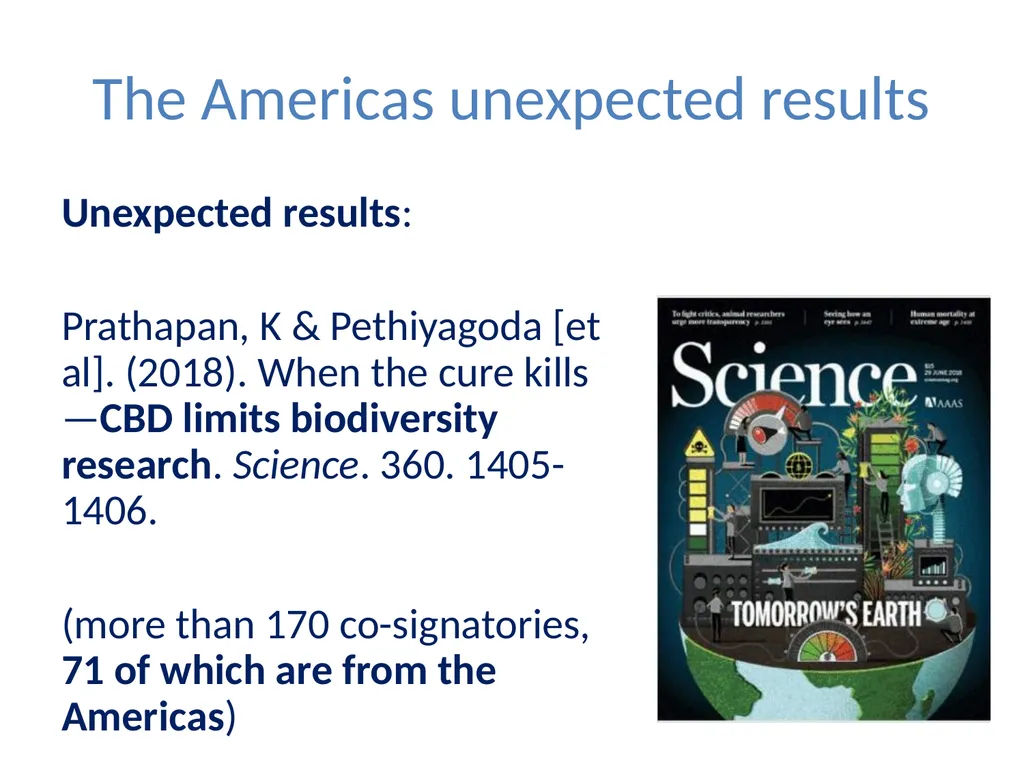
The Americas unexpected results Unexpected results:
Prathapan, K & Pethiyagoda [et al]. (2018). When the cure kills—CBD limits biodiversity research. Science. 360. 1405-1406.
(more than 170 co-signatories, 71 of which are from the Americas)<br>
13
The Americas and poor policy-science interface The Article discusses the regulatory framework under the Nagoya Protocol on Access and Benefit-sharing*:
The resulting national legislations vary greatly, from being extremely prohibitive of research, to a very few that are relatively enabling, such as Costa Rica and South Africa. The problem is particularly acute where there is a poor policy-science interface resulting from weak scientific institutions.<br>
14
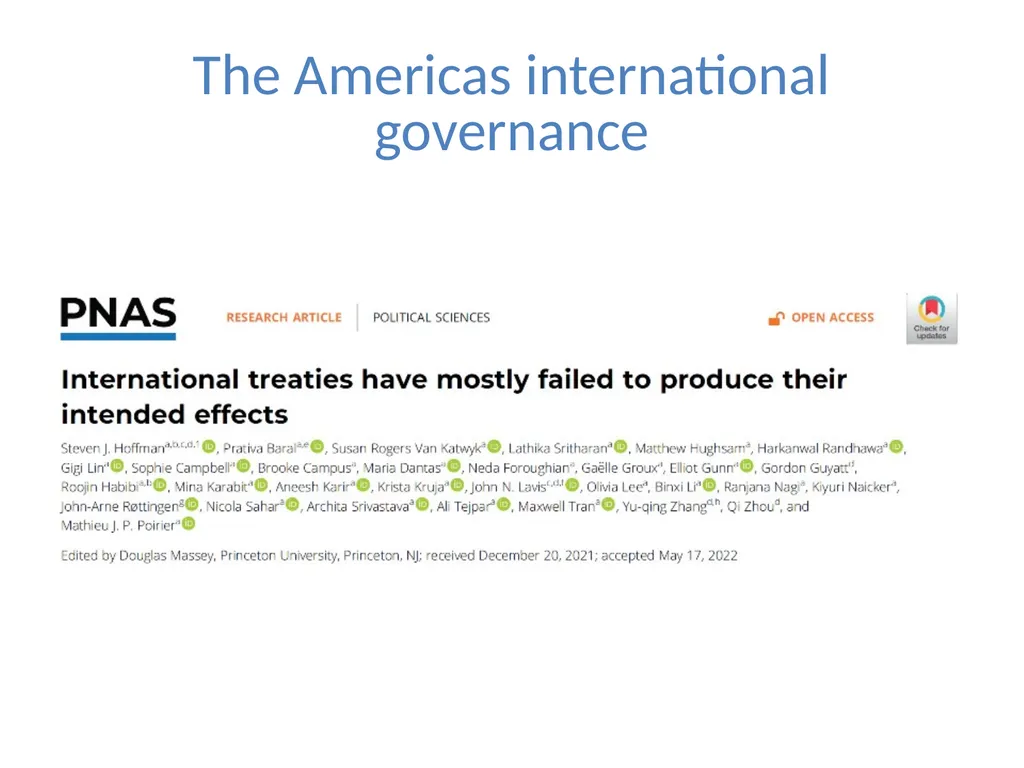
The Americas international governance<br>
15
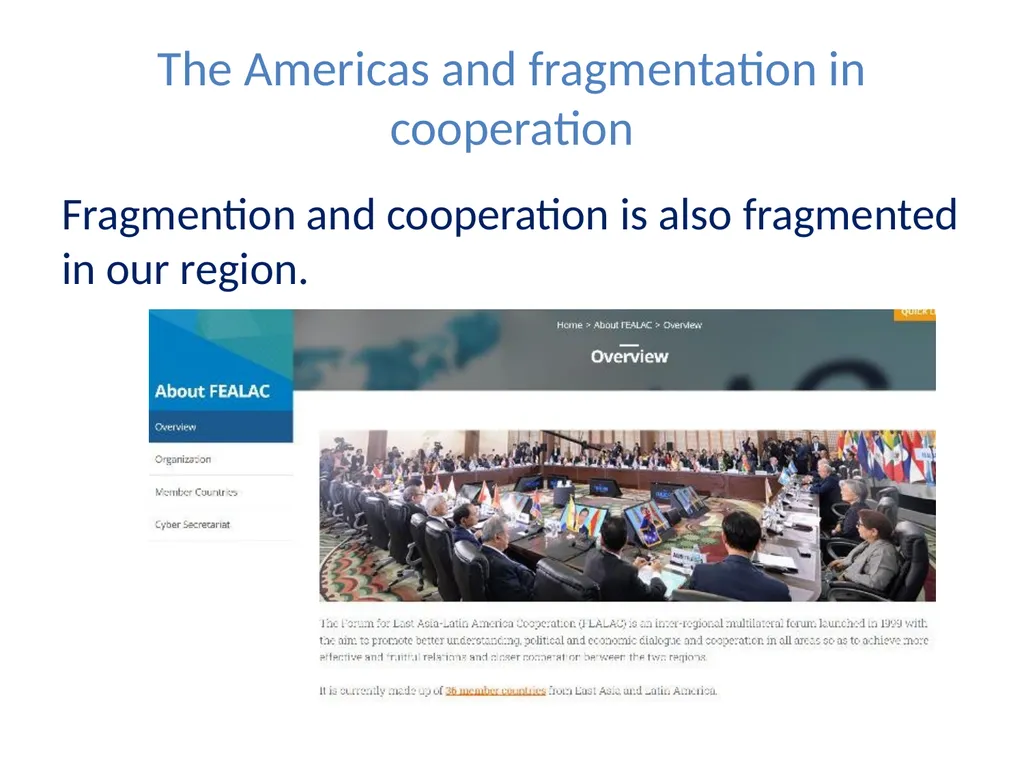
The Americas and fragmentation in cooperation Fragmention and cooperation is also fragmented in our region.<br>
16
Key opportunities and challenges Within this fragmented governance environment the Americas has been uniquely effective in making its priorities known
GRULAC, for example, is an effective negotiating block in many MEAs
Such homogeneity in action provides many many opportunities<br>
17
Key opportunities and challenges Within international environmental governance (or international governance more generally) three issues come to the fore:
National sovereignty
Liability and redress
Enforcement
Mechanisms for liability and redress and enforcement are weak or non-existent<br>
18
Geoengineering and governance Which international instrument would be most appropriate as the umbrella agreement for sovereign nations to discuss challenges posed by Solar Radiation Modification?
UN General Assembly?
UNEP (UN Environment Assembly)?
The Convention on Biological Diversity?
UNFCCC?<br>
19
Key opportunities and challenges The IAI is the result of American countries deciding to establish a collaborative mechanism to provide its policy makers with the best available scientific information for more informed decision making
In many ways, it reflects the cooperative and successful regional framework found in Latin America and the Caribbean 2<br>
20
Key opportunities and challenges From a regional organization’s perspective, key opportunities and challenges are identified through:
The establishment of partnerships—realizing that no one organization can succeed alone;
Making use of partnerships to establish self-sustaining networks of peers
Supporting open science and data 2<br>
21
Strategies for meeting challenges and identifying opportunities The IAI functions in this ecosystem by working with Parties to understand national priorities as defined by regional/international frameworks
This understanding provides the context for the science and activities, including capacity building at the regional level, it supports<br>
22
Strategy for identifying, developing and maintaining partnerships None of this could have been possible without:
Funding to seed the scientific projects
A collaborative, multinational approach to identifying and researching an issue anchored to national needs and articulated internationally
Member country involvement through its scientific communities
Interdisciplinary and transdisciplinary research<br>
23
Conclusions Latin America and the Caribbean offers a unique opportunity for supporting collaborative, multinational effective scientific projects
It has a well established network of peers
As a region, it is uniquely effective in the articulation of its needs and in the involvement of its scientists and policy makers in international fora<br>
24
Conclusions In summary, Latin America and the Caribbean have will, the expertise and the willingness to:
overcome challenges and build opportunities for multi-national collaboration, and
strengthen linkages to global frameworks to leverage extramural funding for Americas Regional priorities<br>
25
Conclusions Solar Radiation Modification?<br>
26
Thank you
Dr. Marcos Regis da Silva
IAI<br>