An Inspector Calls Date: Title: What was JB Priestleys motivation for writing An Inspector Calls? Recap questions: 1, What do the Birlings realise about the Inspector after he has left? 2. How do the Birlings react to the news that there
"An Inspector Calls Date: Title: What was JB" is the property of its rightful owner. Permission is granted to
download and print the materials on this website for personal, non-commercial use only, and to display it
on your personal computer provided you do not modify the materials and that you retain all copyright
notices contained in the materials. By downloading content from our website, you accept the terms of this
agreement.
Presentation Transcript
01
An Inspector Calls Date:
Title: What was JB Priestley’s motivation for writing An Inspector Calls?
Recap questions:
1, What do the Birlings realise about the Inspector after he has left?
2. How do the Birlings react to the news that there has been no suicide? Consider especially the reaction of Mr and Mrs Birling versus Sheila and Eric.
3, What is the significance of the ending for the Birling family?<br>
02
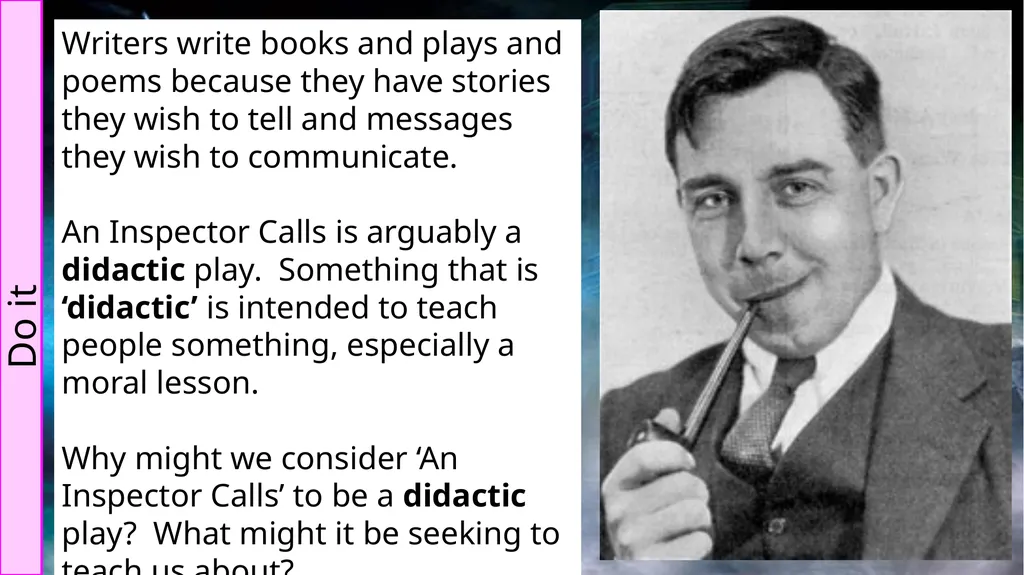
Do it now Writers write books and plays and poems because they have stories they wish to tell and messages they wish to communicate.
An Inspector Calls is arguably a didactic play. Something that is ‘didactic’ is intended to teach people something, especially a moral lesson.
Why might we consider ‘An Inspector Calls’ to be a didactic play? What might it be seeking to teach us about?<br>
03
JB Priestley’s motivation for writing ‘An Inspector Calls’ JB Priestley was a socialist living through a time of great hardship after two World Wars. He wanted the world to become a better place, a kinder place, a more thoughtful place.
In today’s lesson we are going to consider what it means to be a socialist and how this central concept is posited within the play. Do it now<br>
04
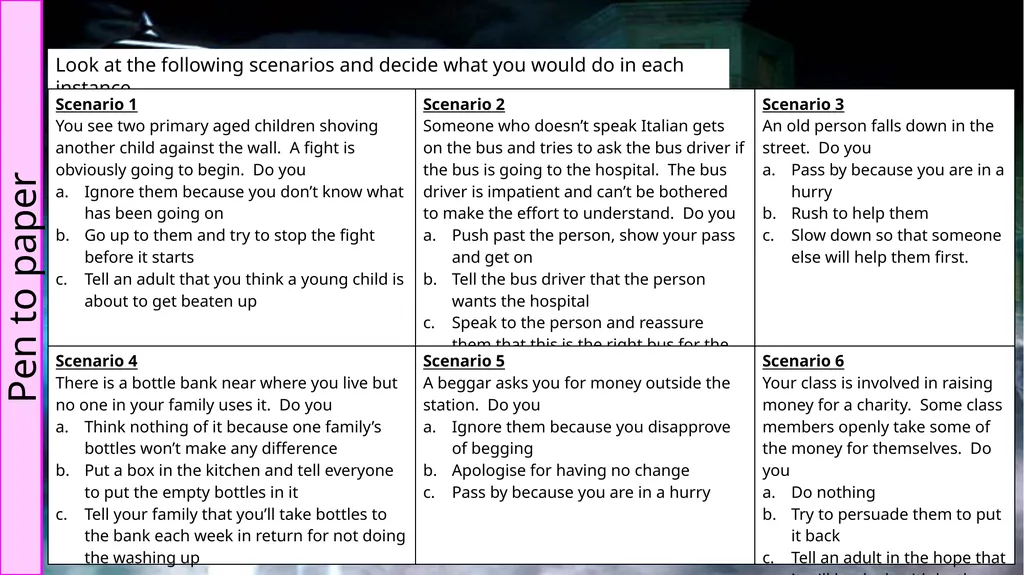
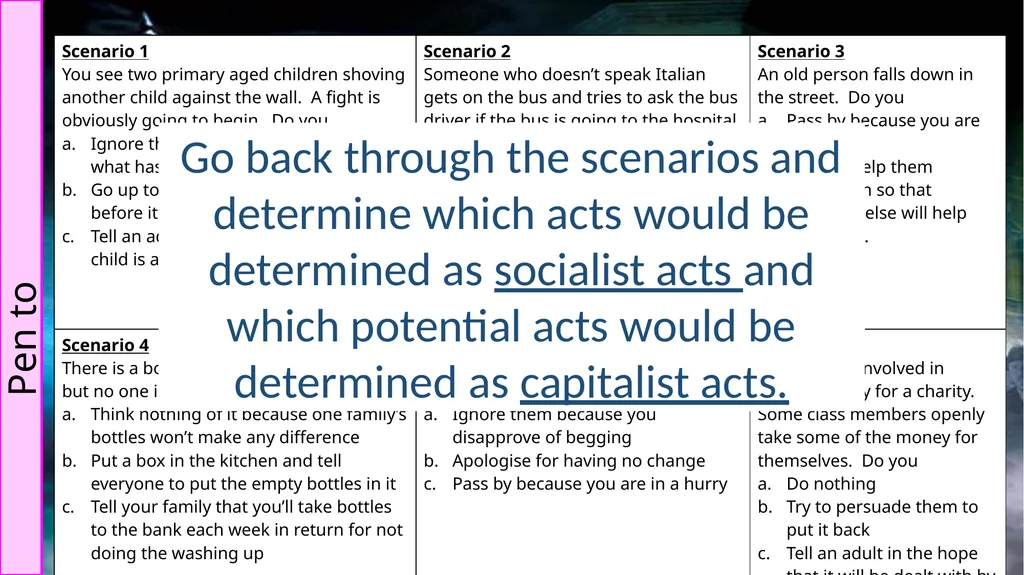
Pen to paper Look at the following scenarios and decide what you would do in each instance.<br>
05
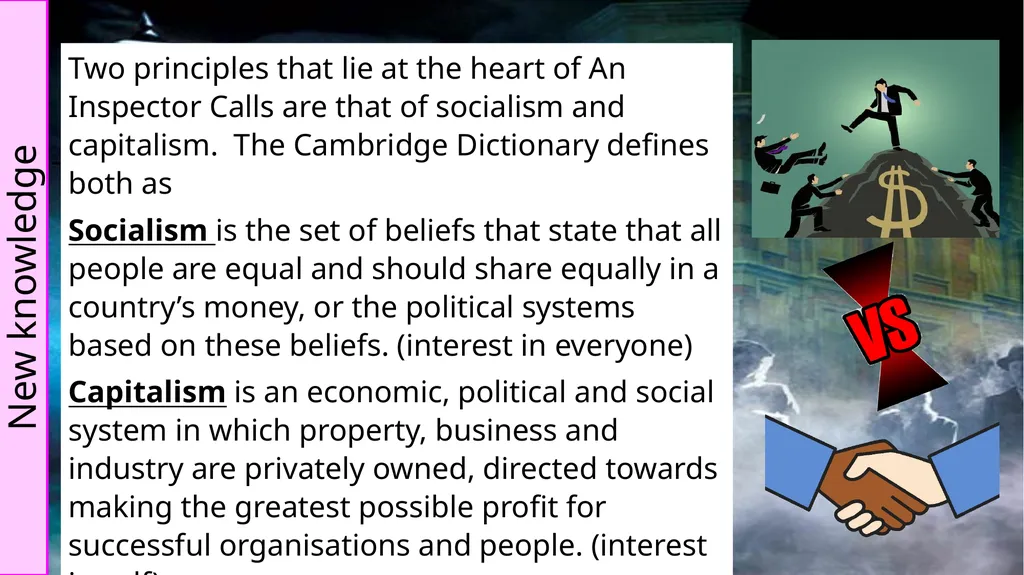
New knowledge Two principles that lie at the heart of An Inspector Calls are that of socialism and capitalism. The Cambridge Dictionary defines both as
Socialism is the set of beliefs that state that all people are equal and should share equally in a country’s money, or the political systems based on these beliefs. (interest in everyone)
Capitalism is an economic, political and social system in which property, business and industry are privately owned, directed towards making the greatest possible profit for successful organisations and people. (interest in self)<br>
06
Pen to paper Go back through the scenarios and determine which acts would be determined as socialist acts and which potential acts would be determined as capitalist acts.<br>
07
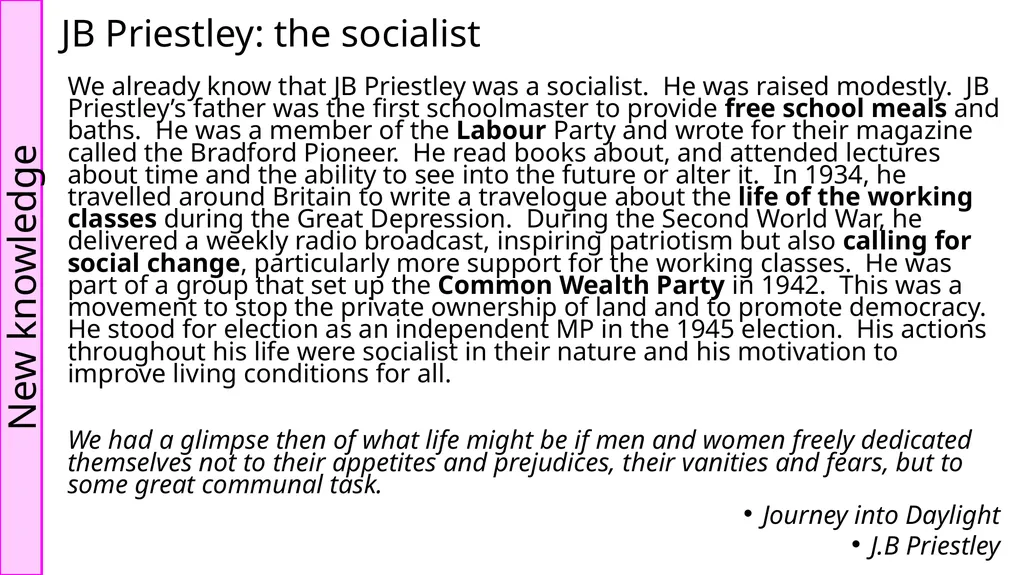
JB Priestley: the socialist We already know that JB Priestley was a socialist. He was raised modestly. JB Priestley’s father was the first schoolmaster to provide free school meals and baths. He was a member of the Labour Party and wrote for their magazine called the Bradford Pioneer. He read books about, and attended lectures about time and the ability to see into the future or alter it. In 1934, he travelled around Britain to write a travelogue about the life of the working classes during the Great Depression. During the Second World War, he delivered a weekly radio broadcast, inspiring patriotism but also calling for social change, particularly more support for the working classes. He was part of a group that set up the Common Wealth Party in 1942. This was a movement to stop the private ownership of land and to promote democracy. He stood for election as an independent MP in the 1945 election. His actions throughout his life were socialist in their nature and his motivation to improve living conditions for all.
We had a glimpse then of what life might be if men and women freely dedicated themselves not to their appetites and prejudices, their vanities and fears, but to some great communal task.
Journey into Daylight
J.B Priestley New knowledge<br>
08
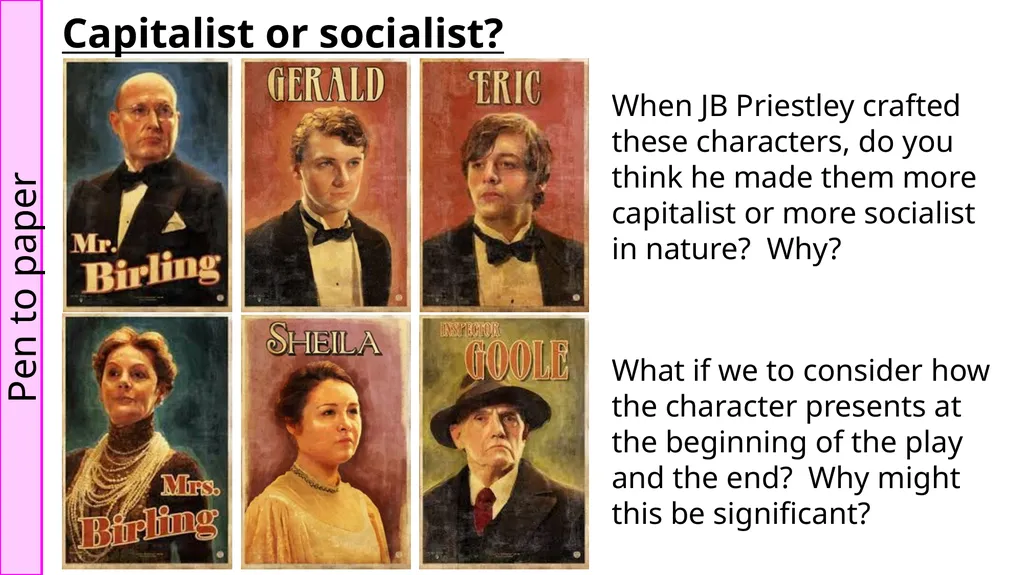
Pen to paper Capitalist or socialist? When JB Priestley crafted these characters, do you think he made them more capitalist or more socialist in nature? Why? What if we to consider how the character presents at the beginning of the play and the end? Why might this be significant?<br>
09
Reflection JB Priestley’s motivation for writing ‘An Inspector Calls’ JB Priestley wrote ‘An Inspector Calls’ to critique the values associated with capitalism (through the actions and words of the Birling family, especially that of Mr and Mrs Birling) and offer his audiences an alternative path in the hope of building a fairer society in the future (through the actions and words of Sheila, and to some extent, Eric).
We had a glimpse then of what life might be if men and women freely dedicated themselves not to their appetites and prejudices, their vanities and fears, but to some great communal task.
To what extent do you, at this stage, agree?
Is ‘An Inspector Calls’ a didactic play as a result?<br>