
An Update on the (GEPIC) Return to Work Claimants






Description: An Update on the (GEPIC) Return to Work Claimants Presenter: Dr Michael Epstein 1 Program 2 Review of your purpose and role Overview of the process of impairment assessment using the GEPIC Refining your score Neurologypsychiatry overlap
Related Topics
Download Presentation
"An Update on the (GEPIC) Return to Work Claimants" is the property of its rightful owner. Permission is granted to download and print the materials on this website for personal, non-commercial use only, and to display it on your personal computer provided you do not modify the materials and that you retain all copyright notices contained in the materials. By downloading content from our website, you accept the terms of this agreement.
Presentation Transcript
slide1. An Update on the (GEPIC)
Return to Work Claimants Presenter:
Dr Michael Epstein 1<br>
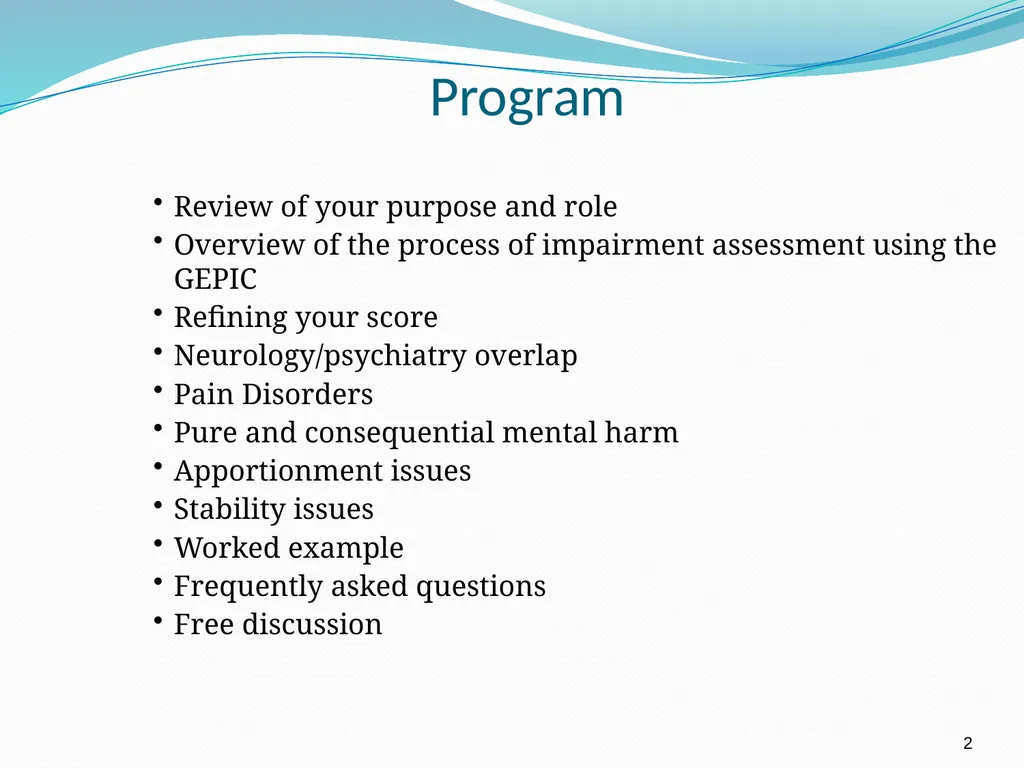
slide2. Program 2 Review of your purpose and role
Overview of the process of impairment assessment using the GEPIC
Refining your score
Neurology/psychiatry overlap
Pain Disorders
Pure and consequential mental harm
Apportionment issues
Stability issues
Worked example
Frequently asked questions
Free discussion<br>
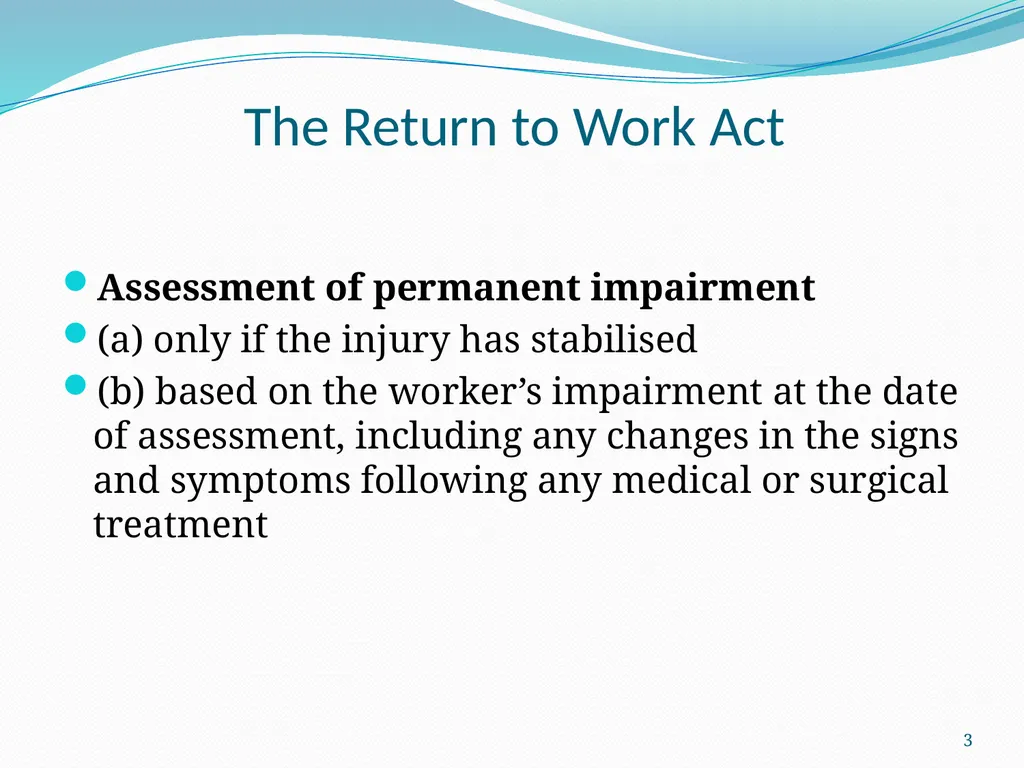
slide3. The Return to Work Act Assessment of permanent impairment
(a) only if the injury has stabilised
(b) based on the worker’s impairment at the date of assessment, including any changes in the signs and symptoms following any medical or surgical treatment 3<br>
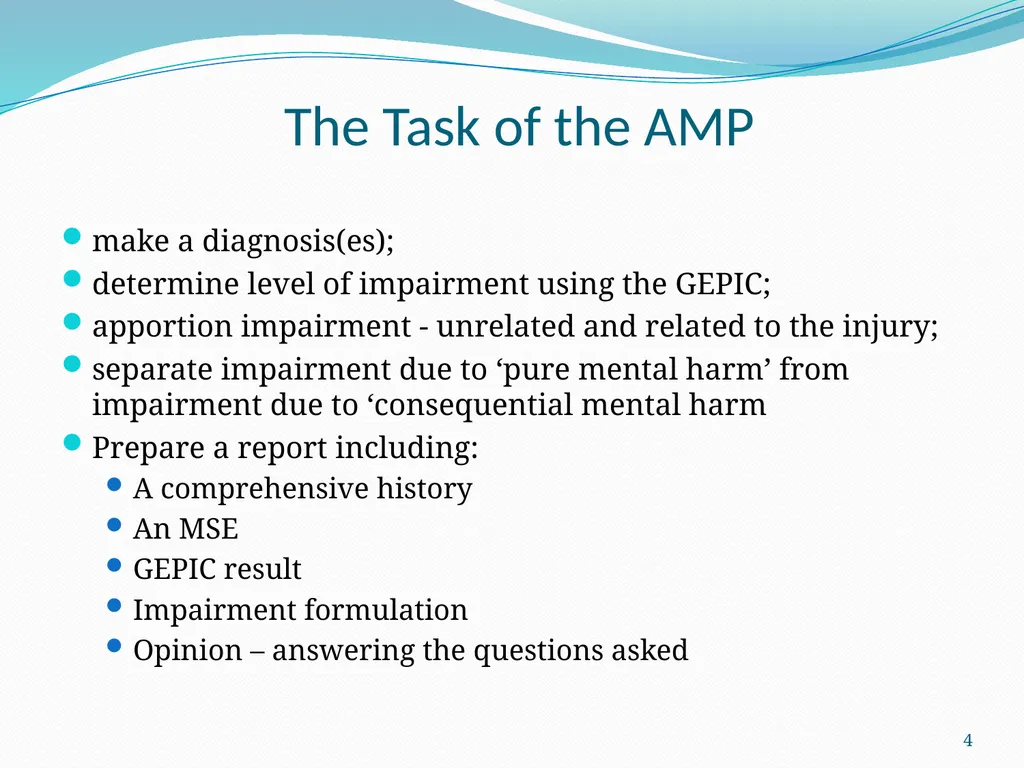
slide4. The Task of the AMP make a diagnosis(es);
determine level of impairment using the GEPIC;
apportion impairment - unrelated and related to the injury;
separate impairment due to ‘pure mental harm’ from impairment due to ‘consequential mental harm
Prepare a report including:
A comprehensive history
An MSE
GEPIC result
Impairment formulation
Opinion – answering the questions asked 4<br>
slide5. The Process 1 Interview and review of documentation
[ injury
[ current condition and treatment
Mental State Examination
[ diagnosis(es)
[ unrelated diagnoses
[ stability and prognosis 5<br>
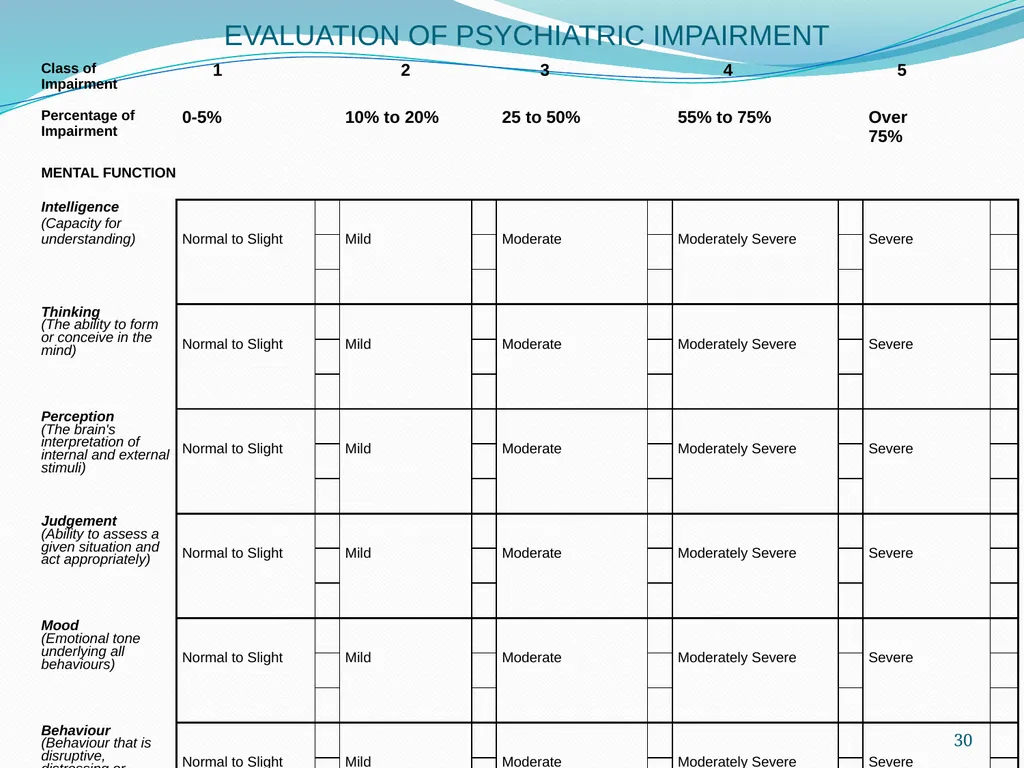
slide6. The Process 2 correlate GEPIC descriptors to MSE
use GEPIC method including Severity to find Total Psychiatric Impairment (TPI)
subtract impairment unrelated to injury
subtract impairment due to Consequential Mental Harm
Leaves impairment due to Pure Mental Harm 6<br>
slide7. Common Psychiatric Disorders: Work Injuries DSM 5 Acute stress disorder (acute stress disorder and post-traumatic stress disorder may occur in the absence of physical injury)
Post-traumatic stress disorder
Generalised anxiety disorder
Adjustment disorder with depressed mood (and/or anxiety)
Panic disorder
Agoraphobia
Obsessive compulsive disorder
Major depressive disorder
Somatic symptom disorder with predominant pain
Substance induced disorder
Persistent depressive disorder 7<br>
slide8. Reasons for Measurement of Psychiatric Impairment Work Injuries: To determine serious injury according to the Return to Work Act 2014
If psychiatric impairment 30% or more then ongoing income maintenance,
No return-to-work obligation,
Access to common law for future economic loss
No entitlement for psychiatric injury or consequential mental harm for lump sum payment for non- economic loss. 8<br>
slide9. Compensable Psychiatric Impairment 9 There needs to be a diagnosable psychiatric disorder.
The disorder must lead to impairment.
There has to be a clearly established link between the work injury and the psychiatric disorder.
The psychiatric disorder is not ‘consequential mental harm’<br>
slide10. The Royal Australian and New Zealand College of Psychiatrists Practice Guideline #9 Mental status examination
A mental status examination for medico-legal purposes generally contains
the minimum core elements of:
appearance and general behavior
mood
affect
speech and language
psychomotor behaviour
thought content
thought form or associations
perceptual abnormalities (if any)
suicidal, homicidal, violent, or self-injurious thoughts or impulses
examinee or patient’s understanding of his or her current situation, and
elements of the cognitive status (Systematic assessment of cognitive functions is an essential part of the general psychiatric evaluation, the level of detail necessary and the appropriateness of particular formal tests depend on the purpose of the evaluation and the psychiatrist's clinical judgement). 10<br>
slide11. 11<br>
slide12. Principles of Psychiatric Impairment Assessment Principle 1:
Readily observable empirical criteria must be applied. The mental state examination as used by consultant psychiatrists, is the prime method of evaluating psychiatric impairment.
Principle 2:
Diagnosis is among the factors to be considered in impairment, but is by no means the sole criterion.
Principle 3:
Consideration given to other factors level of functioning, educational, financial, social and family situation and others. 12<br>
slide13. Principles of Psychiatric Impairment Assessment Principle 4:
Character and value system of the individual is of considerable importance in the outcome of the disorder, be it mental or physical. Motivation for improvement is a key factor in the outcome.
Principle 5:
Review treatment and rehabilitation methods used. No final judgement can be made until the whole history of the illness, the treatment, the rehabilitation phase, and the individual’s current mental and physical status and behaviour have been considered. 13<br>
slide14. Use of the GEPIC 14 Used by consultant psychiatrists
Database: clinical information, documentation, mental state.
Clinical judgement required, not a “cookbook”.
Descriptors and MSE emerge during the clinical interview.
Descriptors are indicative only. Other symptoms can be used if it can be justified that the symptom(s) is/are associated with a particular class of severity.<br>
slide15. Use of the GEPIC - 2 Clinician’s decision re presence of specific rating
Assess severity of 6 specific mental functions from
Class 1-5. The resultant median class is used together with severity ratings within each class to help determine initial impairment.
Unrelated and consequential impairments removed leading to final psychiatric impairment 15<br>
slide16. Definitions 16 Impairment: World Health Organization (WHO) has defined impairment: “In the context of health experience, an impairment is any loss or abnormality of psychological, physiological, or anatomical structure or function”.
Permanent impairment is impairment that has become static or well stabilised with or without medical treatment and is not likely to remit despite future medical treatment. The condition has reached ‘Maximal Medical Improvement (MMI). If an impairment is not permanent, it is inappropriate to characterise it as such.
Disability: The WHO has defined disability: “In the context of health experience, a disability is any restriction or lack (resulting from an impairment) of ability to perform an activity in the manner or within the range considered normal for a human being”.
Hallucinations. Disorders of sensory perception in the absence of stimuli.
Illusions. Misinterpretations of real sensory stimuli – illusions can be a normal phenomenon as well as indicating psychopathology.<br>
slide17. 17 Intelligence
Capacity for understanding and for other forms of adaptive behaviour. Impairments of intelligence are a consequence of brain injury or disease. Generally, before impairment of intelligence is confirmed neuropsychological assessment should be undertaken. (Care has to be exercised to ensure that there is no overlap between an assessment of impairment of intelligence made during a psychiatric evaluation and an assessment of impairment of higher cerebral functions made by an assessor in accordance with Chapter 4 of the 4th edition American Medical Association Guides.)
Guides for the rating of impairment of intelligence:
Class Impairment Description
1 0 - 5% Normal to Slight
- there is no evidence of cognitive impairment on mental state examination, and the individual does not report any
difficulties in everyday functioning that can be attributed to
cognitive difficulties
2 10 - 20% Mild (Mildly retarded)
- some interference with everyday functioning
3 25 - 50% Moderate (moderately/mildly retarded)
- a reduction in intelligence that significantly interferes
with everyday functioning.
4 55 - 75% Moderately Severe (moderately severely retarded)
- a reduction in intelligence which makes independent
living impossible.
5 over 75% Severe (severely retarded)
- needs constant supervision and care<br>
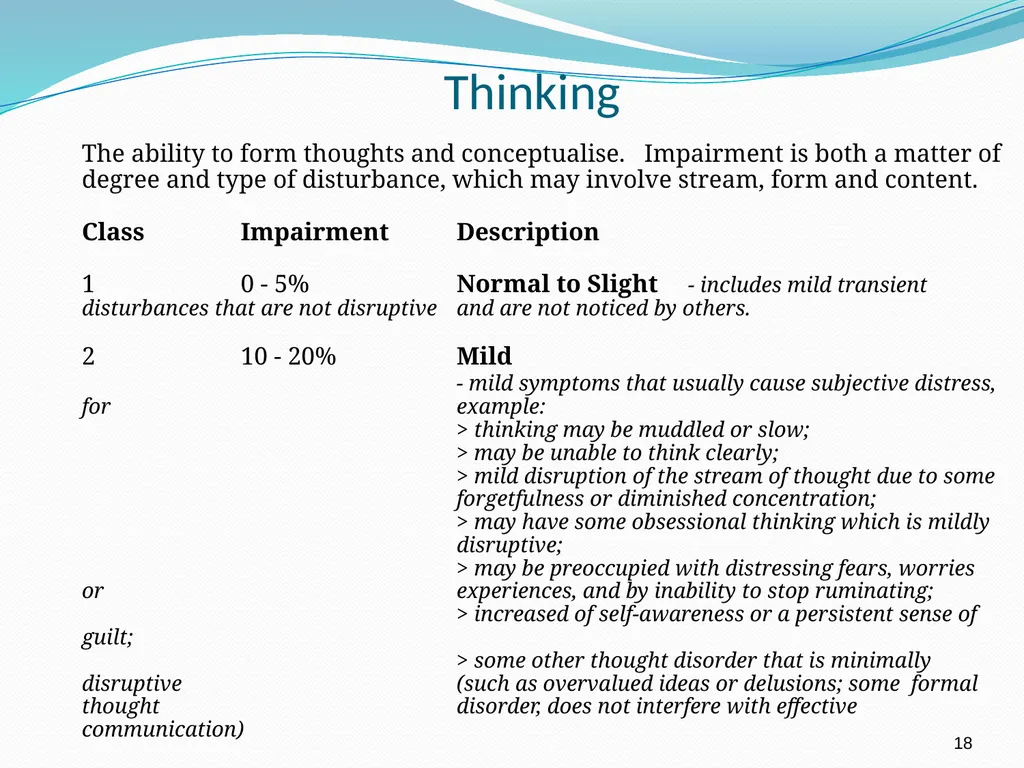
slide18. The ability to form thoughts and conceptualise. Impairment is both a matter of degree and type of disturbance, which may involve stream, form and content. Class Impairment Description 1 0 - 5% Normal to Slight - includes mild transient disturbances that are not disruptive and are not noticed by others. 2 10 - 20% Mild - mild symptoms that usually cause subjective distress, for example: > thinking may be muddled or slow; > may be unable to think clearly; > mild disruption of the stream of thought due to some forgetfulness or diminished concentration; > may have some obsessional thinking which is mildly disruptive; > may be preoccupied with distressing fears, worries or experiences, and by inability to stop ruminating; > increased of self-awareness or a persistent sense of guilt; > some other thought disorder that is minimally disruptive (such as overvalued ideas or delusions; some formal thought disorder, does not interfere with effective communication) 18 Thinking<br>
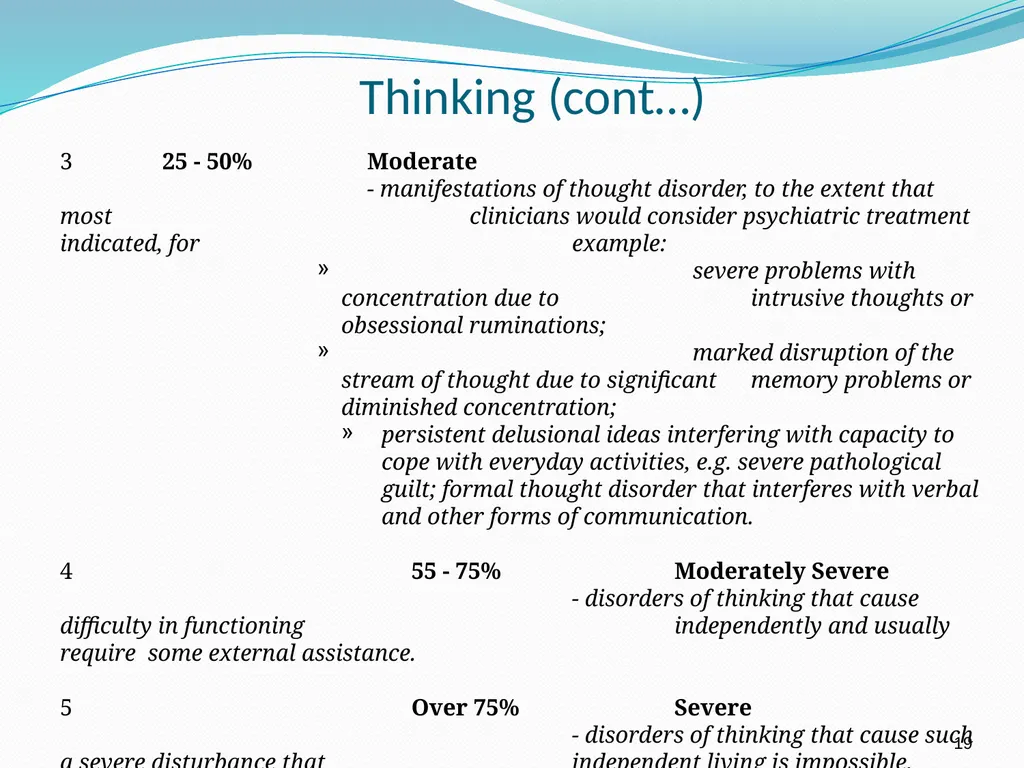
slide19. Thinking (cont…) 19 3 25 - 50% Moderate
- manifestations of thought disorder, to the extent that most clinicians would consider psychiatric treatment indicated, for example:
severe problems with concentration due to intrusive thoughts or obsessional ruminations;
marked disruption of the stream of thought due to significant memory problems or diminished concentration;
persistent delusional ideas interfering with capacity to cope with everyday activities, e.g. severe pathological guilt; formal thought disorder that interferes with verbal and other forms of communication.
4 55 - 75% Moderately Severe
- disorders of thinking that cause difficulty in functioning independently and usually require some external assistance.
5 Over 75% Severe
- disorders of thinking that cause such a severe disturbance that independent living is impossible.<br>
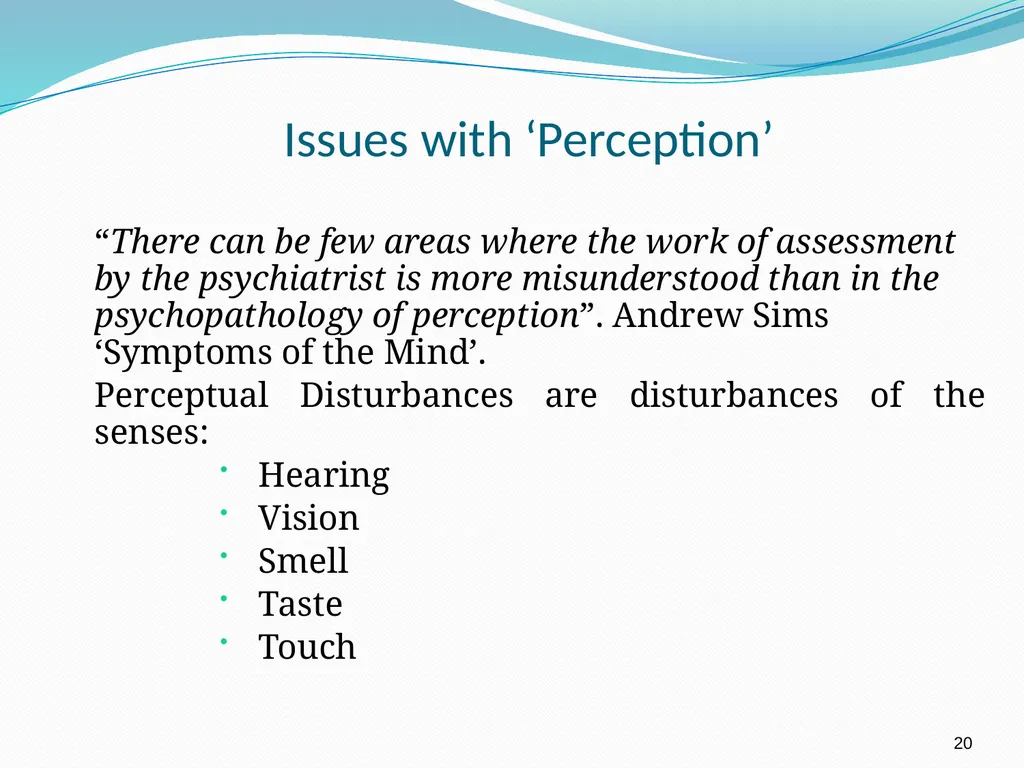
slide20. Issues with ‘Perception’ “There can be few areas where the work of assessment by the psychiatrist is more misunderstood than in the psychopathology of perception”. Andrew Sims ‘Symptoms of the Mind’.
Perceptual Disturbances are disturbances of the senses:
Hearing
Vision
Smell
Taste
Touch 20<br>
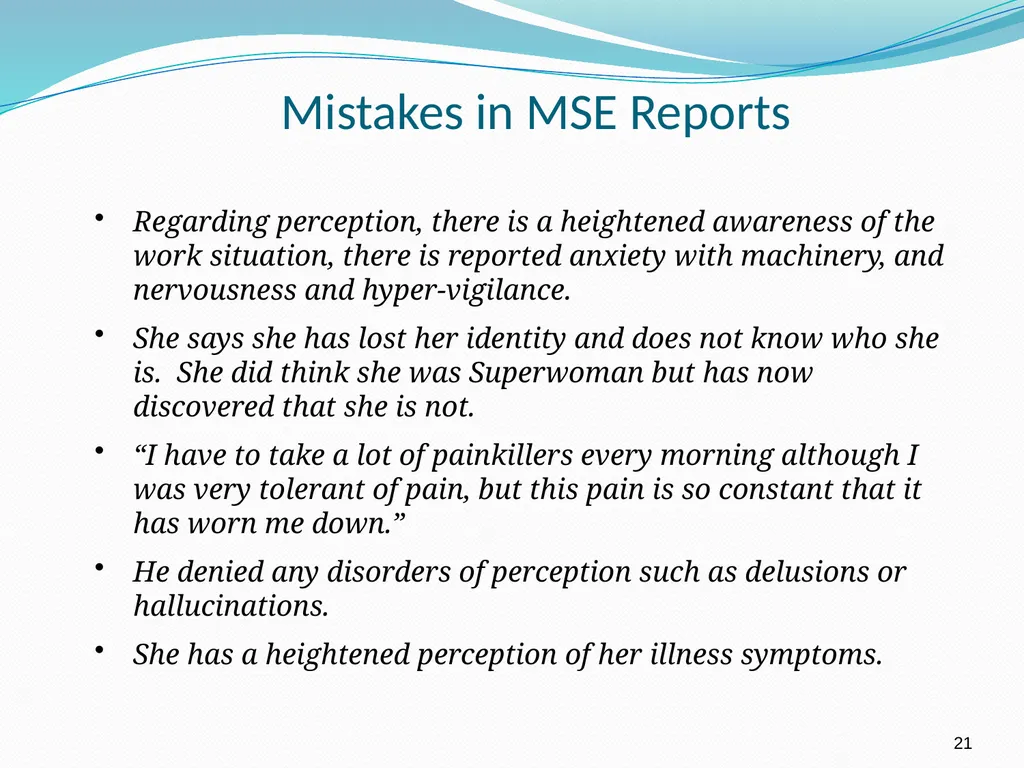
slide21. 21 Mistakes in MSE Reports Regarding perception, there is a heightened awareness of the work situation, there is reported anxiety with machinery, and nervousness and hyper-vigilance.
She says she has lost her identity and does not know who she is. She did think she was Superwoman but has now discovered that she is not.
“I have to take a lot of painkillers every morning although I was very tolerant of pain, but this pain is so constant that it has worn me down.”
He denied any disorders of perception such as delusions or hallucinations.
She has a heightened perception of her illness symptoms.<br>
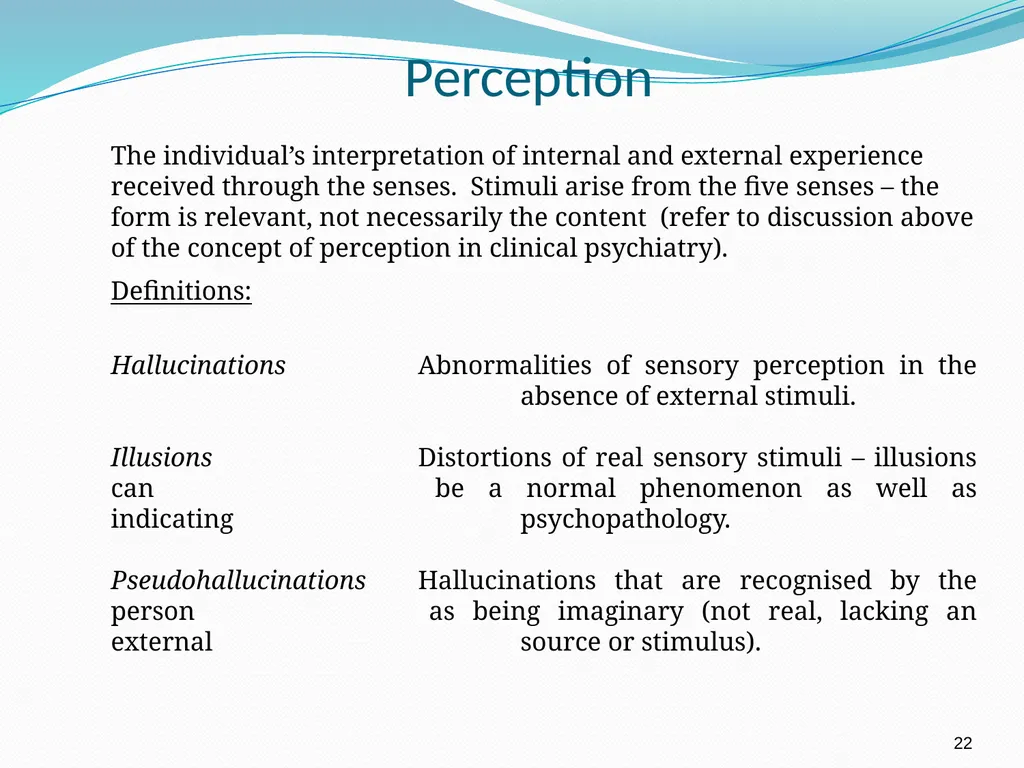
slide22. 22 Perception The individual’s interpretation of internal and external experience received through the senses. Stimuli arise from the five senses – the form is relevant, not necessarily the content (refer to discussion above of the concept of perception in clinical psychiatry).
Definitions:
Hallucinations Abnormalities of sensory perception in the absence of external stimuli.
Illusions Distortions of real sensory stimuli – illusions can be a normal phenomenon as well as indicating psychopathology.
Pseudohallucinations Hallucinations that are recognised by the person as being imaginary (not real, lacking an external source or stimulus).<br>
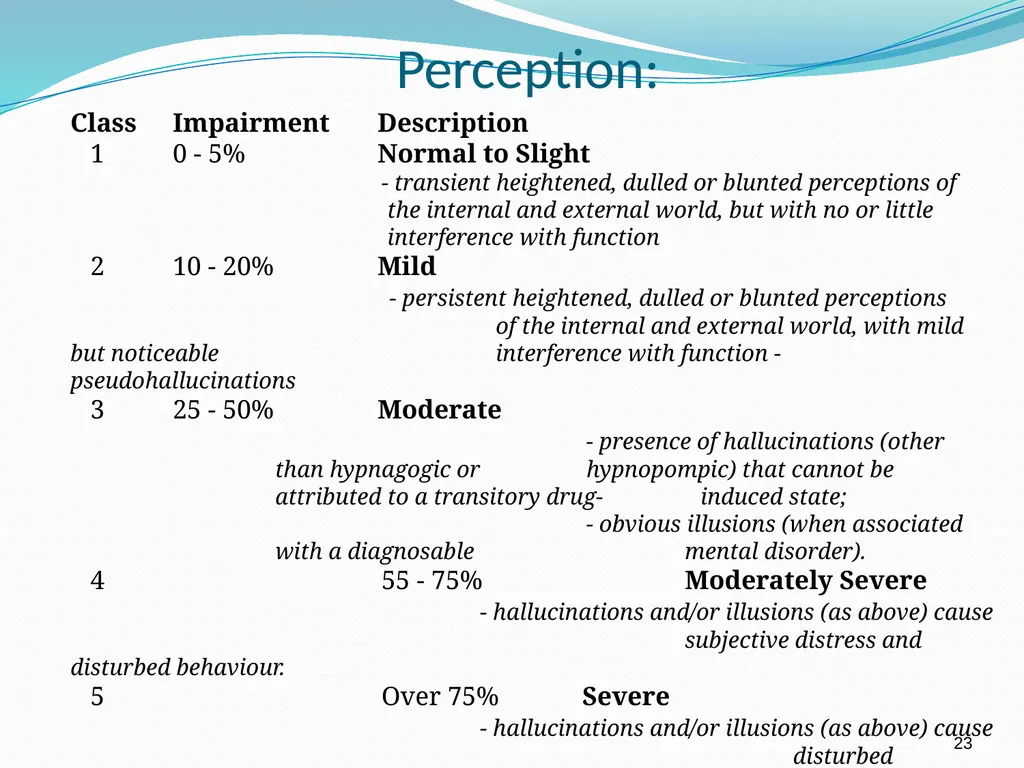
slide23. Perception: 23 Class Impairment Description
1 0 - 5% Normal to Slight
- transient heightened, dulled or blunted perceptions of the internal and external world, but with no or little interference with function
2 10 - 20% Mild
- persistent heightened, dulled or blunted perceptions of the internal and external world, with mild but noticeable interference with function - pseudohallucinations
3 25 - 50% Moderate
- presence of hallucinations (other than hypnagogic or hypnopompic) that cannot be attributed to a transitory drug- induced state;
- obvious illusions (when associated with a diagnosable mental disorder).
4 55 - 75% Moderately Severe
- hallucinations and/or illusions (as above) cause subjective distress and disturbed behaviour.
5 Over 75% Severe
- hallucinations and/or illusions (as above) cause disturbed behaviour to the extent that constant supervision is required.<br>
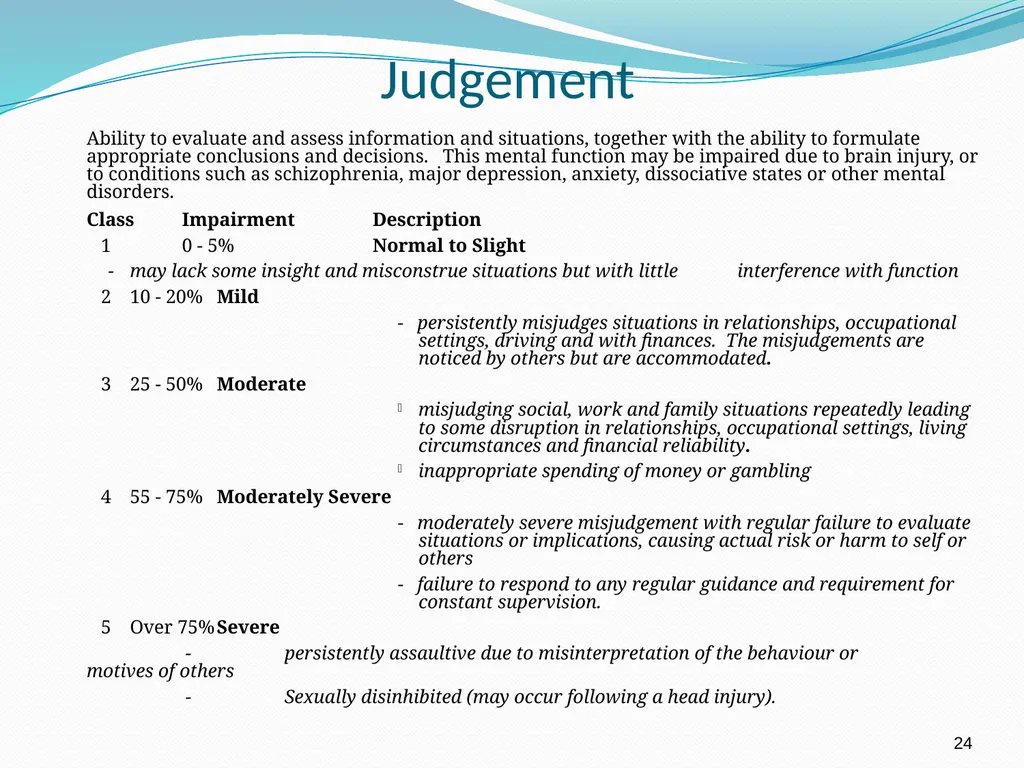
slide24. Judgement Ability to evaluate and assess information and situations, together with the ability to formulate appropriate conclusions and decisions. This mental function may be impaired due to brain injury, or to conditions such as schizophrenia, major depression, anxiety, dissociative states or other mental disorders.
Class Impairment Description
1 0 - 5% Normal to Slight
- may lack some insight and misconstrue situations but with little interference with function
2 10 - 20% Mild
- persistently misjudges situations in relationships, occupational settings, driving and with finances. The misjudgements are noticed by others but are accommodated.
3 25 - 50% Moderate
misjudging social, work and family situations repeatedly leading to some disruption in relationships, occupational settings, living circumstances and financial reliability.
inappropriate spending of money or gambling
4 55 - 75% Moderately Severe
- moderately severe misjudgement with regular failure to evaluate situations or implications, causing actual risk or harm to self or others
- failure to respond to any regular guidance and requirement for constant supervision.
5 Over 75% Severe
- persistently assaultive due to misinterpretation of the behaviour or motives of others
- Sexually disinhibited (may occur following a head injury). 24<br>
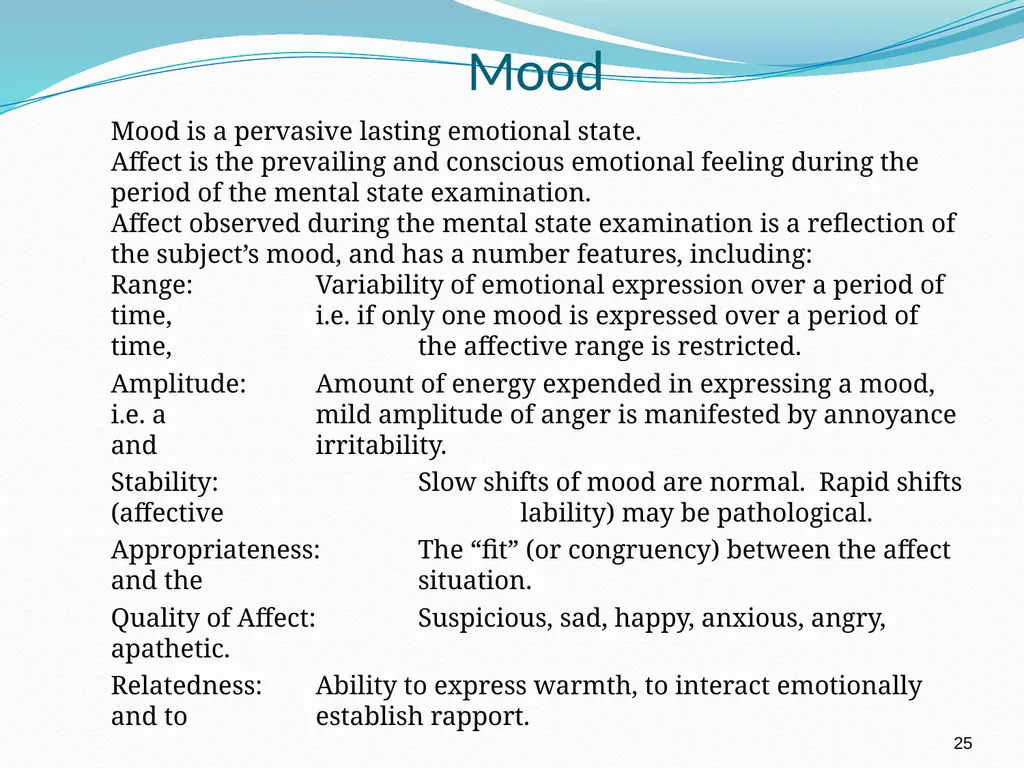
slide25. Mood 25 Mood is a pervasive lasting emotional state.
Affect is the prevailing and conscious emotional feeling during the period of the mental state examination.
Affect observed during the mental state examination is a reflection of the subject’s mood, and has a number features, including:
Range: Variability of emotional expression over a period of time, i.e. if only one mood is expressed over a period of time, the affective range is restricted.
Amplitude: Amount of energy expended in expressing a mood, i.e. a mild amplitude of anger is manifested by annoyance and irritability.
Stability: Slow shifts of mood are normal. Rapid shifts (affective lability) may be pathological.
Appropriateness: The “fit” (or congruency) between the affect and the situation.
Quality of Affect: Suspicious, sad, happy, anxious, angry, apathetic.
Relatedness: Ability to express warmth, to interact emotionally and to establish rapport.<br>
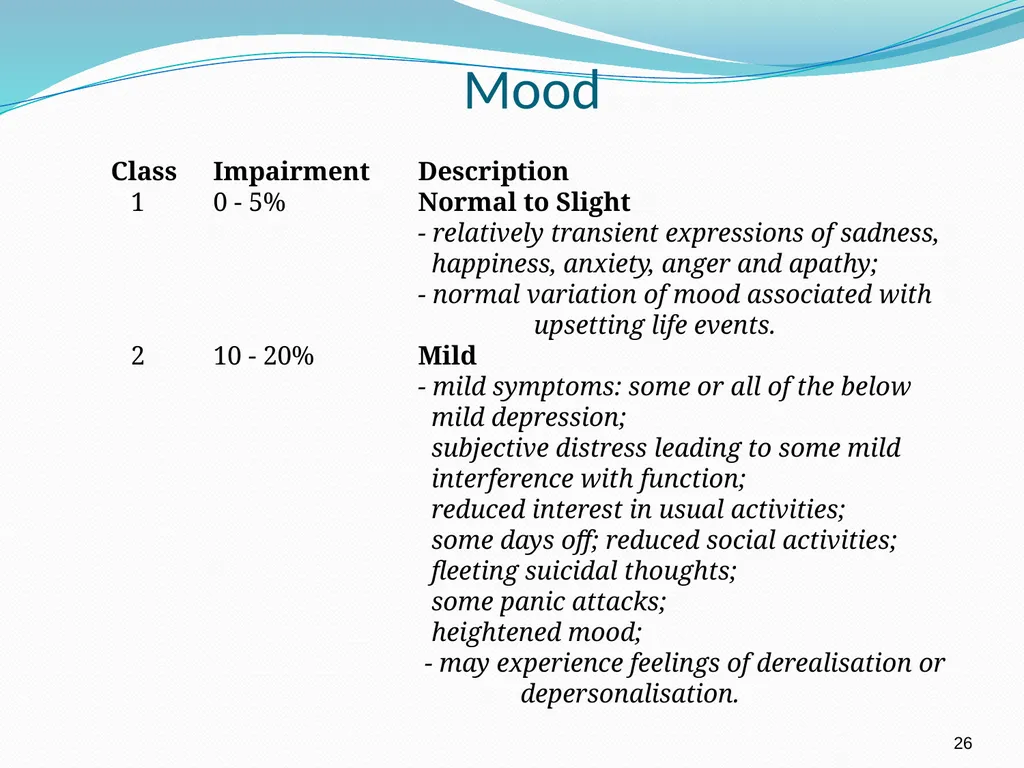
slide26. Mood 26 Class Impairment Description
1 0 - 5% Normal to Slight
- relatively transient expressions of sadness,
happiness, anxiety, anger and apathy;
- normal variation of mood associated with upsetting life events.
2 10 - 20% Mild
- mild symptoms: some or all of the below
mild depression;
subjective distress leading to some mild interference with function;
reduced interest in usual activities;
some days off; reduced social activities;
fleeting suicidal thoughts;
some panic attacks;
heightened mood;
- may experience feelings of derealisation or depersonalisation.<br>
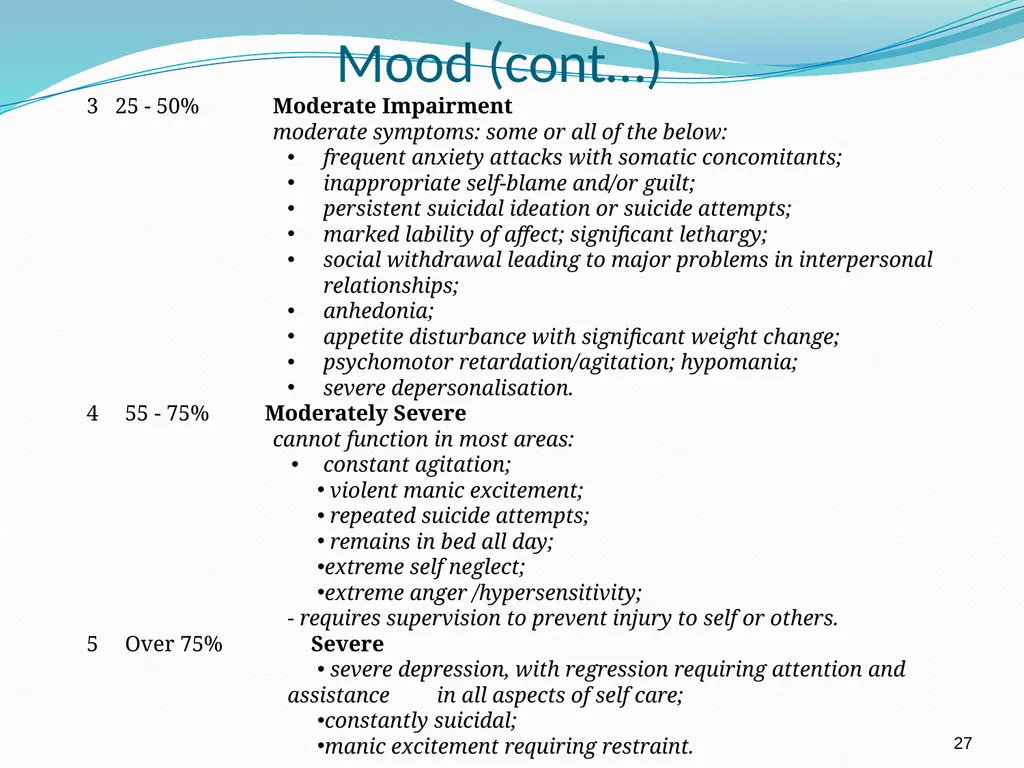
slide27. Mood (cont…) 27 3 25 - 50% Moderate Impairment
moderate symptoms: some or all of the below:
frequent anxiety attacks with somatic concomitants;
inappropriate self-blame and/or guilt;
persistent suicidal ideation or suicide attempts;
marked lability of affect; significant lethargy;
social withdrawal leading to major problems in interpersonal relationships;
anhedonia;
appetite disturbance with significant weight change;
psychomotor retardation/agitation; hypomania;
severe depersonalisation.
55 - 75% Moderately Severe
cannot function in most areas:
constant agitation;
violent manic excitement;
repeated suicide attempts;
remains in bed all day;
extreme self neglect;
extreme anger /hypersensitivity;
- requires supervision to prevent injury to self or others.
Over 75% Severe
severe depression, with regression requiring attention and assistance in all aspects of self care;
constantly suicidal;
manic excitement requiring restraint.<br>
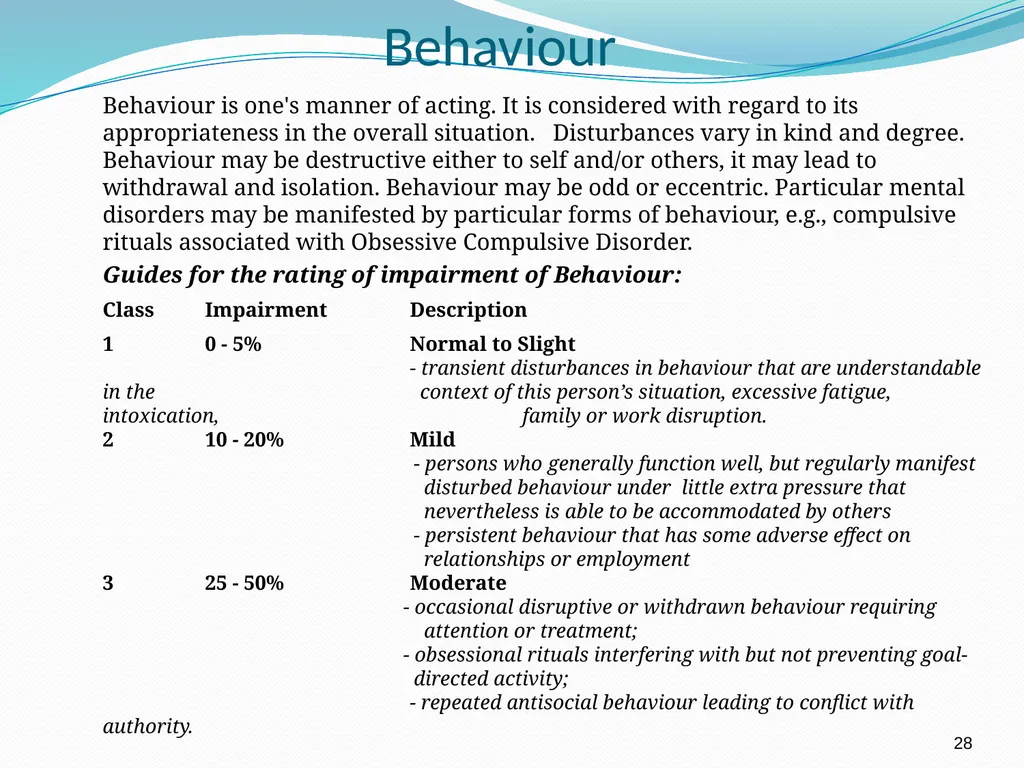
slide28. Behaviour 28 Behaviour is one's manner of acting. It is considered with regard to its appropriateness in the overall situation. Disturbances vary in kind and degree. Behaviour may be destructive either to self and/or others, it may lead to withdrawal and isolation. Behaviour may be odd or eccentric. Particular mental disorders may be manifested by particular forms of behaviour, e.g., compulsive rituals associated with Obsessive Compulsive Disorder.
Guides for the rating of impairment of Behaviour:
Class Impairment Description
1 0 - 5% Normal to Slight
- transient disturbances in behaviour that are understandable in the context of this person’s situation, excessive fatigue, intoxication, family or work disruption.
2 10 - 20% Mild
- persons who generally function well, but regularly manifest disturbed behaviour under little extra pressure that nevertheless is able to be accommodated by others
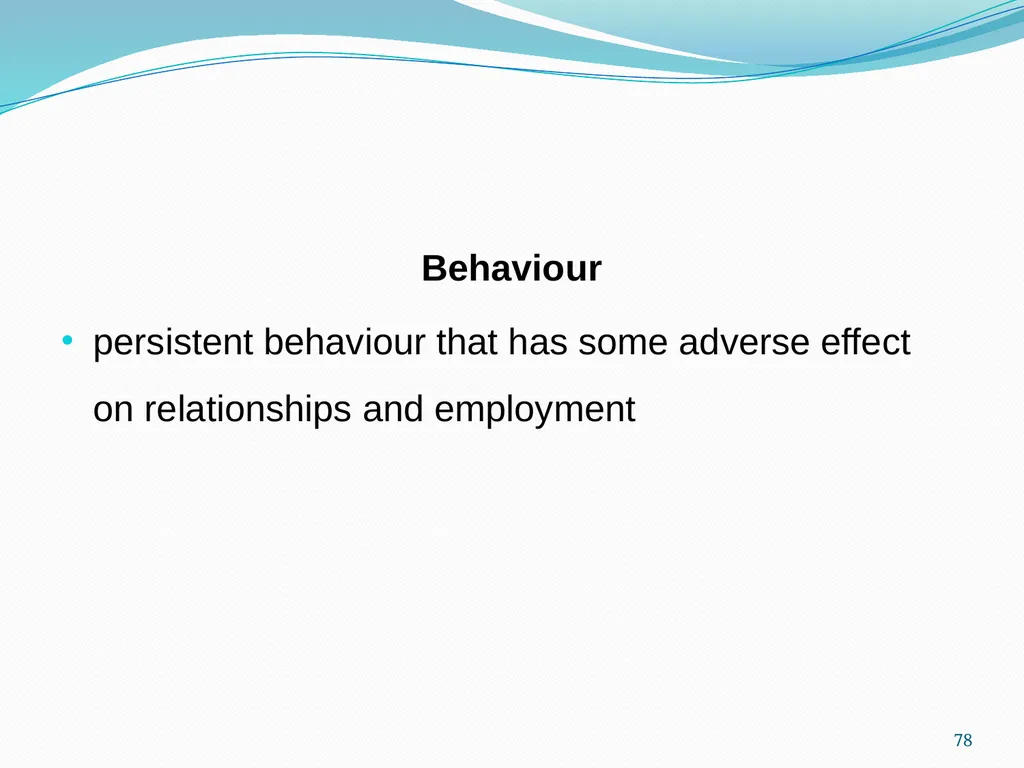
- persistent behaviour that has some adverse effect on relationships or employment
3 25 - 50% Moderate
- occasional disruptive or withdrawn behaviour requiring attention or treatment;
- obsessional rituals interfering with but not preventing goal-directed activity;
- repeated antisocial behaviour leading to conflict with authority.<br>
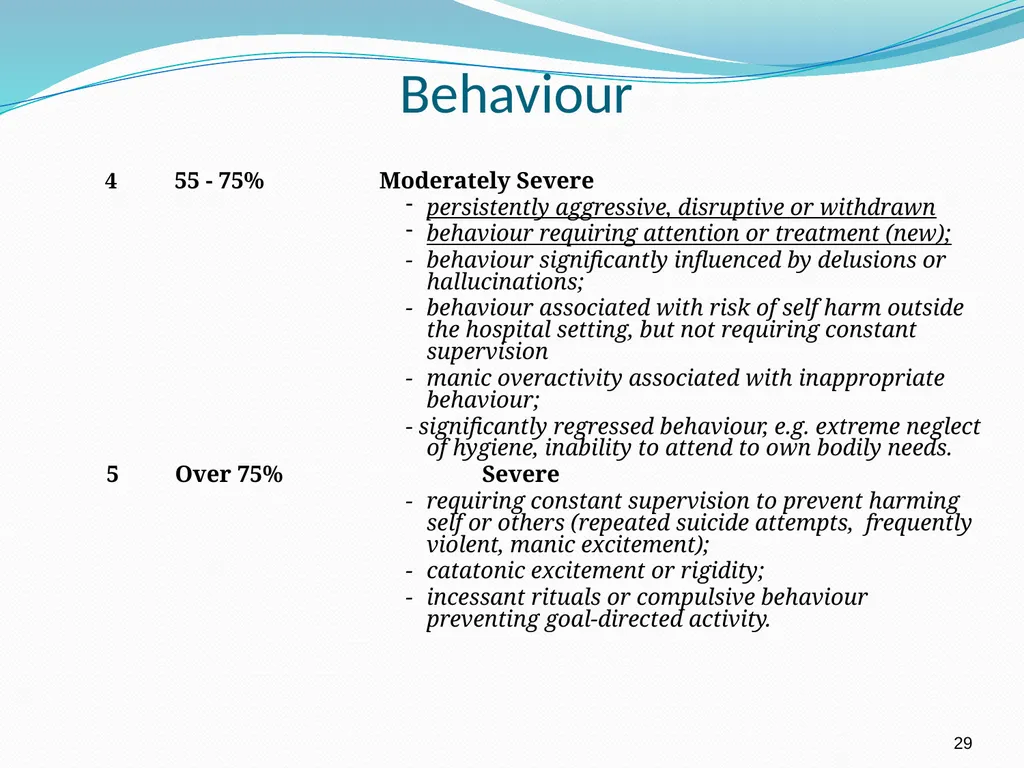
slide29. Behaviour 55 - 75% Moderately Severe
persistently aggressive, disruptive or withdrawn
behaviour requiring attention or treatment (new);
- behaviour significantly influenced by delusions or hallucinations;
- behaviour associated with risk of self harm outside the hospital setting, but not requiring constant supervision
- manic overactivity associated with inappropriate behaviour;
- significantly regressed behaviour, e.g. extreme neglect of hygiene, inability to attend to own bodily needs.
5 Over 75% Severe
- requiring constant supervision to prevent harming self or others (repeated suicide attempts, frequently violent, manic excitement);
- catatonic excitement or rigidity;
- incessant rituals or compulsive behaviour preventing goal-directed activity. 29<br>
slide30. 30<br>
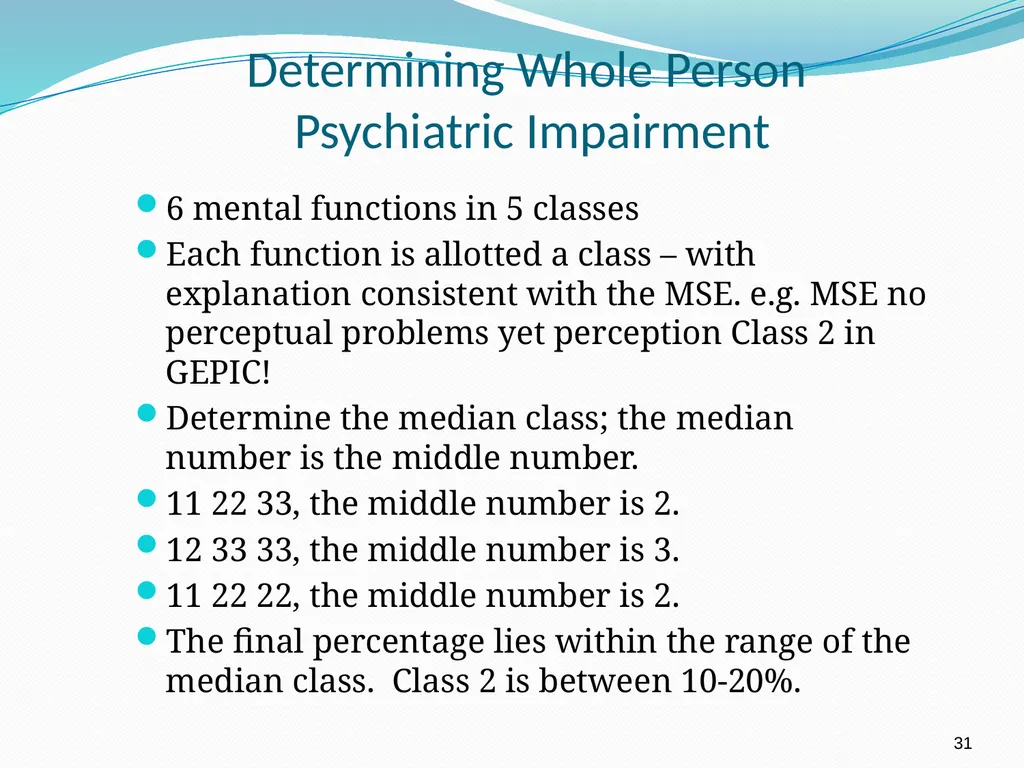
slide31. Determining Whole Person Psychiatric Impairment 6 mental functions in 5 classes
Each function is allotted a class – with explanation consistent with the MSE. e.g. MSE no perceptual problems yet perception Class 2 in GEPIC!
Determine the median class; the median number is the middle number.
11 22 33, the middle number is 2.
12 33 33, the middle number is 3.
11 22 22, the middle number is 2.
The final percentage lies within the range of the median class. Class 2 is between 10-20%. 31<br>
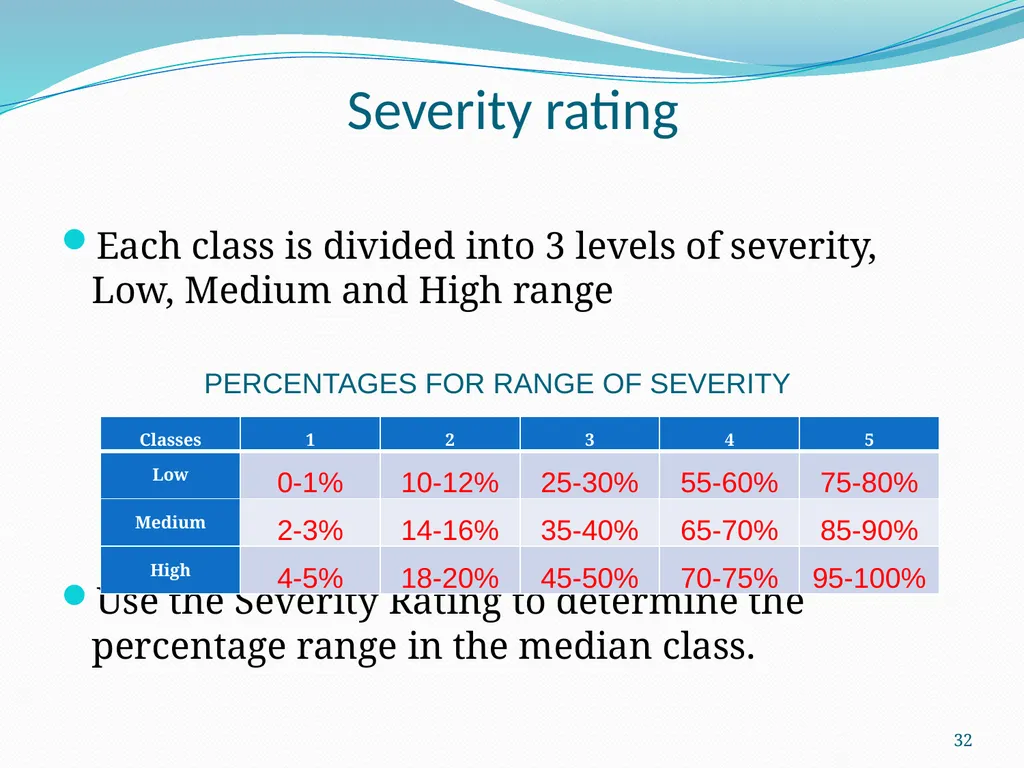
slide32. Severity rating Each class is divided into 3 levels of severity, Low, Medium and High range
Use the Severity Rating to determine the percentage range in the median class. 32 PERCENTAGES FOR RANGE OF SEVERITY<br>
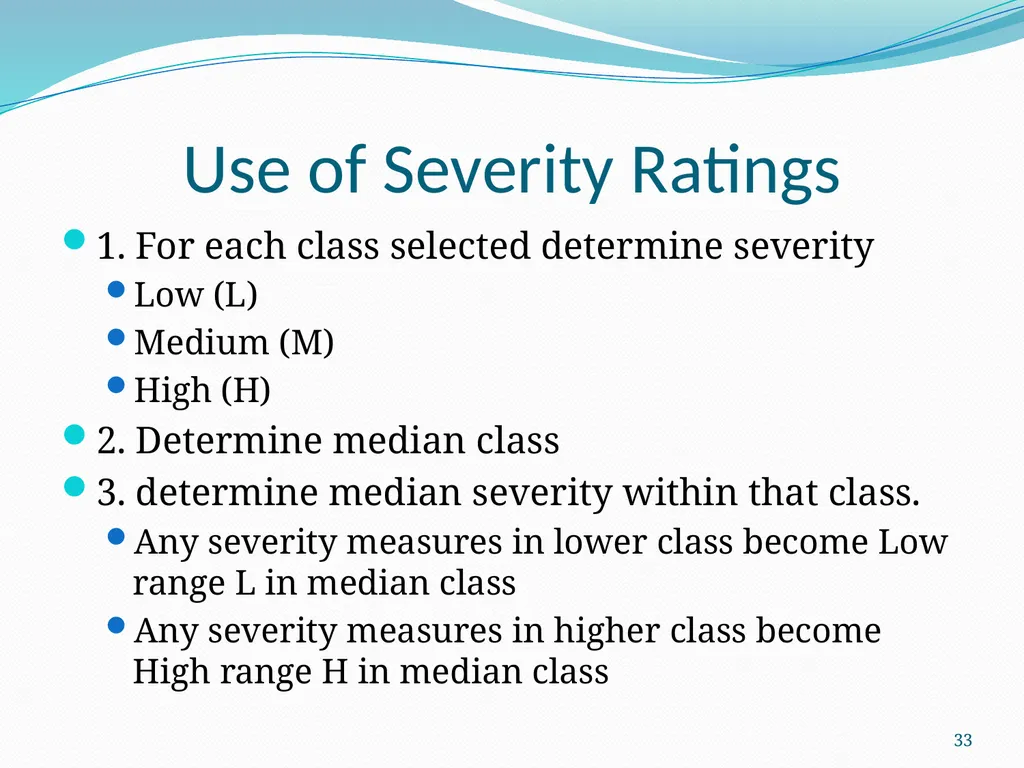
slide33. Use of Severity Ratings 1. For each class selected determine severity
Low (L)
Medium (M)
High (H)
2. Determine median class
3. determine median severity within that class.
Any severity measures in lower class become Low range L in median class
Any severity measures in higher class become High range H in median class 33<br>
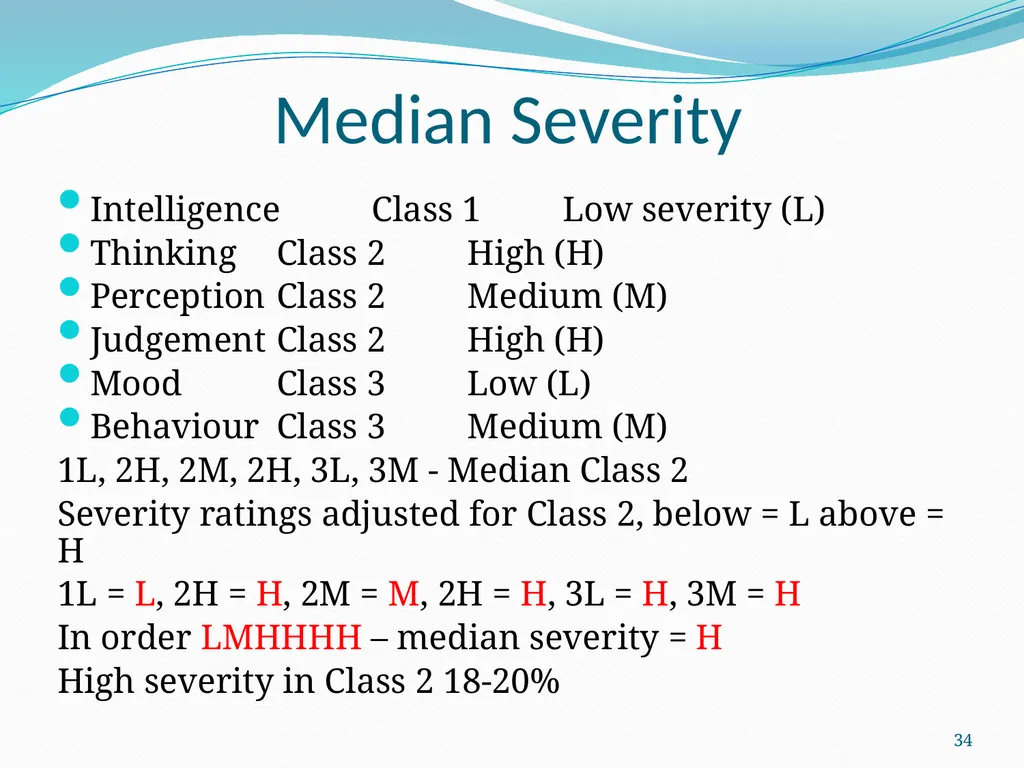
slide34. Median Severity Intelligence Class 1 Low severity (L)
Thinking Class 2 High (H)
Perception Class 2 Medium (M)
Judgement Class 2 High (H)
Mood Class 3 Low (L)
Behaviour Class 3 Medium (M)
1L, 2H, 2M, 2H, 3L, 3M - Median Class 2
Severity ratings adjusted for Class 2, below = L above = H
1L = L, 2H = H, 2M = M, 2H = H, 3L = H, 3M = H
In order LMHHHH – median severity = H
High severity in Class 2 18-20% 34<br>
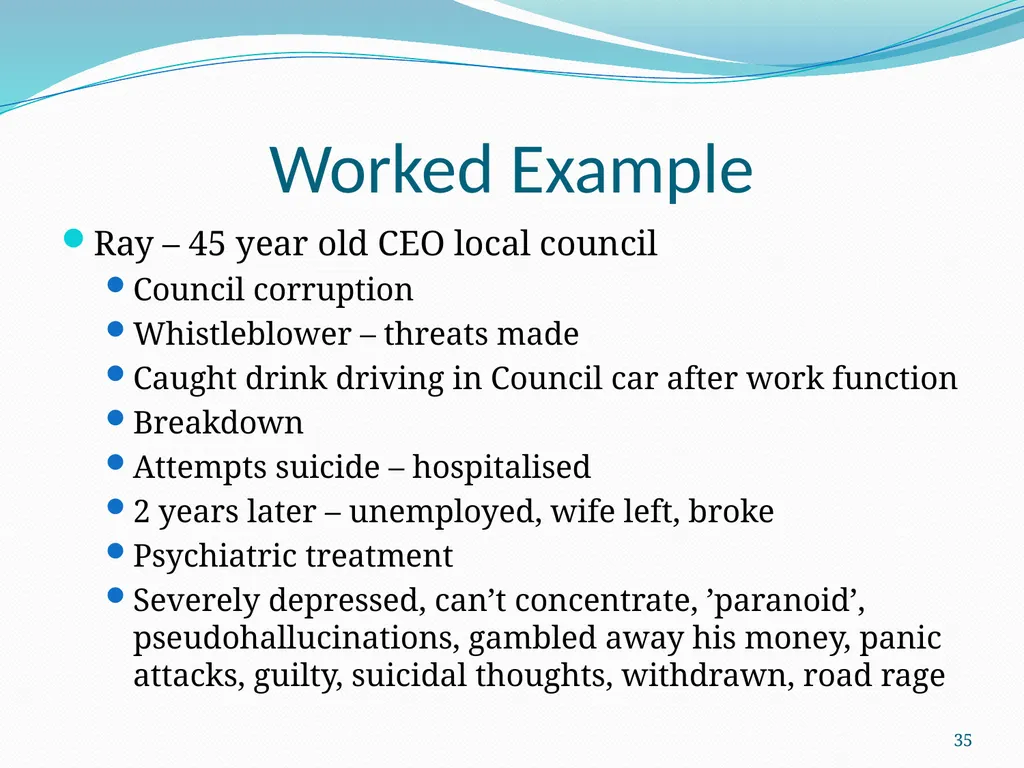
slide35. Worked Example Ray – 45 year old CEO local council
Council corruption
Whistleblower – threats made
Caught drink driving in Council car after work function
Breakdown
Attempts suicide – hospitalised
2 years later – unemployed, wife left, broke
Psychiatric treatment
Severely depressed, can’t concentrate, ’paranoid’, pseudohallucinations, gambled away his money, panic attacks, guilty, suicidal thoughts, withdrawn, road rage 35<br>
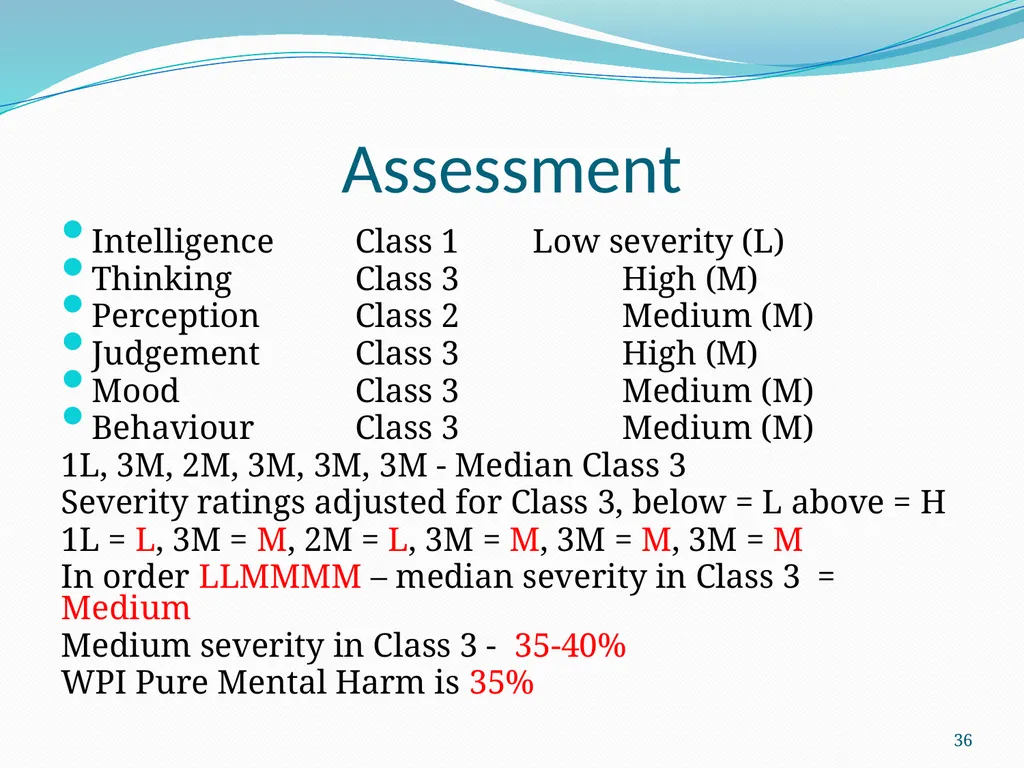
slide36. Assessment Intelligence Class 1 Low severity (L)
Thinking Class 3 High (M)
Perception Class 2 Medium (M)
Judgement Class 3 High (M)
Mood Class 3 Medium (M)
Behaviour Class 3 Medium (M)
1L, 3M, 2M, 3M, 3M, 3M - Median Class 3
Severity ratings adjusted for Class 3, below = L above = H
1L = L, 3M = M, 2M = L, 3M = M, 3M = M, 3M = M
In order LLMMMM – median severity in Class 3 = Medium
Medium severity in Class 3 - 35-40%
WPI Pure Mental Harm is 35% 36<br>
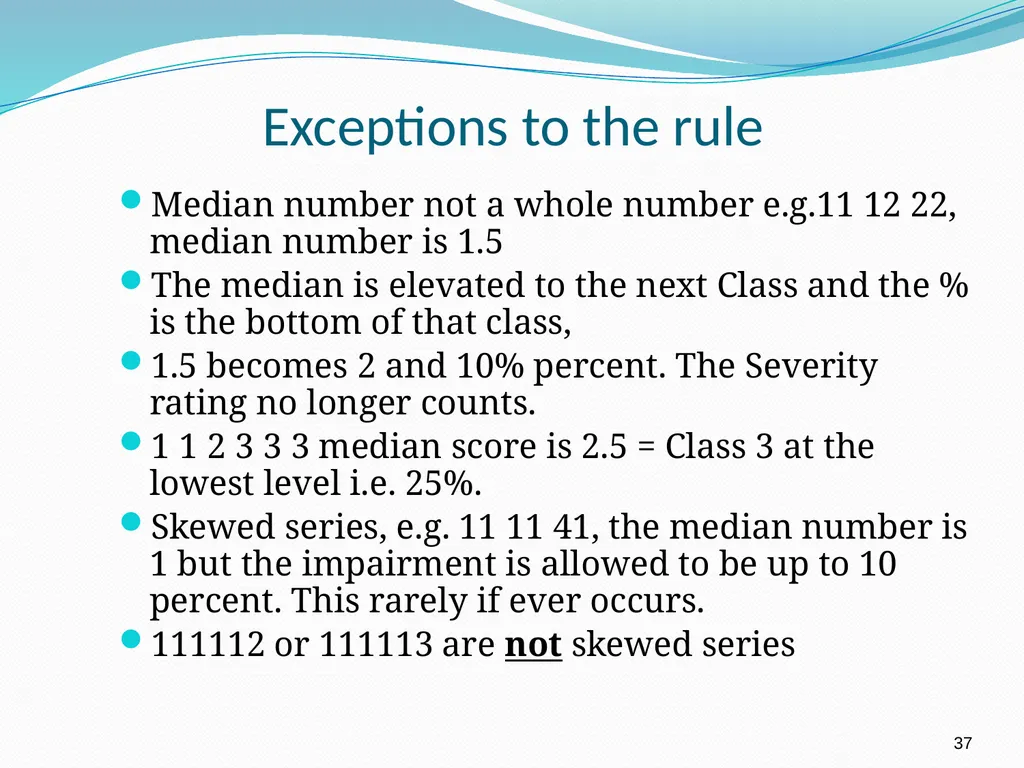
slide37. Exceptions to the rule Median number not a whole number e.g.11 12 22, median number is 1.5
The median is elevated to the next Class and the % is the bottom of that class,
1.5 becomes 2 and 10% percent. The Severity rating no longer counts.
1 1 2 3 3 3 median score is 2.5 = Class 3 at the lowest level i.e. 25%.
Skewed series, e.g. 11 11 41, the median number is 1 but the impairment is allowed to be up to 10 percent. This rarely if ever occurs.
111112 or 111113 are not skewed series 37<br>
slide38. Overlap Between Psychiatric and Neurological Impairment Traumatic brain injury: impairment involves two disciplines, neurology and psychiatry.
The Impairment Assessment guidelines have modified AMA 5 Chapter 13. Cerebral Impairment evaluated using 4 of the 7 tables in AMA5 including:
13-2 Impairment of consciousness or awareness
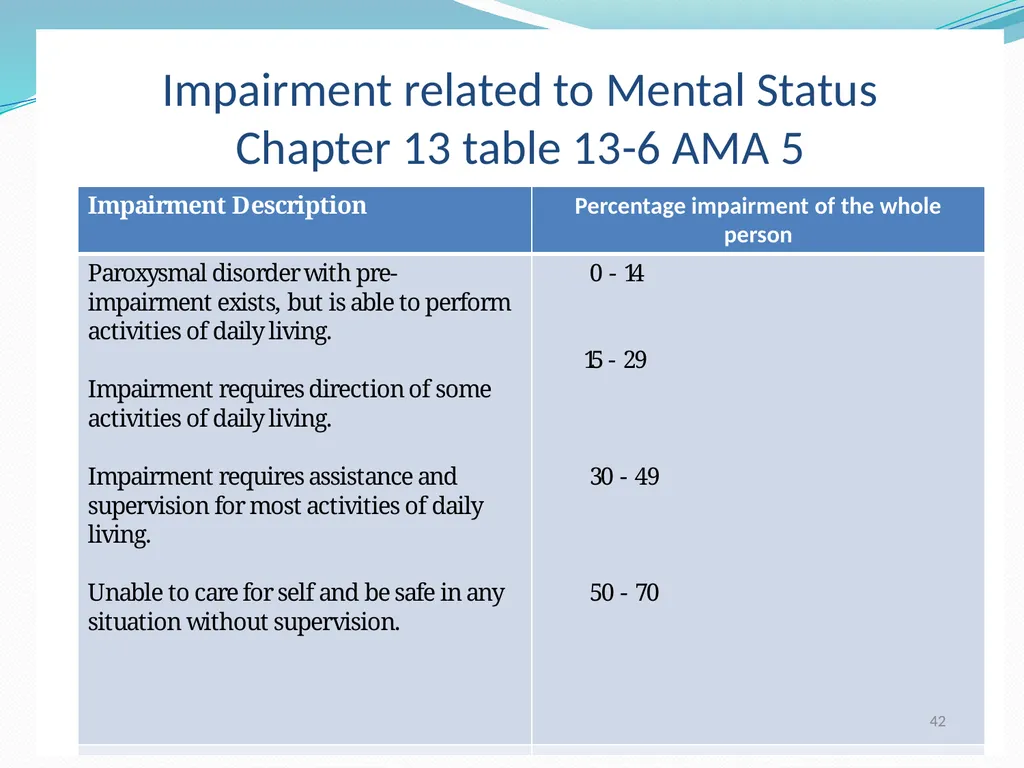
13-6 Impairment related to mental status, cognition and highest integrative function
13-7 Impairment due to aphasia and communication disorders
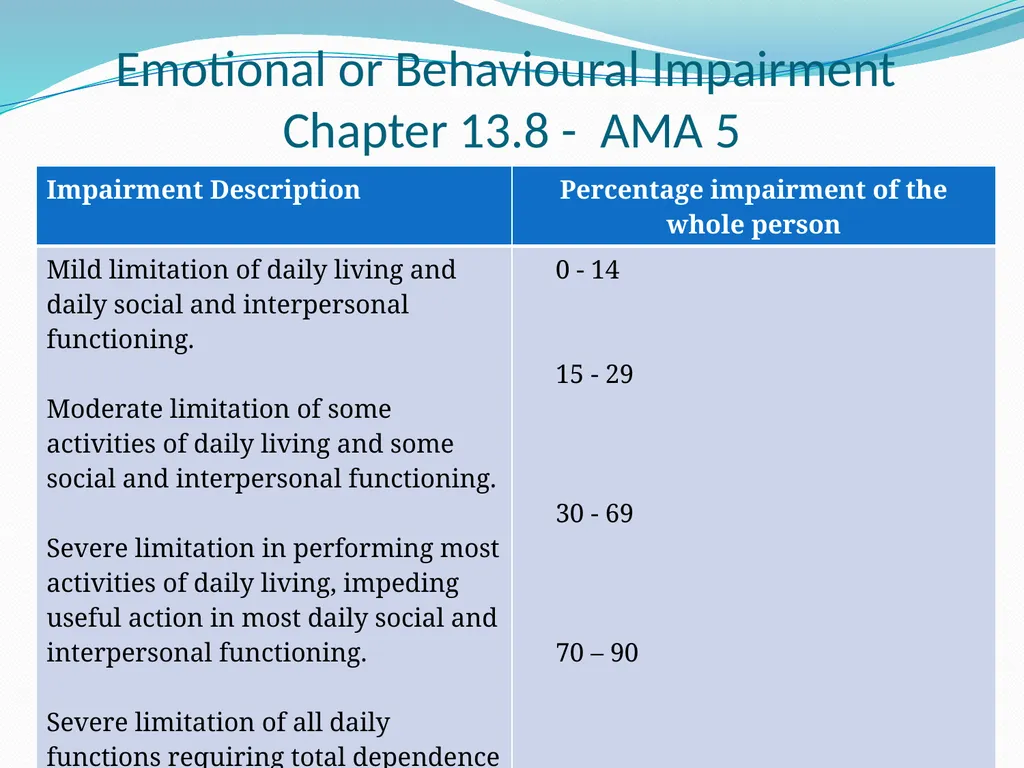
13-8 Impairment due to emotional or behavioural disorders related to a verifiable neurological disorder
These scores are combined using the combined values table.
Probable overlap with GEPIC.
Behavioural disturbance arising from a TBI is Consequential Mental Harm
Use the GEPIC to measure Pure Mental Harm . 38<br>
slide39. 39<br>
slide40. Emotional or Behavioural Impairment Chapter 13.8 - AMA 5 40<br>
slide41. Pain and psychiatric impairment Chapter 18 on pain removed from AMA 5 re Return to Work claims. The IAG states:
subjective experience
measurement tools are based on self reports
some ratings (e.g. WPI spine) take pain into account but others don’t.
peripheral nerve injury with sensory loss, some impairment categories allow for pain to be included
causalgia and complex regional pain syndrome should not be used
The GEPIC may be used as a proxy for impairment from pain. 41<br>
slide42. Summary of issues to do with pain Pain – almost always due to a physical injury.
organic factors may not fully explain the pain
The psychiatrist assesses if there is a Somatic Symptom Disorder with Predominant Pain
if any physical injury – Consequential Mental Harm
If Pure Mental Harm GEPIC uses proxies of pain such as impairment of thinking, judgement, mood and behaviour. 42<br>
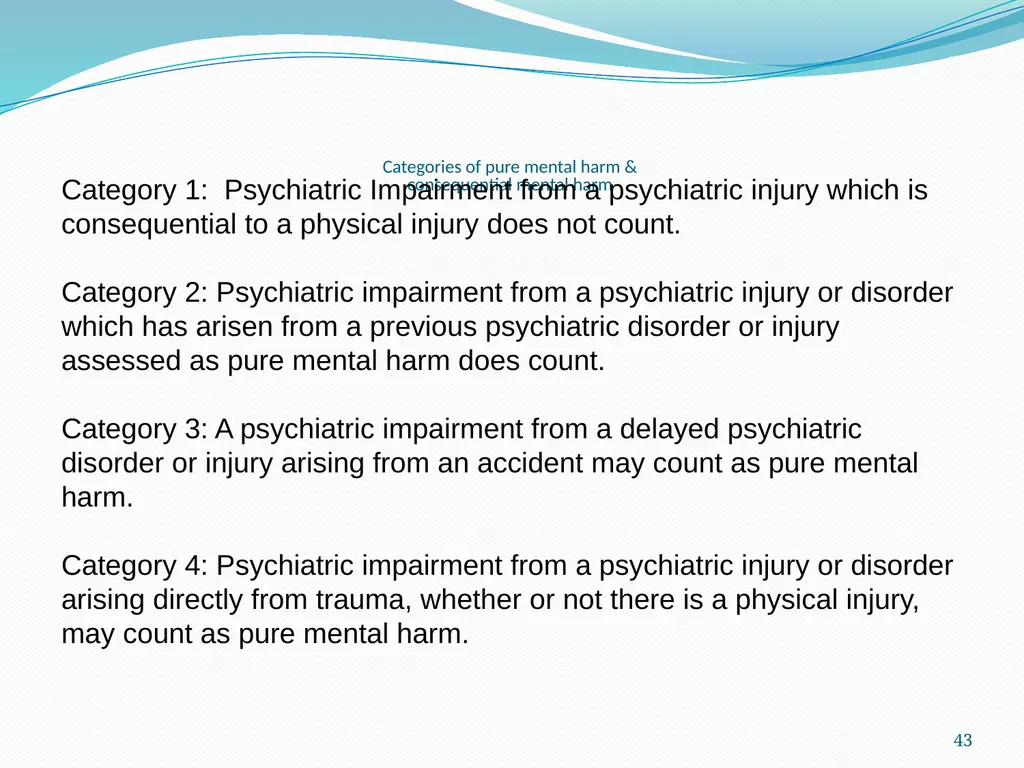
slide43. Categories of pure mental harm & consequential mental harm Category 1: Psychiatric Impairment from a psychiatric injury which is consequential to a physical injury does not count. Category 2: Psychiatric impairment from a psychiatric injury or disorder which has arisen from a previous psychiatric disorder or injury assessed as pure mental harm does count. Category 3: A psychiatric impairment from a delayed psychiatric disorder or injury arising from an accident may count as pure mental harm. Category 4: Psychiatric impairment from a psychiatric injury or disorder arising directly from trauma, whether or not there is a physical injury, may count as pure mental harm. 43<br>
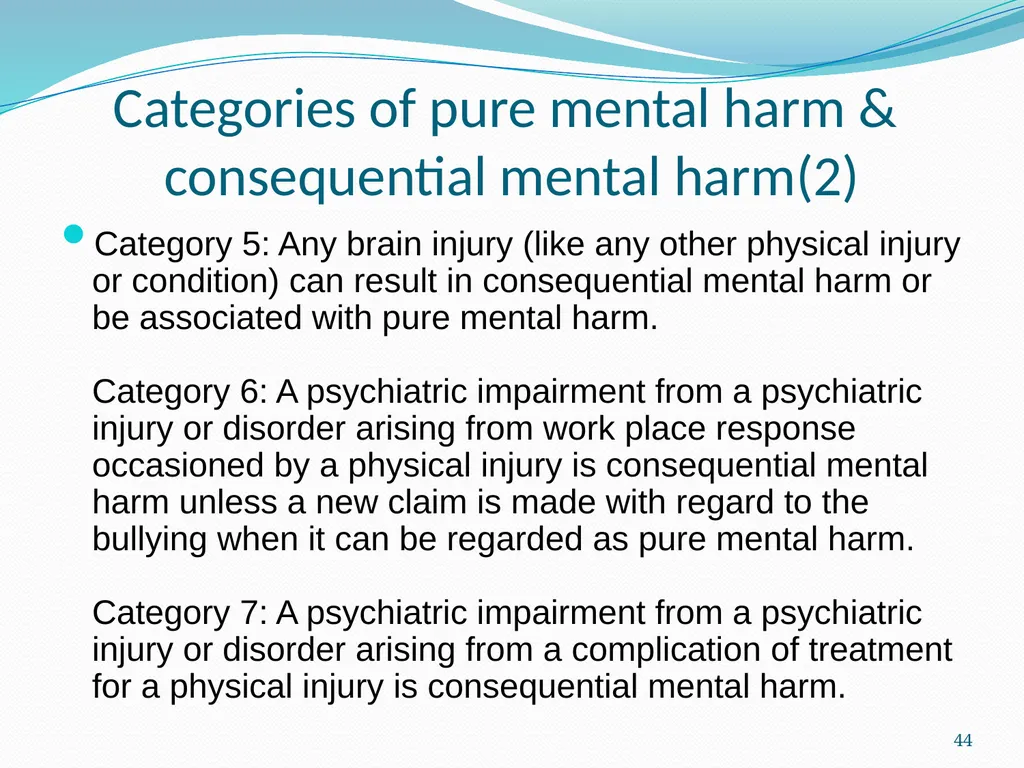
slide44. Categories of pure mental harm & consequential mental harm(2) Category 5: Any brain injury (like any other physical injury or condition) can result in consequential mental harm or be associated with pure mental harm. Category 6: A psychiatric impairment from a psychiatric injury or disorder arising from work place response occasioned by a physical injury is consequential mental harm unless a new claim is made with regard to the bullying when it can be regarded as pure mental harm. Category 7: A psychiatric impairment from a psychiatric injury or disorder arising from a complication of treatment for a physical injury is consequential mental harm. 44<br>
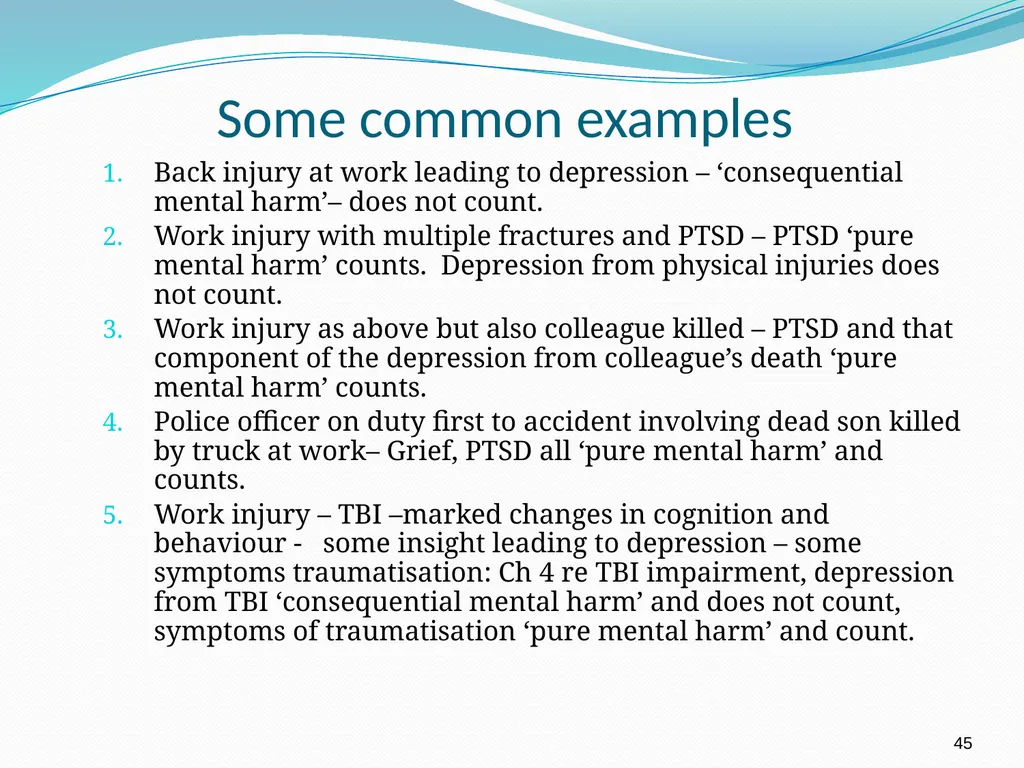
slide45. Some common examples Back injury at work leading to depression – ‘consequential mental harm’– does not count.
Work injury with multiple fractures and PTSD – PTSD ‘pure mental harm’ counts. Depression from physical injuries does not count.
Work injury as above but also colleague killed – PTSD and that component of the depression from colleague’s death ‘pure mental harm’ counts.
Police officer on duty first to accident involving dead son killed by truck at work– Grief, PTSD all ‘pure mental harm’ and counts.
Work injury – TBI –marked changes in cognition and behaviour - some insight leading to depression – some symptoms traumatisation: Ch 4 re TBI impairment, depression from TBI ‘consequential mental harm’ and does not count, symptoms of traumatisation ‘pure mental harm’ and count. 45<br>
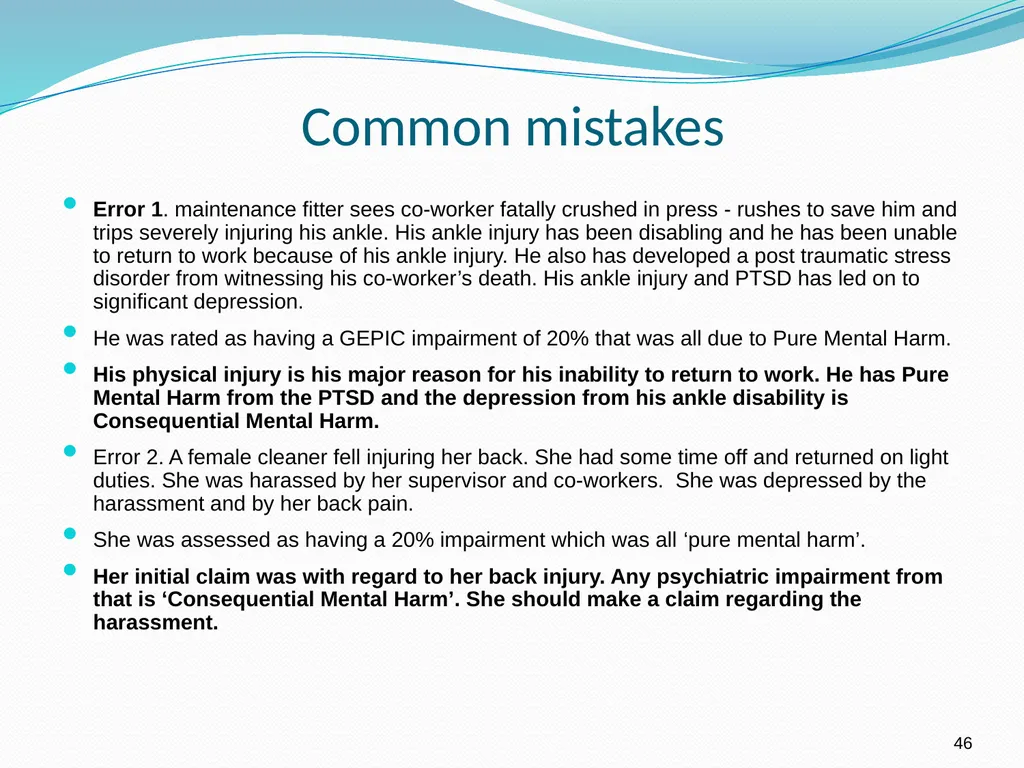
slide46. Common mistakes Error 1. maintenance fitter sees co-worker fatally crushed in press - rushes to save him and trips severely injuring his ankle. His ankle injury has been disabling and he has been unable to return to work because of his ankle injury. He also has developed a post traumatic stress disorder from witnessing his co-worker’s death. His ankle injury and PTSD has led on to significant depression.
He was rated as having a GEPIC impairment of 20% that was all due to Pure Mental Harm.
His physical injury is his major reason for his inability to return to work. He has Pure Mental Harm from the PTSD and the depression from his ankle disability is Consequential Mental Harm.
Error 2. A female cleaner fell injuring her back. She had some time off and returned on light duties. She was harassed by her supervisor and co-workers. She was depressed by the harassment and by her back pain.
She was assessed as having a 20% impairment which was all ‘pure mental harm’.
Her initial claim was with regard to her back injury. Any psychiatric impairment from that is ‘Consequential Mental Harm’. She should make a claim regarding the harassment. 46<br>
slide47. The cardinal rule is that any psychiatric impairment secondary or consequential to physical injury from the work injury is ‘consequential mental harm’ and does not count. 47<br>
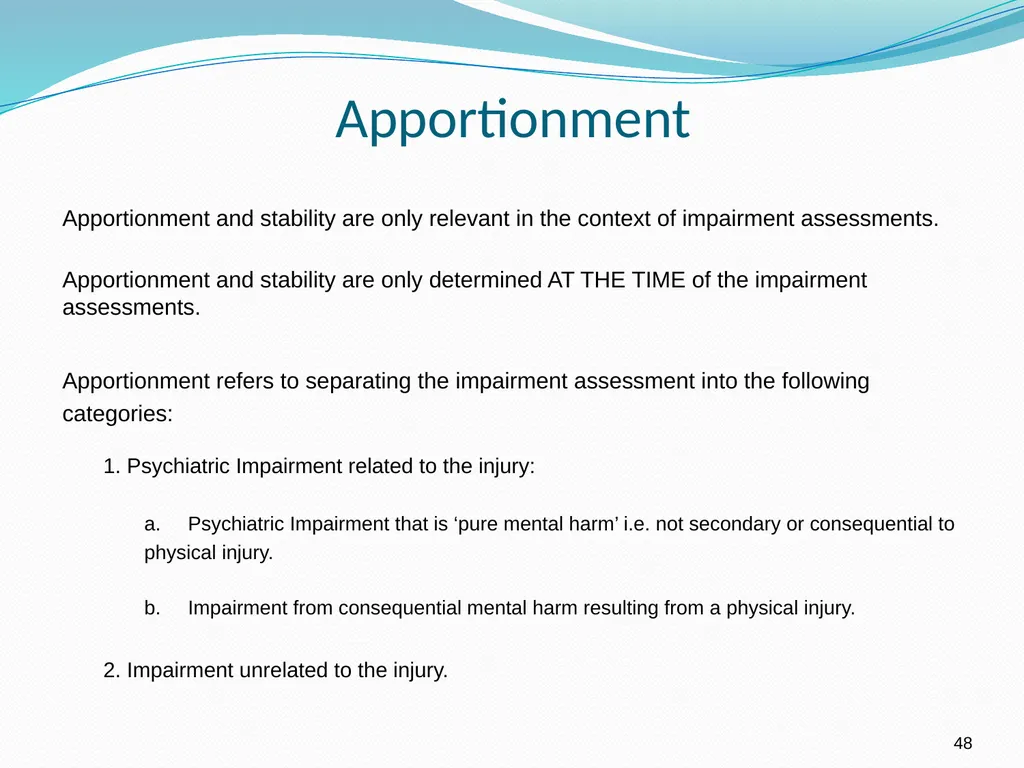
slide48. Apportionment Apportionment and stability are only relevant in the context of impairment assessments.
Apportionment and stability are only determined AT THE TIME of the impairment assessments.
Apportionment refers to separating the impairment assessment into the following categories:
1. Psychiatric Impairment related to the injury:
a. Psychiatric Impairment that is ‘pure mental harm’ i.e. not secondary or consequential to physical injury.
b. Impairment from consequential mental harm resulting from a physical injury.
2. Impairment unrelated to the injury. 48<br>
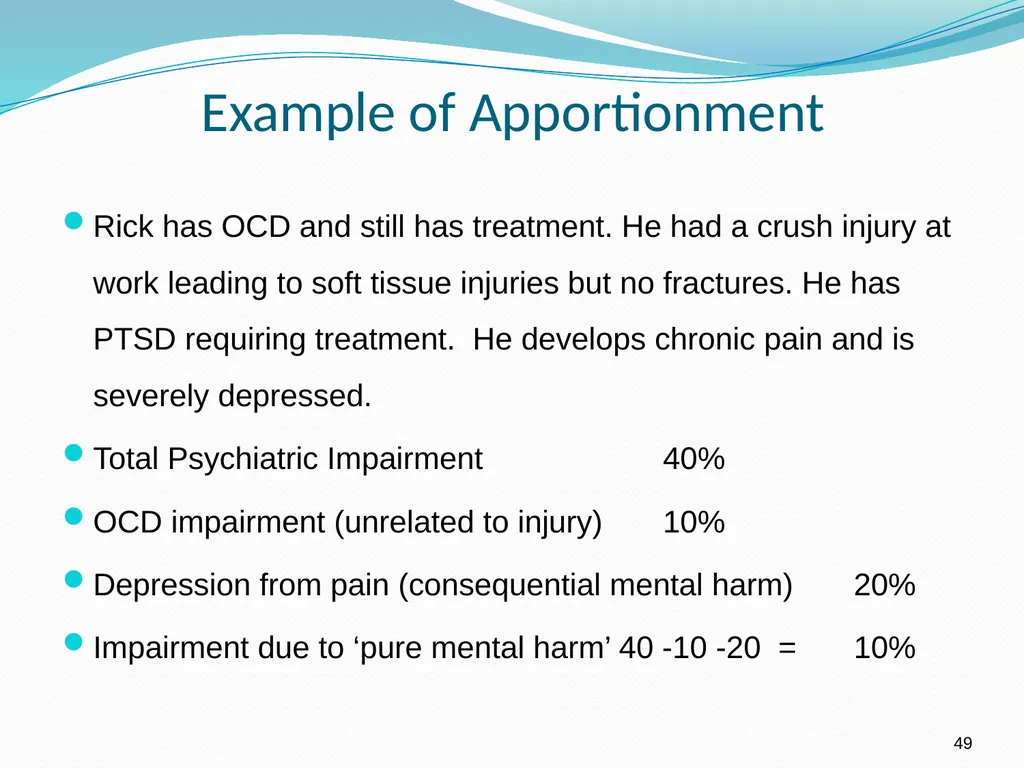
slide49. Example of Apportionment Rick has OCD and still has treatment. He had a crush injury at work leading to soft tissue injuries but no fractures. He has PTSD requiring treatment. He develops chronic pain and is severely depressed.
Total Psychiatric Impairment 40%
OCD impairment (unrelated to injury) 10%
Depression from pain (consequential mental harm) 20%
Impairment due to ‘pure mental harm’ 40 -10 -20 = 10% 49<br>
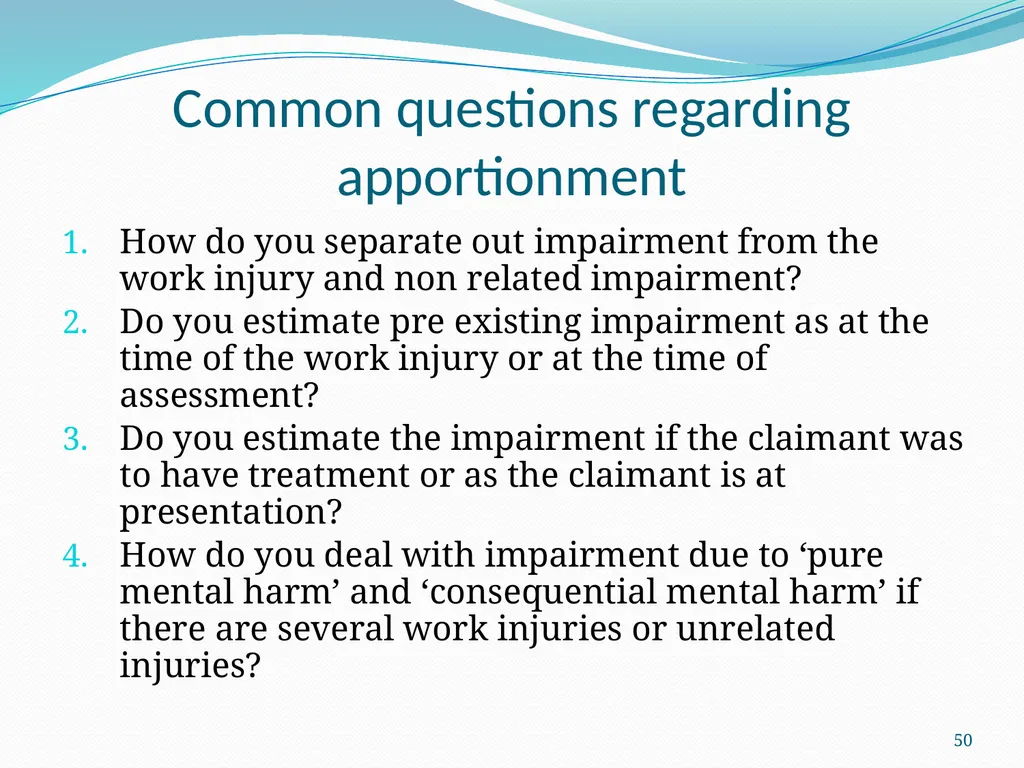
slide50. Common questions regarding apportionment How do you separate out impairment from the work injury and non related impairment?
Do you estimate pre existing impairment as at the time of the work injury or at the time of assessment?
Do you estimate the impairment if the claimant was to have treatment or as the claimant is at presentation?
How do you deal with impairment due to ‘pure mental harm’ and ‘consequential mental harm’ if there are several work injuries or unrelated injuries? 50<br>
slide51. Impairment unrelated to the injury Impairment unrelated to the work injury includes:
Pre-existing impairment present at the time of the impairment assessment (e.g. a chronic schizophrenic disorder) that may or may not have been exacerbated by the work injury
Pre-existing impairment - no longer present at the time of the impairment assessment (e.g. a major depressive disorder that was successfully treated and for which there has been no ongoing treatment or symptoms)
Impairment arisen since the injury and unrelated to the injury (a non injury-related assault leading to the development of a post traumatic stress disorder)
Another injury whether or not work related 51<br>
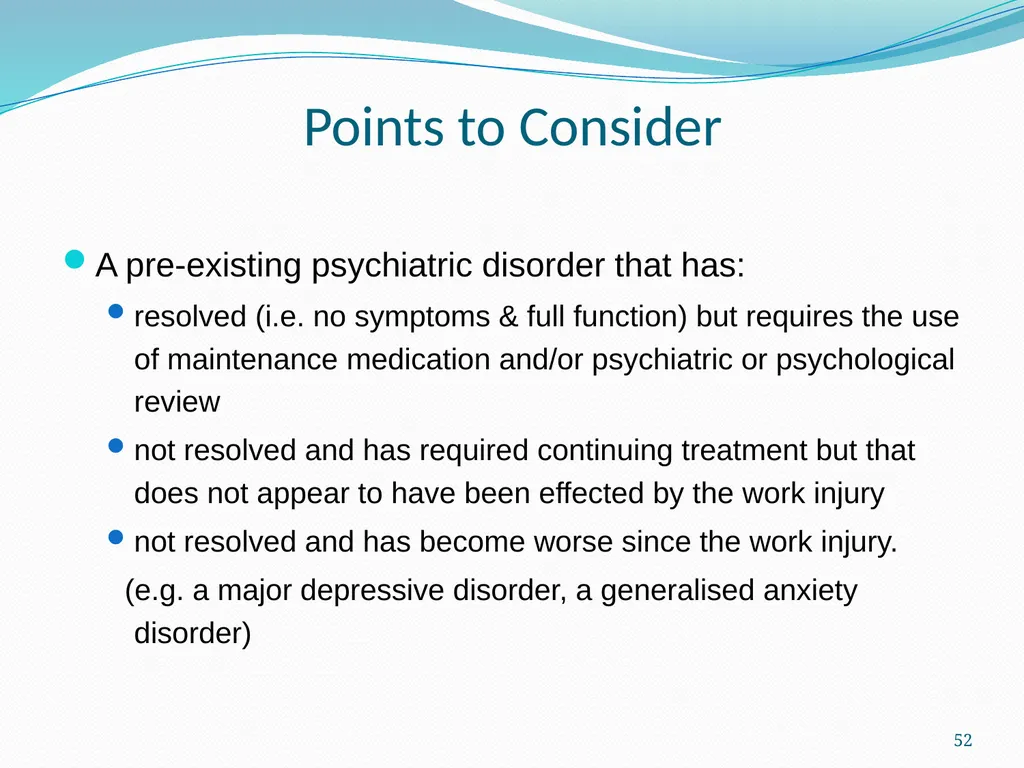
slide52. Points to Consider A pre-existing psychiatric disorder that has:
resolved (i.e. no symptoms & full function) but requires the use of maintenance medication and/or psychiatric or psychological review
not resolved and has required continuing treatment but that does not appear to have been effected by the work injury
not resolved and has become worse since the work injury.
(e.g. a major depressive disorder, a generalised anxiety disorder) 52<br>
slide53. Points to Consider (2) An unrelated psychiatric disorder that has occurred since the work injury that has:
resolved but that has involved the use of maintenance medication and/or psychiatric or psychological review
not resolved and has required continuing treatment but that does not appear to have been effected by the work injury
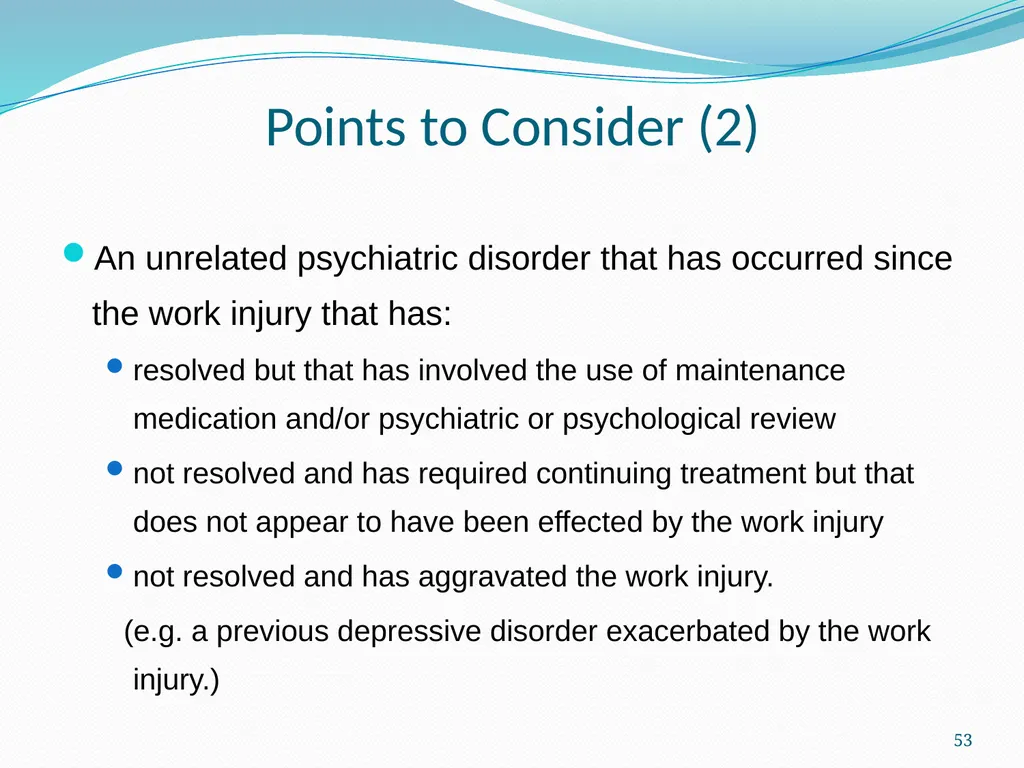
not resolved and has aggravated the work injury.
(e.g. a previous depressive disorder exacerbated by the work injury.) 53<br>
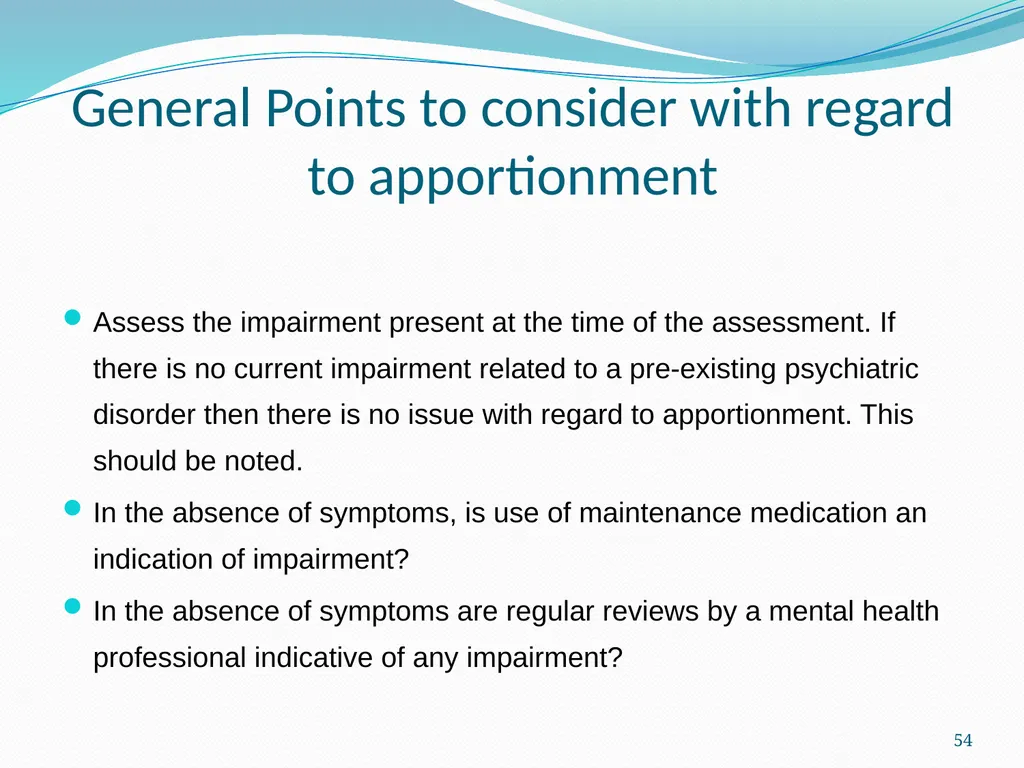
slide54. General Points to consider with regard to apportionment Assess the impairment present at the time of the assessment. If there is no current impairment related to a pre-existing psychiatric disorder then there is no issue with regard to apportionment. This should be noted.
In the absence of symptoms, is use of maintenance medication an indication of impairment?
In the absence of symptoms are regular reviews by a mental health professional indicative of any impairment? 54<br>
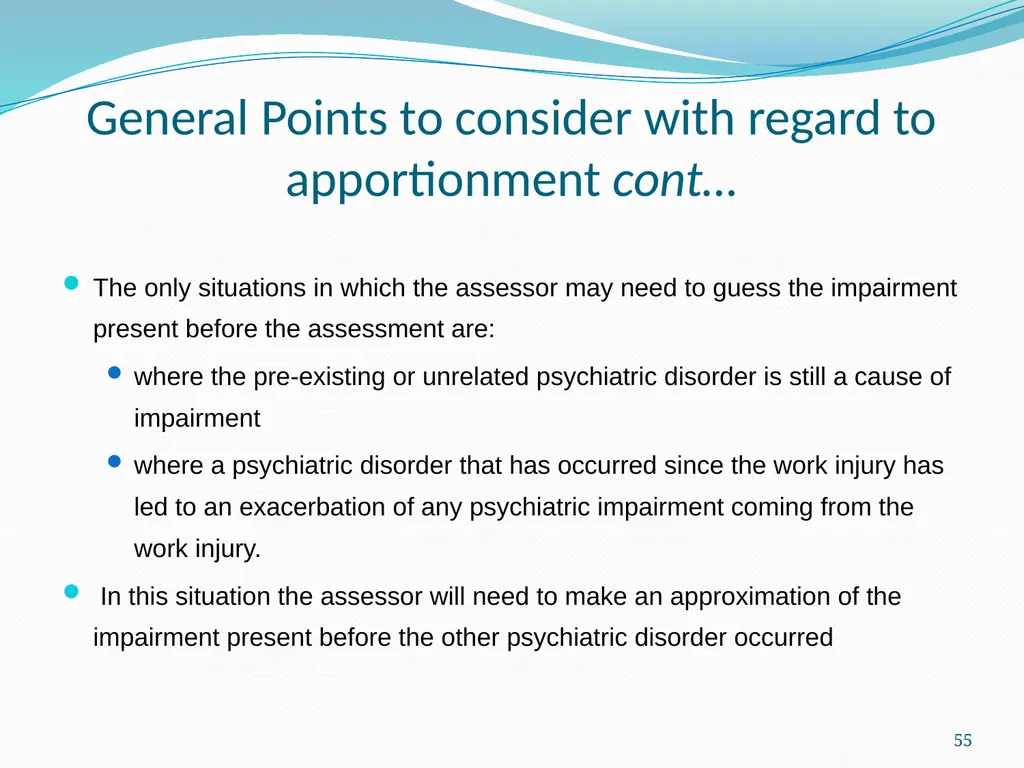
slide55. General Points to consider with regard to apportionment cont… The only situations in which the assessor may need to guess the impairment present before the assessment are:
where the pre-existing or unrelated psychiatric disorder is still a cause of impairment
where a psychiatric disorder that has occurred since the work injury has led to an exacerbation of any psychiatric impairment coming from the work injury.
In this situation the assessor will need to make an approximation of the impairment present before the other psychiatric disorder occurred 55<br>
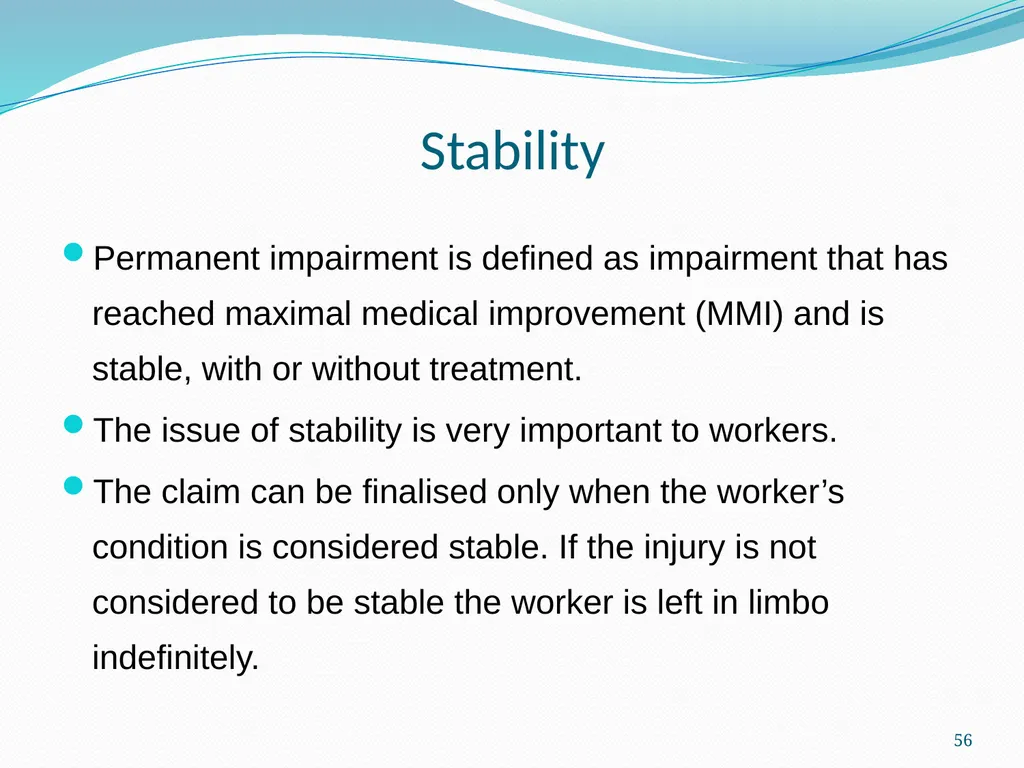
slide56. Stability Permanent impairment is defined as impairment that has reached maximal medical improvement (MMI) and is stable, with or without treatment.
The issue of stability is very important to workers.
The claim can be finalised only when the worker’s condition is considered stable. If the injury is not considered to be stable the worker is left in limbo indefinitely. 56<br>
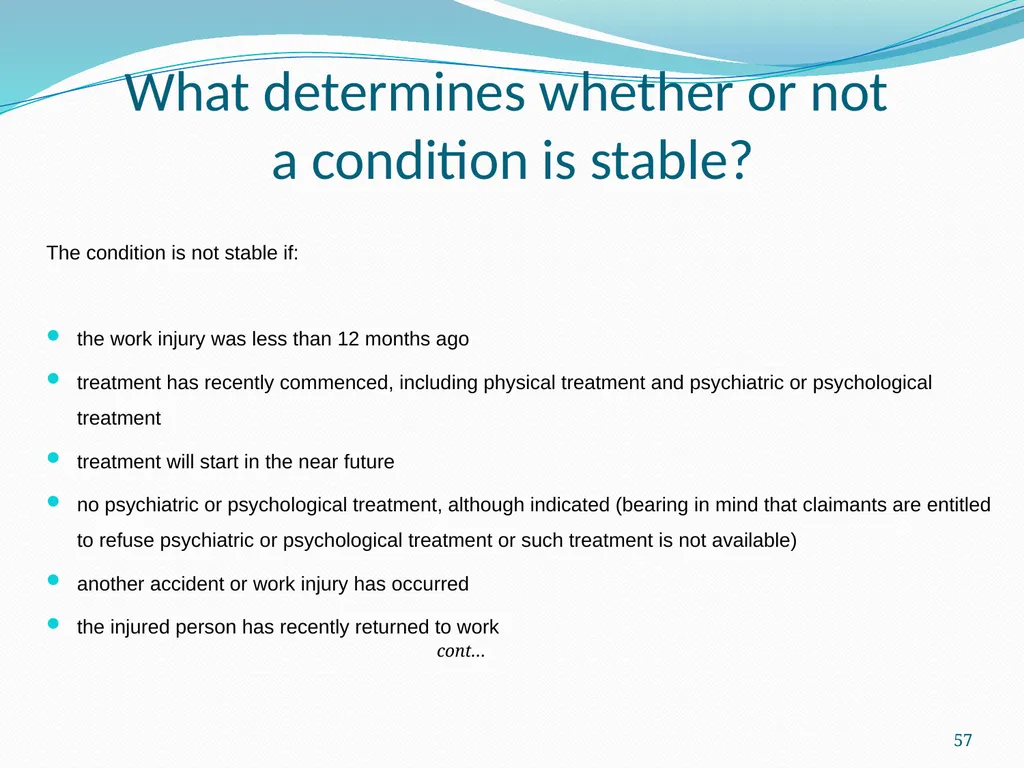
slide57. What determines whether or not a condition is stable? The condition is not stable if:
the work injury was less than 12 months ago
treatment has recently commenced, including physical treatment and psychiatric or psychological treatment
treatment will start in the near future
no psychiatric or psychological treatment, although indicated (bearing in mind that claimants are entitled to refuse psychiatric or psychological treatment or such treatment is not available)
another accident or work injury has occurred
the injured person has recently returned to work
cont… 57<br>
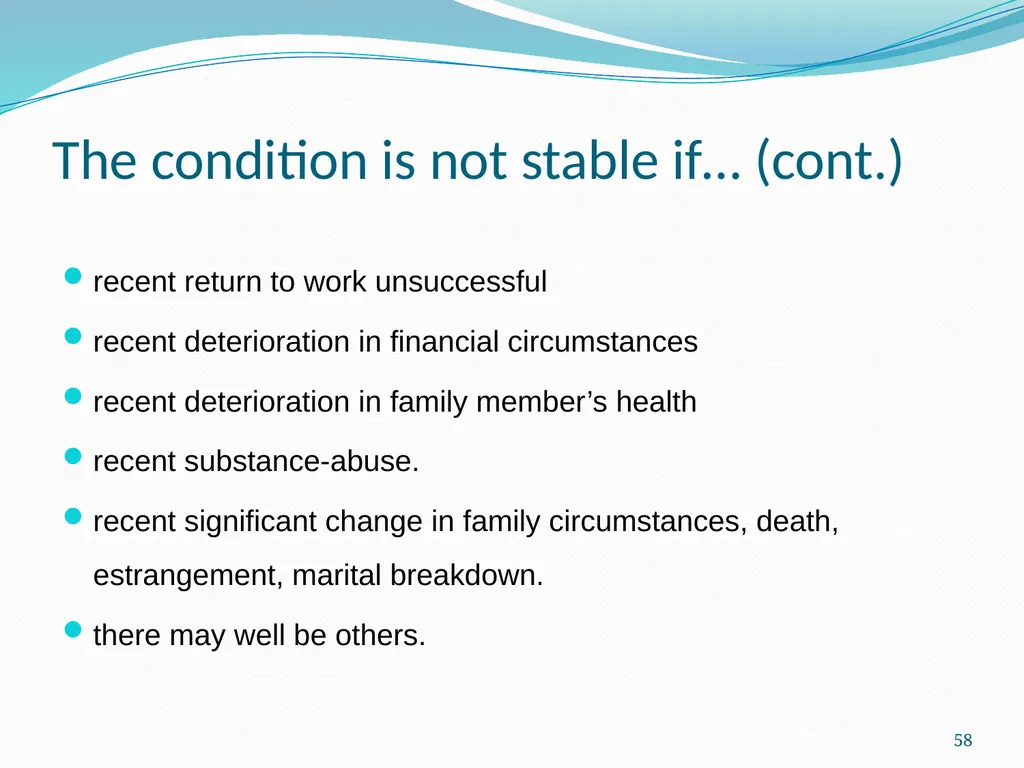
slide58. The condition is not stable if… (cont.) recent return to work unsuccessful
recent deterioration in financial circumstances
recent deterioration in family member’s health
recent substance-abuse.
recent significant change in family circumstances, death, estrangement, marital breakdown.
there may well be others. 58<br>
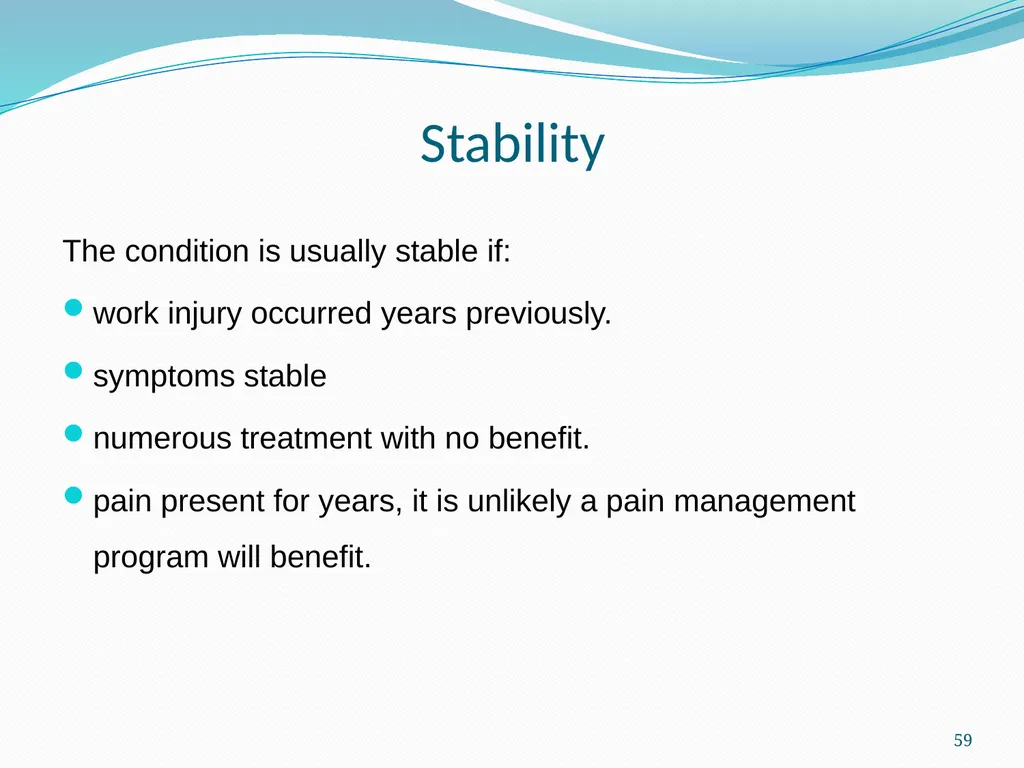
slide59. Stability The condition is usually stable if:
work injury occurred years previously.
symptoms stable
numerous treatment with no benefit.
pain present for years, it is unlikely a pain management program will benefit. 59<br>
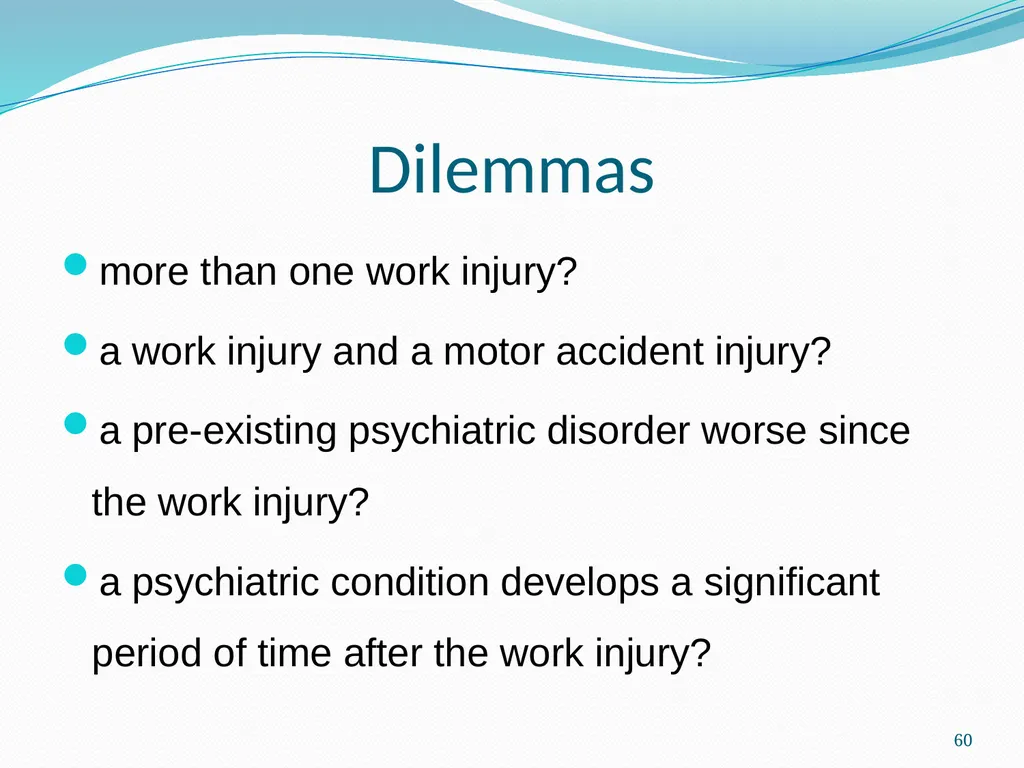
slide60. Dilemmas more than one work injury?
a work injury and a motor accident injury?
a pre-existing psychiatric disorder worse since the work injury?
a psychiatric condition develops a significant period of time after the work injury? 60<br>
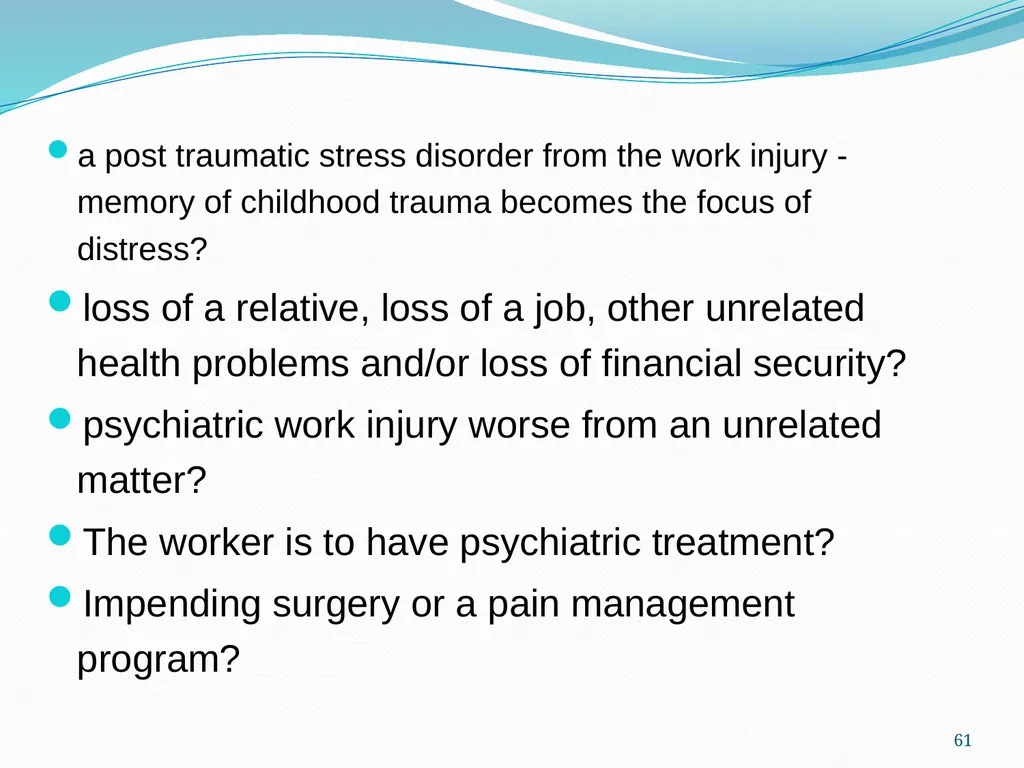
slide61. a post traumatic stress disorder from the work injury - memory of childhood trauma becomes the focus of distress?
loss of a relative, loss of a job, other unrelated health problems and/or loss of financial security?
psychiatric work injury worse from an unrelated matter?
The worker is to have psychiatric treatment?
Impending surgery or a pain management program? 61<br>
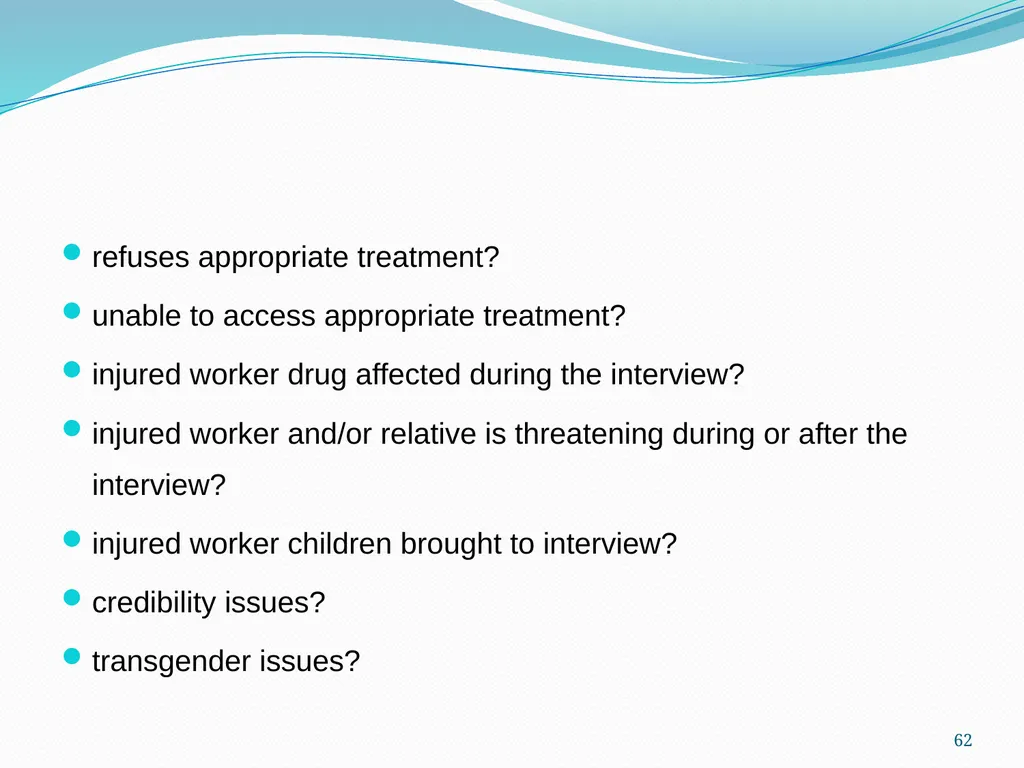
slide62. refuses appropriate treatment?
unable to access appropriate treatment?
injured worker drug affected during the interview?
injured worker and/or relative is threatening during or after the interview?
injured worker children brought to interview?
credibility issues?
transgender issues? 62<br>
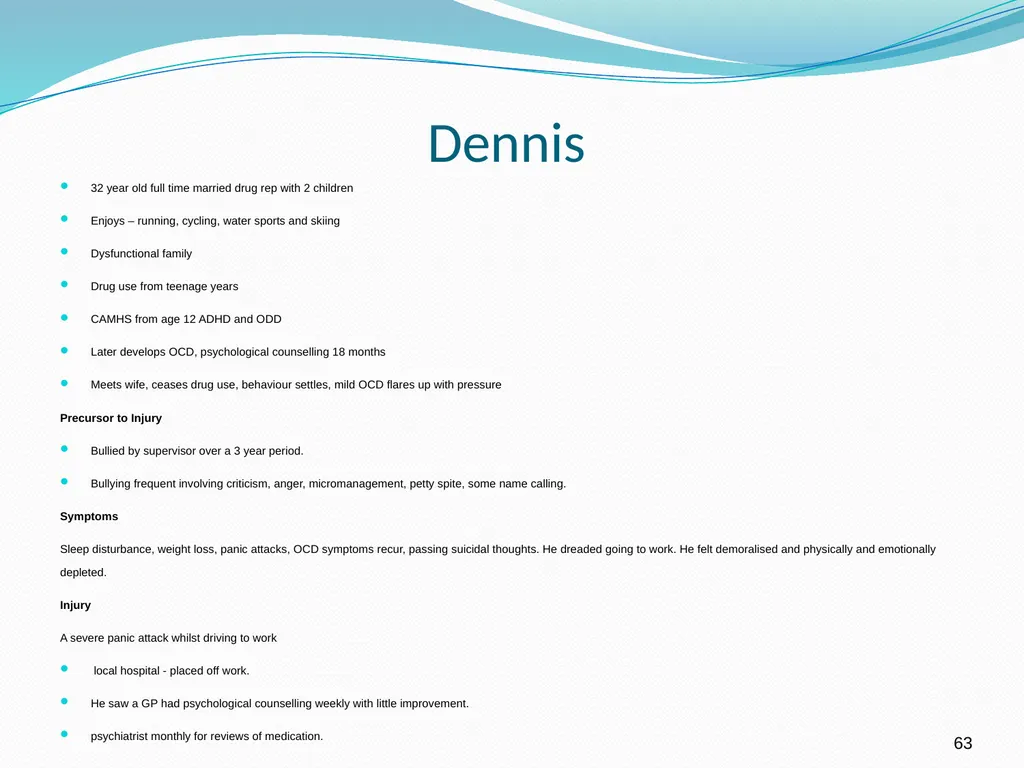
slide63. Dennis 32 year old full time married drug rep with 2 children
Enjoys – running, cycling, water sports and skiing
Dysfunctional family
Drug use from teenage years
CAMHS from age 12 ADHD and ODD
Later develops OCD, psychological counselling 18 months
Meets wife, ceases drug use, behaviour settles, mild OCD flares up with pressure
Precursor to Injury
Bullied by supervisor over a 3 year period.
Bullying frequent involving criticism, anger, micromanagement, petty spite, some name calling.
Symptoms
Sleep disturbance, weight loss, panic attacks, OCD symptoms recur, passing suicidal thoughts. He dreaded going to work. He felt demoralised and physically and emotionally depleted.
Injury
A severe panic attack whilst driving to work
local hospital - placed off work.
He saw a GP had psychological counselling weekly with little improvement.
psychiatrist monthly for reviews of medication. 63<br>
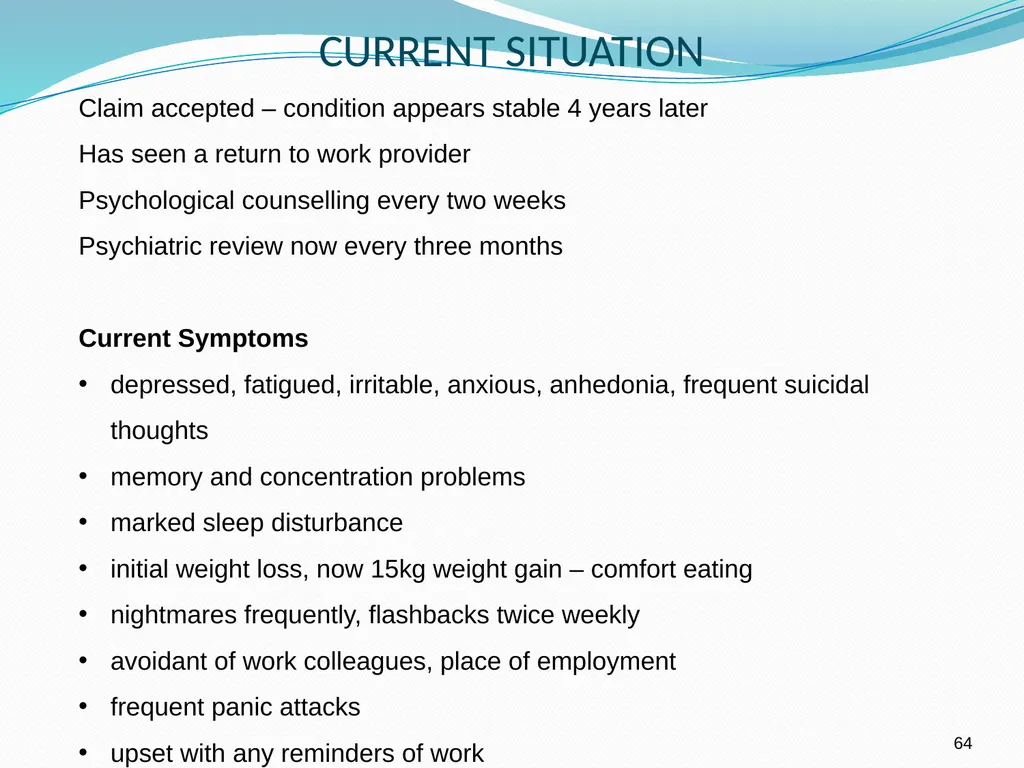
slide64. 64 CURRENT SITUATION
Claim accepted – condition appears stable 4 years later
Has seen a return to work provider
Psychological counselling every two weeks
Psychiatric review now every three months
Current Symptoms
depressed, fatigued, irritable, anxious, anhedonia, frequent suicidal thoughts
memory and concentration problems
marked sleep disturbance
initial weight loss, now 15kg weight gain – comfort eating
nightmares frequently, flashbacks twice weekly
avoidant of work colleagues, place of employment
frequent panic attacks
upset with any reminders of work
financial and work problems & relationship finished
excessive use of alcohol
Frequent hand washing, some ritualistic behaviour<br>
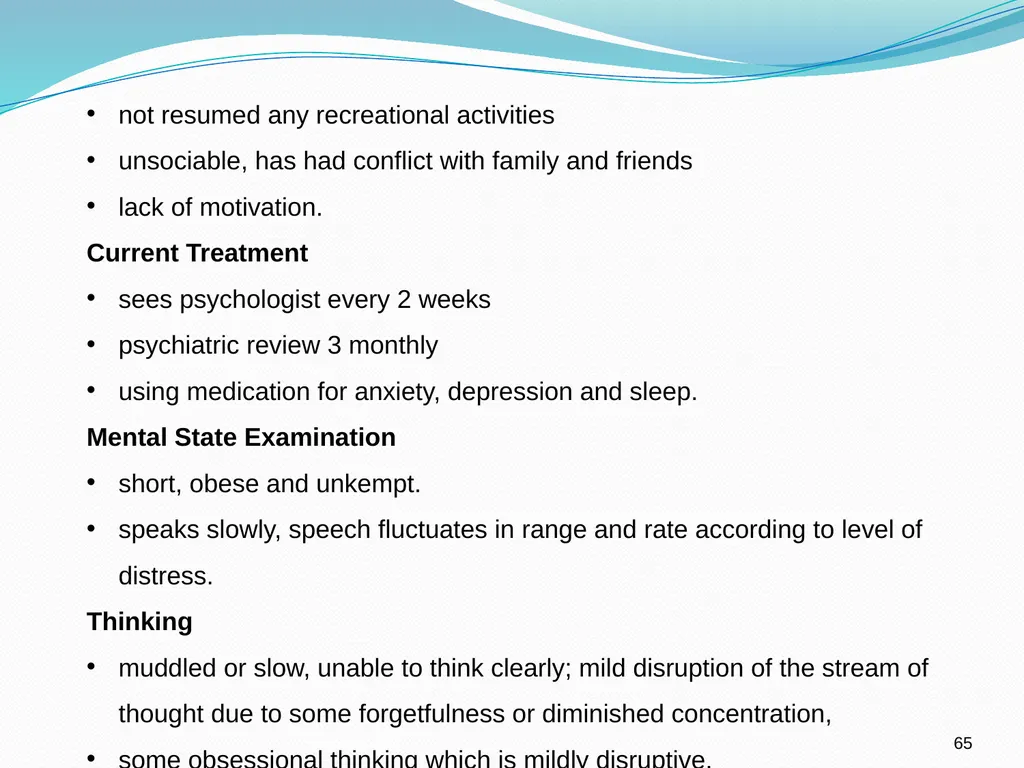
slide65. 65 not resumed any recreational activities
unsociable, has had conflict with family and friends
lack of motivation.
Current Treatment
sees psychologist every 2 weeks
psychiatric review 3 monthly
using medication for anxiety, depression and sleep.
Mental State Examination
short, obese and unkempt.
speaks slowly, speech fluctuates in range and rate according to level of distress.
Thinking
muddled or slow, unable to think clearly; mild disruption of the stream of thought due to some forgetfulness or diminished concentration,
some obsessional thinking which is mildly disruptive,
preoccupied with distressing fears, worries about payback by his supervisor, and by inability to stop ruminating; - increased sense of self-awareness<br>
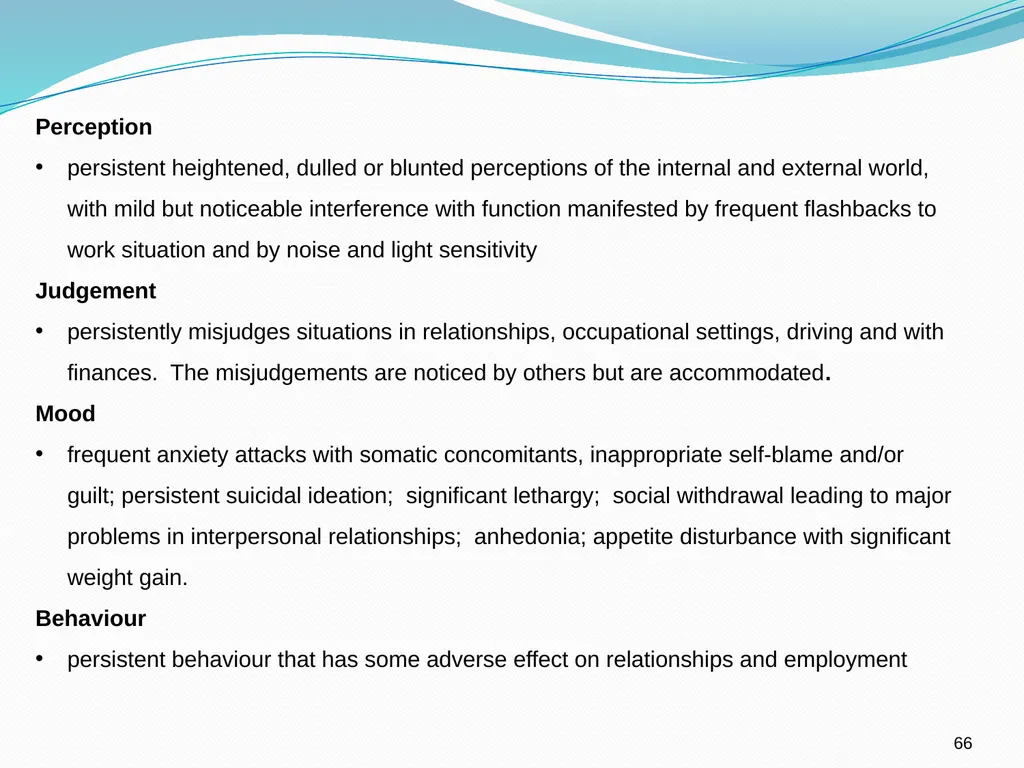
slide66. 66 Perception
persistent heightened, dulled or blunted perceptions of the internal and external world, with mild but noticeable interference with function manifested by frequent flashbacks to work situation and by noise and light sensitivity
Judgement
persistently misjudges situations in relationships, occupational settings, driving and with finances. The misjudgements are noticed by others but are accommodated.
Mood
frequent anxiety attacks with somatic concomitants, inappropriate self-blame and/or guilt; persistent suicidal ideation; significant lethargy; social withdrawal leading to major problems in interpersonal relationships; anhedonia; appetite disturbance with significant weight gain.
Behaviour
persistent behaviour that has some adverse effect on relationships and employment<br>
slide67. Dennis – Diagnosis & Impairment assessment Panic disorder
Major depressive Disorder
OCD pre-existing - exacerbated
No physical injury
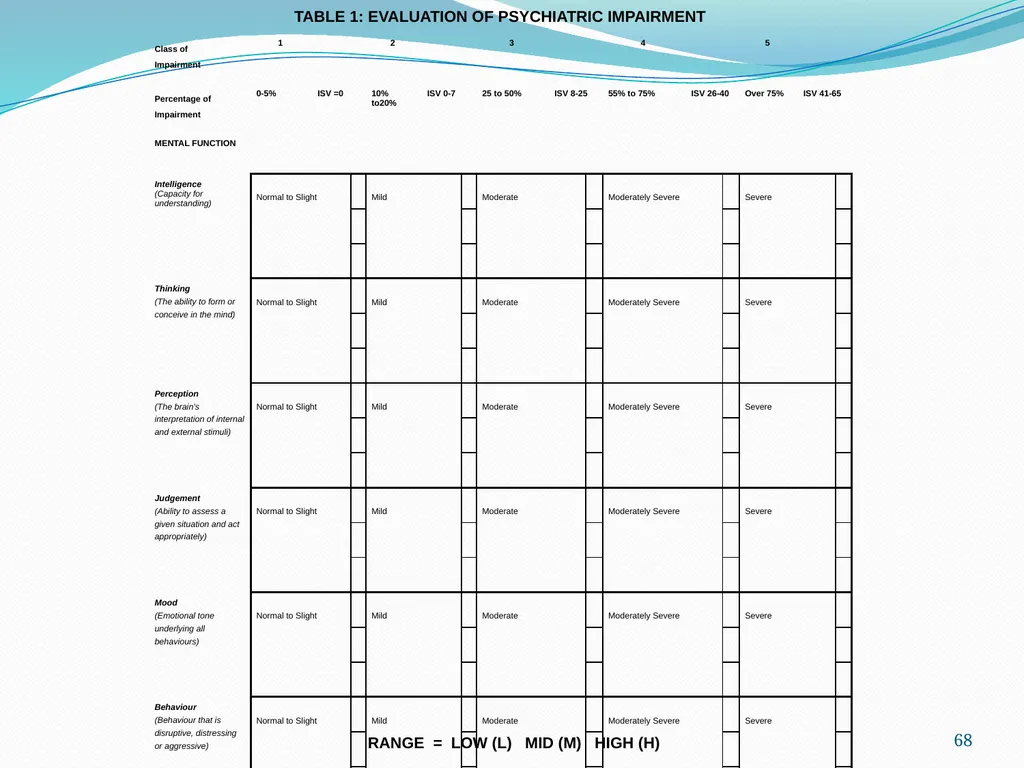
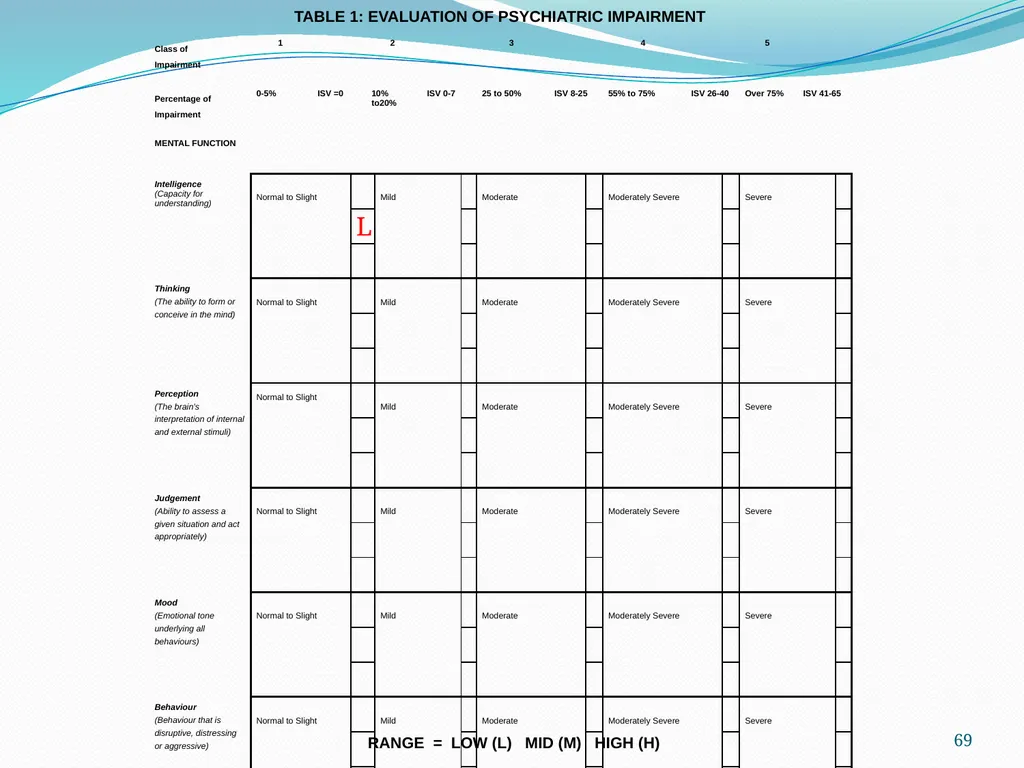
What is his level of impairment? Look at each function of the GEPIC to determine the appropriate class for each function.
Intelligence
Thinking
Perception
Judgement
Mood
Behaviour 67<br>
slide68. RANGE = LOW (L) MID (M) HIGH (H) 68<br>
slide69. RANGE = LOW (L) MID (M) HIGH (H) 69<br>
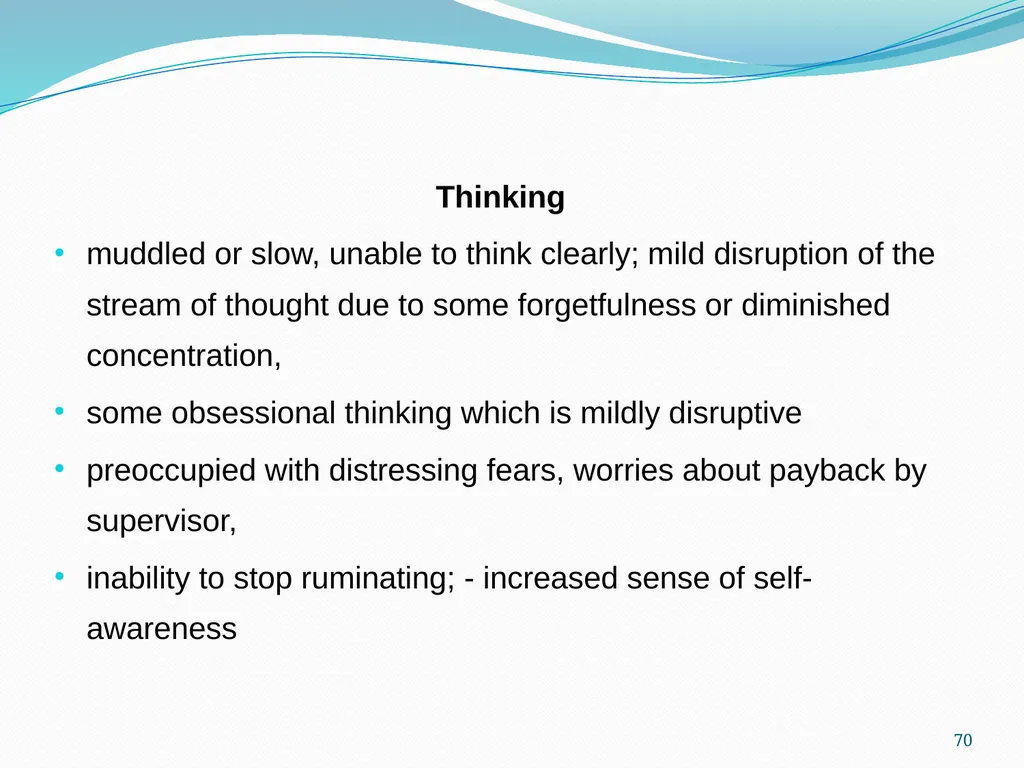
slide70. Thinking
muddled or slow, unable to think clearly; mild disruption of the stream of thought due to some forgetfulness or diminished concentration,
some obsessional thinking which is mildly disruptive
preoccupied with distressing fears, worries about payback by supervisor,
inability to stop ruminating; - increased sense of self-awareness 70<br>
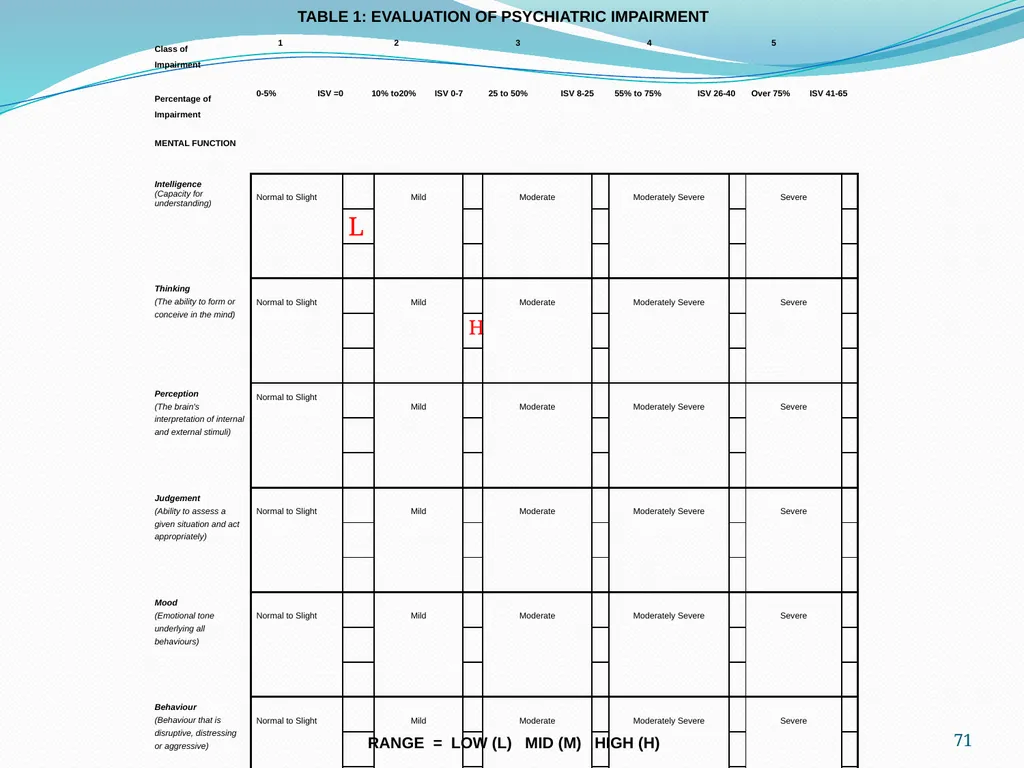
slide71. RANGE = LOW (L) MID (M) HIGH (H) 71<br>
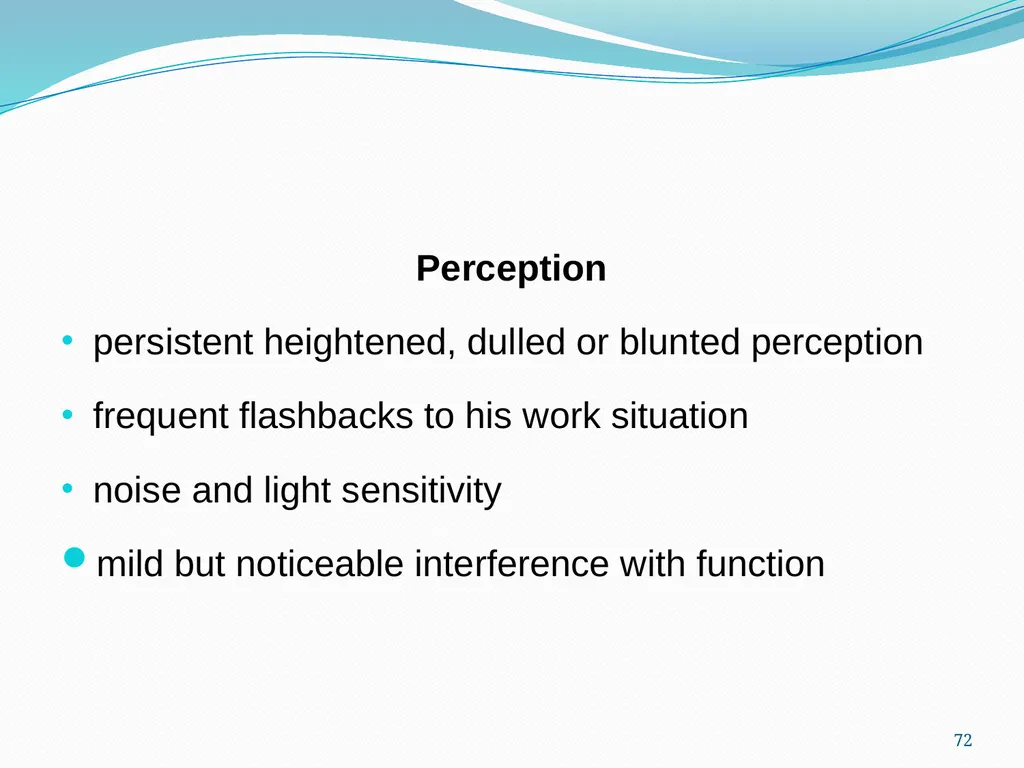
slide72. Perception
persistent heightened, dulled or blunted perception
frequent flashbacks to his work situation
noise and light sensitivity
mild but noticeable interference with function 72<br>
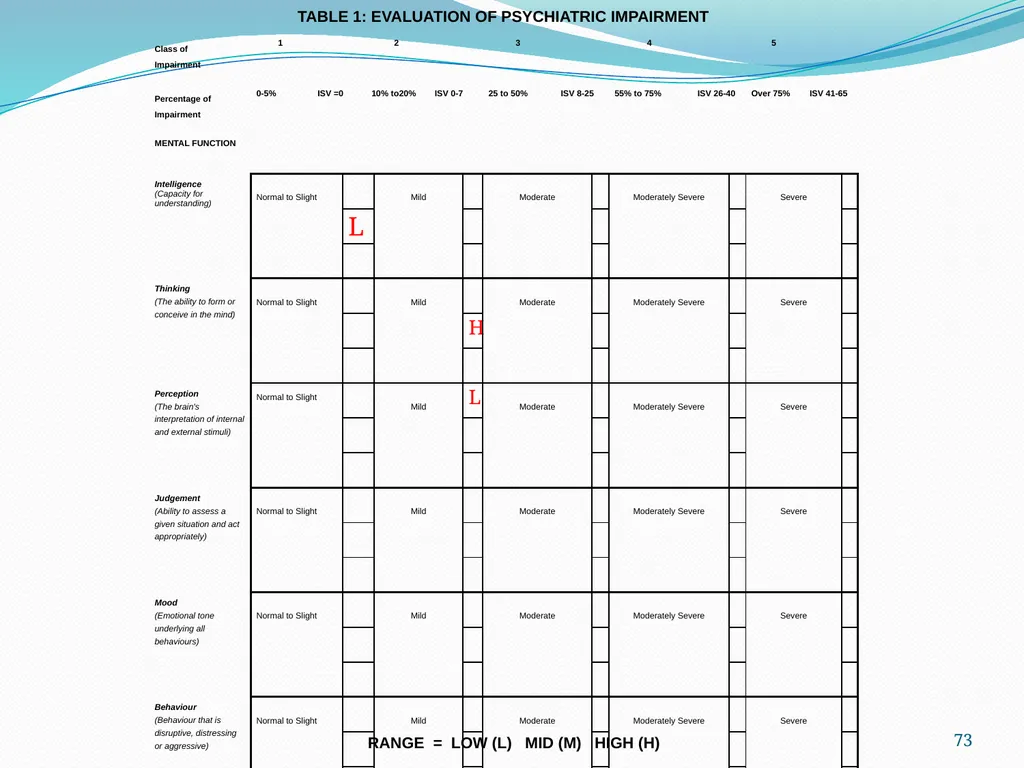
slide73. RANGE = LOW (L) MID (M) HIGH (H) 73<br>
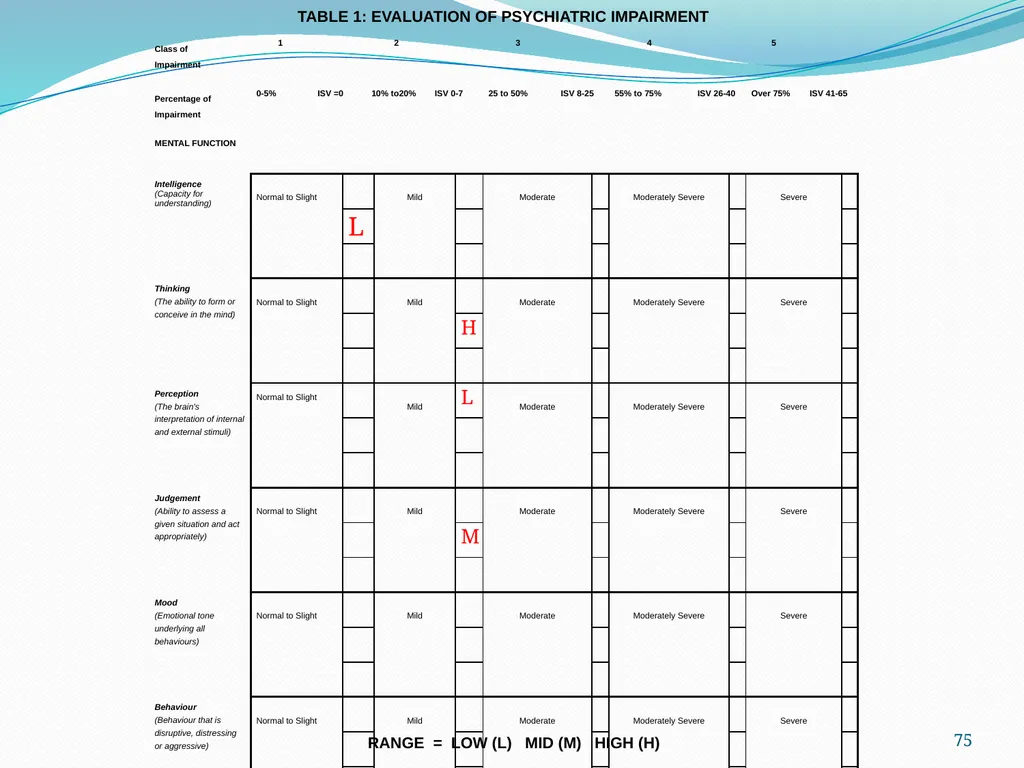
slide74. Judgement
persistently misjudges situations in relationships, occupational settings, driving and with finances.
The misjudgements are noticed by others but are accommodated. 74<br>
slide75. RANGE = LOW (L) MID (M) HIGH (H) 75<br>
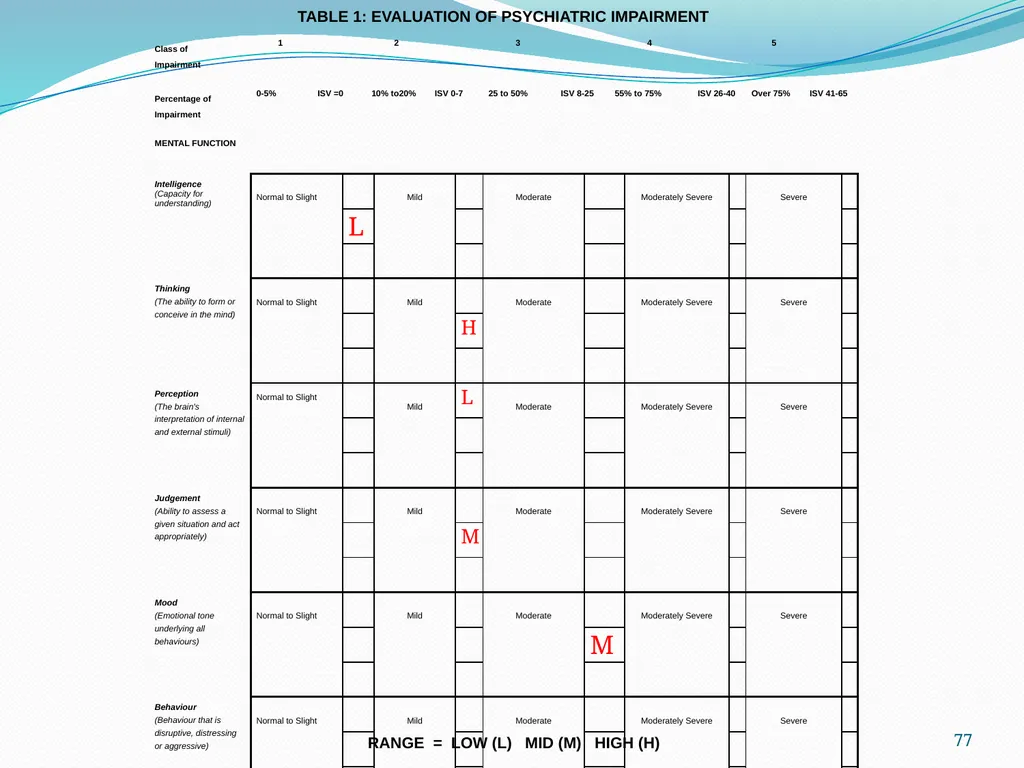
slide76. Mood
frequent anxiety attacks with somatic concomitants
inappropriate self-blame and/or guilt
persistent suicidal ideation
significant lethargy
social withdrawal leading to major problems in interpersonal relationships
Anhedonia
appetite disturbance with significant weight gain. 76<br>
slide77. RANGE = LOW (L) MID (M) HIGH (H) 77<br>
slide78. Behaviour
persistent behaviour that has some adverse effect on relationships and employment 78<br>
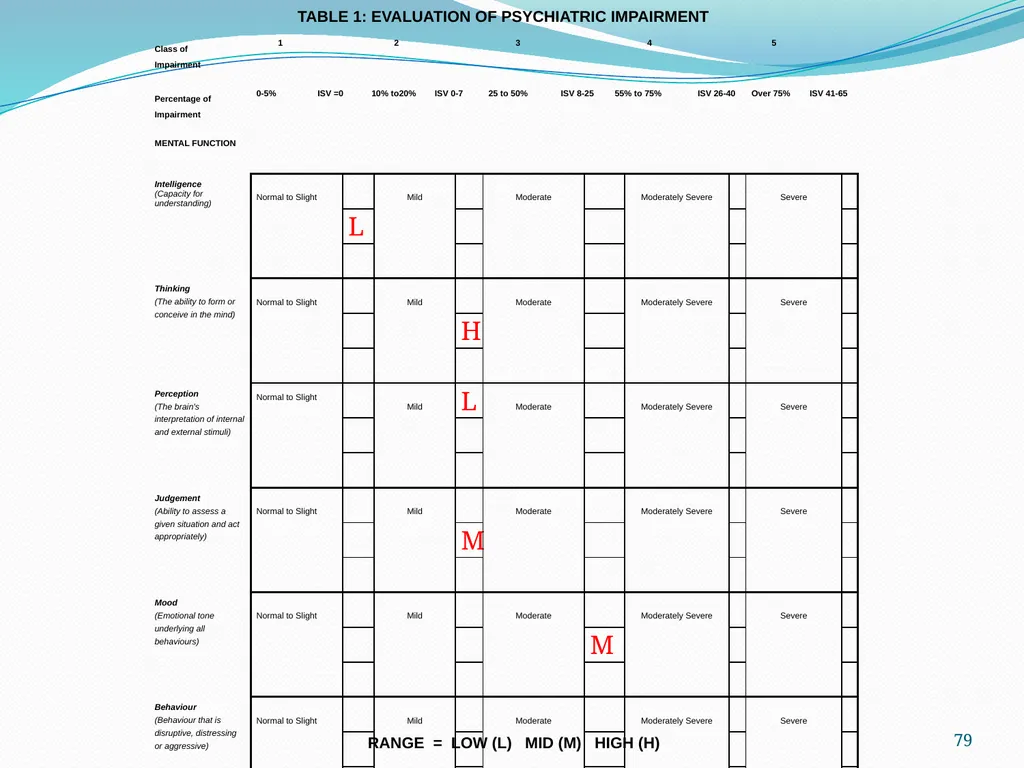
slide79. RANGE = LOW (L) MID (M) HIGH (H) 79<br>
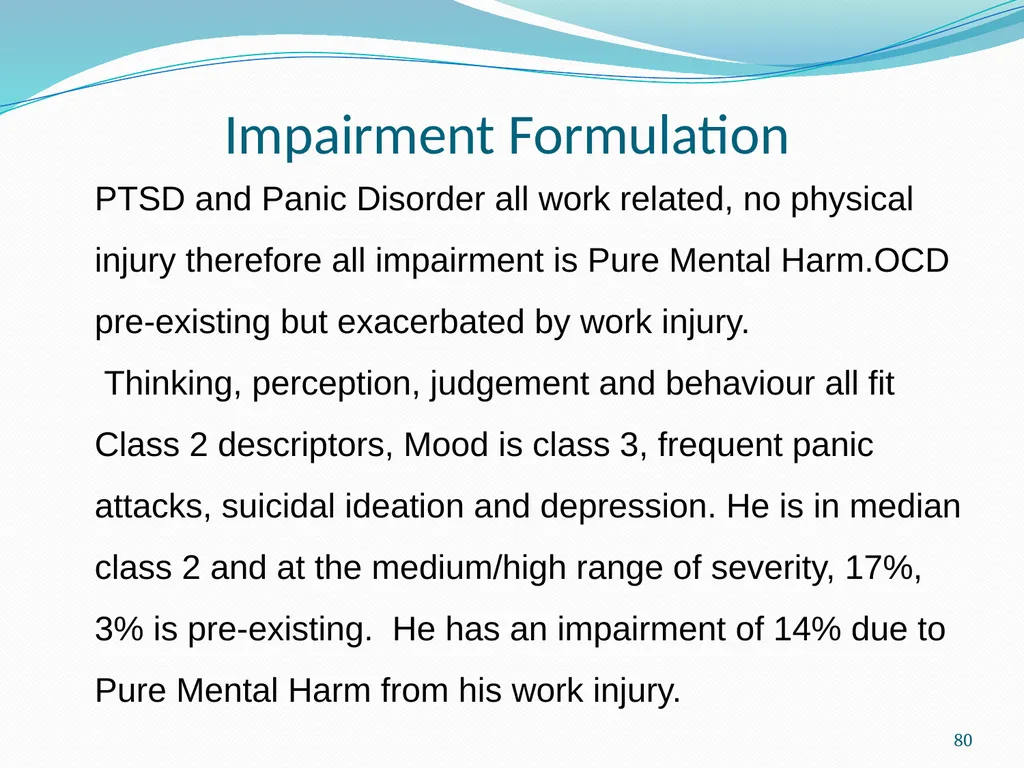
slide80. 80 Impairment Formulation PTSD and Panic Disorder all work related, no physical injury therefore all impairment is Pure Mental Harm.OCD pre-existing but exacerbated by work injury.
Thinking, perception, judgement and behaviour all fit Class 2 descriptors, Mood is class 3, frequent panic attacks, suicidal ideation and depression. He is in median class 2 and at the medium/high range of severity, 17%, 3% is pre-existing. He has an impairment of 14% due to Pure Mental Harm from his work injury.<br>
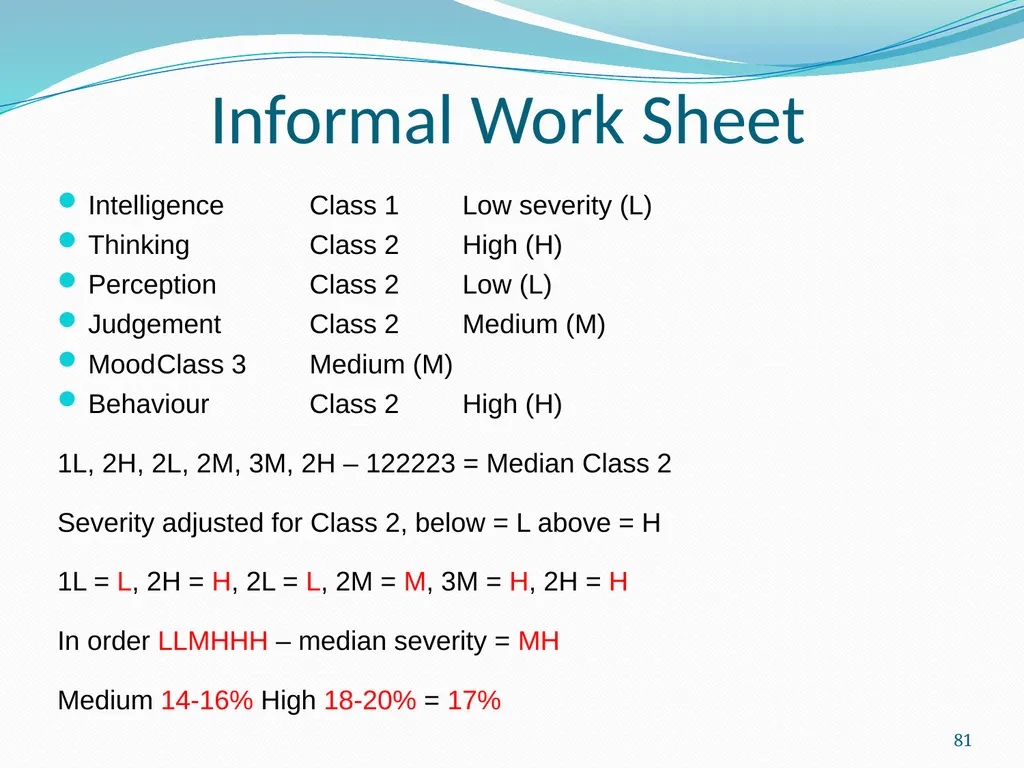
slide81. Informal Work Sheet Intelligence Class 1 Low severity (L)
Thinking Class 2 High (H)
Perception Class 2 Low (L)
Judgement Class 2 Medium (M)
Mood Class 3 Medium (M)
Behaviour Class 2 High (H)
1L, 2H, 2L, 2M, 3M, 2H – 122223 = Median Class 2
Severity adjusted for Class 2, below = L above = H
1L = L, 2H = H, 2L = L, 2M = M, 3M = H, 2H = H
In order LLMHHH – median severity = MH
Medium 14-16% High 18-20% = 17% 81<br>
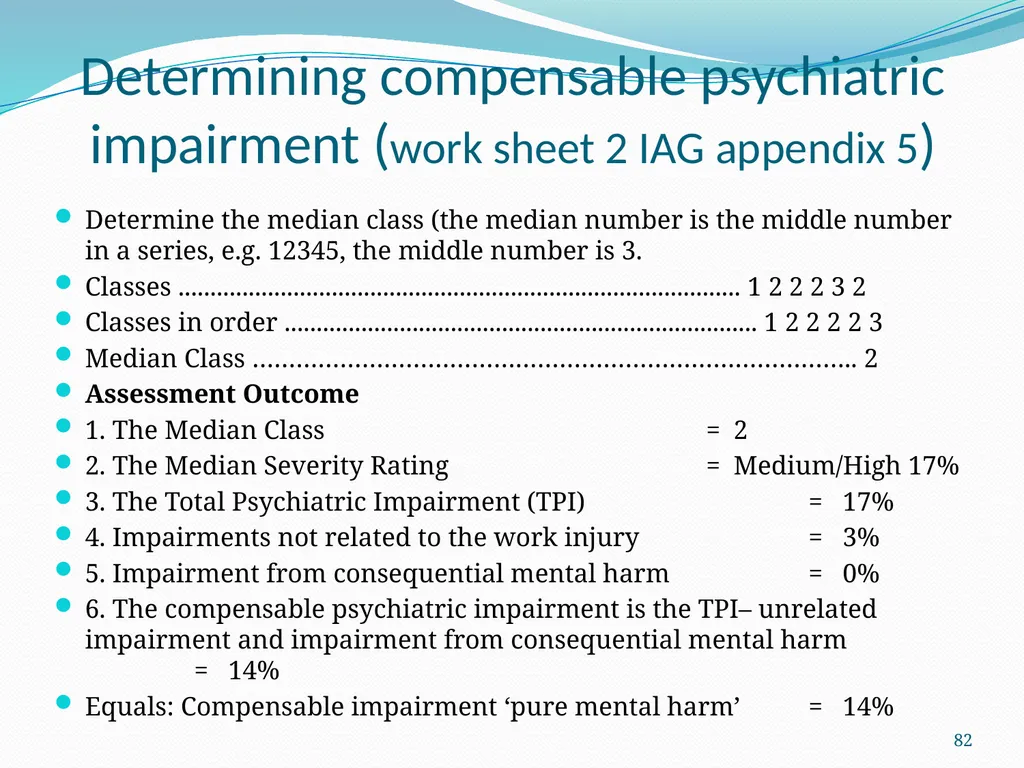
slide82. Determining compensable psychiatric impairment (work sheet 2 IAG appendix 5) Determine the median class (the median number is the middle number in a series, e.g. 12345, the middle number is 3.
Classes ........................................................................................ 1 2 2 2 3 2
Classes in order .......................................................................... 1 2 2 2 2 3
Median Class ……………………………………………………………………….. 2
Assessment Outcome
1. The Median Class = 2
2. The Median Severity Rating = Medium/High 17%
3. The Total Psychiatric Impairment (TPI) = 17%
4. Impairments not related to the work injury = 3%
5. Impairment from consequential mental harm = 0%
6. The compensable psychiatric impairment is the TPI– unrelated impairment and impairment from consequential mental harm = 14%
Equals: Compensable impairment ‘pure mental harm’ = 14% 82<br>
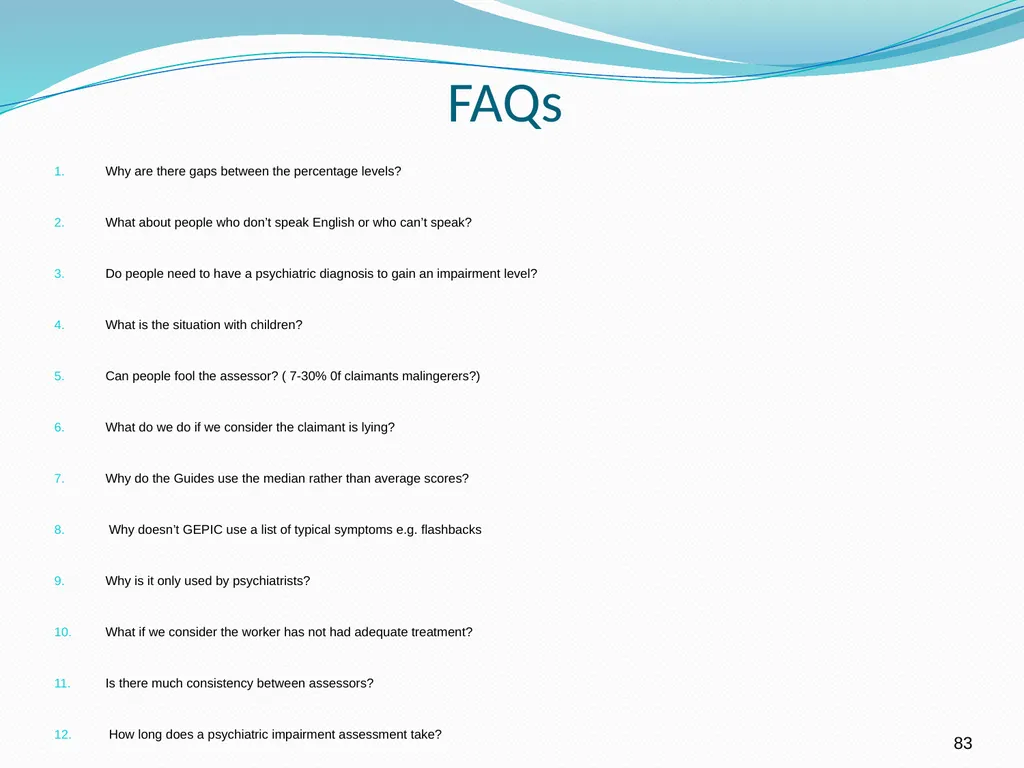
slide83. FAQs Why are there gaps between the percentage levels?
What about people who don’t speak English or who can’t speak?
Do people need to have a psychiatric diagnosis to gain an impairment level?
What is the situation with children?
Can people fool the assessor? ( 7-30% 0f claimants malingerers?)
What do we do if we consider the claimant is lying?
Why do the Guides use the median rather than average scores?
Why doesn’t GEPIC use a list of typical symptoms e.g. flashbacks
Why is it only used by psychiatrists?
What if we consider the worker has not had adequate treatment?
Is there much consistency between assessors?
How long does a psychiatric impairment assessment take? 83<br>
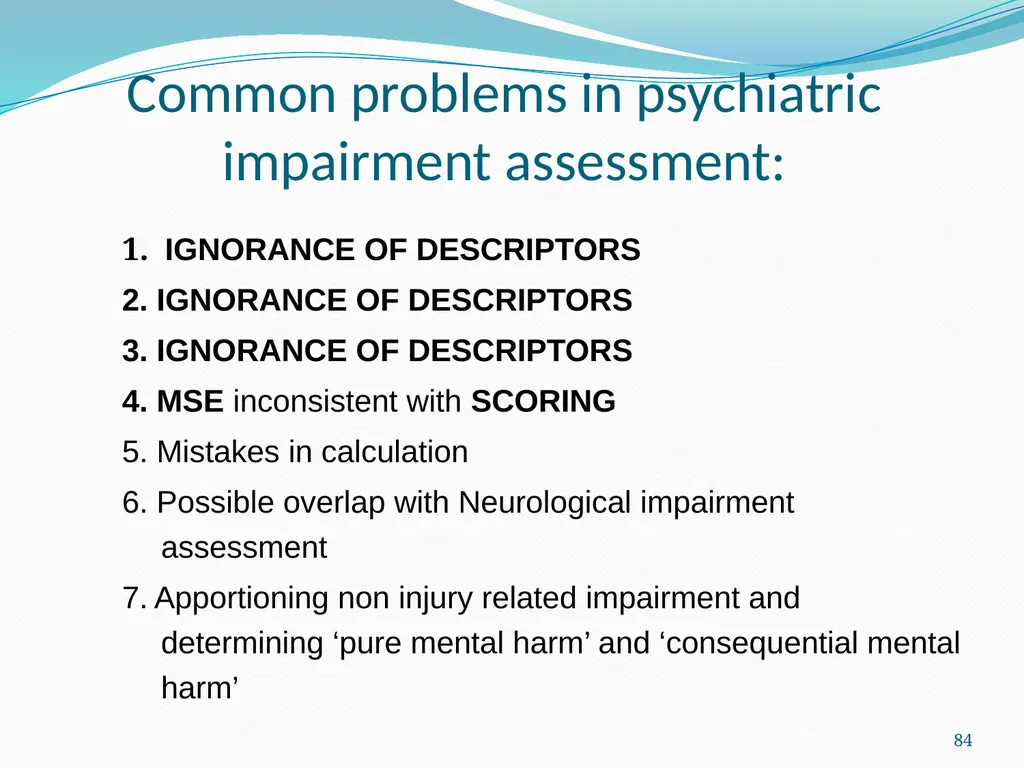
slide84. Common problems in psychiatric impairment assessment: 1. IGNORANCE OF DESCRIPTORS
2. IGNORANCE OF DESCRIPTORS
3. IGNORANCE OF DESCRIPTORS
4. MSE inconsistent with SCORING
5. Mistakes in calculation
6. Possible overlap with Neurological impairment assessment
7. Apportioning non injury related impairment and determining ‘pure mental harm’ and ‘consequential mental harm’ 84<br>
slide85. Issues 85 Free discussion<br>
slide86. Conclusions Measurement of psychiatric impairment is an important part of assessing people injured at work
Psychiatric illness can arise from a number of causes including work injuries
The Guides for the Evaluation of Psychiatric Impairment for Clinicians (the GEPIC) is legislated to assess severe injury for the Return to Work Act 2014.
Experience and review is essential for accurate use of the Guides 86<br>
Return to Work Claimants Presenter:
Dr Michael Epstein 1<br>
slide2. Program 2 Review of your purpose and role
Overview of the process of impairment assessment using the GEPIC
Refining your score
Neurology/psychiatry overlap
Pain Disorders
Pure and consequential mental harm
Apportionment issues
Stability issues
Worked example
Frequently asked questions
Free discussion<br>
slide3. The Return to Work Act Assessment of permanent impairment
(a) only if the injury has stabilised
(b) based on the worker’s impairment at the date of assessment, including any changes in the signs and symptoms following any medical or surgical treatment 3<br>
slide4. The Task of the AMP make a diagnosis(es);
determine level of impairment using the GEPIC;
apportion impairment - unrelated and related to the injury;
separate impairment due to ‘pure mental harm’ from impairment due to ‘consequential mental harm
Prepare a report including:
A comprehensive history
An MSE
GEPIC result
Impairment formulation
Opinion – answering the questions asked 4<br>
slide5. The Process 1 Interview and review of documentation
[ injury
[ current condition and treatment
Mental State Examination
[ diagnosis(es)
[ unrelated diagnoses
[ stability and prognosis 5<br>
slide6. The Process 2 correlate GEPIC descriptors to MSE
use GEPIC method including Severity to find Total Psychiatric Impairment (TPI)
subtract impairment unrelated to injury
subtract impairment due to Consequential Mental Harm
Leaves impairment due to Pure Mental Harm 6<br>
slide7. Common Psychiatric Disorders: Work Injuries DSM 5 Acute stress disorder (acute stress disorder and post-traumatic stress disorder may occur in the absence of physical injury)
Post-traumatic stress disorder
Generalised anxiety disorder
Adjustment disorder with depressed mood (and/or anxiety)
Panic disorder
Agoraphobia
Obsessive compulsive disorder
Major depressive disorder
Somatic symptom disorder with predominant pain
Substance induced disorder
Persistent depressive disorder 7<br>
slide8. Reasons for Measurement of Psychiatric Impairment Work Injuries: To determine serious injury according to the Return to Work Act 2014
If psychiatric impairment 30% or more then ongoing income maintenance,
No return-to-work obligation,
Access to common law for future economic loss
No entitlement for psychiatric injury or consequential mental harm for lump sum payment for non- economic loss. 8<br>
slide9. Compensable Psychiatric Impairment 9 There needs to be a diagnosable psychiatric disorder.
The disorder must lead to impairment.
There has to be a clearly established link between the work injury and the psychiatric disorder.
The psychiatric disorder is not ‘consequential mental harm’<br>
slide10. The Royal Australian and New Zealand College of Psychiatrists Practice Guideline #9 Mental status examination
A mental status examination for medico-legal purposes generally contains
the minimum core elements of:
appearance and general behavior
mood
affect
speech and language
psychomotor behaviour
thought content
thought form or associations
perceptual abnormalities (if any)
suicidal, homicidal, violent, or self-injurious thoughts or impulses
examinee or patient’s understanding of his or her current situation, and
elements of the cognitive status (Systematic assessment of cognitive functions is an essential part of the general psychiatric evaluation, the level of detail necessary and the appropriateness of particular formal tests depend on the purpose of the evaluation and the psychiatrist's clinical judgement). 10<br>
slide11. 11<br>
slide12. Principles of Psychiatric Impairment Assessment Principle 1:
Readily observable empirical criteria must be applied. The mental state examination as used by consultant psychiatrists, is the prime method of evaluating psychiatric impairment.
Principle 2:
Diagnosis is among the factors to be considered in impairment, but is by no means the sole criterion.
Principle 3:
Consideration given to other factors level of functioning, educational, financial, social and family situation and others. 12<br>
slide13. Principles of Psychiatric Impairment Assessment Principle 4:
Character and value system of the individual is of considerable importance in the outcome of the disorder, be it mental or physical. Motivation for improvement is a key factor in the outcome.
Principle 5:
Review treatment and rehabilitation methods used. No final judgement can be made until the whole history of the illness, the treatment, the rehabilitation phase, and the individual’s current mental and physical status and behaviour have been considered. 13<br>
slide14. Use of the GEPIC 14 Used by consultant psychiatrists
Database: clinical information, documentation, mental state.
Clinical judgement required, not a “cookbook”.
Descriptors and MSE emerge during the clinical interview.
Descriptors are indicative only. Other symptoms can be used if it can be justified that the symptom(s) is/are associated with a particular class of severity.<br>
slide15. Use of the GEPIC - 2 Clinician’s decision re presence of specific rating
Assess severity of 6 specific mental functions from
Class 1-5. The resultant median class is used together with severity ratings within each class to help determine initial impairment.
Unrelated and consequential impairments removed leading to final psychiatric impairment 15<br>
slide16. Definitions 16 Impairment: World Health Organization (WHO) has defined impairment: “In the context of health experience, an impairment is any loss or abnormality of psychological, physiological, or anatomical structure or function”.
Permanent impairment is impairment that has become static or well stabilised with or without medical treatment and is not likely to remit despite future medical treatment. The condition has reached ‘Maximal Medical Improvement (MMI). If an impairment is not permanent, it is inappropriate to characterise it as such.
Disability: The WHO has defined disability: “In the context of health experience, a disability is any restriction or lack (resulting from an impairment) of ability to perform an activity in the manner or within the range considered normal for a human being”.
Hallucinations. Disorders of sensory perception in the absence of stimuli.
Illusions. Misinterpretations of real sensory stimuli – illusions can be a normal phenomenon as well as indicating psychopathology.<br>
slide17. 17 Intelligence
Capacity for understanding and for other forms of adaptive behaviour. Impairments of intelligence are a consequence of brain injury or disease. Generally, before impairment of intelligence is confirmed neuropsychological assessment should be undertaken. (Care has to be exercised to ensure that there is no overlap between an assessment of impairment of intelligence made during a psychiatric evaluation and an assessment of impairment of higher cerebral functions made by an assessor in accordance with Chapter 4 of the 4th edition American Medical Association Guides.)
Guides for the rating of impairment of intelligence:
Class Impairment Description
1 0 - 5% Normal to Slight
- there is no evidence of cognitive impairment on mental state examination, and the individual does not report any
difficulties in everyday functioning that can be attributed to
cognitive difficulties
2 10 - 20% Mild (Mildly retarded)
- some interference with everyday functioning
3 25 - 50% Moderate (moderately/mildly retarded)
- a reduction in intelligence that significantly interferes
with everyday functioning.
4 55 - 75% Moderately Severe (moderately severely retarded)
- a reduction in intelligence which makes independent
living impossible.
5 over 75% Severe (severely retarded)
- needs constant supervision and care<br>
slide18. The ability to form thoughts and conceptualise. Impairment is both a matter of degree and type of disturbance, which may involve stream, form and content. Class Impairment Description 1 0 - 5% Normal to Slight - includes mild transient disturbances that are not disruptive and are not noticed by others. 2 10 - 20% Mild - mild symptoms that usually cause subjective distress, for example: > thinking may be muddled or slow; > may be unable to think clearly; > mild disruption of the stream of thought due to some forgetfulness or diminished concentration; > may have some obsessional thinking which is mildly disruptive; > may be preoccupied with distressing fears, worries or experiences, and by inability to stop ruminating; > increased of self-awareness or a persistent sense of guilt; > some other thought disorder that is minimally disruptive (such as overvalued ideas or delusions; some formal thought disorder, does not interfere with effective communication) 18 Thinking<br>
slide19. Thinking (cont…) 19 3 25 - 50% Moderate
- manifestations of thought disorder, to the extent that most clinicians would consider psychiatric treatment indicated, for example:
severe problems with concentration due to intrusive thoughts or obsessional ruminations;
marked disruption of the stream of thought due to significant memory problems or diminished concentration;
persistent delusional ideas interfering with capacity to cope with everyday activities, e.g. severe pathological guilt; formal thought disorder that interferes with verbal and other forms of communication.
4 55 - 75% Moderately Severe
- disorders of thinking that cause difficulty in functioning independently and usually require some external assistance.
5 Over 75% Severe
- disorders of thinking that cause such a severe disturbance that independent living is impossible.<br>
slide20. Issues with ‘Perception’ “There can be few areas where the work of assessment by the psychiatrist is more misunderstood than in the psychopathology of perception”. Andrew Sims ‘Symptoms of the Mind’.
Perceptual Disturbances are disturbances of the senses:
Hearing
Vision
Smell
Taste
Touch 20<br>
slide21. 21 Mistakes in MSE Reports Regarding perception, there is a heightened awareness of the work situation, there is reported anxiety with machinery, and nervousness and hyper-vigilance.
She says she has lost her identity and does not know who she is. She did think she was Superwoman but has now discovered that she is not.
“I have to take a lot of painkillers every morning although I was very tolerant of pain, but this pain is so constant that it has worn me down.”
He denied any disorders of perception such as delusions or hallucinations.
She has a heightened perception of her illness symptoms.<br>
slide22. 22 Perception The individual’s interpretation of internal and external experience received through the senses. Stimuli arise from the five senses – the form is relevant, not necessarily the content (refer to discussion above of the concept of perception in clinical psychiatry).
Definitions:
Hallucinations Abnormalities of sensory perception in the absence of external stimuli.
Illusions Distortions of real sensory stimuli – illusions can be a normal phenomenon as well as indicating psychopathology.
Pseudohallucinations Hallucinations that are recognised by the person as being imaginary (not real, lacking an external source or stimulus).<br>
slide23. Perception: 23 Class Impairment Description
1 0 - 5% Normal to Slight
- transient heightened, dulled or blunted perceptions of the internal and external world, but with no or little interference with function
2 10 - 20% Mild
- persistent heightened, dulled or blunted perceptions of the internal and external world, with mild but noticeable interference with function - pseudohallucinations
3 25 - 50% Moderate
- presence of hallucinations (other than hypnagogic or hypnopompic) that cannot be attributed to a transitory drug- induced state;
- obvious illusions (when associated with a diagnosable mental disorder).
4 55 - 75% Moderately Severe
- hallucinations and/or illusions (as above) cause subjective distress and disturbed behaviour.
5 Over 75% Severe
- hallucinations and/or illusions (as above) cause disturbed behaviour to the extent that constant supervision is required.<br>
slide24. Judgement Ability to evaluate and assess information and situations, together with the ability to formulate appropriate conclusions and decisions. This mental function may be impaired due to brain injury, or to conditions such as schizophrenia, major depression, anxiety, dissociative states or other mental disorders.
Class Impairment Description
1 0 - 5% Normal to Slight
- may lack some insight and misconstrue situations but with little interference with function
2 10 - 20% Mild
- persistently misjudges situations in relationships, occupational settings, driving and with finances. The misjudgements are noticed by others but are accommodated.
3 25 - 50% Moderate
misjudging social, work and family situations repeatedly leading to some disruption in relationships, occupational settings, living circumstances and financial reliability.
inappropriate spending of money or gambling
4 55 - 75% Moderately Severe
- moderately severe misjudgement with regular failure to evaluate situations or implications, causing actual risk or harm to self or others
- failure to respond to any regular guidance and requirement for constant supervision.
5 Over 75% Severe
- persistently assaultive due to misinterpretation of the behaviour or motives of others
- Sexually disinhibited (may occur following a head injury). 24<br>
slide25. Mood 25 Mood is a pervasive lasting emotional state.
Affect is the prevailing and conscious emotional feeling during the period of the mental state examination.
Affect observed during the mental state examination is a reflection of the subject’s mood, and has a number features, including:
Range: Variability of emotional expression over a period of time, i.e. if only one mood is expressed over a period of time, the affective range is restricted.
Amplitude: Amount of energy expended in expressing a mood, i.e. a mild amplitude of anger is manifested by annoyance and irritability.
Stability: Slow shifts of mood are normal. Rapid shifts (affective lability) may be pathological.
Appropriateness: The “fit” (or congruency) between the affect and the situation.
Quality of Affect: Suspicious, sad, happy, anxious, angry, apathetic.
Relatedness: Ability to express warmth, to interact emotionally and to establish rapport.<br>
slide26. Mood 26 Class Impairment Description
1 0 - 5% Normal to Slight
- relatively transient expressions of sadness,
happiness, anxiety, anger and apathy;
- normal variation of mood associated with upsetting life events.
2 10 - 20% Mild
- mild symptoms: some or all of the below
mild depression;
subjective distress leading to some mild interference with function;
reduced interest in usual activities;
some days off; reduced social activities;
fleeting suicidal thoughts;
some panic attacks;
heightened mood;
- may experience feelings of derealisation or depersonalisation.<br>
slide27. Mood (cont…) 27 3 25 - 50% Moderate Impairment
moderate symptoms: some or all of the below:
frequent anxiety attacks with somatic concomitants;
inappropriate self-blame and/or guilt;
persistent suicidal ideation or suicide attempts;
marked lability of affect; significant lethargy;
social withdrawal leading to major problems in interpersonal relationships;
anhedonia;
appetite disturbance with significant weight change;
psychomotor retardation/agitation; hypomania;
severe depersonalisation.
55 - 75% Moderately Severe
cannot function in most areas:
constant agitation;
violent manic excitement;
repeated suicide attempts;
remains in bed all day;
extreme self neglect;
extreme anger /hypersensitivity;
- requires supervision to prevent injury to self or others.
Over 75% Severe
severe depression, with regression requiring attention and assistance in all aspects of self care;
constantly suicidal;
manic excitement requiring restraint.<br>
slide28. Behaviour 28 Behaviour is one's manner of acting. It is considered with regard to its appropriateness in the overall situation. Disturbances vary in kind and degree. Behaviour may be destructive either to self and/or others, it may lead to withdrawal and isolation. Behaviour may be odd or eccentric. Particular mental disorders may be manifested by particular forms of behaviour, e.g., compulsive rituals associated with Obsessive Compulsive Disorder.
Guides for the rating of impairment of Behaviour:
Class Impairment Description
1 0 - 5% Normal to Slight
- transient disturbances in behaviour that are understandable in the context of this person’s situation, excessive fatigue, intoxication, family or work disruption.
2 10 - 20% Mild
- persons who generally function well, but regularly manifest disturbed behaviour under little extra pressure that nevertheless is able to be accommodated by others
- persistent behaviour that has some adverse effect on relationships or employment
3 25 - 50% Moderate
- occasional disruptive or withdrawn behaviour requiring attention or treatment;
- obsessional rituals interfering with but not preventing goal-directed activity;
- repeated antisocial behaviour leading to conflict with authority.<br>
slide29. Behaviour 55 - 75% Moderately Severe
persistently aggressive, disruptive or withdrawn
behaviour requiring attention or treatment (new);
- behaviour significantly influenced by delusions or hallucinations;
- behaviour associated with risk of self harm outside the hospital setting, but not requiring constant supervision
- manic overactivity associated with inappropriate behaviour;
- significantly regressed behaviour, e.g. extreme neglect of hygiene, inability to attend to own bodily needs.
5 Over 75% Severe
- requiring constant supervision to prevent harming self or others (repeated suicide attempts, frequently violent, manic excitement);
- catatonic excitement or rigidity;
- incessant rituals or compulsive behaviour preventing goal-directed activity. 29<br>
slide30. 30<br>
slide31. Determining Whole Person Psychiatric Impairment 6 mental functions in 5 classes
Each function is allotted a class – with explanation consistent with the MSE. e.g. MSE no perceptual problems yet perception Class 2 in GEPIC!
Determine the median class; the median number is the middle number.
11 22 33, the middle number is 2.
12 33 33, the middle number is 3.
11 22 22, the middle number is 2.
The final percentage lies within the range of the median class. Class 2 is between 10-20%. 31<br>
slide32. Severity rating Each class is divided into 3 levels of severity, Low, Medium and High range
Use the Severity Rating to determine the percentage range in the median class. 32 PERCENTAGES FOR RANGE OF SEVERITY<br>
slide33. Use of Severity Ratings 1. For each class selected determine severity
Low (L)
Medium (M)
High (H)
2. Determine median class
3. determine median severity within that class.
Any severity measures in lower class become Low range L in median class
Any severity measures in higher class become High range H in median class 33<br>
slide34. Median Severity Intelligence Class 1 Low severity (L)
Thinking Class 2 High (H)
Perception Class 2 Medium (M)
Judgement Class 2 High (H)
Mood Class 3 Low (L)
Behaviour Class 3 Medium (M)
1L, 2H, 2M, 2H, 3L, 3M - Median Class 2
Severity ratings adjusted for Class 2, below = L above = H
1L = L, 2H = H, 2M = M, 2H = H, 3L = H, 3M = H
In order LMHHHH – median severity = H
High severity in Class 2 18-20% 34<br>
slide35. Worked Example Ray – 45 year old CEO local council
Council corruption
Whistleblower – threats made
Caught drink driving in Council car after work function
Breakdown
Attempts suicide – hospitalised
2 years later – unemployed, wife left, broke
Psychiatric treatment
Severely depressed, can’t concentrate, ’paranoid’, pseudohallucinations, gambled away his money, panic attacks, guilty, suicidal thoughts, withdrawn, road rage 35<br>
slide36. Assessment Intelligence Class 1 Low severity (L)
Thinking Class 3 High (M)
Perception Class 2 Medium (M)
Judgement Class 3 High (M)
Mood Class 3 Medium (M)
Behaviour Class 3 Medium (M)
1L, 3M, 2M, 3M, 3M, 3M - Median Class 3
Severity ratings adjusted for Class 3, below = L above = H
1L = L, 3M = M, 2M = L, 3M = M, 3M = M, 3M = M
In order LLMMMM – median severity in Class 3 = Medium
Medium severity in Class 3 - 35-40%
WPI Pure Mental Harm is 35% 36<br>
slide37. Exceptions to the rule Median number not a whole number e.g.11 12 22, median number is 1.5
The median is elevated to the next Class and the % is the bottom of that class,
1.5 becomes 2 and 10% percent. The Severity rating no longer counts.
1 1 2 3 3 3 median score is 2.5 = Class 3 at the lowest level i.e. 25%.
Skewed series, e.g. 11 11 41, the median number is 1 but the impairment is allowed to be up to 10 percent. This rarely if ever occurs.
111112 or 111113 are not skewed series 37<br>
slide38. Overlap Between Psychiatric and Neurological Impairment Traumatic brain injury: impairment involves two disciplines, neurology and psychiatry.
The Impairment Assessment guidelines have modified AMA 5 Chapter 13. Cerebral Impairment evaluated using 4 of the 7 tables in AMA5 including:
13-2 Impairment of consciousness or awareness
13-6 Impairment related to mental status, cognition and highest integrative function
13-7 Impairment due to aphasia and communication disorders
13-8 Impairment due to emotional or behavioural disorders related to a verifiable neurological disorder
These scores are combined using the combined values table.
Probable overlap with GEPIC.
Behavioural disturbance arising from a TBI is Consequential Mental Harm
Use the GEPIC to measure Pure Mental Harm . 38<br>
slide39. 39<br>
slide40. Emotional or Behavioural Impairment Chapter 13.8 - AMA 5 40<br>
slide41. Pain and psychiatric impairment Chapter 18 on pain removed from AMA 5 re Return to Work claims. The IAG states:
subjective experience
measurement tools are based on self reports
some ratings (e.g. WPI spine) take pain into account but others don’t.
peripheral nerve injury with sensory loss, some impairment categories allow for pain to be included
causalgia and complex regional pain syndrome should not be used
The GEPIC may be used as a proxy for impairment from pain. 41<br>
slide42. Summary of issues to do with pain Pain – almost always due to a physical injury.
organic factors may not fully explain the pain
The psychiatrist assesses if there is a Somatic Symptom Disorder with Predominant Pain
if any physical injury – Consequential Mental Harm
If Pure Mental Harm GEPIC uses proxies of pain such as impairment of thinking, judgement, mood and behaviour. 42<br>
slide43. Categories of pure mental harm & consequential mental harm Category 1: Psychiatric Impairment from a psychiatric injury which is consequential to a physical injury does not count. Category 2: Psychiatric impairment from a psychiatric injury or disorder which has arisen from a previous psychiatric disorder or injury assessed as pure mental harm does count. Category 3: A psychiatric impairment from a delayed psychiatric disorder or injury arising from an accident may count as pure mental harm. Category 4: Psychiatric impairment from a psychiatric injury or disorder arising directly from trauma, whether or not there is a physical injury, may count as pure mental harm. 43<br>
slide44. Categories of pure mental harm & consequential mental harm(2) Category 5: Any brain injury (like any other physical injury or condition) can result in consequential mental harm or be associated with pure mental harm. Category 6: A psychiatric impairment from a psychiatric injury or disorder arising from work place response occasioned by a physical injury is consequential mental harm unless a new claim is made with regard to the bullying when it can be regarded as pure mental harm. Category 7: A psychiatric impairment from a psychiatric injury or disorder arising from a complication of treatment for a physical injury is consequential mental harm. 44<br>
slide45. Some common examples Back injury at work leading to depression – ‘consequential mental harm’– does not count.
Work injury with multiple fractures and PTSD – PTSD ‘pure mental harm’ counts. Depression from physical injuries does not count.
Work injury as above but also colleague killed – PTSD and that component of the depression from colleague’s death ‘pure mental harm’ counts.
Police officer on duty first to accident involving dead son killed by truck at work– Grief, PTSD all ‘pure mental harm’ and counts.
Work injury – TBI –marked changes in cognition and behaviour - some insight leading to depression – some symptoms traumatisation: Ch 4 re TBI impairment, depression from TBI ‘consequential mental harm’ and does not count, symptoms of traumatisation ‘pure mental harm’ and count. 45<br>
slide46. Common mistakes Error 1. maintenance fitter sees co-worker fatally crushed in press - rushes to save him and trips severely injuring his ankle. His ankle injury has been disabling and he has been unable to return to work because of his ankle injury. He also has developed a post traumatic stress disorder from witnessing his co-worker’s death. His ankle injury and PTSD has led on to significant depression.
He was rated as having a GEPIC impairment of 20% that was all due to Pure Mental Harm.
His physical injury is his major reason for his inability to return to work. He has Pure Mental Harm from the PTSD and the depression from his ankle disability is Consequential Mental Harm.
Error 2. A female cleaner fell injuring her back. She had some time off and returned on light duties. She was harassed by her supervisor and co-workers. She was depressed by the harassment and by her back pain.
She was assessed as having a 20% impairment which was all ‘pure mental harm’.
Her initial claim was with regard to her back injury. Any psychiatric impairment from that is ‘Consequential Mental Harm’. She should make a claim regarding the harassment. 46<br>
slide47. The cardinal rule is that any psychiatric impairment secondary or consequential to physical injury from the work injury is ‘consequential mental harm’ and does not count. 47<br>
slide48. Apportionment Apportionment and stability are only relevant in the context of impairment assessments.
Apportionment and stability are only determined AT THE TIME of the impairment assessments.
Apportionment refers to separating the impairment assessment into the following categories:
1. Psychiatric Impairment related to the injury:
a. Psychiatric Impairment that is ‘pure mental harm’ i.e. not secondary or consequential to physical injury.
b. Impairment from consequential mental harm resulting from a physical injury.
2. Impairment unrelated to the injury. 48<br>
slide49. Example of Apportionment Rick has OCD and still has treatment. He had a crush injury at work leading to soft tissue injuries but no fractures. He has PTSD requiring treatment. He develops chronic pain and is severely depressed.
Total Psychiatric Impairment 40%
OCD impairment (unrelated to injury) 10%
Depression from pain (consequential mental harm) 20%
Impairment due to ‘pure mental harm’ 40 -10 -20 = 10% 49<br>
slide50. Common questions regarding apportionment How do you separate out impairment from the work injury and non related impairment?
Do you estimate pre existing impairment as at the time of the work injury or at the time of assessment?
Do you estimate the impairment if the claimant was to have treatment or as the claimant is at presentation?
How do you deal with impairment due to ‘pure mental harm’ and ‘consequential mental harm’ if there are several work injuries or unrelated injuries? 50<br>
slide51. Impairment unrelated to the injury Impairment unrelated to the work injury includes:
Pre-existing impairment present at the time of the impairment assessment (e.g. a chronic schizophrenic disorder) that may or may not have been exacerbated by the work injury
Pre-existing impairment - no longer present at the time of the impairment assessment (e.g. a major depressive disorder that was successfully treated and for which there has been no ongoing treatment or symptoms)
Impairment arisen since the injury and unrelated to the injury (a non injury-related assault leading to the development of a post traumatic stress disorder)
Another injury whether or not work related 51<br>
slide52. Points to Consider A pre-existing psychiatric disorder that has:
resolved (i.e. no symptoms & full function) but requires the use of maintenance medication and/or psychiatric or psychological review
not resolved and has required continuing treatment but that does not appear to have been effected by the work injury
not resolved and has become worse since the work injury.
(e.g. a major depressive disorder, a generalised anxiety disorder) 52<br>
slide53. Points to Consider (2) An unrelated psychiatric disorder that has occurred since the work injury that has:
resolved but that has involved the use of maintenance medication and/or psychiatric or psychological review
not resolved and has required continuing treatment but that does not appear to have been effected by the work injury
not resolved and has aggravated the work injury.
(e.g. a previous depressive disorder exacerbated by the work injury.) 53<br>
slide54. General Points to consider with regard to apportionment Assess the impairment present at the time of the assessment. If there is no current impairment related to a pre-existing psychiatric disorder then there is no issue with regard to apportionment. This should be noted.
In the absence of symptoms, is use of maintenance medication an indication of impairment?
In the absence of symptoms are regular reviews by a mental health professional indicative of any impairment? 54<br>
slide55. General Points to consider with regard to apportionment cont… The only situations in which the assessor may need to guess the impairment present before the assessment are:
where the pre-existing or unrelated psychiatric disorder is still a cause of impairment
where a psychiatric disorder that has occurred since the work injury has led to an exacerbation of any psychiatric impairment coming from the work injury.
In this situation the assessor will need to make an approximation of the impairment present before the other psychiatric disorder occurred 55<br>
slide56. Stability Permanent impairment is defined as impairment that has reached maximal medical improvement (MMI) and is stable, with or without treatment.
The issue of stability is very important to workers.
The claim can be finalised only when the worker’s condition is considered stable. If the injury is not considered to be stable the worker is left in limbo indefinitely. 56<br>
slide57. What determines whether or not a condition is stable? The condition is not stable if:
the work injury was less than 12 months ago
treatment has recently commenced, including physical treatment and psychiatric or psychological treatment
treatment will start in the near future
no psychiatric or psychological treatment, although indicated (bearing in mind that claimants are entitled to refuse psychiatric or psychological treatment or such treatment is not available)
another accident or work injury has occurred
the injured person has recently returned to work
cont… 57<br>
slide58. The condition is not stable if… (cont.) recent return to work unsuccessful
recent deterioration in financial circumstances
recent deterioration in family member’s health
recent substance-abuse.
recent significant change in family circumstances, death, estrangement, marital breakdown.
there may well be others. 58<br>
slide59. Stability The condition is usually stable if:
work injury occurred years previously.
symptoms stable
numerous treatment with no benefit.
pain present for years, it is unlikely a pain management program will benefit. 59<br>
slide60. Dilemmas more than one work injury?
a work injury and a motor accident injury?
a pre-existing psychiatric disorder worse since the work injury?
a psychiatric condition develops a significant period of time after the work injury? 60<br>
slide61. a post traumatic stress disorder from the work injury - memory of childhood trauma becomes the focus of distress?
loss of a relative, loss of a job, other unrelated health problems and/or loss of financial security?
psychiatric work injury worse from an unrelated matter?
The worker is to have psychiatric treatment?
Impending surgery or a pain management program? 61<br>
slide62. refuses appropriate treatment?
unable to access appropriate treatment?
injured worker drug affected during the interview?
injured worker and/or relative is threatening during or after the interview?
injured worker children brought to interview?
credibility issues?
transgender issues? 62<br>
slide63. Dennis 32 year old full time married drug rep with 2 children
Enjoys – running, cycling, water sports and skiing
Dysfunctional family
Drug use from teenage years
CAMHS from age 12 ADHD and ODD
Later develops OCD, psychological counselling 18 months
Meets wife, ceases drug use, behaviour settles, mild OCD flares up with pressure
Precursor to Injury
Bullied by supervisor over a 3 year period.
Bullying frequent involving criticism, anger, micromanagement, petty spite, some name calling.
Symptoms
Sleep disturbance, weight loss, panic attacks, OCD symptoms recur, passing suicidal thoughts. He dreaded going to work. He felt demoralised and physically and emotionally depleted.
Injury
A severe panic attack whilst driving to work
local hospital - placed off work.
He saw a GP had psychological counselling weekly with little improvement.
psychiatrist monthly for reviews of medication. 63<br>
slide64. 64 CURRENT SITUATION
Claim accepted – condition appears stable 4 years later
Has seen a return to work provider
Psychological counselling every two weeks
Psychiatric review now every three months
Current Symptoms
depressed, fatigued, irritable, anxious, anhedonia, frequent suicidal thoughts
memory and concentration problems
marked sleep disturbance
initial weight loss, now 15kg weight gain – comfort eating
nightmares frequently, flashbacks twice weekly
avoidant of work colleagues, place of employment
frequent panic attacks
upset with any reminders of work
financial and work problems & relationship finished
excessive use of alcohol
Frequent hand washing, some ritualistic behaviour<br>
slide65. 65 not resumed any recreational activities
unsociable, has had conflict with family and friends
lack of motivation.
Current Treatment
sees psychologist every 2 weeks
psychiatric review 3 monthly
using medication for anxiety, depression and sleep.
Mental State Examination
short, obese and unkempt.
speaks slowly, speech fluctuates in range and rate according to level of distress.
Thinking
muddled or slow, unable to think clearly; mild disruption of the stream of thought due to some forgetfulness or diminished concentration,
some obsessional thinking which is mildly disruptive,
preoccupied with distressing fears, worries about payback by his supervisor, and by inability to stop ruminating; - increased sense of self-awareness<br>
slide66. 66 Perception
persistent heightened, dulled or blunted perceptions of the internal and external world, with mild but noticeable interference with function manifested by frequent flashbacks to work situation and by noise and light sensitivity
Judgement
persistently misjudges situations in relationships, occupational settings, driving and with finances. The misjudgements are noticed by others but are accommodated.
Mood
frequent anxiety attacks with somatic concomitants, inappropriate self-blame and/or guilt; persistent suicidal ideation; significant lethargy; social withdrawal leading to major problems in interpersonal relationships; anhedonia; appetite disturbance with significant weight gain.
Behaviour
persistent behaviour that has some adverse effect on relationships and employment<br>
slide67. Dennis – Diagnosis & Impairment assessment Panic disorder
Major depressive Disorder
OCD pre-existing - exacerbated
No physical injury
What is his level of impairment? Look at each function of the GEPIC to determine the appropriate class for each function.
Intelligence
Thinking
Perception
Judgement
Mood
Behaviour 67<br>
slide68. RANGE = LOW (L) MID (M) HIGH (H) 68<br>
slide69. RANGE = LOW (L) MID (M) HIGH (H) 69<br>
slide70. Thinking
muddled or slow, unable to think clearly; mild disruption of the stream of thought due to some forgetfulness or diminished concentration,
some obsessional thinking which is mildly disruptive
preoccupied with distressing fears, worries about payback by supervisor,
inability to stop ruminating; - increased sense of self-awareness 70<br>
slide71. RANGE = LOW (L) MID (M) HIGH (H) 71<br>
slide72. Perception
persistent heightened, dulled or blunted perception
frequent flashbacks to his work situation
noise and light sensitivity
mild but noticeable interference with function 72<br>
slide73. RANGE = LOW (L) MID (M) HIGH (H) 73<br>
slide74. Judgement
persistently misjudges situations in relationships, occupational settings, driving and with finances.
The misjudgements are noticed by others but are accommodated. 74<br>
slide75. RANGE = LOW (L) MID (M) HIGH (H) 75<br>
slide76. Mood
frequent anxiety attacks with somatic concomitants
inappropriate self-blame and/or guilt
persistent suicidal ideation
significant lethargy
social withdrawal leading to major problems in interpersonal relationships
Anhedonia
appetite disturbance with significant weight gain. 76<br>
slide77. RANGE = LOW (L) MID (M) HIGH (H) 77<br>
slide78. Behaviour
persistent behaviour that has some adverse effect on relationships and employment 78<br>
slide79. RANGE = LOW (L) MID (M) HIGH (H) 79<br>
slide80. 80 Impairment Formulation PTSD and Panic Disorder all work related, no physical injury therefore all impairment is Pure Mental Harm.OCD pre-existing but exacerbated by work injury.
Thinking, perception, judgement and behaviour all fit Class 2 descriptors, Mood is class 3, frequent panic attacks, suicidal ideation and depression. He is in median class 2 and at the medium/high range of severity, 17%, 3% is pre-existing. He has an impairment of 14% due to Pure Mental Harm from his work injury.<br>
slide81. Informal Work Sheet Intelligence Class 1 Low severity (L)
Thinking Class 2 High (H)
Perception Class 2 Low (L)
Judgement Class 2 Medium (M)
Mood Class 3 Medium (M)
Behaviour Class 2 High (H)
1L, 2H, 2L, 2M, 3M, 2H – 122223 = Median Class 2
Severity adjusted for Class 2, below = L above = H
1L = L, 2H = H, 2L = L, 2M = M, 3M = H, 2H = H
In order LLMHHH – median severity = MH
Medium 14-16% High 18-20% = 17% 81<br>
slide82. Determining compensable psychiatric impairment (work sheet 2 IAG appendix 5) Determine the median class (the median number is the middle number in a series, e.g. 12345, the middle number is 3.
Classes ........................................................................................ 1 2 2 2 3 2
Classes in order .......................................................................... 1 2 2 2 2 3
Median Class ……………………………………………………………………….. 2
Assessment Outcome
1. The Median Class = 2
2. The Median Severity Rating = Medium/High 17%
3. The Total Psychiatric Impairment (TPI) = 17%
4. Impairments not related to the work injury = 3%
5. Impairment from consequential mental harm = 0%
6. The compensable psychiatric impairment is the TPI– unrelated impairment and impairment from consequential mental harm = 14%
Equals: Compensable impairment ‘pure mental harm’ = 14% 82<br>
slide83. FAQs Why are there gaps between the percentage levels?
What about people who don’t speak English or who can’t speak?
Do people need to have a psychiatric diagnosis to gain an impairment level?
What is the situation with children?
Can people fool the assessor? ( 7-30% 0f claimants malingerers?)
What do we do if we consider the claimant is lying?
Why do the Guides use the median rather than average scores?
Why doesn’t GEPIC use a list of typical symptoms e.g. flashbacks
Why is it only used by psychiatrists?
What if we consider the worker has not had adequate treatment?
Is there much consistency between assessors?
How long does a psychiatric impairment assessment take? 83<br>
slide84. Common problems in psychiatric impairment assessment: 1. IGNORANCE OF DESCRIPTORS
2. IGNORANCE OF DESCRIPTORS
3. IGNORANCE OF DESCRIPTORS
4. MSE inconsistent with SCORING
5. Mistakes in calculation
6. Possible overlap with Neurological impairment assessment
7. Apportioning non injury related impairment and determining ‘pure mental harm’ and ‘consequential mental harm’ 84<br>
slide85. Issues 85 Free discussion<br>
slide86. Conclusions Measurement of psychiatric impairment is an important part of assessing people injured at work
Psychiatric illness can arise from a number of causes including work injuries
The Guides for the Evaluation of Psychiatric Impairment for Clinicians (the GEPIC) is legislated to assess severe injury for the Return to Work Act 2014.
Experience and review is essential for accurate use of the Guides 86<br>