
Ancient River Valley Civs ANCIENT MESOPOTAMIA












Description: Ancient River Valley Civs ANCIENT MESOPOTAMIA Oldest known civilization Cradle of Human Civilization Old Testament Nebuchadnezzar Ziggurat (right) Hanging gardens Geography This civ rose in the valleys between the Tigris and Euphrates
Related Topics
Download Presentation
"Ancient River Valley Civs ANCIENT MESOPOTAMIA" is the property of its rightful owner. Permission is granted to download and print the materials on this website for personal, non-commercial use only, and to display it on your personal computer provided you do not modify the materials and that you retain all copyright notices contained in the materials. By downloading content from our website, you accept the terms of this agreement.
Presentation Transcript
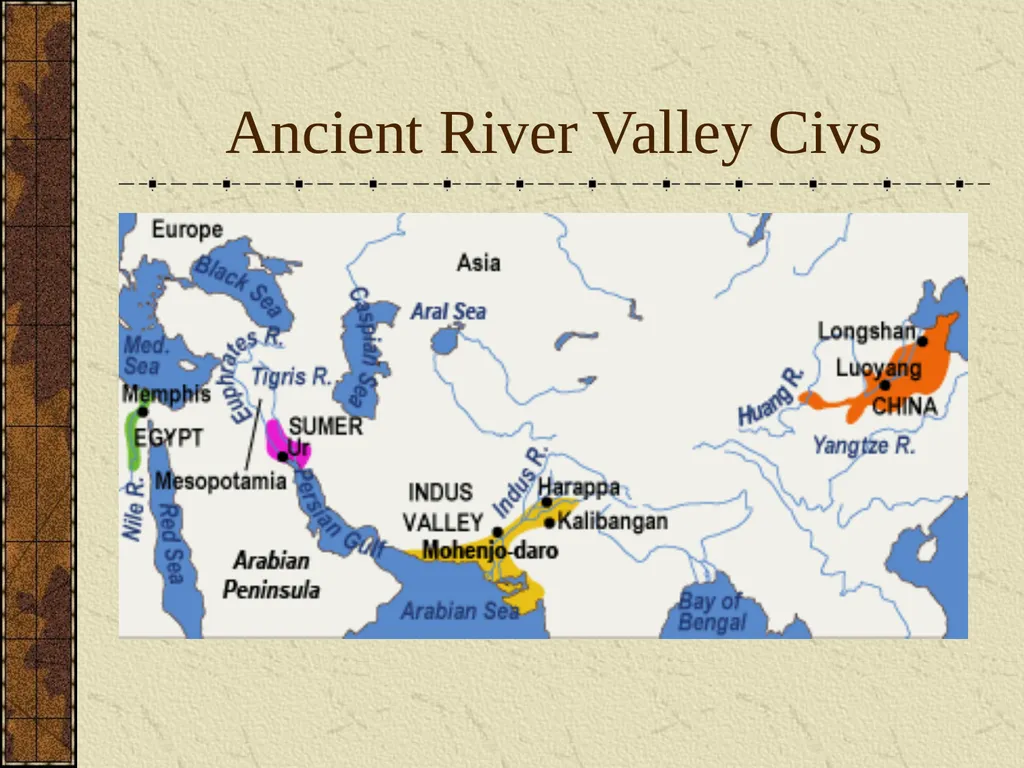
slide1. Ancient River Valley Civs<br>
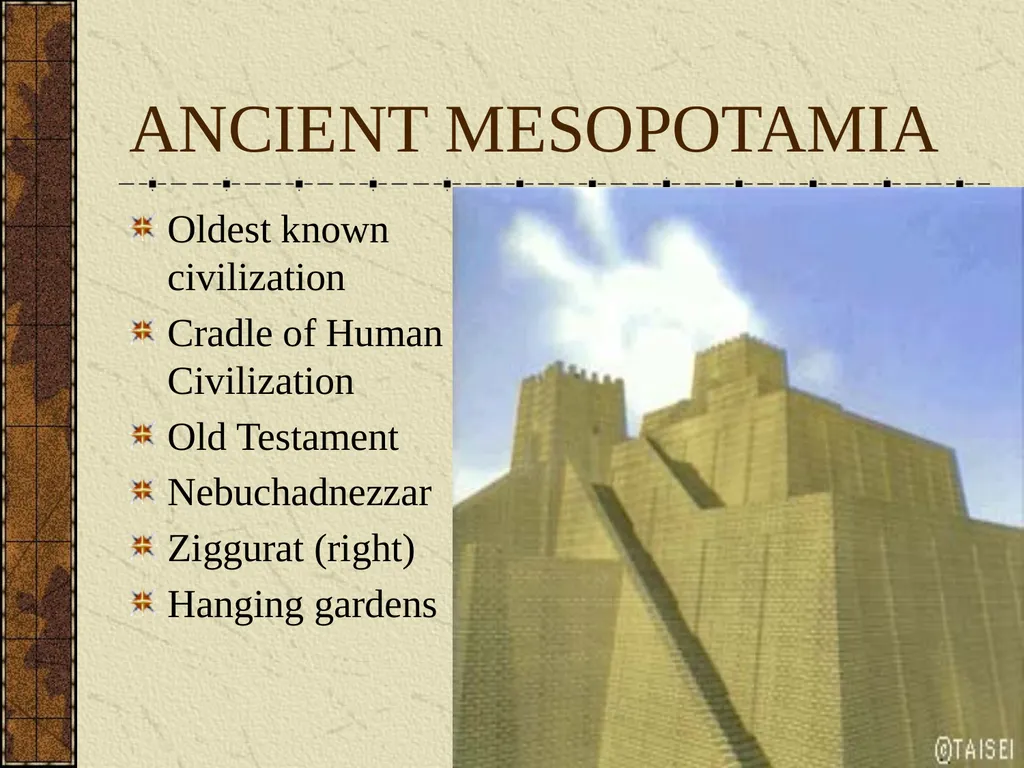
slide2. ANCIENT MESOPOTAMIA Oldest known civilization
Cradle of Human Civilization
Old Testament
Nebuchadnezzar
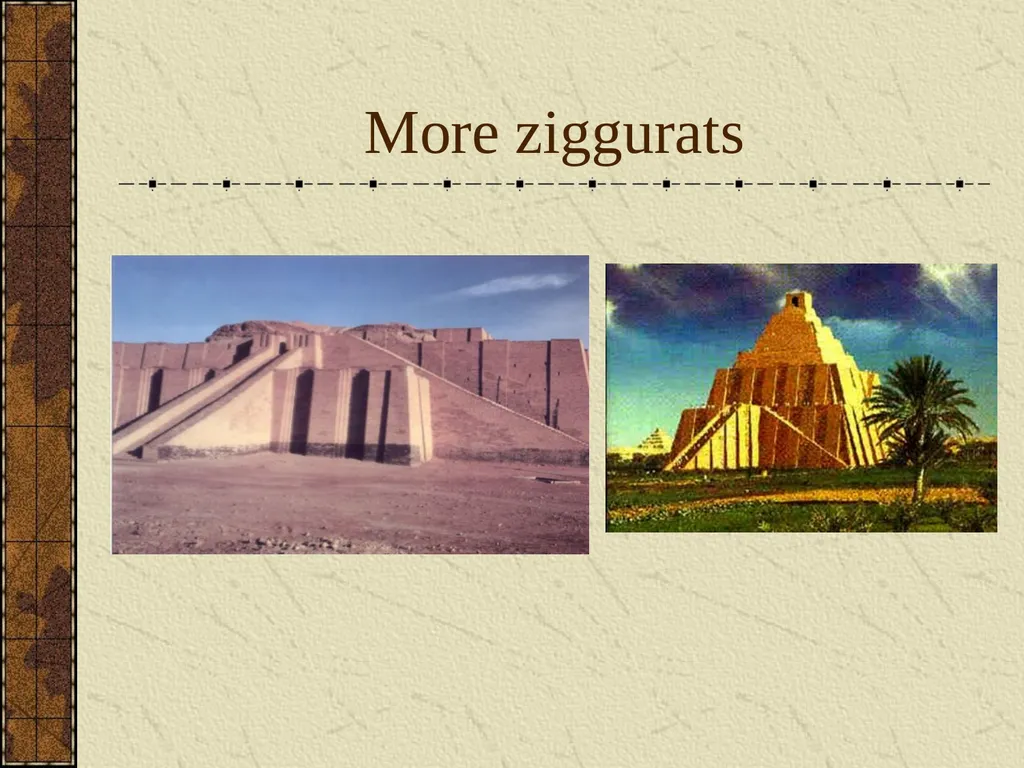
Ziggurat (right)
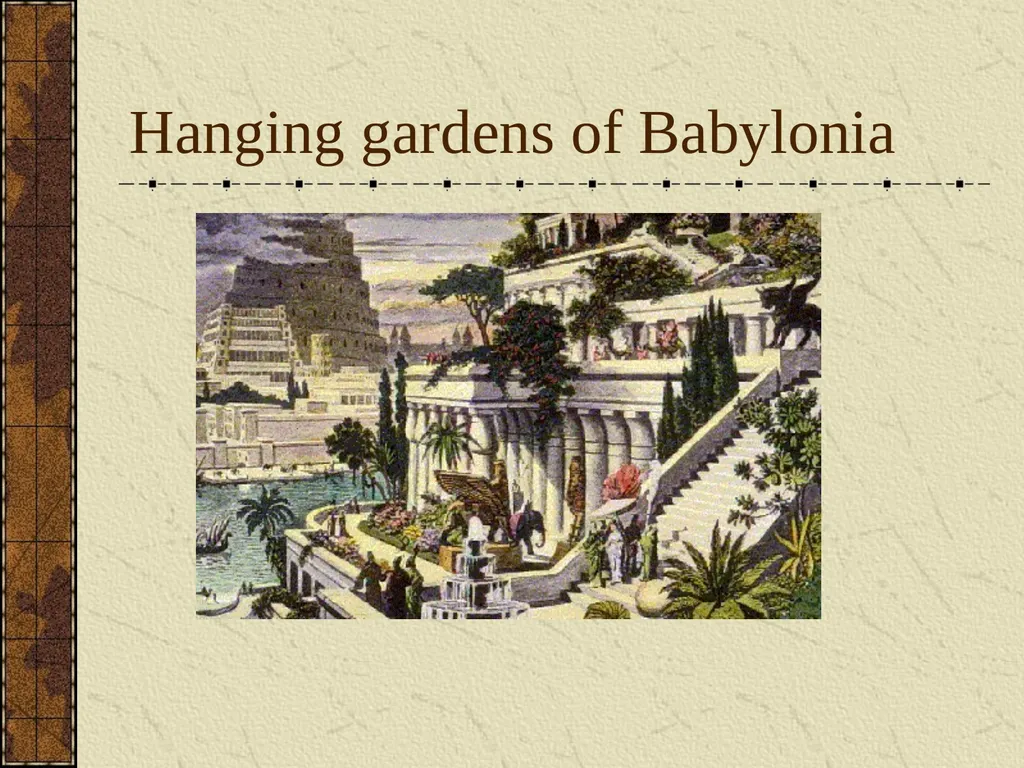
Hanging gardens<br>
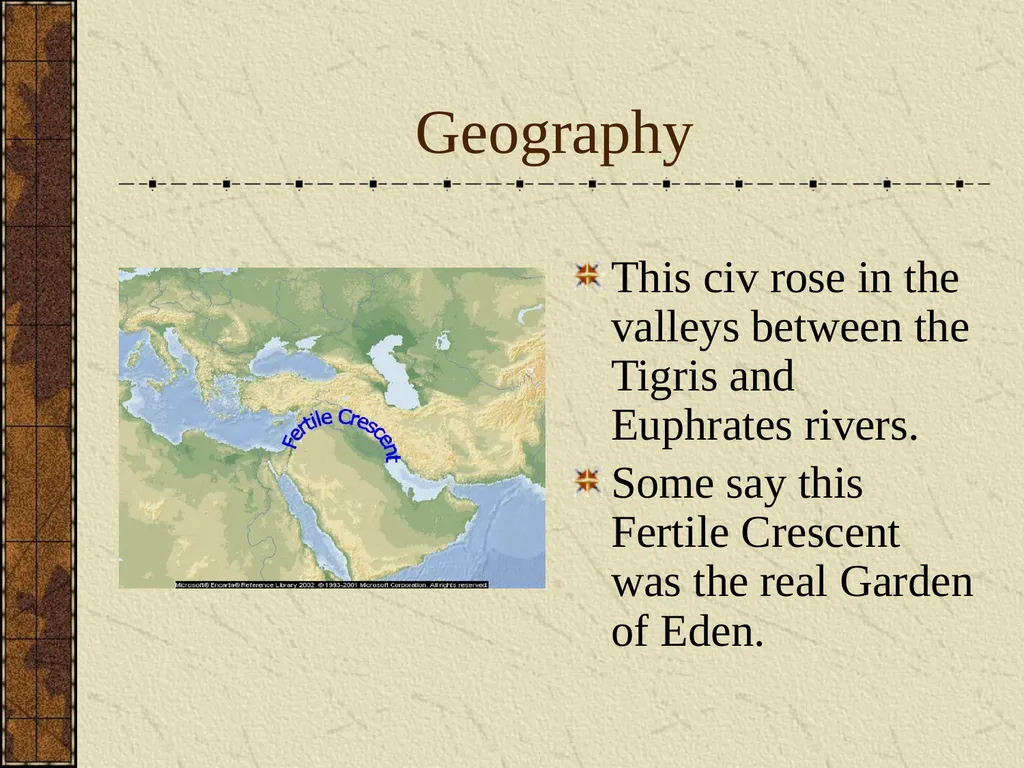
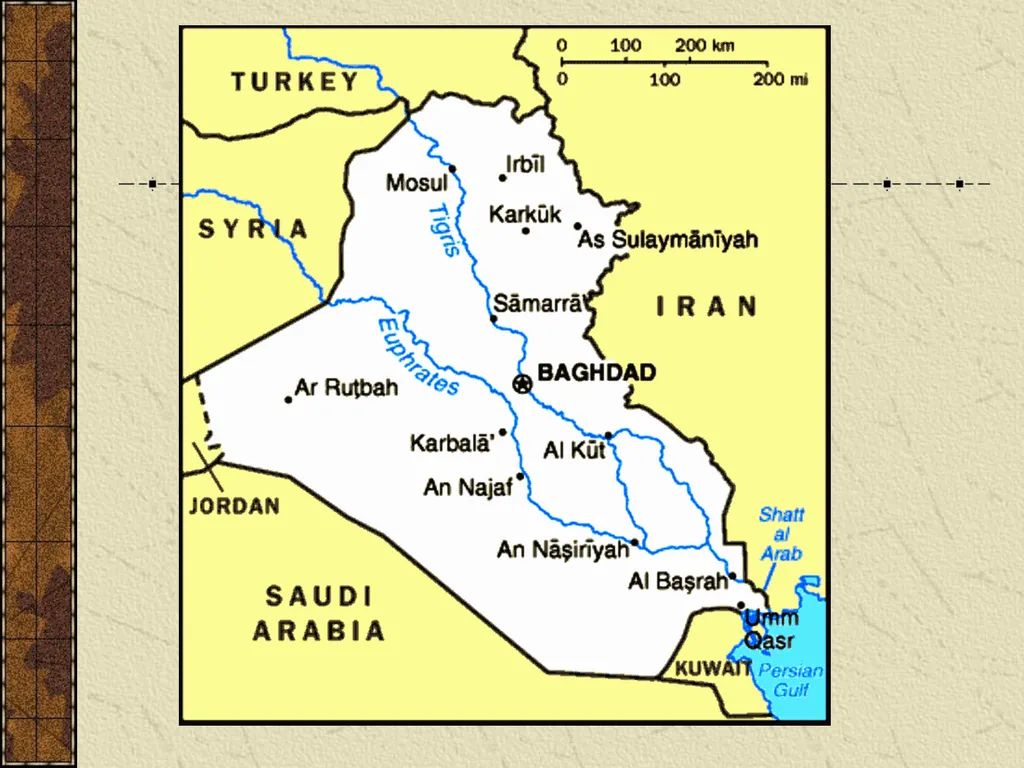
slide3. Geography This civ rose in the valleys between the Tigris and Euphrates rivers.
Some say this Fertile Crescent was the real Garden of Eden.<br>
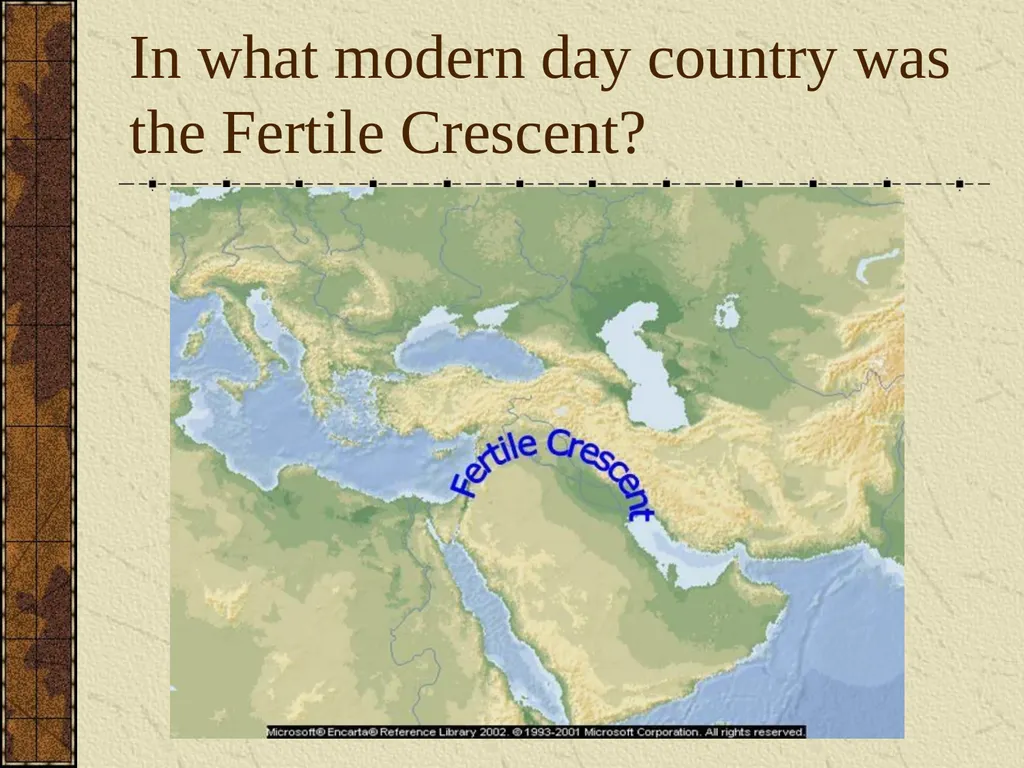
slide4. In what modern day country was the Fertile Crescent?<br>
slide6. Ur, the capital city of Mesopotamia<br>
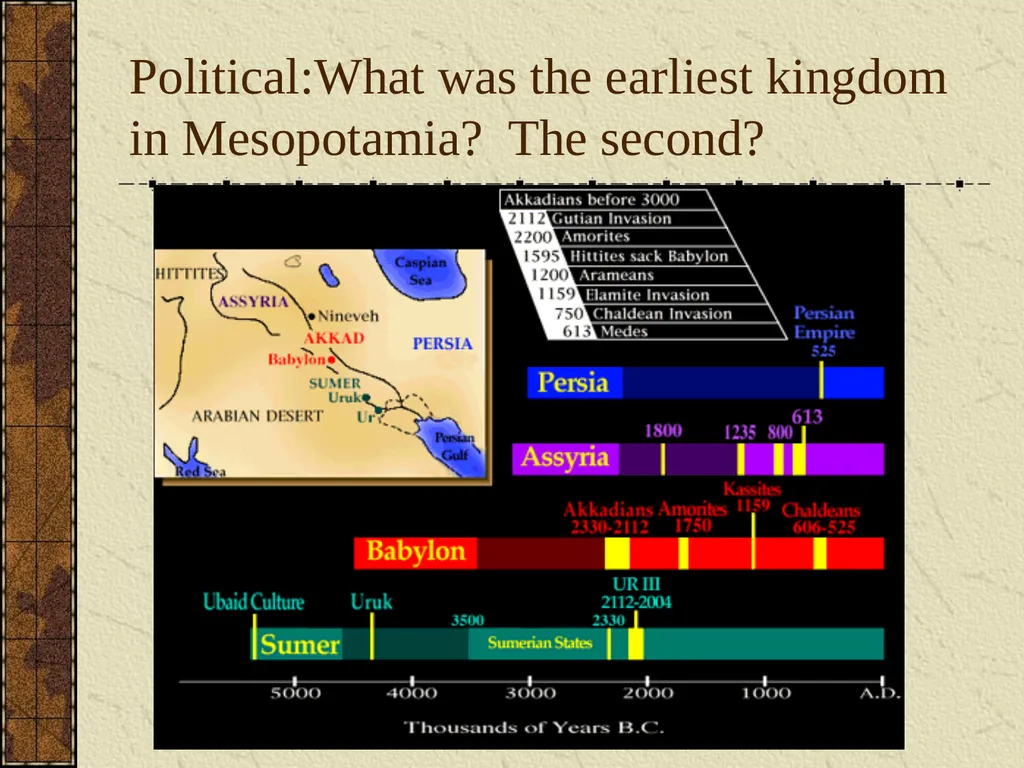
slide7. Political:What was the earliest kingdom in Mesopotamia? The second?<br>
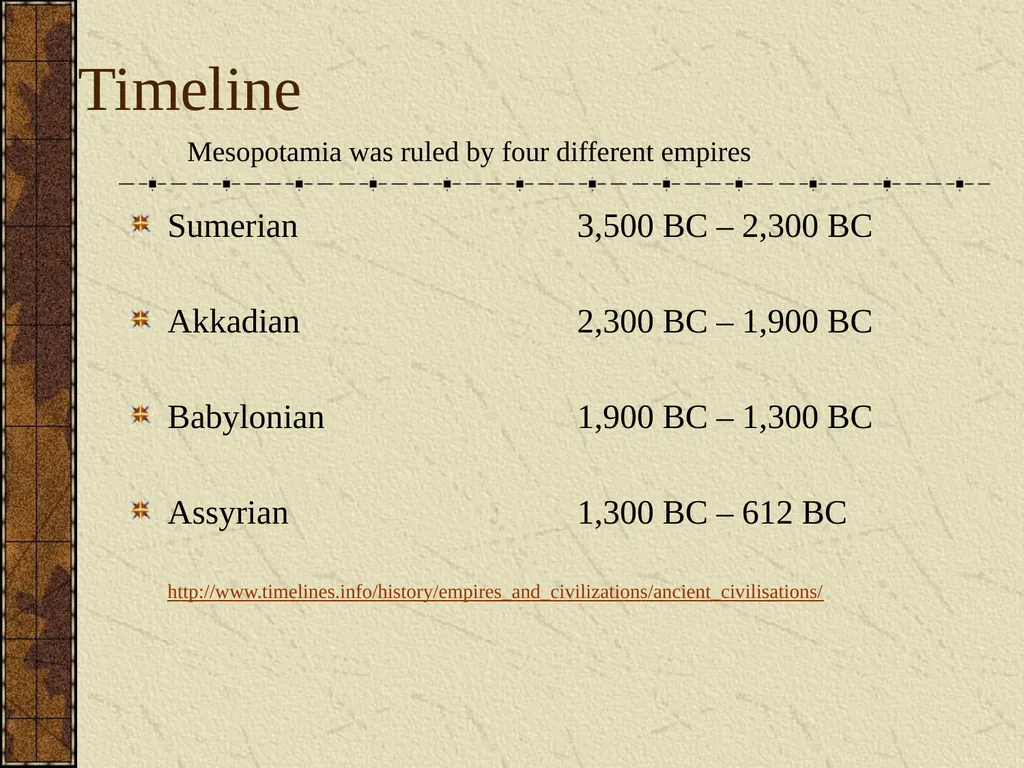
slide8. Timeline Sumerian 3,500 BC – 2,300 BC
Akkadian 2,300 BC – 1,900 BC
Babylonian 1,900 BC – 1,300 BC
Assyrian 1,300 BC – 612 BC
http://www.timelines.info/history/empires_and_civilizations/ancient_civilisations/ Mesopotamia was ruled by four different empires<br>
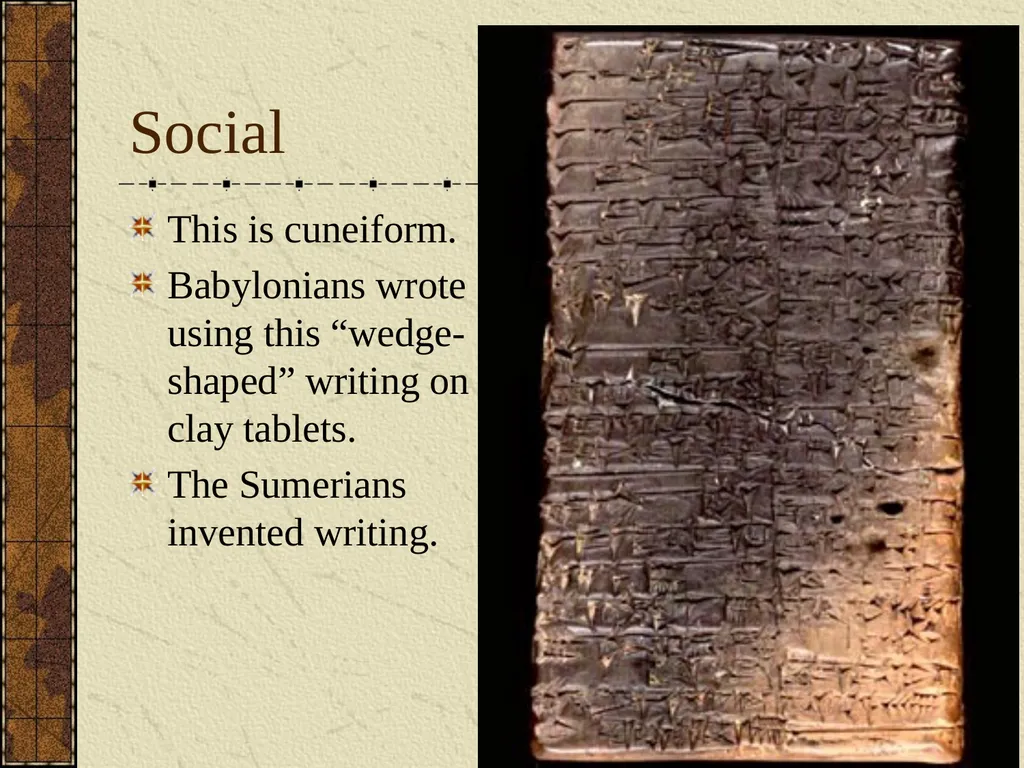
slide9. Social This is cuneiform.
Babylonians wrote using this “wedge-shaped” writing on clay tablets.
The Sumerians invented writing.<br>
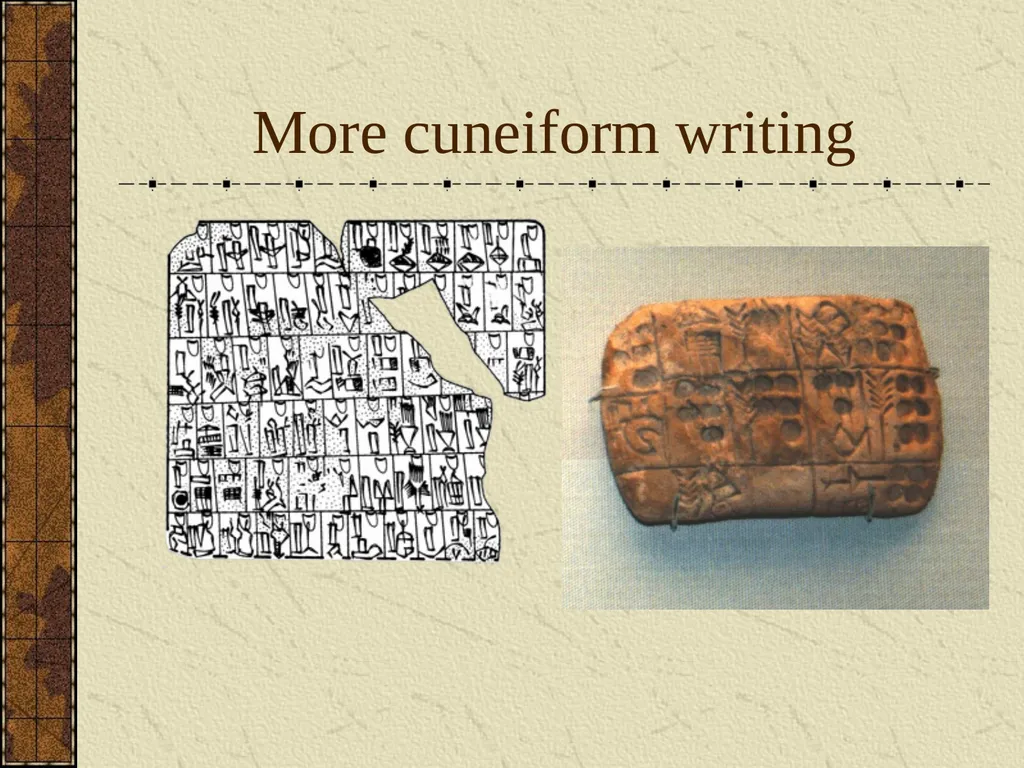
slide10. More cuneiform writing<br>
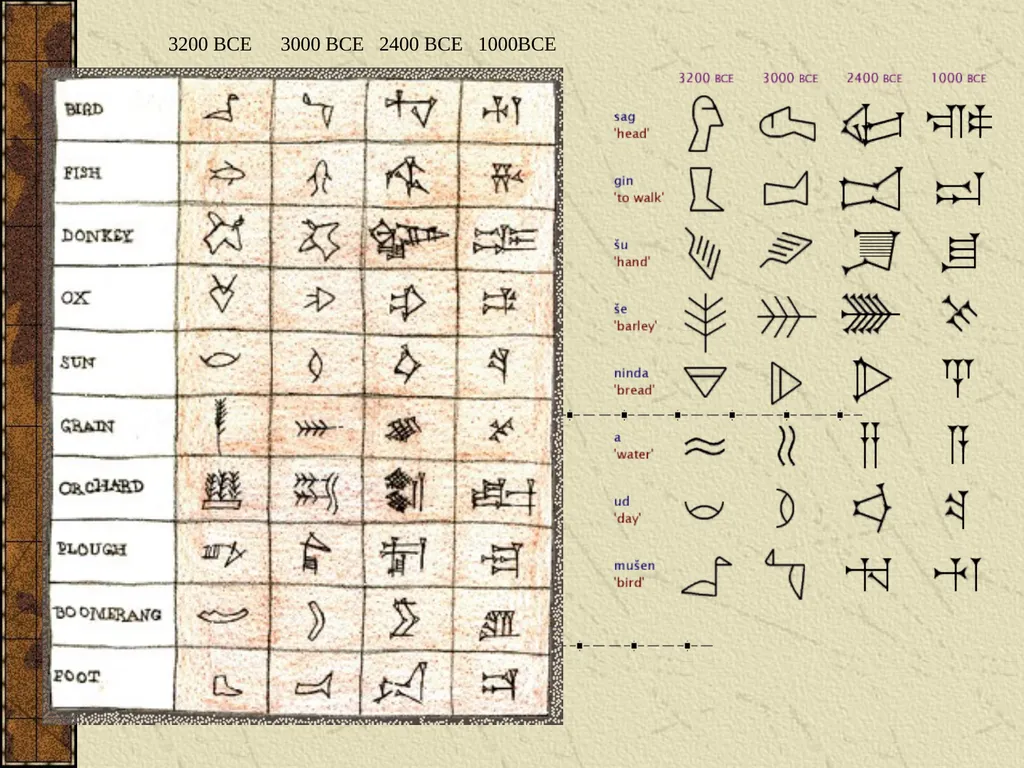
slide11. 3200 BCE 3000 BCE 2400 BCE 1000BCE<br>
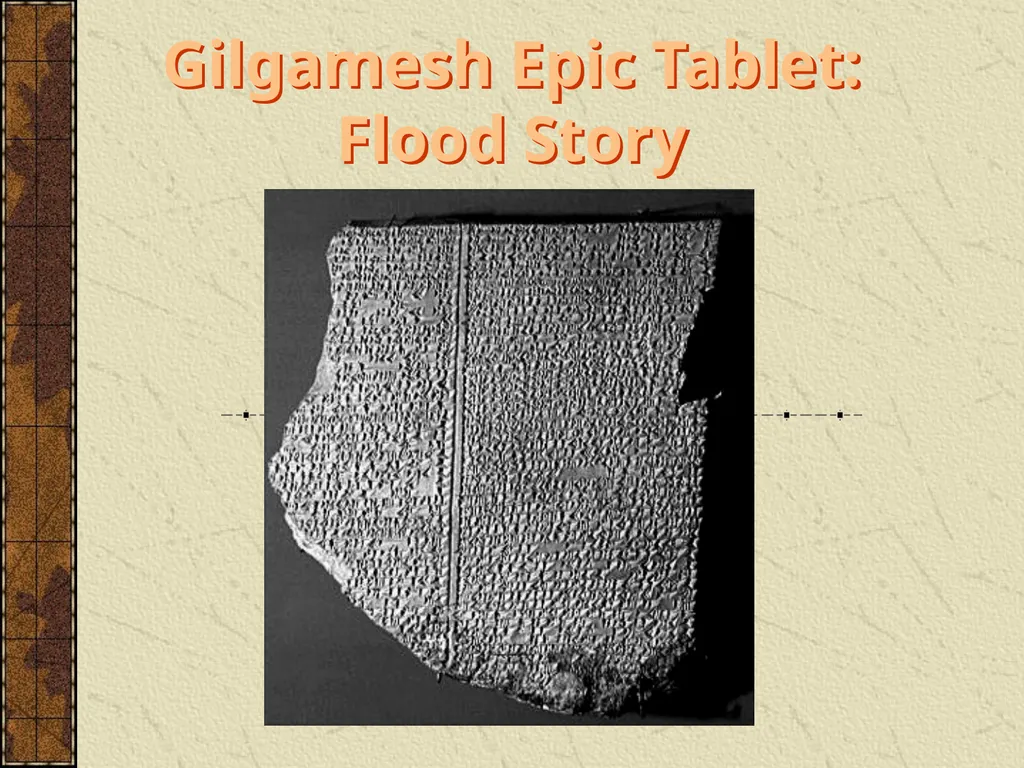
slide13. Gilgamesh Epic Tablet: Flood Story<br>
slide14. More ziggurats<br>
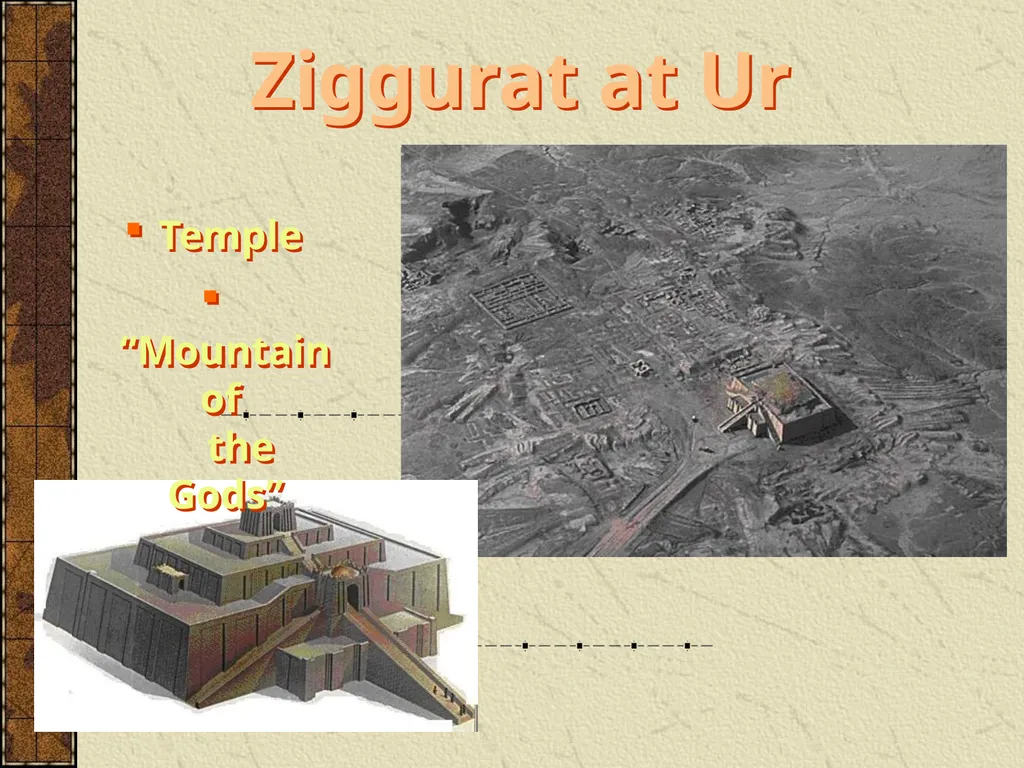
slide15. Ziggurat at Ur Temple
“Mountain of the Gods”<br>
slide17. Hanging gardens of Babylonia<br>
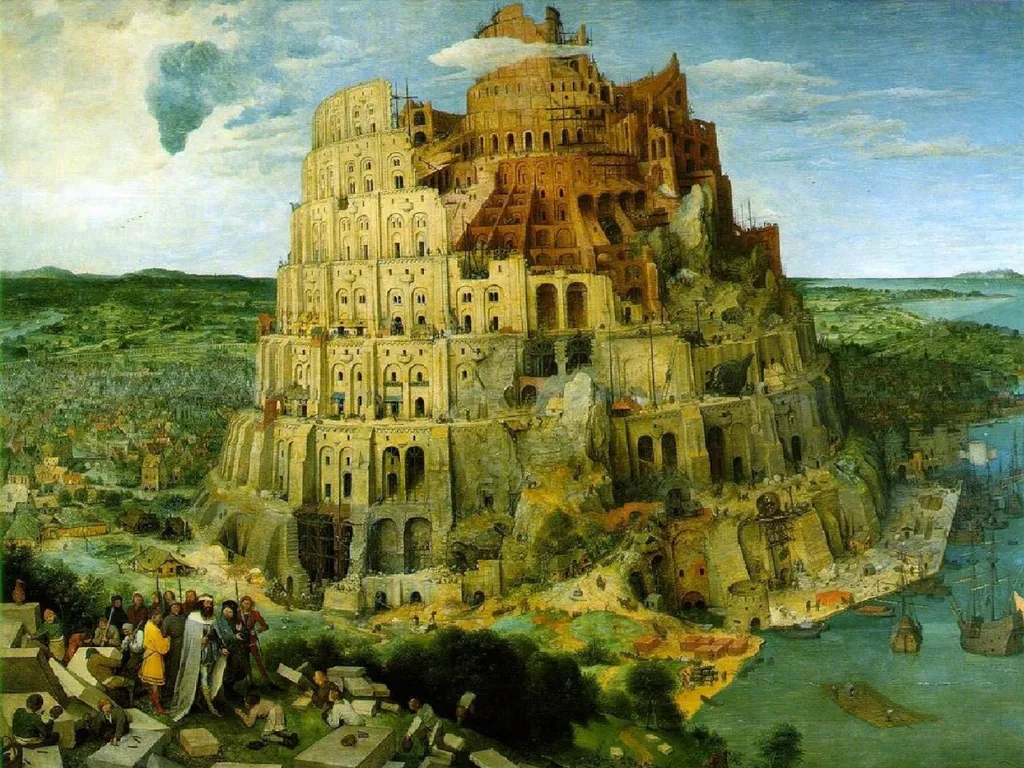
slide19. Another painting of the hanging gardens with Tower of Babel in back<br>
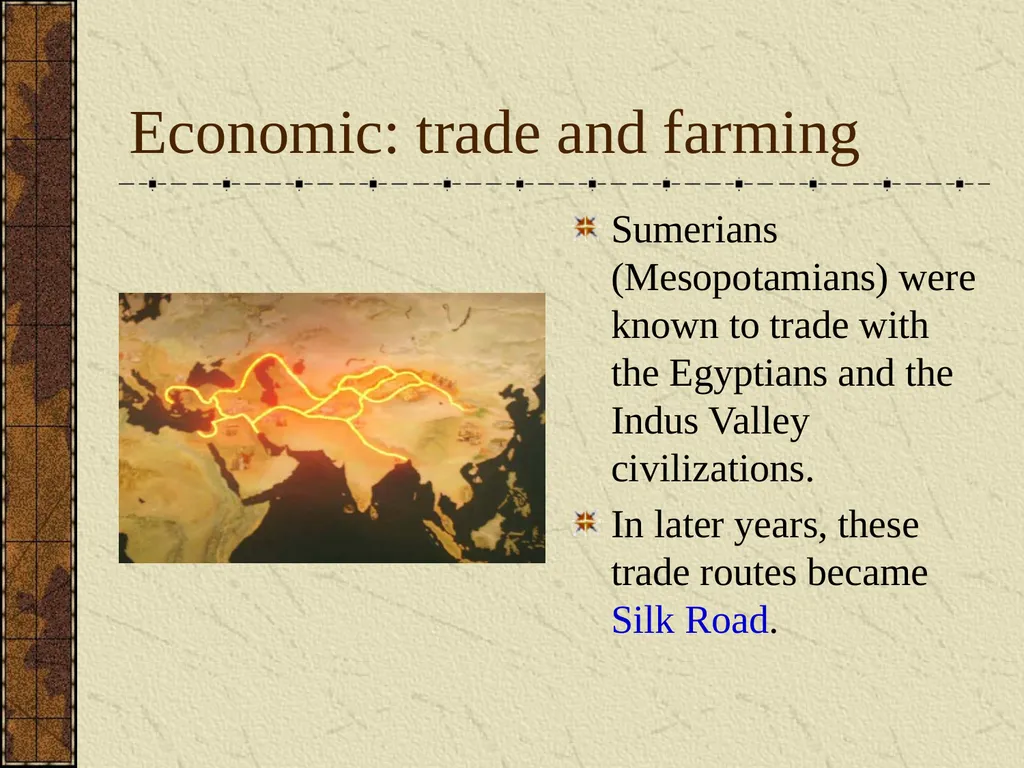
slide20. Economic: trade and farming Sumerians (Mesopotamians) were known to trade with the Egyptians and the Indus Valley civilizations.
In later years, these trade routes became Silk Road.<br>
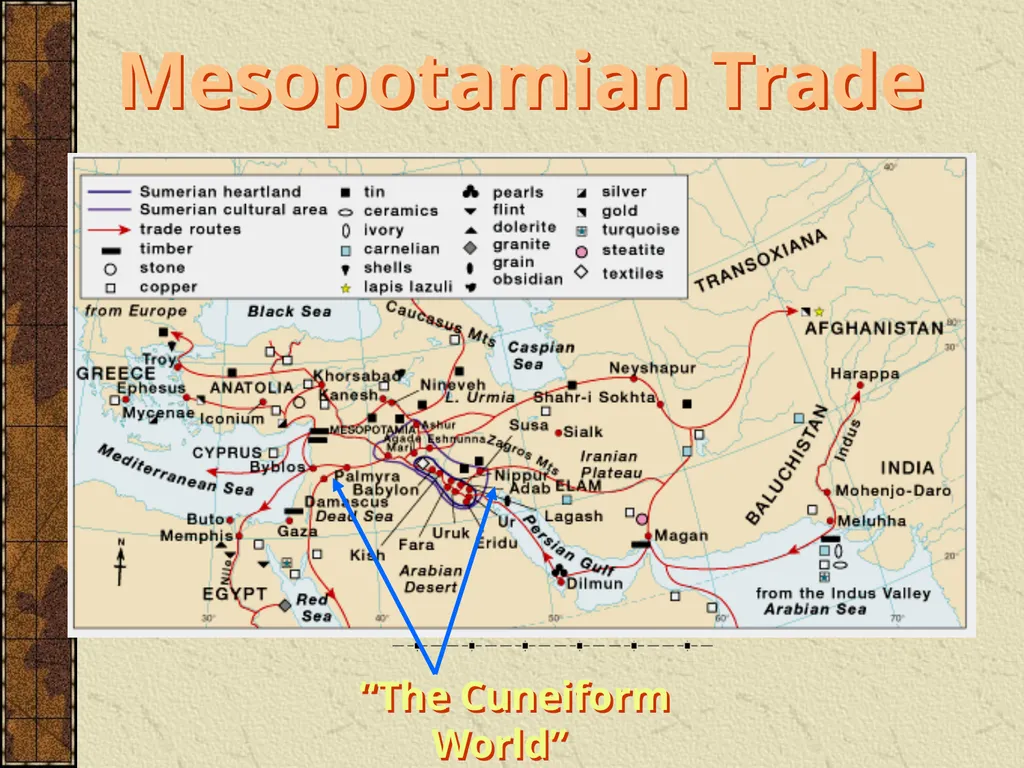
slide21. Mesopotamian Trade “The Cuneiform World”<br>
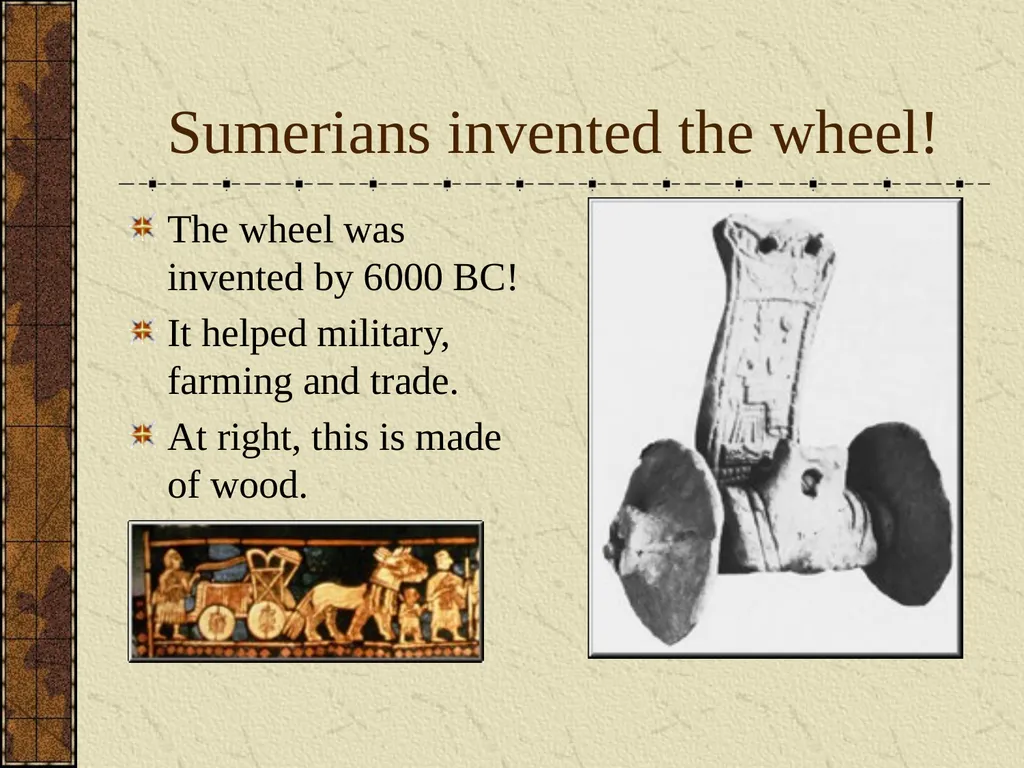
slide22. Sumerians invented the wheel! The wheel was invented by 6000 BC!
It helped military, farming and trade.
At right, this is made of wood.<br>
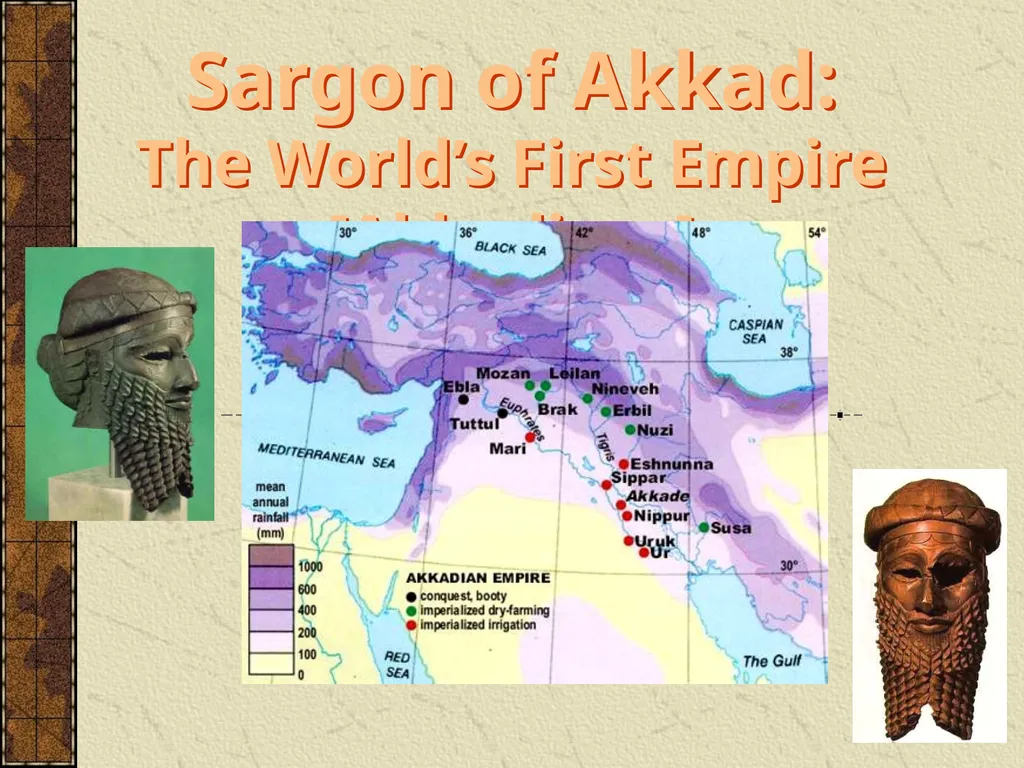
slide23. Sargon of Akkad: The World’s First Empire [Akkadians]<br>
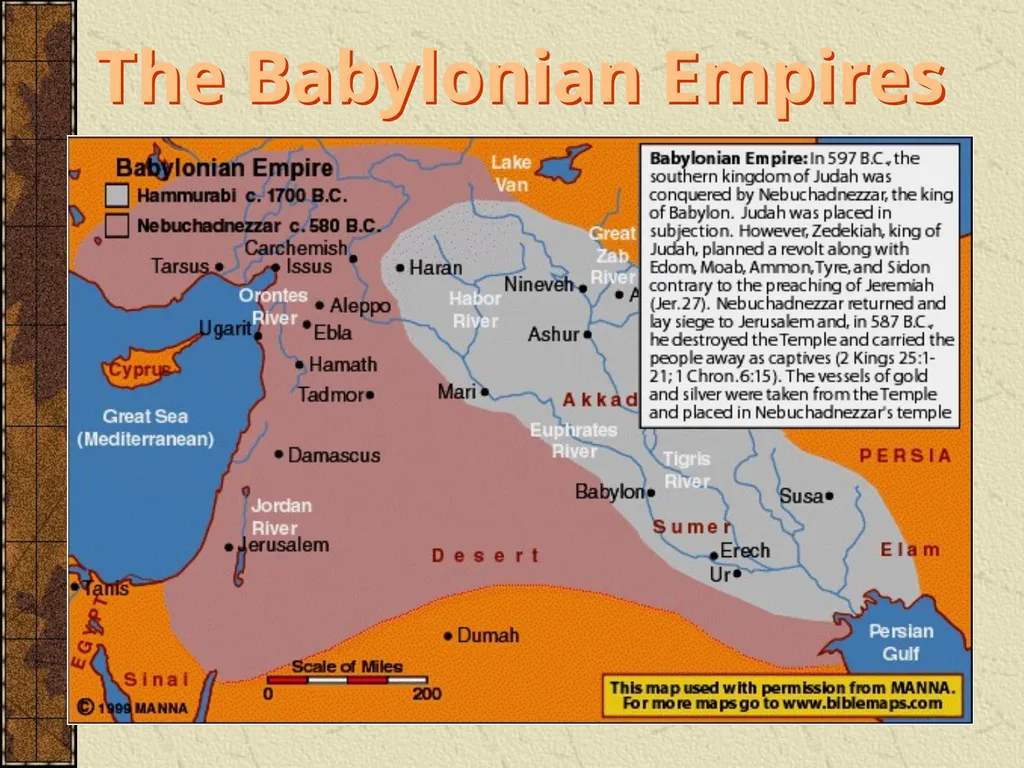
slide24. The Babylonian Empires<br>
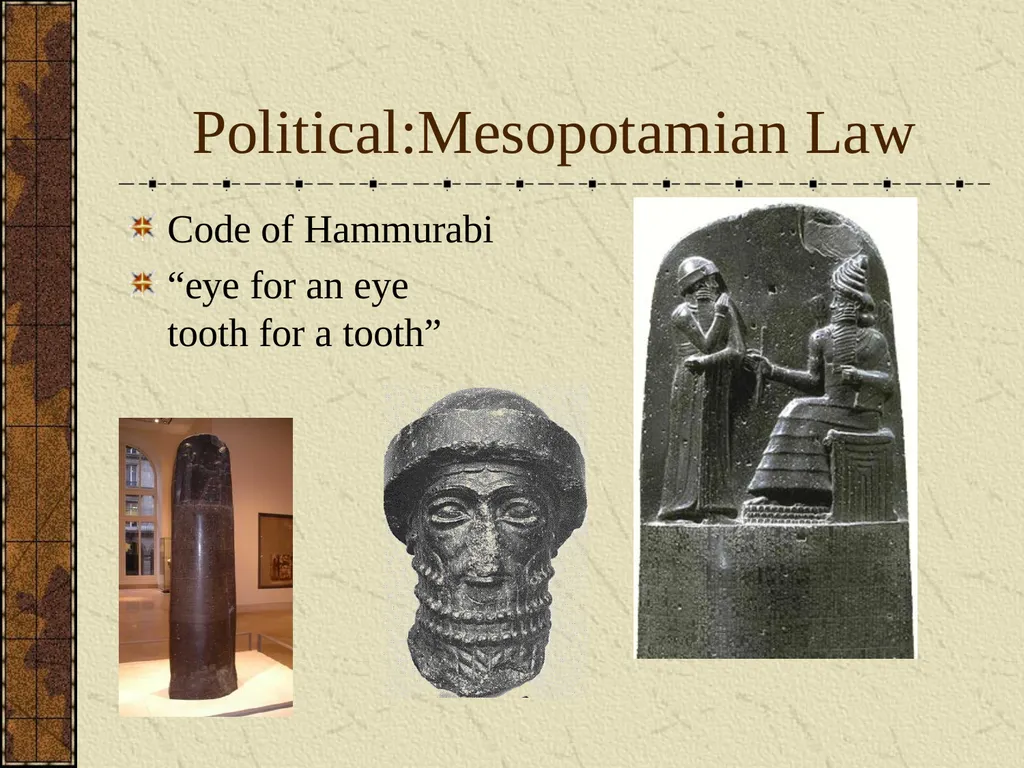
slide25. Political:Mesopotamian Law Code of Hammurabi
“eye for an eye tooth for a tooth”<br>
slide26. Hammurabi’s [r. 1792-1750 B. C. E.] Code<br>
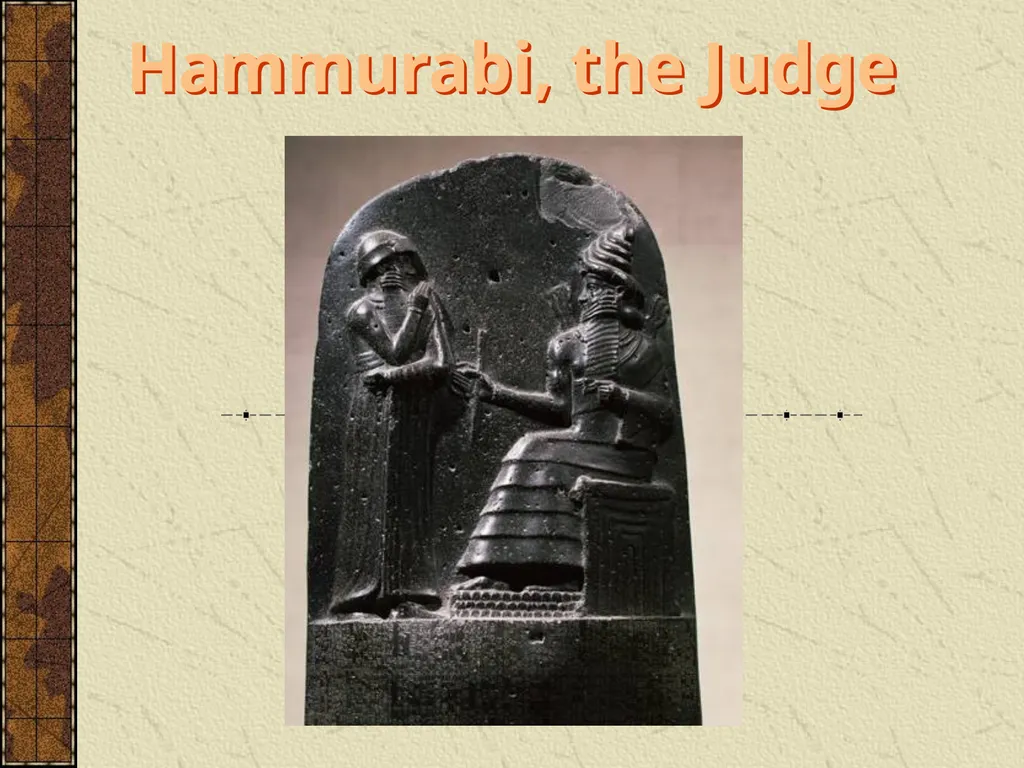
slide27. Hammurabi, the Judge<br>
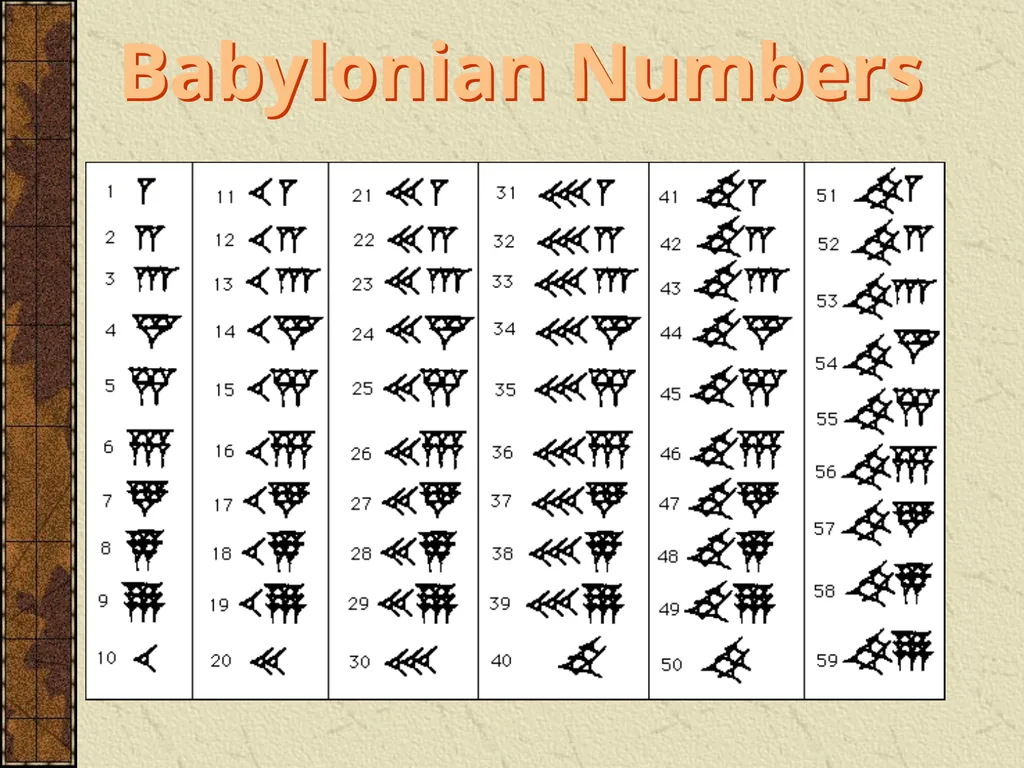
slide28. Babylonian Numbers<br>
slide29. That concludes Mesopotamia. Any questions before the quiz?<br>
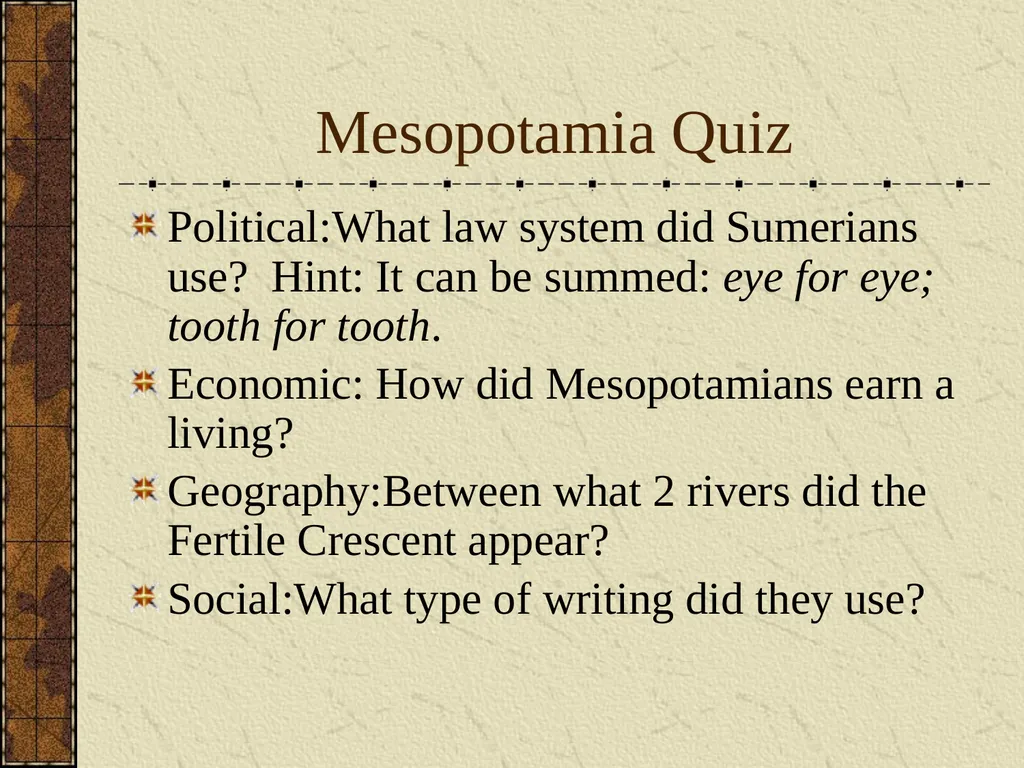
slide30. Mesopotamia Quiz Political:What law system did Sumerians use? Hint: It can be summed: eye for eye; tooth for tooth.
Economic: How did Mesopotamians earn a living?
Geography:Between what 2 rivers did the Fertile Crescent appear?
Social:What type of writing did they use?<br>
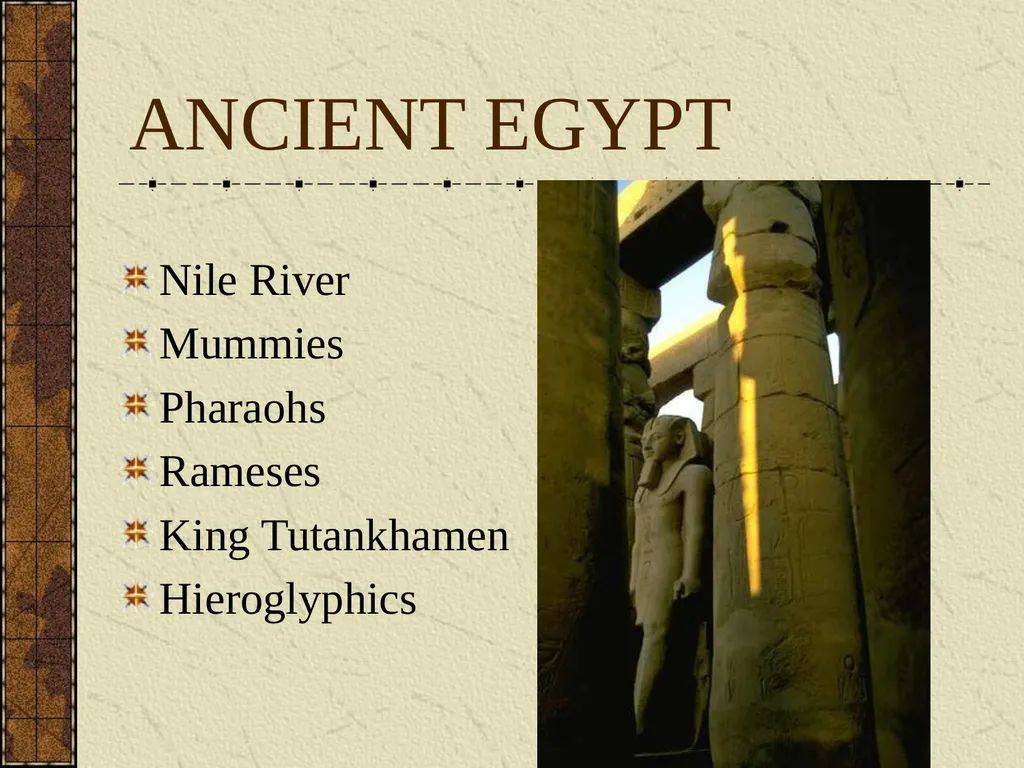
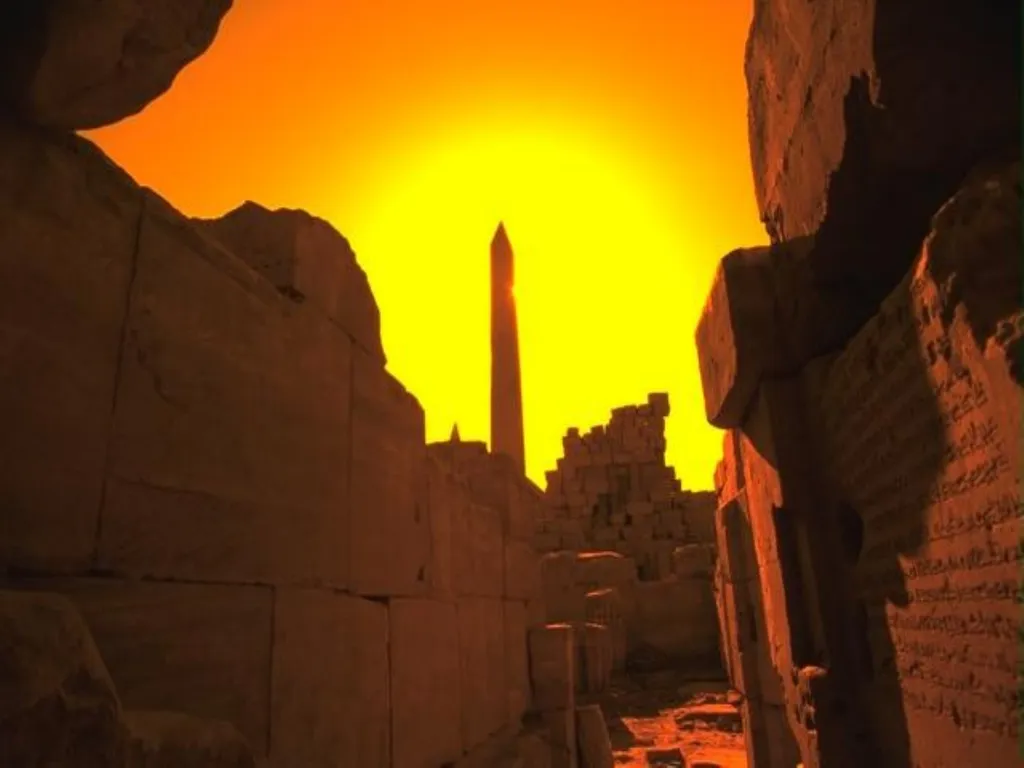
slide31. ANCIENT EGYPT Nile River
Mummies
Pharaohs
Rameses
King Tutankhamen
Hieroglyphics<br>
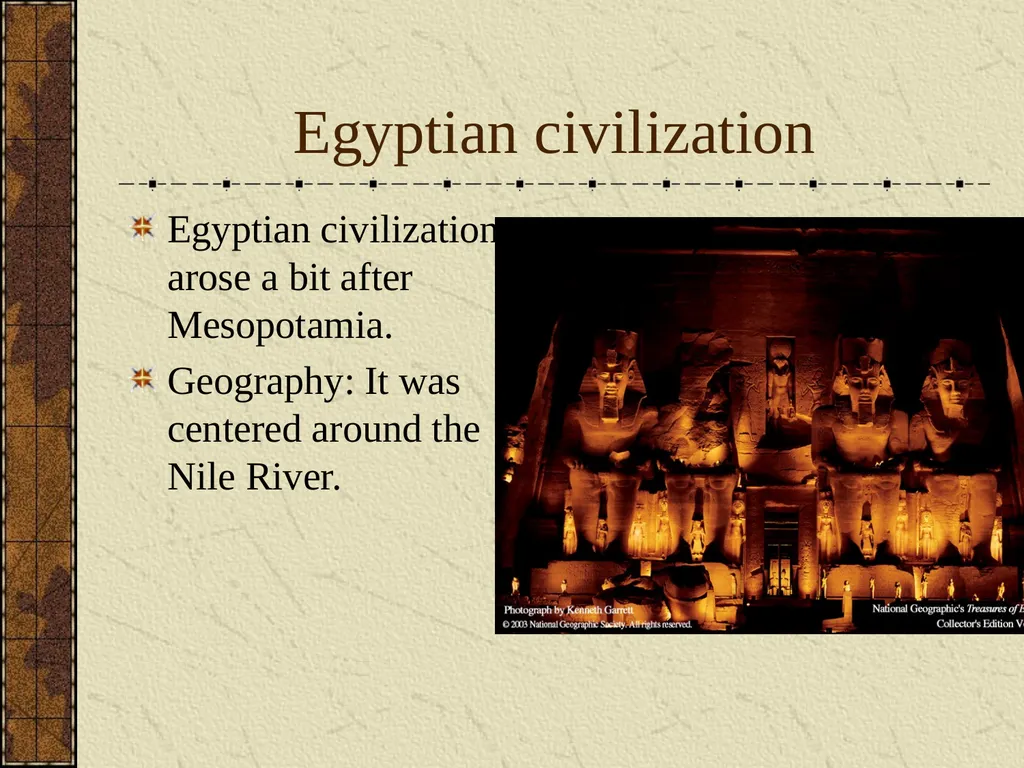
slide32. Egyptian civilization Egyptian civilization arose a bit after Mesopotamia.
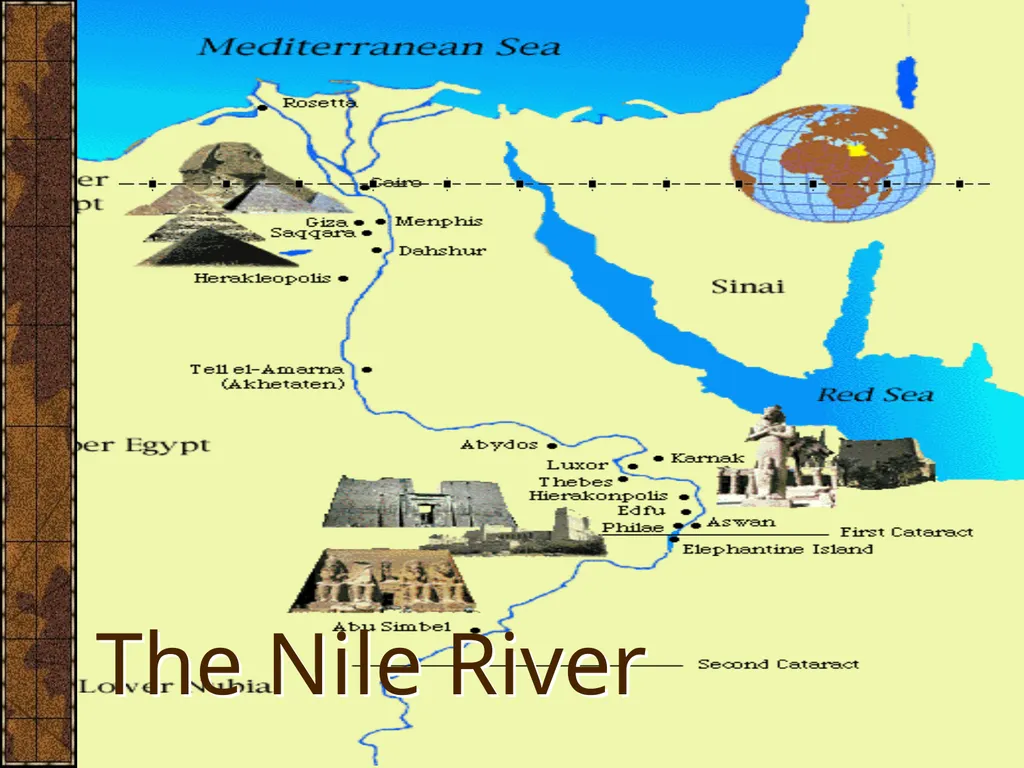
Geography: It was centered around the Nile River.<br>
slide33. The Nile River<br>
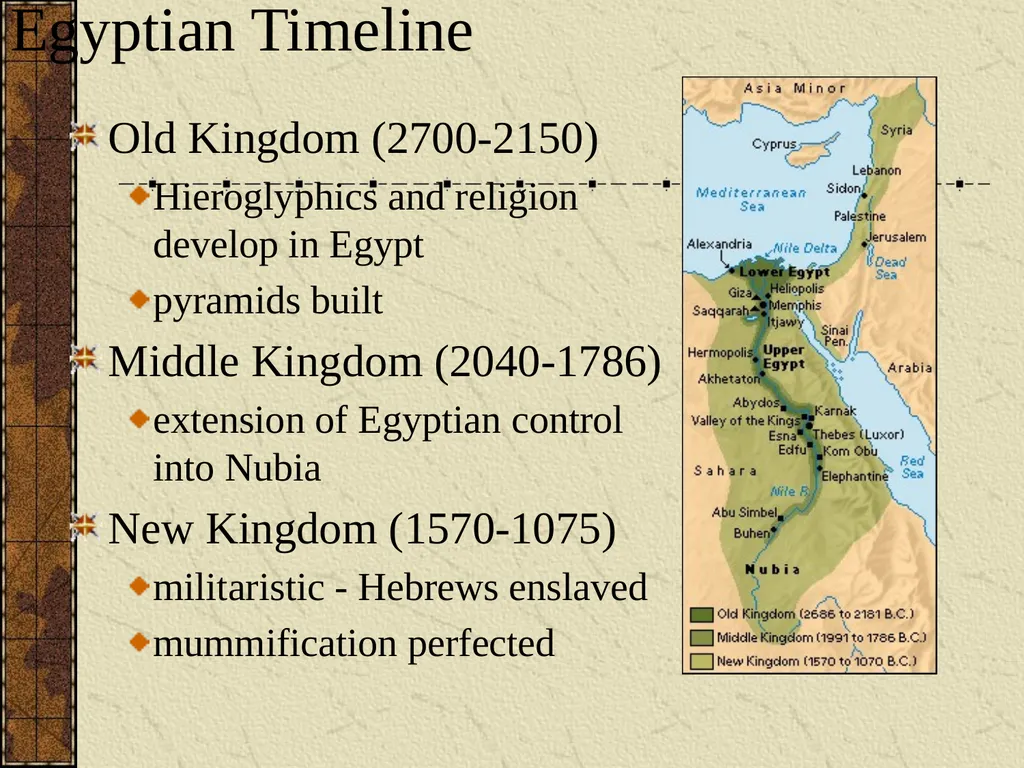
slide34. Egyptian Timeline Old Kingdom (2700-2150)
Hieroglyphics and religion develop in Egypt
pyramids built
Middle Kingdom (2040-1786)
extension of Egyptian control into Nubia
New Kingdom (1570-1075)
militaristic - Hebrews enslaved
mummification perfected<br>
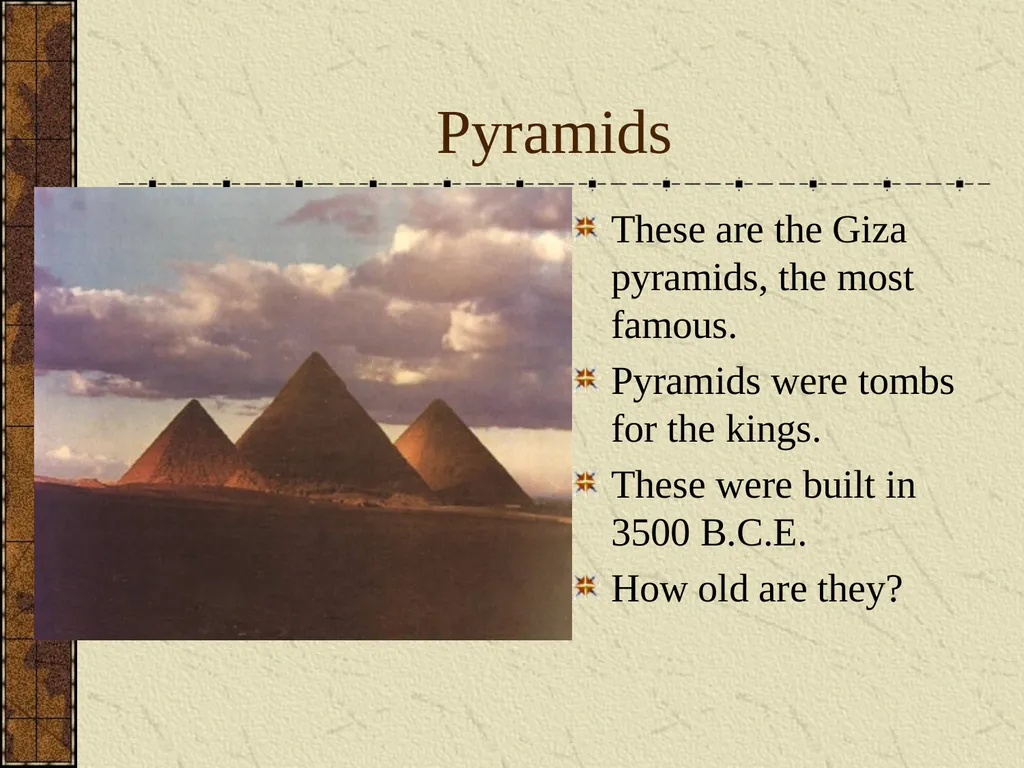
slide35. Pyramids These are the Giza pyramids, the most famous.
Pyramids were tombs for the kings.
These were built in 3500 B.C.E.
How old are they?<br>
slide37. Ahmose I leading Egyptians against the Hyksos<br>
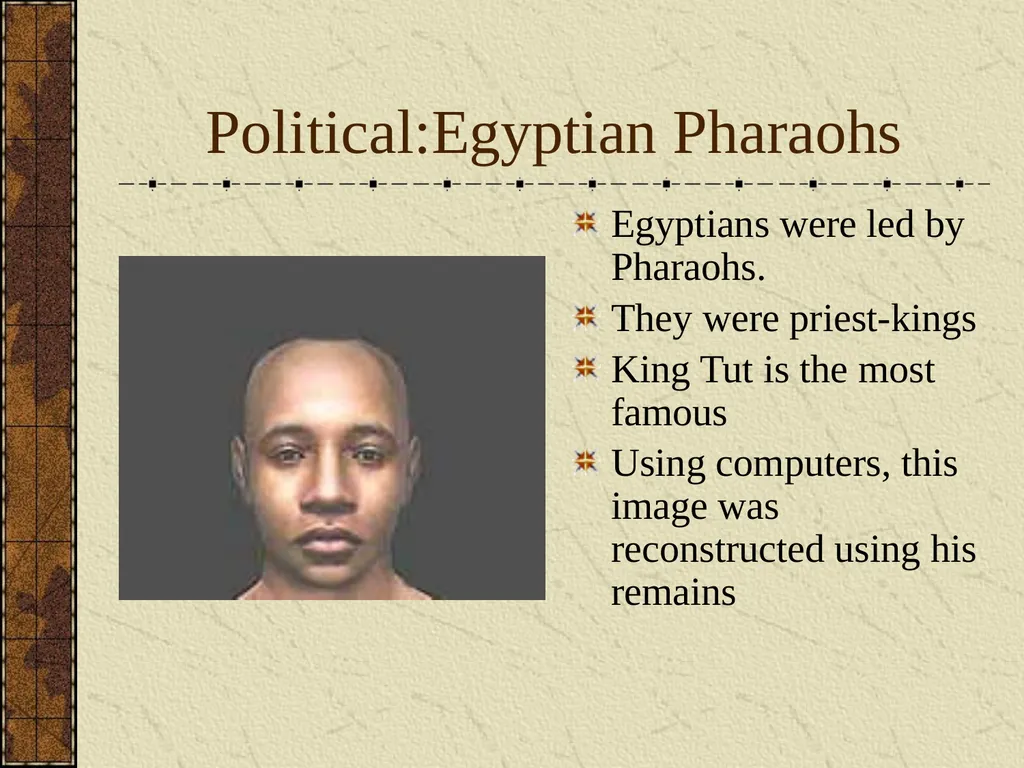
slide38. Political:Egyptian Pharaohs Egyptians were led by Pharaohs.
They were priest-kings
King Tut is the most famous
Using computers, this image was reconstructed using his remains<br>
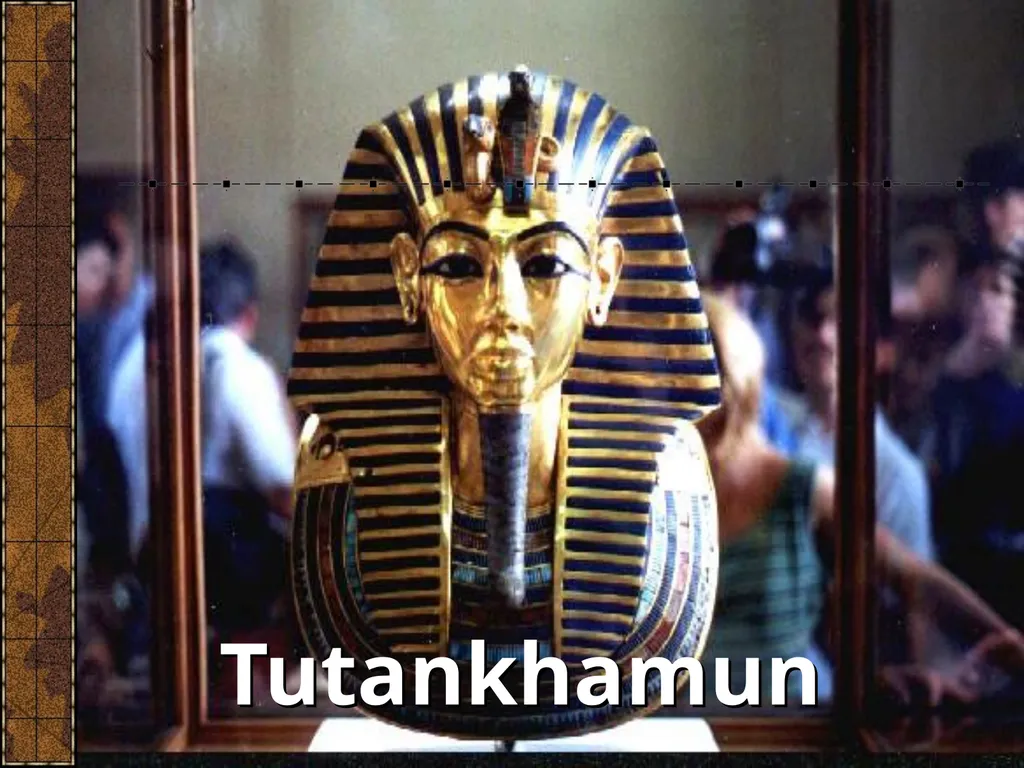
slide39. Tutankhamun<br>
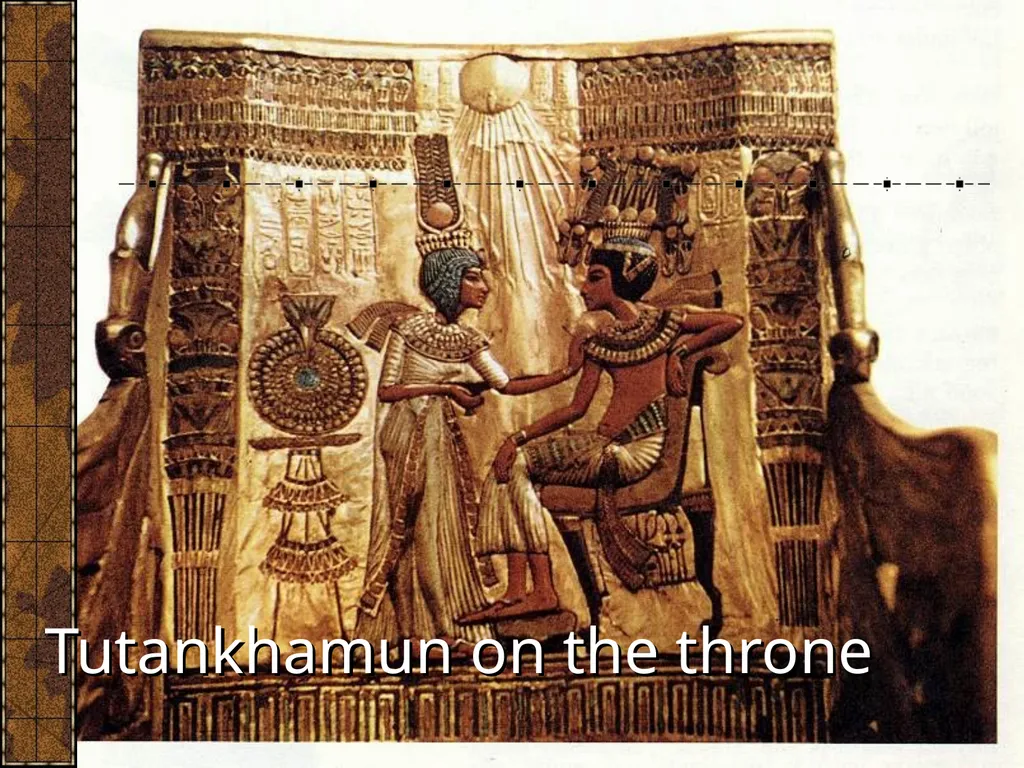
slide40. Tutankhamun on the throne<br>
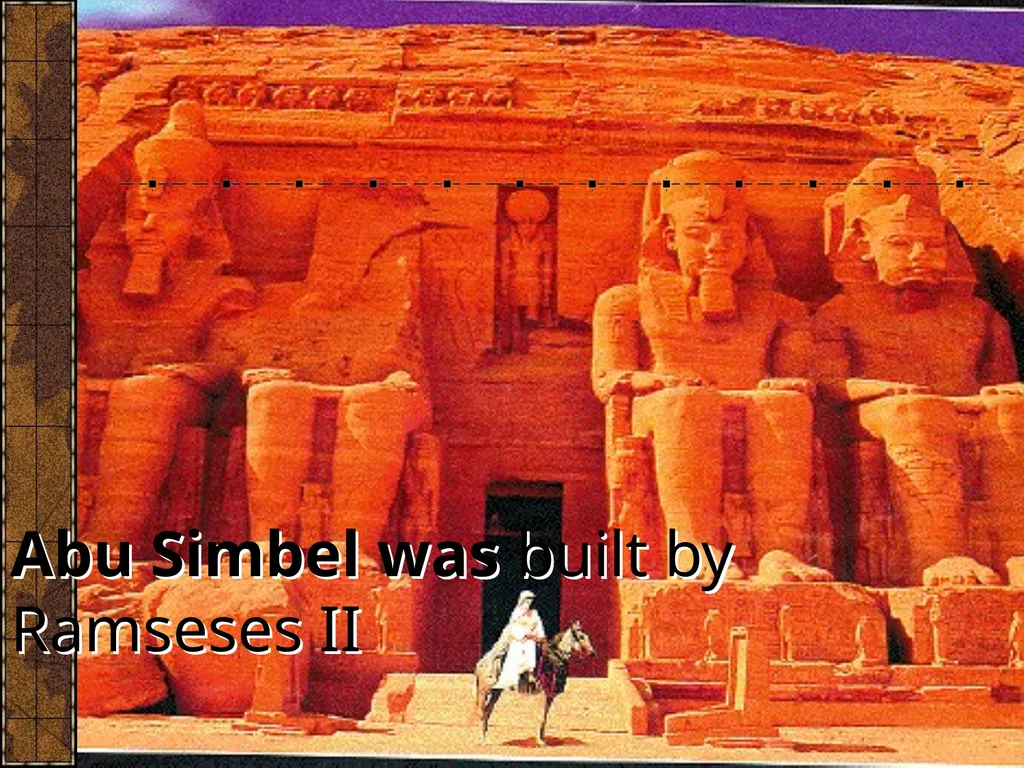
slide41. Abu Simbel was built by Ramseses II<br>
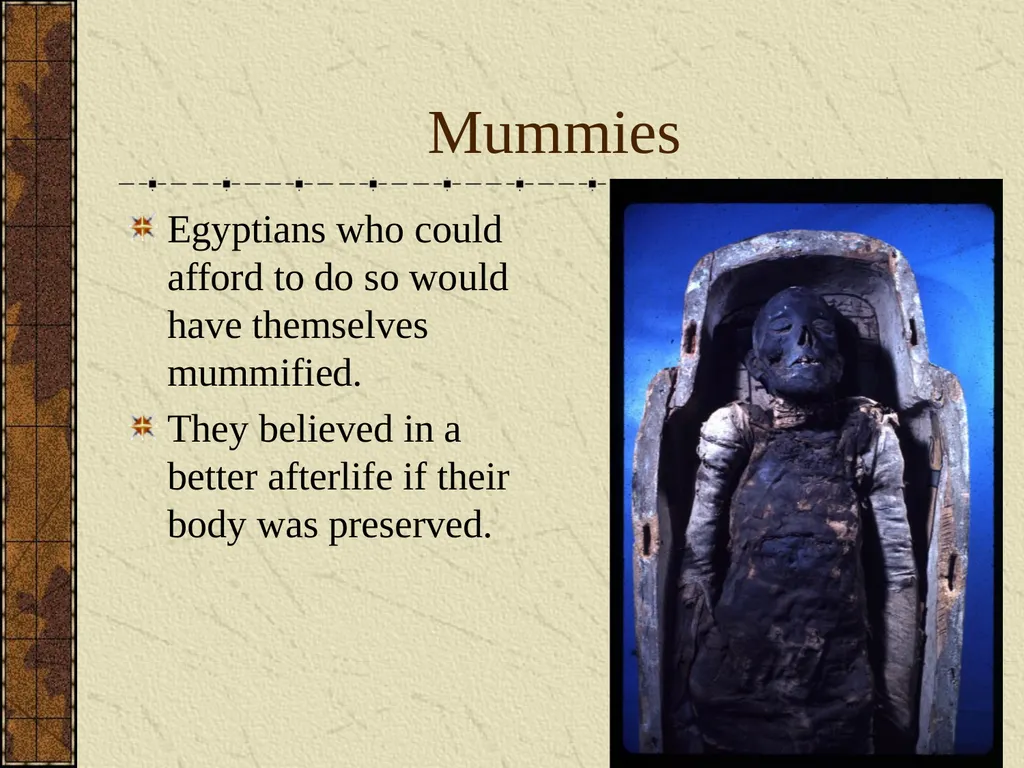
slide42. Mummies Egyptians who could afford to do so would have themselves mummified.
They believed in a better afterlife if their body was preserved.<br>
slide43. The Egyptians took out all of the internal organs, except the heart. When they removed them the organs were put in canopic jars, that were put in the tomb with the mummy. They did not take out the heart because it was believed to be the intelligence and emotion of the person. The Egyptians thought the brain had no significant value, so they took it out through the nose. The body was packed and covered with natron (a salty drying agent). After this the body was left for 40-50 days.<br>
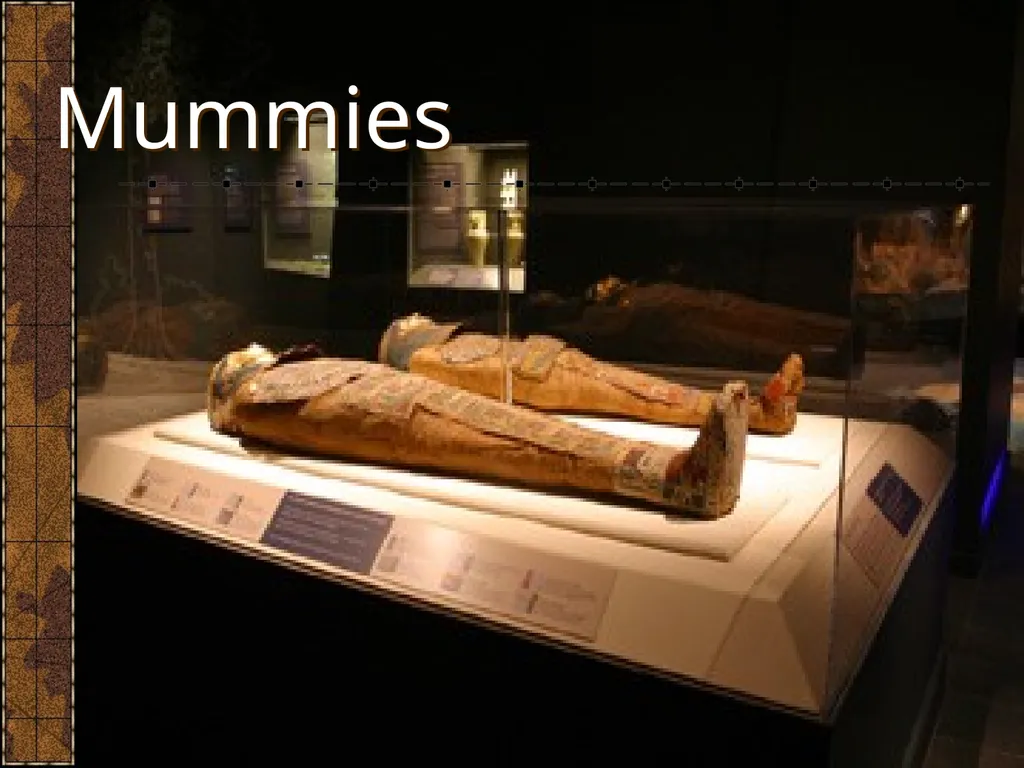
slide44. Mummies<br>
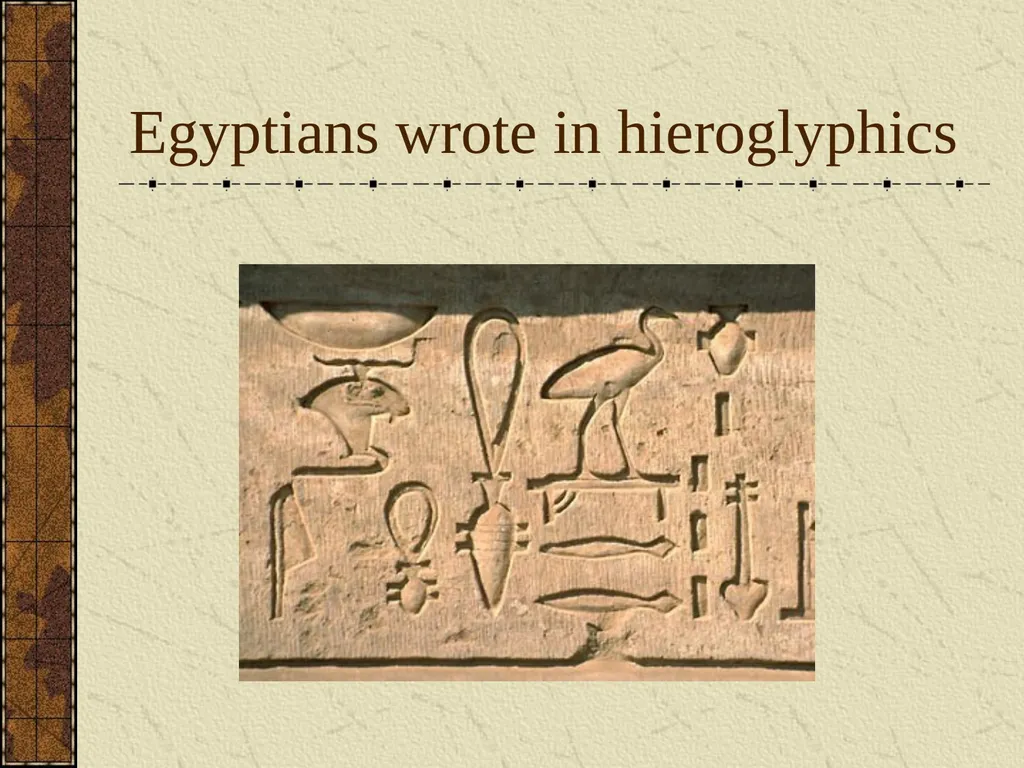
slide45. Egyptians wrote in hieroglyphics<br>
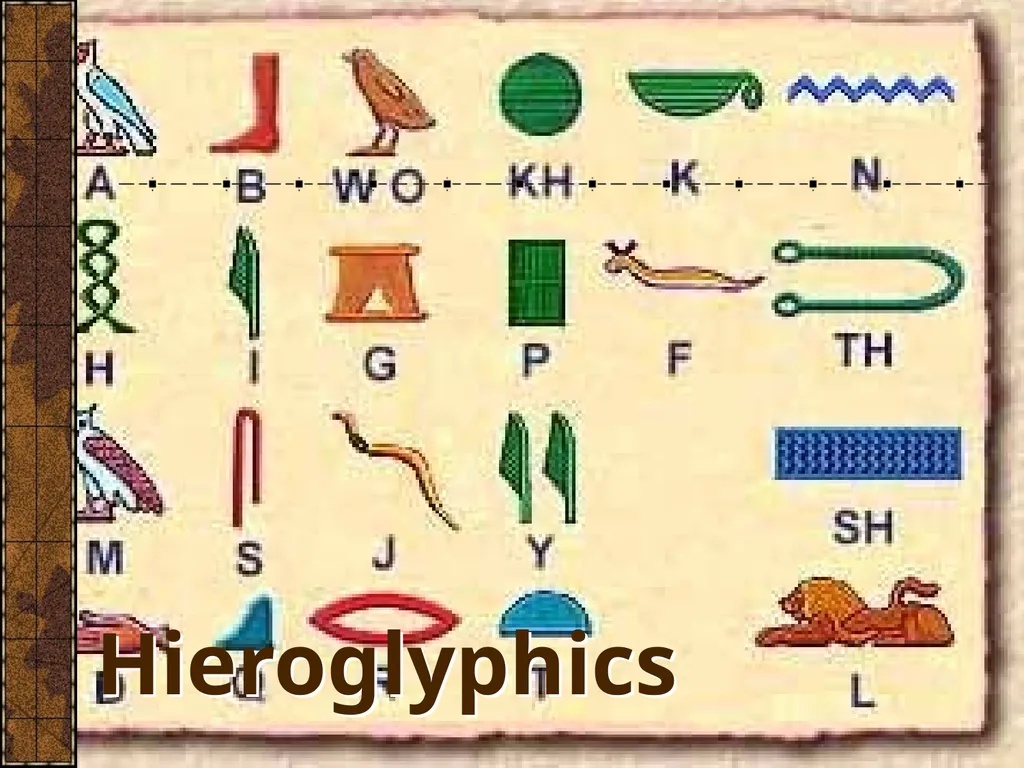
slide46. Hieroglyphics<br>
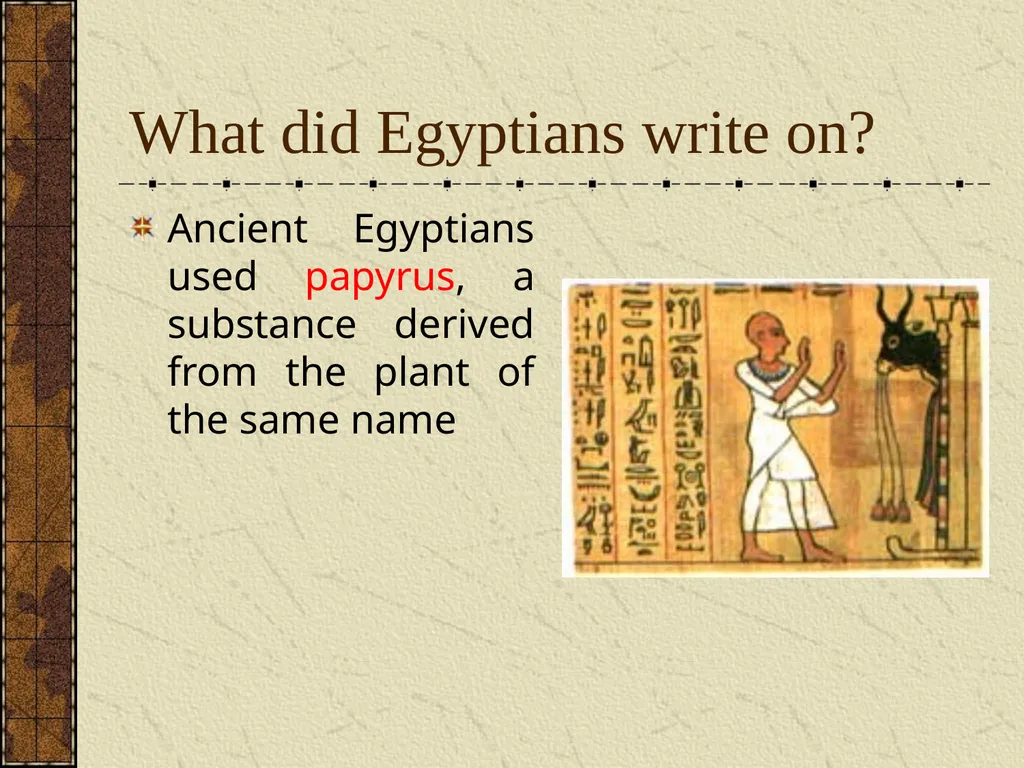
slide47. What did Egyptians write on? Ancient Egyptians used papyrus, a substance derived from the plant of the same name<br>
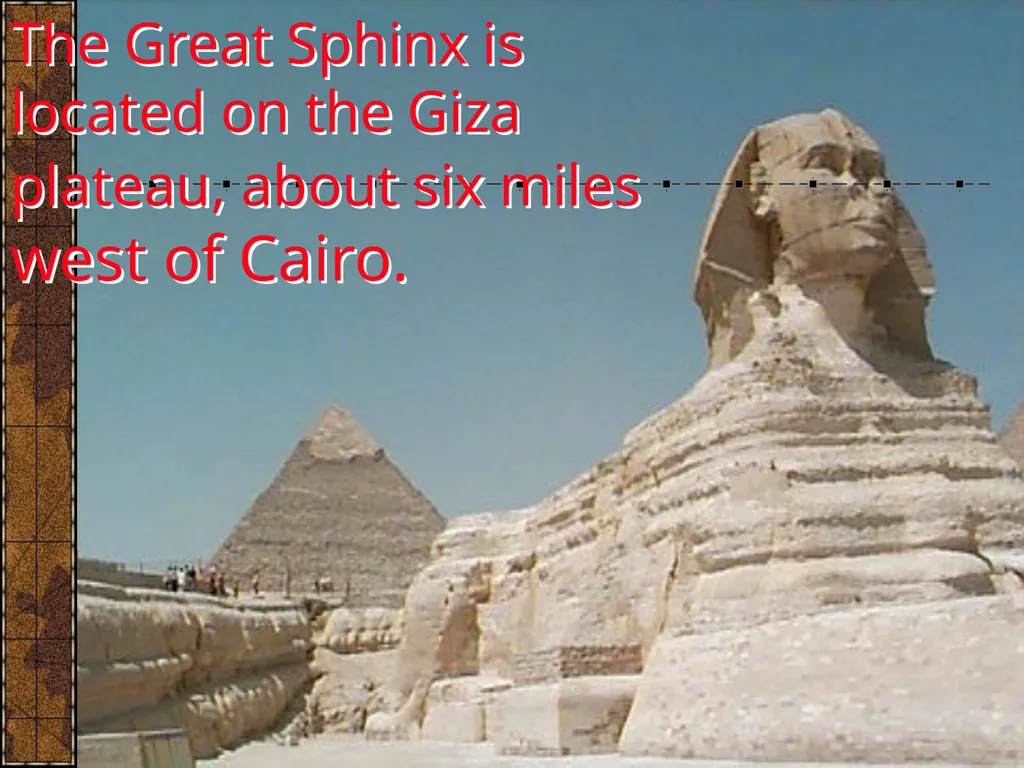
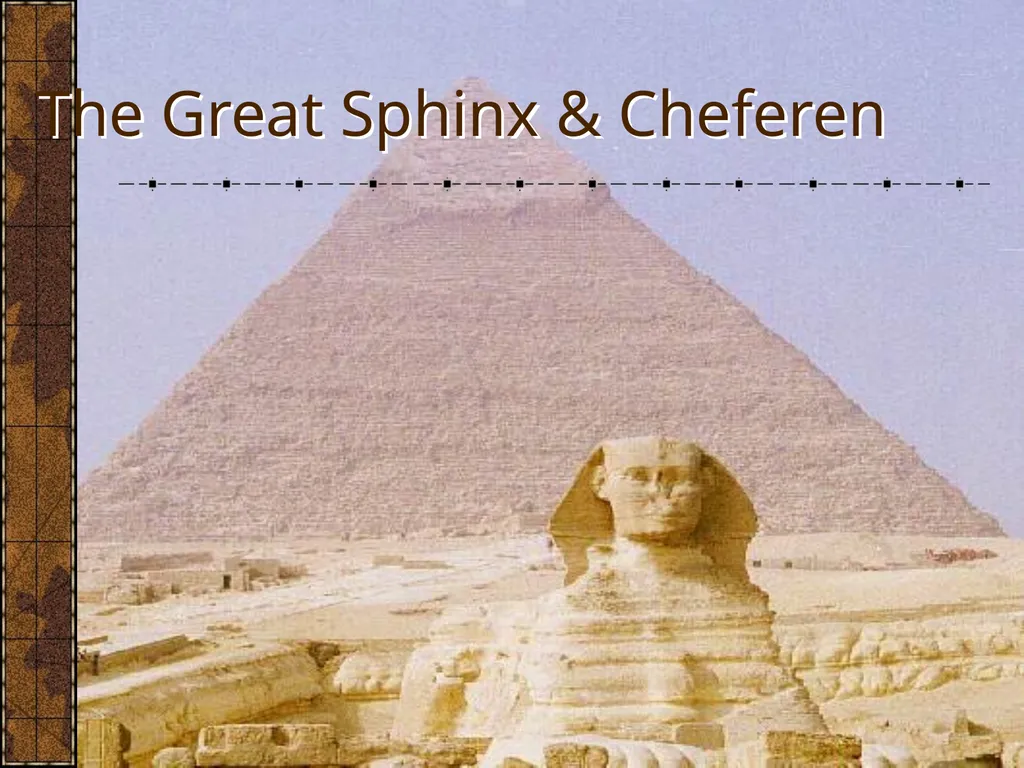
slide48. The Great Sphinx is located on the Giza plateau, about six miles west of Cairo.<br>
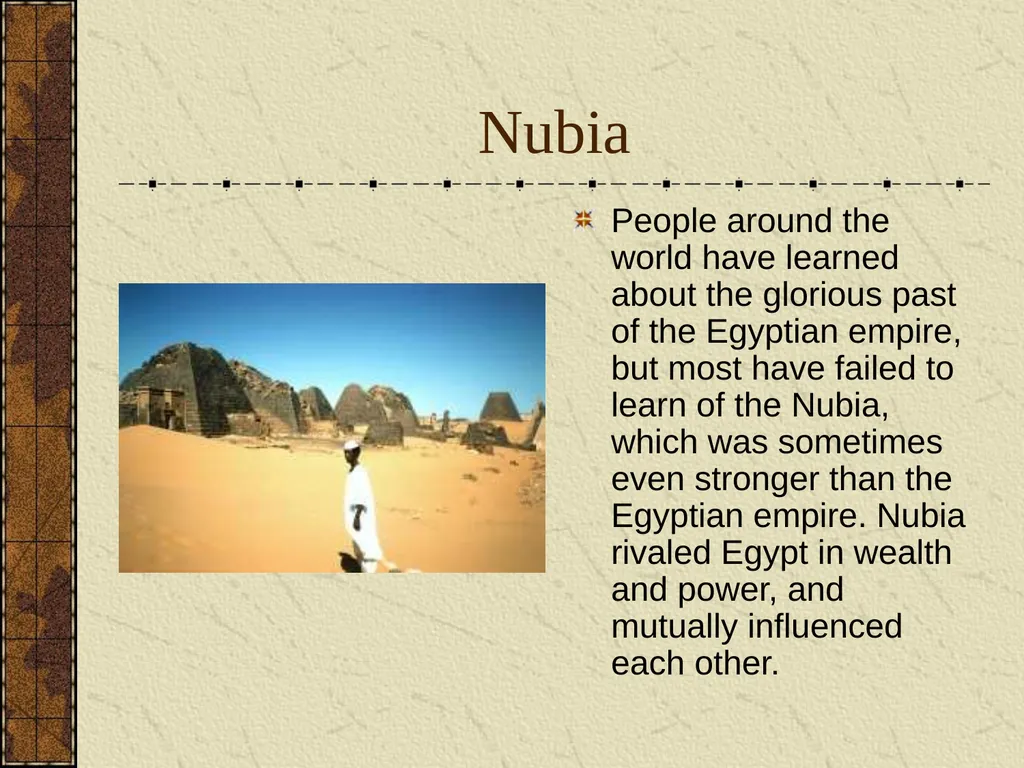
slide49. Nubia People around the world have learned about the glorious past of the Egyptian empire, but most have failed to learn of the Nubia, which was sometimes even stronger than the Egyptian empire. Nubia rivaled Egypt in wealth and power, and mutually influenced each other.<br>
slide50. The Egyptians called them the Kush. The Kush was comparable with Egypt, and both states communicated with each other constantly. Today we do not hear of Nubia nor Kush. In its place is nothern Sudan. With the construction of the Aswan high dam in the 1960s, Nubian land was flooded and that forced some 100,000 Nubians to seek new homes in Egyptian and Sudanese cities. Nubia's glorious past is now under water.<br>
slide51. The Great Sphinx & Cheferen<br>
slide52. Egyptian economy Although Egypt looks really sophisticated, the economy is a traditional economy based on farming and trade.
Egyptians traded up and down the Nile, with Mesopotamians and sometimes with Indus Valley (in Pakistan)<br>
slide53. That concludes Egypt. Any questions before the quiz?<br>
slide54. Egypt Quiz 1.What river is the basis for Egyptian civilization?
2.What “paper” did Egyptians write on?
3. What is an Egyptian ruler called?
4.What writing system did Egyptians use?
5.What other African kingdom did Egypt trade and interact with?
6. What type of economic system did Egypt have?<br>
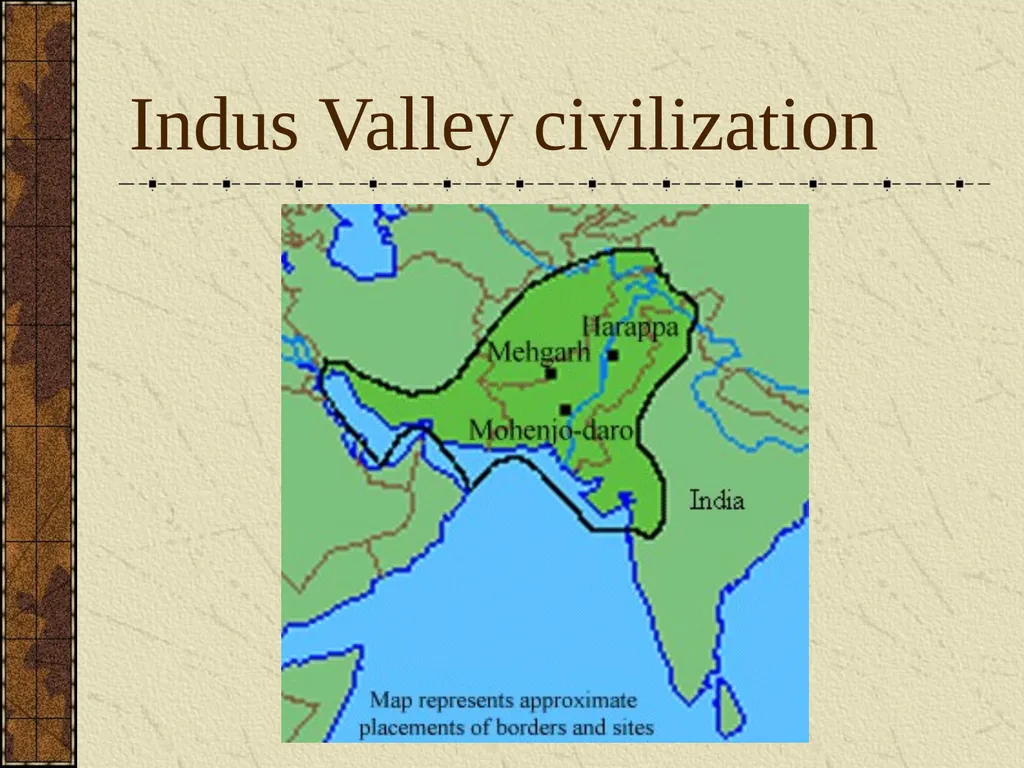
slide55. Indus Valley civilization<br>
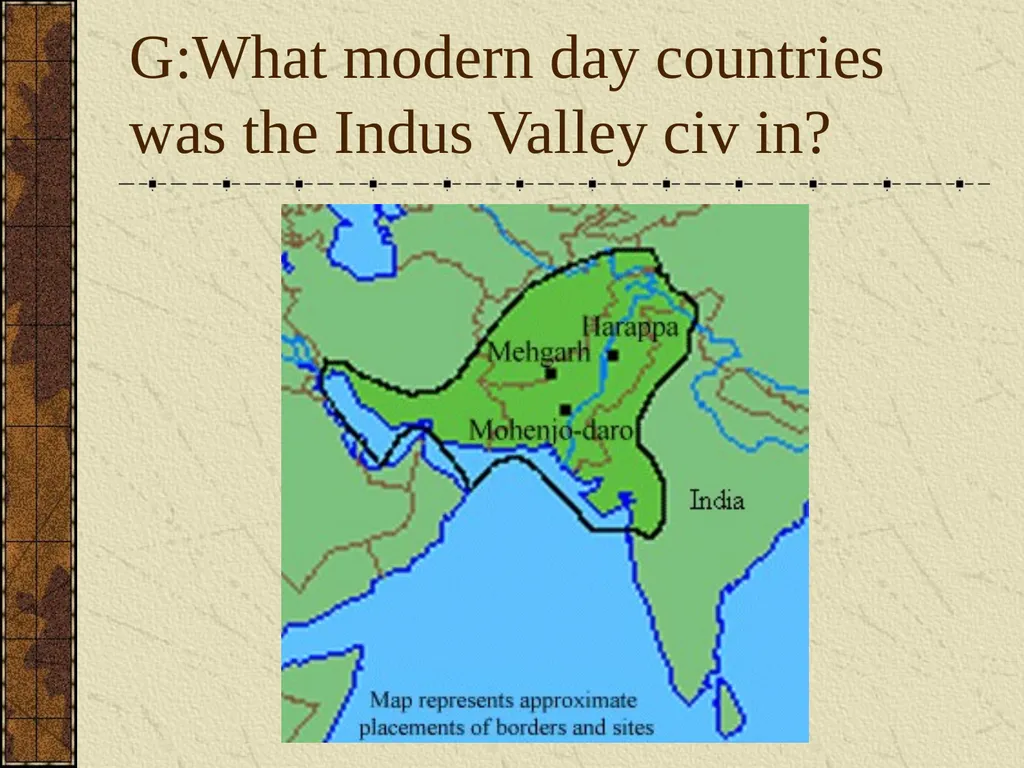
slide56. G:What modern day countries was the Indus Valley civ in?<br>
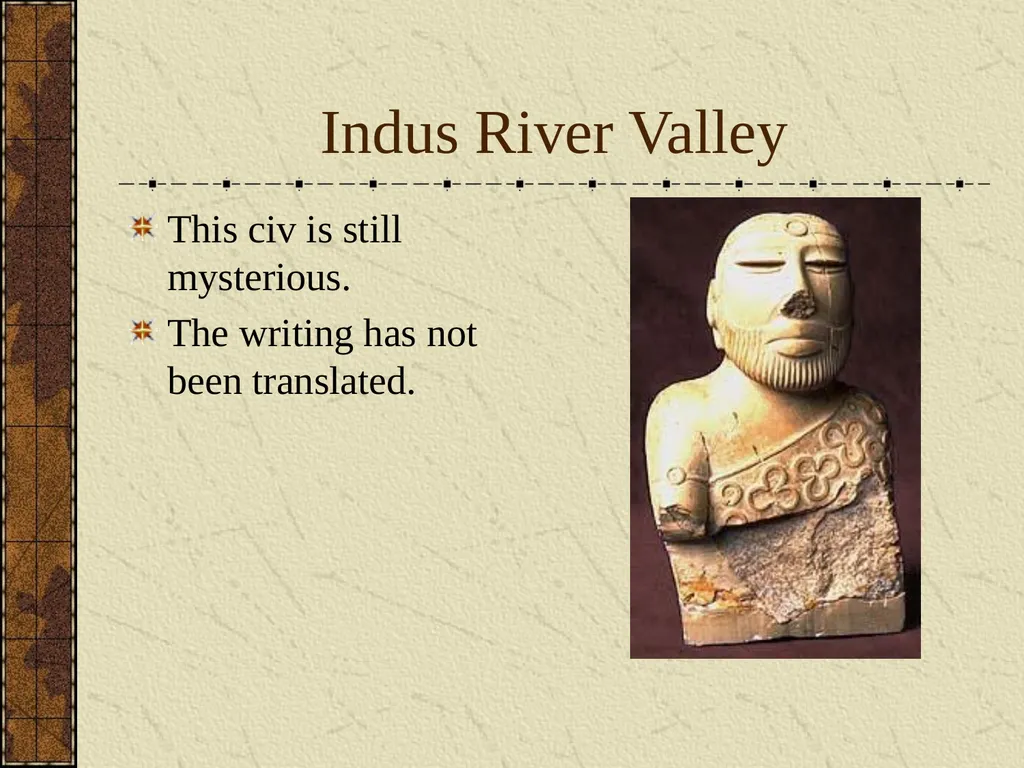
slide57. Indus River Valley This civ is still mysterious.
The writing has not been translated.<br>
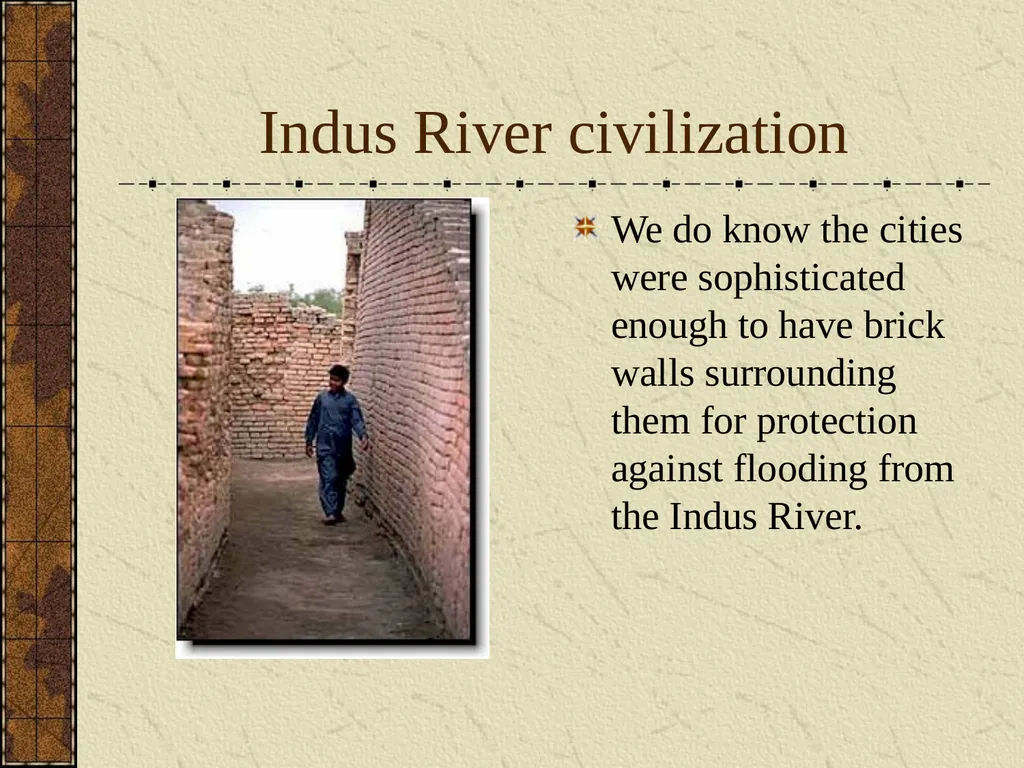
slide58. Indus River civilization We do know the cities were sophisticated enough to have brick walls surrounding them for protection against flooding from the Indus River.<br>
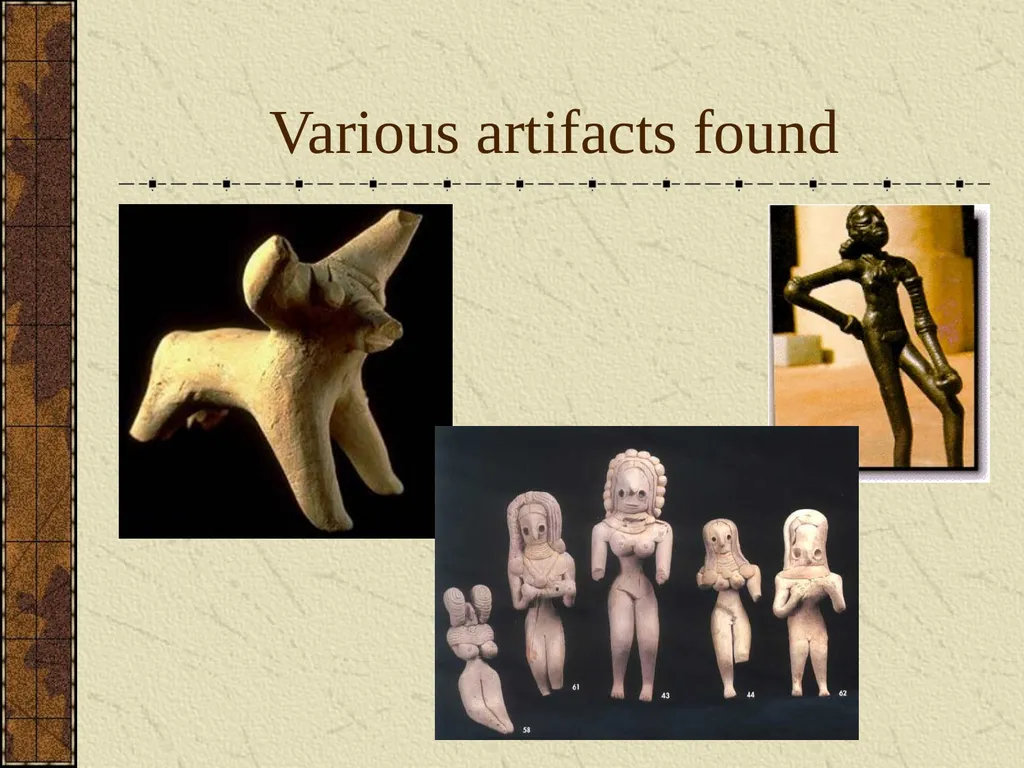
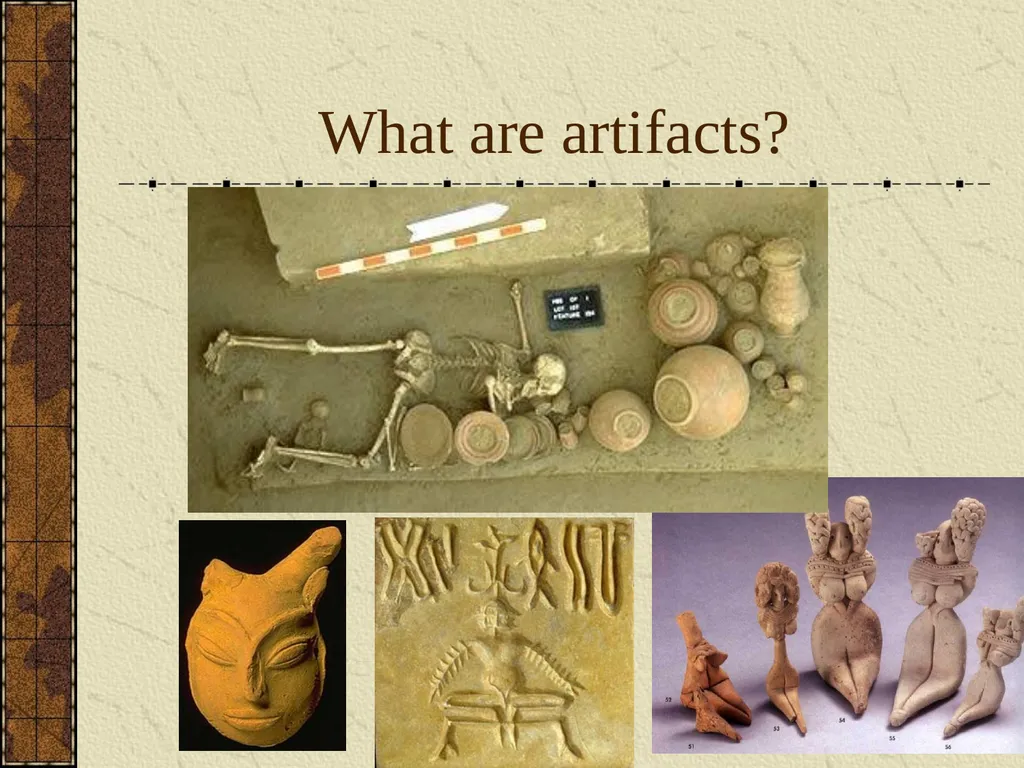
slide59. Various artifacts found<br>
slide60. What are artifacts?<br>
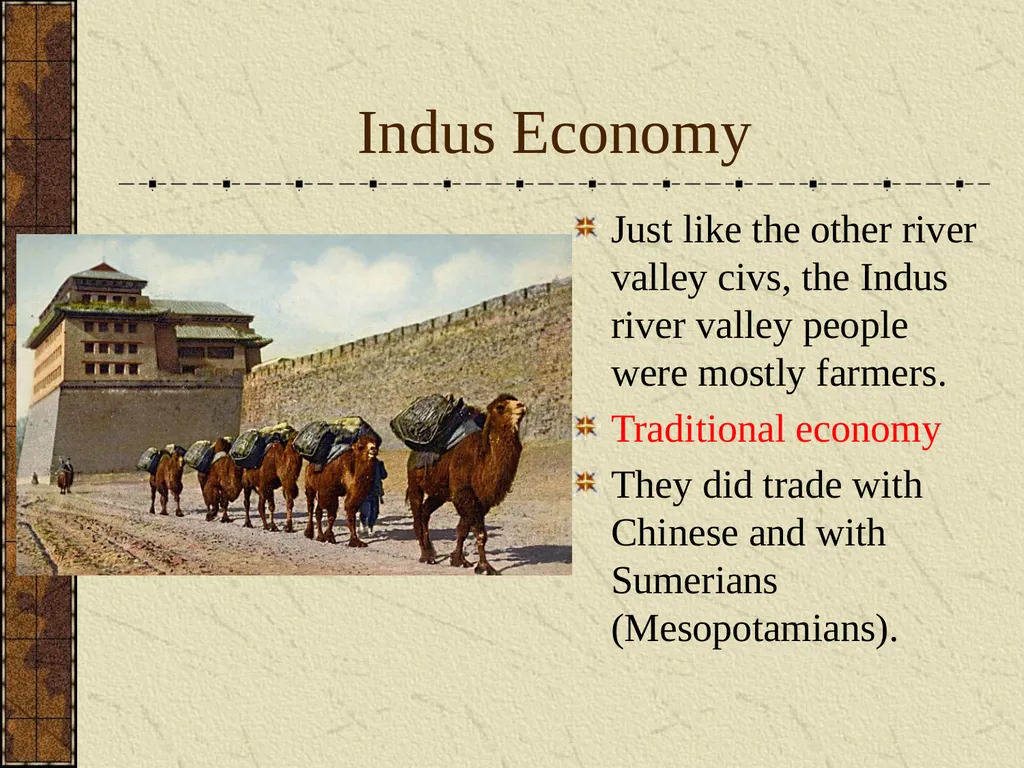
slide61. Indus Economy Just like the other river valley civs, the Indus river valley people were mostly farmers.
Traditional economy
They did trade with Chinese and with Sumerians (Mesopotamians).<br>
slide62. That concludes Indus River Valley Civilization. Get ready for the quiz.<br>
slide63. Indus River Quiz P: Why do we know so little of the power structure in the Indus Valley?
E: How did the Indus make a living?
G:In what modern day country are the settlements of the Indus River Valley civilization?
G:Why did the cities have so many walls?
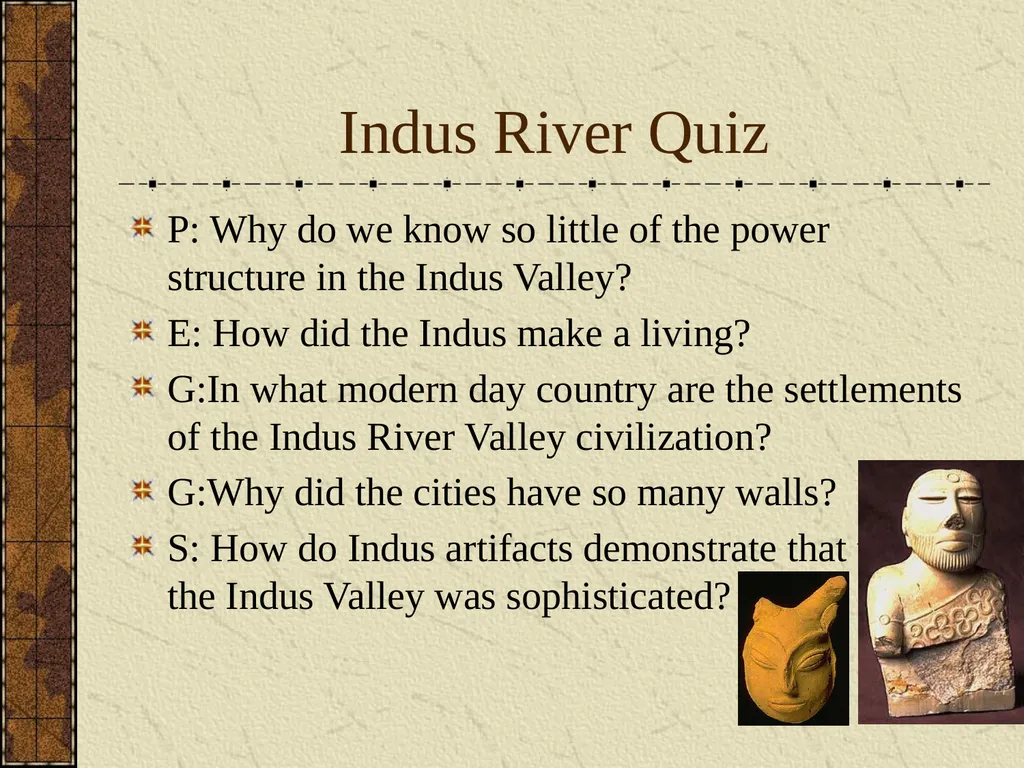
S: How do Indus artifacts demonstrate that the the the Indus Valley was sophisticated?<br>
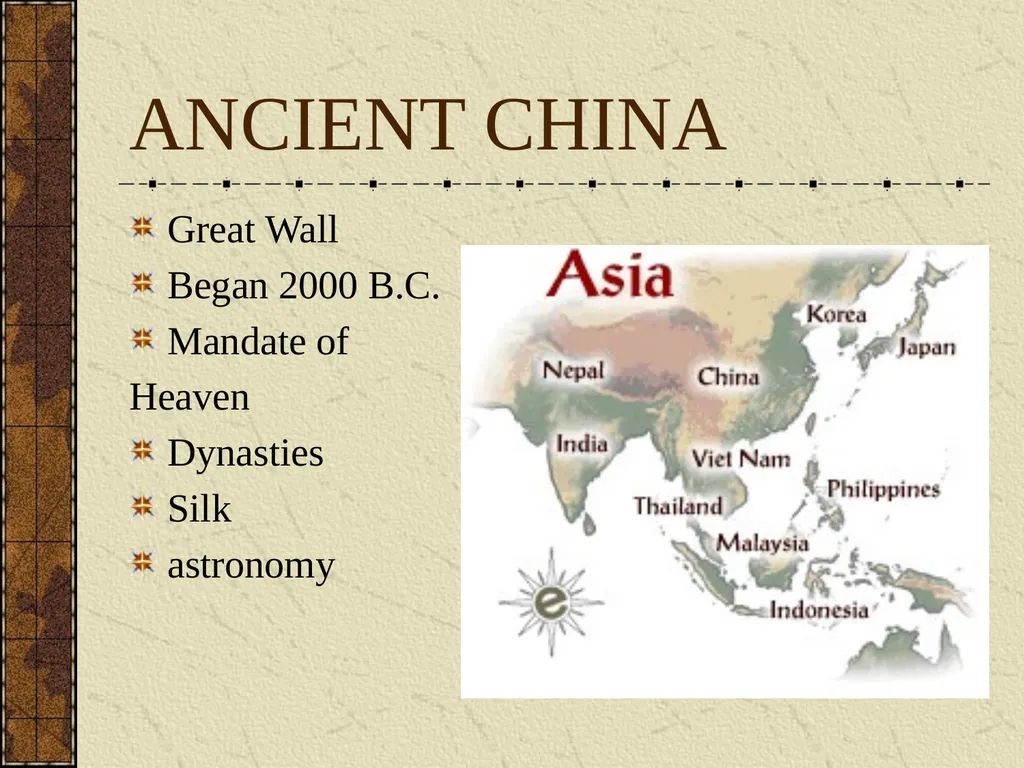
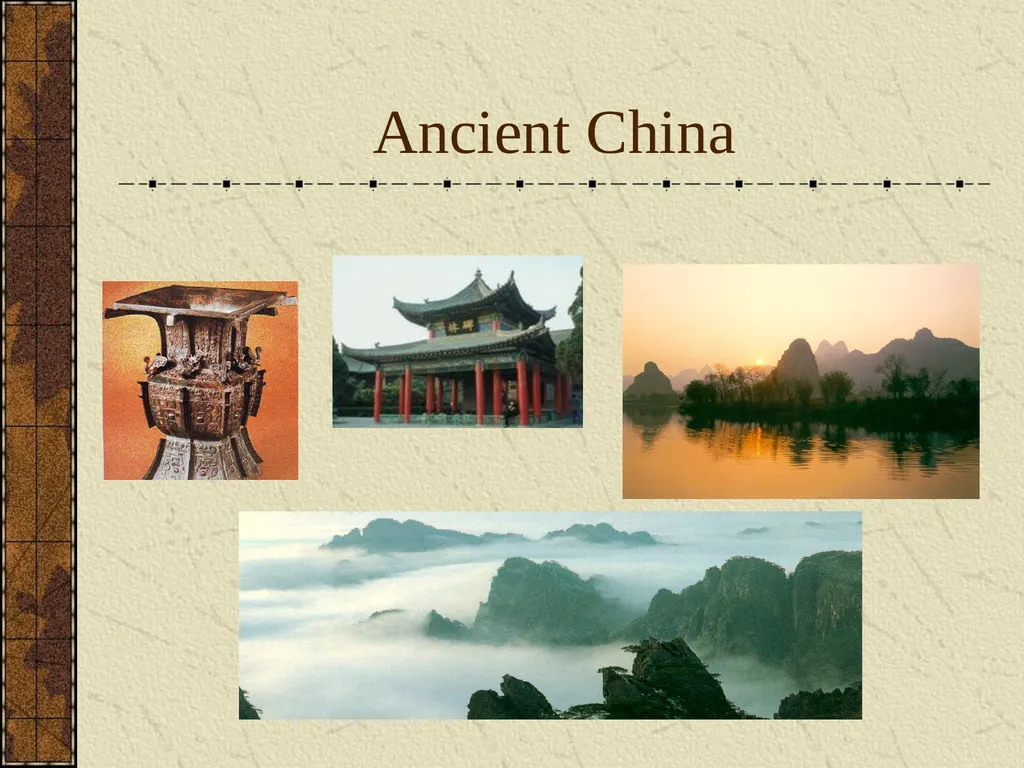
slide64. ANCIENT CHINA Great Wall
Began 2000 B.C.
Mandate of
Heaven
Dynasties
Silk
astronomy<br>
slide65. As in Egypt, Mesopotamia, and along the Indus River, Chinese civilization began within a major river valley. Modern China itself is a huge geographical expanse. Around 4000 BC, this huge area contained an almost infinite number of ethnic groups and languages. This history, in which a vast area populated by diverse ethnic groups became, over time, a more or less single culture, began in the Yellow River Valley.<br>
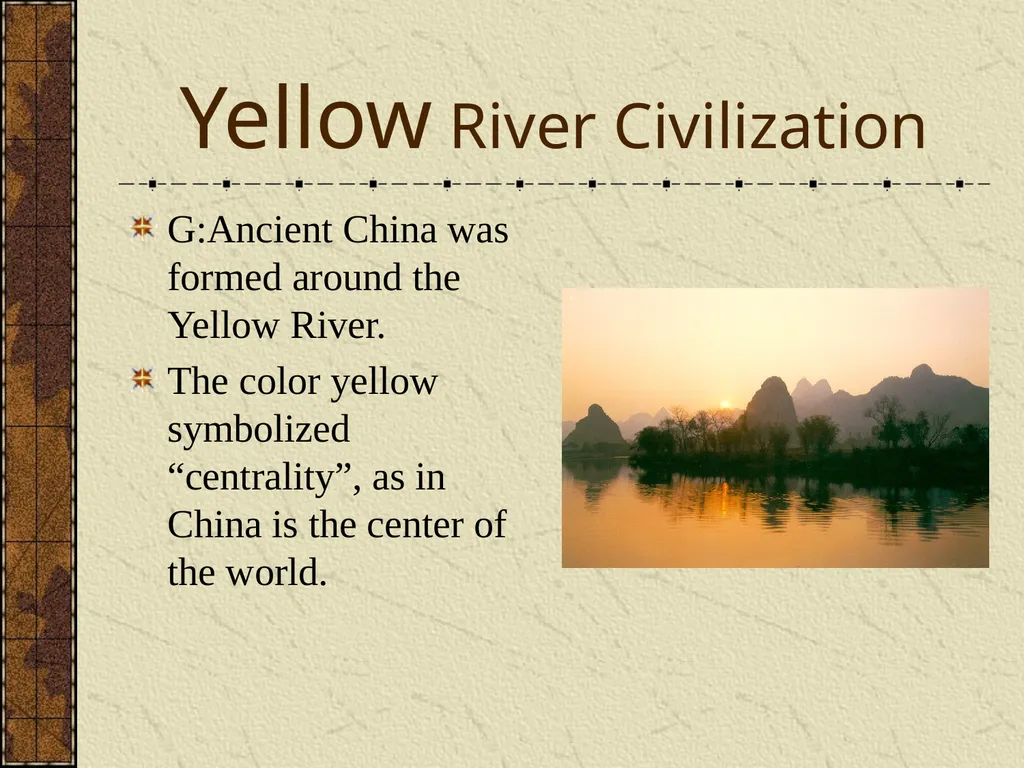
slide66. Yellow River Civilization G:Ancient China was formed around the Yellow River.
The color yellow symbolized “centrality”, as in China is the center of the world.<br>
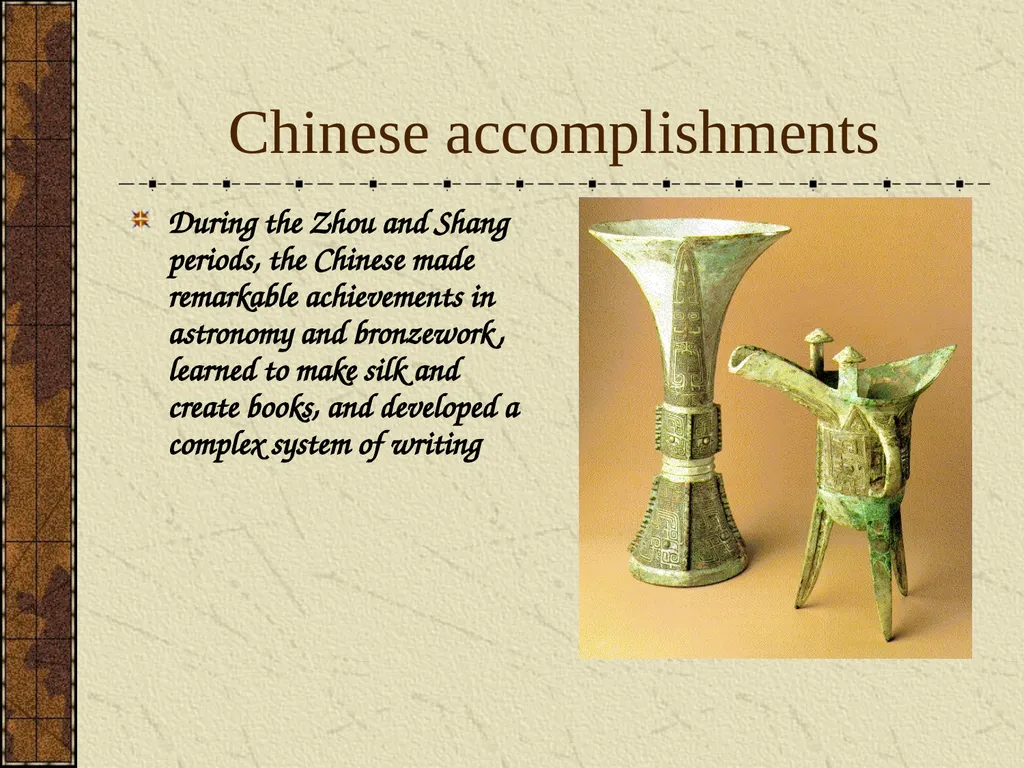
slide67. Chinese accomplishments During the Zhou and Shang periods, the Chinese made remarkable achievements in astronomy and bronzework, learned to make silk and create books, and developed a complex system of writing<br>
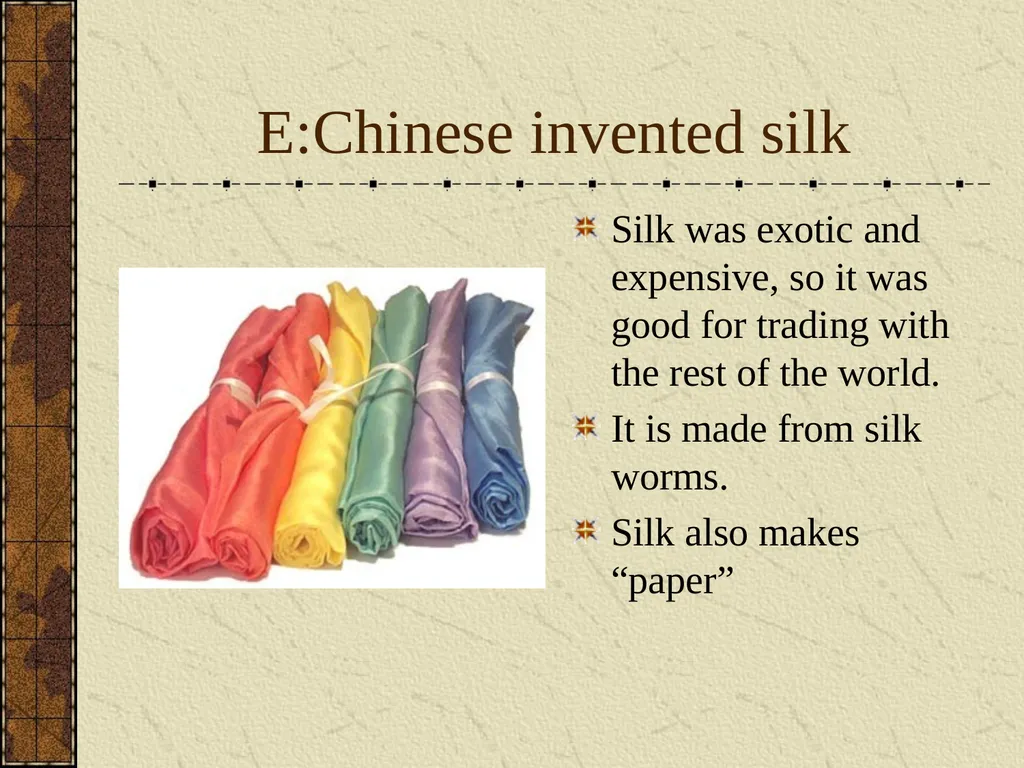
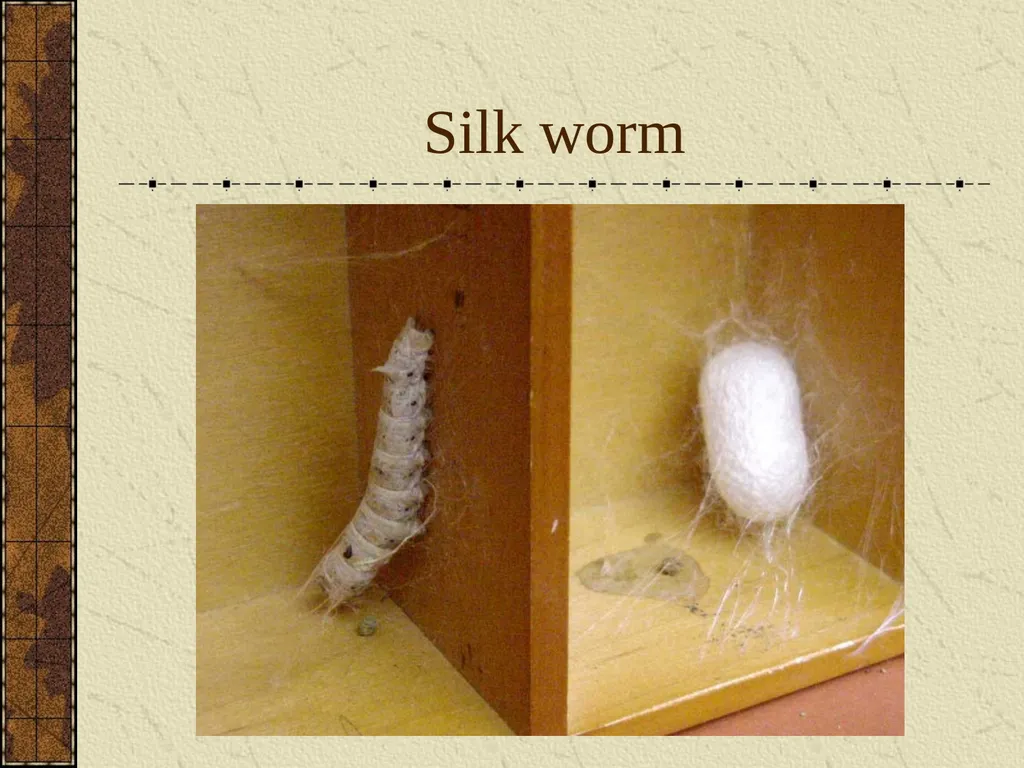
slide68. E:Chinese invented silk Silk was exotic and expensive, so it was good for trading with the rest of the world.
It is made from silk worms.
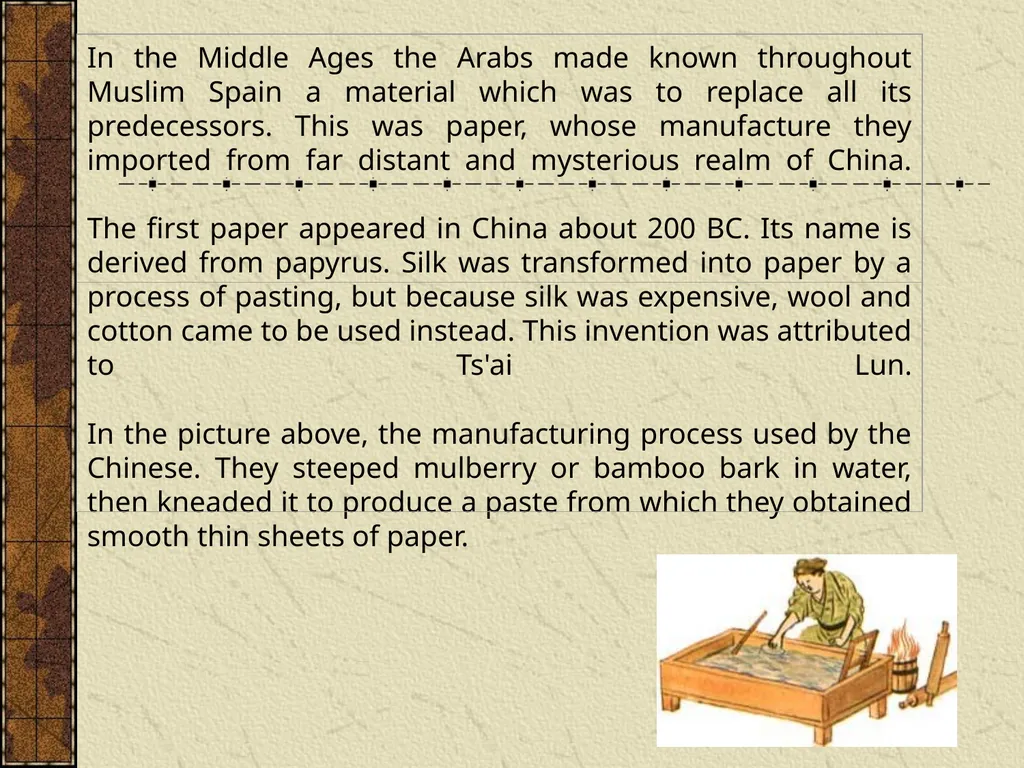
Silk also makes “paper”<br>
slide69. Silk worm<br>
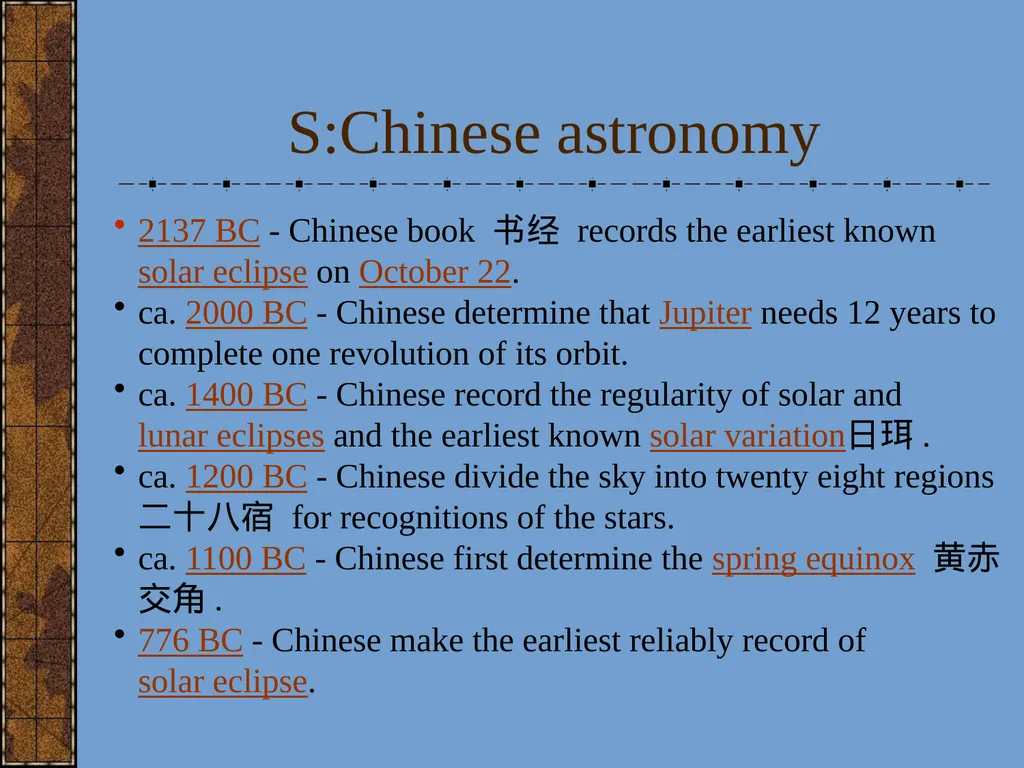
slide70. S:Chinese astronomy 2137 BC - Chinese book 书经 records the earliest known solar eclipse on October 22.
ca. 2000 BC - Chinese determine that Jupiter needs 12 years to complete one revolution of its orbit.
ca. 1400 BC - Chinese record the regularity of solar and lunar eclipses and the earliest known solar variation日珥.
ca. 1200 BC - Chinese divide the sky into twenty eight regions 二十八宿 for recognitions of the stars.
ca. 1100 BC - Chinese first determine the spring equinox 黄赤交角.
776 BC - Chinese make the earliest reliably record of solar eclipse.<br>
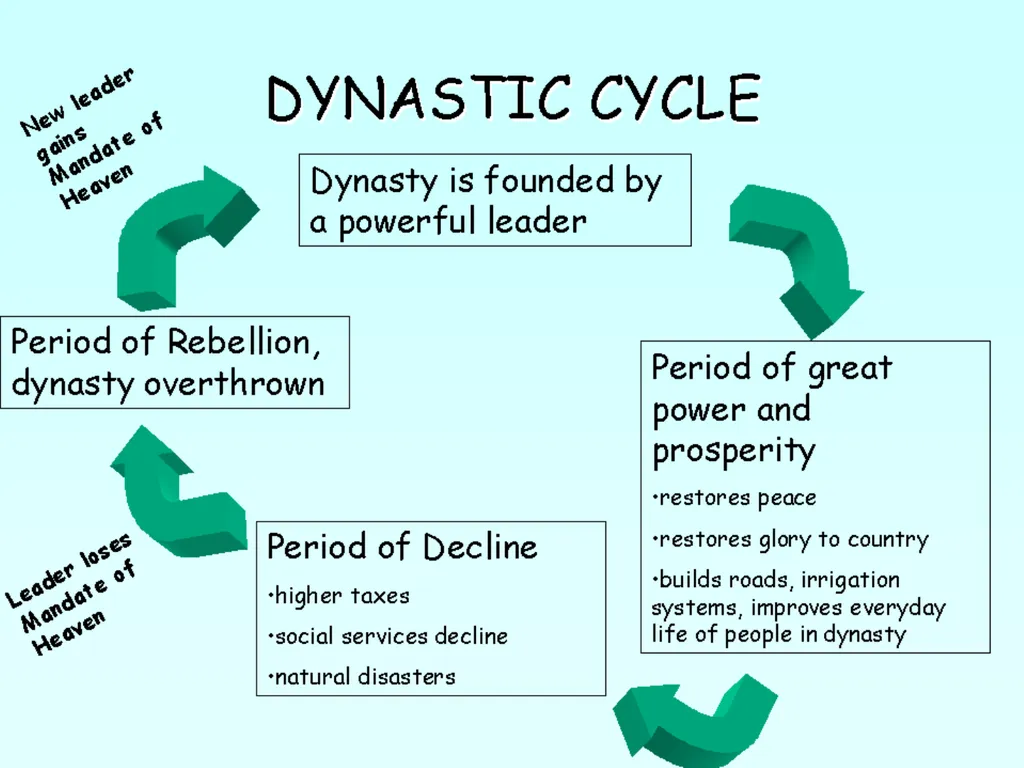
slide72. According to Chinese political theory, every dynasty goes through the so-called dynastic cycle:
A new ruler unites China and founds a new dynasty.
China, under the new dynasty, achieves prosperity and a new golden age.
The royal family of the dynasty begins to decay, corruption becomes rampant in the imperial court, and the empire begins to enter decline and instability.
The dynasty loses the Mandate of Heaven, their legitimacy to rule, and is overthrown by a rebellion. The Mandate of Heaven is then passed to the next dynasty<br>
slide74. Ancient China<br>
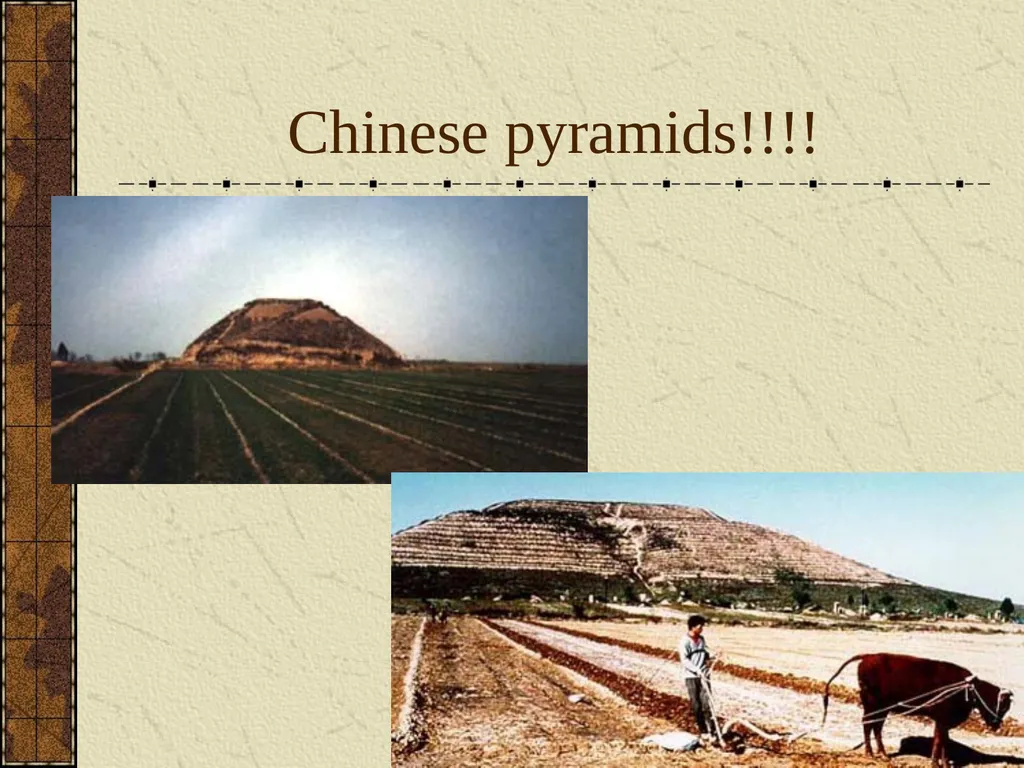
slide75. Chinese pyramids!!!!<br>
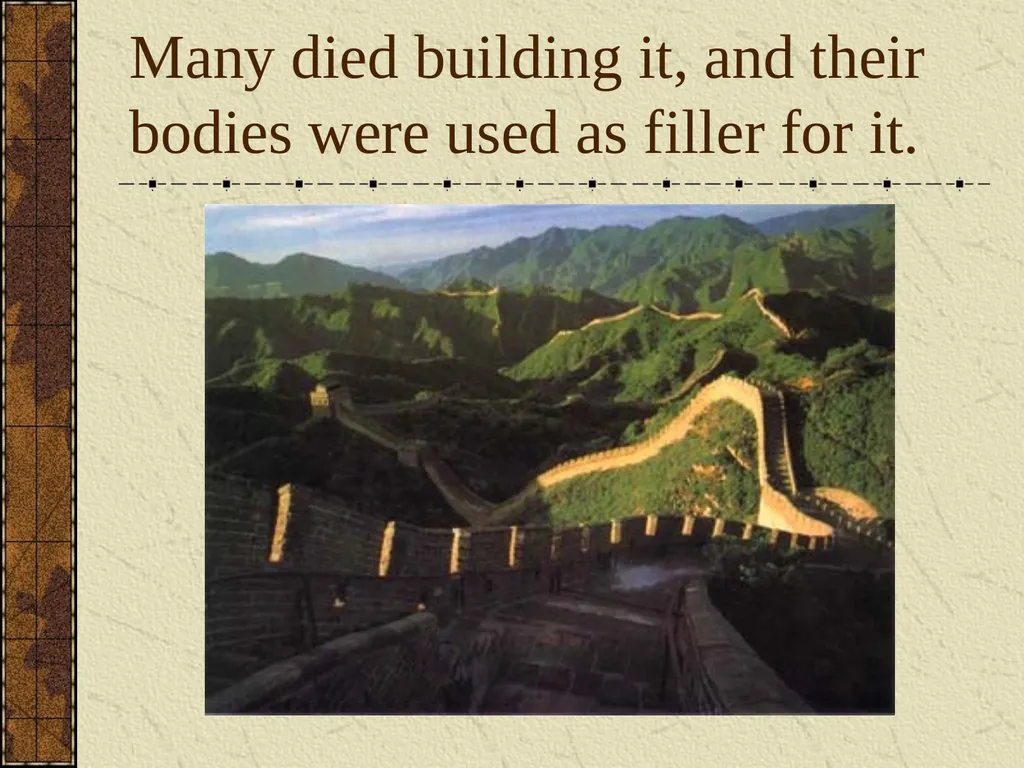
slide76. The Great Wall of China was built to keep the Mongols out.<br>
slide77. Many died building it, and their bodies were used as filler for it.<br>
slide78. That concludes China. Any questions before we take the quiz?<br>
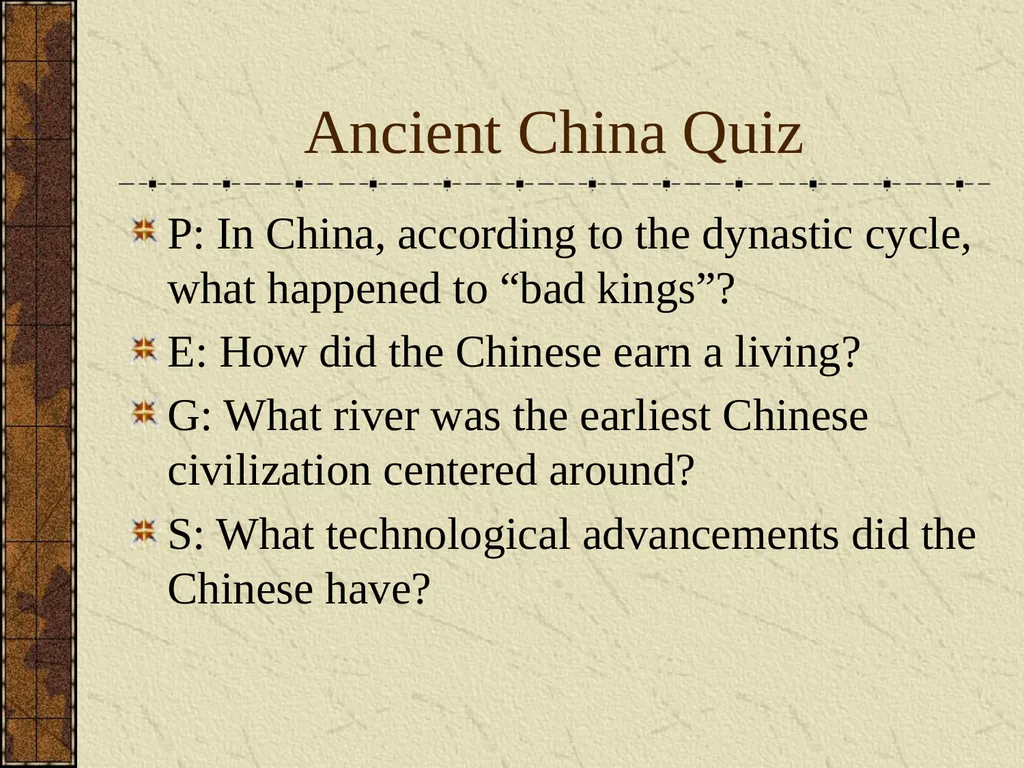
slide79. Ancient China Quiz P: In China, according to the dynastic cycle, what happened to “bad kings”?
E: How did the Chinese earn a living?
G: What river was the earliest Chinese civilization centered around?
S: What technological advancements did the Chinese have?<br>
slide80. This powerpoint was kindly donated to www.worldofteaching.com
http://www.worldofteaching.com is home to over a thousand powerpoints submitted by teachers. This is a completely free site and requires no registration. Please visit and I hope it will help in your teaching.<br>
slide2. ANCIENT MESOPOTAMIA Oldest known civilization
Cradle of Human Civilization
Old Testament
Nebuchadnezzar
Ziggurat (right)
Hanging gardens<br>
slide3. Geography This civ rose in the valleys between the Tigris and Euphrates rivers.
Some say this Fertile Crescent was the real Garden of Eden.<br>
slide4. In what modern day country was the Fertile Crescent?<br>
slide6. Ur, the capital city of Mesopotamia<br>
slide7. Political:What was the earliest kingdom in Mesopotamia? The second?<br>
slide8. Timeline Sumerian 3,500 BC – 2,300 BC
Akkadian 2,300 BC – 1,900 BC
Babylonian 1,900 BC – 1,300 BC
Assyrian 1,300 BC – 612 BC
http://www.timelines.info/history/empires_and_civilizations/ancient_civilisations/ Mesopotamia was ruled by four different empires<br>
slide9. Social This is cuneiform.
Babylonians wrote using this “wedge-shaped” writing on clay tablets.
The Sumerians invented writing.<br>
slide10. More cuneiform writing<br>
slide11. 3200 BCE 3000 BCE 2400 BCE 1000BCE<br>
slide13. Gilgamesh Epic Tablet: Flood Story<br>
slide14. More ziggurats<br>
slide15. Ziggurat at Ur Temple
“Mountain of the Gods”<br>
slide17. Hanging gardens of Babylonia<br>
slide19. Another painting of the hanging gardens with Tower of Babel in back<br>
slide20. Economic: trade and farming Sumerians (Mesopotamians) were known to trade with the Egyptians and the Indus Valley civilizations.
In later years, these trade routes became Silk Road.<br>
slide21. Mesopotamian Trade “The Cuneiform World”<br>
slide22. Sumerians invented the wheel! The wheel was invented by 6000 BC!
It helped military, farming and trade.
At right, this is made of wood.<br>
slide23. Sargon of Akkad: The World’s First Empire [Akkadians]<br>
slide24. The Babylonian Empires<br>
slide25. Political:Mesopotamian Law Code of Hammurabi
“eye for an eye tooth for a tooth”<br>
slide26. Hammurabi’s [r. 1792-1750 B. C. E.] Code<br>
slide27. Hammurabi, the Judge<br>
slide28. Babylonian Numbers<br>
slide29. That concludes Mesopotamia. Any questions before the quiz?<br>
slide30. Mesopotamia Quiz Political:What law system did Sumerians use? Hint: It can be summed: eye for eye; tooth for tooth.
Economic: How did Mesopotamians earn a living?
Geography:Between what 2 rivers did the Fertile Crescent appear?
Social:What type of writing did they use?<br>
slide31. ANCIENT EGYPT Nile River
Mummies
Pharaohs
Rameses
King Tutankhamen
Hieroglyphics<br>
slide32. Egyptian civilization Egyptian civilization arose a bit after Mesopotamia.
Geography: It was centered around the Nile River.<br>
slide33. The Nile River<br>
slide34. Egyptian Timeline Old Kingdom (2700-2150)
Hieroglyphics and religion develop in Egypt
pyramids built
Middle Kingdom (2040-1786)
extension of Egyptian control into Nubia
New Kingdom (1570-1075)
militaristic - Hebrews enslaved
mummification perfected<br>
slide35. Pyramids These are the Giza pyramids, the most famous.
Pyramids were tombs for the kings.
These were built in 3500 B.C.E.
How old are they?<br>
slide37. Ahmose I leading Egyptians against the Hyksos<br>
slide38. Political:Egyptian Pharaohs Egyptians were led by Pharaohs.
They were priest-kings
King Tut is the most famous
Using computers, this image was reconstructed using his remains<br>
slide39. Tutankhamun<br>
slide40. Tutankhamun on the throne<br>
slide41. Abu Simbel was built by Ramseses II<br>
slide42. Mummies Egyptians who could afford to do so would have themselves mummified.
They believed in a better afterlife if their body was preserved.<br>
slide43. The Egyptians took out all of the internal organs, except the heart. When they removed them the organs were put in canopic jars, that were put in the tomb with the mummy. They did not take out the heart because it was believed to be the intelligence and emotion of the person. The Egyptians thought the brain had no significant value, so they took it out through the nose. The body was packed and covered with natron (a salty drying agent). After this the body was left for 40-50 days.<br>
slide44. Mummies<br>
slide45. Egyptians wrote in hieroglyphics<br>
slide46. Hieroglyphics<br>
slide47. What did Egyptians write on? Ancient Egyptians used papyrus, a substance derived from the plant of the same name<br>
slide48. The Great Sphinx is located on the Giza plateau, about six miles west of Cairo.<br>
slide49. Nubia People around the world have learned about the glorious past of the Egyptian empire, but most have failed to learn of the Nubia, which was sometimes even stronger than the Egyptian empire. Nubia rivaled Egypt in wealth and power, and mutually influenced each other.<br>
slide50. The Egyptians called them the Kush. The Kush was comparable with Egypt, and both states communicated with each other constantly. Today we do not hear of Nubia nor Kush. In its place is nothern Sudan. With the construction of the Aswan high dam in the 1960s, Nubian land was flooded and that forced some 100,000 Nubians to seek new homes in Egyptian and Sudanese cities. Nubia's glorious past is now under water.<br>
slide51. The Great Sphinx & Cheferen<br>
slide52. Egyptian economy Although Egypt looks really sophisticated, the economy is a traditional economy based on farming and trade.
Egyptians traded up and down the Nile, with Mesopotamians and sometimes with Indus Valley (in Pakistan)<br>
slide53. That concludes Egypt. Any questions before the quiz?<br>
slide54. Egypt Quiz 1.What river is the basis for Egyptian civilization?
2.What “paper” did Egyptians write on?
3. What is an Egyptian ruler called?
4.What writing system did Egyptians use?
5.What other African kingdom did Egypt trade and interact with?
6. What type of economic system did Egypt have?<br>
slide55. Indus Valley civilization<br>
slide56. G:What modern day countries was the Indus Valley civ in?<br>
slide57. Indus River Valley This civ is still mysterious.
The writing has not been translated.<br>
slide58. Indus River civilization We do know the cities were sophisticated enough to have brick walls surrounding them for protection against flooding from the Indus River.<br>
slide59. Various artifacts found<br>
slide60. What are artifacts?<br>
slide61. Indus Economy Just like the other river valley civs, the Indus river valley people were mostly farmers.
Traditional economy
They did trade with Chinese and with Sumerians (Mesopotamians).<br>
slide62. That concludes Indus River Valley Civilization. Get ready for the quiz.<br>
slide63. Indus River Quiz P: Why do we know so little of the power structure in the Indus Valley?
E: How did the Indus make a living?
G:In what modern day country are the settlements of the Indus River Valley civilization?
G:Why did the cities have so many walls?
S: How do Indus artifacts demonstrate that the the the Indus Valley was sophisticated?<br>
slide64. ANCIENT CHINA Great Wall
Began 2000 B.C.
Mandate of
Heaven
Dynasties
Silk
astronomy<br>
slide65. As in Egypt, Mesopotamia, and along the Indus River, Chinese civilization began within a major river valley. Modern China itself is a huge geographical expanse. Around 4000 BC, this huge area contained an almost infinite number of ethnic groups and languages. This history, in which a vast area populated by diverse ethnic groups became, over time, a more or less single culture, began in the Yellow River Valley.<br>
slide66. Yellow River Civilization G:Ancient China was formed around the Yellow River.
The color yellow symbolized “centrality”, as in China is the center of the world.<br>
slide67. Chinese accomplishments During the Zhou and Shang periods, the Chinese made remarkable achievements in astronomy and bronzework, learned to make silk and create books, and developed a complex system of writing<br>
slide68. E:Chinese invented silk Silk was exotic and expensive, so it was good for trading with the rest of the world.
It is made from silk worms.
Silk also makes “paper”<br>
slide69. Silk worm<br>
slide70. S:Chinese astronomy 2137 BC - Chinese book 书经 records the earliest known solar eclipse on October 22.
ca. 2000 BC - Chinese determine that Jupiter needs 12 years to complete one revolution of its orbit.
ca. 1400 BC - Chinese record the regularity of solar and lunar eclipses and the earliest known solar variation日珥.
ca. 1200 BC - Chinese divide the sky into twenty eight regions 二十八宿 for recognitions of the stars.
ca. 1100 BC - Chinese first determine the spring equinox 黄赤交角.
776 BC - Chinese make the earliest reliably record of solar eclipse.<br>
slide72. According to Chinese political theory, every dynasty goes through the so-called dynastic cycle:
A new ruler unites China and founds a new dynasty.
China, under the new dynasty, achieves prosperity and a new golden age.
The royal family of the dynasty begins to decay, corruption becomes rampant in the imperial court, and the empire begins to enter decline and instability.
The dynasty loses the Mandate of Heaven, their legitimacy to rule, and is overthrown by a rebellion. The Mandate of Heaven is then passed to the next dynasty<br>
slide74. Ancient China<br>
slide75. Chinese pyramids!!!!<br>
slide76. The Great Wall of China was built to keep the Mongols out.<br>
slide77. Many died building it, and their bodies were used as filler for it.<br>
slide78. That concludes China. Any questions before we take the quiz?<br>
slide79. Ancient China Quiz P: In China, according to the dynastic cycle, what happened to “bad kings”?
E: How did the Chinese earn a living?
G: What river was the earliest Chinese civilization centered around?
S: What technological advancements did the Chinese have?<br>
slide80. This powerpoint was kindly donated to www.worldofteaching.com
http://www.worldofteaching.com is home to over a thousand powerpoints submitted by teachers. This is a completely free site and requires no registration. Please visit and I hope it will help in your teaching.<br>