
and Going Forward …. Yash Dhadda | Chartered
YM
Published · 112 slides · 0 views

1 / 1





Description
and Going Forward . Yash Dhadda Chartered Accountant Jaipur Overview of GSTAT Recent GST Case Laws 1 YaSh Dhadda GST- A New Animal Waiting to Pounce? When I saw the GST Bill, it is mind-boggling constitutional complexity. It is
Related Topics
Share
Embed code
Download this presentation From Below
"and Going Forward …. Yash Dhadda | Chartered" is the property of its rightful owner. Permission is granted to download and print the materials on this website for personal, non-commercial use only, and to display it on your personal computer provided you do not modify the materials and that you retain all copyright notices contained in the materials. By downloading content from our website, you accept the terms of this agreement.
Presentation Transcript
01
and Going Forward …. Yash Dhadda | Chartered Accountant | Jaipur Overview of GSTAT & Recent GST Case Laws 1 © YaSh Dhadda<br>
02
GST- A New Animal Waiting to Pounce? “When I saw the GST Bill, it is mind-boggling constitutional complexity. It is neither the exclusive list nor the concurrent list; it’s a fourth dimensional animal. It is post Einstenian Physics. Heisenberg’s uncertainty of quantum mechanics is elementary compared to the complexity of this. Even the political complexity of States and Union coming together on a continual basis to ratchet the policy of GST is a huge challenge. It is an economical challenge, it is a political challenge, policy challenge, an administrative challenge. It is an adjudication challenge. So that is the next animal waiting to pounce on you. But we have to fight, we have to survive.”
Source
Shri Goda Raghuram
CESTAT President, while inaugurating the Hyderabad bench of CESTAT © Yash Dhadda 2<br>
Source
Shri Goda Raghuram
CESTAT President, while inaugurating the Hyderabad bench of CESTAT © Yash Dhadda 2<br>
03
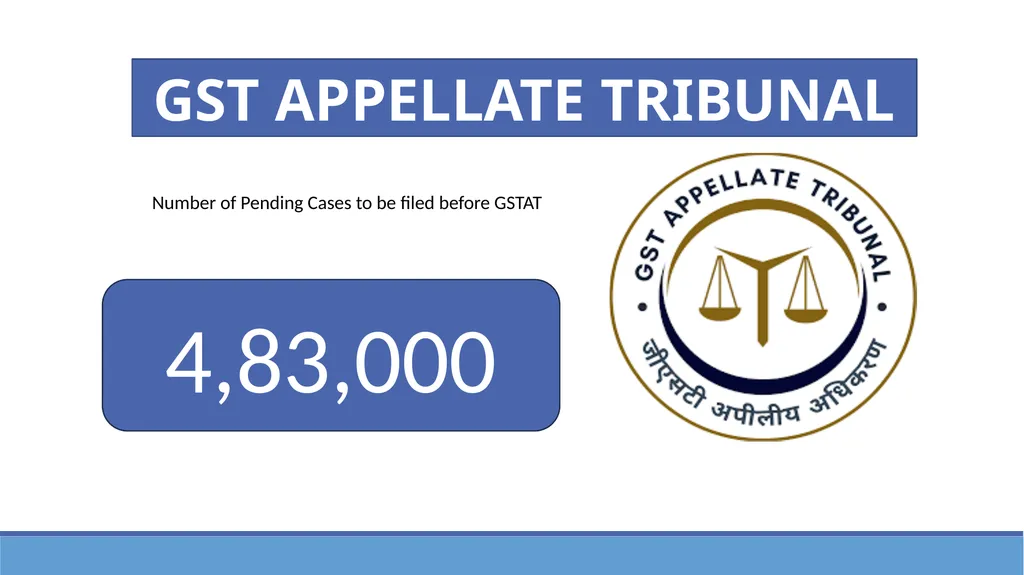
GST APPELLATE TRIBUNAL 4,83,000 Number of Pending Cases to be filed before GSTAT<br>
04
Why Has the GST Appellate Tribunal Been Delayed? Madras Revenue Bar Association challenged the validity of Section 109 of the CGST Act before the Hon’ble Madras High Court by way of a writ petition in W.P. Nos. 21147-21148 & 14919 of 2018 and W.M.P. Nos. 24826-24827 & 17635-17636 of 2018.
In case of BHARATIYA VITTA SALAHKAR SAMITI & ANR. Vs. UNION OF INDIA & ORS. W.P.(C) 6900/2018, the Hon’ble Delhi High Court stayed the constitution of the Tribunal. The writ was subsequently withdrawn.
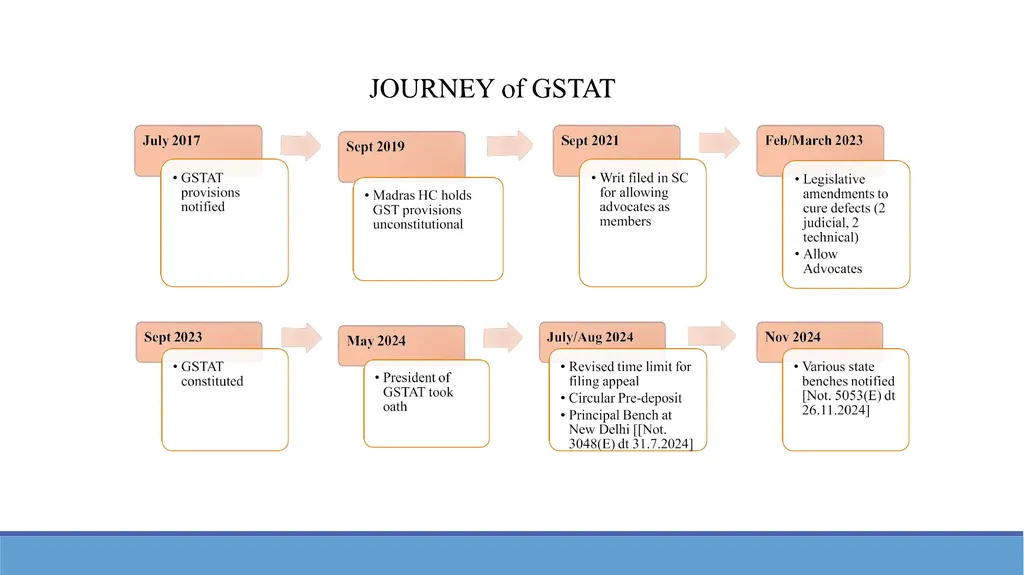
Amendments to Section 109 and Section 110 of the CGST Act were brought into effect from 1 August 2023.<br>
05
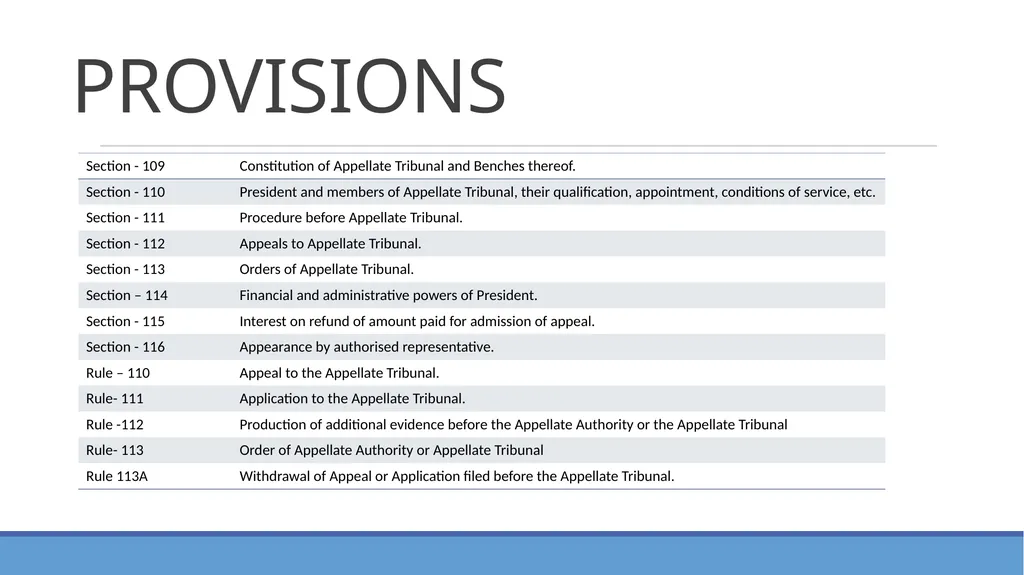
PROVISIONS<br>
06
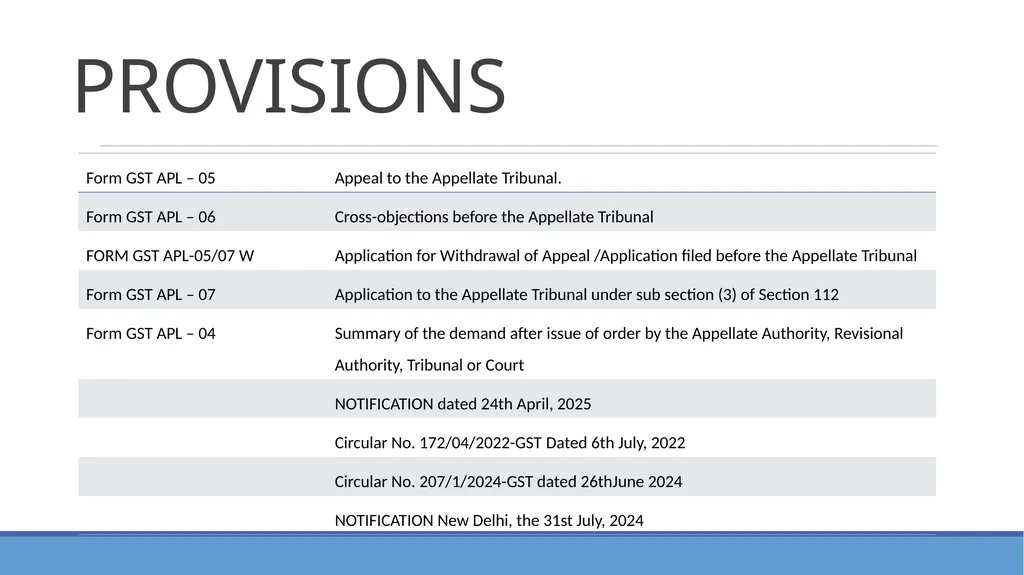
PROVISIONS<br>
07
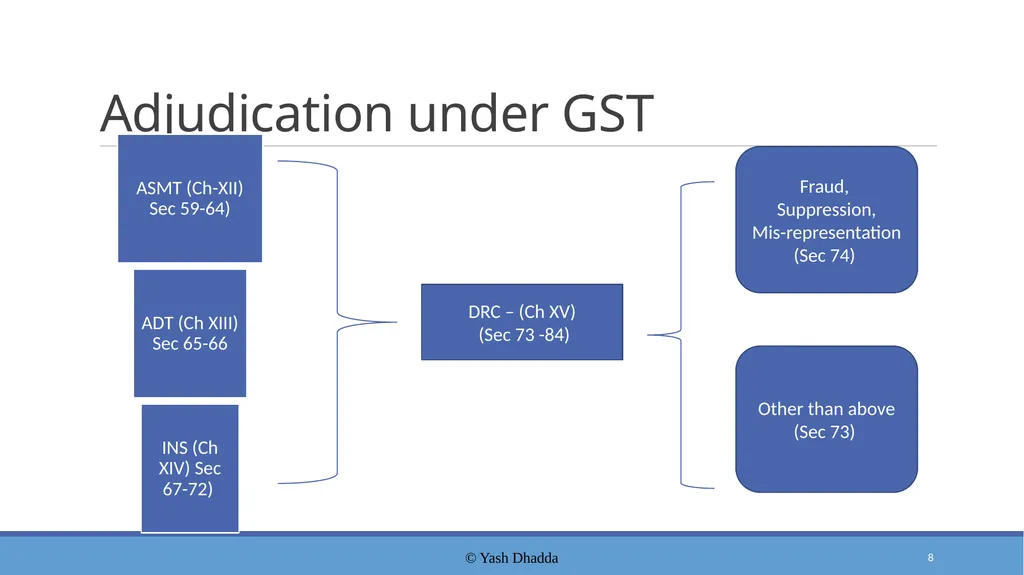
Adjudication under GST © Yash Dhadda 8 DRC – (Ch XV)
(Sec 73 -84) Fraud,
Suppression,
Mis-representation
(Sec 74) Other than above
(Sec 73)<br>
(Sec 73 -84) Fraud,
Suppression,
Mis-representation
(Sec 74) Other than above
(Sec 73)<br>
08
Adjudicating Authority
Section 2(4) Appellate Authority
Section 107 Supreme Court
Section 118 High Court
Section 117 Special Cases Writ Jurisdiction Violation of Principal of Natural Justice
Threat to Fundamental Right
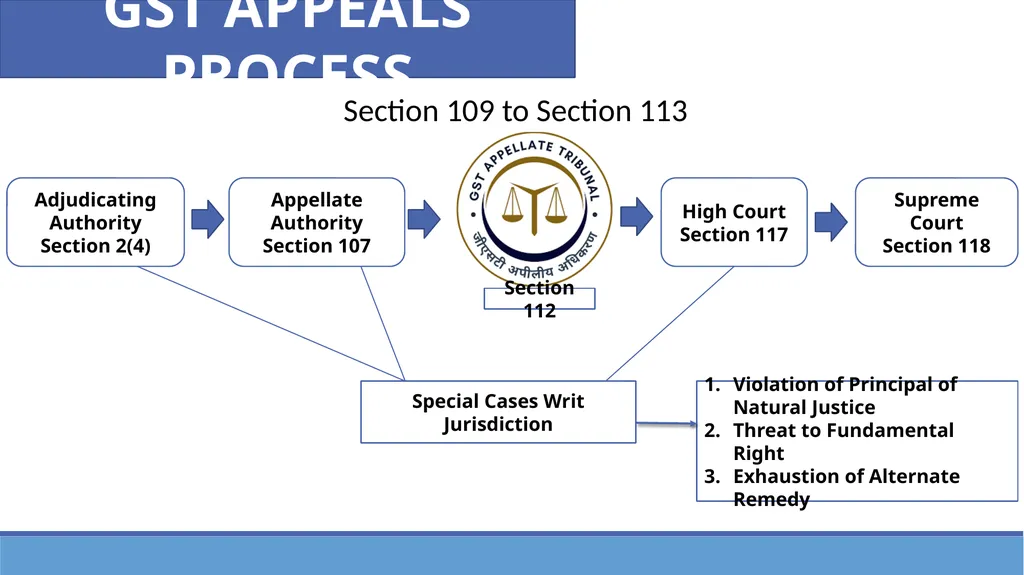
Exhaustion of Alternate Remedy Section 109 to Section 113 GST APPEALS PROCESS Section 112<br>
Section 2(4) Appellate Authority
Section 107 Supreme Court
Section 118 High Court
Section 117 Special Cases Writ Jurisdiction Violation of Principal of Natural Justice
Threat to Fundamental Right
Exhaustion of Alternate Remedy Section 109 to Section 113 GST APPEALS PROCESS Section 112<br>
09
STRUCTURE OF THE TRIBUNAL<br>
10
GST APPELLATE TRIBUNAL – SECTION 109 Composition of the GST Appellate Tribunal Principal Bench (Located at New Delhi):
Tribunal is headed by the President
Members:
President
1 Judicial Member
1 Technical Member (Centre)
1 Technical Member (State)
Following matters can be heard by Principal Bench Only:
Place of supply
Anti-Profiteering cases
As may be notified Regional/ State Benches:
Composition:
2 Judicial Members
1 Technical Member(Centre)
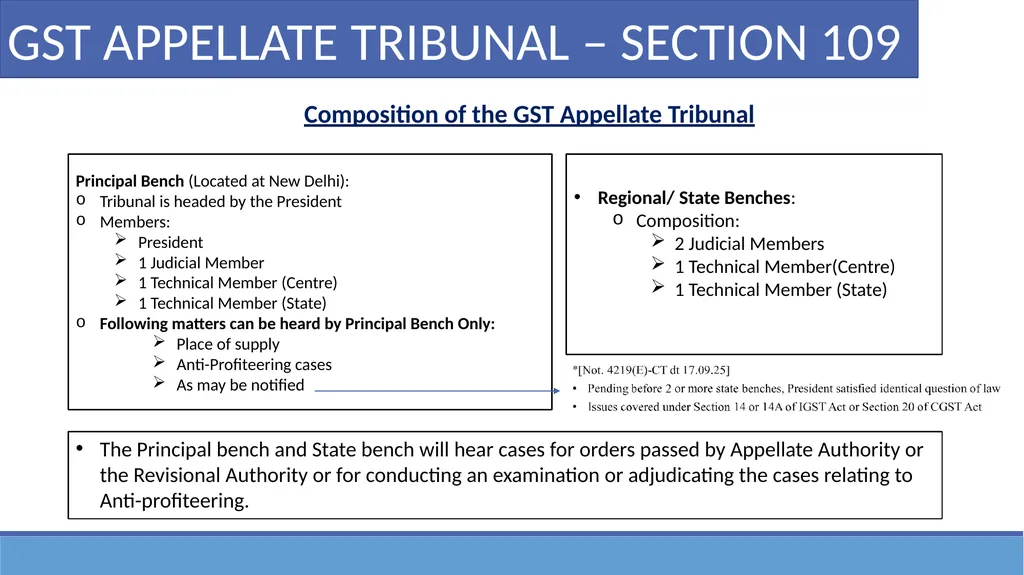
1 Technical Member (State) The Principal bench and State bench will hear cases for orders passed by Appellate Authority or the Revisional Authority or for conducting an examination or adjudicating the cases relating to Anti-profiteering.<br>
11
GST APPELLATE TRIBUNAL – SECTION 109 Composition of the GST Appellate Tribunal Responsibilities and Decision-making:
The notified senior-most Judicial member of State Benches shall act as Vice-President
Distribution of responsibilities is managed by the President and State Vice President
Appeals involving taxes or ITC or fine/fee or penalties up to Rs. 50 Lakh and does not involve question of law may be heard by a single member.
in all other cases, shall be heard together by one Judicial Member and one Technical Member.
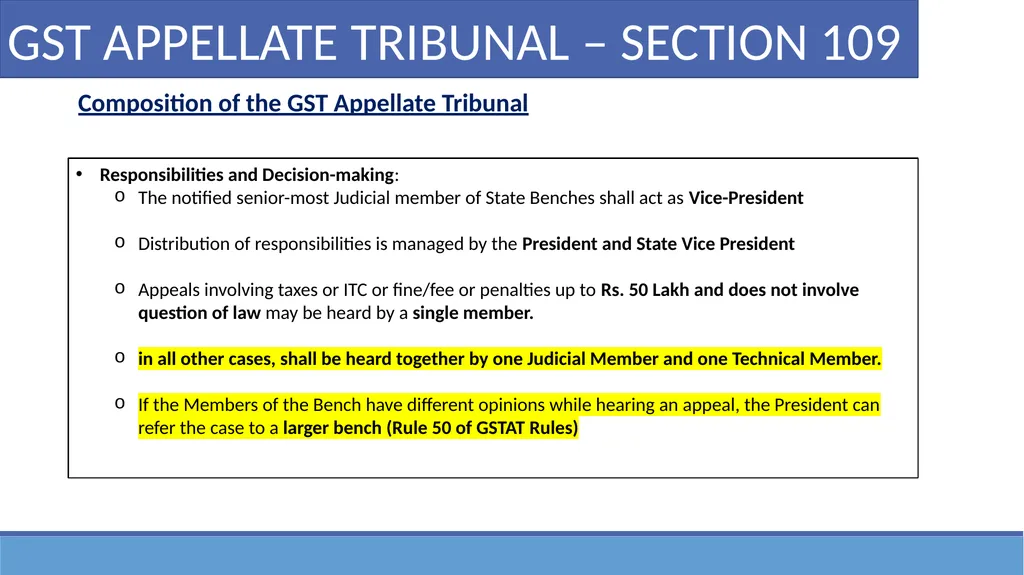
If the Members of the Bench have different opinions while hearing an appeal, the President can refer the case to a larger bench (Rule 50 of GSTAT Rules)<br>
12
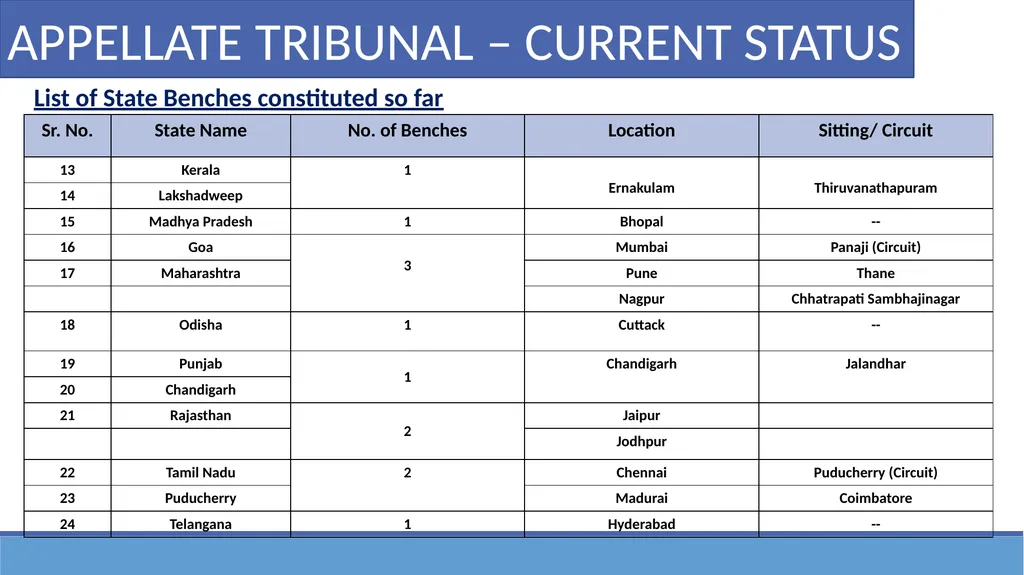
APPELLATE TRIBUNAL – CURRENT STATUS List of State Benches constituted so far<br>
13
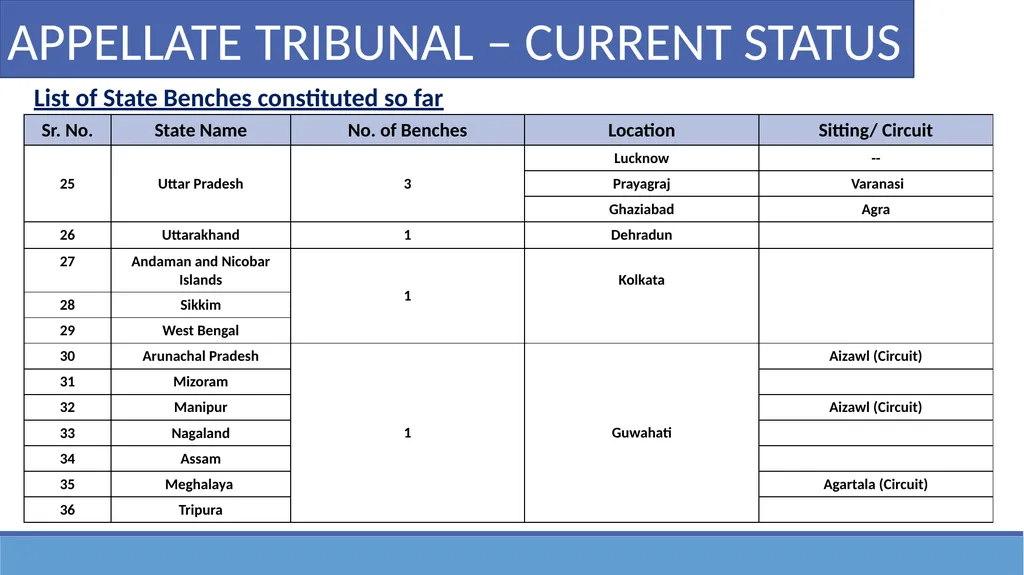
List of State Benches constituted so far APPELLATE TRIBUNAL – CURRENT STATUS<br>
14
APPELLATE TRIBUNAL – CURRENT STATUS List of State Benches constituted so far<br>
15
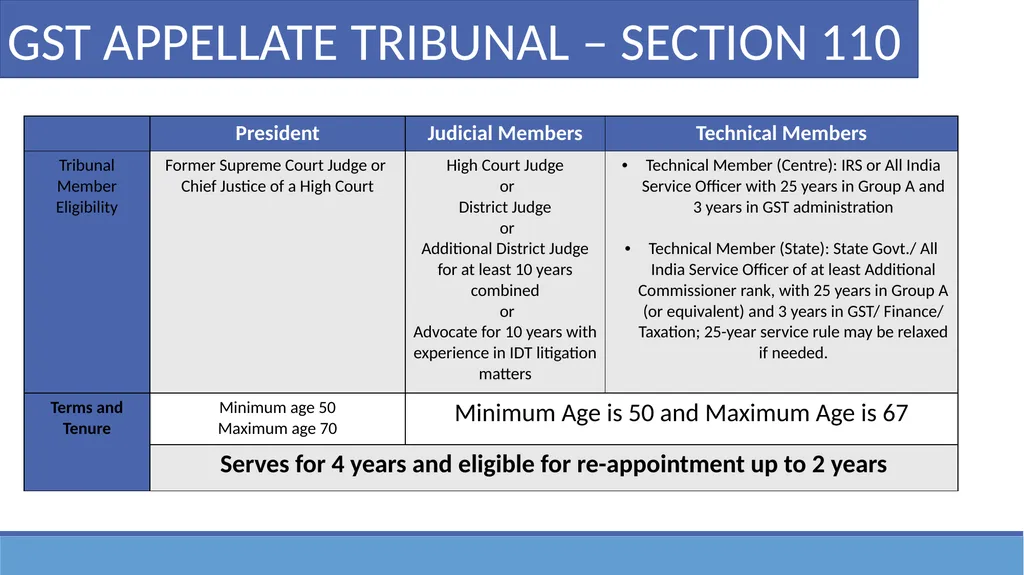
GST APPELLATE TRIBUNAL – SECTION 110<br>
16
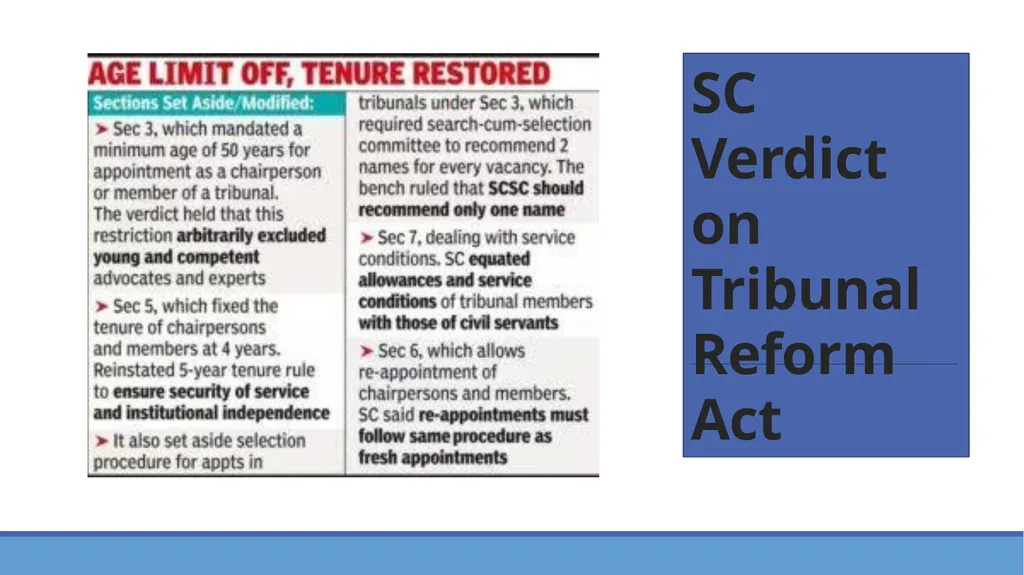
SC Verdict on Tribunal Reform Act<br>
17
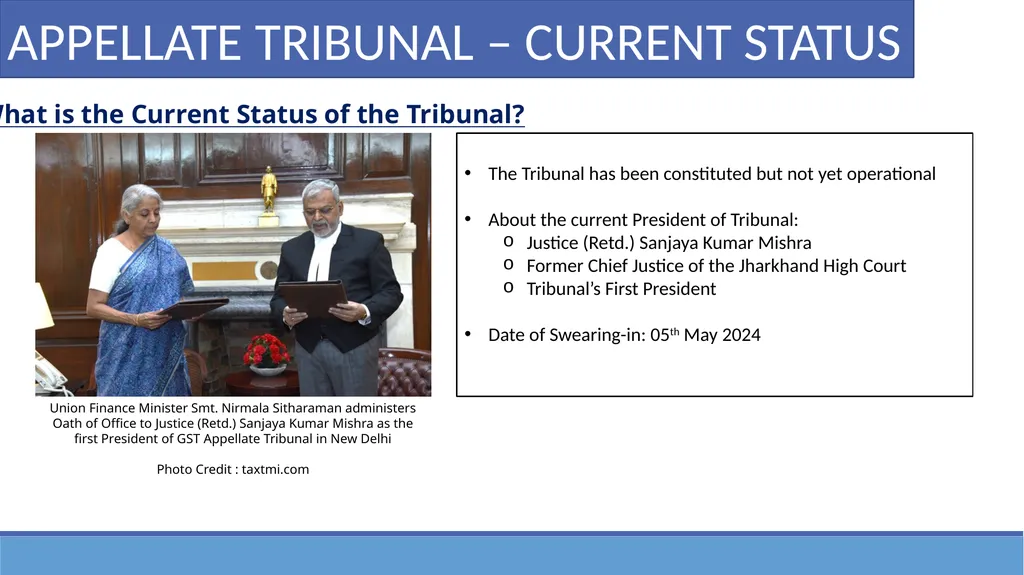
APPELLATE TRIBUNAL – CURRENT STATUS What is the Current Status of the Tribunal? Union Finance Minister Smt. Nirmala Sitharaman administers Oath of Office to Justice (Retd.) Sanjaya Kumar Mishra as the first President of GST Appellate Tribunal in New Delhi
Photo Credit : taxtmi.com The Tribunal has been constituted but not yet operational
About the current President of Tribunal:
Justice (Retd.) Sanjaya Kumar Mishra
Former Chief Justice of the Jharkhand High Court
Tribunal’s First President
Date of Swearing-in: 05th May 2024<br>
Photo Credit : taxtmi.com The Tribunal has been constituted but not yet operational
About the current President of Tribunal:
Justice (Retd.) Sanjaya Kumar Mishra
Former Chief Justice of the Jharkhand High Court
Tribunal’s First President
Date of Swearing-in: 05th May 2024<br>
18
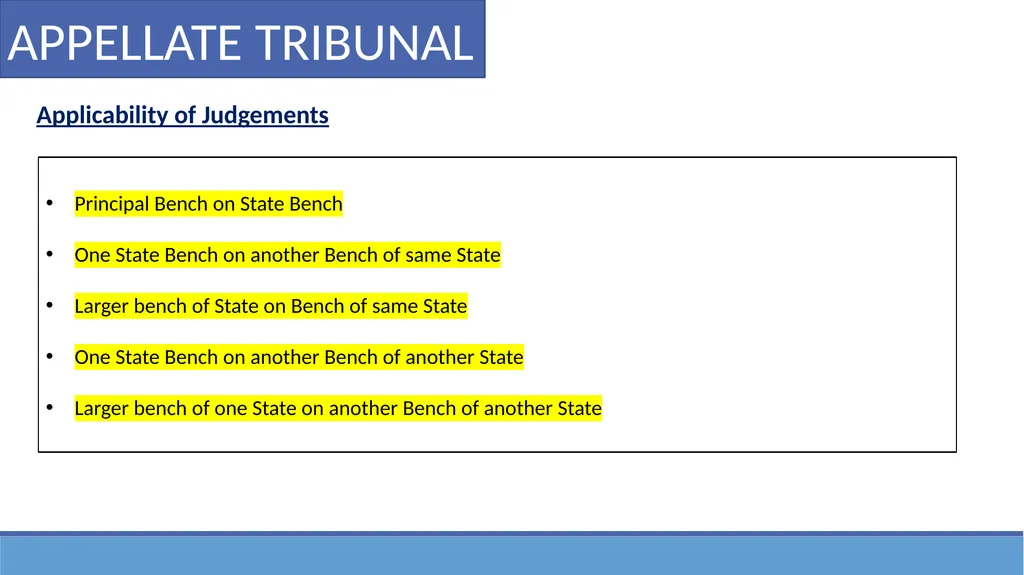
APPELLATE TRIBUNAL Applicability of Judgements Principal Bench on State Bench
One State Bench on another Bench of same State
Larger bench of State on Bench of same State
One State Bench on another Bench of another State
Larger bench of one State on another Bench of another State<br>
One State Bench on another Bench of same State
Larger bench of State on Bench of same State
One State Bench on another Bench of another State
Larger bench of one State on another Bench of another State<br>
19
APPEALS TO TRIBUNAL<br>
20
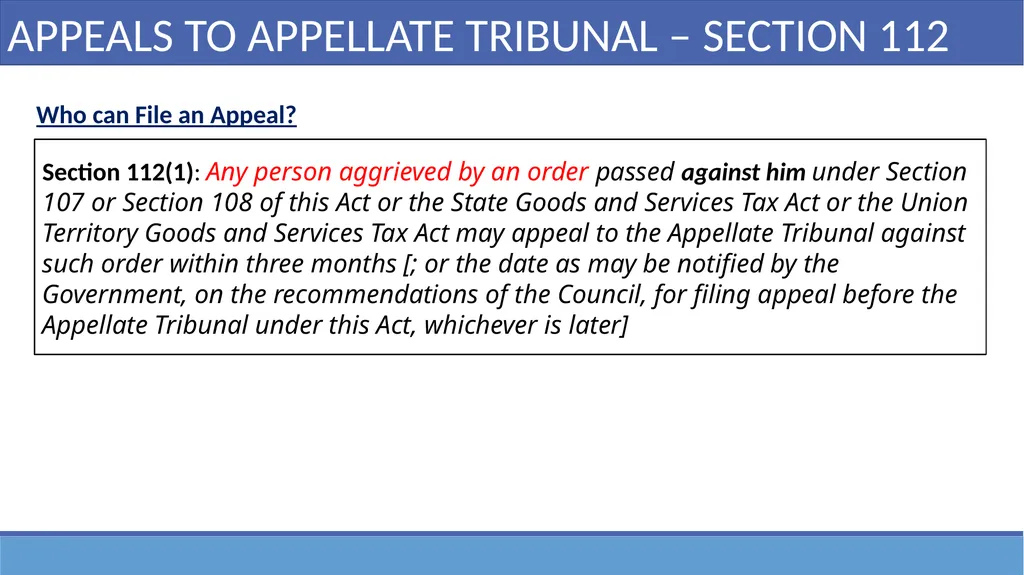
APPEALS TO APPELLATE TRIBUNAL – SECTION 112 Who can File an Appeal? Section 112(1): Any person aggrieved by an order passed against him under Section 107 or Section 108 of this Act or the State Goods and Services Tax Act or the Union Territory Goods and Services Tax Act may appeal to the Appellate Tribunal against such order within three months [; or the date as may be notified by the Government, on the recommendations of the Council, for filing appeal before the Appellate Tribunal under this Act, whichever is later]<br>
21
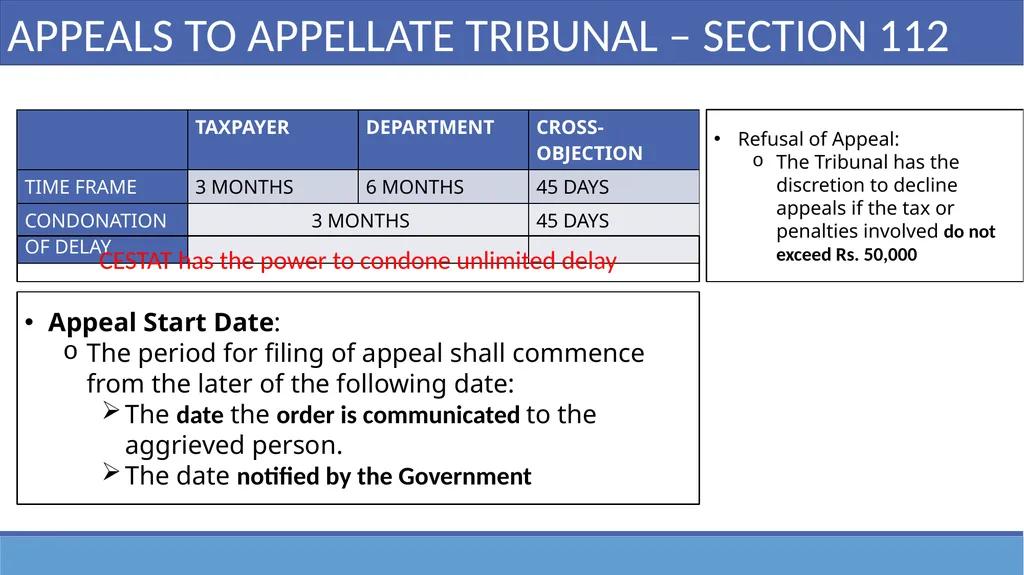
APPEALS TO APPELLATE TRIBUNAL – SECTION 112 CESTAT has the power to condone unlimited delay Refusal of Appeal:
The Tribunal has the discretion to decline appeals if the tax or penalties involved do not exceed Rs. 50,000 Appeal Start Date:
The period for filing of appeal shall commence from the later of the following date:
The date the order is communicated to the aggrieved person.
The date notified by the Government<br>
22
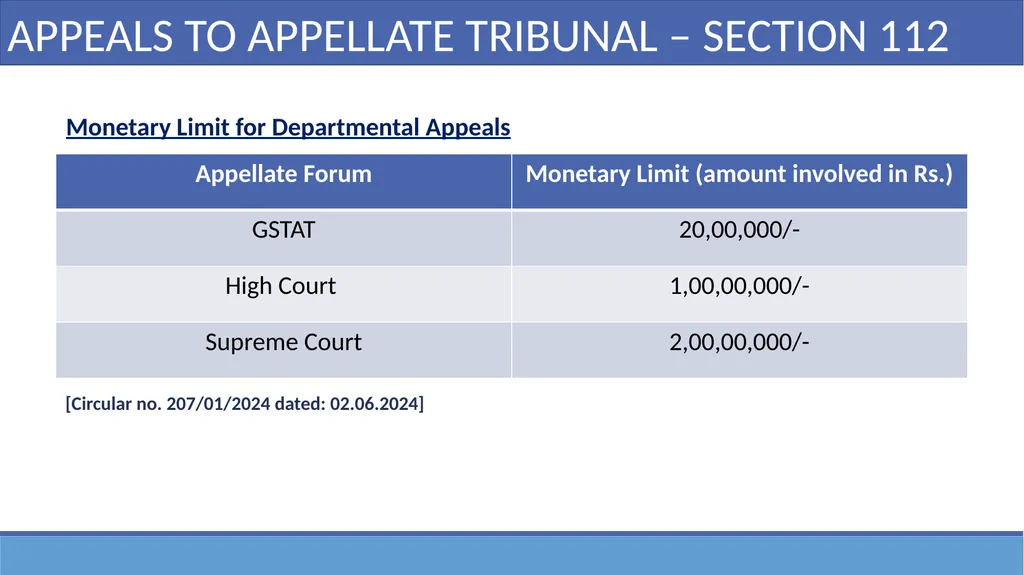
APPEALS TO APPELLATE TRIBUNAL – SECTION 112 Monetary Limit for Departmental Appeals [Circular no. 207/01/2024 dated: 02.06.2024]<br>
23
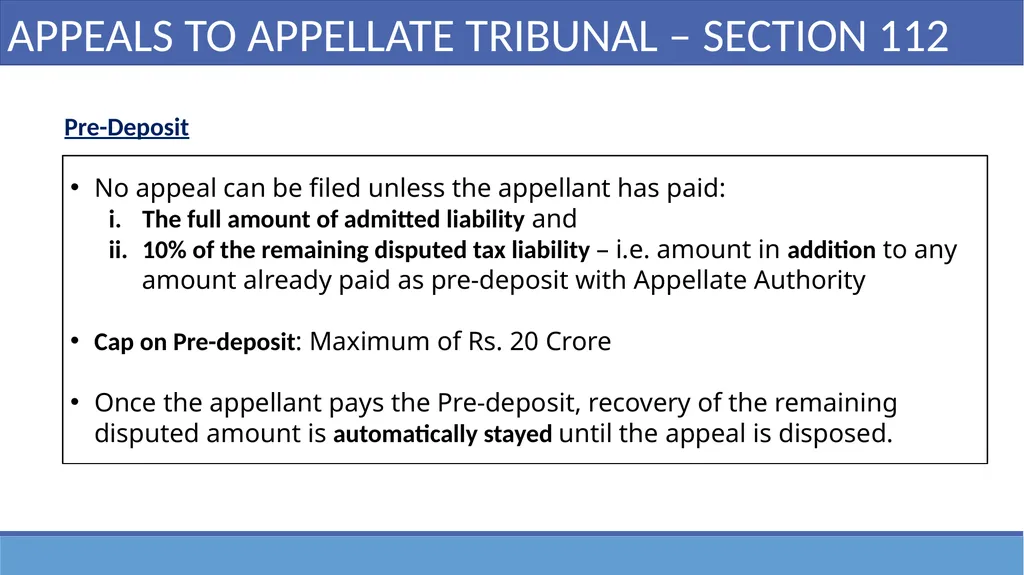
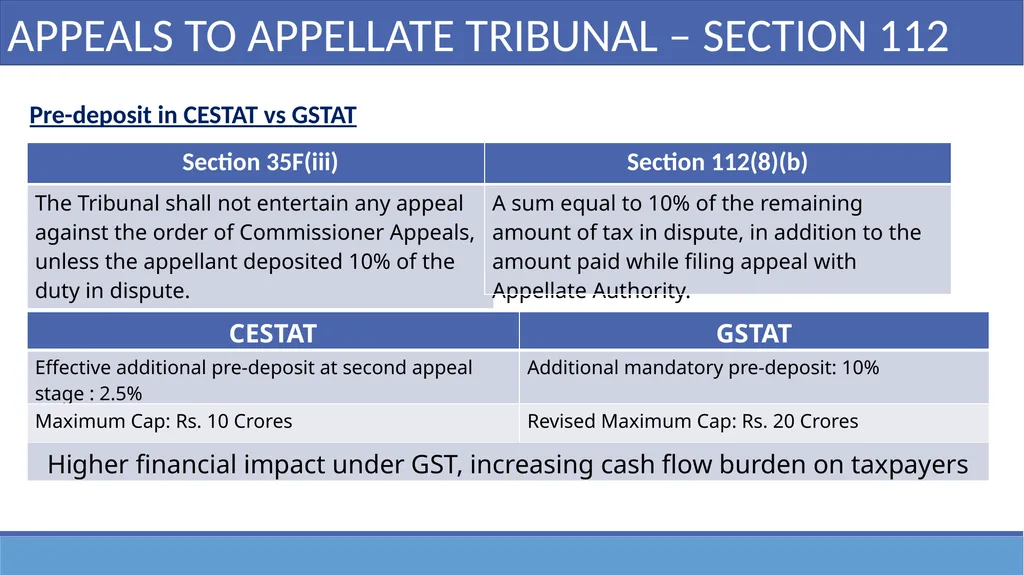
APPEALS TO APPELLATE TRIBUNAL – SECTION 112 Pre-Deposit No appeal can be filed unless the appellant has paid:
The full amount of admitted liability and
10% of the remaining disputed tax liability – i.e. amount in addition to any amount already paid as pre-deposit with Appellate Authority
Cap on Pre-deposit: Maximum of Rs. 20 Crore
Once the appellant pays the Pre-deposit, recovery of the remaining disputed amount is automatically stayed until the appeal is disposed.<br>
24
APPEALS TO APPELLATE TRIBUNAL – SECTION 112 Pre-deposit in CESTAT vs GSTAT<br>
25
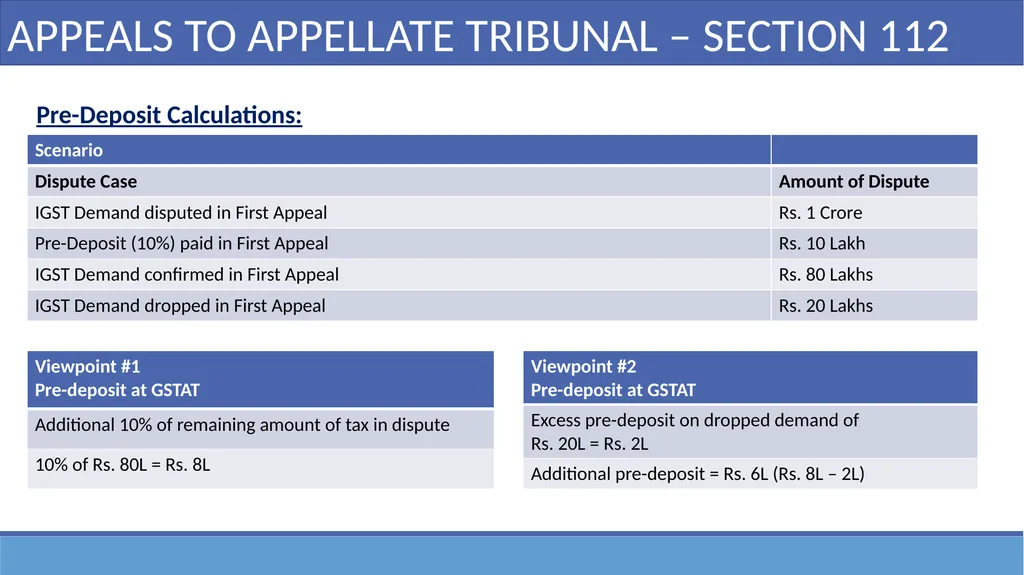
APPEALS TO APPELLATE TRIBUNAL – SECTION 112 Pre-Deposit Calculations:<br>
26
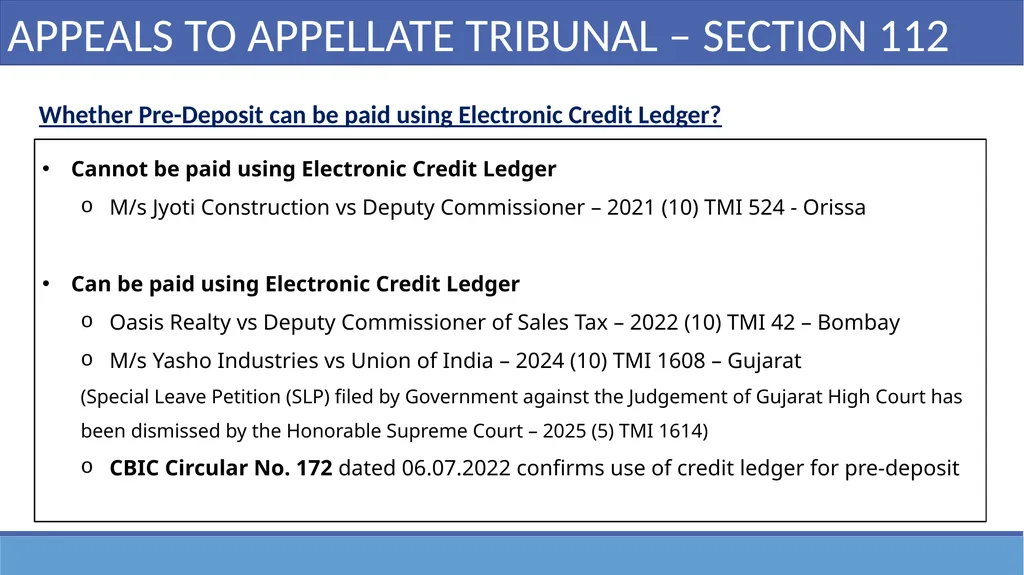
APPEALS TO APPELLATE TRIBUNAL – SECTION 112 Whether Pre-Deposit can be paid using Electronic Credit Ledger? Cannot be paid using Electronic Credit Ledger
M/s Jyoti Construction vs Deputy Commissioner – 2021 (10) TMI 524 - Orissa
Can be paid using Electronic Credit Ledger
Oasis Realty vs Deputy Commissioner of Sales Tax – 2022 (10) TMI 42 – Bombay
M/s Yasho Industries vs Union of India – 2024 (10) TMI 1608 – Gujarat
(Special Leave Petition (SLP) filed by Government against the Judgement of Gujarat High Court has been dismissed by the Honorable Supreme Court – 2025 (5) TMI 1614)
CBIC Circular No. 172 dated 06.07.2022 confirms use of credit ledger for pre-deposit<br>
27
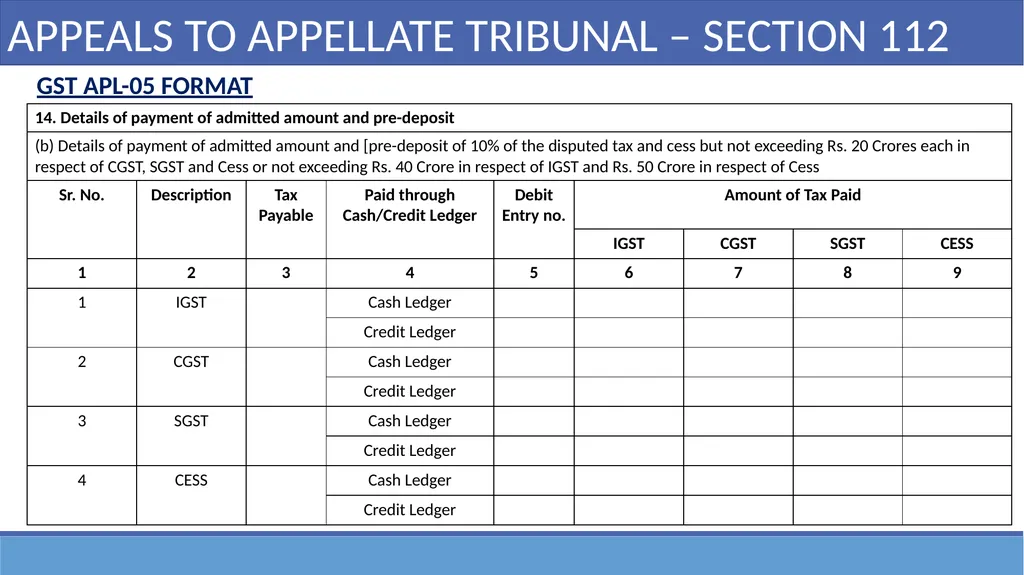
APPEALS TO APPELLATE TRIBUNAL – SECTION 112 GST APL-05 FORMAT<br>
28
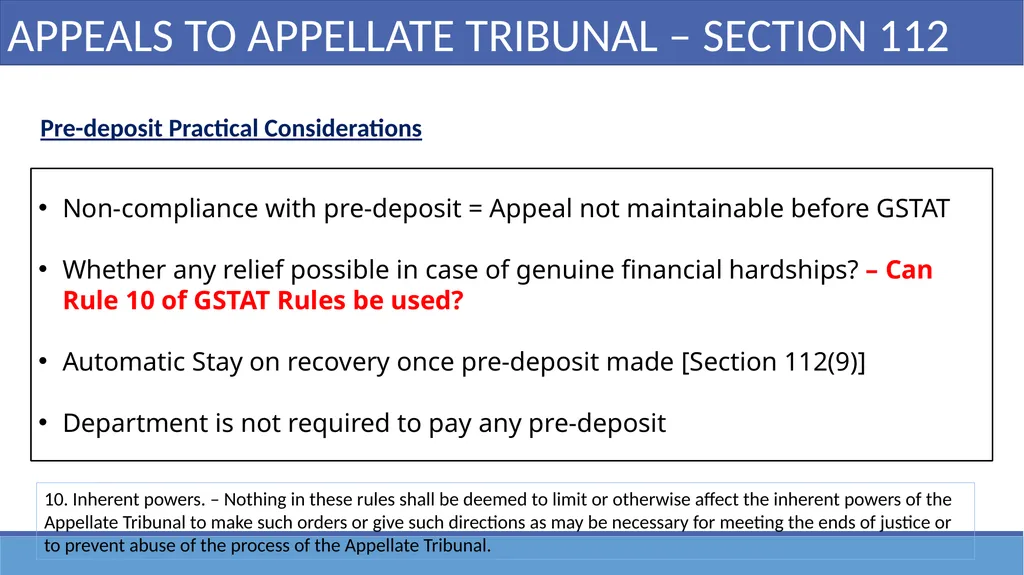
APPEALS TO APPELLATE TRIBUNAL – SECTION 112 Pre-deposit Practical Considerations Non-compliance with pre-deposit = Appeal not maintainable before GSTAT
Whether any relief possible in case of genuine financial hardships? – Can Rule 10 of GSTAT Rules be used?
Automatic Stay on recovery once pre-deposit made [Section 112(9)]
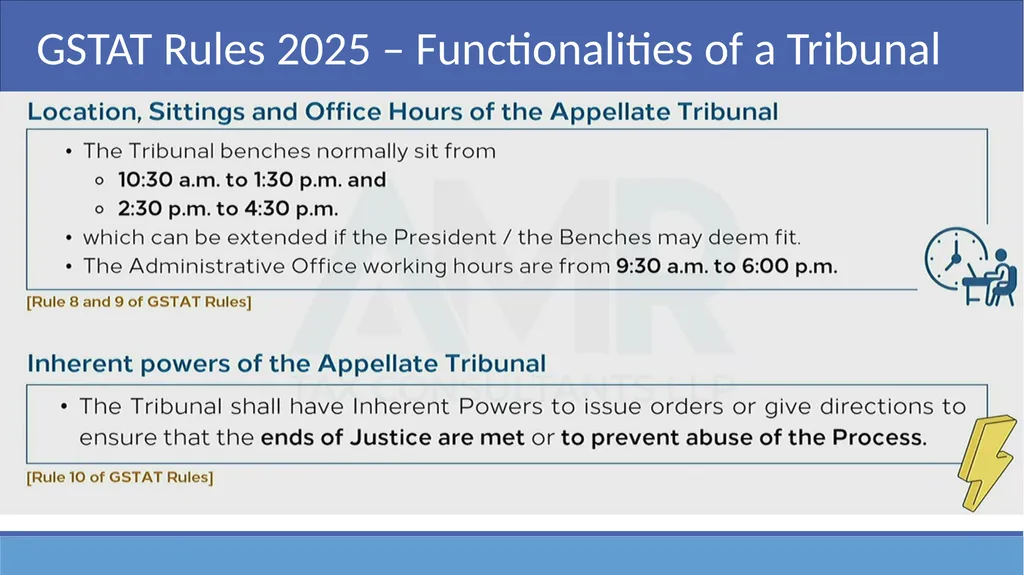
Department is not required to pay any pre-deposit 10. Inherent powers. – Nothing in these rules shall be deemed to limit or otherwise affect the inherent powers of the Appellate Tribunal to make such orders or give such directions as may be necessary for meeting the ends of justice or to prevent abuse of the process of the Appellate Tribunal.<br>
29
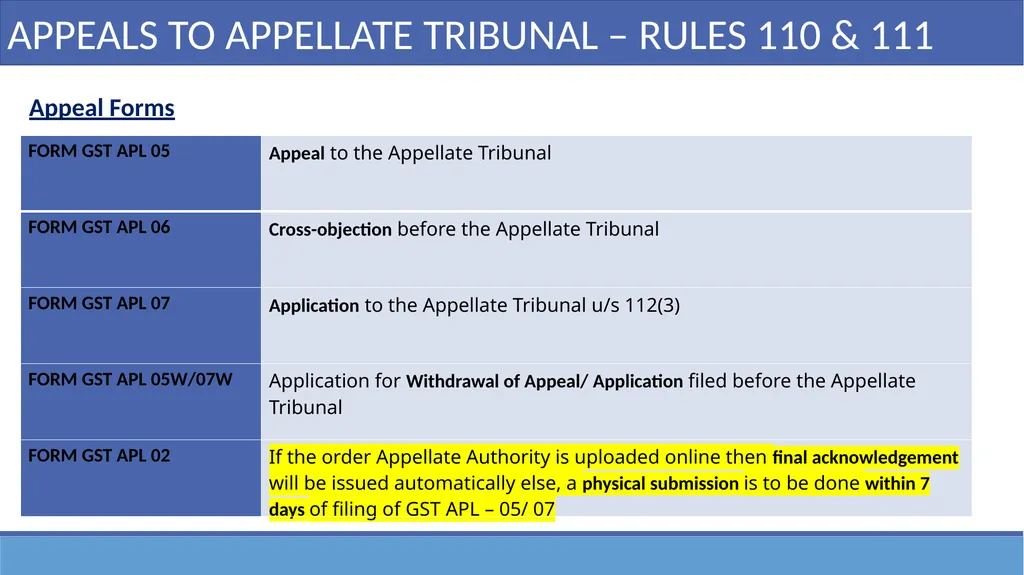
APPEALS TO APPELLATE TRIBUNAL – RULES 110 & 111 Appeal Forms<br>
30
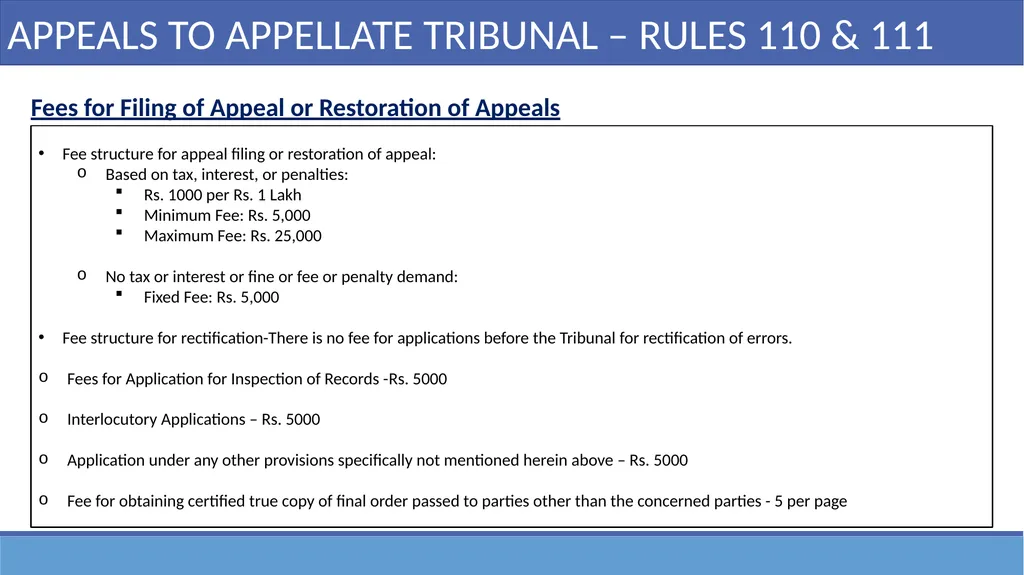
APPEALS TO APPELLATE TRIBUNAL – RULES 110 & 111 Fees for Filing of Appeal or Restoration of Appeals Fee structure for appeal filing or restoration of appeal:
Based on tax, interest, or penalties:
Rs. 1000 per Rs. 1 Lakh
Minimum Fee: Rs. 5,000
Maximum Fee: Rs. 25,000
No tax or interest or fine or fee or penalty demand:
Fixed Fee: Rs. 5,000
Fee structure for rectification-There is no fee for applications before the Tribunal for rectification of errors.
Fees for Application for Inspection of Records -Rs. 5000
Interlocutory Applications – Rs. 5000
Application under any other provisions specifically not mentioned herein above – Rs. 5000
Fee for obtaining certified true copy of final order passed to parties other than the concerned parties - 5 per page<br>
31
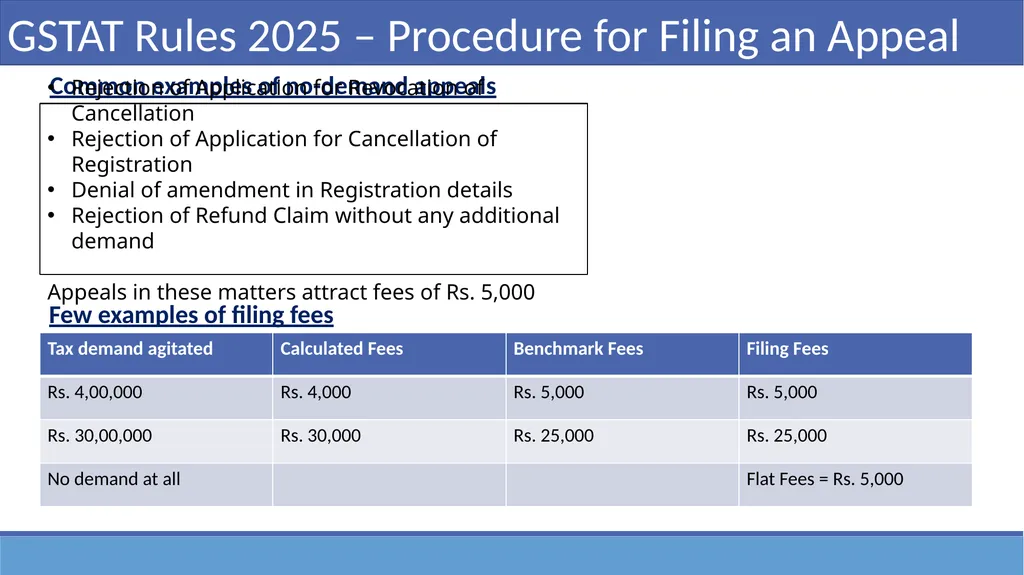
GSTAT Rules 2025 – Procedure for Filing an Appeal Common examples of no-demand appeals Rejection of Application for Revocation of Cancellation
Rejection of Application for Cancellation of Registration
Denial of amendment in Registration details
Rejection of Refund Claim without any additional demand
Appeals in these matters attract fees of Rs. 5,000 Few examples of filing fees<br>
Rejection of Application for Cancellation of Registration
Denial of amendment in Registration details
Rejection of Refund Claim without any additional demand
Appeals in these matters attract fees of Rs. 5,000 Few examples of filing fees<br>
32
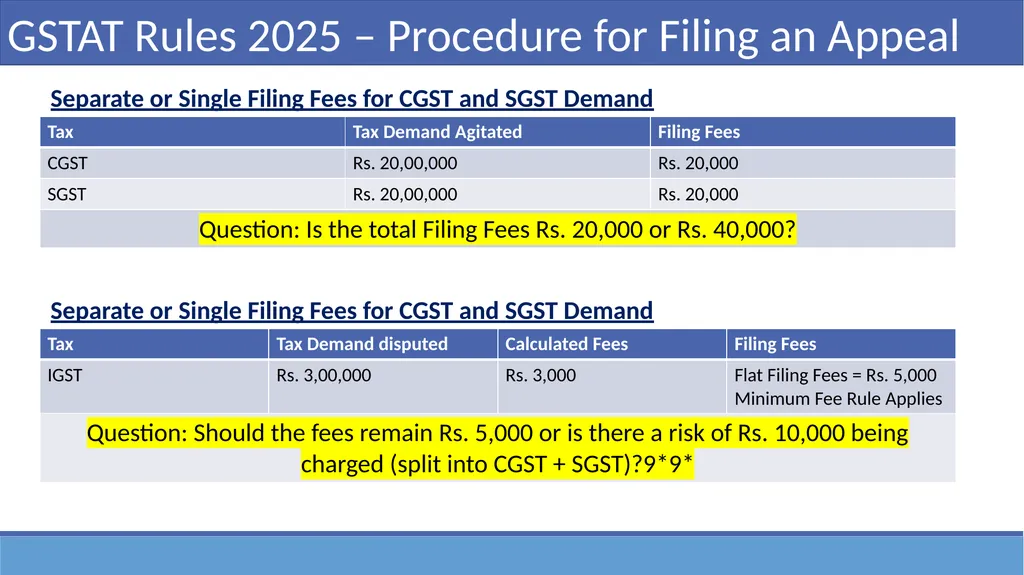
GSTAT Rules 2025 – Procedure for Filing an Appeal Separate or Single Filing Fees for CGST and SGST Demand Separate or Single Filing Fees for CGST and SGST Demand<br>
33
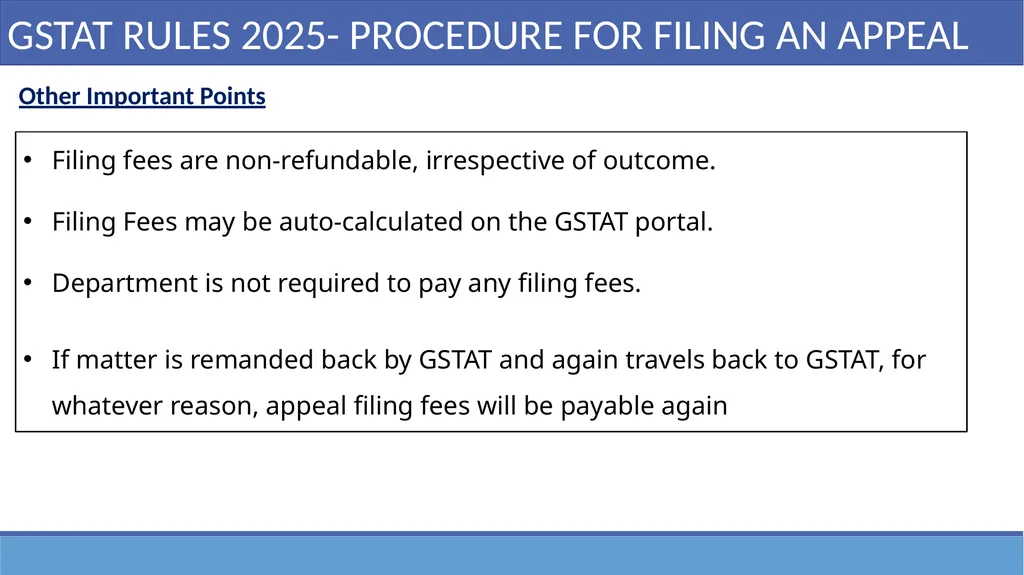
GSTAT RULES 2025- PROCEDURE FOR FILING AN APPEAL Other Important Points Filing fees are non-refundable, irrespective of outcome.
Filing Fees may be auto-calculated on the GSTAT portal.
Department is not required to pay any filing fees.
If matter is remanded back by GSTAT and again travels back to GSTAT, for whatever reason, appeal filing fees will be payable again<br>
Filing Fees may be auto-calculated on the GSTAT portal.
Department is not required to pay any filing fees.
If matter is remanded back by GSTAT and again travels back to GSTAT, for whatever reason, appeal filing fees will be payable again<br>
34
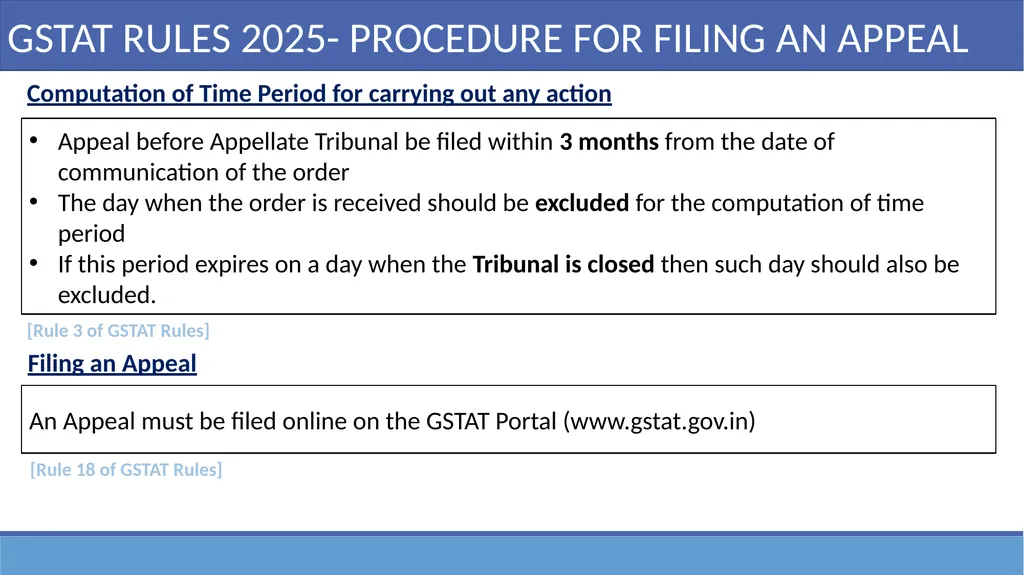
GSTAT RULES 2025- PROCEDURE FOR FILING AN APPEAL Computation of Time Period for carrying out any action Appeal before Appellate Tribunal be filed within 3 months from the date of communication of the order
The day when the order is received should be excluded for the computation of time period
If this period expires on a day when the Tribunal is closed then such day should also be excluded. [Rule 3 of GSTAT Rules] Filing an Appeal An Appeal must be filed online on the GSTAT Portal (www.gstat.gov.in) [Rule 18 of GSTAT Rules]<br>
35
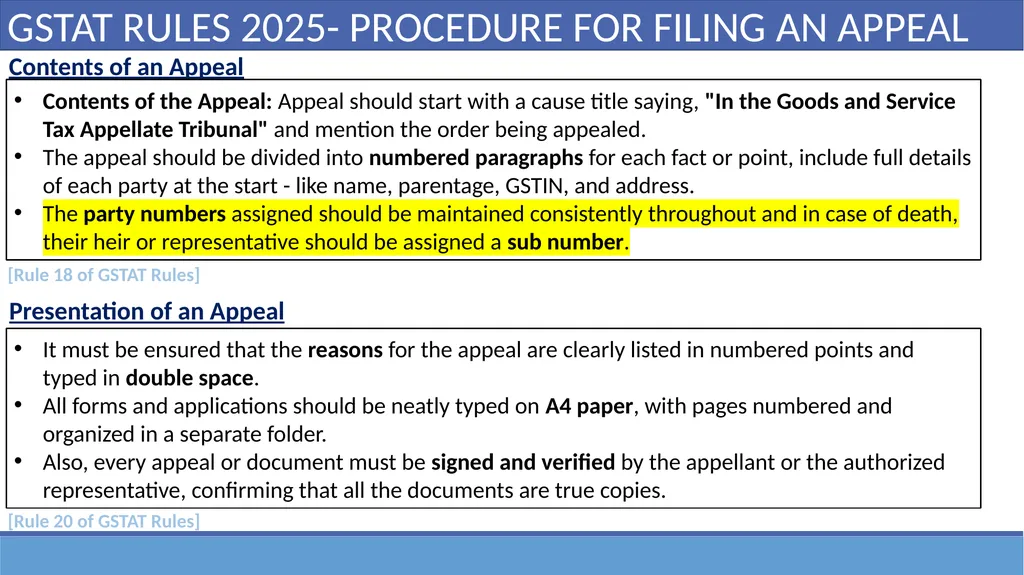
GSTAT RULES 2025- PROCEDURE FOR FILING AN APPEAL Contents of an Appeal Contents of the Appeal: Appeal should start with a cause title saying, "In the Goods and Service Tax Appellate Tribunal" and mention the order being appealed.
The appeal should be divided into numbered paragraphs for each fact or point, include full details of each party at the start - like name, parentage, GSTIN, and address.
The party numbers assigned should be maintained consistently throughout and in case of death, their heir or representative should be assigned a sub number. [Rule 18 of GSTAT Rules] Presentation of an Appeal It must be ensured that the reasons for the appeal are clearly listed in numbered points and typed in double space.
All forms and applications should be neatly typed on A4 paper, with pages numbered and organized in a separate folder.
Also, every appeal or document must be signed and verified by the appellant or the authorized representative, confirming that all the documents are true copies. [Rule 20 of GSTAT Rules]<br>
36
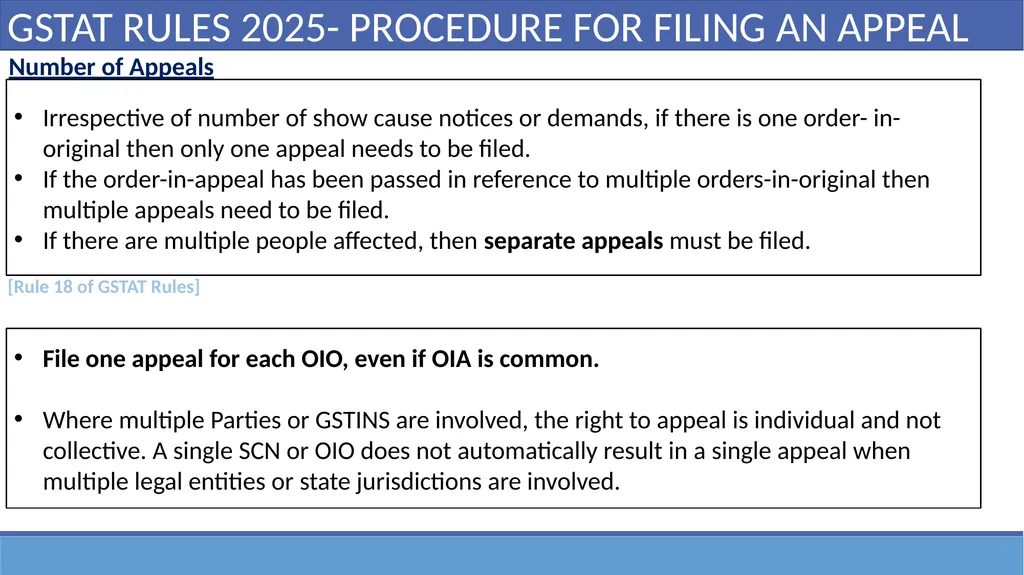
GSTAT RULES 2025- PROCEDURE FOR FILING AN APPEAL Number of Appeals Irrespective of number of show cause notices or demands, if there is one order- in-original then only one appeal needs to be filed.
If the order-in-appeal has been passed in reference to multiple orders-in-original then multiple appeals need to be filed.
If there are multiple people affected, then separate appeals must be filed. [Rule 18 of GSTAT Rules] File one appeal for each OIO, even if OIA is common.
Where multiple Parties or GSTINS are involved, the right to appeal is individual and not collective. A single SCN or OIO does not automatically result in a single appeal when multiple legal entities or state jurisdictions are involved.<br>
37
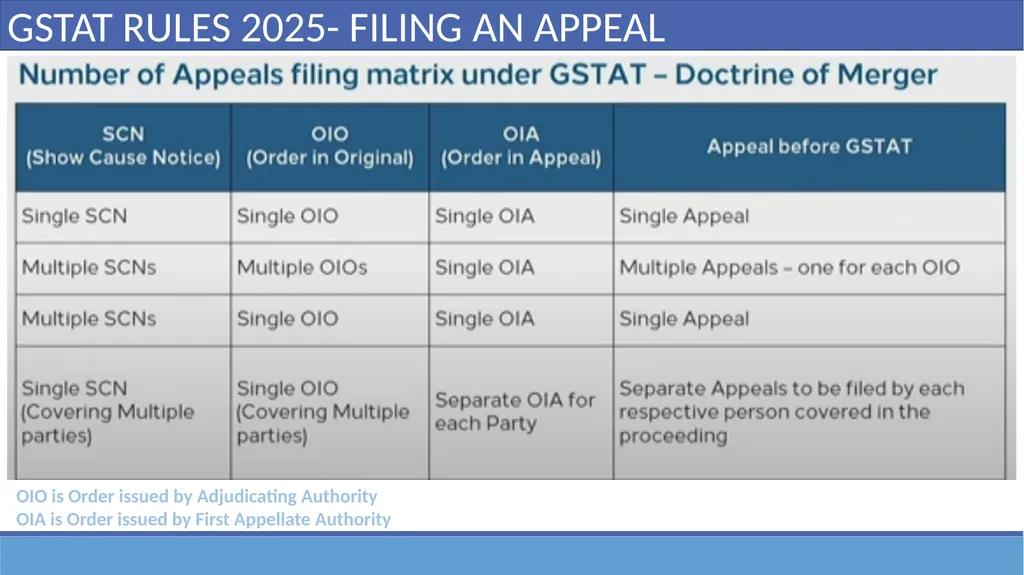
GSTAT RULES 2025- FILING AN APPEAL OIO is Order issued by Adjudicating Authority
OIA is Order issued by First Appellate Authority<br>
OIA is Order issued by First Appellate Authority<br>
38
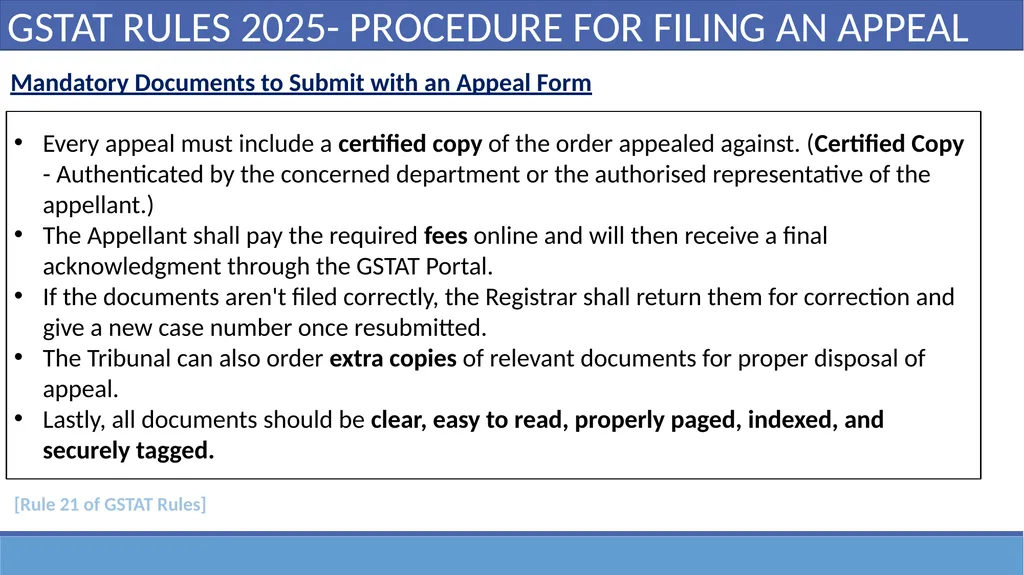
GSTAT RULES 2025- PROCEDURE FOR FILING AN APPEAL Mandatory Documents to Submit with an Appeal Form Every appeal must include a certified copy of the order appealed against. (Certified Copy - Authenticated by the concerned department or the authorised representative of the appellant.)
The Appellant shall pay the required fees online and will then receive a final acknowledgment through the GSTAT Portal.
If the documents aren't filed correctly, the Registrar shall return them for correction and give a new case number once resubmitted.
The Tribunal can also order extra copies of relevant documents for proper disposal of appeal.
Lastly, all documents should be clear, easy to read, properly paged, indexed, and securely tagged. [Rule 21 of GSTAT Rules]<br>
39
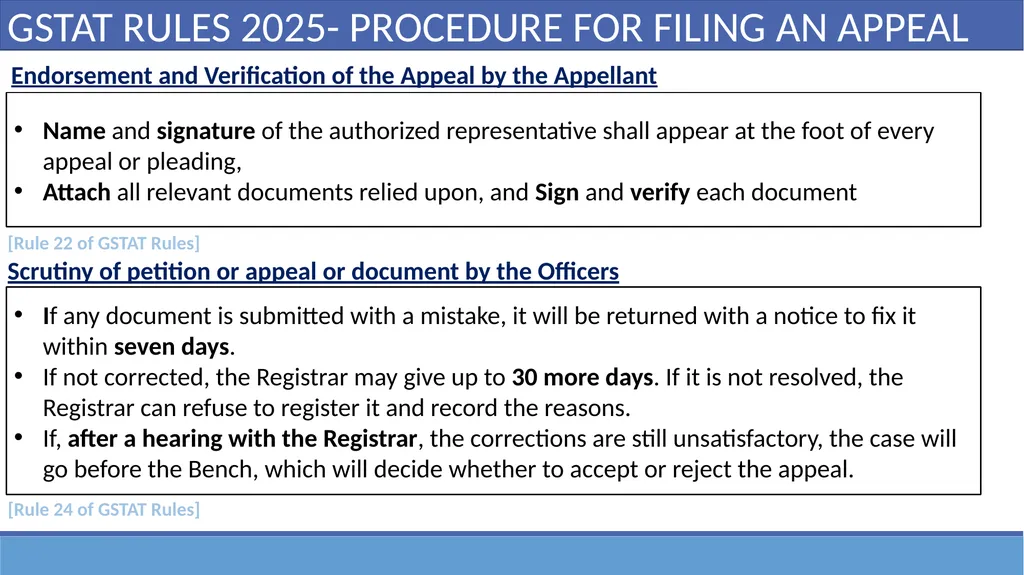
GSTAT RULES 2025- PROCEDURE FOR FILING AN APPEAL Endorsement and Verification of the Appeal by the Appellant Name and signature of the authorized representative shall appear at the foot of every appeal or pleading,
Attach all relevant documents relied upon, and Sign and verify each document [Rule 22 of GSTAT Rules] If any document is submitted with a mistake, it will be returned with a notice to fix it within seven days.
If not corrected, the Registrar may give up to 30 more days. If it is not resolved, the Registrar can refuse to register it and record the reasons.
If, after a hearing with the Registrar, the corrections are still unsatisfactory, the case will go before the Bench, which will decide whether to accept or reject the appeal. Scrutiny of petition or appeal or document by the Officers [Rule 24 of GSTAT Rules]<br>
40
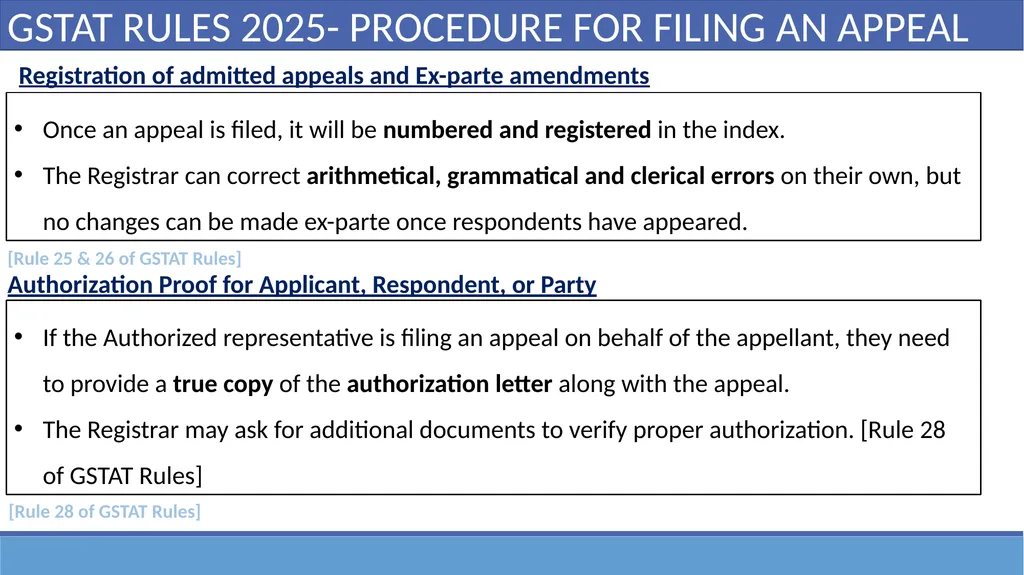
GSTAT RULES 2025- PROCEDURE FOR FILING AN APPEAL Registration of admitted appeals and Ex-parte amendments Once an appeal is filed, it will be numbered and registered in the index.
The Registrar can correct arithmetical, grammatical and clerical errors on their own, but no changes can be made ex-parte once respondents have appeared. [Rule 25 & 26 of GSTAT Rules] If the Authorized representative is filing an appeal on behalf of the appellant, they need to provide a true copy of the authorization letter along with the appeal.
The Registrar may ask for additional documents to verify proper authorization. [Rule 28 of GSTAT Rules] Authorization Proof for Applicant, Respondent, or Party [Rule 28 of GSTAT Rules]<br>
41
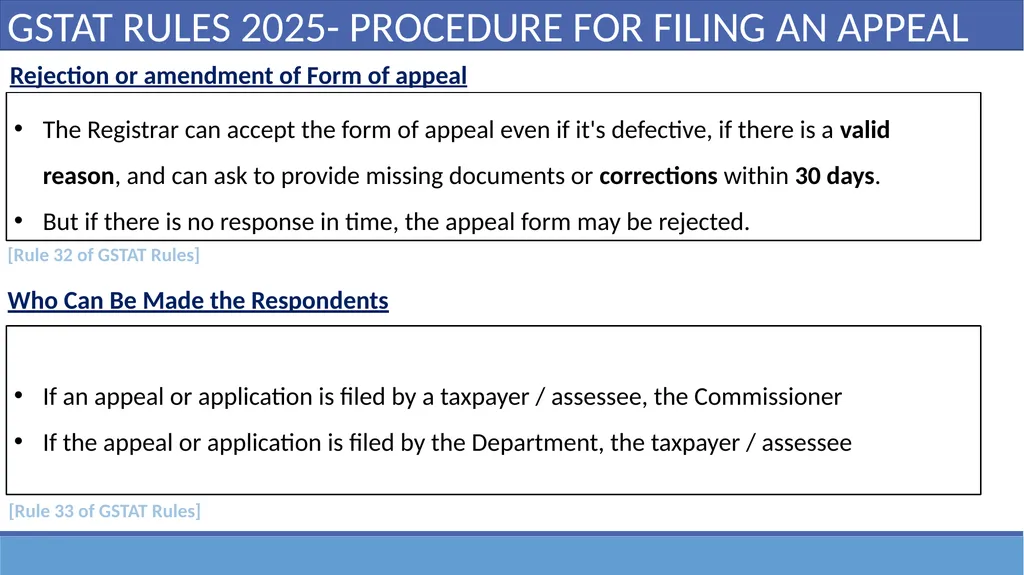
GSTAT RULES 2025- PROCEDURE FOR FILING AN APPEAL Rejection or amendment of Form of appeal The Registrar can accept the form of appeal even if it's defective, if there is a valid reason, and can ask to provide missing documents or corrections within 30 days.
But if there is no response in time, the appeal form may be rejected. [Rule 32 of GSTAT Rules] If an appeal or application is filed by a taxpayer / assessee, the Commissioner
If the appeal or application is filed by the Department, the taxpayer / assessee Who Can Be Made the Respondents [Rule 33 of GSTAT Rules]<br>
42
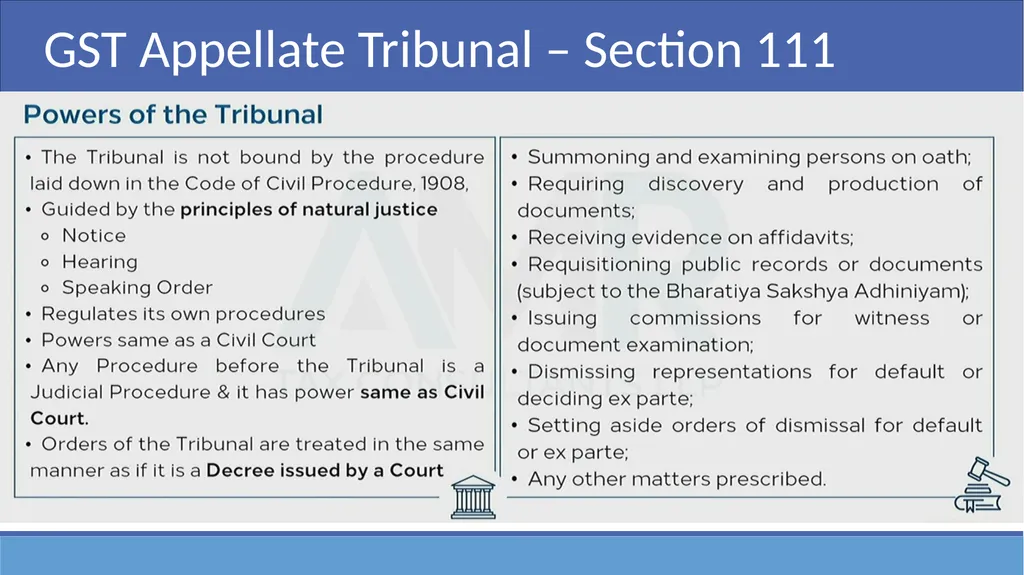
GST Appellate Tribunal – Section 111<br>
43
GSTAT Rules 2025 – Functionalities of a Tribunal<br>
44
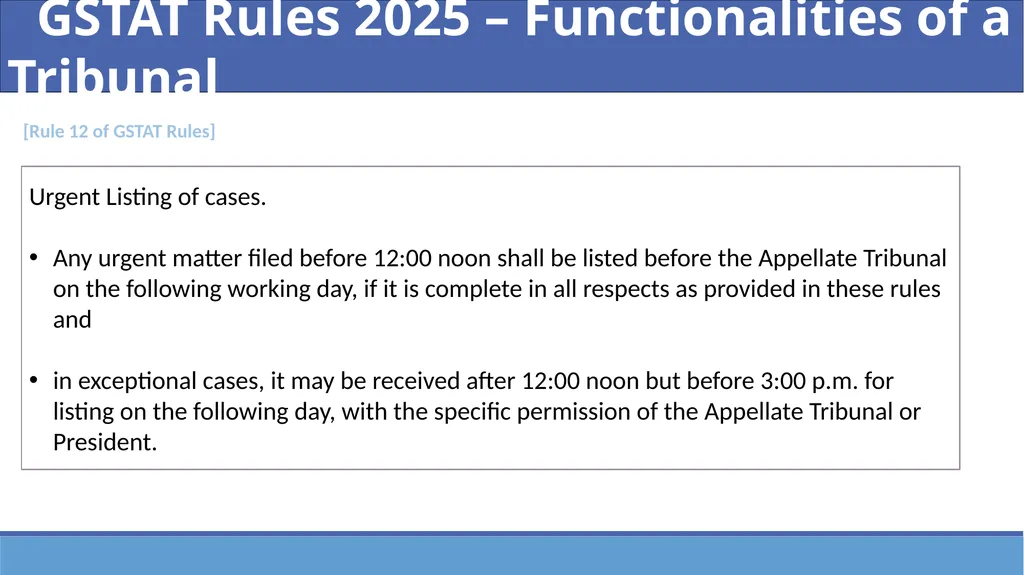
GSTAT Rules 2025 – Functionalities of a Tribunal Urgent Listing of cases.
Any urgent matter filed before 12:00 noon shall be listed before the Appellate Tribunal on the following working day, if it is complete in all respects as provided in these rules and
in exceptional cases, it may be received after 12:00 noon but before 3:00 p.m. for listing on the following day, with the specific permission of the Appellate Tribunal or President. [Rule 12 of GSTAT Rules]<br>
45
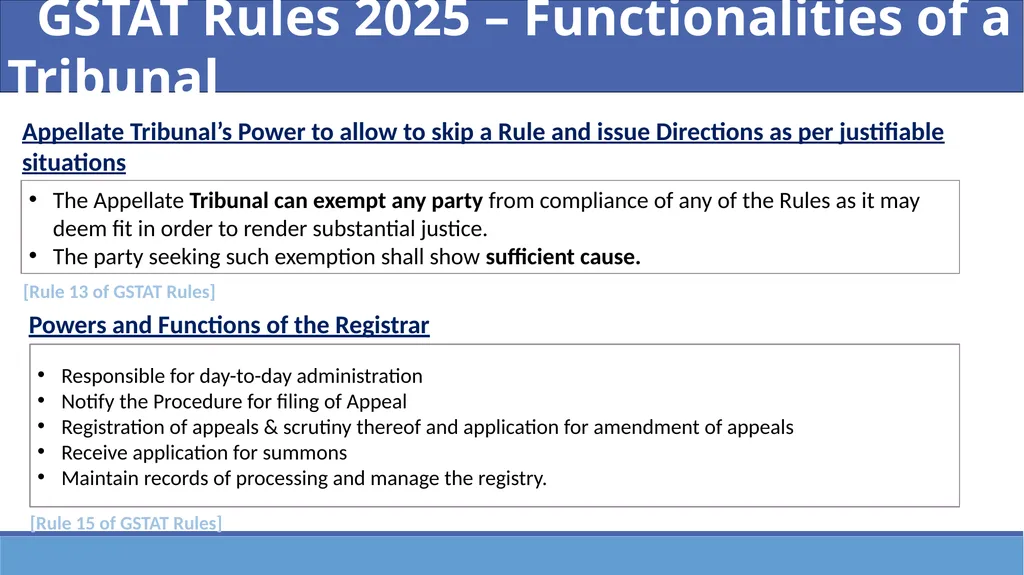
GSTAT Rules 2025 – Functionalities of a Tribunal Appellate Tribunal’s Power to allow to skip a Rule and issue Directions as per justifiable situations The Appellate Tribunal can exempt any party from compliance of any of the Rules as it may deem fit in order to render substantial justice.
The party seeking such exemption shall show sufficient cause. Powers and Functions of the Registrar Responsible for day-to-day administration
Notify the Procedure for filing of Appeal
Registration of appeals & scrutiny thereof and application for amendment of appeals
Receive application for summons
Maintain records of processing and manage the registry. [Rule 13 of GSTAT Rules] [Rule 15 of GSTAT Rules]<br>
46
HEARING OF APPEALS<br>
47
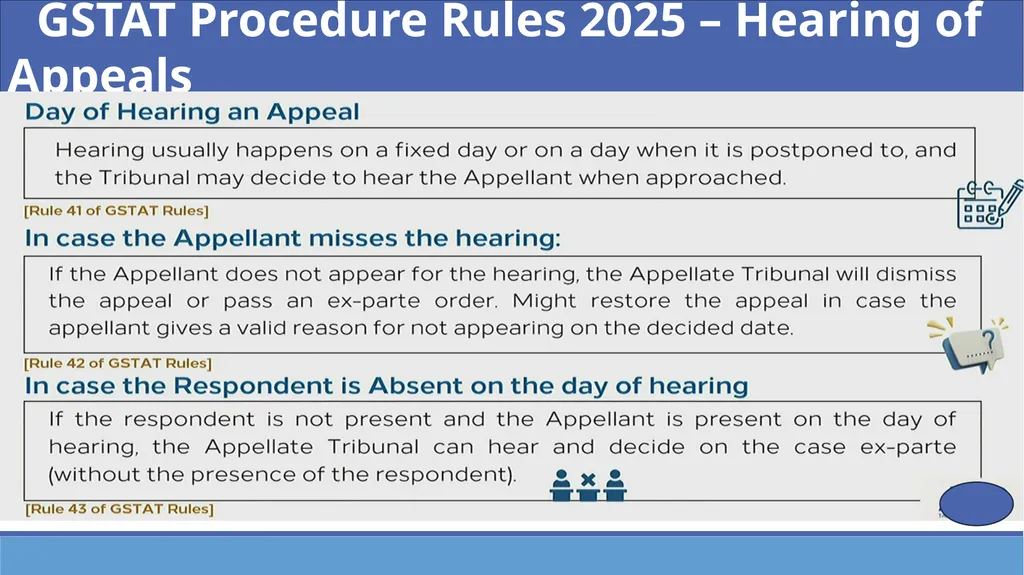
GSTAT Procedure Rules 2025 – Hearing of Appeals<br>
48
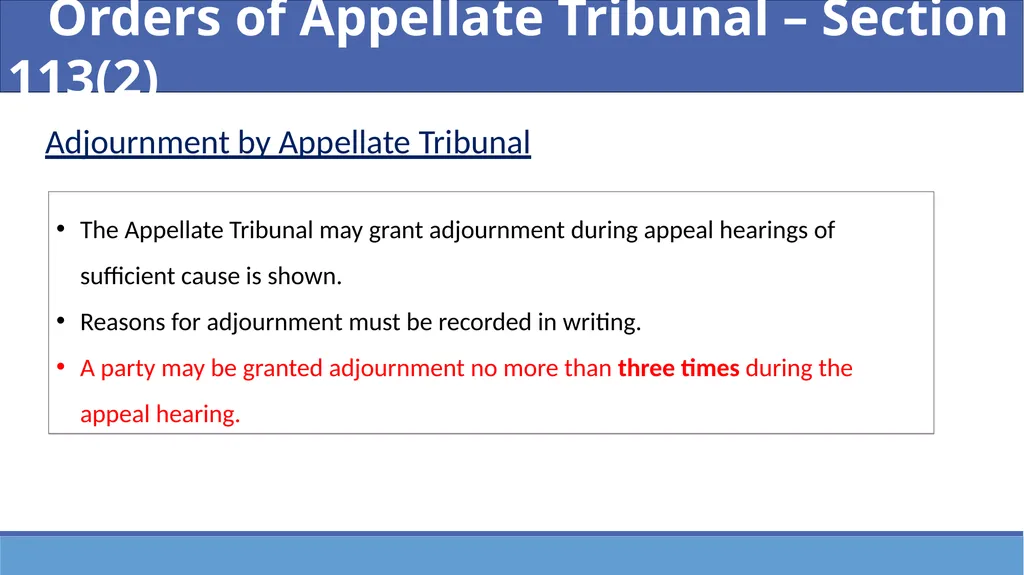
Orders of Appellate Tribunal – Section 113(2) Adjournment by Appellate Tribunal The Appellate Tribunal may grant adjournment during appeal hearings of sufficient cause is shown.
Reasons for adjournment must be recorded in writing.
A party may be granted adjournment no more than three times during the appeal hearing.<br>
Reasons for adjournment must be recorded in writing.
A party may be granted adjournment no more than three times during the appeal hearing.<br>
49
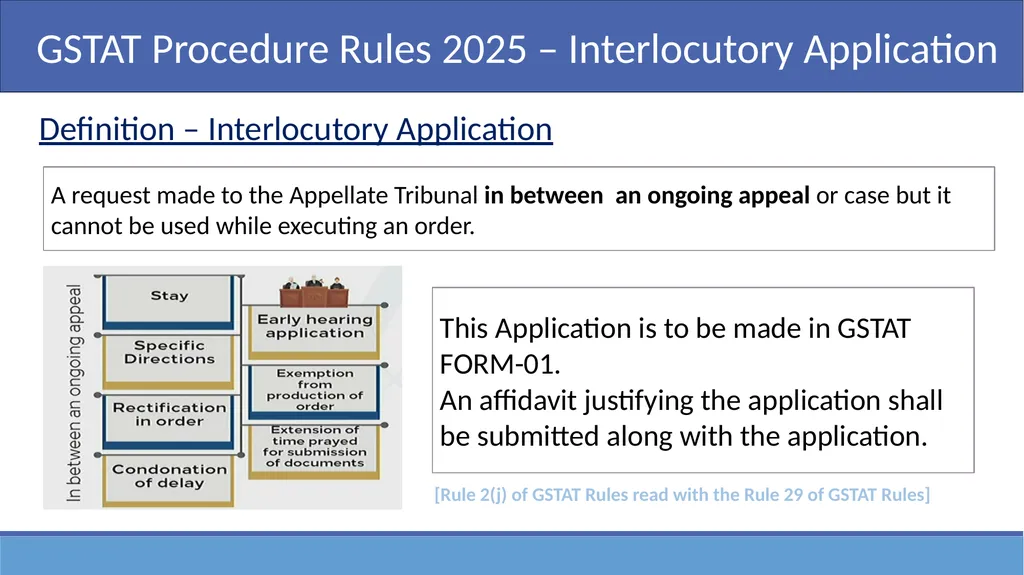
GSTAT Procedure Rules 2025 – Interlocutory Application Definition – Interlocutory Application A request made to the Appellate Tribunal in between an ongoing appeal or case but it cannot be used while executing an order. This Application is to be made in GSTAT FORM-01.
An affidavit justifying the application shall be submitted along with the application. [Rule 2(j) of GSTAT Rules read with the Rule 29 of GSTAT Rules]<br>
An affidavit justifying the application shall be submitted along with the application. [Rule 2(j) of GSTAT Rules read with the Rule 29 of GSTAT Rules]<br>
50
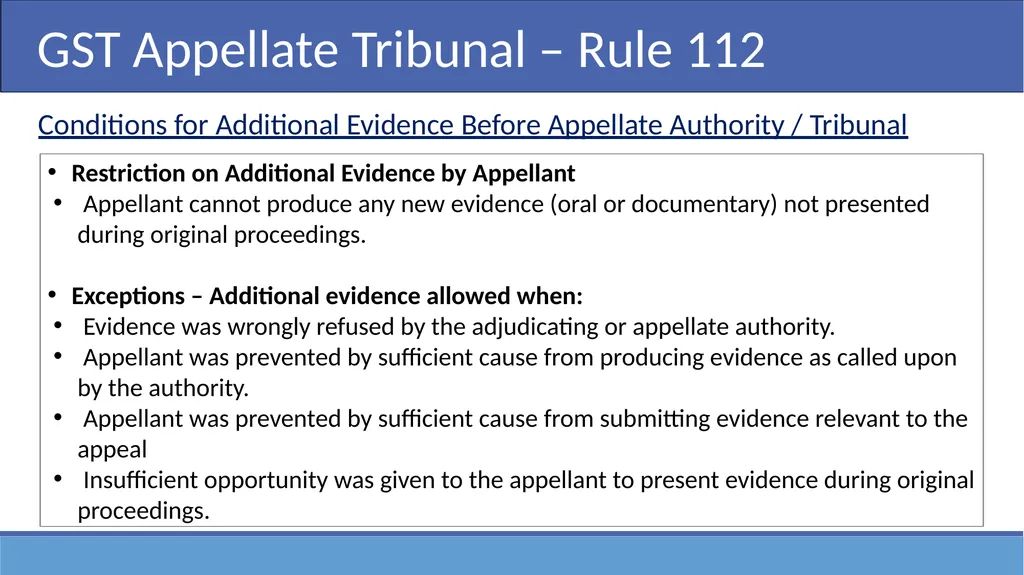
GST Appellate Tribunal – Rule 112 Conditions for Additional Evidence Before Appellate Authority / Tribunal Restriction on Additional Evidence by Appellant
Appellant cannot produce any new evidence (oral or documentary) not presented during original proceedings.
Exceptions – Additional evidence allowed when:
Evidence was wrongly refused by the adjudicating or appellate authority.
Appellant was prevented by sufficient cause from producing evidence as called upon by the authority.
Appellant was prevented by sufficient cause from submitting evidence relevant to the appeal
Insufficient opportunity was given to the appellant to present evidence during original proceedings.<br>
51
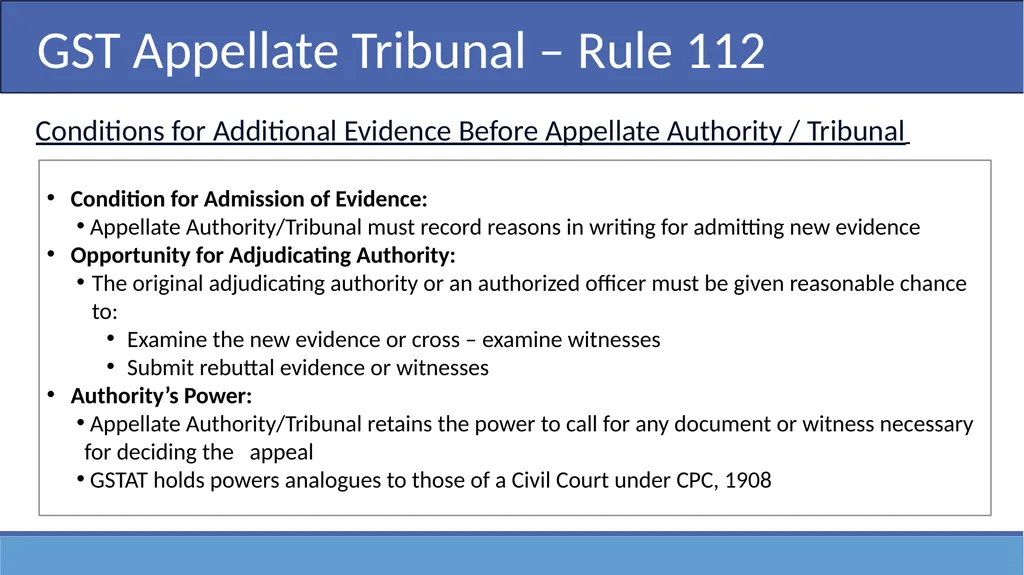
GST Appellate Tribunal – Rule 112 Conditions for Additional Evidence Before Appellate Authority / Tribunal Condition for Admission of Evidence:
Appellate Authority/Tribunal must record reasons in writing for admitting new evidence
Opportunity for Adjudicating Authority:
The original adjudicating authority or an authorized officer must be given reasonable chance to:
Examine the new evidence or cross – examine witnesses
Submit rebuttal evidence or witnesses
Authority’s Power:
Appellate Authority/Tribunal retains the power to call for any document or witness necessary for deciding the appeal
GSTAT holds powers analogues to those of a Civil Court under CPC, 1908<br>
52
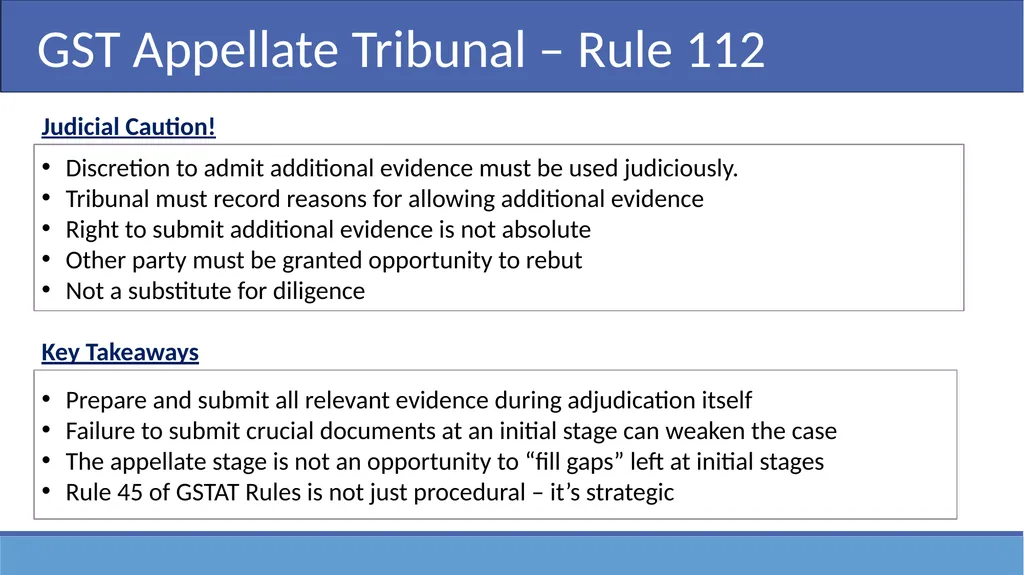
GST Appellate Tribunal – Rule 112 Judicial Caution! Discretion to admit additional evidence must be used judiciously.
Tribunal must record reasons for allowing additional evidence
Right to submit additional evidence is not absolute
Other party must be granted opportunity to rebut
Not a substitute for diligence Key Takeaways Prepare and submit all relevant evidence during adjudication itself
Failure to submit crucial documents at an initial stage can weaken the case
The appellate stage is not an opportunity to “fill gaps” left at initial stages
Rule 45 of GSTAT Rules is not just procedural – it’s strategic<br>
53
ORDERS<br>
54
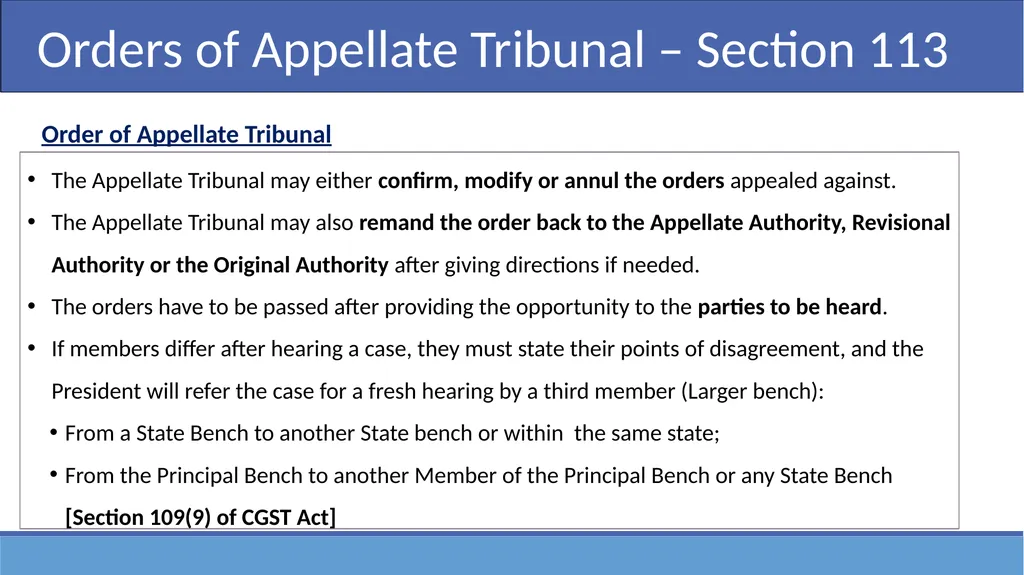
Orders of Appellate Tribunal – Section 113 Order of Appellate Tribunal The Appellate Tribunal may either confirm, modify or annul the orders appealed against.
The Appellate Tribunal may also remand the order back to the Appellate Authority, Revisional Authority or the Original Authority after giving directions if needed.
The orders have to be passed after providing the opportunity to the parties to be heard.
If members differ after hearing a case, they must state their points of disagreement, and the President will refer the case for a fresh hearing by a third member (Larger bench):
From a State Bench to another State bench or within the same state;
From the Principal Bench to another Member of the Principal Bench or any State Bench [Section 109(9) of CGST Act]<br>
55
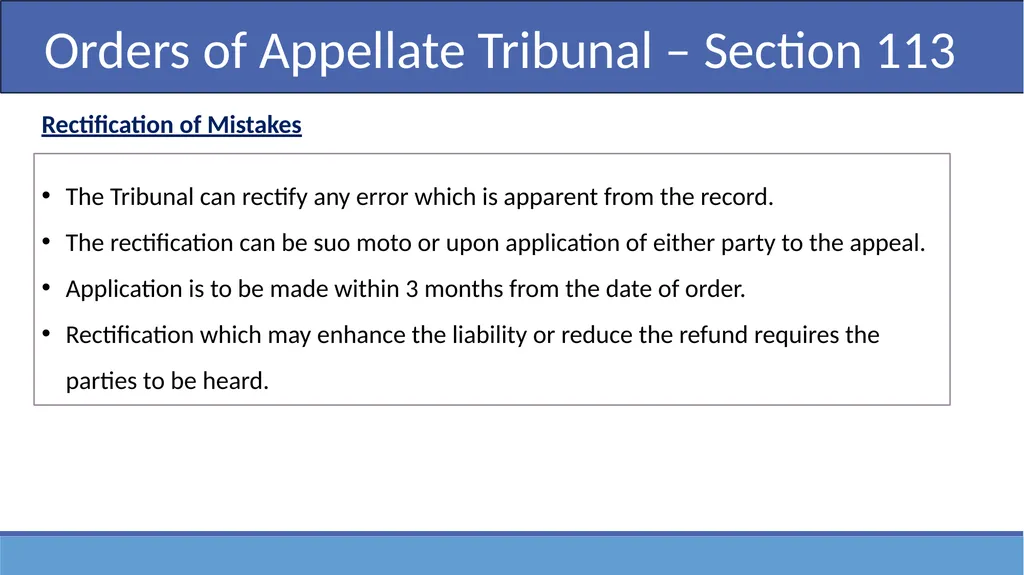
Orders of Appellate Tribunal – Section 113 Rectification of Mistakes The Tribunal can rectify any error which is apparent from the record.
The rectification can be suo moto or upon application of either party to the appeal.
Application is to be made within 3 months from the date of order.
Rectification which may enhance the liability or reduce the refund requires the parties to be heard.<br>
The rectification can be suo moto or upon application of either party to the appeal.
Application is to be made within 3 months from the date of order.
Rectification which may enhance the liability or reduce the refund requires the parties to be heard.<br>
56
AUTHORISED REPRESENTATIVE<br>
57
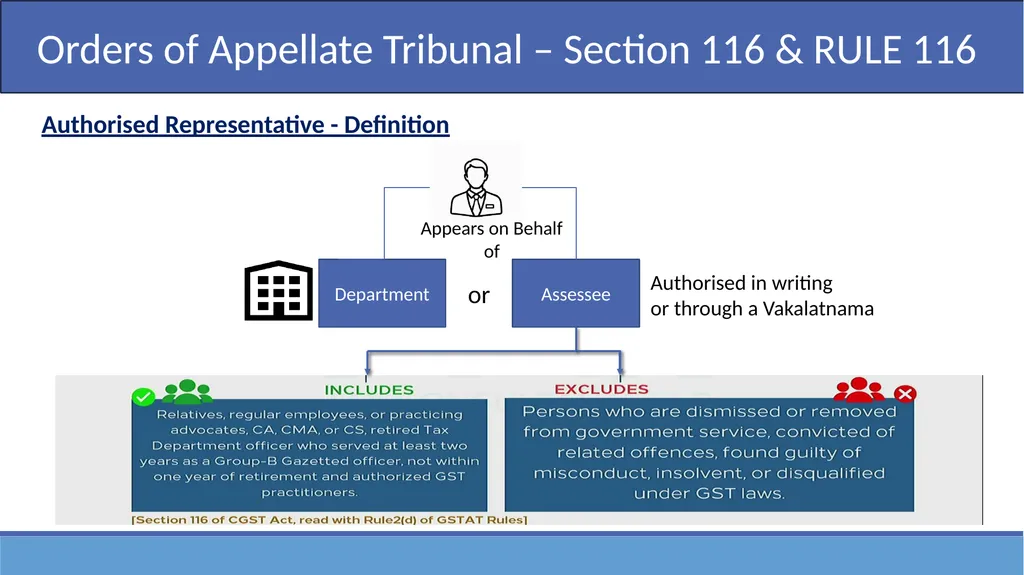
Orders of Appellate Tribunal – Section 116 & RULE 116 Authorised Representative - Definition Department Assessee Appears on Behalf of Authorised in writing
or through a Vakalatnama or<br>
or through a Vakalatnama or<br>
58
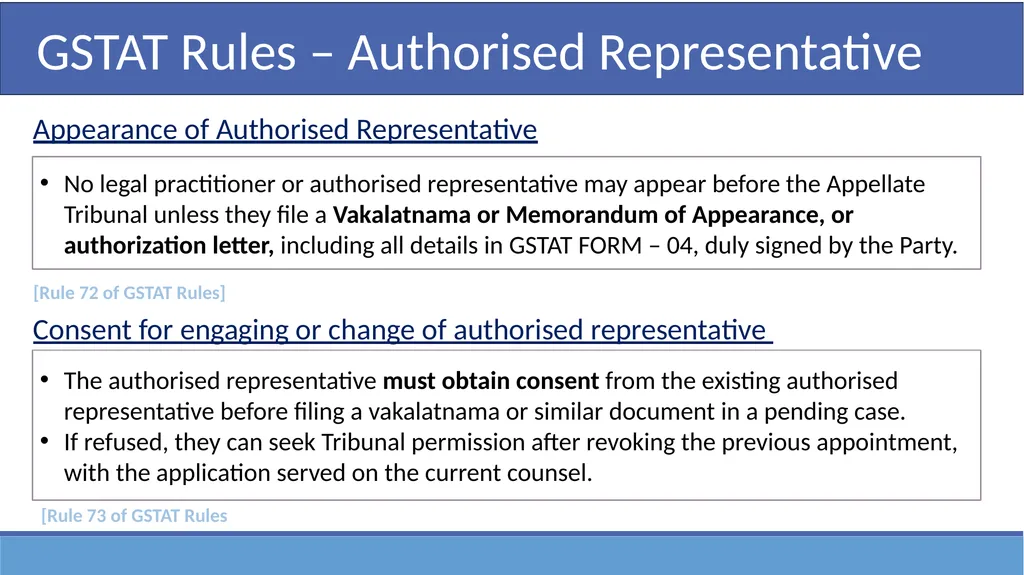
GSTAT Rules – Authorised Representative Appearance of Authorised Representative No legal practitioner or authorised representative may appear before the Appellate Tribunal unless they file a Vakalatnama or Memorandum of Appearance, or authorization letter, including all details in GSTAT FORM – 04, duly signed by the Party. Consent for engaging or change of authorised representative The authorised representative must obtain consent from the existing authorised representative before filing a vakalatnama or similar document in a pending case.
If refused, they can seek Tribunal permission after revoking the previous appointment, with the application served on the current counsel. [Rule 72 of GSTAT Rules] [Rule 73 of GSTAT Rules<br>
If refused, they can seek Tribunal permission after revoking the previous appointment, with the application served on the current counsel. [Rule 72 of GSTAT Rules] [Rule 73 of GSTAT Rules<br>
59
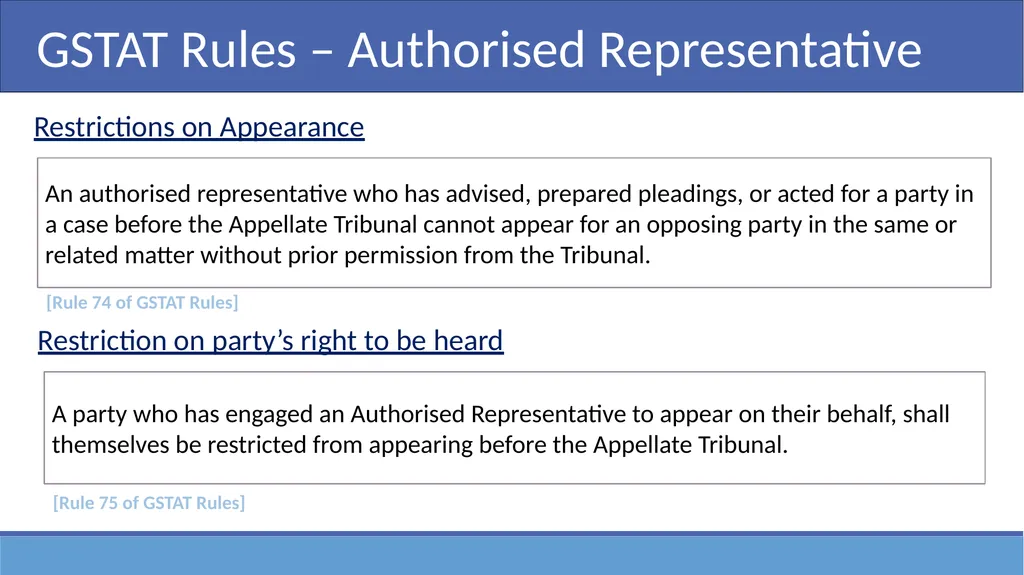
GSTAT Rules – Authorised Representative Restrictions on Appearance An authorised representative who has advised, prepared pleadings, or acted for a party in a case before the Appellate Tribunal cannot appear for an opposing party in the same or related matter without prior permission from the Tribunal. Restriction on party’s right to be heard A party who has engaged an Authorised Representative to appear on their behalf, shall themselves be restricted from appearing before the Appellate Tribunal. [Rule 74 of GSTAT Rules] [Rule 75 of GSTAT Rules]<br>
60
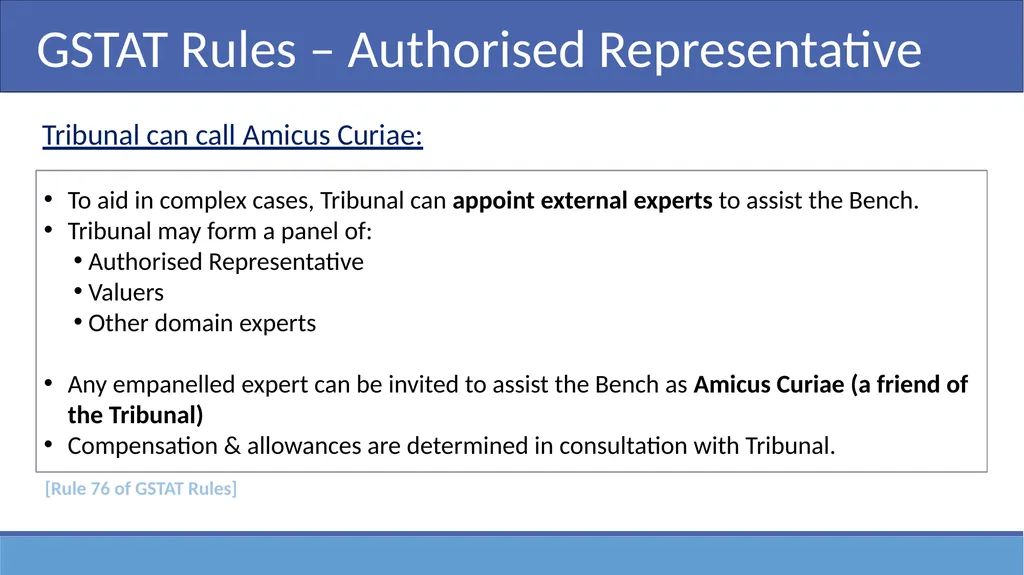
GSTAT Rules – Authorised Representative Tribunal can call Amicus Curiae: To aid in complex cases, Tribunal can appoint external experts to assist the Bench.
Tribunal may form a panel of:
Authorised Representative
Valuers
Other domain experts
Any empanelled expert can be invited to assist the Bench as Amicus Curiae (a friend of the Tribunal)
Compensation & allowances are determined in consultation with Tribunal. [Rule 76 of GSTAT Rules]<br>
Tribunal may form a panel of:
Authorised Representative
Valuers
Other domain experts
Any empanelled expert can be invited to assist the Bench as Amicus Curiae (a friend of the Tribunal)
Compensation & allowances are determined in consultation with Tribunal. [Rule 76 of GSTAT Rules]<br>
61
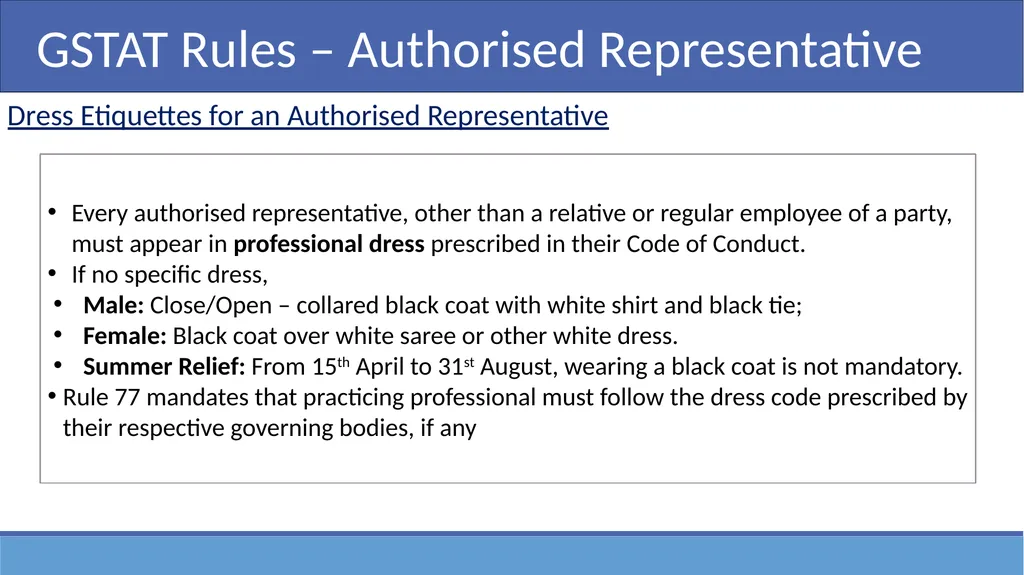
GSTAT Rules – Authorised Representative Dress Etiquettes for an Authorised Representative Every authorised representative, other than a relative or regular employee of a party, must appear in professional dress prescribed in their Code of Conduct.
If no specific dress,
Male: Close/Open – collared black coat with white shirt and black tie;
Female: Black coat over white saree or other white dress.
Summer Relief: From 15th April to 31st August, wearing a black coat is not mandatory.
Rule 77 mandates that practicing professional must follow the dress code prescribed by their respective governing bodies, if any<br>
62
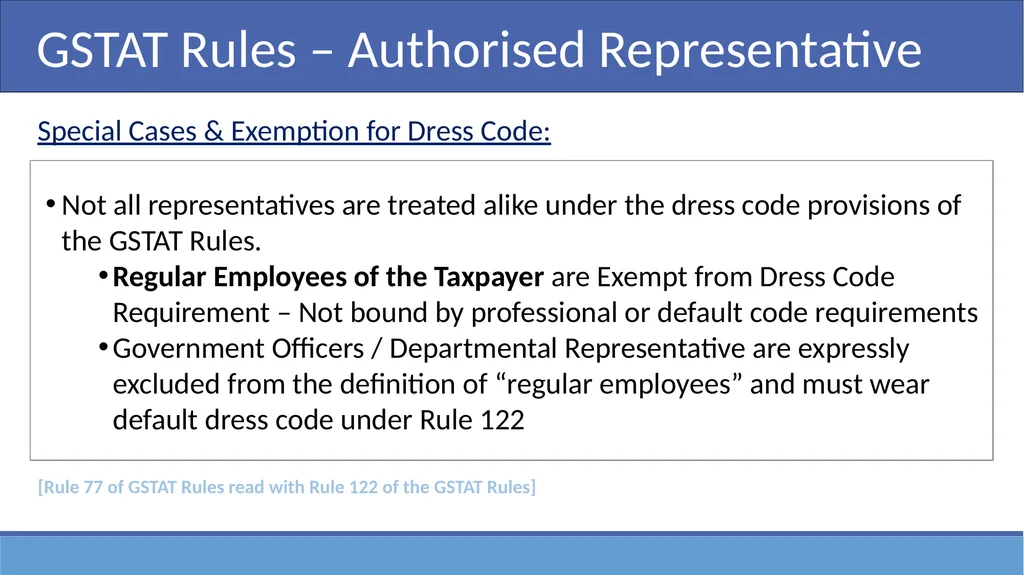
GSTAT Rules – Authorised Representative Special Cases & Exemption for Dress Code: Not all representatives are treated alike under the dress code provisions of the GSTAT Rules.
Regular Employees of the Taxpayer are Exempt from Dress Code Requirement – Not bound by professional or default code requirements
Government Officers / Departmental Representative are expressly excluded from the definition of “regular employees” and must wear default dress code under Rule 122 [Rule 77 of GSTAT Rules read with Rule 122 of the GSTAT Rules]<br>
63
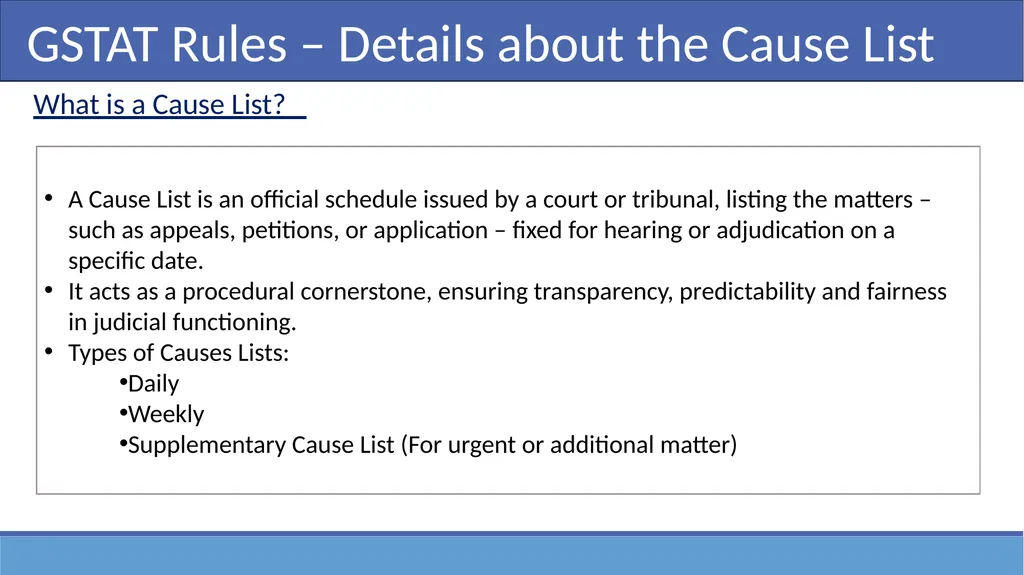
GSTAT Rules – Details about the Cause List What is a Cause List? A Cause List is an official schedule issued by a court or tribunal, listing the matters – such as appeals, petitions, or application – fixed for hearing or adjudication on a specific date.
It acts as a procedural cornerstone, ensuring transparency, predictability and fairness in judicial functioning.
Types of Causes Lists:
Daily
Weekly
Supplementary Cause List (For urgent or additional matter)<br>
It acts as a procedural cornerstone, ensuring transparency, predictability and fairness in judicial functioning.
Types of Causes Lists:
Daily
Weekly
Supplementary Cause List (For urgent or additional matter)<br>
64
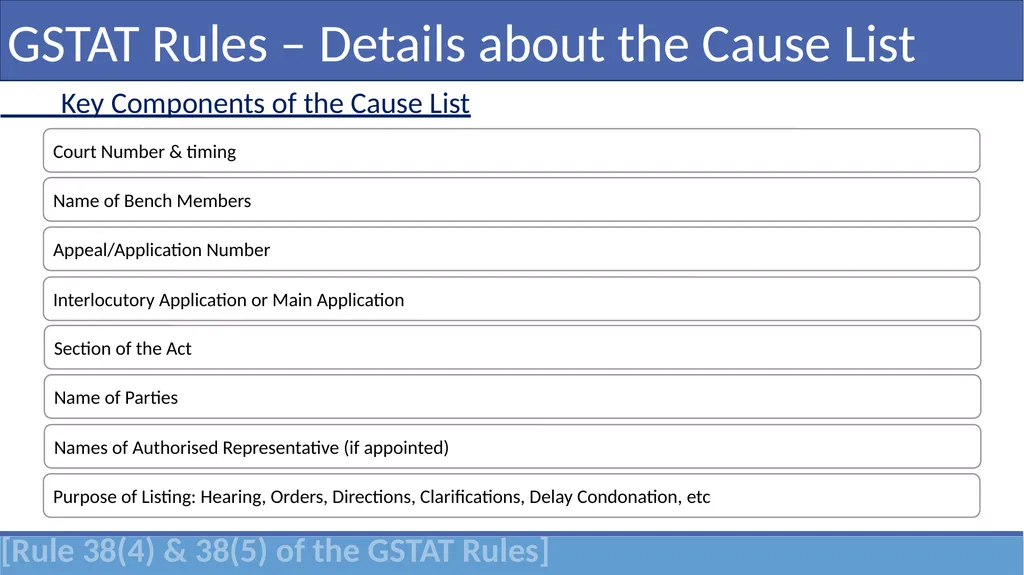
GSTAT Rules – Details about the Cause List Key Components of the Cause List
[Rule 38(4) & 38(5) of the GSTAT Rules] Court Number & timing Name of Bench Members Appeal/Application Number Interlocutory Application or Main Application Section of the Act Name of Parties Names of Authorised Representative (if appointed) Purpose of Listing: Hearing, Orders, Directions, Clarifications, Delay Condonation, etc<br>
[Rule 38(4) & 38(5) of the GSTAT Rules] Court Number & timing Name of Bench Members Appeal/Application Number Interlocutory Application or Main Application Section of the Act Name of Parties Names of Authorised Representative (if appointed) Purpose of Listing: Hearing, Orders, Directions, Clarifications, Delay Condonation, etc<br>
65
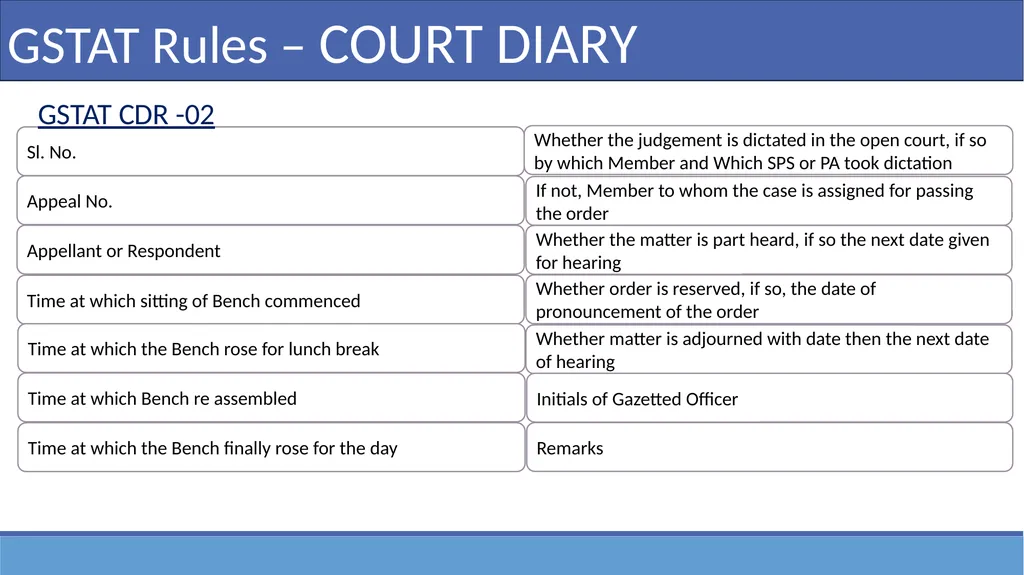
GSTAT Rules – COURT DIARY Sl. No. Appeal No. Appellant or Respondent Time at which sitting of Bench commenced Time at which the Bench rose for lunch break Time at which Bench re assembled Time at which the Bench finally rose for the day Whether the judgement is dictated in the open court, if so by which Member and Which SPS or PA took dictation If not, Member to whom the case is assigned for passing the order Whether the matter is part heard, if so the next date given for hearing Whether order is reserved, if so, the date of pronouncement of the order Whether matter is adjourned with date then the next date of hearing Initials of Gazetted Officer Remarks GSTAT CDR -02<br>
66
QUESTIONS
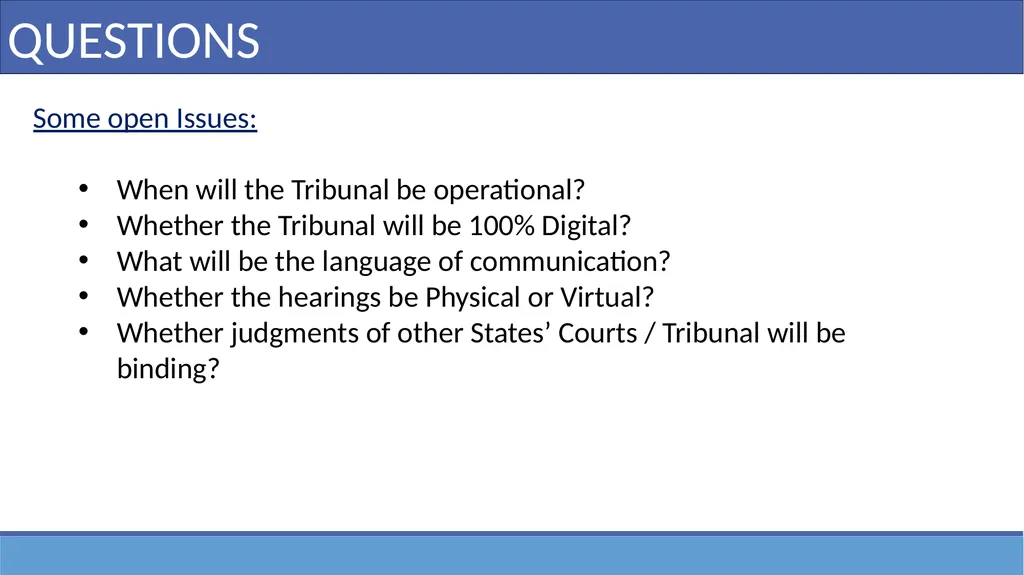
Some open Issues:
When will the Tribunal be operational?
Whether the Tribunal will be 100% Digital?
What will be the language of communication?
Whether the hearings be Physical or Virtual?
Whether judgments of other States’ Courts / Tribunal will be binding? QUESTIONS<br>
Some open Issues:
When will the Tribunal be operational?
Whether the Tribunal will be 100% Digital?
What will be the language of communication?
Whether the hearings be Physical or Virtual?
Whether judgments of other States’ Courts / Tribunal will be binding? QUESTIONS<br>
67
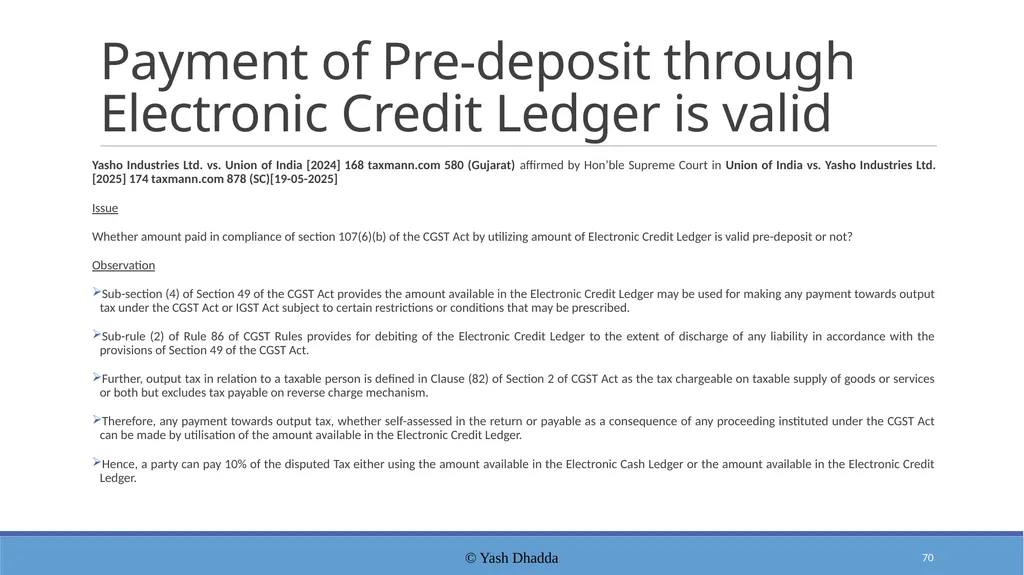
Payment of Pre-deposit through Electronic Credit Ledger is valid © Yash Dhadda 70 Yasho Industries Ltd. vs. Union of India [2024] 168 taxmann.com 580 (Gujarat) affirmed by Hon’ble Supreme Court in Union of India vs. Yasho Industries Ltd. [2025] 174 taxmann.com 878 (SC)[19-05-2025]
Issue
Whether amount paid in compliance of section 107(6)(b) of the CGST Act by utilizing amount of Electronic Credit Ledger is valid pre-deposit or not?
Observation
Sub-section (4) of Section 49 of the CGST Act provides the amount available in the Electronic Credit Ledger may be used for making any payment towards output tax under the CGST Act or IGST Act subject to certain restrictions or conditions that may be prescribed.
Sub-rule (2) of Rule 86 of CGST Rules provides for debiting of the Electronic Credit Ledger to the extent of discharge of any liability in accordance with the provisions of Section 49 of the CGST Act.
Further, output tax in relation to a taxable person is defined in Clause (82) of Section 2 of CGST Act as the tax chargeable on taxable supply of goods or services or both but excludes tax payable on reverse charge mechanism.
Therefore, any payment towards output tax, whether self-assessed in the return or payable as a consequence of any proceeding instituted under the CGST Act can be made by utilisation of the amount available in the Electronic Credit Ledger.
Hence, a party can pay 10% of the disputed Tax either using the amount available in the Electronic Cash Ledger or the amount available in the Electronic Credit Ledger.<br>
68
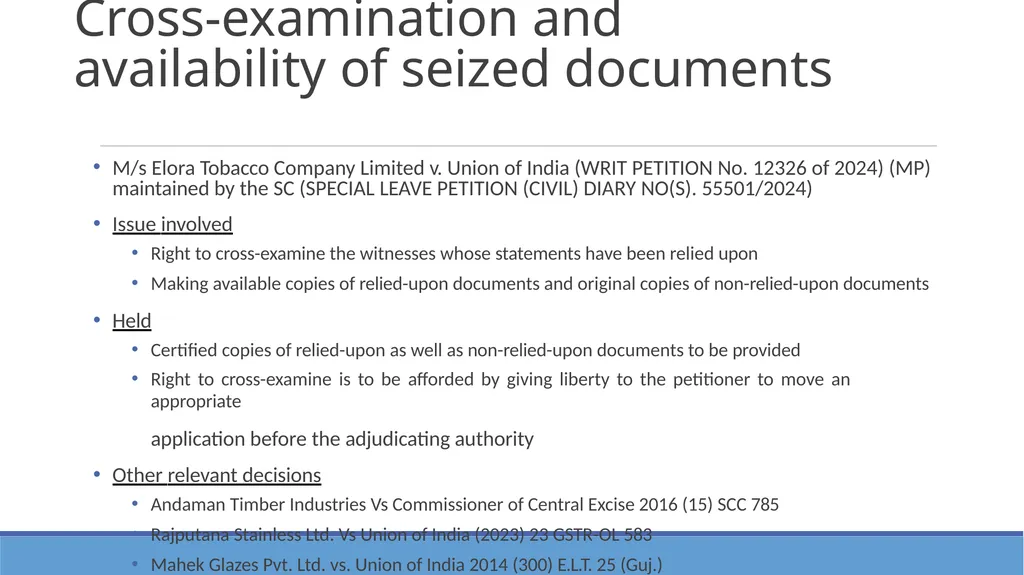
Cross-examination and availability of seized documents M/s Elora Tobacco Company Limited v. Union of India (WRIT PETITION No. 12326 of 2024) (MP) maintained by the SC (SPECIAL LEAVE PETITION (CIVIL) DIARY NO(S). 55501/2024)
Issue involved
Right to cross-examine the witnesses whose statements have been relied upon
Making available copies of relied-upon documents and original copies of non-relied-upon documents
Held
Certified copies of relied-upon as well as non-relied-upon documents to be provided
Right to cross-examine is to be afforded by giving liberty to the petitioner to move an appropriate
application before the adjudicating authority
Other relevant decisions
Andaman Timber Industries Vs Commissioner of Central Excise 2016 (15) SCC 785
Rajputana Stainless Ltd. Vs Union of India (2023) 23 GSTR-OL 583
Mahek Glazes Pvt. Ltd. vs. Union of India 2014 (300) E.L.T. 25 (Guj.)<br>
69
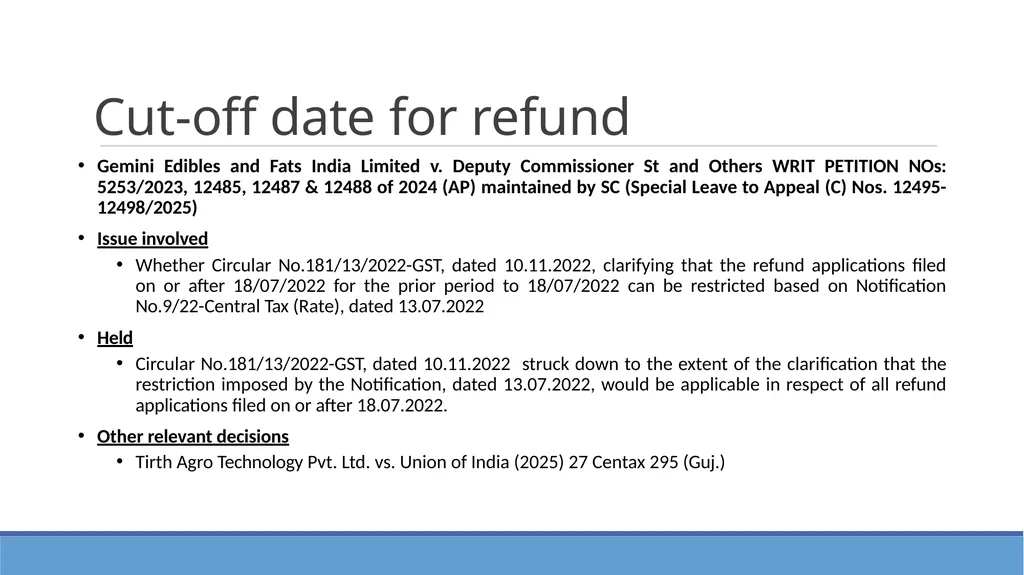
Cut-off date for refund Gemini Edibles and Fats India Limited v. Deputy Commissioner St and Others WRIT PETITION NOs: 5253/2023, 12485, 12487 & 12488 of 2024 (AP) maintained by SC (Special Leave to Appeal (C) Nos. 12495- 12498/2025)
Issue involved
Whether Circular No.181/13/2022-GST, dated 10.11.2022, clarifying that the refund applications filed on or after 18/07/2022 for the prior period to 18/07/2022 can be restricted based on Notification No.9/22-Central Tax (Rate), dated 13.07.2022
Held
Circular No.181/13/2022-GST, dated 10.11.2022 struck down to the extent of the clarification that the restriction imposed by the Notification, dated 13.07.2022, would be applicable in respect of all refund applications filed on or after 18.07.2022.
Other relevant decisions
Tirth Agro Technology Pvt. Ltd. vs. Union of India (2025) 27 Centax 295 (Guj.)<br>
70
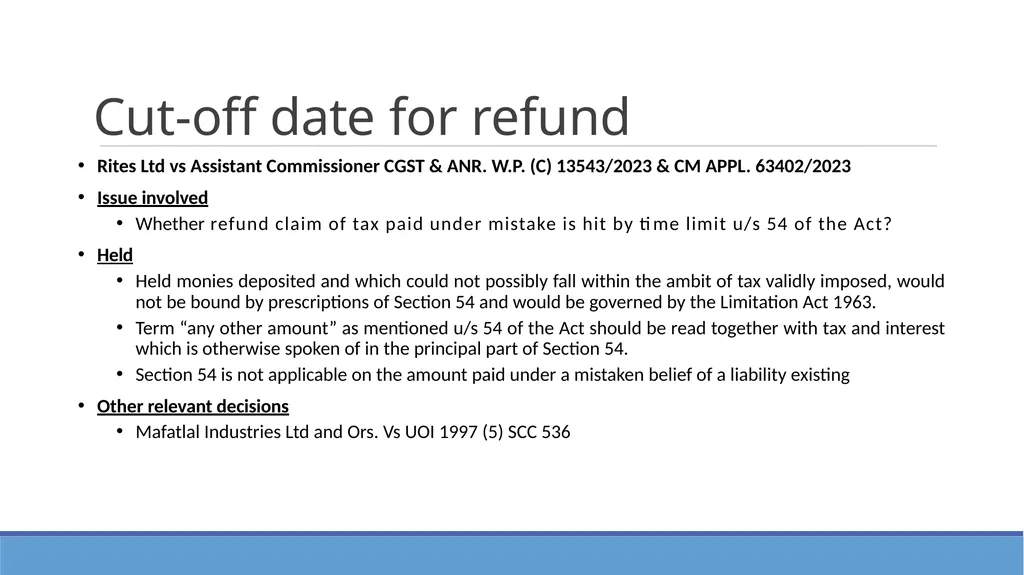
Cut-off date for refund Rites Ltd vs Assistant Commissioner CGST & ANR. W.P. (C) 13543/2023 & CM APPL. 63402/2023
Issue involved
Whether refund claim of tax paid under mistake is hit by time limit u/s 54 of the Act?
Held
Held monies deposited and which could not possibly fall within the ambit of tax validly imposed, would not be bound by prescriptions of Section 54 and would be governed by the Limitation Act 1963.
Term “any other amount” as mentioned u/s 54 of the Act should be read together with tax and interest which is otherwise spoken of in the principal part of Section 54.
Section 54 is not applicable on the amount paid under a mistaken belief of a liability existing
Other relevant decisions
Mafatlal Industries Ltd and Ors. Vs UOI 1997 (5) SCC 536<br>
71
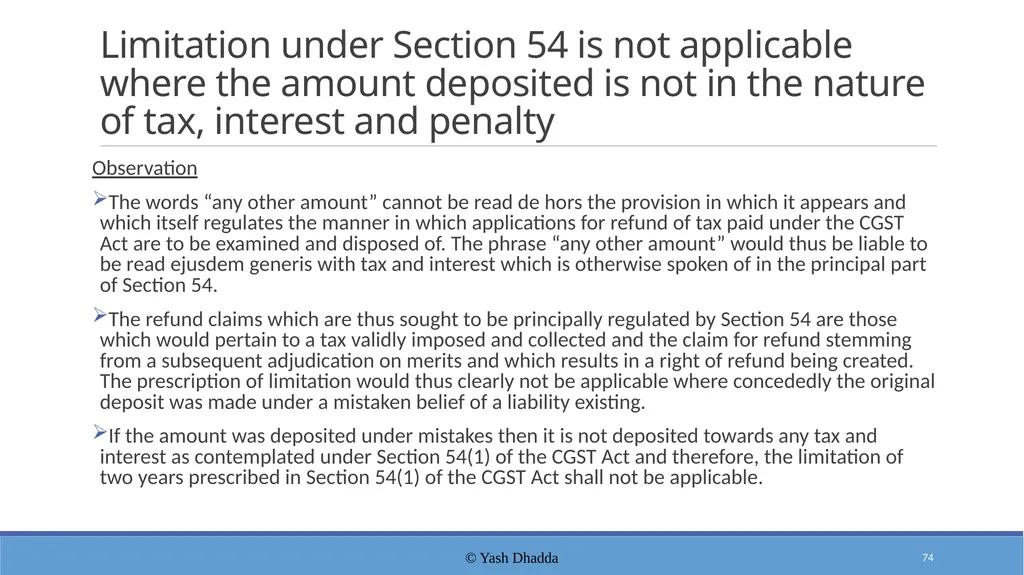
Limitation under Section 54 is not applicable where the amount deposited is not in the nature of tax, interest and penalty Observation
The words “any other amount” cannot be read de hors the provision in which it appears and which itself regulates the manner in which applications for refund of tax paid under the CGST Act are to be examined and disposed of. The phrase “any other amount” would thus be liable to be read ejusdem generis with tax and interest which is otherwise spoken of in the principal part of Section 54.
The refund claims which are thus sought to be principally regulated by Section 54 are those which would pertain to a tax validly imposed and collected and the claim for refund stemming from a subsequent adjudication on merits and which results in a right of refund being created. The prescription of limitation would thus clearly not be applicable where concededly the original deposit was made under a mistaken belief of a liability existing.
If the amount was deposited under mistakes then it is not deposited towards any tax and interest as contemplated under Section 54(1) of the CGST Act and therefore, the limitation of two years prescribed in Section 54(1) of the CGST Act shall not be applicable. © Yash Dhadda 74<br>
72
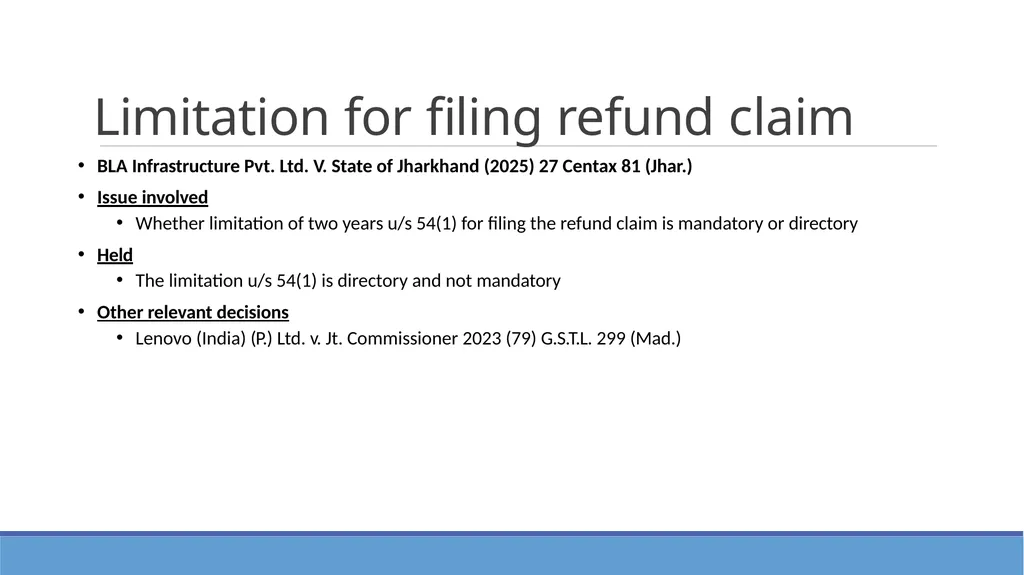
Limitation for filing refund claim BLA Infrastructure Pvt. Ltd. V. State of Jharkhand (2025) 27 Centax 81 (Jhar.)
Issue involved
Whether limitation of two years u/s 54(1) for filing the refund claim is mandatory or directory
Held
The limitation u/s 54(1) is directory and not mandatory
Other relevant decisions
Lenovo (India) (P.) Ltd. v. Jt. Commissioner 2023 (79) G.S.T.L. 299 (Mad.)<br>
Issue involved
Whether limitation of two years u/s 54(1) for filing the refund claim is mandatory or directory
Held
The limitation u/s 54(1) is directory and not mandatory
Other relevant decisions
Lenovo (India) (P.) Ltd. v. Jt. Commissioner 2023 (79) G.S.T.L. 299 (Mad.)<br>
73
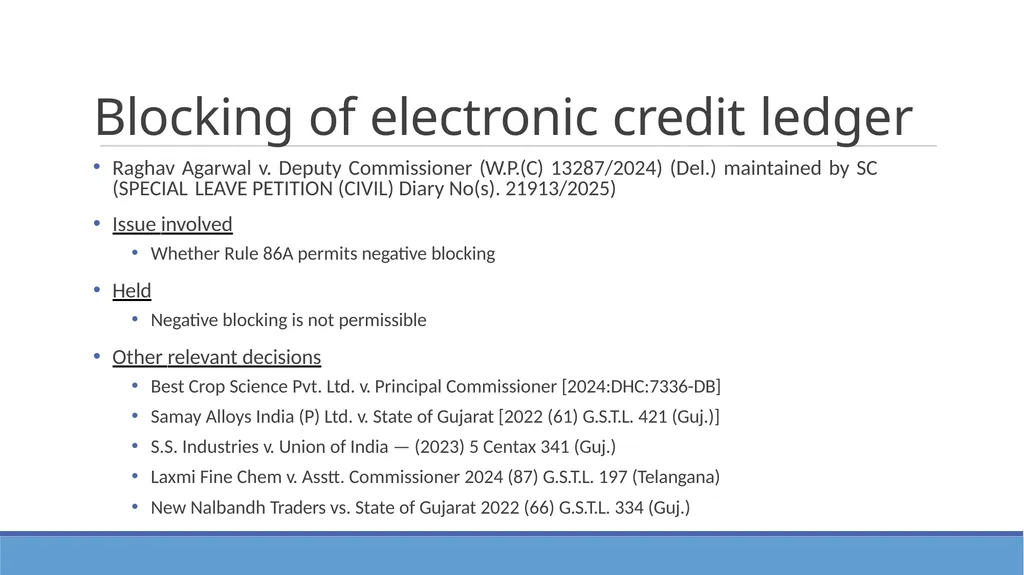
Blocking of electronic credit ledger Raghav Agarwal v. Deputy Commissioner (W.P.(C) 13287/2024) (Del.) maintained by SC (SPECIAL LEAVE PETITION (CIVIL) Diary No(s). 21913/2025)
Issue involved
Whether Rule 86A permits negative blocking
Held
Negative blocking is not permissible
Other relevant decisions
Best Crop Science Pvt. Ltd. v. Principal Commissioner [2024:DHC:7336-DB]
Samay Alloys India (P) Ltd. v. State of Gujarat [2022 (61) G.S.T.L. 421 (Guj.)]
S.S. Industries v. Union of India — (2023) 5 Centax 341 (Guj.)
Laxmi Fine Chem v. Asstt. Commissioner 2024 (87) G.S.T.L. 197 (Telangana)
New Nalbandh Traders vs. State of Gujarat 2022 (66) G.S.T.L. 334 (Guj.)<br>
74
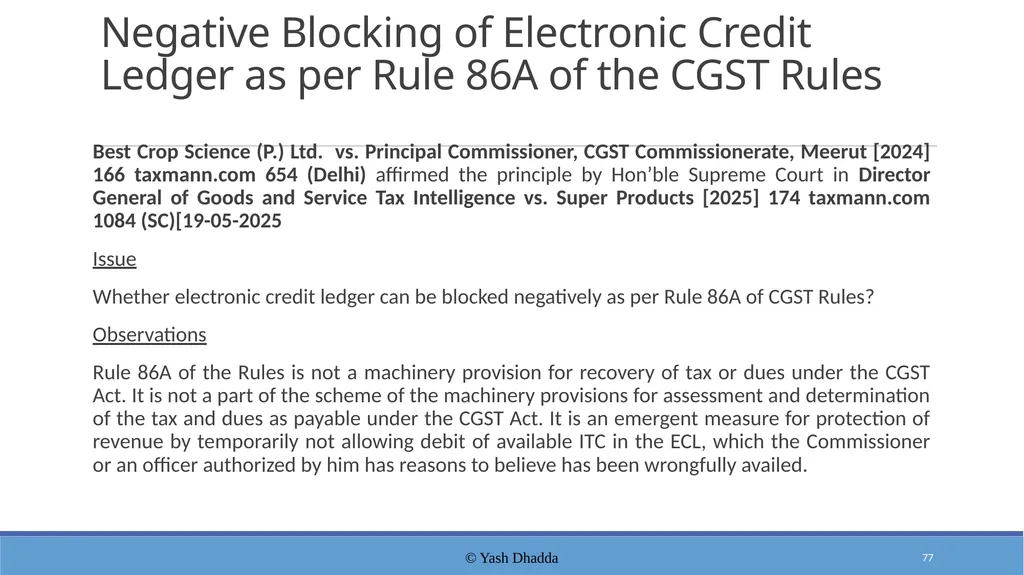
Negative Blocking of Electronic Credit Ledger as per Rule 86A of the CGST Rules Best Crop Science (P.) Ltd. vs. Principal Commissioner, CGST Commissionerate, Meerut [2024] 166 taxmann.com 654 (Delhi) affirmed the principle by Hon’ble Supreme Court in Director General of Goods and Service Tax Intelligence vs. Super Products [2025] 174 taxmann.com 1084 (SC)[19-05-2025
Issue
Whether electronic credit ledger can be blocked negatively as per Rule 86A of CGST Rules?
Observations
Rule 86A of the Rules is not a machinery provision for recovery of tax or dues under the CGST Act. It is not a part of the scheme of the machinery provisions for assessment and determination of the tax and dues as payable under the CGST Act. It is an emergent measure for protection of revenue by temporarily not allowing debit of available ITC in the ECL, which the Commissioner or an officer authorized by him has reasons to believe has been wrongfully availed. © Yash Dhadda 77<br>
75
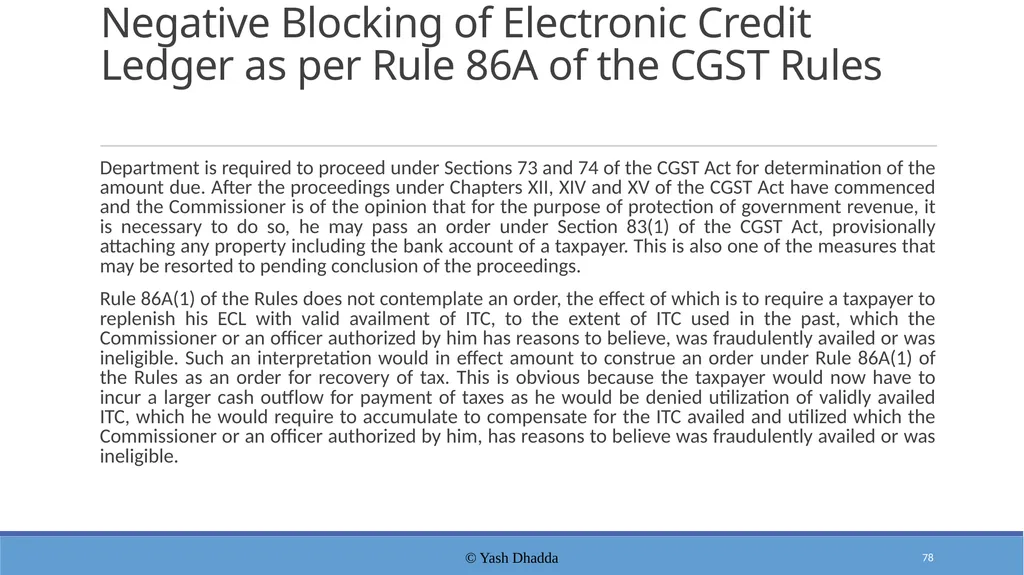
Negative Blocking of Electronic Credit Ledger as per Rule 86A of the CGST Rules Department is required to proceed under Sections 73 and 74 of the CGST Act for determination of the amount due. After the proceedings under Chapters XII, XIV and XV of the CGST Act have commenced and the Commissioner is of the opinion that for the purpose of protection of government revenue, it is necessary to do so, he may pass an order under Section 83(1) of the CGST Act, provisionally attaching any property including the bank account of a taxpayer. This is also one of the measures that may be resorted to pending conclusion of the proceedings.
Rule 86A(1) of the Rules does not contemplate an order, the effect of which is to require a taxpayer to replenish his ECL with valid availment of ITC, to the extent of ITC used in the past, which the Commissioner or an officer authorized by him has reasons to believe, was fraudulently availed or was ineligible. Such an interpretation would in effect amount to construe an order under Rule 86A(1) of the Rules as an order for recovery of tax. This is obvious because the taxpayer would now have to incur a larger cash outflow for payment of taxes as he would be denied utilization of validly availed ITC, which he would require to accumulate to compensate for the ITC availed and utilized which the Commissioner or an officer authorized by him, has reasons to believe was fraudulently availed or was ineligible. © Yash Dhadda 78<br>
Rule 86A(1) of the Rules does not contemplate an order, the effect of which is to require a taxpayer to replenish his ECL with valid availment of ITC, to the extent of ITC used in the past, which the Commissioner or an officer authorized by him has reasons to believe, was fraudulently availed or was ineligible. Such an interpretation would in effect amount to construe an order under Rule 86A(1) of the Rules as an order for recovery of tax. This is obvious because the taxpayer would now have to incur a larger cash outflow for payment of taxes as he would be denied utilization of validly availed ITC, which he would require to accumulate to compensate for the ITC availed and utilized which the Commissioner or an officer authorized by him, has reasons to believe was fraudulently availed or was ineligible. © Yash Dhadda 78<br>
76
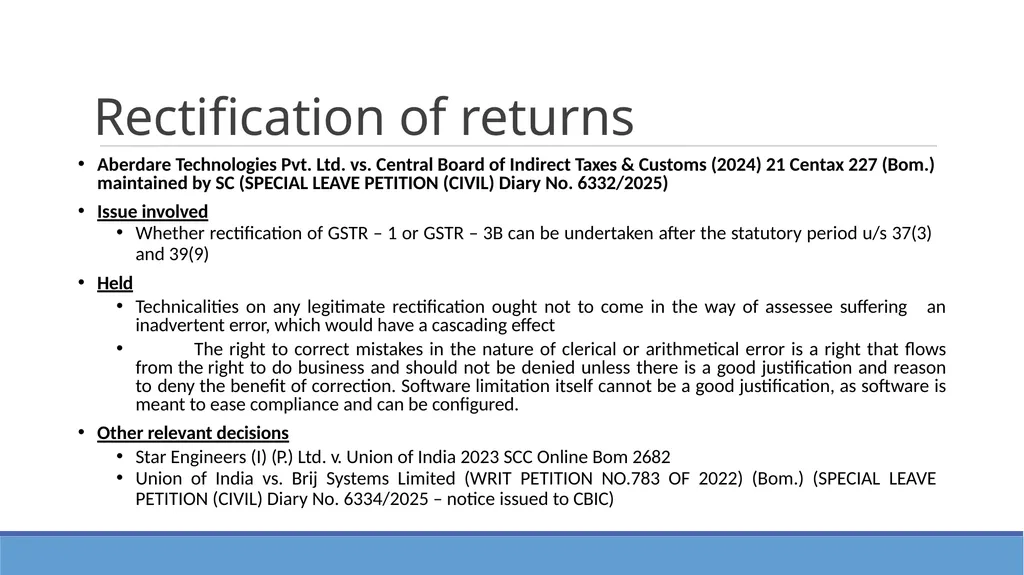
Rectification of returns Aberdare Technologies Pvt. Ltd. vs. Central Board of Indirect Taxes & Customs (2024) 21 Centax 227 (Bom.) maintained by SC (SPECIAL LEAVE PETITION (CIVIL) Diary No. 6332/2025)
Issue involved
Whether rectification of GSTR – 1 or GSTR – 3B can be undertaken after the statutory period u/s 37(3)
and 39(9)
Held
Technicalities on any legitimate rectification ought not to come in the way of assessee suffering an inadvertent error, which would have a cascading effect
The right to correct mistakes in the nature of clerical or arithmetical error is a right that flows from the right to do business and should not be denied unless there is a good justification and reason to deny the benefit of correction. Software limitation itself cannot be a good justification, as software is meant to ease compliance and can be configured.
Other relevant decisions
Star Engineers (I) (P.) Ltd. v. Union of India 2023 SCC Online Bom 2682
Union of India vs. Brij Systems Limited (WRIT PETITION NO.783 OF 2022) (Bom.) (SPECIAL LEAVE
PETITION (CIVIL) Diary No. 6334/2025 – notice issued to CBIC)<br>
77
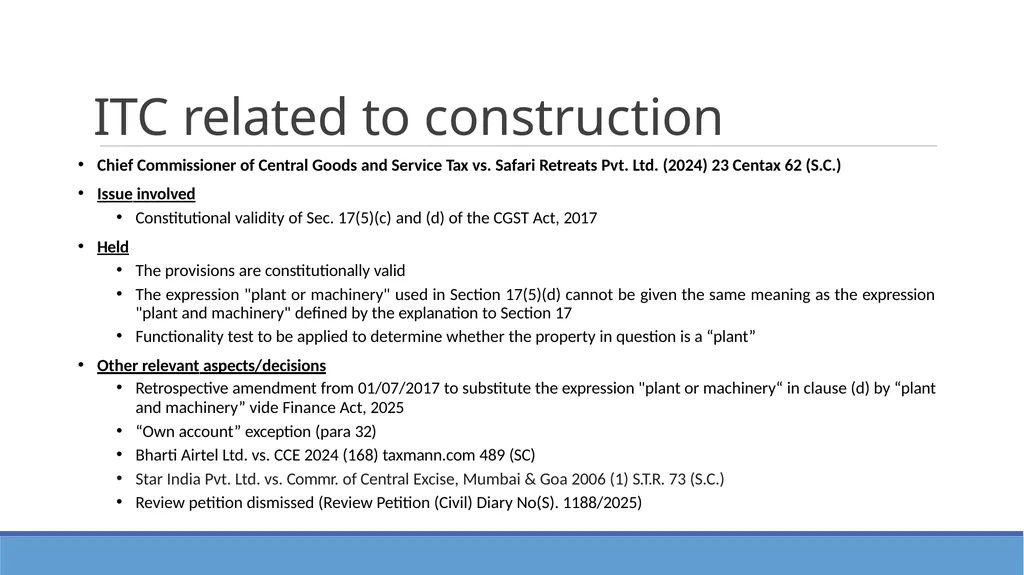
ITC related to construction Chief Commissioner of Central Goods and Service Tax vs. Safari Retreats Pvt. Ltd. (2024) 23 Centax 62 (S.C.)
Issue involved
Constitutional validity of Sec. 17(5)(c) and (d) of the CGST Act, 2017
Held
The provisions are constitutionally valid
The expression "plant or machinery" used in Section 17(5)(d) cannot be given the same meaning as the expression "plant and machinery" defined by the explanation to Section 17
Functionality test to be applied to determine whether the property in question is a “plant”
Other relevant aspects/decisions
Retrospective amendment from 01/07/2017 to substitute the expression "plant or machinery“ in clause (d) by “plant
and machinery” vide Finance Act, 2025
“Own account” exception (para 32)
Bharti Airtel Ltd. vs. CCE 2024 (168) taxmann.com 489 (SC)
Star India Pvt. Ltd. vs. Commr. of Central Excise, Mumbai & Goa 2006 (1) S.T.R. 73 (S.C.)
Review petition dismissed (Review Petition (Civil) Diary No(S). 1188/2025)<br>
78
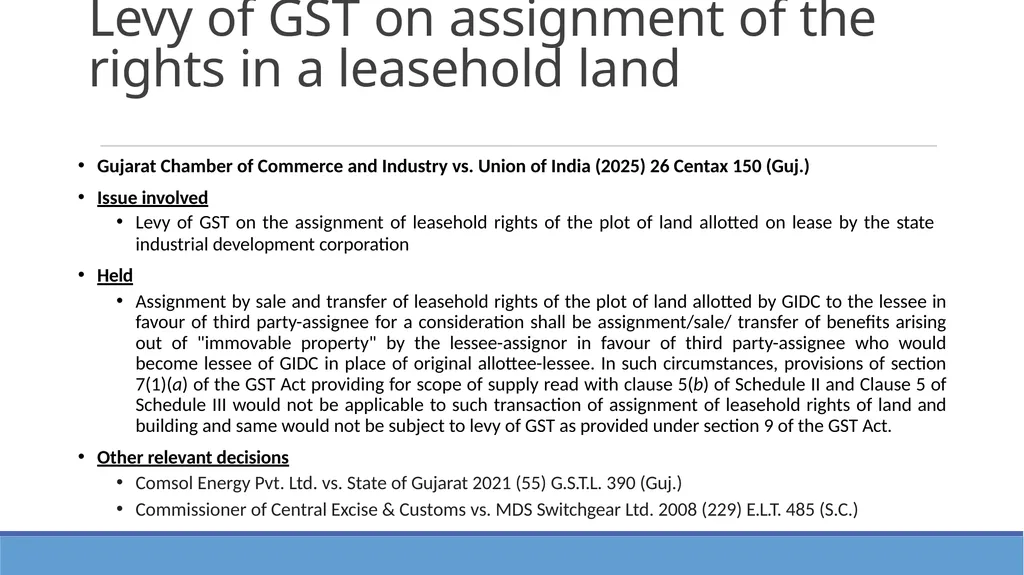
Levy of GST on assignment of the rights in a leasehold land Gujarat Chamber of Commerce and Industry vs. Union of India (2025) 26 Centax 150 (Guj.)
Issue involved
Levy of GST on the assignment of leasehold rights of the plot of land allotted on lease by the state
industrial development corporation
Held
Assignment by sale and transfer of leasehold rights of the plot of land allotted by GIDC to the lessee in favour of third party-assignee for a consideration shall be assignment/sale/ transfer of benefits arising out of "immovable property" by the lessee-assignor in favour of third party-assignee who would become lessee of GIDC in place of original allottee-lessee. In such circumstances, provisions of section 7(1)(a) of the GST Act providing for scope of supply read with clause 5(b) of Schedule II and Clause 5 of Schedule III would not be applicable to such transaction of assignment of leasehold rights of land and building and same would not be subject to levy of GST as provided under section 9 of the GST Act.
Other relevant decisions
Comsol Energy Pvt. Ltd. vs. State of Gujarat 2021 (55) G.S.T.L. 390 (Guj.)
Commissioner of Central Excise & Customs vs. MDS Switchgear Ltd. 2008 (229) E.L.T. 485 (S.C.)<br>
79
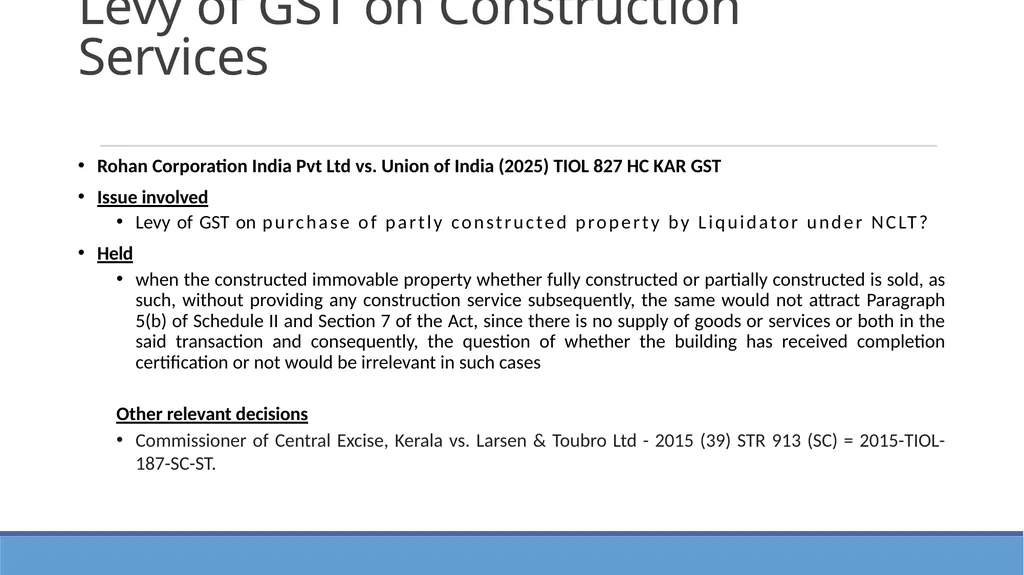
Levy of GST on Construction Services Rohan Corporation India Pvt Ltd vs. Union of India (2025) TIOL 827 HC KAR GST
Issue involved
Levy of GST on purchase of partly constructed property by Liquidator under NCLT?
Held
when the constructed immovable property whether fully constructed or partially constructed is sold, as such, without providing any construction service subsequently, the same would not attract Paragraph 5(b) of Schedule II and Section 7 of the Act, since there is no supply of goods or services or both in the said transaction and consequently, the question of whether the building has received completion certification or not would be irrelevant in such cases
Other relevant decisions
Commissioner of Central Excise, Kerala vs. Larsen & Toubro Ltd - 2015 (39) STR 913 (SC) = 2015-TIOL-187-SC-ST.<br>
80
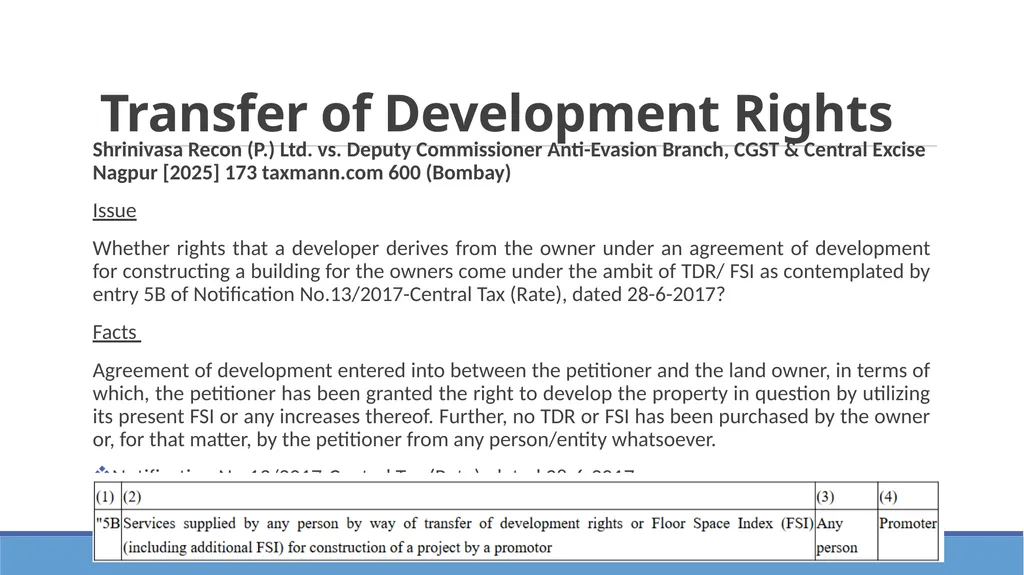
Transfer of Development Rights © Yash Dhadda 83 Shrinivasa Recon (P.) Ltd. vs. Deputy Commissioner Anti-Evasion Branch, CGST & Central Excise Nagpur [2025] 173 taxmann.com 600 (Bombay)
Issue
Whether rights that a developer derives from the owner under an agreement of development for constructing a building for the owners come under the ambit of TDR/ FSI as contemplated by entry 5B of Notification No.13/2017-Central Tax (Rate), dated 28-6-2017?
Facts
Agreement of development entered into between the petitioner and the land owner, in terms of which, the petitioner has been granted the right to develop the property in question by utilizing its present FSI or any increases thereof. Further, no TDR or FSI has been purchased by the owner or, for that matter, by the petitioner from any person/entity whatsoever.
Notification No.13/2017-Central Tax (Rate), dated 28-6-2017<br>
81
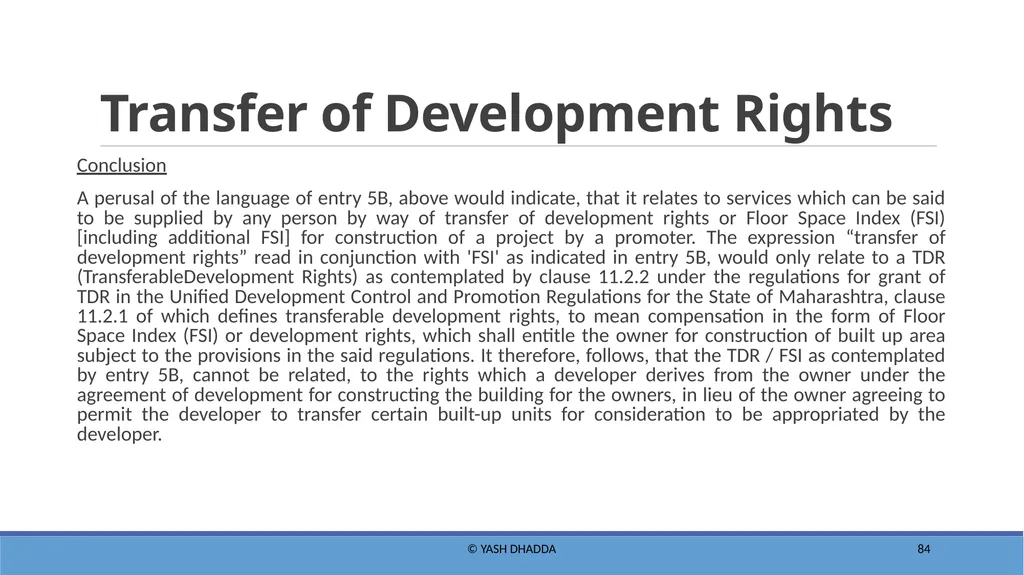
Transfer of Development Rights Conclusion
A perusal of the language of entry 5B, above would indicate, that it relates to services which can be said to be supplied by any person by way of transfer of development rights or Floor Space Index (FSI) [including additional FSI] for construction of a project by a promoter. The expression “transfer of development rights” read in conjunction with 'FSI' as indicated in entry 5B, would only relate to a TDR (TransferableDevelopment Rights) as contemplated by clause 11.2.2 under the regulations for grant of TDR in the Unified Development Control and Promotion Regulations for the State of Maharashtra, clause 11.2.1 of which defines transferable development rights, to mean compensation in the form of Floor Space Index (FSI) or development rights, which shall entitle the owner for construction of built up area subject to the provisions in the said regulations. It therefore, follows, that the TDR / FSI as contemplated by entry 5B, cannot be related, to the rights which a developer derives from the owner under the agreement of development for constructing the building for the owners, in lieu of the owner agreeing to permit the developer to transfer certain built-up units for consideration to be appropriated by the developer. © Yash Dhadda 84<br>
A perusal of the language of entry 5B, above would indicate, that it relates to services which can be said to be supplied by any person by way of transfer of development rights or Floor Space Index (FSI) [including additional FSI] for construction of a project by a promoter. The expression “transfer of development rights” read in conjunction with 'FSI' as indicated in entry 5B, would only relate to a TDR (TransferableDevelopment Rights) as contemplated by clause 11.2.2 under the regulations for grant of TDR in the Unified Development Control and Promotion Regulations for the State of Maharashtra, clause 11.2.1 of which defines transferable development rights, to mean compensation in the form of Floor Space Index (FSI) or development rights, which shall entitle the owner for construction of built up area subject to the provisions in the said regulations. It therefore, follows, that the TDR / FSI as contemplated by entry 5B, cannot be related, to the rights which a developer derives from the owner under the agreement of development for constructing the building for the owners, in lieu of the owner agreeing to permit the developer to transfer certain built-up units for consideration to be appropriated by the developer. © Yash Dhadda 84<br>
82
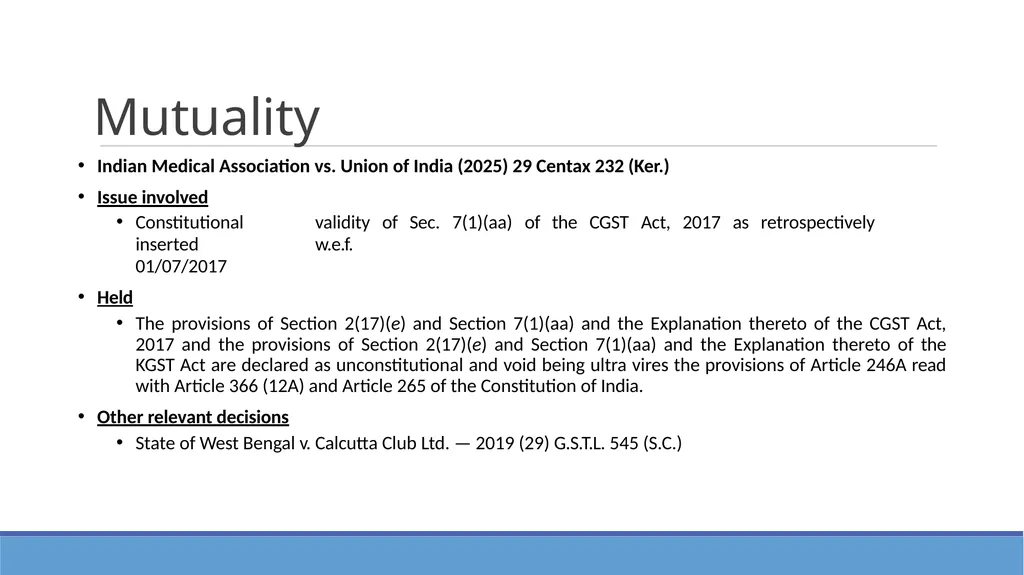
Mutuality Indian Medical Association vs. Union of India (2025) 29 Centax 232 (Ker.)
Issue involved
Constitutional validity of Sec. 7(1)(aa) of the CGST Act, 2017 as retrospectively inserted w.e.f.
01/07/2017
Held
The provisions of Section 2(17)(e) and Section 7(1)(aa) and the Explanation thereto of the CGST Act, 2017 and the provisions of Section 2(17)(e) and Section 7(1)(aa) and the Explanation thereto of the KGST Act are declared as unconstitutional and void being ultra vires the provisions of Article 246A read with Article 366 (12A) and Article 265 of the Constitution of India.
Other relevant decisions
State of West Bengal v. Calcutta Club Ltd. — 2019 (29) G.S.T.L. 545 (S.C.)<br>
83
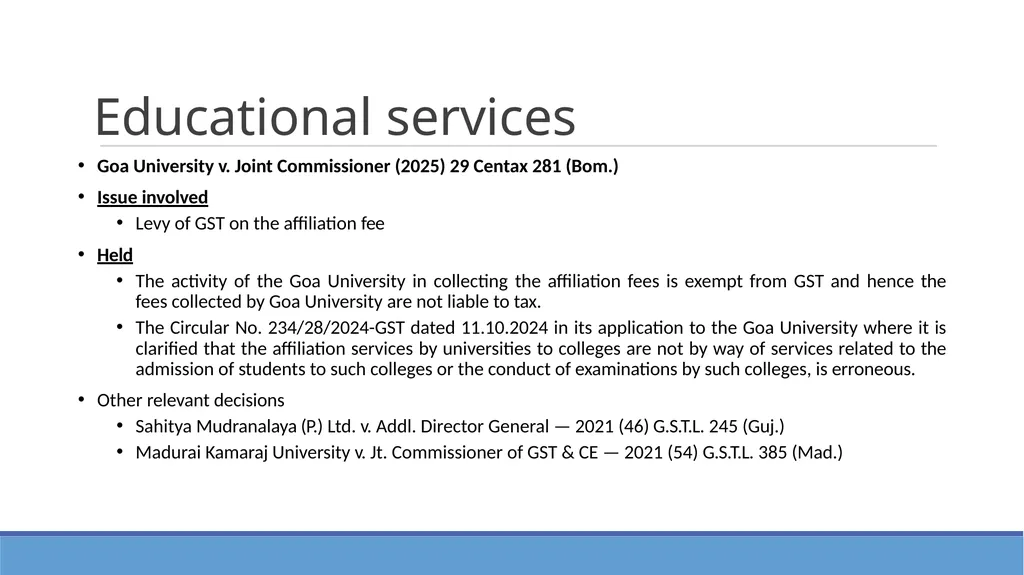
Educational services Goa University v. Joint Commissioner (2025) 29 Centax 281 (Bom.)
Issue involved
Levy of GST on the affiliation fee
Held
The activity of the Goa University in collecting the affiliation fees is exempt from GST and hence the fees collected by Goa University are not liable to tax.
The Circular No. 234/28/2024-GST dated 11.10.2024 in its application to the Goa University where it is clarified that the affiliation services by universities to colleges are not by way of services related to the admission of students to such colleges or the conduct of examinations by such colleges, is erroneous.
Other relevant decisions
Sahitya Mudranalaya (P.) Ltd. v. Addl. Director General — 2021 (46) G.S.T.L. 245 (Guj.)
Madurai Kamaraj University v. Jt. Commissioner of GST & CE — 2021 (54) G.S.T.L. 385 (Mad.)<br>
84
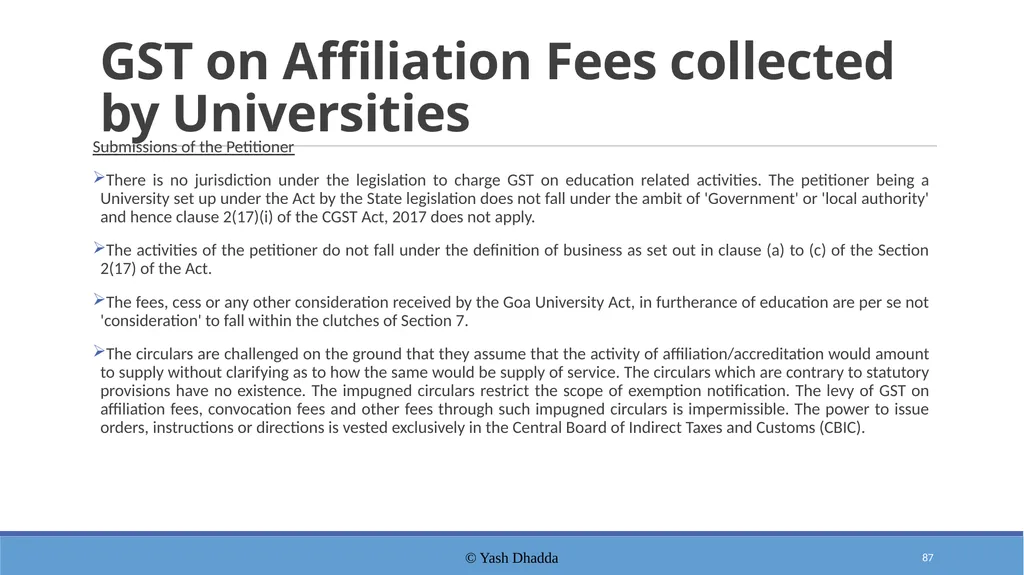
GST on Affiliation Fees collected by Universities © Yash Dhadda 87 Submissions of the Petitioner
There is no jurisdiction under the legislation to charge GST on education related activities. The petitioner being a University set up under the Act by the State legislation does not fall under the ambit of 'Government' or 'local authority' and hence clause 2(17)(i) of the CGST Act, 2017 does not apply.
The activities of the petitioner do not fall under the definition of business as set out in clause (a) to (c) of the Section 2(17) of the Act.
The fees, cess or any other consideration received by the Goa University Act, in furtherance of education are per se not 'consideration' to fall within the clutches of Section 7.
The circulars are challenged on the ground that they assume that the activity of affiliation/accreditation would amount to supply without clarifying as to how the same would be supply of service. The circulars which are contrary to statutory provisions have no existence. The impugned circulars restrict the scope of exemption notification. The levy of GST on affiliation fees, convocation fees and other fees through such impugned circulars is impermissible. The power to issue orders, instructions or directions is vested exclusively in the Central Board of Indirect Taxes and Customs (CBIC).<br>
85
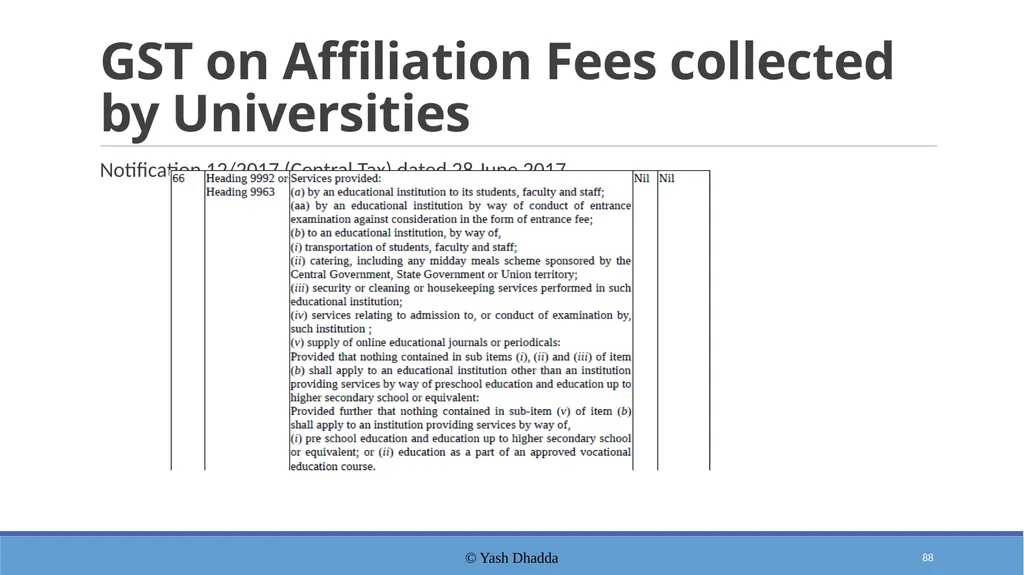
GST on Affiliation Fees collected by Universities Notification 12/2017 (Central Tax) dated 28 June 2017 © Yash Dhadda 88<br>
86
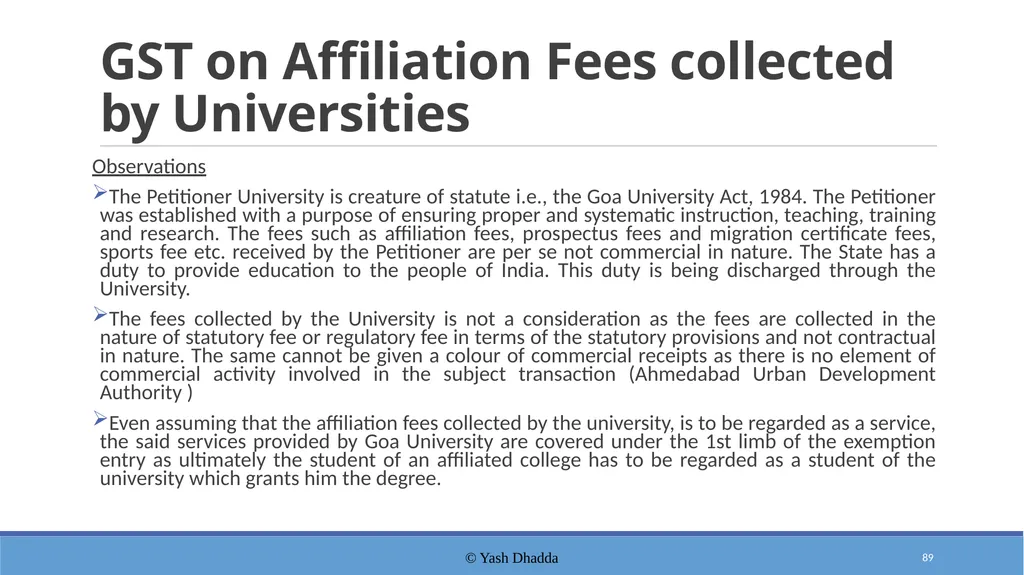
GST on Affiliation Fees collected by Universities Observations
The Petitioner University is creature of statute i.e., the Goa University Act, 1984. The Petitioner was established with a purpose of ensuring proper and systematic instruction, teaching, training and research. The fees such as affiliation fees, prospectus fees and migration certificate fees, sports fee etc. received by the Petitioner are per se not commercial in nature. The State has a duty to provide education to the people of India. This duty is being discharged through the University.
The fees collected by the University is not a consideration as the fees are collected in the nature of statutory fee or regulatory fee in terms of the statutory provisions and not contractual in nature. The same cannot be given a colour of commercial receipts as there is no element of commercial activity involved in the subject transaction (Ahmedabad Urban Development Authority )
Even assuming that the affiliation fees collected by the university, is to be regarded as a service, the said services provided by Goa University are covered under the 1st limb of the exemption entry as ultimately the student of an affiliated college has to be regarded as a student of the university which grants him the degree. © Yash Dhadda 89<br>
87
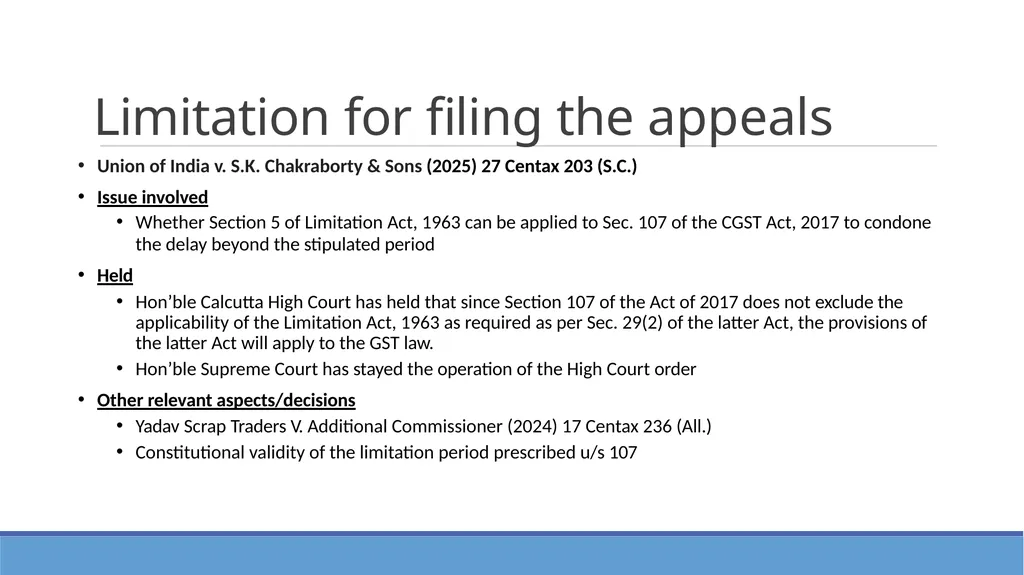
Limitation for filing the appeals Union of India v. S.K. Chakraborty & Sons (2025) 27 Centax 203 (S.C.)
Issue involved
Whether Section 5 of Limitation Act, 1963 can be applied to Sec. 107 of the CGST Act, 2017 to condone
the delay beyond the stipulated period
Held
Hon’ble Calcutta High Court has held that since Section 107 of the Act of 2017 does not exclude the applicability of the Limitation Act, 1963 as required as per Sec. 29(2) of the latter Act, the provisions of the latter Act will apply to the GST law.
Hon’ble Supreme Court has stayed the operation of the High Court order
Other relevant aspects/decisions
Yadav Scrap Traders V. Additional Commissioner (2024) 17 Centax 236 (All.)
Constitutional validity of the limitation period prescribed u/s 107<br>
88
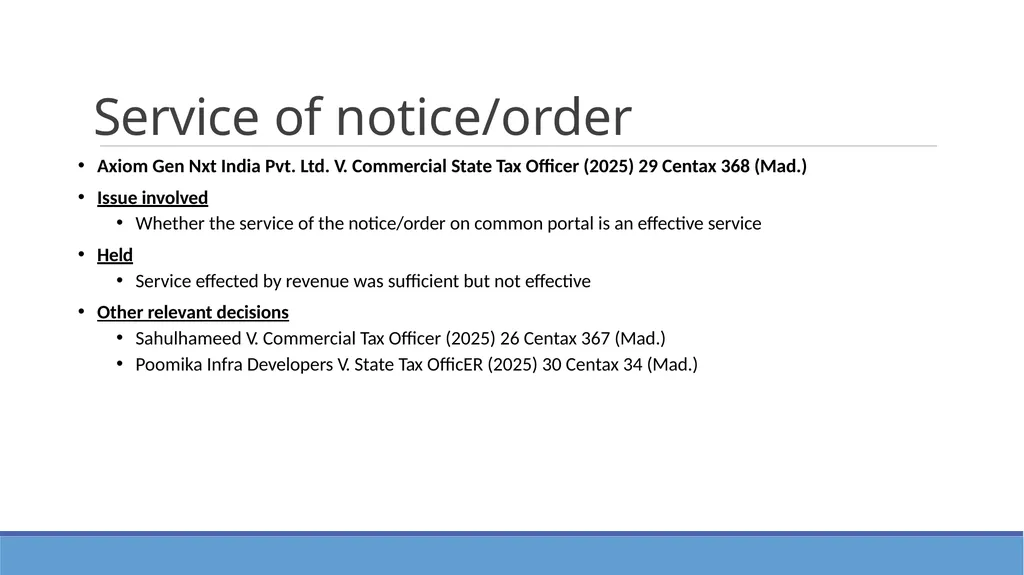
Service of notice/order Axiom Gen Nxt India Pvt. Ltd. V. Commercial State Tax Officer (2025) 29 Centax 368 (Mad.)
Issue involved
Whether the service of the notice/order on common portal is an effective service
Held
Service effected by revenue was sufficient but not effective
Other relevant decisions
Sahulhameed V. Commercial Tax Officer (2025) 26 Centax 367 (Mad.)
Poomika Infra Developers V. State Tax OfficER (2025) 30 Centax 34 (Mad.)<br>
89
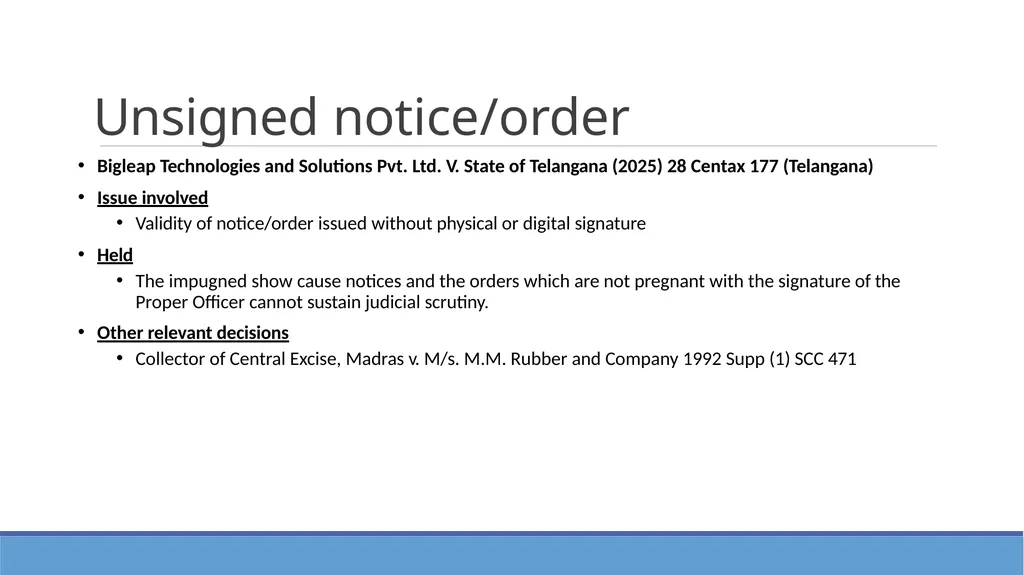
Unsigned notice/order Bigleap Technologies and Solutions Pvt. Ltd. V. State of Telangana (2025) 28 Centax 177 (Telangana)
Issue involved
Validity of notice/order issued without physical or digital signature
Held
The impugned show cause notices and the orders which are not pregnant with the signature of the Proper Officer cannot sustain judicial scrutiny.
Other relevant decisions
Collector of Central Excise, Madras v. M/s. M.M. Rubber and Company 1992 Supp (1) SCC 471<br>
90
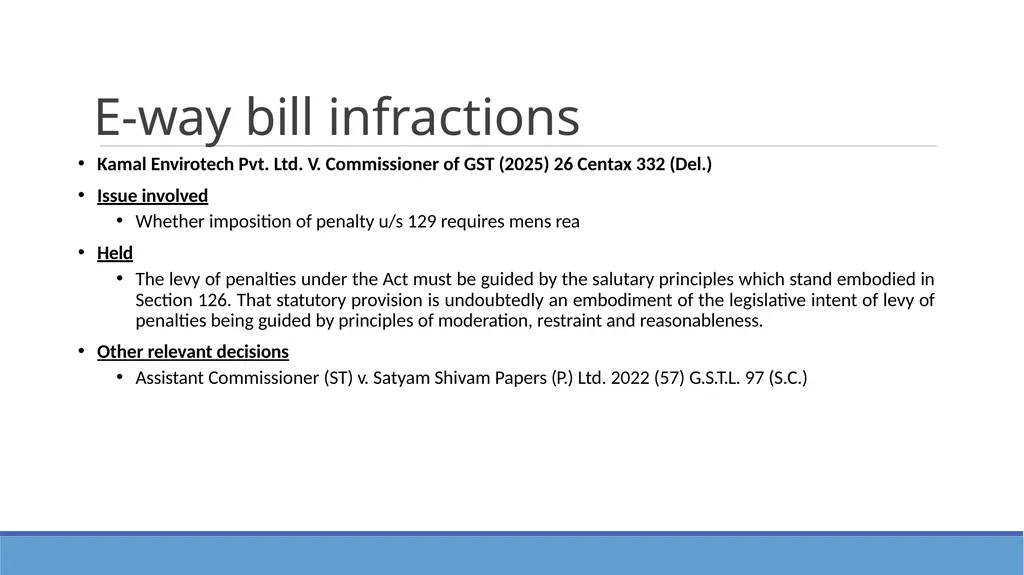
E-way bill infractions Kamal Envirotech Pvt. Ltd. V. Commissioner of GST (2025) 26 Centax 332 (Del.)
Issue involved
Whether imposition of penalty u/s 129 requires mens rea
Held
The levy of penalties under the Act must be guided by the salutary principles which stand embodied in Section 126. That statutory provision is undoubtedly an embodiment of the legislative intent of levy of penalties being guided by principles of moderation, restraint and reasonableness.
Other relevant decisions
Assistant Commissioner (ST) v. Satyam Shivam Papers (P.) Ltd. 2022 (57) G.S.T.L. 97 (S.C.)<br>
91
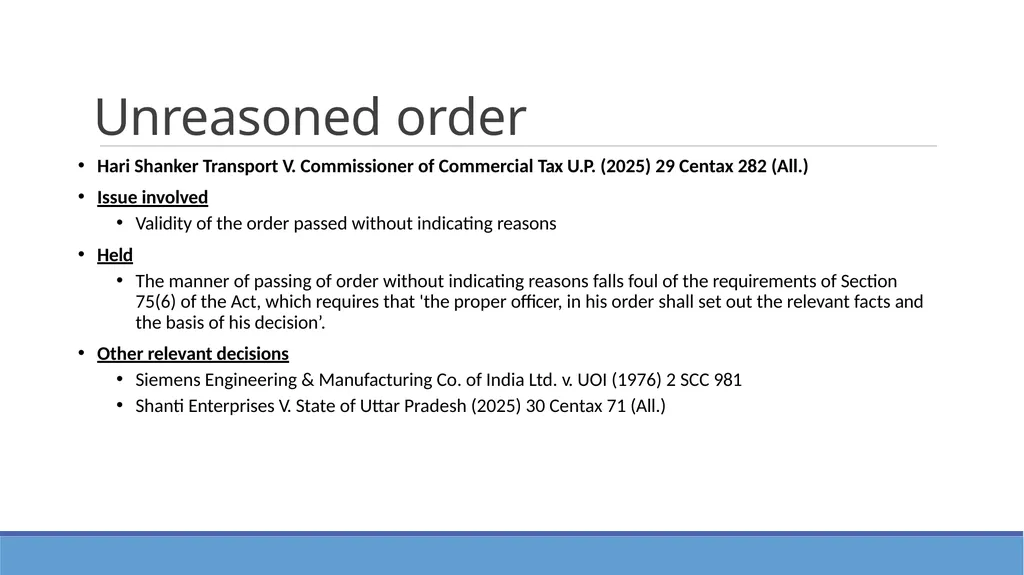
Unreasoned order Hari Shanker Transport V. Commissioner of Commercial Tax U.P. (2025) 29 Centax 282 (All.)
Issue involved
Validity of the order passed without indicating reasons
Held
The manner of passing of order without indicating reasons falls foul of the requirements of Section 75(6) of the Act, which requires that 'the proper officer, in his order shall set out the relevant facts and the basis of his decision’.
Other relevant decisions
Siemens Engineering & Manufacturing Co. of India Ltd. v. UOI (1976) 2 SCC 981
Shanti Enterprises V. State of Uttar Pradesh (2025) 30 Centax 71 (All.)<br>
92
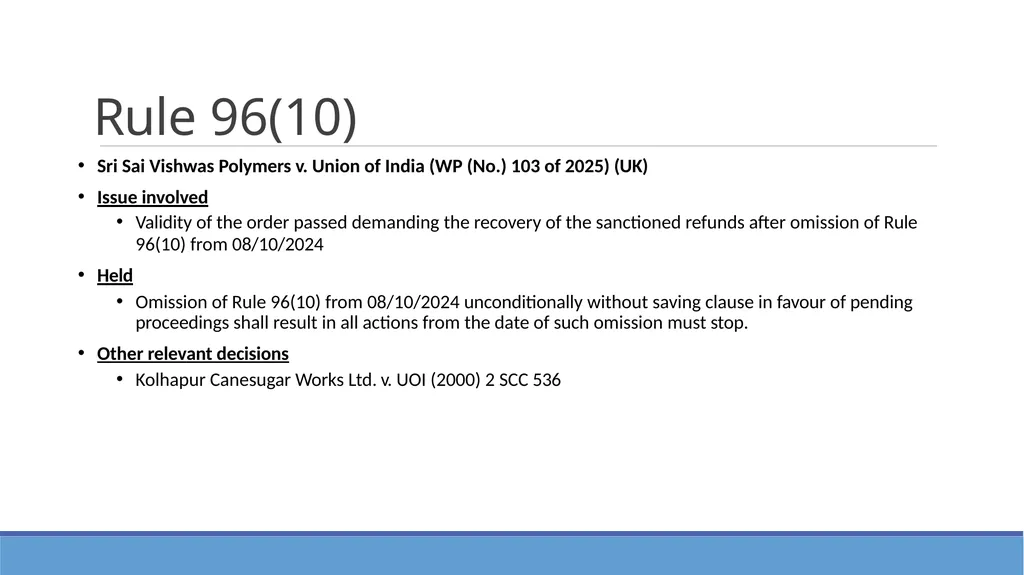
Rule 96(10) Sri Sai Vishwas Polymers v. Union of India (WP (No.) 103 of 2025) (UK)
Issue involved
Validity of the order passed demanding the recovery of the sanctioned refunds after omission of Rule
96(10) from 08/10/2024
Held
Omission of Rule 96(10) from 08/10/2024 unconditionally without saving clause in favour of pending proceedings shall result in all actions from the date of such omission must stop.
Other relevant decisions
Kolhapur Canesugar Works Ltd. v. UOI (2000) 2 SCC 536<br>
93
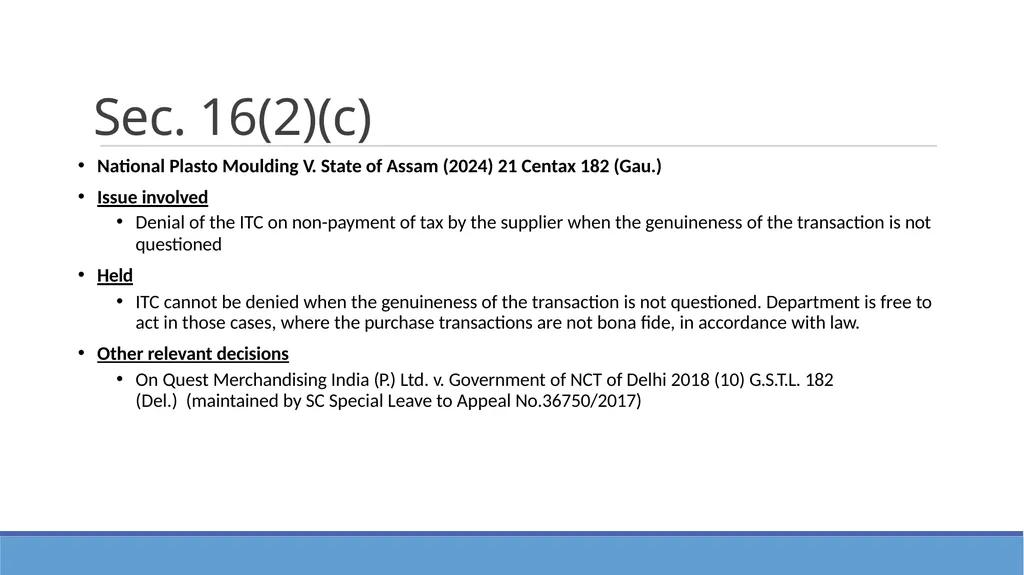
Sec. 16(2)(c) National Plasto Moulding V. State of Assam (2024) 21 Centax 182 (Gau.)
Issue involved
Denial of the ITC on non-payment of tax by the supplier when the genuineness of the transaction is not
questioned
Held
ITC cannot be denied when the genuineness of the transaction is not questioned. Department is free to act in those cases, where the purchase transactions are not bona fide, in accordance with law.
Other relevant decisions
On Quest Merchandising India (P.) Ltd. v. Government of NCT of Delhi 2018 (10) G.S.T.L. 182 (Del.) (maintained by SC Special Leave to Appeal No.36750/2017)<br>
94
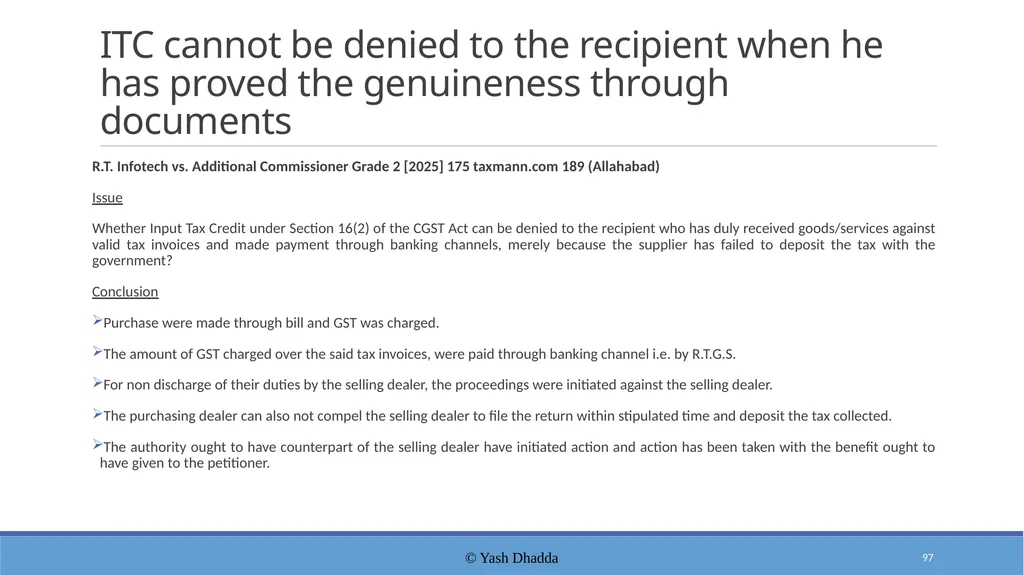
ITC cannot be denied to the recipient when he has proved the genuineness through documents R.T. Infotech vs. Additional Commissioner Grade 2 [2025] 175 taxmann.com 189 (Allahabad)
Issue
Whether Input Tax Credit under Section 16(2) of the CGST Act can be denied to the recipient who has duly received goods/services against valid tax invoices and made payment through banking channels, merely because the supplier has failed to deposit the tax with the government?
Conclusion
Purchase were made through bill and GST was charged.
The amount of GST charged over the said tax invoices, were paid through banking channel i.e. by R.T.G.S.
For non discharge of their duties by the selling dealer, the proceedings were initiated against the selling dealer.
The purchasing dealer can also not compel the selling dealer to file the return within stipulated time and deposit the tax collected.
The authority ought to have counterpart of the selling dealer have initiated action and action has been taken with the benefit ought to have given to the petitioner. © Yash Dhadda 97<br>
95
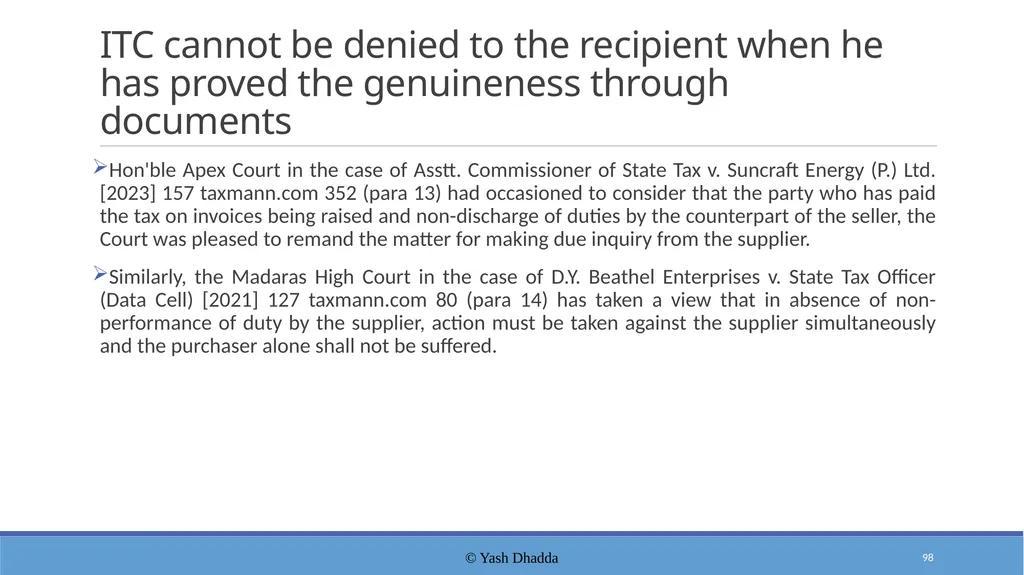
ITC cannot be denied to the recipient when he has proved the genuineness through documents Hon'ble Apex Court in the case of Asstt. Commissioner of State Tax v. Suncraft Energy (P.) Ltd. [2023] 157 taxmann.com 352 (para 13) had occasioned to consider that the party who has paid the tax on invoices being raised and non-discharge of duties by the counterpart of the seller, the Court was pleased to remand the matter for making due inquiry from the supplier.
Similarly, the Madaras High Court in the case of D.Y. Beathel Enterprises v. State Tax Officer (Data Cell) [2021] 127 taxmann.com 80 (para 14) has taken a view that in absence of non-performance of duty by the supplier, action must be taken against the supplier simultaneously and the purchaser alone shall not be suffered. © Yash Dhadda 98<br>
Similarly, the Madaras High Court in the case of D.Y. Beathel Enterprises v. State Tax Officer (Data Cell) [2021] 127 taxmann.com 80 (para 14) has taken a view that in absence of non-performance of duty by the supplier, action must be taken against the supplier simultaneously and the purchaser alone shall not be suffered. © Yash Dhadda 98<br>
96
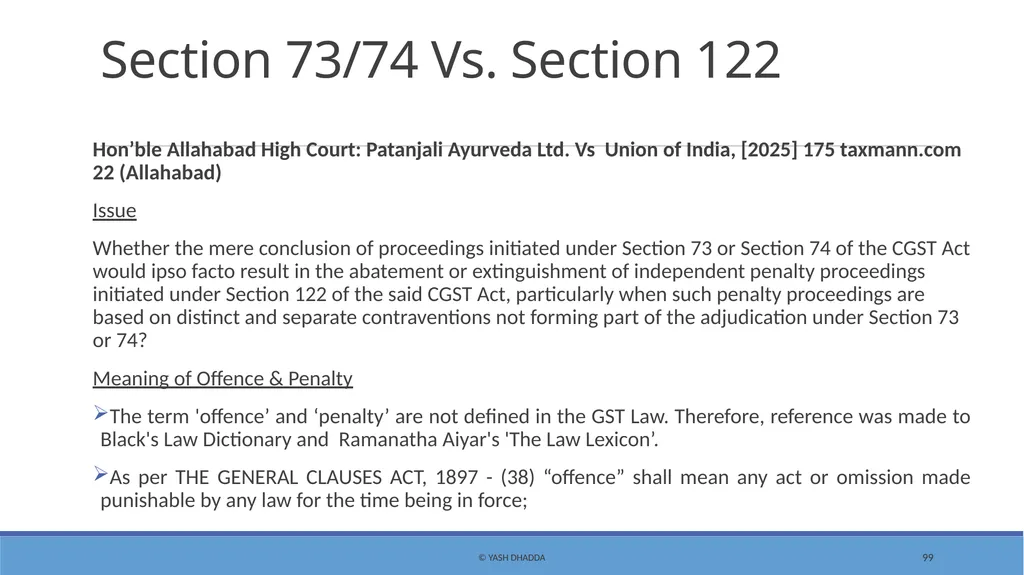
Section 73/74 Vs. Section 122 Hon’ble Allahabad High Court: Patanjali Ayurveda Ltd. Vs Union of India, [2025] 175 taxmann.com 22 (Allahabad)
Issue
Whether the mere conclusion of proceedings initiated under Section 73 or Section 74 of the CGST Act would ipso facto result in the abatement or extinguishment of independent penalty proceedings initiated under Section 122 of the said CGST Act, particularly when such penalty proceedings are based on distinct and separate contraventions not forming part of the adjudication under Section 73 or 74?
Meaning of Offence & Penalty
The term 'offence’ and ‘penalty’ are not defined in the GST Law. Therefore, reference was made to Black's Law Dictionary and Ramanatha Aiyar's 'The Law Lexicon’.
As per THE GENERAL CLAUSES ACT, 1897 - (38) “offence” shall mean any act or omission made punishable by any law for the time being in force; © Yash Dhadda 99<br>
97
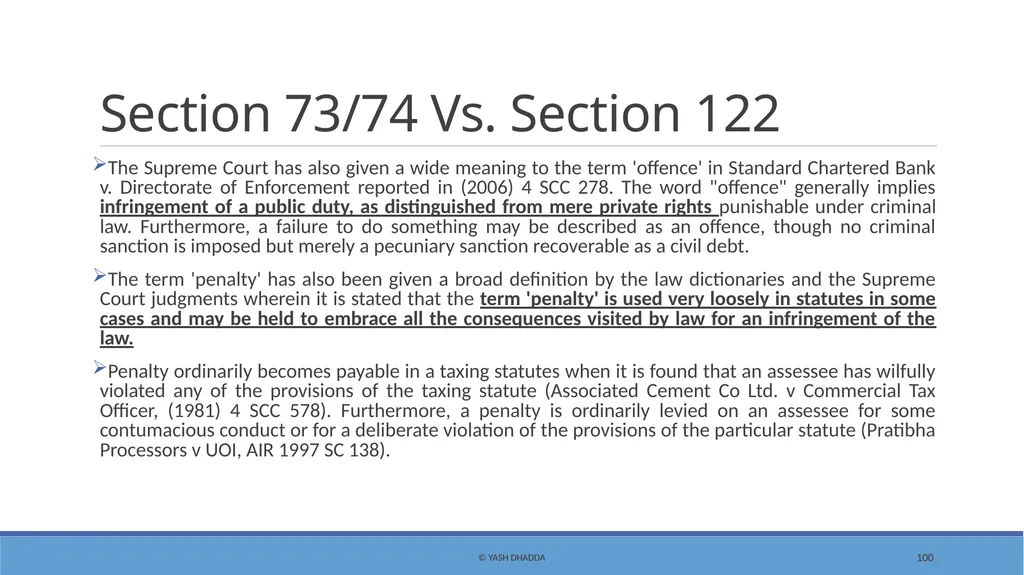
Section 73/74 Vs. Section 122 The Supreme Court has also given a wide meaning to the term 'offence' in Standard Chartered Bank v. Directorate of Enforcement reported in (2006) 4 SCC 278. The word "offence" generally implies infringement of a public duty, as distinguished from mere private rights punishable under criminal law. Furthermore, a failure to do something may be described as an offence, though no criminal sanction is imposed but merely a pecuniary sanction recoverable as a civil debt.
The term 'penalty' has also been given a broad definition by the law dictionaries and the Supreme Court judgments wherein it is stated that the term 'penalty' is used very loosely in statutes in some cases and may be held to embrace all the consequences visited by law for an infringement of the law.
Penalty ordinarily becomes payable in a taxing statutes when it is found that an assessee has wilfully violated any of the provisions of the taxing statute (Associated Cement Co Ltd. v Commercial Tax Officer, (1981) 4 SCC 578). Furthermore, a penalty is ordinarily levied on an assessee for some contumacious conduct or for a deliberate violation of the provisions of the particular statute (Pratibha Processors v UOI, AIR 1997 SC 138). © Yash Dhadda 100<br>
98
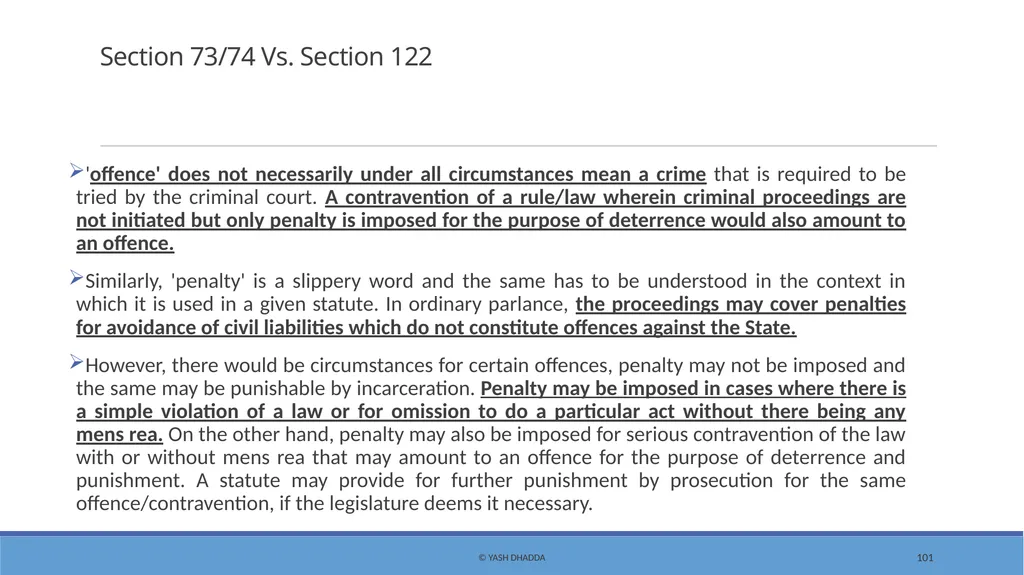
Section 73/74 Vs. Section 122 'offence' does not necessarily under all circumstances mean a crime that is required to be tried by the criminal court. A contravention of a rule/law wherein criminal proceedings are not initiated but only penalty is imposed for the purpose of deterrence would also amount to an offence.
Similarly, 'penalty' is a slippery word and the same has to be understood in the context in which it is used in a given statute. In ordinary parlance, the proceedings may cover penalties for avoidance of civil liabilities which do not constitute offences against the State.
However, there would be circumstances for certain offences, penalty may not be imposed and the same may be punishable by incarceration. Penalty may be imposed in cases where there is a simple violation of a law or for omission to do a particular act without there being any mens rea. On the other hand, penalty may also be imposed for serious contravention of the law with or without mens rea that may amount to an offence for the purpose of deterrence and punishment. A statute may provide for further punishment by prosecution for the same offence/contravention, if the legislature deems it necessary. © Yash Dhadda 101<br>
99
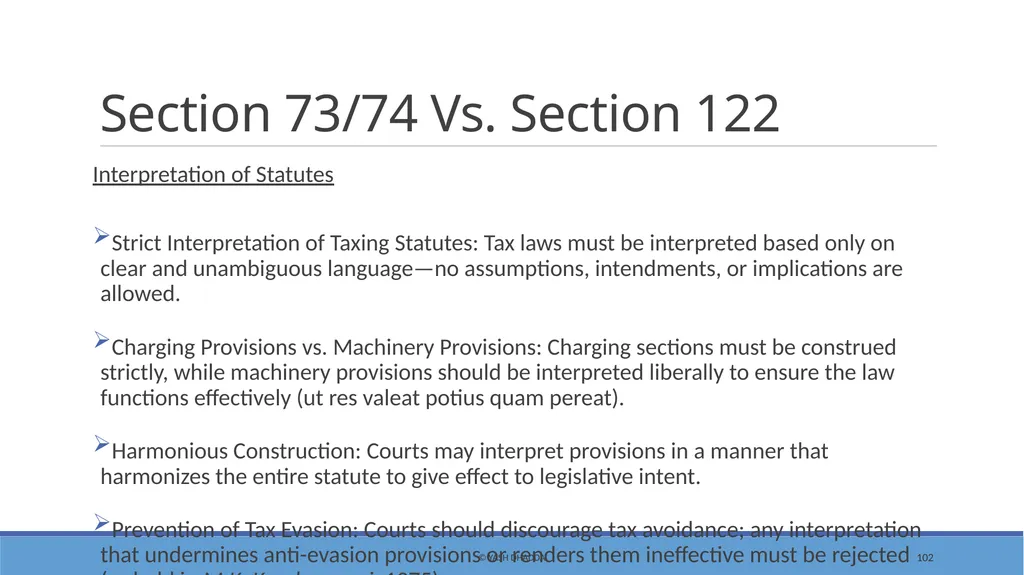
Section 73/74 Vs. Section 122 © Yash Dhadda 102 Interpretation of Statutes
Strict Interpretation of Taxing Statutes: Tax laws must be interpreted based only on clear and unambiguous language—no assumptions, intendments, or implications are allowed.
Charging Provisions vs. Machinery Provisions: Charging sections must be construed strictly, while machinery provisions should be interpreted liberally to ensure the law functions effectively (ut res valeat potius quam pereat).
Harmonious Construction: Courts may interpret provisions in a manner that harmonizes the entire statute to give effect to legislative intent.
Prevention of Tax Evasion: Courts should discourage tax avoidance; any interpretation that undermines anti-evasion provisions or renders them ineffective must be rejected (as held in M.K. Kandaswami, 1975).<br>
100
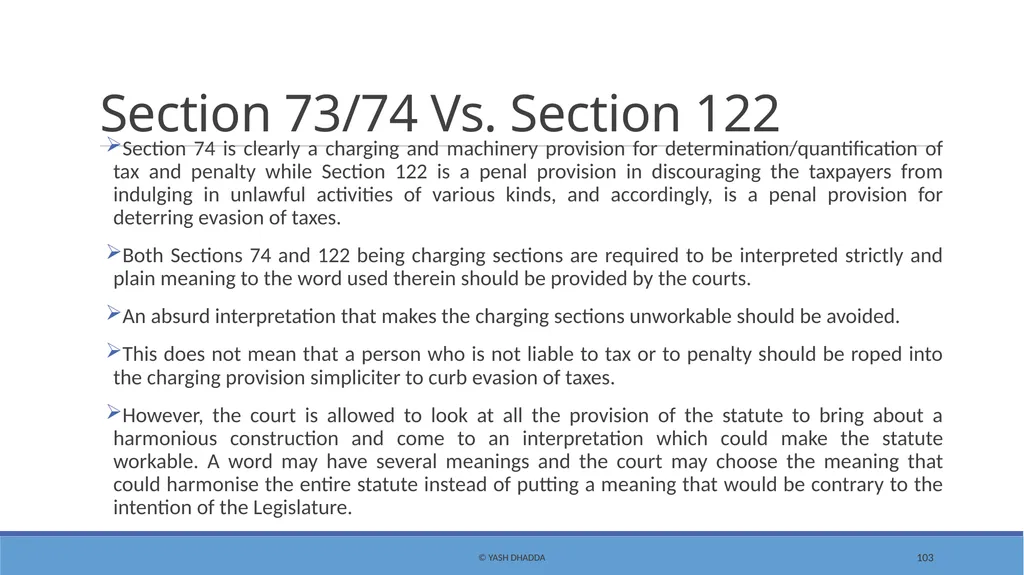
Section 73/74 Vs. Section 122 © Yash Dhadda 103 Section 74 is clearly a charging and machinery provision for determination/quantification of tax and penalty while Section 122 is a penal provision in discouraging the taxpayers from indulging in unlawful activities of various kinds, and accordingly, is a penal provision for deterring evasion of taxes.
Both Sections 74 and 122 being charging sections are required to be interpreted strictly and plain meaning to the word used therein should be provided by the courts.
An absurd interpretation that makes the charging sections unworkable should be avoided.
This does not mean that a person who is not liable to tax or to penalty should be roped into the charging provision simpliciter to curb evasion of taxes.
However, the court is allowed to look at all the provision of the statute to bring about a harmonious construction and come to an interpretation which could make the statute workable. A word may have several meanings and the court may choose the meaning that could harmonise the entire statute instead of putting a meaning that would be contrary to the intention of the Legislature.<br>
101
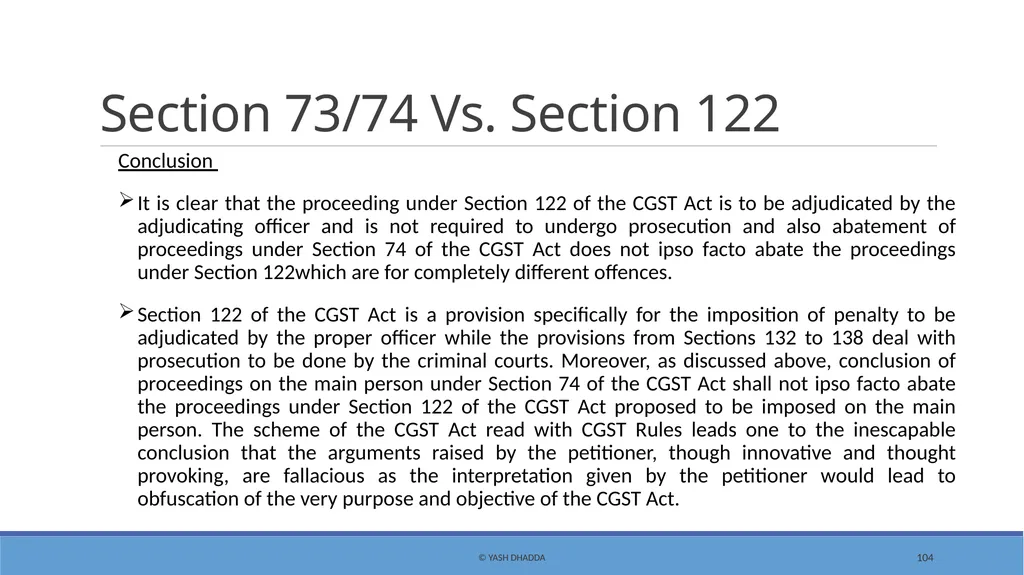
Section 73/74 Vs. Section 122 © Yash Dhadda 104 Conclusion
It is clear that the proceeding under Section 122 of the CGST Act is to be adjudicated by the adjudicating officer and is not required to undergo prosecution and also abatement of proceedings under Section 74 of the CGST Act does not ipso facto abate the proceedings under Section 122which are for completely different offences.
Section 122 of the CGST Act is a provision specifically for the imposition of penalty to be adjudicated by the proper officer while the provisions from Sections 132 to 138 deal with prosecution to be done by the criminal courts. Moreover, as discussed above, conclusion of proceedings on the main person under Section 74 of the CGST Act shall not ipso facto abate the proceedings under Section 122 of the CGST Act proposed to be imposed on the main person. The scheme of the CGST Act read with CGST Rules leads one to the inescapable conclusion that the arguments raised by the petitioner, though innovative and thought provoking, are fallacious as the interpretation given by the petitioner would lead to obfuscation of the very purpose and objective of the CGST Act.<br>
102
CASH or silver bars cannot be seized during search operation under Section 67 © Yash Dhadda 105<br>
103
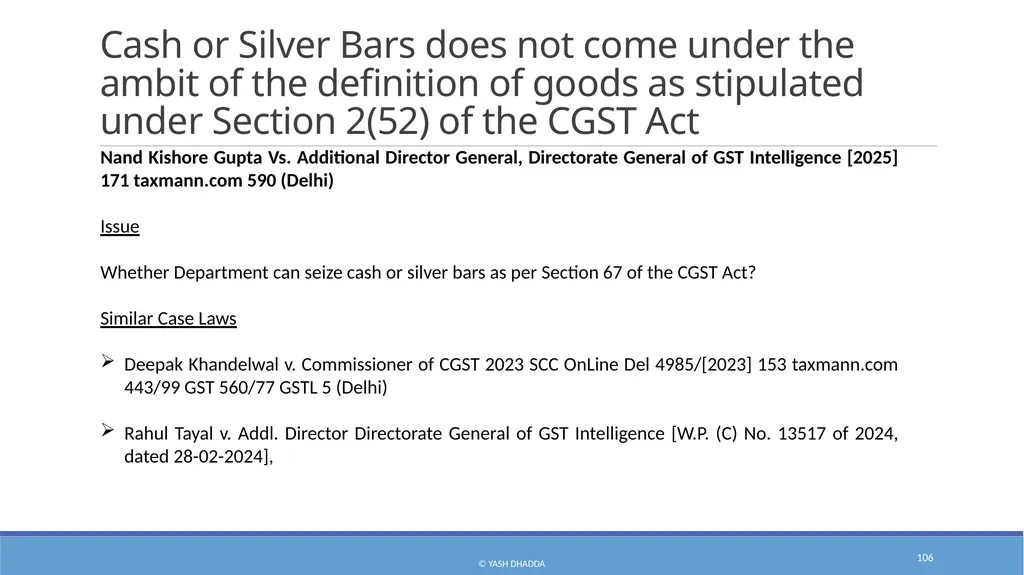
Cash or Silver Bars does not come under the ambit of the definition of goods as stipulated under Section 2(52) of the CGST Act © Yash Dhadda 106 Nand Kishore Gupta Vs. Additional Director General, Directorate General of GST Intelligence [2025] 171 taxmann.com 590 (Delhi)
Issue
Whether Department can seize cash or silver bars as per Section 67 of the CGST Act?
Similar Case Laws
Deepak Khandelwal v. Commissioner of CGST 2023 SCC OnLine Del 4985/[2023] 153 taxmann.com 443/99 GST 560/77 GSTL 5 (Delhi)
Rahul Tayal v. Addl. Director Directorate General of GST Intelligence [W.P. (C) No. 13517 of 2024, dated 28-02-2024],<br>
104
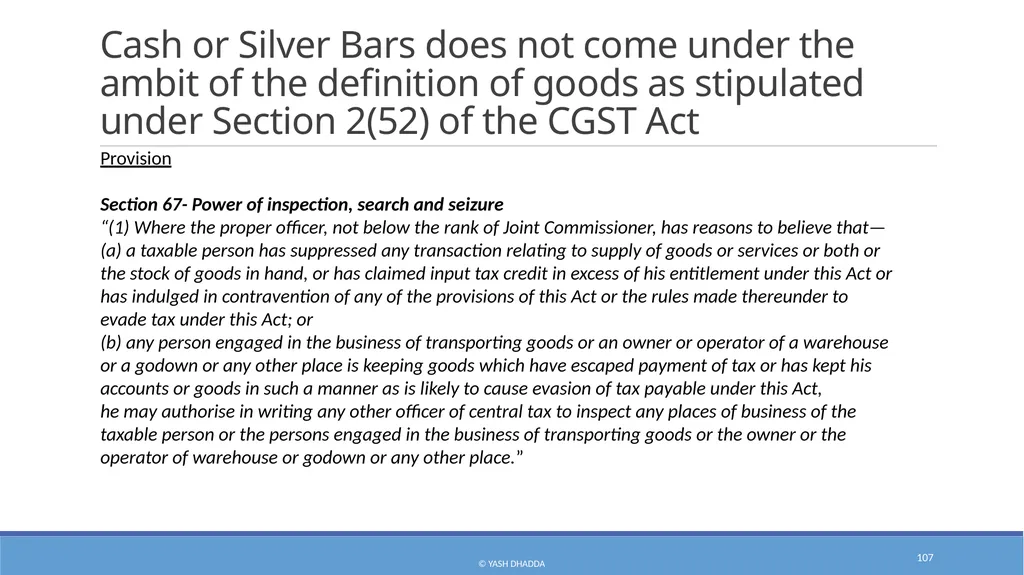
Cash or Silver Bars does not come under the ambit of the definition of goods as stipulated under Section 2(52) of the CGST Act © Yash Dhadda 107 Provision
Section 67- Power of inspection, search and seizure
“(1) Where the proper officer, not below the rank of Joint Commissioner, has reasons to believe that—
(a) a taxable person has suppressed any transaction relating to supply of goods or services or both or the stock of goods in hand, or has claimed input tax credit in excess of his entitlement under this Act or has indulged in contravention of any of the provisions of this Act or the rules made thereunder to evade tax under this Act; or
(b) any person engaged in the business of transporting goods or an owner or operator of a warehouse or a godown or any other place is keeping goods which have escaped payment of tax or has kept his accounts or goods in such a manner as is likely to cause evasion of tax payable under this Act,
he may authorise in writing any other officer of central tax to inspect any places of business of the taxable person or the persons engaged in the business of transporting goods or the owner or the operator of warehouse or godown or any other place.”<br>
105
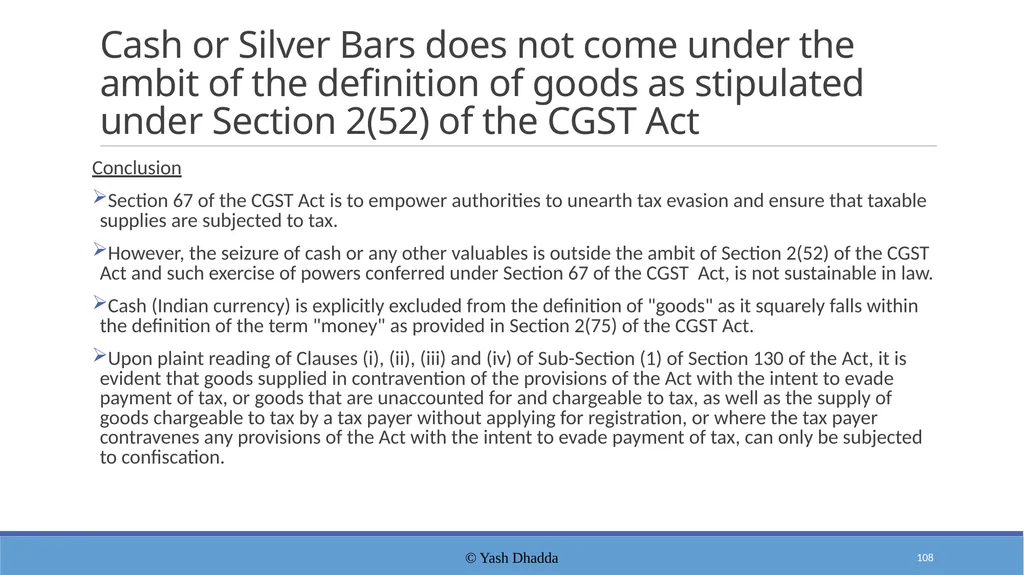
Cash or Silver Bars does not come under the ambit of the definition of goods as stipulated under Section 2(52) of the CGST Act Conclusion
Section 67 of the CGST Act is to empower authorities to unearth tax evasion and ensure that taxable supplies are subjected to tax.
However, the seizure of cash or any other valuables is outside the ambit of Section 2(52) of the CGST Act and such exercise of powers conferred under Section 67 of the CGST Act, is not sustainable in law.
Cash (Indian currency) is explicitly excluded from the definition of "goods" as it squarely falls within the definition of the term "money" as provided in Section 2(75) of the CGST Act.
Upon plaint reading of Clauses (i), (ii), (iii) and (iv) of Sub-Section (1) of Section 130 of the Act, it is evident that goods supplied in contravention of the provisions of the Act with the intent to evade payment of tax, or goods that are unaccounted for and chargeable to tax, as well as the supply of goods chargeable to tax by a tax payer without applying for registration, or where the tax payer contravenes any provisions of the Act with the intent to evade payment of tax, can only be subjected to confiscation. © Yash Dhadda 108<br>
106
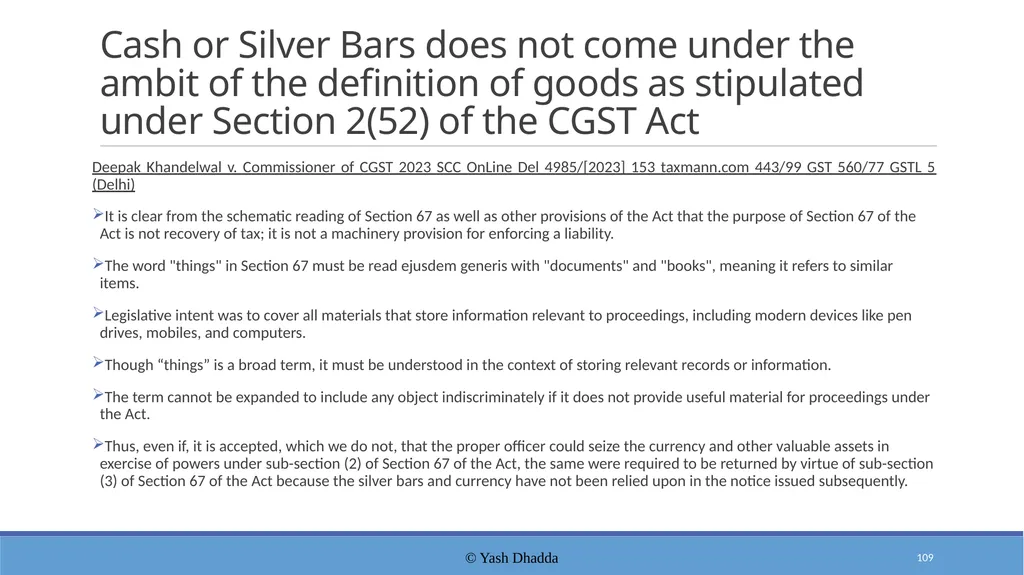
Cash or Silver Bars does not come under the ambit of the definition of goods as stipulated under Section 2(52) of the CGST Act Deepak Khandelwal v. Commissioner of CGST 2023 SCC OnLine Del 4985/[2023] 153 taxmann.com 443/99 GST 560/77 GSTL 5 (Delhi)
It is clear from the schematic reading of Section 67 as well as other provisions of the Act that the purpose of Section 67 of the Act is not recovery of tax; it is not a machinery provision for enforcing a liability.
The word "things" in Section 67 must be read ejusdem generis with "documents" and "books", meaning it refers to similar items.
Legislative intent was to cover all materials that store information relevant to proceedings, including modern devices like pen drives, mobiles, and computers.
Though “things” is a broad term, it must be understood in the context of storing relevant records or information.
The term cannot be expanded to include any object indiscriminately if it does not provide useful material for proceedings under the Act.
Thus, even if, it is accepted, which we do not, that the proper officer could seize the currency and other valuable assets in exercise of powers under sub-section (2) of Section 67 of the Act, the same were required to be returned by virtue of sub-section (3) of Section 67 of the Act because the silver bars and currency have not been relied upon in the notice issued subsequently. © Yash Dhadda 109<br>
107
ISSUANCE OF SINGLE SCN FOR MULTIPLE YEARS © Yash Dhadda 110<br>
108
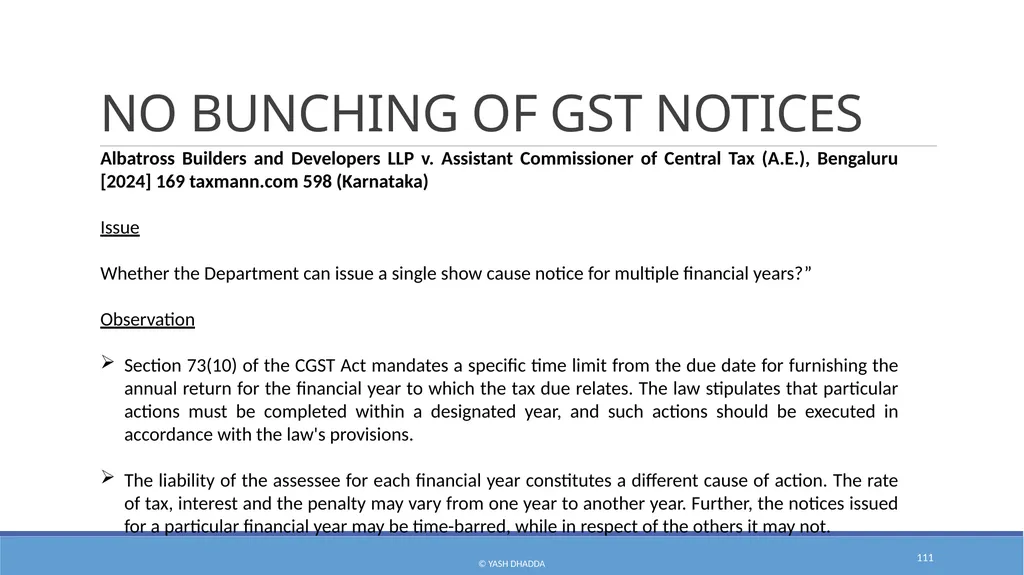
NO BUNCHING OF GST NOTICES © Yash Dhadda 111 Albatross Builders and Developers LLP v. Assistant Commissioner of Central Tax (A.E.), Bengaluru [2024] 169 taxmann.com 598 (Karnataka)
Issue
Whether the Department can issue a single show cause notice for multiple financial years?”
Observation
Section 73(10) of the CGST Act mandates a specific time limit from the due date for furnishing the annual return for the financial year to which the tax due relates. The law stipulates that particular actions must be completed within a designated year, and such actions should be executed in accordance with the law's provisions.
The liability of the assessee for each financial year constitutes a different cause of action. The rate of tax, interest and the penalty may vary from one year to another year. Further, the notices issued for a particular financial year may be time-barred, while in respect of the others it may not.<br>
109
Thank You Yash Dhadda
Dhadda & Co.
Chartered Accountants
Jaipur | Kota |Mumbai |Bangalore | Ahmadabad © Yash Dhadda 112<br>
Dhadda & Co.
Chartered Accountants
Jaipur | Kota |Mumbai |Bangalore | Ahmadabad © Yash Dhadda 112<br>