
Anesthetic Considerations for Patients with
KB
Published · 28 slides · 0 views

1 / 1









Description
Anesthetic Considerations for Patients with Preeclampsia Lawrence Weinstein, MD University of California, San Diego August 12, 2023 Introduction Preeclampsia (PET) is a multi-system disorder effecting about 7 of pregnancies Presents with
Related Topics
Share
Embed code
Download this presentation From Below
"Anesthetic Considerations for Patients with" is the property of its rightful owner. Permission is granted to download and print the materials on this website for personal, non-commercial use only, and to display it on your personal computer provided you do not modify the materials and that you retain all copyright notices contained in the materials. By downloading content from our website, you accept the terms of this agreement.
Presentation Transcript
01
Anesthetic Considerations for Patients with Preeclampsia Lawrence Weinstein, MD
University of California, San Diego
August 12, 2023<br>
University of California, San Diego
August 12, 2023<br>
02
Introduction Preeclampsia (PET) is a multi-system disorder effecting about 7% of pregnancies
Presents with hypertension and can include multi-organ dysfunction
PET is a significant cause of pregnancy related morbidity and mortality
peripartum morbidity can include renal disease, coagulopathy, stroke and seizures
The fetus is at risk for growth restriction and pre-term delivery
Anesthesia providers play an essential role in the management of patients with PET
The anesthesia provider must be familiar with the pathology and consequences of PET to choose safe and appropriate anesthetic options<br>
Presents with hypertension and can include multi-organ dysfunction
PET is a significant cause of pregnancy related morbidity and mortality
peripartum morbidity can include renal disease, coagulopathy, stroke and seizures
The fetus is at risk for growth restriction and pre-term delivery
Anesthesia providers play an essential role in the management of patients with PET
The anesthesia provider must be familiar with the pathology and consequences of PET to choose safe and appropriate anesthetic options<br>
03
Preeclampsia defined htn presenting after 20 weeks gestation accompanied by at least one of the following:
Proteinuria
Acute kidney injury
Proteinuria is screening test for diagnosis (urine protein/creatinine ratio > 0.3 mg/dl)
Liver involvement (alt/ast > 40 iu/L or right upper quadrant pain)
Neurological complications ( eclampsia, headache, visual changes, stroke)
Hematology perturbances (low platelets, elevated pt/ptt, hemolysis)
Uteroplacental dysfunction
Fetal growth restriction
Abnormal umbilical artery doppler waveforms
Edema – historical diagnostic criterion but removed around 2000<br>
Proteinuria
Acute kidney injury
Proteinuria is screening test for diagnosis (urine protein/creatinine ratio > 0.3 mg/dl)
Liver involvement (alt/ast > 40 iu/L or right upper quadrant pain)
Neurological complications ( eclampsia, headache, visual changes, stroke)
Hematology perturbances (low platelets, elevated pt/ptt, hemolysis)
Uteroplacental dysfunction
Fetal growth restriction
Abnormal umbilical artery doppler waveforms
Edema – historical diagnostic criterion but removed around 2000<br>
04
Preeclampsia: pathophysiology Preeclampsia is a spectrum of disease
Big range in severity of disease and organ systems involved
Varied clinical presentations make diagnosis tricky
Most agree that preeclampsia is caused in large part by placental pathology
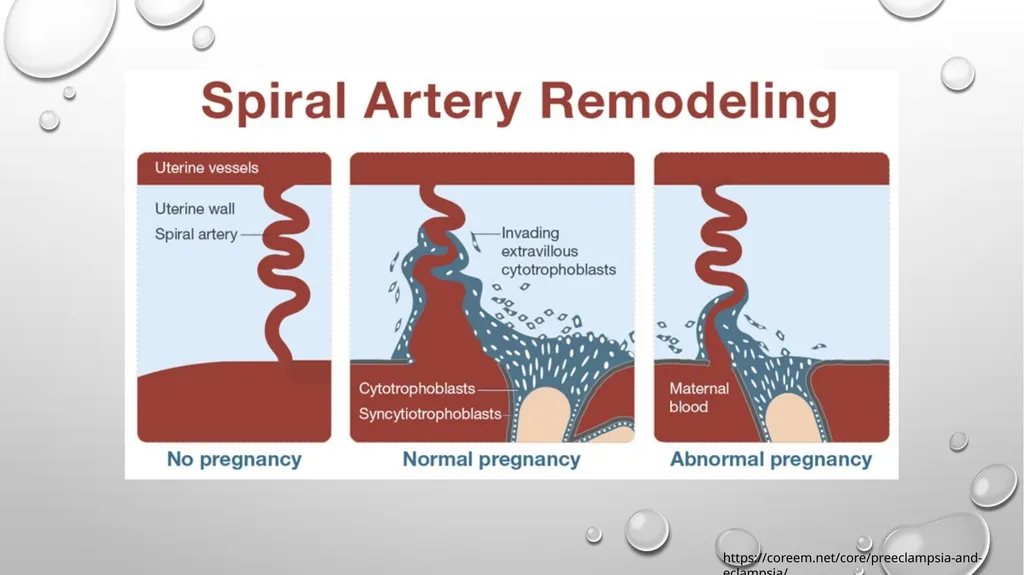
In “normal” pregnancy, extravillous trophoblasts (EVT) migrate to uterine spiral arteries
Spiral arteries are the terminal branches of endometrial vascular that supply placenta
Evt essential for spiral artery remodeling, which increases diameter of spiral arteries
Remodeling decreases resistance to flow, making the placenta a low resistance circuit
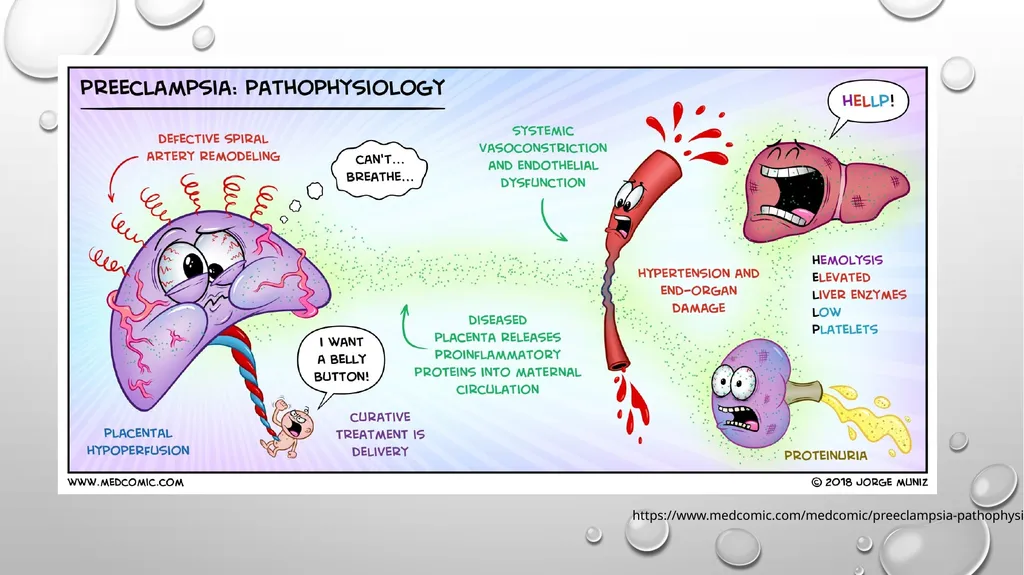
In preeclampsia, evt do not fully remodel spiral arteries, more resistance to blood flow
Placental perfusion compromised stressed placenta
Stressed placenta releases “inflammatory mediators” into maternal circulation
Vasoconstriction and endothelial damage result HTN and organ impairment
Low fetal perfusion fetal growth restriction<br>
Big range in severity of disease and organ systems involved
Varied clinical presentations make diagnosis tricky
Most agree that preeclampsia is caused in large part by placental pathology
In “normal” pregnancy, extravillous trophoblasts (EVT) migrate to uterine spiral arteries
Spiral arteries are the terminal branches of endometrial vascular that supply placenta
Evt essential for spiral artery remodeling, which increases diameter of spiral arteries
Remodeling decreases resistance to flow, making the placenta a low resistance circuit
In preeclampsia, evt do not fully remodel spiral arteries, more resistance to blood flow
Placental perfusion compromised stressed placenta
Stressed placenta releases “inflammatory mediators” into maternal circulation
Vasoconstriction and endothelial damage result HTN and organ impairment
Low fetal perfusion fetal growth restriction<br>
05
https://coreem.net/core/preeclampsia-and-eclampsia/<br>
06
Spiral arteries do not dilate and remodel
Increased resistance to blood flow
Stressed placenta
Placenta releases inflammatory factors
Maternal vasoconstriction and endothelial damage
Hypertension
Potential injury to
Kidney
Liver
Lungs
Brain
Hematology ( ↓ platelets, hemolysis)
Disseminated intravascular coagulation Pathology of preeclampsia<br>
Increased resistance to blood flow
Stressed placenta
Placenta releases inflammatory factors
Maternal vasoconstriction and endothelial damage
Hypertension
Potential injury to
Kidney
Liver
Lungs
Brain
Hematology ( ↓ platelets, hemolysis)
Disseminated intravascular coagulation Pathology of preeclampsia<br>
07
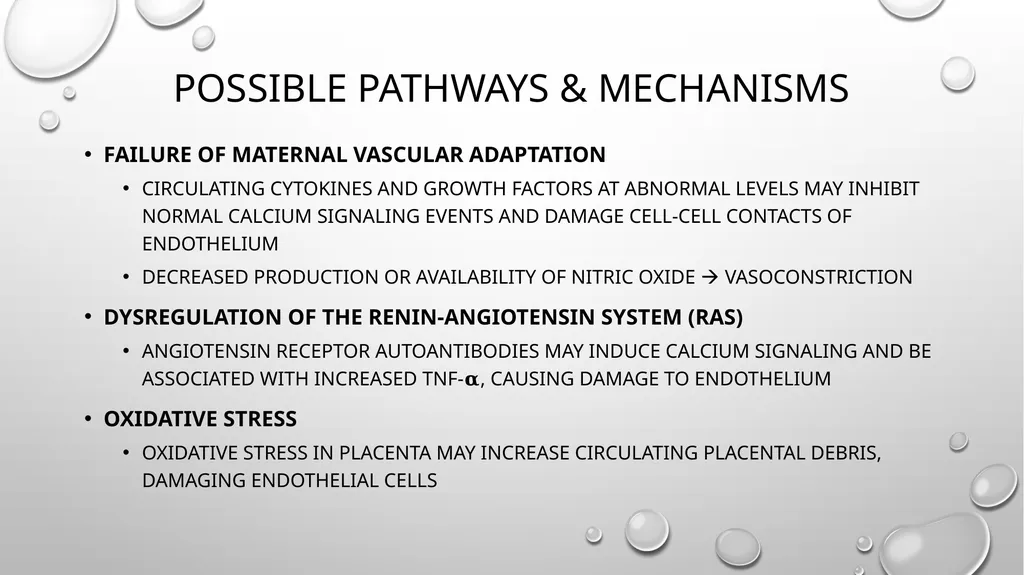
Possible pathways & mechanisms Failure of maternal vascular adaptation
Circulating cytokines and growth factors at abnormal levels may inhibit normal calcium signaling events and damage cell-cell contacts of endothelium
Decreased production or availability of nitric oxide vasoconstriction
Dysregulation of the renin-angiotensin system (RAS)
Angiotensin receptor autoantibodies may induce calcium signaling and be associated with increased TNF-𝛂, causing damage to endothelium
Oxidative stress
Oxidative stress in placenta may increase circulating placental debris, damaging endothelial cells<br>
Circulating cytokines and growth factors at abnormal levels may inhibit normal calcium signaling events and damage cell-cell contacts of endothelium
Decreased production or availability of nitric oxide vasoconstriction
Dysregulation of the renin-angiotensin system (RAS)
Angiotensin receptor autoantibodies may induce calcium signaling and be associated with increased TNF-𝛂, causing damage to endothelium
Oxidative stress
Oxidative stress in placenta may increase circulating placental debris, damaging endothelial cells<br>
08
https://www.medcomic.com/medcomic/preeclampsia-pathophysiologyPET<br>
09
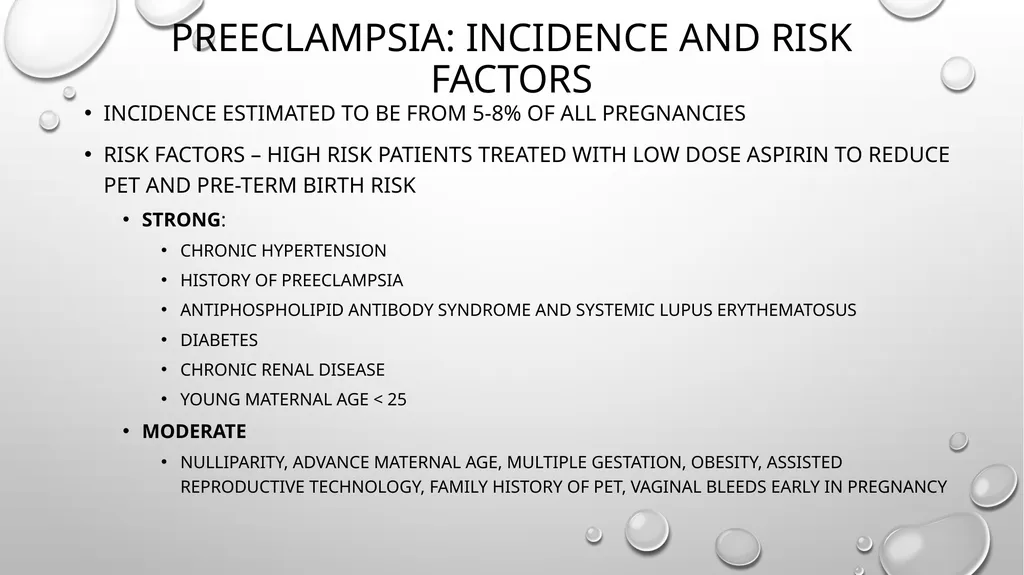
Preeclampsia: incidence and risk factors Incidence estimated to be from 5-8% of all pregnancies
Risk factors – high risk patients treated with low dose aspirin to reduce PET and pre-term birth risk
Strong:
chronic hypertension
history of preeclampsia
Antiphospholipid antibody syndrome and systemic lupus erythematosus
diabetes
Chronic renal disease
Young maternal age < 25
Moderate
Nulliparity, advance maternal age, multiple gestation, obesity, assisted reproductive technology, family history of PET, vaginal bleeds early in pregnancy<br>
Risk factors – high risk patients treated with low dose aspirin to reduce PET and pre-term birth risk
Strong:
chronic hypertension
history of preeclampsia
Antiphospholipid antibody syndrome and systemic lupus erythematosus
diabetes
Chronic renal disease
Young maternal age < 25
Moderate
Nulliparity, advance maternal age, multiple gestation, obesity, assisted reproductive technology, family history of PET, vaginal bleeds early in pregnancy<br>
10
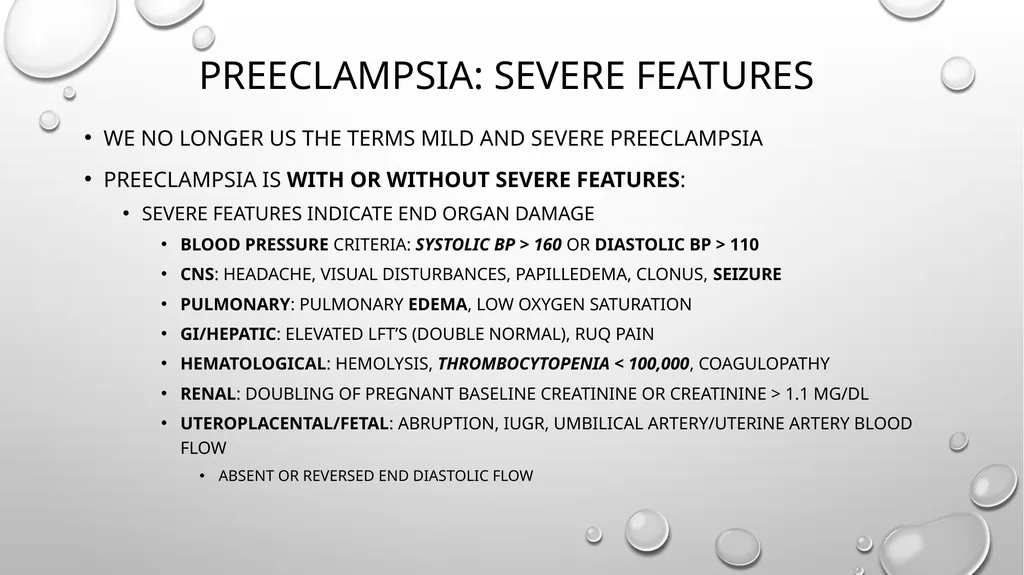
Preeclampsia: severe features We no longer us the terms mild and severe preeclampsia
Preeclampsia is with or without severe features:
Severe features indicate end organ damage
Blood pressure criteria: systolic bp > 160 or diastolic bp > 110
Cns: headache, visual disturbances, papilledema, clonus, seizure
Pulmonary: pulmonary edema, low oxygen saturation
GI/hepatic: elevated LFT’s (double normal), RUQ pain
Hematological: hemolysis, thrombocytopenia < 100,000, coagulopathy
Renal: doubling of pregnant baseline creatinine or creatinine > 1.1 mg/dl
Uteroplacental/fetal: abruption, IUGR, umbilical artery/uterine artery blood flow
Absent or reversed end diastolic flow<br>
Preeclampsia is with or without severe features:
Severe features indicate end organ damage
Blood pressure criteria: systolic bp > 160 or diastolic bp > 110
Cns: headache, visual disturbances, papilledema, clonus, seizure
Pulmonary: pulmonary edema, low oxygen saturation
GI/hepatic: elevated LFT’s (double normal), RUQ pain
Hematological: hemolysis, thrombocytopenia < 100,000, coagulopathy
Renal: doubling of pregnant baseline creatinine or creatinine > 1.1 mg/dl
Uteroplacental/fetal: abruption, IUGR, umbilical artery/uterine artery blood flow
Absent or reversed end diastolic flow<br>
11
Preeclampsia: treatment and management Delivery of the placenta is the ultimate treatment
Timing of delivery must balance fetal development and maternal morbidity
For preeclampsia without severe features bp management and close observation
Delivery can be vaginal if no progressive severe features
Worsening severe features urgent c-section Preeclampsia with severe features:
Prompt treatment of severe range htn
Seizure prophylaxis with magnesium
Deliver imminently for:
Uncontrolled severe range BP despite multiple iv meds
Pulmonary edema/maternal hypoxia
Progressively rising lft’s, creatinine
Worsening thrombocytopenia
Worsening cns symptoms
Placental abruption
Non-reassuring fetal status<br>
Timing of delivery must balance fetal development and maternal morbidity
For preeclampsia without severe features bp management and close observation
Delivery can be vaginal if no progressive severe features
Worsening severe features urgent c-section Preeclampsia with severe features:
Prompt treatment of severe range htn
Seizure prophylaxis with magnesium
Deliver imminently for:
Uncontrolled severe range BP despite multiple iv meds
Pulmonary edema/maternal hypoxia
Progressively rising lft’s, creatinine
Worsening thrombocytopenia
Worsening cns symptoms
Placental abruption
Non-reassuring fetal status<br>
12
Severe range blood pressure: why we care! Severe range htn is sbp > 160 mm hg or dbp > 110 mm hg
Sbp > 160 mm hg is associated with elevated risk of hemorrhagic stroke
Stroke is leading cause of death in preeclampsia
Severe range htn above sbp 180 mm hg is a hypertensive crisis and needs immediate treatment
First line iv meds are labetalol and hydralazine
Anesthesia providers can consider nicardipine in the operating room (fast & short acting)
If no iv access oral nifedipine drug of choice while establishing access
Persistently severe range htn urgent delivery<br>
Sbp > 160 mm hg is associated with elevated risk of hemorrhagic stroke
Stroke is leading cause of death in preeclampsia
Severe range htn above sbp 180 mm hg is a hypertensive crisis and needs immediate treatment
First line iv meds are labetalol and hydralazine
Anesthesia providers can consider nicardipine in the operating room (fast & short acting)
If no iv access oral nifedipine drug of choice while establishing access
Persistently severe range htn urgent delivery<br>
13
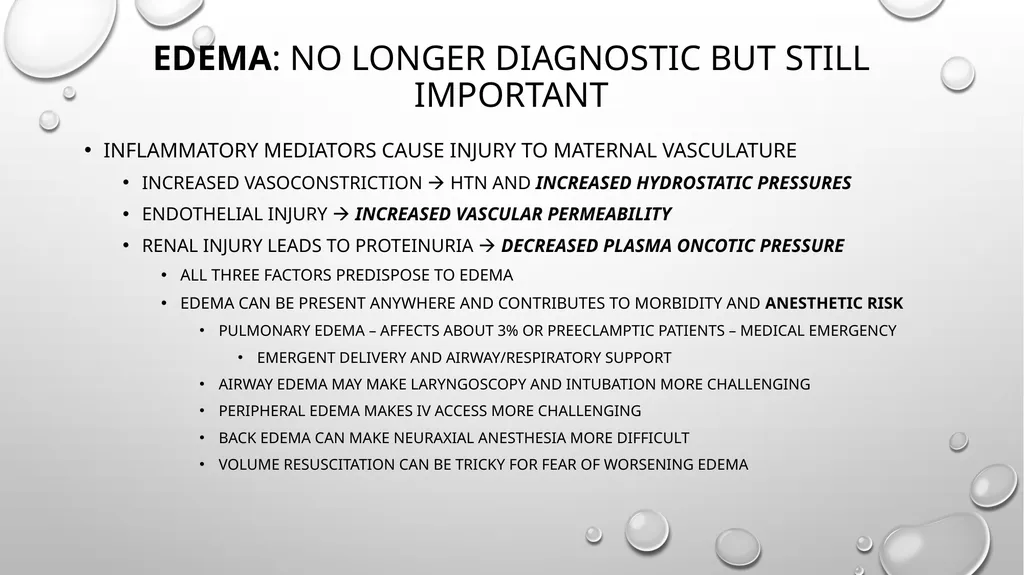
Edema: no longer diagnostic but still important inflammatory mediators cause injury to maternal vasculature
Increased vasoconstriction HTN and increased hydrostatic pressures
Endothelial injury increased vascular permeability
Renal injury leads to proteinuria decreased plasma oncotic pressure
All three factors Predispose to edema
Edema can be present anywhere and contributes to morbidity and anesthetic risk
Pulmonary edema – affects about 3% or preeclamptic patients – medical emergency
Emergent delivery and airway/respiratory support
Airway edema may make laryngoscopy and intubation more challenging
Peripheral edema makes iv access more challenging
Back edema can make neuraxial anesthesia more difficult
Volume resuscitation can be tricky for fear of worsening edema<br>
Increased vasoconstriction HTN and increased hydrostatic pressures
Endothelial injury increased vascular permeability
Renal injury leads to proteinuria decreased plasma oncotic pressure
All three factors Predispose to edema
Edema can be present anywhere and contributes to morbidity and anesthetic risk
Pulmonary edema – affects about 3% or preeclamptic patients – medical emergency
Emergent delivery and airway/respiratory support
Airway edema may make laryngoscopy and intubation more challenging
Peripheral edema makes iv access more challenging
Back edema can make neuraxial anesthesia more difficult
Volume resuscitation can be tricky for fear of worsening edema<br>
14
Hematologic severe features: why we care hematologic changes have perhaps the greatest impact on anesthetic risks & options
Thrombocytopenia is a common severe feature
Endothelial dysfunction stimulates platelet activation and consumption
Significantly low platelets may contraindicate neuraxial anesthesia
Most studies agree that neuraxial anesthesia safe at platelet > 70,000
In absence of other coagulation abnormalities
If platelets > 100,000 and no clinical bleeding ok for neuraxial anesthesia
If 60,000 < platelets <100,000 examine Pt/ptt, fibrinogen and trends
May be developing dic if coags and fibrinogen are abnormal
Must balance maternal benefit vs. risk of epidural hematoma
Spinals may have lower hematoma risk than epidural given smaller needle & lack of catheter<br>
Thrombocytopenia is a common severe feature
Endothelial dysfunction stimulates platelet activation and consumption
Significantly low platelets may contraindicate neuraxial anesthesia
Most studies agree that neuraxial anesthesia safe at platelet > 70,000
In absence of other coagulation abnormalities
If platelets > 100,000 and no clinical bleeding ok for neuraxial anesthesia
If 60,000 < platelets <100,000 examine Pt/ptt, fibrinogen and trends
May be developing dic if coags and fibrinogen are abnormal
Must balance maternal benefit vs. risk of epidural hematoma
Spinals may have lower hematoma risk than epidural given smaller needle & lack of catheter<br>
15
Eclampsia: seizure prevention and treatment Eclampsia signifies severe disease – associated with stroke, cardiac arrest & death
Mortality about 3%
Seizure requires prompt treatment with magnesium sulfate first line agent
Reduced chance of death compared with benzodiazepines
If magnesium delayed, anesthesia provider can treat with midazolam or propofol
Be prepared to manage airway
May need emergent c-section with general anesthesia
All patients with preeclampsia should have a thorough airway exam on admission
Ob or should always have backup airway equipment available
Parturients with severe features on magnesium infusions for seizure prophylaxis
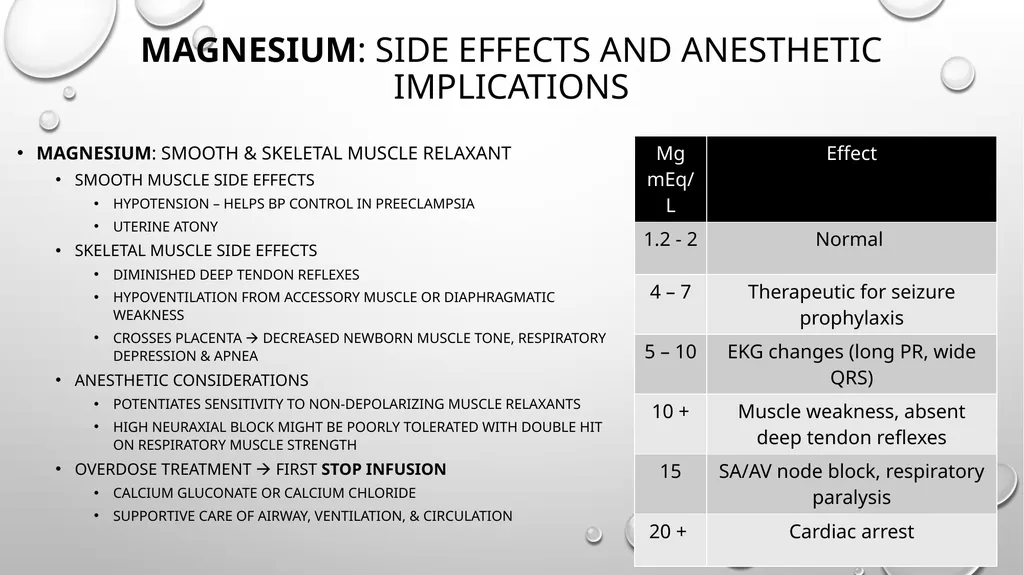
Therapeutic levels about 4- 7 meq/l
Must be aware of side effects and signs of toxicity<br>
Mortality about 3%
Seizure requires prompt treatment with magnesium sulfate first line agent
Reduced chance of death compared with benzodiazepines
If magnesium delayed, anesthesia provider can treat with midazolam or propofol
Be prepared to manage airway
May need emergent c-section with general anesthesia
All patients with preeclampsia should have a thorough airway exam on admission
Ob or should always have backup airway equipment available
Parturients with severe features on magnesium infusions for seizure prophylaxis
Therapeutic levels about 4- 7 meq/l
Must be aware of side effects and signs of toxicity<br>
16
Magnesium: side effects and anesthetic implications Magnesium: smooth & skeletal muscle relaxant
Smooth muscle side effects
Hypotension – helps bp control in preeclampsia
Uterine atony
Skeletal muscle side effects
Diminished deep tendon reflexes
Hypoventilation from accessory muscle or diaphragmatic weakness
Crosses placenta decreased newborn muscle tone, respiratory depression & apnea
Anesthetic considerations
Potentiates sensitivity to non-depolarizing muscle relaxants
High neuraxial block might be poorly tolerated with double hit on respiratory muscle strength
OVERDOSE TREATMENT FIRST STOP INFUSION
CALCIUM GLUCONATE OR CALCIUM CHLORIDE
SUPPORTIVE CARE OF AIRWAY, VENTILATION, & CIRCULATION<br>
Smooth muscle side effects
Hypotension – helps bp control in preeclampsia
Uterine atony
Skeletal muscle side effects
Diminished deep tendon reflexes
Hypoventilation from accessory muscle or diaphragmatic weakness
Crosses placenta decreased newborn muscle tone, respiratory depression & apnea
Anesthetic considerations
Potentiates sensitivity to non-depolarizing muscle relaxants
High neuraxial block might be poorly tolerated with double hit on respiratory muscle strength
OVERDOSE TREATMENT FIRST STOP INFUSION
CALCIUM GLUCONATE OR CALCIUM CHLORIDE
SUPPORTIVE CARE OF AIRWAY, VENTILATION, & CIRCULATION<br>
17
Labor analgesia in preeclampsia Many women with preeclampsia are eligible for vaginal delivery
Effective analgesia is important in the overall control of blood pressure
injured vasculature of preeclamptic patients is hyper-responsive to catecholamines
Pain increases circulating catecholamines more htn
In the absence of contraindication, early Lumbar epidural analgesia is preferred
Effective pain control without neonatal nor maternal respiratory depression
Hemodynamically stable when dosed incrementally
Provides a conduit to surgical anesthesia for urgent cesarean delivery
Improved intervillous blood flow
Any neuraxial anesthesia can cause hypotension
In setting of preeclampsia, fluid boluses should be carefully considered given edema risk
Avoid excessive bp drop – must consider fetal perfusion in setting of high resistance placenta
If contraindicated, iv pca or nitrous oxide can be used<br>
Effective analgesia is important in the overall control of blood pressure
injured vasculature of preeclamptic patients is hyper-responsive to catecholamines
Pain increases circulating catecholamines more htn
In the absence of contraindication, early Lumbar epidural analgesia is preferred
Effective pain control without neonatal nor maternal respiratory depression
Hemodynamically stable when dosed incrementally
Provides a conduit to surgical anesthesia for urgent cesarean delivery
Improved intervillous blood flow
Any neuraxial anesthesia can cause hypotension
In setting of preeclampsia, fluid boluses should be carefully considered given edema risk
Avoid excessive bp drop – must consider fetal perfusion in setting of high resistance placenta
If contraindicated, iv pca or nitrous oxide can be used<br>
18
Lumbar epidural safety in preeclampsia Patients with diagnosed or suspected preeclampsia should have at least a cbc with platelet count prior to epidural placement
Platelets > 100,000 and no clinical bleeding ok to proceed
Platelets < 70,000 and preeclampsia most likely inadvisable
Platelets > 70,000 order pt/ptt/fibrinogen or teg
If all other tests normal – may consider epidural but advise that bleeding risk may be elevated
If c-section planned may consider spinal as lower bleeding risk with smaller needle
Each patient requires thorough analysis of risks and benefits – remember, if you don’t stick a needle in the back, there is no risk of epidural hematoma!
Airway exam important factor in these decisions!<br>
Platelets > 100,000 and no clinical bleeding ok to proceed
Platelets < 70,000 and preeclampsia most likely inadvisable
Platelets > 70,000 order pt/ptt/fibrinogen or teg
If all other tests normal – may consider epidural but advise that bleeding risk may be elevated
If c-section planned may consider spinal as lower bleeding risk with smaller needle
Each patient requires thorough analysis of risks and benefits – remember, if you don’t stick a needle in the back, there is no risk of epidural hematoma!
Airway exam important factor in these decisions!<br>
19
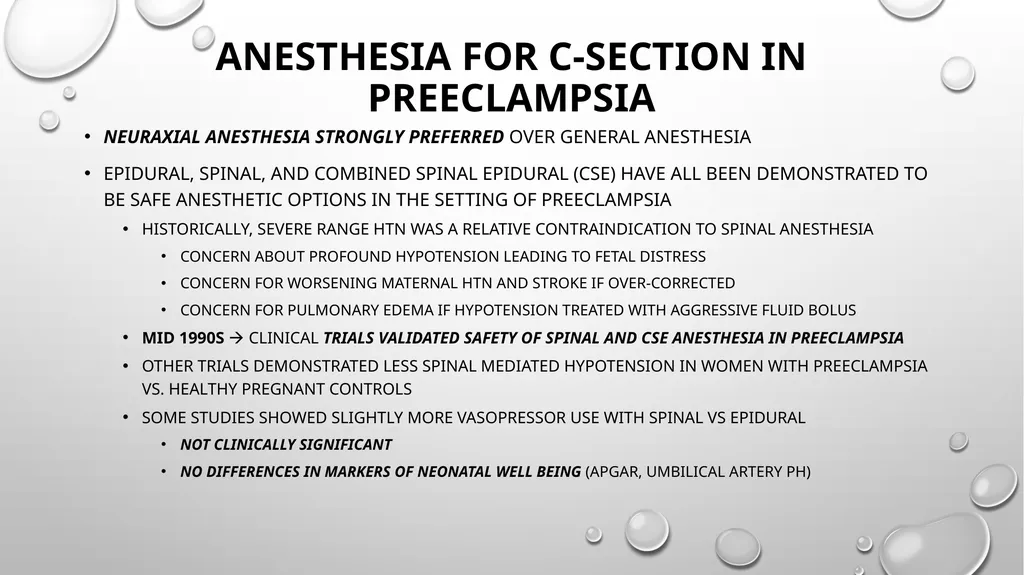
Anesthesia for c-section in preeclampsia Neuraxial anesthesia strongly preferred over general anesthesia
Epidural, spinal, and combined spinal epidural (CSE) have all been demonstrated to be safe anesthetic options in the setting of preeclampsia
Historically, severe range htn was a relative contraindication to spinal anesthesia
Concern about profound hypotension leading to fetal distress
Concern for worsening maternal htn and stroke if over-corrected
Concern for pulmonary edema if hypotension treated with aggressive fluid bolus
mid 1990s clinical trials validated safety of spinal and cse anesthesia in preeclampsia
Other trials demonstrated less spinal mediated hypotension in women with preeclampsia vs. healthy pregnant controls
Some studies showed slightly more vasopressor use with spinal vs epidural
Not clinically significant
No differences in markers of neonatal well being (APGar, umbilical artery ph)<br>
Epidural, spinal, and combined spinal epidural (CSE) have all been demonstrated to be safe anesthetic options in the setting of preeclampsia
Historically, severe range htn was a relative contraindication to spinal anesthesia
Concern about profound hypotension leading to fetal distress
Concern for worsening maternal htn and stroke if over-corrected
Concern for pulmonary edema if hypotension treated with aggressive fluid bolus
mid 1990s clinical trials validated safety of spinal and cse anesthesia in preeclampsia
Other trials demonstrated less spinal mediated hypotension in women with preeclampsia vs. healthy pregnant controls
Some studies showed slightly more vasopressor use with spinal vs epidural
Not clinically significant
No differences in markers of neonatal well being (APGar, umbilical artery ph)<br>
20
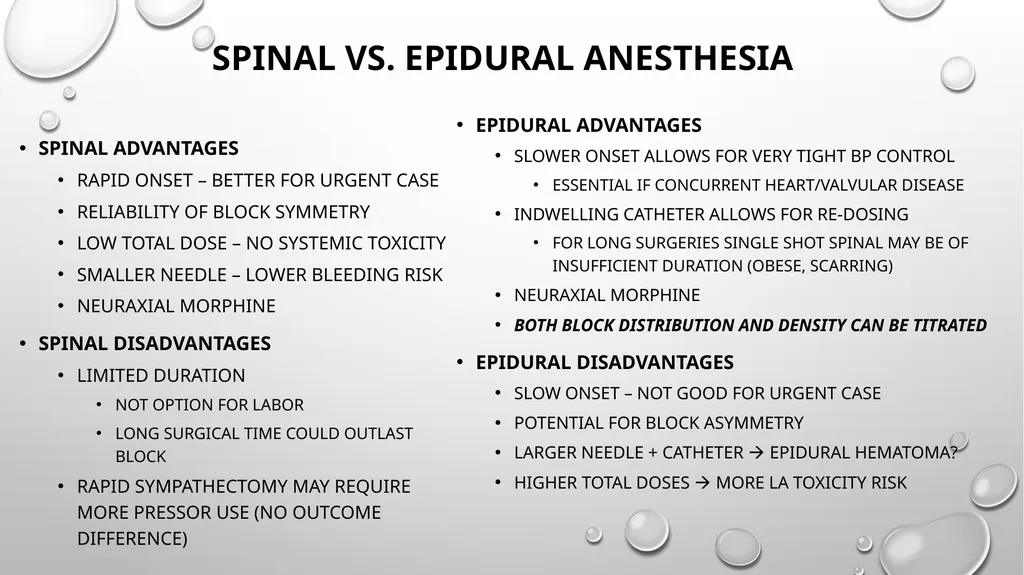
Spinal vs. epidural anesthesia Spinal advantages
Rapid onset – better for urgent case
Reliability of block symmetry
Low total dose – no systemic toxicity
Smaller needle – lower bleeding risk
neuraxial morphine
Spinal disadvantages
Limited duration
not option for labor
Long surgical time could outlast block
Rapid sympathectomy may require more pressor use (no outcome difference) Epidural advantages
Slower onset allows for very tight bp control
essential if concurrent heart/valvular disease
Indwelling catheter allows for re-dosing
For long surgeries single shot spinal may be of insufficient duration (obese, scarring)
neuraxial morphine
Both block distribution and density can be titrated
Epidural disadvantages
Slow onset – not good for urgent case
Potential for block asymmetry
Larger needle + catheter epidural hematoma?
Higher total doses more LA toxicity risk<br>
Rapid onset – better for urgent case
Reliability of block symmetry
Low total dose – no systemic toxicity
Smaller needle – lower bleeding risk
neuraxial morphine
Spinal disadvantages
Limited duration
not option for labor
Long surgical time could outlast block
Rapid sympathectomy may require more pressor use (no outcome difference) Epidural advantages
Slower onset allows for very tight bp control
essential if concurrent heart/valvular disease
Indwelling catheter allows for re-dosing
For long surgeries single shot spinal may be of insufficient duration (obese, scarring)
neuraxial morphine
Both block distribution and density can be titrated
Epidural disadvantages
Slow onset – not good for urgent case
Potential for block asymmetry
Larger needle + catheter epidural hematoma?
Higher total doses more LA toxicity risk<br>
21
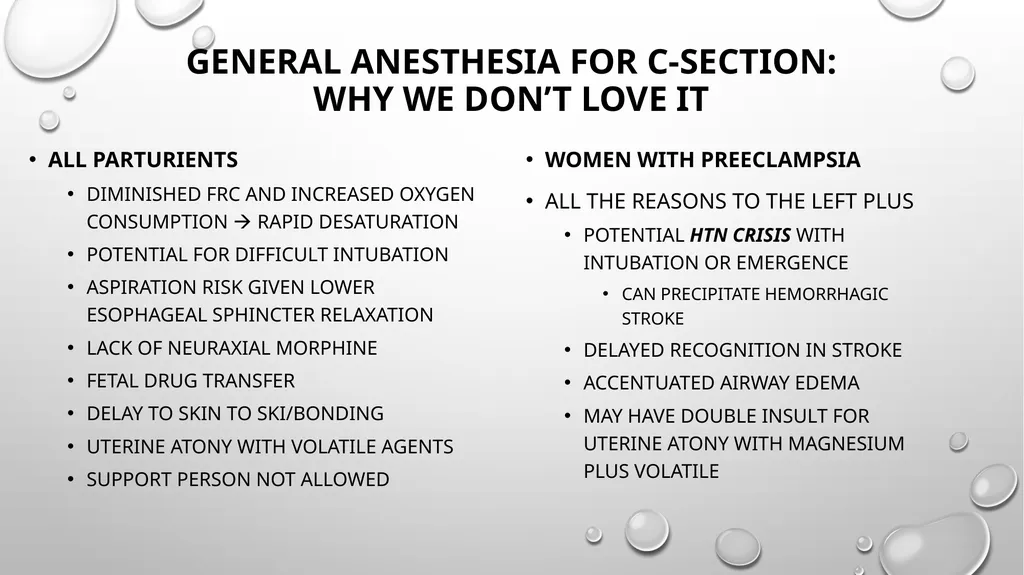
General anesthesia for c-section:
why we don’t love it All parturients
Diminished frc and increased oxygen consumption rapid desaturation
Potential for difficult intubation
Aspiration risk given lower esophageal sphincter relaxation
Lack of neuraxial morphine
Fetal drug transfer
Delay to skin to ski/bonding
Uterine atony with volatile agents
Support person not allowed Women with preeclampsia
All the reasons to the left plus
Potential htn crisis with intubation or emergence
Can precipitate hemorrhagic stroke
Delayed recognition in stroke
Accentuated airway edema
May have double insult for uterine atony with magnesium plus volatile<br>
Diminished frc and increased oxygen consumption rapid desaturation
Potential for difficult intubation
Aspiration risk given lower esophageal sphincter relaxation
Lack of neuraxial morphine
Fetal drug transfer
Delay to skin to ski/bonding
Uterine atony with volatile agents
Support person not allowed Women with preeclampsia
All the reasons to the left plus
Potential htn crisis with intubation or emergence
Can precipitate hemorrhagic stroke
Delayed recognition in stroke
Accentuated airway edema
May have double insult for uterine atony with magnesium plus volatile<br>
22
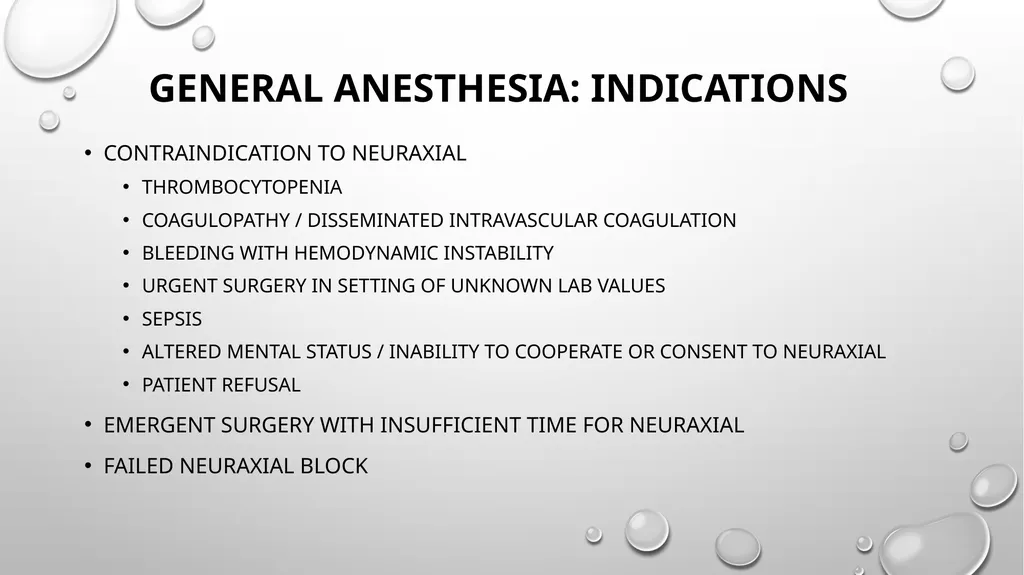
General anesthesia: indications contraindication to neuraxial
Thrombocytopenia
Coagulopathy / disseminated intravascular coagulation
Bleeding with hemodynamic instability
Urgent surgery in setting of unknown lab values
Sepsis
Altered mental status / inability to cooperate or consent to neuraxial
Patient refusal
Emergent surgery with insufficient time for neuraxial
Failed neuraxial block<br>
Thrombocytopenia
Coagulopathy / disseminated intravascular coagulation
Bleeding with hemodynamic instability
Urgent surgery in setting of unknown lab values
Sepsis
Altered mental status / inability to cooperate or consent to neuraxial
Patient refusal
Emergent surgery with insufficient time for neuraxial
Failed neuraxial block<br>
23
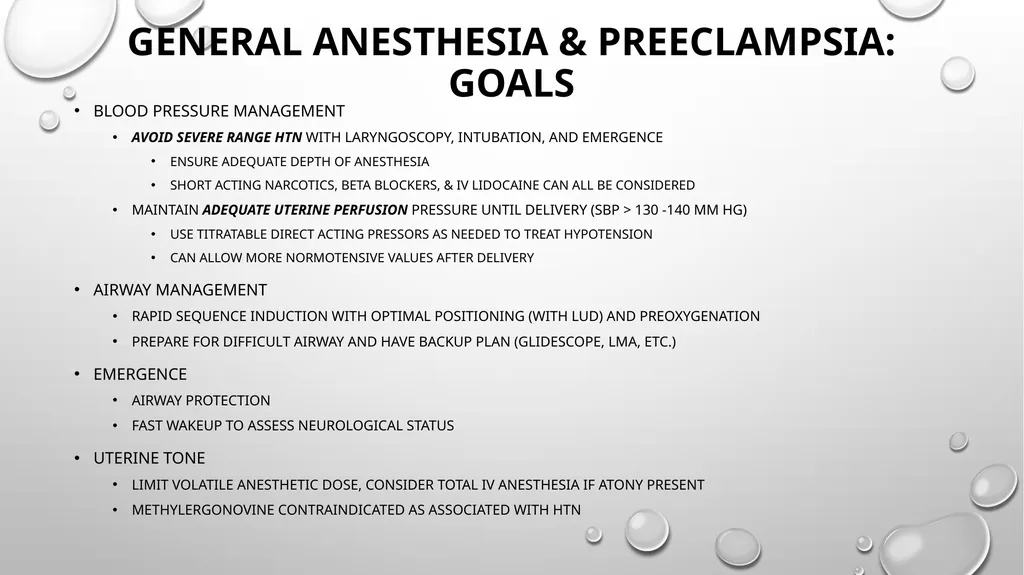
General anesthesia & preeclampsia: goals blood pressure management
Avoid severe range htn with laryngoscopy, intubation, and emergence
Ensure adequate depth of anesthesia
Short acting narcotics, beta blockers, & iv lidocaine can all be considered
Maintain adequate uterine perfusion pressure until delivery (sbp > 130 -140 mm hg)
Use titratable direct acting pressors as needed to treat hypotension
Can allow more normotensive values after delivery
Airway management
Rapid sequence induction with optimal positioning (with lud) and preoxygenation
Prepare for difficult airway and have backup plan (glidescope, lma, etc.)
Emergence
Airway protection
Fast wakeup to assess neurological status
Uterine tone
Limit volatile anesthetic dose, consider total iv anesthesia if atony present
Methylergonovine contraindicated as associated with htn<br>
Avoid severe range htn with laryngoscopy, intubation, and emergence
Ensure adequate depth of anesthesia
Short acting narcotics, beta blockers, & iv lidocaine can all be considered
Maintain adequate uterine perfusion pressure until delivery (sbp > 130 -140 mm hg)
Use titratable direct acting pressors as needed to treat hypotension
Can allow more normotensive values after delivery
Airway management
Rapid sequence induction with optimal positioning (with lud) and preoxygenation
Prepare for difficult airway and have backup plan (glidescope, lma, etc.)
Emergence
Airway protection
Fast wakeup to assess neurological status
Uterine tone
Limit volatile anesthetic dose, consider total iv anesthesia if atony present
Methylergonovine contraindicated as associated with htn<br>
24
Uterine tone & hemorrhage in preeclampsia Preeclampsia poses a risk for intrapartum and postpartum hemorrhage
Thrombocytopenia
Coagulopathy
Dic
Placental abruption
Uterine atony secondary to magnesium
Methylergonovine contraindicated
Crucial for anesthesia provider to ensure adequate iv access
Type and cross for blood products at first sign of trouble
Consider arterial line for hemodynamic monitoring and lab draws
low threshold for general anesthesia with secure airway if massive transfusion expected
Call for help!<br>
Thrombocytopenia
Coagulopathy
Dic
Placental abruption
Uterine atony secondary to magnesium
Methylergonovine contraindicated
Crucial for anesthesia provider to ensure adequate iv access
Type and cross for blood products at first sign of trouble
Consider arterial line for hemodynamic monitoring and lab draws
low threshold for general anesthesia with secure airway if massive transfusion expected
Call for help!<br>
25
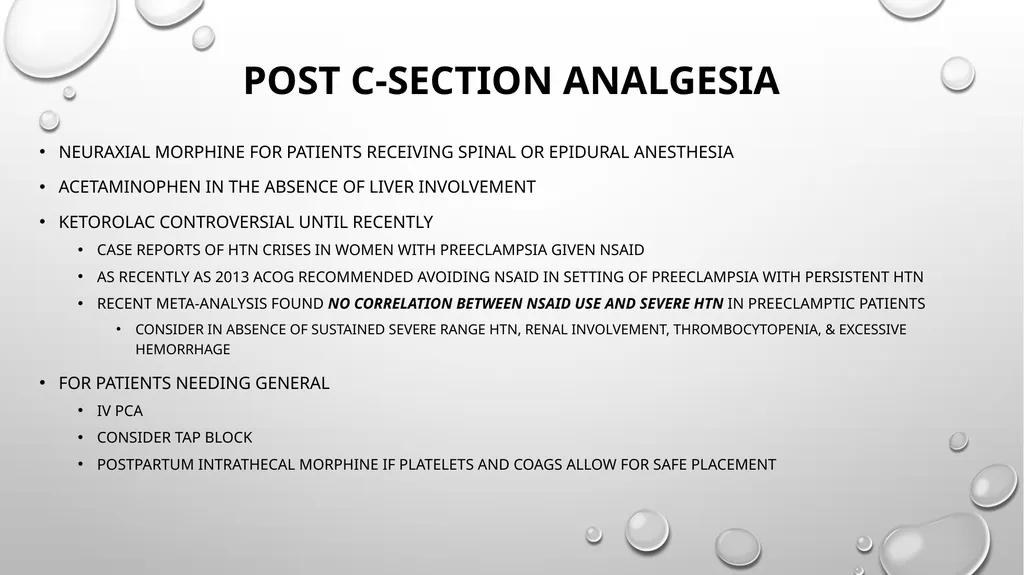
Post c-section analgesia Neuraxial morphine for patients receiving spinal or epidural anesthesia
Acetaminophen in the absence of liver involvement
Ketorolac controversial until recently
case reports of htn crises in women with preeclampsia given nsaid
As recently as 2013 Acog recommended avoiding nsaid in setting of preeclampsia with persistent htn
recent meta-analysis found no correlation between nsaid use and severe htn in preeclamptic patients
consider in absence of sustained severe range htn, renal involvement, thrombocytopenia, & excessive hemorrhage
For patients needing general
Iv pca
Consider tap block
Postpartum intrathecal morphine if platelets and Coags allow for safe placement<br>
Acetaminophen in the absence of liver involvement
Ketorolac controversial until recently
case reports of htn crises in women with preeclampsia given nsaid
As recently as 2013 Acog recommended avoiding nsaid in setting of preeclampsia with persistent htn
recent meta-analysis found no correlation between nsaid use and severe htn in preeclamptic patients
consider in absence of sustained severe range htn, renal involvement, thrombocytopenia, & excessive hemorrhage
For patients needing general
Iv pca
Consider tap block
Postpartum intrathecal morphine if platelets and Coags allow for safe placement<br>
26
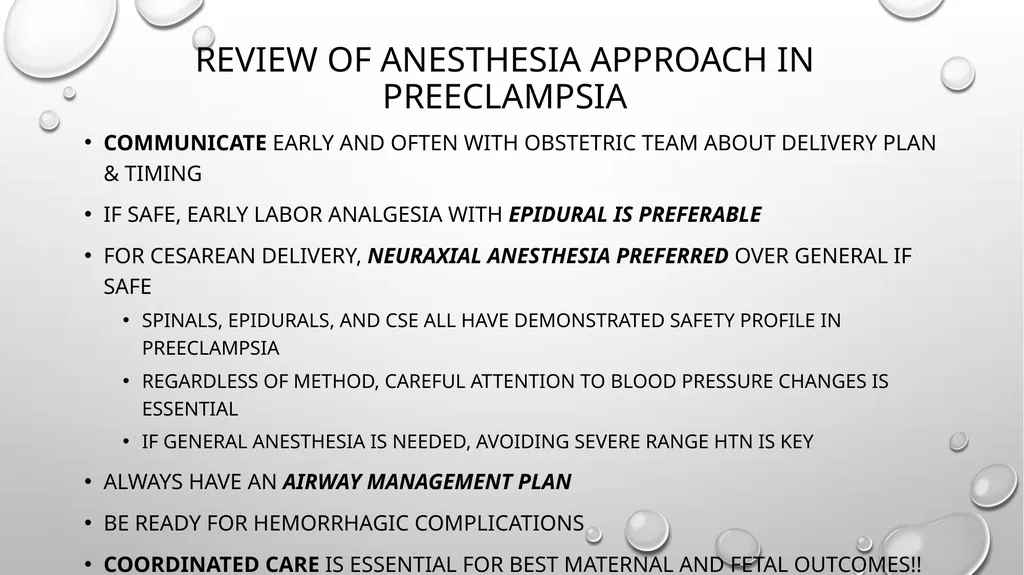
Review of anesthesia approach in preeclampsia Communicate early and often with obstetric team about delivery plan & timing
If safe, early labor analgesia with epidural is preferable
For cesarean delivery, neuraxial anesthesia preferred over general if safe
Spinals, epidurals, and cse all have demonstrated safety profile in preeclampsia
Regardless of method, careful attention to blood pressure changes is essential
If general anesthesia is needed, avoiding severe range htn is key
Always have an airway management plan
Be ready for hemorrhagic complications
Coordinated care is essential for best maternal and fetal outcomes!!<br>
If safe, early labor analgesia with epidural is preferable
For cesarean delivery, neuraxial anesthesia preferred over general if safe
Spinals, epidurals, and cse all have demonstrated safety profile in preeclampsia
Regardless of method, careful attention to blood pressure changes is essential
If general anesthesia is needed, avoiding severe range htn is key
Always have an airway management plan
Be ready for hemorrhagic complications
Coordinated care is essential for best maternal and fetal outcomes!!<br>
27
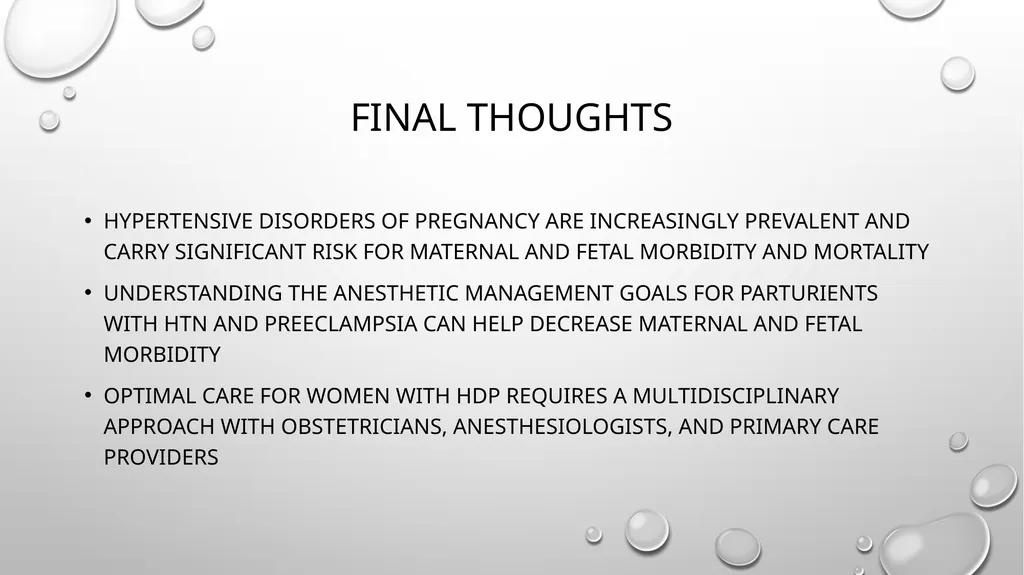
Final thoughts Hypertensive disorders of pregnancy are increasingly prevalent and carry significant risk for maternal and fetal morbidity and mortality
Understanding the anesthetic management goals for parturients with htn and preeclampsia can help decrease maternal and fetal morbidity
Optimal care for women with hdp requires a multidisciplinary approach with obstetricians, anesthesiologists, and primary care providers<br>
Understanding the anesthetic management goals for parturients with htn and preeclampsia can help decrease maternal and fetal morbidity
Optimal care for women with hdp requires a multidisciplinary approach with obstetricians, anesthesiologists, and primary care providers<br>
28
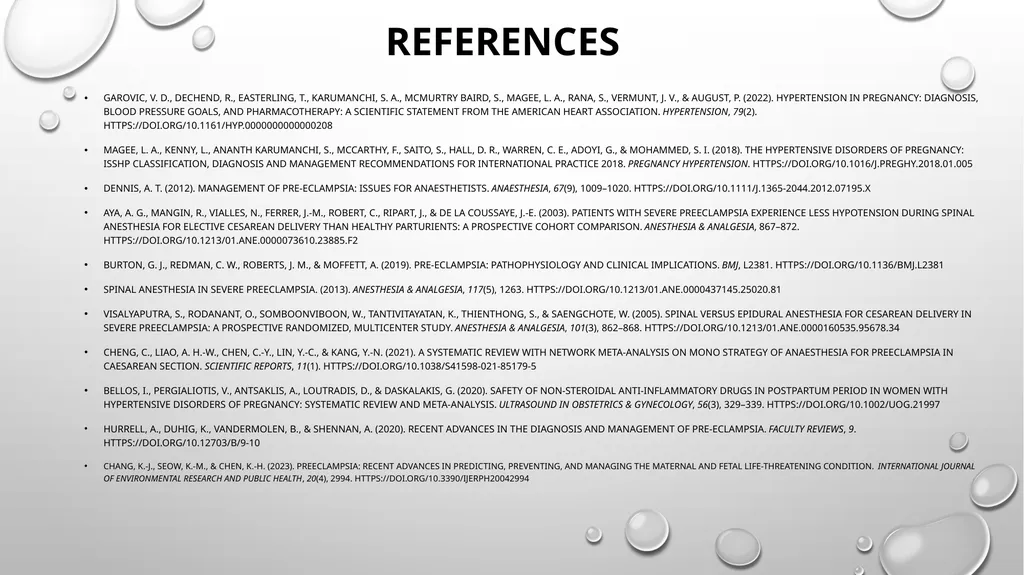
references Garovic, V. D., Dechend, R., Easterling, T., Karumanchi, S. A., McMurtry Baird, S., Magee, L. A., Rana, S., Vermunt, J. V., & August, P. (2022). Hypertension in pregnancy: Diagnosis, blood pressure goals, and pharmacotherapy: A scientific statement from the American Heart Association. Hypertension, 79(2). https://doi.org/10.1161/hyp.0000000000000208
Magee, L. A., Kenny, L., Ananth Karumanchi, S., McCarthy, F., Saito, S., Hall, D. R., Warren, C. E., Adoyi, G., & Mohammed, S. I. (2018). The hypertensive disorders of pregnancy: ISSHP classification, diagnosis and management recommendations for International Practice 2018. Pregnancy Hypertension. https://doi.org/10.1016/j.preghy.2018.01.005
Dennis, A. T. (2012). Management of pre-eclampsia: Issues for Anaesthetists. Anaesthesia, 67(9), 1009–1020. https://doi.org/10.1111/j.1365-2044.2012.07195.x
Aya, A. G., Mangin, R., Vialles, N., Ferrer, J.-M., Robert, C., Ripart, J., & de La Coussaye, J.-E. (2003). Patients with severe preeclampsia experience less hypotension during spinal anesthesia for elective cesarean delivery than healthy parturients: A prospective cohort comparison. Anesthesia & Analgesia, 867–872. https://doi.org/10.1213/01.ane.0000073610.23885.f2
Burton, G. J., Redman, C. W., Roberts, J. M., & Moffett, A. (2019). Pre-eclampsia: Pathophysiology and clinical implications. BMJ, l2381. https://doi.org/10.1136/bmj.l2381
Spinal anesthesia in severe preeclampsia. (2013). Anesthesia & Analgesia, 117(5), 1263. https://doi.org/10.1213/01.ane.0000437145.25020.81
Visalyaputra, S., Rodanant, O., Somboonviboon, W., Tantivitayatan, K., Thienthong, S., & Saengchote, W. (2005). Spinal versus epidural anesthesia for cesarean delivery in severe preeclampsia: A prospective randomized, Multicenter Study. Anesthesia & Analgesia, 101(3), 862–868. https://doi.org/10.1213/01.ane.0000160535.95678.34
Cheng, C., Liao, A. H.-W., Chen, C.-Y., Lin, Y.-C., & Kang, Y.-N. (2021). A systematic review with network meta-analysis on Mono strategy of anaesthesia for preeclampsia in caesarean section. Scientific Reports, 11(1). https://doi.org/10.1038/s41598-021-85179-5
Bellos, I., Pergialiotis, V., Antsaklis, A., Loutradis, D., & Daskalakis, G. (2020). Safety of non‐steroidal anti‐inflammatory drugs in postpartum period in women with hypertensive disorders of pregnancy: Systematic review and meta‐analysis. Ultrasound in Obstetrics & Gynecology, 56(3), 329–339. https://doi.org/10.1002/uog.21997
Hurrell, A., Duhig, K., Vandermolen, B., & Shennan, A. (2020). Recent advances in the diagnosis and management of pre-eclampsia. Faculty Reviews, 9. https://doi.org/10.12703/b/9-10
Chang, K.-J., Seow, K.-M., & Chen, K.-H. (2023). Preeclampsia: Recent advances in predicting, preventing, and managing the maternal and fetal life-threatening condition. International Journal of Environmental Research and Public Health, 20(4), 2994. https://doi.org/10.3390/ijerph20042994<br>
Magee, L. A., Kenny, L., Ananth Karumanchi, S., McCarthy, F., Saito, S., Hall, D. R., Warren, C. E., Adoyi, G., & Mohammed, S. I. (2018). The hypertensive disorders of pregnancy: ISSHP classification, diagnosis and management recommendations for International Practice 2018. Pregnancy Hypertension. https://doi.org/10.1016/j.preghy.2018.01.005
Dennis, A. T. (2012). Management of pre-eclampsia: Issues for Anaesthetists. Anaesthesia, 67(9), 1009–1020. https://doi.org/10.1111/j.1365-2044.2012.07195.x
Aya, A. G., Mangin, R., Vialles, N., Ferrer, J.-M., Robert, C., Ripart, J., & de La Coussaye, J.-E. (2003). Patients with severe preeclampsia experience less hypotension during spinal anesthesia for elective cesarean delivery than healthy parturients: A prospective cohort comparison. Anesthesia & Analgesia, 867–872. https://doi.org/10.1213/01.ane.0000073610.23885.f2
Burton, G. J., Redman, C. W., Roberts, J. M., & Moffett, A. (2019). Pre-eclampsia: Pathophysiology and clinical implications. BMJ, l2381. https://doi.org/10.1136/bmj.l2381
Spinal anesthesia in severe preeclampsia. (2013). Anesthesia & Analgesia, 117(5), 1263. https://doi.org/10.1213/01.ane.0000437145.25020.81
Visalyaputra, S., Rodanant, O., Somboonviboon, W., Tantivitayatan, K., Thienthong, S., & Saengchote, W. (2005). Spinal versus epidural anesthesia for cesarean delivery in severe preeclampsia: A prospective randomized, Multicenter Study. Anesthesia & Analgesia, 101(3), 862–868. https://doi.org/10.1213/01.ane.0000160535.95678.34
Cheng, C., Liao, A. H.-W., Chen, C.-Y., Lin, Y.-C., & Kang, Y.-N. (2021). A systematic review with network meta-analysis on Mono strategy of anaesthesia for preeclampsia in caesarean section. Scientific Reports, 11(1). https://doi.org/10.1038/s41598-021-85179-5
Bellos, I., Pergialiotis, V., Antsaklis, A., Loutradis, D., & Daskalakis, G. (2020). Safety of non‐steroidal anti‐inflammatory drugs in postpartum period in women with hypertensive disorders of pregnancy: Systematic review and meta‐analysis. Ultrasound in Obstetrics & Gynecology, 56(3), 329–339. https://doi.org/10.1002/uog.21997
Hurrell, A., Duhig, K., Vandermolen, B., & Shennan, A. (2020). Recent advances in the diagnosis and management of pre-eclampsia. Faculty Reviews, 9. https://doi.org/10.12703/b/9-10
Chang, K.-J., Seow, K.-M., & Chen, K.-H. (2023). Preeclampsia: Recent advances in predicting, preventing, and managing the maternal and fetal life-threatening condition. International Journal of Environmental Research and Public Health, 20(4), 2994. https://doi.org/10.3390/ijerph20042994<br>