Animal Behavior and Restraint Cattle Cattle Characteristics Prey animals Grazers Poor depth perception Panoramic vision 310-360 Blind side behind them Keen hearing Curious Just In Time Training Animal Behavior and Restraint: Cattle Normal
"Animal Behavior and Restraint Cattle Cattle" is the property of its rightful owner. Permission is granted to
download and print the materials on this website for personal, non-commercial use only, and to display it
on your personal computer provided you do not modify the materials and that you retain all copyright
notices contained in the materials. By downloading content from our website, you accept the terms of this
agreement.
Presentation Transcript
01
Animal Behavior and Restraint Cattle<br>
02
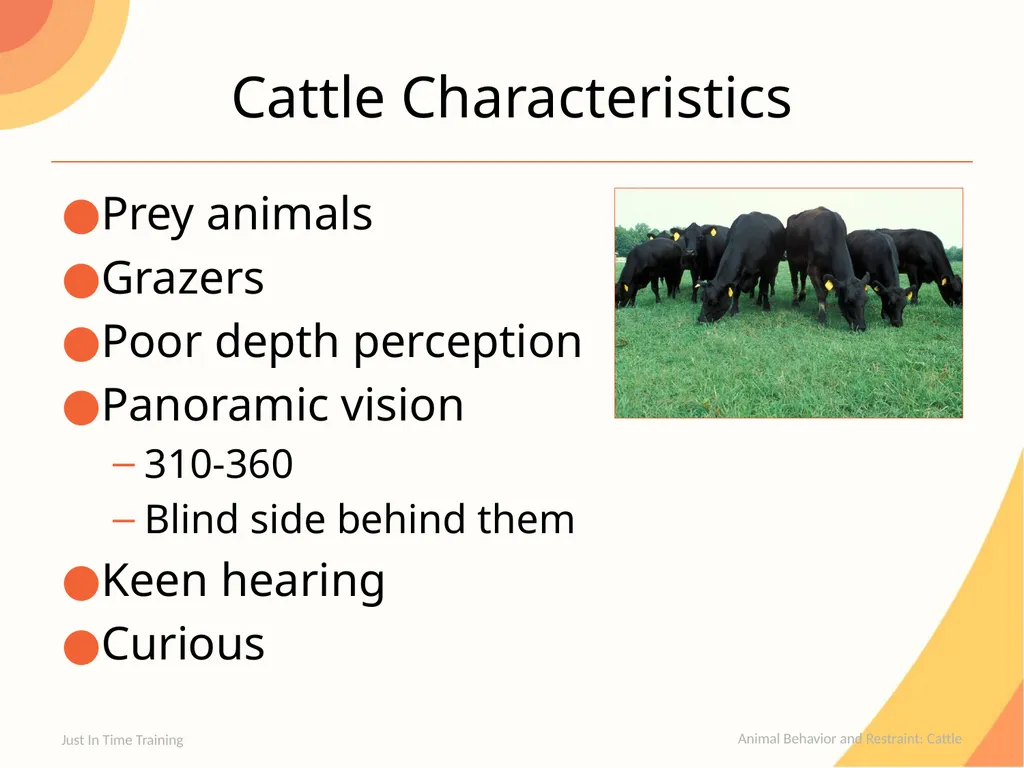
Cattle Characteristics Prey animals
Grazers
Poor depth perception
Panoramic vision
310-360
Blind side behind them
Keen hearing
Curious Just In Time Training Animal Behavior and Restraint: Cattle<br>
03
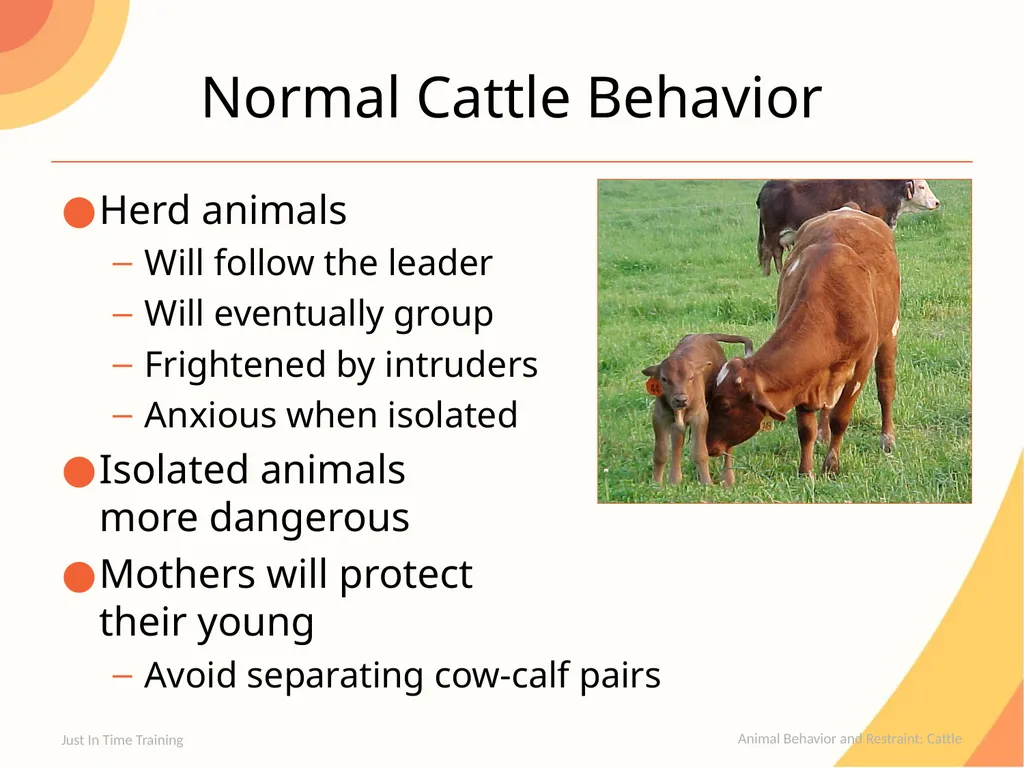
Normal Cattle Behavior Herd animals
Will follow the leader
Will eventually group
Frightened by intruders
Anxious when isolated
Isolated animals more dangerous
Mothers will protect their young
Avoid separating cow-calf pairs Just In Time Training Animal Behavior and Restraint: Cattle<br>
04
Handling & Moving Cattle Utilize cattle’s routine
Avoid
Abuse
Loud noises, yelling
Isolating animals
Distractions
Use slow, deliberate movements
Balking Just In Time Training Animal Behavior and Restraint: Cattle<br>
05
Flight Zone Animals are handled easily if flight zone is understood
Animal’s personal space
Indicator of possible threat
Size of flight zone determined by
Tameness
Degree of excitement
Move away from things in flight zone Just In Time Training Animal Behavior and Restraint: Cattle<br>
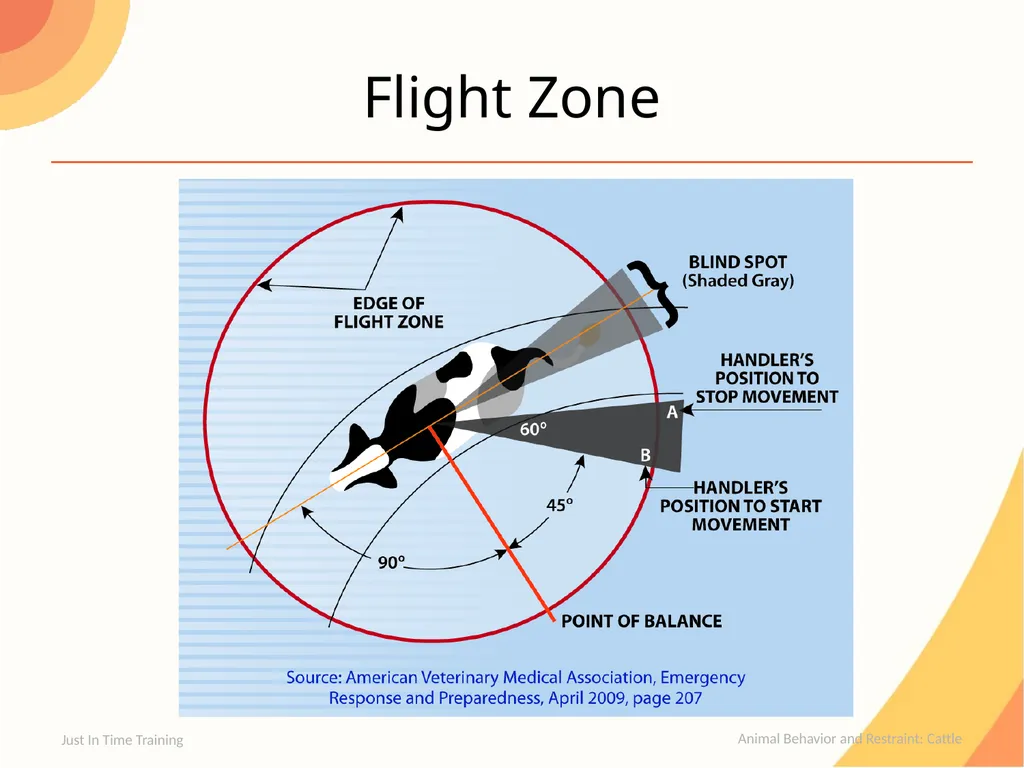
06
Flight Zone Just In Time Training Animal Behavior and Restraint: Cattle<br>
07
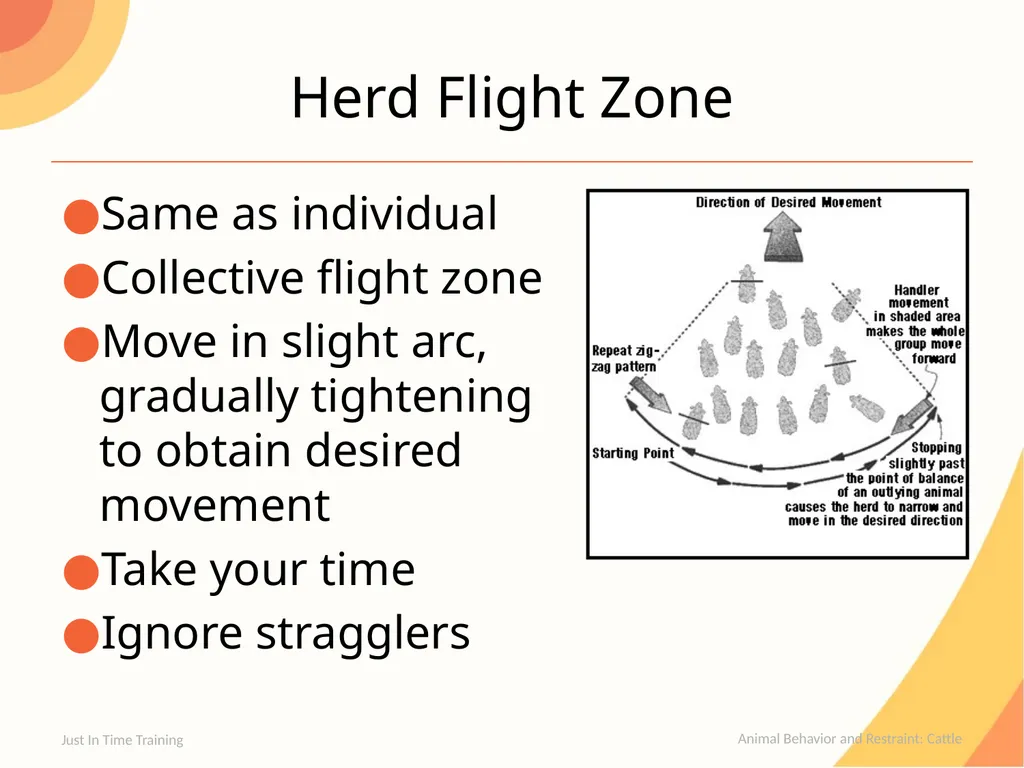
Herd Flight Zone Same as individual
Collective flight zone
Move in slight arc, gradually tightening to obtain desired movement
Take your time
Ignore stragglers Just In Time Training Animal Behavior and Restraint: Cattle<br>
08
Capture & Containment Dairy cattle
Used to humans
Easily penned
Beef cattle
Feeding practices aid in containment
Range cattle
Horses should be used in corralling Just In Time Training Animal Behavior and Restraint: Cattle<br>
09
Capture & Containment Makeshift corrals can be used
Runways and chutes can also be added
Wire fencing should be avoided
Chemical tranquilizers should be a last resort Just In Time Training Animal Behavior and Restraint: Cattle<br>
10
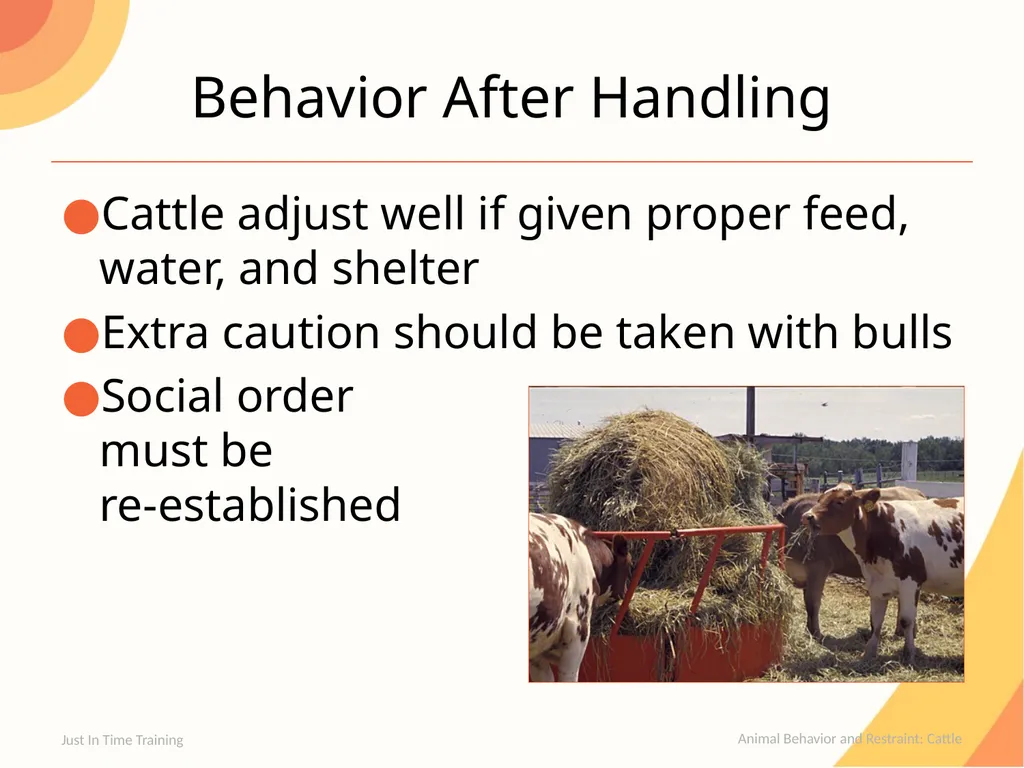
Behavior After Handling Cattle adjust well if given proper feed, water, and shelter
Extra caution should be taken with bulls
Social order must be re-established Just In Time Training Animal Behavior and Restraint: Cattle<br>
11
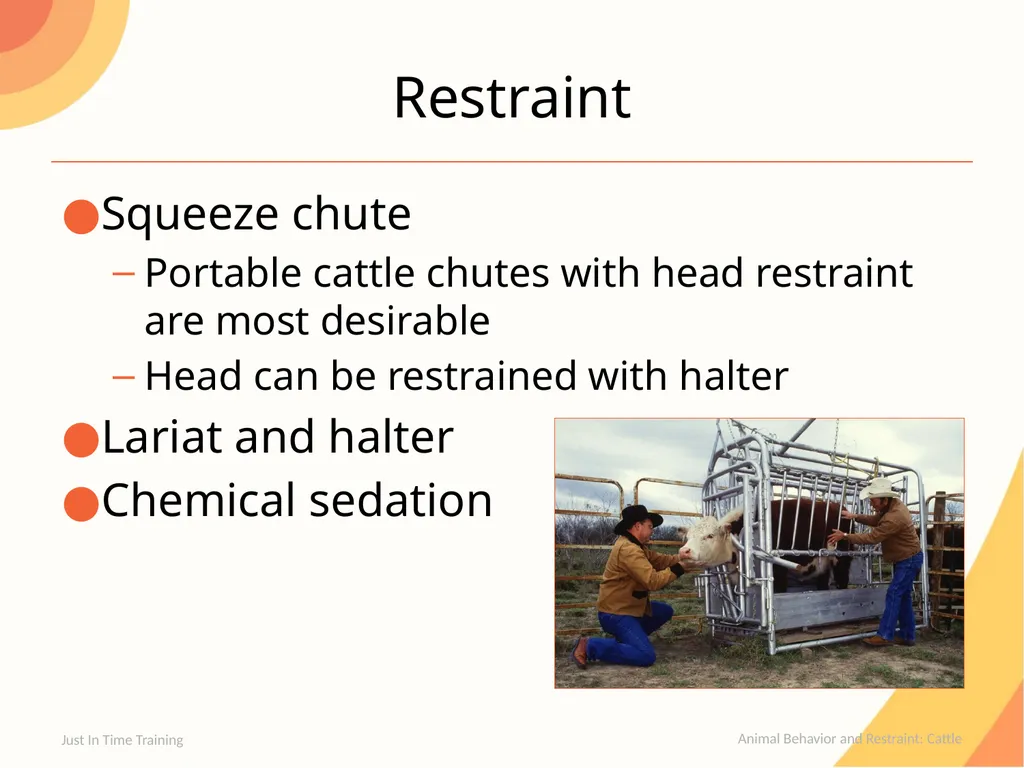
Restraint Squeeze chute
Portable cattle chutes with head restraint are most desirable
Head can be restrained with halter
Lariat and halter
Chemical sedation Just In Time Training Animal Behavior and Restraint: Cattle<br>
12
Special Considerations Monitor cattle in conditions of high heat and/or humidity
Winter weather requires special equipment
Heaters
Gritty, non-slip substances
Antifreeze Just In Time Training Animal Behavior and Restraint: Cattle<br>
13
Safety Avoid Injuries from Cattle
Kicks
Cows kick with back feet
Crowding
Crushing
Can inflict injuries with head
Don’t bite
Will run over you if desperate Just In Time Training Animal Behavior and Restraint: Cattle<br>
14
Additional Information Recommended Basic Livestock Handling: Safety Tips for Workers Temple Grandin, PhD
http://www.grandin.com/behaviour/principles/principles.html
Low Stress Methods for Moving and Herding Cattle on Pastures, Paddocks, and Large Feedlot Pens, by Temple Grandin
http://www.grandin.com/B.Williams.html
Understanding Livestock Behavior The Ohio State University Extension
http://nasdonline.org/static_content/documents/1704/d001709.pdf
Cattle Handling and Working Facilities. The Ohio State University Extension
http://ohioline.osu.edu/b906/
Cattle Handling Safety in Working Facilities. Oklahoma Cooperative Extension Service
http://pods.dasnr.okstate.edu/docushare/dsweb/Get/Document-4821/BAE-1738web.pdf Just In Time Training Animal Behavior and Restraint: Cattle<br>
15
Acknowledgments Development of this presentation was by the Center for Food Security and Public Health at Iowa State University through funding from the Multi-State Partnership for Security in Agriculture Authors: Shaine Devoe; Glenda Dvorak, DVM, MPH, DACVPM<br>