
Animal Behaviour-Lecture 5 Social Hierarchy


Description: Animal Behaviour-Lecture 5 Social Hierarchy Non-human Primate Social Group Composition: While there is considerable variation in social group composition among the primates, there is very little variability within each species. In fact,
Related Topics
Download Presentation
"Animal Behaviour-Lecture 5 Social Hierarchy" is the property of its rightful owner. Permission is granted to download and print the materials on this website for personal, non-commercial use only, and to display it on your personal computer provided you do not modify the materials and that you retain all copyright notices contained in the materials. By downloading content from our website, you accept the terms of this agreement.
Presentation Transcript
slide1. Animal Behaviour-Lecture 5 Social Hierarchy<br>
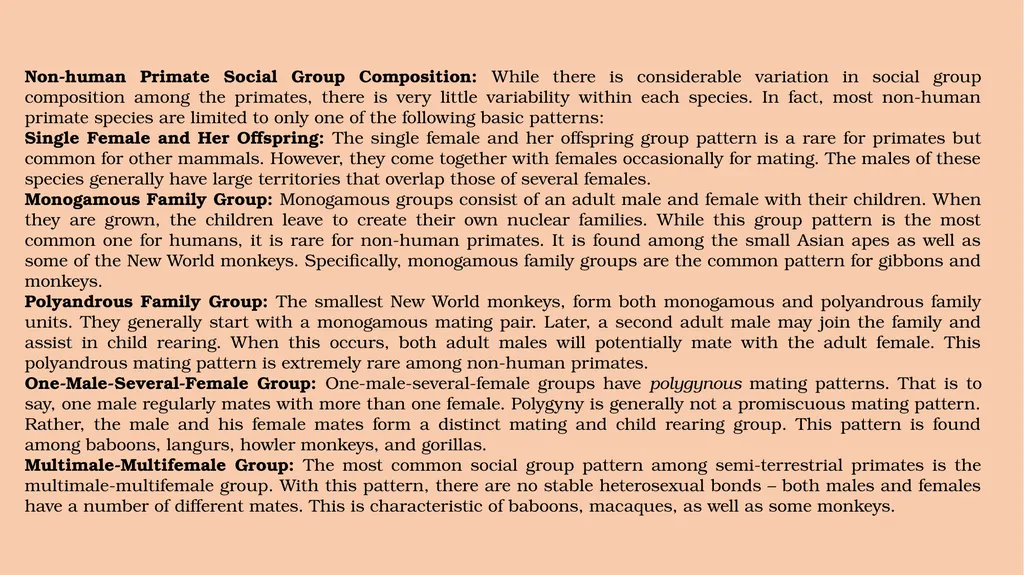
slide2. Non-human Primate Social Group Composition: While there is considerable variation in social group composition among the primates, there is very little variability within each species. In fact, most non-human primate species are limited to only one of the following basic patterns:
Single Female and Her Offspring: The single female and her offspring group pattern is a rare for primates but common for other mammals. However, they come together with females occasionally for mating. The males of these species generally have large territories that overlap those of several females.
Monogamous Family Group: Monogamous groups consist of an adult male and female with their children. When they are grown, the children leave to create their own nuclear families. While this group pattern is the most common one for humans, it is rare for non-human primates. It is found among the small Asian apes as well as some of the New World monkeys. Specifically, monogamous family groups are the common pattern for gibbons and monkeys.
Polyandrous Family Group: The smallest New World monkeys, form both monogamous and polyandrous family units. They generally start with a monogamous mating pair. Later, a second adult male may join the family and assist in child rearing. When this occurs, both adult males will potentially mate with the adult female. This polyandrous mating pattern is extremely rare among non-human primates.
One-Male-Several-Female Group: One-male-several-female groups have polygynous mating patterns. That is to say, one male regularly mates with more than one female. Polygyny is generally not a promiscuous mating pattern. Rather, the male and his female mates form a distinct mating and child rearing group. This pattern is found among baboons, langurs, howler monkeys, and gorillas.
Multimale-Multifemale Group: The most common social group pattern among semi-terrestrial primates is the multimale-multifemale group. With this pattern, there are no stable heterosexual bonds – both males and females have a number of different mates. This is characteristic of baboons, macaques, as well as some monkeys.<br>
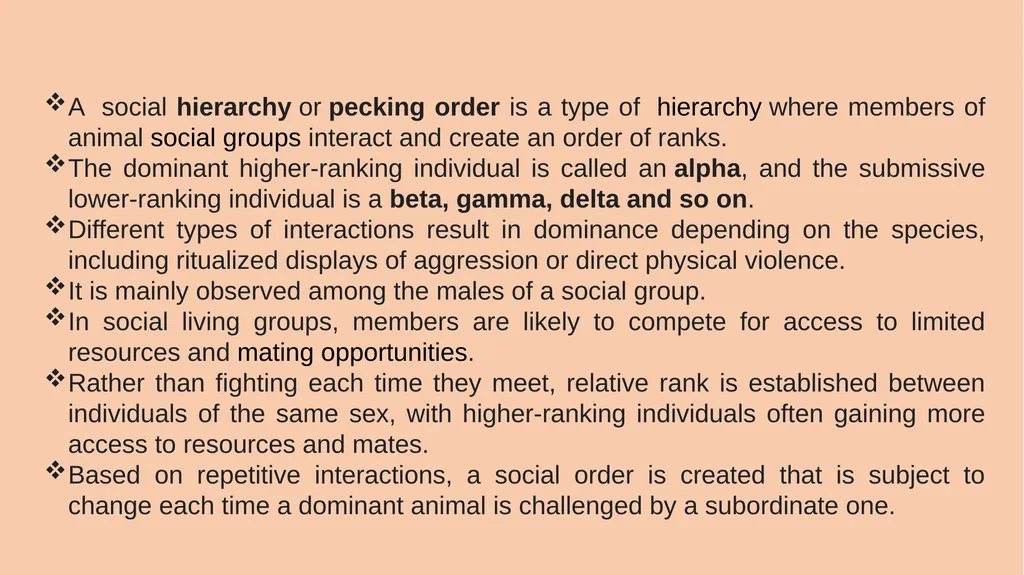
slide3. A social hierarchy or pecking order is a type of hierarchy where members of animal social groups interact and create an order of ranks.
The dominant higher-ranking individual is called an alpha, and the submissive lower-ranking individual is a beta, gamma, delta and so on.
Different types of interactions result in dominance depending on the species, including ritualized displays of aggression or direct physical violence.
It is mainly observed among the males of a social group.
In social living groups, members are likely to compete for access to limited resources and mating opportunities.
Rather than fighting each time they meet, relative rank is established between individuals of the same sex, with higher-ranking individuals often gaining more access to resources and mates.
Based on repetitive interactions, a social order is created that is subject to change each time a dominant animal is challenged by a subordinate one.<br>
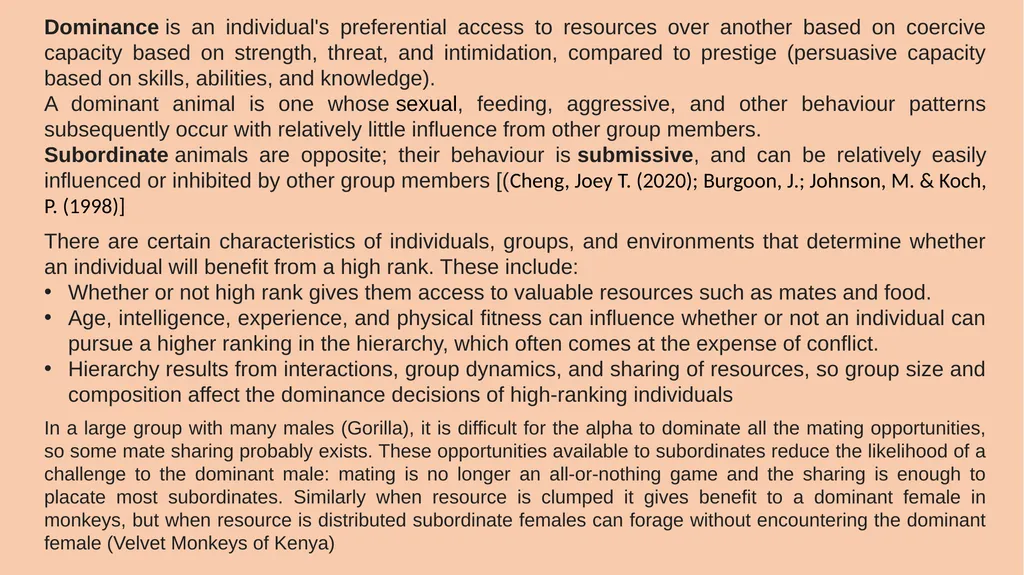
slide4. Dominance is an individual's preferential access to resources over another based on coercive capacity based on strength, threat, and intimidation, compared to prestige (persuasive capacity based on skills, abilities, and knowledge).
A dominant animal is one whose sexual, feeding, aggressive, and other behaviour patterns subsequently occur with relatively little influence from other group members.
Subordinate animals are opposite; their behaviour is submissive, and can be relatively easily influenced or inhibited by other group members [(Cheng, Joey T. (2020); Burgoon, J.; Johnson, M. & Koch, P. (1998)] There are certain characteristics of individuals, groups, and environments that determine whether an individual will benefit from a high rank. These include:
Whether or not high rank gives them access to valuable resources such as mates and food.
Age, intelligence, experience, and physical fitness can influence whether or not an individual can pursue a higher ranking in the hierarchy, which often comes at the expense of conflict.
Hierarchy results from interactions, group dynamics, and sharing of resources, so group size and composition affect the dominance decisions of high-ranking individuals In a large group with many males (Gorilla), it is difficult for the alpha to dominate all the mating opportunities, so some mate sharing probably exists. These opportunities available to subordinates reduce the likelihood of a challenge to the dominant male: mating is no longer an all-or-nothing game and the sharing is enough to placate most subordinates. Similarly when resource is clumped it gives benefit to a dominant female in monkeys, but when resource is distributed subordinate females can forage without encountering the dominant female (Velvet Monkeys of Kenya)<br>
slide5. BENEFITS:
Foraging Success:
A benefit to high ranking individuals is increased foraging success and access to food resources. During times of water shortage the highest-ranking vervet females have greater access than subordinates females to water in tree holes. In chacma baboons, the high-ranking males have the first access to vertebrate prey that has been caught by the group, and in yellow baboons the dominant males feed for longer without being interrupted.
In many bird species, the dominant individuals have higher rates of food intake. Such species include dark-eyed juncos and oystercatchers. The dominant individuals in these groups fill themselves up first and fill up more quickly, so they spend less time foraging, which reduces the risk of predation. Thus they have increased survival because of increased nutrition and decreased predation
Reproductive Success:
In primates, a well-studied group, high rank brings reproductive success, as seen in a 1991 meta-analysis of 32 studies. High-ranking bonnet macaque males have more access to fertile females and consequently partake in most of the mating within the group. In many primates, including bonnet macaques and rhesus monkeys, the offspring of high-ranking individuals have better fitness and thus an increased rate of survival. This is most likely a function of two factors. The first is that high-ranking males mate with high-ranking females. Assuming their high rank is correlated with higher fitness and fighting ability, this trait will be conferred to their offspring. The second factor is that higher-ranking parents probably provide better protection to their offspring and thus ensure higher survival rates [(Huntingford, Felicity; Turner, Angela K. (1987); Cowlishaw, Guy; Dunbar, Robin I. M. (1991)]
In many monogamous bird species, the dominant pairs tend to get the best territories, which in turn promote offspring survival and adult health<br>
slide6. COSTS
The most common costs to high-ranking individuals are higher metabolic rates and higher levels of stress hormones. In great tits and pied flycatchers, high-ranking individuals experience higher resting metabolic rates and therefore need to consume more food in order to maintain fitness and activity levels compared to subordinates in their groups. The energetic costs of defending territory, mates, and other resources can be very consuming and cause high-ranking individuals, who spend more time in these activities, to lose body mass over long periods of dominance. Therefore, their physical condition decreases the longer they spend partaking in these high-energy activities, and they lose rank as a function of age.
In wild male baboons, the highest ranking male, also known as the alpha, experiences high levels of both testosterone and glucocorticoid, which indicates that high-ranking males undergo higher levels of stress which reduces fitness. Reduced health and longevity occurs because these two hormones have immunosuppressant activity, which reduces survival and presents opportunities for parasitic infestation and other health risks [(Gesquiere, Laurence R.; Learn, Niki H.; Simao, Carolina M.; et al. (2011)].<br>
slide7. BENEFITS
There are a number of benefits to being subordinate. Subordination is beneficial in agonistic conflicts where rank predicts the outcome of a fight. Less injury will occur if subordinate individuals avoid fighting with higher-ranking individuals who would win a large percentage of the time - knowledge of the pecking order keeps both parties from incurring the costs of a prolonged fight.
Fighting with dominant males is a risky behavior that may result in defeat, injury or even death. COSTS
Subordinate individuals suffer a range of costs from dominance hierarchies, one of the most notable being reduced access to food sources.
Subordinates also lose out in shelter and nesting sites.
Subordinate individuals often demonstrate a huge reproductive disadvantage in dominance hierarchies. Among brown hyenas, subordinate females have less opportunity to rear young in the communal den, and thus had decreased survival of offspring when compared to high-ranking individuals. Subordinate males have far less copulations with females compared to the high-ranking males [Owens, D.; Owens, M. (1996); Dittus, W. P. J. (1977)]<br>
slide8. Animal’s involvement in conflict is defined by the interplay between cost and benefit of being in agonistic behaviour
It was originally based on the simplistic assumption of game theory of pair-wise conflict that both participant have equal strength and ability to fight
Modifications, have provided increased focus on the differences between the fighting capabilities of animals and their evolutionary development. These will determine the outcomes of fights, their intensity, and animal decisions to submit or continue fighting. The influence of aggression, threats, and fighting on the strategies of individuals engaged in conflict has proven integral to establishing social hierarchies reflective of dominant-subordinate interactions
Thus the asymmetries between the individuals are categorised based on the following interactions
Resource-holding potential: Animals that are better able to defend resources often win without much physical contact.
Resource value: Animals more invested in a resource are likely to invest more in the fight despite potential for incurring higher costs.
Intruder retreats: When participants are of equal fighting ability and competing for a certain territory, the resident of the territory is likely to end as the victor because he values the territory more. Huntingford, Felicity; Turner, Angela K. (1987)<br>
slide9. As conflicts are costly especially to the one loosing (resource and mate), animals rarely try to engage in conflicts to gain social rank. In order to minimize these losses, animals generally retreat from fighting or displaying fighting ability unless there are obvious cues indicating victory.
These often involve characteristics that provide an advantage during agonistic behaviour, such as size of body, displays, etc. Red stags, for example, engage in exhausting roaring contests to exhibit their strength.
Some times low level threat signals are generates in order to avoid a fight among deer.
Animals try to achieve rank using passive ways of showing dominance.
White crowned sparrows display a unique white plumage i.e. the higher the percentage of the crown that consists of white feathers, the higher the status of the individual.
Sometimes offspring born to mothers of higher rank in a social primate group (Rhesus monkey) automatically gains social dominance after reaching adulthood.<br>
slide10. REFERENCES
Owens, D.; Owens, M. (1996). "Social dominance and reproductive patterns in brown hyaenas, Hyaena brunnea, of the central Kalahari desert". Animal Behaviour. 51 (3): 535–551
Dittus, W. P. J. (1977). "The Social Regulation of Population Density and Age-Sex Distribution in the Toque Monkey". Behaviour. 63 (3): 281–322
Huntingford, Felicity; Turner, Angela K. (1987). Animal Conflict. London: Chapman and Hall. pp. 156–159, 194–205, 208–209, 250–253
Gesquiere, Laurence R.; Learn, Niki H.; Simao, Carolina M.; et al. (2011). "Life at the Top: Rank and Stress in Wild Male Baboons". Science. 333 (6040): 357–60
Cowlishaw, Guy; Dunbar, Robin I. M. (1991). "Dominance rank and mating success in male primates". Animal Behaviour. 41 (6): 1045–1056
Huntingford, Felicity; Turner, Angela K. (1987). Animal Conflict. London: Chapman and Hall. pp. 39–54
Cheng, Joey T. (2020). "Dominance, prestige, and the role of leveling in human social hierarchy and equality". Current Opinion in Psychology (Review). 33: 238–244
MLA. Alcock, John, 1942-. Animal Behavior : an Evolutionary Approach. Sunderland, Mass. :Sinauer Publishers, 2001<br>
slide2. Non-human Primate Social Group Composition: While there is considerable variation in social group composition among the primates, there is very little variability within each species. In fact, most non-human primate species are limited to only one of the following basic patterns:
Single Female and Her Offspring: The single female and her offspring group pattern is a rare for primates but common for other mammals. However, they come together with females occasionally for mating. The males of these species generally have large territories that overlap those of several females.
Monogamous Family Group: Monogamous groups consist of an adult male and female with their children. When they are grown, the children leave to create their own nuclear families. While this group pattern is the most common one for humans, it is rare for non-human primates. It is found among the small Asian apes as well as some of the New World monkeys. Specifically, monogamous family groups are the common pattern for gibbons and monkeys.
Polyandrous Family Group: The smallest New World monkeys, form both monogamous and polyandrous family units. They generally start with a monogamous mating pair. Later, a second adult male may join the family and assist in child rearing. When this occurs, both adult males will potentially mate with the adult female. This polyandrous mating pattern is extremely rare among non-human primates.
One-Male-Several-Female Group: One-male-several-female groups have polygynous mating patterns. That is to say, one male regularly mates with more than one female. Polygyny is generally not a promiscuous mating pattern. Rather, the male and his female mates form a distinct mating and child rearing group. This pattern is found among baboons, langurs, howler monkeys, and gorillas.
Multimale-Multifemale Group: The most common social group pattern among semi-terrestrial primates is the multimale-multifemale group. With this pattern, there are no stable heterosexual bonds – both males and females have a number of different mates. This is characteristic of baboons, macaques, as well as some monkeys.<br>
slide3. A social hierarchy or pecking order is a type of hierarchy where members of animal social groups interact and create an order of ranks.
The dominant higher-ranking individual is called an alpha, and the submissive lower-ranking individual is a beta, gamma, delta and so on.
Different types of interactions result in dominance depending on the species, including ritualized displays of aggression or direct physical violence.
It is mainly observed among the males of a social group.
In social living groups, members are likely to compete for access to limited resources and mating opportunities.
Rather than fighting each time they meet, relative rank is established between individuals of the same sex, with higher-ranking individuals often gaining more access to resources and mates.
Based on repetitive interactions, a social order is created that is subject to change each time a dominant animal is challenged by a subordinate one.<br>
slide4. Dominance is an individual's preferential access to resources over another based on coercive capacity based on strength, threat, and intimidation, compared to prestige (persuasive capacity based on skills, abilities, and knowledge).
A dominant animal is one whose sexual, feeding, aggressive, and other behaviour patterns subsequently occur with relatively little influence from other group members.
Subordinate animals are opposite; their behaviour is submissive, and can be relatively easily influenced or inhibited by other group members [(Cheng, Joey T. (2020); Burgoon, J.; Johnson, M. & Koch, P. (1998)] There are certain characteristics of individuals, groups, and environments that determine whether an individual will benefit from a high rank. These include:
Whether or not high rank gives them access to valuable resources such as mates and food.
Age, intelligence, experience, and physical fitness can influence whether or not an individual can pursue a higher ranking in the hierarchy, which often comes at the expense of conflict.
Hierarchy results from interactions, group dynamics, and sharing of resources, so group size and composition affect the dominance decisions of high-ranking individuals In a large group with many males (Gorilla), it is difficult for the alpha to dominate all the mating opportunities, so some mate sharing probably exists. These opportunities available to subordinates reduce the likelihood of a challenge to the dominant male: mating is no longer an all-or-nothing game and the sharing is enough to placate most subordinates. Similarly when resource is clumped it gives benefit to a dominant female in monkeys, but when resource is distributed subordinate females can forage without encountering the dominant female (Velvet Monkeys of Kenya)<br>
slide5. BENEFITS:
Foraging Success:
A benefit to high ranking individuals is increased foraging success and access to food resources. During times of water shortage the highest-ranking vervet females have greater access than subordinates females to water in tree holes. In chacma baboons, the high-ranking males have the first access to vertebrate prey that has been caught by the group, and in yellow baboons the dominant males feed for longer without being interrupted.
In many bird species, the dominant individuals have higher rates of food intake. Such species include dark-eyed juncos and oystercatchers. The dominant individuals in these groups fill themselves up first and fill up more quickly, so they spend less time foraging, which reduces the risk of predation. Thus they have increased survival because of increased nutrition and decreased predation
Reproductive Success:
In primates, a well-studied group, high rank brings reproductive success, as seen in a 1991 meta-analysis of 32 studies. High-ranking bonnet macaque males have more access to fertile females and consequently partake in most of the mating within the group. In many primates, including bonnet macaques and rhesus monkeys, the offspring of high-ranking individuals have better fitness and thus an increased rate of survival. This is most likely a function of two factors. The first is that high-ranking males mate with high-ranking females. Assuming their high rank is correlated with higher fitness and fighting ability, this trait will be conferred to their offspring. The second factor is that higher-ranking parents probably provide better protection to their offspring and thus ensure higher survival rates [(Huntingford, Felicity; Turner, Angela K. (1987); Cowlishaw, Guy; Dunbar, Robin I. M. (1991)]
In many monogamous bird species, the dominant pairs tend to get the best territories, which in turn promote offspring survival and adult health<br>
slide6. COSTS
The most common costs to high-ranking individuals are higher metabolic rates and higher levels of stress hormones. In great tits and pied flycatchers, high-ranking individuals experience higher resting metabolic rates and therefore need to consume more food in order to maintain fitness and activity levels compared to subordinates in their groups. The energetic costs of defending territory, mates, and other resources can be very consuming and cause high-ranking individuals, who spend more time in these activities, to lose body mass over long periods of dominance. Therefore, their physical condition decreases the longer they spend partaking in these high-energy activities, and they lose rank as a function of age.
In wild male baboons, the highest ranking male, also known as the alpha, experiences high levels of both testosterone and glucocorticoid, which indicates that high-ranking males undergo higher levels of stress which reduces fitness. Reduced health and longevity occurs because these two hormones have immunosuppressant activity, which reduces survival and presents opportunities for parasitic infestation and other health risks [(Gesquiere, Laurence R.; Learn, Niki H.; Simao, Carolina M.; et al. (2011)].<br>
slide7. BENEFITS
There are a number of benefits to being subordinate. Subordination is beneficial in agonistic conflicts where rank predicts the outcome of a fight. Less injury will occur if subordinate individuals avoid fighting with higher-ranking individuals who would win a large percentage of the time - knowledge of the pecking order keeps both parties from incurring the costs of a prolonged fight.
Fighting with dominant males is a risky behavior that may result in defeat, injury or even death. COSTS
Subordinate individuals suffer a range of costs from dominance hierarchies, one of the most notable being reduced access to food sources.
Subordinates also lose out in shelter and nesting sites.
Subordinate individuals often demonstrate a huge reproductive disadvantage in dominance hierarchies. Among brown hyenas, subordinate females have less opportunity to rear young in the communal den, and thus had decreased survival of offspring when compared to high-ranking individuals. Subordinate males have far less copulations with females compared to the high-ranking males [Owens, D.; Owens, M. (1996); Dittus, W. P. J. (1977)]<br>
slide8. Animal’s involvement in conflict is defined by the interplay between cost and benefit of being in agonistic behaviour
It was originally based on the simplistic assumption of game theory of pair-wise conflict that both participant have equal strength and ability to fight
Modifications, have provided increased focus on the differences between the fighting capabilities of animals and their evolutionary development. These will determine the outcomes of fights, their intensity, and animal decisions to submit or continue fighting. The influence of aggression, threats, and fighting on the strategies of individuals engaged in conflict has proven integral to establishing social hierarchies reflective of dominant-subordinate interactions
Thus the asymmetries between the individuals are categorised based on the following interactions
Resource-holding potential: Animals that are better able to defend resources often win without much physical contact.
Resource value: Animals more invested in a resource are likely to invest more in the fight despite potential for incurring higher costs.
Intruder retreats: When participants are of equal fighting ability and competing for a certain territory, the resident of the territory is likely to end as the victor because he values the territory more. Huntingford, Felicity; Turner, Angela K. (1987)<br>
slide9. As conflicts are costly especially to the one loosing (resource and mate), animals rarely try to engage in conflicts to gain social rank. In order to minimize these losses, animals generally retreat from fighting or displaying fighting ability unless there are obvious cues indicating victory.
These often involve characteristics that provide an advantage during agonistic behaviour, such as size of body, displays, etc. Red stags, for example, engage in exhausting roaring contests to exhibit their strength.
Some times low level threat signals are generates in order to avoid a fight among deer.
Animals try to achieve rank using passive ways of showing dominance.
White crowned sparrows display a unique white plumage i.e. the higher the percentage of the crown that consists of white feathers, the higher the status of the individual.
Sometimes offspring born to mothers of higher rank in a social primate group (Rhesus monkey) automatically gains social dominance after reaching adulthood.<br>
slide10. REFERENCES
Owens, D.; Owens, M. (1996). "Social dominance and reproductive patterns in brown hyaenas, Hyaena brunnea, of the central Kalahari desert". Animal Behaviour. 51 (3): 535–551
Dittus, W. P. J. (1977). "The Social Regulation of Population Density and Age-Sex Distribution in the Toque Monkey". Behaviour. 63 (3): 281–322
Huntingford, Felicity; Turner, Angela K. (1987). Animal Conflict. London: Chapman and Hall. pp. 156–159, 194–205, 208–209, 250–253
Gesquiere, Laurence R.; Learn, Niki H.; Simao, Carolina M.; et al. (2011). "Life at the Top: Rank and Stress in Wild Male Baboons". Science. 333 (6040): 357–60
Cowlishaw, Guy; Dunbar, Robin I. M. (1991). "Dominance rank and mating success in male primates". Animal Behaviour. 41 (6): 1045–1056
Huntingford, Felicity; Turner, Angela K. (1987). Animal Conflict. London: Chapman and Hall. pp. 39–54
Cheng, Joey T. (2020). "Dominance, prestige, and the role of leveling in human social hierarchy and equality". Current Opinion in Psychology (Review). 33: 238–244
MLA. Alcock, John, 1942-. Animal Behavior : an Evolutionary Approach. Sunderland, Mass. :Sinauer Publishers, 2001<br>