
Annex II: Potential Applications Quality Risk
AS
Published · 62 slides · 0 views
1 / 1





Description
Annex II: Potential Applications Quality Risk Management as part of Integrated Quality Management Quality Risk Management, ICH Q9(R1) Training Slides Quality Risk Management as part of Integrated Quality Management Note: This presentation
Related Topics
Share
Embed code
Download this presentation From Below
"Annex II: Potential Applications Quality Risk" is the property of its rightful owner. Permission is granted to download and print the materials on this website for personal, non-commercial use only, and to display it on your personal computer provided you do not modify the materials and that you retain all copyright notices contained in the materials. By downloading content from our website, you accept the terms of this agreement.
Presentation Transcript
01
Annex II: Potential Applications
Quality Risk Management as part of Integrated Quality Management<br>
Quality Risk Management as part of Integrated Quality Management<br>
02
Quality Risk Management, ICH Q9(R1)
Training Slides Quality Risk Management as part of Integrated Quality Management
Note: This presentation relates to Annex II.1 of ICH Q9(R1) International Council for Harmonisation of Technical Requirements
for Pharmaceuticals for Human Use<br>
Training Slides Quality Risk Management as part of Integrated Quality Management
Note: This presentation relates to Annex II.1 of ICH Q9(R1) International Council for Harmonisation of Technical Requirements
for Pharmaceuticals for Human Use<br>
03
Legal Notice This presentation is protected by copyright and may, with the exception of the ICH logo, be used, reproduced, incorporated into other works, adapted, modified, translated or distributed under a public license provided that ICH's copyright in the presentation is acknowledged at all times. In case of any adaption, modification or translation of the presentation, reasonable steps must be taken to clearly label, demarcate or otherwise identify that changes were made to or based on the original presentation. Any impression that the adaption, modification or translation of the original presentation is endorsed or sponsored by the ICH must be avoided.
The presentation is provided "as is" without warranty of any kind. In no event shall the ICH or the authors of the original presentation be liable for any claim, damages or other liability arising from the use of the presentation.
The above-mentioned permissions do not apply to content supplied by third parties. Therefore, for documents where the copyright vests in a third party, permission for reproduction must be obtained from this copyright holder.<br>
The presentation is provided "as is" without warranty of any kind. In no event shall the ICH or the authors of the original presentation be liable for any claim, damages or other liability arising from the use of the presentation.
The above-mentioned permissions do not apply to content supplied by third parties. Therefore, for documents where the copyright vests in a third party, permission for reproduction must be obtained from this copyright holder.<br>
04
QRM as part of the Integrated Quality Management In this training material, the term 'QRM as part of Integrated Quality Management' refers to the integration of QRM in all relevant parts of the Pharmaceutical Quality System.
When QRM is integrated into the PQS, there is a structured approach to identifying hazards and effectively manage their associated risks throughout the product lifecycle.
This helps to identify critical areas, assess potential risks, and implement controls to ensure product quality, and patient safety.
It also helps to prioritise resources, determine appropriate control measures, and drive continuous improvement within the organisation.<br>
When QRM is integrated into the PQS, there is a structured approach to identifying hazards and effectively manage their associated risks throughout the product lifecycle.
This helps to identify critical areas, assess potential risks, and implement controls to ensure product quality, and patient safety.
It also helps to prioritise resources, determine appropriate control measures, and drive continuous improvement within the organisation.<br>
05
To ensure the adequate management of risks and continuous improvement, it is essential for the principles and practices of QRM to be fully integrated within the PQS as outlined by ICH Q9 (R1).
ICH Q9 (R1) is not a guidance document intended to stand alone and it should be considered together with the other ICH Quality Guidelines.
QRM is a valuable component of an effective pharmaceutical quality system and is a regulatory requirement.
Note: The examples presented in this training serve as illustrations only and demonstrate potential applications of QRM within the context of Integrated Quality Management. These examples, which encompass management responsibilities, can serve as a guide to foster sustainable compliance with GMP and ensure quality assurance for the benefit of our patients. QRM as part of Integrated Quality Management<br>
ICH Q9 (R1) is not a guidance document intended to stand alone and it should be considered together with the other ICH Quality Guidelines.
QRM is a valuable component of an effective pharmaceutical quality system and is a regulatory requirement.
Note: The examples presented in this training serve as illustrations only and demonstrate potential applications of QRM within the context of Integrated Quality Management. These examples, which encompass management responsibilities, can serve as a guide to foster sustainable compliance with GMP and ensure quality assurance for the benefit of our patients. QRM as part of Integrated Quality Management<br>
06
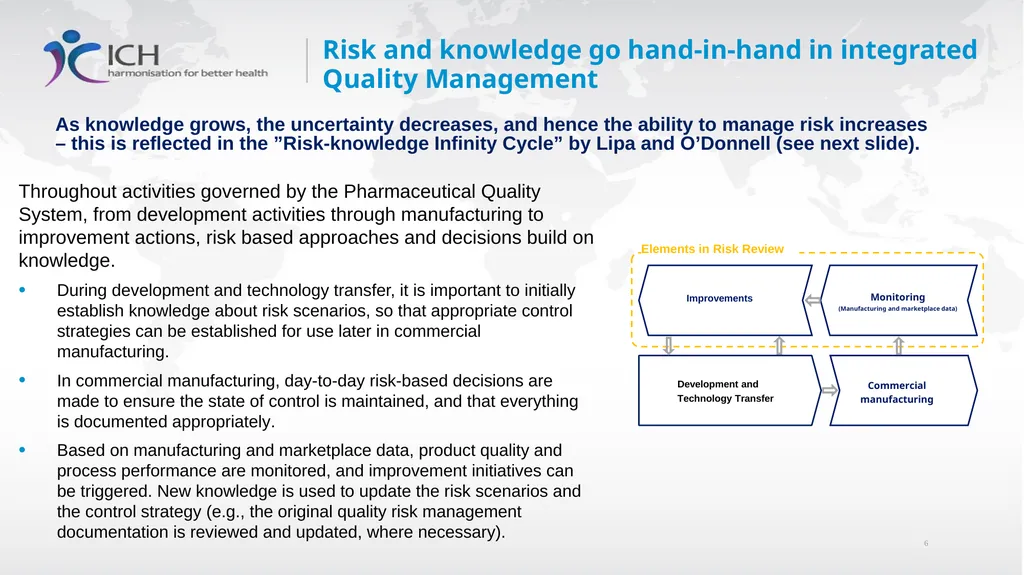
Throughout activities governed by the Pharmaceutical Quality System, from development activities through manufacturing to improvement actions, risk based approaches and decisions build on knowledge.
During development and technology transfer, it is important to initially establish knowledge about risk scenarios, so that appropriate control strategies can be established for use later in commercial manufacturing.
In commercial manufacturing, day-to-day risk-based decisions are made to ensure the state of control is maintained, and that everything is documented appropriately.
Based on manufacturing and marketplace data, product quality and process performance are monitored, and improvement initiatives can be triggered. New knowledge is used to update the risk scenarios and the control strategy (e.g., the original quality risk management documentation is reviewed and updated, where necessary). Risk and knowledge go hand-in-hand in integrated Quality Management As knowledge grows, the uncertainty decreases, and hence the ability to manage risk increases – this is reflected in the ”Risk-knowledge Infinity Cycle” by Lipa and O’Donnell (see next slide).<br>
During development and technology transfer, it is important to initially establish knowledge about risk scenarios, so that appropriate control strategies can be established for use later in commercial manufacturing.
In commercial manufacturing, day-to-day risk-based decisions are made to ensure the state of control is maintained, and that everything is documented appropriately.
Based on manufacturing and marketplace data, product quality and process performance are monitored, and improvement initiatives can be triggered. New knowledge is used to update the risk scenarios and the control strategy (e.g., the original quality risk management documentation is reviewed and updated, where necessary). Risk and knowledge go hand-in-hand in integrated Quality Management As knowledge grows, the uncertainty decreases, and hence the ability to manage risk increases – this is reflected in the ”Risk-knowledge Infinity Cycle” by Lipa and O’Donnell (see next slide).<br>
07
Risk and Knowledge go hand in hand (continued)
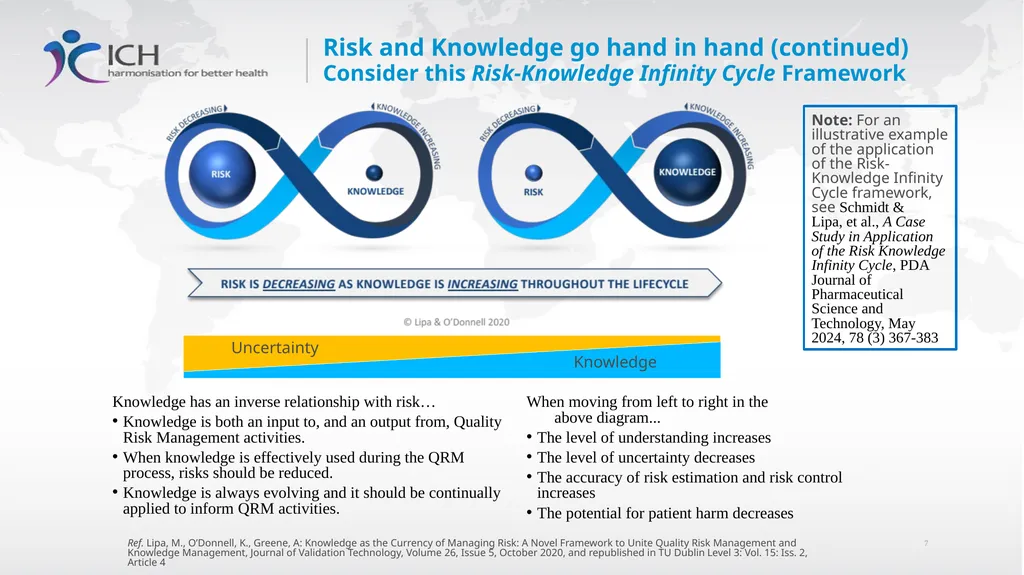
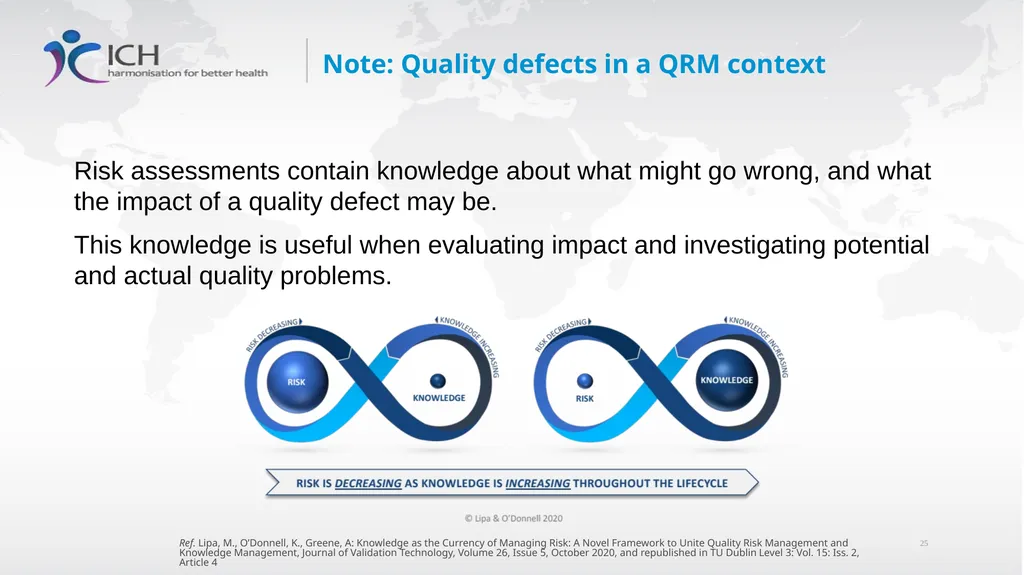
Consider this Risk-Knowledge Infinity Cycle Framework Ref. Lipa, M., O’Donnell, K., Greene, A: Knowledge as the Currency of Managing Risk: A Novel Framework to Unite Quality Risk Management and Knowledge Management, Journal of Validation Technology, Volume 26, Issue 5, October 2020, and republished in TU Dublin Level 3: Vol. 15: Iss. 2, Article 4 Knowledge has an inverse relationship with risk…
Knowledge is both an input to, and an output from, Quality Risk Management activities.
When knowledge is effectively used during the QRM process, risks should be reduced.
Knowledge is always evolving and it should be continually applied to inform QRM activities. When moving from left to right in the above diagram...
The level of understanding increases
The level of uncertainty decreases
The accuracy of risk estimation and risk control increases
The potential for patient harm decreases Note: For an illustrative example of the application of the Risk-Knowledge Infinity Cycle framework, see Schmidt & Lipa, et al., A Case Study in Application of the Risk Knowledge Infinity Cycle, PDA Journal of Pharmaceutical Science and Technology, May 2024, 78 (3) 367-383<br>
Knowledge is both an input to, and an output from, Quality Risk Management activities.
When knowledge is effectively used during the QRM process, risks should be reduced.
Knowledge is always evolving and it should be continually applied to inform QRM activities. When moving from left to right in the above diagram...
The level of understanding increases
The level of uncertainty decreases
The accuracy of risk estimation and risk control increases
The potential for patient harm decreases Note: For an illustrative example of the application of the Risk-Knowledge Infinity Cycle framework, see Schmidt & Lipa, et al., A Case Study in Application of the Risk Knowledge Infinity Cycle, PDA Journal of Pharmaceutical Science and Technology, May 2024, 78 (3) 367-383<br>
08
QRM as part of Integrated Quality Management This training material is designed to help one learn how QRM may be integrated into Quality Management activities:
Documentation
Training and education
Quality defects
Auditing / Inspection
Periodic review
Change management / change control
Continual improvement<br>
Documentation
Training and education
Quality defects
Auditing / Inspection
Periodic review
Change management / change control
Continual improvement<br>
09
Documentation<br>
10
In relation to documentation, the guideline indicates that QRM can be used:
To review current interpretations and applications of regulatory expectations;
To determine the desirability of and/or develop the content for SOPs, guidelines, etc. Documentation – what the guideline states<br>
To review current interpretations and applications of regulatory expectations;
To determine the desirability of and/or develop the content for SOPs, guidelines, etc. Documentation – what the guideline states<br>
11
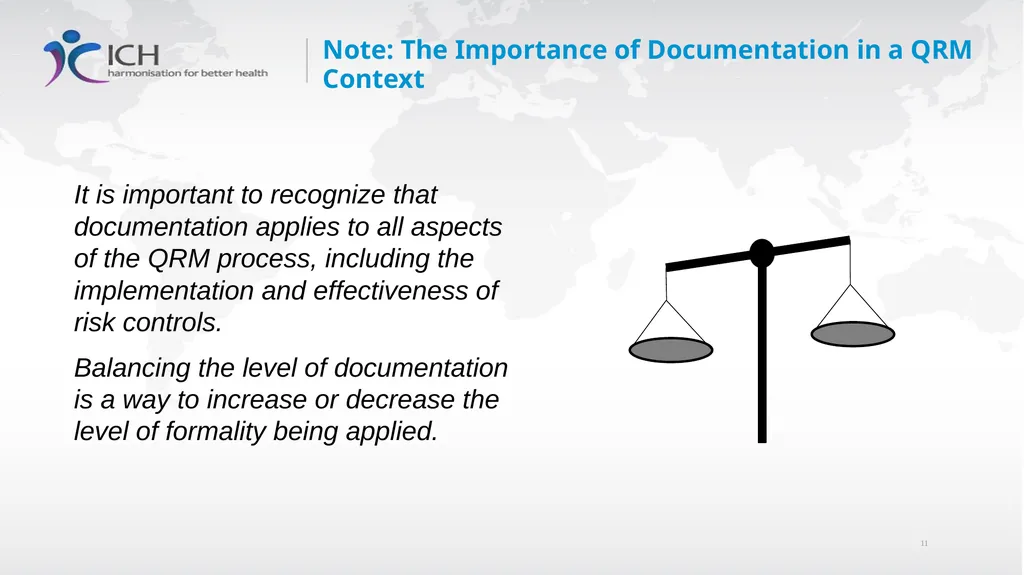
It is important to recognize that documentation applies to all aspects of the QRM process, including the implementation and effectiveness of risk controls.
Balancing the level of documentation is a way to increase or decrease the level of formality being applied. Note: The Importance of Documentation in a QRM Context<br>
Balancing the level of documentation is a way to increase or decrease the level of formality being applied. Note: The Importance of Documentation in a QRM Context<br>
12
Regulatory expectations are often an expression of the need to control risks.
In the review of current interpretations and applications of regulatory expectations, it is important to review current quality risk management documentation. This lets one evaluate whether risks are adequately controlled, or if gaps exist.
It also enables one to determine whether the documentation provides an appropriate level of detail and depth in relation to how risks are controlled. This can be an indicator of how much formality was applied during the quality risk management process.
These activities can be considered to be a form of Risk Review. Documentation - Exploring the meaning of the guideline text To review current interpretations and application of regulatory expectations Guideline Text Explanation<br>
In the review of current interpretations and applications of regulatory expectations, it is important to review current quality risk management documentation. This lets one evaluate whether risks are adequately controlled, or if gaps exist.
It also enables one to determine whether the documentation provides an appropriate level of detail and depth in relation to how risks are controlled. This can be an indicator of how much formality was applied during the quality risk management process.
These activities can be considered to be a form of Risk Review. Documentation - Exploring the meaning of the guideline text To review current interpretations and application of regulatory expectations Guideline Text Explanation<br>
13
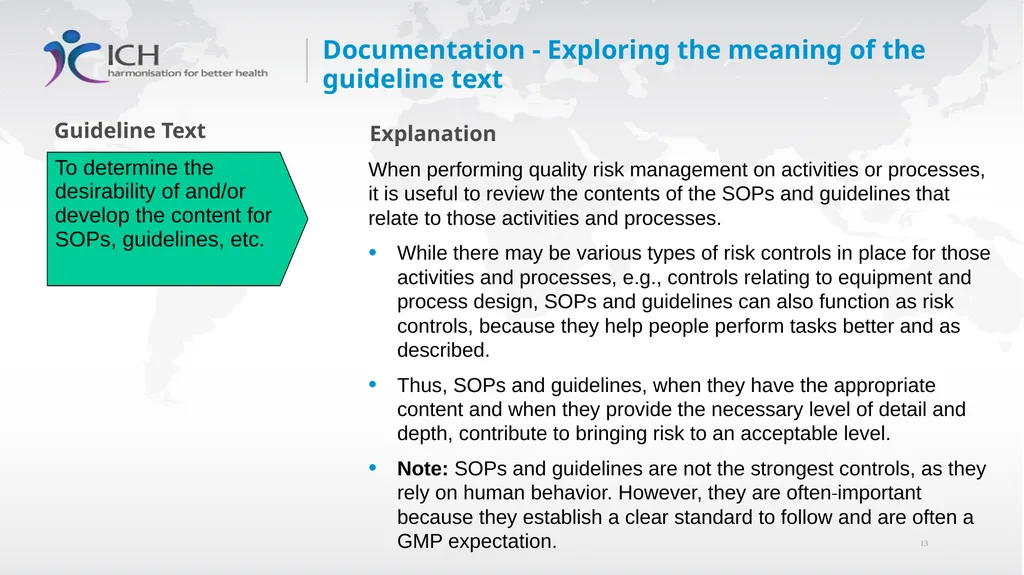
When performing quality risk management on activities or processes, it is useful to review the contents of the SOPs and guidelines that relate to those activities and processes.
While there may be various types of risk controls in place for those activities and processes, e.g., controls relating to equipment and process design, SOPs and guidelines can also function as risk controls, because they help people perform tasks better and as described.
Thus, SOPs and guidelines, when they have the appropriate content and when they provide the necessary level of detail and depth, contribute to bringing risk to an acceptable level.
Note: SOPs and guidelines are not the strongest controls, as they rely on human behavior. However, they are often important because they establish a clear standard to follow and are often a GMP expectation. Documentation - Exploring the meaning of the guideline text To determine the desirability of and/or develop the content for SOPs, guidelines, etc. Guideline Text Explanation<br>
While there may be various types of risk controls in place for those activities and processes, e.g., controls relating to equipment and process design, SOPs and guidelines can also function as risk controls, because they help people perform tasks better and as described.
Thus, SOPs and guidelines, when they have the appropriate content and when they provide the necessary level of detail and depth, contribute to bringing risk to an acceptable level.
Note: SOPs and guidelines are not the strongest controls, as they rely on human behavior. However, they are often important because they establish a clear standard to follow and are often a GMP expectation. Documentation - Exploring the meaning of the guideline text To determine the desirability of and/or develop the content for SOPs, guidelines, etc. Guideline Text Explanation<br>
14
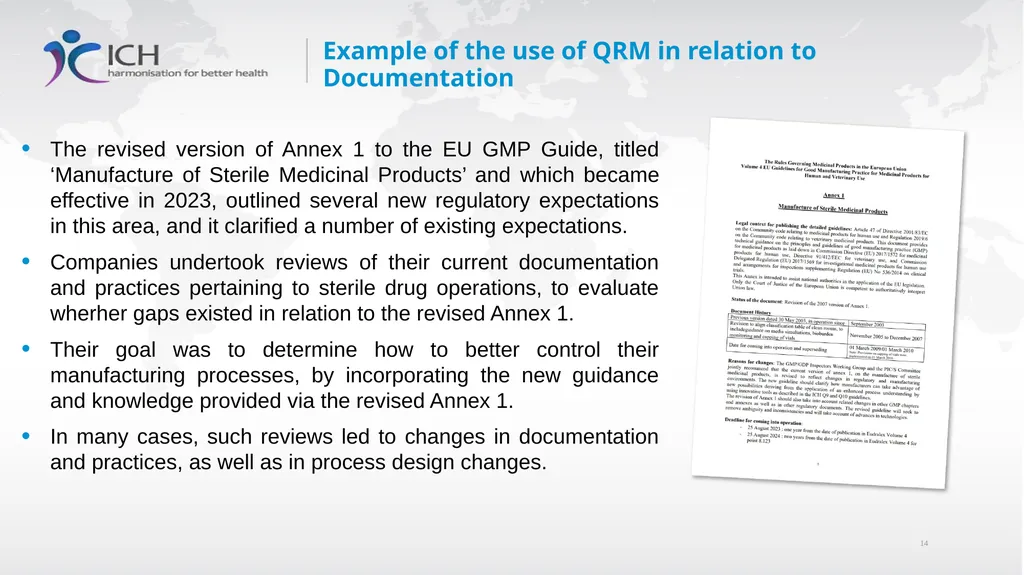
The revised version of Annex 1 to the EU GMP Guide, titled ‘Manufacture of Sterile Medicinal Products’ and which became effective in 2023, outlined several new regulatory expectations in this area, and it clarified a number of existing expectations.
Companies undertook reviews of their current documentation and practices pertaining to sterile drug operations, to evaluate wherher gaps existed in relation to the revised Annex 1.
Their goal was to determine how to better control their manufacturing processes, by incorporating the new guidance and knowledge provided via the revised Annex 1.
In many cases, such reviews led to changes in documentation and practices, as well as in process design changes. Example of the use of QRM in relation to Documentation<br>
Companies undertook reviews of their current documentation and practices pertaining to sterile drug operations, to evaluate wherher gaps existed in relation to the revised Annex 1.
Their goal was to determine how to better control their manufacturing processes, by incorporating the new guidance and knowledge provided via the revised Annex 1.
In many cases, such reviews led to changes in documentation and practices, as well as in process design changes. Example of the use of QRM in relation to Documentation<br>
15
Training and Education<br>
16
In relation to Training and Education, the guideline indicates that QRM can be used:
To determine the appropriateness of initial and/or ongoing training sessions based on education, experience and working habits of staff, as well as on a periodic assessment of previous training (e.g., its effectiveness);
To identify the training, experience, qualifications and physical abilities that allow personnel to perform an operation reliably and with no adverse impact on the quality of the product. Training and Education – what the guideline states<br>
To determine the appropriateness of initial and/or ongoing training sessions based on education, experience and working habits of staff, as well as on a periodic assessment of previous training (e.g., its effectiveness);
To identify the training, experience, qualifications and physical abilities that allow personnel to perform an operation reliably and with no adverse impact on the quality of the product. Training and Education – what the guideline states<br>
17
Providing training and education is a way of ensuring that tasks are performed in a certain way, and that certain competences and capabilities exist, so that the tasks lead to the desired outcomes.
In this way, training and education not only help define how risk controls are determined and applied, they also serve, to some extent, as risk controls themselves. Note: Training and Education in a QRM context<br>
In this way, training and education not only help define how risk controls are determined and applied, they also serve, to some extent, as risk controls themselves. Note: Training and Education in a QRM context<br>
18
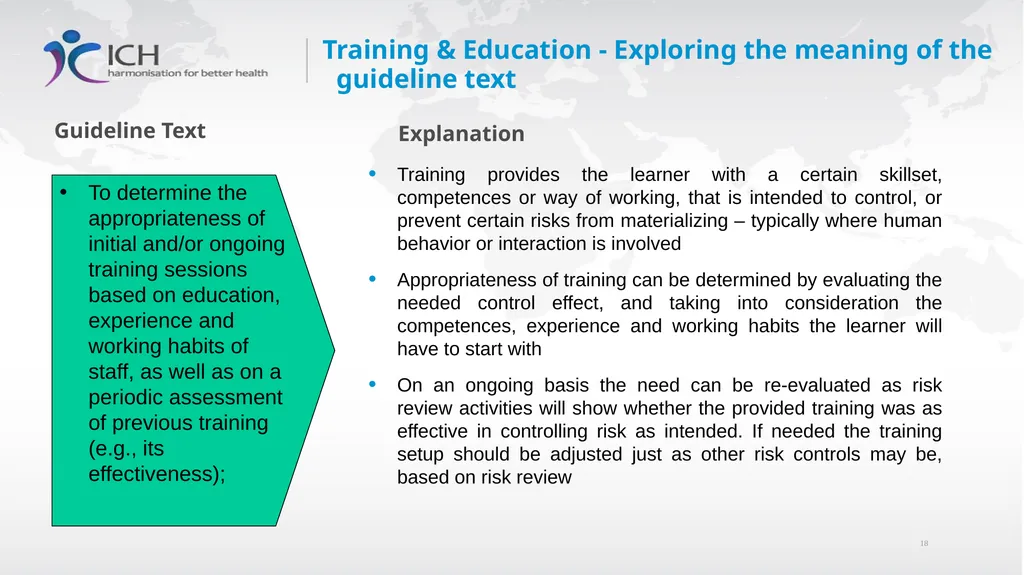
Training provides the learner with a certain skillset, competences or way of working, that is intended to control, or prevent certain risks from materializing – typically where human behavior or interaction is involved
Appropriateness of training can be determined by evaluating the needed control effect, and taking into consideration the competences, experience and working habits the learner will have to start with
On an ongoing basis the need can be re-evaluated as risk review activities will show whether the provided training was as effective in controlling risk as intended. If needed the training setup should be adjusted just as other risk controls may be, based on risk review Training & Education - Exploring the meaning of the guideline text To determine the appropriateness of initial and/or ongoing training sessions based on education, experience and working habits of staff, as well as on a periodic assessment of previous training (e.g., its effectiveness); Guideline Text Explanation<br>
Appropriateness of training can be determined by evaluating the needed control effect, and taking into consideration the competences, experience and working habits the learner will have to start with
On an ongoing basis the need can be re-evaluated as risk review activities will show whether the provided training was as effective in controlling risk as intended. If needed the training setup should be adjusted just as other risk controls may be, based on risk review Training & Education - Exploring the meaning of the guideline text To determine the appropriateness of initial and/or ongoing training sessions based on education, experience and working habits of staff, as well as on a periodic assessment of previous training (e.g., its effectiveness); Guideline Text Explanation<br>
19
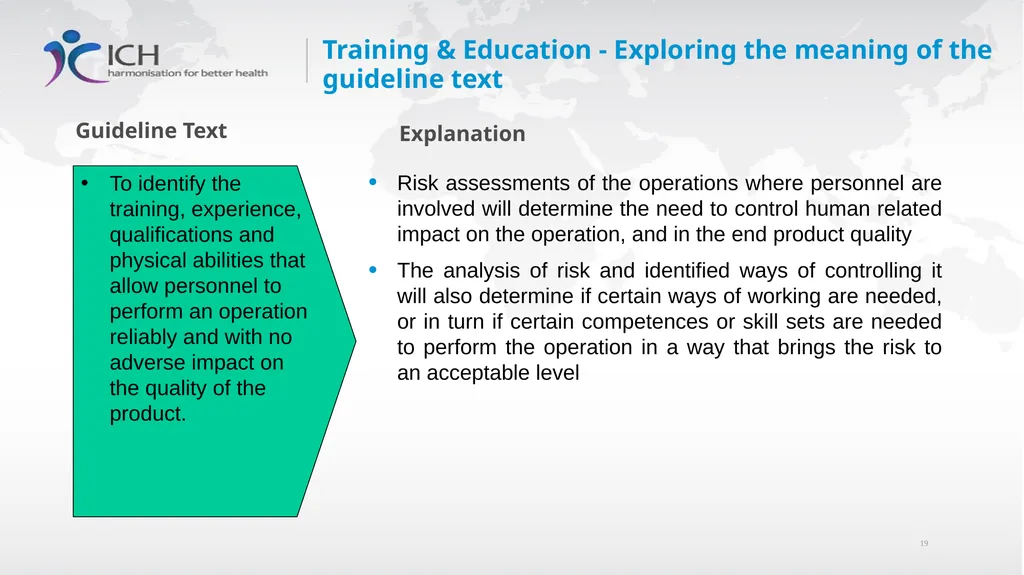
Risk assessments of the operations where personnel are involved will determine the need to control human related impact on the operation, and in the end product quality
The analysis of risk and identified ways of controlling it will also determine if certain ways of working are needed, or in turn if certain competences or skill sets are needed to perform the operation in a way that brings the risk to an acceptable level Training & Education - Exploring the meaning of the guideline text To identify the training, experience, qualifications and physical abilities that allow personnel to perform an operation reliably and with no adverse impact on the quality of the product. Guideline Text Explanation<br>
The analysis of risk and identified ways of controlling it will also determine if certain ways of working are needed, or in turn if certain competences or skill sets are needed to perform the operation in a way that brings the risk to an acceptable level Training & Education - Exploring the meaning of the guideline text To identify the training, experience, qualifications and physical abilities that allow personnel to perform an operation reliably and with no adverse impact on the quality of the product. Guideline Text Explanation<br>
20
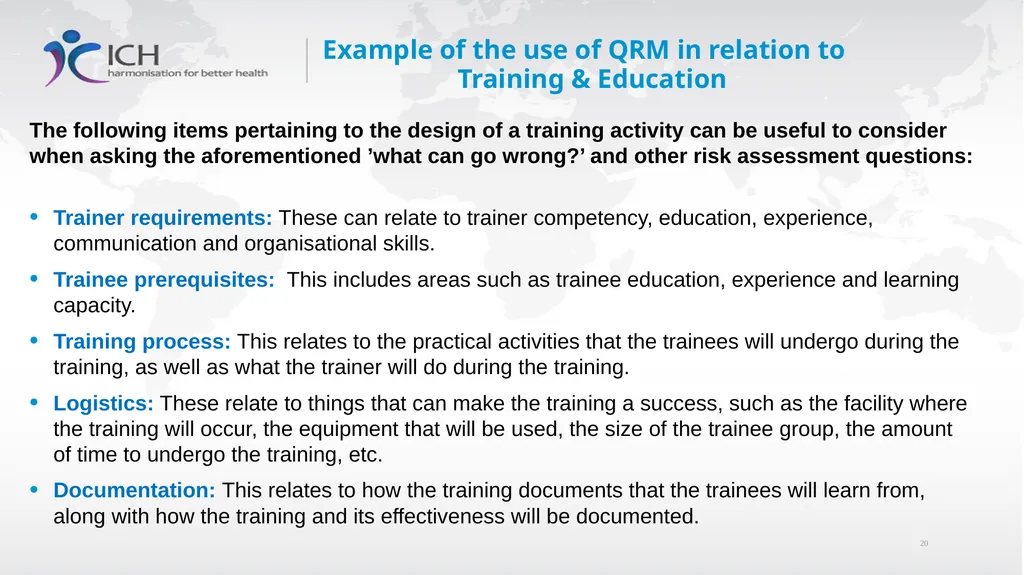
The following items pertaining to the design of a training activity can be useful to consider when asking the aforementioned ’what can go wrong?’ and other risk assessment questions:
Trainer requirements: These can relate to trainer competency, education, experience, communication and organisational skills.
Trainee prerequisites: This includes areas such as trainee education, experience and learning capacity.
Training process: This relates to the practical activities that the trainees will undergo during the training, as well as what the trainer will do during the training.
Logistics: These relate to things that can make the training a success, such as the facility where the training will occur, the equipment that will be used, the size of the trainee group, the amount of time to undergo the training, etc.
Documentation: This relates to how the training documents that the trainees will learn from, along with how the training and its effectiveness will be documented. Example of the use of QRM in relation to Training & Education<br>
Trainer requirements: These can relate to trainer competency, education, experience, communication and organisational skills.
Trainee prerequisites: This includes areas such as trainee education, experience and learning capacity.
Training process: This relates to the practical activities that the trainees will undergo during the training, as well as what the trainer will do during the training.
Logistics: These relate to things that can make the training a success, such as the facility where the training will occur, the equipment that will be used, the size of the trainee group, the amount of time to undergo the training, etc.
Documentation: This relates to how the training documents that the trainees will learn from, along with how the training and its effectiveness will be documented. Example of the use of QRM in relation to Training & Education<br>
21
The Risk Assessment and Risk Control elements of QRM can be applied to training activities. For example:
When designing a training activity or programme, the question ‘what might go wrong?’ in relation to the training can be considered.
One may also ask: ‘Where, when and how might this happen?’
These are risk assessment questions; they can prompt one to ensure that there are controls in place to counteract those potential problems. In this way, training materials equate to risk controls.
Other useful questions to consider may be the following, and they can also result in useful risk controls:
What hazards or risk factors may impede learning during the training?
What may limit the effectiveness of the training? Example of the use of QRM in relation to Training & Education<br>
When designing a training activity or programme, the question ‘what might go wrong?’ in relation to the training can be considered.
One may also ask: ‘Where, when and how might this happen?’
These are risk assessment questions; they can prompt one to ensure that there are controls in place to counteract those potential problems. In this way, training materials equate to risk controls.
Other useful questions to consider may be the following, and they can also result in useful risk controls:
What hazards or risk factors may impede learning during the training?
What may limit the effectiveness of the training? Example of the use of QRM in relation to Training & Education<br>
22
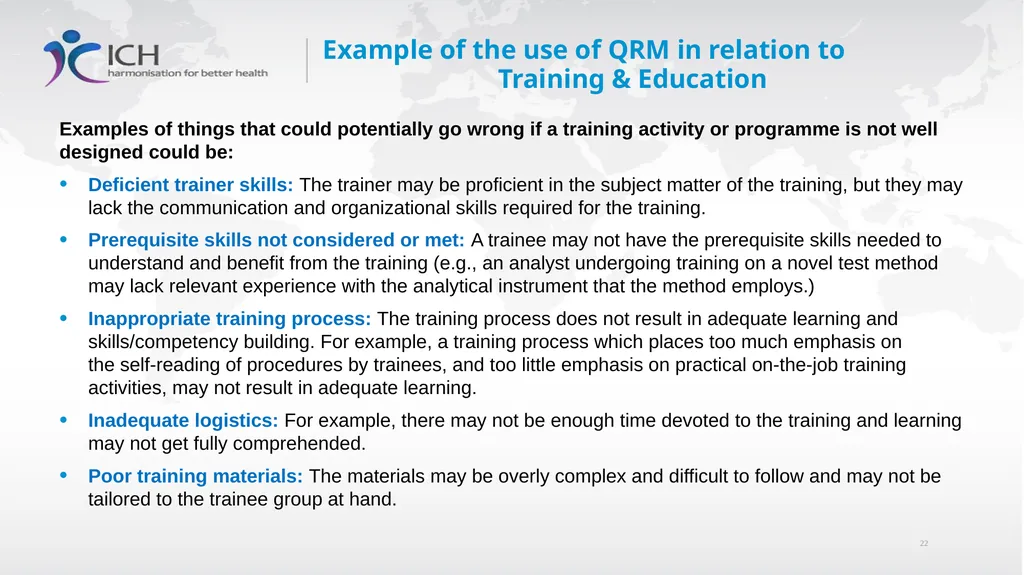
Examples of things that could potentially go wrong if a training activity or programme is not well designed could be:
Deficient trainer skills: The trainer may be proficient in the subject matter of the training, but they may lack the communication and organizational skills required for the training.
Prerequisite skills not considered or met: A trainee may not have the prerequisite skills needed to understand and benefit from the training (e.g., an analyst undergoing training on a novel test method may lack relevant experience with the analytical instrument that the method employs.)
Inappropriate training process: The training process does not result in adequate learning and skills/competency building. For example, a training process which places too much emphasis on the self-reading of procedures by trainees, and too little emphasis on practical on-the-job training activities, may not result in adequate learning.
Inadequate logistics: For example, there may not be enough time devoted to the training and learning may not get fully comprehended.
Poor training materials: The materials may be overly complex and difficult to follow and may not be tailored to the trainee group at hand. Example of the use of QRM in relation to Training & Education<br>
Deficient trainer skills: The trainer may be proficient in the subject matter of the training, but they may lack the communication and organizational skills required for the training.
Prerequisite skills not considered or met: A trainee may not have the prerequisite skills needed to understand and benefit from the training (e.g., an analyst undergoing training on a novel test method may lack relevant experience with the analytical instrument that the method employs.)
Inappropriate training process: The training process does not result in adequate learning and skills/competency building. For example, a training process which places too much emphasis on the self-reading of procedures by trainees, and too little emphasis on practical on-the-job training activities, may not result in adequate learning.
Inadequate logistics: For example, there may not be enough time devoted to the training and learning may not get fully comprehended.
Poor training materials: The materials may be overly complex and difficult to follow and may not be tailored to the trainee group at hand. Example of the use of QRM in relation to Training & Education<br>
23
Quality Defects<br>
24
In relation to Quality Defects, the guideline indicates that QRM can be used:
To provide the basis for identifying, evaluating, and communicating the potential quality impact of a suspected quality defect, complaint, trend, deviation, investigation, out of specification result, etc;
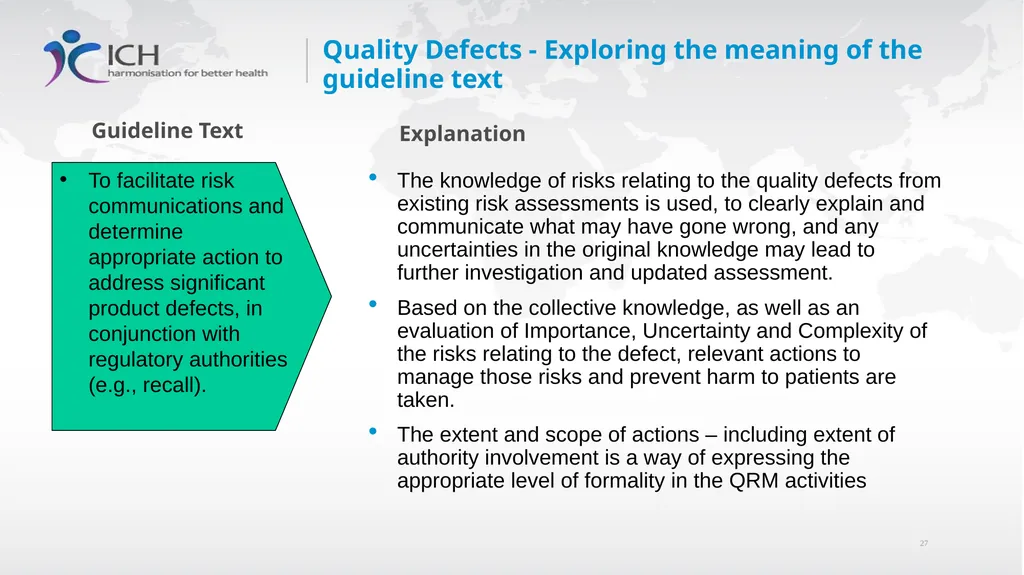
To facilitate risk communications and determine appropriate action to address significant product defects, in conjunction with regulatory authorities (e.g., recall). Quality Defects – what the guideline states<br>
To provide the basis for identifying, evaluating, and communicating the potential quality impact of a suspected quality defect, complaint, trend, deviation, investigation, out of specification result, etc;
To facilitate risk communications and determine appropriate action to address significant product defects, in conjunction with regulatory authorities (e.g., recall). Quality Defects – what the guideline states<br>
25
Risk assessments contain knowledge about what might go wrong, and what the impact of a quality defect may be.
This knowledge is useful when evaluating impact and investigating potential and actual quality problems. Note: Quality defects in a QRM context Ref. Lipa, M., O’Donnell, K., Greene, A: Knowledge as the Currency of Managing Risk: A Novel Framework to Unite Quality Risk Management and Knowledge Management, Journal of Validation Technology, Volume 26, Issue 5, October 2020, and republished in TU Dublin Level 3: Vol. 15: Iss. 2, Article 4<br>
This knowledge is useful when evaluating impact and investigating potential and actual quality problems. Note: Quality defects in a QRM context Ref. Lipa, M., O’Donnell, K., Greene, A: Knowledge as the Currency of Managing Risk: A Novel Framework to Unite Quality Risk Management and Knowledge Management, Journal of Validation Technology, Volume 26, Issue 5, October 2020, and republished in TU Dublin Level 3: Vol. 15: Iss. 2, Article 4<br>
26
Existing risk assessments, and the knowledge of what might go wrong, and what the impact may be, is relevant to use as background when trying to assess the potential impact of potential or actual quality issues. In many cases the (potential) issue at hand may have been assessed already
This will facilitate a faster triaging of defect issues, the ability to decide the right level of formality applied to the investigation, the need for potential Corrective and Preventive actions, as well as how risk communication should be performed.
And if not described in the risk assessment already, this is useful new knowledge, that as part of risk review, may trigger a revision of the relevant risk assessment(s) to make sure that risk controls are up to date and adequate. (see the ICH Q9R1 training material on Risk Review)
Note: Effective QRM helps to prevent quality defects occurring. Quality Defects - Exploring the meaning of the guideline text To provide the basis for identifying, evaluating, and communicating the potential quality impact of a suspected quality defect, complaint, trend, deviation, investigation, out of specification result, etc.; Guideline Text Explanation<br>
This will facilitate a faster triaging of defect issues, the ability to decide the right level of formality applied to the investigation, the need for potential Corrective and Preventive actions, as well as how risk communication should be performed.
And if not described in the risk assessment already, this is useful new knowledge, that as part of risk review, may trigger a revision of the relevant risk assessment(s) to make sure that risk controls are up to date and adequate. (see the ICH Q9R1 training material on Risk Review)
Note: Effective QRM helps to prevent quality defects occurring. Quality Defects - Exploring the meaning of the guideline text To provide the basis for identifying, evaluating, and communicating the potential quality impact of a suspected quality defect, complaint, trend, deviation, investigation, out of specification result, etc.; Guideline Text Explanation<br>
27
The knowledge of risks relating to the quality defects from existing risk assessments is used, to clearly explain and communicate what may have gone wrong, and any uncertainties in the original knowledge may lead to further investigation and updated assessment.
Based on the collective knowledge, as well as an evaluation of Importance, Uncertainty and Complexity of the risks relating to the defect, relevant actions to manage those risks and prevent harm to patients are taken.
The extent and scope of actions – including extent of authority involvement is a way of expressing the appropriate level of formality in the QRM activities Quality Defects - Exploring the meaning of the guideline text To facilitate risk communications and determine appropriate action to address significant product defects, in conjunction with regulatory authorities (e.g., recall). Guideline Text Explanation<br>
Based on the collective knowledge, as well as an evaluation of Importance, Uncertainty and Complexity of the risks relating to the defect, relevant actions to manage those risks and prevent harm to patients are taken.
The extent and scope of actions – including extent of authority involvement is a way of expressing the appropriate level of formality in the QRM activities Quality Defects - Exploring the meaning of the guideline text To facilitate risk communications and determine appropriate action to address significant product defects, in conjunction with regulatory authorities (e.g., recall). Guideline Text Explanation<br>
28
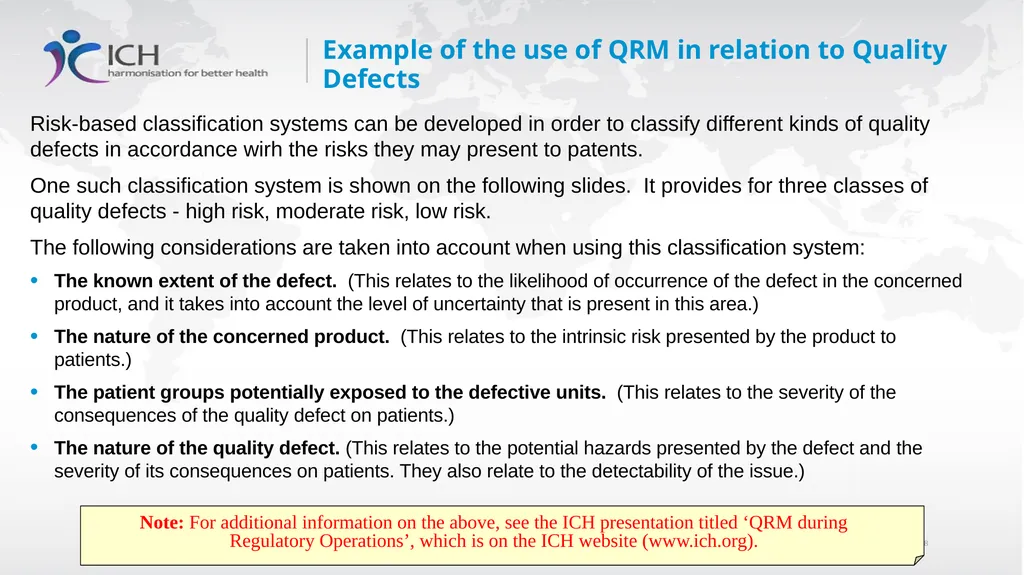
Risk-based classification systems can be developed in order to classify different kinds of quality defects in accordance wirh the risks they may present to patents.
One such classification system is shown on the following slides. It provides for three classes of quality defects - high risk, moderate risk, low risk.
The following considerations are taken into account when using this classification system:
The known extent of the defect. (This relates to the likelihood of occurrence of the defect in the concerned product, and it takes into account the level of uncertainty that is present in this area.)
The nature of the concerned product. (This relates to the intrinsic risk presented by the product to patients.)
The patient groups potentially exposed to the defective units. (This relates to the severity of the consequences of the quality defect on patients.)
The nature of the quality defect. (This relates to the potential hazards presented by the defect and the severity of its consequences on patients. They also relate to the detectability of the issue.) Example of the use of QRM in relation to Quality Defects<br>
One such classification system is shown on the following slides. It provides for three classes of quality defects - high risk, moderate risk, low risk.
The following considerations are taken into account when using this classification system:
The known extent of the defect. (This relates to the likelihood of occurrence of the defect in the concerned product, and it takes into account the level of uncertainty that is present in this area.)
The nature of the concerned product. (This relates to the intrinsic risk presented by the product to patients.)
The patient groups potentially exposed to the defective units. (This relates to the severity of the consequences of the quality defect on patients.)
The nature of the quality defect. (This relates to the potential hazards presented by the defect and the severity of its consequences on patients. They also relate to the detectability of the issue.) Example of the use of QRM in relation to Quality Defects<br>
29
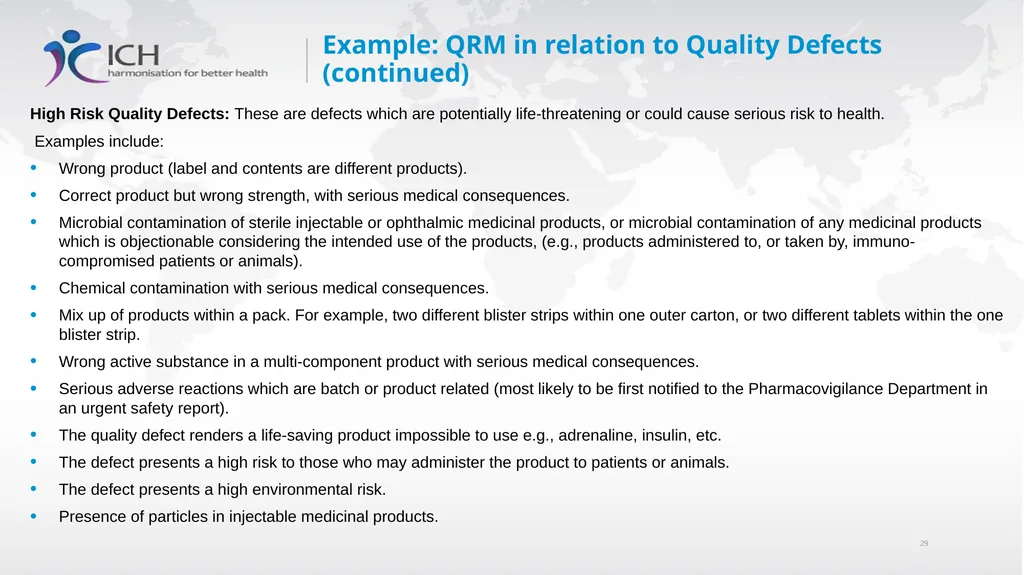
High Risk Quality Defects: These are defects which are potentially life-threatening or could cause serious risk to health.
Examples include:
Wrong product (label and contents are different products).
Correct product but wrong strength, with serious medical consequences.
Microbial contamination of sterile injectable or ophthalmic medicinal products, or microbial contamination of any medicinal products which is objectionable considering the intended use of the products, (e.g., products administered to, or taken by, immuno-compromised patients or animals).
Chemical contamination with serious medical consequences.
Mix up of products within a pack. For example, two different blister strips within one outer carton, or two different tablets within the one blister strip.
Wrong active substance in a multi-component product with serious medical consequences.
Serious adverse reactions which are batch or product related (most likely to be first notified to the Pharmacovigilance Department in an urgent safety report).
The quality defect renders a life-saving product impossible to use e.g., adrenaline, insulin, etc.
The defect presents a high risk to those who may administer the product to patients or animals.
The defect presents a high environmental risk.
Presence of particles in injectable medicinal products. Example: QRM in relation to Quality Defects (continued)<br>
Examples include:
Wrong product (label and contents are different products).
Correct product but wrong strength, with serious medical consequences.
Microbial contamination of sterile injectable or ophthalmic medicinal products, or microbial contamination of any medicinal products which is objectionable considering the intended use of the products, (e.g., products administered to, or taken by, immuno-compromised patients or animals).
Chemical contamination with serious medical consequences.
Mix up of products within a pack. For example, two different blister strips within one outer carton, or two different tablets within the one blister strip.
Wrong active substance in a multi-component product with serious medical consequences.
Serious adverse reactions which are batch or product related (most likely to be first notified to the Pharmacovigilance Department in an urgent safety report).
The quality defect renders a life-saving product impossible to use e.g., adrenaline, insulin, etc.
The defect presents a high risk to those who may administer the product to patients or animals.
The defect presents a high environmental risk.
Presence of particles in injectable medicinal products. Example: QRM in relation to Quality Defects (continued)<br>
30
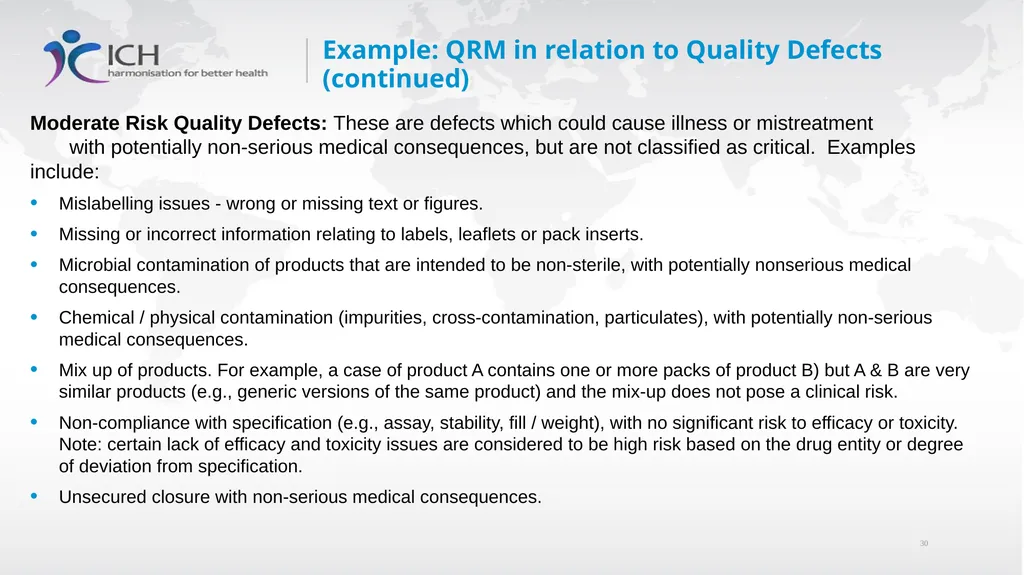
Moderate Risk Quality Defects: These are defects which could cause illness or mistreatment with potentially non-serious medical consequences, but are not classified as critical. Examples include:
Mislabelling issues - wrong or missing text or figures.
Missing or incorrect information relating to labels, leaflets or pack inserts.
Microbial contamination of products that are intended to be non-sterile, with potentially nonserious medical consequences.
Chemical / physical contamination (impurities, cross-contamination, particulates), with potentially non-serious medical consequences.
Mix up of products. For example, a case of product A contains one or more packs of product B) but A & B are very similar products (e.g., generic versions of the same product) and the mix-up does not pose a clinical risk.
Non-compliance with specification (e.g., assay, stability, fill / weight), with no significant risk to efficacy or toxicity. Note: certain lack of efficacy and toxicity issues are considered to be high risk based on the drug entity or degree of deviation from specification.
Unsecured closure with non-serious medical consequences. Example: QRM in relation to Quality Defects (continued)<br>
Mislabelling issues - wrong or missing text or figures.
Missing or incorrect information relating to labels, leaflets or pack inserts.
Microbial contamination of products that are intended to be non-sterile, with potentially nonserious medical consequences.
Chemical / physical contamination (impurities, cross-contamination, particulates), with potentially non-serious medical consequences.
Mix up of products. For example, a case of product A contains one or more packs of product B) but A & B are very similar products (e.g., generic versions of the same product) and the mix-up does not pose a clinical risk.
Non-compliance with specification (e.g., assay, stability, fill / weight), with no significant risk to efficacy or toxicity. Note: certain lack of efficacy and toxicity issues are considered to be high risk based on the drug entity or degree of deviation from specification.
Unsecured closure with non-serious medical consequences. Example: QRM in relation to Quality Defects (continued)<br>
31
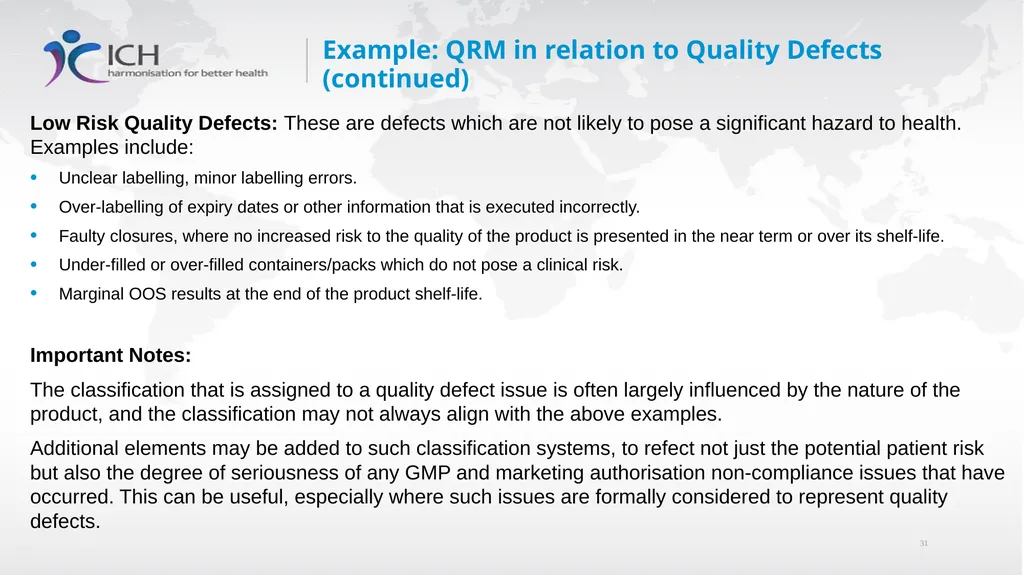
Low Risk Quality Defects: These are defects which are not likely to pose a significant hazard to health. Examples include:
Unclear labelling, minor labelling errors.
Over-labelling of expiry dates or other information that is executed incorrectly.
Faulty closures, where no increased risk to the quality of the product is presented in the near term or over its shelf-life.
Under-filled or over-filled containers/packs which do not pose a clinical risk.
Marginal OOS results at the end of the product shelf-life.
Important Notes:
The classification that is assigned to a quality defect issue is often largely influenced by the nature of the product, and the classification may not always align with the above examples.
Additional elements may be added to such classification systems, to refect not just the potential patient risk but also the degree of seriousness of any GMP and marketing authorisation non-compliance issues that have occurred. This can be useful, especially where such issues are formally considered to represent quality defects. Example: QRM in relation to Quality Defects (continued)<br>
Unclear labelling, minor labelling errors.
Over-labelling of expiry dates or other information that is executed incorrectly.
Faulty closures, where no increased risk to the quality of the product is presented in the near term or over its shelf-life.
Under-filled or over-filled containers/packs which do not pose a clinical risk.
Marginal OOS results at the end of the product shelf-life.
Important Notes:
The classification that is assigned to a quality defect issue is often largely influenced by the nature of the product, and the classification may not always align with the above examples.
Additional elements may be added to such classification systems, to refect not just the potential patient risk but also the degree of seriousness of any GMP and marketing authorisation non-compliance issues that have occurred. This can be useful, especially where such issues are formally considered to represent quality defects. Example: QRM in relation to Quality Defects (continued)<br>
32
Auditing / Inspection<br>
33
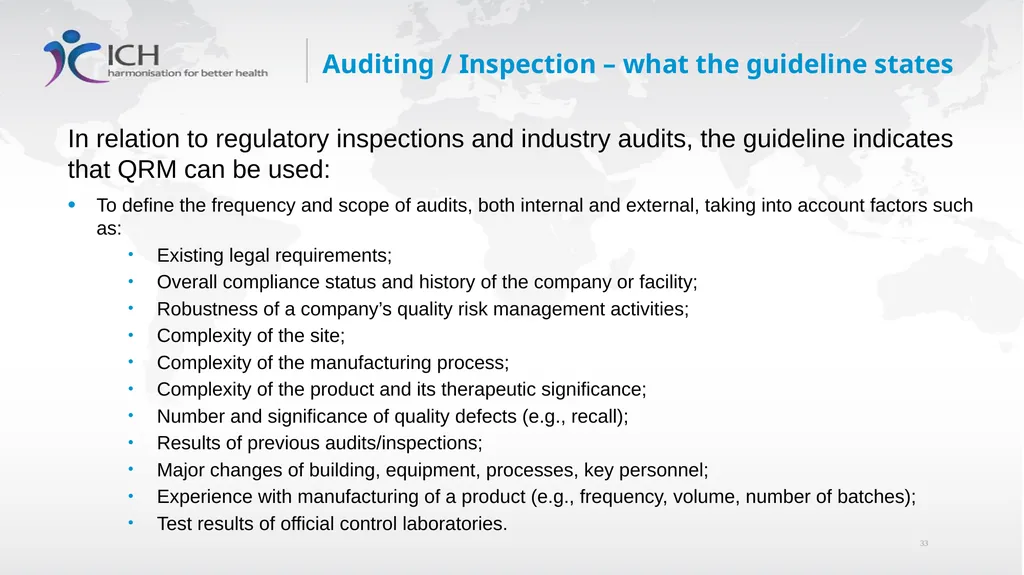
In relation to regulatory inspections and industry audits, the guideline indicates that QRM can be used:
To define the frequency and scope of audits, both internal and external, taking into account factors such as:
Existing legal requirements;
Overall compliance status and history of the company or facility;
Robustness of a company’s quality risk management activities;
Complexity of the site;
Complexity of the manufacturing process;
Complexity of the product and its therapeutic significance;
Number and significance of quality defects (e.g., recall);
Results of previous audits/inspections;
Major changes of building, equipment, processes, key personnel;
Experience with manufacturing of a product (e.g., frequency, volume, number of batches);
Test results of official control laboratories. Auditing / Inspection – what the guideline states<br>
To define the frequency and scope of audits, both internal and external, taking into account factors such as:
Existing legal requirements;
Overall compliance status and history of the company or facility;
Robustness of a company’s quality risk management activities;
Complexity of the site;
Complexity of the manufacturing process;
Complexity of the product and its therapeutic significance;
Number and significance of quality defects (e.g., recall);
Results of previous audits/inspections;
Major changes of building, equipment, processes, key personnel;
Experience with manufacturing of a product (e.g., frequency, volume, number of batches);
Test results of official control laboratories. Auditing / Inspection – what the guideline states<br>
34
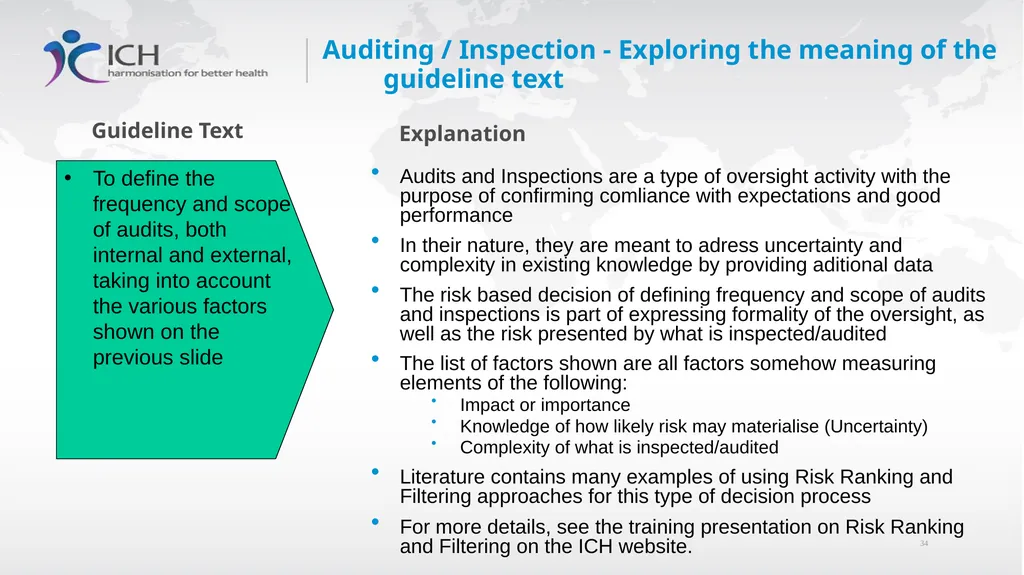
Audits and Inspections are a type of oversight activity with the purpose of confirming comliance with expectations and good performance
In their nature, they are meant to adress uncertainty and complexity in existing knowledge by providing aditional data
The risk based decision of defining frequency and scope of audits and inspections is part of expressing formality of the oversight, as well as the risk presented by what is inspected/audited
The list of factors shown are all factors somehow measuring elements of the following:
Impact or importance
Knowledge of how likely risk may materialise (Uncertainty)
Complexity of what is inspected/audited
Literature contains many examples of using Risk Ranking and Filtering approaches for this type of decision process
For more details, see the training presentation on Risk Ranking and Filtering on the ICH website. Auditing / Inspection - Exploring the meaning of the guideline text To define the frequency and scope of audits, both internal and external, taking into account the various factors shown on the previous slide Guideline Text Explanation<br>
In their nature, they are meant to adress uncertainty and complexity in existing knowledge by providing aditional data
The risk based decision of defining frequency and scope of audits and inspections is part of expressing formality of the oversight, as well as the risk presented by what is inspected/audited
The list of factors shown are all factors somehow measuring elements of the following:
Impact or importance
Knowledge of how likely risk may materialise (Uncertainty)
Complexity of what is inspected/audited
Literature contains many examples of using Risk Ranking and Filtering approaches for this type of decision process
For more details, see the training presentation on Risk Ranking and Filtering on the ICH website. Auditing / Inspection - Exploring the meaning of the guideline text To define the frequency and scope of audits, both internal and external, taking into account the various factors shown on the previous slide Guideline Text Explanation<br>
35
The ICH presentation titled: ‘Quality Risk Management as part of Regulatory Operations’ includes an example of the use of Quality Risk Management in Inspections
Click here to access that presentation Example of the use of QRM in relation to Inspecting<br>
Click here to access that presentation Example of the use of QRM in relation to Inspecting<br>
36
Periodic Review<br>
37
In relation to Periodic Review, the guideline indicates that QRM can be used:
To select, evaluate and interpret trend results of data within the product quality review;
To interpret monitoring data (e.g., to support an assessment of the appropriateness of revalidation or changes in sampling). Periodic Review – what the guideline states<br>
To select, evaluate and interpret trend results of data within the product quality review;
To interpret monitoring data (e.g., to support an assessment of the appropriateness of revalidation or changes in sampling). Periodic Review – what the guideline states<br>
38
Periodic reviews are all part of the monitoring setup in what ICH Q9(R1) defines as Risk Review.
For different periodic reviews, knowledge from related existing risk assessments is used to define what data to look at.
Data to be trended and interpreted should relate to measuring the state of control, so that conclusions can be made on residual risk.
State of control can be measured by:
Measuring the effectiveness of the risk controls that are in place;
Monitoring whether risks are materialising (or are about to materialize) using trend and other data;
Investigating unexpected events – these may indicate a knowledge gap and a potential loss of control.
Also, the knowledge from the original risk assessments is often helpful in determining how trends and other movements in data should be interpreted, as these can give rise to risk. Periodic Review - Exploring the meaning of the guideline text To select, evaluate and interpret trend results of data within the product quality review; Guideline Text Explanation<br>
For different periodic reviews, knowledge from related existing risk assessments is used to define what data to look at.
Data to be trended and interpreted should relate to measuring the state of control, so that conclusions can be made on residual risk.
State of control can be measured by:
Measuring the effectiveness of the risk controls that are in place;
Monitoring whether risks are materialising (or are about to materialize) using trend and other data;
Investigating unexpected events – these may indicate a knowledge gap and a potential loss of control.
Also, the knowledge from the original risk assessments is often helpful in determining how trends and other movements in data should be interpreted, as these can give rise to risk. Periodic Review - Exploring the meaning of the guideline text To select, evaluate and interpret trend results of data within the product quality review; Guideline Text Explanation<br>
39
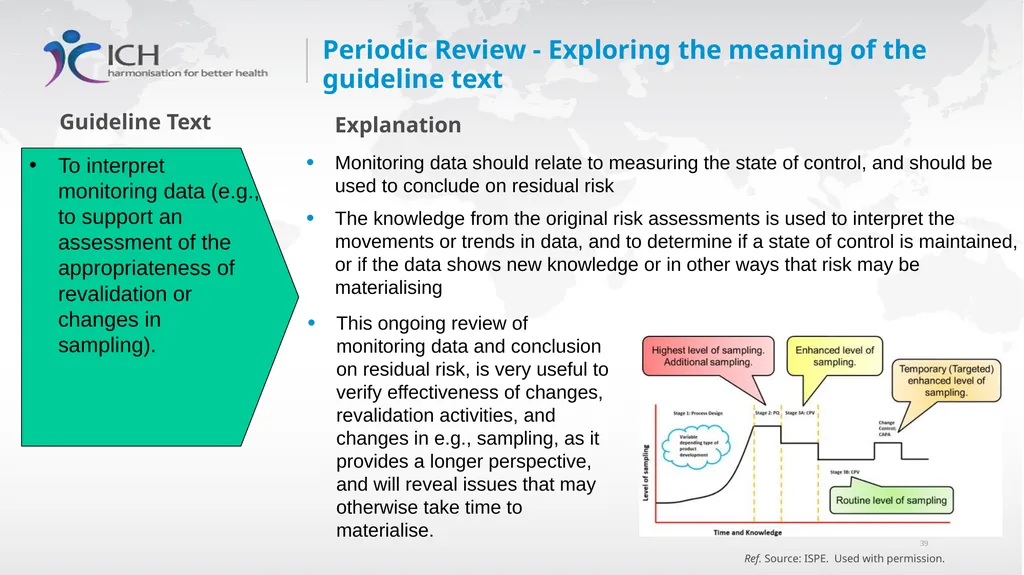
Monitoring data should relate to measuring the state of control, and should be used to conclude on residual risk
The knowledge from the original risk assessments is used to interpret the movements or trends in data, and to determine if a state of control is maintained, or if the data shows new knowledge or in other ways that risk may be materialising Periodic Review - Exploring the meaning of the guideline text To interpret monitoring data (e.g., to support an assessment of the appropriateness of revalidation or changes in sampling). Guideline Text Explanation This ongoing review of monitoring data and conclusion on residual risk, is very useful to verify effectiveness of changes, revalidation activities, and changes in e.g., sampling, as it provides a longer perspective, and will reveal issues that may otherwise take time to materialise. Ref. Source: ISPE. Used with permission.<br>
The knowledge from the original risk assessments is used to interpret the movements or trends in data, and to determine if a state of control is maintained, or if the data shows new knowledge or in other ways that risk may be materialising Periodic Review - Exploring the meaning of the guideline text To interpret monitoring data (e.g., to support an assessment of the appropriateness of revalidation or changes in sampling). Guideline Text Explanation This ongoing review of monitoring data and conclusion on residual risk, is very useful to verify effectiveness of changes, revalidation activities, and changes in e.g., sampling, as it provides a longer perspective, and will reveal issues that may otherwise take time to materialise. Ref. Source: ISPE. Used with permission.<br>
40
Ongoing Monitoring and PQRs can both be considered part of Periodic Review activities.
PQRs are usually performed after a year’s worth of production (i.e., annually).
While they can usefully be used to review the state of control and residual risk levels, as indicated in the following example, it is important, however, that ongoing monitoring systems are also leveraged, to identify near term adverse trends in a timelier manner, to review the state of control and trigger continual improvements.
See the ICH Training Presentation on Risk Review for information in relating to the use of ongoing monitoring systems. Reflections on Ongoing Monitoring, PQRs and Periodic Review<br>
PQRs are usually performed after a year’s worth of production (i.e., annually).
While they can usefully be used to review the state of control and residual risk levels, as indicated in the following example, it is important, however, that ongoing monitoring systems are also leveraged, to identify near term adverse trends in a timelier manner, to review the state of control and trigger continual improvements.
See the ICH Training Presentation on Risk Review for information in relating to the use of ongoing monitoring systems. Reflections on Ongoing Monitoring, PQRs and Periodic Review<br>
41
GMP guidelines and related regulations in various parts of the world require manufacturers to generate Product Quality Reviews (PQRs) on their products on, usually, an annual basis. (These are often referred to as Annual Product Quality Reviews.)
PQRs are a form of periodic review; they represent a compilation of data about the product and its manufacturing process that can facilitate an assessment of whether corrective action or any revalidation should be undertaken.
Trend analysis is a key element of such reports, and where adverse trends or potential concerns are identified, it is important that these be discussed in the reports, in relation to how they are being investigated and addressed.
ICH Q10 highlights the importance of trend analysis; it indicates that trends can be obtained from process performance and product quality monitoring.
ICH Q10 positions trending as a performance indicator that can be used to monitor the effectiveness of processes within the pharmaceutical quality system. Example of the use of QRM in relation to Periodic Review For ICH Q7, the GMP Guideline for Active Pharmaceutical Ingredient (API) manufacturers, indicates that certain items should be reviewed in API PQRs… see next slide.<br>
PQRs are a form of periodic review; they represent a compilation of data about the product and its manufacturing process that can facilitate an assessment of whether corrective action or any revalidation should be undertaken.
Trend analysis is a key element of such reports, and where adverse trends or potential concerns are identified, it is important that these be discussed in the reports, in relation to how they are being investigated and addressed.
ICH Q10 highlights the importance of trend analysis; it indicates that trends can be obtained from process performance and product quality monitoring.
ICH Q10 positions trending as a performance indicator that can be used to monitor the effectiveness of processes within the pharmaceutical quality system. Example of the use of QRM in relation to Periodic Review For ICH Q7, the GMP Guideline for Active Pharmaceutical Ingredient (API) manufacturers, indicates that certain items should be reviewed in API PQRs… see next slide.<br>
42
ICH Q7 specifies that the following items (at least) should be reviewed in API PQRs:
Critical in-process control and critical API test results
All batches that failed to meet established specification(s)
All critical deviations or non-conformances and related investigations
Any changes carried out to the processes or analytical methods
Results of the stability monitoring program
All quality-related returns, complaints and recalls
The adequacy of corrective actions
Applying QRM principles to PQRs presents opportunities for API manufacturers to make their PQRs more value-adding and informative about the state of control of their manufacturing process.
For example, PQRs could serve as a means to document residual risk levels at the end of the review period. The residual risk in this context could relate to:
the risk of losing control of the manufacturing process,
the risk of generating out-of-specification batches, and
the risk of a product availability issue occurring as a result of quality/manufacturing issues.
The next slide lists a number of things that could be done to achieve this. Example: Periodic Review (continued)<br>
Critical in-process control and critical API test results
All batches that failed to meet established specification(s)
All critical deviations or non-conformances and related investigations
Any changes carried out to the processes or analytical methods
Results of the stability monitoring program
All quality-related returns, complaints and recalls
The adequacy of corrective actions
Applying QRM principles to PQRs presents opportunities for API manufacturers to make their PQRs more value-adding and informative about the state of control of their manufacturing process.
For example, PQRs could serve as a means to document residual risk levels at the end of the review period. The residual risk in this context could relate to:
the risk of losing control of the manufacturing process,
the risk of generating out-of-specification batches, and
the risk of a product availability issue occurring as a result of quality/manufacturing issues.
The next slide lists a number of things that could be done to achieve this. Example: Periodic Review (continued)<br>
43
In relation to PQRs:
PQRs could include a summary of, or the conclusions from, ongoing review of monitoring data on the known effectiveness of the controls in the manufacturing process which provide for risk control, risk reduction and process understanding. Where actual and potential/emerging issues with control exist, the PQR is one of the tools that can address such issues.
The data from PQRs could be used to support ongoing process verification activities, where manufacturers monitor product quality and the variability and capability of the manufacturing process to determine whether a state of control has been maintained, taking into account the current level of process understanding and process performance.
PQRs could serve as a repository for new product and process knowledge, as well as any continuous improvement activities which related to the manufacturing process and the product during the review period.
PQRs could be used to holistically assess the potential impact on product quality and the state of control of incremental process and other changes which occurred during the review period.
PQRs could include an evaluation of the effectiveness of the manufacturing and supply chain controls that are in place to reduce risks to product availability and the likelihood of drug shortages. Where risk controls may be inadequate, the PQR provides an opportunity to highlight this as well as the need to address gaps.
In this way, PQRs can serve as one of the triggers within the PQS for continual improvement. Example: Periodic Review cont’d<br>
PQRs could include a summary of, or the conclusions from, ongoing review of monitoring data on the known effectiveness of the controls in the manufacturing process which provide for risk control, risk reduction and process understanding. Where actual and potential/emerging issues with control exist, the PQR is one of the tools that can address such issues.
The data from PQRs could be used to support ongoing process verification activities, where manufacturers monitor product quality and the variability and capability of the manufacturing process to determine whether a state of control has been maintained, taking into account the current level of process understanding and process performance.
PQRs could serve as a repository for new product and process knowledge, as well as any continuous improvement activities which related to the manufacturing process and the product during the review period.
PQRs could be used to holistically assess the potential impact on product quality and the state of control of incremental process and other changes which occurred during the review period.
PQRs could include an evaluation of the effectiveness of the manufacturing and supply chain controls that are in place to reduce risks to product availability and the likelihood of drug shortages. Where risk controls may be inadequate, the PQR provides an opportunity to highlight this as well as the need to address gaps.
In this way, PQRs can serve as one of the triggers within the PQS for continual improvement. Example: Periodic Review cont’d<br>
44
Statistical Quality Control tools (e.g., Statistical Process Control charts, Process Performance Indices, etc.) can be utilized as part of a PQR to measure overall performance and confirm a state of control.
These tools can be applied to monitor CQAs for a given product, consumer complaints, and other KPIs that are collected to measure the performance of the PQS (e.g., repeat deviation rate, right first-time rate, CAPA effectiveness, etc.).
The following slide presents a case study showing how SQC tools can be applied when conducting a PQR; specifically monitoring certain CQAs. The Application of Statistical Quality Control in Product Quality Reviews<br>
These tools can be applied to monitor CQAs for a given product, consumer complaints, and other KPIs that are collected to measure the performance of the PQS (e.g., repeat deviation rate, right first-time rate, CAPA effectiveness, etc.).
The following slide presents a case study showing how SQC tools can be applied when conducting a PQR; specifically monitoring certain CQAs. The Application of Statistical Quality Control in Product Quality Reviews<br>
45
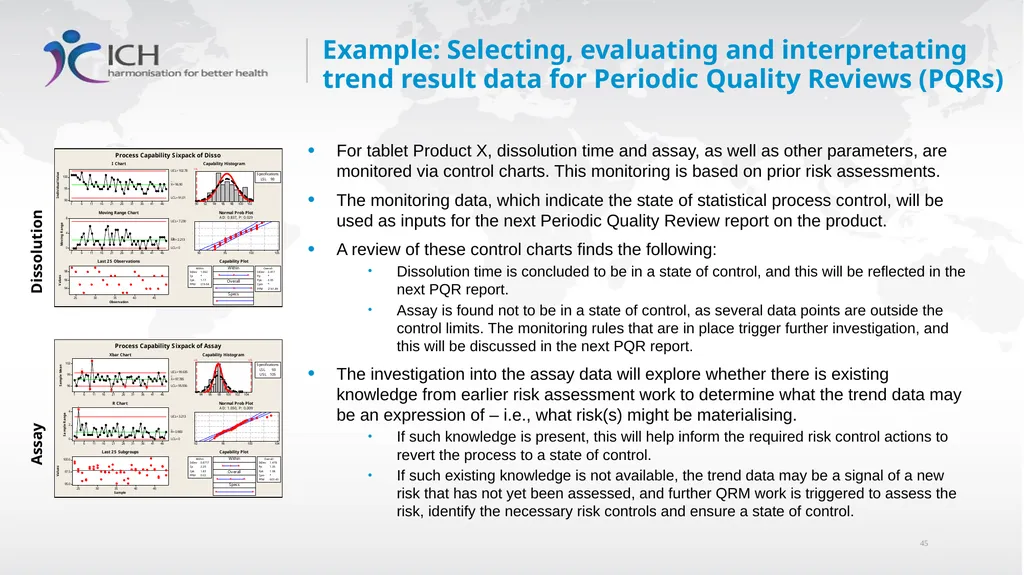
For tablet Product X, dissolution time and assay, as well as other parameters, are monitored via control charts. This monitoring is based on prior risk assessments.
The monitoring data, which indicate the state of statistical process control, will be used as inputs for the next Periodic Quality Review report on the product.
A review of these control charts finds the following:
Dissolution time is concluded to be in a state of control, and this will be reflected in the next PQR report.
Assay is found not to be in a state of control, as several data points are outside the control limits. The monitoring rules that are in place trigger further investigation, and this will be discussed in the next PQR report.
The investigation into the assay data will explore whether there is existing knowledge from earlier risk assessment work to determine what the trend data may be an expression of – i.e., what risk(s) might be materialising.
If such knowledge is present, this will help inform the required risk control actions to revert the process to a state of control.
If such existing knowledge is not available, the trend data may be a signal of a new risk that has not yet been assessed, and further QRM work is triggered to assess the risk, identify the necessary risk controls and ensure a state of control. Example: Selecting, evaluating and interpretating trend result data for Periodic Quality Reviews (PQRs) Dissolution Assay<br>
The monitoring data, which indicate the state of statistical process control, will be used as inputs for the next Periodic Quality Review report on the product.
A review of these control charts finds the following:
Dissolution time is concluded to be in a state of control, and this will be reflected in the next PQR report.
Assay is found not to be in a state of control, as several data points are outside the control limits. The monitoring rules that are in place trigger further investigation, and this will be discussed in the next PQR report.
The investigation into the assay data will explore whether there is existing knowledge from earlier risk assessment work to determine what the trend data may be an expression of – i.e., what risk(s) might be materialising.
If such knowledge is present, this will help inform the required risk control actions to revert the process to a state of control.
If such existing knowledge is not available, the trend data may be a signal of a new risk that has not yet been assessed, and further QRM work is triggered to assess the risk, identify the necessary risk controls and ensure a state of control. Example: Selecting, evaluating and interpretating trend result data for Periodic Quality Reviews (PQRs) Dissolution Assay<br>
46
Using PQRs as shown on the previous two slides can support the Process Performance and Product Quality Monitoring System (PPPQMS) that ICH Q10 discusses.
ICH Q10 states that pharmaceutical companies should plan and execute a system for the monitoring of process performance and product quality, to ensure a state of control is maintained.
It states that an effective monitoring system provides assurance of the continued capability of processes and controls to produce a product of desired quality and to identify areas for continual improvement.
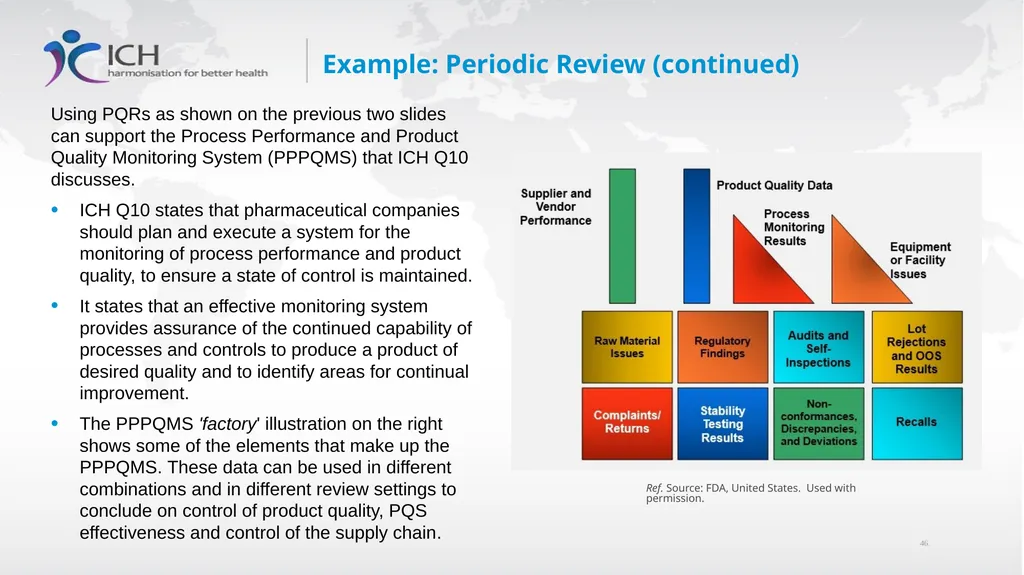
The PPPQMS 'factory' illustration on the right shows some of the elements that make up the PPPQMS. These data can be used in different combinations and in different review settings to conclude on control of product quality, PQS effectiveness and control of the supply chain. Example: Periodic Review (continued) Ref. Source: FDA, United States. Used with permission.<br>
ICH Q10 states that pharmaceutical companies should plan and execute a system for the monitoring of process performance and product quality, to ensure a state of control is maintained.
It states that an effective monitoring system provides assurance of the continued capability of processes and controls to produce a product of desired quality and to identify areas for continual improvement.
The PPPQMS 'factory' illustration on the right shows some of the elements that make up the PPPQMS. These data can be used in different combinations and in different review settings to conclude on control of product quality, PQS effectiveness and control of the supply chain. Example: Periodic Review (continued) Ref. Source: FDA, United States. Used with permission.<br>
47
Sometimes the effort of preparing PQRs ends with the assembly, in one place, of data, where those data are already available and evaluated in other systems.
The knowledge that the data represent is sometimes not acquired, or the knowledge that was already extracted from these data might not be carried over into the PQR
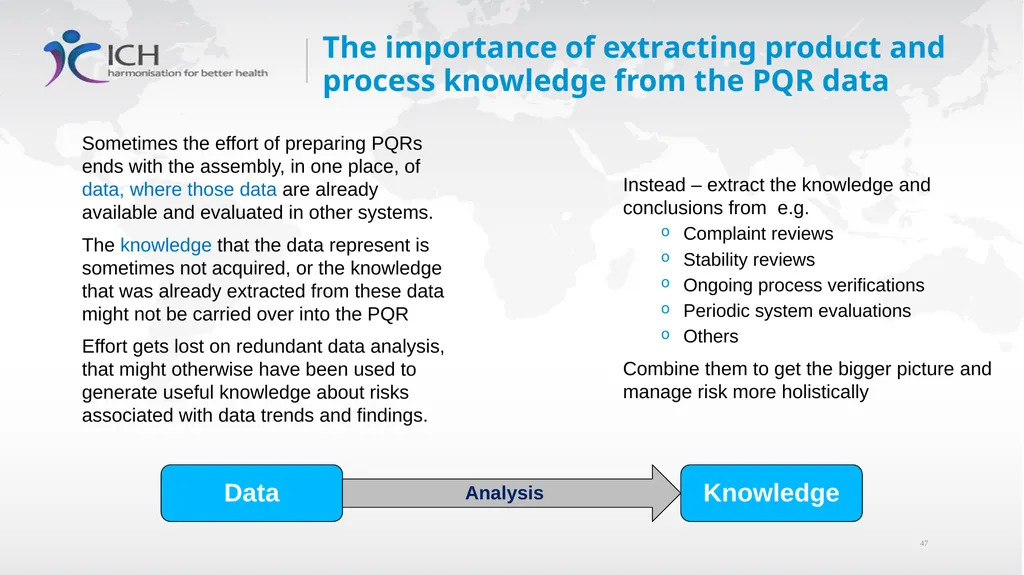
Effort gets lost on redundant data analysis, that might otherwise have been used to generate useful knowledge about risks associated with data trends and findings. The importance of extracting product and process knowledge from the PQR data Instead – extract the knowledge and conclusions from e.g.
Complaint reviews
Stability reviews
Ongoing process verifications
Periodic system evaluations
Others
Combine them to get the bigger picture and manage risk more holistically Data Knowledge Analysis<br>
The knowledge that the data represent is sometimes not acquired, or the knowledge that was already extracted from these data might not be carried over into the PQR
Effort gets lost on redundant data analysis, that might otherwise have been used to generate useful knowledge about risks associated with data trends and findings. The importance of extracting product and process knowledge from the PQR data Instead – extract the knowledge and conclusions from e.g.
Complaint reviews
Stability reviews
Ongoing process verifications
Periodic system evaluations
Others
Combine them to get the bigger picture and manage risk more holistically Data Knowledge Analysis<br>
48
Change Management / Change Control<br>
49
In relation to Change Management / Change Control, the guideline indicates that QRM can be used:
To manage changes based on knowledge and information accumulated in pharmaceutical development and during manufacturing;
To evaluate the impact of the changes on the availability of the final product;
To evaluate the impact on product quality of changes to the facility, equipment, material, manufacturing process or technical transfers;
To determine appropriate actions preceding the implementation of a change, e.g., additional testing, (re)qualification, (re)validation or communication with regulators. Change Management / Change Control – what the guideline states<br>
To manage changes based on knowledge and information accumulated in pharmaceutical development and during manufacturing;
To evaluate the impact of the changes on the availability of the final product;
To evaluate the impact on product quality of changes to the facility, equipment, material, manufacturing process or technical transfers;
To determine appropriate actions preceding the implementation of a change, e.g., additional testing, (re)qualification, (re)validation or communication with regulators. Change Management / Change Control – what the guideline states<br>
50
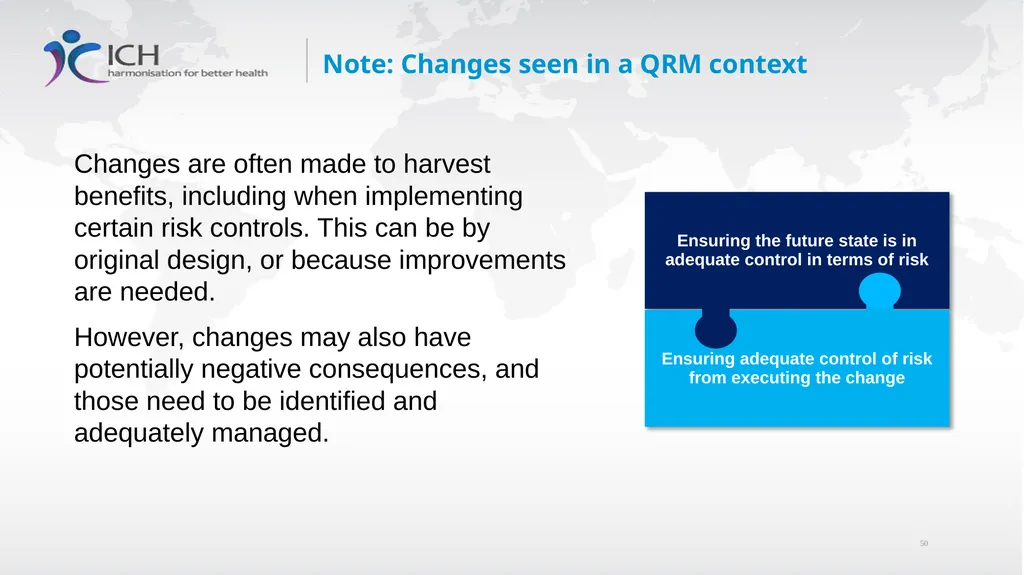
Changes are often made to harvest benefits, including when implementing certain risk controls. This can be by original design, or because improvements are needed.
However, changes may also have potentially negative consequences, and those need to be identified and adequately managed. Note: Changes seen in a QRM context Ensuring the future state is in adequate control in terms of risk Ensuring adequate control of risk from executing the change<br>
However, changes may also have potentially negative consequences, and those need to be identified and adequately managed. Note: Changes seen in a QRM context Ensuring the future state is in adequate control in terms of risk Ensuring adequate control of risk from executing the change<br>
51
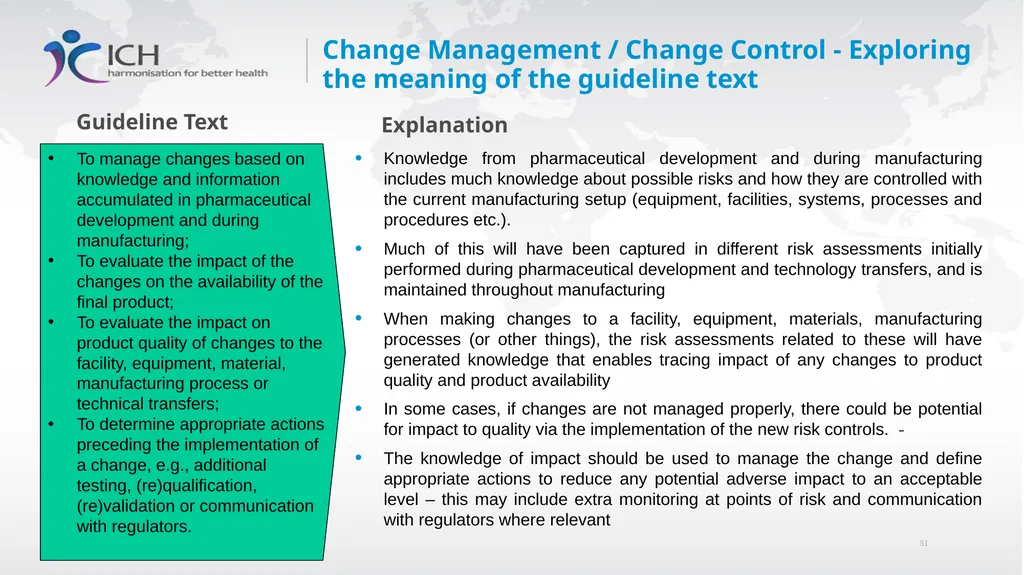
Knowledge from pharmaceutical development and during manufacturing includes much knowledge about possible risks and how they are controlled with the current manufacturing setup (equipment, facilities, systems, processes and procedures etc.).
Much of this will have been captured in different risk assessments initially performed during pharmaceutical development and technology transfers, and is maintained throughout manufacturing
When making changes to a facility, equipment, materials, manufacturing processes (or other things), the risk assessments related to these will have generated knowledge that enables tracing impact of any changes to product quality and product availability
In some cases, if changes are not managed properly, there could be potential for impact to quality via the implementation of the new risk controls.
The knowledge of impact should be used to manage the change and define appropriate actions to reduce any potential adverse impact to an acceptable level – this may include extra monitoring at points of risk and communication with regulators where relevant Change Management / Change Control - Exploring the meaning of the guideline text To manage changes based on knowledge and information accumulated in pharmaceutical development and during manufacturing;
To evaluate the impact of the changes on the availability of the final product;
To evaluate the impact on product quality of changes to the facility, equipment, material, manufacturing process or technical transfers;
To determine appropriate actions preceding the implementation of a change, e.g., additional testing, (re)qualification, (re)validation or communication with regulators. Guideline Text Explanation<br>
Much of this will have been captured in different risk assessments initially performed during pharmaceutical development and technology transfers, and is maintained throughout manufacturing
When making changes to a facility, equipment, materials, manufacturing processes (or other things), the risk assessments related to these will have generated knowledge that enables tracing impact of any changes to product quality and product availability
In some cases, if changes are not managed properly, there could be potential for impact to quality via the implementation of the new risk controls.
The knowledge of impact should be used to manage the change and define appropriate actions to reduce any potential adverse impact to an acceptable level – this may include extra monitoring at points of risk and communication with regulators where relevant Change Management / Change Control - Exploring the meaning of the guideline text To manage changes based on knowledge and information accumulated in pharmaceutical development and during manufacturing;
To evaluate the impact of the changes on the availability of the final product;
To evaluate the impact on product quality of changes to the facility, equipment, material, manufacturing process or technical transfers;
To determine appropriate actions preceding the implementation of a change, e.g., additional testing, (re)qualification, (re)validation or communication with regulators. Guideline Text Explanation<br>
52
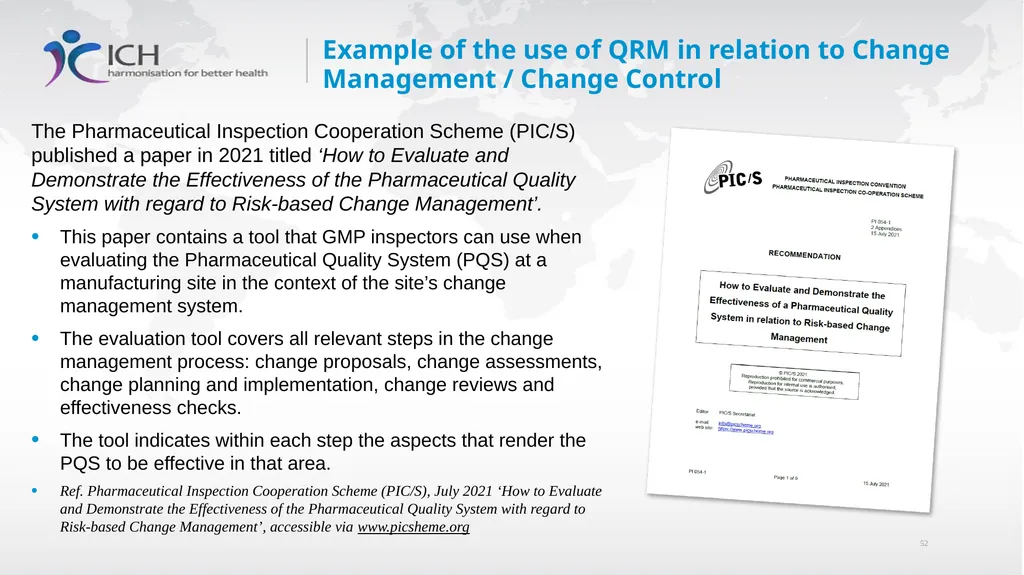
Example of the use of QRM in relation to Change Management / Change Control The Pharmaceutical Inspection Cooperation Scheme (PIC/S) published a paper in 2021 titled ‘How to Evaluate and Demonstrate the Effectiveness of the Pharmaceutical Quality System with regard to Risk-based Change Management’.
This paper contains a tool that GMP inspectors can use when evaluating the Pharmaceutical Quality System (PQS) at a manufacturing site in the context of the site’s change management system.
The evaluation tool covers all relevant steps in the change management process: change proposals, change assessments, change planning and implementation, change reviews and effectiveness checks.
The tool indicates within each step the aspects that render the PQS to be effective in that area.
Ref. Pharmaceutical Inspection Cooperation Scheme (PIC/S), July 2021 ‘How to Evaluate and Demonstrate the Effectiveness of the Pharmaceutical Quality System with regard to Risk-based Change Management’, accessible via www.picsheme.org<br>
This paper contains a tool that GMP inspectors can use when evaluating the Pharmaceutical Quality System (PQS) at a manufacturing site in the context of the site’s change management system.
The evaluation tool covers all relevant steps in the change management process: change proposals, change assessments, change planning and implementation, change reviews and effectiveness checks.
The tool indicates within each step the aspects that render the PQS to be effective in that area.
Ref. Pharmaceutical Inspection Cooperation Scheme (PIC/S), July 2021 ‘How to Evaluate and Demonstrate the Effectiveness of the Pharmaceutical Quality System with regard to Risk-based Change Management’, accessible via www.picsheme.org<br>
53
Example of the use of QRM in relation to Change Management / Change Control (continued) Quality Risk Management concepts are at the core of the PIC/S evaluation tool.
For example, the tool involves making an evaluation of how the manufacturer assesses and manages change proposals from a risk perspective, in terms of:
whether the level of rigor, effort and documentation applied by the manufacturer is commensurate with the level of risk
whether the manufacturer’s risk assessments adequately evaluate the potential risks and benefits of changes to product quality, safety and efficacy
whether those risk assessments consider the potential risks and benefits to other products, processes and systems
whether the classification of changes by the manufacturer is based on the level of risk that is presented by the changes.
whether the outcomes of risk assessments drive change planning, prioritisation, implementation, and their timelines.
whether changes meet their intended objectives and pre-defined effectiveness criteria, where residual risks are assessed and managed to acceptable levels, and where changes are monitored via ongoing monitoring systems to ensure maintenance of a state of control.
Ref. Pharmaceutical Inspection Cooperation Scheme (PIC/S), July 2021 ‘How to Evaluate and Demonstrate the Effectiveness of the Pharmaceutical Quality System with regard to Risk-based Change Management’, accessible via www.picsheme.org<br>
For example, the tool involves making an evaluation of how the manufacturer assesses and manages change proposals from a risk perspective, in terms of:
whether the level of rigor, effort and documentation applied by the manufacturer is commensurate with the level of risk
whether the manufacturer’s risk assessments adequately evaluate the potential risks and benefits of changes to product quality, safety and efficacy
whether those risk assessments consider the potential risks and benefits to other products, processes and systems
whether the classification of changes by the manufacturer is based on the level of risk that is presented by the changes.
whether the outcomes of risk assessments drive change planning, prioritisation, implementation, and their timelines.
whether changes meet their intended objectives and pre-defined effectiveness criteria, where residual risks are assessed and managed to acceptable levels, and where changes are monitored via ongoing monitoring systems to ensure maintenance of a state of control.
Ref. Pharmaceutical Inspection Cooperation Scheme (PIC/S), July 2021 ‘How to Evaluate and Demonstrate the Effectiveness of the Pharmaceutical Quality System with regard to Risk-based Change Management’, accessible via www.picsheme.org<br>
54
Example of the use of QRM in relation to Change Management / Change Control (continued) In relation to risk assessment, the tool recognises that Change Management procedures at manufacturing sites often require a risk-based classification (e.g. critical, major, minor) to be assigned to proposed changes, as well as an impact assessment to be performed.
The tool indicates that impact assessments routinely determine the potential impacts of the proposed change on various items, such as:
Product quality
Documentation
Cleaning
Maintenance
Regulatory compliance, etc.
The tool indicates that, in some cases, especially for simple and minor/low risk changes:
An impact assessment is sufficient to document the risk-based rationale for a change
There may be no need to use more formalised risk-assessment tools or approaches
Ref. Pharmaceutical Inspection Cooperation Scheme (PIC/S), July 2021 ‘How to Evaluate and Demonstrate the Effectiveness of the Pharmaceutical Quality System with regard to Risk-based Change Management’, accessible via www.picsheme.org<br>
The tool indicates that impact assessments routinely determine the potential impacts of the proposed change on various items, such as:
Product quality
Documentation
Cleaning
Maintenance
Regulatory compliance, etc.
The tool indicates that, in some cases, especially for simple and minor/low risk changes:
An impact assessment is sufficient to document the risk-based rationale for a change
There may be no need to use more formalised risk-assessment tools or approaches
Ref. Pharmaceutical Inspection Cooperation Scheme (PIC/S), July 2021 ‘How to Evaluate and Demonstrate the Effectiveness of the Pharmaceutical Quality System with regard to Risk-based Change Management’, accessible via www.picsheme.org<br>
55
Example of the use of QRM in relation to Change Management / Change Control (continued) The tool indicates that more formal risk assessments should be applied to change proposals which represent more complex or significant (e.g., major, critical) changes.
Such risk assessments should more substantially address what might go wrong with the proposed change.
They should address the potential impact of the change in the context of current process knowledge and the product/facility lifecycle.
Where possible, changes should reduce product quality risks and/or patient safety hazards to an acceptable level.
At a minimum, changes should maintain or improve product quality and/or patient safety, and they should not increase process variability.
Ref. Pharmaceutical Inspection Cooperation Scheme (PIC/S), July 2021 ‘How to Evaluate and Demonstrate the Effectiveness of the Pharmaceutical Quality System with regard to Risk-based Change Management’, accessible via www.picsheme.org<br>
Such risk assessments should more substantially address what might go wrong with the proposed change.
They should address the potential impact of the change in the context of current process knowledge and the product/facility lifecycle.
Where possible, changes should reduce product quality risks and/or patient safety hazards to an acceptable level.
At a minimum, changes should maintain or improve product quality and/or patient safety, and they should not increase process variability.
Ref. Pharmaceutical Inspection Cooperation Scheme (PIC/S), July 2021 ‘How to Evaluate and Demonstrate the Effectiveness of the Pharmaceutical Quality System with regard to Risk-based Change Management’, accessible via www.picsheme.org<br>
56
Example of the use of QRM in relation to Change Management / Change Control (continued) Overall, the PIC/S paper states that:
Adherence to the above guidance [by manufacturers] should provide sufficient evidence of an effective science and risk-based change management system.
It should drive risk reduction, where possible, to ensure better quality performance, manufacturing performance, continual improvement and innovation, through adequate and timely management of product quality and patient safety risks.
Maturity in change management may support maximal benefits from the regulatory flexibilities discussed in ICH Q12.
The heavy emphasis that the PIC/S tool places on Quality Risk Management is an indicator of the importance, from a product quality and patient safety perspective, of applying risk-based approaches to the management of proposed changes.
The paper indicates that such risk-based change management systems may lead to the timely management of risks to product quality and patient safety, as well as better quality and manufacturing performance, continual improvement and innovation.
Ref. Pharmaceutical Inspection Cooperation Scheme (PIC/S), July 2021 ‘How to Evaluate and Demonstrate the Effectiveness of the Pharmaceutical Quality System with regard to Risk-based Change Management’, accessible via www.picsheme.org<br>
Adherence to the above guidance [by manufacturers] should provide sufficient evidence of an effective science and risk-based change management system.
It should drive risk reduction, where possible, to ensure better quality performance, manufacturing performance, continual improvement and innovation, through adequate and timely management of product quality and patient safety risks.
Maturity in change management may support maximal benefits from the regulatory flexibilities discussed in ICH Q12.
The heavy emphasis that the PIC/S tool places on Quality Risk Management is an indicator of the importance, from a product quality and patient safety perspective, of applying risk-based approaches to the management of proposed changes.
The paper indicates that such risk-based change management systems may lead to the timely management of risks to product quality and patient safety, as well as better quality and manufacturing performance, continual improvement and innovation.
Ref. Pharmaceutical Inspection Cooperation Scheme (PIC/S), July 2021 ‘How to Evaluate and Demonstrate the Effectiveness of the Pharmaceutical Quality System with regard to Risk-based Change Management’, accessible via www.picsheme.org<br>
57
Continual Improvement<br>
58
In relation to Continual Improvement, the guideline indicates that QRM can be used:
To facilitate continual improvement in processes throughout the product lifecycle. Continual Improvement – what the guideline states<br>
To facilitate continual improvement in processes throughout the product lifecycle. Continual Improvement – what the guideline states<br>
59
Performing QRM activities throughout the lifecycle results in knowledge which can drive continual improvements, because new knowledge will be gained about risks and how they should be controlled.
Such QRM activites can also lead to improvements in how processes (both manufacturing and administrative) are monitored, to demonstrate risk control effectiveness.
Continual improvements may not only relate to manufacturing processes, they may also result in enhancements of QRM documentation, where the new knowledge is captured, e.g., about the effectiveness (or lack thereof) of certain risk controls.
Note: These monitoring activities, as well as identifying continual improvements, are considered part of what the guideline defines as Risk Review. For more information see the training presentation on Risk Review on the ICH website. Continual Improvement - Exploring the meaning of the guideline text To facilitate continual improvement in processes throughout the product lifecycle. Guideline Text Explanation<br>
Such QRM activites can also lead to improvements in how processes (both manufacturing and administrative) are monitored, to demonstrate risk control effectiveness.
Continual improvements may not only relate to manufacturing processes, they may also result in enhancements of QRM documentation, where the new knowledge is captured, e.g., about the effectiveness (or lack thereof) of certain risk controls.
Note: These monitoring activities, as well as identifying continual improvements, are considered part of what the guideline defines as Risk Review. For more information see the training presentation on Risk Review on the ICH website. Continual Improvement - Exploring the meaning of the guideline text To facilitate continual improvement in processes throughout the product lifecycle. Guideline Text Explanation<br>
60
Example:
Continuous Improvement of a Contamination Control Strategy The diagram on this slide illustrates an example of how a lifecycle of continuous improvement was established for working with a contamination control strategy.
The example illustrates how ongoing monitoring and other types of risk review activities are used to identify new knowledge, and how quality system elements like the CAPA system and Change Control are used to identify, form and implement improvements
The example is explained in more detail in the ICH training presentation on Risk Review, which is availble on the ICH website (LINK).<br>
The example illustrates how ongoing monitoring and other types of risk review activities are used to identify new knowledge, and how quality system elements like the CAPA system and Change Control are used to identify, form and implement improvements
The example is explained in more detail in the ICH training presentation on Risk Review, which is availble on the ICH website (LINK).<br>
61
The integration of QRM in all relevant parts of the Pharamaceutical Quality System means that risk-based approaches are embedded in the activities of the PQS.
This presentation addresses the integration of QRM into the PQS in seven keys areas, which are:
Documentation
Training and education
Quality defects
Auditing / Inspection
Periodic review
Change management / change control
Continual improvement
Integrating QRM within these activities helps achieve robust product manufacturing, where risks are adequately managed, leading to products of the desired quality and availability.
When QRM is integrated in the PQS, the ability to control risk increases as knowledge increases over time. Thus, the use of knowledge in all QRM activities is of fundamental importance, as is the mananagement of such knowledge. Wrap-up and key take-away messages<br>
This presentation addresses the integration of QRM into the PQS in seven keys areas, which are:
Documentation
Training and education
Quality defects
Auditing / Inspection
Periodic review
Change management / change control
Continual improvement
Integrating QRM within these activities helps achieve robust product manufacturing, where risks are adequately managed, leading to products of the desired quality and availability.
When QRM is integrated in the PQS, the ability to control risk increases as knowledge increases over time. Thus, the use of knowledge in all QRM activities is of fundamental importance, as is the mananagement of such knowledge. Wrap-up and key take-away messages<br>
62
Acknowledgement to the ICH Q9(R1) Expert Working Group (EWG)
For any questions, please contact the ICH Secretariat:
admin@ich.org EWG Acknowledgment and Contact<br>
For any questions, please contact the ICH Secretariat:
admin@ich.org EWG Acknowledgment and Contact<br>