
Annual Education Information Booklet Reviewed June
NS
Published · 65 slides · 0 views

1 / 1




Description
Annual Education Information Booklet Reviewed June 2026 Missions, Visions and Values Mission: Stony Brook Southampton Hospital delivers world-class, compassionate care to our patients, advances our understanding of the origins of human
Related Topics
Share
Embed code
Download this presentation From Below
"Annual Education Information Booklet Reviewed June" is the property of its rightful owner. Permission is granted to download and print the materials on this website for personal, non-commercial use only, and to display it on your personal computer provided you do not modify the materials and that you retain all copyright notices contained in the materials. By downloading content from our website, you accept the terms of this agreement.
Presentation Transcript
01
Annual Education Information Booklet Reviewed June 2026<br>
02
Missions, Visions and Values Mission: Stony Brook Southampton Hospital delivers world-class, compassionate care to our patients, advances our understanding of the origins of human health and disease, and educates the healthcare professionals and biomedical investigators of the future, so they can bring the fruits of scientific discovery to our patients.
Vision: The Vision of Stony Brook Southampton Hospital is to meet the evolving healthcare needs of its Eastern Long Island community by providing access to a continuum of high quality clinical services. To achieve this, the Hospital will focus resources on continuously improving clinical outcomes, patient safety, service excellence and promoting educational outreach and professional development of its staff.
Values:
Integrity – We are honest and ethical in all our interactions.
Compassion – We provide empathic care with attentive listening and affirmation.
Accountability – We hold ourselves accountable to our community,
to our organization and to each other for our performance and behaviors.
Respect – We foster an environment of mutual respect and trust, embracing diversity in people and thinking.
Excellence – We set the highest standards for safety, clinical outcomes and service.<br>
Vision: The Vision of Stony Brook Southampton Hospital is to meet the evolving healthcare needs of its Eastern Long Island community by providing access to a continuum of high quality clinical services. To achieve this, the Hospital will focus resources on continuously improving clinical outcomes, patient safety, service excellence and promoting educational outreach and professional development of its staff.
Values:
Integrity – We are honest and ethical in all our interactions.
Compassion – We provide empathic care with attentive listening and affirmation.
Accountability – We hold ourselves accountable to our community,
to our organization and to each other for our performance and behaviors.
Respect – We foster an environment of mutual respect and trust, embracing diversity in people and thinking.
Excellence – We set the highest standards for safety, clinical outcomes and service.<br>
03
Patient's Rights, Patient Confidentiality Receive treatment without discrimination as to race, color, religion, sex, national origin, disability, sexual orientation, gender identity, gender expression or source of payment
Receive considerate and respectful care in a clean and safe environment free of unnecessary restraints
Receive emergency care if you need it
Be informed of the names and position of the doctor who will be in charge of your care in the hospital
Know the names, positions, and functions of any hospital staff involved in your care and refuse their treatment, examination or observation
A non-smoking room
Receive complete information about your diagnosis, treatment and prognosis
Receive all the information that you need to give informed consent for any proposed procedure or treatment. This information shall include the possible risks and benefits of the procedure or treatment
Receive all the information that you need to give informed consent for an order not to resuscitate. You also have the right to designate an individual to give this consent for you, if you are too ill to do so. If you would like additional information, please ask for a copy of the pamphlet "Do Not Resuscitate Orders - A Guide for Patient and Families.”
Refuse treatment and be told what effect this may have on your health
Refuse to take part in research. In deciding whether or not to participate, you have the right to a full explanation
Privacy while in the hospital and confidentiality of all information and records regarding your care<br>
Receive considerate and respectful care in a clean and safe environment free of unnecessary restraints
Receive emergency care if you need it
Be informed of the names and position of the doctor who will be in charge of your care in the hospital
Know the names, positions, and functions of any hospital staff involved in your care and refuse their treatment, examination or observation
A non-smoking room
Receive complete information about your diagnosis, treatment and prognosis
Receive all the information that you need to give informed consent for any proposed procedure or treatment. This information shall include the possible risks and benefits of the procedure or treatment
Receive all the information that you need to give informed consent for an order not to resuscitate. You also have the right to designate an individual to give this consent for you, if you are too ill to do so. If you would like additional information, please ask for a copy of the pamphlet "Do Not Resuscitate Orders - A Guide for Patient and Families.”
Refuse treatment and be told what effect this may have on your health
Refuse to take part in research. In deciding whether or not to participate, you have the right to a full explanation
Privacy while in the hospital and confidentiality of all information and records regarding your care<br>
04
More patient rights... Authorize those family members and other adults who will be given priority to visit consistent with your ability to receive visitors
Understand and use these rights. If for any reason you do not understand or you need help, the hospital must provide assistance, including an interpreter.
Participate in all decisions about your treatment and discharge from the hospital. The Hospital must provide you with a written discharge plan and written description of how you can appeal your discharge
Review your medical record without a charge. Obtain a copy of your medical record for which the hospital can charge a reasonable fee. You cannot be denied a copy solely because you cannot afford to pay
Receive an itemized bill and explanation of all charges
Complain without fear of reprisals about the care and services you are receiving and to have the hospital respond to you and if you request it, a written response. If you are not satisfied with the hospital's response, you can complain to the New York State Department of Health. The hospital must provide you with its telephone number
Make known your wishes in regard to anatomical gifts. You may document your wishes in your healthcare proxy or on a donor card, available from the hospital<br>
Understand and use these rights. If for any reason you do not understand or you need help, the hospital must provide assistance, including an interpreter.
Participate in all decisions about your treatment and discharge from the hospital. The Hospital must provide you with a written discharge plan and written description of how you can appeal your discharge
Review your medical record without a charge. Obtain a copy of your medical record for which the hospital can charge a reasonable fee. You cannot be denied a copy solely because you cannot afford to pay
Receive an itemized bill and explanation of all charges
Complain without fear of reprisals about the care and services you are receiving and to have the hospital respond to you and if you request it, a written response. If you are not satisfied with the hospital's response, you can complain to the New York State Department of Health. The hospital must provide you with its telephone number
Make known your wishes in regard to anatomical gifts. You may document your wishes in your healthcare proxy or on a donor card, available from the hospital<br>
05
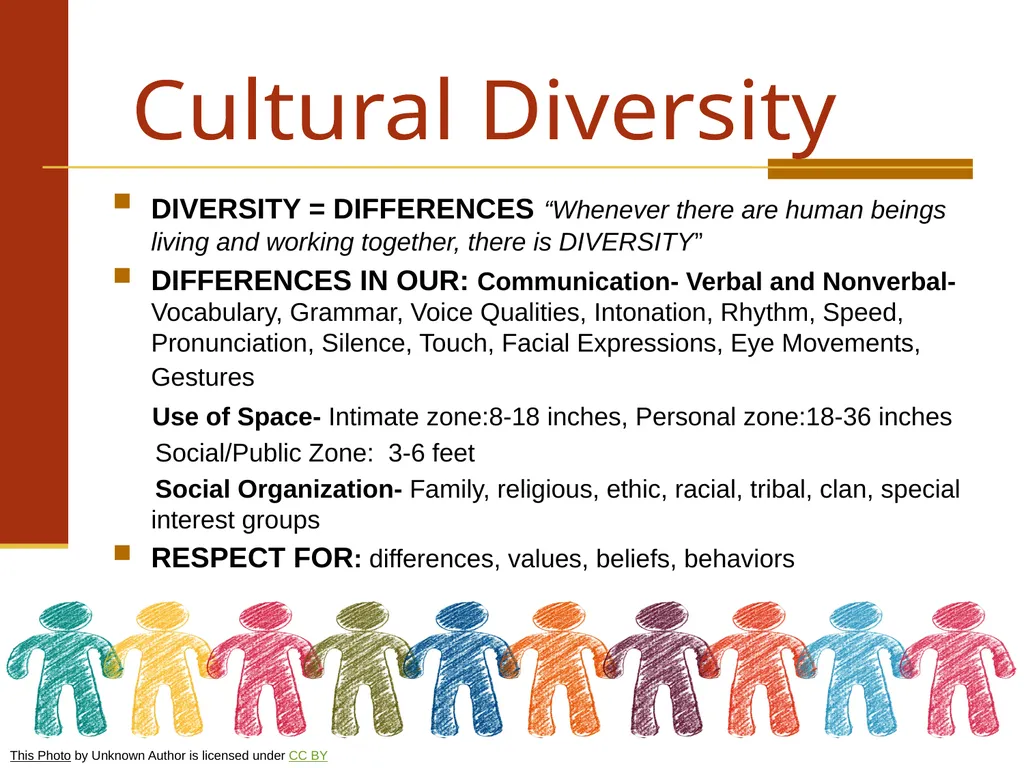
DIVERSITY = DIFFERENCES “Whenever there are human beings living and working together, there is DIVERSITY”
DIFFERENCES IN OUR: Communication- Verbal and Nonverbal- Vocabulary, Grammar, Voice Qualities, Intonation, Rhythm, Speed, Pronunciation, Silence, Touch, Facial Expressions, Eye Movements, Gestures
Use of Space- Intimate zone:8-18 inches, Personal zone:18-36 inches
Social/Public Zone: 3-6 feet
Social Organization- Family, religious, ethic, racial, tribal, clan, special interest groups
RESPECT FOR: differences, values, beliefs, behaviors Cultural Diversity This Photo by Unknown Author is licensed under CC BY<br>
DIFFERENCES IN OUR: Communication- Verbal and Nonverbal- Vocabulary, Grammar, Voice Qualities, Intonation, Rhythm, Speed, Pronunciation, Silence, Touch, Facial Expressions, Eye Movements, Gestures
Use of Space- Intimate zone:8-18 inches, Personal zone:18-36 inches
Social/Public Zone: 3-6 feet
Social Organization- Family, religious, ethic, racial, tribal, clan, special interest groups
RESPECT FOR: differences, values, beliefs, behaviors Cultural Diversity This Photo by Unknown Author is licensed under CC BY<br>
06
Mon-Fri 7:00-3:00: Interpreting Services Coordinator at ext: 8331. Do NOT leave message for urgent calls, use SPOK Messaging System, cell: 631-461-5918 Overhead PA is always a backup.
All other times, attempt to use the hospital qualified interpreters list to access staff volunteers or if not available, use the Language Line for Over the Phone Interpretation (OPI) or use Stratus Video for Video Remote Interpretation (VRI) or Refer to the policy manual for instructions.
In keeping with HIPAA and DOH regulations only qualified and certified staff should provide interpreting/translating services. Staff should offer the Hospital's free services.
Only qualified interpreters used.
Patients have the right to refuse and have a friend or family member interpret but the risk must be explained in their language
Waiver must be signed and placed in permanent record.
A qualified interpreter must still be in the room despite the signing of the waiver. Access to Interpreting Services<br>
All other times, attempt to use the hospital qualified interpreters list to access staff volunteers or if not available, use the Language Line for Over the Phone Interpretation (OPI) or use Stratus Video for Video Remote Interpretation (VRI) or Refer to the policy manual for instructions.
In keeping with HIPAA and DOH regulations only qualified and certified staff should provide interpreting/translating services. Staff should offer the Hospital's free services.
Only qualified interpreters used.
Patients have the right to refuse and have a friend or family member interpret but the risk must be explained in their language
Waiver must be signed and placed in permanent record.
A qualified interpreter must still be in the room despite the signing of the waiver. Access to Interpreting Services<br>
07
Customers are both internal and external….. External customers might be PATIENTS,FAMILIES,INSURANCE COMPANIES/GOVERNMENT REIMBURSORS. Internal customers might be employees in departments you work, physicians and each other
Excellent Customer Service means doing what you say you will, anticipating customer needs and going beyond what’s expected.
The only certain means of success is to render more and better services than is expected of you, no matter what your task may be.
THE CUSTOMER IS OUR REASON FOR BEING HERE!
Handle complaints by…. listening carefully to the customer, repeating the complaint back to the customer, apologize so the customer knows that you are sorry, acknowledge their feelings, explain the action that you are going to take and thank them for bringing the matter to your attention.
Resolving problems is vital to success of customer service. When the resolution takes too long, satisfaction drops substantially. Studies have shown that 70% of customers would do business with an organization again if a complaint is resolved in their favor, but 95% would do business again if problem is resolved on the spot! Problem solving should take place at a level closest to the customer. Customer Service<br>
Excellent Customer Service means doing what you say you will, anticipating customer needs and going beyond what’s expected.
The only certain means of success is to render more and better services than is expected of you, no matter what your task may be.
THE CUSTOMER IS OUR REASON FOR BEING HERE!
Handle complaints by…. listening carefully to the customer, repeating the complaint back to the customer, apologize so the customer knows that you are sorry, acknowledge their feelings, explain the action that you are going to take and thank them for bringing the matter to your attention.
Resolving problems is vital to success of customer service. When the resolution takes too long, satisfaction drops substantially. Studies have shown that 70% of customers would do business with an organization again if a complaint is resolved in their favor, but 95% would do business again if problem is resolved on the spot! Problem solving should take place at a level closest to the customer. Customer Service<br>
08
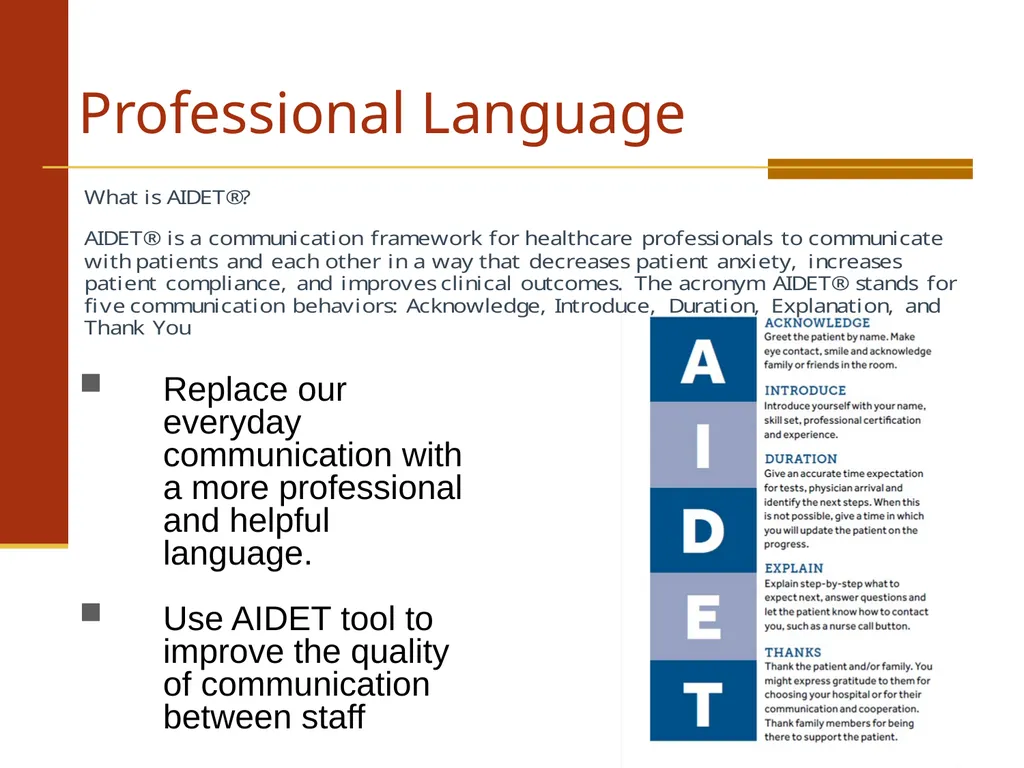
Professional Language Replace our everyday communication with a more professional and helpful language.
Use AIDET tool to improve the quality of communication between staff<br>
Use AIDET tool to improve the quality of communication between staff<br>
09
The Excellence of Service Ownership Service excellence is a combination of skill, commitment and ownership.
Defining one’s sense of ownership and taking responsibility for successes and missteps is a big part of providing wonderful customer experiences.
We must define our own personal level of ownership.<br>
Defining one’s sense of ownership and taking responsibility for successes and missteps is a big part of providing wonderful customer experiences.
We must define our own personal level of ownership.<br>
10
BARIATRIC SENSITIVITY Stony Brook Southampton Hospital is committed to providing quality care in a dignified, compassionate manner to all of our patients and visitors. We need to be mindful of our actions, words and facial expressions while attending to the needs of others. As our population is extremely diverse, we must not forget the needs, both physical and emotional, of our bariatric population. Nearly one third of the United States population is overweight and the social stigma that sometimes is associated with obesity can be hurtful and cruel. We need to be proactive in providing care in a non-judgmental manner.<br>
11
BARIATRIC SENSITIVITY
See The Person Not The Size… Sensitive treatment of obese patients involves attending to their needs of comfort, safety, and self-esteem.
The person, not the obesity, should be the focus of treatment.
Ensure that care is provided in a manner that enhances dignity, acceptance, and a sense of worth.<br>
The person, not the obesity, should be the focus of treatment.
Ensure that care is provided in a manner that enhances dignity, acceptance, and a sense of worth.<br>
12
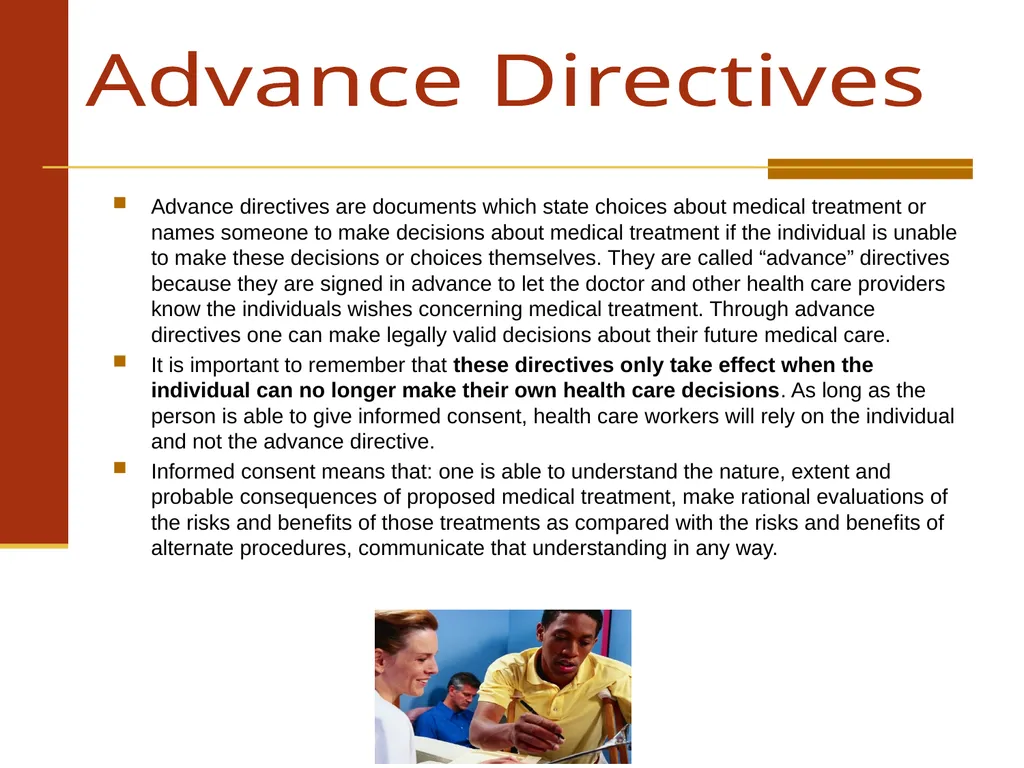
Advance directives are documents which state choices about medical treatment or names someone to make decisions about medical treatment if the individual is unable to make these decisions or choices themselves. They are called “advance” directives because they are signed in advance to let the doctor and other health care providers know the individuals wishes concerning medical treatment. Through advance directives one can make legally valid decisions about their future medical care.
It is important to remember that these directives only take effect when the individual can no longer make their own health care decisions. As long as the person is able to give informed consent, health care workers will rely on the individual and not the advance directive.
Informed consent means that: one is able to understand the nature, extent and probable consequences of proposed medical treatment, make rational evaluations of the risks and benefits of those treatments as compared with the risks and benefits of alternate procedures, communicate that understanding in any way. Advance Directives<br>
It is important to remember that these directives only take effect when the individual can no longer make their own health care decisions. As long as the person is able to give informed consent, health care workers will rely on the individual and not the advance directive.
Informed consent means that: one is able to understand the nature, extent and probable consequences of proposed medical treatment, make rational evaluations of the risks and benefits of those treatments as compared with the risks and benefits of alternate procedures, communicate that understanding in any way. Advance Directives<br>
13
Living Will: A legal document that tells the doctor and other healthcare providers whether or not the individual wants life sustaining treatments or procedures administered to them if they are in a terminal condition of a permanent unconscious state. It is called a “living will” because it takes effect while one is still living
Do Not Resuscitate Order: A written order by a doctor dictating that an individual does not desire resuscitative measures in the case of failed breathing or cardiac arrest
Health Care Proxy: A legal document which allows the principal to appoint another person (the ”attorney in fact” or agent) to make medical decisions for them if they should become temporarily or permanently unable to make those decisions for themselves Types of Advance Directives:<br>
Do Not Resuscitate Order: A written order by a doctor dictating that an individual does not desire resuscitative measures in the case of failed breathing or cardiac arrest
Health Care Proxy: A legal document which allows the principal to appoint another person (the ”attorney in fact” or agent) to make medical decisions for them if they should become temporarily or permanently unable to make those decisions for themselves Types of Advance Directives:<br>
14
It is everyone’s role to continually assess and improve the services we provide
Benchmarking: comparing our performance to others. Patient surveys are administered and evaluated by Press Gainey who use the information to tell us how our patients rate us, comparing us to over 450 hospitals
Priorities for improvement are selected by the P.I. committee:
High volume- what we do the most often and can have the greatest impact upon improvement
High Risk - areas in which no defects are acceptable
Problem Prone- based on customer feedback, occurrence reports and concerns
Occurrence Reports: Identifies and documents occurrences and assists both in the identification of causes and the implementation of appropriate preventative measures as part of the risk management program. Occurrence is an unexpected incident that caused/could have caused harm to a patient, visitor or employee. Occurrences that caused/could have caused harm to a patient should be documented in SB Safe. Occurrences that caused/could have caused harm to a visitor should be documented on paper forms. Employee injuries resulting from patients should be documented in the Workplace Violence portion of SB Safe, otherwise other injuries are documented on paper forms. If occurrence concerns an employee make sure you notify your supervisor right away. After completion, forward report to employee health. Once the report is completed forward to P.I. and Nursing office. If incident involves a visitor, make sure security is notified. If there is an injury, ER treatment is indicated. P.I. gets a completed copy of the report Performance Improvement/Risk Management<br>
Benchmarking: comparing our performance to others. Patient surveys are administered and evaluated by Press Gainey who use the information to tell us how our patients rate us, comparing us to over 450 hospitals
Priorities for improvement are selected by the P.I. committee:
High volume- what we do the most often and can have the greatest impact upon improvement
High Risk - areas in which no defects are acceptable
Problem Prone- based on customer feedback, occurrence reports and concerns
Occurrence Reports: Identifies and documents occurrences and assists both in the identification of causes and the implementation of appropriate preventative measures as part of the risk management program. Occurrence is an unexpected incident that caused/could have caused harm to a patient, visitor or employee. Occurrences that caused/could have caused harm to a patient should be documented in SB Safe. Occurrences that caused/could have caused harm to a visitor should be documented on paper forms. Employee injuries resulting from patients should be documented in the Workplace Violence portion of SB Safe, otherwise other injuries are documented on paper forms. If occurrence concerns an employee make sure you notify your supervisor right away. After completion, forward report to employee health. Once the report is completed forward to P.I. and Nursing office. If incident involves a visitor, make sure security is notified. If there is an injury, ER treatment is indicated. P.I. gets a completed copy of the report Performance Improvement/Risk Management<br>
15
One of the best safety measures is prevention. Take a pro-active role in fire prevention by adhering to the following safety measures: keep the hallways clear, do NOT block fire doors, keep the area around fire extinguishers or fire pull stations clear, know your fire plan and follow it during all code “reds”. To report a code “red” call 555 or use a fire pull station.
Fire Drills: All drills are unannounced, listen to all PA announcements, do not move about the building during a code “red” a response team will attempt to extinguish the fire until the fire department responds, wait for the “all clear announcement”
Evacuation: The decision to implement the evacuation of a building will be made by the Fire Chief or Hospital Administrator. Horizontal evacuation- depending on the location of the fire, move to the next smoke compartment through the smoke doors. Vertical evacuation-Go down the stairwells to a lower floor or out of the building. Listen for announcements, evacuate ambulatory patients first, then semi-ambulatory. Remove charts if safety permits. For patients who can walk, form a chain holding hands with a staff member leading the way. For patients who can’t walk use wheelchairs or stretchers, slide patient on floor using blankets or sheets, or use one of the patient carriers. Fire Safety Prevention<br>
Fire Drills: All drills are unannounced, listen to all PA announcements, do not move about the building during a code “red” a response team will attempt to extinguish the fire until the fire department responds, wait for the “all clear announcement”
Evacuation: The decision to implement the evacuation of a building will be made by the Fire Chief or Hospital Administrator. Horizontal evacuation- depending on the location of the fire, move to the next smoke compartment through the smoke doors. Vertical evacuation-Go down the stairwells to a lower floor or out of the building. Listen for announcements, evacuate ambulatory patients first, then semi-ambulatory. Remove charts if safety permits. For patients who can walk, form a chain holding hands with a staff member leading the way. For patients who can’t walk use wheelchairs or stretchers, slide patient on floor using blankets or sheets, or use one of the patient carriers. Fire Safety Prevention<br>
16
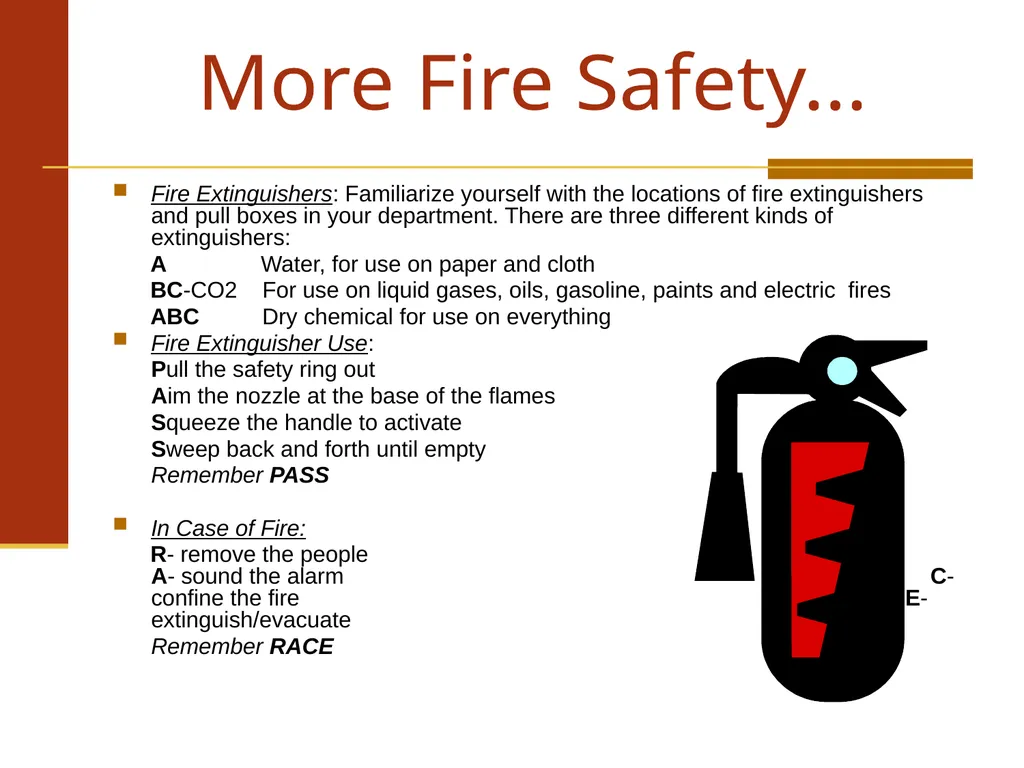
Fire Extinguishers: Familiarize yourself with the locations of fire extinguishers and pull boxes in your department. There are three different kinds of extinguishers:
A Water, for use on paper and cloth
BC-CO2 For use on liquid gases, oils, gasoline, paints and electric fires
ABC Dry chemical for use on everything
Fire Extinguisher Use:
Pull the safety ring out
Aim the nozzle at the base of the flames
Squeeze the handle to activate
Sweep back and forth until empty
Remember PASS
In Case of Fire:
R- remove the people A- sound the alarm C- confine the fire E- extinguish/evacuate
Remember RACE More Fire Safety...<br>
A Water, for use on paper and cloth
BC-CO2 For use on liquid gases, oils, gasoline, paints and electric fires
ABC Dry chemical for use on everything
Fire Extinguisher Use:
Pull the safety ring out
Aim the nozzle at the base of the flames
Squeeze the handle to activate
Sweep back and forth until empty
Remember PASS
In Case of Fire:
R- remove the people A- sound the alarm C- confine the fire E- extinguish/evacuate
Remember RACE More Fire Safety...<br>
17
O2 SHUT OFF FOR FIRE EMERGENCIES ONLY In the event of a fire emergency, the Fire Control Team will be responsible to shutting down the oxygen. The oxygen system has zone valves located throughout the building. They are labeled and show the area of the building and the room numbers that will be affected if the valve is shut off. Signs are also posted above these valves. The Fire Control Team will:
Check all rooms for Patients, who are on oxygen, ensure that there are sufficient portable oxygen tanks available for those Patients who will be directly affected by the shut off.
The Oxygen shut down should be limited to small areas. If a fire occurs on North II, there is no need to shut down the ICU again unless directed.
If Respiratory care is not present have the Operator Page them "stat."
After all rooms within the shutdown zone are checked and there is sufficient portable oxygen tanks on hand for the Patients the valve may be shut down.
Be aware that oxygen lines shut down still have pressure in them and may indeed be a potential source of danger.<br>
Check all rooms for Patients, who are on oxygen, ensure that there are sufficient portable oxygen tanks available for those Patients who will be directly affected by the shut off.
The Oxygen shut down should be limited to small areas. If a fire occurs on North II, there is no need to shut down the ICU again unless directed.
If Respiratory care is not present have the Operator Page them "stat."
After all rooms within the shutdown zone are checked and there is sufficient portable oxygen tanks on hand for the Patients the valve may be shut down.
Be aware that oxygen lines shut down still have pressure in them and may indeed be a potential source of danger.<br>
18
Goal: to maintain a safe environment for all customers and employees of Stony Brook Southampton Hospital. This is achieved by educating all employees on hazardous materials, how to respond in an emergency situation and reporting any situation in which possible injury/property damage could occur.
Electrical safety: Report all shocks immediately, never work around electricity when surroundings are wet
Don’t: 1) Use too many adaptors; plugging in too many cords can overload the circuit. 2) Attach cords to the floor, wall or other objects with tacks or pins or run cords under rugs or through doorways
Do: 1) Examine all plugs and cords routinely, replacing any that are damaged or heat up with use. 2) Keep cords away from heat and water
Securing Valuables: Patient valuables should be given to Security and locked in the hospital safe. Patient property should be kept with the patient. All employees should secure their own personal belongings.
I.D. badges: Per the NY State health code, every employee, physician, volunteer and student is required to wear picture ID at all times. Safety and Security<br>
Electrical safety: Report all shocks immediately, never work around electricity when surroundings are wet
Don’t: 1) Use too many adaptors; plugging in too many cords can overload the circuit. 2) Attach cords to the floor, wall or other objects with tacks or pins or run cords under rugs or through doorways
Do: 1) Examine all plugs and cords routinely, replacing any that are damaged or heat up with use. 2) Keep cords away from heat and water
Securing Valuables: Patient valuables should be given to Security and locked in the hospital safe. Patient property should be kept with the patient. All employees should secure their own personal belongings.
I.D. badges: Per the NY State health code, every employee, physician, volunteer and student is required to wear picture ID at all times. Safety and Security<br>
19
It is the policy of Stony Brook Southampton Hospital to maintain an environment in which the employees health and safety is paramount. The Hazard Communication Program ensures that all staff are furnished with information concerning the health hazards they may encounter in the workplace. The program ensures compliance with the “Occupational Safety and Health Administration” (OSHA) Hazardous Communication Standards and the NY State “Right to Know” law.
The Hazardous Communication Standard states: all containers must be labeled, all materials must be accompanied by a Safety Data Sheet (SDS) including information on identity of products, hazardous ingredients, physical and chemical characteristics, physical hazards, reactions, health hazards, precautions for safe handling and any other precautions and control measures. Training must be provided for anyone using the product , personal protective equipment must be made available for use if necessary, workers are accountable to heed precautions and use product safely
Types of hazardous chemicals common to healthcare facilities include compressed gasses, example: oxygen), anesthetic gasses (like nitrous oxide), disinfectants (like glutaraldehyde) cleaning agents (like chlorine), hazardous drugs (like antineoplastics) and metals (such as mercury and potassium) Hazardous Communication Standard
"Right to Know Law"<br>
The Hazardous Communication Standard states: all containers must be labeled, all materials must be accompanied by a Safety Data Sheet (SDS) including information on identity of products, hazardous ingredients, physical and chemical characteristics, physical hazards, reactions, health hazards, precautions for safe handling and any other precautions and control measures. Training must be provided for anyone using the product , personal protective equipment must be made available for use if necessary, workers are accountable to heed precautions and use product safely
Types of hazardous chemicals common to healthcare facilities include compressed gasses, example: oxygen), anesthetic gasses (like nitrous oxide), disinfectants (like glutaraldehyde) cleaning agents (like chlorine), hazardous drugs (like antineoplastics) and metals (such as mercury and potassium) Hazardous Communication Standard
"Right to Know Law"<br>
20
A disaster is defined as any situation in which this hospital is called upon to care for casualties greater in number than what can be cared for efficiently within the Hospital.
Internal Disaster Plan: in event of internal disaster or outage of any utility systems (water, electricity, oxygen, elevators, medical air or gas, telephone, air conditioning or heating) the hospital has a system for communication so that a plan of action can be undertaken
Levels of disaster preparedness:
* condition l: may require additional personnel. Number of casualties not expected to exceed 10-15 urgent care cases or 15-20 of less urgent need. Effect will be to expand regular ER procedures and methods by calling in extra personnel
* condition ll: requires maximum expansion of accommodations and services. Administrative Officer will check with neighboring facilities to determine availability of services
Triage and Treatment Areas (this is done in the hallway by admitting):
* Urgent Care Area- ED. Burn cases will be treated in the ED trauma rooms
* Deferred Care Area- Casualties not requiring immediate care are taken to ambulatory surgery
* Ambulatory casualties not requiring immediate attention are triaged to pre-surgical testing area of south l Disaster Plan<br>
Internal Disaster Plan: in event of internal disaster or outage of any utility systems (water, electricity, oxygen, elevators, medical air or gas, telephone, air conditioning or heating) the hospital has a system for communication so that a plan of action can be undertaken
Levels of disaster preparedness:
* condition l: may require additional personnel. Number of casualties not expected to exceed 10-15 urgent care cases or 15-20 of less urgent need. Effect will be to expand regular ER procedures and methods by calling in extra personnel
* condition ll: requires maximum expansion of accommodations and services. Administrative Officer will check with neighboring facilities to determine availability of services
Triage and Treatment Areas (this is done in the hallway by admitting):
* Urgent Care Area- ED. Burn cases will be treated in the ED trauma rooms
* Deferred Care Area- Casualties not requiring immediate care are taken to ambulatory surgery
* Ambulatory casualties not requiring immediate attention are triaged to pre-surgical testing area of south l Disaster Plan<br>
21
The Hospitals Comprehensive Emergency Management Plan is based on the Hospital Incident Command System (HICS). It’s a flexible plan that can be modified as needed, it follows a chain of command system. The chain of command is organized into positions and it also defines levels of activation.
Internal Disasters: are described as an outage of any utility system (water, electricity, oxygen, elevators, medical air or gas, telephone, air conditioning or heating).
External Disasters: A major incidents which occurred outside the building that could send us a large amount of Patients, for example a plane crash or a bus accident.
Every Department has there own plan that you must follow, it should describe your responsibilities during a disaster. Comprehensive Emergency Management Plan<br>
Internal Disasters: are described as an outage of any utility system (water, electricity, oxygen, elevators, medical air or gas, telephone, air conditioning or heating).
External Disasters: A major incidents which occurred outside the building that could send us a large amount of Patients, for example a plane crash or a bus accident.
Every Department has there own plan that you must follow, it should describe your responsibilities during a disaster. Comprehensive Emergency Management Plan<br>
22
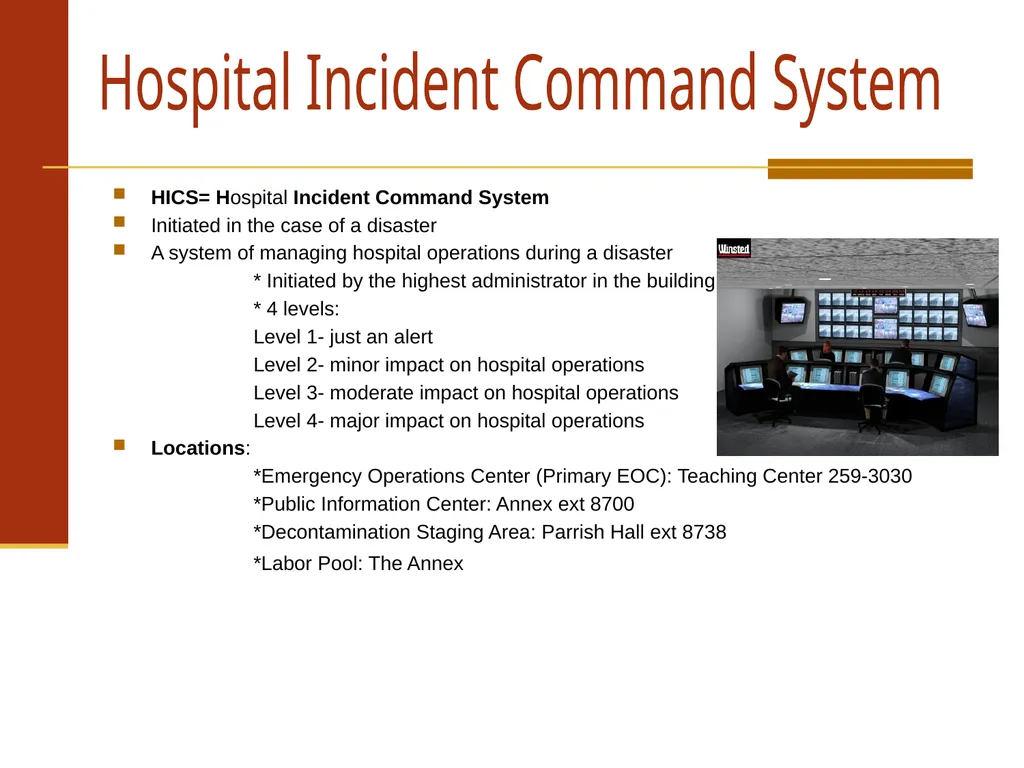
HICS= Hospital Incident Command System
Initiated in the case of a disaster
A system of managing hospital operations during a disaster
* Initiated by the highest administrator in the building
* 4 levels:
Level 1- just an alert
Level 2- minor impact on hospital operations
Level 3- moderate impact on hospital operations
Level 4- major impact on hospital operations
Locations:
*Emergency Operations Center (Primary EOC): Teaching Center 259-3030
*Public Information Center: Annex ext 8700
*Decontamination Staging Area: Parrish Hall ext 8738
*Labor Pool: The Annex Hospital Incident Command System<br>
Initiated in the case of a disaster
A system of managing hospital operations during a disaster
* Initiated by the highest administrator in the building
* 4 levels:
Level 1- just an alert
Level 2- minor impact on hospital operations
Level 3- moderate impact on hospital operations
Level 4- major impact on hospital operations
Locations:
*Emergency Operations Center (Primary EOC): Teaching Center 259-3030
*Public Information Center: Annex ext 8700
*Decontamination Staging Area: Parrish Hall ext 8738
*Labor Pool: The Annex Hospital Incident Command System<br>
23
SPOK Mobile Messaging System SPOK is our Paging and On-Call System that we utilize to reduce overhead noise and improve patient satisfaction throughout the hospital and off-sites. SPOK allows us to offer two methods of communication: through an alpha-numeric beeper or SPOK Mobile which is an app you can access for free on a mobile device that offers a secure instant message exchange of PHI.<br>
24
SPOK Mobile Messaging System With the implementation of SPOK, only codes and announcements will be paged overhead. All hospital staff should be utilizing SPOK Web. If the staff have any questions or concerns in regard to SPOK, they can contact Patient Access at EXT. 8530 or they can email SBSH_PACommunications@stonybrookmedicine.edu.<br>
25
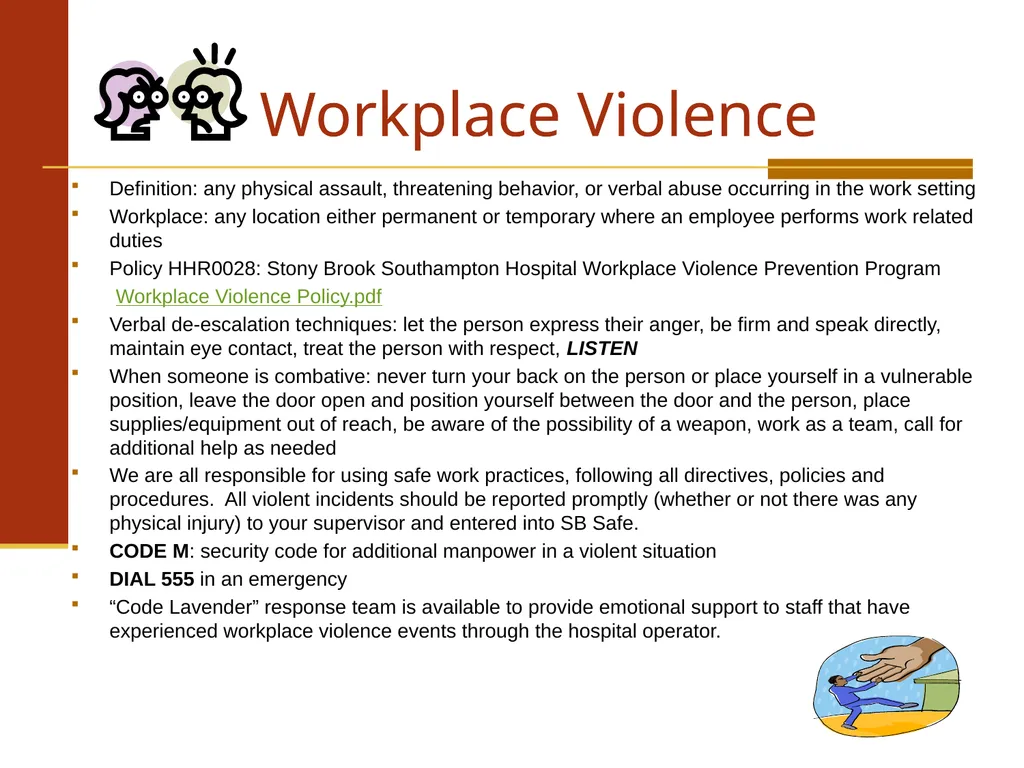
Workplace Violence Definition: any physical assault, threatening behavior, or verbal abuse occurring in the work setting
Workplace: any location either permanent or temporary where an employee performs work related duties
Policy HHR0028: Stony Brook Southampton Hospital Workplace Violence Prevention Program
Workplace Violence Policy.pdf
Verbal de-escalation techniques: let the person express their anger, be firm and speak directly, maintain eye contact, treat the person with respect, LISTEN
When someone is combative: never turn your back on the person or place yourself in a vulnerable position, leave the door open and position yourself between the door and the person, place supplies/equipment out of reach, be aware of the possibility of a weapon, work as a team, call for additional help as needed
We are all responsible for using safe work practices, following all directives, policies and procedures. All violent incidents should be reported promptly (whether or not there was any physical injury) to your supervisor and entered into SB Safe.
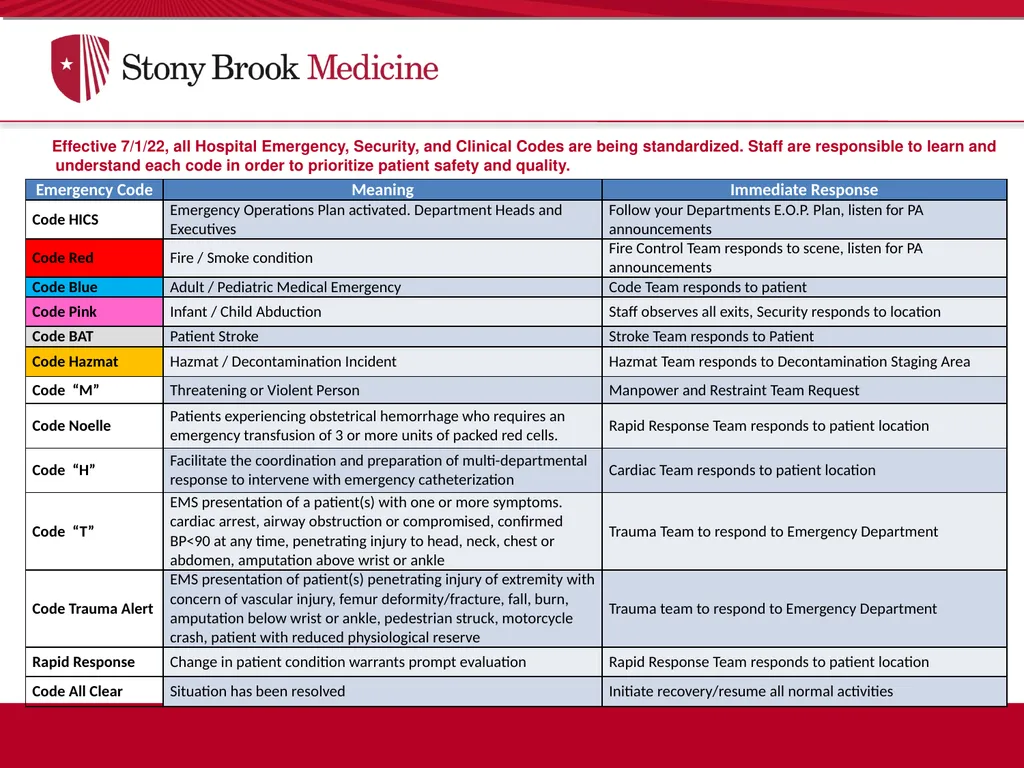
CODE M: security code for additional manpower in a violent situation
DIAL 555 in an emergency
“Code Lavender” response team is available to provide emotional support to staff that have experienced workplace violence events through the hospital operator.<br>
Workplace: any location either permanent or temporary where an employee performs work related duties
Policy HHR0028: Stony Brook Southampton Hospital Workplace Violence Prevention Program
Workplace Violence Policy.pdf
Verbal de-escalation techniques: let the person express their anger, be firm and speak directly, maintain eye contact, treat the person with respect, LISTEN
When someone is combative: never turn your back on the person or place yourself in a vulnerable position, leave the door open and position yourself between the door and the person, place supplies/equipment out of reach, be aware of the possibility of a weapon, work as a team, call for additional help as needed
We are all responsible for using safe work practices, following all directives, policies and procedures. All violent incidents should be reported promptly (whether or not there was any physical injury) to your supervisor and entered into SB Safe.
CODE M: security code for additional manpower in a violent situation
DIAL 555 in an emergency
“Code Lavender” response team is available to provide emotional support to staff that have experienced workplace violence events through the hospital operator.<br>
26
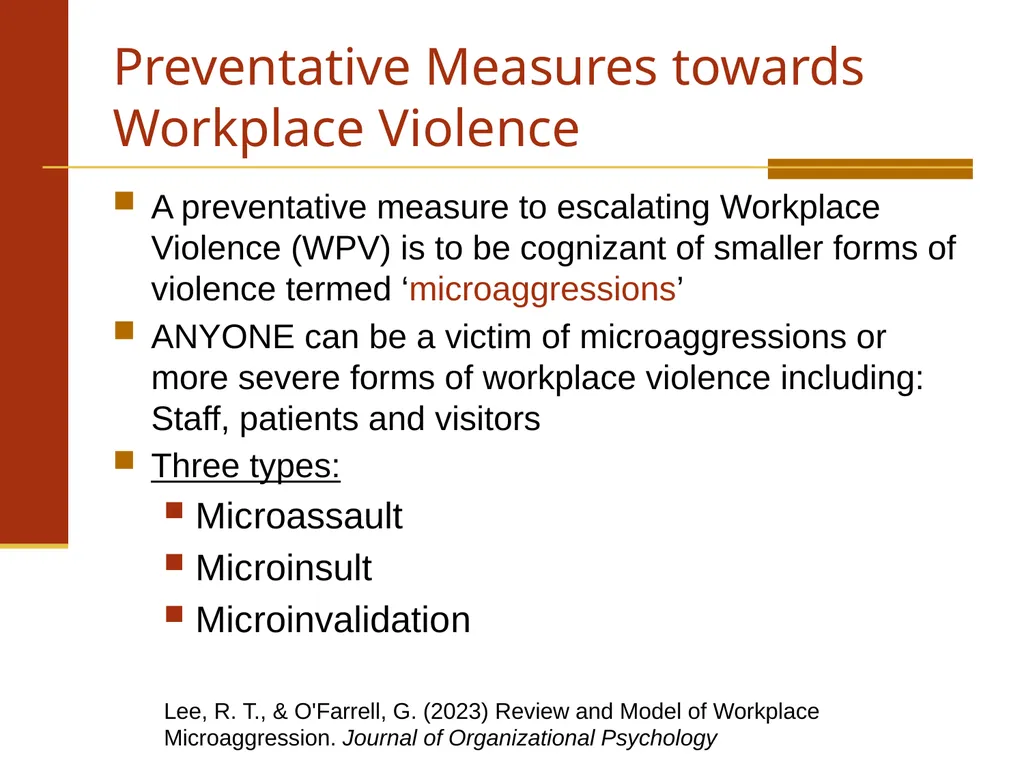
Preventative Measures towards Workplace Violence A preventative measure to escalating Workplace Violence (WPV) is to be cognizant of smaller forms of violence termed ‘microaggressions’
ANYONE can be a victim of microaggressions or more severe forms of workplace violence including: Staff, patients and visitors
Three types:
Microassault
Microinsult
Microinvalidation
Lee, R. T., & O'Farrell, G. (2023) Review and Model of Workplace Microaggression. Journal of Organizational Psychology<br>
ANYONE can be a victim of microaggressions or more severe forms of workplace violence including: Staff, patients and visitors
Three types:
Microassault
Microinsult
Microinvalidation
Lee, R. T., & O'Farrell, G. (2023) Review and Model of Workplace Microaggression. Journal of Organizational Psychology<br>
27
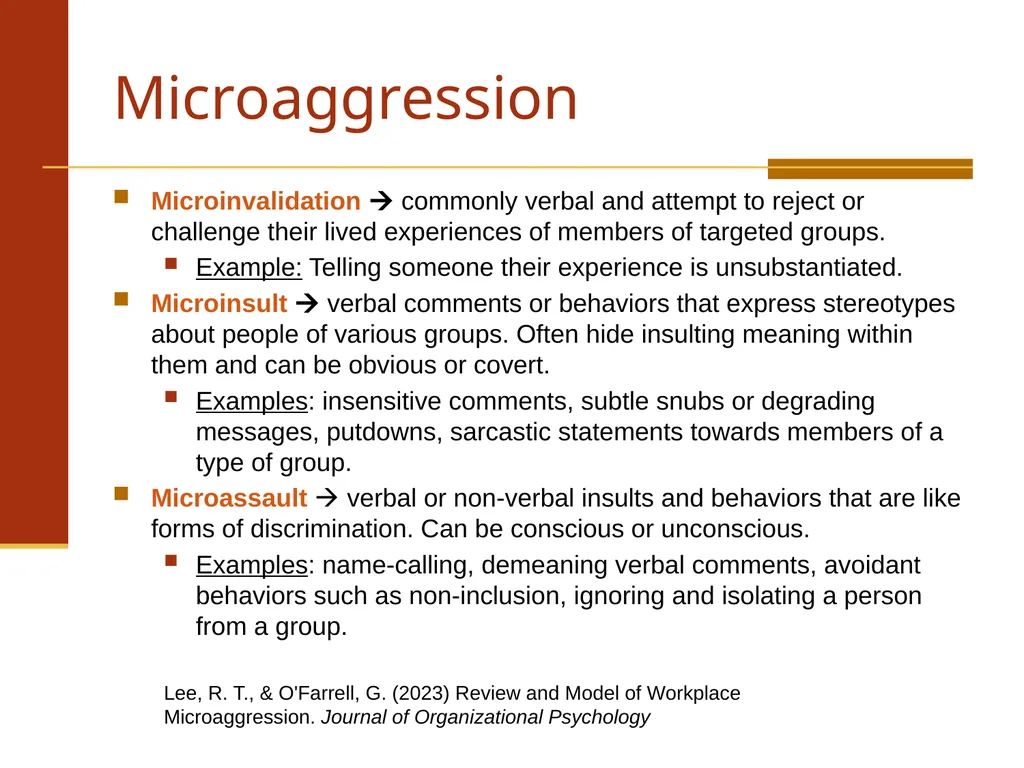
Microaggression Microinvalidation commonly verbal and attempt to reject or challenge their lived experiences of members of targeted groups.
Example: Telling someone their experience is unsubstantiated.
Microinsult verbal comments or behaviors that express stereotypes about people of various groups. Often hide insulting meaning within them and can be obvious or covert.
Examples: insensitive comments, subtle snubs or degrading messages, putdowns, sarcastic statements towards members of a type of group.
Microassault verbal or non-verbal insults and behaviors that are like forms of discrimination. Can be conscious or unconscious.
Examples: name-calling, demeaning verbal comments, avoidant behaviors such as non-inclusion, ignoring and isolating a person from a group.
Lee, R. T., & O'Farrell, G. (2023) Review and Model of Workplace Microaggression. Journal of Organizational Psychology<br>
Example: Telling someone their experience is unsubstantiated.
Microinsult verbal comments or behaviors that express stereotypes about people of various groups. Often hide insulting meaning within them and can be obvious or covert.
Examples: insensitive comments, subtle snubs or degrading messages, putdowns, sarcastic statements towards members of a type of group.
Microassault verbal or non-verbal insults and behaviors that are like forms of discrimination. Can be conscious or unconscious.
Examples: name-calling, demeaning verbal comments, avoidant behaviors such as non-inclusion, ignoring and isolating a person from a group.
Lee, R. T., & O'Farrell, G. (2023) Review and Model of Workplace Microaggression. Journal of Organizational Psychology<br>
28
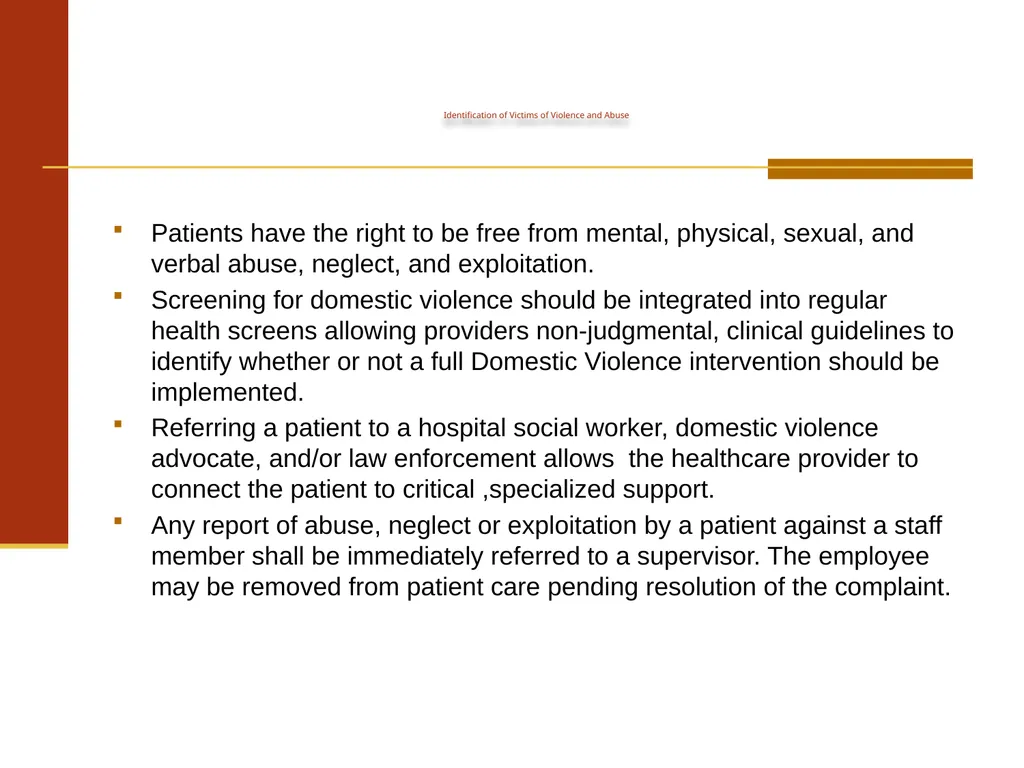
Identification of Victims of Violence and Abuse Patients have the right to be free from mental, physical, sexual, and verbal abuse, neglect, and exploitation.
Screening for domestic violence should be integrated into regular health screens allowing providers non-judgmental, clinical guidelines to identify whether or not a full Domestic Violence intervention should be implemented.
Referring a patient to a hospital social worker, domestic violence advocate, and/or law enforcement allows the healthcare provider to connect the patient to critical ,specialized support.
Any report of abuse, neglect or exploitation by a patient against a staff member shall be immediately referred to a supervisor. The employee may be removed from patient care pending resolution of the complaint.<br>
Screening for domestic violence should be integrated into regular health screens allowing providers non-judgmental, clinical guidelines to identify whether or not a full Domestic Violence intervention should be implemented.
Referring a patient to a hospital social worker, domestic violence advocate, and/or law enforcement allows the healthcare provider to connect the patient to critical ,specialized support.
Any report of abuse, neglect or exploitation by a patient against a staff member shall be immediately referred to a supervisor. The employee may be removed from patient care pending resolution of the complaint.<br>
29
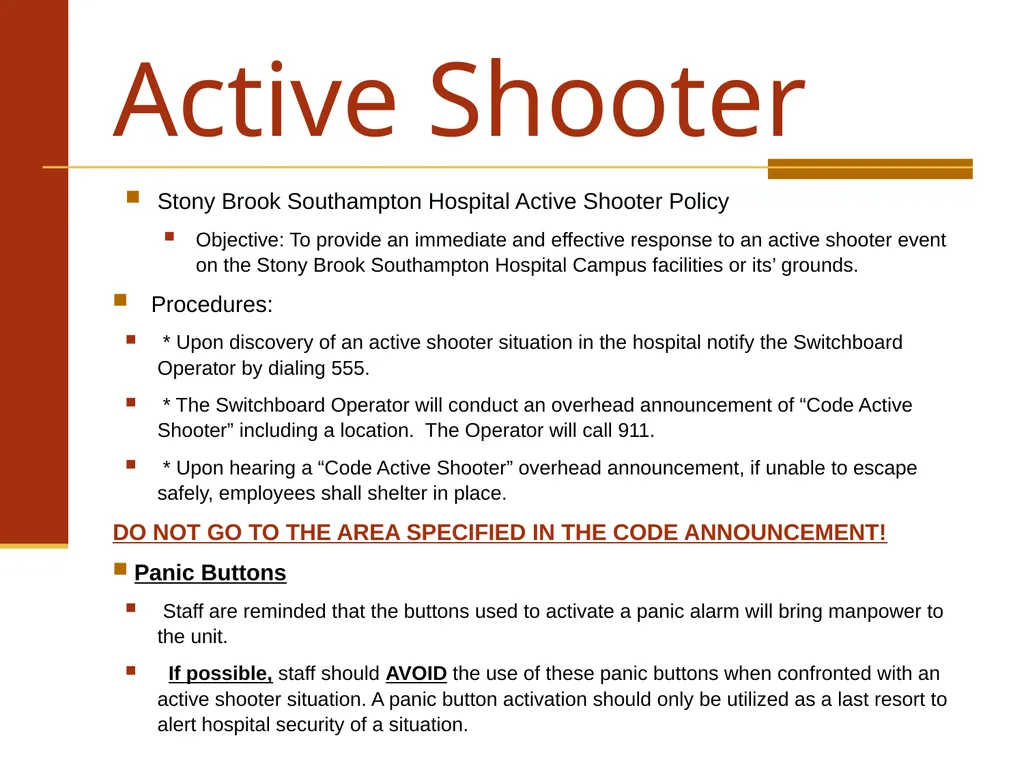
Active Shooter Stony Brook Southampton Hospital Active Shooter Policy
Objective: To provide an immediate and effective response to an active shooter event on the Stony Brook Southampton Hospital Campus facilities or its’ grounds.
Procedures:
* Upon discovery of an active shooter situation in the hospital notify the Switchboard Operator by dialing 555.
* The Switchboard Operator will conduct an overhead announcement of “Code Active Shooter” including a location. The Operator will call 911.
* Upon hearing a “Code Active Shooter” overhead announcement, if unable to escape safely, employees shall shelter in place.
DO NOT GO TO THE AREA SPECIFIED IN THE CODE ANNOUNCEMENT!
Panic Buttons
Staff are reminded that the buttons used to activate a panic alarm will bring manpower to the unit.
If possible, staff should AVOID the use of these panic buttons when confronted with an active shooter situation. A panic button activation should only be utilized as a last resort to alert hospital security of a situation.<br>
Objective: To provide an immediate and effective response to an active shooter event on the Stony Brook Southampton Hospital Campus facilities or its’ grounds.
Procedures:
* Upon discovery of an active shooter situation in the hospital notify the Switchboard Operator by dialing 555.
* The Switchboard Operator will conduct an overhead announcement of “Code Active Shooter” including a location. The Operator will call 911.
* Upon hearing a “Code Active Shooter” overhead announcement, if unable to escape safely, employees shall shelter in place.
DO NOT GO TO THE AREA SPECIFIED IN THE CODE ANNOUNCEMENT!
Panic Buttons
Staff are reminded that the buttons used to activate a panic alarm will bring manpower to the unit.
If possible, staff should AVOID the use of these panic buttons when confronted with an active shooter situation. A panic button activation should only be utilized as a last resort to alert hospital security of a situation.<br>
30
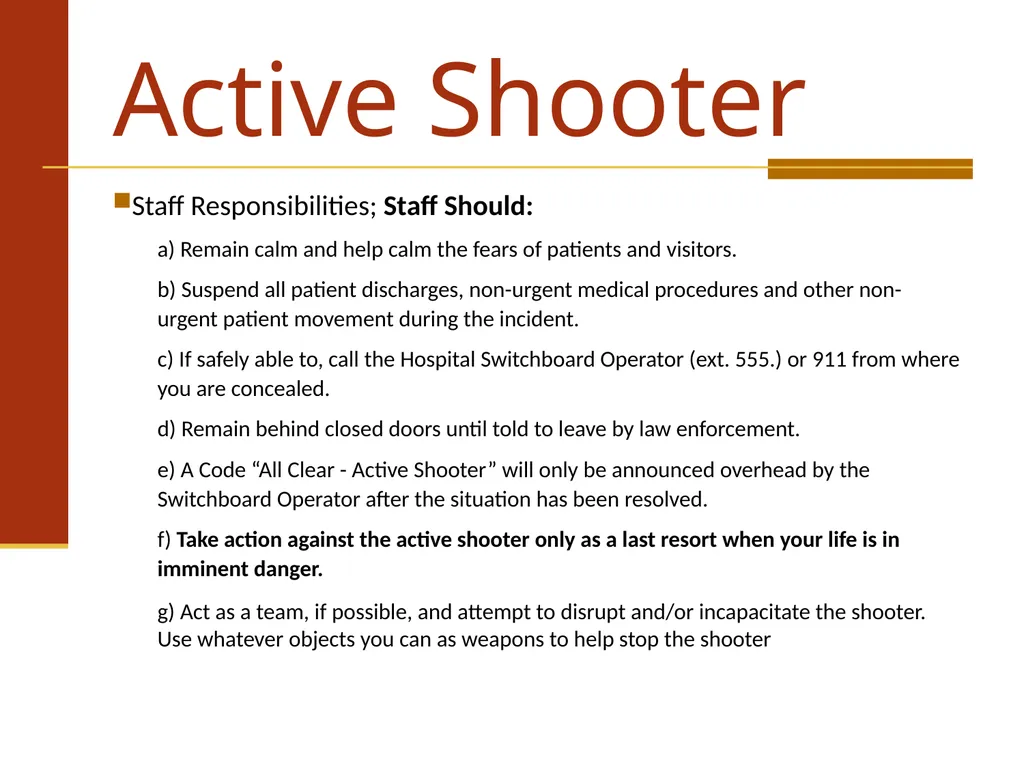
Active Shooter Staff Responsibilities; Staff Should:
a) Remain calm and help calm the fears of patients and visitors.
b) Suspend all patient discharges, non-urgent medical procedures and other non-urgent patient movement during the incident.
c) If safely able to, call the Hospital Switchboard Operator (ext. 555.) or 911 from where you are concealed.
d) Remain behind closed doors until told to leave by law enforcement.
e) A Code “All Clear - Active Shooter” will only be announced overhead by the Switchboard Operator after the situation has been resolved.
f) Take action against the active shooter only as a last resort when your life is in imminent danger.
g) Act as a team, if possible, and attempt to disrupt and/or incapacitate the shooter. Use whatever objects you can as weapons to help stop the shooter<br>
a) Remain calm and help calm the fears of patients and visitors.
b) Suspend all patient discharges, non-urgent medical procedures and other non-urgent patient movement during the incident.
c) If safely able to, call the Hospital Switchboard Operator (ext. 555.) or 911 from where you are concealed.
d) Remain behind closed doors until told to leave by law enforcement.
e) A Code “All Clear - Active Shooter” will only be announced overhead by the Switchboard Operator after the situation has been resolved.
f) Take action against the active shooter only as a last resort when your life is in imminent danger.
g) Act as a team, if possible, and attempt to disrupt and/or incapacitate the shooter. Use whatever objects you can as weapons to help stop the shooter<br>
31
Employee Conduct All staff are expected to conduct themselves in a manner that supports the efficient operations of the Hospital and for the benefit and safety of staff.
General expectations include:
Report to work punctually and notify your supervisor in advance if you expect to be late or absent from work
Comply with all Hospital safety standards
Be neatly and appropriately attired (See Personal Appearance Policy)
Treat all patients, visitors, and staff in a courteous and professional manner.<br>
General expectations include:
Report to work punctually and notify your supervisor in advance if you expect to be late or absent from work
Comply with all Hospital safety standards
Be neatly and appropriately attired (See Personal Appearance Policy)
Treat all patients, visitors, and staff in a courteous and professional manner.<br>
32
HARASSMENT AND
NON DISCRIMINATION Policy: Discrimination and harassment on the basis of an employee's race, color, creed, religion, national or ethnic origin, sex, sexual orientation, gender identity or gender expression, age, disability (including pregnancy), citizenship, marital status, familial status, genetic predisposition, source of income, domestic violence victim status, military or veteran status, or any other basis protected by Federal, State, or local law and regulations is expressly prohibited.
Harassment: Unlawful forms of harassment includes sexual harassment and unwelcome conduct, whether verbal, physical or visual which is based upon race, religion, ethnicity, color, ancestry, creed, age, genetic information, actual or perceived disability, medical condition, sex, national origin, sexual orientation, marital status, familial or parental status, domestic partner status, alienage or citizenship, military or veteran status, source of income, domestic violence victim status or any other status protected by federal, state, or local law.
Examples of harassment:
Oral or written communications that contain offensive name-calling, derogatory comments, jokes, slurs, negative stereotyping, or threats.
Nonverbal conduct such as staring, leering and giving inappropriate gifts, especially if this conduct is repetitive.
Visual images such as posting or sharing derogatory or offensive pictures, cartoons, drawings or gestures.
Other behavior that creates a workplace where an employee reasonably feels threatened, humiliated, intimidated, or bullied in the workplace<br>
Harassment: Unlawful forms of harassment includes sexual harassment and unwelcome conduct, whether verbal, physical or visual which is based upon race, religion, ethnicity, color, ancestry, creed, age, genetic information, actual or perceived disability, medical condition, sex, national origin, sexual orientation, marital status, familial or parental status, domestic partner status, alienage or citizenship, military or veteran status, source of income, domestic violence victim status or any other status protected by federal, state, or local law.
Examples of harassment:
Oral or written communications that contain offensive name-calling, derogatory comments, jokes, slurs, negative stereotyping, or threats.
Nonverbal conduct such as staring, leering and giving inappropriate gifts, especially if this conduct is repetitive.
Visual images such as posting or sharing derogatory or offensive pictures, cartoons, drawings or gestures.
Other behavior that creates a workplace where an employee reasonably feels threatened, humiliated, intimidated, or bullied in the workplace<br>
33
HARASSMENT AND
NON DISCRIMINATION Sexual harassment: Sexual harassment is a form of harassment that is based on a person’s sex or that is sex-based behavior. It is also sexual harassment for anyone in a position of authority to make a condition of employment upon submission to a request or demand for sexual favors.
Your role: Every employee has a role to play in achieving a respectful workplace:
Be sensitive to how others may perceive your actions. Just because someone does not complain to you does not mean that they don’t object to your behavior.
If someone offends you, let that person know so that it won’t happen again. If you have offended someone, understand his or her perspective, apologize and don’t let it happen again.
Report any unwelcome behavior you think might be harassment under this policy to your Supervisor or the Human Resources Department. An appropriate investigation will follow.
Non-retaliation: retaliation of any kind against any employee for bringing a complaint or assisting in the investigation of a complaint is prohibited.<br>
Your role: Every employee has a role to play in achieving a respectful workplace:
Be sensitive to how others may perceive your actions. Just because someone does not complain to you does not mean that they don’t object to your behavior.
If someone offends you, let that person know so that it won’t happen again. If you have offended someone, understand his or her perspective, apologize and don’t let it happen again.
Report any unwelcome behavior you think might be harassment under this policy to your Supervisor or the Human Resources Department. An appropriate investigation will follow.
Non-retaliation: retaliation of any kind against any employee for bringing a complaint or assisting in the investigation of a complaint is prohibited.<br>
34
LGBTQIA+ Gender Identity: how an individual identifies their own gender, this is a spectrum
Transgender / Gender-Nonconforming (TGNC)- Individuals whose gender identity and/or gender expression differs from what is typically associated with the sex they were assigned at birth.
Female to male (Transgender Male/Trans Man) - Female at birth, identify as male
Male to female (Transgender Female/Trans Woman) - Male at birth, identify as female
Non-binary: individual whose gender identity isn’t exclusively male or female
Genderqueer: gender identities that are not solely male or female—identities that are outside the gender binary
Two-spirit: refers to a person who identifies as having both a masculine and a feminine spirit, and is used by some Indigenous people to describe their sexual, gender and/or spiritual identity.
Cis-gender: a term for people whose gender identity matches the sex they were assigned at birth. https://www.stonybrookmedicine.edu/LGBTQ<br>
Transgender / Gender-Nonconforming (TGNC)- Individuals whose gender identity and/or gender expression differs from what is typically associated with the sex they were assigned at birth.
Female to male (Transgender Male/Trans Man) - Female at birth, identify as male
Male to female (Transgender Female/Trans Woman) - Male at birth, identify as female
Non-binary: individual whose gender identity isn’t exclusively male or female
Genderqueer: gender identities that are not solely male or female—identities that are outside the gender binary
Two-spirit: refers to a person who identifies as having both a masculine and a feminine spirit, and is used by some Indigenous people to describe their sexual, gender and/or spiritual identity.
Cis-gender: a term for people whose gender identity matches the sex they were assigned at birth. https://www.stonybrookmedicine.edu/LGBTQ<br>
35
Performance Appraisals It is our policy that performance and competency of employees is assessed initially during the probation period and annually thereafter.
Performance appraisal may also be completed to document a plan for improvement in connection with a performance concern or disciplinary action
Annual appraisal should be completed no later than the end of the calendar year quarter in which the employee’s date of hire falls.<br>
Performance appraisal may also be completed to document a plan for improvement in connection with a performance concern or disciplinary action
Annual appraisal should be completed no later than the end of the calendar year quarter in which the employee’s date of hire falls.<br>
36
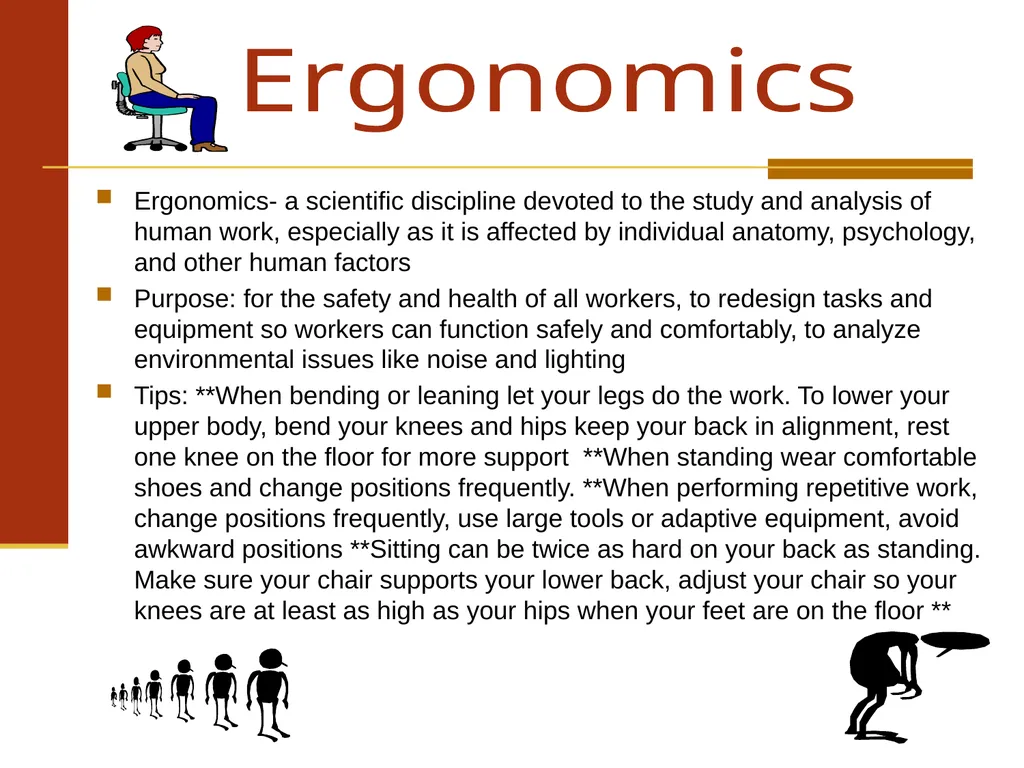
Ergonomics- a scientific discipline devoted to the study and analysis of human work, especially as it is affected by individual anatomy, psychology, and other human factors
Purpose: for the safety and health of all workers, to redesign tasks and equipment so workers can function safely and comfortably, to analyze environmental issues like noise and lighting
Tips: **When bending or leaning let your legs do the work. To lower your upper body, bend your knees and hips keep your back in alignment, rest one knee on the floor for more support **When standing wear comfortable shoes and change positions frequently. **When performing repetitive work, change positions frequently, use large tools or adaptive equipment, avoid awkward positions **Sitting can be twice as hard on your back as standing. Make sure your chair supports your lower back, adjust your chair so your knees are at least as high as your hips when your feet are on the floor ** Ergonomics<br>
Purpose: for the safety and health of all workers, to redesign tasks and equipment so workers can function safely and comfortably, to analyze environmental issues like noise and lighting
Tips: **When bending or leaning let your legs do the work. To lower your upper body, bend your knees and hips keep your back in alignment, rest one knee on the floor for more support **When standing wear comfortable shoes and change positions frequently. **When performing repetitive work, change positions frequently, use large tools or adaptive equipment, avoid awkward positions **Sitting can be twice as hard on your back as standing. Make sure your chair supports your lower back, adjust your chair so your knees are at least as high as your hips when your feet are on the floor ** Ergonomics<br>
37
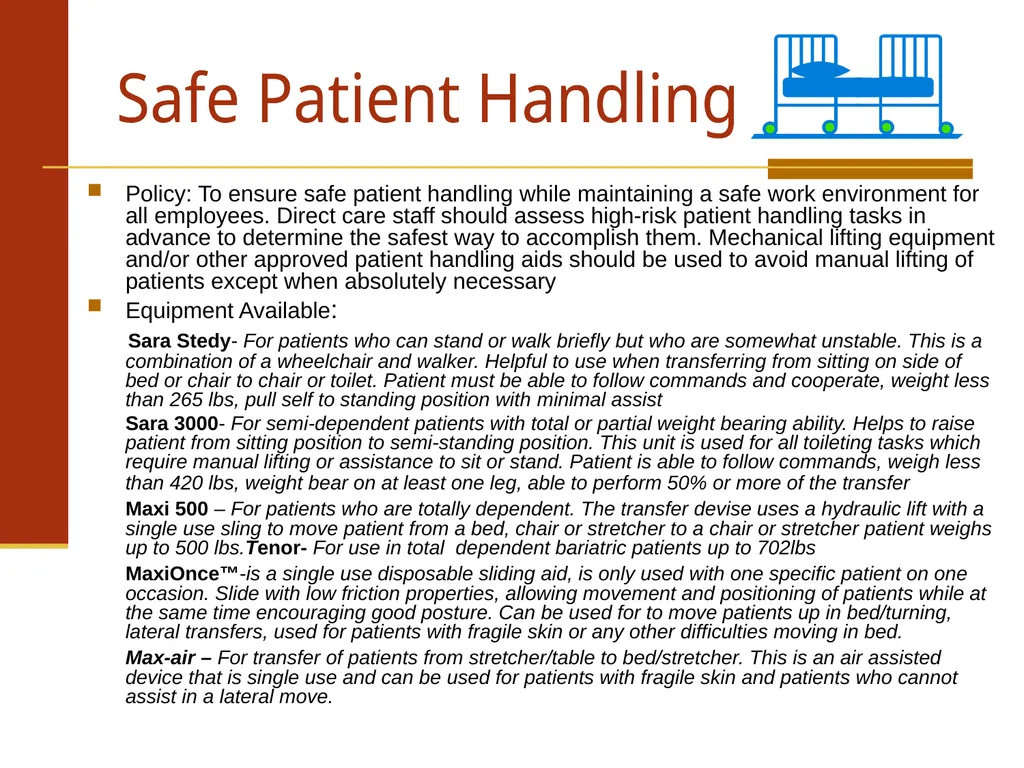
Policy: To ensure safe patient handling while maintaining a safe work environment for all employees. Direct care staff should assess high-risk patient handling tasks in advance to determine the safest way to accomplish them. Mechanical lifting equipment and/or other approved patient handling aids should be used to avoid manual lifting of patients except when absolutely necessary
Equipment Available:
Sara Stedy- For patients who can stand or walk briefly but who are somewhat unstable. This is a combination of a wheelchair and walker. Helpful to use when transferring from sitting on side of bed or chair to chair or toilet. Patient must be able to follow commands and cooperate, weight less than 265 lbs, pull self to standing position with minimal assist
Sara 3000- For semi-dependent patients with total or partial weight bearing ability. Helps to raise patient from sitting position to semi-standing position. This unit is used for all toileting tasks which require manual lifting or assistance to sit or stand. Patient is able to follow commands, weigh less than 420 lbs, weight bear on at least one leg, able to perform 50% or more of the transfer
Maxi 500 – For patients who are totally dependent. The transfer devise uses a hydraulic lift with a single use sling to move patient from a bed, chair or stretcher to a chair or stretcher patient weighs up to 500 lbs.Tenor- For use in total dependent bariatric patients up to 702lbs
MaxiOnce™-is a single use disposable sliding aid, is only used with one specific patient on one occasion. Slide with low friction properties, allowing movement and positioning of patients while at the same time encouraging good posture. Can be used for to move patients up in bed/turning, lateral transfers, used for patients with fragile skin or any other difficulties moving in bed.
Max-air – For transfer of patients from stretcher/table to bed/stretcher. This is an air assisted device that is single use and can be used for patients with fragile skin and patients who cannot assist in a lateral move. Safe Patient Handling<br>
Equipment Available:
Sara Stedy- For patients who can stand or walk briefly but who are somewhat unstable. This is a combination of a wheelchair and walker. Helpful to use when transferring from sitting on side of bed or chair to chair or toilet. Patient must be able to follow commands and cooperate, weight less than 265 lbs, pull self to standing position with minimal assist
Sara 3000- For semi-dependent patients with total or partial weight bearing ability. Helps to raise patient from sitting position to semi-standing position. This unit is used for all toileting tasks which require manual lifting or assistance to sit or stand. Patient is able to follow commands, weigh less than 420 lbs, weight bear on at least one leg, able to perform 50% or more of the transfer
Maxi 500 – For patients who are totally dependent. The transfer devise uses a hydraulic lift with a single use sling to move patient from a bed, chair or stretcher to a chair or stretcher patient weighs up to 500 lbs.Tenor- For use in total dependent bariatric patients up to 702lbs
MaxiOnce™-is a single use disposable sliding aid, is only used with one specific patient on one occasion. Slide with low friction properties, allowing movement and positioning of patients while at the same time encouraging good posture. Can be used for to move patients up in bed/turning, lateral transfers, used for patients with fragile skin or any other difficulties moving in bed.
Max-air – For transfer of patients from stretcher/table to bed/stretcher. This is an air assisted device that is single use and can be used for patients with fragile skin and patients who cannot assist in a lateral move. Safe Patient Handling<br>
38
Tuberculosis Information and Precautions Tuberculosis is a communicable disease caused by the mycobacterium tuberculosis. It is spread through airborne routes when a person who has TB disease coughs, sneezes or talks, releasing droplets of bacteria into the air. It is NOT transmitted by inanimate objects.
TB Infection means that you have been exposed to the bacteria and that your immune system has started to fight the disease (by producing TB antibodies) without making you sick
TB Disease means that your body could not fight the bacteria, and it has spread to the lungs or other parts of the body causing damage. If this infection is not treated with medicine you can become very sick.
Precautions to prevent TB disease: complete annual screening for TB symptoms, follow infection control standards, after being respiratory fit tested, use an OSHA approved N-95 particulate respirator when entering an infected patients room, use negative pressure in all isolated rooms in which TB patient will be kept, keep patient room doors closed at all times, transport patient with surgical mask placed over mouth and nose
If a patient is suspected of having TB disease: notify infection control, begin the TB Infection Control Protocol as stated in the Infection Control Manual. Patient is placed on airborne precautions in a negative pressure isolation room. ALL staff who enter the room MUST wear an N-95 particulate respirator mask per hospital policy.<br>
TB Infection means that you have been exposed to the bacteria and that your immune system has started to fight the disease (by producing TB antibodies) without making you sick
TB Disease means that your body could not fight the bacteria, and it has spread to the lungs or other parts of the body causing damage. If this infection is not treated with medicine you can become very sick.
Precautions to prevent TB disease: complete annual screening for TB symptoms, follow infection control standards, after being respiratory fit tested, use an OSHA approved N-95 particulate respirator when entering an infected patients room, use negative pressure in all isolated rooms in which TB patient will be kept, keep patient room doors closed at all times, transport patient with surgical mask placed over mouth and nose
If a patient is suspected of having TB disease: notify infection control, begin the TB Infection Control Protocol as stated in the Infection Control Manual. Patient is placed on airborne precautions in a negative pressure isolation room. ALL staff who enter the room MUST wear an N-95 particulate respirator mask per hospital policy.<br>
39
New guidelines suggest a QUANTEFERON GOLD blood test in place of a yearly PPD measurement. This is a test eliminating the need for two PPD results. These results must be obtained within 10 weeks of hire if a new employee and results are available as quickly as < 24 hours. IF YOU HAVE BEEN exposed to a patient with TB a Q Gold blood test should be performed and confirmed along with receiving a medical evaluation and follow up per the hospital policy and procedure.
Many healthy adults who have negative QFT-G results are unlikely to have M. tuberculosis infection and do not require further evaluation. However, for persons with recent contact with persons who have infectious TB, negative QFT-G results should be confirmed with a repeat test performed 8--10 weeks after the end of exposure, as is recommended for a negative TST result. Studies to determine the best time to retest contacts with negative QFT-G results have not been reported. Until more information is available, the timing of QFT-G testing should be the same as that used for the TST (CDC, 2005).
If you have previously tested positive, you are exempt from a skin test. However, you should complete a symptoms screening and have a baseline chest x-ray. In the absence of any symptoms and/or abnormal findings on x-ray, you will not need additional x-rays.
Signs and symptoms of TB disease: chronic cough, fever, night sweats, loss of weight, exhaustion and weakness, loss of appetite, blood in sputum More about TB<br>
Many healthy adults who have negative QFT-G results are unlikely to have M. tuberculosis infection and do not require further evaluation. However, for persons with recent contact with persons who have infectious TB, negative QFT-G results should be confirmed with a repeat test performed 8--10 weeks after the end of exposure, as is recommended for a negative TST result. Studies to determine the best time to retest contacts with negative QFT-G results have not been reported. Until more information is available, the timing of QFT-G testing should be the same as that used for the TST (CDC, 2005).
If you have previously tested positive, you are exempt from a skin test. However, you should complete a symptoms screening and have a baseline chest x-ray. In the absence of any symptoms and/or abnormal findings on x-ray, you will not need additional x-rays.
Signs and symptoms of TB disease: chronic cough, fever, night sweats, loss of weight, exhaustion and weakness, loss of appetite, blood in sputum More about TB<br>
40
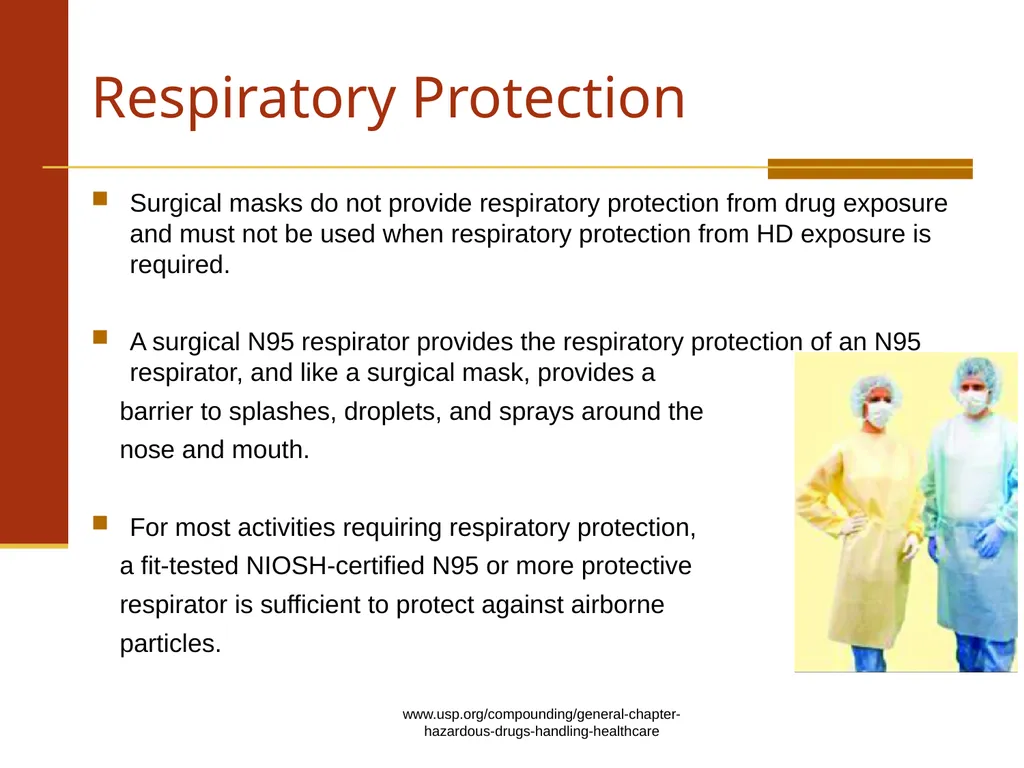
Respiratory Protection Surgical masks do not provide respiratory protection from drug exposure and must not be used when respiratory protection from HD exposure is required.
A surgical N95 respirator provides the respiratory protection of an N95 respirator, and like a surgical mask, provides a
barrier to splashes, droplets, and sprays around the
nose and mouth.
For most activities requiring respiratory protection,
a fit-tested NIOSH-certified N95 or more protective
respirator is sufficient to protect against airborne
particles. www.usp.org/compounding/general-chapter-hazardous-drugs-handling-healthcare<br>
A surgical N95 respirator provides the respiratory protection of an N95 respirator, and like a surgical mask, provides a
barrier to splashes, droplets, and sprays around the
nose and mouth.
For most activities requiring respiratory protection,
a fit-tested NIOSH-certified N95 or more protective
respirator is sufficient to protect against airborne
particles. www.usp.org/compounding/general-chapter-hazardous-drugs-handling-healthcare<br>
41
The Occupational Health and Safety Administration (OSHA) requires that employer’s protect employees from exposure and contamination from the blood and body fluids of another person. This is set forth in the hospital’s Exposure Control that can be found in the Infection Control Manual
Universal Standard Precautions: All patients are treated as though they may be infected. Standard precautions must be used every time you anticipate contact with blood, all body fluids, secretions and excretions, non-intact skin and mucus membranes. The standard precautions apply to ALL health care workers, whether they give direct patient care, or work in support areas like maintenance or housekeeping.
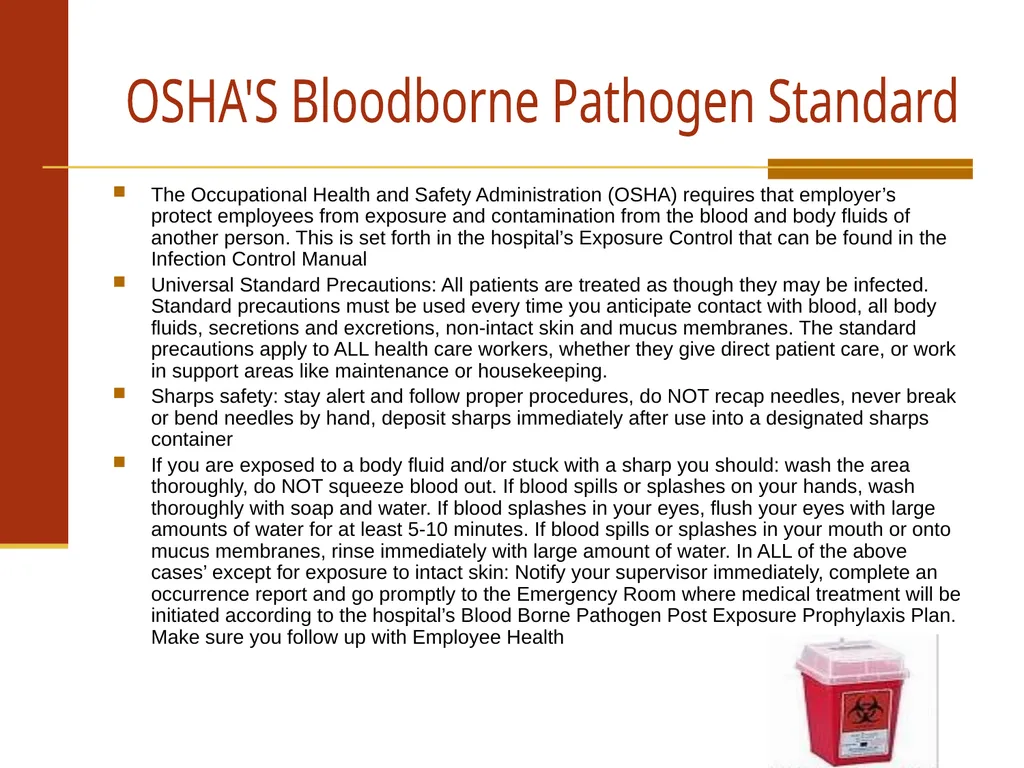
Sharps safety: stay alert and follow proper procedures, do NOT recap needles, never break or bend needles by hand, deposit sharps immediately after use into a designated sharps container
If you are exposed to a body fluid and/or stuck with a sharp you should: wash the area thoroughly, do NOT squeeze blood out. If blood spills or splashes on your hands, wash thoroughly with soap and water. If blood splashes in your eyes, flush your eyes with large amounts of water for at least 5-10 minutes. If blood spills or splashes in your mouth or onto mucus membranes, rinse immediately with large amount of water. In ALL of the above cases’ except for exposure to intact skin: Notify your supervisor immediately, complete an occurrence report and go promptly to the Emergency Room where medical treatment will be initiated according to the hospital’s Blood Borne Pathogen Post Exposure Prophylaxis Plan. Make sure you follow up with Employee Health OSHA'S Bloodborne Pathogen Standard<br>
Universal Standard Precautions: All patients are treated as though they may be infected. Standard precautions must be used every time you anticipate contact with blood, all body fluids, secretions and excretions, non-intact skin and mucus membranes. The standard precautions apply to ALL health care workers, whether they give direct patient care, or work in support areas like maintenance or housekeeping.
Sharps safety: stay alert and follow proper procedures, do NOT recap needles, never break or bend needles by hand, deposit sharps immediately after use into a designated sharps container
If you are exposed to a body fluid and/or stuck with a sharp you should: wash the area thoroughly, do NOT squeeze blood out. If blood spills or splashes on your hands, wash thoroughly with soap and water. If blood splashes in your eyes, flush your eyes with large amounts of water for at least 5-10 minutes. If blood spills or splashes in your mouth or onto mucus membranes, rinse immediately with large amount of water. In ALL of the above cases’ except for exposure to intact skin: Notify your supervisor immediately, complete an occurrence report and go promptly to the Emergency Room where medical treatment will be initiated according to the hospital’s Blood Borne Pathogen Post Exposure Prophylaxis Plan. Make sure you follow up with Employee Health OSHA'S Bloodborne Pathogen Standard<br>
42
Personal Protective Equipment or PPE includes gloves, fluid resistant gowns or aprons, face shields, protective eyewear and masks. PPE protects you from infectious hazards when worn properly. PPE must be appropriate for the task you are doing. You should wear as much or as little PPE needed to keep blood or potentially infectious materials from getting on your clothing, skin or mucus membranes. Before you put on PPE, make sure it is in good condition. Don’t wear anything that is damaged. After, remove PPE to avoid contaminating yourself. Place in designated area, follow with good handwashing
Hepatitis B is a disease which causes inflammation of the liver and is the most infectious form of Hepatitis. It is transmitted person to person by blood and body fluid exposure through a needle stick, human bites or sexual intercourse. It can take 2-6 months for persons infected with Hepatitis B to develop symptoms. There is no cure, but a vaccine is available that can prevent infection and is recommended. If you would like to receive this vaccine or would like more information, please contact Employee Health
Hepatitis C also causes inflammation of the liver. It is transmitted from one person to another by contact with contaminated blood and blood products, through sexual intercourse and perinatal transmission from mother to infant. It can take up to 6 months for symptoms to develop, although symptoms most often occur within 6-7 weeks. There is no vaccine for Hepatitis C
HIV and Aids: attacks and destroys the human immune system, which prevents the body from fighting off disease and infection. The person with HIV may eventually develop AIDS. Some people carry HIV and have no symptoms. Others don’t develop AIDS until years after they’ve been infected. Unfortunately, there is no cure Blood Borne Pathogen Standard<br>
Hepatitis B is a disease which causes inflammation of the liver and is the most infectious form of Hepatitis. It is transmitted person to person by blood and body fluid exposure through a needle stick, human bites or sexual intercourse. It can take 2-6 months for persons infected with Hepatitis B to develop symptoms. There is no cure, but a vaccine is available that can prevent infection and is recommended. If you would like to receive this vaccine or would like more information, please contact Employee Health
Hepatitis C also causes inflammation of the liver. It is transmitted from one person to another by contact with contaminated blood and blood products, through sexual intercourse and perinatal transmission from mother to infant. It can take up to 6 months for symptoms to develop, although symptoms most often occur within 6-7 weeks. There is no vaccine for Hepatitis C
HIV and Aids: attacks and destroys the human immune system, which prevents the body from fighting off disease and infection. The person with HIV may eventually develop AIDS. Some people carry HIV and have no symptoms. Others don’t develop AIDS until years after they’ve been infected. Unfortunately, there is no cure Blood Borne Pathogen Standard<br>
43
PURPOSE: The hospital recognizes the importance of maintaining an environment of integrity, honesty and respect. Patients feel valued and employees enjoy a sense of importance, involvement and empowerment. An environment where ethical responsibility is of utmost importance, directly contributes to our continued success
YOUR RESPONSIBILITY: Doing the right thing, telling the truth and treating each other and our patients with compassion and respect. This is the value that lies at the heart of our approach to healthcare. Sometimes living up to these values is not always an easy task. You may find yourself faced with a situation where the course of action is unclear. Your supervisor or any member of the management team is always available for guidance. Employees are encouraged to review the Hospital’s policy relating to Employee Conduct and Code of Ethical Conduct. These policies describe the rules that all employees are responsible for abiding by.
: Ethical Conduct and Corporate Compliance<br>
YOUR RESPONSIBILITY: Doing the right thing, telling the truth and treating each other and our patients with compassion and respect. This is the value that lies at the heart of our approach to healthcare. Sometimes living up to these values is not always an easy task. You may find yourself faced with a situation where the course of action is unclear. Your supervisor or any member of the management team is always available for guidance. Employees are encouraged to review the Hospital’s policy relating to Employee Conduct and Code of Ethical Conduct. These policies describe the rules that all employees are responsible for abiding by.
: Ethical Conduct and Corporate Compliance<br>
44
These duties and standards include but are not limited to:
a) Following the applicable laws, rules, regulations and standards of ethical conduct and reporting violations you become aware of to the management or through the corporate compliance hotline.
b) Conduct yourself in accordance with the generally accepted principles of professional ethics that are applicable to your position and responsibilities.
c) Refrain from disclosing or revealing in anyway confidential or proprietary or confidential information that you have obtained during your employment or affiliation with the Hospital.
d) Exercise good faith in all transactions relating to the Hospital and it’s property. You shall not use your position or knowledge gained in anyway that may create a conflict of interest between your interest and those of the Hospital.
e) To compile information from, or enter information into a patient’s medical record or Hospital business record in an accurate and timely manner and to keep all such information confidential
f) To keep records for goods or services for which a bill will be sent to a patient or a third party payer in an accurate manner and ensure the bill includes charges only for those goods and services actually rendered Ethical Conduct and Corporate Compliance: Duties and Standards<br>
a) Following the applicable laws, rules, regulations and standards of ethical conduct and reporting violations you become aware of to the management or through the corporate compliance hotline.
b) Conduct yourself in accordance with the generally accepted principles of professional ethics that are applicable to your position and responsibilities.
c) Refrain from disclosing or revealing in anyway confidential or proprietary or confidential information that you have obtained during your employment or affiliation with the Hospital.
d) Exercise good faith in all transactions relating to the Hospital and it’s property. You shall not use your position or knowledge gained in anyway that may create a conflict of interest between your interest and those of the Hospital.
e) To compile information from, or enter information into a patient’s medical record or Hospital business record in an accurate and timely manner and to keep all such information confidential
f) To keep records for goods or services for which a bill will be sent to a patient or a third party payer in an accurate manner and ensure the bill includes charges only for those goods and services actually rendered Ethical Conduct and Corporate Compliance: Duties and Standards<br>
45
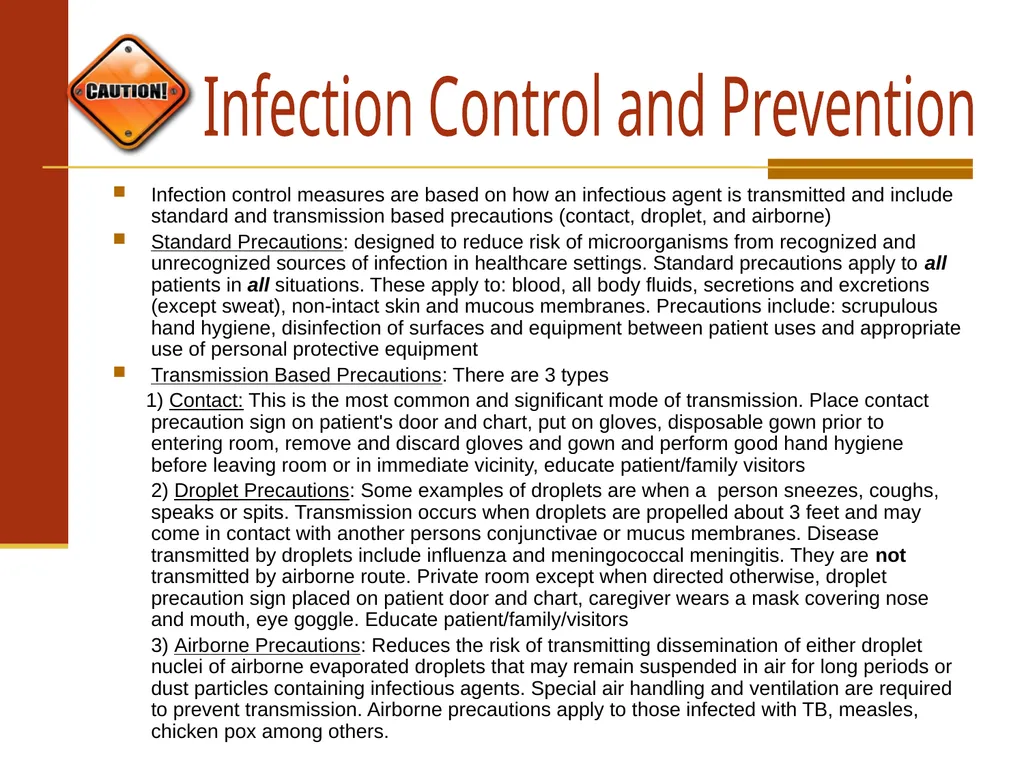
Infection control measures are based on how an infectious agent is transmitted and include standard and transmission based precautions (contact, droplet, and airborne)
Standard Precautions: designed to reduce risk of microorganisms from recognized and unrecognized sources of infection in healthcare settings. Standard precautions apply to all patients in all situations. These apply to: blood, all body fluids, secretions and excretions (except sweat), non-intact skin and mucous membranes. Precautions include: scrupulous hand hygiene, disinfection of surfaces and equipment between patient uses and appropriate use of personal protective equipment
Transmission Based Precautions: There are 3 types
1) Contact: This is the most common and significant mode of transmission. Place contact precaution sign on patient's door and chart, put on gloves, disposable gown prior to entering room, remove and discard gloves and gown and perform good hand hygiene before leaving room or in immediate vicinity, educate patient/family visitors
2) Droplet Precautions: Some examples of droplets are when a person sneezes, coughs, speaks or spits. Transmission occurs when droplets are propelled about 3 feet and may come in contact with another persons conjunctivae or mucus membranes. Disease transmitted by droplets include influenza and meningococcal meningitis. They are not transmitted by airborne route. Private room except when directed otherwise, droplet precaution sign placed on patient door and chart, caregiver wears a mask covering nose and mouth, eye goggle. Educate patient/family/visitors
3) Airborne Precautions: Reduces the risk of transmitting dissemination of either droplet nuclei of airborne evaporated droplets that may remain suspended in air for long periods or dust particles containing infectious agents. Special air handling and ventilation are required to prevent transmission. Airborne precautions apply to those infected with TB, measles, chicken pox among others. Infection Control and Prevention<br>
Standard Precautions: designed to reduce risk of microorganisms from recognized and unrecognized sources of infection in healthcare settings. Standard precautions apply to all patients in all situations. These apply to: blood, all body fluids, secretions and excretions (except sweat), non-intact skin and mucous membranes. Precautions include: scrupulous hand hygiene, disinfection of surfaces and equipment between patient uses and appropriate use of personal protective equipment
Transmission Based Precautions: There are 3 types
1) Contact: This is the most common and significant mode of transmission. Place contact precaution sign on patient's door and chart, put on gloves, disposable gown prior to entering room, remove and discard gloves and gown and perform good hand hygiene before leaving room or in immediate vicinity, educate patient/family visitors
2) Droplet Precautions: Some examples of droplets are when a person sneezes, coughs, speaks or spits. Transmission occurs when droplets are propelled about 3 feet and may come in contact with another persons conjunctivae or mucus membranes. Disease transmitted by droplets include influenza and meningococcal meningitis. They are not transmitted by airborne route. Private room except when directed otherwise, droplet precaution sign placed on patient door and chart, caregiver wears a mask covering nose and mouth, eye goggle. Educate patient/family/visitors
3) Airborne Precautions: Reduces the risk of transmitting dissemination of either droplet nuclei of airborne evaporated droplets that may remain suspended in air for long periods or dust particles containing infectious agents. Special air handling and ventilation are required to prevent transmission. Airborne precautions apply to those infected with TB, measles, chicken pox among others. Infection Control and Prevention<br>
46
Hand washing is the single most important procedure for preventing infections .
Hand hygiene includes several actions :
a) When hands are visibly dirty or contaminated with proteinaceous material or are visibly soiled with blood or other body fluids, wash hands with either non-antimicrobial soap and water or antimicrobial soap and water
b) If hands are not visibly soiled, use an alcohol based hand rub for routinely decontaminating hands except if in contact with a patient who has Clostridium Difficile (C. Diff)
Techniques for:
*Hand Washing- Use soap and water to wash hands, wash for 15-20 seconds, rinse and dry with paper towels
*Alcohol based sanitizer- apply alcohol based foam or gel to hands, rub all hand surfaces together until dry
Perform hand hygiene before and after: patient care, gloving, handling patient equipment.
Perform hand hygiene prior to: entering a patient’s room, eating
Perform hand hygiene after: leaving a patient’s room
blowing nose or coughing, toileting. Infection Control and Hand Washing<br>
Hand hygiene includes several actions :
a) When hands are visibly dirty or contaminated with proteinaceous material or are visibly soiled with blood or other body fluids, wash hands with either non-antimicrobial soap and water or antimicrobial soap and water
b) If hands are not visibly soiled, use an alcohol based hand rub for routinely decontaminating hands except if in contact with a patient who has Clostridium Difficile (C. Diff)
Techniques for:
*Hand Washing- Use soap and water to wash hands, wash for 15-20 seconds, rinse and dry with paper towels
*Alcohol based sanitizer- apply alcohol based foam or gel to hands, rub all hand surfaces together until dry
Perform hand hygiene before and after: patient care, gloving, handling patient equipment.
Perform hand hygiene prior to: entering a patient’s room, eating
Perform hand hygiene after: leaving a patient’s room
blowing nose or coughing, toileting. Infection Control and Hand Washing<br>
47
Q: What is HIPPA?
A: HIPAA, or the Health Insurance Portability and Accountability Act is federal law which requires health insurers and providers to handle your health information with more care.
Compliance with the HIPAA regulations is the responsibility of the entire staff. This includes employees, medical staff, volunteers, residents, and students
You may not use or disclose Protected Health Information (PHI) except as permitted to do your job. PHI is any information relating to a persons health status, treatment or payment that could identify a patient. This includes written, oral and electronic information. some examples include: patient sign in sheet, codes that document a procedure or test, OR schedule, conversation with co-worker over lunch about patients health status
Under HIPAA, patients have the following rights: *To request that the Hospital limits its use and disclosure of their PHI *To receive communications by alternate means (i.e. e-mail, fax) or to alternative locations * To access their PHI * To request amendments to their PHI * To receive an accounting of certain disclosures of their PHI
Steps You Must take to Protect the Security of Patient Information: * Manage your password * Protect your work area * Beware of viruses and other harmful software * Follow hospital policy regarding removal and installation of hardware and software
* Never discuss our patients (even w/o using name) on social Media HIPAA<br>
A: HIPAA, or the Health Insurance Portability and Accountability Act is federal law which requires health insurers and providers to handle your health information with more care.
Compliance with the HIPAA regulations is the responsibility of the entire staff. This includes employees, medical staff, volunteers, residents, and students
You may not use or disclose Protected Health Information (PHI) except as permitted to do your job. PHI is any information relating to a persons health status, treatment or payment that could identify a patient. This includes written, oral and electronic information. some examples include: patient sign in sheet, codes that document a procedure or test, OR schedule, conversation with co-worker over lunch about patients health status
Under HIPAA, patients have the following rights: *To request that the Hospital limits its use and disclosure of their PHI *To receive communications by alternate means (i.e. e-mail, fax) or to alternative locations * To access their PHI * To request amendments to their PHI * To receive an accounting of certain disclosures of their PHI
Steps You Must take to Protect the Security of Patient Information: * Manage your password * Protect your work area * Beware of viruses and other harmful software * Follow hospital policy regarding removal and installation of hardware and software
* Never discuss our patients (even w/o using name) on social Media HIPAA<br>
48
How HIPAA affects your relationship with the hospital:
If you are an employee, student or volunteer, you are part of the hospital workforce. You must comply with the Hospital’s HIPAA compliance program; failure to comply will result in disciplinary action, or could trigger individual liability with penalties
Internal sanctions: the hospital is required to have policies regarding disciplinary actions which may be taken if an employee fails to comply with these HIPAA policies. They may include written censure, suspension or termination
Federal Sanctions: violations may result in the Hospital and the employee being subject to civil monetary penalties and criminal actions
Civil Fines: of no more than $50,000 per violation with a maximum of $1.5 million in each calendar year
Enforcer: Office of Civil Rights
HIPAA Hot Spots :
Media- *may not contact patients directly *employees should never speak directly to the media without express permission of Community Relations/Development Department
Faxing- make sure to take the following steps: fax cover sheet must indicate the “confidential” wording from the HIPAA faxing policy and procedure, wording must be in big, bold type
Public Conversations- Avoid holding conversations about PHI in public areas
E-mail- must have certain safeguards: unless you have authorization and the data is encrypted, you must NEVER send patient information over the internet
If you have further questions or would like to see the whole policy contact: HIPAA Privacy/Security Officer at 631-726-0390 HIPAA<br>
If you are an employee, student or volunteer, you are part of the hospital workforce. You must comply with the Hospital’s HIPAA compliance program; failure to comply will result in disciplinary action, or could trigger individual liability with penalties
Internal sanctions: the hospital is required to have policies regarding disciplinary actions which may be taken if an employee fails to comply with these HIPAA policies. They may include written censure, suspension or termination
Federal Sanctions: violations may result in the Hospital and the employee being subject to civil monetary penalties and criminal actions
Civil Fines: of no more than $50,000 per violation with a maximum of $1.5 million in each calendar year
Enforcer: Office of Civil Rights
HIPAA Hot Spots :
Media- *may not contact patients directly *employees should never speak directly to the media without express permission of Community Relations/Development Department
Faxing- make sure to take the following steps: fax cover sheet must indicate the “confidential” wording from the HIPAA faxing policy and procedure, wording must be in big, bold type
Public Conversations- Avoid holding conversations about PHI in public areas
E-mail- must have certain safeguards: unless you have authorization and the data is encrypted, you must NEVER send patient information over the internet
If you have further questions or would like to see the whole policy contact: HIPAA Privacy/Security Officer at 631-726-0390 HIPAA<br>
49
What Is USP and USP <800>? The United States Pharmacopeia Convention (USP) is a nonprofit scientific organization founded in 1820 in Washington, D.C., that develops quality standards for medicines and other articles.
USP General Chapter <800> describes practice and quality standards for handling hazardous drugs (HDs) to promote patient safety, worker safety, and environmental protection. Handling HDs includes, but is not limited to, the receipt, storage, compounding, dispensing, administration, and disposal of sterile and nonsterile products and preparations.
This chapter applies to all healthcare personnel who handle HD preparations and all entities that store, prepare, transport, or administer HDs. https://www.usp.org/compounding/general-chapter-hazardous-drugs-handling-healthcare<br>
USP General Chapter <800> describes practice and quality standards for handling hazardous drugs (HDs) to promote patient safety, worker safety, and environmental protection. Handling HDs includes, but is not limited to, the receipt, storage, compounding, dispensing, administration, and disposal of sterile and nonsterile products and preparations.
This chapter applies to all healthcare personnel who handle HD preparations and all entities that store, prepare, transport, or administer HDs. https://www.usp.org/compounding/general-chapter-hazardous-drugs-handling-healthcare<br>
50
What is a Hazardous Drug (HD)? A hazardous drug is any drug identified as hazardous or potentially hazardous by the National Institute for Occupational Safety and Health (NIOSH) on the basis of at least one of the following six criteria:
Carcinogenicity –ability to cause cancer.
Teratogenicity or developmental toxicity- ability to cause defects in fetal development or malfunction.
Reproductive toxicity in humans- ability to cause fertility impairment and adverse reproductive outcomes in both women and men.
Organ toxicity at low doses in humans or animals
Genotoxicity – ability to cause a change or mutation in genetic material.
New drugs that mimic existing hazardous drugs in structure or toxicity.
NIOSH maintains a list of antineoplastic and other hazardous drugs used in healthcare settings.<br>
Carcinogenicity –ability to cause cancer.
Teratogenicity or developmental toxicity- ability to cause defects in fetal development or malfunction.
Reproductive toxicity in humans- ability to cause fertility impairment and adverse reproductive outcomes in both women and men.
Organ toxicity at low doses in humans or animals
Genotoxicity – ability to cause a change or mutation in genetic material.
New drugs that mimic existing hazardous drugs in structure or toxicity.
NIOSH maintains a list of antineoplastic and other hazardous drugs used in healthcare settings.<br>
51
NIOSH currently lists HD in three groups Group 1: Antineoplastic drugs Note that many of these drugs may also pose a reproductive risk for susceptible populations (Table 1).
Group 2: Non-antineoplastic drugs that meet one or more of the NIOSH criteria for a hazardous drug. Note that some of these drugs may also pose a reproductive risk for susceptible populations (Table 2).
Group 3: Drugs that primarily pose a reproductive risk to men and women who are actively trying to conceive and women who are pregnant or breast feeding, because some of these drugs may be present in breast milk (Table 3).<br>
Group 2: Non-antineoplastic drugs that meet one or more of the NIOSH criteria for a hazardous drug. Note that some of these drugs may also pose a reproductive risk for susceptible populations (Table 2).
Group 3: Drugs that primarily pose a reproductive risk to men and women who are actively trying to conceive and women who are pregnant or breast feeding, because some of these drugs may be present in breast milk (Table 3).<br>
52
Spills All personnel who are required to clean up a spill of Hazardous Drugs (HD) are trained.
Spills must be contained and cleaned immediately only by qualified personnel with appropriate PPE.
Signs must be available for restricting access to the spill area.
Spill kits contain all of the materials needed to clean HD spills and are readily available in all areas where HDs are routinely handled.<br>
Spills must be contained and cleaned immediately only by qualified personnel with appropriate PPE.
Signs must be available for restricting access to the spill area.
Spill kits contain all of the materials needed to clean HD spills and are readily available in all areas where HDs are routinely handled.<br>
53
What is a stroke? Symptoms and Response The sudden death of brain cells due to lack of oxygen, caused by a blockage of blood flow or rupture of an artery to the brain.
Sudden loss of speech, weakness, or paralysis on one side of the body, sudden confusion, sudden vision problems in one or both eyes, loss of balance, severe headache with no know cause.
At Stony Brook Southampton Hospital we call a Code BAT if we notice a patient/ visitor with signs and symptoms of a stroke.<br>
Sudden loss of speech, weakness, or paralysis on one side of the body, sudden confusion, sudden vision problems in one or both eyes, loss of balance, severe headache with no know cause.
At Stony Brook Southampton Hospital we call a Code BAT if we notice a patient/ visitor with signs and symptoms of a stroke.<br>
54
Stroke: Time is Brain In the ED or a Nursing unit when a code BAT is called:
10 minutes to be seen by a Physician
15 minutes to be seen by the stroke team
25 minutes to have a CT
45 minutes to have CT read
60 minutes if a thrombolytic is to be administered<br>
10 minutes to be seen by a Physician
15 minutes to be seen by the stroke team
25 minutes to have a CT
45 minutes to have CT read
60 minutes if a thrombolytic is to be administered<br>
55
What is Radiation? Radiation Safety Radiation is Energy
Two types
Non-Ionizing Radiation
Ionizing Radiation Ionizing radiation has enough energy to disassociate chemical bonds in molecules and remove tightly bound electrons from atoms, creating charged ions.
Ionization releases energy in the absorbing material
Ionizing radiation can be both electromagnetic and particle radiation<br>
Two types
Non-Ionizing Radiation
Ionizing Radiation Ionizing radiation has enough energy to disassociate chemical bonds in molecules and remove tightly bound electrons from atoms, creating charged ions.
Ionization releases energy in the absorbing material
Ionizing radiation can be both electromagnetic and particle radiation<br>
56
Radiation Exposure Sources Radiation Safety<br>
57
Radiation Safety Radiation Signs / Controlled Areas for Radiation Safety If you are not radiologically trained to routinely work in these areas, inquire with area supervision and /or Radiologic Technologists (RTs) in the area before entry . Controlled Areas for Radiation Safety
1st Floor: Radiology Department; OR Room 6
2nd Floor: Interventional Radiology Department
Portable X-Ray and Portable C-Arm systems
Offsite Locations:
Phillips Family Cancer Center (Therapy LINAC, CT)
East Hampton (X-ray, DEXA, Mammography)
Westhampton (X-ray, Ultrasound)
Hampton Bays (Atrium) (MRI, CT, x-ray, US, DEXA, Mammography)<br>
1st Floor: Radiology Department; OR Room 6
2nd Floor: Interventional Radiology Department
Portable X-Ray and Portable C-Arm systems
Offsite Locations:
Phillips Family Cancer Center (Therapy LINAC, CT)
East Hampton (X-ray, DEXA, Mammography)
Westhampton (X-ray, Ultrasound)
Hampton Bays (Atrium) (MRI, CT, x-ray, US, DEXA, Mammography)<br>
58
Regulatory Limits /Relative Exposure Risk /Radiation Protection Program Annual Regulatory Radiation Dose Limits
Whole Body: 5 rem
Extremities: 50 rem
Any single organ: 50 rem
Lens of the eye: 15 rem
Public:0.1 rem
Fetus: 0.5 rem per gestation period Radiation Safety Radiation Exposure Risk in Perspective
3 mrem exposure imposes the same risk of death (1 in a million) as each of the following common life experiences:
Spending 2 days in New York City (because of the air quality)
Riding 1 mile on a motorcycle or 300 miles in a car (because of the risk of collision).
Eating 40 tablespoons of peanut butter (because of aflatoxin) or 10 charbroiled steaks.
Smoking 1 cigarette
(USNRC web site -“Radiation and Its Health Effects”; https://www.nrc.gov/about-nrc/radiation/rad-health-effects.html) Regulators
Federal: F.D.A. and N.R.C.
State: N.Y.S. Dept. of Health
Local: Suffolk County Dept. of Health Hospital Radiation Safety Committee meets quarterly to administer the radiation protection program<br>
Whole Body: 5 rem
Extremities: 50 rem
Any single organ: 50 rem
Lens of the eye: 15 rem
Public:0.1 rem
Fetus: 0.5 rem per gestation period Radiation Safety Radiation Exposure Risk in Perspective
3 mrem exposure imposes the same risk of death (1 in a million) as each of the following common life experiences:
Spending 2 days in New York City (because of the air quality)
Riding 1 mile on a motorcycle or 300 miles in a car (because of the risk of collision).
Eating 40 tablespoons of peanut butter (because of aflatoxin) or 10 charbroiled steaks.
Smoking 1 cigarette
(USNRC web site -“Radiation and Its Health Effects”; https://www.nrc.gov/about-nrc/radiation/rad-health-effects.html) Regulators
Federal: F.D.A. and N.R.C.
State: N.Y.S. Dept. of Health
Local: Suffolk County Dept. of Health Hospital Radiation Safety Committee meets quarterly to administer the radiation protection program<br>
59
Biological Effects from Radiation Exposure Radiation Safety Skin effects
Hematopoietic effects
Gastrointestinal effects
Neurological effects
Effects on the fetus Early Effects
Immediate or prompt effects occur shortly after a large acute exposure that is delivered within hours to a few days. Early effects are not caused at the levels of radiation exposure allowed under occupational limits. Delayed Effects
Delayed effects may occur years after exposure and are caused indirectly when the radiation changes parts of the cells in the body, which causes the normal function of the cell to change, for example, when normal healthy cells turn into cancer cells. The potential for these delayed health effects is one of the main concerns addressed when setting limits on occupational doses. Increased risk of developing cancer
Damage to genetic material
Formation of cataracts
Damage to the skin<br>
Hematopoietic effects
Gastrointestinal effects
Neurological effects
Effects on the fetus Early Effects
Immediate or prompt effects occur shortly after a large acute exposure that is delivered within hours to a few days. Early effects are not caused at the levels of radiation exposure allowed under occupational limits. Delayed Effects
Delayed effects may occur years after exposure and are caused indirectly when the radiation changes parts of the cells in the body, which causes the normal function of the cell to change, for example, when normal healthy cells turn into cancer cells. The potential for these delayed health effects is one of the main concerns addressed when setting limits on occupational doses. Increased risk of developing cancer
Damage to genetic material
Formation of cataracts
Damage to the skin<br>
60
Personnel Monitoring / ALARA Radiation Safety ALARA
(As Low As Reasonably Achievable)
Minimize exposure - Minimize risk
Minimize time of exposure
Maximize distance to source
Use shielding (e.g. lead aprons) and other engineering controls
Smart work planning Your Radiation Safety Officer (RSO) is responsible for implementing ALARA. Contact your RSO if you think radiation safety practices in your area are not ALARA . (Jann Stavro 631-726-8138).<br>
(As Low As Reasonably Achievable)
Minimize exposure - Minimize risk
Minimize time of exposure
Maximize distance to source
Use shielding (e.g. lead aprons) and other engineering controls
Smart work planning Your Radiation Safety Officer (RSO) is responsible for implementing ALARA. Contact your RSO if you think radiation safety practices in your area are not ALARA . (Jann Stavro 631-726-8138).<br>
61
FLUOROSCOPY SAFETY AWARNESS Authorized Fluoroscopy Use
Fluoroscopic set up and operation can only be conducted by a licensed physician or a licensed radiologic technologist under the direction of a physician.
Fluoroscopic set up and operation by nursing staff is an activity out of the profession's scope of practice and is not permitted. Radiation Safety<br>
Fluoroscopic set up and operation can only be conducted by a licensed physician or a licensed radiologic technologist under the direction of a physician.
Fluoroscopic set up and operation by nursing staff is an activity out of the profession's scope of practice and is not permitted. Radiation Safety<br>
62
Magnet Always ON The magnet is always “on” and will pull all ferromagnetic objects in with great force.
How strong is a 3T MRI Scanner?
60,000 times the earth's magnet field
Strength greater than electromagnets used to pick up cars in junk yards (1.5-2.0T) MRI Safety …strong enough to pull fork-lift tines off of machinery, pull heavy-duty floor buffers and mop buckets into the bore of the magnet, pull stretchers across the room and turn oxygen bottles into flying projectiles reaching speeds in excess of 40 miles per hour!<br>
How strong is a 3T MRI Scanner?
60,000 times the earth's magnet field
Strength greater than electromagnets used to pick up cars in junk yards (1.5-2.0T) MRI Safety …strong enough to pull fork-lift tines off of machinery, pull heavy-duty floor buffers and mop buckets into the bore of the magnet, pull stretchers across the room and turn oxygen bottles into flying projectiles reaching speeds in excess of 40 miles per hour!<br>
63
MR Safety Zones MRI Safety All non-MR personnel & patients must be screened and escorted by MRI staff in ZONE III
Only screened persons authorized by a MR Technologist should ever enter the ZONE IV magnet room.<br>
Only screened persons authorized by a MR Technologist should ever enter the ZONE IV magnet room.<br>
64
CONTACTS Radiation Safety Radiation Safety Officer (RSO)
Jann Stavro
Cell: 631-905-5413
Office: 631-726-8947
email: Jann.Stavro@stonybrookmedicine.edu
Radiology Department
Main Number: 631-726-8411
Scheduling: 631-726-8285<br>
Jann Stavro
Cell: 631-905-5413
Office: 631-726-8947
email: Jann.Stavro@stonybrookmedicine.edu
Radiology Department
Main Number: 631-726-8411
Scheduling: 631-726-8285<br>
65
Effective 7/1/22, all Hospital Emergency, Security, and Clinical Codes are being standardized. Staff are responsible to learn and understand each code in order to prioritize patient safety and quality.<br>