
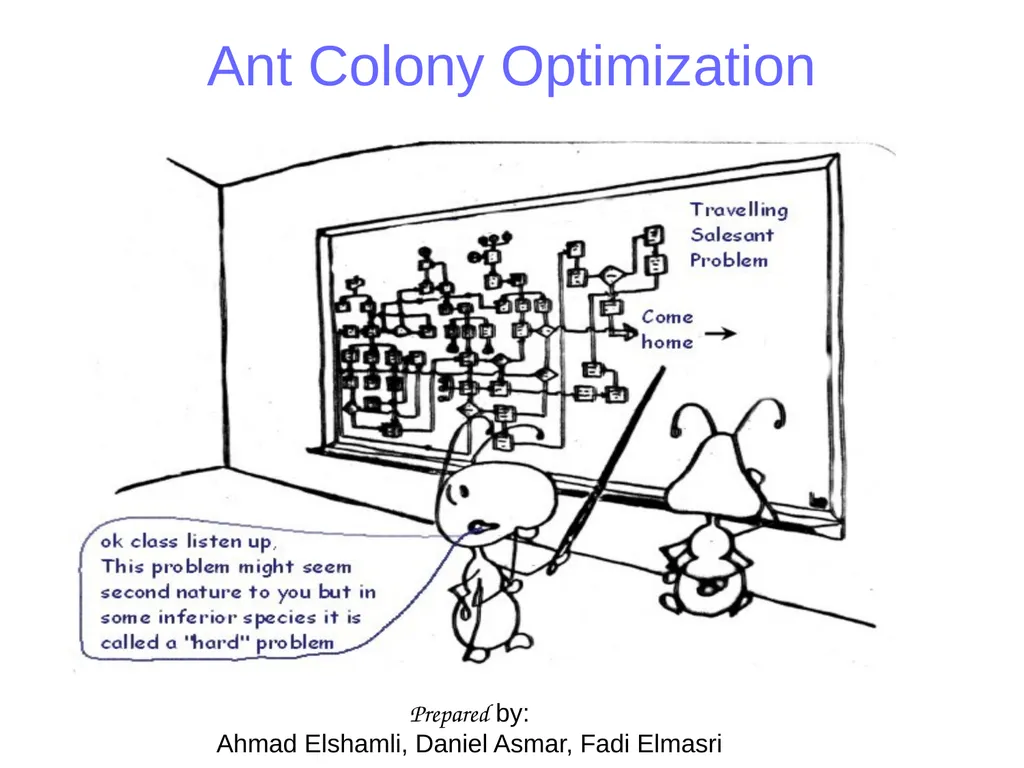
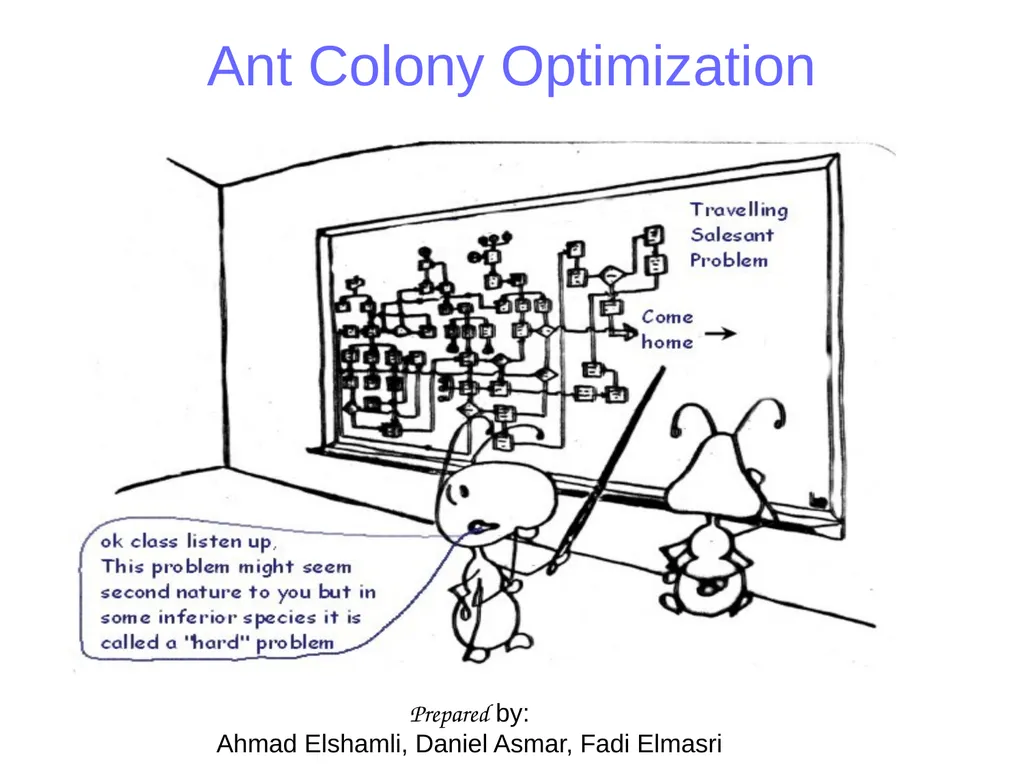
Ant Colony Optimization Prepared by: Ahmad
KB
Published · 50 slides · 0 views
1 / 1
Description
Ant Colony Optimization Prepared by: Ahmad Elshamli, Daniel Asmar, Fadi Elmasri Introduction (Swarm intelligence) Natural behavior of ants First Algorithm: Ant System Improvements to Ant System Applications Swarm intelligence Collective
Related Topics
Share
Embed code
Download this presentation From Below
"Ant Colony Optimization Prepared by: Ahmad" is the property of its rightful owner. Permission is granted to download and print the materials on this website for personal, non-commercial use only, and to display it on your personal computer provided you do not modify the materials and that you retain all copyright notices contained in the materials. By downloading content from our website, you accept the terms of this agreement.
Presentation Transcript
01
Ant Colony Optimization Prepared by:
Ahmad Elshamli, Daniel Asmar, Fadi Elmasri<br>
Ahmad Elshamli, Daniel Asmar, Fadi Elmasri<br>
02
Introduction (Swarm intelligence)
Natural behavior of ants
First Algorithm: Ant System
Improvements to Ant System
Applications<br>
Natural behavior of ants
First Algorithm: Ant System
Improvements to Ant System
Applications<br>
03
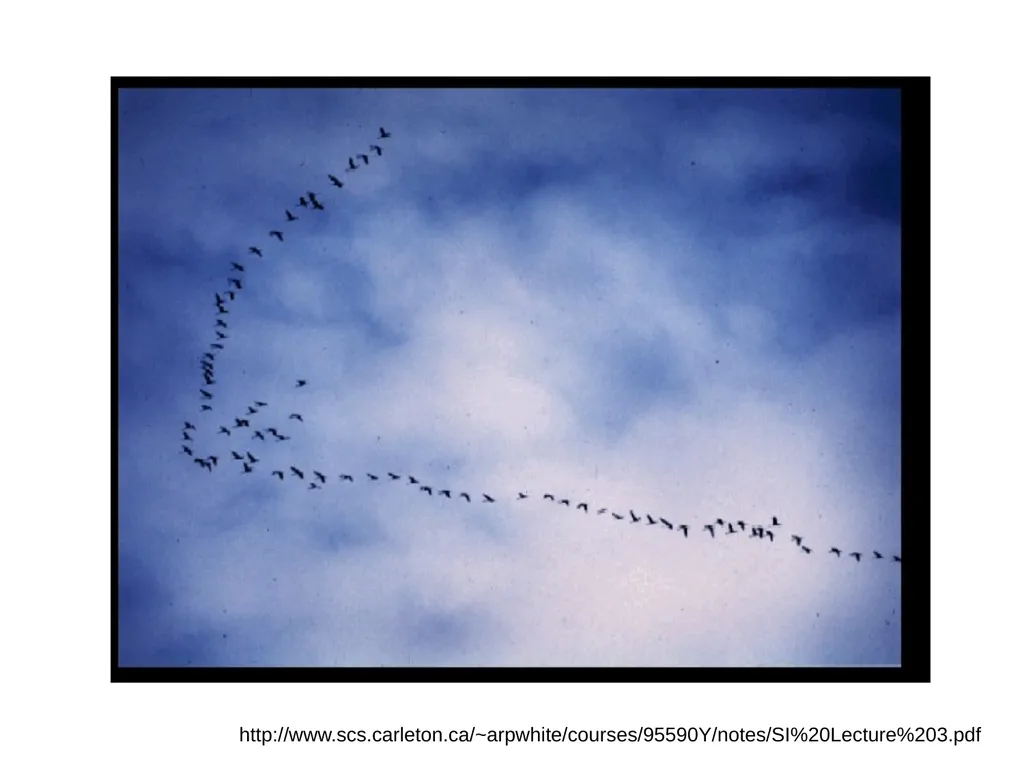
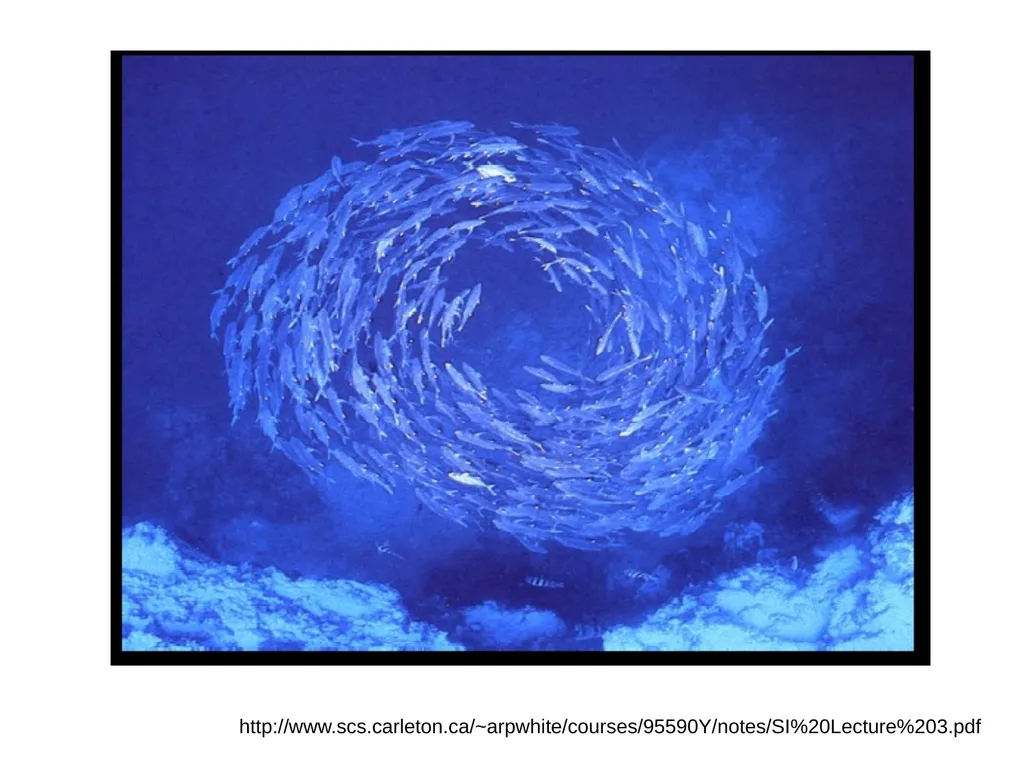
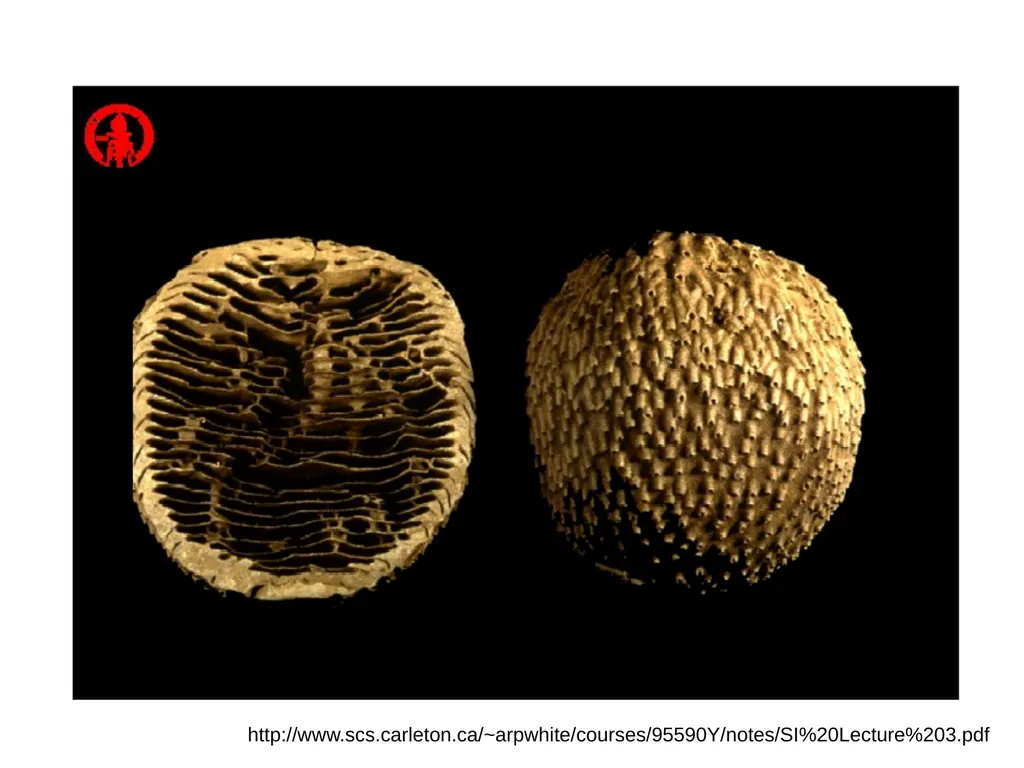
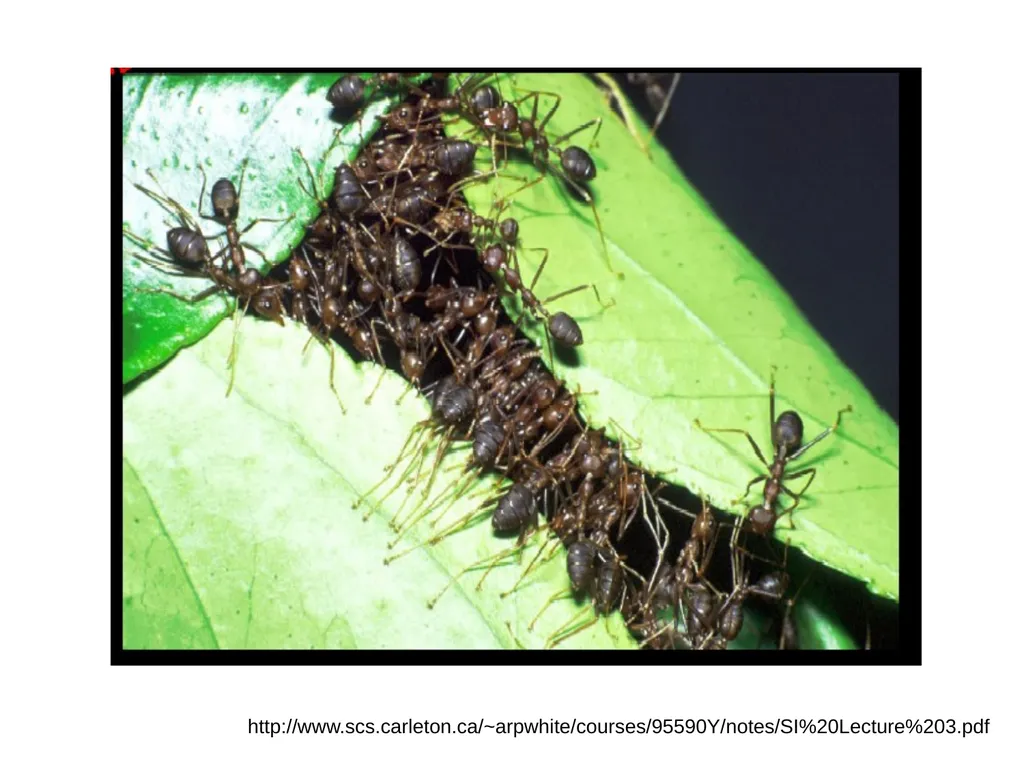
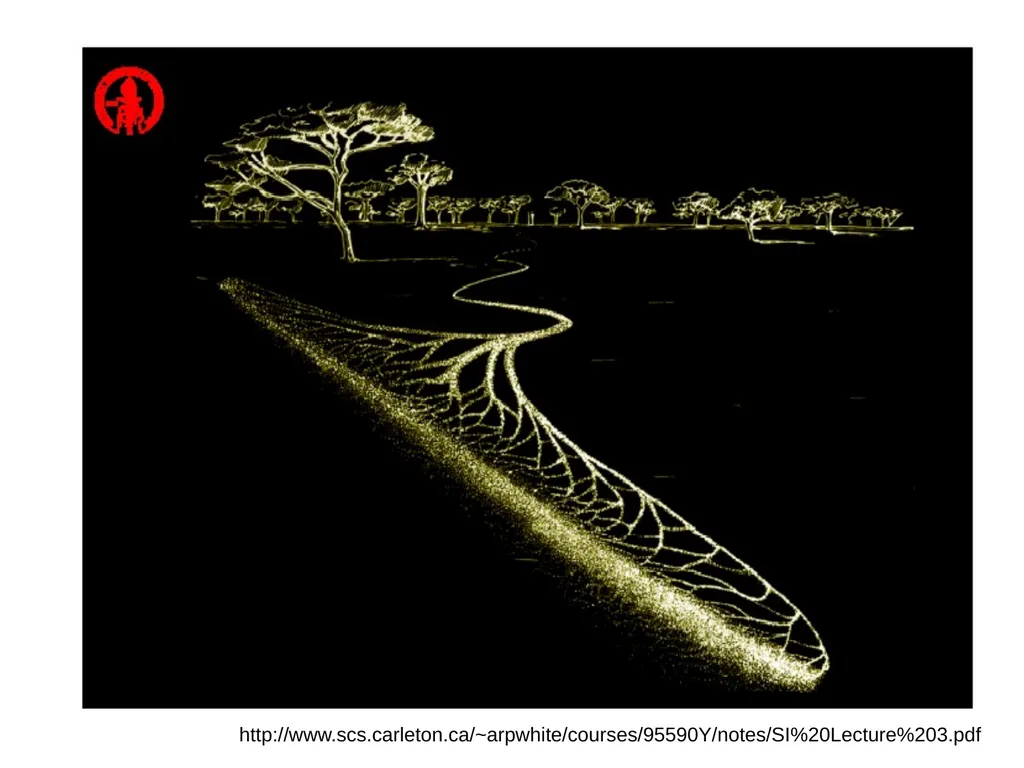
Swarm intelligence Collective system capable of accomplishing difficult tasks in dynamic and varied environments without any external guidance or control and with no central coordination
Achieving a collective performance which could not normally be achieved by an individual acting alone
Constituting a natural model particularly suited to distributed problem solving http://www.scs.carleton.ca/~arpwhite/courses/95590Y/notes/SI%20Lecture%203.pdf<br>
Achieving a collective performance which could not normally be achieved by an individual acting alone
Constituting a natural model particularly suited to distributed problem solving http://www.scs.carleton.ca/~arpwhite/courses/95590Y/notes/SI%20Lecture%203.pdf<br>
04
http://www.scs.carleton.ca/~arpwhite/courses/95590Y/notes/SI%20Lecture%203.pdf<br>
05
http://www.scs.carleton.ca/~arpwhite/courses/95590Y/notes/SI%20Lecture%203.pdf<br>
06
http://www.scs.carleton.ca/~arpwhite/courses/95590Y/notes/SI%20Lecture%203.pdf<br>
07
http://www.scs.carleton.ca/~arpwhite/courses/95590Y/notes/SI%20Lecture%203.pdf<br>
08
http://www.scs.carleton.ca/~arpwhite/courses/95590Y/notes/SI%20Lecture%203.pdf<br>
09
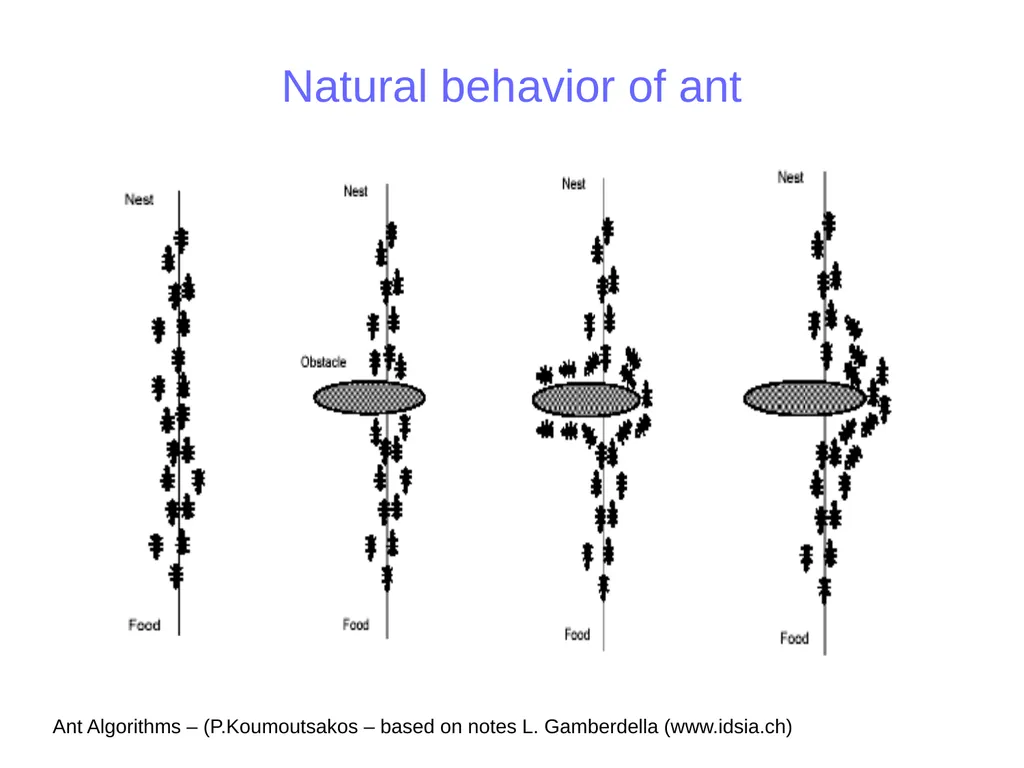
Natural behavior of ant Ant Algorithms – (P.Koumoutsakos – based on notes L. Gamberdella (www.idsia.ch)<br>
10
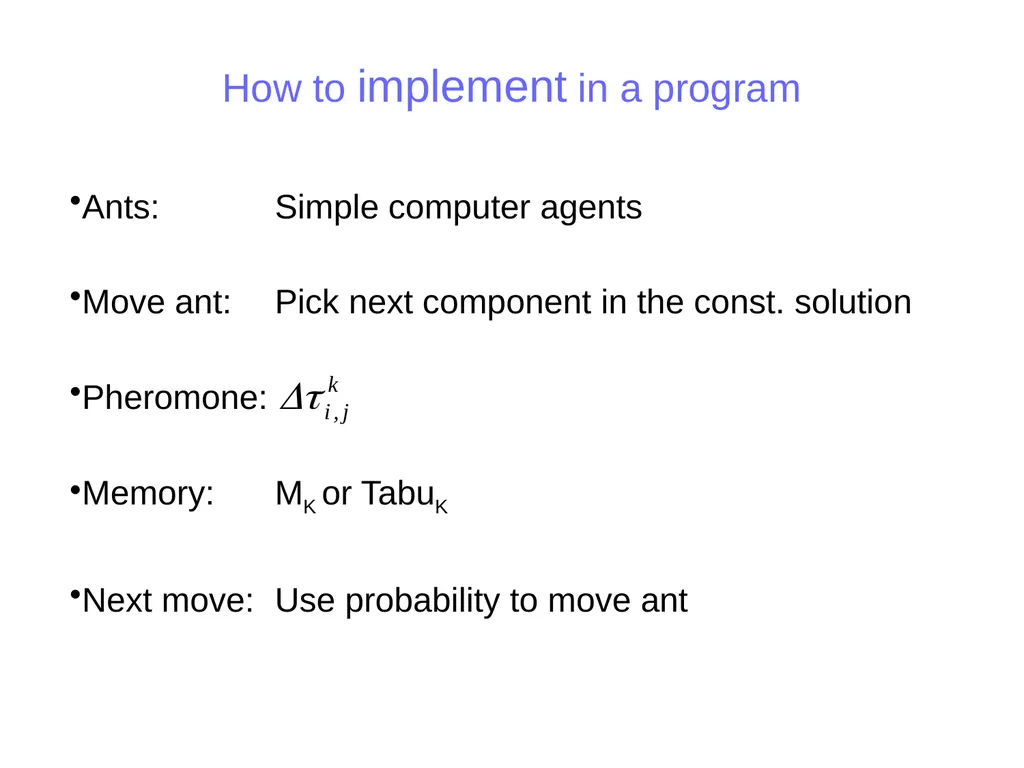
How to implement in a program Ants: Simple computer agents
Move ant: Pick next component in the const. solution
Pheromone:
Memory: MK or TabuK
Next move: Use probability to move ant<br>
Move ant: Pick next component in the const. solution
Pheromone:
Memory: MK or TabuK
Next move: Use probability to move ant<br>
11
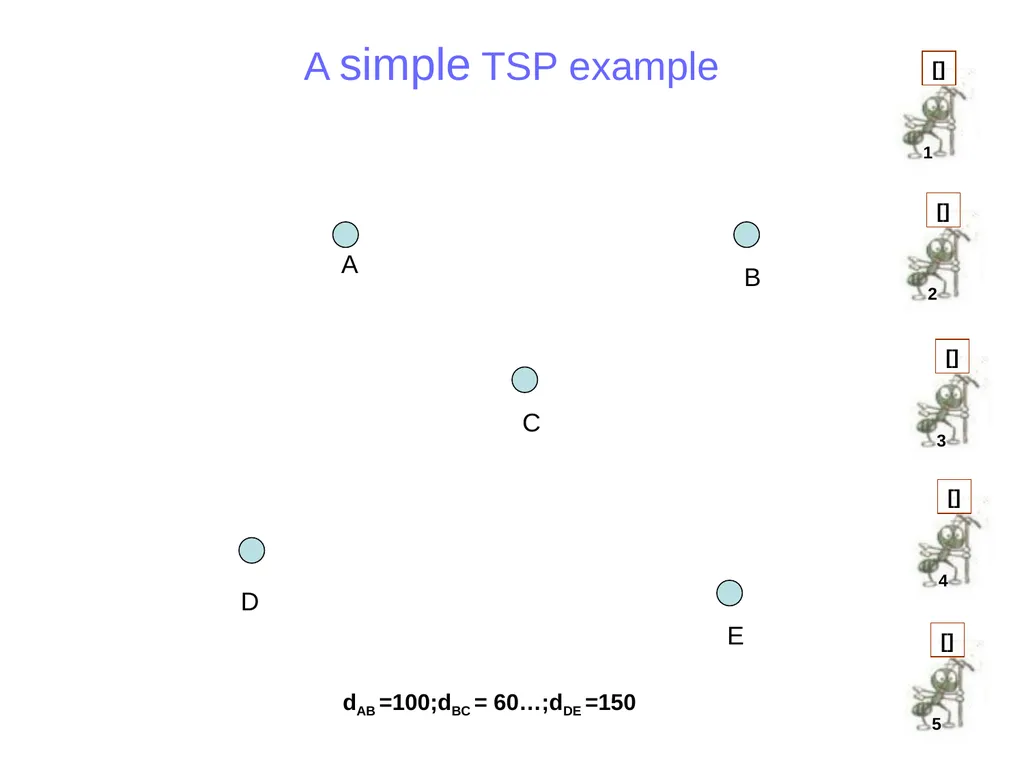
A simple TSP example A E D C B dAB =100;dBC = 60…;dDE =150<br>
12
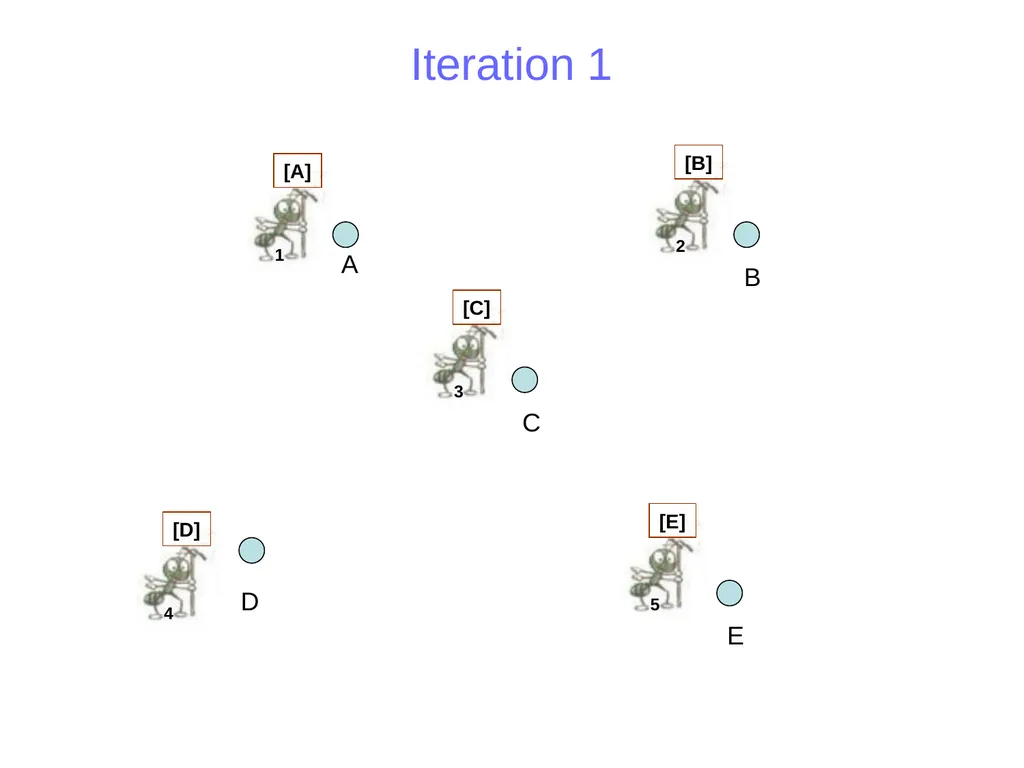
Iteration 1 A E D C B<br>
13
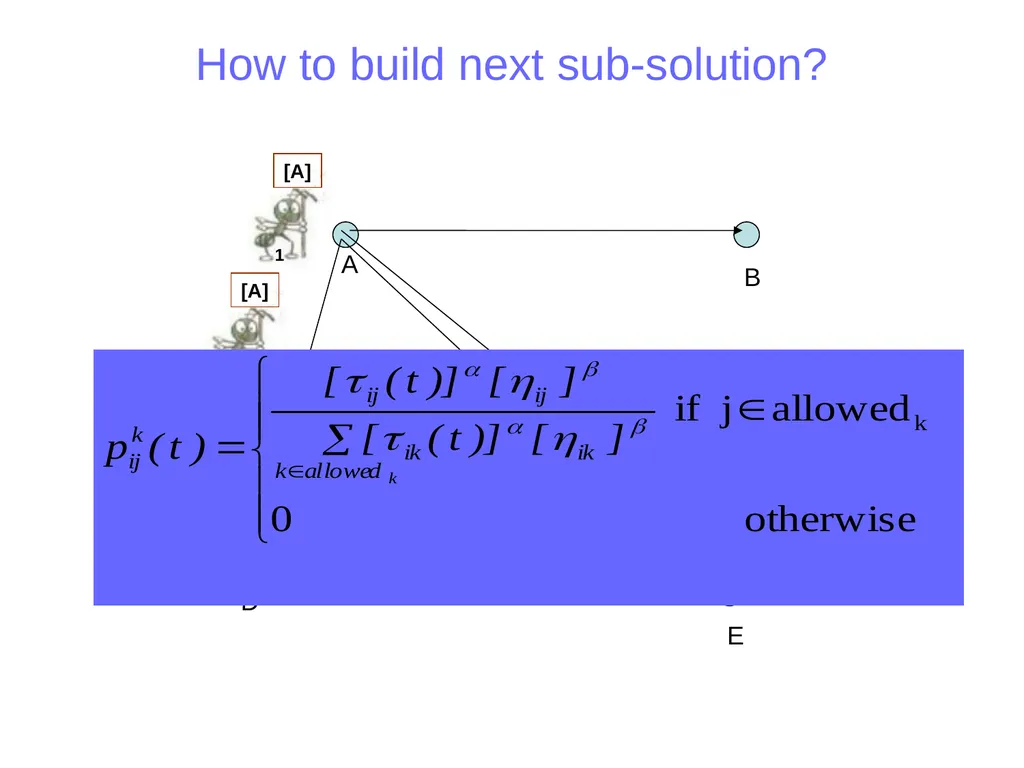
How to build next sub-solution? A E D C B<br>
14
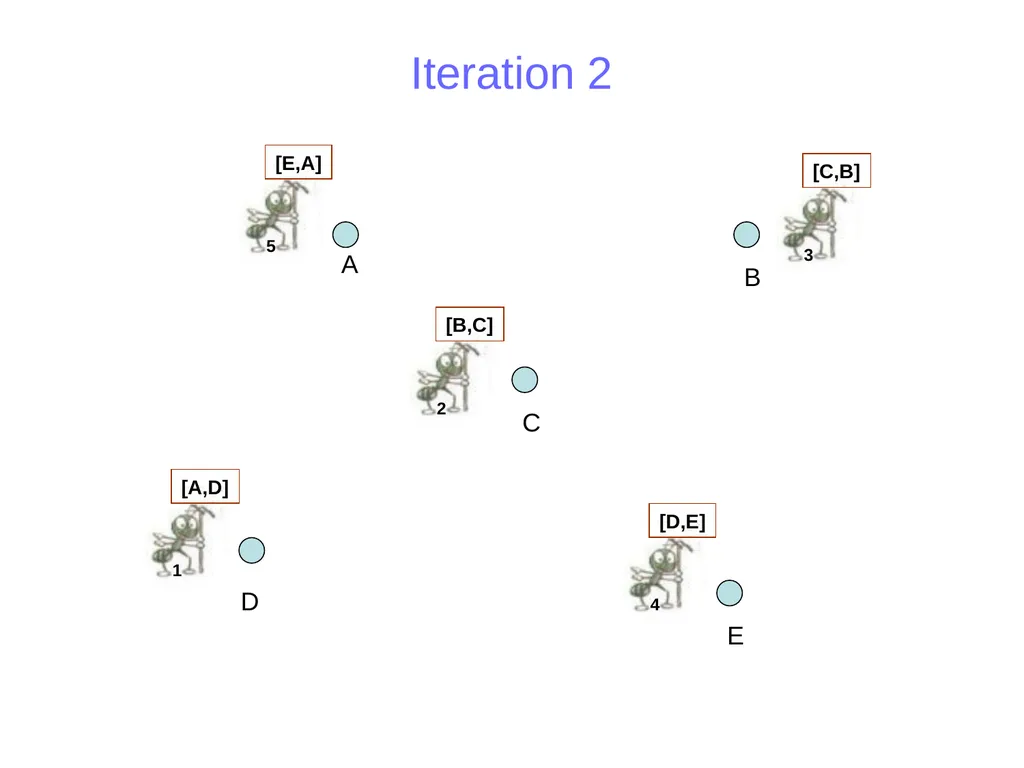
Iteration 2 A E D C B<br>
15
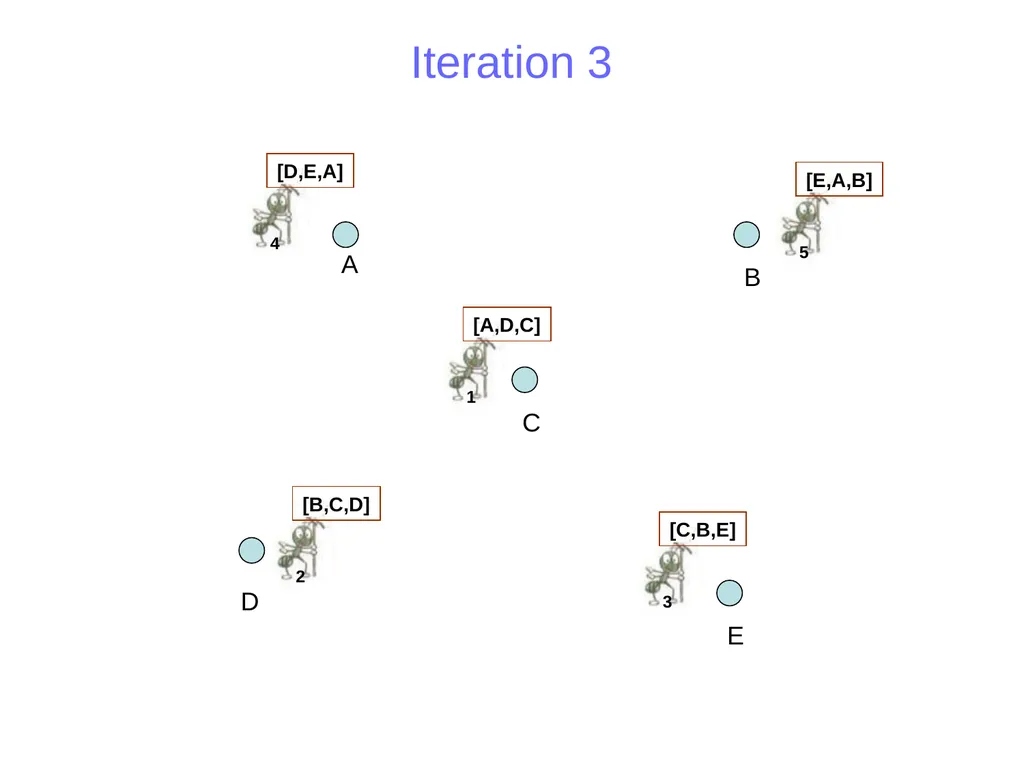
Iteration 3 A E D C B<br>
16
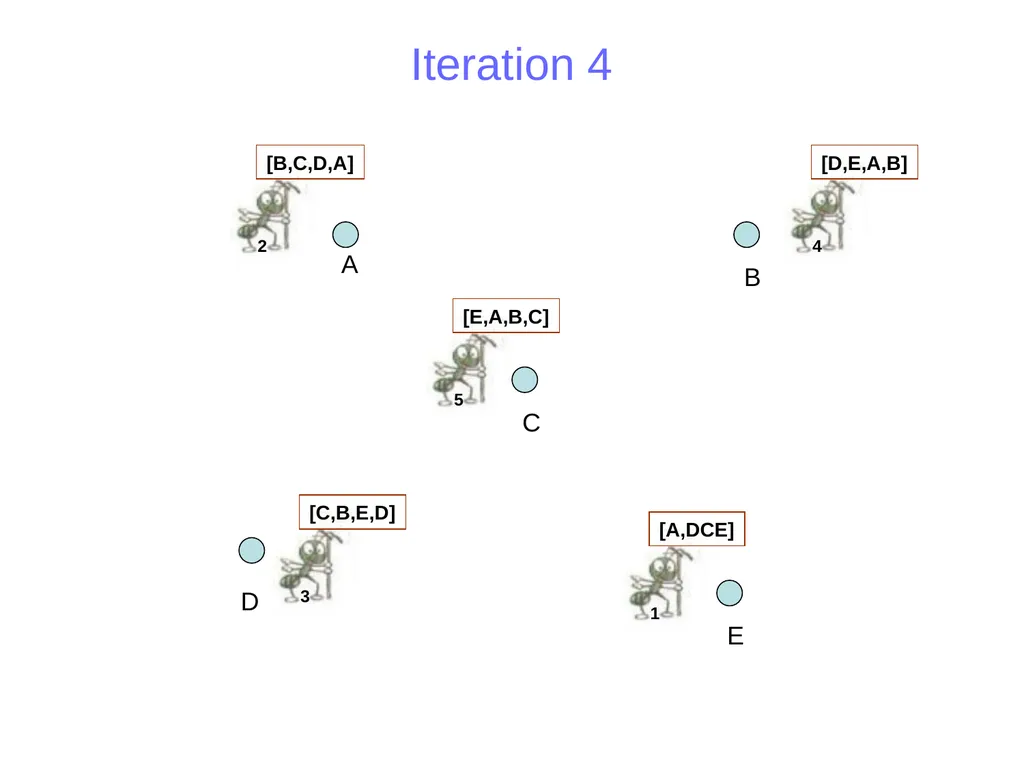
Iteration 4 A E D C B<br>
17
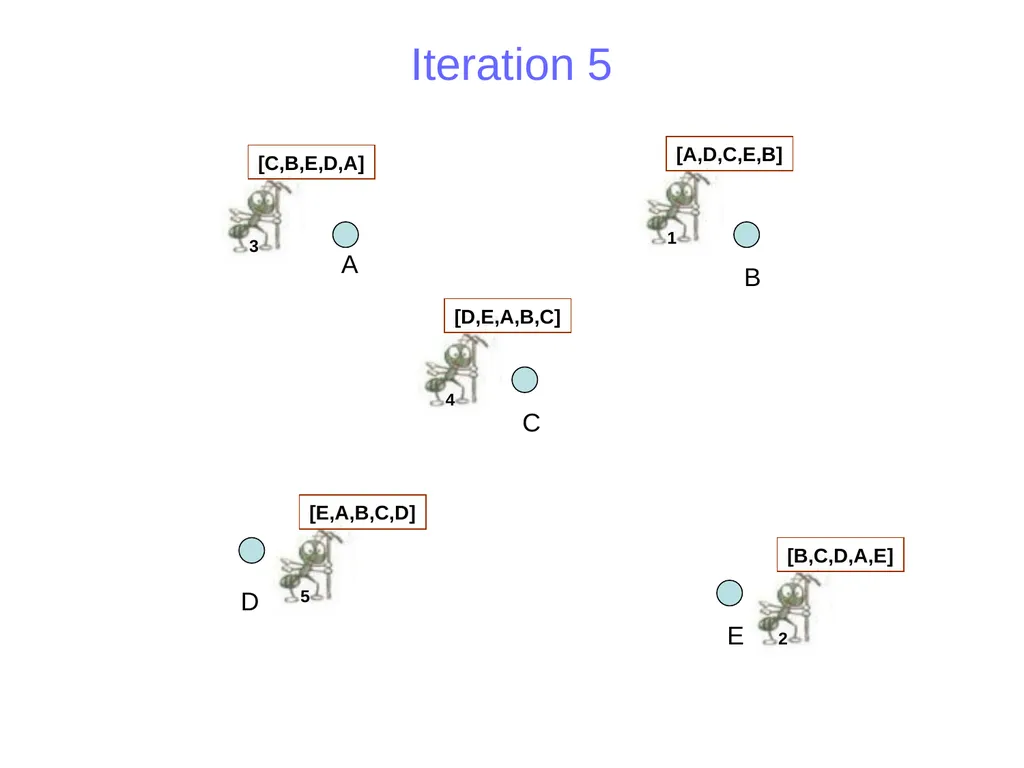
Iteration 5 A E D C B<br>
18
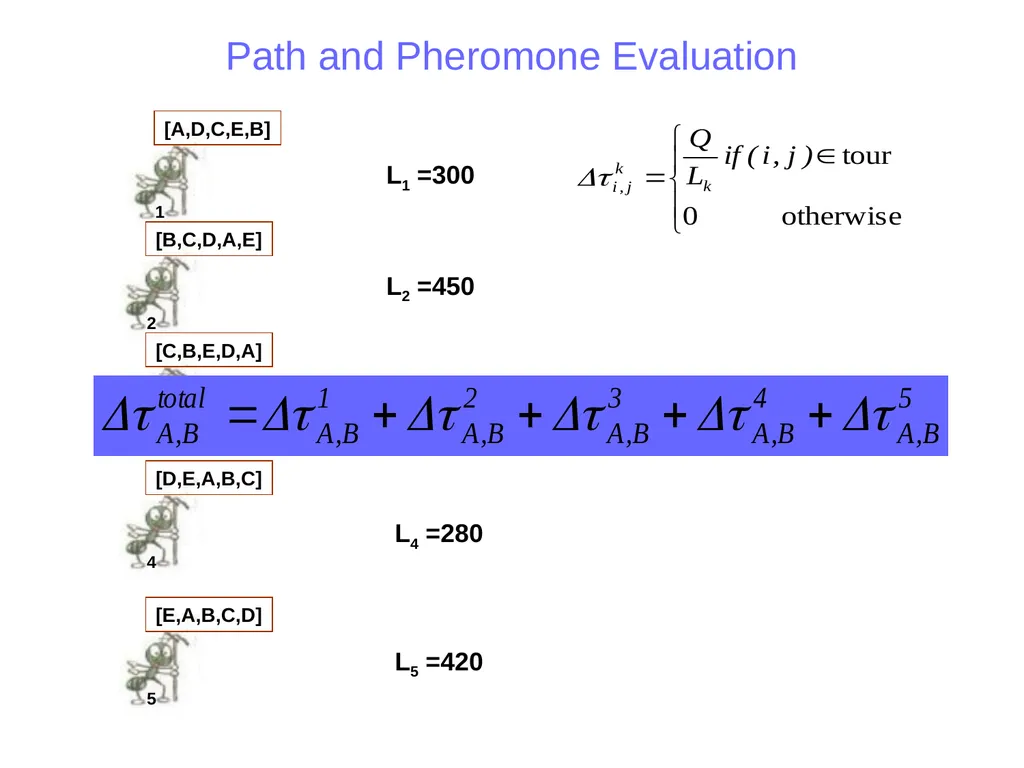
Path and Pheromone Evaluation L1 =300 L2 =450 L3 =260 L4 =280 L5 =420<br>
19
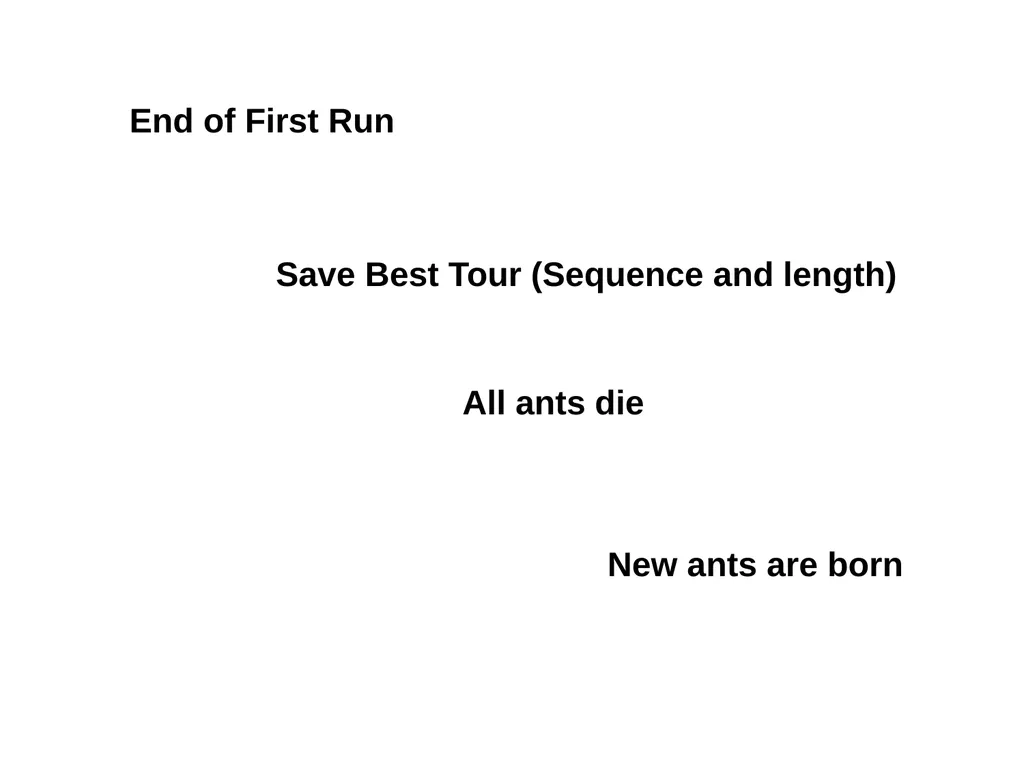
End of First Run All ants die New ants are born Save Best Tour (Sequence and length)<br>
20
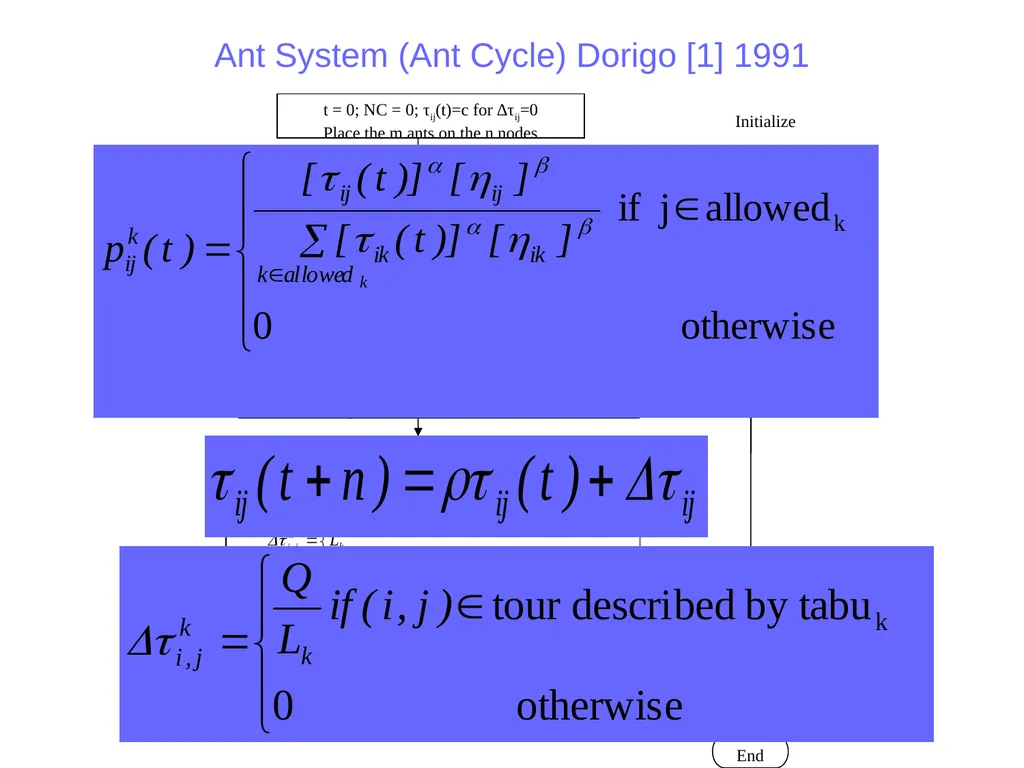
Ant System (Ant Cycle) Dorigo [1] 1991 t = 0; NC = 0; τij(t)=c for ∆τij=0
Place the m ants on the n nodes Update tabuk(s) Compute the length Lk of every ant
Update the shortest tour found
= For every edge (i,j)
Compute
For k:=1 to m do Initialize Choose the city j to move to. Use probability Tabu list management Move k-th ant to town j. Insert town j in tabuk(s) Set t = t + n; NC=NC+1; ∆τij=0 NC<NCmax
&& not stagn. Yes End No Yes<br>
Place the m ants on the n nodes Update tabuk(s) Compute the length Lk of every ant
Update the shortest tour found
= For every edge (i,j)
Compute
For k:=1 to m do Initialize Choose the city j to move to. Use probability Tabu list management Move k-th ant to town j. Insert town j in tabuk(s) Set t = t + n; NC=NC+1; ∆τij=0 NC<NCmax
&& not stagn. Yes End No Yes<br>
21
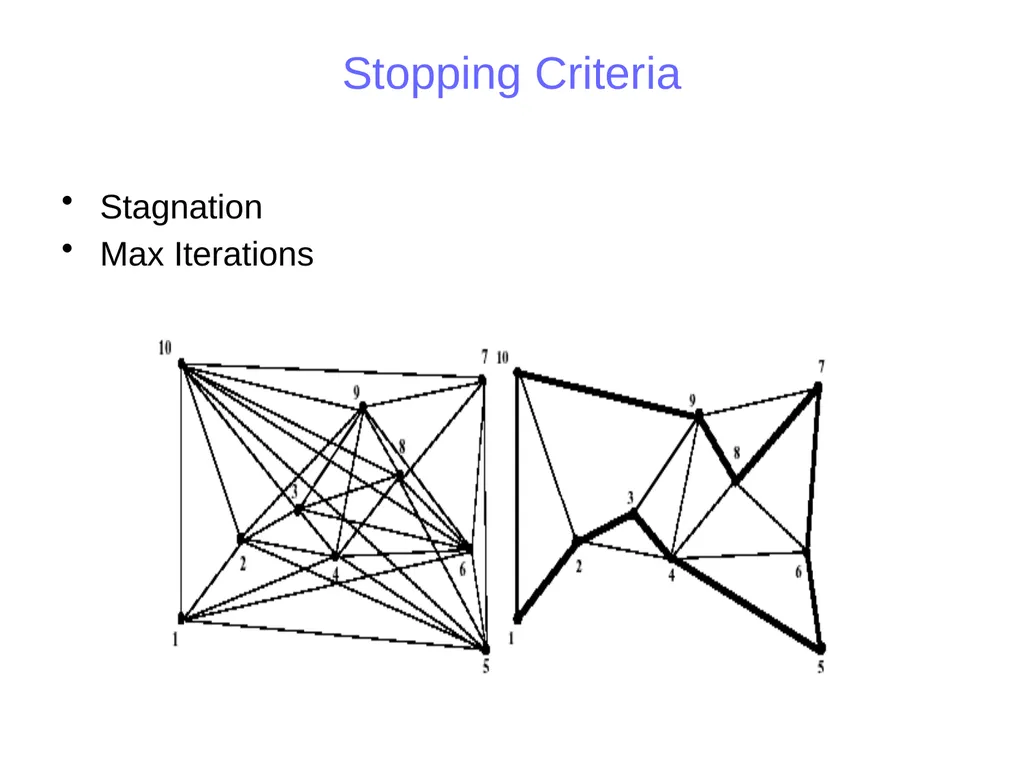
Stopping Criteria Stagnation
Max Iterations<br>
Max Iterations<br>
22
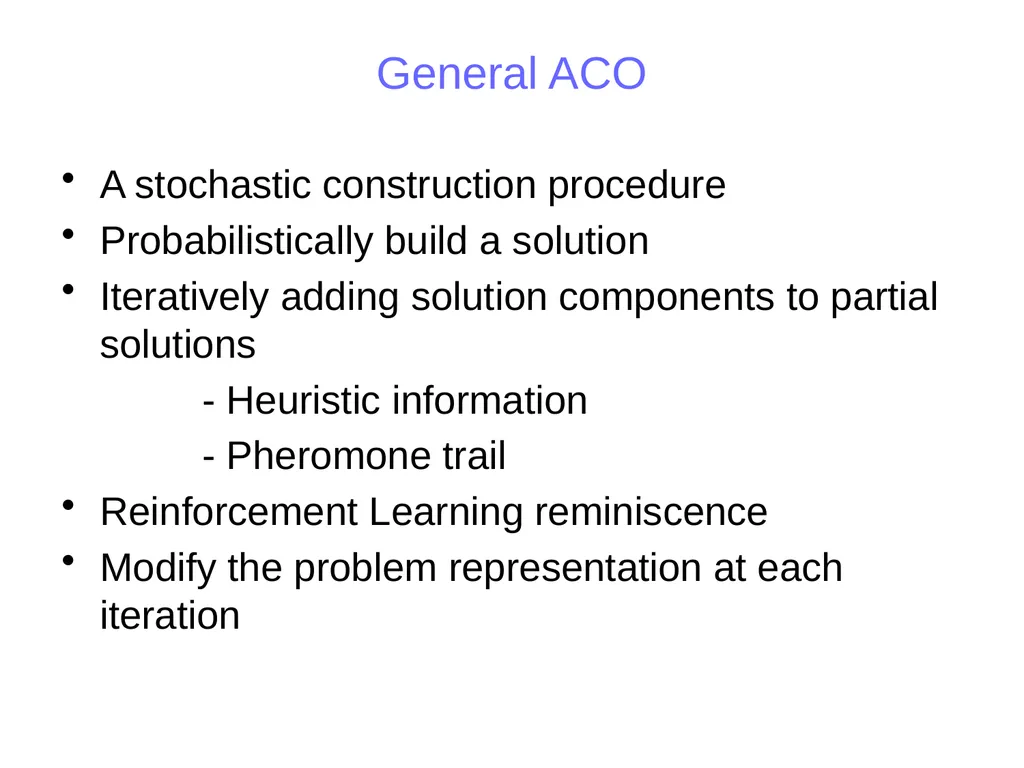
General ACO A stochastic construction procedure
Probabilistically build a solution
Iteratively adding solution components to partial solutions
- Heuristic information
- Pheromone trail
Reinforcement Learning reminiscence
Modify the problem representation at each iteration<br>
Probabilistically build a solution
Iteratively adding solution components to partial solutions
- Heuristic information
- Pheromone trail
Reinforcement Learning reminiscence
Modify the problem representation at each iteration<br>
23
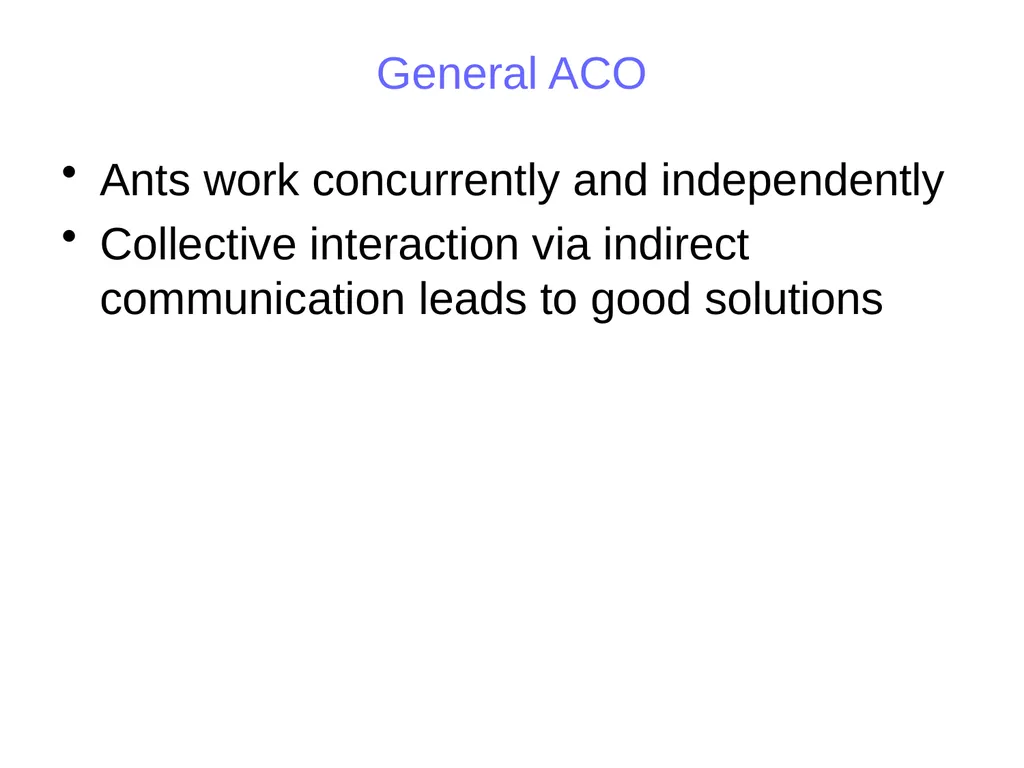
General ACO Ants work concurrently and independently
Collective interaction via indirect communication leads to good solutions<br>
Collective interaction via indirect communication leads to good solutions<br>
24
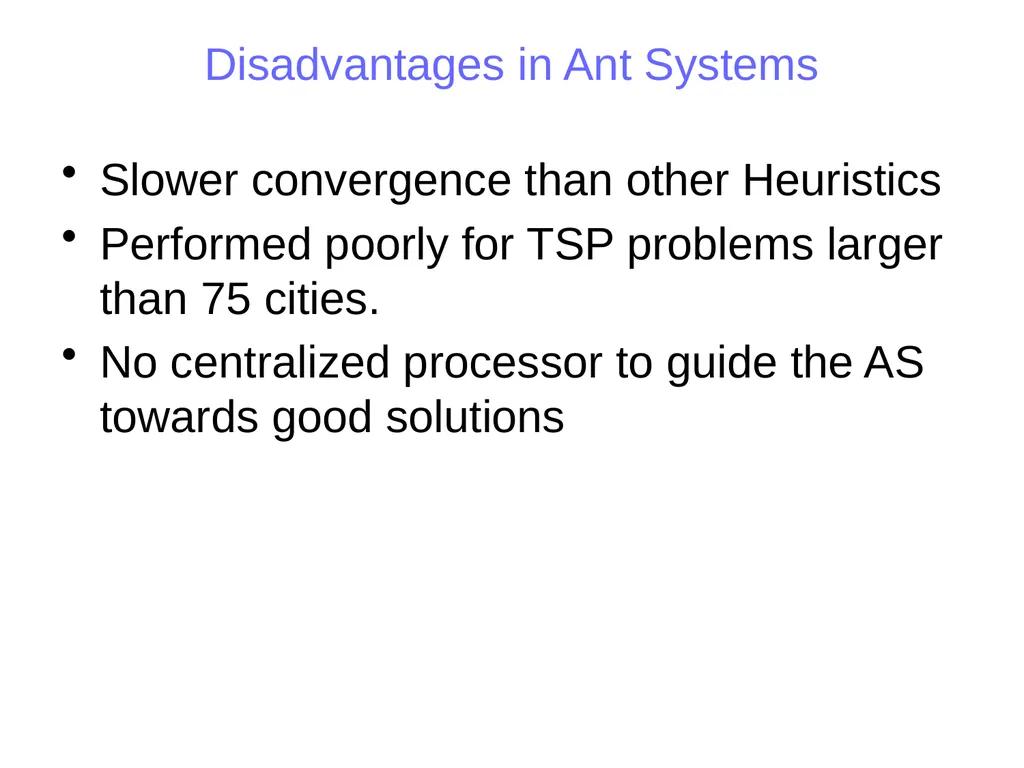
Disadvantages in Ant Systems Slower convergence than other Heuristics
Performed poorly for TSP problems larger than 75 cities.
No centralized processor to guide the AS towards good solutions<br>
Performed poorly for TSP problems larger than 75 cities.
No centralized processor to guide the AS towards good solutions<br>
25
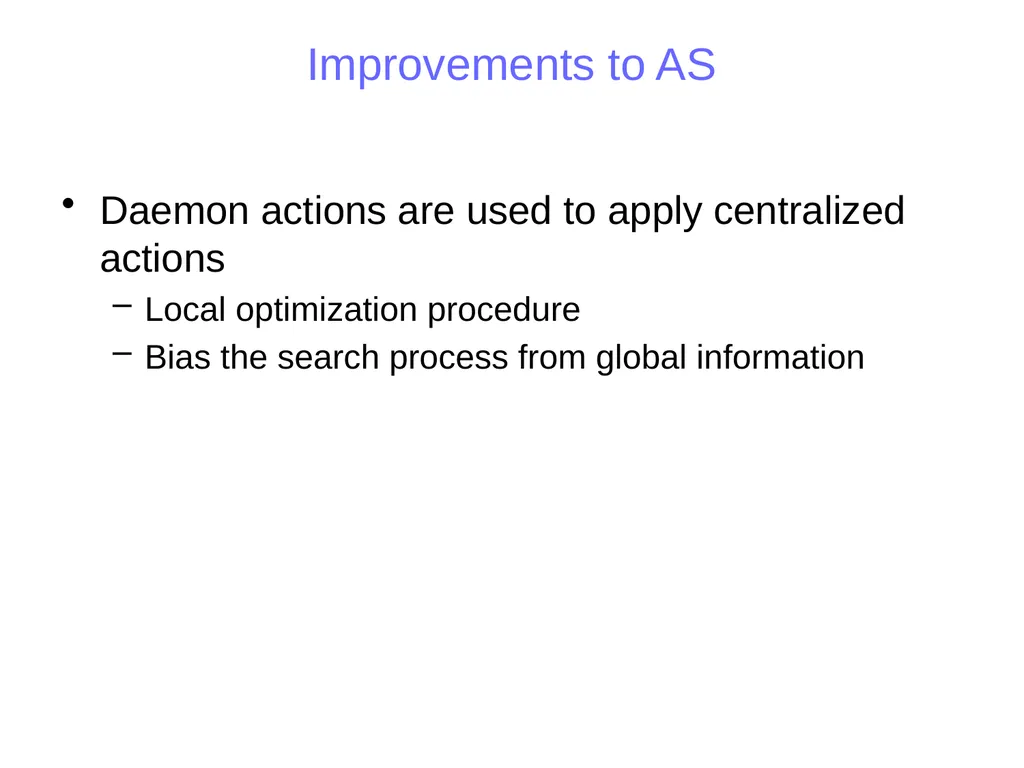
Improvements to AS Daemon actions are used to apply centralized actions
Local optimization procedure
Bias the search process from global information<br>
Local optimization procedure
Bias the search process from global information<br>
26
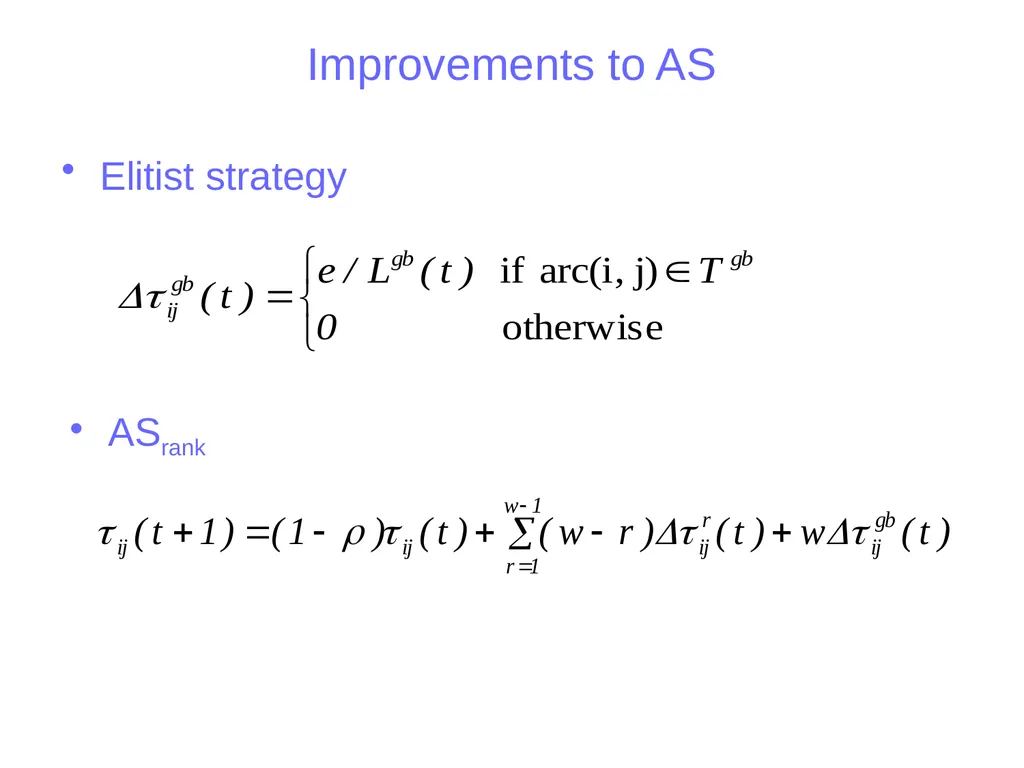
Improvements to AS Elitist strategy ASrank<br>
27
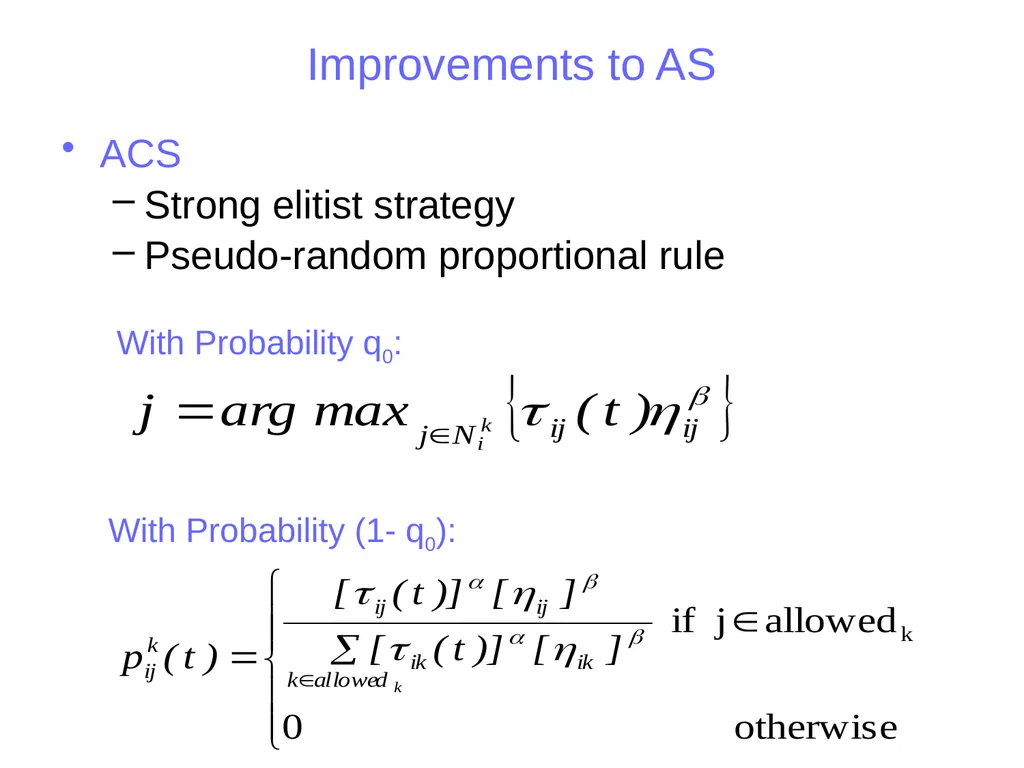
Improvements to AS ACS
Strong elitist strategy
Pseudo-random proportional rule With Probability (1- q0): With Probability q0:<br>
Strong elitist strategy
Pseudo-random proportional rule With Probability (1- q0): With Probability q0:<br>
28
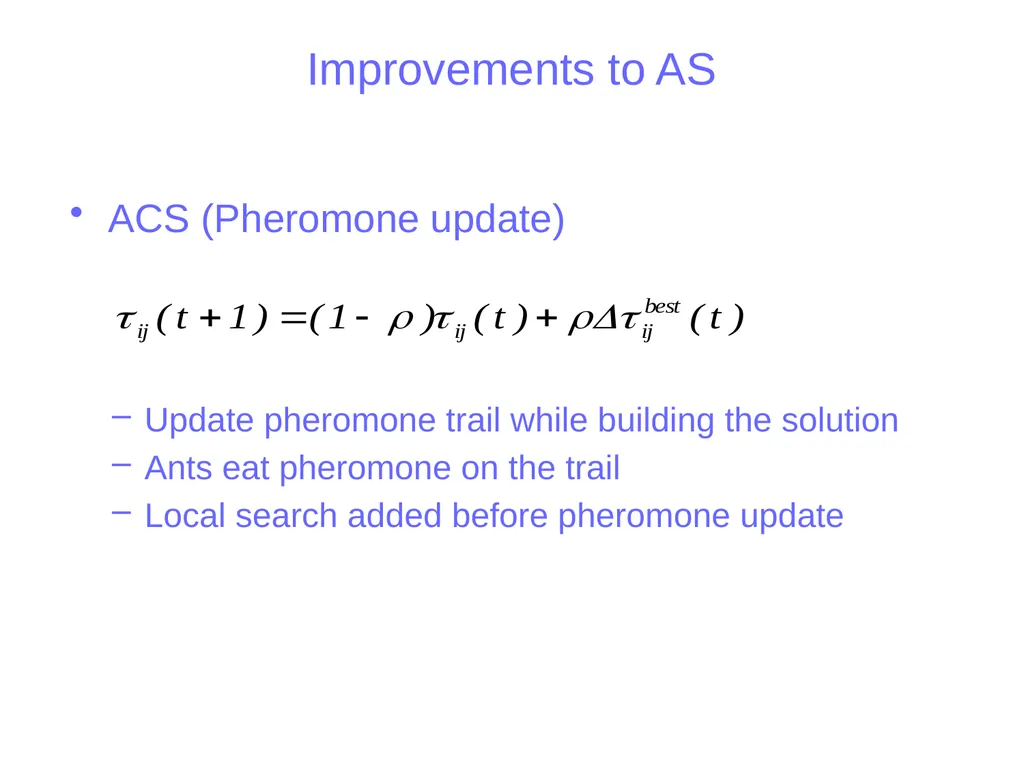
Improvements to AS ACS (Pheromone update) Update pheromone trail while building the solution
Ants eat pheromone on the trail
Local search added before pheromone update<br>
Ants eat pheromone on the trail
Local search added before pheromone update<br>
29
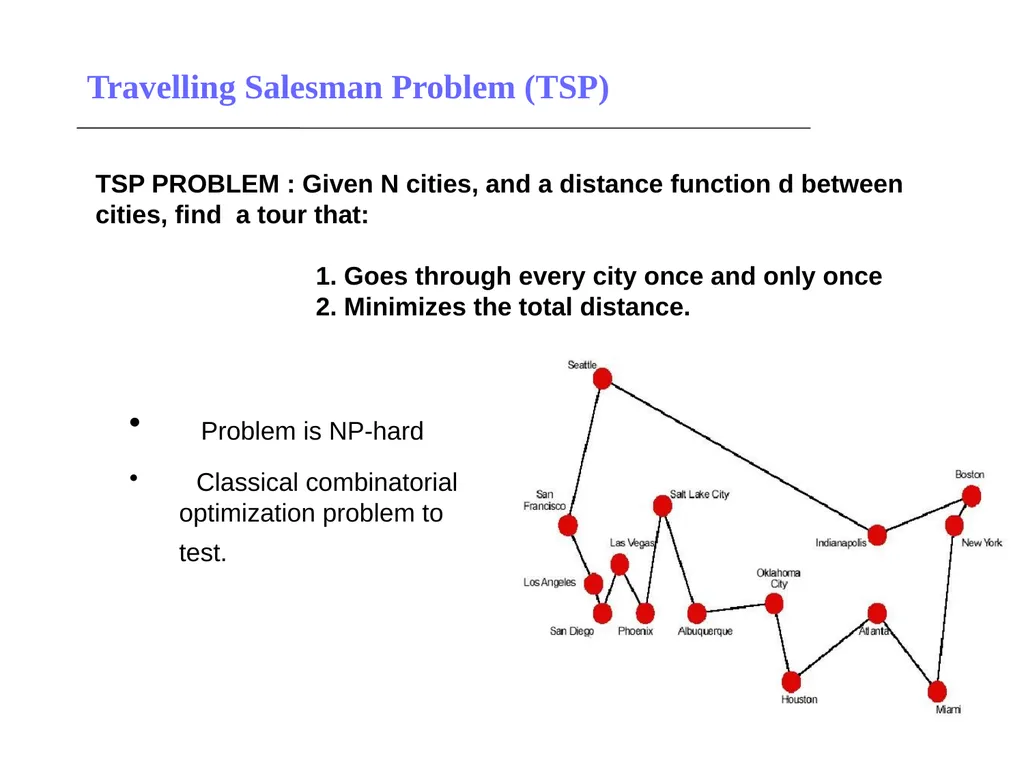
Travelling Salesman Problem (TSP) TSP PROBLEM : Given N cities, and a distance function d between cities, find a tour that:
1. Goes through every city once and only once
2. Minimizes the total distance. Problem is NP-hard Classical combinatorial
optimization problem to
test.<br>
1. Goes through every city once and only once
2. Minimizes the total distance. Problem is NP-hard Classical combinatorial
optimization problem to
test.<br>
30
ACO for the Traveling Salesman Problem The TSP is a very important problem in the context of Ant Colony Optimization because it is the problem to which the original AS was first applied, and it has later often been used as a benchmark to test a new idea and algorithmic variants. The TSP was chosen for many reasons: It is a problem to which the ant colony metaphor It is one of the most studied NP-hard problems in the combinatorial optimization it is very easy to explain. So that the algorithm behavior is not obscured by too many technicalities.<br>
31
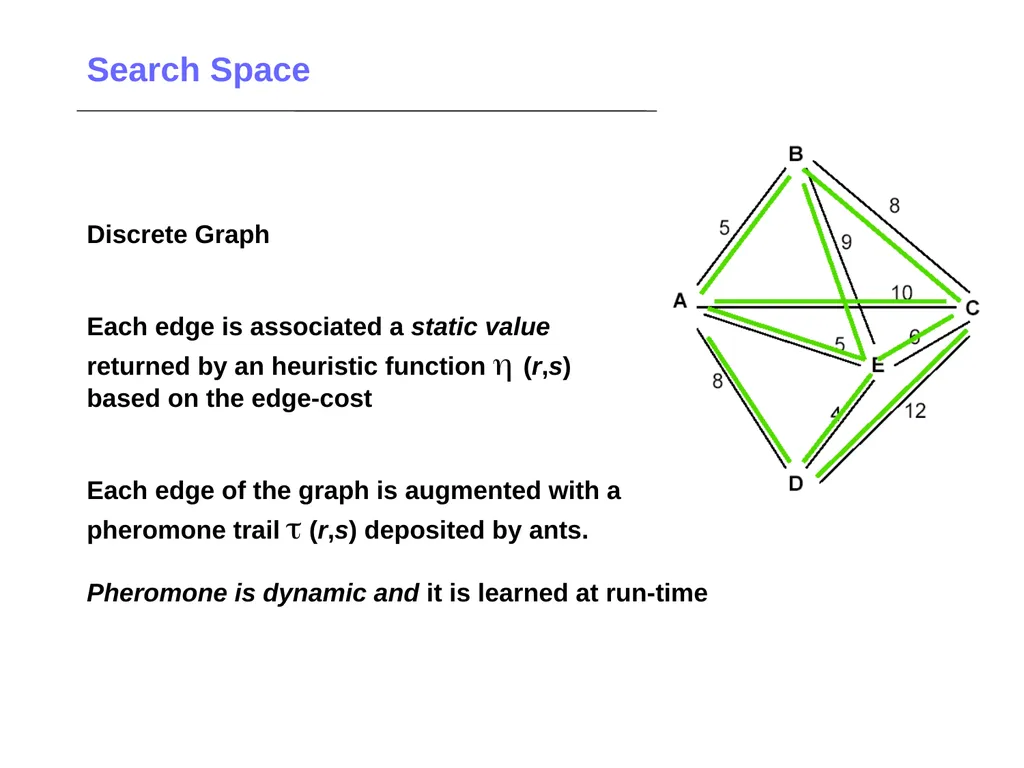
Search Space Discrete Graph
Each edge is associated a static value
returned by an heuristic function (r,s)
based on the edge-cost
Each edge of the graph is augmented with a pheromone trail (r,s) deposited by ants.
Pheromone is dynamic and it is learned at run-time<br>
Each edge is associated a static value
returned by an heuristic function (r,s)
based on the edge-cost
Each edge of the graph is augmented with a pheromone trail (r,s) deposited by ants.
Pheromone is dynamic and it is learned at run-time<br>
32
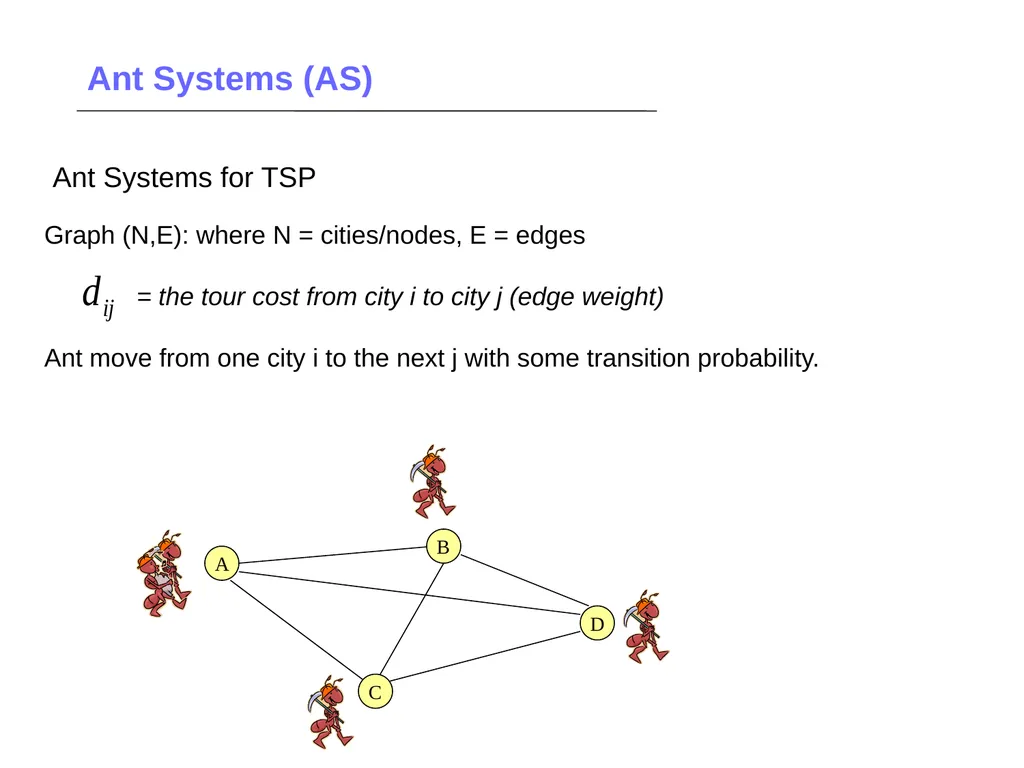
Ant Systems (AS) Ant Systems for TSP Graph (N,E): where N = cities/nodes, E = edges
= the tour cost from city i to city j (edge weight)
Ant move from one city i to the next j with some transition probability.<br>
= the tour cost from city i to city j (edge weight)
Ant move from one city i to the next j with some transition probability.<br>
33
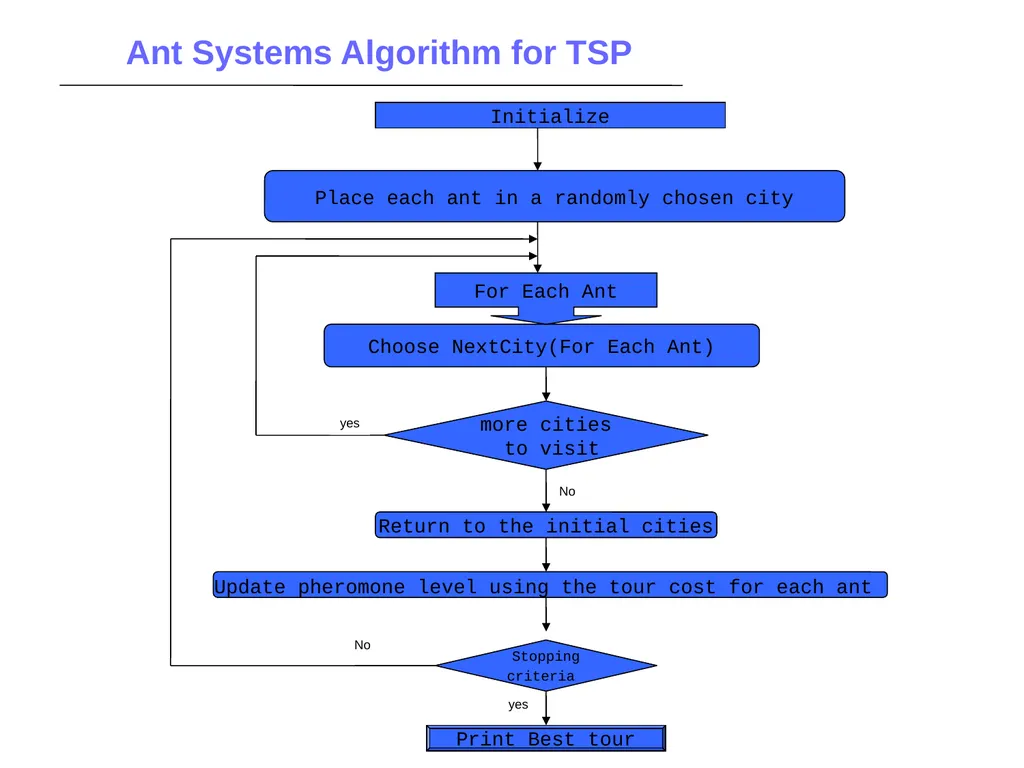
Ant Systems Algorithm for TSP Initialize Place each ant in a randomly chosen city Choose NextCity(For Each Ant) more cities
to visit For Each Ant Return to the initial cities Update pheromone level using the tour cost for each ant Print Best tour yes No Stopping
criteria yes No<br>
to visit For Each Ant Return to the initial cities Update pheromone level using the tour cost for each ant Print Best tour yes No Stopping
criteria yes No<br>
34
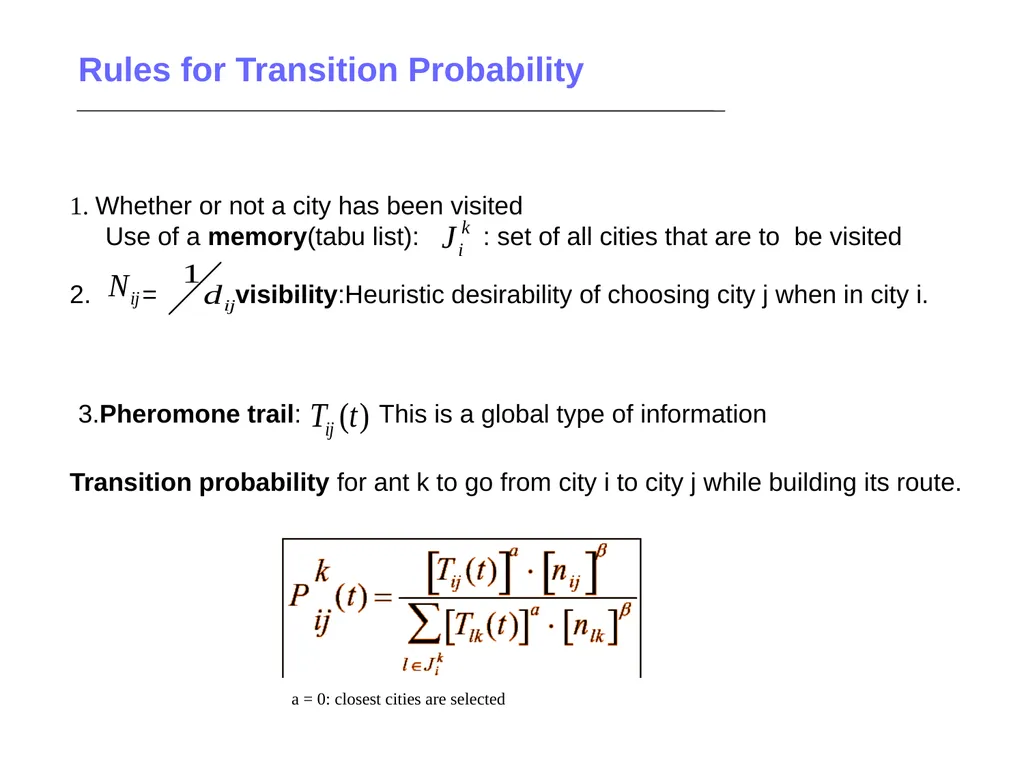
Rules for Transition Probability 1. Whether or not a city has been visited
Use of a memory(tabu list): : set of all cities that are to be visited = visibility:Heuristic desirability of choosing city j when in city i. 3.Pheromone trail: This is a global type of information Transition probability for ant k to go from city i to city j while building its route. a = 0: closest cities are selected<br>
Use of a memory(tabu list): : set of all cities that are to be visited = visibility:Heuristic desirability of choosing city j when in city i. 3.Pheromone trail: This is a global type of information Transition probability for ant k to go from city i to city j while building its route. a = 0: closest cities are selected<br>
35
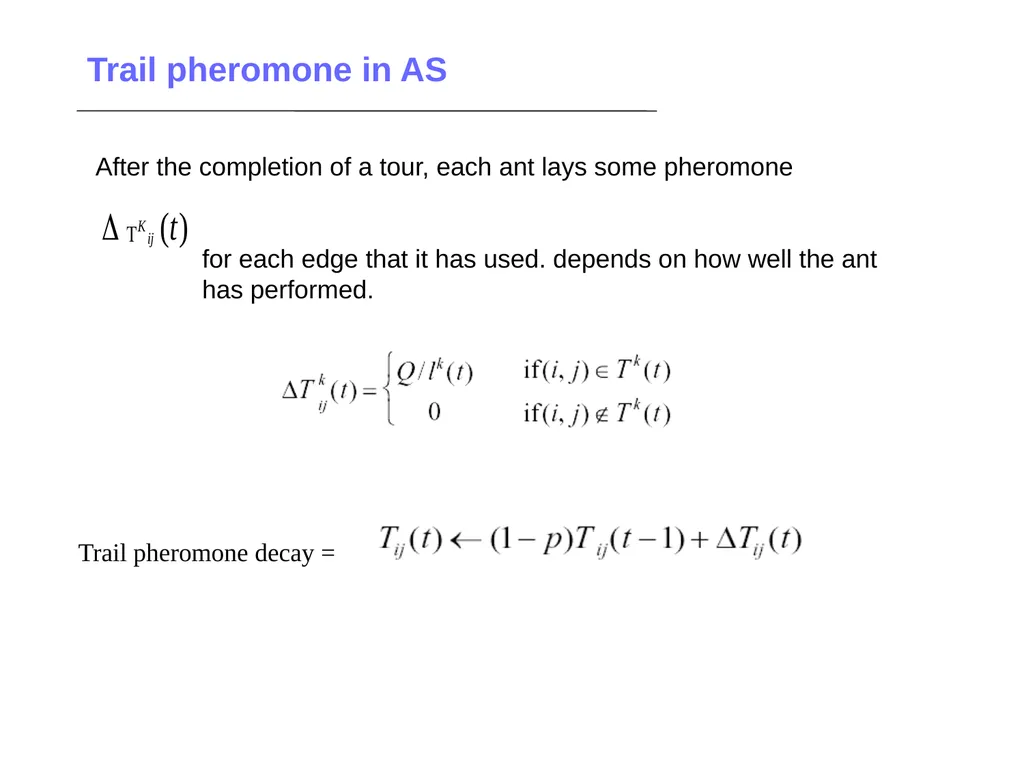
Trail pheromone in AS After the completion of a tour, each ant lays some pheromone
for each edge that it has used. depends on how well the ant
has performed. Trail pheromone decay =<br>
for each edge that it has used. depends on how well the ant
has performed. Trail pheromone decay =<br>
36
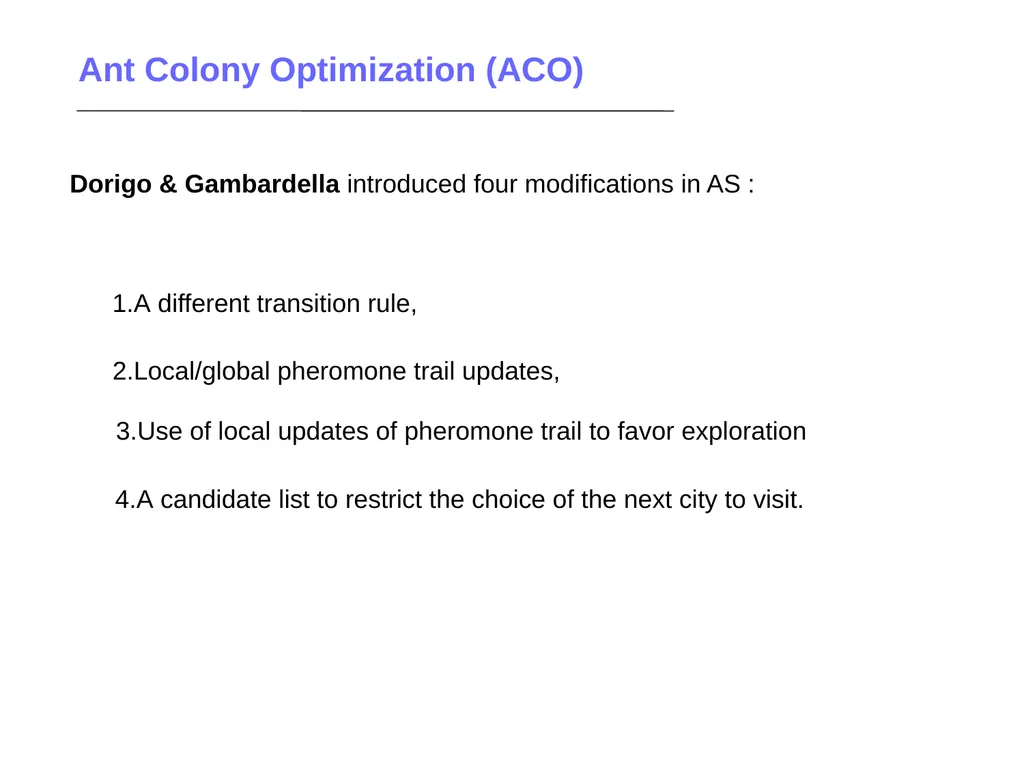
Ant Colony Optimization (ACO) Dorigo & Gambardella introduced four modifications in AS : 1.A different transition rule, 2.Local/global pheromone trail updates, 3.Use of local updates of pheromone trail to favor exploration 4.A candidate list to restrict the choice of the next city to visit.<br>
37
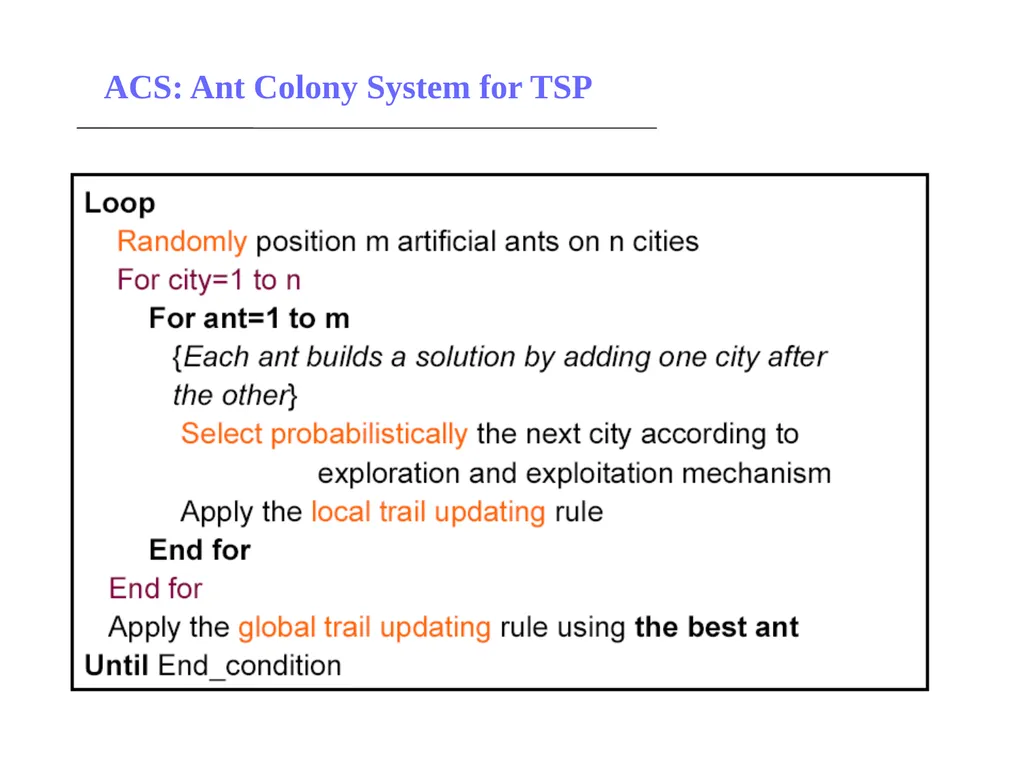
ACS: Ant Colony System for TSP<br>
38
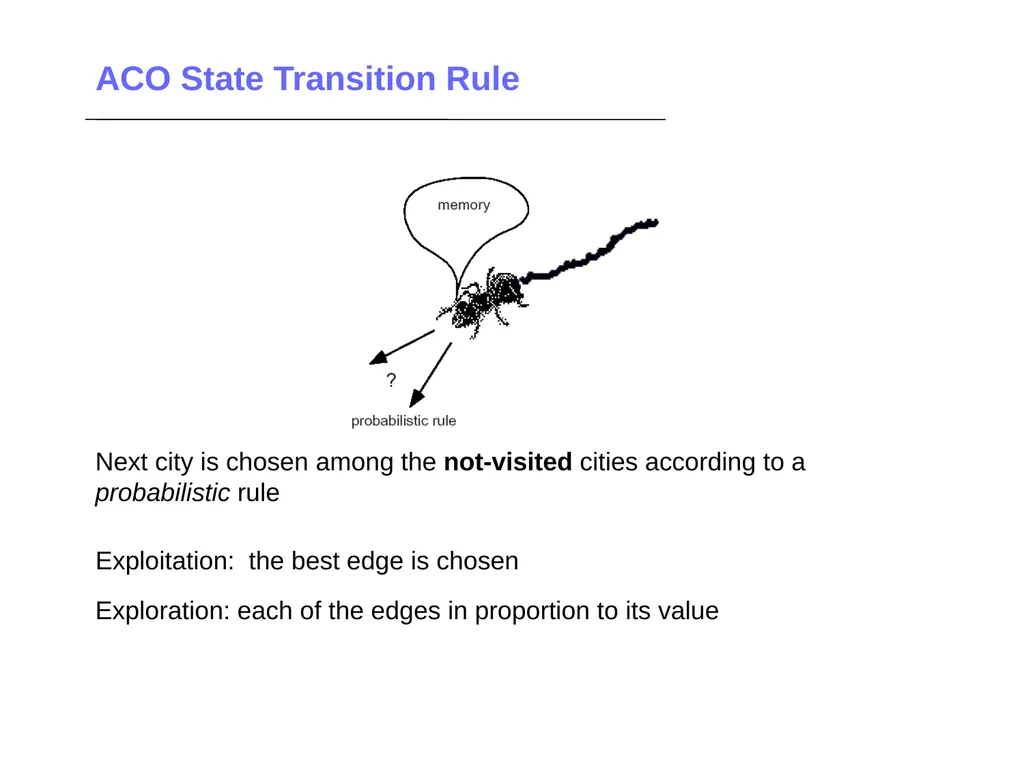
ACO State Transition Rule Next city is chosen among the not-visited cities according to a probabilistic rule Exploitation: the best edge is chosen Exploration: each of the edges in proportion to its value<br>
39
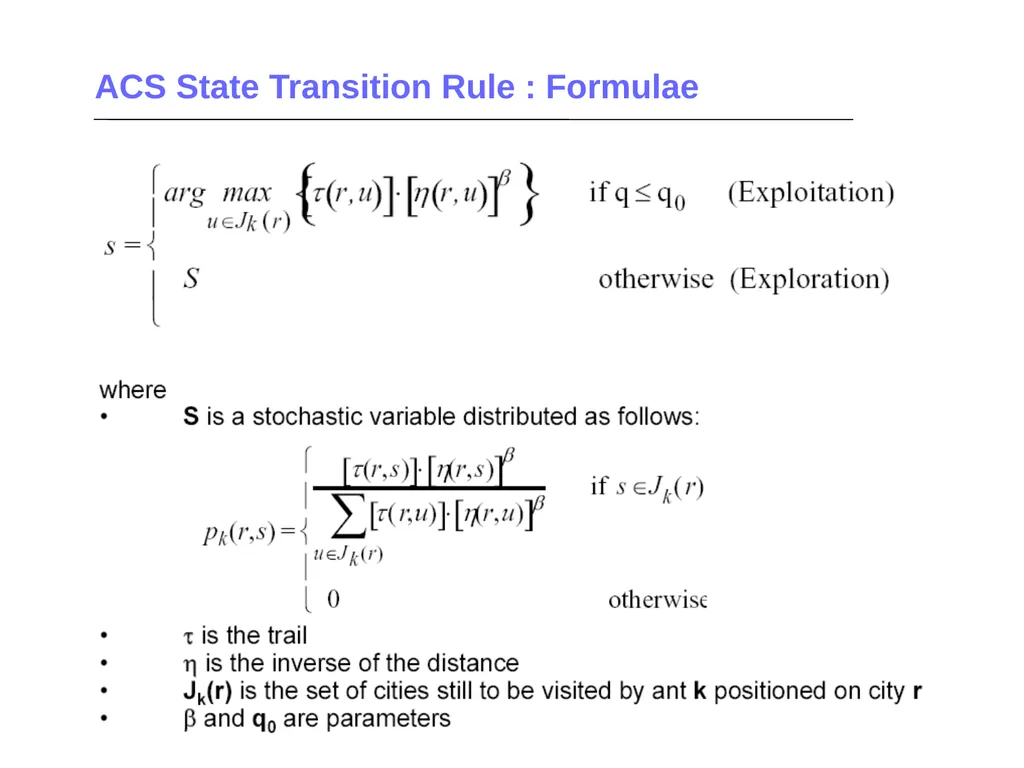
ACS State Transition Rule : Formulae<br>
40
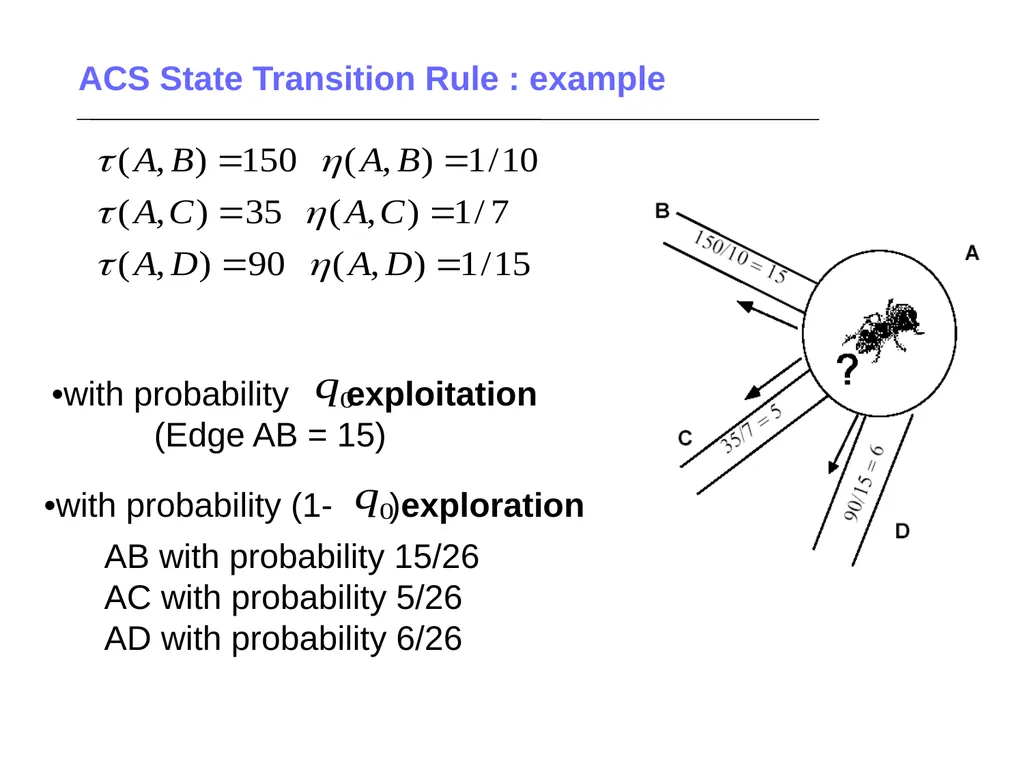
ACS State Transition Rule : example •with probability exploitation
(Edge AB = 15) •with probability (1- )exploration AB with probability 15/26
AC with probability 5/26
AD with probability 6/26<br>
(Edge AB = 15) •with probability (1- )exploration AB with probability 15/26
AC with probability 5/26
AD with probability 6/26<br>
41
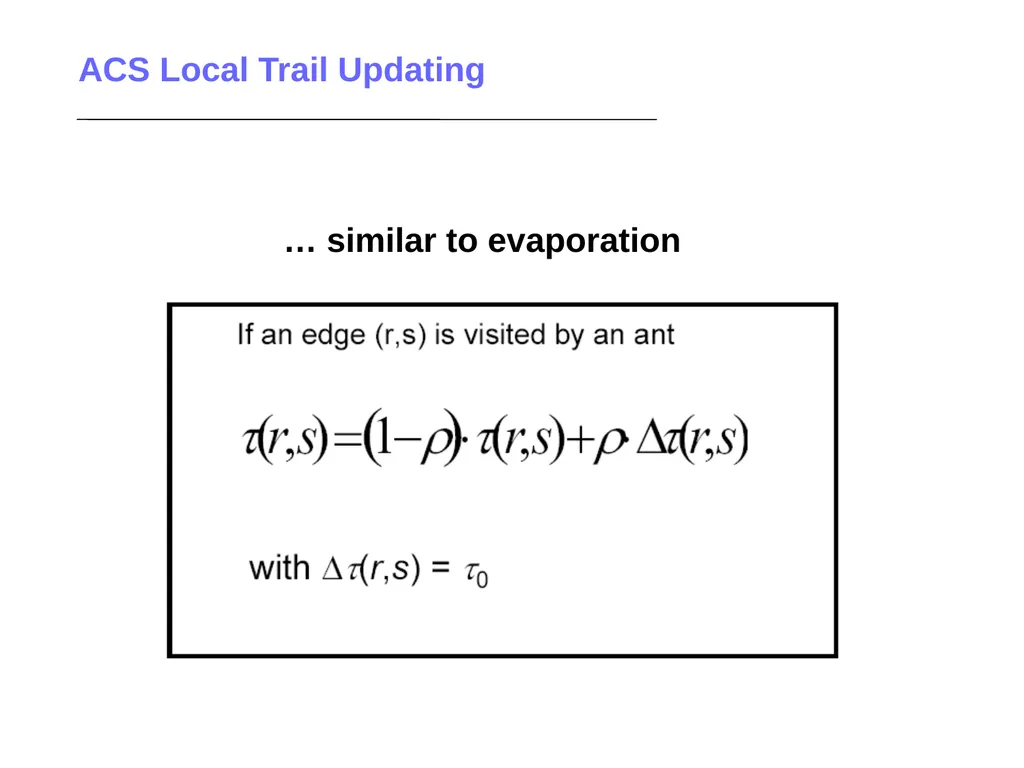
ACS Local Trail Updating … similar to evaporation<br>
42
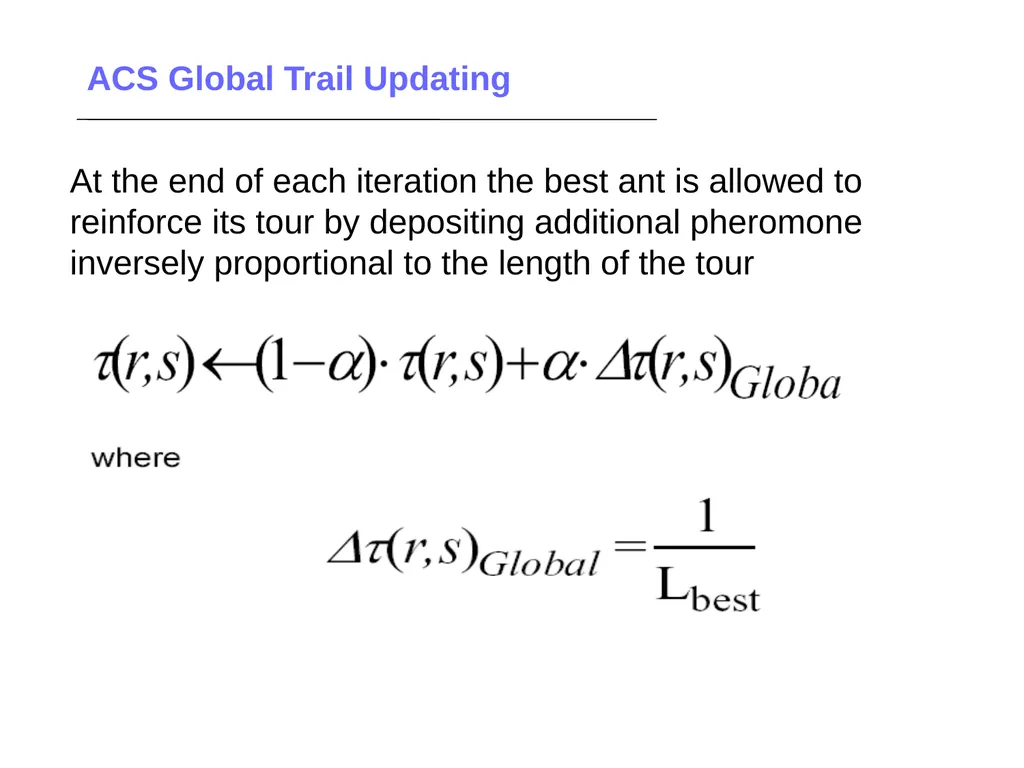
ACS Global Trail Updating At the end of each iteration the best ant is allowed to reinforce its tour by depositing additional pheromone inversely proportional to the length of the tour<br>
43
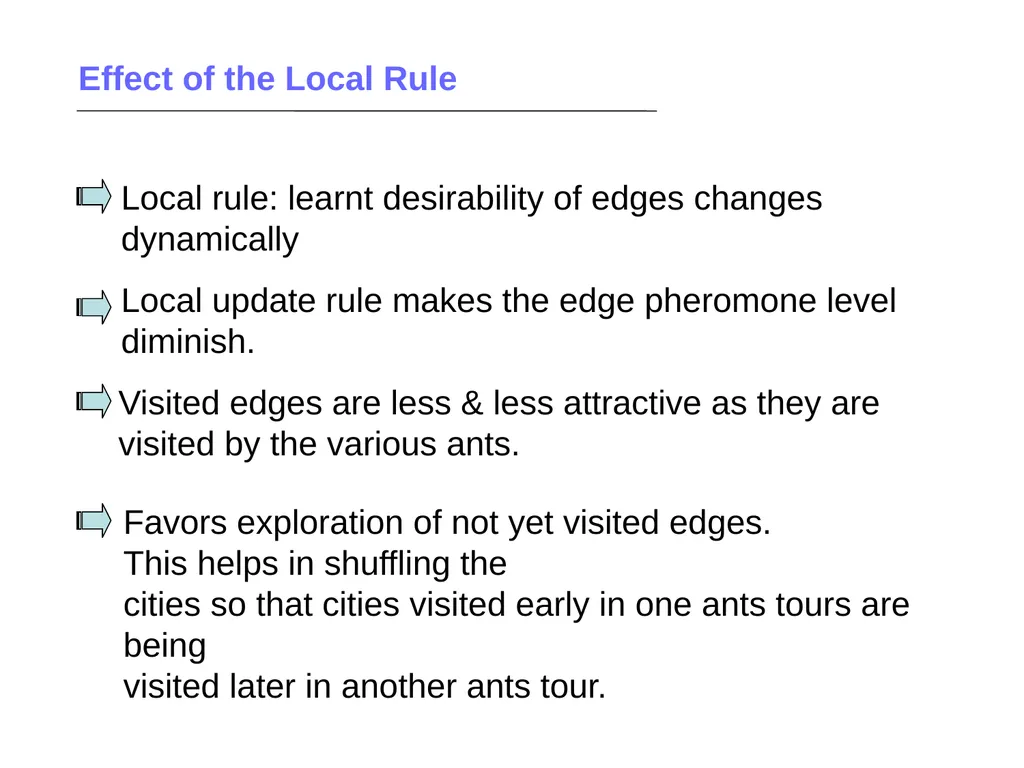
Effect of the Local Rule Local rule: learnt desirability of edges changes dynamically Local update rule makes the edge pheromone level diminish. Visited edges are less & less attractive as they are visited by the various ants. Favors exploration of not yet visited edges.
This helps in shuffling the
cities so that cities visited early in one ants tours are being
visited later in another ants tour.<br>
This helps in shuffling the
cities so that cities visited early in one ants tours are being
visited later in another ants tour.<br>
44
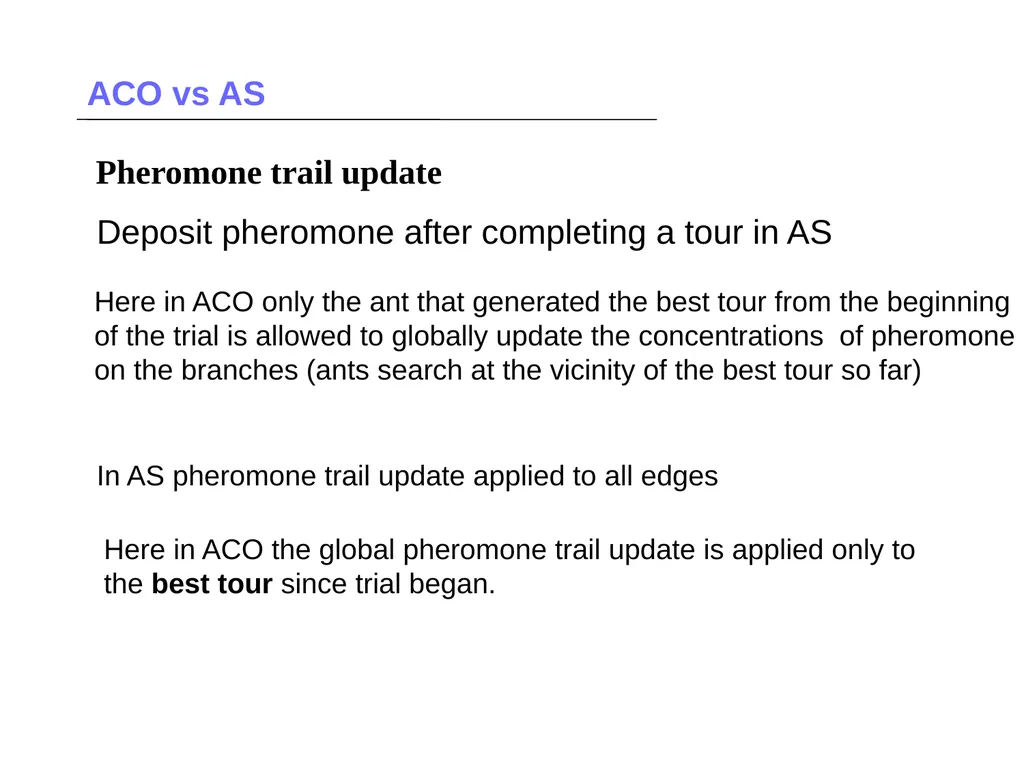
ACO vs AS Pheromone trail update Deposit pheromone after completing a tour in AS Here in ACO only the ant that generated the best tour from the beginning
of the trial is allowed to globally update the concentrations of pheromone
on the branches (ants search at the vicinity of the best tour so far) In AS pheromone trail update applied to all edges Here in ACO the global pheromone trail update is applied only to the best tour since trial began.<br>
of the trial is allowed to globally update the concentrations of pheromone
on the branches (ants search at the vicinity of the best tour so far) In AS pheromone trail update applied to all edges Here in ACO the global pheromone trail update is applied only to the best tour since trial began.<br>
45
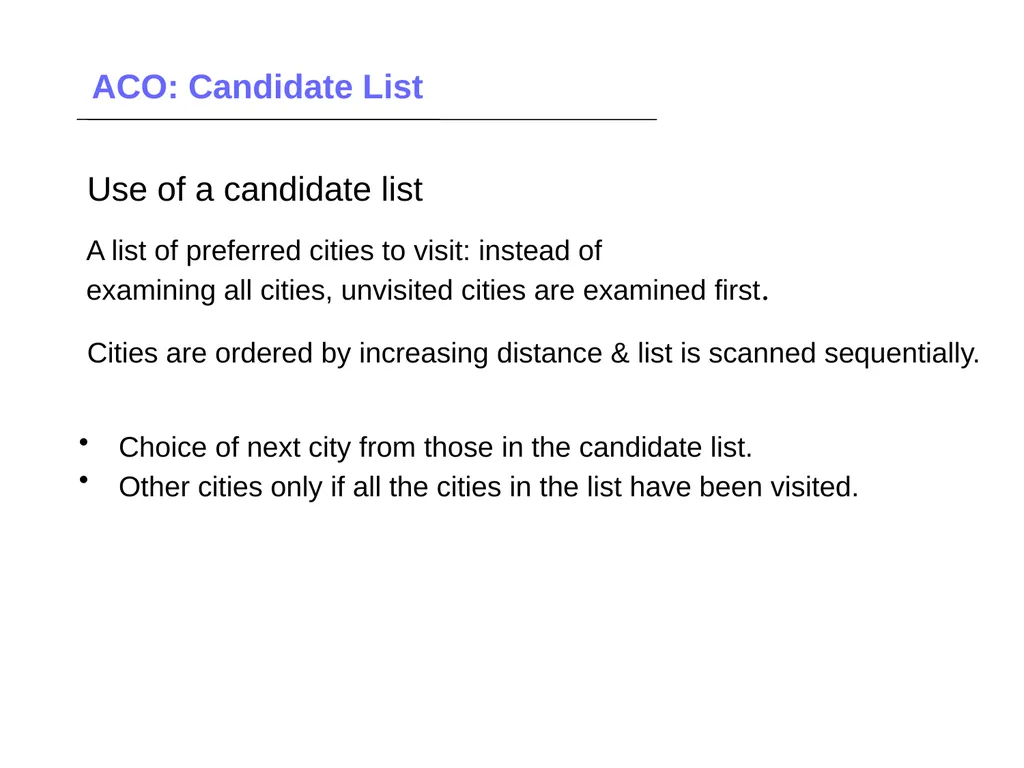
ACO: Candidate List Use of a candidate list A list of preferred cities to visit: instead of
examining all cities, unvisited cities are examined first. Cities are ordered by increasing distance & list is scanned sequentially. Choice of next city from those in the candidate list.
Other cities only if all the cities in the list have been visited.<br>
examining all cities, unvisited cities are examined first. Cities are ordered by increasing distance & list is scanned sequentially. Choice of next city from those in the candidate list.
Other cities only if all the cities in the list have been visited.<br>
46
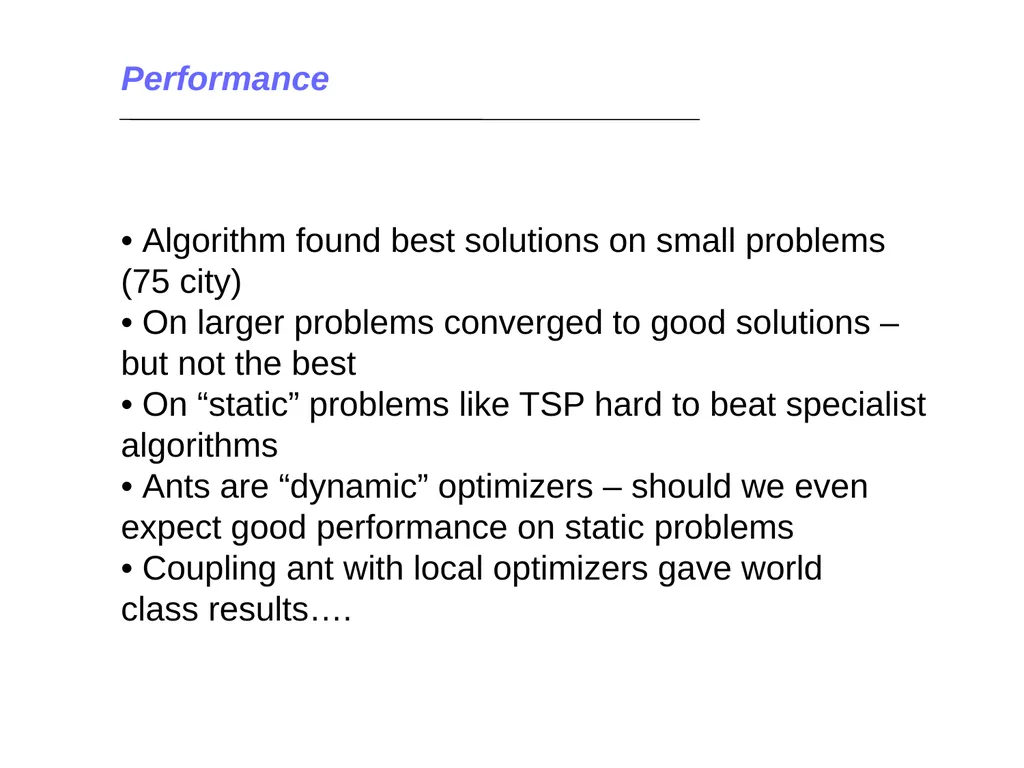
• Algorithm found best solutions on small problems
(75 city)
• On larger problems converged to good solutions –
but not the best
• On “static” problems like TSP hard to beat specialist algorithms
• Ants are “dynamic” optimizers – should we even
expect good performance on static problems
• Coupling ant with local optimizers gave world
class results…. Performance<br>
(75 city)
• On larger problems converged to good solutions –
but not the best
• On “static” problems like TSP hard to beat specialist algorithms
• Ants are “dynamic” optimizers – should we even
expect good performance on static problems
• Coupling ant with local optimizers gave world
class results…. Performance<br>
47
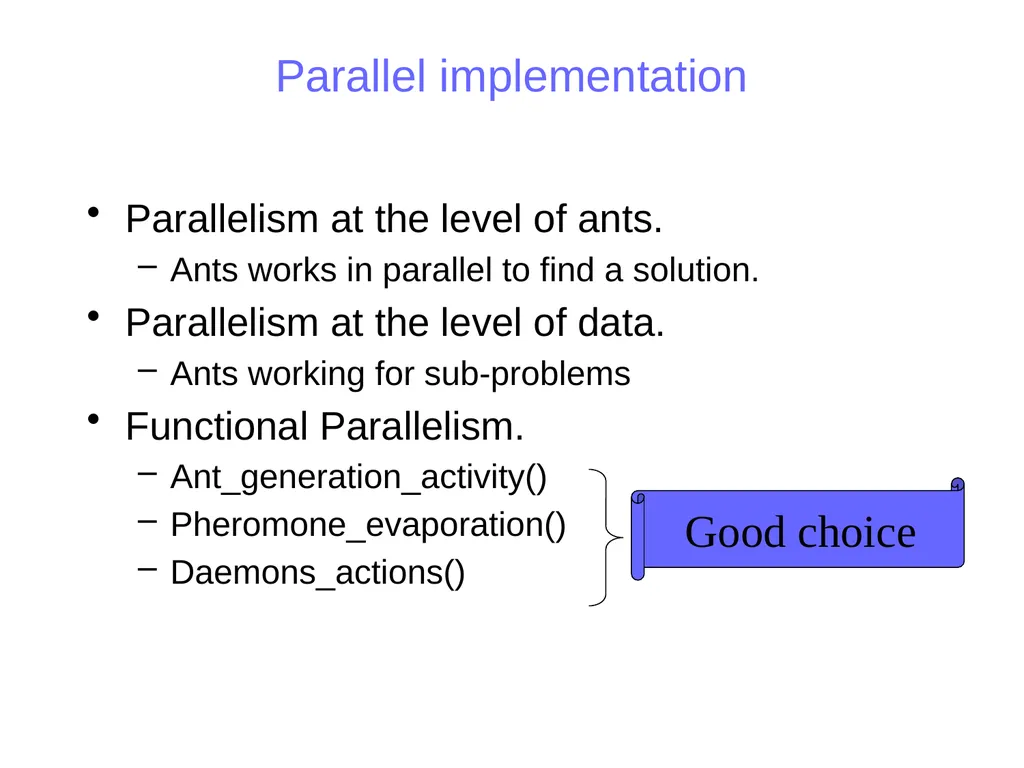
Parallel implementation Parallelism at the level of ants.
Ants works in parallel to find a solution.
Parallelism at the level of data.
Ants working for sub-problems
Functional Parallelism.
Ant_generation_activity()
Pheromone_evaporation()
Daemons_actions() Good choice<br>
Ants works in parallel to find a solution.
Parallelism at the level of data.
Ants working for sub-problems
Functional Parallelism.
Ant_generation_activity()
Pheromone_evaporation()
Daemons_actions() Good choice<br>
48
Similarities with other Opt. Technique Populations,Elitism ~ GA
Probabilistic,RANDOM ~ GRASP
Constructive ~ GRASP
Heuristic info, Memory ~ TS<br>
Probabilistic,RANDOM ~ GRASP
Constructive ~ GRASP
Heuristic info, Memory ~ TS<br>
49
Design Choices Number of ants.
Balance of exploration and exploitation
Combination with other heuristics techniques
When are pheromones updated?
Which ants should update the pheromone?
Termination Criteria<br>
Balance of exploration and exploitation
Combination with other heuristics techniques
When are pheromones updated?
Which ants should update the pheromone?
Termination Criteria<br>
50
Conclusions ACO is a metaheuristic approach for solving hard combinatorial optimization problems.
Artificial ants implement a randomized construction heuristic which makes probabilistic decisions.
The accumulated search experience is taken into account by the adaptation of the pheromone trail.
ACO shows great performance with the “ill-structured” problems like network routing.
In ACO, local search is extremely important to obtain good results.<br>
Artificial ants implement a randomized construction heuristic which makes probabilistic decisions.
The accumulated search experience is taken into account by the adaptation of the pheromone trail.
ACO shows great performance with the “ill-structured” problems like network routing.
In ACO, local search is extremely important to obtain good results.<br>