
Anthropogenic Activities and River Basin Hydrology
SN
Published · 13 slides · 0 views

1 / 1
Description
Anthropogenic Activities and River Basin Hydrology Dr. Pranjit Kumar Sarma Anthropogenic Activities: These are human-caused activities that can significantly alter the natural processes within a river basin. Examples include: Deforestation:
Related Topics
Share
Embed code
Download this presentation From Below
"Anthropogenic Activities and River Basin Hydrology" is the property of its rightful owner. Permission is granted to download and print the materials on this website for personal, non-commercial use only, and to display it on your personal computer provided you do not modify the materials and that you retain all copyright notices contained in the materials. By downloading content from our website, you accept the terms of this agreement.
Presentation Transcript
01
Anthropogenic Activities and River Basin Hydrology Dr. Pranjit Kumar Sarma<br>
02
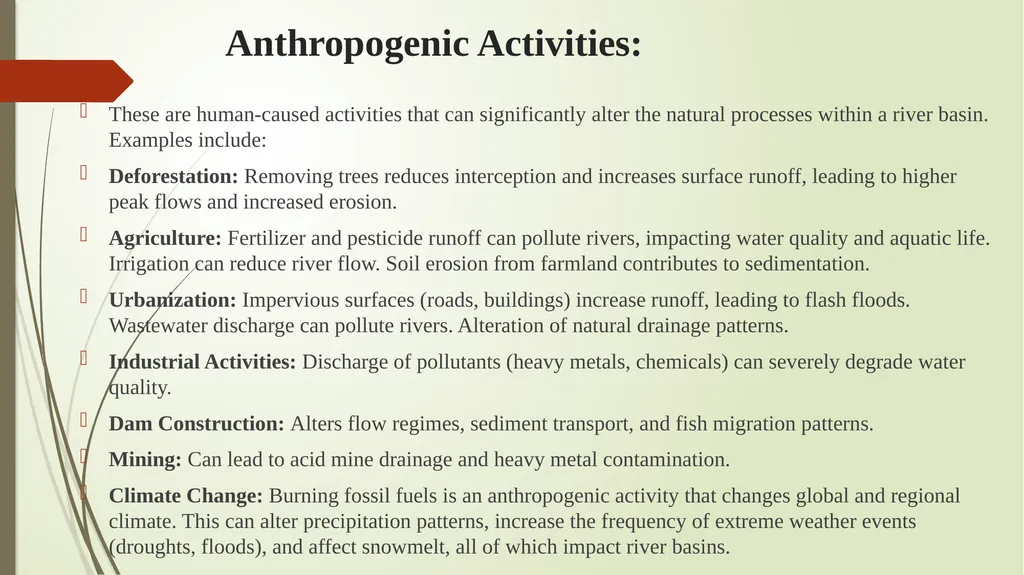
Anthropogenic Activities: These are human-caused activities that can significantly alter the natural processes within a river basin. Examples include:
Deforestation: Removing trees reduces interception and increases surface runoff, leading to higher peak flows and increased erosion.
Agriculture: Fertilizer and pesticide runoff can pollute rivers, impacting water quality and aquatic life. Irrigation can reduce river flow. Soil erosion from farmland contributes to sedimentation.
Urbanization: Impervious surfaces (roads, buildings) increase runoff, leading to flash floods. Wastewater discharge can pollute rivers. Alteration of natural drainage patterns.
Industrial Activities: Discharge of pollutants (heavy metals, chemicals) can severely degrade water quality.
Dam Construction: Alters flow regimes, sediment transport, and fish migration patterns.
Mining: Can lead to acid mine drainage and heavy metal contamination.
Climate Change: Burning fossil fuels is an anthropogenic activity that changes global and regional climate. This can alter precipitation patterns, increase the frequency of extreme weather events (droughts, floods), and affect snowmelt, all of which impact river basins.<br>
Deforestation: Removing trees reduces interception and increases surface runoff, leading to higher peak flows and increased erosion.
Agriculture: Fertilizer and pesticide runoff can pollute rivers, impacting water quality and aquatic life. Irrigation can reduce river flow. Soil erosion from farmland contributes to sedimentation.
Urbanization: Impervious surfaces (roads, buildings) increase runoff, leading to flash floods. Wastewater discharge can pollute rivers. Alteration of natural drainage patterns.
Industrial Activities: Discharge of pollutants (heavy metals, chemicals) can severely degrade water quality.
Dam Construction: Alters flow regimes, sediment transport, and fish migration patterns.
Mining: Can lead to acid mine drainage and heavy metal contamination.
Climate Change: Burning fossil fuels is an anthropogenic activity that changes global and regional climate. This can alter precipitation patterns, increase the frequency of extreme weather events (droughts, floods), and affect snowmelt, all of which impact river basins.<br>
03
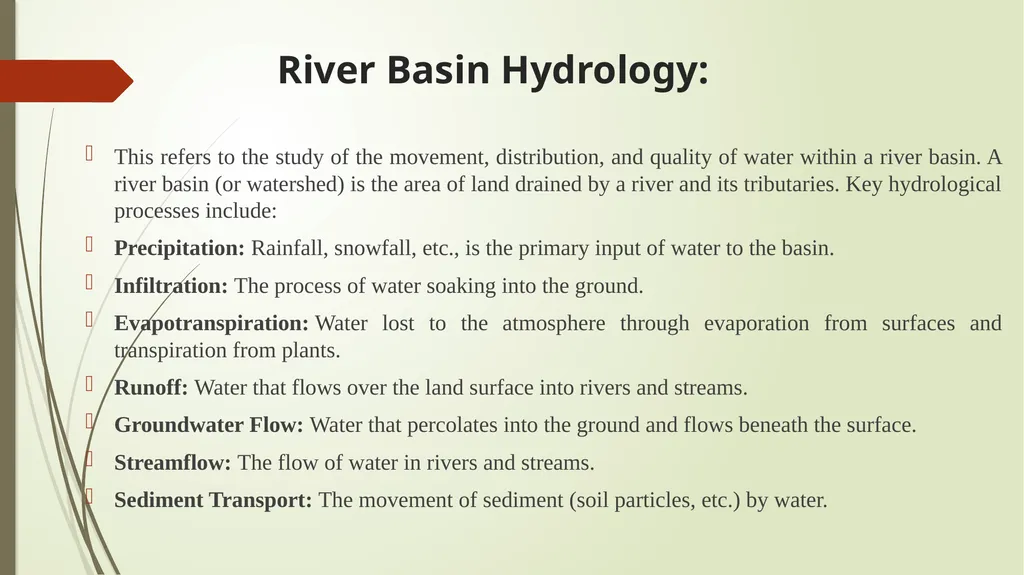
River Basin Hydrology: This refers to the study of the movement, distribution, and quality of water within a river basin. A river basin (or watershed) is the area of land drained by a river and its tributaries. Key hydrological processes include:
Precipitation: Rainfall, snowfall, etc., is the primary input of water to the basin.
Infiltration: The process of water soaking into the ground.
Evapotranspiration: Water lost to the atmosphere through evaporation from surfaces and transpiration from plants.
Runoff: Water that flows over the land surface into rivers and streams.
Groundwater Flow: Water that percolates into the ground and flows beneath the surface.
Streamflow: The flow of water in rivers and streams.
Sediment Transport: The movement of sediment (soil particles, etc.) by water.<br>
Precipitation: Rainfall, snowfall, etc., is the primary input of water to the basin.
Infiltration: The process of water soaking into the ground.
Evapotranspiration: Water lost to the atmosphere through evaporation from surfaces and transpiration from plants.
Runoff: Water that flows over the land surface into rivers and streams.
Groundwater Flow: Water that percolates into the ground and flows beneath the surface.
Streamflow: The flow of water in rivers and streams.
Sediment Transport: The movement of sediment (soil particles, etc.) by water.<br>
04
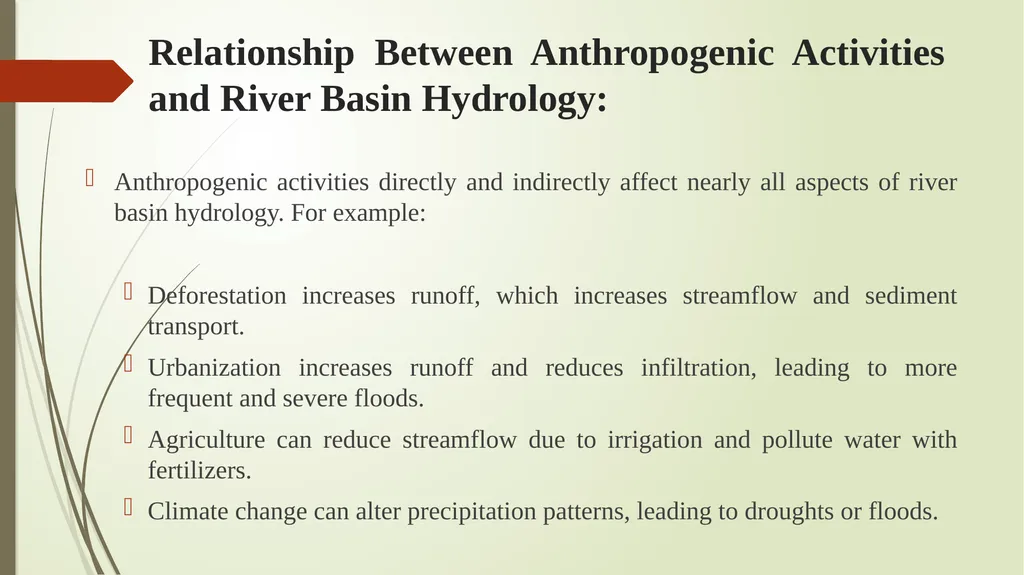
Relationship Between Anthropogenic Activities and River Basin Hydrology: Anthropogenic activities directly and indirectly affect nearly all aspects of river basin hydrology. For example:
Deforestation increases runoff, which increases streamflow and sediment transport.
Urbanization increases runoff and reduces infiltration, leading to more frequent and severe floods.
Agriculture can reduce streamflow due to irrigation and pollute water with fertilizers.
Climate change can alter precipitation patterns, leading to droughts or floods.<br>
Deforestation increases runoff, which increases streamflow and sediment transport.
Urbanization increases runoff and reduces infiltration, leading to more frequent and severe floods.
Agriculture can reduce streamflow due to irrigation and pollute water with fertilizers.
Climate change can alter precipitation patterns, leading to droughts or floods.<br>
05
The study of this relationship is crucial for:
Water Resource Management: Ensuring sustainable water supplies for human use and ecological health.
Flood Control: Reducing the risk of flooding through better land management and infrastructure.
Water Quality Protection: Preventing pollution of rivers and streams.
Ecosystem Conservation: Protecting aquatic habitats and biodiversity.
Climate Change Adaptation: Developing strategies to cope with the impacts of climate change on water resources. Relationship Between Anthropogenic Activities and River Basin Hydrology:<br>
Water Resource Management: Ensuring sustainable water supplies for human use and ecological health.
Flood Control: Reducing the risk of flooding through better land management and infrastructure.
Water Quality Protection: Preventing pollution of rivers and streams.
Ecosystem Conservation: Protecting aquatic habitats and biodiversity.
Climate Change Adaptation: Developing strategies to cope with the impacts of climate change on water resources. Relationship Between Anthropogenic Activities and River Basin Hydrology:<br>
06
Human Impacts Land Use Change:
Deforestation:
Impact: Reduced interception of rainfall, leading to increased surface runoff. Higher peak flows during storms, increased erosion, and sedimentation in rivers. Reduced baseflow during dry periods due to less infiltration. Can cause drier soils which leads to increased temperature of land.
Anomaly: Flashier hydrographs (rapid rise and fall in streamflow), increased sediment load, lower dry-season flows.
Agriculture:
Impact: Compaction of soil reduces infiltration. Irrigation diverts water from rivers, reducing downstream flow. Fertilizer and pesticide runoff pollutes water, leading to eutrophication and impacting aquatic ecosystems. Soil erosion from agricultural lands contributes to sedimentation and turbidity. Can lead to the drying out of rivers.
Anomaly: Reduced streamflow, altered water quality (increased nutrients, pesticides), increased sediment load, reduced dissolved oxygen.<br>
Deforestation:
Impact: Reduced interception of rainfall, leading to increased surface runoff. Higher peak flows during storms, increased erosion, and sedimentation in rivers. Reduced baseflow during dry periods due to less infiltration. Can cause drier soils which leads to increased temperature of land.
Anomaly: Flashier hydrographs (rapid rise and fall in streamflow), increased sediment load, lower dry-season flows.
Agriculture:
Impact: Compaction of soil reduces infiltration. Irrigation diverts water from rivers, reducing downstream flow. Fertilizer and pesticide runoff pollutes water, leading to eutrophication and impacting aquatic ecosystems. Soil erosion from agricultural lands contributes to sedimentation and turbidity. Can lead to the drying out of rivers.
Anomaly: Reduced streamflow, altered water quality (increased nutrients, pesticides), increased sediment load, reduced dissolved oxygen.<br>
07
Urbanization: Impact: Increased impervious surfaces (roads, buildings) dramatically increase runoff. Shorter lag times between rainfall and peak flow, leading to flash floods. Wastewater discharge pollutes rivers. Altered drainage patterns. The Heat Island effect leads to increased local temperatures.
Anomaly: Increased flood frequency and magnitude, reduced baseflow, altered water quality (increased pollutants), higher water temperatures.<br>
Anomaly: Increased flood frequency and magnitude, reduced baseflow, altered water quality (increased pollutants), higher water temperatures.<br>
08
Water Management: Dam Construction and Reservoirs:
Impact: Altered flow regimes (reduced peak flows, increased base flows downstream of the dam), blocked sediment transport, altered water temperature, changed fish migration patterns, increased evaporation losses. Disrupting the natural flood cycle can negatively affect floodplain ecosystems.
Anomaly: More stable but less natural streamflow, altered sediment distribution, changes in water temperature and nutrient levels, disrupted ecological processes. Reservoir induced seismicity.
Water Diversion and Abstraction:
Impact: Reduced downstream flow, increased salinity in coastal areas, loss of habitat for aquatic species, groundwater depletion (if abstraction exceeds recharge). Can lead to the complete drying up of rivers.
Anomaly: Lower streamflow, saltwater intrusion, reduced groundwater levels, altered ecological conditions.<br>
Impact: Altered flow regimes (reduced peak flows, increased base flows downstream of the dam), blocked sediment transport, altered water temperature, changed fish migration patterns, increased evaporation losses. Disrupting the natural flood cycle can negatively affect floodplain ecosystems.
Anomaly: More stable but less natural streamflow, altered sediment distribution, changes in water temperature and nutrient levels, disrupted ecological processes. Reservoir induced seismicity.
Water Diversion and Abstraction:
Impact: Reduced downstream flow, increased salinity in coastal areas, loss of habitat for aquatic species, groundwater depletion (if abstraction exceeds recharge). Can lead to the complete drying up of rivers.
Anomaly: Lower streamflow, saltwater intrusion, reduced groundwater levels, altered ecological conditions.<br>
09
Industrial Activities: Impact: Discharge of pollutants (heavy metals, chemicals, thermal pollution) can severely degrade water quality, harming aquatic life and making water unsuitable for human use.
Anomaly: Elevated levels of pollutants in water and sediments, reduced biodiversity, altered pH, increased water temperature.<br>
Anomaly: Elevated levels of pollutants in water and sediments, reduced biodiversity, altered pH, increased water temperature.<br>
10
Mining: Impact: Acid mine drainage (AMD) releases sulphuric acid and heavy metals into waterways, devastating aquatic ecosystems. Increased sediment load due to erosion from mining sites.
Anomaly: Extremely acidic water, high concentrations of heavy metals, loss of aquatic life, altered sediment load.<br>
Anomaly: Extremely acidic water, high concentrations of heavy metals, loss of aquatic life, altered sediment load.<br>
11
Climate Change (Anthropogenic Driven): Impact: Altered precipitation patterns (increased droughts in some areas, increased floods in others), increased frequency and intensity of extreme weather events, melting glaciers and snowpack affecting streamflow, sea-level rise causing saltwater intrusion in coastal areas, increased water temperatures.
Anomaly: More frequent and severe droughts and floods, altered streamflow timing, reduced water availability, saltwater intrusion, increased water temperatures.<br>
Anomaly: More frequent and severe droughts and floods, altered streamflow timing, reduced water availability, saltwater intrusion, increased water temperatures.<br>
12
Factors Causing Anomalies: Intensification of Land Use: As populations grow, there's increased pressure to convert natural landscapes into agricultural land, urban areas, or industrial zones. This leads to more drastic changes in hydrology.
Lack of Integrated Water Resource Management (IWRM): When water resources are managed in a fragmented way (e.g., focusing on a single sector like agriculture without considering the needs of other sectors or the environment), it can lead to unsustainable practices and hydrological anomalies.
Poorly Planned Infrastructure: Dams, canals, and other water infrastructure projects can have unintended consequences on river ecosystems and downstream water availability if they are not carefully planned and managed.<br>
Lack of Integrated Water Resource Management (IWRM): When water resources are managed in a fragmented way (e.g., focusing on a single sector like agriculture without considering the needs of other sectors or the environment), it can lead to unsustainable practices and hydrological anomalies.
Poorly Planned Infrastructure: Dams, canals, and other water infrastructure projects can have unintended consequences on river ecosystems and downstream water availability if they are not carefully planned and managed.<br>
13
Factors Causing Anomalies: Inadequate Pollution Control: Weak regulations and enforcement of pollution control measures allow industries and municipalities to discharge pollutants into waterways, leading to water quality degradation and ecological damage.
Deforestation and Reforestation Strategies: Improperly managed deforestation and reforestation strategies can change the albedo of a watershed, which changes the soil temperature and water characteristics in a given area.
Climate Change Feedback Loops: Hydrological anomalies can exacerbate climate change impacts. For example, deforestation reduces carbon sequestration and increases greenhouse gas emissions, further contributing to climate change and its effects on water resources.<br>
Deforestation and Reforestation Strategies: Improperly managed deforestation and reforestation strategies can change the albedo of a watershed, which changes the soil temperature and water characteristics in a given area.
Climate Change Feedback Loops: Hydrological anomalies can exacerbate climate change impacts. For example, deforestation reduces carbon sequestration and increases greenhouse gas emissions, further contributing to climate change and its effects on water resources.<br>