
AQA English Language – Paper 2, Section A Stuart
Description: AQA English Language Paper 2, Section A Stuart Pryke SPryke2 What makes students anxious about the paper? What can we do to rectify this? Where do we begin? What does perspective actually mean? What does the paper help us to DO as
Related Topics
Download Presentation
"AQA English Language – Paper 2, Section A Stuart" is the property of its rightful owner. Permission is granted to download and print the materials on this website for personal, non-commercial use only, and to display it on your personal computer provided you do not modify the materials and that you retain all copyright notices contained in the materials. By downloading content from our website, you accept the terms of this agreement.
Presentation Transcript
slide1. AQA English Language – Paper 2, Section A Stuart Pryke
@SPryke2 What makes students anxious about the paper?
What can we do to rectify this?
Where do we begin? What does perspective actually mean?
What does the paper help us to DO as teachers?
How can one approach each question?<br>
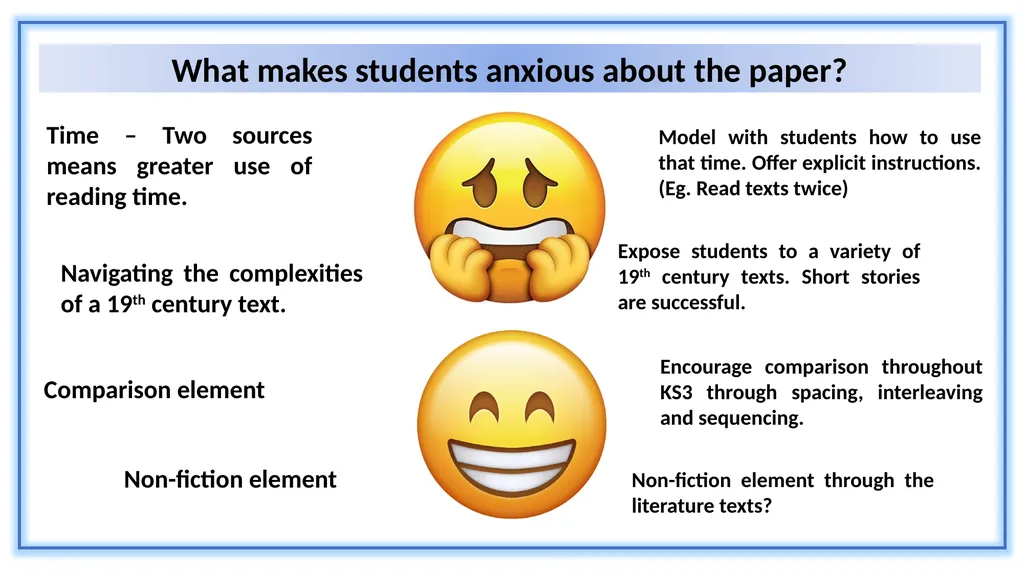
slide2. What makes students anxious about the paper? Time – Two sources means greater use of reading time. Navigating the complexities of a 19th century text. Comparison element Non-fiction element Model with students how to use that time. Offer explicit instructions. (Eg. Read texts twice) Expose students to a variety of 19th century texts. Short stories are successful. Encourage comparison throughout KS3 through spacing, interleaving and sequencing. Non-fiction element through the literature texts?<br>
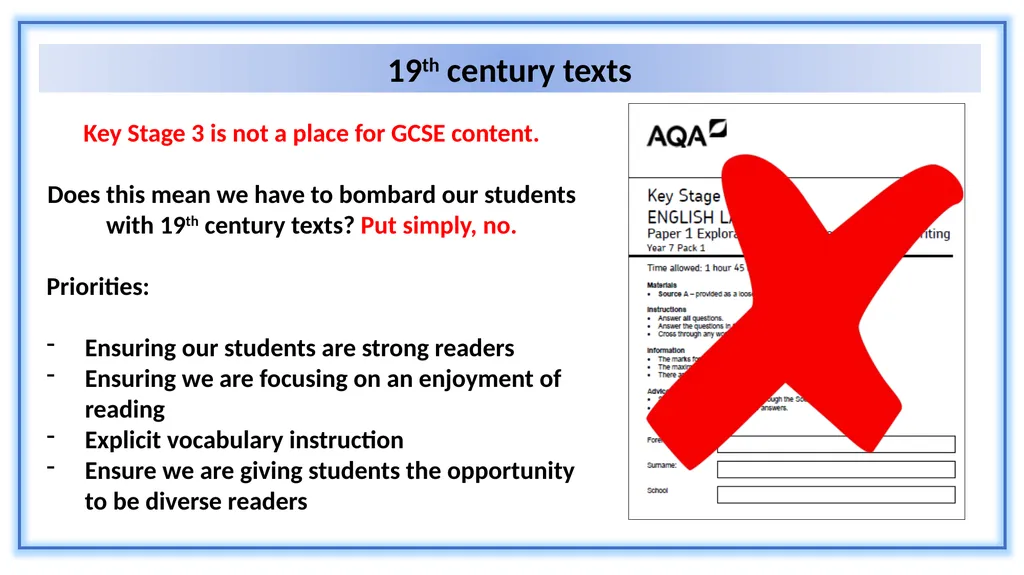
slide3. 19th century texts Key Stage 3 is not a place for GCSE content.
Does this mean we have to bombard our students with 19th century texts? Put simply, no.
Priorities:
Ensuring our students are strong readers
Ensuring we are focusing on an enjoyment of reading
Explicit vocabulary instruction
Ensure we are giving students the opportunity to be diverse readers<br>
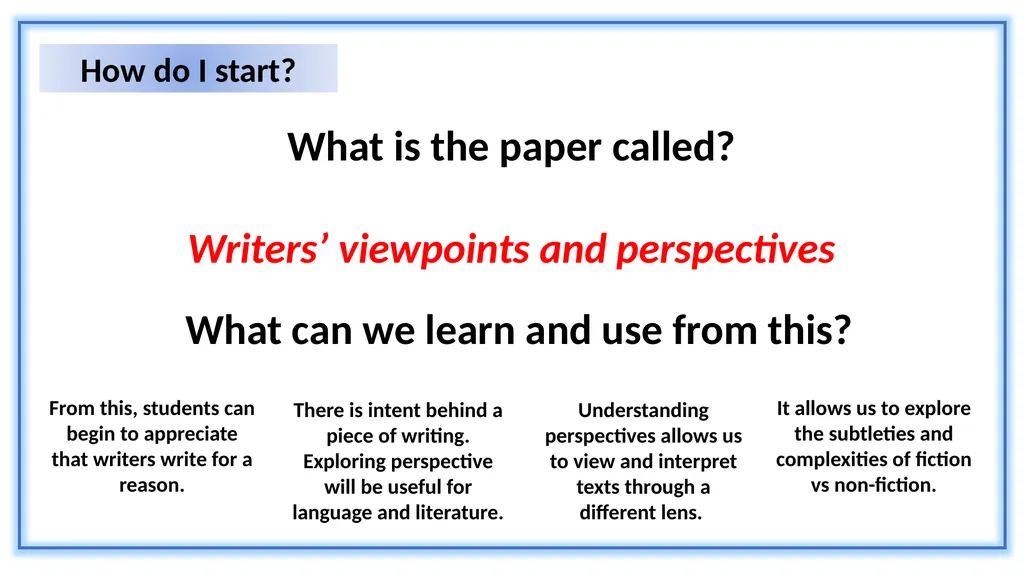
slide4. How do I start? What is the paper called?
Writers’ viewpoints and perspectives What can we learn and use from this? From this, students can begin to appreciate that writers write for a reason. There is intent behind a piece of writing. Exploring perspective will be useful for language and literature. Understanding perspectives allows us to view and interpret texts through a different lens. It allows us to explore the subtleties and complexities of fiction vs non-fiction.<br>
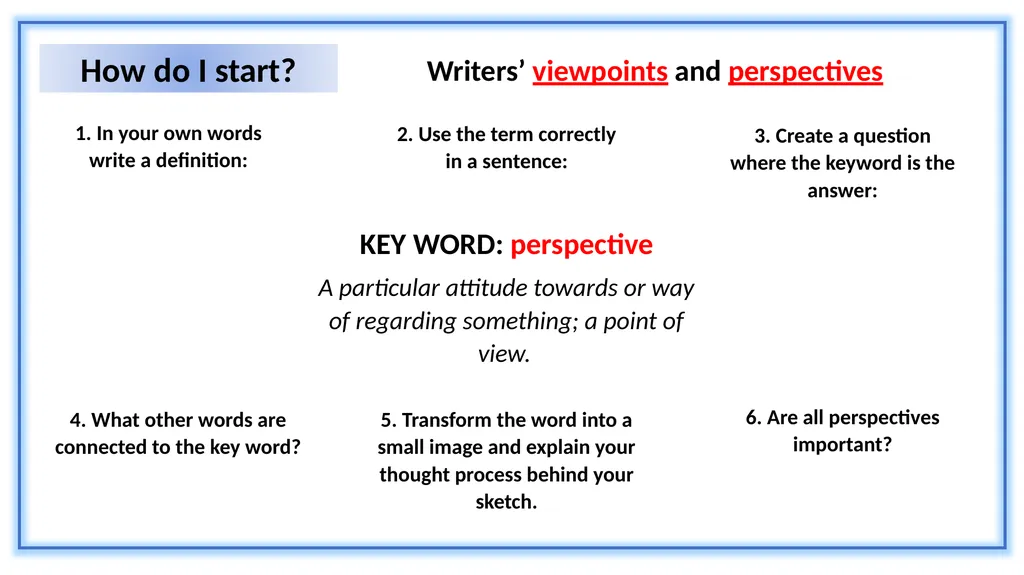
slide5. How do I start? Writers’ viewpoints and perspectives KEY WORD: perspective
A particular attitude towards or way of regarding something; a point of view. 1. In your own words write a definition: 2. Use the term correctly in a sentence: 3. Create a question where the keyword is the answer: 4. What other words are connected to the key word? 6. Are all perspectives important? 5. Transform the word into a small image and explain your thought process behind your sketch.<br>
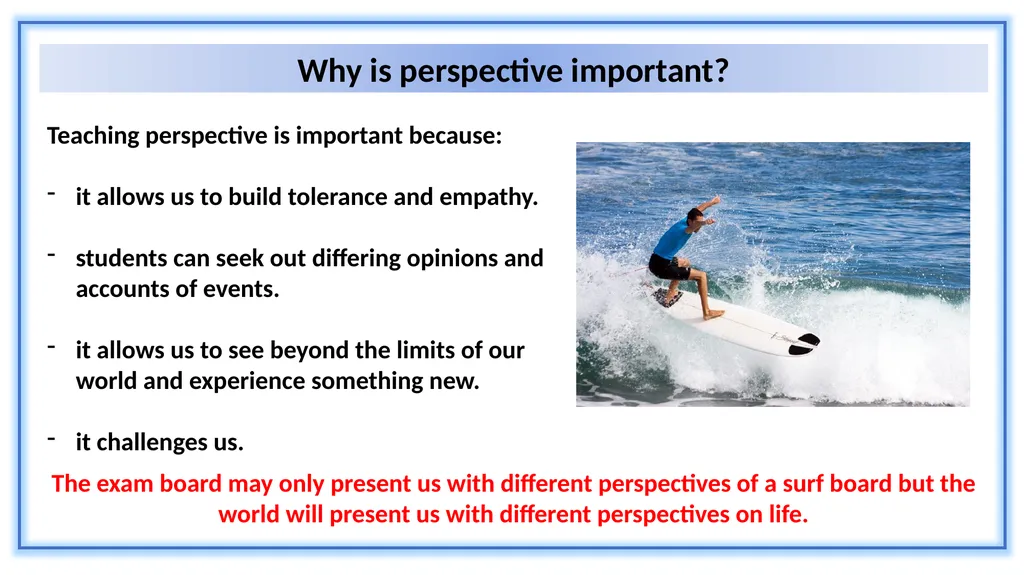
slide6. Why is perspective important? Teaching perspective is important because:
it allows us to build tolerance and empathy.
students can seek out differing opinions and accounts of events.
it allows us to see beyond the limits of our world and experience something new.
it challenges us. The exam board may only present us with different perspectives of a surf board but the world will present us with different perspectives on life.<br>
slide7. Paper 2,
Section A – Question 1<br>
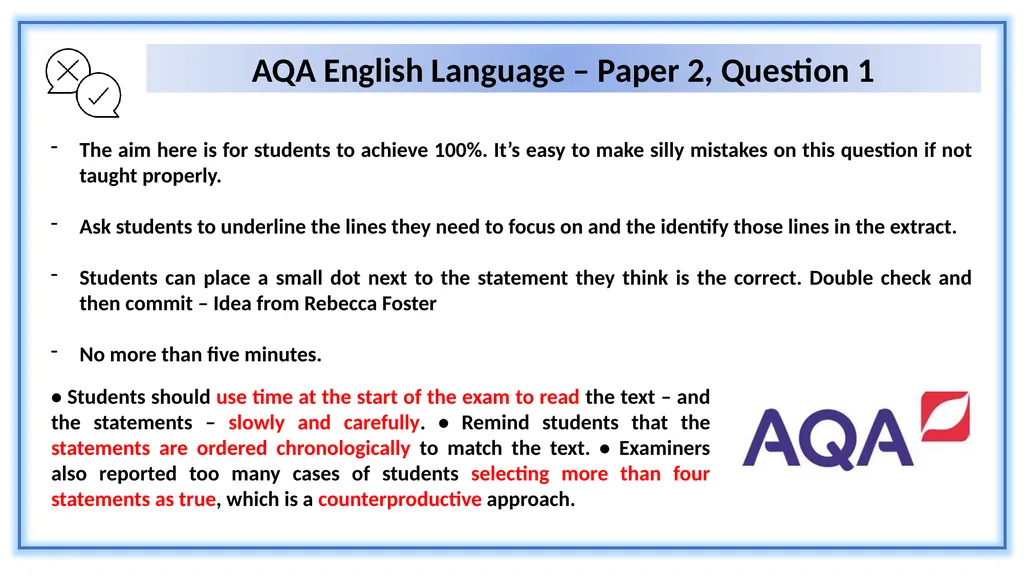
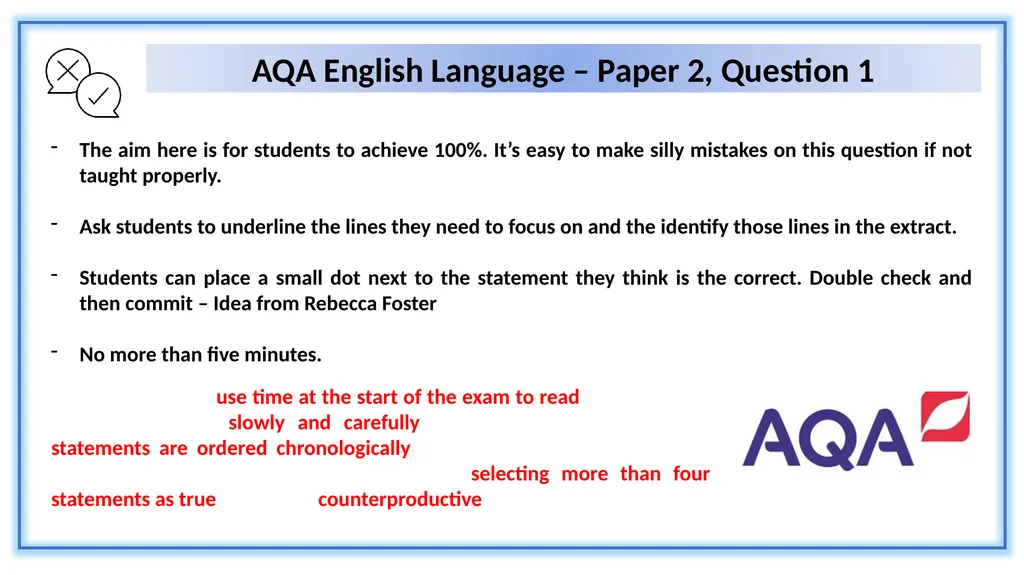
slide8. AQA English Language – Paper 2, Question 1 • Students should use time at the start of the exam to read the text – and the statements – slowly and carefully. • Remind students that the statements are ordered chronologically to match the text. • Examiners also reported too many cases of students selecting more than four statements as true, which is a counterproductive approach. The aim here is for students to achieve 100%. It’s easy to make silly mistakes on this question if not taught properly.
Ask students to underline the lines they need to focus on and the identify those lines in the extract.
Students can place a small dot next to the statement they think is the correct. Double check and then commit – Idea from Rebecca Foster
No more than five minutes.<br>
slide9. AQA English Language – Paper 2, Question 1 • Students should use time at the start of the exam to read the text – and the statements – slowly and carefully. • Remind students that the statements are ordered chronologically to match the text. • Examiners also reported too many cases of students selecting more than four statements as true, which is a counterproductive approach. The aim here is for students to achieve 100%. It’s easy to make silly mistakes on this question if not taught properly.
Ask students to underline the lines they need to focus on and the identify those lines in the extract.
Students can place a small dot next to the statement they think is the correct. Double check and then commit – Idea from Rebecca Foster
No more than five minutes.<br>
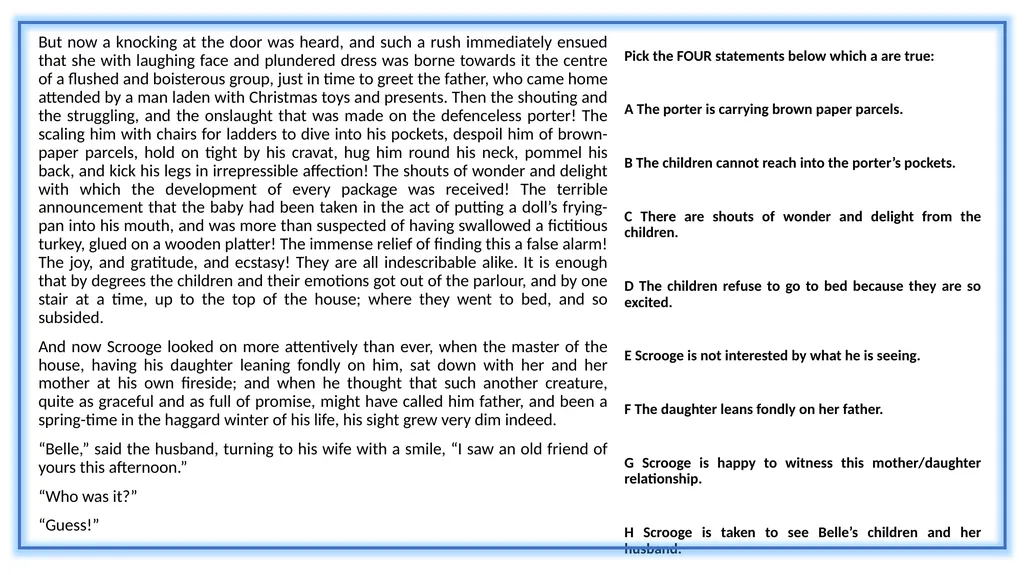
slide10. But now a knocking at the door was heard, and such a rush immediately ensued that she with laughing face and plundered dress was borne towards it the centre of a flushed and boisterous group, just in time to greet the father, who came home attended by a man laden with Christmas toys and presents. Then the shouting and the struggling, and the onslaught that was made on the defenceless porter! The scaling him with chairs for ladders to dive into his pockets, despoil him of brown-paper parcels, hold on tight by his cravat, hug him round his neck, pommel his back, and kick his legs in irrepressible affection! The shouts of wonder and delight with which the development of every package was received! The terrible announcement that the baby had been taken in the act of putting a doll’s frying-pan into his mouth, and was more than suspected of having swallowed a fictitious turkey, glued on a wooden platter! The immense relief of finding this a false alarm! The joy, and gratitude, and ecstasy! They are all indescribable alike. It is enough that by degrees the children and their emotions got out of the parlour, and by one stair at a time, up to the top of the house; where they went to bed, and so subsided.
And now Scrooge looked on more attentively than ever, when the master of the house, having his daughter leaning fondly on him, sat down with her and her mother at his own fireside; and when he thought that such another creature, quite as graceful and as full of promise, might have called him father, and been a spring-time in the haggard winter of his life, his sight grew very dim indeed.
“Belle,” said the husband, turning to his wife with a smile, “I saw an old friend of yours this afternoon.”
“Who was it?”
“Guess!” Pick the FOUR statements below which a are true:
A The porter is carrying brown paper parcels.
B The children cannot reach into the porter’s pockets.
C There are shouts of wonder and delight from the children.
D The children refuse to go to bed because they are so excited.
E Scrooge is not interested by what he is seeing.
F The daughter leans fondly on her father.
G Scrooge is happy to witness this mother/daughter relationship.
H Scrooge is taken to see Belle’s children and her husband.<br>
slide11. Paper 2,
Section A – Question 2<br>
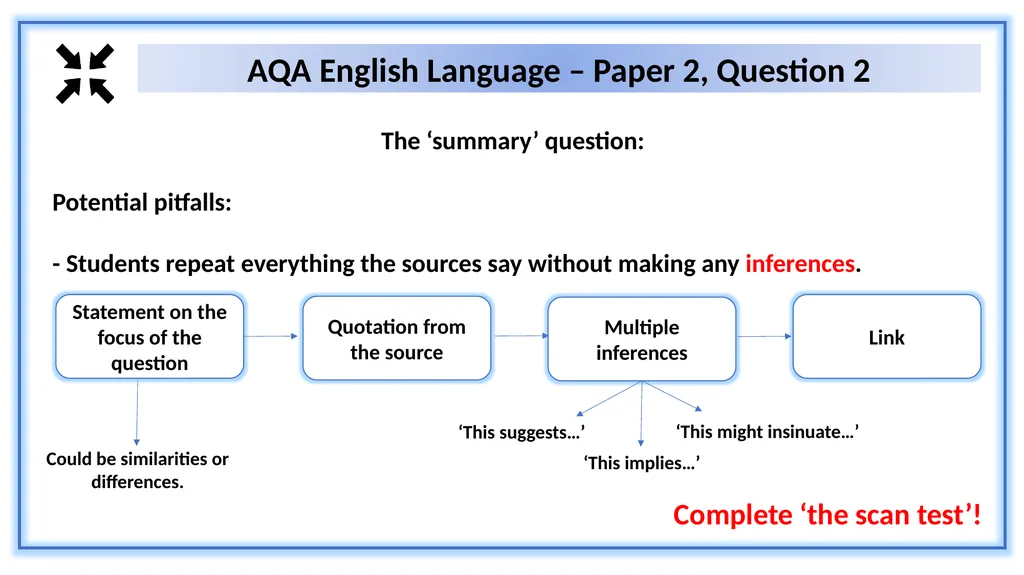
slide12. AQA English Language – Paper 2, Question 2 The ‘summary’ question:
Potential pitfalls:
- Students repeat everything the sources say without making any inferences. Statement on the focus of the question Quotation from the source Multiple inferences Link ‘This suggests…’ ‘This implies…’ ‘This might insinuate…’ Could be similarities or differences. Complete ‘the scan test’!<br>
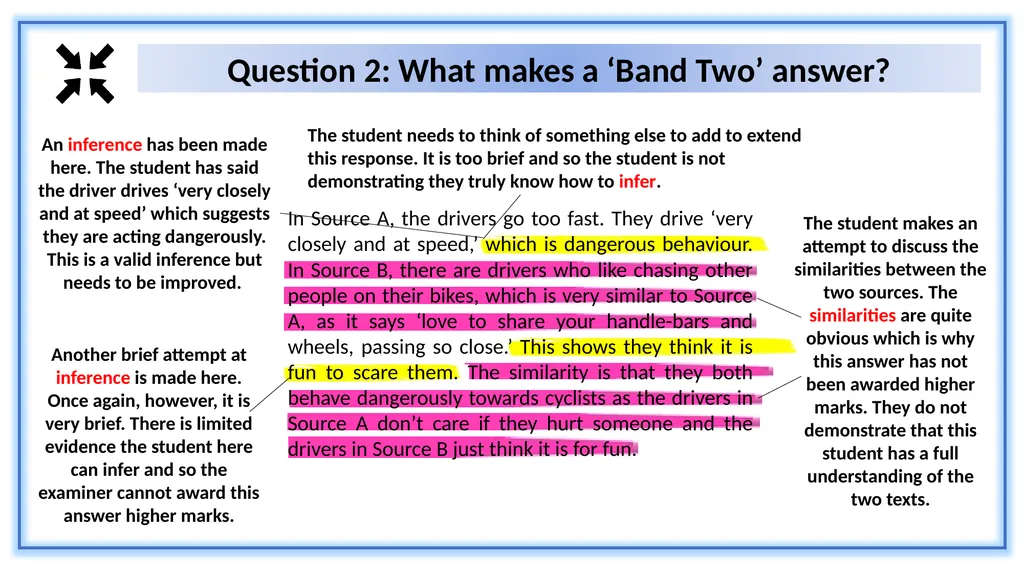
slide13. Question 2: What makes a ‘Band Two’ answer? In Source A, the drivers go too fast. They drive ‘very closely and at speed,’ which is dangerous behaviour. In Source B, there are drivers who like chasing other people on their bikes, which is very similar to Source A, as it says ‘love to share your handle-bars and wheels, passing so close.’ This shows they think it is fun to scare them. The similarity is that they both behave dangerously towards cyclists as the drivers in Source A don’t care if they hurt someone and the drivers in Source B just think it is for fun. An inference has been made here. The student has said the driver drives ‘very closely and at speed’ which suggests they are acting dangerously. This is a valid inference but needs to be improved. The student needs to think of something else to add to extend this response. It is too brief and so the student is not demonstrating they truly know how to infer. Another brief attempt at inference is made here. Once again, however, it is very brief. There is limited evidence the student here can infer and so the examiner cannot award this answer higher marks. The student makes an attempt to discuss the similarities between the two sources. The similarities are quite obvious which is why this answer has not been awarded higher marks. They do not demonstrate that this student has a full understanding of the two texts.<br>
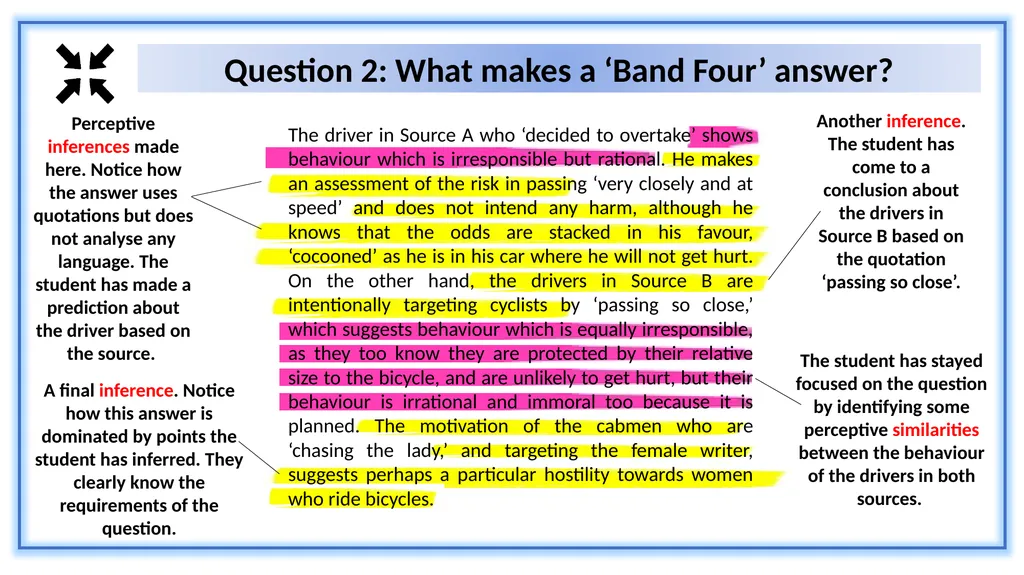
slide14. Question 2: What makes a ‘Band Four’ answer? The driver in Source A who ‘decided to overtake’ shows behaviour which is irresponsible but rational. He makes an assessment of the risk in passing ‘very closely and at speed’ and does not intend any harm, although he knows that the odds are stacked in his favour, ‘cocooned’ as he is in his car where he will not get hurt. On the other hand, the drivers in Source B are intentionally targeting cyclists by ‘passing so close,’ which suggests behaviour which is equally irresponsible, as they too know they are protected by their relative size to the bicycle, and are unlikely to get hurt, but their behaviour is irrational and immoral too because it is planned. The motivation of the cabmen who are ‘chasing the lady,’ and targeting the female writer, suggests perhaps a particular hostility towards women who ride bicycles. Perceptive inferences made here. Notice how the answer uses quotations but does not analyse any language. The student has made a prediction about the driver based on the source. Another inference. The student has come to a conclusion about the drivers in Source B based on the quotation ‘passing so close’. The student has stayed focused on the question by identifying some perceptive similarities between the behaviour of the drivers in both sources. A final inference. Notice how this answer is dominated by points the student has inferred. They clearly know the requirements of the question.<br>
slide15. Paper 2,
Section A – Question 3<br>
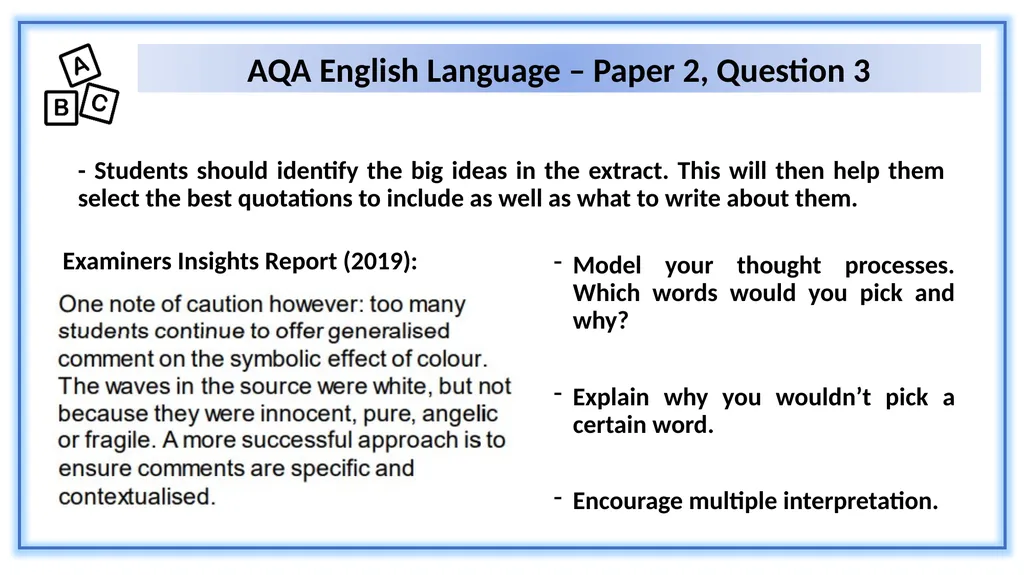
slide16. - Students should identify the big ideas in the extract. This will then help them select the best quotations to include as well as what to write about them. AQA English Language – Paper 2, Question 3 9 Examiners Insights Report (2019): Model your thought processes. Which words would you pick and why?
Explain why you wouldn’t pick a certain word.
Encourage multiple interpretation.<br>
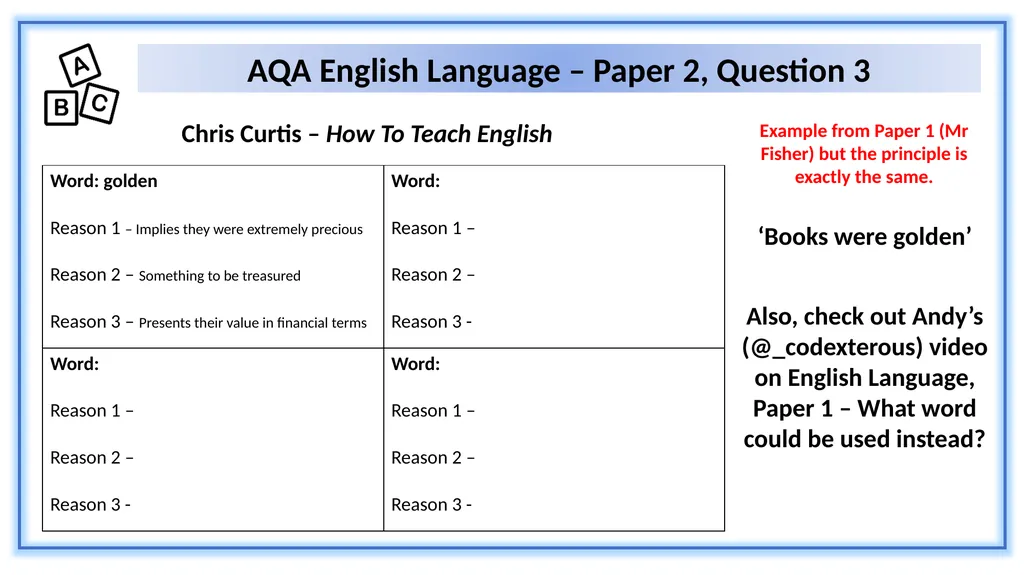
slide17. AQA English Language – Paper 2, Question 3 Example from Paper 1 (Mr Fisher) but the principle is exactly the same. Chris Curtis – How To Teach English ‘Books were golden’ Also, check out Andy’s (@_codexterous) video on English Language, Paper 1 – What word could be used instead?<br>
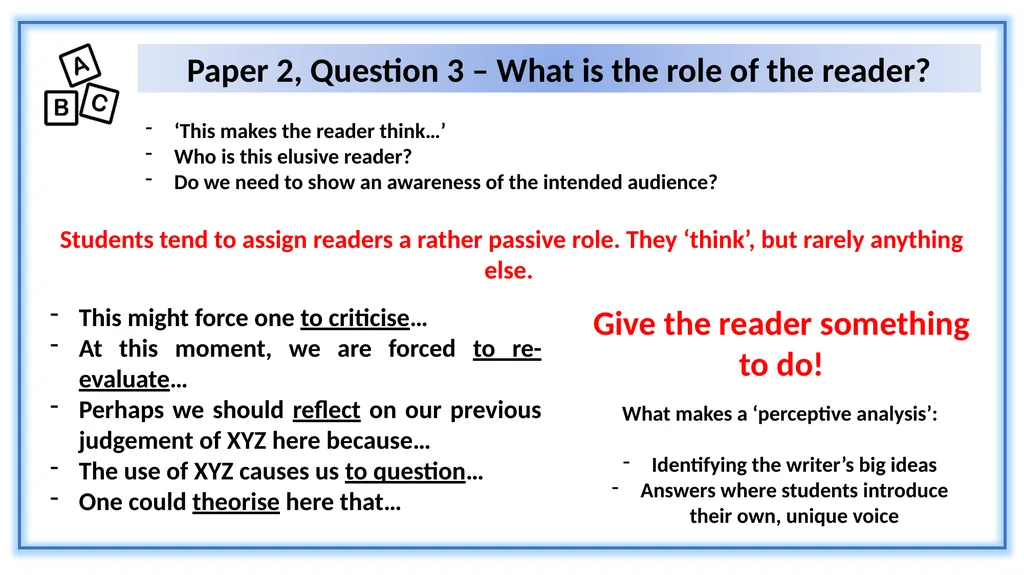
slide18. Paper 2, Question 3 – What is the role of the reader? ‘This makes the reader think…’
Who is this elusive reader?
Do we need to show an awareness of the intended audience? Students tend to assign readers a rather passive role. They ‘think’, but rarely anything else. This might force one to criticise…
At this moment, we are forced to re-evaluate…
Perhaps we should reflect on our previous judgement of XYZ here because…
The use of XYZ causes us to question…
One could theorise here that… Give the reader something to do! What makes a ‘perceptive analysis’:
Identifying the writer’s big ideas
Answers where students introduce their own, unique voice<br>
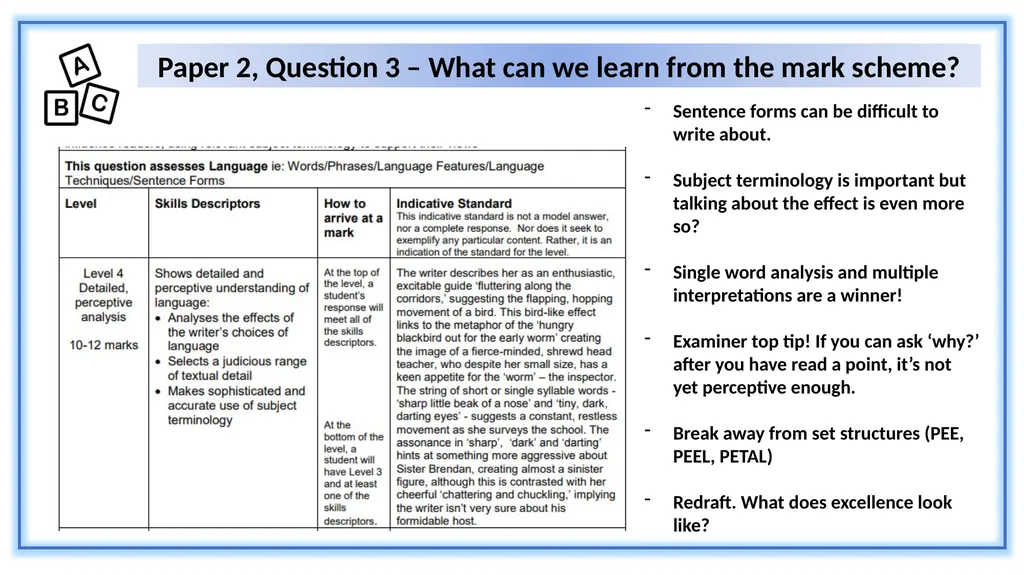
slide19. Paper 2, Question 3 – What can we learn from the mark scheme? Sentence forms can be difficult to write about.
Subject terminology is important but talking about the effect is even more so?
Single word analysis and multiple interpretations are a winner!
Examiner top tip! If you can ask ‘why?’ after you have read a point, it’s not yet perceptive enough.
Break away from set structures (PEE, PEEL, PETAL)
Redraft. What does excellence look like?<br>
slide20. Paper 2,
Section A – Question 4 The synoptic question!<br>
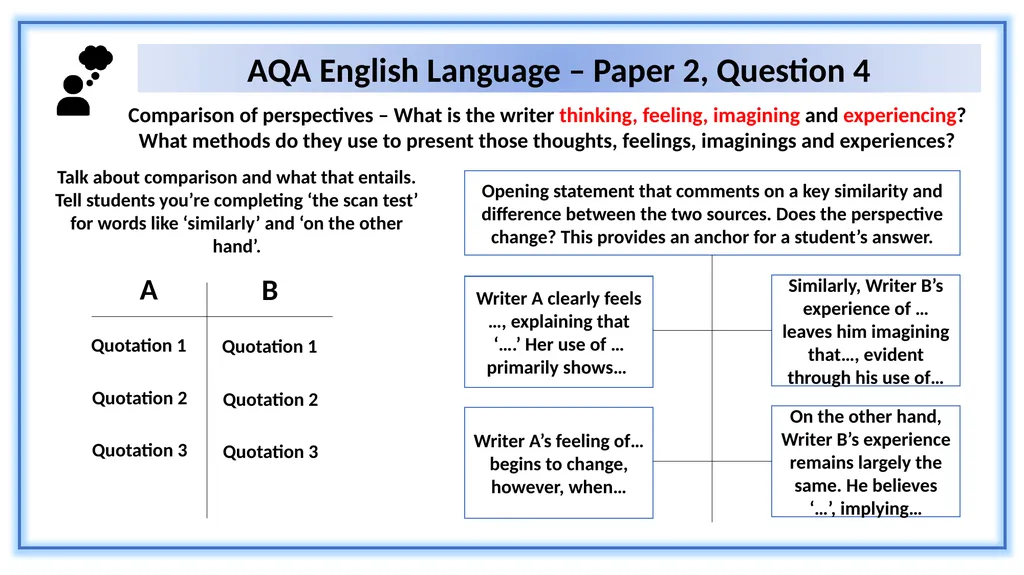
slide21. AQA English Language – Paper 2, Question 4 Comparison of perspectives – What is the writer thinking, feeling, imagining and experiencing? What methods do they use to present those thoughts, feelings, imaginings and experiences? A B Quotation 1 Quotation 2 Quotation 3 Quotation 1 Quotation 2 Quotation 3 Opening statement that comments on a key similarity and difference between the two sources. Does the perspective change? This provides an anchor for a student’s answer. Writer A clearly feels …, explaining that ‘….’ Her use of … primarily shows… Similarly, Writer B’s experience of … leaves him imagining that…, evident through his use of… Writer A’s feeling of… begins to change, however, when… On the other hand, Writer B’s experience remains largely the same. He believes ‘…’, implying… Talk about comparison and what that entails.
Tell students you’re completing ‘the scan test’ for words like ‘similarly’ and ‘on the other hand’.<br>
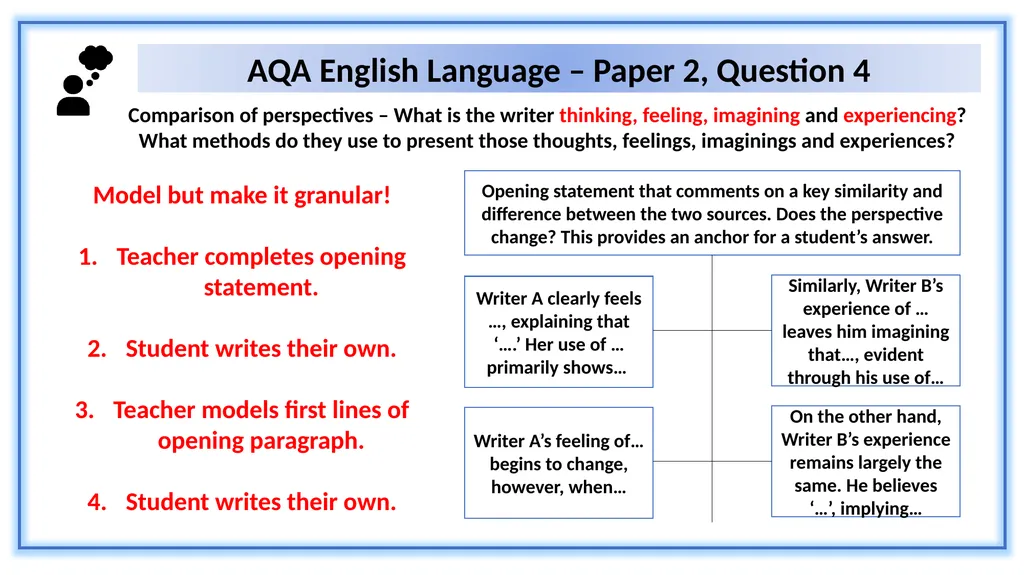
slide22. AQA English Language – Paper 2, Question 4 Comparison of perspectives – What is the writer thinking, feeling, imagining and experiencing? What methods do they use to present those thoughts, feelings, imaginings and experiences? Opening statement that comments on a key similarity and difference between the two sources. Does the perspective change? This provides an anchor for a student’s answer. Writer A clearly feels …, explaining that ‘….’ Her use of … primarily shows… Similarly, Writer B’s experience of … leaves him imagining that…, evident through his use of… Writer A’s feeling of… begins to change, however, when… On the other hand, Writer B’s experience remains largely the same. He believes ‘…’, implying… Model but make it granular!
Teacher completes opening statement.
Student writes their own.
Teacher models first lines of opening paragraph.
Student writes their own.<br>
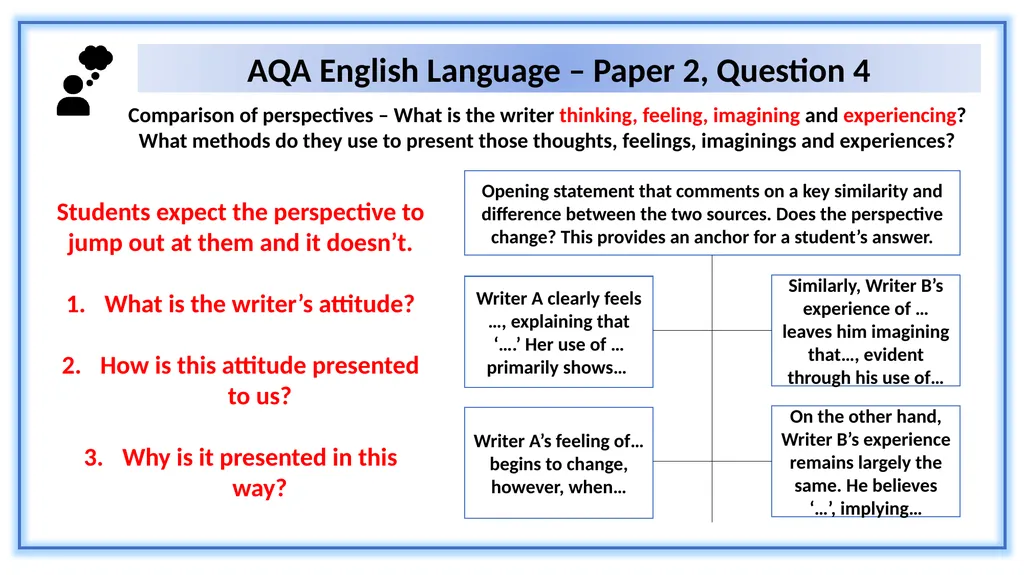
slide23. AQA English Language – Paper 2, Question 4 Comparison of perspectives – What is the writer thinking, feeling, imagining and experiencing? What methods do they use to present those thoughts, feelings, imaginings and experiences? Opening statement that comments on a key similarity and difference between the two sources. Does the perspective change? This provides an anchor for a student’s answer. Writer A clearly feels …, explaining that ‘….’ Her use of … primarily shows… Similarly, Writer B’s experience of … leaves him imagining that…, evident through his use of… Writer A’s feeling of… begins to change, however, when… On the other hand, Writer B’s experience remains largely the same. He believes ‘…’, implying… Students expect the perspective to jump out at them and it doesn’t.
What is the writer’s attitude?
How is this attitude presented to us?
Why is it presented in this way?<br>
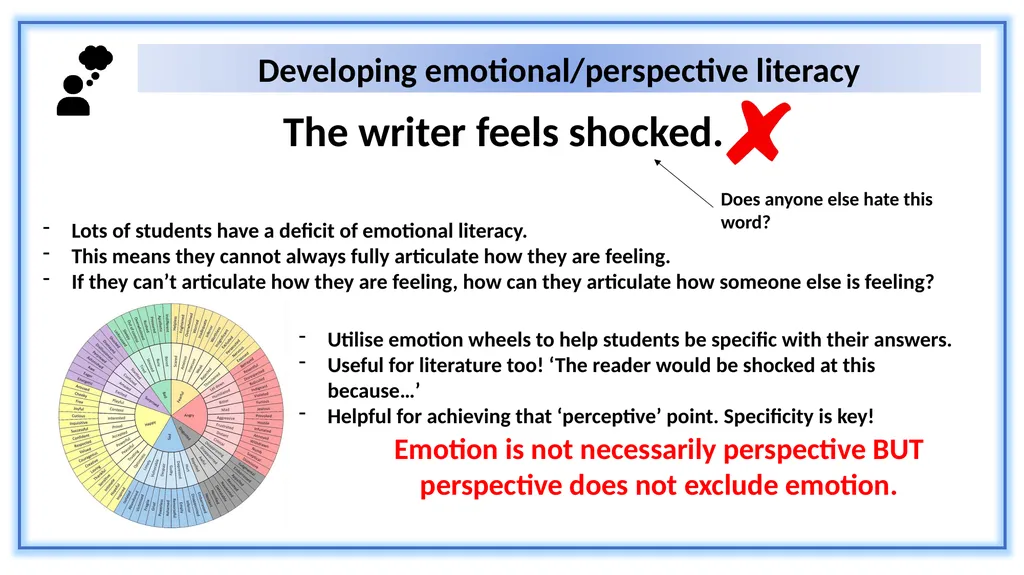
slide24. Developing emotional/perspective literacy The writer feels shocked. Lots of students have a deficit of emotional literacy.
This means they cannot always fully articulate how they are feeling.
If they can’t articulate how they are feeling, how can they articulate how someone else is feeling? Does anyone else hate this word? Utilise emotion wheels to help students be specific with their answers.
Useful for literature too! ‘The reader would be shocked at this because…’
Helpful for achieving that ‘perceptive’ point. Specificity is key! Emotion is not necessarily perspective BUT perspective does not exclude emotion.<br>
slide25. AQA English Language – Top tips! Encourage students to use the majority of their reading time. It will help them access the harder paper.
Lots of modelling! Make things granular and model each step of a paragraph rather than a whole paragraph at once.
Teach students why perspective is important. What can we gain from considering perspective.
Model what excellence looks like. Get students to redraft and compare their answers.
Focus on comparison.<br>
@SPryke2 What makes students anxious about the paper?
What can we do to rectify this?
Where do we begin? What does perspective actually mean?
What does the paper help us to DO as teachers?
How can one approach each question?<br>
slide2. What makes students anxious about the paper? Time – Two sources means greater use of reading time. Navigating the complexities of a 19th century text. Comparison element Non-fiction element Model with students how to use that time. Offer explicit instructions. (Eg. Read texts twice) Expose students to a variety of 19th century texts. Short stories are successful. Encourage comparison throughout KS3 through spacing, interleaving and sequencing. Non-fiction element through the literature texts?<br>
slide3. 19th century texts Key Stage 3 is not a place for GCSE content.
Does this mean we have to bombard our students with 19th century texts? Put simply, no.
Priorities:
Ensuring our students are strong readers
Ensuring we are focusing on an enjoyment of reading
Explicit vocabulary instruction
Ensure we are giving students the opportunity to be diverse readers<br>
slide4. How do I start? What is the paper called?
Writers’ viewpoints and perspectives What can we learn and use from this? From this, students can begin to appreciate that writers write for a reason. There is intent behind a piece of writing. Exploring perspective will be useful for language and literature. Understanding perspectives allows us to view and interpret texts through a different lens. It allows us to explore the subtleties and complexities of fiction vs non-fiction.<br>
slide5. How do I start? Writers’ viewpoints and perspectives KEY WORD: perspective
A particular attitude towards or way of regarding something; a point of view. 1. In your own words write a definition: 2. Use the term correctly in a sentence: 3. Create a question where the keyword is the answer: 4. What other words are connected to the key word? 6. Are all perspectives important? 5. Transform the word into a small image and explain your thought process behind your sketch.<br>
slide6. Why is perspective important? Teaching perspective is important because:
it allows us to build tolerance and empathy.
students can seek out differing opinions and accounts of events.
it allows us to see beyond the limits of our world and experience something new.
it challenges us. The exam board may only present us with different perspectives of a surf board but the world will present us with different perspectives on life.<br>
slide7. Paper 2,
Section A – Question 1<br>
slide8. AQA English Language – Paper 2, Question 1 • Students should use time at the start of the exam to read the text – and the statements – slowly and carefully. • Remind students that the statements are ordered chronologically to match the text. • Examiners also reported too many cases of students selecting more than four statements as true, which is a counterproductive approach. The aim here is for students to achieve 100%. It’s easy to make silly mistakes on this question if not taught properly.
Ask students to underline the lines they need to focus on and the identify those lines in the extract.
Students can place a small dot next to the statement they think is the correct. Double check and then commit – Idea from Rebecca Foster
No more than five minutes.<br>
slide9. AQA English Language – Paper 2, Question 1 • Students should use time at the start of the exam to read the text – and the statements – slowly and carefully. • Remind students that the statements are ordered chronologically to match the text. • Examiners also reported too many cases of students selecting more than four statements as true, which is a counterproductive approach. The aim here is for students to achieve 100%. It’s easy to make silly mistakes on this question if not taught properly.
Ask students to underline the lines they need to focus on and the identify those lines in the extract.
Students can place a small dot next to the statement they think is the correct. Double check and then commit – Idea from Rebecca Foster
No more than five minutes.<br>
slide10. But now a knocking at the door was heard, and such a rush immediately ensued that she with laughing face and plundered dress was borne towards it the centre of a flushed and boisterous group, just in time to greet the father, who came home attended by a man laden with Christmas toys and presents. Then the shouting and the struggling, and the onslaught that was made on the defenceless porter! The scaling him with chairs for ladders to dive into his pockets, despoil him of brown-paper parcels, hold on tight by his cravat, hug him round his neck, pommel his back, and kick his legs in irrepressible affection! The shouts of wonder and delight with which the development of every package was received! The terrible announcement that the baby had been taken in the act of putting a doll’s frying-pan into his mouth, and was more than suspected of having swallowed a fictitious turkey, glued on a wooden platter! The immense relief of finding this a false alarm! The joy, and gratitude, and ecstasy! They are all indescribable alike. It is enough that by degrees the children and their emotions got out of the parlour, and by one stair at a time, up to the top of the house; where they went to bed, and so subsided.
And now Scrooge looked on more attentively than ever, when the master of the house, having his daughter leaning fondly on him, sat down with her and her mother at his own fireside; and when he thought that such another creature, quite as graceful and as full of promise, might have called him father, and been a spring-time in the haggard winter of his life, his sight grew very dim indeed.
“Belle,” said the husband, turning to his wife with a smile, “I saw an old friend of yours this afternoon.”
“Who was it?”
“Guess!” Pick the FOUR statements below which a are true:
A The porter is carrying brown paper parcels.
B The children cannot reach into the porter’s pockets.
C There are shouts of wonder and delight from the children.
D The children refuse to go to bed because they are so excited.
E Scrooge is not interested by what he is seeing.
F The daughter leans fondly on her father.
G Scrooge is happy to witness this mother/daughter relationship.
H Scrooge is taken to see Belle’s children and her husband.<br>
slide11. Paper 2,
Section A – Question 2<br>
slide12. AQA English Language – Paper 2, Question 2 The ‘summary’ question:
Potential pitfalls:
- Students repeat everything the sources say without making any inferences. Statement on the focus of the question Quotation from the source Multiple inferences Link ‘This suggests…’ ‘This implies…’ ‘This might insinuate…’ Could be similarities or differences. Complete ‘the scan test’!<br>
slide13. Question 2: What makes a ‘Band Two’ answer? In Source A, the drivers go too fast. They drive ‘very closely and at speed,’ which is dangerous behaviour. In Source B, there are drivers who like chasing other people on their bikes, which is very similar to Source A, as it says ‘love to share your handle-bars and wheels, passing so close.’ This shows they think it is fun to scare them. The similarity is that they both behave dangerously towards cyclists as the drivers in Source A don’t care if they hurt someone and the drivers in Source B just think it is for fun. An inference has been made here. The student has said the driver drives ‘very closely and at speed’ which suggests they are acting dangerously. This is a valid inference but needs to be improved. The student needs to think of something else to add to extend this response. It is too brief and so the student is not demonstrating they truly know how to infer. Another brief attempt at inference is made here. Once again, however, it is very brief. There is limited evidence the student here can infer and so the examiner cannot award this answer higher marks. The student makes an attempt to discuss the similarities between the two sources. The similarities are quite obvious which is why this answer has not been awarded higher marks. They do not demonstrate that this student has a full understanding of the two texts.<br>
slide14. Question 2: What makes a ‘Band Four’ answer? The driver in Source A who ‘decided to overtake’ shows behaviour which is irresponsible but rational. He makes an assessment of the risk in passing ‘very closely and at speed’ and does not intend any harm, although he knows that the odds are stacked in his favour, ‘cocooned’ as he is in his car where he will not get hurt. On the other hand, the drivers in Source B are intentionally targeting cyclists by ‘passing so close,’ which suggests behaviour which is equally irresponsible, as they too know they are protected by their relative size to the bicycle, and are unlikely to get hurt, but their behaviour is irrational and immoral too because it is planned. The motivation of the cabmen who are ‘chasing the lady,’ and targeting the female writer, suggests perhaps a particular hostility towards women who ride bicycles. Perceptive inferences made here. Notice how the answer uses quotations but does not analyse any language. The student has made a prediction about the driver based on the source. Another inference. The student has come to a conclusion about the drivers in Source B based on the quotation ‘passing so close’. The student has stayed focused on the question by identifying some perceptive similarities between the behaviour of the drivers in both sources. A final inference. Notice how this answer is dominated by points the student has inferred. They clearly know the requirements of the question.<br>
slide15. Paper 2,
Section A – Question 3<br>
slide16. - Students should identify the big ideas in the extract. This will then help them select the best quotations to include as well as what to write about them. AQA English Language – Paper 2, Question 3 9 Examiners Insights Report (2019): Model your thought processes. Which words would you pick and why?
Explain why you wouldn’t pick a certain word.
Encourage multiple interpretation.<br>
slide17. AQA English Language – Paper 2, Question 3 Example from Paper 1 (Mr Fisher) but the principle is exactly the same. Chris Curtis – How To Teach English ‘Books were golden’ Also, check out Andy’s (@_codexterous) video on English Language, Paper 1 – What word could be used instead?<br>
slide18. Paper 2, Question 3 – What is the role of the reader? ‘This makes the reader think…’
Who is this elusive reader?
Do we need to show an awareness of the intended audience? Students tend to assign readers a rather passive role. They ‘think’, but rarely anything else. This might force one to criticise…
At this moment, we are forced to re-evaluate…
Perhaps we should reflect on our previous judgement of XYZ here because…
The use of XYZ causes us to question…
One could theorise here that… Give the reader something to do! What makes a ‘perceptive analysis’:
Identifying the writer’s big ideas
Answers where students introduce their own, unique voice<br>
slide19. Paper 2, Question 3 – What can we learn from the mark scheme? Sentence forms can be difficult to write about.
Subject terminology is important but talking about the effect is even more so?
Single word analysis and multiple interpretations are a winner!
Examiner top tip! If you can ask ‘why?’ after you have read a point, it’s not yet perceptive enough.
Break away from set structures (PEE, PEEL, PETAL)
Redraft. What does excellence look like?<br>
slide20. Paper 2,
Section A – Question 4 The synoptic question!<br>
slide21. AQA English Language – Paper 2, Question 4 Comparison of perspectives – What is the writer thinking, feeling, imagining and experiencing? What methods do they use to present those thoughts, feelings, imaginings and experiences? A B Quotation 1 Quotation 2 Quotation 3 Quotation 1 Quotation 2 Quotation 3 Opening statement that comments on a key similarity and difference between the two sources. Does the perspective change? This provides an anchor for a student’s answer. Writer A clearly feels …, explaining that ‘….’ Her use of … primarily shows… Similarly, Writer B’s experience of … leaves him imagining that…, evident through his use of… Writer A’s feeling of… begins to change, however, when… On the other hand, Writer B’s experience remains largely the same. He believes ‘…’, implying… Talk about comparison and what that entails.
Tell students you’re completing ‘the scan test’ for words like ‘similarly’ and ‘on the other hand’.<br>
slide22. AQA English Language – Paper 2, Question 4 Comparison of perspectives – What is the writer thinking, feeling, imagining and experiencing? What methods do they use to present those thoughts, feelings, imaginings and experiences? Opening statement that comments on a key similarity and difference between the two sources. Does the perspective change? This provides an anchor for a student’s answer. Writer A clearly feels …, explaining that ‘….’ Her use of … primarily shows… Similarly, Writer B’s experience of … leaves him imagining that…, evident through his use of… Writer A’s feeling of… begins to change, however, when… On the other hand, Writer B’s experience remains largely the same. He believes ‘…’, implying… Model but make it granular!
Teacher completes opening statement.
Student writes their own.
Teacher models first lines of opening paragraph.
Student writes their own.<br>
slide23. AQA English Language – Paper 2, Question 4 Comparison of perspectives – What is the writer thinking, feeling, imagining and experiencing? What methods do they use to present those thoughts, feelings, imaginings and experiences? Opening statement that comments on a key similarity and difference between the two sources. Does the perspective change? This provides an anchor for a student’s answer. Writer A clearly feels …, explaining that ‘….’ Her use of … primarily shows… Similarly, Writer B’s experience of … leaves him imagining that…, evident through his use of… Writer A’s feeling of… begins to change, however, when… On the other hand, Writer B’s experience remains largely the same. He believes ‘…’, implying… Students expect the perspective to jump out at them and it doesn’t.
What is the writer’s attitude?
How is this attitude presented to us?
Why is it presented in this way?<br>
slide24. Developing emotional/perspective literacy The writer feels shocked. Lots of students have a deficit of emotional literacy.
This means they cannot always fully articulate how they are feeling.
If they can’t articulate how they are feeling, how can they articulate how someone else is feeling? Does anyone else hate this word? Utilise emotion wheels to help students be specific with their answers.
Useful for literature too! ‘The reader would be shocked at this because…’
Helpful for achieving that ‘perceptive’ point. Specificity is key! Emotion is not necessarily perspective BUT perspective does not exclude emotion.<br>
slide25. AQA English Language – Top tips! Encourage students to use the majority of their reading time. It will help them access the harder paper.
Lots of modelling! Make things granular and model each step of a paragraph rather than a whole paragraph at once.
Teach students why perspective is important. What can we gain from considering perspective.
Model what excellence looks like. Get students to redraft and compare their answers.
Focus on comparison.<br>