
Arc Hazards and Safety Related Work Practices 1
MS
Published · 125 slides · 0 views

1 / 1
















Description
Arc Hazards and Safety Related Work Practices 1 Susan Harwood Grant This material was produced under Grant SH-31231-SH7 from the Occupational Safety and Health Administration, U.S. Department of Labor. It does not necessarily reflect the
Related Topics
Share
Embed code
Download this presentation From Below
"Arc Hazards and Safety Related Work Practices 1" is the property of its rightful owner. Permission is granted to download and print the materials on this website for personal, non-commercial use only, and to display it on your personal computer provided you do not modify the materials and that you retain all copyright notices contained in the materials. By downloading content from our website, you accept the terms of this agreement.
Presentation Transcript
01
Arc Hazards and Safety Related Work Practices 1<br>
02
Susan Harwood Grant This material was produced under Grant SH-31231-SH7 from the Occupational Safety and Health Administration, U.S. Department of Labor. It does not necessarily reflect the views or policies of the U.S. Department of Labor, nor does mention of trade names, commercial products, or organizations imply endorsement by the U.S. Government. 2<br>
03
OSHA Regulations Worker rights and responsibilities
Right to a safe and healthful workplace
Right to know about hazardous chemicals
Right to information about injuries and illnesses in your workplace
Right to complain or request hazard correction from employer
Right to training
Right to access hazard exposure and medical records
Right to file a complaint with OSHA
Right to participate in an OSHA inspection
Right to be free from retaliation for exercising safety and health rights<br>
Right to a safe and healthful workplace
Right to know about hazardous chemicals
Right to information about injuries and illnesses in your workplace
Right to complain or request hazard correction from employer
Right to training
Right to access hazard exposure and medical records
Right to file a complaint with OSHA
Right to participate in an OSHA inspection
Right to be free from retaliation for exercising safety and health rights<br>
04
OSHA Regulations Worker Responsibilities
Section 5(b) of the OSH Act states that each employee shall comply with occupational safety and health standards and all applicable rules, regulations and orders.
Workers are encouraged to follow all appropriate safety and health rules, and wear protective equipment while working.<br>
Section 5(b) of the OSH Act states that each employee shall comply with occupational safety and health standards and all applicable rules, regulations and orders.
Workers are encouraged to follow all appropriate safety and health rules, and wear protective equipment while working.<br>
05
OSHA Regulations Employer Responsibilities
Provide a workplace free from recognized hazards & comply with OSHA standards
Provide training required by OSHA standards
Keep records of injuries and illnesses
Provide medical exams and access to exposure and medical records
Not discriminate against workers who exercise their rights
Post OSHA citations and abatement verification notices
Provide and pay for required PPE 5<br>
Provide a workplace free from recognized hazards & comply with OSHA standards
Provide training required by OSHA standards
Keep records of injuries and illnesses
Provide medical exams and access to exposure and medical records
Not discriminate against workers who exercise their rights
Post OSHA citations and abatement verification notices
Provide and pay for required PPE 5<br>
06
OSHA Regulations If you, your co-workers and/or your union representative determine that an OSHA inspection is needed to get workplace hazards corrected, you have several options.
You can download the complaint form from OSHA's website, complete it and mail or fax it to OSHA. A written, signed complaint submitted to the OSHA area or State Plan office is most likely to result in an onsite inspection.
You can file a complaint online. However, most online complaints are initially considered non-formal complaints and handled by OSHA’s phone/fax system, which means they are resolved informally over the phone.
You can telephone or visit your local, regional or area office to discuss your concerns. After the discussion, OSHA staff can give or send you a complaint form if you wish to file.
Note that if a hazard is life-threatening, call the Regional or local office or 1-800-321-OSHA immediately.<br>
You can download the complaint form from OSHA's website, complete it and mail or fax it to OSHA. A written, signed complaint submitted to the OSHA area or State Plan office is most likely to result in an onsite inspection.
You can file a complaint online. However, most online complaints are initially considered non-formal complaints and handled by OSHA’s phone/fax system, which means they are resolved informally over the phone.
You can telephone or visit your local, regional or area office to discuss your concerns. After the discussion, OSHA staff can give or send you a complaint form if you wish to file.
Note that if a hazard is life-threatening, call the Regional or local office or 1-800-321-OSHA immediately.<br>
07
OSHA Regulations Whistleblower Protection
You may file a complaint with OSHA if your employer retaliates against you by taking unfavorable personnel action because you engaged in protected activity relating to workplace safety and health
Complaints must be filed in writing, following OSHA guidelines<br>
You may file a complaint with OSHA if your employer retaliates against you by taking unfavorable personnel action because you engaged in protected activity relating to workplace safety and health
Complaints must be filed in writing, following OSHA guidelines<br>
08
Introduction Lesson objectives:
Understand the regulations contained in OSHA 1910.331-.335, Electrical Safety Related Work Practices.
Understand and how to use the NFPA 70E®.
Understand how to choose proper equipment when working with energized circuits.
Understand how to use PPE. 8<br>
Understand the regulations contained in OSHA 1910.331-.335, Electrical Safety Related Work Practices.
Understand and how to use the NFPA 70E®.
Understand how to choose proper equipment when working with energized circuits.
Understand how to use PPE. 8<br>
09
29 CFR 1910.331-.335
Electrical Safety Related Work Practices 1.1 1910.331 Scope
Covered work by both qualified and unqualified persons.
The provisions of 1910.331-.335 cover electrical safety work practices for both qualified persons (those who have training in avoiding the electrical hazards of working on or near exposed energized parts) and unqualified persons (those with little or no such training) 9<br>
Covered work by both qualified and unqualified persons.
The provisions of 1910.331-.335 cover electrical safety work practices for both qualified persons (those who have training in avoiding the electrical hazards of working on or near exposed energized parts) and unqualified persons (those with little or no such training) 9<br>
10
29 CFR 1910.331-.335
Electrical Safety Related Work Practices 1.2 1910.331 Scope (continued)
Qualified and unqualified persons working on, near, or the following installations:
Premises Wiring
Wiring for the connection of supply
Other wiring
Optical fiber cable 10<br>
Qualified and unqualified persons working on, near, or the following installations:
Premises Wiring
Wiring for the connection of supply
Other wiring
Optical fiber cable 10<br>
11
29 CFR 1910.331-.335
Electrical Safety Related Work Practices 1.3 The provisions of 1910.331-335 do not apply to work performed by qualified persons on or directly associated with these installations:
Generation, transmission, and distribution of electric energy (including communication and metering) located in buildings used for such purposes or located outdoors
Communications installations. Installations of communication equipment to the extent that the work is covered under 1910.268
Installations in vehicles. Installations in ships, watercraft, railway rolling stock, aircraft or automotive vehicles other than mobile homes or recreational vehicles
Railway installations. Installations of railways for generation, transformation, transmission, or distribution of power used exclusively for operation of rolling stock or installation of railways used exclusively for signaling and communication purposes. 11<br>
Generation, transmission, and distribution of electric energy (including communication and metering) located in buildings used for such purposes or located outdoors
Communications installations. Installations of communication equipment to the extent that the work is covered under 1910.268
Installations in vehicles. Installations in ships, watercraft, railway rolling stock, aircraft or automotive vehicles other than mobile homes or recreational vehicles
Railway installations. Installations of railways for generation, transformation, transmission, or distribution of power used exclusively for operation of rolling stock or installation of railways used exclusively for signaling and communication purposes. 11<br>
12
Copyright 2018 NFPA 70E All Rights Reserved
Copyright 2017 NFPA 70 All Rights Reserved
Copyright 2016 NFPA 70B All Rights Reserved Refer to NFPA 70E® Standard for Electrical Safety in the Workplace®
Refer to NFPA 70®
National Electrical Code®
Refer to NFPA 70B®
Recommended Practice for Electrical Equipment® NFPA® documents 12<br>
Copyright 2017 NFPA 70 All Rights Reserved
Copyright 2016 NFPA 70B All Rights Reserved Refer to NFPA 70E® Standard for Electrical Safety in the Workplace®
Refer to NFPA 70®
National Electrical Code®
Refer to NFPA 70B®
Recommended Practice for Electrical Equipment® NFPA® documents 12<br>
13
NFPA 70E®
Standard for Electrical Safety in the Workplace® 1.1 NFPA 70E® relationship to the NFPA 70®
NFPA 70® is the National Electrical Code®
Practical safeguarding of persons and property from hazards of use of electricity.
Refer to Article 110
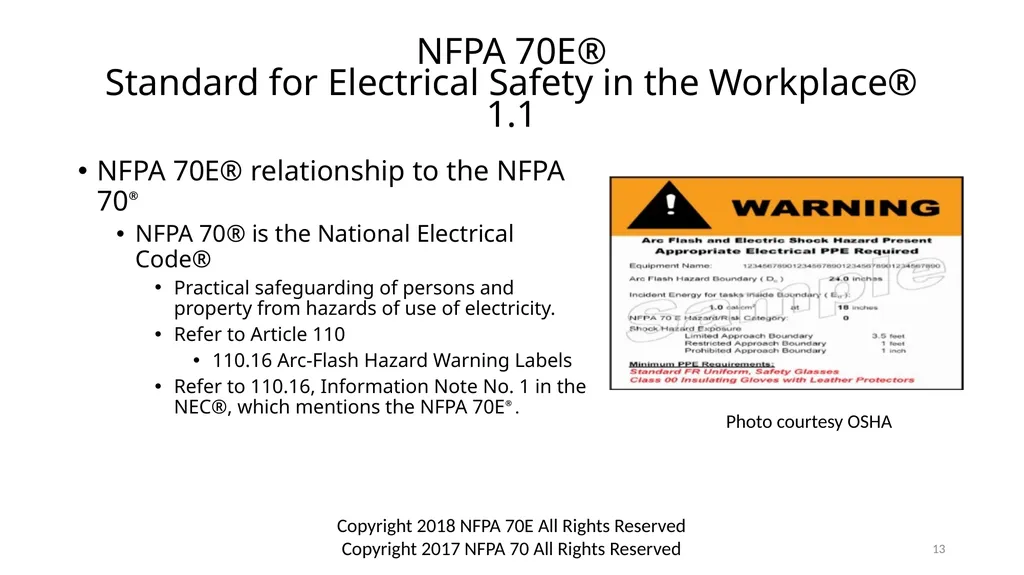
110.16 Arc-Flash Hazard Warning Labels
Refer to 110.16, Information Note No. 1 in the NEC®, which mentions the NFPA 70E®. 13 Copyright 2018 NFPA 70E All Rights Reserved
Copyright 2017 NFPA 70 All Rights Reserved Photo courtesy OSHA<br>
NFPA 70® is the National Electrical Code®
Practical safeguarding of persons and property from hazards of use of electricity.
Refer to Article 110
110.16 Arc-Flash Hazard Warning Labels
Refer to 110.16, Information Note No. 1 in the NEC®, which mentions the NFPA 70E®. 13 Copyright 2018 NFPA 70E All Rights Reserved
Copyright 2017 NFPA 70 All Rights Reserved Photo courtesy OSHA<br>
14
NFPA 70E®
Standard for Electrical Safety in the Workplace® 1.2 NFPA 70E® relationship to the NFPA 70B®
Electrical installations are considered safe during normal operation.
Maintenance is required to keep electrical equipment in proper working order.
Proper maintenance insures that overcurrent protection devices operate normally.
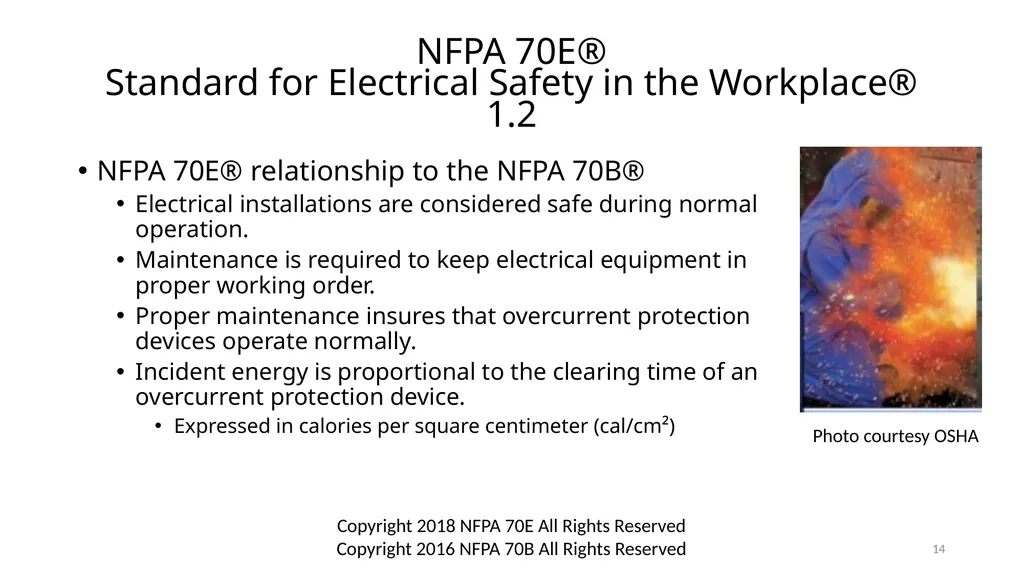
Incident energy is proportional to the clearing time of an overcurrent protection device.
Expressed in calories per square centimeter (cal/cm²) 14 Copyright 2018 NFPA 70E All Rights Reserved
Copyright 2016 NFPA 70B All Rights Reserved Photo courtesy OSHA<br>
Electrical installations are considered safe during normal operation.
Maintenance is required to keep electrical equipment in proper working order.
Proper maintenance insures that overcurrent protection devices operate normally.
Incident energy is proportional to the clearing time of an overcurrent protection device.
Expressed in calories per square centimeter (cal/cm²) 14 Copyright 2018 NFPA 70E All Rights Reserved
Copyright 2016 NFPA 70B All Rights Reserved Photo courtesy OSHA<br>
15
NFPA 70E®
Standard for Electrical Safety in the Workplace® 1.3 OSHA is the “shall”
NFPA 70E® is the “how”
Electrical safety program
Training
Lock out Tag Out
Risk assessments
PPE 15 Copyright 2018 NFPA 70E All Rights Reserved<br>
NFPA 70E® is the “how”
Electrical safety program
Training
Lock out Tag Out
Risk assessments
PPE 15 Copyright 2018 NFPA 70E All Rights Reserved<br>
16
NFPA 70E®
Standard for Electrical Safety in the Workplace® 1.4 Article 90- Introduction
Chapter 1- Safety Related Work Practices
Chapter 2- Safety Related Maintenance Requirements
Chapter 3- Safety Requirements for Special Equipment
Informative Annexes 16 Copyright 2018 NFPA 70E All Rights Reserved<br>
Chapter 1- Safety Related Work Practices
Chapter 2- Safety Related Maintenance Requirements
Chapter 3- Safety Requirements for Special Equipment
Informative Annexes 16 Copyright 2018 NFPA 70E All Rights Reserved<br>
17
NFPA 70E®
Standard for Electrical Safety in the Workplace® 1.5 Article 90- Introduction
Covered
Not Covered
Standard Arrangement
Mandatory Rules
Permissive Rules 17 Copyright 2018 NFPA 70E All Rights Reserved<br>
Covered
Not Covered
Standard Arrangement
Mandatory Rules
Permissive Rules 17 Copyright 2018 NFPA 70E All Rights Reserved<br>
18
NFPA 70E®
Standard for Electrical Safety in the Workplace® 1.6 Article 100- Definitions
Arc Flash Hazard
Arc Rating
Boundary, Arc Flash
Boundary, Limited Approach
Boundary, Restricted Approach
Exposed (energized electrical conductors or circuit parts)
Incident Energy
Maintenance, Condition of
Shock Hazard
Working On (energized electrical conductors or circuit parts) 18 Copyright 2018 NFPA 70E All Rights Reserved<br>
Arc Flash Hazard
Arc Rating
Boundary, Arc Flash
Boundary, Limited Approach
Boundary, Restricted Approach
Exposed (energized electrical conductors or circuit parts)
Incident Energy
Maintenance, Condition of
Shock Hazard
Working On (energized electrical conductors or circuit parts) 18 Copyright 2018 NFPA 70E All Rights Reserved<br>
19
NFPA 70E®
Standard for Electrical Safety in the Workplace® 1.7 Article 100- Definitions
Electrical Hazard
Electrical Safety Program
Electrically Safe Work Condition
Exposed (as applied to wiring methods)
Fault Current
Fault Current , Available
Qualified Person 19 Copyright 2018 NFPA 70E All Rights Reserved<br>
Electrical Hazard
Electrical Safety Program
Electrically Safe Work Condition
Exposed (as applied to wiring methods)
Fault Current
Fault Current , Available
Qualified Person 19 Copyright 2018 NFPA 70E All Rights Reserved<br>
20
OSHA 29CFR1910.399
Definitions Qualified person- One who has received training in and has demonstrated skills and knowledge related to the construction and operation of electric equipment and installations and has received safety training to identify the hazards and reduce the associated risk . 20<br>
21
Definitions Whether an employee is considered to be a ‘‘qualified person’’ will depend upon various circumstances in the workplace. For example, it is possible and, in fact, likely for an individual to be considered ‘‘qualified’’ with regard to certain equipment in the workplace, but ‘‘unqualified’’ as to other equipment. (See 1910.332(b)(3) for training requirements that specifically apply to qualified persons.)<br>
22
NFPA 70E®
Standard for Electrical Safety in the Workplace® 1.8 Article 105- Application of Safety Related Work Practices and Procedures
Purpose
Responsibility
Employer
Employee 22 Copyright 2018 NFPA 70E All Rights Reserved<br>
Purpose
Responsibility
Employer
Employee 22 Copyright 2018 NFPA 70E All Rights Reserved<br>
23
NFPA 70E®
Standard for Electrical Safety in the Workplace® 1.9 Article 110- General Requirements for Electrical Safety Related Work Practices
Electrical Safety Program
Inspection
Condition of Maintenance
Electrical Safety Program Principles
Electrical Safety Program Controls
Electrical Safety Program Procedures
Risk Assessment Procedure
(continued) 23 Copyright 2018 NFPA 70E All Rights Reserved<br>
Electrical Safety Program
Inspection
Condition of Maintenance
Electrical Safety Program Principles
Electrical Safety Program Controls
Electrical Safety Program Procedures
Risk Assessment Procedure
(continued) 23 Copyright 2018 NFPA 70E All Rights Reserved<br>
24
NFPA 70E®
Standard for Electrical Safety in the Workplace® 1.10 Article 110- General Requirements for Electrical Safety Related Work Practices
Electrical Safety Program (continued)
Human Error
Hierarchy of Risk Control Methods
Job Safety Planning and Job Briefing
Incident Investigations
Auditing 24 Copyright 2018 NFPA 70E All Rights Reserved<br>
Electrical Safety Program (continued)
Human Error
Hierarchy of Risk Control Methods
Job Safety Planning and Job Briefing
Incident Investigations
Auditing 24 Copyright 2018 NFPA 70E All Rights Reserved<br>
25
NFPA 70E®
Standard for Electrical Safety in the Workplace® 1.11 Article 110- General Requirements for Electrical Safety Related Work Practices
Training requirements
Electrical safety training
Qualified person
Unqualified person
Retraining
Type of training
Documentation 25 Copyright 2018 NFPA 70E All Rights Reserved<br>
Training requirements
Electrical safety training
Qualified person
Unqualified person
Retraining
Type of training
Documentation 25 Copyright 2018 NFPA 70E All Rights Reserved<br>
26
Qualified Electrical Worker Training OSHA requires that a qualified electrical worker be trained in:
Skills and techniques to determine live parts from others
Skills and techniques to determine nominal voltage
How to determine minimum safe approach distances for shock
Use of special precautionary techniques, use of PPE, use of blankets and shielding, and use insulated hand tools (1910.333) 26<br>
Skills and techniques to determine live parts from others
Skills and techniques to determine nominal voltage
How to determine minimum safe approach distances for shock
Use of special precautionary techniques, use of PPE, use of blankets and shielding, and use insulated hand tools (1910.333) 26<br>
27
NFPA 70E®
Standard for Electrical Safety in the Workplace® 1.12 Article 110- General Requirements for Electrical Safety Related Work Practices
Training requirements
Lock out/Tag out procedure training
Initial training
Retraining
Documentation 27 Copyright 2018 NFPA 70E All Rights Reserved<br>
Training requirements
Lock out/Tag out procedure training
Initial training
Retraining
Documentation 27 Copyright 2018 NFPA 70E All Rights Reserved<br>
28
NFPA 70E®
Standard for Electrical Safety in the Workplace® 1.13 Article 110- General Requirements for Electrical Safety Related Work Practices
Training requirements
Emergency response Training
Contact release
First aid, emergency response, and resuscitation
Training verification
Documentation 28 Copyright 2018 NFPA 70E All Rights Reserved<br>
Training requirements
Emergency response Training
Contact release
First aid, emergency response, and resuscitation
Training verification
Documentation 28 Copyright 2018 NFPA 70E All Rights Reserved<br>
29
29 CFR 1910.331-.335
Electrical Safety Related Work Practices 1.4 1910.332 Training
The training requirements contained in this
section apply to employees who face a risk of electric
shock that is not reduced to a safe level by the
electrical installation requirements of 1910.303
through 1910.308.
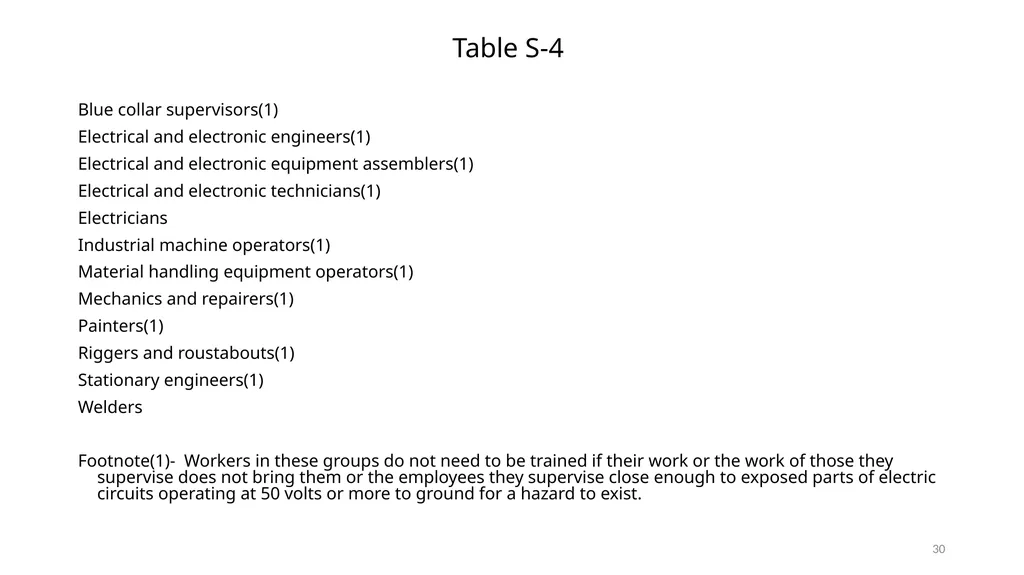
Note: Employees in occupations listed in Table S-4 face such a risk and are required to be trained.
Other employees who also may reasonably be expected to face comparable risk of injury due to electric shock or other electrical hazards must also be trained. 29<br>
The training requirements contained in this
section apply to employees who face a risk of electric
shock that is not reduced to a safe level by the
electrical installation requirements of 1910.303
through 1910.308.
Note: Employees in occupations listed in Table S-4 face such a risk and are required to be trained.
Other employees who also may reasonably be expected to face comparable risk of injury due to electric shock or other electrical hazards must also be trained. 29<br>
30
Table S-4 Blue collar supervisors(1)
Electrical and electronic engineers(1)
Electrical and electronic equipment assemblers(1)
Electrical and electronic technicians(1)
Electricians
Industrial machine operators(1)
Material handling equipment operators(1)
Mechanics and repairers(1)
Painters(1)
Riggers and roustabouts(1)
Stationary engineers(1)
Welders
Footnote(1)- Workers in these groups do not need to be trained if their work or the work of those they supervise does not bring them or the employees they supervise close enough to exposed parts of electric circuits operating at 50 volts or more to ground for a hazard to exist. 30<br>
Electrical and electronic engineers(1)
Electrical and electronic equipment assemblers(1)
Electrical and electronic technicians(1)
Electricians
Industrial machine operators(1)
Material handling equipment operators(1)
Mechanics and repairers(1)
Painters(1)
Riggers and roustabouts(1)
Stationary engineers(1)
Welders
Footnote(1)- Workers in these groups do not need to be trained if their work or the work of those they supervise does not bring them or the employees they supervise close enough to exposed parts of electric circuits operating at 50 volts or more to ground for a hazard to exist. 30<br>
31
NFPA 70E®
Standard for Electrical Safety in the Workplace® 1.14 Article 110- General Requirements for Electrical Safety Related Work Practices
Host and Contract Employers’ Responsibilities.
Host Employer Responsibilities
Contract Employer Responsibilities
Documentation 31 Copyright 2018 NFPA 70E All Rights Reserved<br>
Host and Contract Employers’ Responsibilities.
Host Employer Responsibilities
Contract Employer Responsibilities
Documentation 31 Copyright 2018 NFPA 70E All Rights Reserved<br>
32
NFPA 70E®
Standard for Electrical Safety in the Workplace® 1.15 Article 110- General Requirements for Electrical Safety Related Work Practices
Test Instruments and Equipment.
Testing
Rating
Design
Visual inspection and repair
Operation verification 32 Copyright 2018 NFPA 70E All Rights Reserved<br>
Test Instruments and Equipment.
Testing
Rating
Design
Visual inspection and repair
Operation verification 32 Copyright 2018 NFPA 70E All Rights Reserved<br>
33
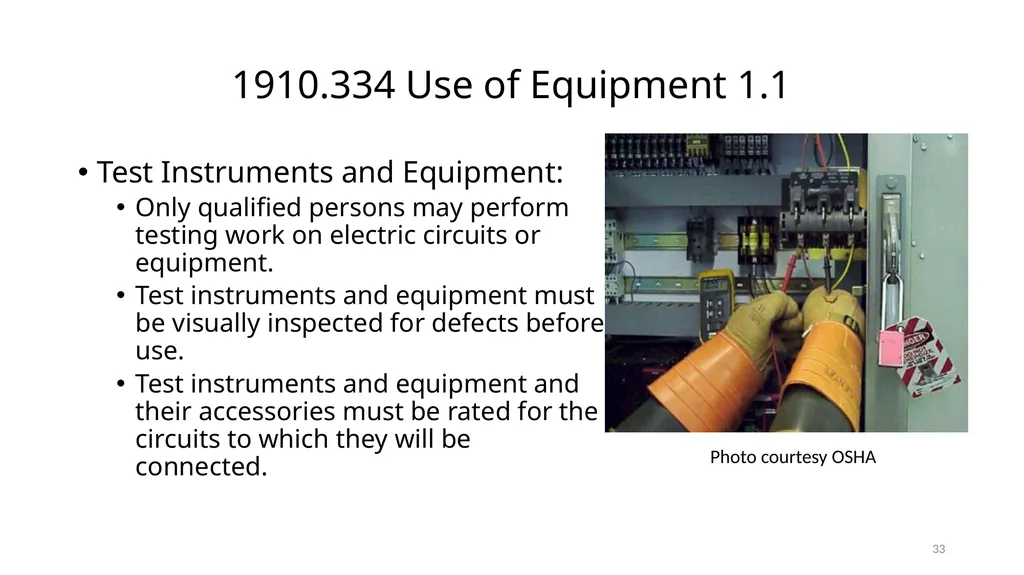
1910.334 Use of Equipment 1.1 Test Instruments and Equipment:
Only qualified persons may perform testing work on electric circuits or equipment.
Test instruments and equipment must be visually inspected for defects before use.
Test instruments and equipment and their accessories must be rated for the circuits to which they will be connected. 33 Photo courtesy OSHA<br>
Only qualified persons may perform testing work on electric circuits or equipment.
Test instruments and equipment must be visually inspected for defects before use.
Test instruments and equipment and their accessories must be rated for the circuits to which they will be connected. 33 Photo courtesy OSHA<br>
34
Test Instruments and Equipment 1.2 Electrical Measuring Equipment
What is the nominal voltage being tested?
What is meters ability to withstand transient over voltages and high short circuit currents?
Both rated voltage and the category must be considered when selecting a meter. 34<br>
What is the nominal voltage being tested?
What is meters ability to withstand transient over voltages and high short circuit currents?
Both rated voltage and the category must be considered when selecting a meter. 34<br>
35
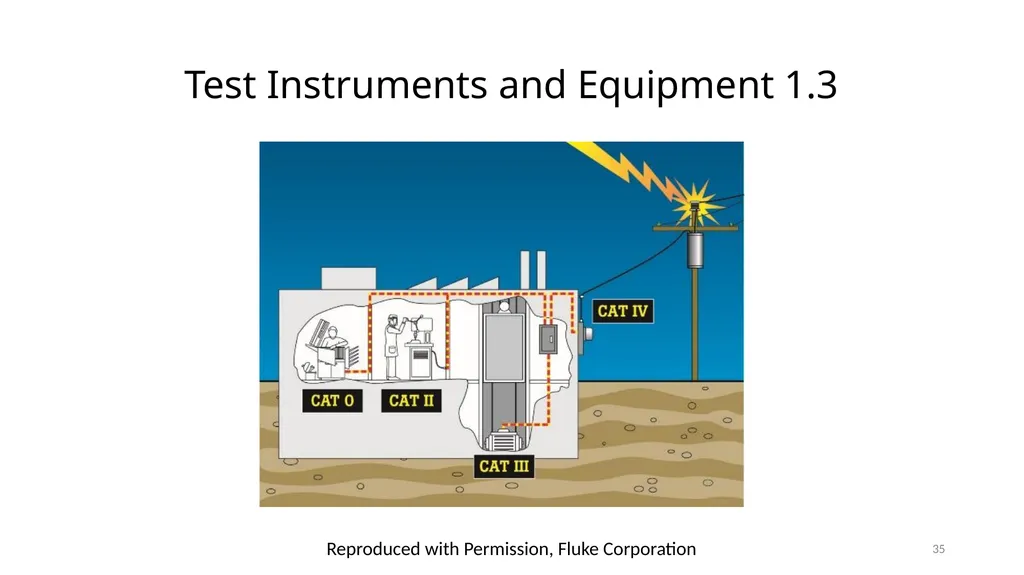
Test Instruments and Equipment 1.3 35 Reproduced with Permission, Fluke Corporation<br>
36
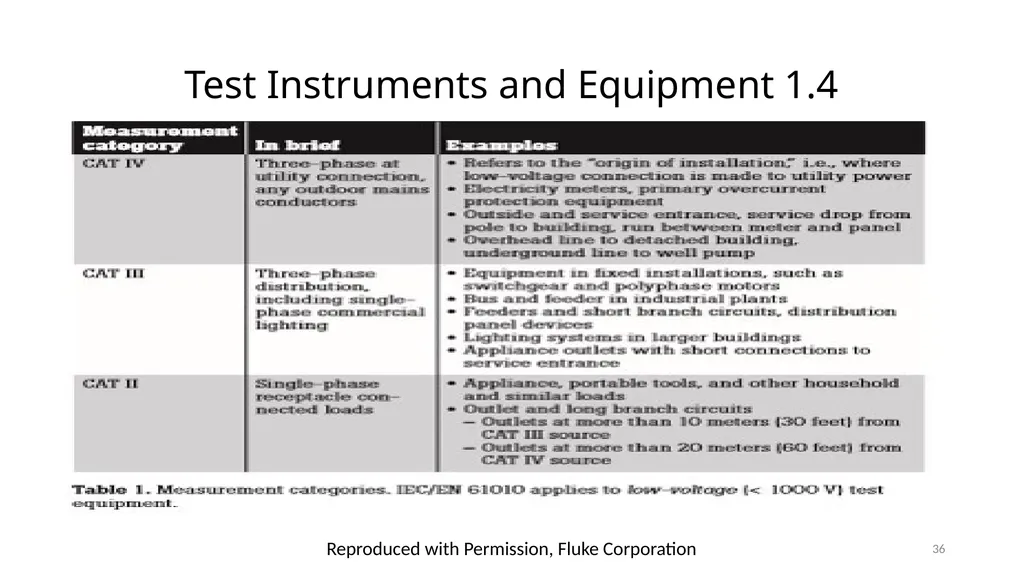
Test Instruments and Equipment 1.4 36 Reproduced with Permission, Fluke Corporation<br>
37
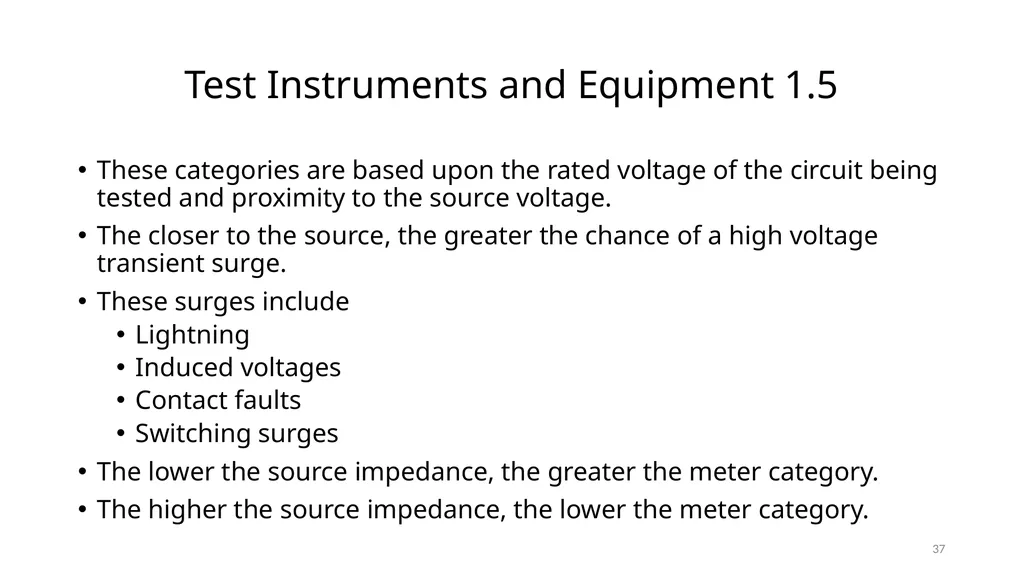
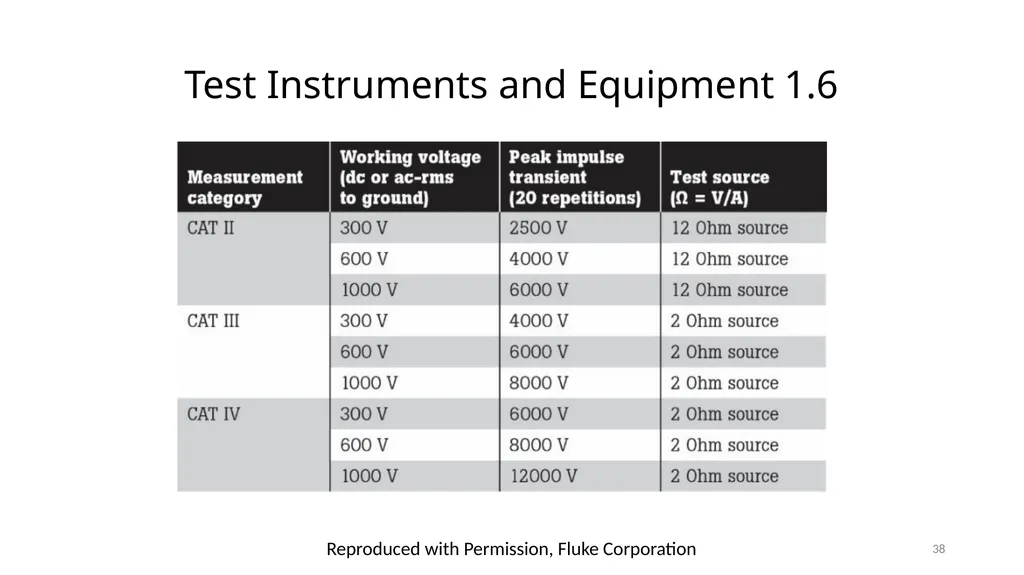
Test Instruments and Equipment 1.5 These categories are based upon the rated voltage of the circuit being tested and proximity to the source voltage.
The closer to the source, the greater the chance of a high voltage transient surge.
These surges include
Lightning
Induced voltages
Contact faults
Switching surges
The lower the source impedance, the greater the meter category.
The higher the source impedance, the lower the meter category. 37<br>
The closer to the source, the greater the chance of a high voltage transient surge.
These surges include
Lightning
Induced voltages
Contact faults
Switching surges
The lower the source impedance, the greater the meter category.
The higher the source impedance, the lower the meter category. 37<br>
38
Test Instruments and Equipment 1.6 38 Reproduced with Permission, Fluke Corporation<br>
39
NFPA 70E®
Standard for Electrical Safety in the Workplace® 1.16 Article 110- General Requirements for Electrical Safety Related Work Practices
Portable Cord- and-Plug Connected Electric Equipment.
Handling and Storage
Grounding-Type Equipment
Inspection
Conductive Work Locations
Connecting Attachment Plugs
Manufacturers Instructions 39 Copyright 2018 NFPA 70E All Rights Reserved<br>
Portable Cord- and-Plug Connected Electric Equipment.
Handling and Storage
Grounding-Type Equipment
Inspection
Conductive Work Locations
Connecting Attachment Plugs
Manufacturers Instructions 39 Copyright 2018 NFPA 70E All Rights Reserved<br>
40
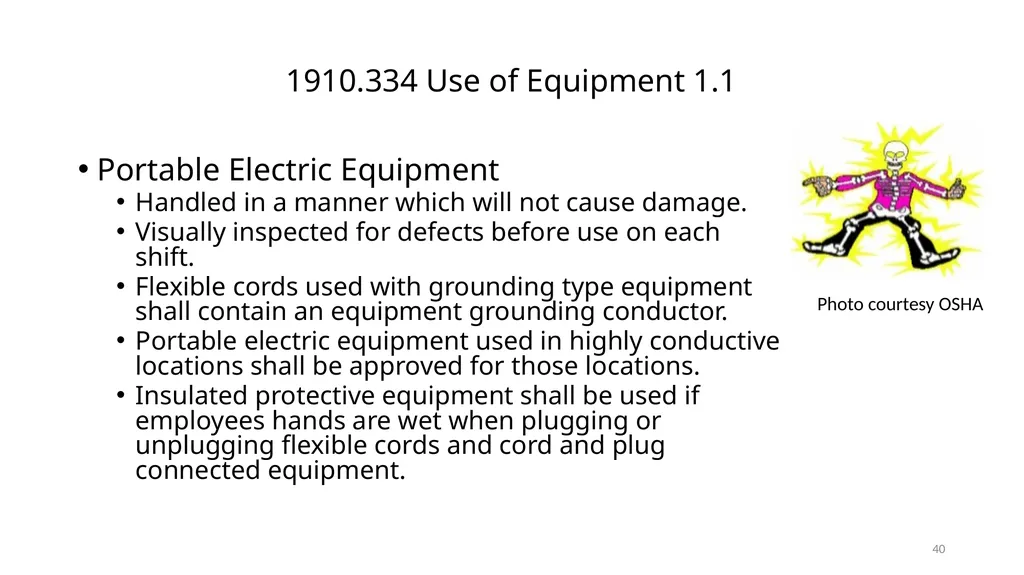
1910.334 Use of Equipment 1.1 Portable Electric Equipment
Handled in a manner which will not cause damage.
Visually inspected for defects before use on each shift.
Flexible cords used with grounding type equipment shall contain an equipment grounding conductor.
Portable electric equipment used in highly conductive locations shall be approved for those locations.
Insulated protective equipment shall be used if employees hands are wet when plugging or unplugging flexible cords and cord and plug connected equipment. 40 Photo courtesy OSHA<br>
Handled in a manner which will not cause damage.
Visually inspected for defects before use on each shift.
Flexible cords used with grounding type equipment shall contain an equipment grounding conductor.
Portable electric equipment used in highly conductive locations shall be approved for those locations.
Insulated protective equipment shall be used if employees hands are wet when plugging or unplugging flexible cords and cord and plug connected equipment. 40 Photo courtesy OSHA<br>
41
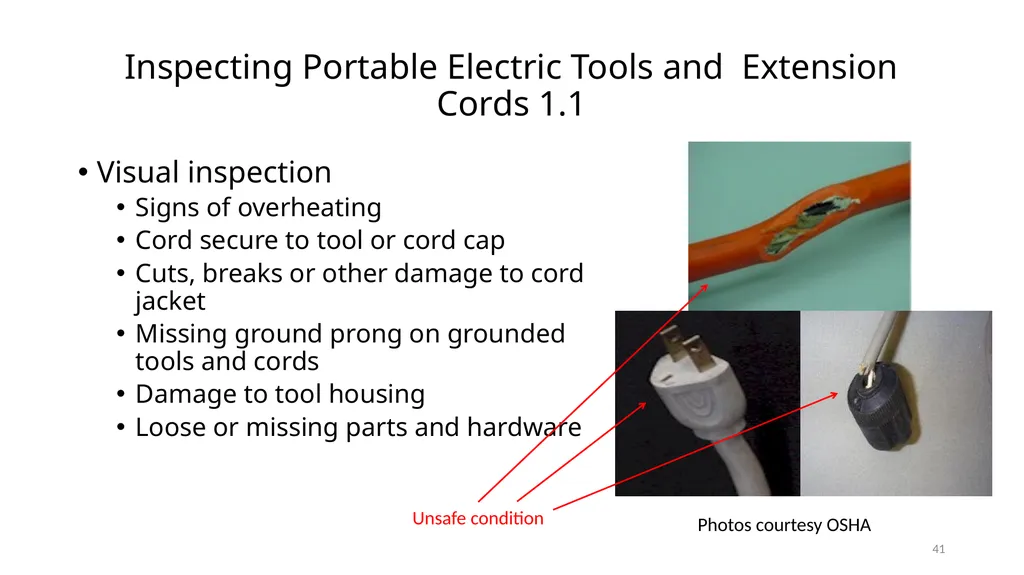
Inspecting Portable Electric Tools and Extension Cords 1.1 Visual inspection
Signs of overheating
Cord secure to tool or cord cap
Cuts, breaks or other damage to cord jacket
Missing ground prong on grounded tools and cords
Damage to tool housing
Loose or missing parts and hardware 41 Photos courtesy OSHA Unsafe condition<br>
Signs of overheating
Cord secure to tool or cord cap
Cuts, breaks or other damage to cord jacket
Missing ground prong on grounded tools and cords
Damage to tool housing
Loose or missing parts and hardware 41 Photos courtesy OSHA Unsafe condition<br>
42
Inspecting Portable Electric Tools and Extension Cords 1.2 Mechanical inspections – operate tool
Sticking trigger or lock button
Excessive sparking from motor
Odd operation
Sluggishness, vibration, chuck issues
Odd noises
Grinding, buzzing, scraping
Excessive heating while running 42 Photo courtesy OSHA<br>
Sticking trigger or lock button
Excessive sparking from motor
Odd operation
Sluggishness, vibration, chuck issues
Odd noises
Grinding, buzzing, scraping
Excessive heating while running 42 Photo courtesy OSHA<br>
43
NFPA 70E®
Standard for Electrical Safety in the Workplace® 1.17 Article 110- General Requirements for Electrical Safety Related Work Practices
Ground-Fault Circuit Interrupter (GFCI) Protection.
General
Maintenance and Construction
Outdoors
Testing 43 Copyright 2018 NFPA 70E All Rights Reserved Photo courtesy OSHA<br>
Ground-Fault Circuit Interrupter (GFCI) Protection.
General
Maintenance and Construction
Outdoors
Testing 43 Copyright 2018 NFPA 70E All Rights Reserved Photo courtesy OSHA<br>
44
NFPA 70E®
Standard for Electrical Safety in the Workplace® 1.18 Article 110- General Requirements for Electrical Safety Related Work Practices
Overcurrent Protection Modification.
Overcurrent protection of circuits and conductors shall not be modified 44 Copyright 2018 NFPA 70E All Rights Reserved<br>
Overcurrent Protection Modification.
Overcurrent protection of circuits and conductors shall not be modified 44 Copyright 2018 NFPA 70E All Rights Reserved<br>
45
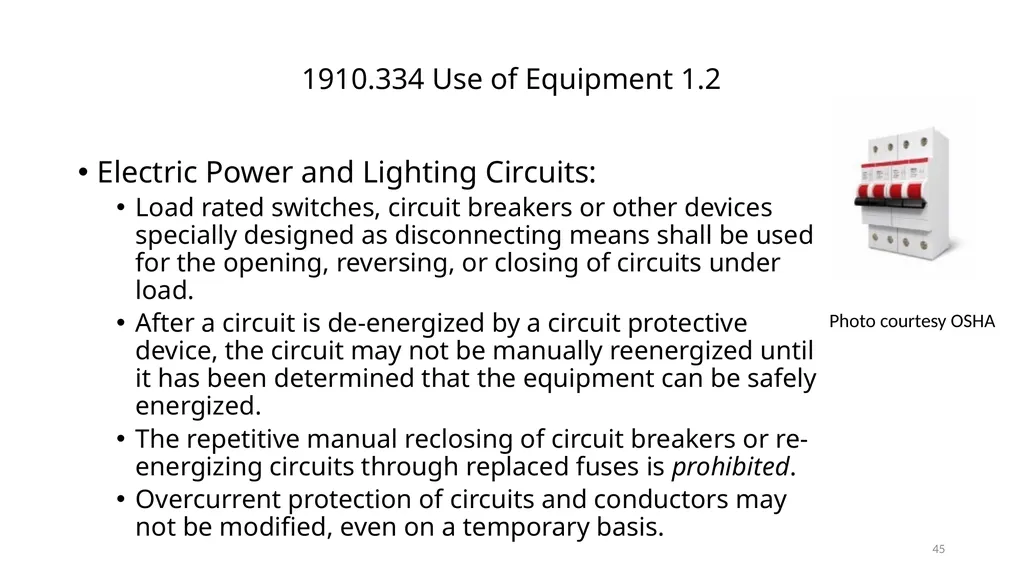
1910.334 Use of Equipment 1.2 Electric Power and Lighting Circuits:
Load rated switches, circuit breakers or other devices specially designed as disconnecting means shall be used for the opening, reversing, or closing of circuits under load.
After a circuit is de-energized by a circuit protective device, the circuit may not be manually reenergized until it has been determined that the equipment can be safely energized.
The repetitive manual reclosing of circuit breakers or re-energizing circuits through replaced fuses is prohibited.
Overcurrent protection of circuits and conductors may not be modified, even on a temporary basis. 45 Photo courtesy OSHA<br>
Load rated switches, circuit breakers or other devices specially designed as disconnecting means shall be used for the opening, reversing, or closing of circuits under load.
After a circuit is de-energized by a circuit protective device, the circuit may not be manually reenergized until it has been determined that the equipment can be safely energized.
The repetitive manual reclosing of circuit breakers or re-energizing circuits through replaced fuses is prohibited.
Overcurrent protection of circuits and conductors may not be modified, even on a temporary basis. 45 Photo courtesy OSHA<br>
46
1910.333
Selection and Use of Work Practices (a) General. Safety-related work practices shall be employed to prevent electric shock or other injuries resulting from either direct or indirect electrical contacts, when work is performed near or on equipment or circuits which are or may be energized. The specific safety-related work practices shall be consistent with the nature and extent of the associated electrical hazards. 46<br>
47
1910.333(a)(1)
De-energized Parts 1910.333(a)(1)
Live parts shall be de-energized unless:
Additional or increased hazards
Infeasible
• Live parts less than 50 volts need not be de-energized if there is no increased exposure to electrical burns or to explosion due to electric arcs 47<br>
Live parts shall be de-energized unless:
Additional or increased hazards
Infeasible
• Live parts less than 50 volts need not be de-energized if there is no increased exposure to electrical burns or to explosion due to electric arcs 47<br>
48
Examples of increased or additional hazards • Interruption of life support systems
• Deactivation of emergency alarm systems
• Shutdown of hazardous location ventilation
• Removal of illumination from an area 48<br>
• Deactivation of emergency alarm systems
• Shutdown of hazardous location ventilation
• Removal of illumination from an area 48<br>
49
Examples of Infeasibility • Testing of electric circuits
• Circuits that form an integral part of a continuous industrial process 49<br>
• Circuits that form an integral part of a continuous industrial process 49<br>
50
1910.333(a)(2)
Energized Parts If exposed live parts are not de-energized (i.e, for reasons of increased or additional hazards or infeasibility), other safety-related work practices shall be used to protect employees who may be exposed to the electrical hazard involved. Such work practices shall protect employees against contact with energized circuit parts directly with any part of their body or indirectly through some other conductive object. The work practices that are used shall be suitable for the voltage level of the exposed electric conductors or circuit parts. 50<br>
51
1910.333(b)
Working on or near exposed de-energized parts Application
This paragraph applies to work on exposed de-energized parts or near enough to them to expose the employee to any electrical hazard they present. Conductors and parts of electric equipment that have been de-energized but have not been locked out or tagged in accordance with paragraph (b) of this section shall be treated as energized parts. 51<br>
This paragraph applies to work on exposed de-energized parts or near enough to them to expose the employee to any electrical hazard they present. Conductors and parts of electric equipment that have been de-energized but have not been locked out or tagged in accordance with paragraph (b) of this section shall be treated as energized parts. 51<br>
52
1910.333(b)(2)(ii)(A)
De-energizing Equipment Safe procedures for de-energizing circuits and equipment shall be determined before circuits or equipment are de-energized
Refer to the NFPA 70E, Article 120, Establishing an Electrically Safe Working Condition
120.5(1) 52 Copyright 2018 NFPA 70E All Rights Reserved<br>
Refer to the NFPA 70E, Article 120, Establishing an Electrically Safe Working Condition
120.5(1) 52 Copyright 2018 NFPA 70E All Rights Reserved<br>
53
1910.333(b)(2)(ii)(B)
De-energizing Equipment The circuits and equipment to be worked on shall be disconnected from all electrical energy sources.
Refer to the NFPA 70E, Article 120, Establishing an Electrically Safe Working Condition
120.5(2) 53 Copyright 2018 NFPA 70E All Rights Reserved<br>
Refer to the NFPA 70E, Article 120, Establishing an Electrically Safe Working Condition
120.5(2) 53 Copyright 2018 NFPA 70E All Rights Reserved<br>
54
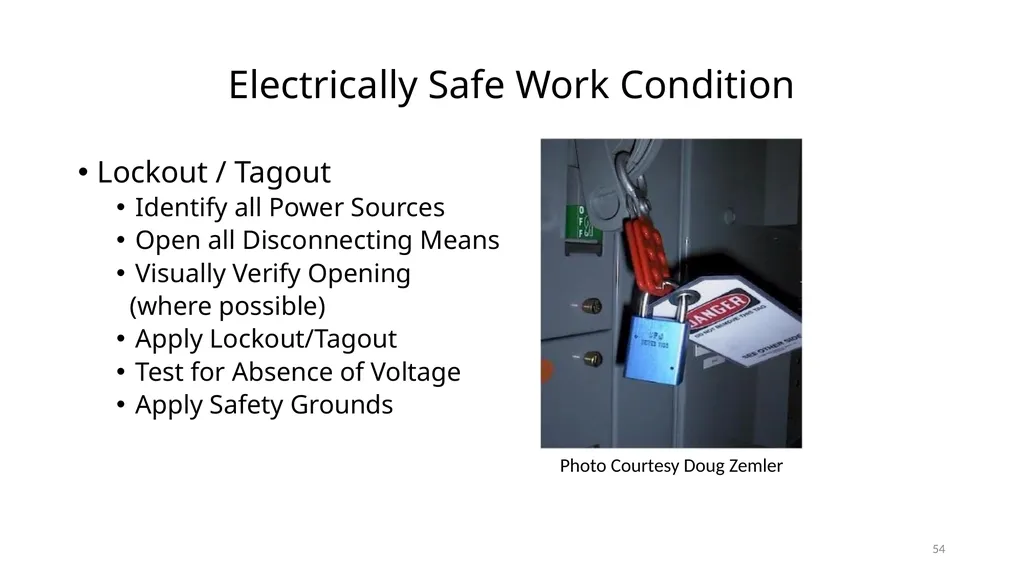
Electrically Safe Work Condition Lockout / Tagout
Identify all Power Sources
Open all Disconnecting Means
Visually Verify Opening
(where possible)
Apply Lockout/Tagout
Test for Absence of Voltage
Apply Safety Grounds 54 Photo Courtesy Doug Zemler<br>
Identify all Power Sources
Open all Disconnecting Means
Visually Verify Opening
(where possible)
Apply Lockout/Tagout
Test for Absence of Voltage
Apply Safety Grounds 54 Photo Courtesy Doug Zemler<br>
55
1910.333(b)(2)(ii)(C)
De-energizing Equipment Stored electrical energy which might endanger personnel shall be released
Refer to the NFPA 70E, Article 120, Establishing an Electrically Safe Working Condition
120.5(4) 55 Copyright 2018 NFPA 70E All Rights Reserved<br>
Refer to the NFPA 70E, Article 120, Establishing an Electrically Safe Working Condition
120.5(4) 55 Copyright 2018 NFPA 70E All Rights Reserved<br>
56
1910.333(b)(2)(ii)(D)
De-energizing Equipment Stored non-electrical energy in devices that could re-energized electrical circuit parts shall be blocked or relieved to the extent that the circuit parts could not be accidentally energized by the device.
Refer to the NFPA 70E, Article 120, Establishing an Electrically Safe Working Condition
120.5(5) 56 Copyright 2018 NFPA 70E All Rights Reserved<br>
Refer to the NFPA 70E, Article 120, Establishing an Electrically Safe Working Condition
120.5(5) 56 Copyright 2018 NFPA 70E All Rights Reserved<br>
57
1910.333(b)(2)(iii)(A)
Application of locks and tags A lock and tag shall be placed on each disconnecting means used to de-energized circuits and equipment on which work is to be performed.
Refer to the NFPA 70E, Article 120, Establishing an Electrically Safe Working Condition
120.5(6) 57 Copyright 2018 NFPA 70E All Rights Reserved<br>
Refer to the NFPA 70E, Article 120, Establishing an Electrically Safe Working Condition
120.5(6) 57 Copyright 2018 NFPA 70E All Rights Reserved<br>
58
1910.333(b)(2)(iv)
Verification of de-energized condition The requirements of the section shall be met:
(A) A qualified person shall operate the equipment operating controls or otherwise verify that the equipment cannot be started.
(B) A qualified person shall use a test equipment to test the circuit elements and electrical parts of equipment to which employees will be exposed and shall verify that all parts are de-energized.
Refer to the NFPA 70E, Article 120, Establishing an Electrically Safe Working Condition
120.5(7)
Before and after each test, determine the test instrument is working correctly on any known voltage source. 58 Copyright 2018 NFPA 70E All Rights Reserved<br>
(A) A qualified person shall operate the equipment operating controls or otherwise verify that the equipment cannot be started.
(B) A qualified person shall use a test equipment to test the circuit elements and electrical parts of equipment to which employees will be exposed and shall verify that all parts are de-energized.
Refer to the NFPA 70E, Article 120, Establishing an Electrically Safe Working Condition
120.5(7)
Before and after each test, determine the test instrument is working correctly on any known voltage source. 58 Copyright 2018 NFPA 70E All Rights Reserved<br>
59
1910.333(b)(2)
1910.333(c)(3)(ii)(C) The person is insulated from all conductive objects at a potential difference from that of the electrical part.
Refer to the NFPA 70E, Article 120, Establishing an Electrically Safe Working Condition
120.5(8)
Induced voltages or stored electrical energy 59 Copyright 2018 NFPA 70E All Rights Reserved<br>
Refer to the NFPA 70E, Article 120, Establishing an Electrically Safe Working Condition
120.5(8)
Induced voltages or stored electrical energy 59 Copyright 2018 NFPA 70E All Rights Reserved<br>
60
1910.333(b)(2)(v)
Re-energizing equipment Re-Energizing Equipment
Requirements shall be met in the order given, before circuits or equipment are re-energized, even temporarily.
(A) A qualified person shall conduct tests and visual inspections.
(B) Employees exposed to the hazard shall be warned to stay clear.
(C) Each tag and lock shall be removed by the employee who placed it or under his/her direct supervision.
(D) there shall be a visual determination that all employees are clear of the circuits and equipment. 60<br>
Requirements shall be met in the order given, before circuits or equipment are re-energized, even temporarily.
(A) A qualified person shall conduct tests and visual inspections.
(B) Employees exposed to the hazard shall be warned to stay clear.
(C) Each tag and lock shall be removed by the employee who placed it or under his/her direct supervision.
(D) there shall be a visual determination that all employees are clear of the circuits and equipment. 60<br>
61
1910.333(c)(2)
Work On Energized Equipment • Only qualified persons may work on energized
equipment (50V and above).
• Person shall be capable of working safely.
• Shall be familiar with the proper use of special precautionary
techniques, personal protective equipment, insulating and shielding materials, and insulated tools. 61<br>
• Person shall be capable of working safely.
• Shall be familiar with the proper use of special precautionary
techniques, personal protective equipment, insulating and shielding materials, and insulated tools. 61<br>
62
1910.333(c)(3)
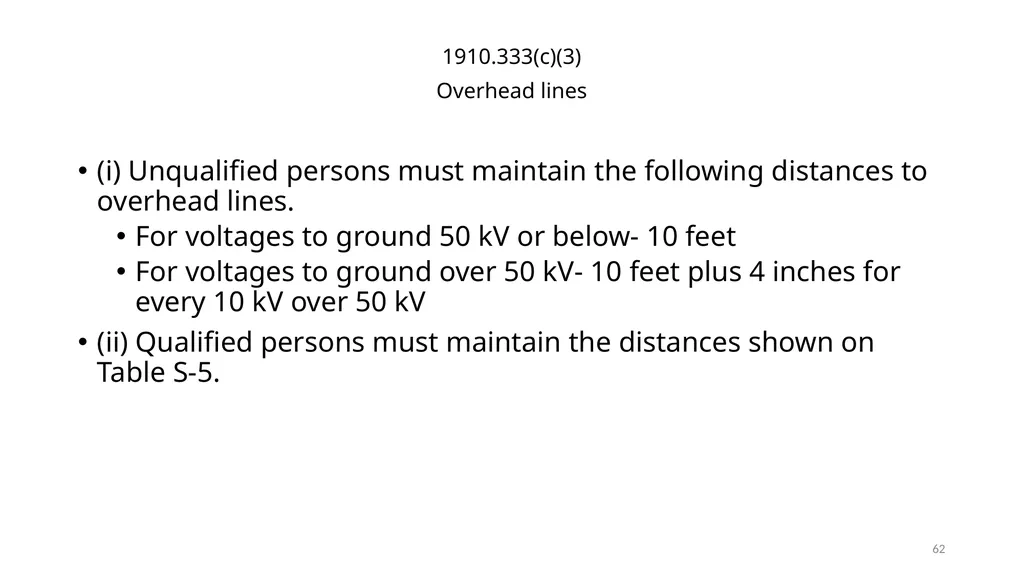
Overhead lines (i) Unqualified persons must maintain the following distances to overhead lines.
For voltages to ground 50 kV or below- 10 feet
For voltages to ground over 50 kV- 10 feet plus 4 inches for every 10 kV over 50 kV
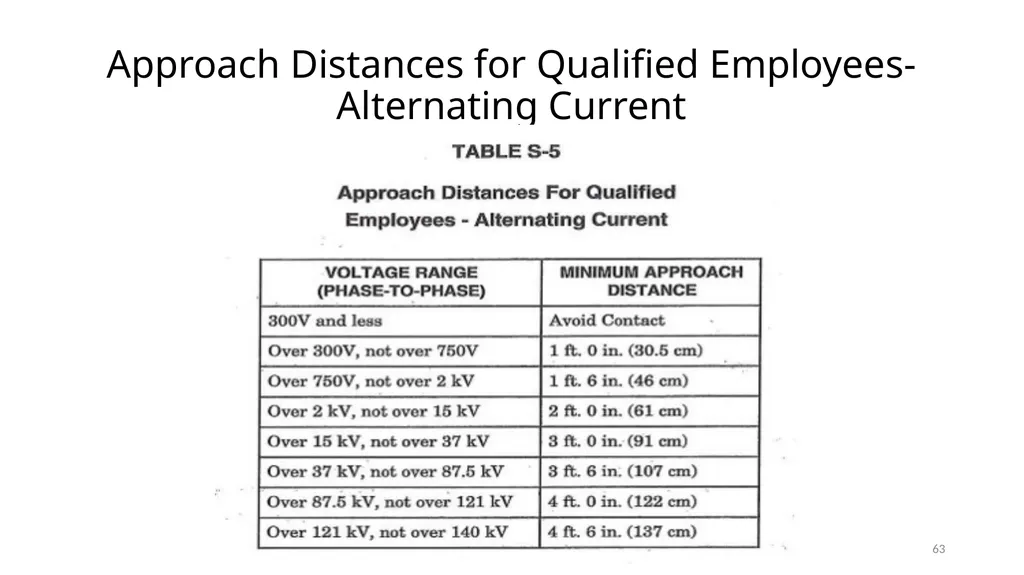
(ii) Qualified persons must maintain the distances shown on Table S-5. 62<br>
For voltages to ground 50 kV or below- 10 feet
For voltages to ground over 50 kV- 10 feet plus 4 inches for every 10 kV over 50 kV
(ii) Qualified persons must maintain the distances shown on Table S-5. 62<br>
63
Approach Distances for Qualified Employees- Alternating Current 63<br>
64
1910.333(c)(3)(iii)
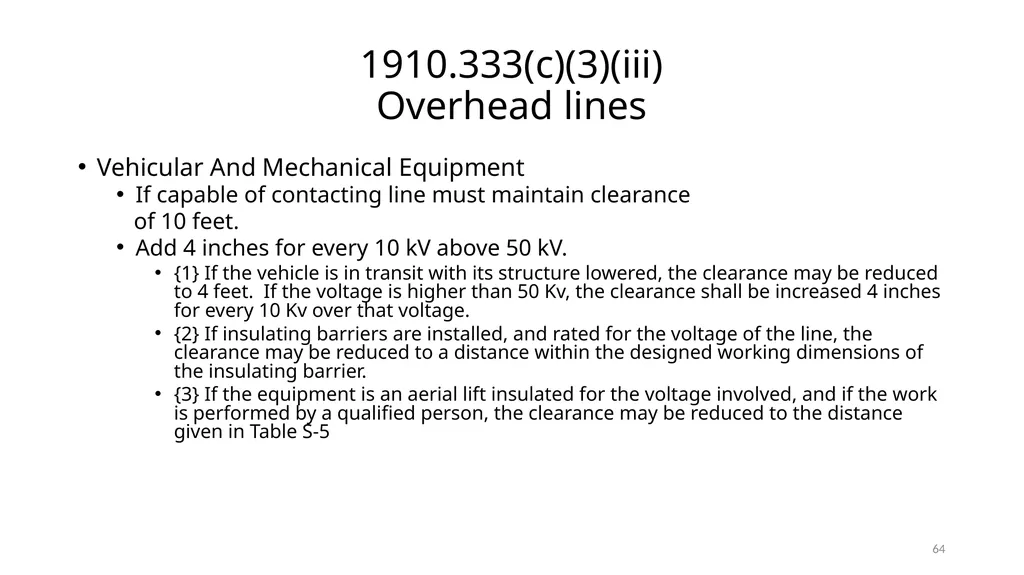
Overhead lines Vehicular And Mechanical Equipment
If capable of contacting line must maintain clearance
of 10 feet.
Add 4 inches for every 10 kV above 50 kV.
{1} If the vehicle is in transit with its structure lowered, the clearance may be reduced to 4 feet. If the voltage is higher than 50 Kv, the clearance shall be increased 4 inches for every 10 Kv over that voltage.
{2} If insulating barriers are installed, and rated for the voltage of the line, the clearance may be reduced to a distance within the designed working dimensions of the insulating barrier.
{3} If the equipment is an aerial lift insulated for the voltage involved, and if the work is performed by a qualified person, the clearance may be reduced to the distance given in Table S-5 64<br>
If capable of contacting line must maintain clearance
of 10 feet.
Add 4 inches for every 10 kV above 50 kV.
{1} If the vehicle is in transit with its structure lowered, the clearance may be reduced to 4 feet. If the voltage is higher than 50 Kv, the clearance shall be increased 4 inches for every 10 Kv over that voltage.
{2} If insulating barriers are installed, and rated for the voltage of the line, the clearance may be reduced to a distance within the designed working dimensions of the insulating barrier.
{3} If the equipment is an aerial lift insulated for the voltage involved, and if the work is performed by a qualified person, the clearance may be reduced to the distance given in Table S-5 64<br>
65
1910.333(c)(4)
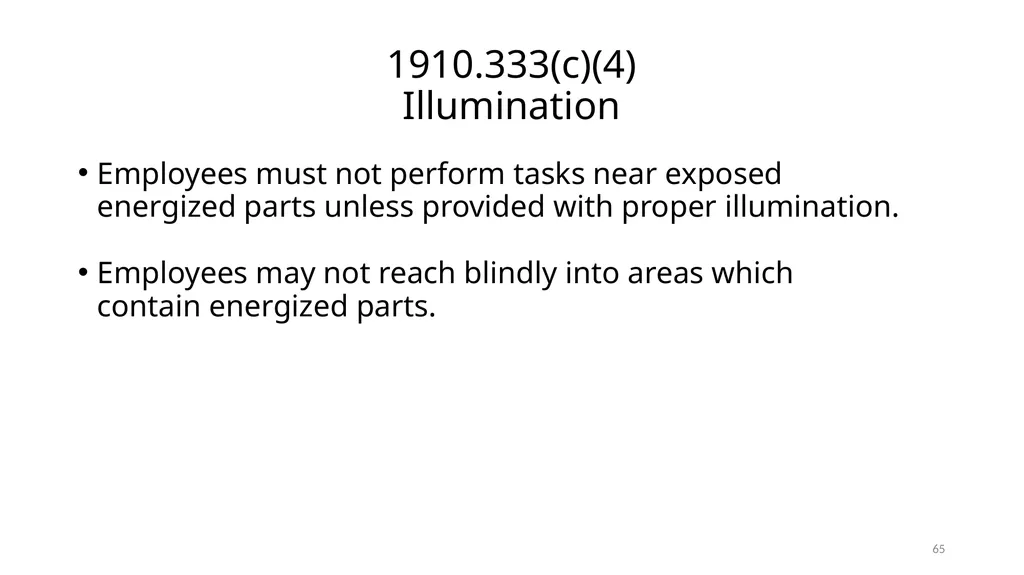
Illumination Employees must not perform tasks near exposed
energized parts unless provided with proper illumination.
Employees may not reach blindly into areas which
contain energized parts. 65<br>
energized parts unless provided with proper illumination.
Employees may not reach blindly into areas which
contain energized parts. 65<br>
66
1910.333(c)(5)
Confined or enclosed work spaces When employees are working in confined or enclosed
work spaces which contain energized parts, the
employer must provide, and the employee shall use shields, barriers, or insulating materials.
Doors and hinged panels must be secured. 66<br>
work spaces which contain energized parts, the
employer must provide, and the employee shall use shields, barriers, or insulating materials.
Doors and hinged panels must be secured. 66<br>
67
1910.333(c)(6)
Conductive materials and equipment Conductive materials must be handled in a manner that
will prevent them from contacting exposed energized
conductors or circuit parts. 67<br>
will prevent them from contacting exposed energized
conductors or circuit parts. 67<br>
68
1910.333(c)(7)
Portable ladders Portable ladders shall have nonconductive side rails if they are used where the employee or the ladder could contact exposed energized parts. 68<br>
69
1910.333(c)(8)
Conductive apparel Conductive articles (rings, watches, bracelets, key chains, necklaces, metallized aprons, cloth with conductive thread, metal headgear) shall be removed.
Unless rendered non-conductive. 69<br>
Unless rendered non-conductive. 69<br>
70
1910.333(c)(9)
Housekeeping duties Where live parts are present, employees shall not
perform housekeeping duties which would expose
them to accidental contact. 70<br>
perform housekeeping duties which would expose
them to accidental contact. 70<br>
71
1910.333(c)(10)
Interlocks • Only Qualified person may defeat an electrical
safety interlock.
• Temporarily.
• Must be returned to its operable condition. 71<br>
safety interlock.
• Temporarily.
• Must be returned to its operable condition. 71<br>
72
1910.334
Use of Equipment Portable electric equipment
This paragraph applies to the use of cord and plug connected equipment, including flexible cord sets (extension cords). 72<br>
This paragraph applies to the use of cord and plug connected equipment, including flexible cord sets (extension cords). 72<br>
73
1910.334(a)(1)
Handling Portable equipment shall be handled in a manner which will not cause damage. Flexible electric cords connected to equipment may not be used for raising or lowering the equipment. Flexible cords may not be fastened by staples or otherwise hung in such a fashion as could damage the outer jacket or insulation. 73<br>
74
1910.334(a)(2)
Visual inspection Visual inspection
Signs of overheating
Cord secure to tool or cord cap
Cuts, breaks or other damage to cord jacket
Missing ground prong on grounded tools and cords
Damage to tool housing
Loose or missing parts and hardware 74<br>
Signs of overheating
Cord secure to tool or cord cap
Cuts, breaks or other damage to cord jacket
Missing ground prong on grounded tools and cords
Damage to tool housing
Loose or missing parts and hardware 74<br>
75
1910.334(a)(4)
Conductive work locations Portable electric equipment used in highly conductive locations (such as those inundated with water or other conductive liquids), or in job locations where employees are likely to contact water or conductive liquids, shall be approved for those locations. 75<br>
76
1910.334(a)(5)
Connecting attachment plugs (i) Employees hands may not be wet when plugging and unplugging flexible cords and cord and plug equipment, if energized equipment is involved.
(ii) Insulated protective equipment shall be used if employees hands are wet when plugging or unplugging flexible cords and cord and plug connected equipment. 76<br>
(ii) Insulated protective equipment shall be used if employees hands are wet when plugging or unplugging flexible cords and cord and plug connected equipment. 76<br>
77
1910.334(b)
Electric power and lighting circuits Routine opening and closing of circuits.
Load-rated devices specifically designed as disconnecting means shall be used for the opening, reversing, or closing of circuits under load. 77<br>
Load-rated devices specifically designed as disconnecting means shall be used for the opening, reversing, or closing of circuits under load. 77<br>
78
1910.334(b)(2)
Reclosing circuits after protective device operation After a circuit has been de-energized by a circuit protective device, the circuit may not be manually re-energized until it has been determined that the equipment can be safely energized. The repetitive manual reclosing of circuit breakers or re-energizing circuits through replaced fuses is prohibited.
Note: When it can be determined from the design of the circuit and the overcurrent devices involved that the automatic operation of a device was caused by an overload rather than a fault condition, no examination of the circuit or connected equipment is needed before the circuit is reenergized. 78<br>
Note: When it can be determined from the design of the circuit and the overcurrent devices involved that the automatic operation of a device was caused by an overload rather than a fault condition, no examination of the circuit or connected equipment is needed before the circuit is reenergized. 78<br>
79
1910.334(b)(3)
Overcurrent protection modification Overcurrent protection of circuits and conductors
may not be modified, even on a temporary basis. 79<br>
may not be modified, even on a temporary basis. 79<br>
80
1910.334(c)
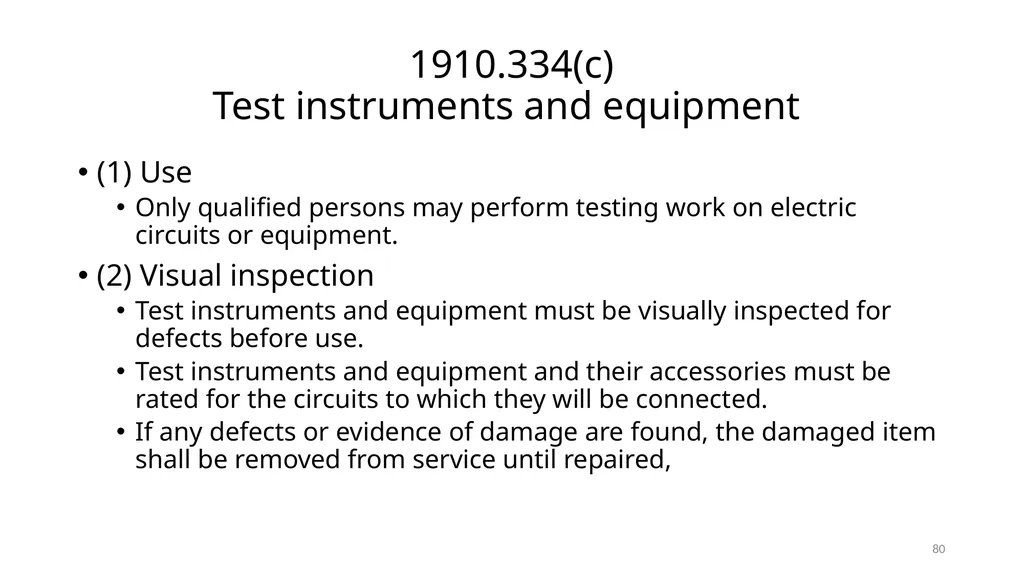
Test instruments and equipment (1) Use
Only qualified persons may perform testing work on electric circuits or equipment.
(2) Visual inspection
Test instruments and equipment must be visually inspected for defects before use.
Test instruments and equipment and their accessories must be rated for the circuits to which they will be connected.
If any defects or evidence of damage are found, the damaged item shall be removed from service until repaired, 80<br>
Only qualified persons may perform testing work on electric circuits or equipment.
(2) Visual inspection
Test instruments and equipment must be visually inspected for defects before use.
Test instruments and equipment and their accessories must be rated for the circuits to which they will be connected.
If any defects or evidence of damage are found, the damaged item shall be removed from service until repaired, 80<br>
81
1910.334(d)
Occasional use of flammable or ignitable materials Where flammable or ignitable material are present only occasionally, electric equipment capable of igniting them shall not be used, unless measures are taken to prevent hazardous conditions from developing. 81<br>
82
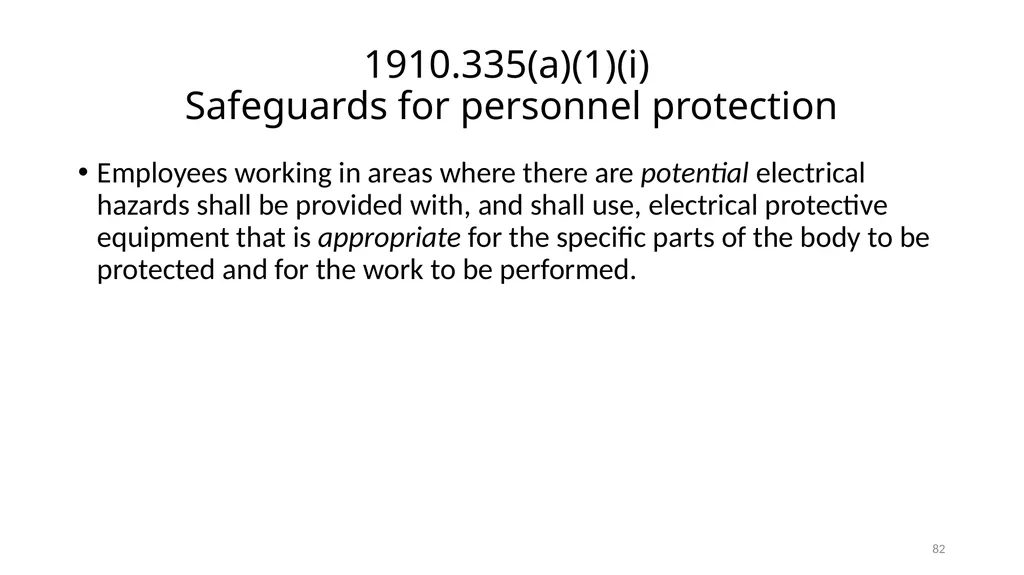
1910.335(a)(1)(i)
Safeguards for personnel protection Employees working in areas where there are potential electrical hazards shall be provided with, and shall use, electrical protective equipment that is appropriate for the specific parts of the body to be protected and for the work to be performed. 82<br>
83
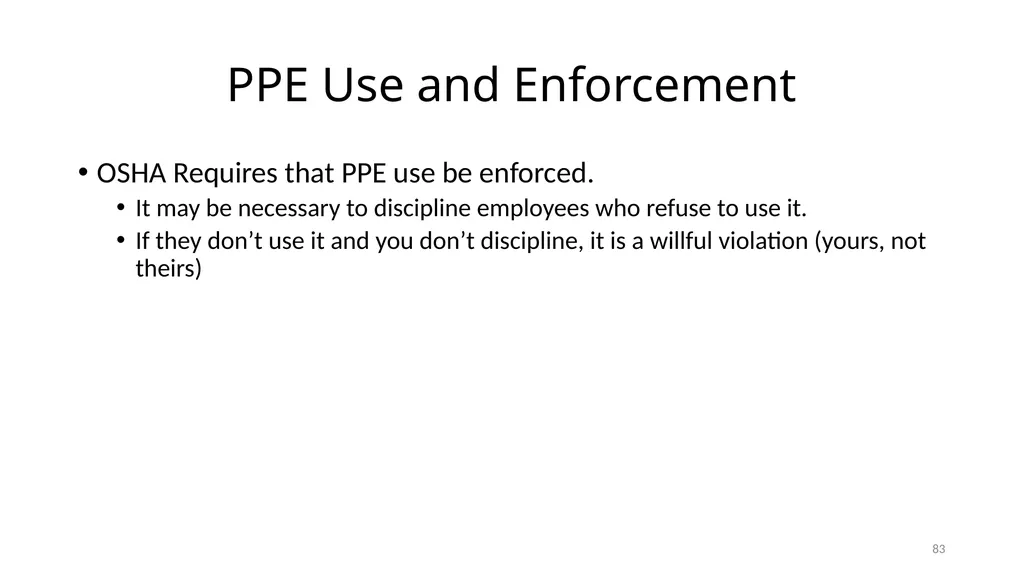
PPE Use and Enforcement OSHA Requires that PPE use be enforced.
It may be necessary to discipline employees who refuse to use it.
If they don’t use it and you don’t discipline, it is a willful violation (yours, not theirs) 83<br>
It may be necessary to discipline employees who refuse to use it.
If they don’t use it and you don’t discipline, it is a willful violation (yours, not theirs) 83<br>
84
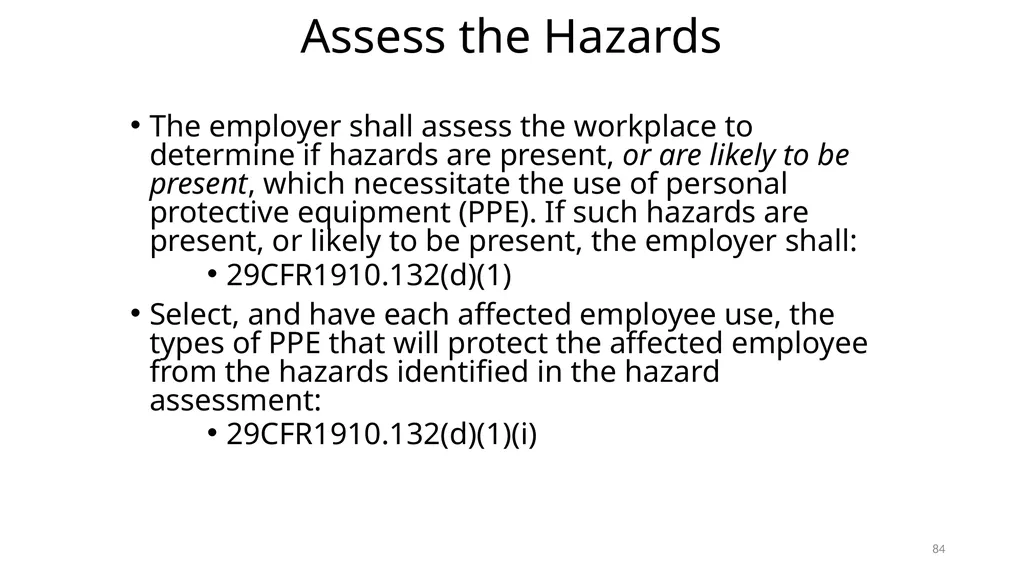
Assess the Hazards The employer shall assess the workplace to determine if hazards are present, or are likely to be present, which necessitate the use of personal protective equipment (PPE). If such hazards are present, or likely to be present, the employer shall:
29CFR1910.132(d)(1)
Select, and have each affected employee use, the types of PPE that will protect the affected employee from the hazards identified in the hazard assessment:
29CFR1910.132(d)(1)(i) 84<br>
29CFR1910.132(d)(1)
Select, and have each affected employee use, the types of PPE that will protect the affected employee from the hazards identified in the hazard assessment:
29CFR1910.132(d)(1)(i) 84<br>
85
1910.335(a)(1)
Safeguards for personal protection (ii) Protective equipment shall be maintained in a safe, reliable condition and shall be periodically inspected or tested, as required by 1910.137.
(iii) If the insulating capability of the protective equipment may be subject to damage during use, the insulating material shall be protected.
An outer covering of leather is sometimes used for the protection of rubber insulating material. 85<br>
(iii) If the insulating capability of the protective equipment may be subject to damage during use, the insulating material shall be protected.
An outer covering of leather is sometimes used for the protection of rubber insulating material. 85<br>
86
1910.137(c)(2)(vi) PPE Is to be “stored in such a location and in such a manner as to protect it from light, temperature extremes, excessive humidity, ozone and other injurious substances and conditions” 86<br>
87
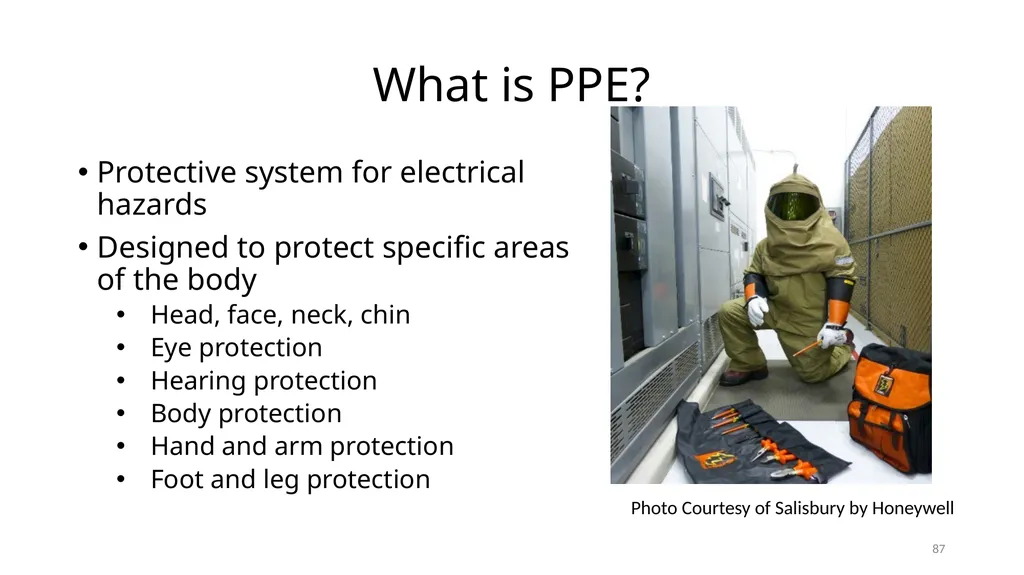
What is PPE? Protective system for electrical hazards
Designed to protect specific areas of the body
Head, face, neck, chin
Eye protection
Hearing protection
Body protection
Hand and arm protection
Foot and leg protection 87 Photo Courtesy of Salisbury by Honeywell<br>
Designed to protect specific areas of the body
Head, face, neck, chin
Eye protection
Hearing protection
Body protection
Hand and arm protection
Foot and leg protection 87 Photo Courtesy of Salisbury by Honeywell<br>
88
Hard Hats 1.1 1910.335(a)(1)(iv)
Employees shall wear nonconductive head protection whenever there is a danger of head injury from electric shock or burns due to contact with exposed energized parts. 88<br>
Employees shall wear nonconductive head protection whenever there is a danger of head injury from electric shock or burns due to contact with exposed energized parts. 88<br>
89
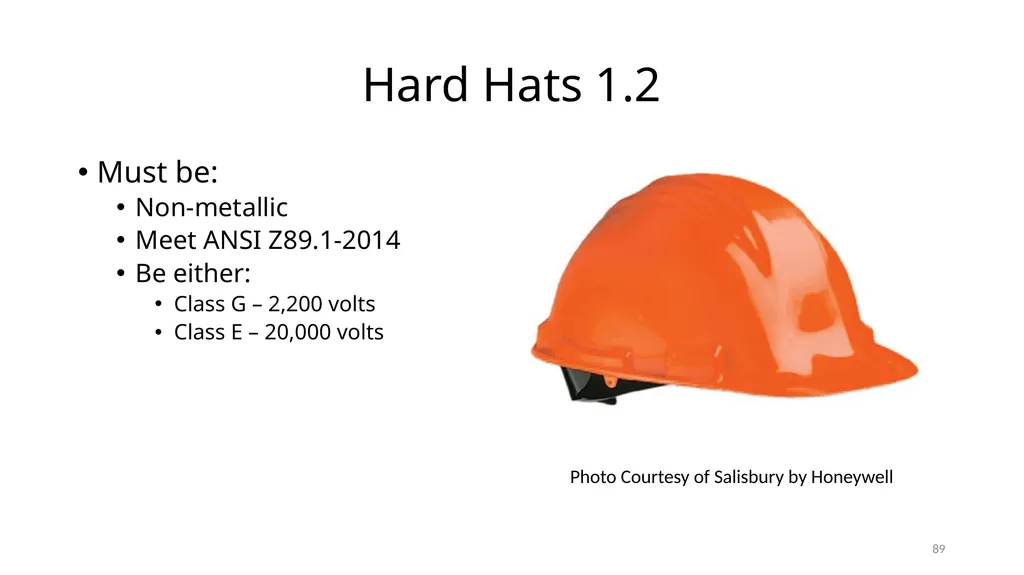
Hard Hats 1.2 Must be:
Non-metallic
Meet ANSI Z89.1-2014
Be either:
Class G – 2,200 volts
Class E – 20,000 volts 89 Photo Courtesy of Salisbury by Honeywell<br>
Non-metallic
Meet ANSI Z89.1-2014
Be either:
Class G – 2,200 volts
Class E – 20,000 volts 89 Photo Courtesy of Salisbury by Honeywell<br>
90
Inspecting Hard Hats Shell for cracks and dents
Stickers and labels cannot cover both inside and outside surfaces
Suspension for cracks and security
Sweatband/headband for flaking or cracking
Press in on sides
If hardhat does not spring out to original shape, replace it 90<br>
Stickers and labels cannot cover both inside and outside surfaces
Suspension for cracks and security
Sweatband/headband for flaking or cracking
Press in on sides
If hardhat does not spring out to original shape, replace it 90<br>
91
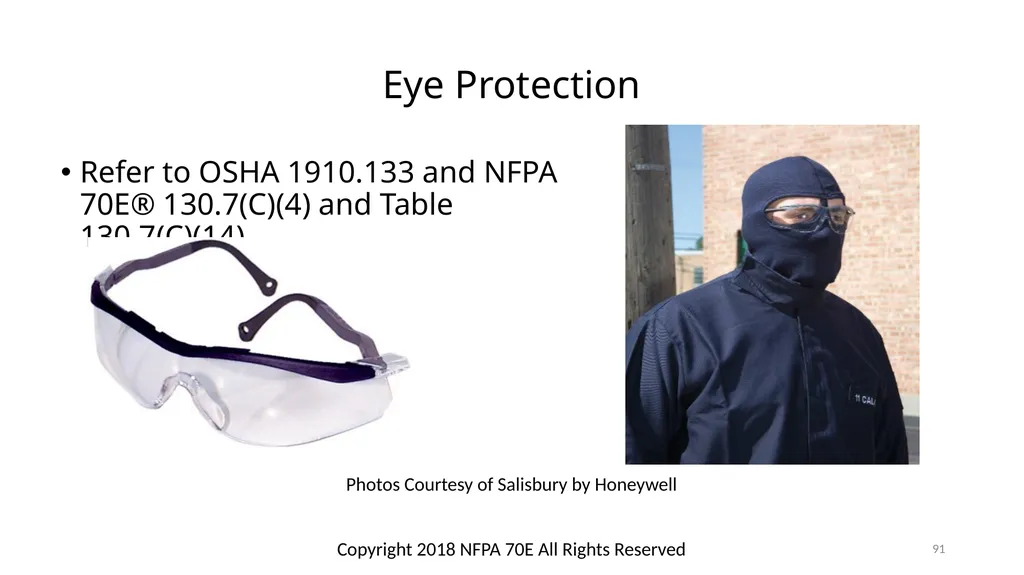
Eye Protection Refer to OSHA 1910.133 and NFPA 70E® 130.7(C)(4) and Table 130.7(C)(14) 91 Copyright 2018 NFPA 70E All Rights Reserved Photos Courtesy of Salisbury by Honeywell<br>
92
Hearing Protection Refer to the NFPA 70E® 130.7(C)(5)
Hearing Protection
Refer to OSHA 1910.95 occupational noise exposure. 92 Copyright 2018 NFPA 70E All Rights Reserved<br>
Hearing Protection
Refer to OSHA 1910.95 occupational noise exposure. 92 Copyright 2018 NFPA 70E All Rights Reserved<br>
93
Rubber Insulating Gloves 1.1 Provides shock protection
Where to find information:
OSHA 29CFR1910.137
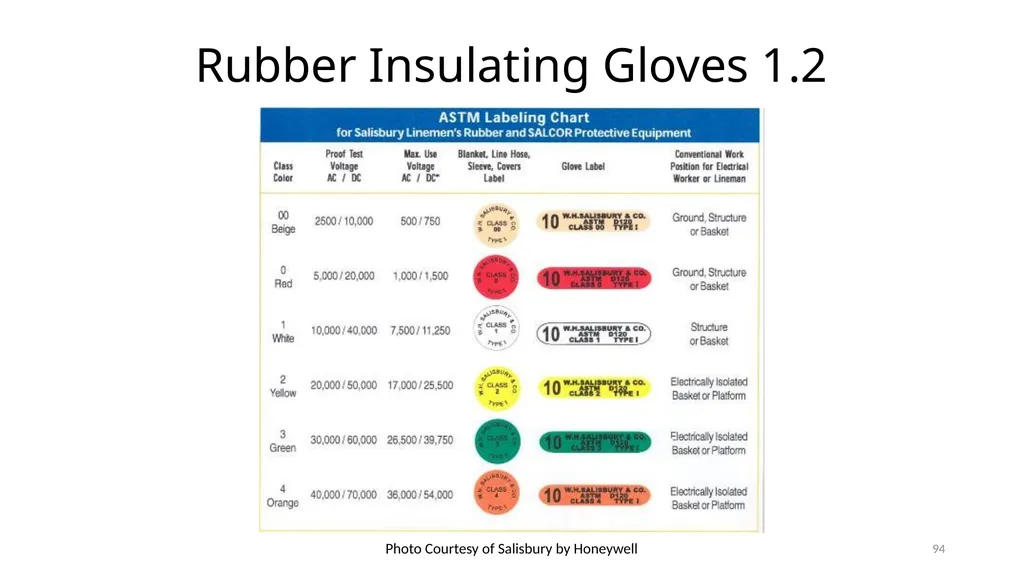
Provides specific design, care, and use requirements for rubber electrical protective equipment. Insulating gloves and sleeves must be rated for the voltage to which a worker will be exposed (phase to ground or phase to phase) and marked to indicate their rating. 1910.137 recognizes Class 0 (up to 1KV) through Class 4 (up to 36KV) rubber equipment.
ASTM D120 Standard Specifications for Rubber Insulating Gloves
Manufacturer’s guidelines 93<br>
Where to find information:
OSHA 29CFR1910.137
Provides specific design, care, and use requirements for rubber electrical protective equipment. Insulating gloves and sleeves must be rated for the voltage to which a worker will be exposed (phase to ground or phase to phase) and marked to indicate their rating. 1910.137 recognizes Class 0 (up to 1KV) through Class 4 (up to 36KV) rubber equipment.
ASTM D120 Standard Specifications for Rubber Insulating Gloves
Manufacturer’s guidelines 93<br>
94
Rubber Insulating Gloves 1.2 Photo Courtesy of Salisbury by Honeywell 94<br>
95
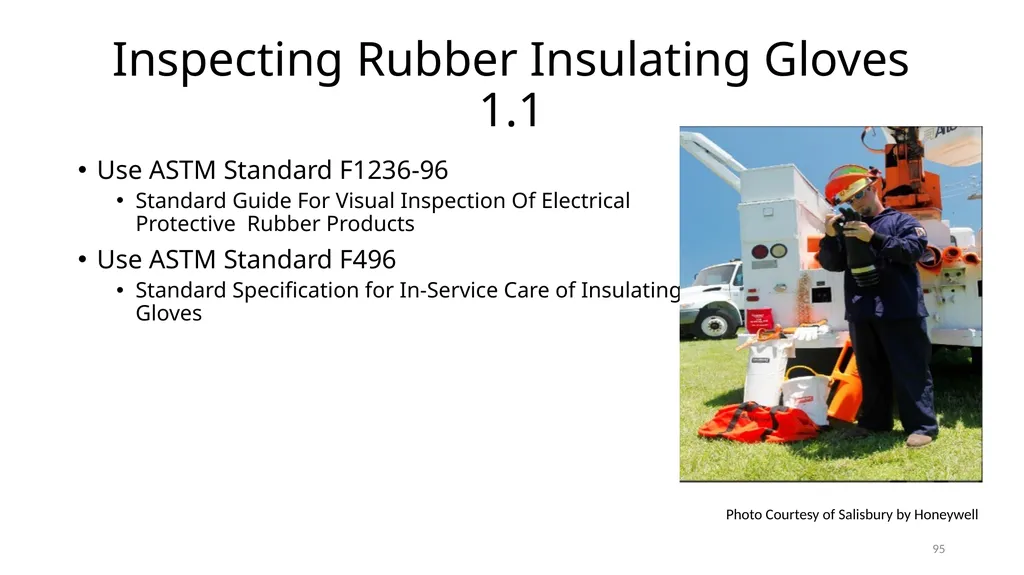
Inspecting Rubber Insulating Gloves 1.1 Use ASTM Standard F1236-96
Standard Guide For Visual Inspection Of Electrical Protective Rubber Products
Use ASTM Standard F496
Standard Specification for In-Service Care of Insulating Gloves Photo Courtesy of Salisbury by Honeywell 95<br>
Standard Guide For Visual Inspection Of Electrical Protective Rubber Products
Use ASTM Standard F496
Standard Specification for In-Service Care of Insulating Gloves Photo Courtesy of Salisbury by Honeywell 95<br>
96
Inspecting Rubber Insulating Gloves 1.2 Inspect gloves for:
Ozone cutting
Ultra-violet radiation checking
Punctures
Cuts
Abrasions
Oxidation
Texture changes such as swelling, softening, hardening, becoming sticky or inelastic
Imbedded foreign objects 96<br>
Ozone cutting
Ultra-violet radiation checking
Punctures
Cuts
Abrasions
Oxidation
Texture changes such as swelling, softening, hardening, becoming sticky or inelastic
Imbedded foreign objects 96<br>
97
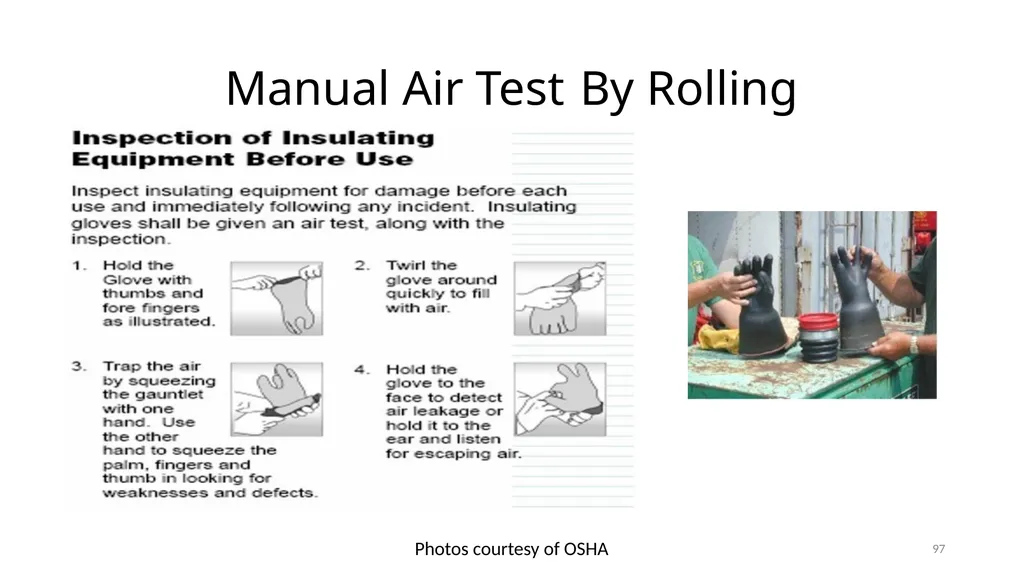
Manual Air Test By Rolling 97 Photos courtesy of OSHA<br>
98
Leather Protectors Inspect for:
Tears
Cuts
Open seams
Imbedded objects
Petroleum product contamination Photos Courtesy of Salisbury by Honeywell 98<br>
Tears
Cuts
Open seams
Imbedded objects
Petroleum product contamination Photos Courtesy of Salisbury by Honeywell 98<br>
99
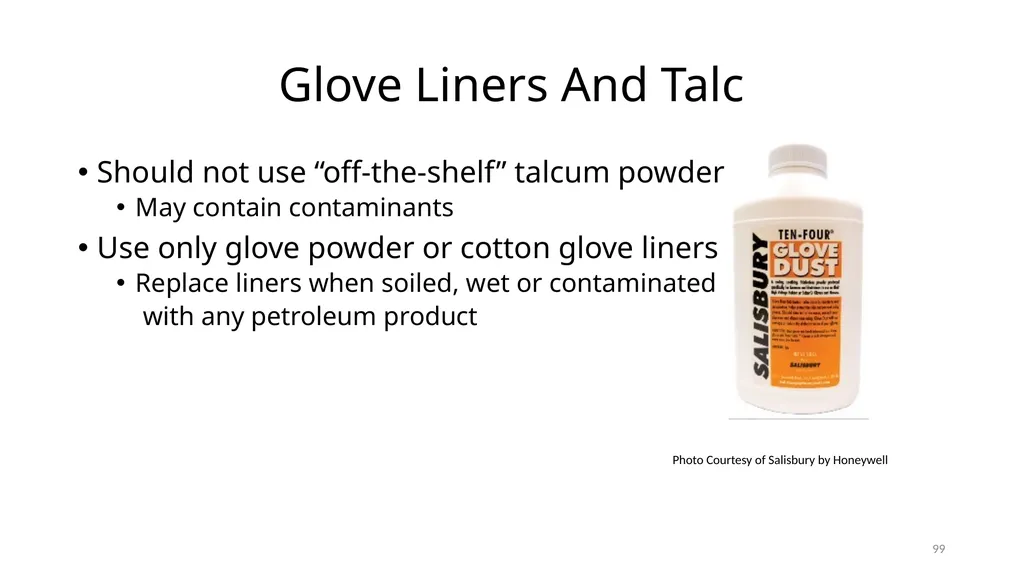
Glove Liners And Talc Should not use “off-the-shelf” talcum powder
May contain contaminants
Use only glove powder or cotton glove liners
Replace liners when soiled, wet or contaminated
with any petroleum product 99 Photo Courtesy of Salisbury by Honeywell<br>
May contain contaminants
Use only glove powder or cotton glove liners
Replace liners when soiled, wet or contaminated
with any petroleum product 99 Photo Courtesy of Salisbury by Honeywell<br>
100
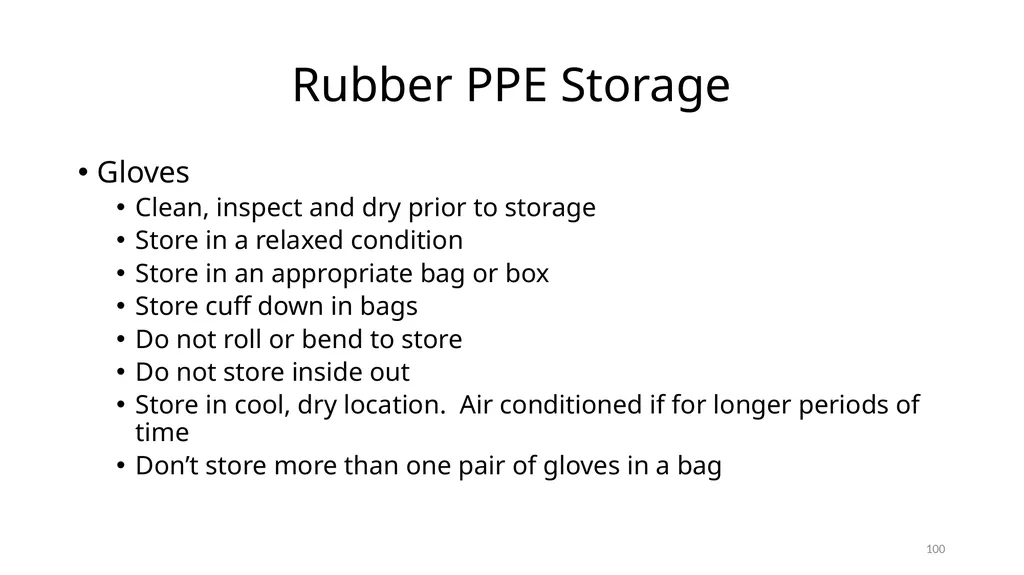
Rubber PPE Storage Gloves
Clean, inspect and dry prior to storage
Store in a relaxed condition
Store in an appropriate bag or box
Store cuff down in bags
Do not roll or bend to store
Do not store inside out
Store in cool, dry location. Air conditioned if for longer periods of time
Don’t store more than one pair of gloves in a bag 100<br>
Clean, inspect and dry prior to storage
Store in a relaxed condition
Store in an appropriate bag or box
Store cuff down in bags
Do not roll or bend to store
Do not store inside out
Store in cool, dry location. Air conditioned if for longer periods of time
Don’t store more than one pair of gloves in a bag 100<br>
101
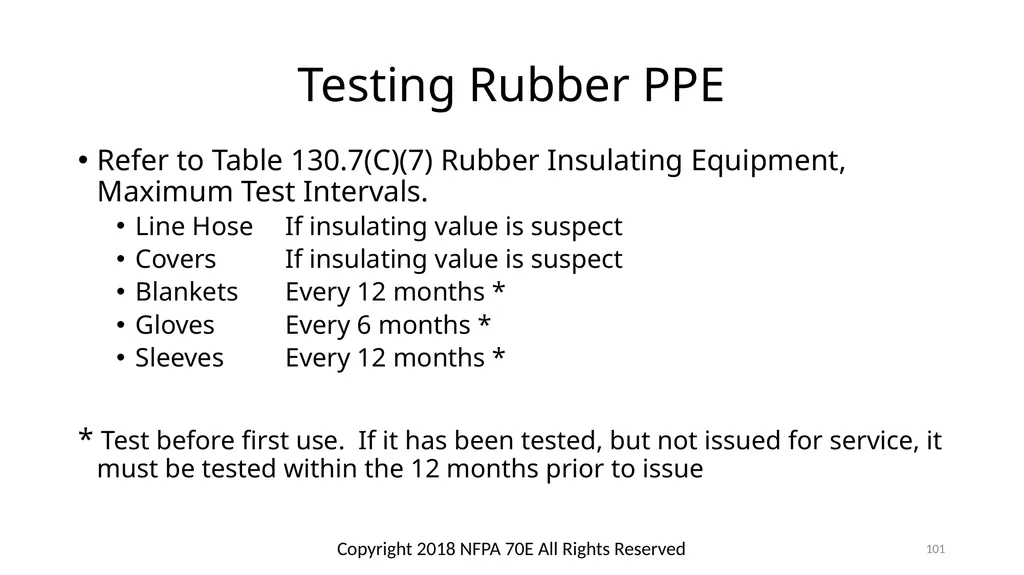
Testing Rubber PPE Refer to Table 130.7(C)(7) Rubber Insulating Equipment, Maximum Test Intervals.
Line Hose If insulating value is suspect
Covers If insulating value is suspect
Blankets Every 12 months *
Gloves Every 6 months *
Sleeves Every 12 months *
* Test before first use. If it has been tested, but not issued for service, it must be tested within the 12 months prior to issue 101 Copyright 2018 NFPA 70E All Rights Reserved<br>
Line Hose If insulating value is suspect
Covers If insulating value is suspect
Blankets Every 12 months *
Gloves Every 6 months *
Sleeves Every 12 months *
* Test before first use. If it has been tested, but not issued for service, it must be tested within the 12 months prior to issue 101 Copyright 2018 NFPA 70E All Rights Reserved<br>
102
Eye and Face Protection 1.1 1910.335(a)(1)(v)
Employees must wear protective equipment for the eyes and face if there is a danger of injury to the eyes and face from electric arcs, flashes, or from flying objects resulting from an electrical explosion 102<br>
Employees must wear protective equipment for the eyes and face if there is a danger of injury to the eyes and face from electric arcs, flashes, or from flying objects resulting from an electrical explosion 102<br>
103
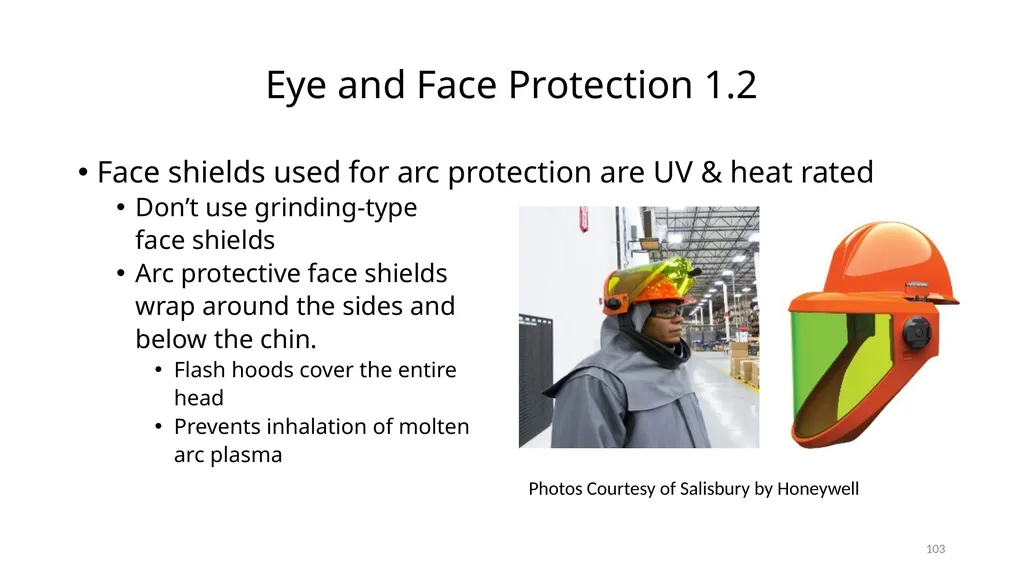
Eye and Face Protection 1.2 Face shields used for arc protection are UV & heat rated
Don’t use grinding-type
face shields
Arc protective face shields
wrap around the sides and
below the chin.
Flash hoods cover the entire
head
Prevents inhalation of molten
arc plasma 103 Photos Courtesy of Salisbury by Honeywell<br>
Don’t use grinding-type
face shields
Arc protective face shields
wrap around the sides and
below the chin.
Flash hoods cover the entire
head
Prevents inhalation of molten
arc plasma 103 Photos Courtesy of Salisbury by Honeywell<br>
104
Arc Rated Clothing 1.1 104 Photo Courtesy of Salisbury by Honeywell<br>
105
Arc Rated Clothing 1.2 Refer to NFPA 70E® 130.7(C)(6)
Employees shall wear arc-rated clothing whenever there is a possible exposure to an electric arc flash above the threshold incident energy level for a second degree burn (1.2 calorie/cm²) 105 Copyright 2018 NFPA 70E All Rights Reserved<br>
Employees shall wear arc-rated clothing whenever there is a possible exposure to an electric arc flash above the threshold incident energy level for a second degree burn (1.2 calorie/cm²) 105 Copyright 2018 NFPA 70E All Rights Reserved<br>
106
Arc Rated Clothing 1.3 Refer to NFPA 70E® 130.7(C)
(9) Factors in Selection of Protective Clothing
(10) Arc Flash Protective Equipment
(11) Clothing Material Characteristics
(12) Clothing and Other Apparel Not Permitted
(13) Care and Maintenance of Arc-Rated Clothing and Arc-Rated Arc Flash Suits
(14) Standards for Personal Protective Equipment (PPE)
Table 130.7(C)(14) 106 Copyright 2018 NFPA 70E All Rights Reserved<br>
(9) Factors in Selection of Protective Clothing
(10) Arc Flash Protective Equipment
(11) Clothing Material Characteristics
(12) Clothing and Other Apparel Not Permitted
(13) Care and Maintenance of Arc-Rated Clothing and Arc-Rated Arc Flash Suits
(14) Standards for Personal Protective Equipment (PPE)
Table 130.7(C)(14) 106 Copyright 2018 NFPA 70E All Rights Reserved<br>
107
Insulated Hand Tools 1.1 1910.335(a)(2)
When working near exposed energized conductors or circuit parts, each employee shall use insulated hand tools or handling equipment if the tools or handling equipment might make contact with such conductors or parts. 107<br>
When working near exposed energized conductors or circuit parts, each employee shall use insulated hand tools or handling equipment if the tools or handling equipment might make contact with such conductors or parts. 107<br>
108
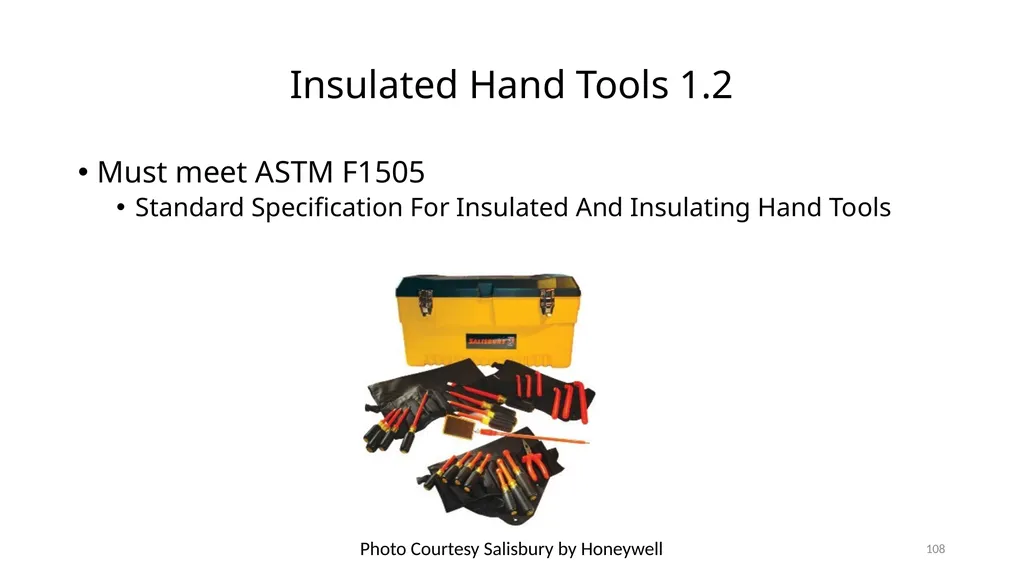
Insulated Hand Tools 1.2 Must meet ASTM F1505
Standard Specification For Insulated And Insulating Hand Tools 108 Photo Courtesy Salisbury by Honeywell<br>
Standard Specification For Insulated And Insulating Hand Tools 108 Photo Courtesy Salisbury by Honeywell<br>
109
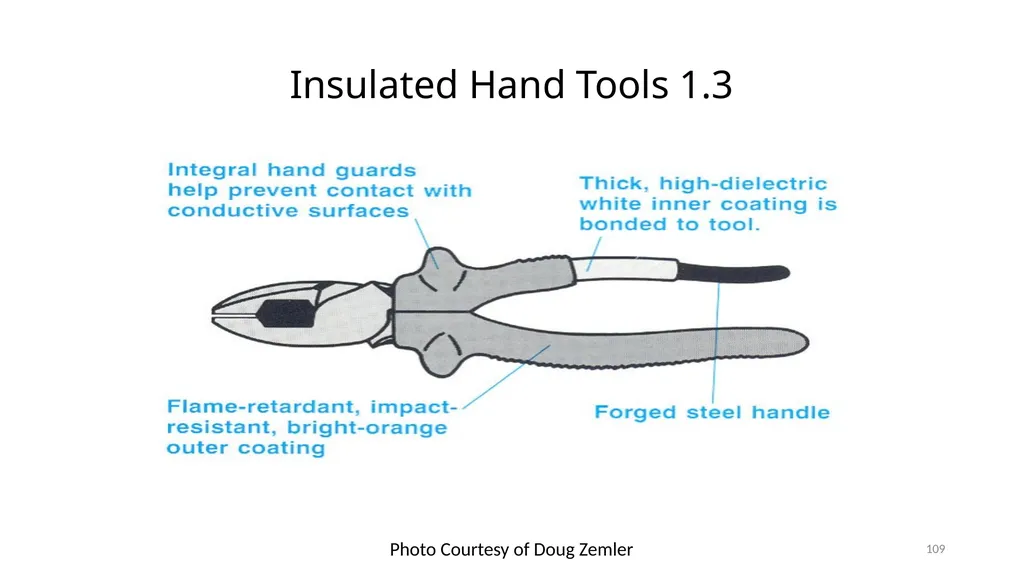
Insulated Hand Tools 1.3 109 Photo Courtesy of Doug Zemler<br>
110
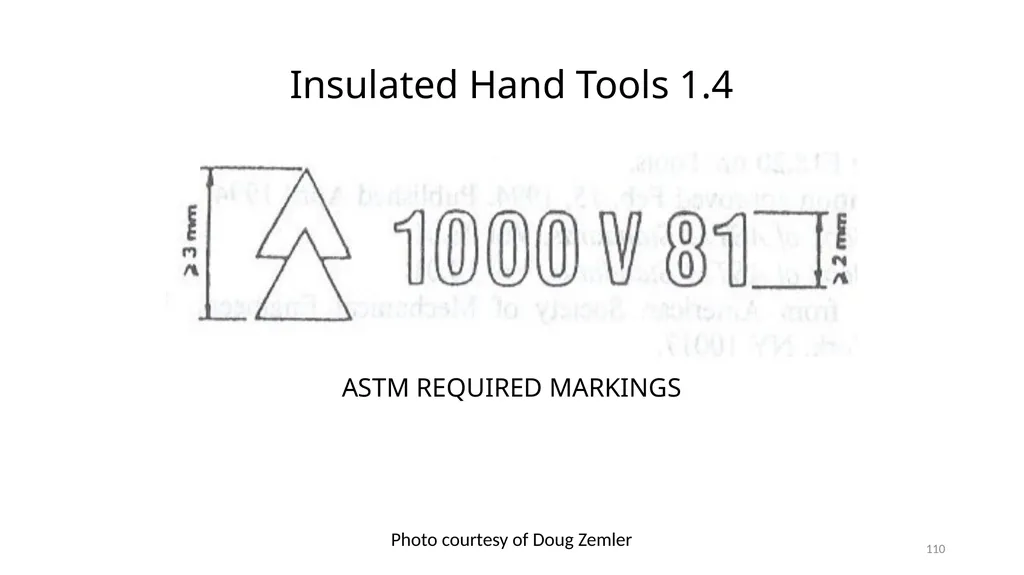
Insulated Hand Tools 1.4 ASTM REQUIRED MARKINGS Photo courtesy of Doug Zemler 110<br>
111
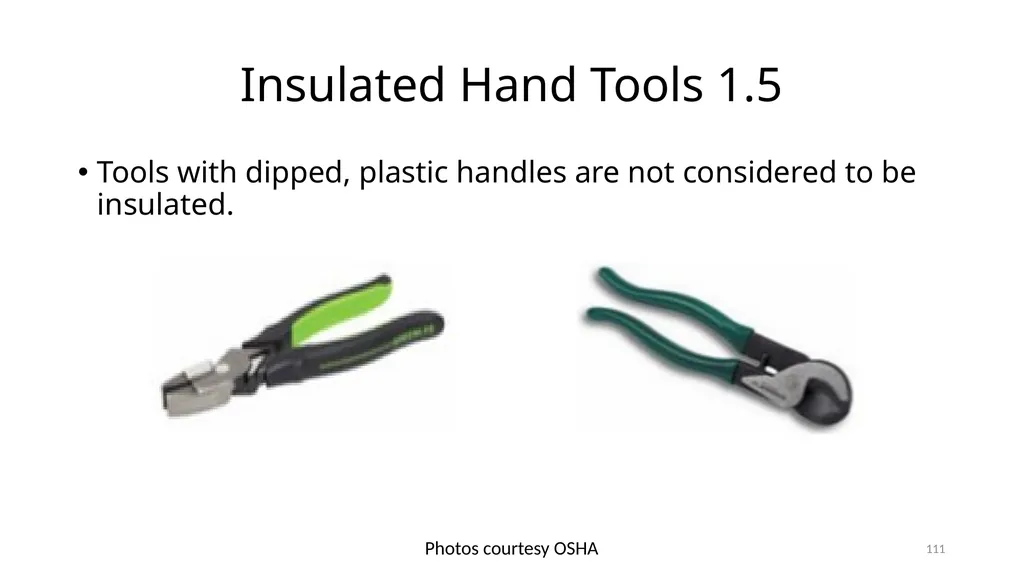
Insulated Hand Tools 1.5 Tools with dipped, plastic handles are not considered to be insulated. 111 Photos courtesy OSHA<br>
112
1910.335(b)
Alerting techniques 1910.335 Safeguards for Personnel Protection
Signs are placed to warn employees about electric
hazards
• Barricades shall be used in conjunction with safety signs to limit employee
access. Conductive barricades may not be used where they might cause an electrical contact hazard.
•If signs and barricades cannot provide a level
of safety sufficient to protect employees, an
attendant shall be placed 112<br>
Signs are placed to warn employees about electric
hazards
• Barricades shall be used in conjunction with safety signs to limit employee
access. Conductive barricades may not be used where they might cause an electrical contact hazard.
•If signs and barricades cannot provide a level
of safety sufficient to protect employees, an
attendant shall be placed 112<br>
113
NFPA 70E®
Standard for Electrical Safety in the Workplace® 1.19 Article 130- Work Involving Electrical Hazards
General
Incident Energy Analysis
Tables 113 Copyright 2018 NFPA 70E All Rights Reserved<br>
General
Incident Energy Analysis
Tables 113 Copyright 2018 NFPA 70E All Rights Reserved<br>
114
NFPA 70E®
Standard for Electrical Safety in the Workplace® 1.20 Article 130- Work Involving Electrical Hazards
(A) Energized Work
(B) Energized Work Permit
When Required
Elements of Work Permit
Exemptions 114 Copyright 2018 NFPA 70E All Rights Reserved<br>
(A) Energized Work
(B) Energized Work Permit
When Required
Elements of Work Permit
Exemptions 114 Copyright 2018 NFPA 70E All Rights Reserved<br>
115
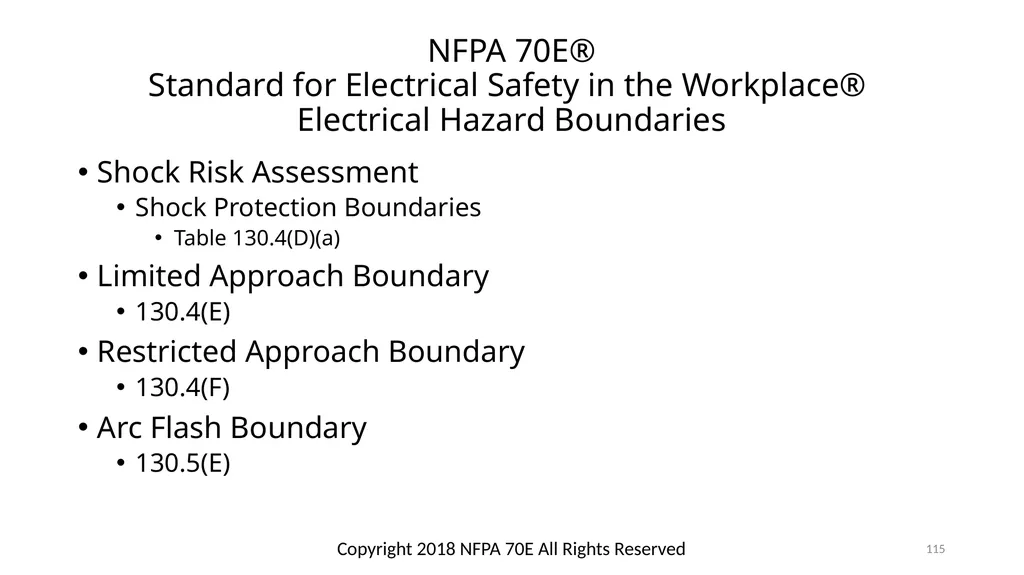
NFPA 70E®
Standard for Electrical Safety in the Workplace®
Electrical Hazard Boundaries Shock Risk Assessment
Shock Protection Boundaries
Table 130.4(D)(a)
Limited Approach Boundary
130.4(E)
Restricted Approach Boundary
130.4(F)
Arc Flash Boundary
130.5(E) 115 Copyright 2018 NFPA 70E All Rights Reserved<br>
Shock Protection Boundaries
Table 130.4(D)(a)
Limited Approach Boundary
130.4(E)
Restricted Approach Boundary
130.4(F)
Arc Flash Boundary
130.5(E) 115 Copyright 2018 NFPA 70E All Rights Reserved<br>
116
NFPA 70E®
Standard for Electrical Safety in the Workplace® 1.21 Article 130- Work Involving Electrical Hazards
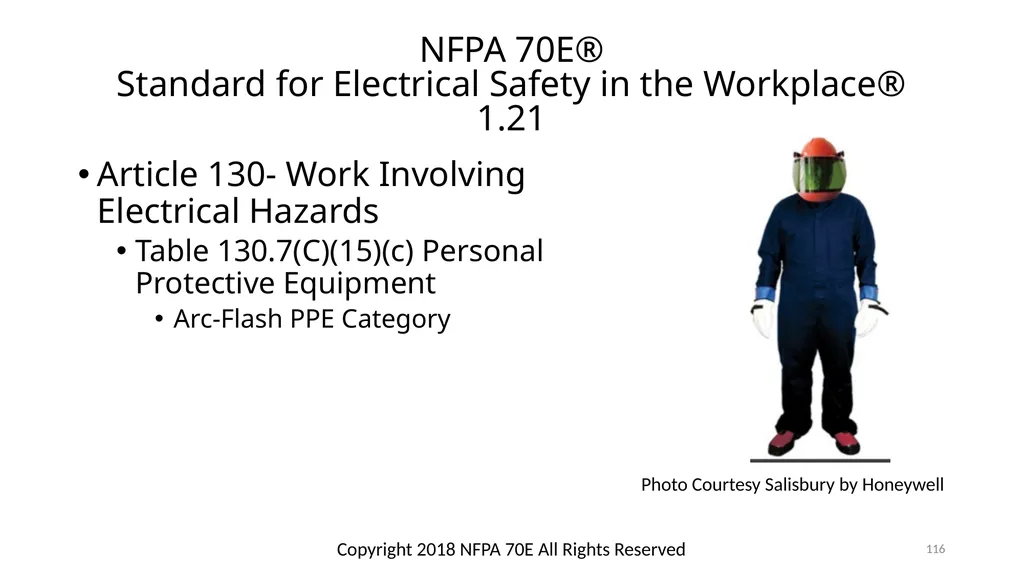
Table 130.7(C)(15)(c) Personal Protective Equipment
Arc-Flash PPE Category 116 Copyright 2018 NFPA 70E All Rights Reserved Photo Courtesy Salisbury by Honeywell<br>
Table 130.7(C)(15)(c) Personal Protective Equipment
Arc-Flash PPE Category 116 Copyright 2018 NFPA 70E All Rights Reserved Photo Courtesy Salisbury by Honeywell<br>
117
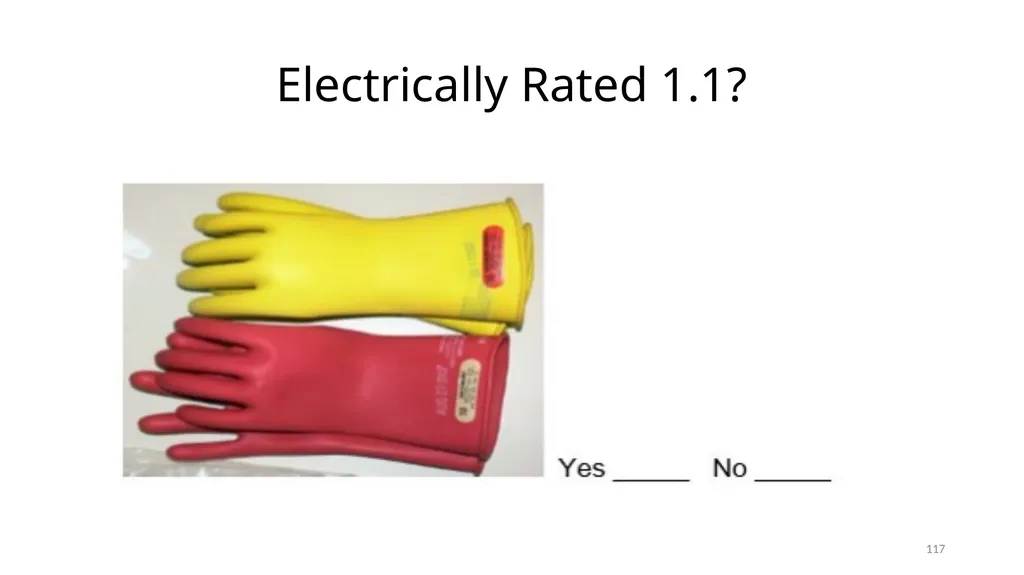
Electrically Rated 1.1? 117 Photo Courtesy of OSHA<br>
118
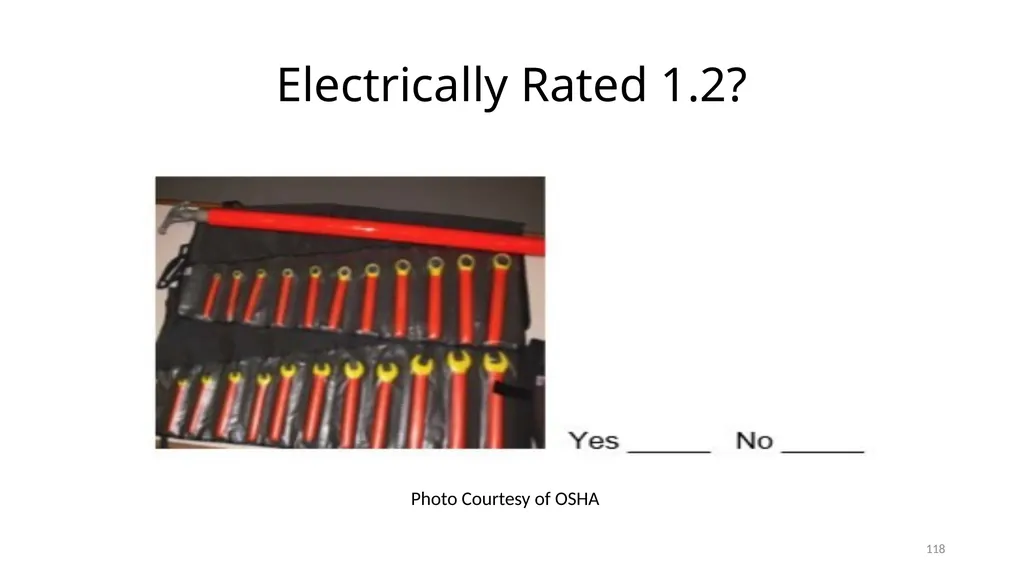
Electrically Rated 1.2? 118 Photo Courtesy of OSHA<br>
119
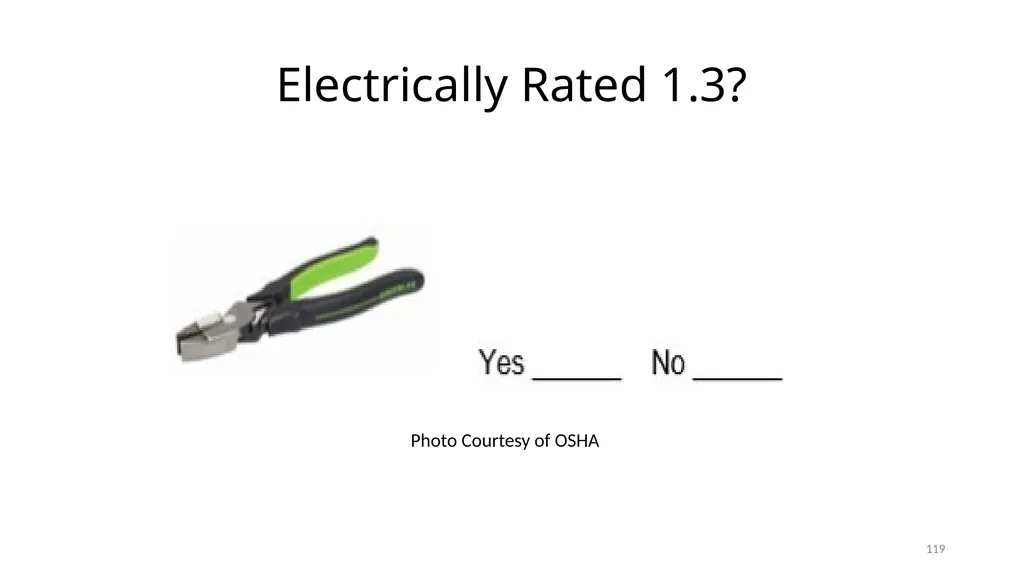
Electrically Rated 1.3? 119 Photo Courtesy of OSHA<br>
120
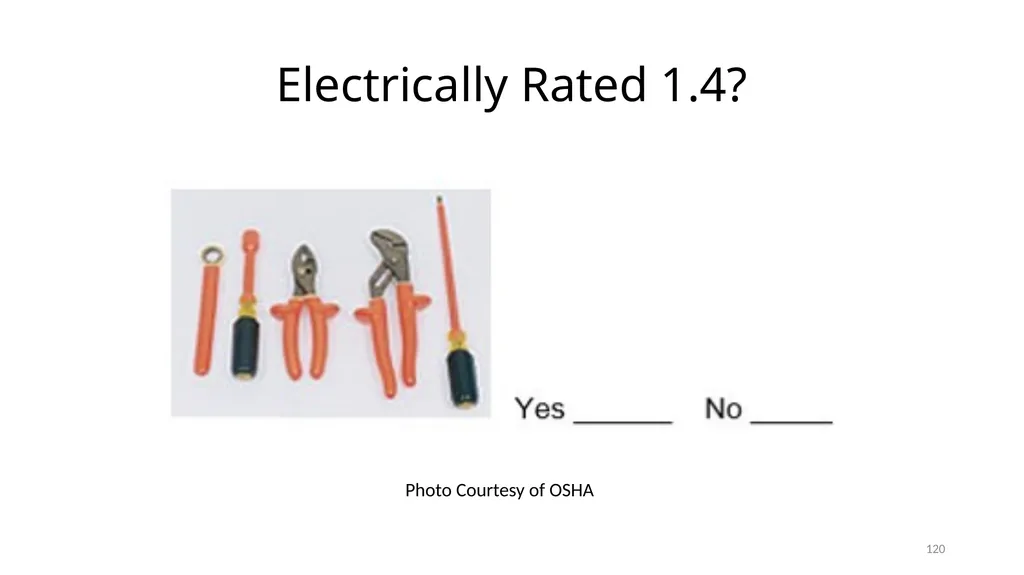
Electrically Rated 1.4? 120 Photo Courtesy of OSHA<br>
121
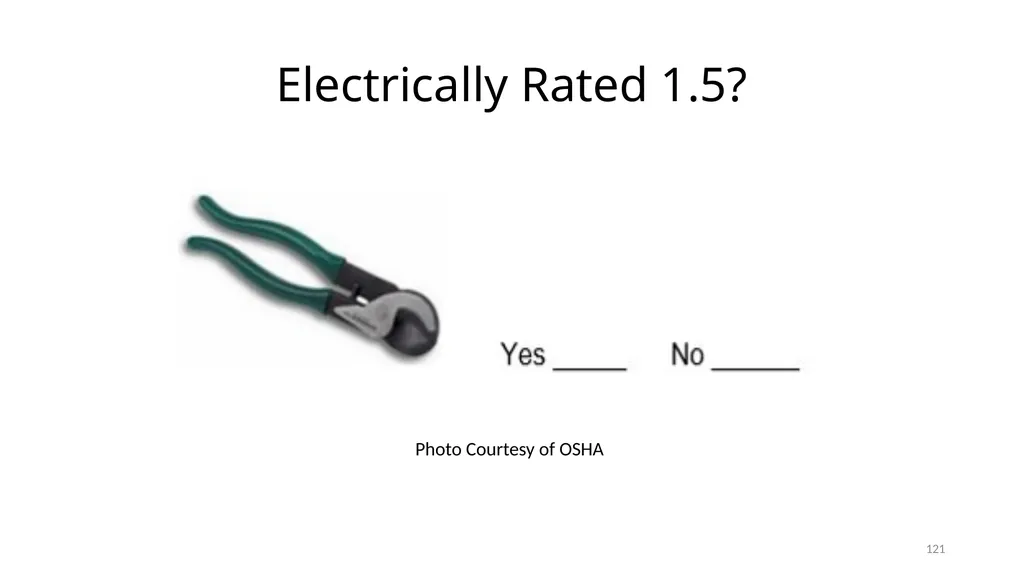
Electrically Rated 1.5? 121 Photo Courtesy of OSHA<br>
122
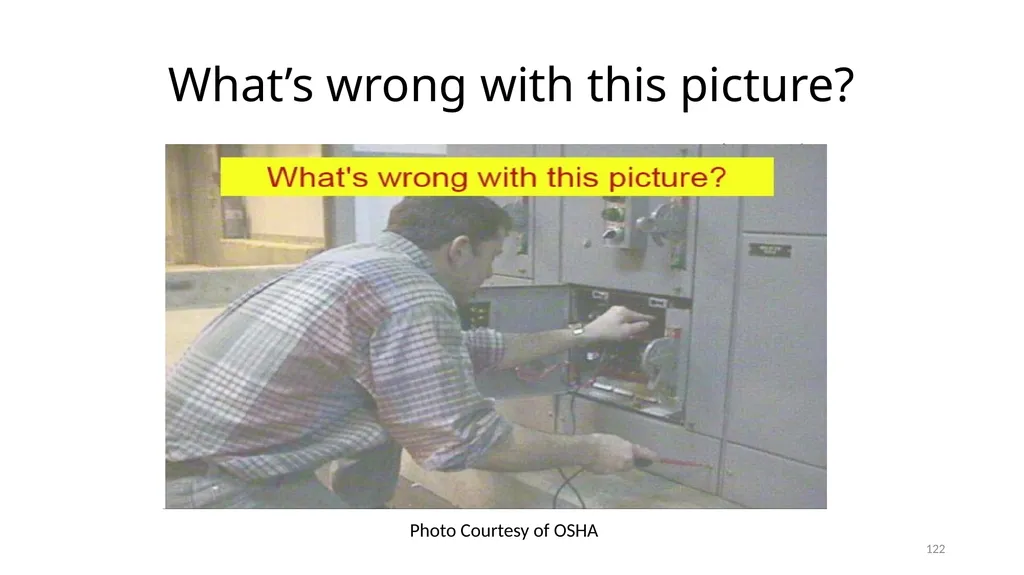
What’s wrong with this picture? 122 Photo Courtesy of OSHA<br>
123
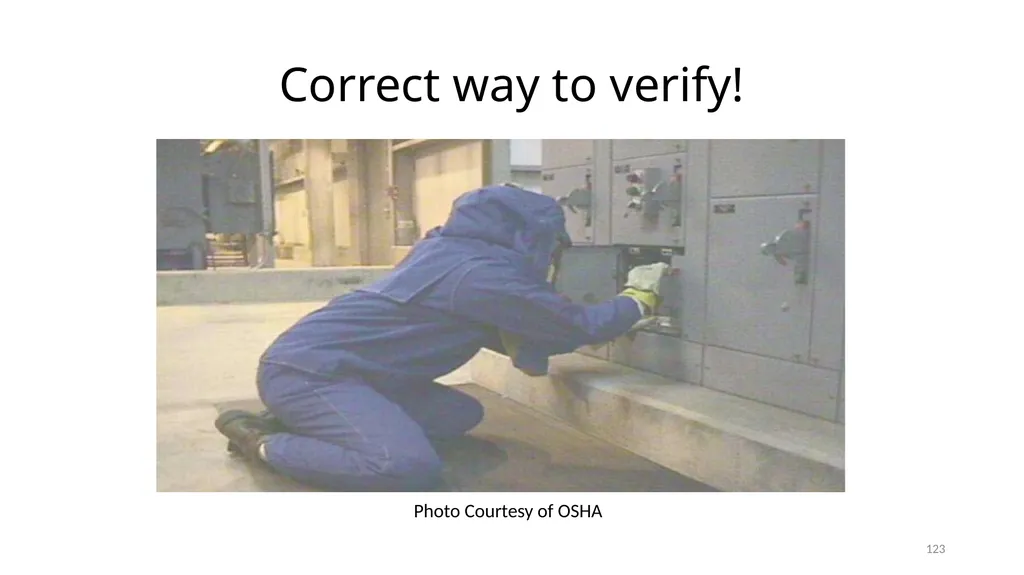
Correct way to verify! 123 Photo Courtesy of OSHA<br>
124
Summarize OSHA is the “shall”
NFPA 70E® is the “how”
Electrical safety is no joke!
Use these documents in your electrical safety program. 124<br>
NFPA 70E® is the “how”
Electrical safety is no joke!
Use these documents in your electrical safety program. 124<br>
125
Conclusion Lesson objectives:
Understand the regulations contained in OSHA 1910.331-.335, Electrical Safety Related Work Practices.
Understand and how to use the NFPA 70E®.
Understand how to choose proper equipment when working with energized circuits.
Understand how to use PPE. 125<br>
Understand the regulations contained in OSHA 1910.331-.335, Electrical Safety Related Work Practices.
Understand and how to use the NFPA 70E®.
Understand how to choose proper equipment when working with energized circuits.
Understand how to use PPE. 125<br>