Architectural Innovation: The Reconfiguration of Existing Product Technologies and the Failure of Established Firms Rebecca M. Henderson and Kim B. Clark, 1990. Administrative Science Quarterly, 35(1) Special Issue: Technology,
"Architectural Innovation: The Reconfiguration of" is the property of its rightful owner. Permission is granted to
download and print the materials on this website for personal, non-commercial use only, and to display it
on your personal computer provided you do not modify the materials and that you retain all copyright
notices contained in the materials. By downloading content from our website, you accept the terms of this
agreement.
Presentation Transcript
01
Architectural Innovation: The Reconfiguration of Existing Product Technologies and the Failure of Established Firms Rebecca M. Henderson and Kim B. Clark, 1990.
Administrative Science Quarterly, 35(1)
Special Issue: Technology, Organizations, and Innovation
Presented by Wenting (Christy) ZHU<br>
02
Research Question Incremental innovation
introduces relatively minor changes to the existing product
exploits the potential of established design
reinforces the dominance of established firms
Radical innovation
based on different set of engineering and scientific principles
opens up whole new markets and potential applications
creates great difficulties for established firms
leads to Successful entry of new firms or redefinition of an industry
However, numerous technical innovations involve apparently modest changes to the existing technology but have quite dramatic competitive consequences, e.g. the case of Xerox and small copiers and the case of RCA and the American radio receiver market.
Why can minor innovations in technological products have disastrous effects on industry incumbents?<br>
03
Conceptual Framework Component and Architectural Knowledge
unit of analysis: a manufactured product sold to an end user and designed, engineered, and manufactured by a single product-development organization
Successful product development requires component knowledge and architectural knowledge
“architectural innovation” refers to innovation that change the way in which the components of a product are linked together, while leaving the core design concepts untouched.
An electric motor is a design concept one could use to deliver power
A component refers to a physically distinct portion of the product that embodies a core design concept, e.g. a particular motor in the fan
Architectural innovation destroys the usefulness of architectural knowledge but preserves the usefulness of its component knowledge.
The firm’s existing architectural knowledge may actually handicap the firm.<br>
04
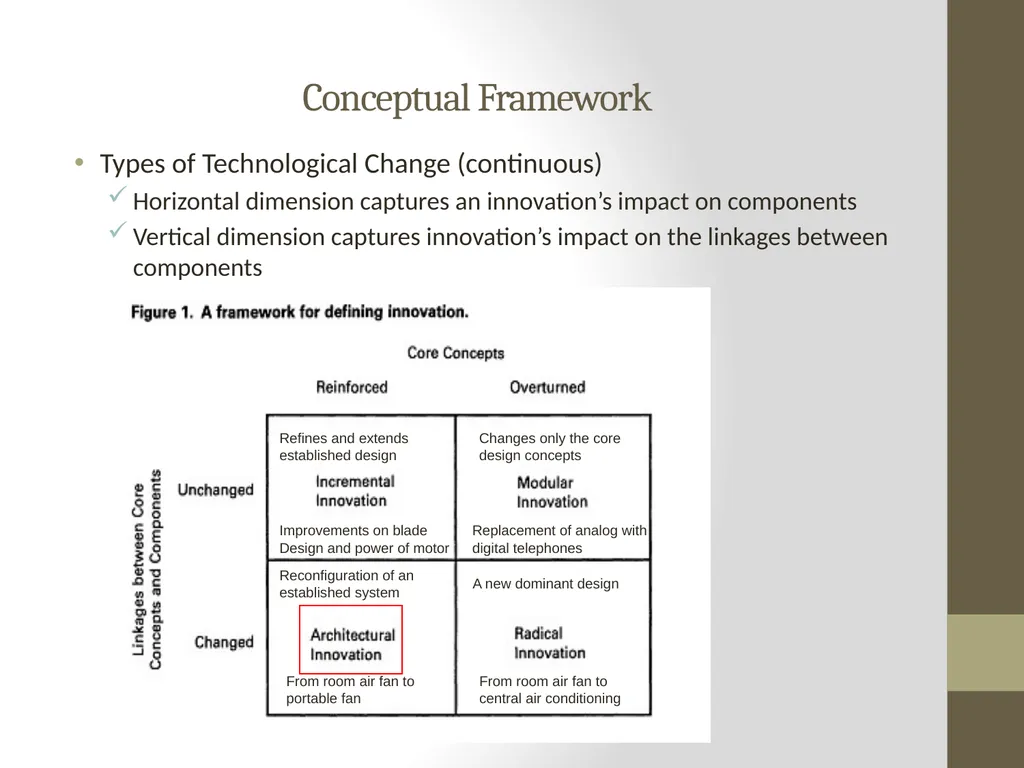
Conceptual Framework Types of Technological Change (continuous)
Horizontal dimension captures an innovation’s impact on components
Vertical dimension captures innovation’s impact on the linkages between components Improvements on blade
Design and power of motor From room air fan to
central air conditioning Reconfiguration of an
established system Refines and extends
established design From room air fan to portable fan A new dominant design Replacement of analog with
digital telephones Changes only the core
design concepts<br>
05
Conceptual Framework The Evolution of Component and Architectural Knowledge
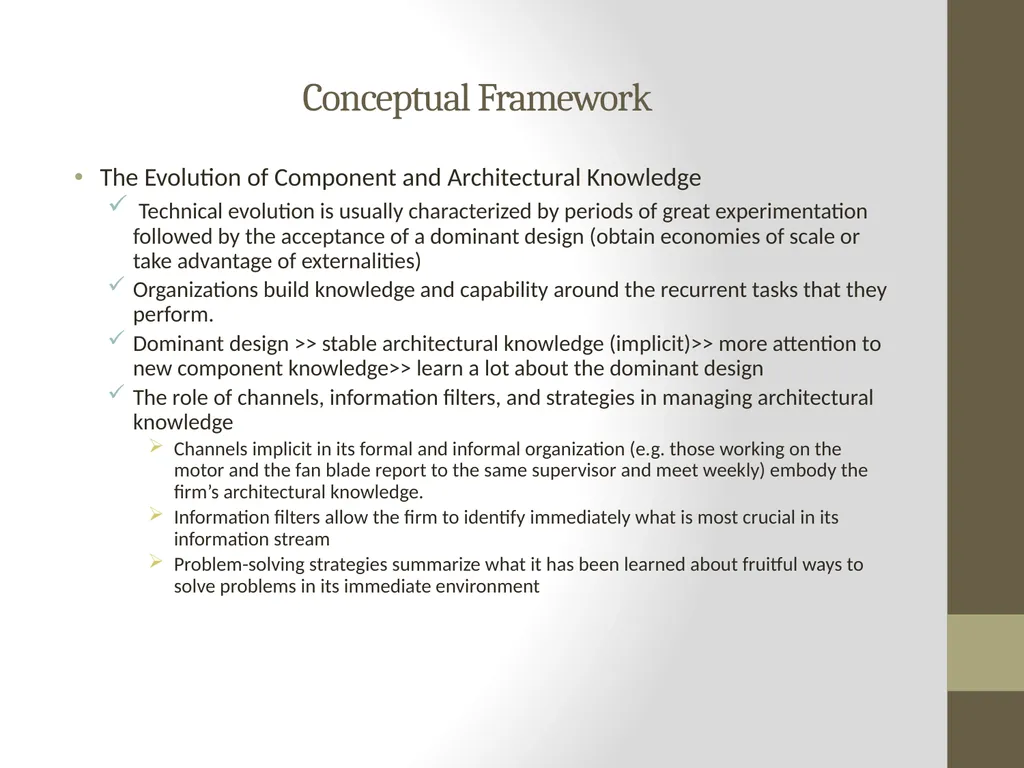
Technical evolution is usually characterized by periods of great experimentation followed by the acceptance of a dominant design (obtain economies of scale or take advantage of externalities)
Organizations build knowledge and capability around the recurrent tasks that they perform.
Dominant design >> stable architectural knowledge (implicit)>> more attention to new component knowledge>> learn a lot about the dominant design
The role of channels, information filters, and strategies in managing architectural knowledge
Channels implicit in its formal and informal organization (e.g. those working on the motor and the fan blade report to the same supervisor and meet weekly) embody the firm’s architectural knowledge.
Information filters allow the firm to identify immediately what is most crucial in its information stream
Problem-solving strategies summarize what it has been learned about fruitful ways to solve problems in its immediate environment<br>
06
Conceptual Framework Problems created by architectural innovation
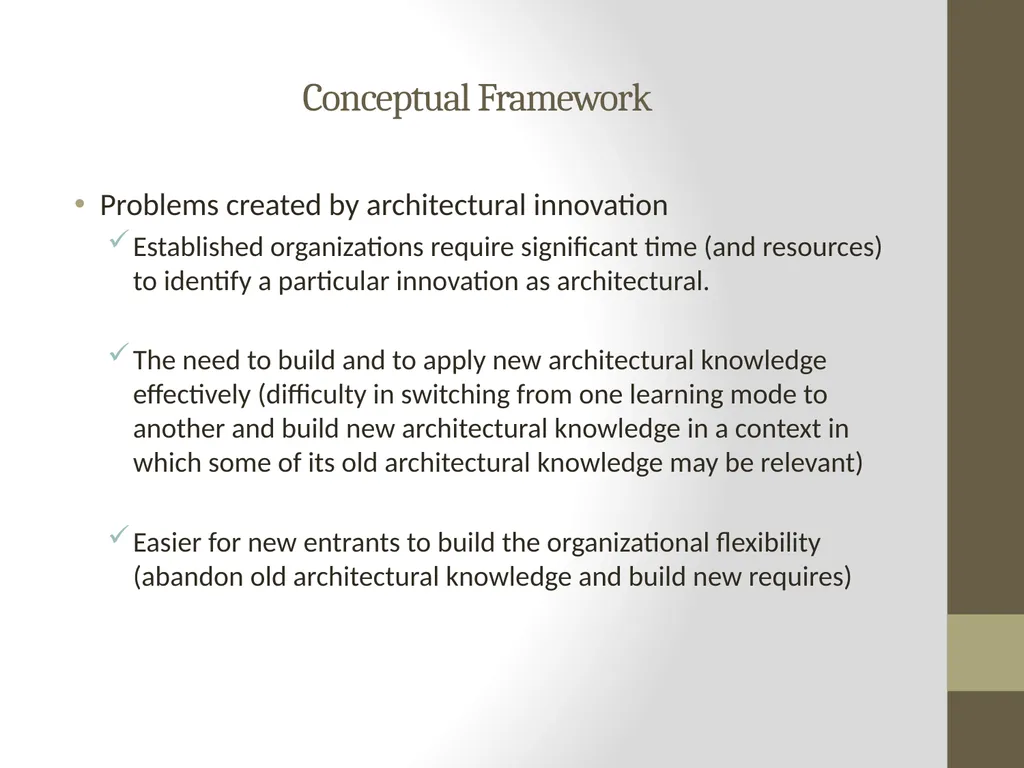
Established organizations require significant time (and resources) to identify a particular innovation as architectural.
The need to build and to apply new architectural knowledge effectively (difficulty in switching from one learning mode to another and build new architectural knowledge in a context in which some of its old architectural knowledge may be relevant)
Easier for new entrants to build the organizational flexibility (abandon old architectural knowledge and build new requires)<br>
07
Innovation in photolithographic alignment equipment Data
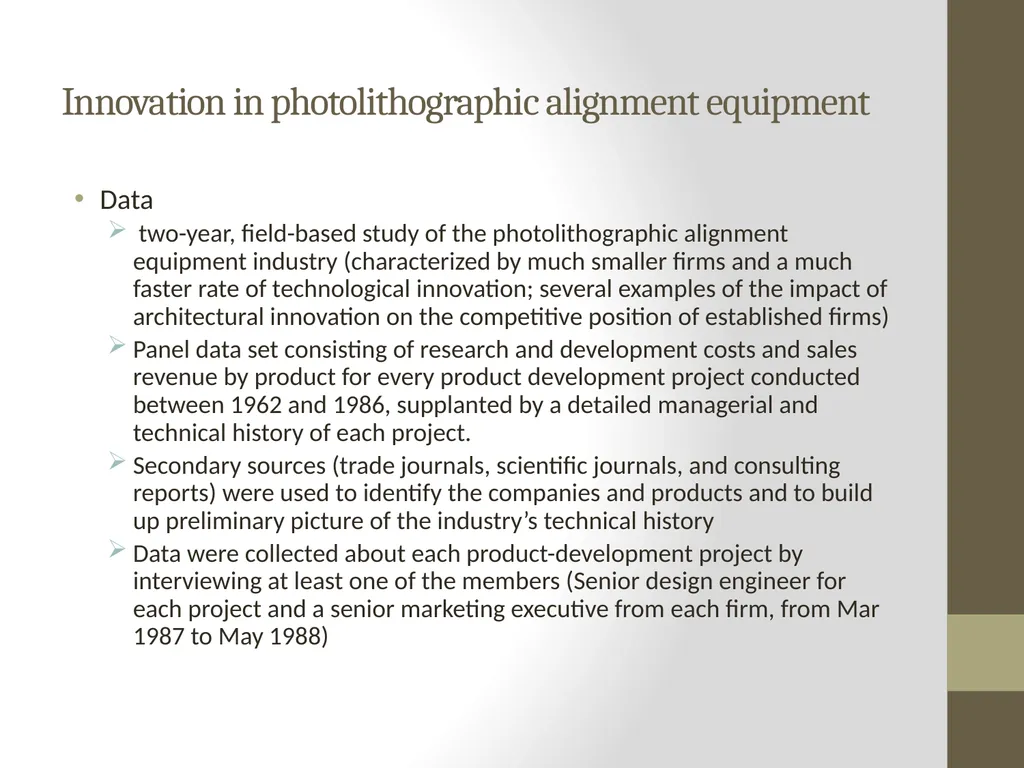
two-year, field-based study of the photolithographic alignment equipment industry (characterized by much smaller firms and a much faster rate of technological innovation; several examples of the impact of architectural innovation on the competitive position of established firms)
Panel data set consisting of research and development costs and sales revenue by product for every product development project conducted between 1962 and 1986, supplanted by a detailed managerial and technical history of each project.
Secondary sources (trade journals, scientific journals, and consulting reports) were used to identify the companies and products and to build up preliminary picture of the industry’s technical history
Data were collected about each product-development project by interviewing at least one of the members (Senior design engineer for each project and a senior marketing executive from each firm, from Mar 1987 to May 1988)<br>
08
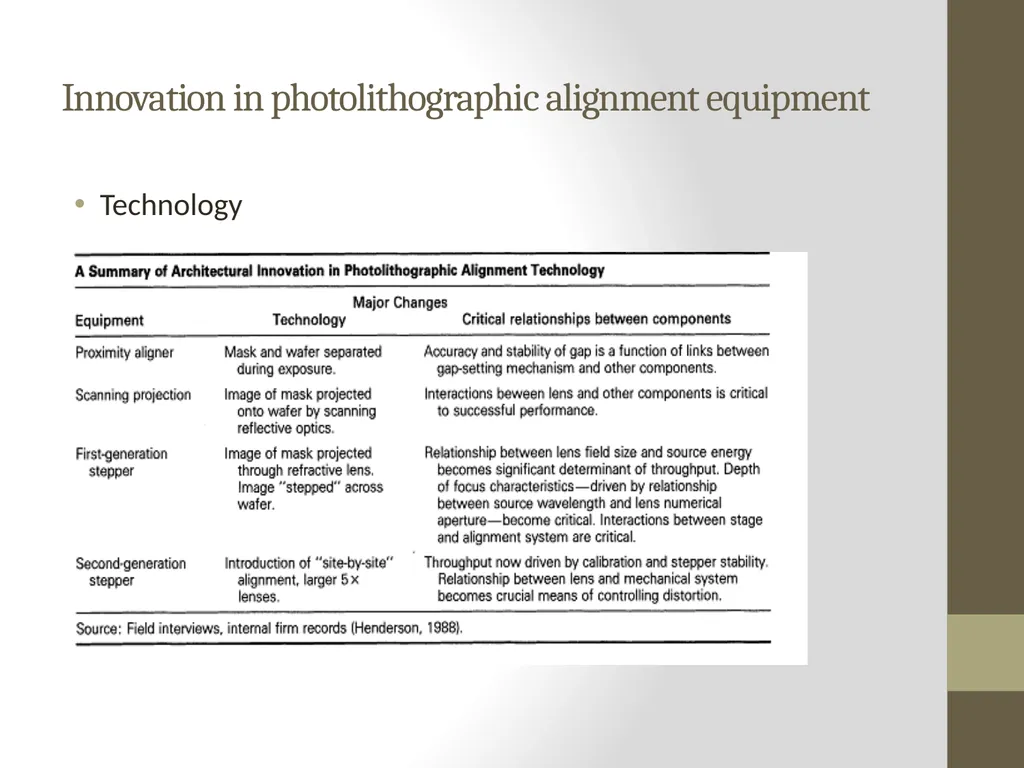
Innovation in photolithographic alignment equipment Technology<br>
09
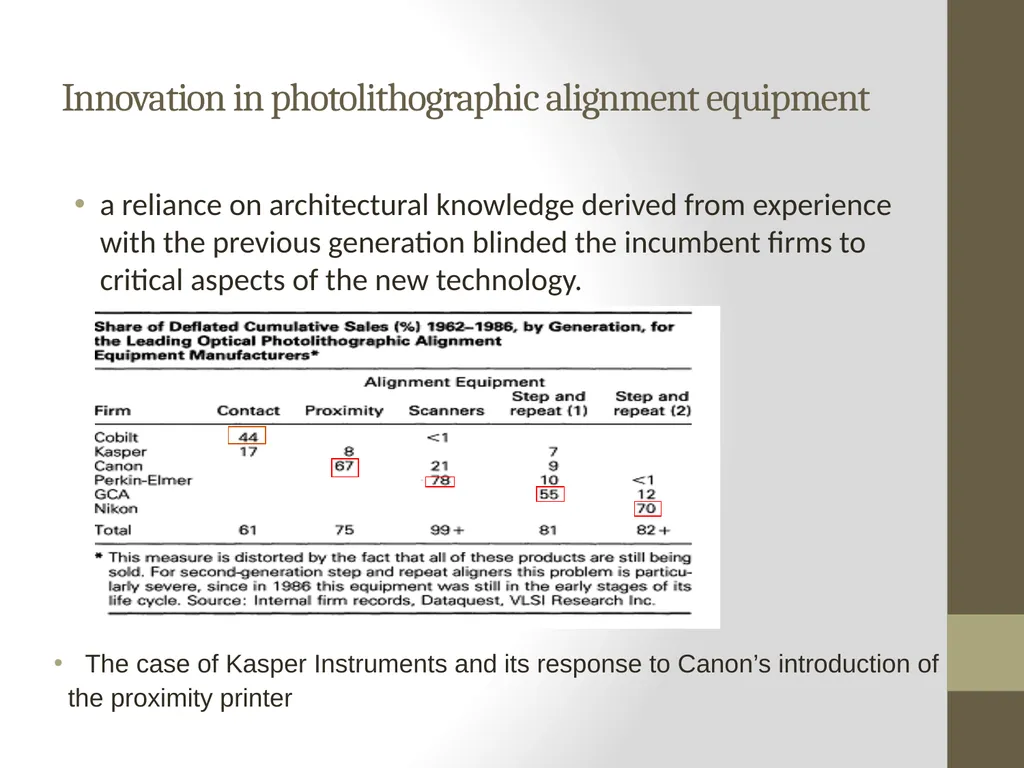
Innovation in photolithographic alignment equipment a reliance on architectural knowledge derived from experience with the previous generation blinded the incumbent firms to critical aspects of the new technology. The case of Kasper Instruments and its response to Canon’s introduction of
the proximity printer<br>
10
Discussion and Conclusions assume that organizations are boundedly rational >> explore the ways in which the formulation of architectural and component knowledge are affected by factors such as firm’s history and culture
Assume that architectural knowledge embedded in routines and channels becomes inert and hard to change. >> explore the extent to which this can be avoided
An architectural innovation’s effect depends in a direct way on the nature of organizational learning. >> what drives effective learning about new architectures and how learning about components may be related to it?
Architectural innovation at the firm level
The effect of technology on competitive strategy<br>